1839 Petitions against Payments at La Pointe
October 10, 2025
Collected & edited by Amorin Mello
Previously we featured 1837 Petitions from La Pointe to the President about $100,000 Payments to Chippewa Mixed-Bloods from the 1837 Treaty of Saint Peters, and 1838 more Petitions from La Pointe to the President about relocating the Payments from St. Croix River to Lake Superior. Those earlier Petitions were from Chief Buffalo and dozens of Mixed-Bloods from the Lake Superior Chippewa Bands, setting precedence for La Pointe to host the 1842 Treaty and 1854 Treaty in later decades.
Today’s post features 1839 Petitions against Payments at La Pointe. These petitioners appear to be looking to get a competitive edge against the American Fur Company monopoly at La Pointe, by moving the payments south across the Great Divide into the Mississippi River Basin.
For more information about the $100,000 Payments at La Pointe in 1839, we strongly recommend Theresa M. Schenck’s excellent book All Our Relations: Chippewa Mixed-Bloods and the Treaty of 1837.
Letters Received by the Office of Indian Affairs:
La Pointe Agency 1831-1839
National Archives Identifier: 164009310

April 9, 1839
from Joseph Rolette at Prairie du Chien
to the Superintendent of Indian Affairs
Received April 27, 1839
Prairie du Chiene 9th April 1839
T.H. Crawford Esq’r
Commissioner of Ind’n affairs
Washington
You must excuse the liberty I take in addressing you once more – presuming you are not well acquainted yet with this Country, I am requested by the Chippewaw half Breeds that remain in this Country, that it is with regret they have heard that the payment allowed to them in the treaty of the 29th July 1837 is to be made on Lake Superior. They have to State, that it will be impossible for them to reach that place as the American Fur Co. are the only Co. who have vessels on Lake Superior & Notwithstanding they could procure on Passage Gratis on the Lake.
This distance between Sault Ste Mary, and the Mississippi is great and expensive. They also represent that the half Breeds born on Lake Superior are not entitled to any Share of the money allowed.
Whereas if the Payment was made at the Falls of St. Croix, there would be Competition amongst traders, whereas in Lake Superior they can be done none. They humbly beseech that you will have Mercy on them and not allow them to be deprived by intrigue of the Sum due them. So Justly to go in other hands but the real owners.
Respectfully
your most obd’t Serv’t
Joseph Rolette
on behalf of the Chippewaw
Half Breeds of
Prairie du Chiens

June 21, 1839
from the Indian Agent at Saint Peters
via the Governor of Wisconsin Territory
to the Superintendent of Indian Affairs
Received July 16, 1839
Answered July 24, 1839
Superintendency of Indn Affairs
for the Territory of Wisconsin
Mineral Point June 20, 1839
Sir,

Henry Dodge
Governor of Wisconsin Territory
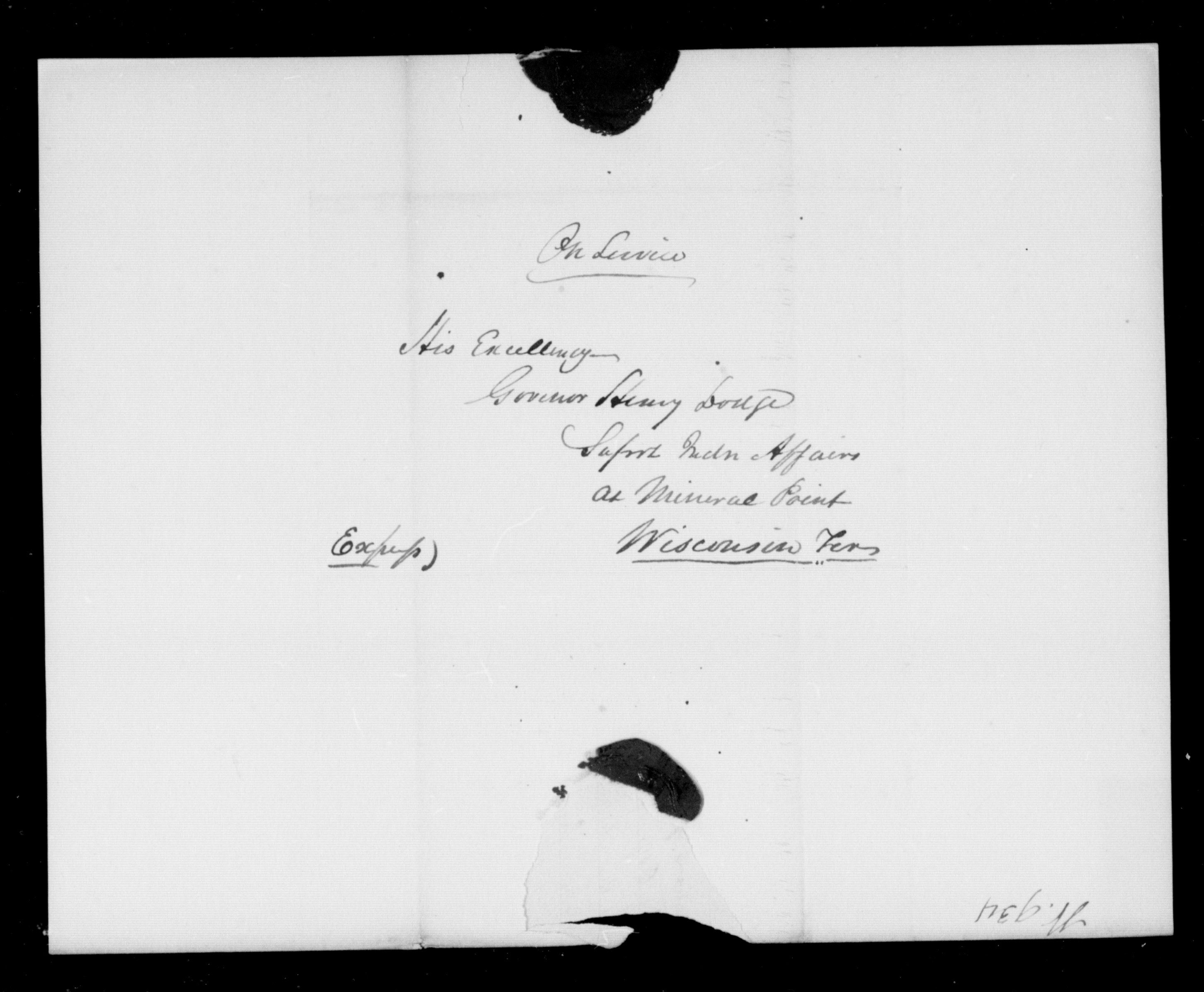
I have the honor to transmit, enclosed herewith, three letters from Major Taliaferro, Indian Agent at St Peters, dated 10th, 16th, & 17th inst, with two Indian talks of 3rd & 14th, for the information of the Department.
Very respectfully
Yours obedt sevt
Henry Dodge
Supt Ind Agy
T Hartley Crawford Esq
Com. of Indian Affairs
North Western Agency St Peters
Upper Mississippi June 10th 1839
Governor,
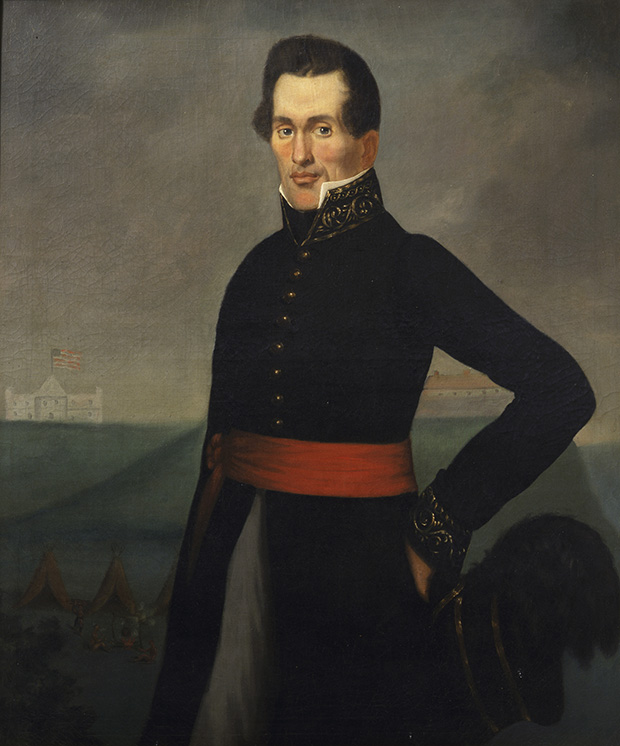
Lawrence Taliaferro
Indian Agent at Fort Snelling
I deem it to be most adviseable that the enclosed paper, addressed to the Agent, and Commanding Officer on this Station from the Chippewa Chief “Hole in the Day” should be forwarded to you, the Indians addressing us being within your Excellency’s Superintendency. It may be well to add that a similar document proceeding from the Chippewa Chiefs of St Croix was on the 4th inst forwarded for the information of the Office of Indian Affairs at Washington.
The consolidation of the two Chippewa Sub Agencies and located at Lapointe, it is feared may lead to rather unpleasant results. I know the Chippewas well, and may have as much influence with those of the Mississippi particularly as most men, yet were I to say “you are not to have an agent in your Country, and you must go to Lapointe in all time to come for your Annuity, and treaty Stipulations.” I should not expect to hold their confidence for one day.
With high respect Sir
Your mo obt Serv
Law Taliaferro
Indian Agent
at S. Peters
His Excellency
Governor Henry Dodge
Suprt of Indi Affairs
at Mineral Point
For Wisconsin
North Western Agency S. Peters
Upper Mississippi June 16th, 1839
Governor
I have been earnestly selected by a number of the respectable half breed Chippewas resident, and others of the Mississippi, interested in the $100,000 set apart in the treaty of July 29, 1837 of S. Peters, to ask for such information as to their final disposal of this Sum, as may be in your possession.
The claimants referred to have learned through the medium of an unofficial letter from the Hon Lucius Lyon to H. H. Sibley Esqr. of this Post, that the funds in question as well as the Debts of the Chippewas to the traders was to be distributed by him as the Commissioner of the United States at Lapointe on Lake Superior, and for this purpose should reach that place on or about the 10th of July. The individuals Seeking this information are those who were were so greatly instrumental in bungling your labours at the treaty aforesaid to a successful issue in opposition to the combinations formed to defeat the objects of the government.
There remains 56,000$ in specie at this post being the one half of the sum appropriated or applicable to the objects in contemplation, and upon which the authorities here have had as yet no official instructions to transfer some special information would relieve the minds of a miserably poor class of people and who fear the entire loss of their just claims.
With high respect, Sir
your mo obt Sevt
Law Taliaferro
Indn Agent
at S. Peters
His Excellency
Gov Henry Dodge
Suprt of Ind. Affairs
for Wisconsin
North Western Agency S. Peters
Upper Mississippi June 17th 1839
Governor
On the 20th of May past I dispatched Peter Quin Express to the Chippewas of the Upper Mississippi with a letter from Maj D. P. Bushnell agent for this tribe at Lapointe notifying the Indians, and half breeds that they would be paid at Lapointe hereafter, and at an earlier period than the last year. I informed you of the result of his mission on the 10th inst. enclosing at the same time the written sentiments of the principle Chief for his people. I now forward by Express a second communication from the Same Source received late last night. I would make a plain copy, but have not time. So the original is Sent.
In four days there will be a large body of Chippwas here, and they cannot be Stopped. There are now also 880 Sioux from remote Sections of the Country at this Post and of course we may calculate on some difficulty between these old enemies. Your presence is deemed essential, or such instructions as may soothe the Angry feelings of the Chippewas, on account of the direction given to their annuity, & treaty Stipulations.
With high respect Sir
Your mo ob Sevt
Law Taliaferro
Indn Agent
at S Peters
His Excellency
Governor Henry Dodge
Suprt of Indi Affairs
Mineral Point
(NB) The Chippewas are to be understood as to the point of payment indicated to be the St.Croix, and not the S.Peters, as deemed by the written Talks. It never could be admited in the present state of the Tribes to pay the Chippewas at this Post, but they might with safety to all parties be paid at or above the Falls of S.Croix, by an agent who they ought to have or some special person assigned to this duty.
Elk River, June 3rd 1839
Maj Toliver. Maj Plimpton.
My respects to you both, and my hand: I am to let you know that I intend to pay you a visit, with my chiefs as braves, the principle of my warriors are verry anxious to pay you a visit.
The above mentioned men are verry anxious to see Gov. Dodge with whom we made the treaty, that we may have a talk with him. It was with him commissioner of the United-States we made the treaty, and we are verry much disappointed to hear the newes, we hear this day (IE that we must go to Lake Sup. for our pay) which we have this day decided we will not do; that we had rather die first: it is on this account we wish to pay you a visit, and have a talk with Gov. Dodge. You sir, Maj Toliver know verry well our situation, and that the distance is so great for us to go to Lake Sup. for to get our pay &c. or even a gun repaired; that it is inconsistent for such a thing to be required of us; even if we did literally place the matter in the hands of Government. We are all living yet that was present at the treaty when we ceded the land to the Unitedstates, and remember well what was our understanding in the agreement.
We now wish Maj Toliver; to mention to your children that it is a fals report that we had any intention to have more difficulty with the Sioux, as our Missionaries can attest as far as they understand us. We will be at the Fort in seventeen days to pay you a friendly visit as soon as we received the news; we sent expressed to our brethren to meet us at the mouth of Rum Riv. and accompany us to the Fort.
It is my desire that Maj Plimpton would keep fast hold of the money appropriated for my children the half breeds, in this section, and not let it go to Lake Sup. as they are like ourselves and it would cost them a great deal to go there for it.
Pah-ko-ne-ge-zeck or Hole in the Day
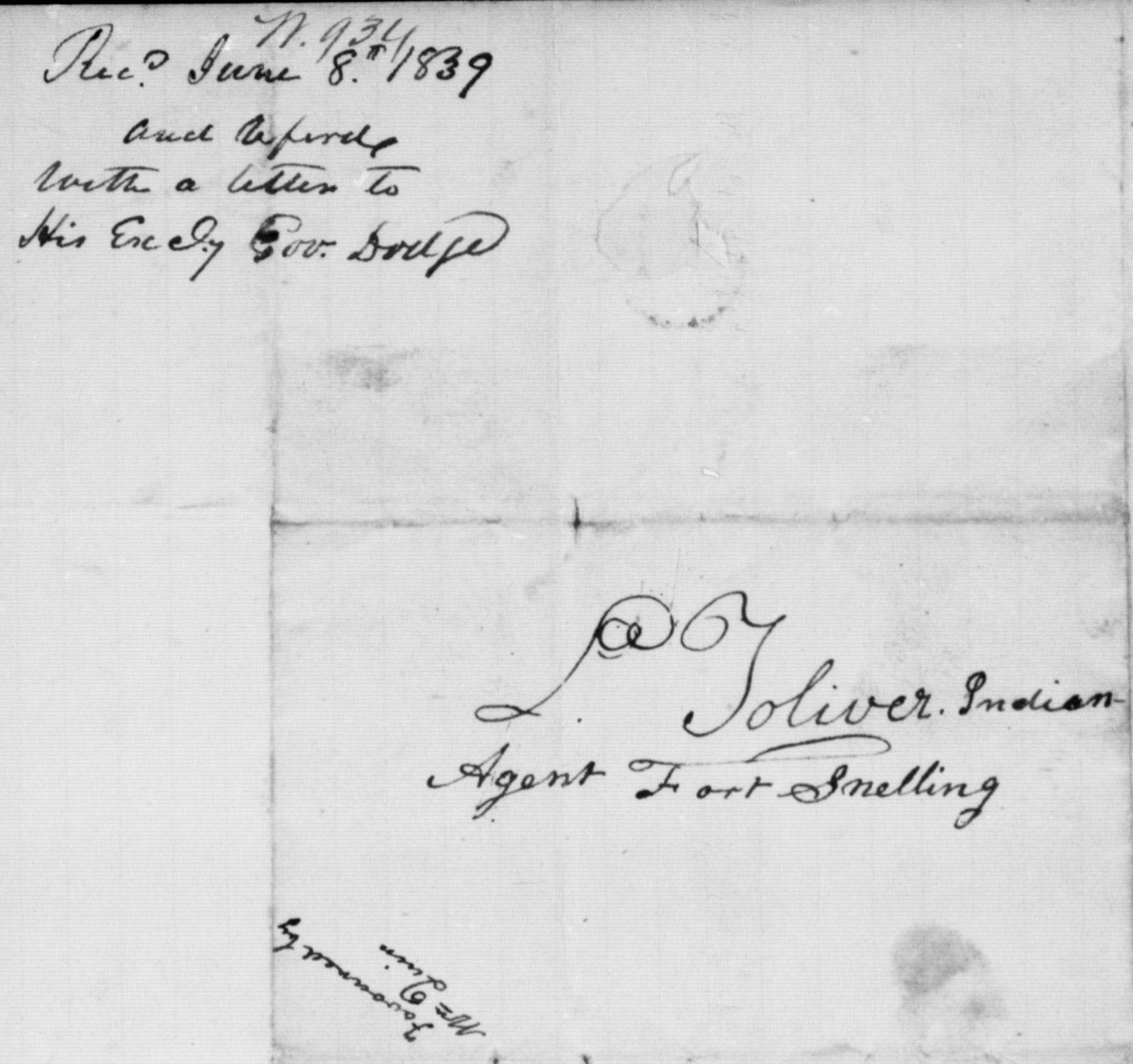
Maj Toliver
Maj Plimpton

Elk River June 14 1839
Maj L. Toliphero,
My hand, It is twelve dayes since we have the newes and are all qouiet yet. My father I shall not forget what was promiced us below, I think of what you promiced us when you were buing our lands.
My father this is the thing that you & we me to take care of when you bougt our lands & I remember all that you said to me. My father I am the cheif of all the Indians that sold there land and this is the time when all of your children are coming down to receive their payment where you promiced to pay us.
My father I am the cheif and hold the paper containing the promices that you made us. The Gov. D. promised us that in one year from the date of the treaty that we should receive our first payment and so continue anually.
My father; I have done for manny years what the white men have told me and have done well, and now I must look before we are to know what I have to do.
When I buy anything I pay immediately the Great Spirit knows this Now when we get below we are expecting all that you promiced us Ministers and Black Smiths and cattle.
I say my father that we want our payment at St Peters where you promiced us. I said that I wanted the half breeds to be payed there with us. I told you that when the half breeds were payed that there was some French that should have something ((ie) of the half breed money) because they had lived with us for many years and allways gave us some thing to eat when we went to their houses.
My father all of your children are displeased because you are to pay us in another place and not at St Peters it is to hard and far for us to be payed at Lapointe.
My father I did not know that the payment was to be made at Lapointe until we heard by Mr Quin.
My father it is so far to Lapointe that we should lose all of our children before we could get their and if we should brake our Gun we may throw it in the water for we cannot go there to get it mended, and if we have a [illegible] holding a coppy of the Treaty in his hand
Black Smith we want him here and not at Lapoint.
My father I want that you should tell me who it was told you that we all wanted our payment at Lapoint. All of the Cheifs are alive that hear what you said to us below. You Mr Toliphero hear me ask Gov Do’ for an Agen and to have him located here and he promiced that it should be so. I want that the Agent should be here because our enemies come here sometimes and if he was here perhaps they would not come. My father we are all of us very sorry that we did not ask you to come and be our Agent. I don’t know who made all of the nois about our being payed at Lapoint. I don’t look above where we should all starve for our payment but below where the Treaty was made.
My father give my compliments to all of the officers at the Fort.
Hole in The Day X
Maj L Toliphereo
This post is on of several that seeks to determine how many images exist of Great Buffalo, the famous La Pointe Ojibwe chief who died in 1855. To learn why this is necessary, read this post introducing the Great Chief Buffalo Picture Search.
Today’s post looks at two paintings from the 1820s of Ojibwe men named Bizhiki (Buffalo). The originals are lost forever, but the images still exist in the lithographs that follow.

Pee-che-kir: A Chippewa Chief Lithograph from McKenney and Hall’s History of the Indian Tribes of North America based on destroyed original by Charles Bird King; 1824. (Wikimedia Images)

Pe-shick-ee: A Celebrated Chippeway Chief from the Aboriginal Port-Folio by James Otto Lewis. The original painting was done by Lewis at Prairie du Chien or Fond du Lac of Lake Superior in 1825 or 1826 (Wisconsin Historical Society).
1824 Delegation to Washington
Chronologically, the first known image to show an Ojibwe chief named Buffalo appeared in the mid-1820s at time when the Ojibwe and the United States government were still getting to know each other. Prior to the 1820s, the Americans viewed the Ojibwe as a large and powerful nation. They had an uncomfortably close history with the British, who were till lurking over the border in Canada, but they otherwise inhabited a remote country unfit for white settlement. To the Ojibwe, the Americans were chimookomaan, “long knives,” in reference to the swords carried by the military officers who were the first Americans to come into their country. It was one of these long knives, Thomas McKenney, who set in motion the gathering of hundreds of paintings of Indians. Two of these showed men named Buffalo (Bizhiki).

Charles Bird King: Self portrait 1815 (Wikimedia Images)
McKenney was appointed the first Superintendent of Indian Affairs in 1824. Indian Affairs was under the Department of War at that time, and McKenneyʼs men in the West were mostly soldiers. He, like many in his day, believed that the Indian nations of North America were destined for extinction within a matter of decades. To preserve a record of these peoples, he commissioned over 100 portraits of various Indian delegates who came to Washington from all over the U.S. states and territories. Most of the painting work fell to Charles Bird King, a skilled Washington portrait artist. Beginning in 1822, King painted Indian portraits for two decades. He would paint famous men like Black Hawk, Red Jacket, Joseph Brandt, and Major Ridge, but Kingʼs primary goal was not to record the stories of important individuals so much as it was to capture the look of a vanishing race.

No-tin copied from 1824 Charles Bird King original by Henry Inman. Noodin (Wind) was a prominent chief from the St. Croix country. King’s painting of Buffalo from St. Croix was probably also copied by Inman, but its location is unknown (Wikimedia Images).
In July of 1824, William Clark, the famous companion of Meriwether Lewis, brought a delegation of Sauks, Foxes, and Ioways to Washington to negotiate land cessions. Lawrence Taliaferro, the Indian agent at Fort St. Anthony (now Minneapolis), brought representatives of the Sioux, Menominee, and Ojibwe to observe the treaty process. The St. Croix chiefs Buffalo and Noodin (Wind) represented the Ojibwe.

Charles Bird King painted portraits of most of the Indians listed here in the the 1824 Washington group by Niles’ Weekly Register, July 31, 1824. (Google Books)
The St. Croix chiefs were treated well: taken to shows, and to visit the sights of the eastern cities. However, there was a more sinister motivation behind the governmentʼs actions. McKenney made sure the chiefs saw the size and scope of the U.S. Military facilities in Washington, the unspoken message being that resistance to American expansion was impossible. This message seems to have resonated with Buffalo and Noodin of St. Croix as it is referred to repeatedly in the official record. McKenney pointed Buffalo out as a witness to American power at the Treaty of Fond du Lac (1826). Schoolcraft and Allen mention Buffalo’s trip in their own ill-fated journey up the St. Croix in 1832 (see it in this post), and Noodin talks about the soldiers he saw in Washington in the treaty deliberations in the 1837 Treaty of St. Peters.
While in Washington, Buffalo, Noodin, and most of the other Indians in the group sat with King for portraits in oil. Buffalo was shown wearing a white shirt and cloak, holding a pipe, with his face painted red. The paintings were hung in the offices of the Department of War, and the chiefs returned to their villages.
James Otto Lewis
The following summer, St. Croix Buffalo and Noodin joined chiefs from villages throughout the Ojibwe country, as well as from the Sioux, Sac and Fox, Menominee, Ho-Chunk, Ioway, Ottawa, and Potawatomi at Prairie du Chien. The Americans had called them there to sign a treaty to establish firm borders between their nations. The stated goal was to end the wars between the Sioux and Ojibwe, but it also provided the government an opportunity to assert its authority over the country and to set the stage for future land cessions.
McKenney did not attend the Treaty of Prairie du Chien leaving it to Clark and Lewis Cass to act as commissioners. A quick scan of the Ojibwe signatories shows “Pee-see- ker or buffalo, St. Croix Band,” toward the bottom. Looking up to the third signature, we see “Gitspee Waskee, or le boeuf of la pointe lake Superior,” so both the St. Croix and La Pointe Buffalos were present among the dozens of signatures. One of the government witnesses listed was an artist from Philadelphia named James Otto Lewis. Over the several days of negotiation, Lewis painted scenes of the treaty grounds as well as portraits of various chiefs. These were sent back to Washington, some were copied and improved by King or other artists, and they were added to the collection of the War Department.
The following year, 1826, McKenney himself traveled to Fond du Lac at the western end of Lake Superior to make a new treaty with the Ojibwe concerning mineral exploration on the south shore. Lewis accompanied him and continued to create images. At some point in these two years, a Lewis portrait of an Ojibwe chief named Pe-schick-ee (Bizhiki) appeared in McKenneyʼs growing War Department collection.
Lithographs
By 1830, McKenney had been dismissed from his position and turned his attention to publishing a portfolio of lithographs from the paintings in the War Department collection. Hoping to cash in his own paintings by beating McKenney to the lithograph market, Lewis released The Aboriginal Port Folio in May of 1835. It included 72 color plates, one of which was Pe-schick-ee: A Celebrated Chippeway Chief.

Pencil sketch of Pee-che-kir by Charles Bird King. King made these sketches after his original paintings to assist in making copies. (Herman J. Viola, The Indian Legacy of Charles Bird King.)
Due to financial issues The History of the Indian Tribes of North America, by McKenney with James Hall, would not come out in full release until the mid 1840s. The three-volume work became a bestseller and included color plates of 120 Indians, 95 of which are accompanied by short biographies. Most of the lithographs were derived from works by King, but some were from Lewis and other artists. Kingʼs portrait of Pee-Che-Kir: A Chippewa Chief was included among them, unfortunately without a biography. However, we know its source as the painting of the St. Croix Buffalo in 1824. Noodin and several others from that delegation also made it into lithograph form. The original War Department paintings, including both Pee-Che-Kir and Pe-schick-ee were sent to the Smithsonian, where they were destroyed in a fire in 1858. Oil copies of some of the originals, including Henry Inmanʼs copy of Kingʼs portrait of Noodin, survive, but the lithographs remain the only known versions of the Buffalo portraits other than a pencil sketch of the head of Pee-Che-Kir done by King.
The man in the Lewis lithograph is difficult to identify. The only potential clue we get from the image itself is the title of “A Celebrated Chippeway Chief,” and information that it was painted at Prairie du Chien in 1825. To many, “celebrated” would indicate Buffalo from La Pointe, but in 1825, he was largely unknown to the Americans while the St. Croix Buffalo had been to Washington. In the 1820s, La Pointe Buffaloʼs stature was nowhere near what it would become. However, he was a noted speaker from a prominent family and his signature is featured prominently in the treaty. Any assumptions about which chief was more “celebrated” are difficult.
In dress and pose, the man painted by Lewis resembles the King portrait of St. Croix Buffalo. This has caused some to claim that the Lewis is simply the original version of the King. King did copy and improve several of Lewisʼ works, but the copies tended to preserve in some degree the grotesque, almost cartoonish, facial features that are characteristic of the self-taught Lewis (see this post for another Lewis portrait). The classically-trained King painted highly realistic faces, and side-by-side comparison of the lithographs shows very little facial resemblance between Kingʼs Pee-Che-Kir and Lewisʼ Pe-schick-ee.

Thomas L. McKenney painted in 1856 by Charles Loring Elliott (Wikimedia Images)
Of the 147 War Department Indian portraits cataloged by William J. Rhees of the Smithsonian prior to the fire, 26 are described as being painted by “King from Lewis,” all of which are from 1826 or after. Most of the rest are attributed solely to King. Almost all the members of the 1824 trip to Washington are represented in the catalog. “Pee-che-ker, Buffalo, Chief of the Chippeways.” does not have an artist listed, but Noodin and several of the others from the 1824 group are listed as King, and it is safe to assume Buffalo’s should be as well. The published lithograph of Pee-che-kir was attributed solely to King, and not “King from Lewis” as others are. This further suggests that the two Buffalo lithographs are separate portraits from separate sittings, and potentially of separate chiefs.
Even without all this evidence, we can be confident that the King is not a copy of the Lewis because the King portrait was painted in 1824, and the Lewis was painted no earlier than 1825. There is, however, some debate about when the Lewis was painted. From the historical record, we know that Lewis was present at both Prairie du Chien and Fond du Lac along with both the La Pointe Buffalo and the St. Croix Buffalo. When Pe- schick-ee was released, Lewis identified it as being painted at Prairie du Chien. However, the work has also been placed at Fond du Lac.
The modern identification of Pee-che-kir as a copy of Pe-schick-ee seems to have originated with the work of James D. Horan. In his 1972 book, The McKenney-Hall Portrait Gallery of American Indians, he reproduces all the images from History of the Indian Tribes, and adds his own analysis. On page 206, he describes the King portrait of Pee-che-kir with:
“Peechekir (or Peechekor, Buffalo) was “a solid, straight formed Indian,” Colonel McKenney recalled many years after the Fond du Lac treaty where he had met the chief. Apparently the Chippewa played a minor role at the council.
Original by James Otto Lewis, Fond du Lac council, 1826, later copied in Washington by Charles Bird King.”
Presumably, the original he refers to would be the Lewis portrait of Pe-schick-ee. However, Horanʼs statement that McKenney met St. Croix Buffalo at Fond du Lac is false. As we already know, the two men met in 1824 in Washington. It is puzzling how Horan did not know this considering he includes the following account on page 68:
The first Indian to step out of the closely packed lines of stone-faced red men made McKenney feel at home; it was a chief he had met a few years before in Washington. The Indian held up his hand in a sign of peace and called out:
“Washigton [sic]… Washington… McKenney shook hands with the chief and nodded to Lewis but the artist had already started to sketch.”
McKenneyʼs original account identifies this chief as none other than St. Croix Buffalo:
In half an hour after, another band came in who commenced, as did the others, by shaking hands, followed, of course, by smoking. In this second band I recognized Pee-che-kee, or rather he recognized me–a chief who had been at Washington, and whose likeness hangs in my office there. I noticed that his eye was upon me, and that he smiled, and was busily employed speaking to an Indian who sat beside him, and no doubt about me. His first word on coming up to speak to me was, “Washington”–pointing to the east. The substance of his address was, that he was glad to see me–he felt his heart jump when he first saw me–it made him think of Washington, of his great father, of the good living he had when he visited us–how kind we all were to him, and that he should never forget any of it.
From this, Horan should have known not only that the two men knew each other, but also that a portrait of the chief (Kingʼs) already was part of the War Department collection and therefore existed before the Lewis portrait. Horanʼs description of Lewis already beginning his sketch does not appear in McKenneyʼs account and seems to invented. This is not the only instance where Horan confuses facts or takes wide license with Ojibwe history. His statement quoted above that the Ojibwe “played a minor role” in the Treaty of Fond du Lac, when they were the only Indian nation present and greatly outnumbered the Americans, should disqualify Horan from being treated as any kind of authority on the topic. However, he is not the only one to place the Lewis portrait of Pe-schick-ee at Fond du Lac rather than Prairie du Chien.
Between, 1835 and 1838 Lewis released 80 lithographs, mostly of individual Indians, in a set of ten installments. He had intended to include an eleventh with biographies. However, a dispute with the publisher prevented the final installment from coming out immediately. His London edition, released in 1844 by another publisher, included a few short biographies but none for Pe-schick-ee. Most scholars assumed that he never released the promised eleventh installment. However, one copy of a self-published 1850 pamphlet donated by Lewisʼs grandson exists in the Free Library of Philadelphia. In it are the remaining biographies. Number 30 reads:
No. 30. Pe-shisk-Kee. A Chippewa warrior from Lake Huron, noted for his attachment to the British, with whom he always sided. At the treaty held at Fond du Lac, when the Council opened, he appeared with a British medal of George the III. on his breast, and carrying a British flag, which Gen. Cass, one of the Commissioners, promptly and indignantly placed under his feet, and pointing to the stars and stripes, floating above them, informed him that that was the only one permitted to wave there.
The Chief haughtily refused to participate in the business of the Council, until, by gifts, he became partly conciliated, when he joined in their deliberations. Painted at Fond du Lac, in 1826.
This new evidence further clouds the story. Initially, this description does not seem to fit what we know about either the La Pointe or the St. Croix Buffalo, as both were born near Lake Superior and lived in Wisconsin. Both men were also inclined to be friendly toward the American government. The St. Croix Buffalo had recently been to Washington, and the La Pointe Buffalo frequently spoke of his desire for good relations with the United States in later years. It is also troubling that Lewis contradicts his earlier identification of the location of the portrait at Prairie du Chien.
It is unlikely that Pe-schick-ee depicts a third chief given that no men named Buffalo other than the two mentioned signed the Treaty of Fond du Lac, and the far-eastern bands of Ojibwe from Lake Huron were not part of treaty councils with the Lake Superior bands. One can speculate that perhaps Lewis, writing 25 years after the original painting, mistook the story of Pe-schick-ee with that one of the many other chiefs he met in his travels, but there are some suggestions that it might, in fact, be La Pointe Buffalo.
The La Pointe Band traded with the British in the other side of Lake Superior for years after the War of 1812 supposedly confirmed Chequamegon as American territory. If you’ve read this post, you’ll know that Buffalo from La Pointe was a follower of Tenskwatawa, whose brother Tecumseh fought beside the British. On July 22, 1822, Schoolcraft writes:
At that place [Chequamegon] lived, in comparatively modern times, Wabojeeg and Andaigweos, and there still lives one of their descendants in Gitchee Waishkee, the Great First-born, or, as he is familiarly called, Pezhickee, or the Buffalo, a chief decorated with British insignia. His band is estimated at one hundred and eighteen souls, of whom thirty-four are adult males, forty-one females, and forty-three children.
It’s possible that it was La Pointe Buffalo with the British flag. Archival research into the Treaty of Fond du Lac could potentially clear this up. If I stumble across any, I’ll be sure to add it here. For now, we can’t say one way or the other which Buffalo is in the Lewis portrait.
The Verdict
Not Chief Buffalo from La Pointe: This is Chief Buffalo from St. Croix.
Inconclusive: This could be Buffalo from La Pointe or Buffalo from St. Croix.
Sources:
Horan, James David, and Thomas Loraine McKenney. The McKenney-Hall Portrait Gallery of American Indians. New York, NY: Bramhall House, 1986. Print.
KAPPLER’S INDIAN AFFAIRS: LAWS AND TREATIES. Ed. Charles J. Kappler. Oklahoma State University Library, n.d. Web. 21 June 2012. <http:// digital.library.okstate.edu/Kappler/>.
Lewis, James O., The Aboriginal Port-Folio: A Collection of Portraits of the Most Celebrated Chiefs of the North American Indians. Philadelphia: J.O. Lewis, 1835-1838. Print.
———– Catalogue of the Indian Gallery,. New York: J.O. Lewis, 1850. Print.
Loew, Patty. Indian Nations of Wisconsin: Histories of Endurance and Renewal.
Madison: Wisconsin Historical Society, 2001. Print.
McKenney, Thomas Loraine. Sketches of a Tour to the Lakes of the Character and Customs of the Chippeway Indians, and of Incidents Connected with the Treaty of Fond Du Lac. Baltimore: F. Lucas, Jun’r., 1827. Print.
McKenney, Thomas Loraine, and James Hall. Biographical Sketches and Anecdotes of Ninety-five of 120 Principal Chiefs from the Indian Tribes of North America. Washington: U.S. Dept. of the Interior, Bureau of Indian Affairs, 1967. Print.
Moore, Robert J. Native Americans: A Portrait : The Art and Travels of Charles Bird King, George Catlin, and Karl Bodmer. New York: Stewart, Tabori & Chang, 1997. Print.
Niles, Hezekiah, William O. Niles, Jeremiah Hughes, and George Beatty, eds. “Indians.” Niles’ Weekly Register [Baltimore] 31 July 1824, Miscellaneous sec.: 363. Print.
Rhees, William J. An Account of the Smithsonian Institution. Washington: T. McGill, 1859. Print.
Satz, Ronald N. Chippewa Treaty Rights: The Reserved Rights of Wisconsin’s Chippewa Indians in Historical Perspective. Madison, WI: Wisconsin Academy of Sciences, Arts and Letters, 1991. Print.
Schoolcraft, Henry Rowe, and Philip P. Mason. Expedition to Lake Itasca; the Discovery of the Source of the Mississippi,. [East Lansing]: Michigan State UP, 1958. Print.
Schoolcraft, Henry R. Personal Memoirs of a Residence of Thirty Years with the Indian Tribes on the American Frontiers: With Brief Notices of Passing Events, Facts, and Opinions, A.D. 1812 to A.D. 1842. Philadelphia: Lippincott, Grambo and, 1851. Print.
Viola, Herman J. The Indian Legacy of Charles Bird King. Washington: Smithsonian Institution, 1976. Print.
Warren, William W., and Theresa M. Schenck. History of the Ojibway People. St. Paul: Minnesota Historical Society, 2009. Print.
Special thanks to Theresa Schenck of the University of Wisconsin and Charles Lippert for helping me work through this information, and to Michael Edmonds of the Wisconsin Historical Society, and Alice Cornell (formerly of the University of Cincinnati) for tracking down the single copy of the unpublished James Otto Lewis catalog.
 Chequamegon History