Edwin Ellis Incidents: Number VIII
February 11, 2024
Collected & edited by Amorin Mello

Originally published in the September 1st, 1877, issue of The Ashland Press.
Transcribed with permission from Ashland Narratives by K. Wallin and published in 2013 by Straddle Creek Co.
… continued from Number VII.
My Dear Press: – Among the early names associated with Ashland, I must not omit to mention a few others.
1. E. F. Prince

came to Ashland early in 1857. He was brother-in-law to Martin Beaser and was induced by him to come from Buffalo to this place. He had been employed as clerk in a large ship building establishment, and when he left the employees of the yard showed their regard for him by presenting to him an elaborate and valuable set of silver service. He erected, in the same year, the house in which he now lives, on Main Street, in Beaser’s Division. From 1861 to 1872, he resided in Ontonagon and Duluth, but upon the commencement of work on the W.C.R.R., at Ashland, he returned to his old home, where he now resides.
Though still young and vigorous, he is entitled to be reckoned as one of the “Old Folk” of Ashland.
2. Oliver St. Germain
came to this place in 1856, and built a home on Main Street, adjoining Mr. Prince’s place. The house, with all its contents, was burnt down in the spring of 1858, inflicting a heavy loss upon Mr. St. Germain. He pre-empted a quarter section of land adjoining the town site, and cleared about twenty acres in 1858. The railroad passes through this clearing about a mile from town.
In the general wreck which followed the crash of 1857, he was compelled to abandon his Ashland home, and for some fifteen years lived at Ontonagon, Carp Lake, and Superior City. In 1872 he returned to his early home, and was among the first to build a house in Vaughn’s Division, in which he now resides. Though like the rest of us, he has encountered hard times, still, in the midst of discouragements, he is ever cheerful and hopeful, and determined never to give up, as long as a plank is left in the ship.
3.
I approach with reluctance another name, for I am conscious of my inability to do justice to his memory; nor fairly exhibit to this generation, his manly social, and religious character; nor make clear, in its true extent, the important part he acted in moulding and elevating the society, not of Ashland alone, but of the Counties of Ashland and Bayfield. In the annals of that History recorded by God himself, upon the tablets of Eternity, I doubt not his name will eclipse in true greatness and glory, those of Caesar and Napoleon.
I allude to
Rev. Hemenway Wheeler.

Reverend Leonard Hemenway Wheeler of the ABCFM Mission.
He was a native of Vermont, educated at Middlebury College, and at Andover Theological Seminary.

Reverend Sherman Hall of the ABCFM Mission.
~ Madeline Island Museum

Bishop Frederick Baraga of the Catholic Mission.
~ Madeline Island Museum
At the time of the completion of his course in theology, he had nearly decided to devote his life to the foreign mission field, in which he had near relatives. At this juncture, his attention was directed to the condition of the Chippewa Indians on Lake Superior. He offered his services to the American Board of Foreign Missions, who, besides the foreign work, had charge of the missions among the American Indians. His offer was accepted, and he was directed to join the Mission at La Pointe, then one of the stations of the Board, under the care of Rev. Sherman Hall, who still survives, at a very advanced age, at Sauk Rapids, in the state of Minnesota. Mr. Wheeler, in the early part of 1841, was married to Miss Harriet Wood, of Lowell, Mass., a refined and cultivated young lady, who, like her husband, was thoroughly imbued with the spirit of missions, and with true heroism, she left her cultivated home, and society, and went into what seemed banishment from civilization. We of this day, with our numerous steamboats, from Chicago, Detroit, Cleveland and Buffalo, – with the iron horse, drinking the waters of the lake at our very doors, and with the streams of commerce, and of social life sweeping by and among us in a constant flow, can have no idea of what it involved to come here for a life work, forty years ago.
At that time, there was a small settlement at the Sault. The site of the present beautiful and substantial city of Marquette was Indian hunting grounds. L’Anse, Houghton, Hancock, Calumet, Eagle harbor, Eagle River, Ontonagon, Ashland, Bayfield, Superior and Duluth were then in the unknown future. La Pointe was at that time the most important town on the Great Lakes. It had, in the 17th century, attracted the notice of the French explorers, and of the Jesuit missionaries, who made choice of it, as a trading post and as a mission station. The mission had been continued for near two centuries, and the trading post still held, though now under another race of men, was now the headquarters of the American Fur Company, where a factor resided, and where great warehouses were erected for the reception of the vast supplies of goods to be used in the Indian trade, which were brought once a year in the company’s vessel. From La Pointe these goods were distributed to various trading posts, scattered around the basin of Lake Superior, for more than four hundred miles, and extending inland indefinitely. Among these posts may be mentioned L’Anse and Iron River, in Michigan; Lake Flambeau, Montreal River, Lac Court Oreille, and St. Croix, in Wisconsin; Fond du Lac, Grand Portage, Vermillion Lake and Crow Wing, in the Territory of Minnesota, thus embracing the largest part of the waters flowing into the gulf.

View of La Pointe, circa 1843.
“American Fur Company with both Mission churches. Sketch purportedly by a Native American youth. Probably an overpainted photographic copy enlargement. Paper on a canvas stretcher.”
~ Wisconsin Historical Society
La Pointe was the emporium, the metropolitan city of this vast extent of country. It was the Mecca of the Ojibwas, occupying the extensive country I have named. To reach La Pointe and be buried there, was to be close to the gate of entrance to the “happy hunting grounds.” It was to him the “sweet Island of the blest.” With joy he hailed its sight, as he emerged from the forests in which months had been spent, gathering his pack of furs; and with regret he turned his lingering look upon it, as he again plunged into the wild wastes for his solitary hunt of half a year.

“Boardwalk leading to St. Joseph’s Catholic Church in La Pointe.” Photograph by Whitney & Zimmerman, circa 1870.
~ Wisconsin Historical Society
It was the scene of some of the most important treaties made with the Chippewas of the Northwest, by which they ceded to the United States, lands in extent sufficient to form respectable states. It was also the gathering place where the annual Indian payments were made for many years, and where the native chiefs, with their braves, delighted to hold their great councils.
Fifty years ago, no other place in this part of the West afforded access to so large a number of natives as did La Pointe. The truths made known to these “untutored minds,” and the light flashed into their dark understandings, by the preaching of the simple story of the Cross, could soon be carried to the head waters of the Mississippi, or to the dwellers on the tributaries of Hudson’s Bay, or of the Arctic Ocean. As a central point for carrying on this work of benevolence and love, it was unsurpassed.

Undated photograph of Hall & Wheeler’s ABCFM Mission Church at it’s original location on Sandy Bay (Middleport) before it was moved uphill onto Mission Hill.
~ Madeline Island Museum
It was the consideration of these facts that induced the American Board to establish a mission station at La Pointe, and to send thither for this purpose, about fifty years ago, the Rev. Sherman Hall. He had successfully planted the mission, and established a school at the time of the arrival of Mr. Wheeler.
Mr. Wheeler immediately entered actively upon his life work devoting himself to learning the Ojibwa language, and preaching by means of an interpreter, teaching in the school, and striving, in every way, to promote the spiritual and material welfare of the people.
To be continued in Number IX…
Asaph Whittlesey Incidents: Number VII
March 27, 2023
Collected & edited by Amorin Mello
Originally published in the March 30, 1878, issue of The Ashland Press. Transcribed with permission from Ashland Narratives by K. Wallin and published in 2013 by Straddle Creek Co.
… continued from Number VI.
Early Recollections of Ashland: Number VII
by Asaph Whittlesey
—
I am now brought to the more difficult task of making suitable mention of those who were associated with me as original proprietors of the place, some of whom have already passed the bounds of time.
Charles Whittlesey whote about Martin Beaser working for the Algonquin Company of Detroit during 1845 in Two Months In The Copper Range:
“… Martin, a sailor just from the whaling grounds of the Northwest Coast …”
Martin Beaser, was a man of much more than ordinary ability. I am not informed as to his opportunities for education in early life, but judge that they were somewhat limited, while his individual experiences were wide spread. Nothing ever passed his notice, nor would he abandon a subject until he fully comprehended it. In form he was compact, and as he was capable of great endurance, no obstacle in his life seemed too great for him to surmount. A look at his extended library will itself evince his inclination for the best of literature. – When I first met him (in August, 1854,) I took him to be something like forty-two or forty-three years of age. I had often heard his name mentioned by my brother Charles, as having been associated with him during the season of 1846 in his geological explorations of the Lake region for the General Government in connection with Dr. Houghton, – but we had never met until in August, 1854. Mr. Beaser had been very successful in business during the “palmy days” of Ontonagon, and was abundantly able to meet the expense of opening the town site of Ashland.
I think Mrs. Beaser first made Ashland her home in 1856. On the 7th of June, 1855, there landed a large sized mackinaw at Ashland, (the boat being named Ashland,) containing the following persons:
~ Edwin Ellis Incidents: Part III
Martin Beaser, Captain and owner; G. L. Brunschweiler, civil engineer and draftsman, Charles Day, J. S. Norton, Jonas Whitney, a man by the name of Weiber and a Menominie Half Breed from Green Bay. This event was a signal for an onward movement, and during that season the town was greatly improved.
I think portions of the boat named may yet be seen near the base of Durfee’s Dock in Ashland. An amusing incident took place during this trip from Ontonagon which is deserving of notice. The boat, besides passengers, was heavily loaded with provisions, groceries, &c., so that the passengers were somewhat cramped for room. As the wind was fair the party kept under way all night long, reaching the mouth of Bad River about day break. Brunschweiler, who was a very passionate man, had passed the night in a very uncomfortable manner, on account of a box of saleratus taking up the room he needed for his comfort. He had evidently felt it as a very great annoyance to him the live-long night, and he could restrain himself no longer. He therefore, with an oath, pitches overboard the box of saleratus, and in doing so lost a very valuable meerschaum pipe belonging to himself, which created a roar of laughter from the party, Mr. Beaser himself joining therein. I will only add regarding our association with Mr. Beaser and his family, that we found them to be most excellent, and accommodating neighbors.

Detail of Ashland and Bay City from inset map on Plat of Prentice’s Addition to Ashland circa late 1850s or early 1860s.
~ Wisconsin Historical Society
Mr. Beaser was drowned in Ashland Bay November 4th, 1866, having evidently reached near the center of the bay before falling overboard. The wind was in the north east so that his boat landed a little south of Whittlesey’s landing at the head of the bay. – When the boat was found the sail was set and the boat contained the purchases he had made at Bayfield. Immediate search was made for his body, but it was not found until the following spring, when a Half Breed first discovered it near the mouth of Boyd’s Creek on the west side of the bay. The citizens of Bayfield gave the body a suitable burial, first at Bayfield, and subsequently it was removed to the Protestant burying ground on La Pointe Island.
Mr. Beaser was noted for his unusual good temper, and often indulged in practical jokes. At one time he was inquired of as to the provisions made for the poor in the town of Ashland. His answer was “we starve them out.”
BRIEF SKETCH OF THE LIFE OF GEORGE KILBOURN, JR.
While I lack much in his history to enable me to be as precise in my statements regarding him as I would like to be, I am, nevertheless, in a general way, fully acquainted with his entire history. Long before I was born, George Kilbourn, Senior, (father to the subject of this notice,) purchased a farm in my native town in Ohio, and here it was that George, Jr., first displayed his qualities as an axeman, evincing the grudge he steadfastly bore towards growing timber. Even before attaining his majority George, Jr., had cleared the principle portion of his father’s farm, and after his marriage he removed to Hudson, Ohio, where he purchased for himself a heavily timbered tract of 160 acres, the clearing of which afforded him the greatest comfort. Unfortunately he married very unhappily, and in due time his wife and children virtually drove him from his own home. I chanced to meet him something like two weeks previous to my leaving Ohio for this place, and informed him of the time I intended to stay, and bade him goodbye. But on my passing through Hudson on the cars for Cleveland as the appointed time, Mr. Kilbourn came on board the train and informed me he had decided to accompany me on my trip to Lake Superior, that he could not endure it to remain at home any longer. This was, in brief, his history up to the time of our leaving Ohio in 1854. – The Kilbourns are known as a long lived race, while the “old stocks” were all hard workers. George, Jr., (better known as Uncle George,) was not far from fifty-five years of age when he first came to this country. He died suddenly in July, 1870, while visiting a daughter then living at East Hartford, Michigan, being not far from seventy-one years of age. His father and mother lived together at Hudson, Ohio, quite a number of years after Uncle George left Ohio, and lived to pass something over seventy years together in married life.
~ Edwin Ellis Incidents: Part IV
Had it not been for Uncle George’s proclivity and skill in clearing land, the clearings in and about original Ashland would have been much more limited than they are now. I have often known him to chop all day long, and during bright nights he not unfrequently left his bed and put in from one third to one half of the night felling timber. He often requested me, in case I out-lived him, to bury a good axe and grind stone with him. He had also another peculiarity belonging strictly to himself and that was a ravenous appetite, and usually ate the most and worked the hardest during his sick days. At one time when he was boarding with Conrad Goeltz, he started out just at day break to get to his chopping, and as he passed through the dining room caught sight of extended preparations upon the table which had been specially arranged the evening previous for a party of six persons who had ordered their breakfast at an early hour, but without giving it a thought Uncle George placed himself outside of all there was in sight, and poor Conrad has not to this day forgotten how infernally mad he felt when he found out how he had been victimized. I will add further that Uncle George called this a lunch only, and was on hand for breakfast at the usual hour. We all regarded him as being a hardworking, conscientious and strictly honest man. The settlers, whites, half breeds or Indians all addressed him by the familiar title of Uncle George.
To be continued in Number VIII…
Edwin Ellis Incidents: Number III
April 9, 2017
By Amorin Mello

Originally published in the July 7th, 1877, issue of The Ashland Press. Transcribed with permission from Ashland Narratives by K. Wallin and published in 2013 by Straddle Creek Co.
… continued from Number II.
EARLY RECOLLECTIONS OF ASHLAND.
“OF WHICH I WAS A PART.”
Number III
Dear Press: – My last jottings brought us to the sweeping away of the first dock ever attempted in Ashland, April 1, 1855. Before relating any of the further attempts in the construction of docks, I will recall the names of some of the settlers who came here in 1855 to 1856.
1. George Kilbourn was then over fifty years old, from the Western Reserve, Ohio – a man of great energy and iron constitution, whose greatest joy was hard work, (and if we had a few hundred such men in our country now, who were not afraid to dive into our forests and open farms, the success of Ashland would soon be assured), and who was ever battling with the woods in this, his new home. No one man who ever came to Ashland ever did half as much as he did, with his own strong arm, to clear up our beautiful town site. His favorite spot is now occupied by the house built by Alex. Livingston, Esq. Ashland was “Uncle George’s” pet, and he loved it with an undying love, and when stricken down by death a few years since, he was on his way from Ohio to Ashland. He merits a monument, and his name should always be held in grateful remembrance.
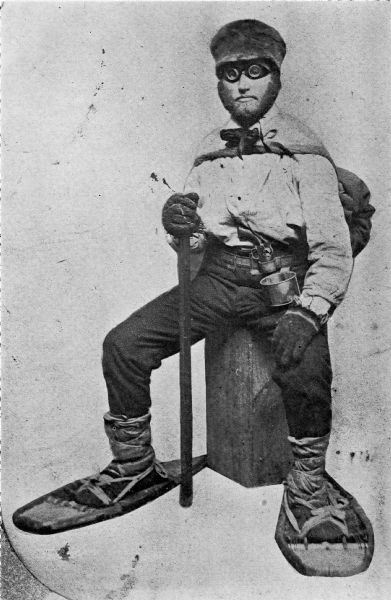
Asaph Whittlesey was Charles Whittlesey’s younger brother.
~ Wisconsin Historical Society
2. Asaph Whittlesey, then about thirty years of age, a native of Ohio, but who had for several years been engaged in business in Peoria, Ill., where the fruits of years of toil were swept away by fire in a single hour, was, in 1854, looking for a place to try anew his fortune. He belonged to one of the oldest and most respectable families of the Buckeye State – an energetic, lively, genial, whole-souled man, whom to know is to esteem. He was active in all the early years of Ashland; was its first Postmaster, (when the office bore his name) in compliment to his venerable uncle, the Hon. Elisha Whittlesey, for many years connected with the U.S. Treasury. And though he now resides at Bayfield, his interests are still largely in our town, and his pleasant face still occasionally gladdens our homes. In his present ill health he has our heartfelt sympathies. May he soon be well again and may his iter ad coctum be postponed yet many years.
~ The Eye of the North-west: First Annual Report of the Statistician of Superior, Wisconsin by Frank Abial Flower, 1890, page 251.
Mrs. Whittlesey, with her mother, Mrs. Haskell, were the first white women who passed the winter on this shore. Her house, though built of logs, was neat and comfortable, and was the resort of all new confers, where we were all made welcome; and the writer will always remember her singing of “The little tailor with the broadcloth under his arm,” and the dancing of her little Eugenia, a flaxen-haired girl of two year, but who, in later years, matured into a beautiful and accomplished woman, and happily settled in life, was, in 1874, called to the “sweet fields beyond the swelling flood.” Mrs. Whittlesey endured much privation, but she was brave and full of life. She is still spared to adorn and cheer her pleasant home at Bayfield.
Her father, Mr. Haskell, who passed the first winter in Mr. Whittlesey’s family, died a few years ago, but Mrs. Haskell still lives in green old age, and in 1875 re-visited the scenes of her pioneer life.

Martin Beaser
~ Western Reserve Historical Society
3. Martin Beaser, though he did not bring his family to Ashland till 1856, he is entitled, nevertheless, to be ranked among the very first settlers of Ashland, for he had chosen this for his home in 1854; had aided by his means and counsel, Messrs. Whittlesey and Kilbourn, and came from Ontonagon several times during the year 1855 to assist in carrying out their plans. He employed and brought with him early in 1855, Dr. Brunschweiler, a Civil Engineer, who surveyed and platted the first site on this bay, which is now known as “Old Ashland” or “Beaser’s Division of Ashland.” Brunschweiler River, twelve miles from Ashland, perpetuates his name.
Mr. Beaser was a native of the State of New York, who, in early life, had passed several years on a whaler in the Pacific Ocean and being an acute observer of men and things, had accumulated a vast amount of useful and entertaining knowledge. He was familiar with the ports of Central and South American and our Northwest coast, not ours then, for the Star Spangled Banner then floated only over a narrow strip of land near the mouth of the Columbia River.
The vast stretch of coast now embraced in the State of California was then Mexican territory and the Russian Bear was the emblem of power extending over forty degrees of longitude and from the fifty-fifth to the seventy-second degree of latitude, or more than eleven hundred miles, from south to north, and sixteen hundred miles from east to west. By the diplomacy of Mr. Seward and the payment of seven million dollars in gold, the vast extent of coast came under our flag.
No one could listen to Mr. Beaser’s recital of what he saw and heard on the Pacific coast without being entertained, and receiving much useful knowledge.
Mr. Beaser came to Ontonagon about 30 years ago, soon after the discovery of copper in that country. Very few settlers had preceded him there; but for several years, from 1858, they came in rapidly.
But here were no regular lines of boats as at present from Lake Erie and Michigan. All the supplies for the population must be brought by water a thousand miles. They were brought to the Sault and transferred across the portage, re-loaded on vessels and distributed to the infant settlements along the coast. As a result of the scanty and uncertain means of conveyance, the early northern winter often found the settlers without their winter’s supply of flour, pork and groceries. They must be brought to Ontonagon from Copper Harbor or Eagle River in open boats, which in the late fall and early winter was a work of hardship and danger. Mr. Beaser’s skill and bravery as a sailor was more than once instrumental in saving Ontonagon from starvation and want.
In the fall of 1856, Mr. Beaser brought his family to Ashland. Here he was closely identified with all enterprises calculated to aid in the opening up of this country. He had accumulated a competence at Ontonagon which he here freely expended.
He was a man of sound discretion and great good common sense, and was one of Ashland’s most useful citizens. Through discouragements and long deferred hope he persevered; while nearly all the rest of us were compelled to retreat. His hope seemed never to forsake him and like the heroes of the Cumberland who went down with their colors flying, he stuck to Ashland in its hours of greatest depression and finally found his grave in the waters of our Bay – while attempting to come from Bayfield to Ashland in an open boat alone during a severe storm in November, 1866. He rests on the Island of La Pointe, but the home of his life should be the home of his mortal remains and I doubt not they will be transferred hither at an early day.
To be continued in Number IV…
Martin Beaser
August 9, 2016
By Amorin Mello

Magazine of Western History Illustrated
November 1888
as republished in
Magazine of Western History: Volume IX, No.1, pages 24-27.
Martin Beaser.

Portrait of Martin Beaser on page 24.
On the fifth day of July 1854, Asaph Whittlesey and George Kilborn left La Pointe, in a row-boat, with the design of finding a “town site” on some available point near the “head of the bay.” At five o’clock P.M. of the same day they landed at the westerly limit of the present town site of Ashland. As Mr. Whittlesey stepped ashore, Mr. Kilborn exclaimed, “Here is the place for a big city!” and handing his companion an axe, he added, “I want you to have the honor of cutting the first tree in a way of a settlement upon the town site.” And the tree thus felled formed one of the foundation logs in the first building in the place. Such is the statement which has found its way into print as to the beginning of Ashland. But the same account adds: “Many new-comers arrived during the first few years after the settlement; among them Martin Beaser, who located permanently in Ashland in 1856, and was one of its founders.”1 How this was will soon be explained.
The father of the subject of this sketch, John Baptiste Beaser, was a native of Switzerland, educated as a priest, but never took orders. He came to America, reaching Philadelphia about the year 1812, where he married Margaret McLeod. They then moved to Buffalo, in one of the suburbs of which, called Williamsville, their son Martin was born, on the twenty-seventh of October, 1822. The boy received his early education in the common schools of the place, when, at the age of fourteen, he went on a whaling voyage, sailing from New Bedford, Massachusetts. His voyage lasted four years; his second voyage, three years; the last of which was made in the whaleship Rosseau, which is still afloat, the oldest of its class in America.
The young man went out as boat-steerer on his second voyage, returning as third mate. During his leisure time on shipboard and the interval between the two voyages, he spent in studying the science of navigation, which he successfully mastered. On his return from his fourth years’ cruise in the Pacific and Indian oceans, he was offered the position of second mate on a new ship then nearing completion and which would be ready to sail in about sixty days. He accepted the offer. They would notify him when the ship was ready, and he would in the meantime visit his mother, then a widow, residing in Buffalo. Accordingly, after an absence of seven years, he returned to his native city, spending the time in renewing old acquaintances and relating the varied experience of a whaler’s life. He had rare conversational powers, holding his listeners spell-bound at the recital of some thrilling adventure. A journal kept by him during his voyages and now in the possession of his family, abounds in hair-breadth escapes from savages on the shores of some of the South sea islands and the perils of whale-fishing, of which he had many narrow escapes. The time passed quickly, and he anxiously awaited the summons to join his ship. Leaving the city for a day the expected letter came, but was carefully concealed by his mother until after the ship had sailed, thus entirely changing the future of his life.
“… Martin, a sailor just from the whaling grounds of the Northwest Coast …”
Disappointed in his aspirations to command a ship in the near future, as he had reasons to hope from the rapid promotions he had already received – from a boy before the mast to mate of a ship in two voyages – and yielding to his mother’s wish not to leave home again, he engaged in sailing on Lake Erie from Buffalo to Detroit until 1847, when he went in the interest of a company in the latter city to Lake Superior for the purpose of exploring the copper ranges in the northern peninsula of Michigan. He coasted from Sault Ste. Marie to Ontonagon in a bateau. Remaining in the employ of the company about a year, he then engaged in a general forwarding and commission business for himself.
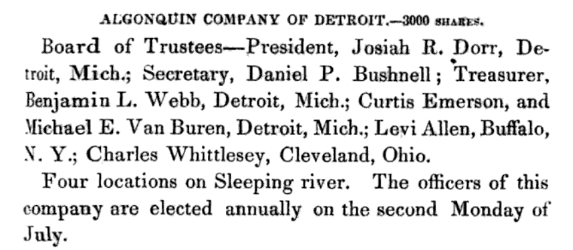
“Algonquin Company of Detroit.”
~ Reports of Wm. A. Burt and Bela Hubbard, by T. W. Bristol, 1846, page 97.
~ A History of the Northern Peninsula of Michigan and Its People: Volume 1, by Alvah Littlefield Sawyer, 1911, page 222.
Mr. Beaser was largely identified with the early mining interests of Ontonagon county, being instrumental in opening up and developing some of the best mines in that district.
In 1848 he was married in Cattaraugus county, New York, in the town of Perrysburgh, to Laura Antionette Bebee. The husband and wife the next spring went west, going to Ontonagon by way of Detroit. The trip from buffalo lasted from the first day of May to the sixth of June, they being detained at the “Soo” two weeks on account of the changing of the schooner Napoleon into a propeller, in which vessel, after a voyage of six days, they reached Ontonagon.
Here Mr. Beaser resided for seven years in the same business of forwarding and commission, furnishing frequently powder and candles to the miners by the ton. He was a portion of the this time associated with Thomas B. Hanna, formerly of Ohio. They then sold out their interest – Mr. Beaser going in company with Augustus Coburn and Edward Sayles to Superior, at the head of the lake, taking a small boat with them and Indian guides. Thus equipped they explored the region of Duluth, going up the Brule and St. Louis rivers. They then returned to La Pointe, going up Chaquamegon bay; and having their attention called to the site of what is now Ashland, on account of what seemed to be its favorable geographical position. As there had been some talk of the feasibility of connecting the Mississippi river and Lake Superior by a ship canal, it was suggested to them that this point would be a good one for its eastern terminus. Another circumstance which struck them was the contiguity of the Penokee iron range. This was in 1853. The company then returned to Ontonagon.
Closing up his business at the latter place, Mr. Beaser decided to return to the bay of Chaquamegon to look up and locate the town site on its southern shore. In the summer of 1854, on arriving there, he found Mr. Whittlesey and Mr. Kilborn on the ground. He then made arrangement with them by which he (Mr. Beaser) was to enter the land, which he did at Superior, where the land office was then located for that section. The contract between the three was, that Mr. Whittlesey and Mr. Kilborn were to receive each an eighth interest in the land, while the residue was to go to Mr. Beaser. The patent for the land was issued to Schuyler Goff, as county Judge of La Pointe county, Wisconsin, who was the trustee for the three men, under the law then governing the location of town sites.
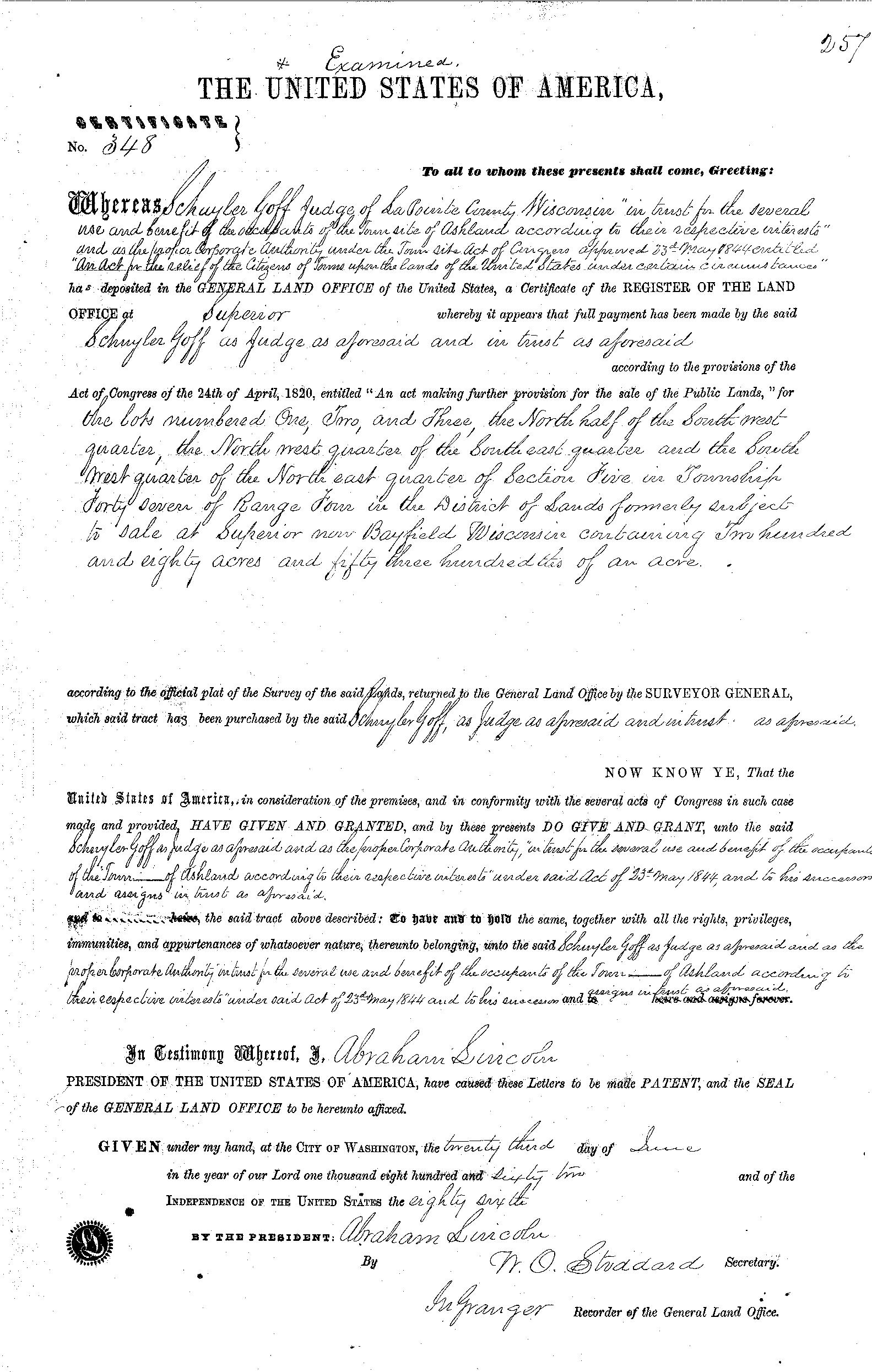
La Pointe County Judge Schuyler Goff was issued this patent for 280.53 acres on June 23rd, 1862, on behalf of Martin Beaser, Asaph Whittlesey, and George Kilburn.
~ General Land Office Records
Mr. Beaser afterwards got his deed from the judge to his three-quarters’ interest in the site.

Beaser named Ashland in honor of the Henry Clay Estate in Kentucky.
~ National Park Service
In January, 1854, Mr. Beaser having previously engaged a topographical engineer, G.L. Brunschweiler, the two, with a dog train and two Indians, made the journey from Ontonagon to the proposed town site, where Mr. Brunschweiler surveyed and platted2 a town on the land of the men before spoken of as parties in interest, to which town Mr. Beaser gave the name of Ashland. These three men, therefore, were the founders of Ashland, although afterwards various additions were made to it.
Mr. Beaser did not bring his family to Ashland until the eighth of September, 1856. He engaged in the mercantile business there until the war broke out, and was drowned in the bay while attempting to come from Bayfield to Ashland in an open boat, during a storm, on the fourth of November, 1866. He was buried on Madeline island at La Pointe. He was “closely identified with enterprises tending to open up the country; was wealthy and expended freely; was a man of fine discretion and good, common sense.” He was never discouraged as to Ashland’s future prosperity.
The children of Mr. Beaser, three in number, are all living: Margaret Elizabeth, wife of James A. Croser of Menominee, Michigan; Percy McLeod, now of Ashland; and Harry Hamlin, also of Ashland, residing with his mother, now Mrs. Wilson, an intelligent and very estimable lady.
1 See ‘History of Northern Wisconsin,’ p. 67.
2 The date of the platting of Ashland by Brunschweiler is taken from the original plat in the possession of the recorder of Ashland county, Wisconsin.
 Chequamegon History