The Story of Chequamegon Bay
March 1, 2016
By Amorin Mello
This is a reproduction of Reuben Gold Thwaites’ 1895 “The Story of Chequamegon Bay” to demonstrate how our local history has been institutionalized and portrayed since the end of the 19th century. Thwaites’ professional legacy as a journalist is embedded in many institutions, including the following:
- American Library Association
- American Antiquarian Society
- University of Wisconsin
- Wisconsin State Journal
- Wisconsin Historical Society
- Mississippi Valley Historical Association
According to Wikipedia:
Thwaites was well-known for not being a mere academic, but rather as a historian who attempted to understand history by experiencing those aspects that he could, and bringing those experiences to life. In 1888 he took canoe trips on the Wisconsin, Fox and Rock rivers. In 1892 he took a bicycle trip across England. In 1903 he took a trip down the Ohio River in a rowboat.
Thwaites’ approach and work has been questioned, to some degree by his contemporaries but more so in modern times. His summaries include phraseology such as “[Europeans] left the most luxurious country in Europe to seek shelter in the foul and unwelcome huts of one of the most wretched races of man.” When editing the Jesuit Relations, he included background information that is generally credible and thorough with respect to events and Europe, but is far less thorough in regard to the disruptions from disease and other sources that the indigenous people themselves were facing. In other words, the criticism is that the original works were insensitive, and Thwaites failed to fully account for the prejudicial and inaccurate reporting in the Relations. However, Thwaites is also recognized as being the pioneer in an approach to using the Relations that is continuing to be enriched by modern scholarship, and so in a sense he started a process by which his very work could be corrected and improved as historians learn more about the periods in question.
The purpose of reproducing this story is to serve as an introduction to Chequamegon Bay history, and as a reference point for modern scholarship and primary research about Chequamegon Bay before 1860.
The Story about Chequamegon Bay was originally published in Collections of the State Historical Society of Wisconsin: Volume XIII, by Reuben Gold Thwaites, 1895, pages 397-425.
The Story Of Chequamegon Bay.
by the Editor.

Reuben Gold Thwaites
~ Wisconsin Historical Society
WE commonly think of Wisconsin as a young State. In a certain sense she is. There are men now living, two or three of whom I meet almost daily, who were blazing paths through the Wisconsin wilderness, only sixty years ago: men who cleared the forests and broke the prairies; who founded frontier communities which have developed into cities; who upon this far away border sowed the seeds of industries which to-day support tens of thousands of their fellows; who threw up their hats when the Territory was erected; and who sat in the convention which gave to the new State a constitution. The Wisconsin of to-day, the Wisconsin which we know, is indeed young; for the lively octogenarians who were in at the birth will not admit that they are now old. But there was an earlier, a less prosaic, a far more romantic Wisconsin,—the French Wisconsin; and it had flourished in its own fashion for full two centuries before the coming of the Anglo-Saxon, who, brusquely crowding the Creole to the wall, made of his old home an American Commonwealth.
In 1634, when the child born upon the Mayflower was but in her fourteenth year, Jean Nicolet, sent out by the enterprising Champlain as far as Wisconsin,— a thousand miles of canoe journey west from Quebec,— made trading contracts, such as they were, with a half-score of squalid tribes huddled in widely-separated villages throughout the broad wilderness lying between Lakes Superior and Michigan. It was a daring, laborious expedition, as notable in its day as Livingstone’s earliest exploits in Darkest Africa ; and although its results were slow of development,—for in the seventeenth century man was still cautiously deliberate,— this initial visit of the forest ambassador of New France to the country of the Upper Lakes broke the path for a train of events which were of mighty significance in American history.1

“Jean Nicolet, landing at the Bay of Green Bay in 1634. Painted by Franz Edward Rohrbeck (1852-1919) in 1910 into the mural in the rotunda of the Brown County Courthouse, Green Bay, Wisconsin. It shows Nicolet wearing a Chinese damask tunic strewn with flowers and birds, and discharging two pistols into the air.”
~ Wikipedia.org
Let us examine the topography of Wisconsin. The State is situated at the head of the chain of Great Lakes. It is touched on the east by Lake Michigan, on the north by Lake Superior, on the west by the Mississippi, and is drained by interlacing rivers which so closely approach each other that the canoe voyager can with case pass from one great water system to the other; he can enter the continent at the Gulf of St. Lawrence, and by means of numerous narrow portages in Wisconsin emerge into the south-flowing Mississippi, eventually returning to the Atlantic through the Gulf of Mexico. From Lake Michigan, the Fox-Wisconsin river system was the most popular highway to the great river; into Lake Superior, there flow numerous turbulent streams from whose sources lead short portage trails over to the headwaters .of feeders of the Mississippi. From the western shore of Lake Superior, Pigeon River invites to exploration of the Winnipeg country, whence the canoeist can by a half-hundred easy routes reach the distant regions of Athabasca and the Polar Sea. In their early voyages to the head of lake navigation, it was in the course of nature that the French should soon discover Wisconsin; and having discovered it, learn that it was the key-point of the Northwest — the gateway to the entire continental interior. Thus, through Wisconsin’s remarkable system of interlacing waterways, to which Nicolet led the way, New France largely prosecuted her far-reaching forest trade and her missionary explorations, securing a nominal control of the basin of the Mississippi at a time when Anglo-Saxons had gained little more of the Atlantic slope than could be seen from the mast-head of a caravel. Thus the geographical character of Wisconsin became, early in the history of New France, an important factor. The trading posts and Jesuit missions on Chequamegon Bay2 of Lake Superior, and on Green Bay of Lake Michigan, soon played a prominent part in American exploration. The career of Green Bay is familiar to us all.3 I have thought it well hastily to summarize, in the brief space allowed me, the equally instructive story of Chequamegon Bay.

“Outline Map showing the position of the ancient mine-pits of Point Keweenaw, Michigan”
~ Ancient Mining on the Shores of Lake Superior, by Charles Whittlesey
The sandstone cliffs of Lake Superior were, many geologists think, among the first Laurentian islands to arise from the ancient ocean; if this be so, then the rim of our greatest inland sea is one of the oldest spots on earth. In its numerous mines of copper, prehistoric man long delved and wrought with rude hammers and chisels of stone, fashioning those curious copper implements which are carefully treasured in American museums of archaeology;4 and upon its rugged shores the Caucasian early planted his stake, when between him and New England tidewater all was savagery.
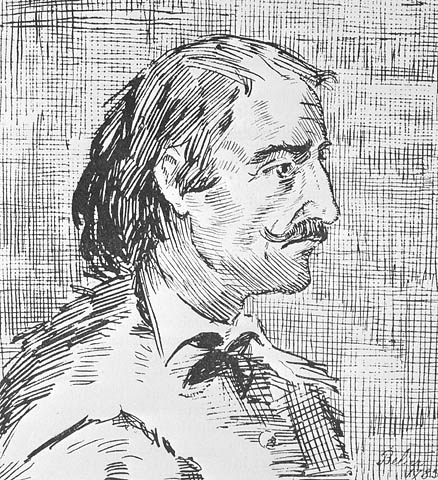
Pierre d’Esprit Sieur Radisson
~ Dictionary of Canadian Biography
After the coming to Wisconsin of Nicolet, a long period followed, in which the energies of New France were devoted to fighting back the Iroquois, who swarmed before the very gates of Quebec and Montreal. Exploration was for the time impossible. A quarter of a century passes away before we have evidence of another white man upon Wisconsin soil. In the spring of 1659, the Indians of the valley of the Fox were visited by two French fur-traders from the Lower St. Lawrence – Pierre d’Esprit, Sieur Radisson, and his sister’s husband, Medard Chouart, Sieur de Groseilliers. In all American history there are no characters more picturesque than these two adventurous Creoles, who, in their fond desire to “travell and see countries,” and “to be known as the remotest people,” roamed at will over the broad region between St. Jame’s seaway and the Wisconsin River, having many curious experiences with wild beasts and wilder men. They made several important geographical discoveries, – among them, probably, the discovery of the Mississippi River in 1659, fourteen years before the visit of Joliet and Marquette; and from a trading settlement proposed by them to the English, when their fellow-countrymen no longer gave them employment, developed the great establishment of the Hudson’s Bay Company. The unconsciously-amusing narrative which Radisson afterwards wrote, for the editication of King Charles II, of England, is one of the most interesting known to American antiquaries.5

“Arrival of Radisson in an Indian camp, 1660”
by Charles William Jefferys
~ Wikimedia.org
Two years after Radisson and Groseilliers were upon the Fox River, and made their notable trip to the Mississippi, they were again in the Northwest (autumn of 1661), and this time upon Lake Superior, which they had approached by carrying around the Sault Ste. Marie. Skirting the southern shore of the lake, past the now famous Pictured Rocks, they carried across Keweenaw Point, visited a band of Christino Indians6 not far from the mouth of Montreal River, now the far western boundary between Upper Michigan and Wisconsin, and, portaging across the base of the Chequamegon Island of to-day, – then united to the mainland,- entered beautiful Chequamegon Bay. Just where they made their camp, it is impossible from Radisson’s confused narrative to say; but that it was upon the mainland no Wisconsin antiquary now doubts, and we have reason to believe that it was upon the southwest shore, between the modern towns of Ashland and Washburn.7

“Close-up of the Radisson and Groseilliers house historic site marker, commemorating the first house built in Wisconsin by white men. The house was believed to have stood in the vicinity of Ashland at the mouth of Fish Creek where it empties into Chequamegon Bay.”
~ Wisconsin Historical Society
Our chronicler writes, with a particularity of detail suggestive of De Foe:
“We went about to make a fort of stakes, w’ was in this manner. Suppose that the watter-side had ben in one end; att the same end there should be murtherers, and att need we made a bastion in a triangle to defend us from assault. The doore was neare the watter side, our fire was in the midle, and our bed on the right hand, covered. There were boughs of trees all about our fort layed acrosse, one uppon an other. Besides those boughs, we had a long cord tyed w’ some small bells, w’ weare sentereys. Finally, we made an ende of that fort in 2 dayes’ time.”
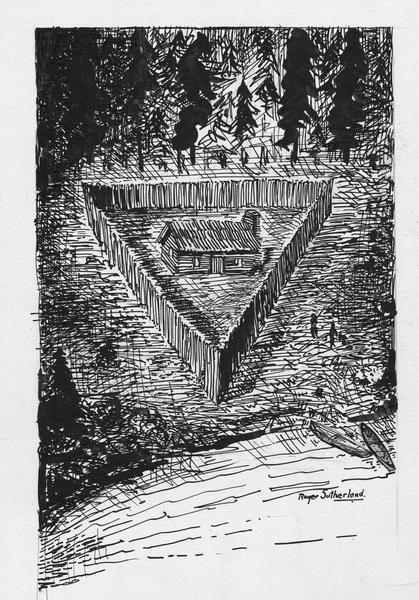
“Front view of the Radisson cabin, the first house built by a white man in Wisconsin. It was built between 1650 and 1660 on Chequamegon Bay, in the vicinity of Ashland. This drawing is not necessarily historically accurate.”
~ Wisconsin Historical Society
Modernize this statement, and in imagination we can see this first dwelling erected by man on the shores of Lake Superior; a small log hut, built possibly on the extremity of a small rocky promontory; the door opens to the water front, while the land side, to the rear of the hut, is defended by a salient of palisades stretching from bank to bank of the narrow promontory; all about the rude structure is a wall of pine boughs piled one upon the other, with a long cord intertwined, and on this cord are strung numbers of the little hawk-bells then largely used in the Indian trade for purposes of gift and barter. It was expected that in case of a night attack from savages, who might be willing to kill them for the sake of their stores, the enemy would stir the boughs and unwittingly ring the bells, thus arousing the little garrison. These ingenious defenses were not put to the test, although no doubt they had a good moral effect; in keeping the thieving Hurons at a respectful distance.
Winter was just setting in. The waters of the noble bay were taking on that black and sullen aspect peculiar to the season. The beautiful islands, later named for the Twelve Apostles,8 looked gloomy indeed in their dark evergreen mantles. From the precipitous edges of the red-sandstone cliffs, which girt about this estuary of our greatest inland sea, the dense pine forests stretched westward and southward for hundreds of miles. Here and there in the primeval depths was a cluster of starveling Algonkins, still trembling from fear of a return of the Iroquois, who had chased them from Canada into this land of swamps and tangled woods, where their safety lay in hiding. At wide intervals, uncertain trails led from village to village, and in places the rivers were convenient highways; these narrow paths, however, beset with danger in a thousand shapes, but emphasized the unspeakable terrors of the wilderness.
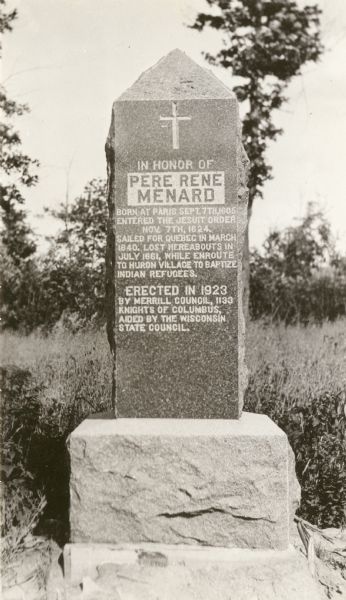
Père René Ménard
“The Search for Wisconsin’s First Priest”
~ Wisconsin Historical Society
Radisson and Groseilliers, true coureurs de bois, were not daunted by the dangers which daily beset them. After caching their goods, they passed the winter of 1661-62 with their Huron neighbors, upon a prolonged hunt, far into the Mille Lacs region of Minnesota. The season was phenomenally severe, and the Indians could not find game enough to sustain life. A famine ensued in the camp, the tragical details of which are painted by our friend Radisson with Hogarthian minuteness. In the spring of 1662, the traders were back again at Chequamegon, and built another fortified shelter, this time possibly on the sand-spit of Shagawaumikong,9 from which base they once more wandered in search of adventures and peltries, going as far northwest as Lake Assiniboine, and later in the season returning to their home on the Lower St. Lawrence.
When Radisson’s party went to Lake Superior, in the autumn of 1661, they were accompanied as far as Keweenaw Bay by a Jesuit priest. Father Pierre Ménard, who established there a mission among the Ottawas. The following June, disheartened in his attempt to convert these obdurate tribesmen, Ménard set out for the Huron villages on the upper waters of the Black and Chippewa, but perished on the way.10
It was not until August of 1665, three years later, that Father Claude Allouez, another Jesuit, was sent to reopen the abandoned Ottawa mission on Lake Superior. He chose his site on the southwestern shore of Chequamegon Bay, possibly the same spot on which Radisson’s hut had been built, four years previous, and piously called his mission and the locality La Pointe du Saint Esprit, which in time was shortened to La Pointe.11
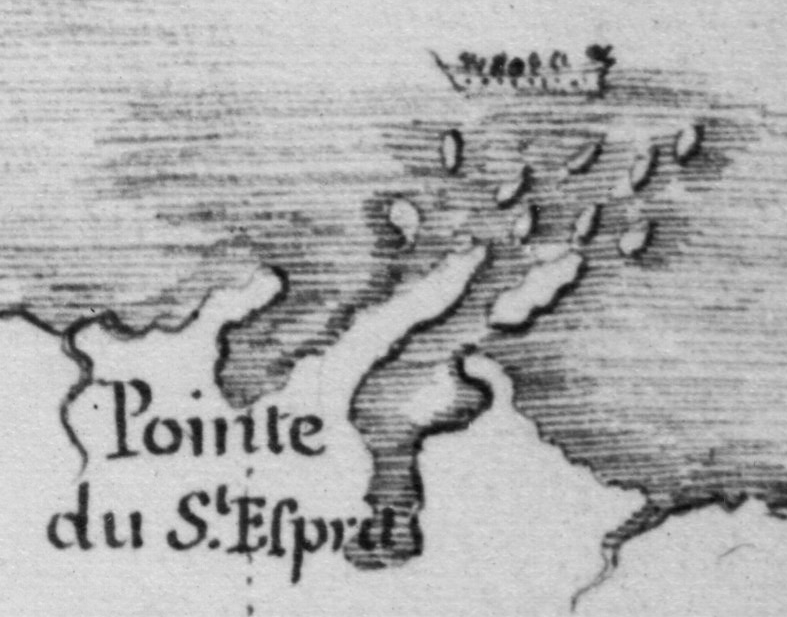
Detail of La Pointe du Saint Esprit
from Claude Allouez map’s of New France, 1669.
~ Research Laboratories of Archaeology

Portrayal of Claude Allouez
~ National Park Service
At the time of Radisson’s visit, the shores of Chequamegon Bay were uninhabited save by a few half-starved Hurons ; but soon thereafter it became the centre of a considerable Indian population, residents of several tribes having been drawn thither, first, by the fisheries, second, by a fancied security in so isolated a region against the Iroquois of the East and the wild Sioux of the West. When Allouez arrived in this polyglot village, October 1, he found there Chippewas, Pottawattómies, Kickapoos, Sauks, and Foxes, all of them Wisconsin tribes; besides these were Hurons, Ottawas, Miamis, and Illinois,— victims of Iroquois hate who had fled in droves before the westward advances of their merciless tormentors.

Jacques Marquette
aka James (Jim) or Père Marquette
~ Wikipedia
Despite his large congregations, Allouez made little headway among these people, being consoled for his hardships and ill-treatment by the devotion of a mere handful of followers. For four years did he labor alone in the Wisconsin wilderness, hoping against hope, varying the monotony of his dreary task by occasional canoe voyages to Quebec, to report progress to his father superior. Father James Marquette, a more youthful zealot, was at last sent to relieve him, and in September, 1669, arrived at La Pointe from Sault Ste. Marie, after spending a full month upon, the journey,—so hampered was he, at that early season, by snow and ice. Allouez, thus relieved from a work that had doubtless palled upon him, proceeded upon invitation of the Pottawattomies to Green Bay, where he arrived early in December, and founded the second Jesuit mission in Wisconsin, St. Francis Xavier, on the site of the modern town of Depere.12
Marquette had succeeded to an uncomfortable berth. Despite his strenuous efforts as a peacemaker, his dusky parishioners soon unwisely quarreled with their western neighbors, the Sioux,13 with the result that the La Pointe bands, and Marquette with them, were driven like leaves before an autumn blast eastward along the southern shore of the great lake: the Ottawas taking up their home in the Manitoulin Islands of Lake Huron, the Hurons accompanying Marquette to the Straits of Mackinaw, where he established the mission of St. Ignace.
With La Pointe mission abandoned, and Lake Superior closed to French enterprise by the “raging Sioux,” the mission at Depere now became the centre of Jesuit operations in Wisconsin, and it was a hundred and sixty-four years later (1835), before mass was again said upon the forest-fringed shores of Chequamegon Bay.
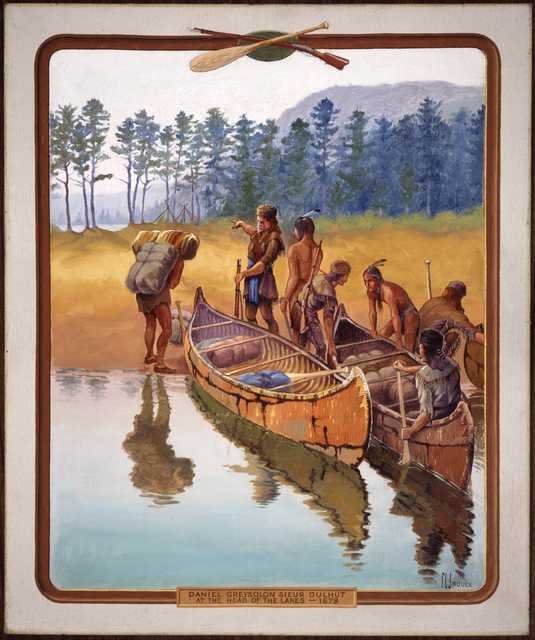
“‘Daniel Greysolon Sieur Dulhut at the Head of the Lakes – 1679.’ Painted by artist Francis Lee Jaques, c.1922.”
~ Minnesota Historical Society
Although the missionary had deserted La Pointe, the fur trader soon came to be much in evidence there. The spirit of Radisson and Groseilliers long permeated this out-of-the-way corner of the Northwest. We find (1673), three years after Marquette’s expulsion. La Salle’s trading agent, Sieur Raudin, cajoling the now relentent Sioux at the western end of Lake Superior. In the summer of 1679, that dashing coureur de bois, Daniel Grayson du l’ Hut,14 ascended the St. Louis River, which divides Wisconsin and Minnesota, and penetrated with his lively crew of voyageurs to the Sandy Lake country, being probably the first white trader upon the head-waters of the Mississippi. The succeeding winter, he spent in profitable commerce with the Assiniboines, Crees, and other northern tribes in the neighborhood of Grand Portage,15 on the boundary between Minnesota and Canada. In June, 1680, probably unaware of the easier portage by way of the Mille Lacs and Rum River, Du I’ Hut set out at the head of a small company of employees to reach the Mississippi by a new route. Entering the narrow and turbulent Bois Brulé,16 half-way along the southern shore of Lake Superior, between Red Cliff and St. Louis River, he with difficulty made his way over the fallen trees and beaver dams which then choked its course. From its head waters there is a mile-long portage to the upper St. Croix; this traversed. Du l’ Hut was upon a romantic stream which swiftly carried him, through foaming rapids and deep, cool lakes, down into the Father of Waters. Here it was that he heard of Father Louis Hennepin’s captivity among the Sioux, and with much address and some courage rescued that doughty adventurer, and carried him by way of the Fox-Wisconsin route in safety to Mackinaw.
…
“In 1693, Le Sueur founded a trading post on the site of present-day La Pointe on Madeline Island, the largest of Chequamegon Bay’s Apostle Islands. After hearing reports of what he believed were valuable deposits of copper ore south of Lake Superior, he traveled to France in 1697, where the French government granted him permission to mine these resources.”
~ Encyclopedia of Exploration, vol. 1, 2004.
An adventurous forest trader, named Le Sueur, was the next man to imprint his name on the page of Lake Superior history. The Fox Indians, who controlled the valleys of the Fox and Wisconsin Rivers, had for various reasons become so hostile to the French that those divergent streams were no longer safe as a gateway from the Great Lakes to the Great River. The tendency of the prolonged Fox War was to force fur trade travel to the portages of Chicago and St. Joseph’s on the south, and those of Lake Superior on the north.17 It was with a view to keeping open one of Du l’ Hut’s old routes, – the Bois Brulé and St. Croix Rivers,- that Le Sueur was despatched by the authorities of New France in 1693. He built a stockaded fort on Madelaine island, convenient for guarding the northern approach,18 and another on an island in the Mississippi, below the mouth of the St. Croix, and near the present town of Red Wing, Minnesota. The post in the Mississippi soon became “the centre of commerce for the Western parts”; and the station in Chequamegon Bay also soon rose to importance, for the Chippewas, who had drifted far inland into Wisconsin and Minnesota with the growing scarcity of game,- the natural result of the indiscriminate slaughter which the fur trade encouraged, – were induced by the new trading facilities to return to their old bay shore haunts, massing themselves in an important village on the southwestern shore.
This incident strikingly illustrates the important part which the trader early came to play in Indian life. At first an agriculturalist in a small way, and a hunter and fisher only so far as the daily necessities of food and clothing required, the Indian was induced by the white man to kill animals for their furs, – luxuries ever in great demand in the marts of civilization. The savage wholly devoted himself to the chase, and it became necessary for the white man to supply him with clothing, tools, weapons, and ornaments of European manufacture; the currency as well as the necessities of the wilderness.19 These articles the savage had heretofore laboriously fashioned for himself at great expenditure of time; no longer was he content with native manufactures, and indeed he quickly lost his old-time facility for making them. It was not long before he was almost wholly dependent on the white trader for the commonest conveniences of life; no longer being tied to his fields, he became more and more a nomad, roving restlessly to and fro in search of fur-bearing game, and quickly populating or depopulating a district according to the conditions of trade. Without his trader, he quickly sank into misery and despair; with the advent of the trader, a certain sort of prosperity once more reigned in the tepee of the red man. In the story of Chequamegon Bay, the heroes are the fur trader and the missionary; and of these the fur trader is the greater, for without his presence on this scene there would have been no Indians to convert.
~ State of Wisconsin Blue Book, 1925, page 66.
Although Le Sueur was not many years in command upon Chequamegon Bay,20 we catch frequent glimpses thereafter of stockaded fur trade stations here, – French, English, and American, in turn, – the most of them doubtless being on Madelaine Island, which was easily defensible from the mainland.21 We know that in 1717 there was a French trader at La Pointe – the popular name for the entire bay district—for he was asked by Lt. Robertel de la Noüe, who was then at Kaministiquoya, to forward a letter to a certain Sioux chief. In September, 1718, Captain Paul Legardeur St. Pierre, whose mother was a daughter of Jean Nicolet, Wisconsin’s first explorer, was sent to command at Chequamegon, assisted by Ensign Linctot, the authorities of the lower country having been informed that the Chippewa chief there was, with his fellow-chief at Keweenaw, going to war with the Foxes. St. Pierre was at Chequamegon for at least a year, and was succeeded by Linctot, who effected an important peace between the Chippewas and Sioux.22
The Indians at La Pointe told the French of an island of copper guarded by spirits; La Ronde, when he heard of the mineral, requested permission from the French Government to combine his duties at the fort with mining. he was not given permission to operate the mines until 1733, and in 1740 his mining activities were halted by an outbreak between the Sioux and the Chippewa. Nonetheless, La Ronde is known as the first practical miner on Lake Superior, and the man who opened this region for settlement by white men.”
~ The WPA Guide to Wisconsin, by Federal Writers’ Project, 2013, page 348.
~ Dictionary of Canadian Biography
Whether a garrisoned fort was maintained at Chequamegon Bay, from St. Pierre’s time to the close of the French domination, it is impossible to say; but it seems probable; for the geographical position was one of great importance in the development of the fur trade, and the few records we have mention the fort as one of long standing.23 In 1730, it is recorded, that a nugget of copper was brought to the post by an Indian, and search was at once made for a mine; but October 18, 1731, the authorities of New France wrote to the home office in Paris that, owing to the superstitions of the Indians, which led them to conceal mineral wealth from the whites, no copper mine had thus far been found in the neighborhood of Chequamegon Bay. The commandant of Chequamegon at this time was Sieur La Ronde Denis, known to history as La Ronde,— like his predecessors, for the most part, a considerable trader in these far Western parts, and necessarily a man of enterprise and vigor. La Ronde was for many years the chief trader in the Lake Superior country, his son and partner being Denis de La Ronde. They built for their trade a boat of 40 tons, which was without doubt “the first vessel on the great lake, with sails larger than an Indian blanket.” 24 On account of the great outlay they had incurred in this and other undertakings in the wilderness, the post of Chequamegon, with its trading monopoly, had been given to the elder La Ronde, according to a despatch of that day, “as a gratuity to defray expenses.” Other allusions to the La Rondes are not infrequent: in 1736,25 the son is ordered to investigate a report of a copper mine at Iron River, not far east of the Bois Brulé; in the spring of 1740, the father is at Mackinaw on his return to Chequamegon from a visit to the lower country, but being sick is obliged to return to Montreal;26 and in 1744, Bellin’s map gives the name “Isle de la Ronde” to what we now know as Madelaine, fair evidence that the French post of this period was on that island.

Detail of Isle de la Ronde from Carte des lacs du Canada by Jacques-Nicolas Bellin, 1744.
~ Wisconsin Historical Society
Pierre-Joseph was the son of Joseph Hertel de St.Francois & Catherine Philippe, born in Trois-Rivieres. He married Catherine-Madeleine Jarrot (daughter of Jean Bte.Jarrot, sieur de Vercheres & Madeleine Francoise d’Ailleboust de Manthet) in 1751. [Her father commanded the post at Green Bay in 1747].
Pierre-Joseph followed in his families tradition and was a captain on a raid of Albany in 1756 during the King George’s War. From 1756 to 1758 he was commander of the post of Lapointe (in today’s northern Wisconsin) and sailed for France after the loss of Canada to the British.”
~ [Unknown].
We hear nothing more of importance concerning Chequamegon until about 1756, when Hertel de Beaubassin, the last French commandant there, was summoned to Lower Canada with his Chippewa allies, to do battle against the English.27 For several years past, wandering English fur traders had been tampering with the Chippewas of Lake Superior, who in consequence frequently maltreated their old friends, the French;28 but now that the tribe were summoned for actual fighting in the lower country, with extravagant promises of presents, booty, and scalps, they with other Wisconsin Indians eagerly flocked under the French banner, and in painted swarms appeared on the banks of the St. Lawrence, with no better result than to embarrass the French commissariat and thus unwittingly aid the ambitious English.
New France was tottering to her fall. The little garrison on Madelaine Island had been withdrawn from the frontier, with many another like it, to help in the defense of the lower country ; and the Upper Lakes, no longer policed by the fur trade monopoly, were free plunder for unlicensed traders, or coureurs des bois. Doubtless such were the party who encamped upon the island during the autumn of 1760. By the time winter had set in upon them, all had left for their wintering grounds in the forests of the far West and Northwest, save a clerk named Joseph, who remained in charge of the stores and the local traffic. With him were his little family,—his wife, who was from Montreal, his child, a small boy, and a man-servant, or voyageur. Traditions differ as to the cause of the servant’s action,— some have it, a desire for wholesale plunder; others, the being detected in a series of petty thefts, which Joseph threatened to report; others, an unholy and unrequited passion for Joseph’s wife. However that may be, the servant murdered first the clerk, and then the wife; and in a few days, stung by the piteous cries of the child, the lad himself. When the spring came, and the traders returned to Chequamegon, they inquired for Joseph and his family, but the servant’s reply was unsatisfactory and he finally confessed to his horrid deed. The story goes, that in horror the traders dismantled the old French fort as a thing accursed, sunk the cannon in a neighboring pool, and so destroyed the palisade that to-day naught remains save grassy mounds. Carrying their prisoner with them on their return voyage to Montreal, he is said to have escaped to the Hurons, among whom he boasted of his deed, only to be killed as too cruel a companion even for savages.29

Detail of “The 12 Apostles” from Captain Jonathan Carver’s journal of his travels with maps and drawings, 1769. ~ Boston Public Library

Alexander Henry , The Elder.
~ Wikipedia.com
New France having now fallen, an English trader, Alexander Henry, spent the winter of 1765-66 upon the mainland, opposite the island.30 Henry had obtained from the English commandant at Mackinaw the exclusive trade of Lake Superior, and at Sault Ste. Marie took into partnership with him Jean Baptiste Cadotte,31 a thrifty Frenchman, who for many years thereafter was one of the most prominent characters on the Upper Lakes. Henry and Cadotte spent several winters together on Lake Superior, but only one upon the shores of Chequamegon, which Henry styles “the metropolis of the Chippeways.”32
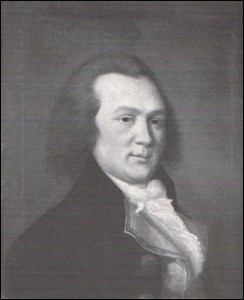
John Johnston
~ Homestead.org
The next dweller at Chequamegon Bay, of whom, we have record, was John Johnston, a Scotch-Irish fur trader of some education. Johnston established himself on Madelaine Island, not far from the site of the old French fort; some four miles across the water, on the mainland to the west, near where is now the white town of Bayfield, was a Chippewa village with whose inhabitants he engaged in traffic. Waubojeeg (White Fisher), a forest celebrity in his day, was the village chief at this time, and possessed of a comely daughter whom Johnston soon sought and obtained in marriage. Taking his bride to his island home, Johnston appears to have lived there for a year or two in friendly commerce with the natives, at last retiring to his old station at Sault Ste. Marie.33
Mention has been made of Jean Baptiste Cadotte, who was a partner of Alexander Henry in the latter’s Lake Superior trade, soon after the middle of the century. Cadotte, whose wife was a Chippewa, after his venture with Henry had returned to Sault Ste. Marie, from which point he conducted an extensive trade through the Northwest. Burdened with advancing years, he retired from the traffic in 1796, and divided the business between his two sons, Jean Baptiste and Michel.

Michel Cadotte
~ Findagrave.com
About the opening of the present century,34 Michel took up his abode on Madelaine Island, and from that time to the present there has been a continuous settlement upon it. He had been educated at Montreal, and marrying Equaysayway, the daughter of White Crane, the village chief of La Pointe,35 at once became a person of much importance in the Lake Superior country. Upon the old trading site at the southwestern corner of the island, by this time commonly called La Pointe,— borrowing the name, as we have seen, from the original La Pointe, on the mainland, and it in turn from Point Chequamegon,—Cadotte for over a quarter of a century lived at his ease; here he cultivated a “comfortable little farm,” commanded a fluctuating, but often far-reaching fur trade, first as agent of the Northwest Company and later of Astor’s American Fur Company, and reared a considerable family, the sons of which were, as he had been, educated at Montreal, and became the heads of families of Creole traders, interpreters, and voyageurs whom antiquarians now eagerly seek when engaged in bringing to light the French and Indian traditions of Lake Superior.36
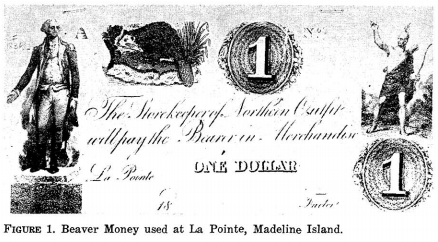
La Pointe Beaver Money
Northern Outfit, American Fur Company
~ Wisconsin Academy of Science, Arts, & Letters, volume 54, page 159.
In the year 1818 there came to the Lake Superior country two sturdy, fairly-educated37 young men, natives of the Berkshire hills of Massachusetts,—Lyman Marcus Warren, and his younger brother, Truman Abraham. They were of the purest New England stock, being lineally descended from Richard Warren, one of the “Mayflower” company. Engaging in the fur trade, the brothers soon became popular with the Chippewas, and in 1821 still further entrenched themselves in the affections of the tribesmen by marrying the two half-breed daughters of old Michel Cadotte,—Lyman taking unto himself Mary, while Charlotte became the wife of Truman. At first the Warrens worked in opposition to the American Fur Company, but John Jacob Astor’s lieutenants were shrewd men and understood the art of overcoming commercial rivals. Lyman was made by them a partner in the lake traffic, and in 1824 established himself at-La Pointe as the company’s agent for the Lac Flambeau, Lac Courte Oreille, and St. Croix departments, an arrangement which continued for some fourteen years. The year previous, the brothers had bought out the interests of their father-in-law, who now, much reduced in means, retired to private life after forty years’ prosecution of the forest trade.38

American Fur Company “Map of La Pointe”
by Lyman Marcus Warren, 1834.
~ Wisconsin Historical Society
The brothers Warren were the last of the great La Pointe fur traders.39 Truman passed away early in his career, having expired in 1825, while upon a voyage between Mackinaw and Detroit. Lyman lived at La Pointe until 1838, when his connection with the American Fur Company was dissolved, and then became United States sub-agent to the Chippewa reservation on Chippewa River, where he died on the tenth of October, 1847, aged fifty-three years.40
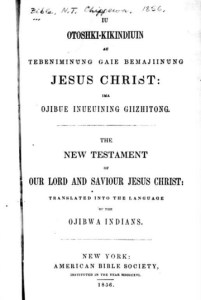
Iu Otoshki-Kikindiuin Au Tebeniminvng Gaie Bemajiinung Jesus Christ, Ima Ojibue Inueuining Giizhitong:
The New Testament of Our Lord and Saviour Jesus Christ
by Sherman Hall and Henry Blatchford, 1856.
~ Archive.org
Lyman Marcus Warren was a Presbyterian, and, although possessed of a Catholic wife, was the first to invite Protestant missionaries to Lake. Superior. Not since the days of Allouez had there been an ordained minister at La Pointe; Warren was solicitous for the spiritual welfare of his Chippewa friends, especially the young, who were being reared without religious instruction, and subject to the demoralizing influence of a rough element of white borderers. The Catholic Church was not just then ready to reenter the long-neglected field; his predilections, too, were for the Protestant faith. In 1830, while upon his annual summer trip to Mackinaw for supplies, be secured the cooperation of Frederick Ayer, of the Mackinaw mission, who returned with him in his batteau as lay preacher and school-teacher, and opened at La Pointe what was then the only mission upon the shores of the great lake. Thither came in Warren’s company, the latter part of August, the following year (1831), Rev. Sherman Hall and wife, who served as missionary and teacher, respectively, and Mrs. John Campbell, an interpreter.41
La Pointe was then upon the site of the old French trading post at the southwest corner of Madelaine Island; and there, on the first Sunday afternoon after his arrival, Mr. Hall preached “the first sermon ever delivered in this place by a regularly-ordained Christian minister.” The missionaries appear to have been kindly received by the Catholic Creoles, several of whom were now domiciled at La Pointe. The school was patronized by most of the families upon the island, red and white, who had children of proper age. By the first of September there was an average attendance of twenty-five. Instruction was given almost wholly in the English language, with regular Sunday-school exercises for the children, and frequent gospel meetings for the Indian and Creole adults.
We have seen that the first La Pointe village was at the southwestern extremity of the island. This was known as the “Old Fort” site, for here had been the original Chippewa village, and later the fur-trading posts of the French and English. Gradually, the old harbor became shallow, because of the shifting sand, and unfit for the new and larger vessels which came to be used in the fur trade.

The American Fur Company therefore built a “New Fort” a few miles farther north, still upon the west shore of the island, and to this place, the present village, the name La Pointe came to be transferred. Half-way between the “Old fort” and the “New fort,” Mr. Hall erected (probably in 1832) “a place for worship and teaching,” which came to be the centre of Protestant missionary work in Chequamegon Bay.

Leonard Hemenway Wheeler
~ Unnamed Wisconsin by John Nelson Davidson, 1895.
At that time, the Presbyterians and Congregationalists were, in the American Home Missionary Society and the American Board, united in the conduct of Wisconsin missions, and it is difficult for a layman to understand to which denomination the institution of the original Protestant mission at La Pointe may properly be ascribed. Warren was, according to Neill, a Presbyterian, so also, nominally, were Ayer and Hall, although the last two were latterly rated as Congregationalists. Davidson, a Congregational authority, says: “The first organization of a Congregational church within the present limits of Wisconsin took place at La Pointe in August, 1833, in connection with this mission”;42 and certainly the missionaries who later came to assist Hall were of the Congregational faith; these were Rev. Leonard Hemenway Wheeler and wife, Rev. Woodbridge L. James and wife, and Miss Abigail Spooner. Their work appears to have been as successful as such proselyting endeavors among our American Indians can hope to be, and no doubt did much among the Wisconsin Chippewas to stem the tide of demoralization which upon the free advent of the whites overwhelmed so many of our Western tribes.
James’ family did not long remain at La Pointe. Wheeler was soon recognized as the leading spirit there, although Hail did useful service in the field of publication, his translation of the New Testament into Chippewa (completed in 1836) being among the earliest of Western books. Ayer eventually went to Minnesota. In May, 1845, owing to the removal of the majority of the La Pointe Indians to the new Odanah mission, on Bad River, Wheeler removed thither, and remained their civil, as well as spiritual, counselor until October, 1866, when he retired from the service, full of years and conscious of a record of noble deeds for the uplifting of the savage. Hall tarried at La Pointe until 1853, when he was assigned to Crow Wing reservation, on the Mississippi, thus ending the Protestant mission on Chequamegon Bay. The new church building, begun in 1887, near the present La Pointe landing, had fallen into sad decay, when, in July, 1892, it became the property of the Lake Superior Congregational Club, who purpose to preserve it as an historic treasure, being the first church-home of their denomination in Wisconsin.

Not far from this interesting relic of Protestant pioneering at venerable La Pointe, is a rude structure dedicated to an older faith. Widely has it been advertised, by poets, romancers, and tourist agencies, as “the identical log structure built by Père Marquette”; while within there hangs a picture which we are soberly told by the cicerone was “given by the Pope of that time to Marquette, for his mission church in the wilderness.” It is strange how this fancy was born; stranger still that it persists in living, when so frequently proved unworthy of credence. It is as well known as any fact in modern Wisconsin history,— based on the testimony of living eyewitnesses, as well as on indisputable records,—that upon July 27, 1835, five years after Cadotte had introduced Ayer to Madelaine Island, there arrived at the hybrid village of La Pointe, with but three dollars in his pocket, a worthy Austrian priest. Father (afterwards Bishop) Frederic Baraga. By the side of the Indian graveyard at Middleport, he at once erected “a log chapel, 50×20 ft. and 18 ft. high,” and therein he said mass on the ninth of August, one hundred and sixty-four years after Marquette had been driven from Chequamegon Bay by the onslaught of the Western Sioux.43 Father Baraga’s resuscitated mission, still bearing the name La Pointe, as had the mainland missions of Allouez and Marquette,—throve apace. His “childlike simplicity,” kindly heart, and self-sacrificing labors in their behalf, won to him the Creoles and the now sadly-impoverished tribesmen; and when, in the winter of 1836-37, he was in Europe begging funds for the cause, his simpIe-hearted enthusiasm met with generous response from the faithful.

“Bishop Frederic Baraga, three-quarter length portrait, facing three-quarters to right, seated, in clerical robes, holding his Dictionary of the Otchipwe Language”
~ Library of Congress
Returning to La Pointe in 1837, he finished his little chapel, built log-houses for his half-starved parishioners, and lavished attentions upon them; says Father Verwyst, himself an experienced missionary among the Chippewas : “In fact, he gave them too much altogether—so to say— spoiled them by excessive kindness.” Four years later, his chapel being ill-built and now too small, he had a new one constructed at the modern village of La Pointe, some of the materials of the first being used in the second. This is the building, blessed by Father Baraga on the second Sunday of August, 1841, which is to-day falsely shown to visitors as that of Father Marquette. It is needless to say that no part of the ancient mainland chapel of the Jesuits went into its construction; as for the picture, a “Descent from the Cross,” alleged to have once been in Marquette’s chapel, we have the best of testimony that it was imported by Father Baraga himself from Europe in 1841, he having obtained it there the preceding winter, when upon a second tour to Rome, this time to raise funds for the new church.44 This remarkable man though later raised to a missionary bishopric, continued throughout his life to labor for the uplifting of the Indiana of the Lake Superior country with a self-sacrificing zeal which is rare in the annals of any church, and established a lasting reputation as a student of Indian philology. He left La Pointe mission in 1853, to devote himself to the Menomonees, leaving his work among the Chippewas of Chequamegon Bay to be conducted by others. About the year 1877, the white town of Bayfield, upon the mainland opposite, became the residence of the Franciscan friars who were now placed, in charge. Thus, while the Protestant mission, after a relatively brief career of prosperity, has long, since been removed to Odanah, the Catholics to this day retain possession of their ancient field in Chequamegon Bay.

View of La Pointe, circa 1843.
“American Fur Company with both Mission churches. Sketch purportedly by a Native American youth. Probably an overpainted photographic copy enlargement. Paper on a canvas stretcher.”
~ Wisconsin Historical Society
In closing, let us briefly rehearse the changes in the location of La Pointe, and thus clear our minds of some misconceptions into which several historians have fallen.
- As name-giver, we have Point Chequamegon (or. Shagawaumikong). Originally a long sand-spit hemming in Chequamegon Bay on the east, it is now an island. The most conspicuous object in the local topography, it gave name to the district; and here, at the time of the Columbian discovery, was the Chippewa stronghold.
- The mission of La Pointe du St. Esprit, founded by Allouez, was, it seems well established, on the mainland at the southwestern corner of the bay, somewhere between the present towns of Ashland and Washburn, and possibly on the site of Radisson’s fort. The point which suggested to Allouez the name of his mission was, of course, the neighboring Point Chequamegon.
- The entire region of Chequamegon Bay came soon to bear this name of La Pointe, and early within the present century it was popularly attached to, the island which had previously borne many names, and to-day is legally designated Madelaine.
- When Cadotte’s little trading village sprang up, on the southwestern extremity of the island, on the site of the old Chippewa village and the old French forts, this came to be particularly designated as La Pointe.
- When the American Fur Company established a new fort, a few miles north of the old, the name La Pointe was transferred thereto. This northern village was in popular parlance styled “New Fort,” and the now almost-deserted .southern village “Old Fort”; while the small settlement around the Indian graveyard midway, where Father Baraga built his first chapel, was known as “Middleport.”
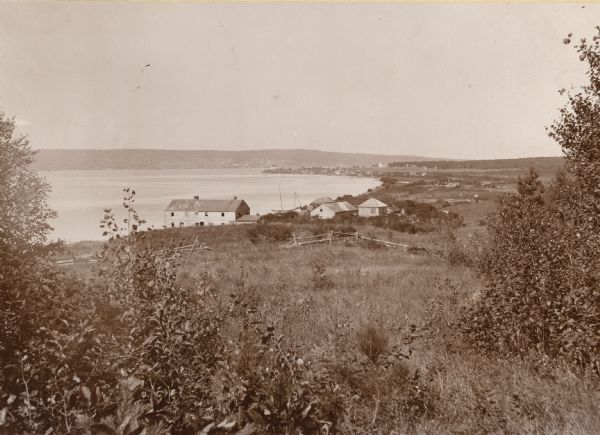
La Pointe, Madelaine Island, Chequamegon Bay, circa 1898.
“The large building in the foreground is an old American Fur Company’s warehouse. The mainland town of Bayfield rests in a hollow of the opposite hills, which appears to merge into the island. This La Pointe, early established as a French military and trading post, must not be confounded with the still earlier missions of La Pointe served by Allouez and Marquette, which is on the mainland on the southwest shore of Chequamegon Bay, between Washburn and Ashland.”
~ Wisconsin Historical Collections, Volume XVI, page 80.
La Pointe has lost much of its old-time significance. No longer is it the refuge of starveling tribes, chased thither by Iroquois, harassed by unneighborly Sioux, and consoled in a measure by the ghostly counsel of Jesuit fathers; no longer a centre of the fur-trade, with coureurs de bois gayly dight, self-seeking English and American factors, Creole traders dispensing largesse to the dusky relatives of their forest brides, and rollicking voyageurs taking no heed of the morrow. Its forest commerce has departed, with the extinction of game and the opening of the Lake Superior country to industrial and agricultural occupation; the Protestant mission has followed the majority of the Indian islanders to mainland reservations; the revived mission of Mother Church has also been quartered upon the bay shore. But the natural charms of Madelaine island, in rocky dell, and matted forest, and sombre, pine-clad shore, are with us still, and over all there floats an aroma of two and a half centuries of historic association, the appreciation of which we need to foster in our materialistic West, for we have none too much of it.
1 The chief authority on Nicolet is Butterfield’s Discovery of the Northwest (Cincinnati, 1881). See also Wis. Hist. Colls., xi, pp. 1-25.
2 In his authoritative “History of the Ojibway Nation,“ in Minn. Hist. Colls., v., Warren prefers the spelling “Chagoumigon,” although recognizing “Shagawaumikong” and “Shaugahwaumikong.” “Chequamegon” is the current modern form. Rev. Edward P. Wheeler, of Ashland, an authority on the Chippewa tongue and traditions, says the pronunciation should be “Sheh-gu-wah-mi-kung,” with the accent on the last syllable.
3 See Nevill and Martin’s Historic Green Bay (Milwaukee,1894); and various articles in the Wisconsin Historical Collections.
4 See Minn. Hist. Colls., v., pp.98, 99, note, for account of early copper mining on Lake Superior by Indians. In the summer of 1892, W. H. Holmes, of the Smithsonian Institution, found on Isle Royale no less than a thousand abandoned shafts which had been worked by them; and “enough stone implements lay around, to stock every museum in the country.”
5 Radisson’s Voyages was published by the Prince Society (Boston, 1895); that portion relation to Wisconsin is reproduced, with notes, in Wis. Hist. Colls., xi. See also Jesuit Relations, 1660, for Father Lallemant’s report of the discoveries of the “two Frenchmen,” who had found “a fine river, great, broad, deep, and comparable, they say, to our great St. Lawrence.”
In Franquelin’s map of 1688, what is now Pigeon River, a part of the international boundary between Minnesota and Canda, is called Groseilliers. An attempt was made by members of the Wisconsin State Historical Society, in the Wisconsin Legislature,during the session of 1895, to have a proposed new county called Radisson; the name was adopted by the friends of the bill, but the measure itself failed to pass.
6 Now called Crees.
7 Radisson’s Voyages plainly indicates that the travelers portaged across the long, narrow sand-spit formerly styled Shagawaumikong, in their day united with the mainland, but now insular, and bearing the name Chequamegon Island; this Radisson describes as “a point of 2 leagues long and some 60 paces broad,”and later he refers to it as “the point that forms that Bay, wch resembles a small lake.” After making this portage of Shagawaumikong, they proceeded in their boats, and “att the end of this bay we landed.” The Ottawas of the party desired to cross over to their villages on the head-waters of the Black and Chippewa, and no landing-place was so advantageous for this purpose as the southwest corner of the bay. It is plain from the narrative that the Frenchmen, now left to themselves, built their fortified hut at or near the place of landing, on the mainland. The Chippewa tradition of the coming of Radisson and Groseilliers, as given by Warren in Minn. Hist. Colls., v., pp. 121, 122, places the camp of the first white men on the eastern extremity of Madeline (or La Pointe) Island. The tradition runs close to the fact in most other particulars; but in the matter of location, Radisson’s journal leaves no room to doubt that the tradition errs.
See post, Father Verwyst’s article, “Historic Sites on Chequamegon Bay,”with notes on the site of Radisson’s fort, by Sam. S. Fifield and Edward P. Wheeler. Verwyst thinks the location to have been “somewhere between Whittlesey’s Creek and Shore’s Landing;” Fifield and Wheeler are confident that it was at Boyd’s Creek.
8 Apparently by Johnathan Carver, in the map accompanying his volume of Travels.
9 Says Warren (Minn. Hist. Colls., v., p. 102): “Shag-a-waum-ik-ong is a narrow neck or point of land about our miles long, and lying nearly parallel to the island of La Pointe, toward the western end of which it converges, till the distance from point to point is not more than two miles.” In first entering the bay, the previous autumn, Radisson describes the point of Shagawaumikong, and says: “That point should be very fitt to build & advantageous for the building of a fort, as we did the spring following.” But later on in his journal, in describing the return to the bay from their winter with the Indians in the Mille Lacs region, he does not mention the exact location of the new “fort.” While in this fort, they “received [news] that the Octanaks [Ottawas] [had] built a fort on the ponit that forms that Bay, wch resembles a small lake. We went towards it with all speede,” – and had a perilous trip thither, across thin ice. This would indicate that the French camp was not on the point. As with many other passages in the journal, it is impossible to reconcile these two statements. Verwyst thinks that the traders were stationed on Houghton Point.
Warren, who had an intimate acquaintance with Chippewa traditions’ believed that that tribe, driven westward by degrees from the shores of the Gulf of St. Lawrence, reached Lake Superior about the time of the Columbian discovery, and came to a stand on Shagaqaumikong Point. “On this spot they remained not long, for they were harassed daily by their warlike foes, and for greater security they were obliged to move their camp to the adjacent island of Mon-in-wun-a-kauning (place of the golden-breasted woodpecker, but known as La Pointe). Here, they chose the site of their ancient town, and it covered a space about three miles long and two broad, comprising the western end of the island.” – (Minn. Hist. Colls., v., p. 96). They remained in this large town “for the space of three generations, or one hundred and twenty years,” but for various reasons (see Ibid, p. 108 et seq., for the details) evacuated the place, and settling on the adjacent mainland came to regard La Pointe Island (now Madeline) as an abode of evil spirits, upon which, it is said, until the days of Cadotte, no Indian dare stay over night alone. Gradually, as the beaver grew more scarce, the Chippewas radiated inland, so that at the time of Radisson’s visit the shores of the bay were almost unoccupied, save during the best fishing season, when Chippewas, Ottawas, Hurons, and others congregated there in considerable numbers.
10 The route which Ménard took, is involved in doubt. Verwyst, following the Jesuit Relations, thinks he ascended some stream flowing into Lake Superior, and portaged over to the head-waters of Black river. Others, following Tailhan’s Perrot, believe that he crossed over to Green Bay, then ascended the Fox, descended the Wisconsin, and ascended the Mississippi to the mouth of the black. If the latter was his route, his visit to the Mississippi preceded Joliet’s by eleven years.
11 Neill (in Minn. Hist. Colls., v., p. 116) is of the opinion that Allouez “built a bark chapel on the shores of the bay, between a village of Petun Hurons and a village composed of three bands of Ottawas.” That Allouez was stationed upon the mainland, where the Indians now were, is evident from his description of the bay (Jesuit Relations for 1666-67): “A beautiful bay, at the bottom of which is situated the great village of the savages, who there plant their fields of Indian corn, and lead a stationary life. There are there, to the number of eight hundred men bearing arms, but collected from seven different nations, who dwell in peace with each other.” Verwyst, whose local knowledge is thorough, thinks that Allouez’s mission was at the mouth of Vanderventer’s Creek, and I have followed him in this regard.
There has always been some confusion among antiquarians as to what particular topographical feature gave name to the region. In christening his mission “La Pointe,” he had reference, I think, not to the particular plot of ground on which his chapel lay, but to the neighboring sandy point of Shagawaumikong, hemming in the bay on the east, in which he must have had a poetic interest, for tradition told him that it was the landfall of the Chippewas, and the place where, perhaps a century before, had been fought a great battle between them and the Dakotah’s (or Sioux), relics of which were to be found in our own day, in the human bones scattered freely through the shifting soil; doubtless in his time, these were much in evidence.
The map of in the Jesuit Relations for 1670-71 styles the entire Bayfield peninsula, forming the west shore of the bay, “La Pointe du St. Esprit,” of 1688, more exact in every particular, places a small settlement near the southwestern extremity of the bay. See also Verwyst’s Missionary Labors of Fathers Marquette, Ménard, and Allouez (Milwaukee, 1886), p. 183.
In 1820, Cass and Schoolcraft visited Chequamegon Bay, and the latter, in his Narrative, says: “Passing this [Bad] River, we continued along the sandy formation to its extreme termination, which separates the Bay of St. Charles [Chequamegon] from that remarkable group of islands called the Twelve Apostles by Carver. It is this sandy point which is called La Pointe Chagoimegon by the old French authors, a term no shortened to La Pointe.”
12 By this time, fear of the Iroquois had subsided, and many Hurons had lately returned with the Pottawattomies, Sauks, and Foxes, to the oldhaunts of the latter, on Fox River. Cadillac, writing in 1703 from Detroit, says (Margry, v., p. 317): “It is proper that you should be informed that more than fifty years since [about 1645] the Iroquois by force of arms drove nearly all of the other Indian nations from this region [Lake Huron] to the extremity of Lake Superior, a country north of this post, and frightfully baren and inhispitable. About thirty-two years ago [1671] these exiled tribes collected themselves together at Michillimakinak.”
13 “The cause of the perpetual war, carried on between these two nations, is this, that both claim, as their exclusive hunting ground, the tract of country which lies between them, and uniformly attack each other when they meet upon it.” – Henry’s Travels and Adventures (N. Y., 1809), pp. 197, 198.
14 From whom the city of Duluth, Minn. was named.
15 For an account of Grand Portage see Wis. Hist. Colls., xi., pp. 123-125.
16 See ante, p. 203, note, for description of the Bois Brulé-St. Croix route.
17 See Parkman’s Half Century of Conflict, and Hebberd’s Wisconsin under French Domination (Madison, 1890).
18 Neill, in Minn. Hist. Colls., v. p 140, says that soon after St. Lusson’s taking possession of the Northwest for France, at Sault. Ste. Marie (1671), French traders built a small fort set about with cedar palisades, on which a cannon was mounted, “at the mouth of a small creek or pond midway between the present location of the American Fur Company’s establishment and the mission-house of the American Board of Foreign Missions.”
19 Minn. Hist. Colls., v., p. 125. Originally, the Indians of Lake Superior went to Quebec to trade; but, as the whites penetrated westward by degrees, these commercial visits were restricted to Montreal, Niagara, Detroit, Mackinaw, Sault Ste. Marie, as each in turn became the outpost of French influence; finally trading-posts were opeend at La Pointe, St. Louis River, and Pigeon River, and in time traders even followed the savages on their long hunts after the ever-decreasing game.
20 In July, 1695, Chingouabé, Chief of the Chippewas, voyaged with Le Sueur to Montreal, to “pay his respects to Onontio, in the name of the young warriors of Point Chagouamigon, and to thank him for having given them some Frenchmen to dwell with them; and to testify their sorrow for one Jobin, a Frenchmen killed at a feast. It occurred accidentally, not maliciously.” In his reply (July 29), Governor Frontenac gave the Chippewas some good advice, and said that he would again send Le Sueur “to command at Chagouamigon.” – Minn. Hist. Colls., v., p. 421.
21 It is evident that hereafter Madelaine Island was the chief seat of French power in Chequamegon Bay, but it was not until the present century that either the name La Pointe or Madelaine was applied to the island. Franquelin’s map (1688) calls it “Isle Detour ou St Michel.” Bellin’s French map of Lake Superior (in Charlevoix’s Histoire et Description Générale de Nouvelle France, Paris, 1744) calls the long sand-point of Shagawaumikong (now Chequamegon Island), “Pointe de Chagauamigon,” and styles the present Madelain Island “Isle La Ronde” after the trader La Ronde; what is now Basswood Island, he calls “Isle Michel,” and at the southern extremity of the bay indicates that at that place was once an important Indian village. In De l’ Isle’s map, of 1745, a French trading house (Maison Francoise) is shown on Shagawaumikong Point itself. Madelaine Island has at various times been known as Monegoinaiccauning (or Moningwnakauning, Chippewa for “golden-breasted woodpecker”), St. Michel, La Ronde, Woodpecker, Montreal, Virginia (Schoolcraft, 1820), Michael’s (McKenney, 1826), Middle (because midway between the stations of Saulte Ste. Marie and Fort William, at Pigeon River), Cadotte’s, and La Pointe (the latter because La pointe village was situated thereon).
22 Minn. Hist. Colls., v., pp. 423-425.
23 It was during this period the only fur-trading station on the south shore of Lake Superior, and was admirably situated for protecting not only the west end of the lake, but the popular portage route between Lake Superior and the Mississippi River, – the Bois Brulé and the St. Croix Rivers.
24 J. D. Butler’s “Early Shipping on Lake Superior,” in Wis. Hist. Soc. Proc., 1894, p. 87. The rigging and material were taken in canoes from the lower country to Sault Ste. Marie, the vessel being built at Point aux Pins, on the north shore, seven miles above the Sault. Butler shows that Alexander Henry was interested with a mining company in launching upon the lake in May, 1771, a sloop of 70 tons. After this, sailing vessels were regularly employed upon Superior, in the prosecution of the fur trade and copper mining. The Hudson’s Bay Company’s “Speedwell” was upon the lake as early as 1789; the Northwest Company’s principal vessel was the “Beaver.”
25 In this year there were reported to be 150 Chippewa braves living on Point Chagouamigon. — N. Y. Colon. Docs., ix.
26 Martin MSS., Dominion Archives, Ottawa, – letter of Beauharnois. For much of the foregoing data, see Neill’s “History of the Ojibways,” Minn. Hist. Colls., v.
27 N. Y. Colon. Docs., x., p. 424
28 Says Governor Galissoniére, in writing to the colonial office at Paris, under date of October, 1748: “Voyageurs robbed and maltreated at Sault Ste. Marie, and elsewhere on Lake Superior; in fine there appears to be no security anywhere.” – N. Y. Colon. Docs., x. p. 182.
29 See the several versions of this tale, Wis. Hist. Colls., viii., pp. 224 et seq.; and Minn. Hist. Colls., v., pp. 141-145, 431-432. Warren says that some Chippewa traditions ascribe this tragedy to the year 1722, but the weight of evidence is as in the text above.
30 “My house, which stood in the bay, was sheltered by an island of fifteen miles in length, and betwen which and the main the channel is four miles broad. On the island there was formerly a French trading post, much frequented; and in its neighborhood a large Indian village.” – Henry’s Travels, p. 199. Henry doubtless means that formerly there was an Indian village on the island; until after the coming of Cadotte, Warren says, the island was thought by the natives to be bewitched.
31 Jean Baptiste Cadotte (formerly spelled Cadot) was the son of one Cadeau, who is said to have come to the Northwest in the train of Sieur de St. Lusson, who took possession of the region centring at Sault Ste. Marie, in 1671. See St. Lusson’s procés verbal in Wis. Hist. Colls., xi., p. 26. Jean Baptiste, who was legally married to a Chippewa woman, had two sons, Jean Paptiste and Michel, both of whom were extensive traders and in their turn married Chippewas. See Minn. Hist. Colls., v., index.
32 “On my arrival at Chagouenig, I found fifty lodges of Indians there. These people were almost naked, their trade having been interrupted first by the English invasion of Canada, and next by Pontiac’s war.” – Travels, p. 193.
33 McKenny, in History of the Indian Tribes (Phila., 1854), i., pp. 154, 155, tells the story. He speaks of Johnston as “the accomplished Irish gentleman who resided so many years at the Sault de Ste. Marie, and who was not better known for his intelligence and polished manners than for his hospitality.” See also, ante, pp. 180, 181, for Schoolcraft and Doty’s notices of Johnston, who died ([ae]t. 66) at Sault Ste. Marie, Sept. 22, 1828. His widow became a Presbyterian, and built a church of that denomination at the Sault. Her daughter married Henry B. Schoolcraft, the historian of the Indian tribes. Waubojeeg died at an advanced age, in 1793.
34 Warren thinks he settled there about 1792 (Minn. Hist. Colls., v., p.111), but there is good evidence that it was at a later date.
35 “The Cranes claim the honor of first having pitched their wigwam and lighted the fire of the Ojibways, at Shaug-ah-waum-ik-ong, a sand point or peninsula lying two miles immediately opposite the Island of La Pointe.” – Warren in Minn. Hist. Colls., v., p. 86.
36 “Kind-hearted Michel Cadotte,” as Warren calls him, also had a trading-post at Lac Courte Oreille. He was, like the other Wisconsin Creole traders, in English employ during the War of 1812-15, and was at the capture of Mackinaw in 1812. He died on the island, July 8, 1837, aged 72 years, and was buried there. As with most of his kind, he made money freely and spent it with prodigality, partly in high living, but mainly in supporting his many Indian relatives; as a consequence, he died poor, the usual fate of men of his type. – (Minn. Hist. Colls., v., p. 449.) Warren says (Ibid., p. 11), the death occurred “in 1836,” but the tombstone gives the above date.
Cass, Schoolcraft, and Doty visited Chequamegon Bay in 1820. Schoolcraft says, in his Narrative, pp. 192, 193: “Six mile beyond the Mauvaise is Pointe Che-goi-me-gon, once the grand rendezvous of the Chippeway tribe, but now reduced to a few lodges. Three miles further west is the island of St. Michel (Madelaine), which lies in the traverse across Chegoimegon Bay, where M. Cadotte has an establishment. This was formerly an important trading post, but is now dwindled to nothing. There is a dwelling of logs, stockaded in the usual manner of trading-housess, besides several out-buildings, and some land in cultivation. We here also found several cows and horses, which have been transported with great labor.” See ante, pp. 200, 201, for Doty’s account of this visit.
37 Alfred Brunson, who visited Lyman Warren at La Pointe, in 1843, wrote: “Mr. Warren had a large and select library, an unexpected sight in an Indian country, containing some books that I had never before seen.” – Brunson, Western Pioneer (Cincinnati, 1879), ii., p. 163.
38 Minn. Hist. Colls., v., pp. 326, 383, 384, 450. Contemporaneously with the settlement of the Warrens at La Pointe, Lieutenant Bayfield of the British navy made (1822-23) surveys from which he prepared the first accurate chart of Lake Superior; his name is preserved in Bayfield peninsula, county, and town.
39 Borup had a trading-post on the island in 1846; but the forest commence had by this time sadly dwindled.
40 He left six children, the oldest son being William Whipple Warren, historian of the Chippewa tribe. See William’s “Memoir of William W. Warren,” in Minn. Hist. Colls., v.
41 See Davidson’s excellent “Missions on Chequamegon Bay,” in Wis. Hist. Colls., xii., to which I am chiefly indebted for information concerning the modern La Pointe missions. Mr. Davidson has since given us, in his Unnamed Wisconsin (Milw., 1895), fuller details of this mission work.
42 Wis. Hist. Colls., xii., p. 445. Mr. Davidson writes to me that in his opinion Ayer leaned to independency, and was really a Congregationalist; Hall is registered as such in the Congregational Year Book for 1859. “As to the La Pointe-Odanah church,” continues Mr. Davidson, in his personal letter, “its early records make no mention of lay elders, – of organization it was independent, rather than strictly Congregational. This could not be otherwise, with no church nearer than the one at Mackinaw. That was Presbyterian, as was its pastor, Rev. William M. Ferry. The La Pointe church adopted articles of faith of its own choosing, instead of holding itself bound by the Westminster confession. Moreover, the church was reorganized after the mission was transferred to the Presbyterian board. For this action there may have been some special reason that I know nothing about. But it seems to me a needless procedure if the church were Presbyterian before.”
43 See Verwyst’s Missionary Labors, pp. 146-149. This chapel was built partly of new logs, and partly of material from an old building given to Father Baraga by the American Fur Company
44 See Wis. Hist. Colls., xii., pp. 445, 446, note, also, Verwyst’s Missionary Labors, pp. 183, 184. Father Verwyst also calls attention to certain vestments at La Pointe, said to be those of Marquette: “That is another fable which we feel it our duty to explode. The vestments there were procured by Bishop Baraga and his successors; not one of them dates from the seventeenth century.”
Barber Papers: “Houghton” Fall of 1857
February 17, 2016
By Amorin Mello
Selected letters of the Joel Allen Barber Papers
… continued from the Summer of 1857.
Sandusky Oct 24th 1857
Dear Son
At length your father and I have both reached this place but how soon we shall be able to leave it is uncertain. He arrived here last Monday night in a most miserable state. I did not get here ’till Wednesday morning when I found him much worse than I had supposed he had been, and I believe worse than he had been at any time with his lameness. He probably exerted himself too much and produced a relapse of his fever and swelling of the limbs.
He got to Detroit Thursday at night – when he got ashore he found his carpet sack was missing – he being to sick to bring it off himself. Friday morning he sent round to the hotels to look for it but got no trace and concluded to go without it – but found he was a few minutes too late for the boat. Saturday morning he went down to the wharf, then the driver pretended, or was told, that the boat would not come and go that morning but at 4 P.M. so he was carried back the house again and paid the scamp 50 cts. Soon after he saw a bill posted saying the “Bay City” would leave that day at 7 oclock but before he could get to it, they told him it was gone so he was obligated to remain over till Monday.

Michigan Exchange Hotel in Detroit, circa 1884.
~ Burton Historical Collection.
He put up at the Michigan Exchange where he was on the second floor and had to climb stairs until his limb became very lame and considerably swollen the whole length. He had some fever and no appetite all the way after leaving La P. and probably when he started. The day after he got here Hamilton procured a Homeopathic Physician who has called to “treat” him every day since. He had intermitent fever all the time. Broke a fever every afternoon and night till yesterday and today, when it seems to be leaving him – his appetite is returning. I think tho he is very weak and can bear but very little food and the of the simplest kind. The Dr thinks he will get up soon if he can get the pain out of his limbs, but that will probably take some time to conquer. Says it is probably a rheumatic affliction and might have been produced by taking Quinine. But he is decidedly better now than three days since – in all respects I believe that had he called an Alopathic Dr, he would surely had a Typhoid fever, but if he is quiet and patient I think he will escape this time. But I fear it will take a long time for him to recover sufficiently to go home in cold weather. He had set up a little the last three days but cannot get off nor on the bed without help, and cannot walk without great paid to his limbs – indeed, he has not walked a step since Wednesday. It has certainly been a very unfortunate season with him and with us all, but I must consider it very fortunate that he has fallen in to so good a place to be be sick, and is in the care of an experienced Homeopathist, who I believe will cure him.
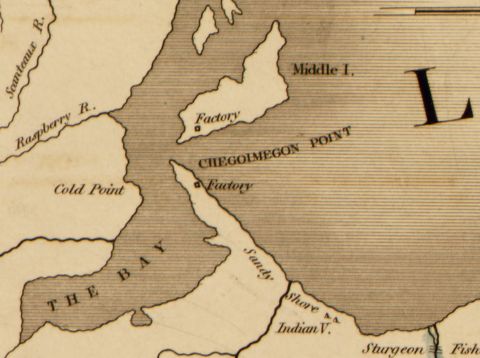
Houghton Point aka “Cold Point”,“Stony Pointe” , and “Point Prospect”.
~ Detail of Map of Michigan & Part of Wisconsin Territory, Exhibiting the Post Offices, Post Roads, Canals, Rail Roads, &c from the 1839 Burr Atlas of Postal Maps.
It is very strange you did not receive any letters from me before father came away as I had sent, certainly three – some of which you may have got before now. And I got but two short letters from you and none from your father after you left me. He wrote to Mr Burr when first taken sick and I heard nothing more from him untill one reached us of Oct 3d saying he wished me to meet him at Sandusky as he was too sick to get to L. Of course, I suffered a good deal of anxiety to know what had become of him and how I was to get home alone – supposing he had gone home without sending me word – I had been so long waiting to hear from him that I had concluded to start in company with Miss Julia Hyde, when I rec’d his letter.

Detail of early settlements and footpaths near Houghton Point from the Barber brothers’ 1855 survey of Chequamegon Bay. Giles and Allen lived with the Maddocks family during 1856 and 1857 at what is now the Houghton Falls State Natural Area.
I had promised a visit to Mrs. Baker at Janesville, so not knowing how soon he would be here, or that he was much ill then, I concluded to stop there and I started Thursday morning from L – and spent three days at Ja – left there Monday at Midnight – that being the express train expecting to get here the next eve but did not till Wed Morning 4O.C.. There being but no train each day from Toledo to this place. I got along very well alone – without losing any thing of consequence. I am afraid that carpet-sack of father’s will never be found tho. Uncle H has written to some one who was on the boat – whom he knows and perhaps it may come again. If not it will be one more loss added to the many we have suffered within two years. When the tide of misfortune will turn with us is yet in the anxious and uncertain future. I yet hope our lives will all be spared to meet again. When I left Lancaster many people were having a sort of influence which they called “colds”. Grandpa – Thode Burr and Mary B. had it and since reaching here Martha has sent a letter saying that Addison – Mame. Lil and Em. in her house – Mother and Lucy – Lib and the two youngest children, and Mary Parker – and Father at Allen’s, Mr. Phelp’s son quite sick; and about half the people in town had the disease. I had the good luck to escape it entirely, tho’ I rode to Boscobel in the stage the worst day there has been this fall. I am afraid we shall not be able to go home without exposing father so much that he will be very sick. I am sure he cannot recover sufficiently to start with safety in less than four weeks if he has very good luck and no relapse on account of the season. But if good nursing & good medicine can cure him he will be well before winter.
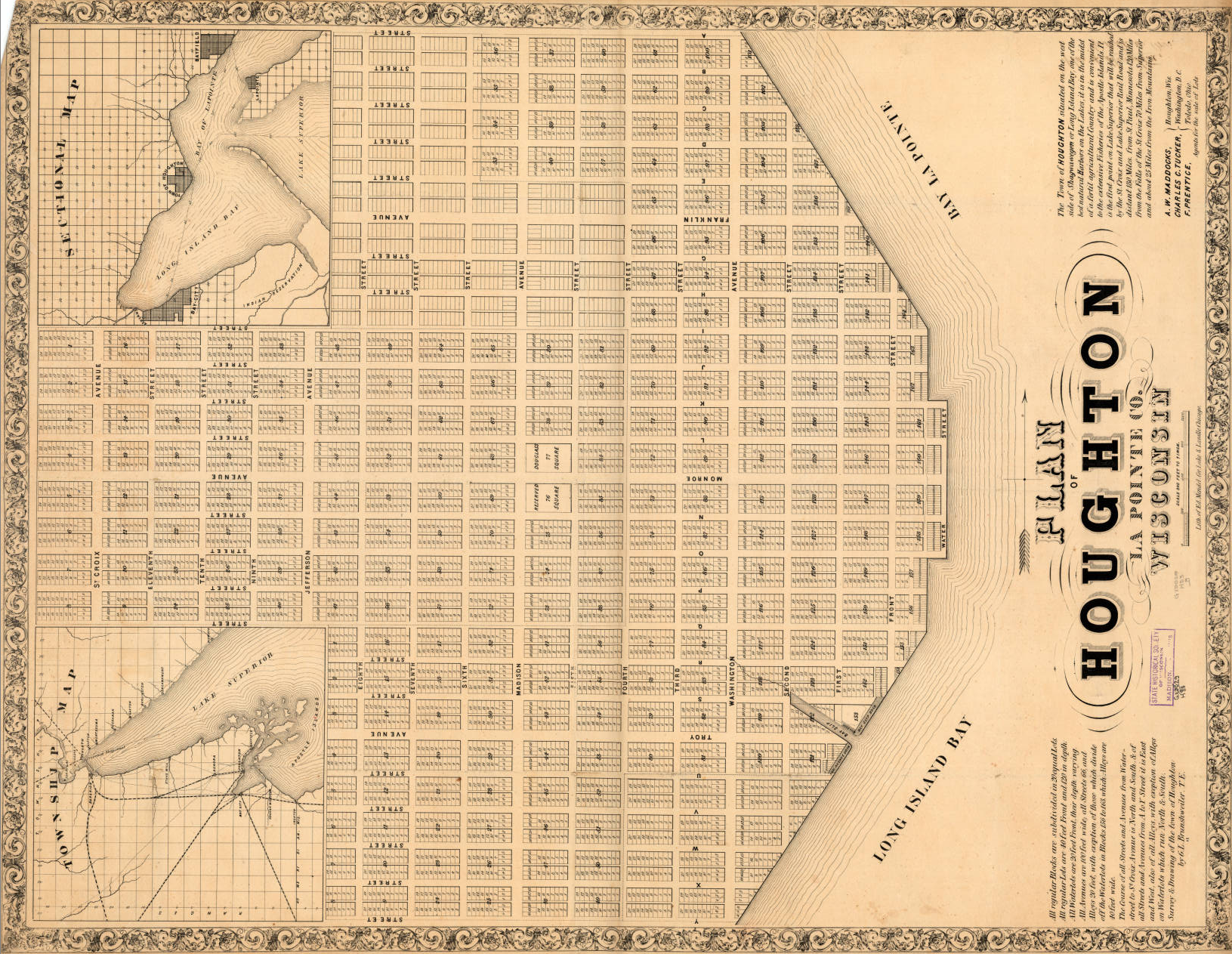
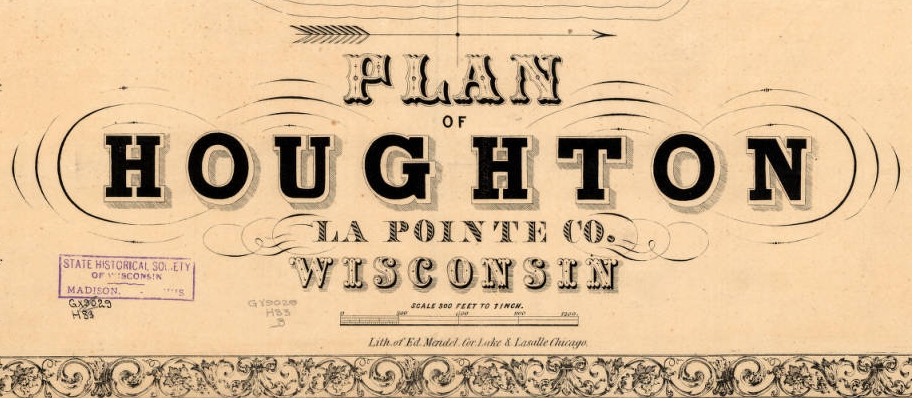
Plan of Houghton, La Pointe County, Wisconsin, 1858.
~ Wisconsin Historical Society
Aunt Emeline is absent, with Frank at Columbus, but the rest of the family are here and show us every kindness. This is a most delightful – comfortable and convenient place to be sick in, if one must be sick. How I wish I could think of our house as possessing half the attractions for a family residence that this does. But, poor as it is I should be very glad to see it once more and be where I could call it home.
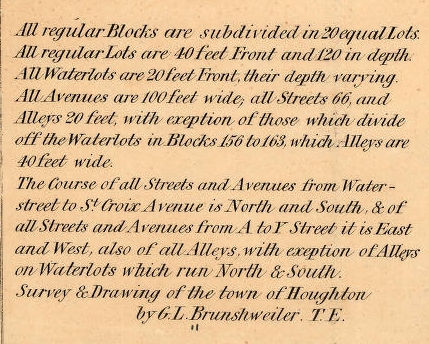
“Survey & Drawing of the town of Houghton
by G. L. Brunschweiler, T.E.”
I am sorry to hear that you have had to wait so long for your money – consequently could not go on with your work. I do hope you will not try to stay there through the winter unless you are sure of money, and that there will be plenty of provisions to be got at. What could have been the reason that your money did not come to you? I did not know that Uncle Sam has suspended payment or lost by the failure of the banks. Perhaps you did not keep reminding them of your case or give them your “address”.
You must write oftener to me and give me an account of your affairs – of all your pleasures and your pains – your disappointments and vexations and be assured no one can feel a deeper interest or more truely sympathize in all that concerns her you than your affectionate parents.
G. A. Barber and M. G. Barber
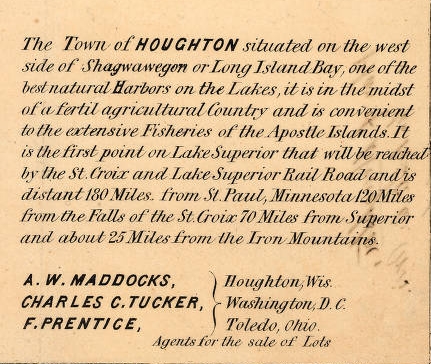
“A. W. Maddocks – Houghton, Wis.
Charles C. Tucker – Washington, D.C.
F. Prentice – Toledo, Ohio.”
Your father wishes you to say to Mrs. Maddocks that he feels under infinite obligations to her for the kindness shown him while sick at her house – that he wishes to express a thousand times more thanks than he was able, when parting from her in the Steam boat, to do. I congratulate you on having the privilege of making it your home at so nice and comfortable a place, with such kind people as father describes those to be. May you have the good fortune or good taste and disposition to make your presence in that, or any other kind hearted family, agreeable – is the wish of your Mother.
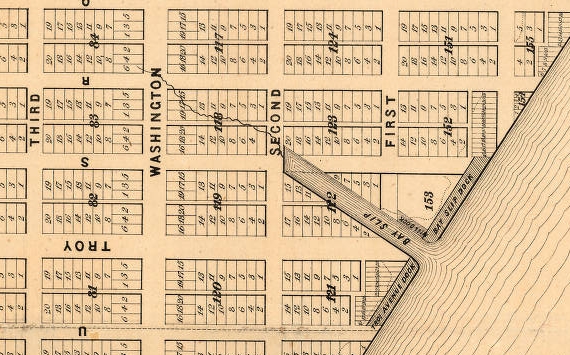
Houghton Falls State Natural Area within the Town of Houghton.
Monday morning
Your father rested better last night than before and had no fever thro the night but sweat a good deal as before – is very cool and comfortable this morning. Has some appetite – does not like to get up as it hurts his limbs. But much less than when I first came here.
Sandusky Nov 1st 1857
Dear Son,
Last sunday I wrote you about your father’s sickness and hope you have rec’d it, or will in good time; but as my letters of the past summer have failed wholey to reach you, perhaps the last has also failed. I shall continue to write to you often while he continues sick – and unless while navigation lasts and you may direct yours here until the last boat leaves your place as I see no prospects now of your father’s being able to move on for some time to come. I told you about the chill he had which made me fear he had got a regular chill fever but he did not have another tho he had pretty severe intermittent fever for three days last week. – indeed it continues somewhat yet, but much lighter. But his lameness is much worse than when he left you – that is – he cannot walk or step because his limbs are so painful and much weaker than when he had more fever. I believe he would never have got here alive had he not been sustained by tonics and morphine, but they would never have cured him, and I do think that had he fallen too sick to get here and had employed another Alopathist he would have gone into a typhoid fever and probably have died, as did the hon. R.C. Benton Sen. a short time since – at Rockford Ill. I met his son – our Johnson teacher one at Janesville who told me the sad news. – He was informed of his father’s sickness but did not reach there ’till after his death. His body was carried to Vt. for interment.
Nov. 2
~ “Business Directory” published in the Superior Chronicle, June 26th, 1855.
Your father wishes to ask you if you know anything about that Geo Perry concern – the present shape of it. And if you have heard any thing farther from the Aminacon claim?
Did you get the money of Jack so as to save your compass? If so – how does it prove? Has Herbert got home since yet? If so, how do the boys fare – do they get any money of him? Does old Whacken let John have his paper? Do you hear anything from your money?
When father left the boat at Detroit he told the porter to get his Carpet bag in his room and send it ashore with his trunk – showing him the trunk. – but when he got to the Michigan Exchange it was not to be found – neither at that house nor any other in the city. In looking for it he was detained so as to lose the boat for Sandusky, Friday morning – Saturday he started in a carriage but was told at the wharf by the driver that the boat would not go – (had not arrived) till afternoon, so he was taken back again when soon word came that it had came, but before he could get started – he being unable to walk – it was off again, so he was obliged to stay ’till Monday.
Thus he was detained nearly four days – sick and lame and obliged to climb a long flight of stairs and take long walks to his meals and other necessities, which all together brought on his fever and rheumatism in the muscles worse than ever. He thinks it almost a miracle that he got through so long a journey – sick as he was when he left you, and without any one to assist or care for him – alive. His lameness is now in the left limb – the other being quite free from pain when kept in a horizontal position, but both pain him extremely yet if put down so that he does not attempt to step on his feet. Ham, Jay, and I brought him up stairs last Saturday where we have every thing we need for convenience and family are all as kind and attentive to one wants as people can be. I do not believe there is any better family, or one happier, than this. It is two weeks today since father came here and I know not how many more he may have to stay – the prospect looks rather dark for a speedy departure.

The “Geo Perry concern” related to Albert McEwen’s death and fraud during the 1856 LaPointe County election. This was investigated by the Wisconsin Assembly.
~ Journal of the Assembly of Wisconsin, Volume 9, 1857, page 191.
We got a letter from Am. Saturday in answer to one from me here, says he is well but I should judge he had not done much this fall but watch and wait for us. I do not wonder the poor boy is out patience as well as every things else, as he says.
Write often to your afflicted parents.
G.A.B. and M.G.B.
Sandusky Friday Nov 13 – 1857
Dear Son.
You will at once perceive that we are stationary since I wrote you last. And when we shall be able to move on, is as much a question of uncertainty as ever. Your father remains sick yet – and I cannot – dare not say that he is even convalescent, tho’ I have a little more courage to think that the medicine now being administered is breaking up his fever. He has had a most singular sickness – having – as I think – more or less fever – with or without chills every day – probably since he was first taking – certainly since coming here. [??] the Dr would not acknowledge – or believe it because his visits would be in the forenoon when the intermissions would occur. But the past week he convinced him that chills and fever do actually exist as he has been [presedest?] to break it up. His sickness is so unlike anything in the experience of the Dr. that he appears to be entirely mistified with [reward?] to the proper course to pursue. I have, and do, doubt his judgement – and sometimes have even put a harsher construction upon his course and doubted his honesty. But he has all along said he had not the least doubt of his ultimate recovery tho it would take considerable time to entirely remove his lameness. As to that lameness I hardly know what to say. He is now free from soreness and only his feet swolen; but he cannot straighten his knees as the cords appear to be contracted and are painful when strained and if his feet are brought lower than his body it brings on the same old tearing pain in the muscles.
But I believe that when his fever leaves him and he begins to gain strength his limbs will improve fast. This week past I have felt more discouraged than ever, as the chills would come on every day about noon – continue an hour – sometimes with a hearty shake – then fever – pulse 120 hr. m. – then a hot sweat most of the night with pulse at 85 at the least pain.
This lasted about 5 days – But the Dr has at length “come in with a Tonic” which appears to work right. It is the most powerful sweating medicine I ever saw. He has taken it two nights and one day – and now the 2nd day – 3 P.M. – he has fairly escaped the chill and fever. I feel greatly encouraged – that he is in a way to recover. He has all the time been quite confined to his bed except as he could manage to get into a great chair once a day and sit up – from two hours to half an hour – this several days he has not got in the chair as he was unwilling to exert himself so much. I have been with him – his only nurse – night and day for 3½ weeks, and I hope and expect to granted health and strength to continue to perform the duties of nurse so long as he shall need my assistance. I cannot but think that he was in just as good condition to receive the medicine, which is working so well over two weeks ago – when the billious fever first left him, as he was two days ago. But the Dr thought not, as his limbs were so bad then, and it might make them worse. It has been altogether an unique case, and the Dr has appeared liked one groping in the dark.
I told you in my letter of last week that father lost his carpet-bag – and intended to tell you to see if it was not returned to La Pointe and left there – he thinks the label on it directed there – tho’ at first he said it was to Lancaster. He can hear nothing from it since and I fear it was stolen by the darkies on the boat. This has truely been an unfortunate year for us as well as for thousands of others.
1872 cartoon of Wisconsinite Carl Schurz by Thomas Nast.
Wikipedia.com definition of a Carpetbagger:
In United States history, a carpetbagger was a Northerner who moved to the South after the American Civil War, during the Reconstruction era (1865–1877). White Southerners denounced them fearing they would loot and plunder the defeated South. Sixty Carpetbaggers were elected to Congress, and they included a majority of Republican governors in the South during Reconstruction. Historian Eric Foner argues:
“… most carpetbaggers probably combine the desire for personal gain with a commitment to taking part in an effort “to substitute the civilization of freedom for that of slavery”. … Carpetbaggers generally supported measures aimed at democratizing and modernizing the South – civil rights legislation, aid to economic development, the establishment of public school systems.”
“Carpetbagger” was a pejorative term referring to the carpet bags (a form of cheap luggage at the time) which many of these newcomers carried. The term came to be associated with opportunism and exploitation by outsiders. The term is still used today to refer to a parachute candidate, an outsider who runs for public office in an area where he or she does not have deep community ties, or has lived only for a short time.
We get nothing yet from you. Why is it that you remain so silent? I think it probable we may have to stay here four weeks longer – waiting for him to get well. You may direct here if you send by return mail or by any boat.
You cannot know, nor be told the amount of distress in the country this money panic has produced. I presume you do not see the papers so often as we do, and perhaps do not realize at all. You father warns you to be careful what you do this winter. – not to meddle with any thing – in Ironton shares – or any kind of property – even if you can buy it for a “song” – Every thing is “dead broke” and the less you have to do with Lake Superior property, the better.
Father sends his best love along with mine to you and his respects to Mrs. Maddocks and family.
I am very sorry to think that you will stay up in that wilderness this winter. I wish you could get your money – settle up every thing – come down here and go home with us. It would be a great relief to us to have your assistance for your father if he should continue too lame to walk without help.
We are under a great many obligations to Uncle H. and family for their kindness.
It is growing dark, so good night
Mother
Sandusky Dec 6th 1857
My Dear Son.
Yesterday we rec’d a letter from Am. containing one from you. I was greatly surprised and grieved to learn that you had not got one of my letters since you left Lancaster. I have sent you three from there and as many from here. Neither had you rec’d your draft. I am really suspicious that some one watches the mails and steals your letters hoping to get money or the draft – which, it is possible he has taken out – forged your name &c and taken the money out. In such case you might not discover the theft for a long time – and would be subjected to a great deal of trouble in consequence. I shall have a deal of anxiety in your account this winter, or until I hear that your money has reached you and that provisions are to be had at reasonable prices – which I fear they will and be this since the loss of that new boat must make quite a difference with that region in supplies.

American carpetbag circa 1860; wool with leather handles.
~ Wikimedia.org
I have before written you an account of your father’s journey and continued sickness which you may have yet [??] now. Lest you have not I will briefly say that he got safely to Detroit where he lost his carpet-sack – was detained there three days – arrived here Monday night 19th ult. Oct. 19th where he has remained ever since, confined to his bed. The fatigue of the journey probably somewhat increased his lameness which has been very severe, and he has not been entirely free from chills and fever and sweats until the last week. He has been improving fast for a few days, but just now he is having a little more fever which I presume is caused by some impending diet – either in quantity or quality.
His disease – a very uncommon one – is, in fact, inflamation of the veins extending from the Loins throug the whole limbs – the left much the most – to the toes. He has not been able to put his feet to the floor without extreme pain since he got here, until the last week, and even now, but a few minutes at a time. The cords under the knees have been considerably constrainted but are getting relaxed a little so that his legs make nearly straightened, tho he cannot begin to bear his weight on them.
The disease has been so complicated and so badly treated before he got here that the Dr has been very much perplexed with it. If you have not got my former letters you do not know that we have had a Homeopathist – one whom Uncle H. and Aunt B. think knows enough for all cases but we think that had he possessed a knowledge of anatomy equal to his partner in business who has called twice with him of late, he would have discovered the seat of the disease at first from the symptoms then apparent. But for four weeks he seemed to be in a state of uncertainty, and baffled at every step. But since he discovered the seat of it he has treated it with very good success.
Your father is much reduced in flesh and strength. I cannot now give you a full description of his case but when he gets able to write much I presume he will amuse himself by giving you the particulars if you should feel interested in the subject. Uncle H and family are very kind and obliging and we have every thing our necesities demand at present, but that does not make me contented to remain so long from home. I wish to be in my own house, but it is impossible to leave here until he can walk enough to help himself a little. We have been here 7 weeks, and I fear it will be many more before it will be safe for him to leave or proper for me to leave him for others to wait on. My health is very good so that no one has had to assist me day or night, in nursing.
Your Aff’nt Mother
I suppose this will never reach you unless I direct to some other person for you.
All well at Lancaster last Sunday. Monday morning Aunt Lucy saw a fine little daughter added to her family.
Sandusky Dec 18th 1857
Dear Son
~ Wikipedia.com
You will see that we are here yet, now nearly 9 weeks since I landed here in an almost insensible state from the effects of morphine which I had to take constantly to allay or drown the pain in my limbs. I have been quite sick much of the time. Three or four weeks were spent in treating my sore before the [rest seat became?] of my disease was ascertained, since which time there has been steady progress toward health. My legs had become crooked at the knees, absent at an angle of 45*. My ankles and feet swollen, white, cold & as useless as though made of putty, but I found the pain that had so long affected them was gone & by much exertion, rubbing &c I got so as to bear any weights, & [thoutes who?] crutches, & I have now got so that I can go twice the width of the house at a time on them. My appetite has returned & I am gaining rapidly. My real disease was what is called Spormator [hea?] or a disease of the Spormation vessels or cord on the left side of my body, which the Drs & your Uncle Ham think was the origin of my sickness & all my pain. Sir Astley Cooper [in thing?] authority, giving all the symptoms of my case. We hope to be able in a week or two to go home to Vt. Your mother wants to start in my present helpless condition when I cannot stand alone in a minute without support to save my life, but I have sworn that I will not go to be jostled around & in the can till I am better able to take of my self than now. I cannot get up or down stairs or sit at all weight with crutches, & as neither of my legs are reliable I assure you it is ticklish business to dare go on them (the crutches).
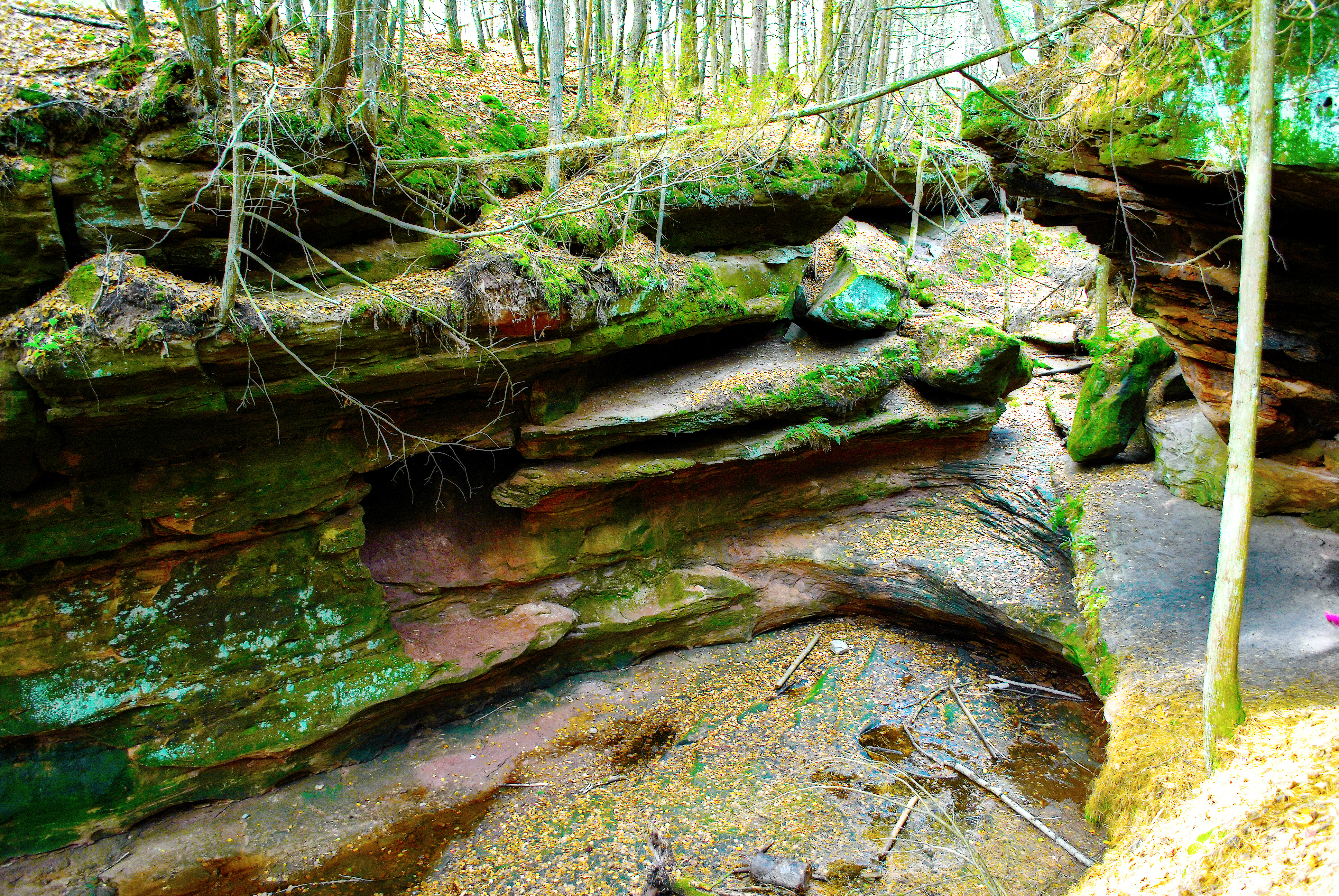
Echo Dells at Houghton Falls State Natural Area.
~ Shared under Creative Commons from Aaron Carlson © 2011
Coming down the lakes from La Pointe I had a pretty hard time of it, was quite sick, had chills, kept my berth most of the time, & when I got to Detroit I was detained by losing my carpet bag and one thing & another because I was unable to help myself, from Thursday P.M. ill Monday A.M. when I came here. Lucky that I had such a refuge to [want?] to in my extremity, had I tried to reach home, my life would have paid the forfeit of I might have had a long sickness among strangers without any of the comforts or conveniences I now enjoy, and insured an enormous train of affection.

Map inset of Chequamegon Bay with Town of Houghton, LaPointe, Bayfield, Ashland, Bay City, and the LaPointe Indian Reservation.
We get letters from Amherst occasionally, he is well & in good spirits boarding at Mr Griswolds, is very anxious for our return to Vermont. By him I learn that Ambrose Chase died after about an hour illness in Nov, & that John Burcham of Johnson died still more suddenly being found dead in the privy. Old Mr Dorsker died lately & that is all he has told of to us. On opening my new trunk here I find some books are missing. Who do you suppose is the rogue? I hope he will russ some amusements & instruction from the books, if so I am content.
Frederick Prentice (“Man of Money and Mystery”) was an “Indian interpreter for Indian agents and traders”, and owned extensive properties in the Chequamegon Bay region during the 1850s. Prentice started the City of Houghton around the same time he cofounded Bay City (Ashland) during 1854, purchased the Buffalo Tract (Duluth) from Benjamin Armstrong during 1856, and cofounded the City of Houghton (near Washburn) during 1857. Prentice returned to Houghton in 1887 and organized the Prentice Brownstone Company, becoming “the most famous quarryman in northern Wisconsin”. Houghton had a “population of about 250 people, a school house and a sawmill with 25,000 foot capacity” by 1888.
~ This portrait and a profile of Frederick Prentice (the “first white child born” in Toledo, Ohio) is available from History of the Maumee Valley by Horace S Knapp, 1872, pages 560-563.
~ “Business Directory” published in the Superior Chronicle, June 26th, 1855.
August 22nd, 1857
“John H Osborn,
Banker and Land Agent,
And Dealer in Exchange, Superior, Wis.
REFERENCES, — J. B. Ramsay & Co., Cincinnati; J. R. Morton & Co., do; E. Jenkins & Son, Baltimore; A. R. Van Nest & Co., N. Y.; Heston & Druckla, Phila; Holiday & Coburn, St. Louis; John H. Richmon, Esq., Maysville, Kentucky.”
Have you recd your draft yet? Was your compass saved to you? Have you got at work on the reservation yet? If so how do you prosper? How does Herbert make it, does he still remain agent? Does he sell any shares, if so, for how much? Is the work still going on at the City of Houghton, or has the news of the general crash and prostration of all kinds of business failed of reaching Stony Pointe? I recd a letter from Prentiss last week who says, there are some going from Toledo next spring to live there, & he appeared to feel as well as ever.
He said he sent 50 bbls Ham & a lot of Pork to Detroit to go up, but it arrived too late for the last boat to Lake Superior. I have written to Hayes that if the Ammanicon case is decided against me to take an appeal to Washington at once & I will go there & see if testimony has been supplied or any unfair things have been done by the clerks in the office.
I have now sat up [little?] hours, read Douglas’ speech & written this much to you but I feel that I have over taxed my powers and must go to my heated bed for rest. Douglas has come out against the Administration policy toward Kansas & will make a split in the party not easily healed. I will send you his speech.
Tell Mr. Maddock’s folks that Judge John Fitch of Toledo was shot yesterday [????] once of his family by one T.G. Mellon, the ball entering his mouth, lodging in the back of his neck, some hopes are entertained of his life. If this is a ½ sheet it is as long as your letters. Be careful of yourself. I remain your affectionate father.
G.A. Barber
Give my respects to Mr & Mrs Maddocks, & to John Cosborn.
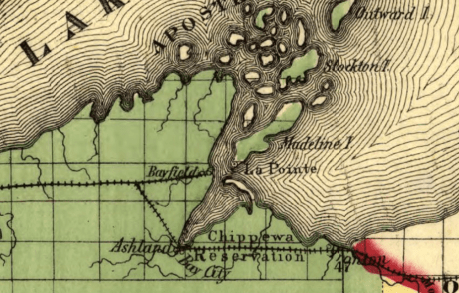
Detail from the 1857 “Township map of Wisconsin showing The Milwaukee & Horicon Rail Road and its connections“. The town-sites of LaPointe County shown here are Ironton, Boyd’s at Old Fort (mislabeled as “La Pointe”), Bay City, Ashland, and Houghton (mislabeled here as “Bayfield” and later as “Lower Bayfield” in the 1865 Colton Atlas). The railroad shown on the LaPointe Indian Reservation correlates to Barber/Wheeler/Stuntz details from “the Gardens“.
~ Library of Congress
To be continued in the Winter of 1858…
Barber Papers: “Ironton” Summer of 1856
December 16, 2015
By Amorin Mello
This summer was a time of trauma for the Barber family immediately following the death of Augustus Hamilton Barber at the mouth of the Montreal River near his town-site claim of Ironton during the Spring of 1856. Augustus had unfinished business on Lake Superior, which was being attended to by his brother Allen and father Giles in mourning.

Item from the Superior Chronicle, August 19th, 1856. Ironton was platted during February of 1856 according to the Bayfield Mercury, August 15th, 1857.
The Summer of 1857 was also a when the town-site claims of Ashland and Ironton were being established and platted by merchants near the east and west borders of the Bad River Indian Reservation. Several memoirs about the early days of Ashland and Ironton will be featured in this post to provide context due to copies of certain letters being missing from the Barber Papers. Only one letter was archived from the Summer of 1856 in the Joel Allen Barber Papers, located at the end of this post.
Oral history traditions from the Lake Superior Chippewa tell about how the language describing the exterior boundaries of the LaPointe Indian Reservation were changed sometime between the 1854 Treaty of LaPointe negotiations and when it was ratified by Congress in 1855. According to at least one oral history, both Ashland and Ironton were located within the boundaries negotiated at the treaty.
The Ashland Press
January 4, 1873
—
Ashland! It’s Growth During the Year 1872
A Quarter of a Million Dollars Expended in Improvements.
A Full List Of Buildings—Docks—And Railroad Work
ALL HAIL TO THE IRON CITY
The history of Ashland, full and complete, would require more space, and more labor in its preparation, than we can possibly give it at this time. Nor is it necessary in connection with this summary of its growth during the first year of its regenerated existence, to enter into an elaborate or extended article upon its past fortunes, but merely to give an outline showing its first organization, and a few of the most important items incident to its early settlement. This much we shall endeavor to do in this article, and no more, leaving other and better informed persons to give a full and accurate historical record, hereafter.
July 6, 1933
by Guy M. Burnham
“During the month of February 1854, Leonard Wheeler, the missionary and an Odanah Indian met at Odanah, where Mr. Wheeler then lived, and drove on the ice along the south shore of the Chequamegon Bay, from Kakagon to Fish Creek. It was the year of the great treaty, in which the Indians agreed to cede most of their lands to the United States and to reserve tracts for their permanent homes. The Indians were glad to do this, for only four years before; the government had decided to move the Chippewa to the Minnesota country. William Whipple Warren led a large delegation to Minnesota but like all others who were interested, they much preferred Wisconsin. Leonard Wheeler himself, took up the cudgel of his wards, and practically led the fight to prevent the removal of the Chippewas from Wisconsin, but in 1854, it was understood that some sort of agreement was going to have to be reached, for white settlers were looking to the north, and they need an outlet to Lake Superior. The Indians realized that they would have to do something so Wheeler, the missionary and Little Current [aka Naawajiwanose], the Chippewa, were delegated to look over the south shore of Chequamegon Bay. William Wheeler who was a small boy accompanied his father and the Indian on the trip, says that the Indians furnished the pony and the missionary the cutter, and they drove down past where Ashland now stands, to the extreme head of the bay. From the head of the bay region, at Fish Creek to nearly where Whittlesey afterwards built his first house, there was a straggling Indian settlement, which the Indians called Equadon.
Every foot of land from Fish Creek to Odanah was Indian Land. It was in this settlement or village, which the wife of Robert Boyd, Jr., told me her father, lived in Equadon, near the many flowing springs, which we now call Prentice Park. The Indians thought the western limits of the proposed reservation of Bad River, should be the west end of the bay, but the missionary pointed out that that would keep the white men from building a city on the south shore of the bay, and that it would be advantageous to the Indians to have such a city built, as it would furnish a market for their furs and other products they might have for sale. Little Current agreed to this, and then and there, the agreed on the western limits of the Bad River Reservation should begin at the Kakagon just as it is now, extending the reservation far enough south to make up for the loss of the frontage from Kakagon to Fish Creek. Asaph Whittlesey frequently talked with Leonard Wheeler about good sites along the south shore and so about four months after the momentous trip of Leonard Wheeler and Little Current, near the end of February. Asaph Whittlesey and George Kilbourne rowed a boat over from Bayfield and felled the first tree, built the first house, establishing the settlement, which was to be known for about six years as Whittlesey. When Whittlesey felled the first tree on July 5, 1854, the land still belonged to the Indians. Three months later, on September 30, 1854, the Treaty of La Pointe was signed, under which Bad River, Lac Courte Oreilles, Red Cliff, the tip of Madeline Island, and Lac du Flambeau were reserved, but it was not until January 10, 1855, that the Senate ratified the treaty, which became a law by proclamation of President Franklin Pierce, on January 29, 1855.
Although Whittlesey built his first house on land, which still belonged to the Indians, there was little danger of the Wheeler-Little Current agreement being disturbed, and Whittlesey became Ashland in 1860. The head of the bay, which then, as well as now, swarmed with fish and game, became a part of the white man’s domain, and this included the Place of Many Springs, Prentice Park.”
~ TurtleTrack.org
Old Ashland, to be properly written up, should be woven into the history of all the country extending from the head of Lake Superior to Ontonagon. This section from the beginning of the first settlements has been intimately connected in all its various fortunes, and its people of that date should be considered as one, and spoken of as the early day pioneers on the Lake. Scarcely an enterprise was attempted that a majority were not more or less interested in, and the early Ashlander was not satisfied with being limited to one small portion as the place of his adoption, but generally considered himself honored only when credited with being a citizen of the “Superior Country,” or as many term it, “of Lake Superior.” Like the old fashioned “Queen’s arm” the early settlers “scattered” terribly, and hence we find them at the present day, posessors of corner lots in exploded townsites, parchment mining stocks, iron lands, copper mines, mineral claims and silver veins, in almost every section of the south shore that has been explored. To enumerate all the enterprises attempted by these enterprising, pushing-ahead, speculating men, would be too great an undertaking for us, but a book, well written, giving a thorough history of their operations, would not only be intensely interesting, but posess a value scarcely to be enumerated. But it is not our purpose to digress. We have to do with Ashland only, and chiefly with its present growth and future prospects.
The Ashland of to-day was formerly Bay City, St. Mark and Ashland, two distinct townsites, located but half a mile apart, the intervening territory being that platted as St. Mark, best known as Vaughn’s Division. Each of these divisions has a history of its own, though of course more or less connected with each other in common interests. These three divisions have, since the new enterprise sprang into existence, been joined together and now constitutes the city of Ashland, all parties interested working harmoniously for the common interest and a general prosperity.
August 28, 1920
“Mr. [William] Wheeler was born at the mission at Odanah and remembers distinctly of a trip he made with his father [Leonard Wheeler] and one of the Indian Chiefs [Little Current aka Naawajiwanose], into the country to establish the boundary limes of the Bad River reservation. The Indians wanted the boundary line at Fish Creek but Rev. Wheeler told them to leave a site where the present city not stands, for he was certain that a big city would grow up and big boats from the outer world would sail into the harbor and that the people would furnish a market for the Indian’s products.”
~ Wisconsin Historical Society
On the 5th day of July, 1854, Asaph Whittlesey and George Kilbourn landed on the bank of Ashland bay, and immediately commenced the erection of a claim shanty, within fifty feet of the west line of Section 5, Town 47 north, Range 4 west, in Ashland proper. The first tree was felled by Mr. Whittlesey, on that day, and by night the first log house, 14×16, was commenced. On the 27th day of August this building was occupied by Mr. Whittlesey’s family. It was used many years after for various purposes, and its ruins can still be found on the bank of the bay. During the same season the small log house near the present residence of James A. Wilson, Esq., on lot 6, block 6 was built, and in November of the same year the largest of the three log houses now standing on the same lot was completed and became the residence of Mr. Whittlesey, which he occupied until the fall of 1857. This house has quite a history. It has witnessed many an exciting and tragic scene, as well as many a pleasant and happy gathering. If its walls could speak, and possessed the genius of a Shakspeare, they would tell a story that would out rival in magic fascination any work of fiction. It was within its walls that the first permanent white settlers in Ashland dwelt. In its spacious room in the winter of 1854, the man of God, the missionary in the cause of Christ, preached the first sermon ever preached on the town-site. The minister was the late Rev. L.H. Wheeler, founder of the Odanah Mission, and a man known as a good and earnest Christian missionary, loved and respected by all the border settlement. It was here that the first ball was given in 1854; the first Fourth of July celebrated, in 1855, some thirty persons participating. It was the first post office, established in March, 1855, with Mr. Whittlesey as P.M. It was here too, that the first election was held, in the spring of 1856, at which time the town of Bayport, (which included Ashland and Bay City and all the surrounding county,) was organized. It was also the scene of a sad tragedy, when Henry Cross, in self defense, shot and killed Robert D. Boyd in 1858. The first Sabbath School was organized in this house in 1858, by Ingraham Fletcher, Esq. It was also, May 31st, 1856, the birth place of Miss Delia E. Whittlesey, the second white child born in the town, the first birth being that of Katherine Goeltz, early in the same month. Many other interesting events might be enumerated as belonging to its history, but space forbids. The old house still remains a monument of Ashland’s former glory.
The first freight ever landed from a steamer in our harbor, was in September, 1854. The steamer “Sam Ward,” Capt. Exsterbrook, brought the household goods of Mr. Whittlesey to Ashland at that time, and they were landed in small boats in the ravine near the foot of Main street.
“The first marriage in the town was that of Martin Roehm to Mrs. Modska, in the fall of 1859, John W. Bell officiating, (music furnished by Conrad Goeltz,)” and a good time generally indulged in by all who participated in the festivities. And here let us state that Ashland was never forsaken by this sturdy veteran pioneer couple. They stood by the place with characteristic German fidelity, king and queen of the deserted village, corner lots and all until the dawn of the new era commenced.
The Indian in his might
Roamed monarch of this wild domain,
With none to bar his right.
Excepting fearless Martin Rhoem.
The first government survey of the territory around the head of the bay was made in 1848, when the township lines were run by S.C. Norris, deputy U.S. Surveyor. It was not subdivided, however, until 1856. The town-site of Ashland, embracing lots 1, 2 and 3, and the N. half of the S.W. quarter, N.W. quarter of S.E. quarter and N.E. quarter Section 5, Town 47, Range 4, was surveyed and platted by G.L. Brunschweiler in 1854, and entered at the United Stated Land Office, at Superior, by Schuyler Goff, County Judge, under the laws then governing the location of town-sites on Lake Superior, December 11th, 1856, for the use and benefit of the owners and occupants thereof, viz: “Asaph Whittlesey, George Kilbourne and Martin Beaser.”
Succeeding the first settlement above mentioned, the population of Ashland increased quite rapidly. During the year 1854 several families moved in. Among the new corners were Martin Beaser, J. P. S. Haskell, Austin Cousen, John Cousen, Conrad Goeltz, A. J. Barclay, Capt. J. D. Angus, G. L. Brunschweiler, Frederic Prentice, Adam Goeltz, John Donaldson, David Lusk and Albert Little. Of these a few remained only a short time, coming merely for temporary purposes. 1855 brought a still larger increase of inhabitants, among them M. H. Mandlebaum (now a resident of Hancocck, Mich.), Augustus Barber (who was drowned at Montreal River in 1856), Benj. Hoppenyan, Chas. Day, Geo R. Stuntz, George E. Stuntz, Dr. Edwin Ellis, Martin Roehm, Col. Lysander Cutler, J. S. Buck, Ingraham Fletcher, Hon. J. R. Nelson, Hon. D. A. J. Baker, Mrs. Conrad Goeltz, Henry Drixler (father of Mrs. Conrad Goeltz, who died in 1857, his being the first death in town), and Henry Palmer. In 1856, Mrs. Beaser (now Mrs. James A. Wilson) arrived, also Oliver St. Germain and family, still here; Mrs. J.D. Angus and family, John Beck and family, Schuyler Goff (afterwards County Judge) and Chas. E. Tucker. In 1857, Mr. Eugene F. Prince and family, A. C. Stuntz and family, Wm. Goetzenberger, Geo. Tucker and others arrived.
On the 25th of October, 1856, Hon. S.S. Vaughn pre-empted Lot 1, Section 32, Town 48, Range 4, and the East half of the N.E. quarter and the N.E. quarter of the S.E. quarter Section 5, Town 47, Range 4, the same being now Vaughn’s Division of Ashland. In 1856 Bay City was surveyed and platted, the town-site being owned by a stock company, of which Dr. Edwin Ellis was the agent. Under his direction a large clearing was made, a store, hotel and several substantial buildings created. A saw mill was also commenced, the frame of which is now standing near the east end of the new bridge across Bay Creek creek. During the same year and the next following improvements were being rapidly made in old Ashland. Martin Beaser, Esq., who was the leading business man and property holder of the place, gave it its name, (after the homestead of Henry Clay, he being an ardent admirer of that eminent statesman,) and erected the store and residence now occupied by James A. Wilson, Esq. Eugene F. Prince built his present residence, and quite a number of dwellings were put up, several of which are still standing and have been fitted up and occupied, while others have been destroyed or fallen into decay. Temporary docks were built both at Bay City and Ashland.
The Ashland dock was built by Martin Beaser and cost about $4,000. Both however were allowed to rot down and wash away. Main street and a portion of what is now Second street, as well as a number of avenues were opened and improved. Additions were also platted, and most prominent being ”Prentice’s Addition,” in 1856, and the Ashland of that day presented a live and vigorous aspect, containing as it did a thrifty and energetic class of citizens.
“With the continuing reports of minerals in the area and some mining being done, another group of hopefuls sought recognition as a corporation and received charter to begin mining. This corporation was formed in Milwaukee and was known as the Wisconsin & Lake Superior Mining & Smelting Co. Its charter was granted in 1856 by the State of Wisconsin, and with the charter the company was granted about 1,900 acres of land in the Penokee Range, some of which is now in Iron County and some in Ashland County.”
[…]
“The other two villages planned for their mining venture were Springdale and Lockwood.”
[…]
“Ironton was the headquarters for the officers for only a short time. They moved their office duties to Ashland shortly after getting established.
The names of some of the merchants from Ashland who planned to be the suppliers for these villages included McElwin [McEwen], Herbert and Mandelbaum. Herbert’s name is mentioned in other areas as well as the name of Mandelbaum, who is mentioned in the history of Ontonagon also.”
~ A Historical and Archaeological Reconnaissance of the Saxon Harbor area, Iron County, Wisconsin by John F Wackman et al, pages 57-58.
This was in an era of speculation and Lake Superior the theatre of many a town-site and mining operation, The Penoka Iron Range had begun to attract the attention of eastern capitalists, while the Copper Range and the mineral regions of the Porcupine Mountains had drawn thither a number of daring adventurers, who sought their fortunes in the discovery of valuable metals. Railroads too were projected then, and the brave surveyors with their compass and chains were penetrating the forest and engineering a path through a trackless wilderness to the land of civilization that lay far away to the south. Ashland then, as now, was the center of attraction, and to possess corner lots and broad acres was to realize one’s fortune.
But Ashland was not alone in its glory. Superior City, at the head of the Lake; Red Cliff, Bayfield, Houghton and La Pointe, among the Apostle harbors; Ironton, near the mouth of Montreal river on Raymond Bay; and Ontonagon, Copper Harbor, Eagle River, Hancock, Houghton and Marquette, on the peninsula of Michigan, were each points of interest and struggling for an existence, their claims being urged by their proprietors with characteristic energy. Money was lavishly expended; mining both of copper and iron largely engaged in and the whole country was apparently undergoing that rapid development that leads to general prosperity and thrift.
[…]
The Ashland Press
February 26, 1926
—
CITY OF ASHLAND IS 72 YEARS OLD TODAY
May 3, 1910
“In the year 1855, Dr. Edwin Ellis located upon land to the eastward of Whittleseys. Instead of locating under the town site laws, Mr. Ellis entered a homestead and began to literally hue out his path to civilization. Several of the doctor’s friends joined him and located on adjacent land and soon there was a plat filed of the town of ‘Bayport.’ After a few years of continuous hardships and disappointments, the hardy pioneers became disheartened and some even moved away. The plat of ‘Bayport’ was declared vacated, but when business began to revive and new settlers came in 1872, the old town plat was revived and reinstated by Dr. Ellis as Ellis Division of the city of Ashland.”
~ Wisconsin Historical Society
The city of Ashland is seventy-two years old today, for on Feb. 24, 1854, Dr. Edwin Ellis landed in Ashland, at a spot where Whittesey Avenue now is located. Dr. and Mrs. Ellis had come from Maine and stopped at St. Paul, with Mrs. Ellis’ brother. From St. Paul, Dr. Ellis walked all the way to Superior. Then to Bayfield, then to La Pointe, in the ice, and then on to Ashland. He constructed the first log cabin at what is now Whittlesey Avenue. Asaph Whittlesey and Kilbourn, the next white men to come to this part of the country, arrived in June or July of the same year.
In 1855, Dr. Ellis walked to Dubuque, Iowa to file a petition to have this country surveyed. The trail which he took was know as the St. Croix Falls and from there Dr. Ellis took a steamer down the river to Dubuque. In 1856 he went to St. Paul and brought Mrs. Ellis and the two girls back with him.
The American Fur Company was situated at La Pointe, at this time but had very little to do with the mainland. The people in the early days sent to Chicago for their supplies. As there was always somebody walking to St. Paul they would send their orders by one of these men and from there the mail was taken to Chicago. The suppliers would come up on the last boat which came up Lake Michigan to what is now the Soo Canal.
Twice the boats on their last trip were wrecked and the early settlers would be without supplies for the winter.
The principal food was fish. Deer at that time always left the country during the winter.
Martin Beaser and party arrived here a short time after the Ellis’ but the Beasers settled on the shore where Beaser Avenue is now situated. This whole country was a mass of woods and the Beaser home. which is now the Jack Harris home, was practically the only house at what is called Old Ashland. When the Ellis Family visited the Beasers they had to hitch up the oxen and go through the dense woods.
Scott Ellis was born August 24, 1824, which is also the birthday of Queen Victoria. He died May 3, 1903, at Ashland, after watching the city grow from a dense forest to the present city.

July 28, 1877
Recollections of Ashland
“OF WHICH I WAS A PART”
Number V
This memoir was ghostwritten for The Ashland Press by Doctor Edwin Ellis.
Mr. Dear Press: – As has been already stated, the land on which Ashland now stands, had not, at the time of its first settlement, in 1854, been surveyed. The town lines had only been laying off the country into blocks six miles square.
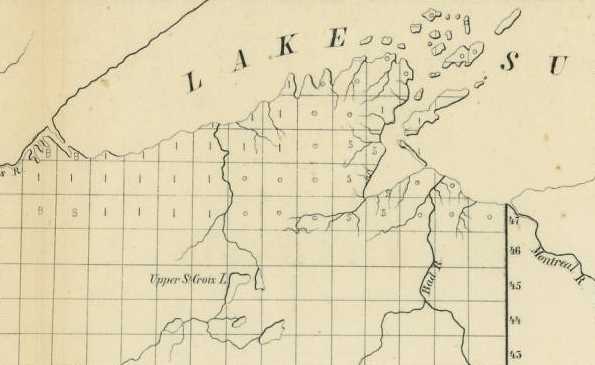
Detail from Sketch of the Public Surveys in Wisconsin and Territory of Minnesota by the Surveyor General’s Office (Warner Lewis), Dubuque, Oct. 21, 1854.

“In 1845 [Warnen Lewis] was appointed Register of the United States Land Office at Dubuque. In 1853 he was appointed by President Pierce Surveyor-General for Iowa, Wisconsin and Minnesota and at the expiration of his term was reappointed by President Buchanan.”
~ The Iowa Legislature
Wisconsin, Iowa, and Minnesota, then were embraced in one Surveyor’s District, with the office at Dubuque, Iowa. It was the duty of the Surveyor General to provide for the details of the Government Surveys in his district, as fast as the settlement of the country might require. Gen’l. Warner Lewis was then Surveyor General of this District.
~ The National Magazine; A Monthly Journal of American History, Volume 9, page 23.
No steps having been taken or any order given for the survey of the shore of Chequamegon Bay, in June 1855, Dr. Ellis left in an open boat for Superior, then on foot through the wilderness to St. Paul, following not far from the route over which many years later was constructed the Lake Superior & Mississippi R.R., – then an early settlement here induced Gen. Lewis to order an immediate subdivision of Towns 47 and 48, North of Range 4 and 5 West, both sides of our bay, and all the lands on which squatters had settled.
Early in September of that year, (1855), Augustus H. Barber began the survey and pushed the work rapidly, so that he had completed 47 and 48 of Range 4 in October, and the returns had been made and plats prepared and forwarded to the local land office by the first of December.
The Pre-emptors now, for the first time, could file claims to their lands and receive assurance that they were likely to be the owners of their homes.
During December many pre-emption claims were filed, and during the closing days of the year and in the first days of 1856, quite a number proved up those claims and received duplicates, upon which patents were afterwards issued. These were the earliest titles to the present site of Ashland. Unlike many towns in the West at that period our site was not cursed with complicating claims, and it is cause for congratulation that Ashland property has no cloud upon its title and that every buyer may, with little trouble, assure himself o this fact. The title to a portion of the site of Superior was bitterly contested involving years of delay and thousands of dollars of cost and much acrimony of feeling; and it is possible that this may have had its influence in carrying the railroad to Duluth rather than to Superior. Quarrels over title are a curse to any town, especially a new one.

“IN MEMORY OF
AUGUSTUS H. BARBER
of Cambridge, Vt.
U.S. Deputy Surveyor
who was drowned in Montreal River.
Apr. 22. A.D. 1856
Aged 24 yrs. & 8 ms.”
~ FindAGrave.com
Of Augustus Barber the early Surveyor of this vicinity, who is unknown to a larger part of this generation, a few words ought to be said:
He was a native of Vermont of an excellent family. At this time he was 22 years of age, well educated, gentle as a lady, refined and easy in his manners and very amiable in his temper. Like many other young men from the east, of active enterprising habits, he had come into this outer verge of civilization to make this his home and to grow up with its institutions. He was the nephew of Hon. J. Allen Barber, of Lancaster, in this State, who once represented his District in Congress. He continued in the surveys of this part of the Lake until in the summer or fall of 1856, when he, with others, conceived of the idea of founding a city at the mouth of the Montreal River – the dividing line between Wisconsin and Michigan about thirty miles east of Ashland.
“According to the Bureau of Public Lands, Department of the Interior, the land surveys were not completed in that area [Ironton] of Wisconsin nor offered for sale to the public until November 18, 1866.
[…]
“A practical location for an operating headquarters was chosen at the site of the Indian settlement on the shore of Lake Superior on that piece of level ground where there were mountains on three sides and through which a creek ran. The village at this location was named Ironton, and because of the activities planned for it and two other mining locations farther inland a group of merchants from Ashland assisted in building up this boat landing and supply headquarters. A dock was built and several buildings for warehouses and some living quarters.”
~ A Historical and Archaeological Reconnaissance of the Saxon Harbor area, Iron County, Wisconsin by John F Wackman et al, pages 57-58.
The iron range approaches nearer the Lake at that point than it does at Ashland. And though the country is much rougher and more difficult for construction of roads than between Ashland and the Range, yet the shorter route, it was argued, would more than compensate for the heavier grades. –The town was laid out and platted by Mr. Barber.
As indication of its future chief industry, as the entry point of the iron range – it was called “Ironton,” with the accent on the second syllable. Great expectations were entertained of the future importance of the place, and much land was entered in the vicinity.
The Montreal, not far from its mouth, leaps down a perpendicular descent of nearly a hundred feet presenting a wild and picturesque view. Being an enthusiastic lover of the beautiful of nature and desiring to reach a position underneath the falls, Mr. Barber in a canoe with two companions, approaching too close, were drawn in by the eddying whirlpool, the canoe was capsized, and before help could reach him he and one of his boatmen were drowned. his body was recovered and was buried on a sand hillock near the mouth of the same river in whose waters he met his death. Ironton has long been deserted, and Barber’s grave with its marble headstone, is the sole mark of that civilization, which twenty years ago there essayed to lay the foundation of a mart of commerce.
The surf of the waves of the lake in summer and fierce driving snow storms in winter, with solitude presiding over the grand orchestra, are perpetually chanting his mournful requiem, while a fond father and mother on the slopes of the distant Green Mountains are mourning bitterly the early death of their first born son.
Interior Field Notes
Ironton Townsite
La Pointe Indian Reservation
Township 47 North, Range 1 West
November, 1856
Notebook ID: [N/a]
This survey is mentioned by multiple sources, however, the Barber Brothers’ field notes and plat map for Ironton from 1856 are not available from the General Land Office Records or from theWisconsin Public Lands Survey Records. Did Warner Lewis receive them at the General Land Office in Dubuque, Iowa? The search for these survey notes continues.
Selected letters of the Joel Allen Barber Papers
… continued from Spring of 1856.
Superior City Sept 15th 1856
Dear Mother
“Ironton’s potential was very promising. While all the activity was taking place for a mining center, plans were being made by the Milwaukee & Superior Railroad to extend its line northward from Stevens Point to a terminus at Ironton at the shore of Lake Superior, then to continue west to Bay City (now Ashland).”[…]
“Besides the officers of the mining company, several businessmen of Ashland became interested in a railroad between Ashland Penokee Gap.
Some of these men were J.S. Beisch, Martin Beaser, John S. Harriss, I.A. Lapham, J.C. Cutler, Edwin Ellis and T.C. Dousman. This railroad was to be the Ashland & Iron Mountain Railroad. A lot of planning and some work was being done when quite suddenly the Panic of 1857 came on bursting many bubbles and bringing to a halt all of the mining activities, causing an exodus of many workers and a large number of potential settlers.”
~ A Historical and Archaeological Reconnaissance of the Saxon Harbor area, Iron County, Wisconsin by John F Wackman et al, page 60.
I wrote a few words to you a few days ago when I was unwell and had to be rather short. I have since recovered my usual health and will try to write a longer letter, but I am afraid it will be of little interest. I see you are anxious that I should quit the lake. It is not strange that you should wish dread to have me remain here. You wish me to come to [?] to Lancaster or any where but here.
Now to tell the truth I am as much attached to this lake as to any other place and I don’t know how to leave it. I know its disadvantages and privations as well as any one. I know the sweets of a more social life and much do I long for them. I know the luxury of living on a fertile soil in a genial climate and hope some day to enjoy it, but still if my life is spared Lake Superior will probably see me occasionally for a number of years.
You ask me my opinion in preference between a good farm in Grant County and ten miles of forest in this country and be bound to it. But I should not be bound to it if I owned [40/41?] miles and there are many farms about here worth more money than any farm on Lamoille river of twice the size.

Detail of Ironton property with trails to Odanah and the Penokee Mountains from T47N-R1W. This survey map was from Elisha S Norris during 1861.
I hope to visit Lancaster this fall but the middle of winter will see me threading my way back to this wild country. I would like extremely to visit Vermont next winter if possible but I expect my engagements will render it impossible.
I hope you will not dwell too much on the terrors of his country and fancy I am suffering all imaginable hardships. I am never hungry and seldom cold or over fatigued. I like the climate about as well any south of here and would sooner emigrate North west than South East, were I not bound by social ties. Were I to follow agriculture as a source of profit I would not go to Vermont or Grant County.
In regard to my Ironton property I have no hopes of getting you to think as you do.
Hon. D. A. J. Baker was introduced as an early resident of Ashland in our Penokee Survey Incidents series. Baker appears to be in business with the Barbers at Ironton.
“A trail between “Penokee” and Ashland is shown on Stuntz’s map of 1858. An Indian trail between Ironton and Odanah was improved for transportation and communication when land travel was preferred to lake travel or when the lake could not be used. During that same time the trail between Odanah and Ashland was being improved to accommodate heavier traffic. (This road later became a part of Old U.S. 10 and now is Ashland County Truck “A”.)
The original Ironton to Odanah trail began on the west side of the village, ascending the highlands at that point, then followed a southwesterly course paralleling the Oronto Creek but avoiding the obstacles of lowlands or ravines until it reached a point where the headwaters of both Oronto Creek and Graveyard Creek were but a few yards apart. As it passed this narrow strip of land and headed both streams it swung sharply to the west towards Odanah.”
A Historical and Archaeological Reconnaissance of the Saxon Harbor area, Iron County, Wisconsin by John F Wackman et al, page 59.
I may be obliged to sacrifice the whole of it, but it will not be my fault. Mr. Baker sold five shares a few days ago for city lots here which will soon be worth 500 dollars. The opinion of explorers and speculars expressed in deeds as well as words confirm my opinion of the place. I suppose Father writes everything concerning his business here so I will depend on him for that and not repeat it.
I would set a time to come home but the future is so uncertain I fear I should only disappoint you and myself. I never yet planned anything as it turns out. I intended to return to Lancaster last fall but did not. I intended to go down last spring but was prevented by the death of Augustus. If I wait untill next spring before going down I shall go to Vermont at the same time probably. “Man proposes and God disposes.” I can only guess how God will dispose my affairs.
I see that you and Amherst feel rather bitter towards [Dow’s?] folks. I am sorry that is so. It is unavoidable that you should see a great many things that you don’t approve but the sum of my advice is “Let em rip.”
I hope to go to Lapointe and Ashland before long where I am about as well acquainted as at any place I ever lived at.
I am now engaged on the field notes of Augustus’ work – [fitting?] them for the office.
With love for yourself and Amherst I remain
Your affectionate son
Allen
To be continued in the Fall of 1856…
Barber Papers: “Let ‘Em Rip” Spring of 1856
October 24, 2015
By Amorin Mello
Selected letters of the Joel Allen Barber Papers
… continued from Winter of 1856.
Johnson April 5th 1856
Dear Son
I grow more & more uneasy every day about your lands. If you get The Grant Co. Herald up there you will see what has got to be done before May 11th. The Herald of March 22nd is out again with two articles in relation to the prefecture of Lands entered under Graduative prices & in one of them says that all lands [forpect?] to Government will be advertised for sale to the highest bidder & if not sold, will be then in the Market at $1.25 per acre. That purchasers under the Graduation Law cannot pay 75 ¢ more per acre & hold nor even can they go now and pay $1.25 to save it, but it must go into the market & sold at a land sale if anybody will buy it. My first efforts will be on reaching Lancaster to see that a dwelling is made on your land & something done by way if improvement & it will be absolutely necessary that you should come there yourself as I view the case.

Barber’s sketch of his Left Hand Point land claim from the Winter of 1856.
If you still have that Pointe of Land in your grip & can leave it for a short time, come & come at any rate if you can possibly without too great a sacrifice, for I cannot bear to have you lose so much money for nothing. Can you not leave your Point after making some moves in the matter without having it squatted on by some one else? Or can you not get some person you can trust to stay on it for you after erecting a cabin on it? You will of course know more about it than I do & must act accordingly. Nothing of great importance transpiring here abouts. Day before yesterday [Vst.?] Pillsbury & Luther Carpenter were hauled up for damages done to Ben Atwell’s Barn on the mountain by cutting down the timbers to the scaffold destroying 1 good horse rake & some hand rakes & 25 buckets & other damages. They had to pay Atwell cost & all $19.12 & on a state prosecution $10 fine each & 3.50 cost each making $46.12 as the price [????] for their sport.
It has got to be warm & snow is [going?], not much sugar made yet. I have got a new tenant on the farm Stephen [Dow?] from York side. Hen. Griswold has become sole owner & occupant of all [red drops?]. Do not go and hang yourself on that [???]. Old Fuller yesterday bought out Bixby’s farm (the [Fod?] [Lathrop?] [place?]). [Belden?] of Eden has [ba?] the Bixby place in the village. Mr. G.W. Hill is nearly gone with consumption. Sir Transit [????]
I [recd?] a letter 2 days ago from [Aug?] dated [Mar?] 4. Written when he was evidently (or as Dr. [Ferhas?] says evidentially) afflicted with the blues. He wanted I should procure some hundreds of Dollars for him to invest in lands & I shall try to get it if possible.
If I can get $1,000. for him, yourself, & myself to invest jointly I will do it.
The [avails?] of the old farm well laid out for lands at the west would soon double while the farm would be gradually going off with the action of the water on the bank & yielding not so much as 4 percent interest on its value.
But Mum will hear to nothing but laying out hundreds of Dollars to fix it up. Well she may have her way about that & that only. I am not for having her jurisdiction extended over all the west while [surveying?] the [distance?] of the world here in Vermont.
Remember your lands. Remember. Shall I meet you at Lancaster about 25th of the present month? All well.
Yours in heart
G. A. Barber.
Johnson April 13th /56
My Dear Allen
This law cheapens, with certain limitations, the price of public lands which have been in market for specified periods to the actual settlers, who are required, before making the entry, to file their affidavits that the purchase is made for actual settlement and cultivation.”
~ United States Congressional serial set, Volume 1117, page 482.
Having had the satisfaction of reading some letters from you of late I now sit down to thank you for them – tho without one thought that I can convey to you an adequate expression of my gratitude for your [??? favors stifl less?] for the continued assurance of your good health and favorable prospects. I am glad to learn that you have had encouragement to persevere in the prosecution of your “claims” and now imagine you doing your utmost to make yourself a house – temporary though it may be – which will some day repay you for all the trouble you have had about it: and I hope much more. Do you intend to build an “Octagon Concrete” house? Or is there no material and no foundation for such a [build.?] Suppose you will have to clear it off and drain it before you will decide on that point. I imagine you will have some [allushectors?] to destroy before you will get peaceable possession. I suppose if you succeed in holding that you will have to give up the land you bought in “Little Grant” as whatever title you could have to that, would seem to be acquired by “preemption and actual settlement” – the reduced price alone depressing on those conditions. Well, no matter if your present “grab” is worth half as much as your exited fancy has you to believe. I know that the letter you have rec’d from home will have a tendency to unsettle your mind and perhaps to send you “packing” to Lancaster, but from such advice come to you too late to be of any use. Indeed, what written advice or sympathy does not when it takes two months to get an answer to a letter?
I, too, have been in something of a “quandary” about a place to stay in while all my family are absent, seeking their fortunes or spending them. Father wished to have me remain in this old house and continue to keep boarders.
I could not agree to that, as I knew how much work there was in it, and how little strength there was in me. Besides, other reasons pertaining to the house and its capacities made me unwilling to stay here. I could see no better way for me than have our goods moved back to the farm and to make it my home there. This did not suit the convenience of the Meads because they could not afford to be troubled to sleep above stairs or to remove any of their things to give me a room. [So?], [their?] minds and interests being previously about equally balanced between staying and going. That turned the scale, and they [prached?] up and were off before we had any warning, scarcely.
But, as good luck would have it, a stranger came with good recommendation and I have the assurance that the woman will be a very agreeable person to reside with – this. I have not yet seen her, but feel hopeful.
They have no children.
~ A Standard History of Kansas and Kansans, Volume 3, page 1313-14.
Presume I shall be lonely, but mean to have work enough to occupy my hands while there and leisure to spend with my friends there at home as well as to visit them at theirs. I shall expect Aug. at home next summer – read a long letter from him to Albe – who, by the way has stared for Kansas – in which he says he shall come to Vermont next summer. Oh! Shant I be glad to see him? [If?] you could come with him. Shall not be so certain of his coming as to be very much disappointed if he does not, as it is my lot to bear his appointments. I am sorry to have Am. go away with his father to such a distance, but I believe he will be much better off to be there than he would to be left with me, as in my care, as he has become selfwilled and independent of my authority to an eminent degree. Hope he will not go to the lake as I do not think he would be of any use there, he is so unused to labor or hardship.
He has not been entirely free from a cough since he had the whooping cough last spring until within three weeks – it seems to have left him free.
My health is quite good tho I cannot endure severe exercise. [?] have best one boarder and no fired girl.
Have a few things to send to you and Aug. – meant to have [???] but my girl [???] away [on?] a visit for a week and as been gone nearly [forever?] – so I could not get [time?] to [grew?] and hurt much for you as I should.
Your Affectionate
Mother
J. A. Barber
Johnson April 13th 1856
Dear Son.
Yours of March [16th?] is rec’d together with one from Augustus by same mail, dated March 11th and you may be assured that it affords me joy to hear of your bright prospects, good health & spirits, courage & perseverance I hope you may finally achieve the object you have in view, and have the satisfaction of distancing all competition for the golden prize. But from what I have been writing to you for some weeks about your land in the town of Little Grant. I shall expect to find you at Lancaster when I get there or at any rate before the 10th of May, if it is necessary that you should be there & commence a residence on your land prior to that time. I have written to your Uncle about the Matter the 2nd time and am looking anxiously for his answer every mail. I cannot see the justice or propriety of your being obliged to make a residence on the law at that particular time when it is taken into consideration that you were only just of age, had exhausted all your means in making the purchase & was forced to seek some employments to raise the necessary means for building and making improvements on your land, & farther than all that, being so young, & unprovided with any means of housekeeping or living. & worst of all, nobody to prepare & get you “bread & milk” when you should happen to feel longer than usual.
Instructions received by the General Land Offices regarding graduation entries of land.
I cannot believe that your land will be forfeit in default of making proof of residence at the time appointed, but it will not be prudent to run any risks about it, if possible to prevent it. I have not yet fixed upon any day for my setting out for Wis, but hope to be ready soon. Perhaps it is all nonsense to take Amherst out there this season. But Augustus & you have said so much about having him go there that your mother (even son) thought best to have him go, & I of course was not unwilling to have it so, but of late you & Aug. do not seem so much in favor of having him up at the Lake, I suppose because you will not know what to do with him, & I should be loth to have him there in burden to you when it costs so much for subsistence if he could do nothing to earn it – But he is nearly in [reading?] [now?] & I rather feel as tough I would choose to have him with me than leave him to the whims and [caprice?] of any woman whatever there would be too many wonderful projects “work on a farm” “Learn a trade” “go into a [store?]” “fit for college” “rest a while certainly two or three years from his studies.” and all the other 1001 notions of a nervous person, who has now within the last ½ hour been complaining of his going off, not from any other consideration but that he were not going when he would not earn anything, or not enough to pay his way. If I work on my little place he can help me & he can do work for others or find some employment or he can go to school to H. B. Woods. I shall feel better if he goes, than if he stays. I have been reading a very long letter today from Augustus to Albe, but Albe is gone to Kansas & left directions that any letters from you or Aug’ to him should be shown to us & then forwarded to him. Everett got home last week, with improved health though not sound yet. He met Allen in Ohio & spent 2 days with him. A. was in good spirit. Minister is so unwell as to give up preaching. Woodruff is failing & will live but a short time. Nothing of consequence to write. Had sugar at the old place & at Columb’s Friday (Fat Friday).
Yours in haste
Giles W. Barber
Cambridge May 30th 1856
My very dear son Allen
“IN MEMORY OF
AUGUSTUS H. BARBER
of Cambridge, Vt.
U.S. Deputy Surveyor
who was drowned in
Montreal River.
Apr. 22. A.D. 1856
Aged 24 yrs. & 8 ms.”
~ FindAGrave.com
One week ago today your letters bearing bearing the heart-crushing intelligence of the sudden Death of our beloved Son and your dear brother were received by me. Oh, may God save – preserve the others to release to me, and may he support us all to endure our great afflictions. Greatly as I suffer under the stroke, my heart bleeds for the absent ones on whom the blow has fallen with equal severity. Augustus was dearly and worthily beloved by us all. Can it be time we shall never again see his face – never receive the dear letters full of bright hopes and cheering anticipations. Oh, he was too much beloved by all who knew him. Why could he not have been spared to bless his family and the world in which he could do good.
My friends [???] tell one that no death has caused such universal sorrow in this vicinity as his. Many of my friends have called to sympathize with me and to learn the particulars of the sad accident.
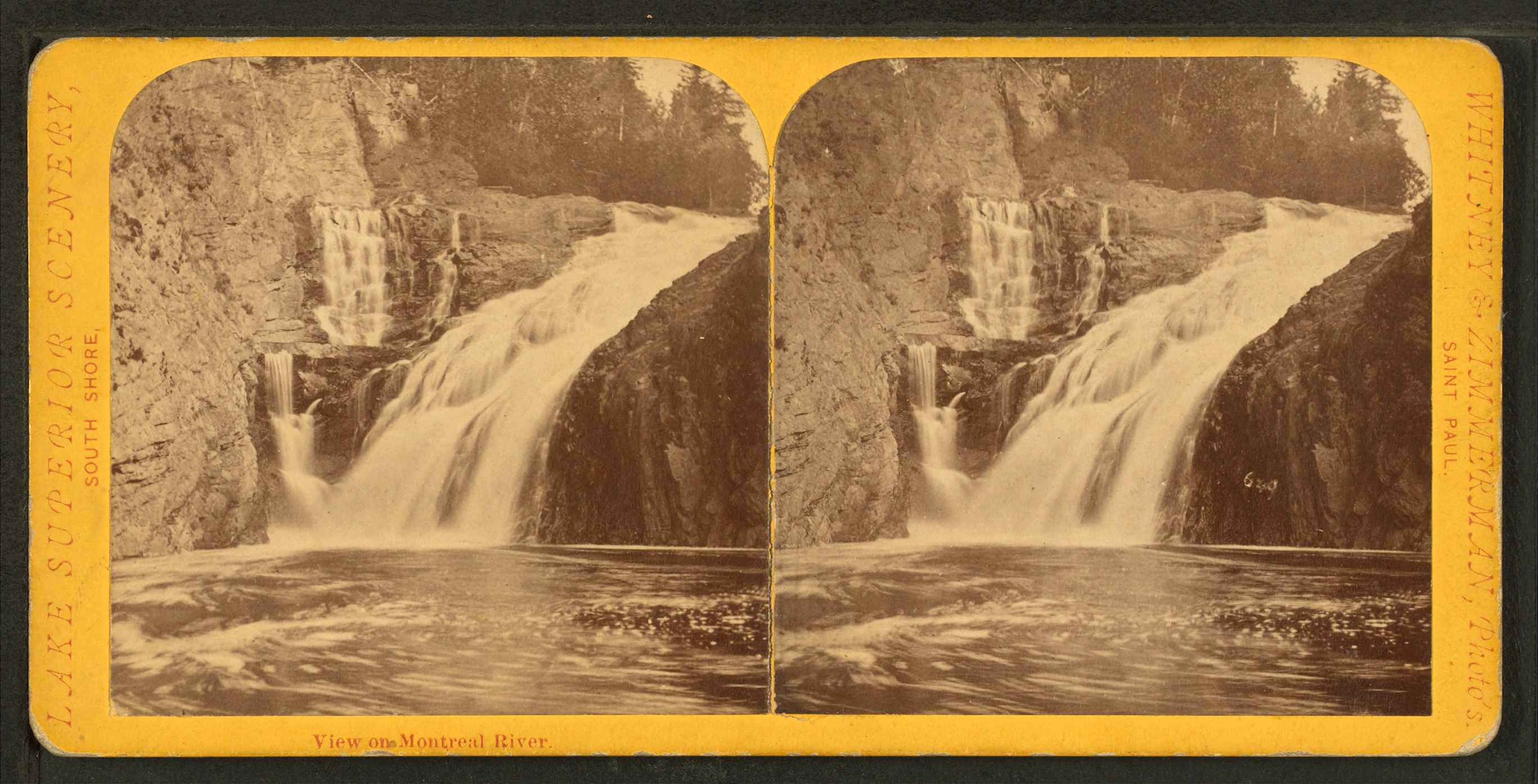
Superior Falls at the mouth of the Montreal River, as featured in the stereograph “View on Montreal River” by Whitney & Zimmerman from St. Paul, circa 1870.
~ Wikimedia Commons
Mr. Dougherty with [Sen.?] Robinson came down on Tuesday to see me. Aunt Martha and Mrs. Chadwick came Wednesday – M. stayed till this Friday morning.
Mr. D. took your letter of the 13 May home with him intending to address his congregation on this mournful subject on next Sabbath, I cannot bear to be present.
I did not get your first letter – addressed to Johnson dated April 28th mailed May 10th until the 23 – the one dated May 13th mailed 14th about two hours afterwards – or in about 10 days from date. I would not write to any one till today – but supposed you had written to your father at Lancaster when you wrote to me last. (13th) If you did not I fear he had started for the lake before the dreadful tidings reached him. Can it be that each one of our severed family has had to bear the grief alone – separated from all the others. How much I know you must have suffered! By your suspense before you could reach the spot where he was lost – and then, during the shocking scenes which followed. I suppose I can imagine but little what your feelings were or what mine would have been had I been present. I am so thankful that you were not with him and that I still have a dear-[kind?] son in this dark and gloomy world – May we all meet again, feeling this chastening affliction to be from the hands of a merciful God. May we be drawn together as a family by a [closer?] tie – even by the bonds of our common affliction.
I hope you will remember to write me as often as possible as I shall feel more concern now for the absent ones than ever before. Am anxiously waiting a letter from “father” that I may know where to direct to him. I want very much to have Amherst come home and stay with me this summer. He would be a great comfort to me if he could be contented to stay here, and would feel that he aught to try to make his mother less miserable. In doing that he would find his reward in being more happy in time to come.
I must close this and prepare to sent it to the office if there is a chance today, shall write soon again. No doubt you have got the letter I wrote to your dear, departed brother, since I came here. If so there is nothing of importance to write now.
Your affectionate Mother
[Incomplete copy of letter]
[ante May, 1856]
A week in Lancaster or Johnson would be worth more to me than an interest in –––. But a copper mine first of all if at all and then for a good time generally.
I have some chances for a location that some would gladly embrace, but I mean to have a right on so I let them drive their trains without making a move or showing that I care a fig for the whole country.
There is a conspiracy, or combination of old preemptors here who have no right to make claims. Their object is to secure each member a claim on the North shore, and to drive off and keep off by knives and pistols any who may wish to make legal preemptions on the lands they choose to appropriate to themselves.
There may be some fighting up here this season and there is certain to be considerable laming before the business is settled. Let ‘em rip.
I can send half a dozen to Jehanum in about as many seconds, but don’t want to do it & will avoid trouble if possible but butcher knife companies must not meddle with any claim when I have made one.
[…]
“Henry Rice, a Minnesota territorial delegate to the US Senate, hadn’t forgotten the Half-Breed Tract. In July 1854, he convinced the Senate to offer the mixed-race claimants a deal. Each could get up to 640 acres of unsurveyed federal lands by giving up their claim to the Half-Breed Tract. Those eligible would receive ‘exchanging scrip,’ certificates that could be used to buy land.”
~ Minnesota Historical Society
Allen, what think you of the [expedring?] of making yourself a location on the famed Half-breed Tract which is to be surveyed and brought into market immediate?
It lies west of Lake Pepin and is as fair a tract of farming land as lies out of doors besides being regarded as very rich in lead.
You never saw such an [Elganim?] as a portion on the Lake appears to be.
I do want to go down and get you out to see more of the North West – not that I wish you to come up here against your inclination, but I want to travel with you, to see what we have not seen and talk over old times together while we rub up each other’s ideas about the things of the present and the future.
If you want a farm in the west and don’t like Sp. just consult Uncle Allen about the “modus operandi” of securing a farm by preemption and then take a look at the country I have mentioned, as there will be great snatching.
My love to Grandmother, Uncles, Aunts and cousins and my respect to the ladies if they inquire – not without.
Augustus H. Barber
To be continued in the Summer of 1856…
Barber Papers: “In a Little Trouble” Winter of 1856
October 9, 2015
By Amorin Mello
Selected letters of the Joel Allen Barber Papers
… continued from Fall of 1855.
Minnesota Point Jan [23rd?] 1856
Dear Parents
It is sometime since I have wrote to you and for a fortnight or more
[???] [two lines on this copy are illegible] [??? ?????]
On arriving at Lapoint we found sheets from home and a good lot of newspapers.
We left Lapoint Thursday afternoon [on a firm of ?????? ? ?? head?] of [?????????] Nagonup the principal chief of all the Chippewas, Augustus and myself [??? ??? ?????] drawn by by two dogs on a dogtrain. At [????? ???????] were joined by one of Nagonup’s [??????].

Photograph of Naagaanab (Minnesota Historical Society).
They were on their way to Washington. Several of them are going accompanied by a gentleman from Lapointe as interpreter. The first night out we stayed in a wigwam with old Chingoon and his interesting family. Friday night we camped. Saturday reached Iron river. Sunday left and [comfortable?] – Monday came here. Augustus has a sore througt, not severe – otherwise we are well as usual notwithstanding our tramp of over [100?] miles. I must now quit writing and try to find one of our dogs which has strayed over to [???].
Under the old permit system, many locations, three miles square, were made on Lake Superior;- several on and near the Montreal river – some on Bad River, south of La Pointe – three on the main land, opposite La Pointe – two or three were made near Superior City, on the Nemadji, or Left Hand river, and one settler’s claim about twenty miles north of Superior.”
~ Mineral Regions of Lake Superior: As Known From Their First Discovery to 1865, by Henry Mower Rice, 1865[?].
Perhaps you wonder what we have made this journey for – perhaps you hope we are going below but that is not the case. Why should we [?????]. It is warmer here than at many places two or three hundred miles south of here. True – one or two thermometers froze up at this place but others did not while at Fort Snelling, the spirit thermometer inside the walls indicated 44 degrees below zero. Augustus wanted to see to his preemption and I had nothing to do but to come along with him. I also wanted to find out a few things concerning a place that I should like to preempt. I suppose there is not a better copper show on the south shore of the lake, but the land is not surveyed and my only sure way to get it is to settle on it and stick to it until it can be legally claimed.
The town lines will be run next summer.
Augustus is in a little trouble about his claim. It appears his declatory statement never reached the land office. But I guess it will all be explained and made right. The dutchman who was to contest his claim has left the country and would stand no chance if he was here. We have a land office here now which saves a great many journeys to Hudson near St. Paul. We shall go back in a few days and commence surveying around the islands. Now don’t fancy that we cannot survey in the winter, for we have tried it and know better.
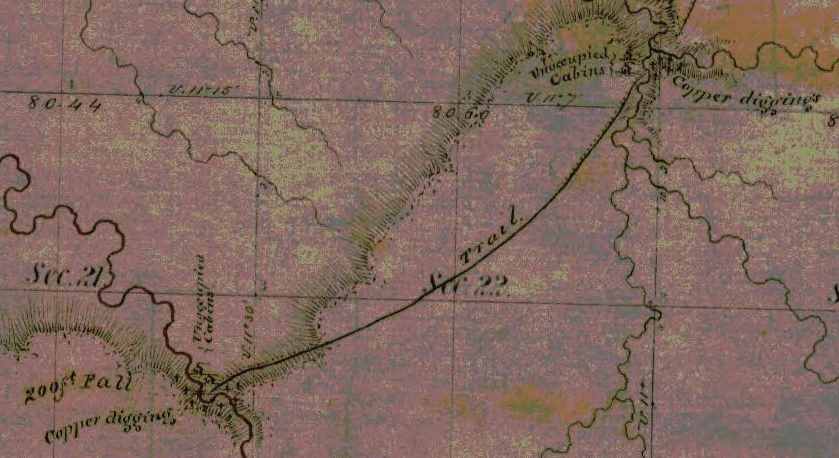
Detail from the Stuntz/Barber survey of T47N R14W.
“J.H. Bardon, a Superior pioneer, stated that ‘at Copper Creek and Black River Falls, twelve or fifteen miles south of Superior, and also near the Brule River, a dozen miles back from Lake Superior, Mr. Stuntz found evidences of mining and exploring for copper on a considerable scale carried on by the American Fur Company, under the direction of Borup and Oaks of La Pointe, in 1845-46. A tote road for the mines was opened from a point ten miles up the Nemadji River to Black River Falls.‘”
~ Duluth and St. Louis County, Minnesota; Their Story and People: An Authentic Narrative of the Past, with Particular Attention to the Modern Era in the Commercial, Industrial, Educational, Civic and Social Development, Volume 1, by Walter Van Brunt, 1921, page 66.
At Bad river we were at work during the coldest weather, and only lost two or three days because of cold but when the thermometer was up to 20* below zero we worked right ahead – sometimes in swamps where we stepped through the snow into the water,
[last line on this page of this copy is cut off]
The weather for a week or more has been fine. Cold enough to cover us with frost but not severe.
Provisions are very scarce – no flour or pork can be had.
They will begin to bring them through from St. Paul in a few days. Flour it is hoped can then be bought for $20 per barrel. Fish are not exactly plenty but they can be obtained for money or labor which is not the case with anything else. The country is flooded with dry goods, [p??y] articles and everything but provisions because they can be bought on time but eatables could only be got by paying cash down.
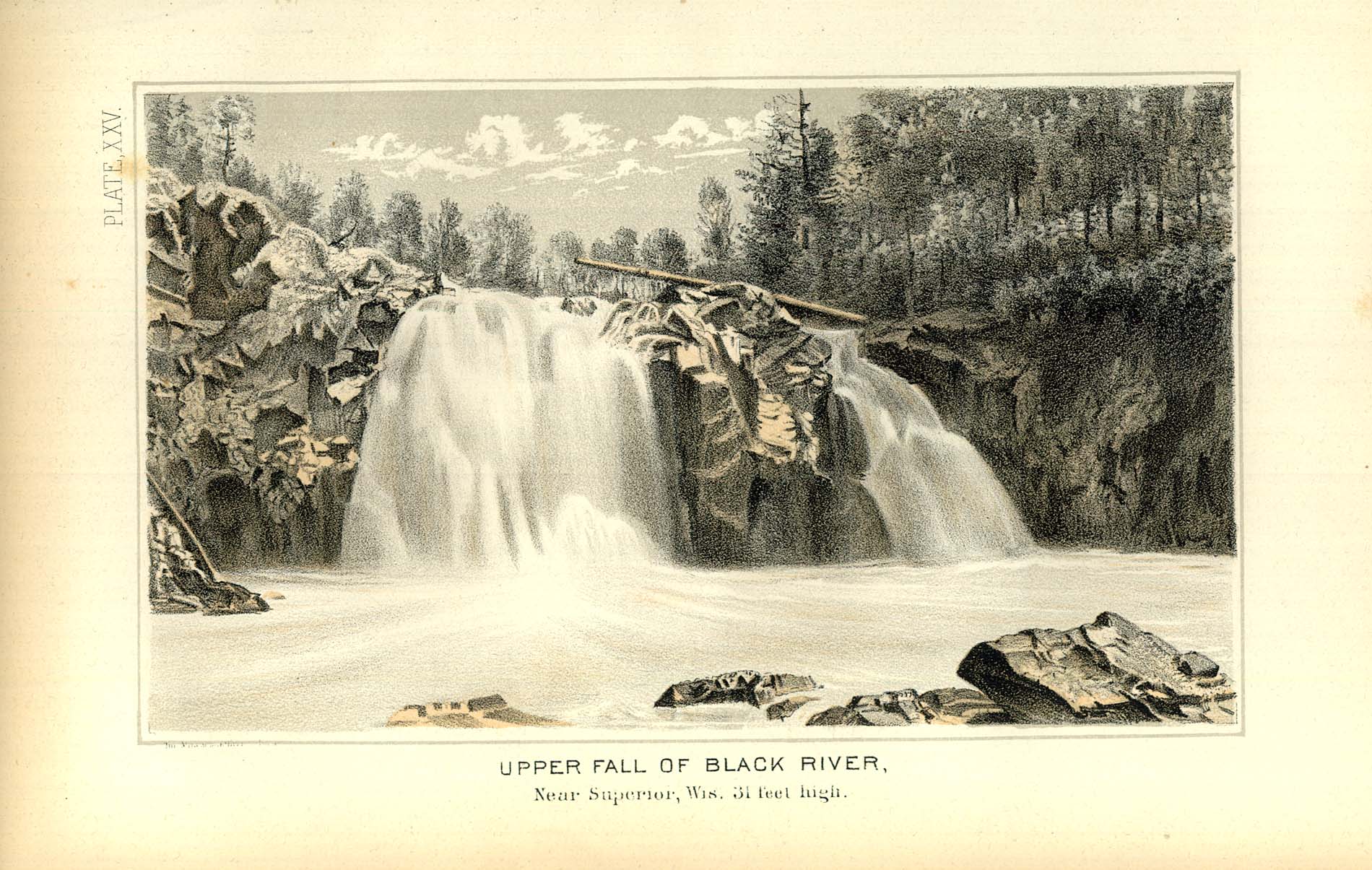
Geology of Wisconsin: Survey of 1873-1879,
Volume III, 1880, page 342[?].

Geology of Wisconsin: Volume 3, page 341.
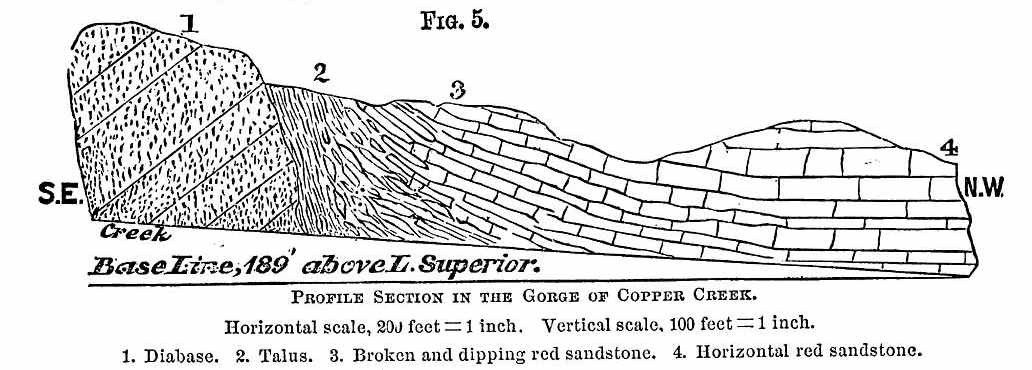
Geology of Wisconsin: Volume 3, page 345.
The Fon du Lac mine has commenced operations with tolerable fair prospects. It is the only mine in operation this side of Montreal river. Augustus’ claim is on the same vein and for aught anyone knows just as good besides having abundance of water power. All the copper excitement since I come to the country has been directed toward the north shore. This morning I signed 2 petitions, one to congress for the early survey of the north shore and another for a road down that way. I have made a little map of the islands and last summers survey and some other things that I will enclose.
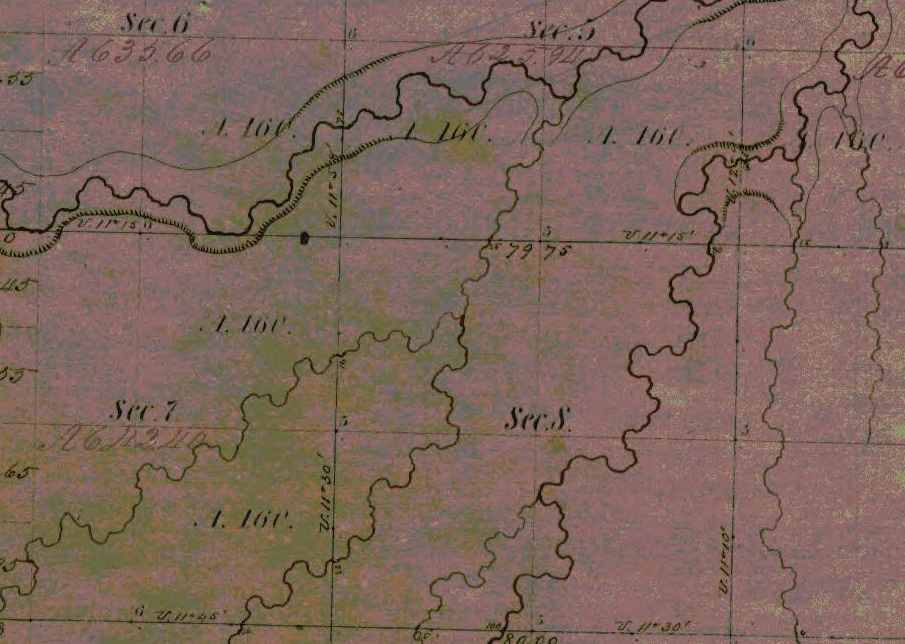
The Fond du Lac copper prospect was located near a small tributary of the Left Hand River on this map detail from T47N R14W, near Pattison State Park. Augustus’ claim was along the same vein of copper but had not been surveyed yet; perhaps it was at Amnicon Falls State Park.
Augustus has begun a letter to send with this. He has just come home with letters now about his claim.
No more at present from
Your affectionate son
J. Allen Barber
Direct to Lapoint
Minnesota Point
Superior County
Minn. Terr.
Sunday Feb 10th 1856
Dear Mother
Augustus has written a letter, and left it for me to enclose and dispatch so I thought I would ship in a few lines before sending it off.
Augustus started today with a young man and two dogs for Lapointe. I shall probably go there in a two or three weeks to return immediately. There are two men going down with a tamlins pony team with provisions from St. Paul for Augustus. The men are going to work for him and I shall probably bring the team back and use it a while. I have at last fixed my mind on a place that I mean to claim. The location is a point at the mouth of Left hand river, known as Left hand point. It contains only 5 or 6 acres in low & swampy and covered only with bushes coarse grass and floodwood. Nothing but the fact of its being a part of Superior city is of any value whatever.
Barber’s sketch of his land claim at the mouth of Left Hand River. This location is now an industrial neighborhood of Superior on the Nemandji River.
As it is $1,000.00 per acre is not an overestimate of its marketable price at present. It joins or is part of the grounds intended for the Railroad buildings when the survey was made here this point was cut off by the meander lines instead of meandered. Therefore according to the [rearns/records?] no such land exists.
A resurvey is to be made and I mean to fasten it by a preemption which is the only way to obtain it before the land sale. I may get cheated out of it and I may throw away my time and money but such chances are scarce and should it transpire that my claim is good I want to have my dish right side up for once. I have written for Uncle Allen’s advice and should I ever find it advisable to drop the matter I can do so without forfeiting my preemption right.
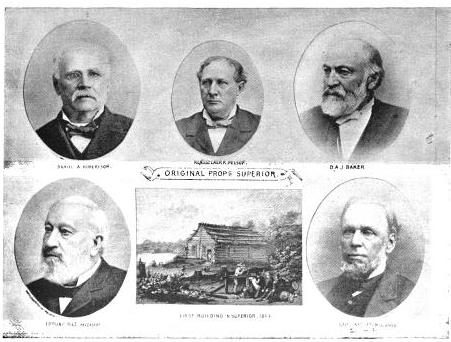
The Eye of the North-west, page 9.
The Superior Company with Company with which I shall probably have to contend is rich, influential, and on good terms with the administration. All that can be done by fair means or foul to defeat any claim will probably be done, but some things can be done as well as others, at any rate we shall see what we shall see.
So my head is so full of business just [snow?] you will please excuse the shortness of this letter and look for more when I have more time.
Your affectionate son
J Allen Barber
Superior Feb. 17th 1856
Dear Brother
It is sometime since I have written anything to you but you have heard of me so often that I suppose it makes no particular difference. It will be nearly sugaring time when you get this.

Makak: a semi-rigid or rigid container: a basket (especially one of birch bark), a box (Ojibwe People’s Dictionary) Photo: Densmore Collection; Smithsonian
I have once more got into a country where sugar is made but not by white men. The Indians make pretty good sugar which is generally done hard and [sinted?] dry and put into birch bark “mo’kucks” holding from 50 to 75 lbs. This bark is also used exclusively for buckets, store trays, gathering pails, &c. The timber in this country is not as equally distributed as in Vermont. The land is mostly covered with evergreens but there are some located portions of country where maple abounds. These “sugar bushes” as they are called are often quite extensive covering several sections and and [they?] only at intervals of 8 or 10 miles, but this is just as well for the Indians are both migratory and gregarious in their habits.
Detail of an Lake Superior Chippewa “sugar bush” from the Barber brothers’ survey of T48N R5W.
I hope you will eat plenty of sugar next spring and take some of the girls to a sugar party or two like I used to. I am doing nothing now most of the time but shall have business enough in a few days when I begin to build my house that is if I conclude to grab for the price of land I am now watching. I am waiting to hear from Uncle Allen and for some other things to transpire. There is not a man in the country whom I could trust that could give me any reliable information such as I want. I want you to hurry and become of age as soon as possible and come out here this spring and make a preemption.
There are some good places left yet, but don’t get married before you make a preemption for it might not be convenient to take your wife out into the woods 30 or 40 miles to live on the place as you would have to do in order to “prove up.” I am going to get up an ice boat before long which will be very useful as I mean to do considerable boating yet this winter, and I might use it to carry lumber and other things up and down the lake. With such winds as we have had a few days ago I could easily go to Lapointe and back in two days. I suppose Augustus got a party started by this time and he will be at it himself in a few days. I am living with a man named Fargo, you have heard of him before. We are living in Stuntz’ store. Board at the hotel is ten dollars per week. Old Steven Bonga is living on the point, he has been something of a traveller having been to Montreal, Hudson Bay, [Oregon?], Prairie du Chien, and all intermediate places.
He is half indian and half negro so you may suppose he is not very white.

Portrait of Stephen Bonga (USDA Forest Service). Additional information about Bonga is available from the Wisconsin Historical Society.
A railroad has been laid out from here to St. Paul and my claim covers the terminus at this end. There have two or three new towns started into existence along its route in imagination. Perhaps they are [surveyed?]. This making towns in a new country is a great business.
What happened in your good town on Christmas and New years eve
Were there any stockings left.
I want to inquire about lots of girls and boys in Johnson and Cambridge but I conclude you will tell me as much as you can in your next letter so with respects to all enquiring friends I remain
Your affectionate brother
Allen
Superior, Douglas Co. Feb. 25th 56
Dear Parents

Detail of Superior City from T49N R1W.
Night before last I got a letter and some papers from Augustus also 2 letters from home which he had read. They were dated Dec. [21st?] & Jan 2nd.
Sad and startling was the news of the death of George Hill. Who could have thought three years ago that such a dark future lay before that family. Every day some sad event warns me of the uncertainty of life. Men have died here who had no friends to mourn their loss, and their death is hardly noticed. I always ask myself why was it not me instead of them and will not my turn come soon. Yes, let it come soon or late as the world reckon, and it will be soon to me.
There is just as much danger or accidents in this country as in any other and no more but as to health there is no better place in the world than this. You seem shocked at the idea of surveying in the winter, but it will be nothing but fun to survey during the rest of the winter. It has been moderate pleasant weather now about two weeks. The snow is going off a little lately and it seems a little like spring. We had some pretty cold weather about new years but we shall have no more such. The lake is more open than it ever was known to be at this season before.
It sometimes freezes across at Lapointe but now it is open within six or eight miles of here. Flour is only $20 per bbl‑ with prospect of falling lower. The Indians chiefs have returned having only been to St. Paul where they found a letter telling them to delay their visit a while.
Poor creatures! They are fooled around by traders and speculators who are with the government in robbing and dwindling them. Any thing like a full account of their wrongs would astonish even them. About my claim I have not [???] today. There is another man after it and it will be no easy thing to carry my point.
Valuable property is troublesome stuff in this country. There is a townsight three miles from there now in litigation for which there is a standing offer of $200,000.
I am still living with Fargo on Minnesota point. I expect to go to Lapointe before long with Albert Stuntz who is going down with some supplies for Augustus which he brought from St. Paul.
It is too dark to write
Good bye
Allen
Superior, March 4th 56
Dear Parents
Not much has happened in this vicinity worth recording. The principle circumstances of note is the burning of a house and all the worldly possessions of a poor [Indian?].
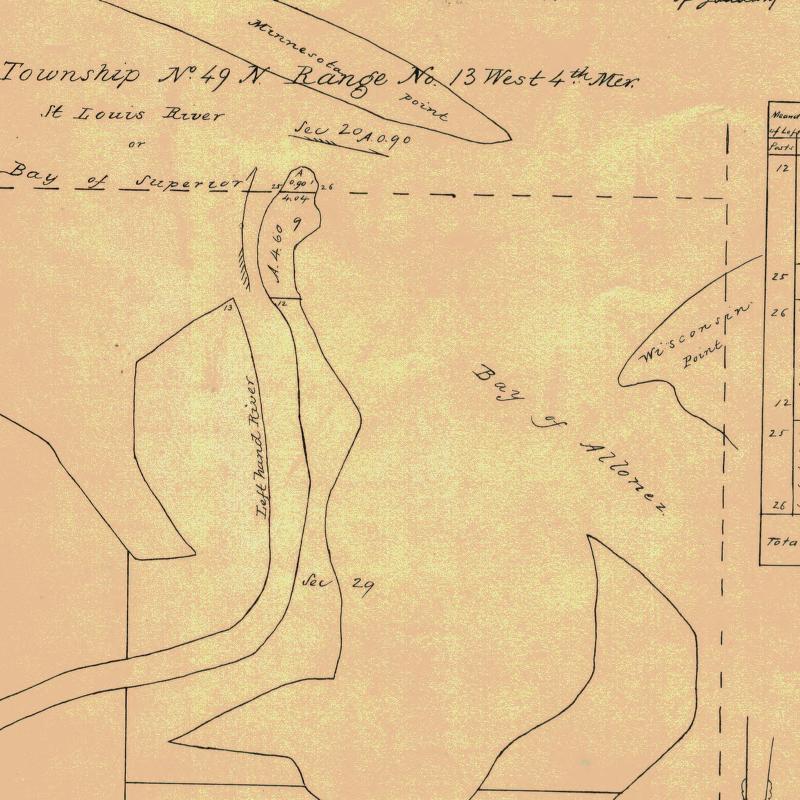
Detail of Left Hand River from Stuntz’s survey; where Barber’s land claim was located.
I have heard nothing of Augustus since writing last but expect to when anybody comes up the lake. About my claim I can say but little my chance is but dull still I don’t mean to give up so large a prize without good reasons.
I have had it surveyed and the notes sent to the Surveyor General with a memorial stating the facts and asking him to [appraise?] the [notes?].
The price contains over 8 acres (8.695).
Perhaps it occurred to you that I am was 22 years old last Sunday. Well such is unquestionably the case although nothing was done to celebrate the day only I had my hair cut for the third time after leaving Vermont. I think I shall have to go to Lancaster this spring but unless I get ousted here it will be difficult to leave.
I wish I could multiply myself by about a dozen in order to hold several valuable claims which are not occupied by any one who can legally hold them. I can’t write here two children [pretting?] and several people [telling?] Albert Stuntz and family are here today. I am perched on a sawhorse writing on a work bench loaded with all manner of [marbles?].
Evening – quiet once more since dark I have written a letter to the Surveyor General to accompany a memorial that I have been circulating. O I wish there was a person in the country that I could depend on to assist me in regard to that claim. There are one or two that I counsel with who know no more than I do and then I do as I think best.
I expect [Lowener?] to find out I have no show, and that will be the last of it I shall [not feel?] that I had lost it for I never had it, but if I don’t get it some body else will get 15 or 20 thousand dollars worth of land that I want.
Provisions are still high and will be higher again before navigation opens which cannot be expected before the 1st of May. Flour is $20/barrel, fresh pork 18 ¾ cents per lb, beef 20 cts milk 20 to 25 cts per qt. &c, &c. Eatables must be higher because there will be little or no sleighing after this over the barrens between here and St. Paul. My mind has been on the [rock?] so much today that I am not in a mood to think much about home so please excuse the shortness and dryness of this letter.
I remain your affectionate son
J Allen Barber
Went to Iron River Thursday 13
Returned 15th
Superior , Douglas Co. March 11 1856
Dear Parents
Yesterday I read a package of letters from Augustus containing one from him & from home one from Albe and one from [Caldridge?]. As Augustus was in town (Lapointe) when he recd. your letters I suppose he has answered them so I cannot tell you much news about him. I am still staying with Fargo – not doing much but hoping to get pay for my time and expense by securing the prize I am after. There is some excitement in town about it, but mighty little is said to me. The Register at the land office gives me good encouragement and says a preemption will hold it. I have taken some steps toward building on it. Today I bought a sack of flour ½ barrel for 12 dollars, I shall get some fish from Lapoint where they are very plenty and cheap and then I shall be almost ready to try housekeeping alone.

I am sorry to hear of the disastrous results of the low price of hops. Although farmers must suffer in consequence yet I believe speculators will make fortunes out of it. If I was in the business of raising them I should stick to it. No articles is so liable to fluctuations in prices as hops but it is well known that the risk fails once in five years on an average so they must come up sometime.
I see you are inclined to believe our country and climate are more in hospitable & forbidding than yours. Such I believe is not the case. We have had some very cold weather but the changes are so moderate and so seldom that we pay but little attention to the weather – in fact we call most all of it very fine weather, as it is. The lake is a great equalizer of temperatures and our cool lake atmosphere in summer causes showers to fall from all the warm, sweaty winds that come here to wash their faces in this big blue pond. People in this country go much better prepared for cold than they ever do in Vermont. I have not worn a boot since leaving Lancaster. We wear shoes in the summer and moccasins in winter.
Boots won’t do for surveyors – they carry too much water unless we stop to empty them after crossing every stream or marsh.
While speaking of clothes perhaps I might as well go on with a few more items of the same sort.
Shoes for this country should have no lining or binding as they are quicker and ae not as stiffwhen dry. We never apply anything to soften them and nothing can preserve them from wearing out in about two months of hard service. They [sell?] about $1.50 per pair. We can get plenty of wool hats which are the only ones we wear.
All manners of shirts can be bought, even the very best quality of red flannel ones, which are universally warm, outside, i.e. by common folks.
The gentry of Superior dress most distressingly.
It is difficult to get good socks any where on the country. I have worn out 6 or 7 pair this summer and lost some more – they cost high bests we don’t wear. I have none. The only cost I have is of [Gihon?] cloth and made by Mrs. Sheldon. Cost are not much more except as an extra garment to wear occasionally.
Good durable pants I find it difficult to get. They are generally poor [ashnet?] and not half put together. Good your mittens would be very acceptable but for want thereof buckskin or blanket mittens are generally warm.
You speak about bringing Kate [in?] to Wisconsin. My advice is to it without fail if you intend coming out to live, nothing should prevent it if I were in your place. The horse that Uncle [Jay?] brought out with him is smarter and tougher than any one he can find to use with him. There is nothing that I regard as more necessary for a family than a first rate horse. I think [Kelty?] will be a very good serviceable animal for work besides being one that you might be proud to ride [after?] over the prairies. Probably Augustus has told you what he thinks about Amherst and other boys coming out here to survey. Butler was so badly disappointed in this country that I have had but little thoughts of [enough?] any one else to come here. Such a disappointment I think would be the fate of 4 out of every 5 that try the business.
A person to be a surveyor must be able to travel all day through the woods and sometimes carry a pack. I would not prevent any from coming here as there is generally business enough besides surveying. A surveyor can make no greater mistake than by hiring any but the best of men. Perhaps Augustus has not told you that he will be out of the business as soon as his present job is done and will devote his time to the improvement of his claim &c. I should like very much to [have?] Amherst here but I dislike to have my parents left entirely alone. As I have [???] two half [sheets?] – when I only [illegible] mind up for the [present?].
[Incomplete copy of letter]
To be continued in the Spring of 1856…
Barber Papers: “Lake Superior” Summer of 1855
September 7, 2015
By Amorin Mello
Selected letters of the Joel Allen Barber Papers
… continued from Spring of 1855.
Superior, Douglas County, July 2nd, 55
Detail of Superior City townsite, Douglas County (T49N R14W).
Beloved Parents
It is now two weeks since I arrived in this country and I feel a little guilty for not writing sooner but as I have been somewhat prevented by circumstances and as Augustus has informed you of my safe arrival here I have neglected writing rather longer than common.
I suppose you would like to hear a great many particulars about your children in the woods which would be too long to write therefore I can only give a synopsis of my adventures.
~ Carlton County Historical Society
~ Retracing the Military Road From Point Douglas to Superior by Grover Singley
On the boat we had a cold raw time and no danger of cholera we arrived at St. Paul on Sunday June 3d and took the stage for Stillwater 18 miles and then proceeded on foot 15 miles. Monday we got to Taylors falls 17 miles where we were detained by the great difficulty in procuring necessary provisions for the trip.
Tuesday we started with an outfit sufficient to last us to Chase’s camp, about 100 miles up the St. Croix. We camped out only three times in coming through, twice we stayed in deserted shantys [door/floor?]less, windowless and partly roofless.
We lost our trail Thursday or was misdirected and travelled all that afternoon among the swamps and thickets on the St. Croix bottoms and bluffs and finally camped on the bank of the river, and [eat?] our last provisions at night. We [where?] not lost but had lost the trail by trying a new one. Friday morning we proceeded up the river about [6?] miles, waded across and got to camp about nine o’clock where we got a good [bush pack?] and a supply of provisions.
We got out again however the night before we got here on the copper range, twelve miles from here. The road of the first hundred miles is very good walking, being mostly over pine barrens but from here to the St. Croix it is horrid much of the country is a complete network of swamps of all sizes up to a mile across. I arrived here Sunday June 10th found Augustus sailing on the bay. Since then I have been helping him build his cabin and do some other work. Camping out did not disturb me so much as I had expected – at last the novelty of lying down in a gloomy forest with the trees moving over us, a big fire at our feet, the whippoorwill singing around us and the dew moistening our blankets was not sufficient to counteract the [f??ig??ts?] of a day’s travelling, so I slept soundly and felt well in the morning. I have not seen a bed now for a month. I sleep sometimes on a bear skin sometimes on boughs and sometimes on the ground, last night on an old tent.

Business Directory published in June 26th, 1855, issue of the Superior Chronicle.
I hardly know what to say about the country.
The air is pure and bracing. Storms are sudden and frequent. One we had was the worst I ever saw. Hail, rain and sand filled the air so we could not see 30 feet. The copper region is equal to [Pabor-dure?] for rain. There is a steamboat aground in the bay near the entry – has been there all day, is now sending her freight to this wharf – will probably get away when the tide begins to go out. All the country I have seen south of the lake is generally flat or gently sloping. The soil of the points is sand thrown up by the lake and drifted into irregular mounds. In the city and some other places the rock earth is the purest red clay I ever saw, back from the lake 4 or 5 miles the soil is pretty good and would compare well with the best parts of Vermont. Some [branches?] of farming I think would pay well. Hay meadows can be made [ikey?] some places by turning up alders and hay brings $[30?] every month.
I can tell better about farming when I see what effect the new canal has on prices about here.
As to making valuable claims there are a number of good chances open yet.
I have seen one as good copper show as there is in the northwest which I might get but there are some drawbacks to it that make me rather doubtful.
There are other chances pretty fair and much surer. There are lots of Indians on this point very peaceable among themselves and towards others but some imps will furnish them with “scoo te wau bo” (firewater). Several Indians are now at work here carrying in freight. The squaws too are hanging round with their children and pappooses. I guess Father, you misunderstanding me about the land Mr. Ladd owns. A large share share of it is entirely clear of brush and ready to break, but all in a state of nature. Augustus is going to put something in with this, so if there is anything more to write I will leave it for him to write. Augustus received letters from home last night enclosing one from mother to me for which I was very thankful and I will try to give it more attention sometime.
With respect to all inquiring friends.
I remain
Your affectionate Son
Allen
Interior Field Notes
Township 48 North, Range 4 West
Barber, Augustus H.
July 1855-Aug. 1855
Notebook ID: INT040W01
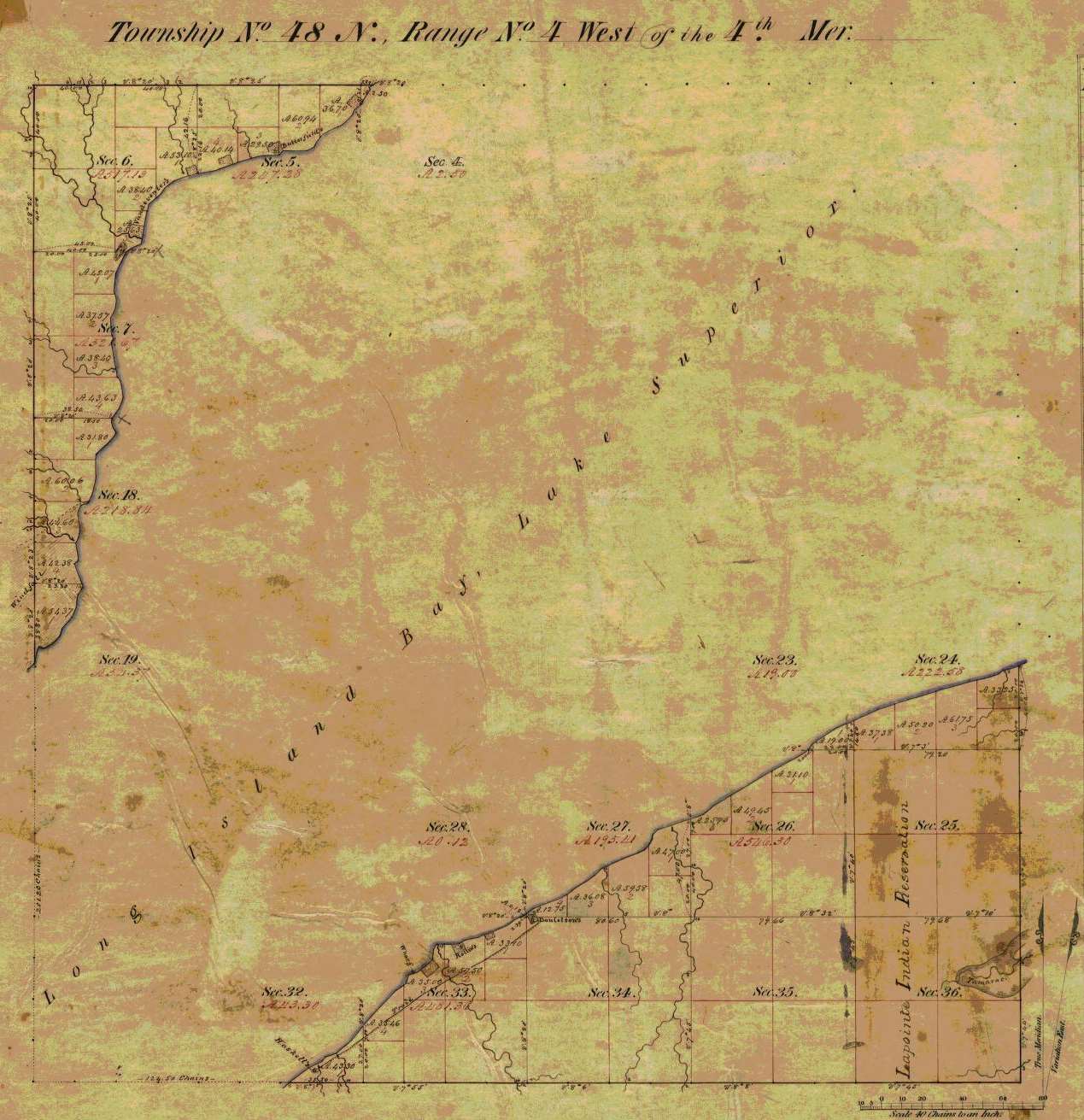
Original plat map of Chequamegon Bay (T48N R4W). Details include: Long Island Bay, Lapointe Indian Reservation, Vanderventer’s, Butterfield’s, Haskell’s, Rollin’s, Danielson’s, and other settlements. Today, this area includes the City of Washburn, the east side of the Township of Barksdale, the east side of the City of Ashland, and the northwest boundary of the Bad River Band of Lake Superior Chippewa Indian Reservation.
Survey of Chequamegon Bay (T48N R4W) by:
Augustus H. Barber, U.S. Deputy Surveyor.

General description of Chequamegon Bay (T48N R4W).
(This handwriting appears to belong to Allen.)

Chainmen: George I. Butler & J. Allen Barber 2nd.
(Allen 2nd is Augustus’ brother; not their cousin)
Axeman: Albert A. Little.
Affidavit signed by: John W. Bell, Justice of the Peace for LaPointe County.
Johnson Aug 5th AD 1855
Dear Sons
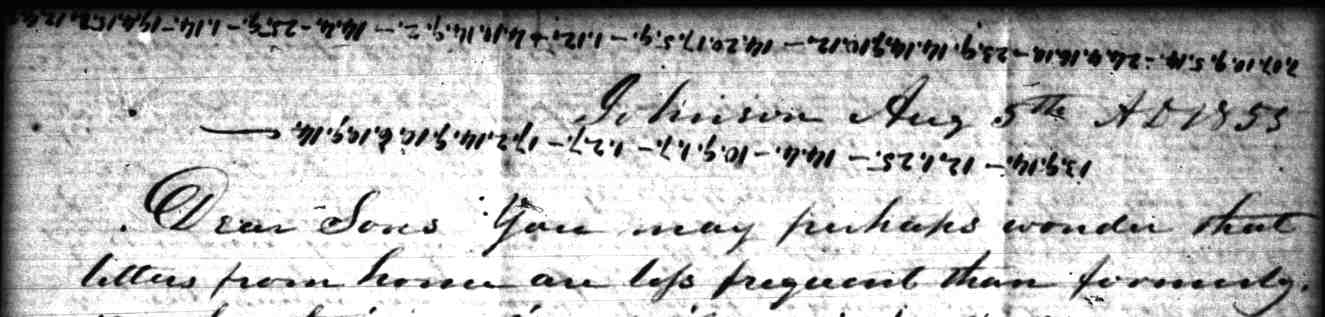
A monoalphabetic cipher was written in the header of this letter upside-down with numbers (1-26). What was father’s secret message to his sons?
“13.9.14.- 12.1.25.- 14.4.- 10.9.1.7.- 1.2.7.- 17.2.14.9.10.6.10.9.14. ~~~
7.17.10.9.5.14.- 26.4.16.10.- 23.9.14.14.9.10.12.- 14.20.17.5.9.- 1.12.- 4.11.14.9.2.- 14.4.- 25.9.- 1.14.- 19.4.15.2.12.4.2.”
Credit and gratitude goes to Eli Fredericks for cracking the Barbers’ code.
“G.E.T.- S.A.M.- T.O.- R.E.A.D.- A.N.D.- I.N.T.E.R.P.R.E.T. ~~~
D.I.R.E.C.T.- Y.O.U.R.- L.E.T.T.E.R.S.- T.W.I.C.E.- A.S.- O.F.T.E.N.- T.O.- M.E.- A.T.- J.O.H.N.S.O.N.”
Who was Sam?
Samuel Stuart Vaughn at LaPointe?
Samuel Champner at Ashland?
You may perhaps wonder that letters from home are less frequent than formerly. Now that the injunction of silence is partially removed by the recpt of a very welcome letter from Augustus, the first news I have had from either of you for nearly a month. I will once never try to write you a few words, having adopted the rule “measure for measure” that is write when I am written to, and endeavor to make up in quantity what it lacks in quality, I have for three weeks wanted to write to you but waited to get something from you first, and the longer I found my box empty when I went to the P.O. in the morning the more determined I was that the long silence might grow still longer before I would break it. I have all along written about two letters to every one I have recd from either of you within the past year and really began to think as your mother does that I “write more than there is any need of” & that you were getting to be of her mind on that [score?], and that if I graduated the number of my letters to those recd from you, I should then know just how often you wanted to hear from home. We are all well, as usual, (the lack of a sofa, centre table, chairs, new carpet, and a few more articles, now forgotten, excepting and even without them we are blest with good health, as any one could reasonably expect under such privations. It is a very healthy time in the village & through the town. Old Martin Smith brother to old Calvin was buried last Sunday having died of an injury that affected his [urinary?] organs. To day Abram [Ferry’s?] wife is dead of consumption.
Last week was commencement week and Am. went down in the Stage starting at 5 A.M. [dined?] with By at the fall, and attended the exercises in the P.M. and evening. Commencement exercises next day & stayed till Friday night before he started for home, living with [Alvira?] all the time & then had hard work to get away. Of course he had great times. He was in the village and saw a company of Firemen from Montreal 300 or 400 in number come into Burlington on Thursday & their reception & the speeches, Band, &c pretty tall time for Hiram.
He got home safely at 2 o’clock Saturday morning. The long expected new bell has arrived and was duly installed into office yesterday, and to day has proved itself a real “church going bell” at [???] its arguments in favor of attending meeting were loud and convincing. The Bell weighs 1137 lbs and has a very fine good musical tone, enough to incline anybody churchward.
I went to Cambridge & got Harvey [Butts?] to come with his tackle & rigging to hoist it into the belfrey which he did to the satisfaction of all. Even Mr D. was so much better to day that he has preached two sermons the first we have had from him for 4 or 5 weeks on account of ill health. He went to Montreal after Sarah, left there Monday (2 weeks tomorrow) at one o’clock P.M. & at [Rausis?] Point a little boy (a relative) wanted to get out of [sight?] for a moment & Sarah took him out of the car & stopped back again, the boy did not come in till the cars started, when [Minites?] sprang out to find the boy, & the cars went on then he remembered that he had Sarah; tuked in his pocket, and she had not a cent of Money with her, but she kept on, told her story was believed & got home at one at same night, but the excitement anxiety and fatigue consequent, overpowered him so that he has been quite feeble ever since, till to day.
Week before last we had a most disgraceful performance in shape of an Indian Show. Some two weeks before a fancy team with a couple of drunken [bloats?] came along, engaged ground for a big tent in the little meadow we used to occupy near Judge [Tom’s?] & put up mighty big [posters?] representing Indians riding &c &c. & on the day appointed the folks began to pour in [torrents?] to – be – humbugged.
The company arrived and after dinner the natives [Kaw shaw gaw?] as leader 5 in number & as many more whites dressed and painted like Indians paraded themselves through the street, on horseback, the horses, & themselves, decked out with feathers and sham Indian finery, well, had you seen the rush you would have been convinced that fools are plenty this year. Mum & Am were obliged to go with [Ransom?] & his wife though against their inclinations. One more notable thing has happened since I wrote last. Uncle Burr and your Aunt Martha have been here and staid 2 nights & we had a pretty good visit. [Pung?] has [bud?] all up and [awas?] in and around St Albans over three thousand dollars. [Sand?] Morgan & Ike Manning will lose about $200. by [signing forkin?] & what is most deplorable the little Devil has got drinking so that to see him drunk was no rarity. He went off with an Irish butcher over the line (45*) & came back as drunk as a fool & he was drunk at the County Convention at Bakersfield. His wife’s Piano & his books have been taken on his debts – Poor foolish fellow. Crops of all kinds are good except Grass & that is not as good in Cambridge as last year, but called about the same around here. [Prein?] have a down on [Butter?] & [breadstuffs?], but we shall have another hard winter that will bring them up again I fear.
You will see by the Grant County Herald that lands entered under the graduated prices, cannot be sold again without forfeiting the land to the government, so that the next man can go and pay the same price, and take the lands as though it had never been entered, so that Allen must not alienate his title to his land as I had advised him in case he wanted to make a preemption claim.
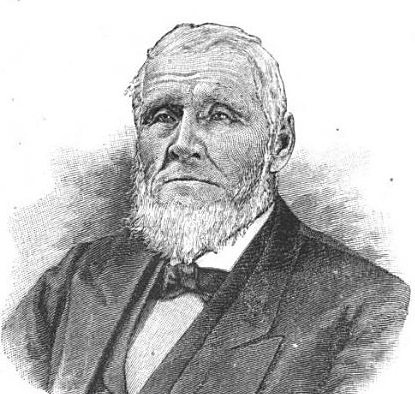
Portrait of U.S. Representative Alvah Sabin (Vermont); in office between 1853-57.
~ Wikipedia.com
It would be very agreeable to hear from you oftener, for we do feel some anxiety to know where you are, what you are about, how you are getting along, and above all to learn that you are alive and well & kicking. I am glad to hear that you receive favors occasionally from Elder Sabin, & though not of great intrinsic value in and of themselves, there is some pleasure in receiving them as a token of remembrance and esteem and another thing it will give those who know you have such documents sent from such a source a favorable opinion of your [anteredents?].
It is so long since I have written to you that I have hard work to get on the truck, and harder still to keep on I believe I have pretty much exhausted my stock of news.
Your Aunt [Betsy?] tells me to send her love to you and [aprise?] you that there is no one in the house who misses you more than she does. (Perhaps she is mistaken after all) & that she does not want you to come home ust so that she can see you, but to come when you get ready & she will be very happy to see you. Mr [Atwood?] was up yesterday with Levi & Oscar & left [Onen?] here with Am to stay a day or two, Levi [took thin] and [pale?] and is unable to do much of any thing, says he rakes hay some &c. The Methodist Meetinghouse is up and will be finished in a few weeks. The Baptist house is progressing slowly but it is evidently their intention that it shall surpass the [Cory?] house for elegance and convenience.
I am buying land warrants in co. with Mr Pike and in such a way as to make something on them. The business of the office will bring me in a pretty good sum when I go out which will probably be this fall, though I confess that for the sake of the profits I should like to hold on, but I have nothing to complain of as I consider I have had my full share for the last four years.
Adieu
G.A. Barber
Interior Field Notes
Township 49 North, Range 4 West
Barber, Augustus H.
Aug. 1855
Notebook ID: INT040W02

Original plat map of Houghton’s Point & Raspberry River Beach.
Details include: Long Island Bay, Long Island, Raspberry River, multiple settlements, and multiple roads including the Talking Trail.
Today this area is known as Houghton Falls State Natural Area, Sioux River, Friendly Valley Beach, Chequamegon Point, and Town of Bayview. Curiously, none of the settlements were attributed to their owners.
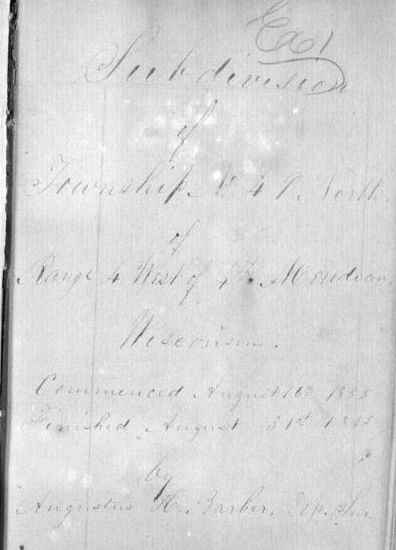
Survey by: Augustus H. Barber, U.S. Deputy Surveyor.
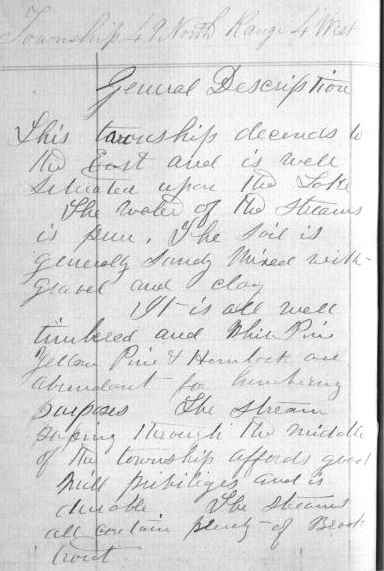
General description of T49N R4W.
First page of affidavit; continued below.
![Chainmen: J. Allen Barber 2nd, George [?]. Butler. Axeman: A.W. Burtt. Affidavit signed by: John W. Bell, Justice of the Peace for Lapointe County.](https://chequamegonhistory.com/wp-content/uploads/2015/09/t49n-r4w-affidavit-2.jpg)
Chainmen: J. Allen Barber 2nd & George I. Butler.
Axeman: A.W. Burtt.
Affidavit signed by: John W. Bell, Justice of the Peace for Lapointe County.
(This handwriting appears to belong to Allen.)
Lake Superior, Aug 12th 1855
Dear Parents

Detail of Ashland townsite, LaPointe County (T47N R4W).
Although this is the first time I have written to you for a long while I suppose you have been informed of my whereabouts often enough by Augustus. I was pained to learn of your anxiety before you heard of my arrival at the lake. But as you fears are once more dispelled I hope they are permanently banished.
Today is Sunday and I am not at work that is not in the woods still I have not been idle.
I have sowed untill my fingers are tired and now I am trying to write a few words to send with Augustus’ letter. It really seems a privilege to live in sight of a church if it is a catholic church in La Pointe 18 miles distant. As to health I am confident I shall be as healthy here as in any part of the world. Sickness is almost unknown here except slight ailments the result of an improper diet. Surveying I think agrees with me. I feel best in the woods and like camp life. Our party is very pleasant and agreeable one and this is a beautiful and interesting part of the country so I ought to enjoy myself life if ever a surveyor did. I suppose Augustus has told you about our little shipwreck so I need not dwell upon it. I will surely say in justice to the boat that it was all the result of carelessness and bad management and we have probably learnt a useful lesson though as a dear price. The mosquitoes are getting thick and it is growing dark so I must wind up.
Has Levi Atwood got well yet. I think a year or two in this country would do him good. Burt of our party came here with consumption but is now free from it [scribbles] too dark [scribbles].

Love to all
Allen
Johnson August 26th 1855
Dear Sons
Yours of Aug 7th came duly to hand relating the misfortunes you experienced, which has caused me to feel considerable anxiety on account of your losses just as you were entering upon your undertaking. But all your [pecuniary?] losses are forgotten when I think that you are safe and unscathed after passing through such deadly peril. yes all else is but a trifle, when compared to life and health, & though your loss was more than you can conveniently bear, or repair in a long time, still with good fortune on your side for the future, you will in time outgrow it, and come out brighter for having passed through affliction.
 Since I wrote to you last there has not been much worthy of record transpiring in this [dully?] town. Last Monday morning I set out by stage for [Bellow’s Falls?] via Burlington and staid at Rutland, reached B.F. next morning [at &?] attended a Convention on State Council (as you please) & went over the river into [Walpole?] & staid with Tom. [Keyes?] that night he having found & invited me to do so. The object of the convention was to make a nomination for State Officers if thought [expudient?], so that it was as necessary for those opposed to an independent nomination to attend as for those in favor of it. There were almost enough of those in favor, to carry the day, but [we the?] wiser and more prudent finally prevented it being done & now Judge [Rayes?] stands with only 3 opposed in the field. [Meritt?] Clark [suce fase?], Judge Shafter the Temperance candidate & President John Wheeler the old line Silver Grey [??? saving, Blue Belly ?????? ??????] whig.
Wednesday morn I left [Walpole?] and came home [via?] Winson, White River Junction, & Waterbury heading home before 10 o’clock, at night, probably faster than you can run a line in the thickets and forests on Lake Superior. While walking near the Depot at B.F. a fellow came out bareheaded and asked if I was not Mr. Barber, said he knew me well, but I was stumped for once and could not make him out “no how“. It was George Enslow, I told him if I had heard him crow, I should have known him. He lives in Rutland and goes on the passenger train from there to B. F. every day at 30 Dolls per month & he board himself. I guess he is a poor wild improvident coot as usual. Marshal Homer is in town with his family at old man’s & he is compassing Heaven Earth & Hell to get me out of his house so that he can come into it. But all his threats, & and artifices will avail nothing, he will wait till 1st April next before he gets possession until I see fit and find I can do as well or better to give him the premises. Not all his & his wife’s storming, or his fathers blab, shall make any difference with me. I will let him understand that when he lets a house for a given time he will find it not so easy to drive the tenant out as he might wish. I shall keep on the defensive, and see that no chance is given for him to resume the occupancy of the house. After all it is very unpleasant and annoying to know that I am in any one’s way, and equally so to hear stories every day of what Marsh’ or his folks say about it, and also the 1001 questions by other people, where I am going and when &c and what was most provoking was Old H’s saying to our women that “it is to bad to have to move now.”
I have consulted [Forrier?] & Benton upon the case, and am assured that there is no trouble on my part so you need give yourself no trouble about our being pitched into the road head forward. We shall all live just as long and wide as though there were not one [Hosmer?] this side of Hell. Enough of this.
King Wallance has been here some days and report says that he is worrying [S.C.D.?] & it is quite possible that is a fact though I do sincerely hope it is otherwise, for I think her much too good a girl for such a [churl?] as H. M. Wallance. Yet it is her business and not mine, and she will have to abide by the consequences be they for weal or for woe.
[Hayes Hyde?] was in a [???] a few days ago to a Miss [Whiternob?] of Springfield [N.Y.?] The [matter?] between Jo. C. Hayes & [Abby?] does not progress so fast now. Heman is not married yet, but will be this fall. Our Houses of worship are getting along finely. The Methodists chapel is completed outside, and the inside will be finished in September. The exterior is very handsome with the exception that it has no portice in front, but the steeple is the finest in the county [in shot?] of Burlington being a [colonnade?] of 12 columns standing on the bell deck 4 on a side & those [swrindunted?] by a roof & heavy jet & a [balustran?] or battlement on the roof. The Baptist house will have a bell as soon as finished and a clock (with 4 faces that are now put up) so as to be seen from every part of this large town. I have been to hear Mr D. & Mr [G?]. both today and Hiram has been to the Plain to attend a tent meeting of Saturday folks under a tent that is carried around for the purpose [large?] enough to convene 2000 people.
Our County Convention and town caucus come off this week and as there is a mighty strife on foot for the officers there will probably be some fun growing out of it.
[Places?] are fewer than expectants or aspirants, and some who are the most greedy are those most Anoxious to the people. However “we shall see what we shall see.”
My good neighbor Caldwell’s mouth is wide open ready to close upon any thing offered, but how can any man of common sense expect office when he is hated by every one like poison and so crooked in his deal that he is shunned by all who know him.
[Riddler?] is also in the field but he has smelt too strong of rotgut for months to pass for a very good temperance man. I think it more than probably that we shall not choose a representative this fall. Capt Sam expects Judge of Probate but it will be a hard pill for Johnson folks to swallow. Well, let them [squizzle?] and suit themselves
Wheeler was here one week ago today. “Same Coon.” Mr. Benton is here again and boards with us next [turn?], as [very?] pleasant & good a boarder, as anybody. Prospect for school I should think not any flattering. I sent the Land Warrants Pike & I had bought to Ladd and got returns showing a profit of $68.45 over cost. I think of going down to Cambridge to morrow to see if I can find any there that I can buy.
There is no risk and possibly some thing to be made. I recd a letter yesterday from your Uncle Ham. who has been to the Saulte and also at Lancaster. I recd one from Mr Burr who says that he & your Aunt Martha will set out for Lancaster the week after Election & they think of buying some place there perhaps Homer’s, for they see that they have got to come to it sooner or later, and may as well make a grab now as to wait till there is no chance for them. Well knowing that you will be sufficiently tired with this [one?] what your Mum is writing I shall not take the trouble to double line the sheet but will endeavour to write you again as soon as I hear from you.
So till then Adieu
G.A. Barber
A.H. & J.A. Barber
I will make Am write this week
I sent a [waverty?] Magazine from Burlington & [one?] N. Y. [Daily Times?] & [1?] [Caladonian Times?] & I intend to furnish you occasionally with a stray paper as well as letters.
Mead has just been along and says that Johnny was [put?] under the [sod?] yesterday. So I stop the press to announce the fact.
Interior Field Notes
Township 47 North, Range 4 West
Barber, Augustus H.
Sept. 1855
Notebook ID: INT039W05

Original plat map of Ashland (T47N R4W).
Details include: Ashland townsite; Fish Creek sloughs; Long Island Bay; and trails to Bad River (Odanah), the White River, and the Penokee Mountains.
Detail NOT included: Wiiwkwedong (now Prentice Park).
Survey by: Augustus H. Barber, U.S. Deputy Surveyor.
(The handwriting in these field notes does not belong to either of the Barber brothers.)

General description of Ashland (T47N R4W).
“Springs are of a good quality and White River in the South East part of Township is a good mill stream. Native copper has been found in this Township, but the formation does not indicate a mining locality.”
First page of affidavit; continued below.
![Chainmen: J. Allen Barber 2nd & George [I?]. Butler. Axeman: Bernard Hoppen. Affidavit signed by: John W. Bell, Justice of the Peace for Lapointe County. (not actual signatures)](https://chequamegonhistory.com/wp-content/uploads/2015/09/t47n-r4w-affidavit-2.jpg)
Chainmen: J. Allen Barber 2nd & George I. Butler.
Axeman: Bernard Hoppen.
Affidavit signed by: John W. Bell, Justice of the Peace for Lapointe County.

The Barber brothers’ original field notes for this township were reproduced in 1901 by The State of Wisconsin Office of the Commissioner of Public Lands. “This copy is made in accordance with the Chapter 177 Laws of 1885 for the reason that the original record is faded and worn from use and is becoming illegible.”
To be continued in the Fall of 1855…
Barber Papers: “I shall not go without Jo” Spring of 1855
September 4, 2015
By Amorin Mello
Selected letters of the Joel Allen Barber Papers
… continued from Winter of 1855.
Lancaster March 23rd, 1855
Dear Father,
It is not long since I wrote to you but I thought I would write just a word though it may not do any good. Uncle Allen says you would do better to send land [????] than money. So many will be drawing land under this new bounty land law, that you can probably get them cheap.
Pine lands may be better in the eastern part of the state [?? ???????] but not worth half as much as in the western part. Lumber that sells in Oshkosh for 8 or 10 dollars brings 18 to 23 or 4 dollars here or any where along the river. Do you know anything about the culture of [osiers?] for willow baskets.
I saw an advertisement in the Tribune which says they will yield 100 to 150 dollars proffit per acre. This would be a good place to raise them I should think. Willow baskets are used here more than any other for all purposes. This I suppose is because there are so many [foreigners?] here who understand making them.
This is a beautiful warm day and the snow is going off in torrents.
Was it not [fl??ging?] smart that Thode Burr could not come out with Uncle Thode. His folks were swift to have him come but as the time approached had to give it up. Grand Mother has just come in, walked up. We are pretty well all but Aunt [Lib?], who was sick yesterday but better today. Have not seen anything of Cad yet. Jo. Alcorn has taken Dr. Woods farm.
Love to all
J. Allen Barber 2nd
This letter appears to be written by Allen, using the name of his Cousin Allen 2nd.
Johnson April 1st, 1855
Dear Son
I do think you hurt yourself writing so often and so much as you do to us. Once in two weeks is a short time to you I suppose to intervene between the times of writing home, but it seems very long to me to wait for news from my absent children. The last letter from Augustus was dated Jan 17th but he is where he cannot write and at a distance of 30 miles from any P.O. as Mr. Stuntz has probably told you. But you are where you could write oftener and more if you would, and as we cannot hear from Augustus do let us here from you. Yet if you do not want to hear from home but seldom, just set the pattern and I will write as often as you do, and relieve you from the trouble of writing, or reading my letters any oftener than you choose. Everything is going on at the usual snail pace about here.
[…]
There was a great dance in the Town Hall Friday 23rd at the Public at the [close?] of the [dancing?] school. Somewhere from 60 to 70 couples in attendance, and what was strangest of all, some of those little lambs in the flock who have recently passed from death unto life, instead of giving living evidence of their having been with Jesus, showed their preference for gayer company & went to see the show.
It was but two days before the holy commission and Mr. Caldwell and [men?] somehow or other concluded not to show their faces there before their august teachers and the mangled remains of their adorable savior so soon after patronizing the company of Jake Dodge, Henry Daniels, Frank Atwell, [Morse’s & Patrk’s?] boys [Jo Read?] and [Almy Ferrier?]. Oh the folly of Sinners.
I thought it would look just as well for old cripples who were just ready to emigrate to the kingdom come to stay away and let the young, the wealthy, proud & gay have their [partihase?] & recreation to themselves and not betray our weakness by going to gaze at them and thereby evince to them & to the world our regrets that we are no longer fit associates for [Jo. Reads?] &c. But some folks act curiously at times like there was a partial insanity in their case.
I felt very well at home & so did Am as we did when Ossian & Dodge was here & Mum went. It is getting to be mad times. Give my love to Mother and to my other Friends if I have any. I have written about twice as much now as you write and have not got half through but time forbids more at present.
G. A. Barber
[ca. 1855] Apr.
Lancaster Apr.
Dear Mother,
Having rec’d several lines from you and Amherst without sending any full equivalent I will now try to write a few words though they may not be very interesting. Today is a beautiful Sunday.
It is now about two o’clock. I have not been to meeting. Shall probably go this evening.
You see my prejudice in favor of evening meetings is not altogether overcome.
I am dressed up in my new vest and boots, clean shirt, thin brown coat and brown hat &c. This morning Uncle Allen drove up with his carriage with his children, [and?] Ham. and three other children. I took Thody and got in (Myron was at meeting) and had a delightful ride on the prairie. Such beautiful spring weather I never saw before. Every day seems unequated. The earth has got green in spite and there are some flowers out. They look just like yellow daisies only they grow as low and humble as violets.
Night before last I got a letter from Augustus at Galena. They are having colera considerable and a number have died on the river or been put ashore in consequence of colera. You may not see anything of it in the papers as they try to keep it mum but John [Henry?] who was down there says it is so. No wonder for he says the mercury stood at 90* one day that he was there. Every boat up the river has 6 or 800 passengers.
Augustus appears to be in fine spirits. He is swift to have me come up that way.
The ground here is warm and dry as any ever need to be, gardens are being made and crops are being put in with all delight.
Uncle Jay and Cyrus will have splendid gardens in a short time. In fact, Uncle Jays garden now is the finest I know of about here, he has enlarged it this spring.
Aunt Fanny has considerable of a start in her garden because the place was made by a fellow who took great pains to have everything that he could get growing.
I am quite anxious to go up the river and see the elephants and would like not a little to see Augustus. Uncle Thode is farming and sleeps in his house and that is all I have got to say about him at present. Father requires me to write so much to him that I can hardly find any thing more to write to any one else. Little Thody is not very well – has a bad cold. My love to all. We expect Uncle Ham here every day.
Your affectionate Son
Allen
Lancaster May 2nd 1855
Dear Father
Perhaps I have neglected writing to you too long but as I have been rather busy of late and have written to mother not long since I hope to be [?????]
[…]
~ FamilySearch.org
Day before yesterday I made Jo. Alcorns folks a visit. They appear to feel pretty well. The girls were all at home.
I took dinner there and looked over the farm some. Jo is building stone wall on the farm for Dr. Wood. I begin to think we have about all the herbs here that grow in Vermont. [Spikenard?], bloodroot, coltsfoot, leeks, wild onions, wild summer savoury, balm, and a great many more grow in abundance.
Uncle Allen has spoken to me about studying law but nothing deffinite has been proposed on either side. Two fellows start from here today to go to Lake Superior. They have to walk over 200 miles so I suppose they would not wish to carry any extra burden and Jo says he thinks Augustus would not care anything about that vest up there. I am really anxious to go up there but I guess I shall not this summer.
[…]
Must close rather abruptly for want of time. Have been looking some days for a letter from you.
Love to all
Allen
All is well but Aunt Fanny who is most [used?] up with a severe cold
Lancaster May 14th /55
Dear Father
It seems to me I have not written to you for about a week and as there is just 25 minutes between [illegible words] a few words. I have nothing of special interest to write but dont want to keep you waiting for a letter. For some time we have been wishing for a little rain for which we would be very thankful although a great deal is needed. We now have a prospect for a good shower.
[…]
~ 15th Uncle Vest Phelps and all his family have arrived in town today I understand. I am most tired to death, have been planting corn all day with Cyrus and I have about a days work more to do alone to finish it and fix the apple trees. I have a wet cloth on my neck to cure a sunburn. Whatever the effort may be ultimately, it saves me a great deal of pain at present. I am thinking quite [strong?] nowadays of pottering off up to the lake.
Jo is here yet and would go with me. I should want no better companion.
There is no serious obstacle that I know of to hinder. While I wish to go for many reasons.
So far as I know I have had excellent success in grafting although I have not done a great deal only about 600. I cant tell exactly about the wheat there was not much of it all a great deal of that was wasted. I have never said a word to Shoemaker and dont want to. He is a foolish howling Methodist and nothing else. I sold 5 bushels of
[Incomplete copy of letter]

MOTHER
Lancaster Wis. May 20th 1855
Dear Mother
Last night I was much gratified by the reception of another Salvo of letters all in one envelope from home.
It is pleasing to thus find myself kindly remembered at home but letters written in the spirit of one I received from father last Tuesday are not quite so agreeable and allow me to say I think they are rather tend to defeat their object. The accounts of the season in Vermont seem rather dismal.
Can it be possible that no leaves were visible on the 13th of May. Here fruit trees were going out of blossom. A fortnight Three weeks ago today (April 26th) the poplar trees appeared to be in full foliage but the leaves were not fully grown wild plum trees were white and crabapple trees were blossoming.
Lilacs are now out of blossom. Gooseberries plums currants and cherries are about as [as peas?] – plums rather larger apples are as large as beans.
I ate rhubarb pie at Uncle Jays May 3rd made of new plants. it is somewhat doubtful about my going up to the lake this summer. Jo dont wish to go untill after harvest or about the last of August but I guess I could get him started now if I [???] really anxious about it.
It is principally on account of my health that I prefer going up there to reading law at present. Today is a beautiful [??????] I have not been to any meeting this forenoon but guess I shall go to the choir meeting this afternoon.
Aunt L is not very well yet. Yesterday I cut out a lot of willows that grew around the best spring on the east side of the farm.
It is a noble spring and might easily be made to run to go building spot on the South end of the farm on the road near the S.E. corner Cyrus thinks of selling his place in town and building on his farm but Aunt Fanny is strongly opposed to it. Going to Lake Superior is not so much of an undertaking as when Augustus first went. I should have to foot it about 200 miles. A great many people are going through every few days but probably I shall not go without Jo as he understands all the minutia of providing necessary articles and food, coaching, camping out &c &c. Well I must close this and write a few words to Father.
Receive with this the Love of
Your affectionate Son
J Allen Barber
Lancaster May 20th 1855
Dear Father
It was my good luck to receive a letter last Tuesday and another on Saturday so I must write again soon or get behind in my correspondence. Uncle Allen says I can find plenty of land though not very near town but the country is filling up so fast that it will all be worth the [??] government price. He says he will go out with me in a day or two [a?] land hunting as he has some plots only a few days old and wants more land. I should not be able to enter more than 80 acres at present but if I dont go to the lake you can send me more money and I will try to make the best disposal of it (21st) Old Ben’s auction goes off today.
There is undoubtedly money to be made in village property here but not near so much as on wild land. Well Old Bens auction has come off and proved to be a kind of mock auction – all but one bargain was struck to off to his bidder, Jim [?evens?].
I got Jo to promise to day to go to the lake in two weeks but he will alter his mind before night I am afraid. There is a terrible amount of sickness on the Mississippi and Missouri boats. The boats are all overloaded often carrying over 600.
This is a very warm day. We had a little rain this morning but not enough to do any good. Other places not 11 miles from here have plenty of rain.
It is common here to have thunder here whenever it rains. If it rains 3 days the thunder cracks around all the time night and day. Then look out for cholera. There are a lot of old telegraph posts standing between here and [Potosi?] and more than half of those that stand in open country are split down by lightning. Jo is fiddling here while I write he remains firm in his resolution to go to the lake in two weeks.
If I go I intend to come back next fall if nothing prevents still as far as health and comfort are concerned I had rather winter there than here if I could have as good accommodations.
I am glad to hear that some of the old faces once so familiar have again visited Johnson although I was not there see them. It really does me good to see their names written. How we are scattered. Albe reminds me of fast day two years ago.
He and John Cook & Charlie and I ate sugar on the catnip farm and had a good time. Now each breathes the air of a different state. It would give me great pleasure to attend the commencement at Burlington this summer. Probably at no other place in the world should I ever meet so old friends. Where is Homer [Wetherly?] now? I had a letter from when he was in Glover and would answer it sometime if I knew where to direct. Aunt Fanny wants me to tell you she is all well and anunt Lucy says when her pen gets started it will with a vengence! They think I write home so often there is no use of any ones writing any more. It may be a disappointment to you to have no more land entered but I shall not have time to receive any money from Vermont if I go up country this summer. What land there is now in market about here is of course of poorer quality and some and I think I had rather enter land north of Wisconsin where there is plenty and lumber cheaper timber plentier.
However I dont know what I shall do. I want to enter a half section all that I can enter under the graduation [act?] and it must all be adjoining or adjoining land I now own.
If I find any land very tempting perhaps I had better borrow the money of Uncle [?????] and you could remit the amount to him.
The interest would not be much for a [month?] or two – at any rate it appears that I have got to act as I think best. A Mrs. [?tig?] opened a lot of bonnets and other goods for sale this morning and the streets are full of women all crazy for a new bonnet. I hope it will have a good effect on the weather as we need rain badly.
Today I had a talk with Shoemaker. He raised 9 bushels of wheat and says he will give up your share if I will sign a receipt in full of all demands. He suffered considerable waste and ought to smart for it. But I suppose he lost money by taking the farm, of about 50 bushels of oats his share after paying for threshing and other helping was only 6 bushels. I can have things well enough this summer. The corn I planted among the hops and appletrees I shall let Cyrus have to remunerate him for the trouble I have made him. I have not done near enough here to pay my board as he has been so situated I could not very well. There are two or three other boys here that want to go up to the lake and perhaps will go with us. If you dont get this in season to answer before the 4th of June direct to Superior. I think this with Mothers and Ams will do for one letter. Shall probably write again before I leave and look for about two more letters from you.
Your affectionate Son
J. Allen Barber
Johnson June 17th 1855
Dear Sons
I expect you are now together and I will address this to you both thereby saving some scribbling paper, postage &c which is no small consideration with some folks, and I must acknowledge is to me a convenience I went to St Albans last Monday to see my father previous to his departure from this country perhaps forever, though I did not then know how so soon he was going but on arriving there found that he had fixed on the Wednesday following for leaving. I accordingly remained till that time & then accompanied him as far as [Run??’s] Point & there parted with him. Thode Burr goes to Sandusky with him, & from thence I expect your Uncle Ham will escort him to Lancaster.
Father felt very much affected at parting with your Uncle B’s folks and they as much so as though they were consigning him to the grave. Returning from St Albans I came to D Fairchild’s and stayed over night & made one more visit on my way through [Georgia?] & arrived at Johnson Thursday night in safety, but I [presumed?] not many hours before Father & Thode reached Sandusky. I found that Am. had recd a letter from Augustus & one from [me?] requesting a deposition to establish your his age. I have made it and also one for Allen thinking that he might want to make a preemption claim in that region, and if he would be deferred from making such claim on account of owning land, would it not be best for him to convey his title to his lands in Wisconsin to me or some other person to be held for him whenever he might wish to resume the ownership again. Augustus will best know how that business can be managed. I have a draft that I shall forward by mail tomorrow morning to J. Allen B. Esq. for the sum of $80.00. I think Allen’s purchase a very good one.
You will see by the Tribune that Messrs Bell & Hale are [listed?] to the U.S. Senate by the Legislature of N.H. & probably will [eybise thereat?] & further that the National [R.N.?] Convention are having hot times on the subject of slavery, & that the whole pro slavery concern will be blown sky high, as all attempts to silence freedom of discussion should be now and forevermore Amen.
[…]
I am now thinking of going to Burlington on the 27th to attend a State Convention [the call?] for which you will see in the [Freeman?]. It is now almost 3 years since I have been there to step my feet on the ground & for that as well as a wish to participate in the doings of the convention I shall like to be there very well.
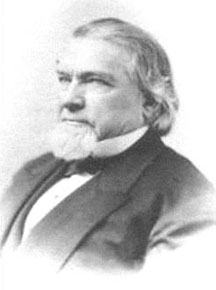
Portrait of U.S. Representative Cadwallader Colden Washburn (Wisconsin); in office between 1855-61.
~ Wikipedia.com
Portrait of U.S. Representative Alvah Sabin (Vermont); in office between 1853-57.
~ Wikipedia.com
This morning I recd a [Pub. Doc.?] from Hon. A Sabin ‘sectry of the [Amaroo?] [pant ???] by [Lieut?] [Gibbon?] with an atlas, also another [Corernoned?] at the presentation of the [swant?] of Gen Jackson, [??? Brainiere? into?] me a Biggon’s battery of the [Amaroo?] just the same thing last winter so that I now have two & if you do not receive one from Mr Sabin I will give you one of mine when you come. I think you will continue to require favors from Mr S. while you [remain?] at the Lake & that Mr C.C. Washburn will not neglect you. If Allen has arrived at the lake how does he like it & how does he propose to spend the summer? He is so great a [mineral agent?] and so patient an explorer I shall look for great exploits by him, & certainly I hope you will both be fortunate in discoveries, and that you may realize ample remuneration for all your privations and toils.
I hope to hear soon of Allen’s safe arrival and hope you will both write often and I will try to do likewise.
Accept my best wishes for your welfare and happiness.
G.A. Barber
A.W.B & J.A. Barber
[fragment, c. 1855, June]
thought but to not enter it without knowing that it was worth something. I have not seen it but Uncle Allen says it is first rate.
I am glad to hear that Am is no worse off but cannot conceive why he should continue at school this summer. The letter r in the map represents a high sand rock like a monument about 12 feet high standing on the point of a bluff. It is biggest at the top and looks very picturesque. That 40 would be a first-rate meadow just as it is and would produce 2 ½ or 3 tons of hay every year, plenty of water could be had on it by digging a few feet.
But what is of some consequence is the land is the very richest quality much better than prairie land will average and it is not more than two miles from a first rate gristmill.
I hope you will come out here and see my great purchase before many years and enter as much more some where. The land in [Richland?] in a short time will come down to .75 ¢ per acre.
I wish the old farm could be sold so that you could all come out here. I should feel a great deal better and I know you all would like your new home. Jo is more than half undecided about going to the lake but I guess he will go.
He thinks now he can’t go so soon as Wednesday. Perhaps I cannot but I want to. Hoping to hear from you once more before I leave I remain
Your affectionate Son
Allen
To be continued in the Summer of 1855…
Barber Papers: “Come up here!” Winter of 1855
August 22, 2015
By Amorin Mello
Selected letters of the Joel Allen Barber Papers
… continued from 1854.
Charlotte Wis. Jan 21st 1855
Dear Parents
You may not like the looks of this small paper but the fact is I have no other, my last sheet of large paper was used for my last letter to you and if I had been aware that I was not going to have any other I would have mentioned it so as in some measure to have modified the shock it must occasion. This is [onerely?] preface as I have not yet been to the office for your letter this week being somewhat distant having no time except today when it is tremendous cold and blustering.
I have three letters ready to mail one to Grandfather one to Uncle Cyrus and one to Albe Whiting. I have written but very few letters this winter except to you, for in fact you have monopolized most of my time for writing. The weather has continued just the same – mild, open, and clear untill today when we have a hard northwind. Prairie fires were running last night in Iowa in many directions and some in this state.
There is not a particle of snow – the brooks are icebound and the ground is frozen and cracked up like it never cracks in Vermont. X X X
Well I have been to the PO and found no letter – shall expect two by next mail. It is snowing some today (Jan 25th).
My health continues as good as could be expected under like circumstances. At the two last places where have the unvarying diet is fried pork and hot biscuits and nothing else to speak of.
Had Johnny Cake yesterday noon, made with all the bran in. It was about the best thing I have seen in the West. I went to a party a few nights ago. It was a miserable trashy affair, nothing but a great barbecue for supper, early, and then dancing untill daylight.
All the rough characters in the country were there. I went at a late hour and retired at about half past 9 oclock, satisfied that I shall not want to attend another such very soon. At Lancaster, the parties are about right, but out here they are a pretty good index of the newness of the country.
It is now impossible to get this to the P.O. unless I go myself and as it blows and snows a perfect old fashioned snow storm I think I shant go but will keep this for another time X X Sat. 27th
Am boarding with a Vermonter two miles from the school house. He is a real Vermonter named Howard one of the best and smartest men on the prairie. He has a good farm which he wants to sell. If any body wants to buy a farm out this way just tell them of this. It will be advertised in the Herald soon. It is a good farm and contains 260 acres, tillable land and firewood enough for two families, the best and most extensive start of fruit in the country. 250 apple trees 20 green gauge plums and innumerable gooseberries [redberries?] currants strawberries and some grapes. The house & barn are new and well built but small. He asks only $2000, is doing well here but wants to leave for other business.
I wish Albe Whiting would see this place; less than half would have to be paid down – good title given.
[Gov.?] Dewy has bought out Cassville or part of it. Prairie La Porte is changed to Guttenburg. Do you know where Sullivan Pierce stopped. He was in company with Hyde coming out but they got separated. Have just been out to the chicken trap found five all alive any fluttering. We killed those and retired and they [lineanes?] have just turned to the [fiels?] again. [scribble] Sunday Three more chickens caught. Went to meeting with Howards folks in a sleigh or rather on a sled – no meeting pretty cold – snow scarcely sufficient for sleighing. If I get a chance I shall try to send some to Lancaster.
I have three more weeks to keep school. 4 more places to board. I like Howards and his folks best of any people on the prairie. They are pious and attend to family worship regularly.
Monday
Have just been to the Post office and got two letters one from you and one from Augustus – He writes nothing except a few business items.
In haste
Yours affectionately
Allen
Johnson, January 27th 1855
Dear Son
Yours of the 11th arrived night before last and contrary to my usual custom I have deferred answering over two mails, but it [will hi?] forwarded now some days sooner than it would have gone by trail, for Ames Dodge will take it along to Galena and by him I shall forward those vests that I bought in the fall for you & Augustus on the very [day?] that I recd your letter saying that Augustus was to be in Lancaster in a few days. Though he has not come & probably will not for some time, [Still,?] you may [be?] your Choice out of the two and send the other to him in the spring if there any going up to the Lake. There are as many who prefer the one as the other, and though I intended to give Aug his choice [????] the danger of his being [wronged?] by your having it [for ?in to ????] he did not take one & you the other. The vests are something nice, only that the style is new and there will not probably be many among the “[Badgers?].” Amos is here after [his monday?] due him [??] estate from Dr [M????] & gets between 700 & 800 & takes west with him. He hails from [Boise?] City, [90?] miles from Dubuque, but he says that he should prefer the Northern front of Ill. or the southern part of West Iowa. Were you or Augs at Lancaster I should try to have him go up there, but he would not go [southwest?]. I know of nothing very new or strange that has happened of late. There is a funeral in [Locon?] to day, of Daniel Mills who lived beyond the Main. You have seen the poor man I suppose. A very hard working & honest man was he.
It is a general time of health in Johnson, I know not of one sick person now except Rob’ Hill who is evidently on his [last?] legs, though around the streets every day. The poor devil had a [time?] in the fore part of Dec. and has been rapidly going down with the consumption ever since. He can have one source of consolation beyond what most men are blessed with, that there will be no excess of grief at his death, and another, that nobody or even the world will ever be able to discover the road that [his?] departure will occasion, & still another, that for his dearest & best friends & companions whose comforts & happiness are undoubted, his strongest & most earnest desire, there will be a greater abundance and at a greatly [demenostred?] price of the blessed creature that has so long stood between [???] & all [witch?] cares. Yesterday Dr C. & I removed two loads of corn fodder and eight loads of hay which with two loads, drawn [before?] makes all the hay I have left, [ample sufficient as?] I think to carry me through with [???] & the old cow. I have some more [slulh?] to [draw?] & two or three loads of wood dry wood in the shed [&?] the [??????] & farming tools, sleigh, waggon, &c to it [??] home yet. Mr Clark from [Miss.?] has moved into the old house & Phelps is going in with him to occupy the part that Dr C did when he was there with us. [Phil??? is?] about buying out [???????] takes a [fusin?] in Wolcott. Sam [Wilson?] has sold or will soon & Bill Smith buys out the Widow Wilson, & [esrnard?] has bought the [Feelting?] farm [in Herling?]. [Gotn?] will probably have the [Muikler?] farm & let Patrk have the Bixley house.
Capt Sam has elected one of the directors of the Bank of Waterbury and keeps a deposit of their money as well as a deposit of [Irusburgh?] money & he is in fact a bank discounting to people like any bank would, & if he keeps it up it will greatly curtail the business of the new bank at Hydepark that will probably go into operation about May 1st. The Hydepark bank stock went off [any?] heavily. Not a dollar take below here & only 46 shares taken here & 26 of them to trade away for other Bank Stocks. The Hydepark folks have sworn vengence against the lower part of the County declaring that no County officer shall come below their [?????]. Let them squirt their dye stuff, it will make them feel better. It is getting to be pretty hard times for almost everything here. Money is scarce & hard to be got. Still prices for everything but [???] & pork are exorbitantly high, wool [no sale?], Pork $[650?] for the [best?] & less in proportion to weight. But corn is $1.25, oats 50¢ Flour $11.00 Beef $5. per [????], & 6 per hind. Butter 20 to 22′ [Churned?] 11 ¢ Hay $15.00 and none to be had at that so that is feared that some poor men will have to kill their cows or see them starve. Wood is from 1.50 to 1.75, Tallow from 14¢ &c &c. If about 1/2 the folks in Johnson were well settled in Grant County I think it would be much better for them and for those who choose to remain on these bleak hills. I should have mentioned Potatoes which are scarce at 50 ¢. Now all who are not producers had better go where they can get the necessaries of life cheaper & wages as good that would be my advice to all, and which I will convince them I am sincere in one of these days.
Your Mother is anxious that you should work with your Uncle Cyrus the ensuing season and learn the builders trade so that you can build a house on our place or one for yourself if you should ever feel the need of one. You have over estimated to us what you thought [??] doing another year, whether to try again to study Medicine, Law, or go to Lake Superior, or teach school, or work around Lancaster. There are many inducements to either course. Ponder the subject well and take the advice of your friends especially of Augustus about going where he is, perhaps he would want you there with him to explore the country for copper. And when you have selected some good place to pursue, why then you may inform us. I intended to [fell????] this [page?] out, but have not time to do it to night, perhaps I may do it in the morning.
So for the present [????] you will [Go & Barber?] I wish you would enquire what timber land can be had for near Lancaster, especially in that grove that was [G??] Dewey’s & do it in a way to not have any one think that your motive is any thing but idle curiosity. I regret that I did not buy 40 or 80 acres of it before he sold it. I am going to Cambridge to day or to morrow and perhaps may pick up some news, that will be interesting to you. If so you may rely on having it forwarded to you soon. You enquired who were Benton’s assistant. Helen Whiteny [tah?] & the small fry Rebeccah [Merriam?] & [Diana?] have [classes?]. I think you will be satisfied with the length of this and can afford to give me one half as long at least. I hope you will continue to write every week and I will endeavour to do the same by you.
G. A. B.
Iron River Falls, LaPointe Co.
Feb. 10th 1855Dear Brother Allen

Survey detail of Iron River Falls, LaPointe County, Wisconsin. A review of this location and survey (T50N R9W) is featured in our series prologue; Stuntz Surveys Superior City 1852-54.
Your [welcome line?] was duly received and at last I find an occasion to write you a word in answer. I am very sorry to learn of your poor health but presume you will improve this winter if you as careful as circumstances will allow, which is generally careful enough. I don’t know how to advise in regard to your future operations but I tell you as I have before told our parents that I wish both yourself and I to obtain a thorough education. Your poor health is at present an obstacle to the pursuit of that object and I do not know that you are resolved on it provided your health was good. I have said so much in my letters about the good efforts of the kind of life I have adopted on the health of consumption or dystrophic men that you will be expecting me to recommend it for you without knowing much about your ailments so I think [is?] almost useless to say to you.
Come up here! I am confident that our season spent in surveying, voyaging, or exploring in this region or any healthy country would do your whole system, constitution, mind & body more good than all the medicines in the universe.
If I could see you I think we might arrange to spend next summer in the woods together. I have seen some experience in frontier-life and the tendency always is (with feeble persons) to giving good health and greatly increasing bodily vigor.
What the changes will be for making a raise in this country next season I can hardly tell you now but I expect they will be pretty good.
I hope you will see Mr. Stuntz when he is in Lancaster this winter, and for I think you would come up with him. I may see you in your schoolhouse before spring, as several things make me wish to visit Lancaster this winter. I don’t know the place where you are teaching, but I wish you all the success you can wish with all my heart. As for your toothache, I wish you as speedy deliverance from it as you would experience if I had a good hold on the offending tooth and hope you will consider the applicability of the “Wellerism” about the [“boy as svollered a fardin”?]
So you don’t like Lancaster? – well, I do! i.e. I like it pretty well generally, and some of the folks in it particularly; and if I supposed my appearance there would excite half the curiosity my supposed advent did last fall I would surely hazard the experiment of confronting those terrific batteries of eyes, for those batteries are not “masked” though I apprehend some of them are case-mated. I received a letter from Father last evening, saying all were well &c.
I wrote to you about the farm, but as you are not in L. you will not find it convenient to attend to it, so you can just let it be if you should not finish your school and return to L. before I return go down or write again. If you should have done anything about it before this reaches you all right or otherwise – all right. I am [well?] and well provided with work so I stand [it?] pretty well although our quarters here are not just as one would like them. I could write better if the idea had [yet?] not taken possession of my mind that I shall see you in mere weeks, so you will excuse imperfections and believe me.
Your affectionate brother
Augustus H. Barber
P.S. I admit that I may err in advising you to undertake the labors of a trip to this region, and that some other vocation in sight be more advantageous in all respects; and I do not wish you to adopt my course simply on the strength of my recommendation. Think about it, and in your ruminations keep this idea before your mind – “Health is the vital principle of bliss. And exercise of health.”
A.H.B.
Patch Grove Wis. Feb. 18, /55
Dear Parents
I have nothing to do this evening to amuse myself unless it is to write a letter.
Closed my school last night and have got this far from the scene of my labors although it may seem that I am not much nearer Lancaster. It is no nearer but there is a stage from here there tomorrow morning.
Had a good chance to ride to L. Saturday morning but only sent my trunk. Got my pay last night in gold. Sold my clock at cost for the gold, and stayed over night at [Basfords?].
[…]
The [????] is There several of meanest roughest imps here I have yet seen in the [state?]. I guess I will wait untill I get to L. before I finish this so as to report my luck in getting home.
X X X X Lancaster Feb 20th
Got here yesterday all safe. Found the good people all well. Uncle Thode went off in the morning so I did not see him. Augustus has written something about the produce of the farm. There is considerable corn which [????] pigs have been living on lately. There are several who want to rent the place and one man wants the house without the land. He is one of the Shoemaker tribe, and I dont want him within ten miles of it. Wheeler who lives on the [place?] now and wants to rent it has a good [team?] and promises to do well with it.
[…]
I mean to get my hair cut today for the first time after leaving Vermont. It has got pretty long and looks “first rate.” There are 40 rabbits to the square rod around here – At least there are so many tracks. From what I can learn I should think Augustus was doing about as much this winter as he did last winter. There are no liquor shops open in town they say and nothing, read and spell better than could be expected of him. Have not time to write another sheet.
Allen
I will try to get some larger paper before I write to you again
1855, [Feb.] 16
Lancaster Wis. 16th 1855
Dear Father & Mother
Knowing myself to much indebted to you for the promptness and length of your letters it is my intent to reciprocate as far as lies in my poor abilities by writing as often and fully as possible. My health still appears to be good and we have all been pretty well except Myron who alarmed us very much night before last by having a fit. He had been sick all day occasionally eating too many new doughnuts and other things. The fit commenced about six o’clock P.M. and lasted 10 or 12 minutes and was stupid until 10, and will occasionaly [??????ahing?] untill next morning.
He was sick all day yesterday but got up this morning smarter than ever and continues well. Uncle Ham. has got back from the north. All the land he went after particularly he found entered but he says he got [????t] of first rate land.
Uncle Allen wants me to enter some [land?] which I think I shall do when I hear of some good [??????]. I suppose I could find land north 2 or three dollars per. acre.
I could easily sell out at any time for 20 or 30 per cent, more than cost. Ben. C. Eastman has returned. He has some timber land for which he asks about 7 dollars per acre, which I suppose is about as well as well you can do. I have some thoughts of applying for a school in [Morrisson8?] district.
The school has got to bad for any female to teach and want a man. That is just the kind of school I would like to try for the sake of variety. They pay $12. per mo to female teachers.
Uncle ham has entered 8 sections on black river, he thinks in 5 years will be worth more than all the other lands he owns.
G. R. Stuntz is in town. We have good sleighing now and have had since Sunday [Sat. 11th?]. More Snow- about a foot of new snow and about 3* below freezing cold.
[…]
Rec’d your letter
of March 6th today. Uncle Allen had got it as he does [most?] of any mail matter. The [???] cannot see the 2nd it appears. The good people here are considerably incensed by their disappointment in not seeing Grandfathers out here this spring. I know of no reason for his not coming out with uncle Thode as far as Sandusky where they would want him to stay untill into summer. I think he will yet be allowed to visit this western paradise and meet his children, grandchildren, and other friends. I did not make so good a bargain as you wished in regards to the farm but I think it was as good as could be made.
[…]
Sunday 18th. Have not been to meeting today.
~ Wikipedia.com
Last night I went up to Rowdens beyond Uncle Jays to see about that school. I guess they dont want any more school this spring. It is rather surprising that the Know Nothings have got such power in [Cambridge?].
I had heard of their strength and [power?] by way of [??] [Heath?] in a letter to Augustus which fell into the hands of Uncle Ham. There are none of them here.
I hope [Wyman?] and Charles Stanly will come out here. This is not a very good place for [??????] but they would go to Lake Superior or St Croix river and [get good wages?]. If they get here soon perhaps they could work with Stuntz.
[Incomplete copy of letter]
Home March 1st 1855
Friend Allen,
It is some time since I rec’d your last and I should have replied earlier but for several weighty reasons. Even now my eyes promise to close and carry the spirit to dream land instead of the western world, but though the flesh is willing the will is not ready to resign itself to the arms of the [dreary?] old night god, till it talks awhile with you.
My [“???”] says I last wrote you (Dec 1st) well, if tis so I ought to have a few to say to this now, but my heart is as barren as no matter what. Could I be blessed with your company tonight we might lay awake and talk till the roosters crowed; and then not say it all, but now I really do not think of anything worthwhile to write.
As I have written west from once to twice a week all winter, to three or more people. I have to repeat the news that way till they become as stale as – new crackers.
[…]
Tis a time of general health here, if we except the small pox, which is in to help the Frenchmen this hard season. Where are you going this summer? what to do? I may go west in April – may not till fall – or never. I wish to go this spring but wish to study a term or two first, still may go soon. Please write very soon, and I may see you before May if I know where to find you. Time hastens – and with a hope for your welfare and prayers for your happiness I am the same old friend.
Albe
A J Barber
Lancaster March 2nd, 1855
Dear Father,
Yours of Jan. 18th was duly received and I hasten to reply.
I have written to Augustus [lately?] all I could think of especially about his getting kissed by a squaw. The next time you write to him you can ask him about the particulars.
I am glad Cad. is going to leave Johnson.

Detail of an abandoned copper exploration of the American Fur Company at Black River Falls (Big Manitou Falls) from the T47N R14W survey in Douglas County, which Augustus worked on with Stuntz in 1852.
If I could do anything to help him to useful and profitable employment God knows I would be glad to do it. Uncle [Ham?] started yesterday for Black river falls after pine lands. [He?] expects to be out in the woods some and perhaps camp out, will be gone from here about twenty days. [Tody?] has been writing [where?], he says it is a [“tow”-(cow)?]
[written in margin] he talks most everything [/margin]
[…]
I cannot express my gratitude for the amount of reading matter I have read from home lately in letter form.
[Jake Moorn?] is very slim has been sick some time. I must close to write Am and others
Good Bye
Allen
P.S. I have lent Cyrus $50. He has bought two cows and wants to buy more
Aunt [Lila?] has been sick over a week with strange and alarming symptoms. Constant headache splitting [leload?] and the exact appearance of being [Calivated?] but she is now better.
I want to write a letter to Am. about his [cars?] and some other things but guess I will wait till some other time
J. Allen Barber
Aunt Fanny thought sending a line in this but concludes not to. She says she has a right wait a while as you did.
A Masonic lodge has been started here lately so you will not miss the privelege of meeting your Morgan killing brethren at Cadys falls when you come out here.
Aunt Fanny wants you to send her some [Russian] turnip seed. Soon as possible. If you could send some two or three years old it would be better and perhaps purer blooded.
I once had a [pear?] spruce seeds which I wish I had here They [more?] in a [papa?] and [labely?]. And I would not care if I had some spruce [germ?]
To be continued in the Spring of 1855…
Barber Papers: “Augustus” 1854
August 7, 2015
By Amorin Mello
Selected letters of the Joel Allen Barber Papers
… continued from the prologue (1852-54).
Abstract:
Augustus Hamilton Barber
brother of Joel Allen Barber
and Amherst Willoughby Barber;
nephew of Joel Allen Barber;
cousin of Joel Allen Barber, 2nd;
son of Giles Addison Barber;
grandson of Joel Barber, Jr;
great-great-great-great-grandson of Thomas Barber.Primarily letters exchanged by Barber, a surveyor in northern Wisconsin and later a soldier in the 25th Wisconsin Volunteer Infantry, and his parents in Vermont from 1854 to 1865. Written from Superior, Ashland, and La Pointe, Barber’s letters refer to economic conditions and pioneer life, to Indian affairs, and to Catholic and Protestant missions. Also included are Civil War letters by Barber; letters from his father, G. A. Barber, while in Montpelier participating in sessions of the Vermont House of Representatives; and miscellaneous items including a Revolutionary War pension statement and genealogical data on the Green family; two letters, Sept. 4 and 27, 1870, written by Joseph C. Cover, U.S. consul at Fayal in the Azores; and a printed memorial address by Col. Clement A. Lounsberry.
Biography/History:
Joel Allen Barber (1834-post 1909) was the son of Giles A. Barber (1803-1879) of Cambridge and Johnson, Vermont, and the nephew of Joel Allen Barber (1809-1881), Wisconsin legislator and Congressman. The senior J. Allen Barber came from Vermont and settled in Lancaster, Wisconsin, in 1837. He was followed by his father, by his brother T. M. Barber, who became a Lancaster merchant, and by numerous other relatives in the 1840’s and 1850’s.
The Barber brothers, Augustus and Allen, received expert legal advice and political updates from Uncle Joel Allen Barber (Senior) regarding their affairs while on Lake Superior.Giles A. Barber had three sons who reached manhood: Augustus (1831-1856), Joel Allen, and Amherst Willoughby (1841-1920). Joel Allen came to Wisconsin in 1854. After a term as a school teacher in the Blake’s Prairie area of Grant County and several months in Lancaster engaged in varied occupations suggested by his uncles, he went to the Lake Superior region in June, 1855, to join his brother Augustus, who was engaged in copper and land speculation and in a surveying business. Augustus was killed in an accident in the spring of 1856 but Joel Allen remained in northwestern Wisconsin as a surveyor until 1861. During the Civil War, he served from 1862 to 1865 in Co. C of the 25th Wisconsin Infantry and was first lieutenant of his unit at the time of his discharge.
Scope and Content Note:
An undated portrait of Uncle Joel Allen Barber is on page 199 of the Proceedings of the State Bar Association of Wisconsin, Volume 1900
A memoir of Uncle Joel is on page 198.
The collection consists primarily of letters exchanged by Joel Allen Barber and his parents from 1854 to 1865. The letters by Allen–as he was known in his family, to distinguish him from his uncle–were written from Superior, Ashland, and La Pointe and contain many references to economic conditions and pioneer life in northern Wisconsin in the 1850’s, to Indian affairs, and to Catholic and Protestant missions. In letters from Vermont, his parents commented on these matters as well as related news of eastern business and politics. G. A. Barber served several terms as judge in Lamoille County, and represented the town of Cambridge in the Vermont House of Representatives in 1858 and 1859. The collection includes numerous letters which he wrote from Montpelier during the sessions. He had also visited Allen in the fall of 1856, and his letter of November 3, 1856, was written during a rough voyage down Lake Superior and Lake Michigan in the famed steamboat “Lady Elgin.”

Johnson Apr. 15th 1854
Dear Brother Augustus
T47N R14W, T47N R15W, T48N R14W, T48N R15W, T49N R14W & T49N R15W (June 1852);
… and Interior Field Notes:
T47N R14W (June 1852);
T49N R13W (May-June 1853);
& T47N R13W (June-July 1853).
T26N R5W (Aug. 1853);
T26N R6W (Aug. 1853);
T27N R5W (Sept. 1853);
T27N R6W (Sept. 1853);
T28N R5W (Sept. 1853);
T26N R4W (Sept.-Oct. 1853);
T27N R4W (Oct. 1853);
& T28N R4W (Oct. 1853).
I wrote to you partly to kill time and partly to let you know what a ridiculous fix I am in. [Jo/Sen?] [M.?] Knight had to go to Boston and Homer Bell is sick – so the best he could do except to shut up the store was to leave me with it. I came in yesterday, then he left for Boston so I don’t know everything about the store yet. And what is worse [now if?] the goods are marked except a few staples which were marked specially for this occasion.
There is considerable [hade hike?] at least so it seems to me. Tobaccco is called for more than have as often as any other article.
[That don’t?] agree with me. Homer may get out so as to be here some of the time to advise me but it is doubtful as the weather which has been very fine of late has changed and threatened to be bad. I was greatly elated a few days ago by the prospect of going west as father thinks of sending me with the [chop roots?] but he has found another way to get them along by [Hayland?] Wilcox to Madison I believe.
Have you seen anything of John Cook out your way?
He and [Aunt?] F Whiting started for the west she stopped at [Eckhart?] Indiana and he went along and did not know but he should go to Lancaster.
Emily Whiting has been sick. She returned from Mount [Holfotre??] Seminary [??????] time ago where there was so much sickness that it had to be broken up. [Sarah Dougherty?] has also been sick from the effects of a hard cold.
We had [a maple?] sugar party at [Azioson fast?] day. I have no more time to write.
Father will write soon
Give my love &c
Allen
Sandusky Sept. 16th 1854
Dear Parents
As you will be looking for a letter I will try to not disappoint you.
I arrived here yesterday (Saturday) at noon in good health and spirits.
You may wish to know something of my journey so I will briefly notice it. We came very slowly to Albany where a valve got out of order which detained us a while, but we finaly got to R. R. where we were so lucky as to find a train waiting for us.
We made rather poor time on this road about half way but after passing a train we came out fast enough. Got to Ogdensburgh about 8 P.M. Waited about 2 hours for the boat and then took the “Ontario.”
Next morning we were at Kingston.
Wednesday, August 23, 1854
“We are desired to say that the new steamboat CLIFTON, just built by the Messrs. MacLem, at Chippewa, C.W., will leave this port, this afternoon, at two o’clock, upon a pleasure and experimental trip.”
~ Maritime History of the Great Lakes
Reached Oswego about the middle of the afternoon. Next morning (Friday) reached Queenston at the mouth of the river and took the cars for Chippeway, this is a new road just opened and much the best way to get along. Stopped at the falls two or three hours. At Chippeway took the steamer Clifton for Buffalo.
Tramped round as much as I could wish to in Buffalo and went to bed on the Mississippi which left at 10 oclock P.M. This was a grand boat, ever way superior to the Oregon. Had some toothache Friday night and one side of my face is badly swelled yet. Aunt Em. is away from home for a few days.
I like the children very well. Have not received any letter from Ind. We have no very rough weather on the lakes yet there was enough wind to make the boat roll and pitch some most of the time. I was a little seasick Friday morning but could not throw up anything.
The weather is fine peaches are plenty. Mr. Messer sends his respects. I should like to hear from home but know not where I shall be.
I shall write again soon.
My love to all.
From your affectionate Son
Allen
Lancaster Oct. 13th 1854
Dear Parents
Perhaps I should have written before but I have been prevented partly by ill health.
I did not start from Sandusky untill the 5th of this month. I was quite unwell several days before leaving Ohio. Reached Galena the second night after leaving Ohio. The cars run to [illegible] around 10 miles from Galena. Stopped at the City Hotel. Found Uncle Thode without difficulty. He is [busy?] as ever.
Stayed at Galena over Sunday and took the stage at midnight for Plattville and then finished my journey on foot.
Found people nearly all well here. Aunty Fanny has been quite sick but is getting well now. Frank Hyde has got here, bought a place in the village, opened a shop &c.
I am [spopping?] now at Uncle Allen’s now.
You will please excuse my being short as I am not well enough to write very easily.
My love to all the family and respects to some others.
Hoping to hear from Vermont often I remain
Your affectionate Son
Allen
Lancaster Oct. 19th 1854
Dear Father & Mother
Although I have written once since I arrived here I think I have reason to write again as I was not very communicative before. I mentioned being unwell as a reason for not writing more but did not mention the cause or nature of my ill health. At Sandusky I was attacked with diarrhea, occasioned I think by eating part of a diseased potatoe – this continued in spite of me four days and after a cessation of one day continued untill untill after I had been here some time. My flesh and strength failed very much, my appetite entirely.
At Galena I found I had lost ten pounds.
I am now improving under Dr. Woods medicine which though very ineffectual has done me well enough, unless the low state of my blood should superinduce fever and ague.
I acknowledge the justice of your remarks upon the paper I used, but that was the best I happened to have then. And I may as well notice the receipt of a very welcome letter from you this afternoon dated Oct. 8th.
I was very sorry to hear of Amherst’s sickness and somewhat surprised as I did not fancy that peculiarity of his breathing could be anything serious. If he is any yellower then I am, he would pass for a good Chinaman.
I believe I briefly mentioned my journey from Sandusky here. To Detroit I went by night. Fare including berth $2.00. Took breakfast at the Rail Road Exchange – a rather humble and cheap house but they are very obliging.
Went to the National Hotel to find Mr. Smith but he had gone to Rock Island to stay.
Had a fine view of the city from the cupola of the National. Was much pleased with Michigan and looked round so much that at night I could not turn my eyes without pain. There was an unequated rush of travel when I came through. Such passenger trains I never saw before. It took four cars for the baggage, express, and mail business.
Was obliged to stay over night at Chicago as the trains do not connect by a minute or two. At Rockford I inquired for Mr. Huntington but he lived on the other side of the river at some distance so I did not see him.
The R.R. will be finished to Galena in two or three weeks.
I have seen a great many people from Vermont in my travels. One fellow I saw at Plattville was lately from Morristown. He lived near [Jenery?]’s and his name was Dodge.
One fat speculator from White river inquired about Doane. I saw him in Michigan.
When I first arrived in town I made my way directly to Uncle Allen’s office where I found him and Uncle Cyrus & Frank Hyde.
Uncle Cyrus me very quick. Aunt Sa’h and Grandmother thought Augustus had returned after a severe sickness.
I felt and no doubt looked some as David Copperfield did when he got to his Aunts.
I have been very kindly received and cared for by all my relations wherever I have been. I am staying now at Aunt Fanny’s. Helped Cyrus pick corn this forenoon it rains nice this P.M. As to the country, the lay of the land &c. I hardly know what to say.
~ History of George Alcorn
I can fully endorse the sentiments of others who have praised the west but I think there are more beautiful places in the vicinity of Freeport and Warren than the country around Lancaster. Jo. Alcorn and his family arrived here a few days since.
He wants to carry on your land next year. Shoemaker does not want it as he is going to carpentry next year.
There is also another Shoemaker coming from Ill. who wants it.
The appletrees Augustus set out are most all doing well – the hops are rather scarce.
Think the [People?] of Lancaster are very kind, good hearted people but I have not got acquainted much yet.
Grandmother is perfectly captivated with Aunt Em, since being there, she thinks there is no place like Uncle Ham’s house – well it is a modest home.
But it grows dark and I must wind up. Please let Am write some in the next.
My love to all
Allen
P.S. I saw Mr Dewing a few days ago
He is swift to have me come out to this place to fish and shoot ducks &c.
Allen
Superior Nov. 7th 1854
Brother Allen
I received your letter of the 18th ult. today, and was glad to hear from you in a place so much to my fancy as Lancaster. Of course you are charmed with the western country, though you don’t say so in your letter, and though other places may offer more immediate chances for entering some lucrative employment [now?] seem more calculated to make a quiet and pleasant home than L. and its beautiful environment. I feel quite flattered by your account of the bustle among the fair ones occasioned by my supposed return, and am quite inclined to [create?] a genuine ‘furor’ by appearing in “Persona Profile” among them some of these days, and prevent the recurrence of their mistake by staying there.
But grateful and precious as are the joys of friendship and free social converse, they are only flowers beautifying the margins of the nigged path to wealth and honor, and he who presents their delights to enthrall his senses or entice him aside, is sure to stumble.
If I strive for wealth it is to enjoy it; if I fail to acquire it I hope to make none wretched by my inefficiency or misfortunes.
Perhaps you would like a little information in regard to my operations –: well Stuntz’ survey is finished and I have some writing to do for him, which will occupy me several days; as for subsequent “doins” you will be dully appraised.
I presume you will stay in L. this Winter, and I almost envy you the pleasure of mixing in the young society of the village – perhaps you will teach the village school. You will remember enough of my letters to look out for the deviltry of the boys about town, but lest you wrong the innocent I will say that with two or three exceptions they are fair and candid.
~ Lancaster Teller, April 30, 1891
You cannot and need not avoid the lately returned Californians, but a little prudent circumspection will not be any injury them and may keep you clear of some petty embarrassments: Some good luck and some good guessing kept me clear of sundry little “contrived plans” of their hatching, and I warn you, perhaps needlessly, but candidly.
Am glad Aunt Lucy has selected and called her little girl after one she knows to be among the best of good girls: she declared she would never call her Eleanor because I wished her to; but I [mistanded?] all the time that she rather meant to, finally. I think this will do at present, for I intend writing soon.
My love to all
Your affct Brother
Augustus
I went to election today and voted for the republican candidate for Congress – Mr. Washburn. All [Lokiss?] here
Johnson, November, 26th 1854
Dear Brother
As it is vacation with me now, I thought I could write a short note to you, not knowing but it might be acceptable. We have all sorts of weather here now, for today it has shone, rained, snowed, & hailed [illegible words] & rained [toreously?] [Jo?] I attended the funeral of Charles Daniels & walked up to his folk’s house with father through the mud and it was about [shortest?] one I ever attended. He died of consumption. Merrill Pillsbury died last Tuesday & was buried Thursday. I don’t know but Father has written you about it before [illegible] I believe he also died of consumpt. We had a great time here Tuesday night. There was a grand [feast?] in the [Town Hall?], and we had pig & almonds & raisins & apples &c. to the [casts-offs?] Would you not have given a quarter as I did to have been here to [both]? Every body there enjoyed themselves greatly. It was a new-fashioned dance in more respects than one for invitations were sent to all the people in the [village?] to attend and many of did so [illegible] in a manner very amusing to the swing generation. The 7th [?] of the United States Magazine came last week & also the last of the Phrenological Journal with a little paper index to the [illegible]. Do you wish to subscribe to it another year? Do you wish the volume bounds? We have prescribed [a large number nicely?] so that it might be bound. But it is time for the mail to go out. I must close.
Goodbye
Amst
Detail of an abandoned copper exploration at Big Manitou Falls from T47N R14W. Augustus worked on the Exterior and Interior Surveys here during June of 1852.
[ca. 1854]
Augustus,
When the draft comes in if you will send it down you will much oblige me.
What are you doing. Would you not do well to make some improvements about the place such as getting or making rails to hew in the pasture. Setting out trees lining for an orchard or any way to make it like a home. I hope you will find something to do for idleness will beget mischief any way you can fix it. My leaving off business so long nearly deprived me of business facultys, at least it is like leaving one again. I feel it very much as Mr. Felt left me the very day I became [introduced?] in the business. Any employment is better than to remain idle. If God will forgive me for wasting so much time will try and do better in future. Any honest business faithfully followed is doing vast good business [betting?] our own condition and enabling us to become much more useful.
Excuse me for making these suggestions for experience has prompted me so to do.
Will you be kind Augustus as to write frequently to me. Again I say forgive my plainess of speech.
Love to all
[illegible]
Truly your Friend & Uncle
T M Barber
To be continued in the Winter of 1855…
By Amorin Mello
In our Penoka Survey Incidents series earlier this year, we followed some of the adventures and schemes of Albert Conrad Stuntz circa 1857. The legacy of Albert’s influential survey still defines the geopolitical landscape of the Penokee Mountains to this day. However, Albert’s work during the late 1850s was relatively minor in comparison to that of his brother, George Riley Stuntz, during the early 1850s. The surveying work of George and his employees started in 1852 and enabled the infamous land speculators and townsite promotors of Superior City to manifest their schemes by early 1854 (months before the Treaty of La Point occurred later that year).
Among the men that worked with George was Augustus Hamilton Barber. Sometime around 1850, Augustus had followed his Grandparents, Aunts, Uncles, and Cousins from the Barber family of Lamoille County, Vermont, to Lancaster in Grant County, Wisconsin. After a short career as a school teacher in Grant County, Augustus came to Lake Superior in 1852 employed by George as a Chainman under his contract with the United States General Land Office to survey lands at the Head of Lake Superior.
Before taking a closer look at the Barber Papers, let’s examine the lives and affairs of other surveyors and speculators along the southwest shore of Lake Superior, starting with George Riley Stuntz and his production of these Exterior Field Notes (June of 1852):


Duluth and St. Louis County, Minnesota;
Their Story and People
By Walter Van Brunt, 1921, pages 64-65.

Portrait of George Nettleton’s cabin on Minnesota Point in 1852 on page 75.
First Settler.– The honor, for both Superior and Duluth, must presumably go to George R. Stuntz. He came in 1852, and settled in 1853. Several were earlier of course, but can hardly be considered to have been legitimate independent settlers. Carlton had been on the ground, at Fond du Lac, for some years, but he was Indian agent; Borup and Oaks had spent their time between La Pointe and Fond du Lac, but were then at St. Paul, and mainly interested in the development of that city, and in fur trading. Wm. R. Marshall stated that he “was on the lake as early as 1848,” but not to settle and he did not come again until 1857. Wm. R. Marshall and George R. Stuntz were fellow-surveyors, in federal pay, “back in the ’40s,” but Marshall did not seek to take the place of Stuntz as premier pioneer at the head of Lake Superior. As a matter of fact, although “on the lake as early as “1848,” Marshall did not then get nearer to Duluth than La Pointe, where he met “Borup and Oaks, the principal traders, Truman Warren, George Nettleton, Cruttenden, Wattrous, Rev. Sherman Hall, E. F. Ely and others.” It is quite possible that Stuntz was with Marshall in 1848, for that was the year in which Stuntz first entered Minnesota territory “having charge of a surveying party that was working near Lake Pepin and in what is now Washington County.”
The “Heart of the Continent.”– George R. Stuntz prepared the way for the first attempt at white settlement at the head of Lake Superior. He surveyed the land on the Wisconsin side, within a year of beginning which survey, in 1852, the first settlers began to appear. George R. Stuntz came by direction of George B. Sargent, who at the time was surveyor-general of the Iowa, Wisconsin and Minnesota district for the federal government, his headquarters being at Davenport, Iowa. In that year, states Carey, “he surveyed and definitely located a portion of the northeastern boundary line between Minnesota and Wisconsin, starting from the head of navigation on the St. Louis River, at Fond du Lac, and running south to the St. Croix River.” Stuntz himself stated: “I came in 1852. I saw the advantages of this point (Minnesota Point) as clearly then as I do now (1892). On finishing the survey for the government, I went away to make a report, and returned the next spring and came for good. I saw as surely then as I do now that this was the heart of the continent commercially, and so I drove my stakes.”
![Group of people, including a number of Ojibwe at Minnesota Point, Duluth, Minnesota [featuring William Howenstein] ~ University of Minnesota Duluth, Kathryn A. Martin Library](https://chequamegonhistory.com/wp-content/uploads/2015/06/howenstein-minnesota-point.jpg)
Group of people, including a number of Ojibwe at Minnesota Point, Duluth, Minnesota [featuring William Howenstein in 1872?] ~ University of Minnesota Duluth
The Vanguard.– He did not come alone, needing of course assistants in the work of surveying, but he was in charge of the work, Gand necessarily takes first place in the accounting. William C. Sargent, son of George B. Sargent, stated in 1916, that his father “came here (Duluth) first in 1852 with George R. Stuntz and Bill Howenstein,” and goes on to state “a word of those two grand men, George R. Stuntz and Bill Howenstein.” He believed that “to George R. Stuntz, more than to any other man belongs the honor (of) opening up that region,” and of Howenstein, he said: “And old Bill Howenstein, one of the best ever, and always my very good friend, a kindly body, with a quaint dry humor unsurpassed and seldom met with in these later days. I had many an interesting chat with him, in his home on Minnesota Point, that he built in 1852, and lived in until his death, some years ago.” Bill Howenstein, undoubtedly was of Stuntz’ party in 1852, but it is doubtful whether he built a log house on Minnesota Point in that year. As to General Sargent’s visit in 1852. If he did come then, it was probably only a flying visit. His interest in the head of Lake Superior in 1852 reached only to the extent of directing Stuntz to survey it. He, himself, had the surveying business of three states to attend to.
The New York Times
[December 11, 1852]
The Region about the Southwest End of Lake Superior.
Mr. Stuntz, of Grant County, Wis., has been deputed by the general Land Surveyor of this Northwest District to lay off such a tract of land about the southwest point of the lake into townships and sections, as emigrants will earliest require. He returned via La Pointe and Stillwater last week. We have obtained from him some new views of that region. From Fond du Lac, a trading post situated 11 miles inland on the St. Louis River, eastward, for perhaps 50 miles, the margin of the lake is a flat strip of land reaching back to a rocky ridge about 11 miles off. The soil of this flat land is a rich red clay. The wood is white cedar and pine of the most magnificent growth. The American line is beyond the mouth of the St. Louis and Pigeon rivers. It evidently abounds in copper, iron and silver. The terrestrial compass cannot be used there, so strong is the attraction to the earth. The needle rears and plunges “like mad.” Points of survey have to be fixed by the solar compass.
The Indian and half breed packmen have astonishing strength. One Indian, who is described by the others as being as large as two men, carried for a company of 11 men provisions for ten days, viz: one barrel of flour, half barrel of pork and something else, beside the utensils. Mirage is a common phenomenon is Spring and Summer. For the bays not opening as soon as the main lake, or not cooling so early, an object out on the lake, is viewed from the shore, through a dense medium of air and a thin medium. Hence is a refraction of rays which gives so many wonderful sights that the Chippewas call that the spirit or enchanted land. Sail vessels which are really 40 miles off, are seen flapping and bellying about almost within touch. Turreted Islands, look heavy and toppling towards the zenith. Forests seem to leap from their stems and go a soaring like thistles for the very sport of it.
The ice did not leave some of the bays till the 10th of June. The fish are delicious, especially the salmon trout. But little land game. Mr. Stunts calculates on wonderful enterprises in that country after the opening of the Saut Canal.
Mr. S. describes La Pointe a town of the Lake, as being situated at the head of a bay some 25 miles from the high lake, and secluded from the lake by several islands. He saw there a warehouse 300 feet long, built of tamarac poles, and roofed with bark. This building is very much warped by the pressure of age ; it is entered by a wooden railway. The town is dingy and dreary. He saw a most luxurious garden by the former residence of Dr. Borup. It contained a variety of fruit trees and shrubs, such as plums, cherries, apples, pears, currants, &c.

Cover of Stuntz’s Exterior Field Notes (August-October 1852) ~ Wisconsin Public Land Survey Records: Original Field Notes and Plat Maps

George Riley Stuntz was also assisted by his brother Albert Conrad Stuntz as well as the African-Chippewa mixed-blood Stephen Bonga employed as an Axeman. To learn more about the interesting Bonga (Bonza) family and Stephen as “the first white child born at the head of Lake Superior,” read pages 39-41 of The Black West by William Loren Katz (1971), and pages 131-34 of Black Indians also by Katz (2012).
The Eye of the North-west: First Annual Report of the Statistician of Superior, Wisconsin
By Frank Abial Flower, 1890

Portrait of Stephen Bonga, page 7.
GEORGE R. STUNTZ, DEPUTY U. S. SURVEYOR [pages 50-52]

Portrait of George Riley Stuntz, page 26.
In 1852 George R. Stuntz took a contract to run the township lines in this part of the country, including the state boundary, and filed with the land-office at Dubuque a rude map of the head of the lake, on the Wisconsin side, in December of that year. He took a new contract and returned in the spring of 1853 to survey the copper range around Black River, a few miles south of Superior. He brought seeds with him and planting them on the Namdji, raised a quantity of vegetables; they grew to great size. he also built a trading-post on Minnesota point near the present light-house, and a mill on Iron River in Bayfield county. In respect of these operations W. W. Ward writes from Morley, Mo.:
The first lumber of any description produced locally, other than by “Whip sawing”, was at Iron River, Wisconsin about forty miles from Superior on the South Shore of Lake Superior.
George R. Stuntz with William C. Howenstein, Andrew Reefer and George Falkner built and operated a water power “up and down” sawmill at the falls on Iron River about a half a mile from the Lake, capable of cutting three thousand feet of lumber a day. The writer has several 1 1/4 inch absolutely “clear” White Pine boards 24 and 26 inches wide and 18 feet long that were originally stored in a loft to be used in building a skiff. This mill was built in 1854 and the lumber was floated up the Lake to Superior, Oneota and Fond du Lac…
~ Superior, Wisconsin, papers, 1831-1942 ([unpublished])
From “A Pioneer of Old Superior” by Lillian Kimball Stewart
“In the summer of ’54 the Sam Ward plying between the Sault and any port on Lake Superior, brought on every trip a goodly number of emigrants, speculators, and tourists, bent on seeing the new “city” of Superior. Stuntz’s dock was located near an Indian village, so that every traveler as well as every piece of freight or baggage was subject to inspection by braves, squaws, and papooses before receiving a passport to the shore across the bay…”
~ Superior, Wisconsin, papers, 1831-1942 ([unpublished])
“It was in the spring of 1853 that Mr. Stuntz, Deputy U. S. Surveyor, received his second contract to survey and run the township lines taking in the range around Black River Falls, a portion of Left-hand River country and that part where Superior now is. In the latter part of April that year he organized a party – viz., Nat. W. Kendall, James McKinzie, Pain Bradt, James McBride, Harvey Fargo, Wm. H. Reed, John Chisholm, Joseph Latham, Augustus Barber, and your humble servant. Procured three birch-bark canoes and supplies at Stillwater, Minn.: left there the first day of May, passed up the St. Croix River to its head, made a portage of about two and a half miles into the headwaters of the Brule River, down said river into Lake Superior, thence up the lake to what was called the entry of St. Louis Bay [now Superior Bay], and landed on Minnesota Point in the early part of June. At that time there were no white settlers in this end of the lake – all Chippewa Indians and ‘breeds’ – scarcely a stick missing on that side of the bay where Superior City now stands. We finished the surveying contract and went in early fall down to Iron River, built a double log-shanty, and made other preparations for the construction of a saw mill. Here the first lumber was made at the head of the lake and the first road opened through to the settlement on the St. Croix. The following February, Mr. Stuntz having a trading-post on Minnesota Point [then Stuntz’s Point], I went there and assisted in building a block-house and steamboat pier, and found improvements and a few log-shanties built where old Superior now is located.”
[…]
HUSTLING FOR TOWNSITES [pages 58-60]
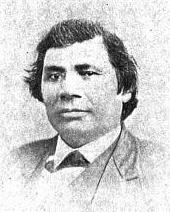
Vincent Roy Jr. ~ Life and Labors of Rt. Rev. Frederic Baraga by Chrysostom Verwyst,
VI. – Superior.
Vincent [Roy Jr.] had barely emerged from the trouble just described when it was necessary for him to exert himself in another direction. A year or so previously he had taken up a claim of land at the headwaters of Lake Superior and there was improvement now on foot for that part of the country, and danger for his interests.
The ship canal at Sault St Marie was in course of construction and it was evidently but a question of days that boats afloat on Lakes Huron and Michigan would be able to run up and unload their cargo for regions further inland somewhere on the shore at the further end of Lake Superior, at which a place, no doubt, a city would be built. The place now occupied by the city of Superior was suitable for the purposes in view but to set it in order and to own the greatest possible part of it, had become all at the same time the cherished idea of too many different elements as that developments could go on smoothly. Three independent crews were struggling to establish themselves at the lower or east end of the bay when a fourth crew approached at the upper or west end, with which Vincent, his brother Frank, and others of LaPointe had joined in. As this crew went directly to and began operations at the place where Vincent had his property it seems to have been guided by him, though it was in reality under the leadership of Wm. Nettleton who was backed by Hon. Henry M. Rice of St. Paul. Without delay the party set to work surveying the land and “improving” each claim, as soon as it was marked off, by building some kind of a log-house upon it. The hewing of timber may have attracted the attention of the other crews at the lower end about two or three miles off, as they came up about noon to see what was going on. The parties met about halfway down the bay at a place where a small creek winds its way through a rugged ravine and falls into the bay. Prospects were anything but pleasant at first at the meeting; for a time it seemed that a battle was to be fought, which however did not take place but the parceling out of ‘claims’ was for the time being suspended. This was in March or April 1854. Hereafter some transacting went on back the curtain, and before long it came out that the interests of the town-site of Superior, as far as necessary for efficient action, were united into a land company of which public and prominent view of New York, Washington, D.C. and other places east of the Mississippi river were the stockholders. Such interests as were not represented in the company were satisfied which meant for some of them that they were set aside for deficiency of right or title to a consideration. The townsite of the Superior of those days was laid out on both sides of the Nemadji river about two or three miles into the country with a base along the water edge about half way up Superior bay, so that Vincent with his property at the upper end of the bay, was pretty well out of the way of the land company, but there were an way such as thought his land a desirable thing and they contested his title in spite of his holding it already for a considerable time. An argument on hand in those days was, that persons of mixed blood were incapable of making a legal claim of land. The assertion looks more like a bugaboo invented for the purpose to get rid of persons in the way than something founded upon law and reason, yet at that time some effect was obtained with it. Vincent managed, however, to ward off all intrusion upon his property, holding it under every possible title, ‘preemption’ etc., until the treaty of LaPointe in the following September, when it was settled upon his name by title of United States scrip so called, that is by reason of the clause, as said above, entered into the second article of that treaty.
The subsequent fate of the piece of land here in question was that Vincent held it through the varying fortune of the ‘head of the lake’ for a period of about thirty six years until it had greatly risen in value, and when the west end was getting pretty much the more important complex of Superior, an English syndicate paid the sum of twenty five thousand dollars, of which was then embodied in a tract afterwards known as “Roy’s Addition”.
~ Biographical Sketch – Vincent Roy Jr; Vincent Roy Jr. Papers.
Up to the time of the survey in the spring of 1854 all was chaos as to lands west of the claims of Robertson, Nelson, Baker and their party. There could be no titles or bona fide purchases, as only the mouth of the Nemadji had been surveyed. There were really three “townsite” companies— Robertson, Nelson and Baker, with their associates J. A. Bullen, J. T. Morgan, E. Y. Shelly, August Zachau, C. G. Pettys, Abraham Emmett, and perhaps others, forming one which had the surveyed lands next to the Nemadji. West of them were Francis Roy, Benjamin Cadotte, Robert Bothwick, Basil Dennis, Charles Knowlton and nearly a dozen half-breeds, mostly brought from Crow Wing by Nettleton in the interest of what was known as the “Hollinshead crowd”—Edmund and Henry M. Rice, George L. Becker, Wm. and George W. Nettleton, Benjamin Thompson, James Stinson and W. H. Newton. Still farther west were Benjamin W. Brunson, A. A. Parker, R. F. Slaughter, C. D. Kimball, Rev. E. F. Ely, George R. Stuntz, Bradley Salter, Joseph Kimball, Calvin Hood, and others who proposed to call their town Endion—”Ahn-dy-yon,” the Chippewa for “home.”
B. W. Brunson, still a resident of St. Paul, has described the contest in writing. He says:
“Believing Superior would become of importance I went there in February, 1854, with R. F. Slaughter. We found some Ontonagon parties had claimed on the bay and we bought an interest in their claims and began to lay out a city and make improvements. While surveying the town, and when we had the same so far completed as to make a plat of it, the township having been subdivided by a good surveyor, then it was that Vincent Roy, Basil Dennis, Charles Brissette and Antoine Warren, accompanied by twenty-one other half-breeds and some four or five white men, headed, led and directed by one Stinson and one Thompson, who were acting for themselves and as agents of the company, came upon the lands to make their claims and avail themselves of pre-emption rights as citizens of the United States. These men were in the employ of the company for the purpose of making claims, and there was a claimant for each and every quarter-section as fast as the surveyor set the quarter-post. They had commenced the day before, with or at the same time the surveyor commenced his work. The timber being dense and there being a strong force, they were able to build an 8×10 cabin and cover it with boughs, upon each quarter, and then overtake the surveyor before he could establish the next quarter, thus taking the land as they went, and in that manner were progressing when they came upon the land marked out and occupied by us.“
The meeting of the two hostile parties occurred on the banks of the deep slough in what is now called Central Park. Nothing but the timidity of the half-breeds prevented bloodshed. Brunson was armed and intended to, and did stand his ground. Thompson, one of the pluckiest of men, was also armed, having two revolvers, and was prepared and intended to proceed. The Indians, not being armed, did not wish to engage in a battle where the leaders only were prepared to fight; and so there was no physical conflict, though a state of chaos and bad feeling continued for some time. Several cabins were demolished, Brunson’s party entirely cutting in pieces a house built by Basil Dennis on the ground now occupied by Dr. Conan’s fine residence.
A long legal contest followed. Finally in 1862-63 patents issued from the government to three men—S. W. Smith, Lars Lenroot and Oliver Lemerise—chosen as trustees of the townsite for the benefit of actual occupants. Thus those who claimed to be proprietors of, but not settlers on the townsite, lost their lands as well as their labor. In the winter of 1853-54 Henry M. Rice asked the Commissioner of the General Land Office whether, when lands which had not been surveyed were claimed for a townsite they would be liable to pre-emption as soon as the survey should be made. The answer was in favor of pre-emption; and that is how those who with Brunson put money into Superior City townsite lost it. The actual settlers got the townsite, the patent being made to the three trustees named who divided the plat, containing 240 acres with riparian rights in Superior Bay, and deeded lots to occupants and purchasers. It may be proper to mention here that a little plat of thirty-four acres, with riparian rights in the bay, and known as Middletown, went through a similar siege of litigation and was finally patented to three trustees —Urguelle Gouge, Louis Morrisette and Nicholas Poulliott—for the benefit of actual occupants. These decisions did not come until the “city” had collapsed and the land become nearly worthless.
The New York Times
[June 19th, 1858]
WESTERN LAND FRAUDS.
More Blood in the Body than Shows in the Face – Land Frauds in the Northwest – The Superior City Controversy – Pre-emptions by Swedes and Indians
Washington, Thursday, June 17, 1858.
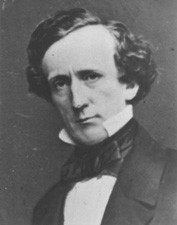
Senator Henry Mower Rice
~ United States Senate Historical Office
There are some interesting matters here besides what takes place in Congress, and I propose from time to time to touch upon them. An expenditure of $60,000,000 per annum does not cover all the pickings and stealings that “prevail” in our hereabouts. Senator RICE did not tell all he knew about land-office operations, when he testified to the value of the Fort Snelling property. Nobody is better aware than he that the tract would be much better to cut up into town lots than Bayfield was when he bought it for a few cents an acre, and sold it for hundreds of dollars. If we could find out all that Senator BRIGHT knows of these matters, one could learn how to become a millionaire at very small expense of brains or labor. Indian treaties and land-office jobbing have made more men rich than care to tell of it – ask General CASS if this is not so.
Seeing a bushel-basket of papers in the Interior Department the other day, I was curious to know what the kernel might be to all that rind, and made inquiry in the premises. I was told that they enveloped the case of Superior City. I cast my eye over some of them, and noticed that an argument was filed on behalf of one of the parties by Mr. Senator BRIGHT – or rather with Senator BRIGHT’S indorsement. This whetted my desire of knowledge, and I ran my eye over the paper in question, which was from the pen of a Minnesota Judge and was without exception the richest document I ever saw intended for a judicial or administrative tribunal. The substance of it was that the opinion of the Attorney-General CUSHING in the case was absurd, the adoption of his views by the Interior Department preposterous, and the action of the local Land office at Superior, in defining the status of certain half-breed Indians on the most abundant testimony, corrupt. It was clear enough that such a document required at least a senatorial indorsement to justify its reception. Nobody can suppose for a moment that Senator BRIGHT has any interest in the result of the case, or that he expected to influence the judgement of his friend, HENDRICKS, (Commissioner of the General Land Office,) by appearing in it. That would be too strong an inference to draw from so meek a fact ; and yet the malicious might suggest it as an apprehension.

Original Proprietors of Superior featuring James Stinson, Benjamin Thomson, Dr. W.W. Coran, U.S. Senator Robert J Walker, George W. Cass, and Horace Bridge. Featured in The Eye of the North-west, pg. 8.
From the printed argument of Senator BRIGHT’S friend, and from a private abstract of the testimony in the case, and a few items I have picked up in the Land Office, I think it will be in my power to indite an epistle that may excite some attention. At the Southwestern extremity of Lake Superior, there is a tract of land, which is expected some day to become the cite of a large city. Being aware of its great advantages for this purpose, a St. Paul speculator by the name of THOMPSON, and a Canadian operator by the name of STINSON, undertook to possess themselves of it as long as as in the early part of General PIERCE‘S administration, by vicarious preemptions. In this plan they were assisted by some official gentlement, who shared in the spoils, and patents were ground out in double-quick time, or certificates issued to Swedes and Indians for the benefit of this STINSON and THOMPSON, and their associate speculators.
More Proprietors of Supeior from The Eye of the North-west, pg. 9.
In the Summer of 1854, this Mr. STINSON, headed a gang of Swedes and led them from Swede Lake, in the Territory of Minnesota, to Lake Superior, guiding them in person to the tracts he wished them to preempt. These men were ignorant of our language and of our laws, and were used by STINSON to “settle” their tracts, “prove up” their claims, and “convey” to him, the said STINSON, without knowing either the frauds they were practicing, or the rights which they might have secured to themselves if they had been acting in good faith. In the Land Office at Hudson, where these frauds were perpetrated, there was a notary public, who drew the deeds to STINSON, got the signatures of the Swedes to them and took the acknowledgements, immediately after the preemption oath had been administered – the Swedes thinking the whole operation a part of the preemption process. The terms were said to be $30 a month, and a bonus of $15 on the consummation of the bargain. The names of these Swedes were Aaron Peterson, Martin Larson, Peter Nelson, John Johnson, Sven Magnassan, Lorenz Johnson, Peter Norell, Sven Larson, Andreas Senson, Johannes Helon, Johannes Peterson, and Peter Erickson. These “preemptors,” for their own benefit, all “proved up” at Hudson, and the very same day they made conveyances to STINSON. The same thing is true of another Swedish invasion that was made in the Summer of 1855. In that year three Swedes – Old Westerland, Andrew Walmart, and Israel Janssen – commenced their settlements June 11, proved up June 22, and conveyed to STINSON June 22 – eleven days being sufficient for the whole operation. The records of the Land Office at Superior, and of the Register of Deeds of Douglas County, show these facts. They are well known in the General Land Office.
But Mr. STINSON did not operate through Swedes alone. He and his friend THOMPSON worked with half-breed Indians also. In March, 1854, he and THOMPSON followed up the Government Surveys with a gang of Chippewa half-breed Indians. The whole gang made preemptions in Douglas County, under the guidance of THOMPSON and STINSON, who hired them at La Pointe, and convered a large portion of a township with their fraudulent pre-emptions, which were proved up simultaneously, and simultaneously conveyed to the attorney of THOMPSON and STINSON. The names of all of this gang appear on the tract books in the General Land Office. These were Joseph Lamoureaux, Joseph Defaut, Joseph Dennis, Joseph Gauthier, Francis Decoteau, John B. Goslin, George D. Morrison and Levi B. Coffee, all preemptors for these land-sharks. There were three or four more half-breeds in the gang, who ran foul of some eight or ten American citizens who were seeking to save a slice of this Territory from Swedish and Indian preemption, and lay out a town site there under the law. This was the origin of the Superior City controversy, which has been pending some three or four years in the various land offices, and which has accumulated the basket of papers which first drew my attention to a case of such interesting dimensions. The contest is nominally between three or four Chippewa half-breeds claiming some three hundred acres as a town site. But the Indians are not merely bogus citizens, they are bogus pre-emptors in the bargain, for they were the hired men of THOMPSON & STINSON.
Mr. CUSHING decided in this controversy, before it was so settled by the Dred Scott case, that a half-breed Indian, receiving annuities as such, recognized as a dependent of a tribe, and the beneficiary of treaty stipulations, could become a citizen of the United States only by some positive act of Federal legislation ; that he could not, of his own volition, or by the laws of a State, change his condition from that of an Indian to that of a Federal citizen. Strange as it may seem, it appears that this part of the Dred Scott is repudiated by Mr. Commissioner HENDRICKS, who thinks a state cannot make a Federal citizen of a man with a drop of negro blood in his veins, but that the Commissioner of the General Land Office may naturalize Indians, ad libitum, without statute or judgement to sustain him.
I am curious to see how this controversy will be decided. The General Land Office upheld STINTSON’S Swedish preemption, on the ground that the frauds were discovered too late for the Commissioner to interefere. Whether or not STINSON hasmade any negro preemptions does not appear. It was too cold at the end of the lake for negroes to flourish much. But now it is to be settled in a case where the attempted frauds have been seasonably discovered, whether or not a Canadian adventurer can preempt whole townships of the Public Lands by the agency of a gang of half-breed Indians, and procure patents for them when the facts are known to the Federal authorities.
The pre-emptive right. Homesteads.
~ Superior, Wisconsin, papers, 1831-1942 ([unpublished])
Detail of Superior City townsite at the head of Lake Superior from Stuntz’s 1854 Plat Map of Township 49 North Range 14 West.
Early history of Superior should make mention of this right of acquisition, since there under, titles to government land were derived. Any qualified person might acquire title to one hundred and sixty acres of land by settling thereon, erecting a dwelling and making other improvements. Such person was to be twenty-one years of age, either male or female, or the head of a family whether man or woman.
Proof of each settlement was required to be made on a certain day at the United State Land Office and upon the payment of two hundred dollars with the taking of a required oath, the preemptioner got his one hundred and sixty acres of land.
But the whole proceeding, was far from straight, as a general thing, and in fact often amounted to a fraud.
“In the first place, Superior was backed by a powerful company of Democratic politicians and Government bankers in Washington, while the northern and northeastern portions of the state were still held by the Indians. This Superior company sought a connection with the Mississippi river, to obtain which they urged in congress the passage of a land grant bill, offering ten sections to the mile to aid in the construction of a railroad from Milwaukee to some point on Lake St. Croix, on the western boundary of the state of Wisconsin.”
~ History of Duluth and St. Louis County, Past and Present,
Volume 1, page 230.
Hence the whole country, in and about Superior, was dotted with preemption cabins, which were little more than logs piles up in walls, without floors, or windows, often with brush for a roof, a hole therein for a chimney and perhaps for a door. A slashing of half an acre or so of trees was the “improvement” so called. A very barbarous travesty, it was, upon a white man’s home and farm. Here is an instance, where as was said, a certain doctor of divinity laid claim to a quarter section of land, now in the midst of this city.
One day he sought “to prove up” his preemption, and one Alfred Allen was his witness, and they asked Allen, “Was the pre-emptions shanty good to live in?“, the law requiring a good habitable house on the claim. And Alf said “Yes, good for mosquitoes.” The Reverend said “Pshaw! Pshaw!” Meanding to upbraid or caution the witness who thereupon only protested and adjured the harder. The difficulty was somehow smoothed over, through some mending of the proofs, and perhaps connivance on the part of persons charged with administration of the United States land laws.
Nevertheless, it is interesting to member that upon rude and rough proceedings, such as are herein alluded to, rest at bottom the titles and claims to everything we own in the nature of lots, blocks, and land.
From: Statements of Hiram Hayes. Mr. Hayes came to Superior in 1854.
History of Duluth and St. Louis County, Past and Present, Volume 1
By Dwight Edwards Woodbridge, et al, 1910
GEORGE R. STUNTZ. [pages 229-231]
One of the earliest settlers at the head of the lakes was Mr. George E. Stuntz, who a short time ago joined the great majority. Before his death Mr. Stuntz wrote of his pioneer experiences as follows:
“In July, 1852, I came to the head of Lake Superior to run the land lines and subdivide certain townships. When I arrived at the head of the lakes there was nothing in Duluth or Superior. There was no settlement. The old American Fur Company had a post at La Pointe, at the west side of Madeline Island.
Detail of Minnesota Point from Stuntz’s Exterior Field Notes (August-October of 1852).
“In 1853 I got the range subdivided, and also in Superior, townsite 49, range 13. During the same year, later, in my absence, there came parties from the copper district of upper Michigan and located claims upon the range. They were principally miners. During the same year I built a residence on Minnesota Point under treaty license before the territory was sold to the Government. At that time there were only missionaries or license traders in the tract, as it belonged to the original Indian territory. In 1852, at Fond du Lac, there was a trading post and warehouse, in which I stored my goods on my arrival. In the fall of 1853 I bought three yoke of cattle and two cows at St. Croix Falls and brought them to the mouth of the Iron river, and had to cut a road thirty miles through the dense forest so as to get the oxen, cows and cart through. Later in the fall of 1853 I came through with an extra yoke of oxen, buying provisions, etc., and on coming up to Superior I found quite a settlement of log cabins. These settlers were anxious to get to the United States land office, then at Hudson, Wis. A dense forest intervened. We organized a volunteer company in January, 1854, to cut a road from old Superior to the nearest lumber camp on the St. Croix river, I furnishing two barrels of flour, provisions, pony and dog train, necessary to carry the provisions for a gang of seventeen men. The road was completed in twenty days, the snow being at that time two feet deep. This cut through a direct road to Taylor’s Falls and Stillwater. In 1854 I completed a mill on the Iron river and employed a man to superintend it, and I remained at Minnesota Point, my trading post, where I had first taken out the license. In the same year I took a contract to subdivide two townships located in Superior, townships 48-49, range 15, and afterward I attended the treaty at the time the Indians sold this country to the Government.
Before the 1854 Treaty of La Pointe could be ratified in Washington, D.C., the oral description agreed upon during the negotiations for exterior boundaries of the Chippewa treaties had to be surveyed with the tribe, documented, and delivered to Washington, D.C. before 1855. It is not clear who was involved with the exterior boundaries of these reservations; whether it was Stuntz, Barber, and/or others from their party.
“There were 5,000 Indians present with their chiefs. It was the biggest assemblage of Indians ever held at Lake Superior at this period of the country’s history. It took a month to pacify the troubles that grew among the different tribes in regard to their proportionate rights. This treaty was sent to congress September [30], 1854, and was ratified and became law in January, 1855.
To be continued in 1854…
 Chequamegon History