Barber Papers: “The Gardens” Fall of 1856
December 29, 2015
By Amorin Mello
Selected letters of the Joel Allen Barber Papers
… continued from the Summer of 1856.
Lapoint Oct. 12th 1856
Dear Mother
This afternoon I returned from Bad River where I have been attending an Indian payment. Father will tell you all about it. I will only say I had a good time, saw many old friends and made some acquaintances among the government officials that I deem very portinate. I also got a contract from the Indian agent on which I ought to make more than a thousand dollars.
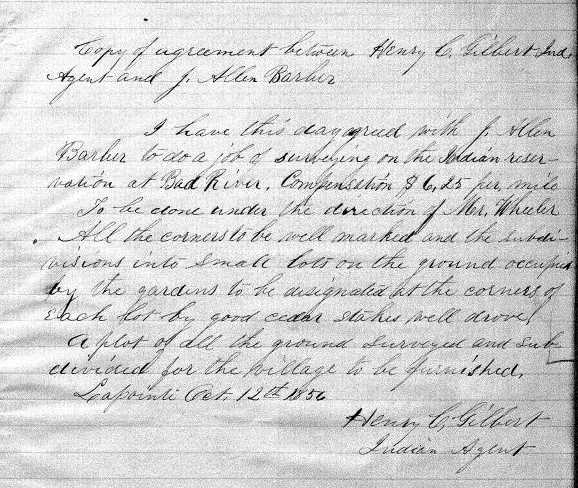
Copy of contract between the LaPointe Indian Agency and Joel Allen Barber to survey the LaPointe Indian Reservation and “the gardens” town-site (Old Odanah), to be done under the direction of Reverend Leonard Wheeler.
~ Board of Commissioners of Public Lands
~ History of Northern Wisconsin, page 64.
I could easily if I had means to carry it on to my liking. It is surveying at $6.25 per mile.
Father has gone to Ironton. I could not go as I wished to stay and conclude my business with the agent.
[You might?] I have been offered $50.00 per share for Ironton I took on which I have only paid 25 dollars per share, but I refused to take it. It may cause you pain to see that I am everyday becoming more and more fastened to this country but I cannot think of deserting it yet. As yet I have not realized one cent for my sojourn in the wilderness but I am far from being discouraged. I have seen fortunes made and have seen men make tens of thousands by taking chances that I might as well have had but I was green and could not read the future.
I am not in a mood for writing my thoughts to you [see rum?] principally upon many matters. Perhaps that is because I have been to payment and and because there is a gambling table in full opperation in the room where I am writing.
It is strange that father never told you the facts in regards to the $600.
There was never any mystery about it to me. Stuntz & Dr. Ellis had the money and returned over $400 of it. It is all right or will be. I nearly forgot to mention that I just got a letter from you to Father of Sept. 25th.
We are both well. Please excuse haste and carelessness.
Your affectionate Son
Allen
[Incomplete copy of letter]
~ Scope and Summary of Joel Allen Barber Papers
There is a young Englishman aboard who has been quite a tourist. He was in the Crimeran? army, went East of there to Ferlizand through Syria to their Holy land to Jerusalem to Egypt the Pyramids the Catacombs. Through all the Country in the South of Europe and northward through Scotland to the [Shetwood Jelas?], has been travelling in the U.S. the past season & is now returning from Superior, got there the day we left [songs her?] visited that poor [Ratefu?] that lost his foot every day till he died. He is a rich land lord & nobleman as I suppose and has a happy way of communicating information upon all subjects especially upon Geology, Mineralogy, Geography [overrated spy?] as well as all other “ologies” He is laying [w/a Speciation?] & [conavasated ??? ??? from?] to England.

1860 photograph of the Paddle Steamboat “Lady Elgin”.
~ Ship-Wrecks.net
The boat has just put to the Canal & [???? ? ????] Do be careful of your life & health and let us hear from you as often as you can.
May God bless and preserve you for many
yearsG. A. Barber
Give my respect to Jo & William.
Interior Field Notes
La Pointe Indian Reservation
Township 47 North, Range 2 West
Notebook ID: [N/a]

Contract awarded by La Pointe Indian Agency to Joel Allen Barber on October 12th, 1856. These survey notes are not available from the General Land Office or the Wisconsin Board of Commissioners of Public Lands.
Lapoint Nov 9th 1856
Dear Mother
I start today for Bad river with four others to commence my job of surveying on the reserve. I am well and in pretty good spirits. Father left on the S.b. Lady Elgin last week.
I am in such a hurry that I can scarcely write legibly. I was elected county Surveyor of this county last Tuesday. My term of office commences Jan 2nd.
I would not like to have this known in Lancaster as it might cause me a little difficulty. I am writing this in a [gragshop?] where there are several men talking so I couldn’t write very sensibly so you must excuse levity. I will write as often as possible but don’t expect me every week as the mails are very irregular and it will be very inconvenient for me to write sometimes. I expect to have a good time this winter. Shall not be far from the very best kind of folks about the Mission and I beg of you don’t grieve because I remain here this winter.
I am very anxious to go home but you see I had something to stay for.
With best love to Am, Aunt Betsy and yourself.
I remain your affectionate Son
Allen
Lapoint Wis. Nov. 9th 1856
Dear Father
Joel Allen Barber;
William W Ward;
Larry Marston;
Joseph Latham.
I expect to get away today for Bad River with one party – Bill & I Larry Marston and Joseph Latham.
I went to Ironton on Saturday before election so I was not there on that interesting day. That mound of earth has scarcely changed at all and will not materially in years. Business is going on pretty well at Ironton. The house is probably up [?? this?].
Joel Allen Barber;
Asaph Whittlesey;
Major McAboy;
[Fremont?];
James Buck;
and others.
The election came off here all right as far as I am concerned. Whittlesey 11 or 12 and McAboy 1. Whole number of votes 108. [Fremont?] got ten votes. The Buck ticket was carried throughout. We only start with one party because no steamboat has come yet and it is doubtful where we shall get a large supply of provisions.
We are all well and prospering. Give my love to all friends in Lancaster
Your affectionate Son
Allen
Excuse haste.
Interior Field Notes
La Pointe Indian Reservation
Township 48 North, Range 2 West
Notebook ID: [N/a]

Contract awarded by La Pointe Indian Agency to Joel Allen Barber on October 12th, 1856. These survey notes are not available from the General Land Office or the Wisconsin Board of Commissioners of Public Lands.
Cambridge Nov 9th 1856
Dear Son.
Now that your father has left you I suppose you will be very glad to hear from Am and me sometimes; at least I hope you have not so much forgotten us that you do not look for a letter whenever the boat arrives and have one prepared to send home by every one. But I forgot that there will be no boats for 5 or 6 long tedious months to come and I fear we shall hear from you but seldom. Let me entreat you to have a letter ready to send to me at least by every visit that leaves your region. I cannot imagine how any one can think of surveying in the deep, dark forest during the winter months to be exposed to storms, day and night without shelter – how you lived do tell me. I am sure no one could live here through the winter in the woods without a pretty warm house and a good fire. Were it not that I know you have had some experience in the business & manner of living I should feel certain you would be frozen or perish in some way. But I suppose you have no such fears.
I have sent 2 or 3 letters for you and father to Lancaster supposing he would be there and hoping you would also. In one I mentioned the happy marriage of M. C. Heath to a most excellent pious young lady who taught school in the village center last summer named Mott. No one suspected his intention – not even his own family till he brought her home and presented her as his wife. Every body is much pleased at the matter.
Mr. J Woodruff has departed this life after lingering and suffering much longer than his friends expected. He tried every possible remedy, but nothing – not even Dr. Hunter’s boasted inhaling method could arrest the fated disease. The latter remedy has been tried in several cases of Consumption in Johnson and equally failed in every case.
You have never said any thing about the trouble in your head and throught since you left home. How is it – does it increase or has that climate proved beneficial in that affliction, as in other respects, to your health?
I am pained to have to announce the death of one more of your dear friends and school mates. Julia Whiting has gone to the spirit world to join the happy throng of the young the beautiful and the good who have passed on before. This is the fourth daughter that afflicted family have been called to mourn – they have but one left. I mentioned the sickness of the rest of the family before – at last Julia was taken unwell with slow fever – then Typhoid symptoms which ended in death. We heard of it the morning of the funeral and Amherst and I went to J to attend it, and do some errands.
I have had a little good fortune –. Mr. Pike has at length drawn a small sum from the pensions office for me on account of my father’s services so [Serjeant?]. He only drew 80 dollars a year as private when he was entitled to 100 dollars as [Serjeant?]. The sum drawn was $209.86 out of which Pike takes about 25.00 for the expenses of getting it. I never expected to get so much if I get anything – but trouble and expense.
If you stay at the lake this winter what will become of your title to the land you bought in Grant? You will have to improve it some before June or you will lose it. I wrote to you about Lewis Wilson. I understand he has gone into the Blake house for this winter but has bought nothing. I have not seen him since I wrote you but would go to see them if we had a horse we could drive. “Old Grey” is so lame in her fore foot she cannot go farther than a walk so we do not drive her far and [Fate?] has a bad trick of starting and turning short about when she is a little frightened so that Dow thinks her unsafe for Am or I to drive. She is a large, beautiful beast and perfectly gentle when not mad.
Oh, how I do wish you were going to spend the winter at home – you would have such nice times riding about and visiting the young people here. There are several young ladies still single that would no doubt like to take a side. There is not a large number to be sure but some of them are worthy of the attention of any good young man. There is Miss Anna Bryant who is said to be a prodigy of learning and good sense – and Carry C – your old school mate – lovely as a rose – accomplished in all domestic affairs, and, as you well know, an excellent schollar. But of all those with which we are acquainted there is no one so perfectly amiable and good – who would, if I am not deceived and misinformed be so desirable a companion for life as Miss C Griswold. I believe she is beloved by old and young – one of the excellent of the earth. And M. A. Chadwick who is always with her. But I suppose none but little David can come near her.
According to your father’s description of the people in your country, you must see a great deal of vice – drunkenness, gambling, quarreling, and I should expect fighting. But I hope and pray with a strong faith that you in no way participate in such scenes. With all my fears for your personal safety I have never had the sorrow of knowing or fearing that my dear sons would be tempted from the path of virtue.
What must be the agony of parents who have vicious children. I believe that whenever a man conforms to the will of his Maker by using all in his own power – through the exercise of all his faculties he may safely trust in his protection.
That you may be as protected is the prayer of your affectionate Mother
Nov 10th 56
Dear brother Allen,
I have but little to write at this time but I thought I would put in a few lines to let you know that I still read [lest?] you & can write to you. We suppose by father’s letters that you are yet to remain at the lake through the winter. We were in hopes that you would go to Lancaster, or come home with father, but I don’t know but it will be best that you stay there. But I wish you were to spend the winter in some more congenial & convenient situation if possible. It is already pretty cold weather here & it freezes considerably. Mother & I have been living in the old west room pretty comfortably this fall. I have provided wood as fast as we needed it but I guess Dow will have to get it for us after this. I am going to the Centre school now and enjoy it quite well. Mr. Ed. Bryant, my teacher, is very well liked here, & is going to stay & teach select school through the winter. We have a tolerable good [Scycum?] here now & I have some speaking & writing to do for it. Last week was appointed to get up a dissertation, which I am now writing. My subject is Noses. There is not much going on here but the school & [Scycum?]. & it’s pretty dull times now. Hardly any one here will talk polities except the business of whom there are 74 in town. We got partial returns from election Saturday night which set the Democrats all right greatly. That day we heard cannon all over the country.
Atwood’s folks are over here occasionally; all is well as usual; & Levi is I think improving in health as he works considerably now. The Johnson school is flourishing nicely under their new teacher. Old Bent, the former preceptor is now 2nd clerk of the Senate at Montpelier. Mother & things at Johnson are getting along about as usual & the same in Cambridge. Allen, I have not written near as much as I ought, but some other time I’ll write a longer & better letter. Now father is gone do let us hear from you often. We will write you often.
Good bye
A. W. Barber
Lancaster 13th Nov 1856
Dear Son
I [improve?] this 1st Mail to inform you of my safe arrival here night before last at 8 P.M. & that all the friends here are well &c &c
November 25, 1856
“Nov. 11 – The Steamer Lady Elgin, which left the St. Mary’s River for Chicago, Nov. 1st, had not, at latest advices, reached her port or been heard from elsewhere.”
~ MarinetimeHistoryOfTheGreatLakes.ca
I wrote you from the Sault by which you will learn my progress to that place. Left there at 1 P.M. & ran down the river 40 miles when wind & fog threatened an unpleasant night & the Capt ran to a Sawmill dock & tied up for the night. Next morning showed the wisdom of stopping for it was that awful snow storm Election day. We land there 2 nights & on Wednesday started again stopped at Mackinaw 3 hours & then put out again against a dead head wind that increased in violence till 3 next morning when the Capt put about & ran 15 miles back for shelter under the North Manitou where we laid till 7 o’clock drifting down the shore & then storming up to the head of the Island. Anchor was then thrown over & held untill 2 next morning when the boat drifted off with the anchor & we drifted down & steamed up the east shore till toward night when we made the dock on the Island the wind heaving about & changed from South to N.E. & blew like the D’l till just night next day (Saturday) when we started again for the [west?] shore of the Lake & [p????ed] our voyage till we reached Chicago toward might Sunday night.

These locations are on a page of this letter to Allen from his Father.
The handwriting appears to be of Allen’s, not of his Father’s:
“Lot 1 Sec 19 Town 48 R 4 con 44.37
Lot 1 39.99 and NE 1/4 of NE 1/4 39.99
Sec 24 Town 48 R 5 W containing 40.00
Lots 124.36
Lots 1 and 2 Sec 36 and NE 1/4 of SE 1/4
And SE 1/4 of NE 1/4 Sec 25 Town 48 R 5 West”
These locations are along the shoreline of Barksdale on either side of Boyd Creek (and underneath Chequamegon Bay). Was this “Barbers Camp“?
Monday I came to [Galena?]. Found on the [car?] John [Muskler?] & Sarah [Le???] on her way to live with Mr. L.O. Stevens in Iowa. From them I heard direct from Johnson. There is much sickness there this fall. Dexter Whiting had been sick unto death of Typhoid fever but was getting well but had his upper lip all eaten off. Mrs. W had also been sick & poor Julian was sick & died of some fever rather unexpectedly. She had been asleep 30 hours & died [?] Sarah said she saw Mother & Amherst at the Funeral. Mr. Woodruff died 3 or 4 weeks ago. It is about Mail time & I cannot be brief. Tell Jo that Jay paid his taxes last spring so that he is all right there.
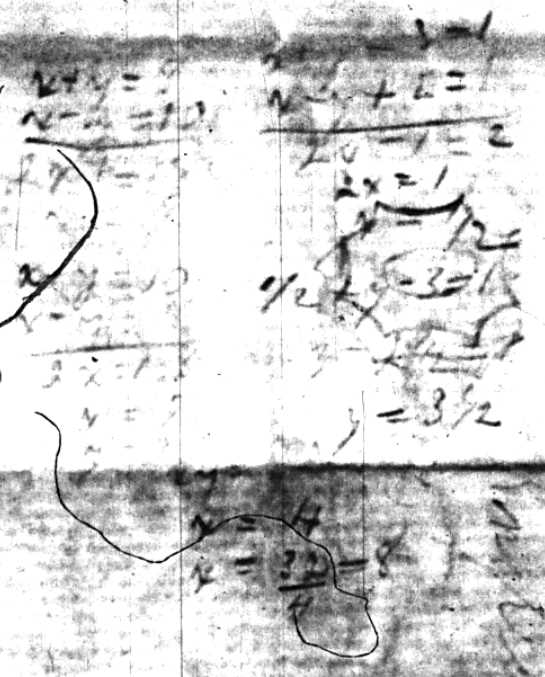
Algebra equations on the backside of a sheet from this letter.
“Dexter Ward was born in Chittenden VT and came to Grant County on February 8, 1843. He settled in Lancaster where he was a carpenter and builder. He was elected Counstable in 1857 (? Possibly 1847) and held that job for 5 years. He was a deputy sheriff under Matthew Woods and George Stuntz.”
~ GrantCountySheriffWisconsin.com
Take good care of your life & health and do as well as you can for yourself. I will write you again before leaving for VT. You may be [apsment?] that it looks rather better about here where there are [lesasy?] crops all about me than about the Lake where there is nothing. I called at the Sherriffs & left William’s letter, found all well.
In haste your affectionate father
G. A. Barber
Interior Field Notes
Odanah Townsite aka “The Gardens”
La Pointe Indian Reservation
Township 48 North, Range 3 West
November, 1856
Notebook ID: [N/a?]
!["For Plat of Townsite Odanah LaPointe Indian Reservation [...] See Large Plat Book [s]Next to last page[/s] Middle of Book" ~ Board of Commissioners of Public Lands](https://chequamegonhistory.com/wp-content/uploads/2015/12/1856-odanah-town-plat.jpg)
“For Plat of Townsite Odanah
LaPointe Indian Reservation
and Resurvey of Sec 23, 24, 25, 26, 35, & 36
See Large Plat BookNext to last page
Middle of Book”
~ Board of Commissioners of Public Lands

“*Note Sections 23, 24, 25, 26, 35 & 36 having been previous surveyed by Mr George R Stuntz have been omitted by J. Allen Barber Dept. Surveyor, under Henry C. Gilbert, Indian Agent, so says Mr Barber but no evidence can be found to support his declaration either in the Gen’l L. Office or Indian Bureau. Secs 23, 24, 25, 26, 35 & 36 were recently surveyed by A.C. Stuntz so says the Comm’r Indian Affairs in his letter of Feb’y 6, 1865, inclosing a diagram thereof.”
~ General Land Office Records
LaPoint Nov. 22nd 1856
Dear Mother

Detail of the “Chippewa Gardens” at Odanah from Summary narrative of an exploratory expedition to the sources of the Mississippi River, in 1820, by Henry Rowe Schoolcraft, page 105.
—
The steamer Superior was lost near Grand Island, Lake Superior, October 29, 1856, during a violent storm. Her rudder was carried away and the boat fell into the trough of the sea. She commenced making, the fires were put out and she struck the rocks, soon after going to pieces. Thirty-five lives, including 11 passengers, were lost, and 16, including five passengers, were saved. Capt. Hiram J. Jones was among the lost. The Superior was considered one of the best sea boats in the trade, and had lived through many a storm. She left Chicago October 25, loaded principally with supplies for miners.”
~ History of the Great Lakes, Chapter 37.
Yesterday I arrived here from Bad River in a Macinaw boat with two fair men, we have been surveying nearly two weeks although we have scarcely made a beginning. Thus far we have been at work at “the Gardens” as the settlement at Bad River is called to layout out an Indian Village. I was over to Bay City [???] Wednesday to see about getting provisions for the winter but got [clism?] appointed and found others in the same fix. Mr. Stuntz had promised to furnish us with provisions but all his supplies were last on the Superior. You have probably seen an account of that said disaster. The boat was last on the pictured rocks in the night, 45 or 50 lives were lost, only 16 saved. As for us I have heard no one was lost that I know personally. No one may prove Superior with [3 Sisters?] were lost. [This?] father lived in Superior – his name is [Mentar?]. I have not much news to make. I think my prospects [to get?] surveying are pretty fair. I have been successful in getting a fair supply of provisions and if anything happened I believe we will do a pretty fair lot of work within the next month or two. My provisions are not thought to be scarce but so navigation is closed prices will be high.
Pork is 30 dollars per Barrel, Sugar 15 or 15 cents per pound.
I have not yet decided when to go below but I should probably see Lancaster before many months.
Last night I attended a half breed ball – not as a participant but as a spectator. The balls are rather an important affair as they generally last three days.
Last night was the third night and was necessarily the last as the ball was very suddenly “broken” by the Catholic priest about 8 o’clock. The priest and Bishop came to the door and demanded admittance and the priest went in and after asking a few questions commanded them to disperse and you may depend on it there was a scattering.
Ironton is prospering finally. Today I sold 6 shares at $60 per share. They were sold to two men who are at work for me and are good men. I am writing this in Squire Bell’s office and the others present are getting [warm?] and it is getting dark so I will fold this up.
Your affectionate Son
Allen
Interior Field Notes
La Pointe Indian Reservation
Township 47 North, Range 3 West
December, 1856
Notebook ID: [N/a]
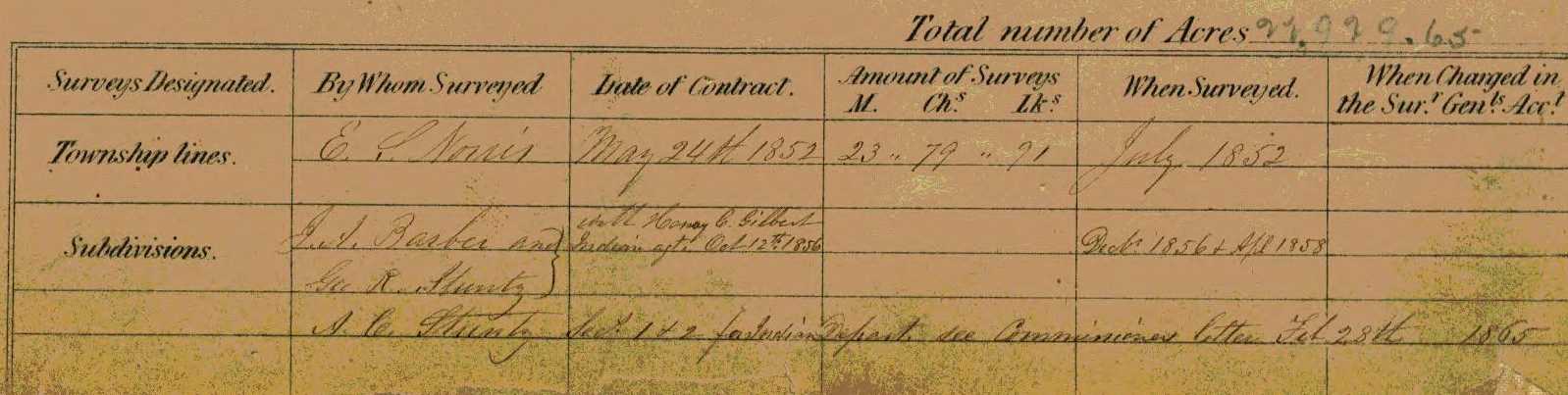
Contract awarded by La Pointe Indian Agency to Joel Allen Barber and George R Stuntz on October 12th, 1856. Survey partially completed by Barber and Stuntz during December, 1856. These survey notes are not available from the General Land Office or the Wisconsin Board of Commissioners of Public Lands.

Detail of Sturgeon Falls on the Bad River omitted from Barber’s resurvey during 1858.

Detail of the White River omitted from Barber’s resurvey during 1858.
Lancaster, Sunday Dec 7th 1856
Dear Son Allen
Here I am yet, amid my friends in this beautiful country. It was far from my intention to have spent so long a time here, but one hindrance after another has prevented my getting away. It is my design to leave the present week & stop at Sandusky probably over next Sunday. I have now passed by my friends three times, and feel as though to do so any more would look like studied neglect of them.
My disappointment at not getting any thing from you up to this time is great, & I now begin to hope you have sent a letter or two to Vermont instead of here, & that I shall find them all right when I get there. Though to tell the truth I am in some concern for your safety, fearing that you have been wrecked on your journey from La Pointe to Ironton or Bad River. I am still in hopes to get a letter from you tomorrow or before I leave the place. Your friends are all well hereabouts, and everything carry on swimmingly.
Thode Burr was dismissed from Ryland & Swab’s employment last Monday, not for any fault but because Ryland has got well enough to work in the Store “[the St Louis?]” are able to do all their business. He is doing nothing at present though he could have $30.00 per Month to go into a school at [Baserbol?]. I mistake perhaps in saying that he is doing nothing, for he is attending [any/my?] [earnestly?] to his [hymn?] & nothing else.
George Parker & Lincoln of [Midden?] (you know him) are in DTP [stom?]. Lincoln was in College 2 years & had to quit on account of sore eyes after trying to resume study twice. He gave me the following items concerning some of the Johnson Boys.
[Thuler?] was expelled last June for participating in the annual mock training contrary to the command of the College Officers. He talked of going to [knive Coll. Schunistudy?], but has not yet. Hotchkiss had to quit College & has gone to work on the farm. [Spurr?] is Married to a Miss [Denny?] of [Largage?] a real visage and was teaching in Mass. receiving $1000. for his & his wife’s services for [canninor?].
This is all that he told me of them. Had there been any thing else worthy of note, he would have told of it.
I wrote you about the Small pox being in the town & that there had been some deaths. Whether there have been any since my last I cannot say. Only 3 in all. There are no new cases for some 10 days or more & it is hoped that it will spread no further. Mr. James Mc[Gonigal?] brother to William from Tennessee was was buried last Sunday. He was taken sick of fever the Sunday previous, & went to bed saying, that was the last time, & was expecting to die untill he breathed his last on Friday night at 10’o’clock. He was a very fine young man, had lost a wife & only child, before he came here, & has been clerk for D.T.P. for some time.
Wm Carter & Miss [Rawdon?] were married last Thursday.
I should feel much better if you were living in this country than I do now, when my mind is constantly worried by thoughts of you suffering from cold, fatigue, hunger & all sorts of privations, to say nothing of being deprived of all society congenial to your natural taste.
I cannot sit down to a good meal or get into one of the warm soft comfortable beds, without thinking of my poor son who is where all such things are unknown, and may be suffering for want of the comforts that here so much abound and especially did I think of you last Sunday when there was the worst storm of snow from the N.E. ever known in the Western part of Wisconsin, so said by all the badgers. Snow fell 18 in deep in the timber, but it piled up in the roads & streets like it does in Vermont. The snow was drifted into one place East of Galena 40 feet on the track with a freight train beneath. They got the [cars?] through yesterday. The weather has been very cold here for this time of the year. Thursday Morning 4th Therm 11* below 0, Friday 14* below 0, & Saturday 6th at 14* below 0. I do not believe Vermont ever beat that in the 1st week of December, & in all that time I have been thinking how you & your company must suffer if out in the woods surveying.
I hope you keep warm nights, if so, you can do enough in the day to keep from suffering. My greatest fears at present for your [sloping?].
Allen Hyde has been very swift to purchase the little farm and has offered $35.00 per acre by my taking $415.00 of it in two lots of land. One of five acres South of the burying grounds at $315, & directly opposite the new schoolhouse. The other is a meadow of 8 acres out towards where [Sprader?] used to live at $[6.00/600?] which is cheap for either place. But I shall not be in great haste about selling for I should prefer that that little piece of land should remain in the family even if I do not live to come on it myself. There is quite a stir about farms at present. There was a Mr. Hayward from N.Y. State wishing to purchase & bartered for Jay’s farm & I think would have paid $50.00 per acre for it but Jay would not sale without he could put in his 2 ½ acres of an out lot with it. Mr. H. offered Frank Hyde $36.40 per acre for his land, East of Hollaway’s & did buy Hyde’s new brick house built the summer past near Esq. Philp’s new house, at $1,000.
Tell Jo that I think I shall want to buy his land when I can see him. I went to it soon after I got here, but I was sick all the time so I could scarcely move, consequently did not see much of it & cared very little for what I did see. Tell Wm. W. Ward that I did as I promised to do, & went to his Father’s and had a good meal that would astonish any body from Lake Superior. I have been there three times since I came, I wish you boys could have had some of the chicken din & other fixings… Wm’s eldest sister played on the [a Melodron?] & sang a number of [piren?]… Mr. Richard [Myers?], an old country Dutchman who married Martha Phelps’ sister to your Aunt [Lucy?], is erecting a steam Sawmill just across the brook due East from your Uncle Allen’s & intends to have it ready for business in the spring & Mr. [Kirke?] of Philadelphia talks of coming here to erect a Steam Gristmill in the springs.
Some things are as dear here as in the country around you. Coffe 6 lbs per $1.00. Sugar 7 lbs per 1 doll. Butter 25¢ for [good/gevd?] but Pork sells for 5. to 5.50 [gevd?] fat beef rather better than [Cousin?] Ox for [?] for [foze grs?] & 5. for Hind do. Flour $2.50 per 100 lbs, &c. Venison is brought in and sold frequently & on the whole I think there is more comfort in living here than there you can be on the Lake.
I find considerable difficulty in settling off with Old Black for the proceeds of the little farm but shall get through with him tomorrow I now hope he has drawn some [manners?] on the orchard & and done some [plervisy?] for [Sish?] he charges exorbitantly, all done before I came & he had harvested most of the corn, but I am confident the dishonest whelp will cheat me out of a good deal any way I can fix it, but I will get shut of him some way and remain so ever afterward. He has sold his tavern stand today & taken a farm 4 miles north of the Village in payment of a Mr. Wilhinson. There is a new store opened in the [forver?] East of the Burnett House where J. M. Otis over traded by two men under the firm of Baily & Carroll who are giving the build a new Gristmill below Handall’s Sawmill.

Portrait of Uncle Joel Allen Barber from page 199 of the Proceedings of the State Bar Association of Wisconsin, Volume 1900.
The prospect now is that your Uncle Allen will be elected U.S. Senator for the next 6 years after the 4th March next. I would not write this had I not good reasons for believing that it will be so. And now in regard to yourself, I do hope you will be careful of your life and health, that you will avoid exposure to the dangers of the cold & the treacherous ice as much as possible. That you will not trust yourself on the ice, long distances in the cold or storms, or alone. Finally I beseech you to take all possible care of yourself. If you have not got blankets enough to keep you sufficiently warm nights do so & get more & not suffer or be uncomfortable without or for want of them. I do not feel reconciled to the thought of going home without hearing from you, & knowing that you are alive & well. I overhauled the trunk of our dear lamented Augustus yesterday and [leave?] nearly every thing as I found it. There are some good clothes, that may be of service to you, should God spare you to ever come down here. I have rec’d a number of letters from home since I got here, but none lately, as they are probably expecting me home about this time, all were well. I do not know whether I mentioned in my letter to you that your mother had drawn $209. from Government additional pension money.
Adieu my dear son.
That our Heavenly father will bless and preserve you is the daily prayer of your affectionate as well as afflicted father.
Giles A. Barber
To be continued in the Winter of 1857…
Barber Papers: “Ironton” Summer of 1856
December 16, 2015
By Amorin Mello
This summer was a time of trauma for the Barber family immediately following the death of Augustus Hamilton Barber at the mouth of the Montreal River near his town-site claim of Ironton during the Spring of 1856. Augustus had unfinished business on Lake Superior, which was being attended to by his brother Allen and father Giles in mourning.

Item from the Superior Chronicle, August 19th, 1856. Ironton was platted during February of 1856 according to the Bayfield Mercury, August 15th, 1857.
The Summer of 1857 was also a when the town-site claims of Ashland and Ironton were being established and platted by merchants near the east and west borders of the Bad River Indian Reservation. Several memoirs about the early days of Ashland and Ironton will be featured in this post to provide context due to copies of certain letters being missing from the Barber Papers. Only one letter was archived from the Summer of 1856 in the Joel Allen Barber Papers, located at the end of this post.
Oral history traditions from the Lake Superior Chippewa tell about how the language describing the exterior boundaries of the LaPointe Indian Reservation were changed sometime between the 1854 Treaty of LaPointe negotiations and when it was ratified by Congress in 1855. According to at least one oral history, both Ashland and Ironton were located within the boundaries negotiated at the treaty.
The Ashland Press
January 4, 1873
—
Ashland! It’s Growth During the Year 1872
A Quarter of a Million Dollars Expended in Improvements.
A Full List Of Buildings—Docks—And Railroad Work
ALL HAIL TO THE IRON CITY
The history of Ashland, full and complete, would require more space, and more labor in its preparation, than we can possibly give it at this time. Nor is it necessary in connection with this summary of its growth during the first year of its regenerated existence, to enter into an elaborate or extended article upon its past fortunes, but merely to give an outline showing its first organization, and a few of the most important items incident to its early settlement. This much we shall endeavor to do in this article, and no more, leaving other and better informed persons to give a full and accurate historical record, hereafter.
July 6, 1933
by Guy M. Burnham
“During the month of February 1854, Leonard Wheeler, the missionary and an Odanah Indian met at Odanah, where Mr. Wheeler then lived, and drove on the ice along the south shore of the Chequamegon Bay, from Kakagon to Fish Creek. It was the year of the great treaty, in which the Indians agreed to cede most of their lands to the United States and to reserve tracts for their permanent homes. The Indians were glad to do this, for only four years before; the government had decided to move the Chippewa to the Minnesota country. William Whipple Warren led a large delegation to Minnesota but like all others who were interested, they much preferred Wisconsin. Leonard Wheeler himself, took up the cudgel of his wards, and practically led the fight to prevent the removal of the Chippewas from Wisconsin, but in 1854, it was understood that some sort of agreement was going to have to be reached, for white settlers were looking to the north, and they need an outlet to Lake Superior. The Indians realized that they would have to do something so Wheeler, the missionary and Little Current [aka Naawajiwanose], the Chippewa, were delegated to look over the south shore of Chequamegon Bay. William Wheeler who was a small boy accompanied his father and the Indian on the trip, says that the Indians furnished the pony and the missionary the cutter, and they drove down past where Ashland now stands, to the extreme head of the bay. From the head of the bay region, at Fish Creek to nearly where Whittlesey afterwards built his first house, there was a straggling Indian settlement, which the Indians called Equadon.
Every foot of land from Fish Creek to Odanah was Indian Land. It was in this settlement or village, which the wife of Robert Boyd, Jr., told me her father, lived in Equadon, near the many flowing springs, which we now call Prentice Park. The Indians thought the western limits of the proposed reservation of Bad River, should be the west end of the bay, but the missionary pointed out that that would keep the white men from building a city on the south shore of the bay, and that it would be advantageous to the Indians to have such a city built, as it would furnish a market for their furs and other products they might have for sale. Little Current agreed to this, and then and there, the agreed on the western limits of the Bad River Reservation should begin at the Kakagon just as it is now, extending the reservation far enough south to make up for the loss of the frontage from Kakagon to Fish Creek. Asaph Whittlesey frequently talked with Leonard Wheeler about good sites along the south shore and so about four months after the momentous trip of Leonard Wheeler and Little Current, near the end of February. Asaph Whittlesey and George Kilbourne rowed a boat over from Bayfield and felled the first tree, built the first house, establishing the settlement, which was to be known for about six years as Whittlesey. When Whittlesey felled the first tree on July 5, 1854, the land still belonged to the Indians. Three months later, on September 30, 1854, the Treaty of La Pointe was signed, under which Bad River, Lac Courte Oreilles, Red Cliff, the tip of Madeline Island, and Lac du Flambeau were reserved, but it was not until January 10, 1855, that the Senate ratified the treaty, which became a law by proclamation of President Franklin Pierce, on January 29, 1855.
Although Whittlesey built his first house on land, which still belonged to the Indians, there was little danger of the Wheeler-Little Current agreement being disturbed, and Whittlesey became Ashland in 1860. The head of the bay, which then, as well as now, swarmed with fish and game, became a part of the white man’s domain, and this included the Place of Many Springs, Prentice Park.”
~ TurtleTrack.org
Old Ashland, to be properly written up, should be woven into the history of all the country extending from the head of Lake Superior to Ontonagon. This section from the beginning of the first settlements has been intimately connected in all its various fortunes, and its people of that date should be considered as one, and spoken of as the early day pioneers on the Lake. Scarcely an enterprise was attempted that a majority were not more or less interested in, and the early Ashlander was not satisfied with being limited to one small portion as the place of his adoption, but generally considered himself honored only when credited with being a citizen of the “Superior Country,” or as many term it, “of Lake Superior.” Like the old fashioned “Queen’s arm” the early settlers “scattered” terribly, and hence we find them at the present day, posessors of corner lots in exploded townsites, parchment mining stocks, iron lands, copper mines, mineral claims and silver veins, in almost every section of the south shore that has been explored. To enumerate all the enterprises attempted by these enterprising, pushing-ahead, speculating men, would be too great an undertaking for us, but a book, well written, giving a thorough history of their operations, would not only be intensely interesting, but posess a value scarcely to be enumerated. But it is not our purpose to digress. We have to do with Ashland only, and chiefly with its present growth and future prospects.
The Ashland of to-day was formerly Bay City, St. Mark and Ashland, two distinct townsites, located but half a mile apart, the intervening territory being that platted as St. Mark, best known as Vaughn’s Division. Each of these divisions has a history of its own, though of course more or less connected with each other in common interests. These three divisions have, since the new enterprise sprang into existence, been joined together and now constitutes the city of Ashland, all parties interested working harmoniously for the common interest and a general prosperity.
August 28, 1920
“Mr. [William] Wheeler was born at the mission at Odanah and remembers distinctly of a trip he made with his father [Leonard Wheeler] and one of the Indian Chiefs [Little Current aka Naawajiwanose], into the country to establish the boundary limes of the Bad River reservation. The Indians wanted the boundary line at Fish Creek but Rev. Wheeler told them to leave a site where the present city not stands, for he was certain that a big city would grow up and big boats from the outer world would sail into the harbor and that the people would furnish a market for the Indian’s products.”
~ Wisconsin Historical Society
On the 5th day of July, 1854, Asaph Whittlesey and George Kilbourn landed on the bank of Ashland bay, and immediately commenced the erection of a claim shanty, within fifty feet of the west line of Section 5, Town 47 north, Range 4 west, in Ashland proper. The first tree was felled by Mr. Whittlesey, on that day, and by night the first log house, 14×16, was commenced. On the 27th day of August this building was occupied by Mr. Whittlesey’s family. It was used many years after for various purposes, and its ruins can still be found on the bank of the bay. During the same season the small log house near the present residence of James A. Wilson, Esq., on lot 6, block 6 was built, and in November of the same year the largest of the three log houses now standing on the same lot was completed and became the residence of Mr. Whittlesey, which he occupied until the fall of 1857. This house has quite a history. It has witnessed many an exciting and tragic scene, as well as many a pleasant and happy gathering. If its walls could speak, and possessed the genius of a Shakspeare, they would tell a story that would out rival in magic fascination any work of fiction. It was within its walls that the first permanent white settlers in Ashland dwelt. In its spacious room in the winter of 1854, the man of God, the missionary in the cause of Christ, preached the first sermon ever preached on the town-site. The minister was the late Rev. L.H. Wheeler, founder of the Odanah Mission, and a man known as a good and earnest Christian missionary, loved and respected by all the border settlement. It was here that the first ball was given in 1854; the first Fourth of July celebrated, in 1855, some thirty persons participating. It was the first post office, established in March, 1855, with Mr. Whittlesey as P.M. It was here too, that the first election was held, in the spring of 1856, at which time the town of Bayport, (which included Ashland and Bay City and all the surrounding county,) was organized. It was also the scene of a sad tragedy, when Henry Cross, in self defense, shot and killed Robert D. Boyd in 1858. The first Sabbath School was organized in this house in 1858, by Ingraham Fletcher, Esq. It was also, May 31st, 1856, the birth place of Miss Delia E. Whittlesey, the second white child born in the town, the first birth being that of Katherine Goeltz, early in the same month. Many other interesting events might be enumerated as belonging to its history, but space forbids. The old house still remains a monument of Ashland’s former glory.
The first freight ever landed from a steamer in our harbor, was in September, 1854. The steamer “Sam Ward,” Capt. Exsterbrook, brought the household goods of Mr. Whittlesey to Ashland at that time, and they were landed in small boats in the ravine near the foot of Main street.
“The first marriage in the town was that of Martin Roehm to Mrs. Modska, in the fall of 1859, John W. Bell officiating, (music furnished by Conrad Goeltz,)” and a good time generally indulged in by all who participated in the festivities. And here let us state that Ashland was never forsaken by this sturdy veteran pioneer couple. They stood by the place with characteristic German fidelity, king and queen of the deserted village, corner lots and all until the dawn of the new era commenced.
The Indian in his might
Roamed monarch of this wild domain,
With none to bar his right.
Excepting fearless Martin Rhoem.
The first government survey of the territory around the head of the bay was made in 1848, when the township lines were run by S.C. Norris, deputy U.S. Surveyor. It was not subdivided, however, until 1856. The town-site of Ashland, embracing lots 1, 2 and 3, and the N. half of the S.W. quarter, N.W. quarter of S.E. quarter and N.E. quarter Section 5, Town 47, Range 4, was surveyed and platted by G.L. Brunschweiler in 1854, and entered at the United Stated Land Office, at Superior, by Schuyler Goff, County Judge, under the laws then governing the location of town-sites on Lake Superior, December 11th, 1856, for the use and benefit of the owners and occupants thereof, viz: “Asaph Whittlesey, George Kilbourne and Martin Beaser.”
Succeeding the first settlement above mentioned, the population of Ashland increased quite rapidly. During the year 1854 several families moved in. Among the new corners were Martin Beaser, J. P. S. Haskell, Austin Cousen, John Cousen, Conrad Goeltz, A. J. Barclay, Capt. J. D. Angus, G. L. Brunschweiler, Frederic Prentice, Adam Goeltz, John Donaldson, David Lusk and Albert Little. Of these a few remained only a short time, coming merely for temporary purposes. 1855 brought a still larger increase of inhabitants, among them M. H. Mandlebaum (now a resident of Hancocck, Mich.), Augustus Barber (who was drowned at Montreal River in 1856), Benj. Hoppenyan, Chas. Day, Geo R. Stuntz, George E. Stuntz, Dr. Edwin Ellis, Martin Roehm, Col. Lysander Cutler, J. S. Buck, Ingraham Fletcher, Hon. J. R. Nelson, Hon. D. A. J. Baker, Mrs. Conrad Goeltz, Henry Drixler (father of Mrs. Conrad Goeltz, who died in 1857, his being the first death in town), and Henry Palmer. In 1856, Mrs. Beaser (now Mrs. James A. Wilson) arrived, also Oliver St. Germain and family, still here; Mrs. J.D. Angus and family, John Beck and family, Schuyler Goff (afterwards County Judge) and Chas. E. Tucker. In 1857, Mr. Eugene F. Prince and family, A. C. Stuntz and family, Wm. Goetzenberger, Geo. Tucker and others arrived.
On the 25th of October, 1856, Hon. S.S. Vaughn pre-empted Lot 1, Section 32, Town 48, Range 4, and the East half of the N.E. quarter and the N.E. quarter of the S.E. quarter Section 5, Town 47, Range 4, the same being now Vaughn’s Division of Ashland. In 1856 Bay City was surveyed and platted, the town-site being owned by a stock company, of which Dr. Edwin Ellis was the agent. Under his direction a large clearing was made, a store, hotel and several substantial buildings created. A saw mill was also commenced, the frame of which is now standing near the east end of the new bridge across Bay Creek creek. During the same year and the next following improvements were being rapidly made in old Ashland. Martin Beaser, Esq., who was the leading business man and property holder of the place, gave it its name, (after the homestead of Henry Clay, he being an ardent admirer of that eminent statesman,) and erected the store and residence now occupied by James A. Wilson, Esq. Eugene F. Prince built his present residence, and quite a number of dwellings were put up, several of which are still standing and have been fitted up and occupied, while others have been destroyed or fallen into decay. Temporary docks were built both at Bay City and Ashland.
The Ashland dock was built by Martin Beaser and cost about $4,000. Both however were allowed to rot down and wash away. Main street and a portion of what is now Second street, as well as a number of avenues were opened and improved. Additions were also platted, and most prominent being ”Prentice’s Addition,” in 1856, and the Ashland of that day presented a live and vigorous aspect, containing as it did a thrifty and energetic class of citizens.
“With the continuing reports of minerals in the area and some mining being done, another group of hopefuls sought recognition as a corporation and received charter to begin mining. This corporation was formed in Milwaukee and was known as the Wisconsin & Lake Superior Mining & Smelting Co. Its charter was granted in 1856 by the State of Wisconsin, and with the charter the company was granted about 1,900 acres of land in the Penokee Range, some of which is now in Iron County and some in Ashland County.”
[…]
“The other two villages planned for their mining venture were Springdale and Lockwood.”
[…]
“Ironton was the headquarters for the officers for only a short time. They moved their office duties to Ashland shortly after getting established.
The names of some of the merchants from Ashland who planned to be the suppliers for these villages included McElwin [McEwen], Herbert and Mandelbaum. Herbert’s name is mentioned in other areas as well as the name of Mandelbaum, who is mentioned in the history of Ontonagon also.”
~ A Historical and Archaeological Reconnaissance of the Saxon Harbor area, Iron County, Wisconsin by John F Wackman et al, pages 57-58.
This was in an era of speculation and Lake Superior the theatre of many a town-site and mining operation, The Penoka Iron Range had begun to attract the attention of eastern capitalists, while the Copper Range and the mineral regions of the Porcupine Mountains had drawn thither a number of daring adventurers, who sought their fortunes in the discovery of valuable metals. Railroads too were projected then, and the brave surveyors with their compass and chains were penetrating the forest and engineering a path through a trackless wilderness to the land of civilization that lay far away to the south. Ashland then, as now, was the center of attraction, and to possess corner lots and broad acres was to realize one’s fortune.
But Ashland was not alone in its glory. Superior City, at the head of the Lake; Red Cliff, Bayfield, Houghton and La Pointe, among the Apostle harbors; Ironton, near the mouth of Montreal river on Raymond Bay; and Ontonagon, Copper Harbor, Eagle River, Hancock, Houghton and Marquette, on the peninsula of Michigan, were each points of interest and struggling for an existence, their claims being urged by their proprietors with characteristic energy. Money was lavishly expended; mining both of copper and iron largely engaged in and the whole country was apparently undergoing that rapid development that leads to general prosperity and thrift.
[…]
The Ashland Press
February 26, 1926
—
CITY OF ASHLAND IS 72 YEARS OLD TODAY
May 3, 1910
“In the year 1855, Dr. Edwin Ellis located upon land to the eastward of Whittleseys. Instead of locating under the town site laws, Mr. Ellis entered a homestead and began to literally hue out his path to civilization. Several of the doctor’s friends joined him and located on adjacent land and soon there was a plat filed of the town of ‘Bayport.’ After a few years of continuous hardships and disappointments, the hardy pioneers became disheartened and some even moved away. The plat of ‘Bayport’ was declared vacated, but when business began to revive and new settlers came in 1872, the old town plat was revived and reinstated by Dr. Ellis as Ellis Division of the city of Ashland.”
~ Wisconsin Historical Society
The city of Ashland is seventy-two years old today, for on Feb. 24, 1854, Dr. Edwin Ellis landed in Ashland, at a spot where Whittesey Avenue now is located. Dr. and Mrs. Ellis had come from Maine and stopped at St. Paul, with Mrs. Ellis’ brother. From St. Paul, Dr. Ellis walked all the way to Superior. Then to Bayfield, then to La Pointe, in the ice, and then on to Ashland. He constructed the first log cabin at what is now Whittlesey Avenue. Asaph Whittlesey and Kilbourn, the next white men to come to this part of the country, arrived in June or July of the same year.
In 1855, Dr. Ellis walked to Dubuque, Iowa to file a petition to have this country surveyed. The trail which he took was know as the St. Croix Falls and from there Dr. Ellis took a steamer down the river to Dubuque. In 1856 he went to St. Paul and brought Mrs. Ellis and the two girls back with him.
The American Fur Company was situated at La Pointe, at this time but had very little to do with the mainland. The people in the early days sent to Chicago for their supplies. As there was always somebody walking to St. Paul they would send their orders by one of these men and from there the mail was taken to Chicago. The suppliers would come up on the last boat which came up Lake Michigan to what is now the Soo Canal.
Twice the boats on their last trip were wrecked and the early settlers would be without supplies for the winter.
The principal food was fish. Deer at that time always left the country during the winter.
Martin Beaser and party arrived here a short time after the Ellis’ but the Beasers settled on the shore where Beaser Avenue is now situated. This whole country was a mass of woods and the Beaser home. which is now the Jack Harris home, was practically the only house at what is called Old Ashland. When the Ellis Family visited the Beasers they had to hitch up the oxen and go through the dense woods.
Scott Ellis was born August 24, 1824, which is also the birthday of Queen Victoria. He died May 3, 1903, at Ashland, after watching the city grow from a dense forest to the present city.

July 28, 1877
Recollections of Ashland
“OF WHICH I WAS A PART”
Number V
This memoir was ghostwritten for The Ashland Press by Doctor Edwin Ellis.
Mr. Dear Press: – As has been already stated, the land on which Ashland now stands, had not, at the time of its first settlement, in 1854, been surveyed. The town lines had only been laying off the country into blocks six miles square.
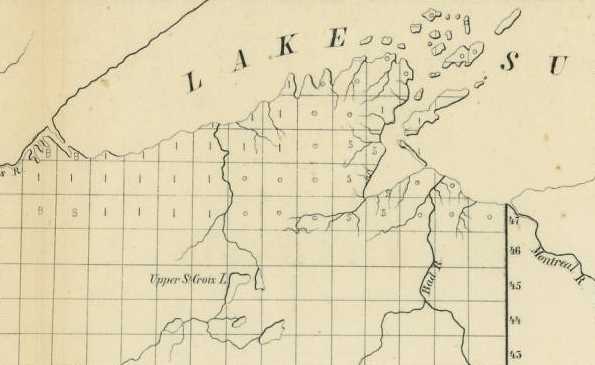
Detail from Sketch of the Public Surveys in Wisconsin and Territory of Minnesota by the Surveyor General’s Office (Warner Lewis), Dubuque, Oct. 21, 1854.

“In 1845 [Warnen Lewis] was appointed Register of the United States Land Office at Dubuque. In 1853 he was appointed by President Pierce Surveyor-General for Iowa, Wisconsin and Minnesota and at the expiration of his term was reappointed by President Buchanan.”
~ The Iowa Legislature
Wisconsin, Iowa, and Minnesota, then were embraced in one Surveyor’s District, with the office at Dubuque, Iowa. It was the duty of the Surveyor General to provide for the details of the Government Surveys in his district, as fast as the settlement of the country might require. Gen’l. Warner Lewis was then Surveyor General of this District.
~ The National Magazine; A Monthly Journal of American History, Volume 9, page 23.
No steps having been taken or any order given for the survey of the shore of Chequamegon Bay, in June 1855, Dr. Ellis left in an open boat for Superior, then on foot through the wilderness to St. Paul, following not far from the route over which many years later was constructed the Lake Superior & Mississippi R.R., – then an early settlement here induced Gen. Lewis to order an immediate subdivision of Towns 47 and 48, North of Range 4 and 5 West, both sides of our bay, and all the lands on which squatters had settled.
Early in September of that year, (1855), Augustus H. Barber began the survey and pushed the work rapidly, so that he had completed 47 and 48 of Range 4 in October, and the returns had been made and plats prepared and forwarded to the local land office by the first of December.
The Pre-emptors now, for the first time, could file claims to their lands and receive assurance that they were likely to be the owners of their homes.
During December many pre-emption claims were filed, and during the closing days of the year and in the first days of 1856, quite a number proved up those claims and received duplicates, upon which patents were afterwards issued. These were the earliest titles to the present site of Ashland. Unlike many towns in the West at that period our site was not cursed with complicating claims, and it is cause for congratulation that Ashland property has no cloud upon its title and that every buyer may, with little trouble, assure himself o this fact. The title to a portion of the site of Superior was bitterly contested involving years of delay and thousands of dollars of cost and much acrimony of feeling; and it is possible that this may have had its influence in carrying the railroad to Duluth rather than to Superior. Quarrels over title are a curse to any town, especially a new one.

“IN MEMORY OF
AUGUSTUS H. BARBER
of Cambridge, Vt.
U.S. Deputy Surveyor
who was drowned in Montreal River.
Apr. 22. A.D. 1856
Aged 24 yrs. & 8 ms.”
~ FindAGrave.com
Of Augustus Barber the early Surveyor of this vicinity, who is unknown to a larger part of this generation, a few words ought to be said:
He was a native of Vermont of an excellent family. At this time he was 22 years of age, well educated, gentle as a lady, refined and easy in his manners and very amiable in his temper. Like many other young men from the east, of active enterprising habits, he had come into this outer verge of civilization to make this his home and to grow up with its institutions. He was the nephew of Hon. J. Allen Barber, of Lancaster, in this State, who once represented his District in Congress. He continued in the surveys of this part of the Lake until in the summer or fall of 1856, when he, with others, conceived of the idea of founding a city at the mouth of the Montreal River – the dividing line between Wisconsin and Michigan about thirty miles east of Ashland.
“According to the Bureau of Public Lands, Department of the Interior, the land surveys were not completed in that area [Ironton] of Wisconsin nor offered for sale to the public until November 18, 1866.
[…]
“A practical location for an operating headquarters was chosen at the site of the Indian settlement on the shore of Lake Superior on that piece of level ground where there were mountains on three sides and through which a creek ran. The village at this location was named Ironton, and because of the activities planned for it and two other mining locations farther inland a group of merchants from Ashland assisted in building up this boat landing and supply headquarters. A dock was built and several buildings for warehouses and some living quarters.”
~ A Historical and Archaeological Reconnaissance of the Saxon Harbor area, Iron County, Wisconsin by John F Wackman et al, pages 57-58.
The iron range approaches nearer the Lake at that point than it does at Ashland. And though the country is much rougher and more difficult for construction of roads than between Ashland and the Range, yet the shorter route, it was argued, would more than compensate for the heavier grades. –The town was laid out and platted by Mr. Barber.
As indication of its future chief industry, as the entry point of the iron range – it was called “Ironton,” with the accent on the second syllable. Great expectations were entertained of the future importance of the place, and much land was entered in the vicinity.
The Montreal, not far from its mouth, leaps down a perpendicular descent of nearly a hundred feet presenting a wild and picturesque view. Being an enthusiastic lover of the beautiful of nature and desiring to reach a position underneath the falls, Mr. Barber in a canoe with two companions, approaching too close, were drawn in by the eddying whirlpool, the canoe was capsized, and before help could reach him he and one of his boatmen were drowned. his body was recovered and was buried on a sand hillock near the mouth of the same river in whose waters he met his death. Ironton has long been deserted, and Barber’s grave with its marble headstone, is the sole mark of that civilization, which twenty years ago there essayed to lay the foundation of a mart of commerce.
The surf of the waves of the lake in summer and fierce driving snow storms in winter, with solitude presiding over the grand orchestra, are perpetually chanting his mournful requiem, while a fond father and mother on the slopes of the distant Green Mountains are mourning bitterly the early death of their first born son.
Interior Field Notes
Ironton Townsite
La Pointe Indian Reservation
Township 47 North, Range 1 West
November, 1856
Notebook ID: [N/a]
This survey is mentioned by multiple sources, however, the Barber Brothers’ field notes and plat map for Ironton from 1856 are not available from the General Land Office Records or from theWisconsin Public Lands Survey Records. Did Warner Lewis receive them at the General Land Office in Dubuque, Iowa? The search for these survey notes continues.
Selected letters of the Joel Allen Barber Papers
… continued from Spring of 1856.
Superior City Sept 15th 1856
Dear Mother
“Ironton’s potential was very promising. While all the activity was taking place for a mining center, plans were being made by the Milwaukee & Superior Railroad to extend its line northward from Stevens Point to a terminus at Ironton at the shore of Lake Superior, then to continue west to Bay City (now Ashland).”[…]
“Besides the officers of the mining company, several businessmen of Ashland became interested in a railroad between Ashland Penokee Gap.
Some of these men were J.S. Beisch, Martin Beaser, John S. Harriss, I.A. Lapham, J.C. Cutler, Edwin Ellis and T.C. Dousman. This railroad was to be the Ashland & Iron Mountain Railroad. A lot of planning and some work was being done when quite suddenly the Panic of 1857 came on bursting many bubbles and bringing to a halt all of the mining activities, causing an exodus of many workers and a large number of potential settlers.”
~ A Historical and Archaeological Reconnaissance of the Saxon Harbor area, Iron County, Wisconsin by John F Wackman et al, page 60.
I wrote a few words to you a few days ago when I was unwell and had to be rather short. I have since recovered my usual health and will try to write a longer letter, but I am afraid it will be of little interest. I see you are anxious that I should quit the lake. It is not strange that you should wish dread to have me remain here. You wish me to come to [?] to Lancaster or any where but here.
Now to tell the truth I am as much attached to this lake as to any other place and I don’t know how to leave it. I know its disadvantages and privations as well as any one. I know the sweets of a more social life and much do I long for them. I know the luxury of living on a fertile soil in a genial climate and hope some day to enjoy it, but still if my life is spared Lake Superior will probably see me occasionally for a number of years.
You ask me my opinion in preference between a good farm in Grant County and ten miles of forest in this country and be bound to it. But I should not be bound to it if I owned [40/41?] miles and there are many farms about here worth more money than any farm on Lamoille river of twice the size.

Detail of Ironton property with trails to Odanah and the Penokee Mountains from T47N-R1W. This survey map was from Elisha S Norris during 1861.
I hope to visit Lancaster this fall but the middle of winter will see me threading my way back to this wild country. I would like extremely to visit Vermont next winter if possible but I expect my engagements will render it impossible.
I hope you will not dwell too much on the terrors of his country and fancy I am suffering all imaginable hardships. I am never hungry and seldom cold or over fatigued. I like the climate about as well any south of here and would sooner emigrate North west than South East, were I not bound by social ties. Were I to follow agriculture as a source of profit I would not go to Vermont or Grant County.
In regard to my Ironton property I have no hopes of getting you to think as you do.
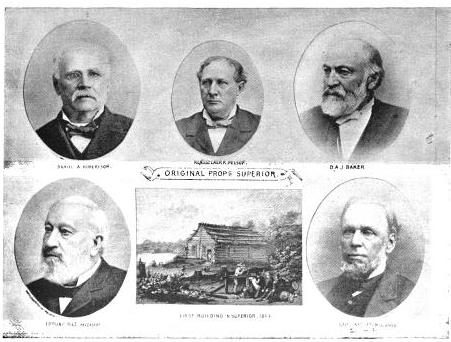
Hon. D. A. J. Baker was introduced as an early resident of Ashland in our Penokee Survey Incidents series. Baker appears to be in business with the Barbers at Ironton.
“A trail between “Penokee” and Ashland is shown on Stuntz’s map of 1858. An Indian trail between Ironton and Odanah was improved for transportation and communication when land travel was preferred to lake travel or when the lake could not be used. During that same time the trail between Odanah and Ashland was being improved to accommodate heavier traffic. (This road later became a part of Old U.S. 10 and now is Ashland County Truck “A”.)
The original Ironton to Odanah trail began on the west side of the village, ascending the highlands at that point, then followed a southwesterly course paralleling the Oronto Creek but avoiding the obstacles of lowlands or ravines until it reached a point where the headwaters of both Oronto Creek and Graveyard Creek were but a few yards apart. As it passed this narrow strip of land and headed both streams it swung sharply to the west towards Odanah.”
A Historical and Archaeological Reconnaissance of the Saxon Harbor area, Iron County, Wisconsin by John F Wackman et al, page 59.
I may be obliged to sacrifice the whole of it, but it will not be my fault. Mr. Baker sold five shares a few days ago for city lots here which will soon be worth 500 dollars. The opinion of explorers and speculars expressed in deeds as well as words confirm my opinion of the place. I suppose Father writes everything concerning his business here so I will depend on him for that and not repeat it.
I would set a time to come home but the future is so uncertain I fear I should only disappoint you and myself. I never yet planned anything as it turns out. I intended to return to Lancaster last fall but did not. I intended to go down last spring but was prevented by the death of Augustus. If I wait untill next spring before going down I shall go to Vermont at the same time probably. “Man proposes and God disposes.” I can only guess how God will dispose my affairs.
I see that you and Amherst feel rather bitter towards [Dow’s?] folks. I am sorry that is so. It is unavoidable that you should see a great many things that you don’t approve but the sum of my advice is “Let em rip.”
I hope to go to Lapointe and Ashland before long where I am about as well acquainted as at any place I ever lived at.
I am now engaged on the field notes of Augustus’ work – [fitting?] them for the office.
With love for yourself and Amherst I remain
Your affectionate son
Allen
To be continued in the Fall of 1856…
Barber Papers: “In a Little Trouble” Winter of 1856
October 9, 2015
By Amorin Mello
Selected letters of the Joel Allen Barber Papers
… continued from Fall of 1855.
Minnesota Point Jan [23rd?] 1856
Dear Parents
It is sometime since I have wrote to you and for a fortnight or more
[???] [two lines on this copy are illegible] [??? ?????]
On arriving at Lapoint we found sheets from home and a good lot of newspapers.
We left Lapoint Thursday afternoon [on a firm of ?????? ? ?? head?] of [?????????] Nagonup the principal chief of all the Chippewas, Augustus and myself [??? ??? ?????] drawn by by two dogs on a dogtrain. At [????? ???????] were joined by one of Nagonup’s [??????].

Photograph of Naagaanab (Minnesota Historical Society).
They were on their way to Washington. Several of them are going accompanied by a gentleman from Lapointe as interpreter. The first night out we stayed in a wigwam with old Chingoon and his interesting family. Friday night we camped. Saturday reached Iron river. Sunday left and [comfortable?] – Monday came here. Augustus has a sore througt, not severe – otherwise we are well as usual notwithstanding our tramp of over [100?] miles. I must now quit writing and try to find one of our dogs which has strayed over to [???].
Under the old permit system, many locations, three miles square, were made on Lake Superior;- several on and near the Montreal river – some on Bad River, south of La Pointe – three on the main land, opposite La Pointe – two or three were made near Superior City, on the Nemadji, or Left Hand river, and one settler’s claim about twenty miles north of Superior.”
~ Mineral Regions of Lake Superior: As Known From Their First Discovery to 1865, by Henry Mower Rice, 1865[?].
Perhaps you wonder what we have made this journey for – perhaps you hope we are going below but that is not the case. Why should we [?????]. It is warmer here than at many places two or three hundred miles south of here. True – one or two thermometers froze up at this place but others did not while at Fort Snelling, the spirit thermometer inside the walls indicated 44 degrees below zero. Augustus wanted to see to his preemption and I had nothing to do but to come along with him. I also wanted to find out a few things concerning a place that I should like to preempt. I suppose there is not a better copper show on the south shore of the lake, but the land is not surveyed and my only sure way to get it is to settle on it and stick to it until it can be legally claimed.
The town lines will be run next summer.
Augustus is in a little trouble about his claim. It appears his declatory statement never reached the land office. But I guess it will all be explained and made right. The dutchman who was to contest his claim has left the country and would stand no chance if he was here. We have a land office here now which saves a great many journeys to Hudson near St. Paul. We shall go back in a few days and commence surveying around the islands. Now don’t fancy that we cannot survey in the winter, for we have tried it and know better.
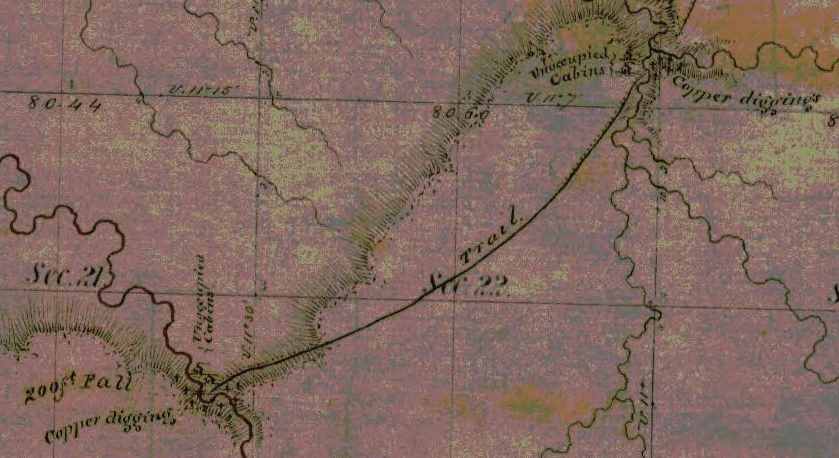
Detail from the Stuntz/Barber survey of T47N R14W.
“J.H. Bardon, a Superior pioneer, stated that ‘at Copper Creek and Black River Falls, twelve or fifteen miles south of Superior, and also near the Brule River, a dozen miles back from Lake Superior, Mr. Stuntz found evidences of mining and exploring for copper on a considerable scale carried on by the American Fur Company, under the direction of Borup and Oaks of La Pointe, in 1845-46. A tote road for the mines was opened from a point ten miles up the Nemadji River to Black River Falls.‘”
~ Duluth and St. Louis County, Minnesota; Their Story and People: An Authentic Narrative of the Past, with Particular Attention to the Modern Era in the Commercial, Industrial, Educational, Civic and Social Development, Volume 1, by Walter Van Brunt, 1921, page 66.
At Bad river we were at work during the coldest weather, and only lost two or three days because of cold but when the thermometer was up to 20* below zero we worked right ahead – sometimes in swamps where we stepped through the snow into the water,
[last line on this page of this copy is cut off]
The weather for a week or more has been fine. Cold enough to cover us with frost but not severe.
Provisions are very scarce – no flour or pork can be had.
They will begin to bring them through from St. Paul in a few days. Flour it is hoped can then be bought for $20 per barrel. Fish are not exactly plenty but they can be obtained for money or labor which is not the case with anything else. The country is flooded with dry goods, [p??y] articles and everything but provisions because they can be bought on time but eatables could only be got by paying cash down.
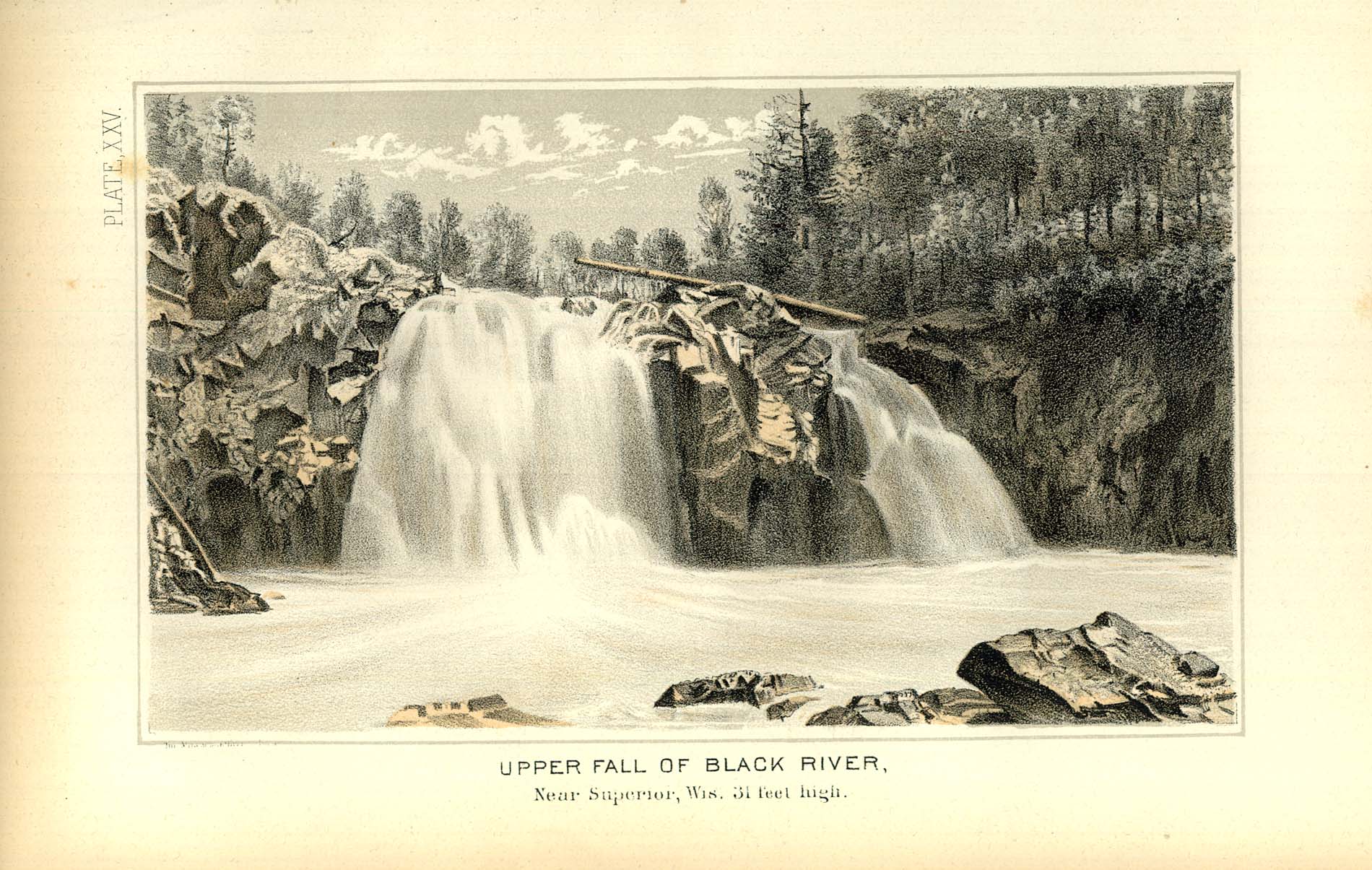
Geology of Wisconsin: Survey of 1873-1879,
Volume III, 1880, page 342[?].

Geology of Wisconsin: Volume 3, page 341.
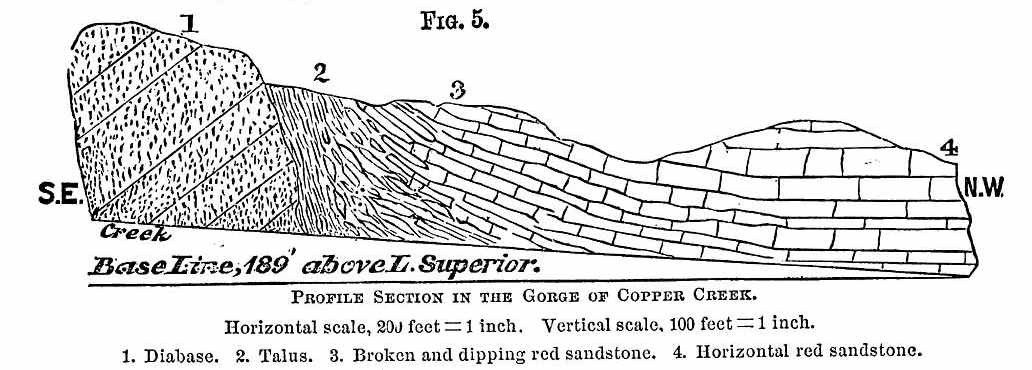
Geology of Wisconsin: Volume 3, page 345.
The Fon du Lac mine has commenced operations with tolerable fair prospects. It is the only mine in operation this side of Montreal river. Augustus’ claim is on the same vein and for aught anyone knows just as good besides having abundance of water power. All the copper excitement since I come to the country has been directed toward the north shore. This morning I signed 2 petitions, one to congress for the early survey of the north shore and another for a road down that way. I have made a little map of the islands and last summers survey and some other things that I will enclose.
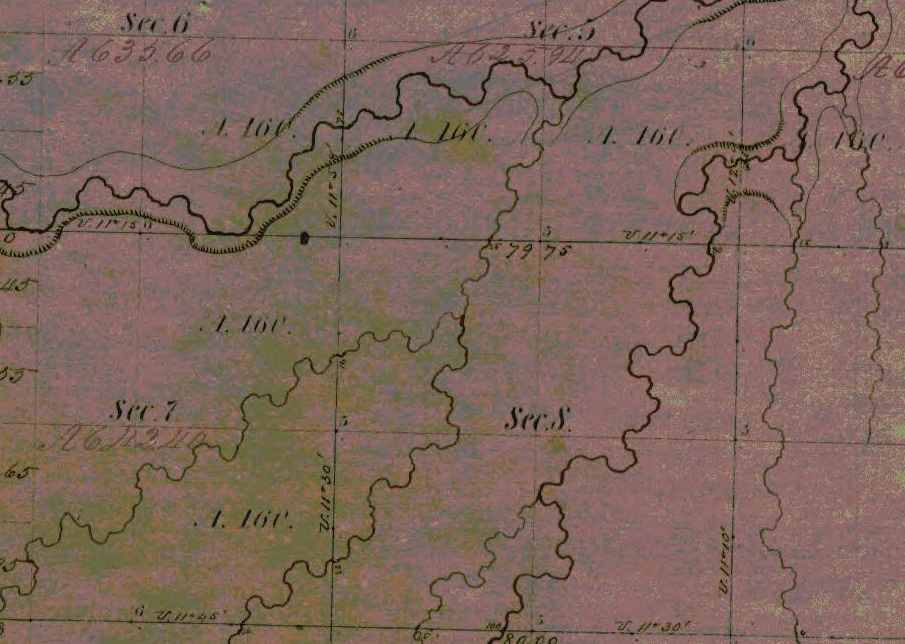
The Fond du Lac copper prospect was located near a small tributary of the Left Hand River on this map detail from T47N R14W, near Pattison State Park. Augustus’ claim was along the same vein of copper but had not been surveyed yet; perhaps it was at Amnicon Falls State Park.
Augustus has begun a letter to send with this. He has just come home with letters now about his claim.
No more at present from
Your affectionate son
J. Allen Barber
Direct to Lapoint
Minnesota Point
Superior County
Minn. Terr.
Sunday Feb 10th 1856
Dear Mother
Augustus has written a letter, and left it for me to enclose and dispatch so I thought I would ship in a few lines before sending it off.
Augustus started today with a young man and two dogs for Lapointe. I shall probably go there in a two or three weeks to return immediately. There are two men going down with a tamlins pony team with provisions from St. Paul for Augustus. The men are going to work for him and I shall probably bring the team back and use it a while. I have at last fixed my mind on a place that I mean to claim. The location is a point at the mouth of Left hand river, known as Left hand point. It contains only 5 or 6 acres in low & swampy and covered only with bushes coarse grass and floodwood. Nothing but the fact of its being a part of Superior city is of any value whatever.

Barber’s sketch of his land claim at the mouth of Left Hand River. This location is now an industrial neighborhood of Superior on the Nemandji River.
As it is $1,000.00 per acre is not an overestimate of its marketable price at present. It joins or is part of the grounds intended for the Railroad buildings when the survey was made here this point was cut off by the meander lines instead of meandered. Therefore according to the [rearns/records?] no such land exists.

A resurvey is to be made and I mean to fasten it by a preemption which is the only way to obtain it before the land sale. I may get cheated out of it and I may throw away my time and money but such chances are scarce and should it transpire that my claim is good I want to have my dish right side up for once. I have written for Uncle Allen’s advice and should I ever find it advisable to drop the matter I can do so without forfeiting my preemption right.
The Eye of the North-west, page 9.
The Superior Company with Company with which I shall probably have to contend is rich, influential, and on good terms with the administration. All that can be done by fair means or foul to defeat any claim will probably be done, but some things can be done as well as others, at any rate we shall see what we shall see.
So my head is so full of business just [snow?] you will please excuse the shortness of this letter and look for more when I have more time.
Your affectionate son
J Allen Barber
Superior Feb. 17th 1856
Dear Brother
It is sometime since I have written anything to you but you have heard of me so often that I suppose it makes no particular difference. It will be nearly sugaring time when you get this.

Makak: a semi-rigid or rigid container: a basket (especially one of birch bark), a box (Ojibwe People’s Dictionary) Photo: Densmore Collection; Smithsonian
I have once more got into a country where sugar is made but not by white men. The Indians make pretty good sugar which is generally done hard and [sinted?] dry and put into birch bark “mo’kucks” holding from 50 to 75 lbs. This bark is also used exclusively for buckets, store trays, gathering pails, &c. The timber in this country is not as equally distributed as in Vermont. The land is mostly covered with evergreens but there are some located portions of country where maple abounds. These “sugar bushes” as they are called are often quite extensive covering several sections and and [they?] only at intervals of 8 or 10 miles, but this is just as well for the Indians are both migratory and gregarious in their habits.
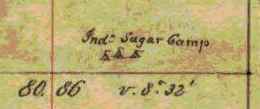
Detail of an Lake Superior Chippewa “sugar bush” from the Barber brothers’ survey of T48N R5W.
I hope you will eat plenty of sugar next spring and take some of the girls to a sugar party or two like I used to. I am doing nothing now most of the time but shall have business enough in a few days when I begin to build my house that is if I conclude to grab for the price of land I am now watching. I am waiting to hear from Uncle Allen and for some other things to transpire. There is not a man in the country whom I could trust that could give me any reliable information such as I want. I want you to hurry and become of age as soon as possible and come out here this spring and make a preemption.
There are some good places left yet, but don’t get married before you make a preemption for it might not be convenient to take your wife out into the woods 30 or 40 miles to live on the place as you would have to do in order to “prove up.” I am going to get up an ice boat before long which will be very useful as I mean to do considerable boating yet this winter, and I might use it to carry lumber and other things up and down the lake. With such winds as we have had a few days ago I could easily go to Lapointe and back in two days. I suppose Augustus got a party started by this time and he will be at it himself in a few days. I am living with a man named Fargo, you have heard of him before. We are living in Stuntz’ store. Board at the hotel is ten dollars per week. Old Steven Bonga is living on the point, he has been something of a traveller having been to Montreal, Hudson Bay, [Oregon?], Prairie du Chien, and all intermediate places.
He is half indian and half negro so you may suppose he is not very white.

Portrait of Stephen Bonga (USDA Forest Service). Additional information about Bonga is available from the Wisconsin Historical Society.
A railroad has been laid out from here to St. Paul and my claim covers the terminus at this end. There have two or three new towns started into existence along its route in imagination. Perhaps they are [surveyed?]. This making towns in a new country is a great business.
What happened in your good town on Christmas and New years eve
Were there any stockings left.
I want to inquire about lots of girls and boys in Johnson and Cambridge but I conclude you will tell me as much as you can in your next letter so with respects to all enquiring friends I remain
Your affectionate brother
Allen
Superior, Douglas Co. Feb. 25th 56
Dear Parents

Detail of Superior City from T49N R1W.
Night before last I got a letter and some papers from Augustus also 2 letters from home which he had read. They were dated Dec. [21st?] & Jan 2nd.
Sad and startling was the news of the death of George Hill. Who could have thought three years ago that such a dark future lay before that family. Every day some sad event warns me of the uncertainty of life. Men have died here who had no friends to mourn their loss, and their death is hardly noticed. I always ask myself why was it not me instead of them and will not my turn come soon. Yes, let it come soon or late as the world reckon, and it will be soon to me.
There is just as much danger or accidents in this country as in any other and no more but as to health there is no better place in the world than this. You seem shocked at the idea of surveying in the winter, but it will be nothing but fun to survey during the rest of the winter. It has been moderate pleasant weather now about two weeks. The snow is going off a little lately and it seems a little like spring. We had some pretty cold weather about new years but we shall have no more such. The lake is more open than it ever was known to be at this season before.
It sometimes freezes across at Lapointe but now it is open within six or eight miles of here. Flour is only $20 per bbl‑ with prospect of falling lower. The Indians chiefs have returned having only been to St. Paul where they found a letter telling them to delay their visit a while.
Poor creatures! They are fooled around by traders and speculators who are with the government in robbing and dwindling them. Any thing like a full account of their wrongs would astonish even them. About my claim I have not [???] today. There is another man after it and it will be no easy thing to carry my point.
Valuable property is troublesome stuff in this country. There is a townsight three miles from there now in litigation for which there is a standing offer of $200,000.
I am still living with Fargo on Minnesota point. I expect to go to Lapointe before long with Albert Stuntz who is going down with some supplies for Augustus which he brought from St. Paul.
It is too dark to write
Good bye
Allen
Superior, March 4th 56
Dear Parents
Not much has happened in this vicinity worth recording. The principle circumstances of note is the burning of a house and all the worldly possessions of a poor [Indian?].
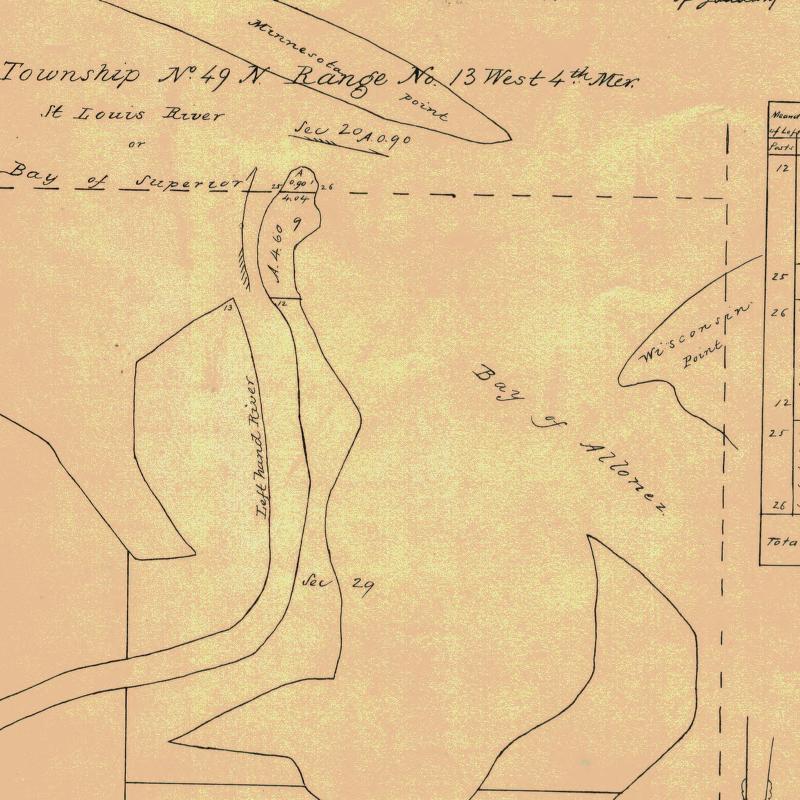
Detail of Left Hand River from Stuntz’s survey; where Barber’s land claim was located.
I have heard nothing of Augustus since writing last but expect to when anybody comes up the lake. About my claim I can say but little my chance is but dull still I don’t mean to give up so large a prize without good reasons.
I have had it surveyed and the notes sent to the Surveyor General with a memorial stating the facts and asking him to [appraise?] the [notes?].
The price contains over 8 acres (8.695).
Perhaps it occurred to you that I am was 22 years old last Sunday. Well such is unquestionably the case although nothing was done to celebrate the day only I had my hair cut for the third time after leaving Vermont. I think I shall have to go to Lancaster this spring but unless I get ousted here it will be difficult to leave.
I wish I could multiply myself by about a dozen in order to hold several valuable claims which are not occupied by any one who can legally hold them. I can’t write here two children [pretting?] and several people [telling?] Albert Stuntz and family are here today. I am perched on a sawhorse writing on a work bench loaded with all manner of [marbles?].
Evening – quiet once more since dark I have written a letter to the Surveyor General to accompany a memorial that I have been circulating. O I wish there was a person in the country that I could depend on to assist me in regard to that claim. There are one or two that I counsel with who know no more than I do and then I do as I think best.
I expect [Lowener?] to find out I have no show, and that will be the last of it I shall [not feel?] that I had lost it for I never had it, but if I don’t get it some body else will get 15 or 20 thousand dollars worth of land that I want.
Provisions are still high and will be higher again before navigation opens which cannot be expected before the 1st of May. Flour is $20/barrel, fresh pork 18 ¾ cents per lb, beef 20 cts milk 20 to 25 cts per qt. &c, &c. Eatables must be higher because there will be little or no sleighing after this over the barrens between here and St. Paul. My mind has been on the [rock?] so much today that I am not in a mood to think much about home so please excuse the shortness and dryness of this letter.
I remain your affectionate son
J Allen Barber
Went to Iron River Thursday 13
Returned 15th
Superior , Douglas Co. March 11 1856
Dear Parents
Yesterday I read a package of letters from Augustus containing one from him & from home one from Albe and one from [Caldridge?]. As Augustus was in town (Lapointe) when he recd. your letters I suppose he has answered them so I cannot tell you much news about him. I am still staying with Fargo – not doing much but hoping to get pay for my time and expense by securing the prize I am after. There is some excitement in town about it, but mighty little is said to me. The Register at the land office gives me good encouragement and says a preemption will hold it. I have taken some steps toward building on it. Today I bought a sack of flour ½ barrel for 12 dollars, I shall get some fish from Lapoint where they are very plenty and cheap and then I shall be almost ready to try housekeeping alone.

I am sorry to hear of the disastrous results of the low price of hops. Although farmers must suffer in consequence yet I believe speculators will make fortunes out of it. If I was in the business of raising them I should stick to it. No articles is so liable to fluctuations in prices as hops but it is well known that the risk fails once in five years on an average so they must come up sometime.
I see you are inclined to believe our country and climate are more in hospitable & forbidding than yours. Such I believe is not the case. We have had some very cold weather but the changes are so moderate and so seldom that we pay but little attention to the weather – in fact we call most all of it very fine weather, as it is. The lake is a great equalizer of temperatures and our cool lake atmosphere in summer causes showers to fall from all the warm, sweaty winds that come here to wash their faces in this big blue pond. People in this country go much better prepared for cold than they ever do in Vermont. I have not worn a boot since leaving Lancaster. We wear shoes in the summer and moccasins in winter.
Boots won’t do for surveyors – they carry too much water unless we stop to empty them after crossing every stream or marsh.
While speaking of clothes perhaps I might as well go on with a few more items of the same sort.
Shoes for this country should have no lining or binding as they are quicker and ae not as stiffwhen dry. We never apply anything to soften them and nothing can preserve them from wearing out in about two months of hard service. They [sell?] about $1.50 per pair. We can get plenty of wool hats which are the only ones we wear.
All manners of shirts can be bought, even the very best quality of red flannel ones, which are universally warm, outside, i.e. by common folks.
The gentry of Superior dress most distressingly.
It is difficult to get good socks any where on the country. I have worn out 6 or 7 pair this summer and lost some more – they cost high bests we don’t wear. I have none. The only cost I have is of [Gihon?] cloth and made by Mrs. Sheldon. Cost are not much more except as an extra garment to wear occasionally.
Good durable pants I find it difficult to get. They are generally poor [ashnet?] and not half put together. Good your mittens would be very acceptable but for want thereof buckskin or blanket mittens are generally warm.
You speak about bringing Kate [in?] to Wisconsin. My advice is to it without fail if you intend coming out to live, nothing should prevent it if I were in your place. The horse that Uncle [Jay?] brought out with him is smarter and tougher than any one he can find to use with him. There is nothing that I regard as more necessary for a family than a first rate horse. I think [Kelty?] will be a very good serviceable animal for work besides being one that you might be proud to ride [after?] over the prairies. Probably Augustus has told you what he thinks about Amherst and other boys coming out here to survey. Butler was so badly disappointed in this country that I have had but little thoughts of [enough?] any one else to come here. Such a disappointment I think would be the fate of 4 out of every 5 that try the business.
A person to be a surveyor must be able to travel all day through the woods and sometimes carry a pack. I would not prevent any from coming here as there is generally business enough besides surveying. A surveyor can make no greater mistake than by hiring any but the best of men. Perhaps Augustus has not told you that he will be out of the business as soon as his present job is done and will devote his time to the improvement of his claim &c. I should like very much to [have?] Amherst here but I dislike to have my parents left entirely alone. As I have [???] two half [sheets?] – when I only [illegible] mind up for the [present?].
[Incomplete copy of letter]
To be continued in the Spring of 1856…
By Amorin Mello
The original handwritten memoir of Joseph Austrian is held by the Chicago History Museum. We saw some interesting stories and insights about La Pointe in Part I through the eyes of Doodooshaaboo (milk) as Joseph was known there during 1851 and 1852. The later La Pointe stories in Part II, however, are where the really good stuff is about white settlement and land speculation prior to the Treaty of 1854. When we last checked in with Joseph, he had just been ordered by brother-in-law Louis F. Leopold to terminate his business career at brother Julius Austrian’s Indian trading post at La Pointe, and to immediately relocate to Keweenaw Peninsula to co-manage brother-in-law Henry F. Leopold’s store in Eagle River.

Joseph Austrian’s land purchase at La Pointe during 1852.
~ General Land Office Records
In this installment we follow pages 66-78 of Joseph Austrian’s memoir about his reassignment to Eagle River. While there he engages with the Leopolds’ business affairs with copper mines and miners of the Keweenaw Peninsula before the opening of the Soo Locks. Joseph is quick to succeed in his new position as a trusted business partner during 1852-54.
A mysterious omission from this memoir is the fact that, during the summer of 1852, Doodooshaboo purchased 183 acres in La Pointe from the U.S. General Land Office in Willow River. In other words, this was the first federal sale of any land in La Pointe County. We will take a closer look at this critical shift in La Pointe’s political landscape as the subject of a future post on Chequamegon History. But for now, Joseph’s stories about 1852-54 provide us with glimpses of the Austrian family’s affairs at La Pointe during these pivotal years before the 1854 Treaty of La Pointe.
Memoirs of Doodooshaboo
… continued from La Pointe 1851-1852 (Part 2).

Outline Map showing the position of the ancient mine-pits of Point Keweenaw, Michigan.
~ Ancient Mining on the Shores of Lake Superior, by Charles Whittlesey
Reached Eagle River by Sleigh. 1852.
~ CopperCountryExplorer.com
Mr. H. F. Leopold, who hearing that the boat had passed by during the night and expecting me on her, came over with a sleigh for me. Eagle River was a small settlement of not over one hundred inhabitants situated in Houghton County, Michigan. It depended entirely for its business patronage on the adjacent copper mines, principally the Cliff Mine, North American, Phoenix & Garden City mines, some of which at that time were just in course of development. In the place there were but two stores the smaller one 18 x 24 situated on top of a hill facing the Lake was Leopolds. The other larger store was owned by Tenter and Mandelbaum. There were a number of saloons and boarding houses combined and this constituted the business portion of the town.

Simon Mandelbaum was an employee of the Phoenix Mine, the successor of the the Lake Superior Copper Company (the first regularly organized corporation to engage in Lake Superior Copper mining).
~ Annual Report by the Michigan Department of Mineral Statistics, 1900, pg. 240-41
Started Work at Eagle River. 1852.
I was at once installed in my work after my arrival, and the next day went to the Cliff Mine to attend to some collections. Mr. H. F. Leopold was an uneducated man not able to read or write English, the business correspondence and keeping of accounts therefore devolved entirely on me.
After becoming thoroughly acquainted with the business I resolved to enlarge the same and my efforts to do so succeeded well. A short time after my arrival at Eagle River a letter was received by the Leopolds containing the sad news of the death of my father. He died suddenly Sept 17th, 1852 from a stroke of apoplexy at the age of 75 years. This was naturally a cause of great grief and worry to me, as there was besides my mother, my blind brother Marx, a younger sister and brother at home to be cared for.
The next spring a larger stock was ordered than had ever been carried before and new departments added, namely: groceries, grain, and provisions, heretofore, only dry goods had been carried, from this time on the business as a matter of course showed a decided increase, and at the next annual inventory the profits showed a much better result than ever before. We boarded at Joseph Lang’s place who had a saloon in connection with his boarding house and poor as it was we had no choice to better ourselves. Mr. Leopold spent his evenings generally at the boarding house enjoying a game of cards with some of his friends, while I had to pass my evenings alone at the store playing watchman. We had no fire insurance on the store or on its contents, as firstly there were no insurance companies taking risks there at the time, and secondly even if they had I doubt that we could had placed any, owing to the dangerous condition of the heating apparatus. The store was heated by a box wood stove with the pipe running through the entire length of the store to the chimney, and it was necessary to be very careful and watchful under the circumstances. The store was hard to get comfortably warm, and I often sat there cold and shivering wrapped up in a blanket waiting for Mr. Leopold to come in for the night.
We slept up stairs over the store, and here it was most cheerless and dismal, not being heated at all.
The winters were very severe and extremely cold which did not add to our comfort and during our first winter there we had to put up with many hardships.
Dug Tunnel Under Snow to Stable.
We had frequently severe blizzards one I well remember, it lasted over a week. The depth of the snow that fell at that time was so great that with the drifts it reached high as the roof of the stable and we had to dig a tunnel through the snow to get from the store to the stable, and the horses were led out some weeks through this tunnel. Our store was exposed to the full force of the severe Lake Superior gales which some times shook the building threatening to demolish it.
Tough Boarding House Experiences.
During the winter there was no fresh meat to be had. In the Fall the boats would bring some, but having no refrigerators it was hung up on the boom of the Schooner to preserve it during transportation and when it reached the table it was anything but tempting. However, it was kept and used for weeks after, strong vinegar was used in preparing it by our land lord’s cook to hide the flavor. When this “so called” fresh meat gave out for the rest of the winter they substituted salted meat.
The Cliff Mine store had a large supply which it had had on hand for several years, our land lord bought of this firstly because it was cheap and secondly because he could not get any other. Eggs were not to be had either and turnips and potatoes were about the only vegetable procurable. This diet caused scurvy more or less. In the Spring when navigation opened, the first boat of the season was hailed with delight it was the signal for eggs and other delicacies we had been deprived of so long. Our land lord bought a barrel of eggs and fed us on them three times a day, while they lasted. During the summer we were also regaled with a variety of fresh vegetables and some fresh meat that could be had at times.
Brother Julius Brings our Family to America. 1853.
Secretary of State
Office of Indian Affairs
June 30th, 1853
Dear Sir,
In the absence of the Commissioner of Indian Affairs, to whom the bearer, Mr. Julius Austrian of Cleveland, Ohio, has letters of introduction and whose business here pertains to your Department in connection with an intended visit to Europe with his family, I beg leave respectfully to salient for him such courtesies as the case demands.
I have the honor to be
Very respectfully
Your obedient
Charles E. Mix
Acting Comm.”
~ Ancestry.com
Things went on satisfactorily in the business and in the summer of 1853 brother Julius, who was stationed at La Point started with his wife, a sister of the Leopolds, for Germany in accordance with a conclusion we had come to, to bring mother and the rest of the family to this country, and at the same time to visit the native village of his wife – “Rḯchen,” in the Grand Dukedom of Baden. It was a mission combined with a great deal of hardship and trouble for Julius, as it meant for him to convert all the real & personal property of my late father’s estate into money, which was in itself very difficult besides getting the family ready for this long voyage for their destination in the new world after having lived all their lifetime in Wittelshofen. Brother Marx especially was disinclined to go on account of his affliction from loss of eyesight.
My mother not having any special ties there to keep her, was in a measure glad to go where the most of her children were living, and did everything in her power to get ready without unnecessary delay.
They had a safe voyage and arrived at Cleveland Sept 1853.

U.S.M. Steamship Atlantic, James West, Commander.
~ Library of Congress Prints and Photographs Division Washington, D.C.
Julius Austrian returned from Europe on the U.S.M. Steamer Atlantic to America on October 17th, 1853 with his family: Hannah Leopold Austrian (Wife); Malka Heule Austrian (Mother); Marx Austrian (Brother); Samuel Solomon Austrian (Brother); Mina (Sister); and Henry Guttman aka Goodman (Cousin).
~ New York, Passenger Lists, 1820-1891, pg. 499, FamilySearch.org
Mother took a small house in Cleveland on Ohio St. and started house keeping with my sister Mina and necessary help when she was comfortably located. My brother Sol for the time being lived with my sister Babette. During this winter my sister Mina became engaged to Levi Jordan of Baltimore, where he was in business. He came from the same place where we were born, and therefore the families were well acquainted. Their marriage took place the next summer (1854) and afterward they resided in Baltimore.
Store Sold by Mistake.
The business had kept on increasing steadily. Mr. Louis F. Leopold had removed from Mackinaw and was living in Cleveland Ohio. In sending the annual inventory to Mr. L. F. L., through a mistake of his, he did not think the result satisfactory and peremptorily ordered his brother Henry to close out the business in Eagle River and sell the store. Henry boy like regardless of his own individual ideas and judgement at once obeyed his controlling brother, and sold out to his competitor, Mandelbaum, but soon regretted having done so.
I Spend Winter of 1853 in Cleveland.
After selling the store Henry Leopold and I went to Cleveland. I was anxious to meet my mother and the rest of the family from Germany. That winter I spent in Cleveland visiting my mother and the others. One of the first things we did was to get brother Solomon (then about 13 yrs- old) to learn a trade, and decided on shoe making as he was also eager to do something. We arranged for him to go into the service of a certain Weidenthal who agreed to instruct him in the trade at a small remuneration.
He took his place at once, living for the time being with our sister Babette. He took a good hold of the work and progressed very well in the trade to the entire satisfaction of his employer.
During the winter my brother Julius came through from Lake Superior, also Aaron and Sam F. Leopold for a conference between the Leopold brothers and me about the future program of our business. We all decided it had been a mistake to sell the store as the profits when correctly viewed was quite satisfactory with good prospects ahead. It was ascertained that Mr. Louis F. Leopold had taken it for granted that the inventory sent him showed him the result of two years profit since the business had existed; whereas it in reality was a statement of the one year of my management. We all agreed to open up again in the Spring on a larger scale. During the winter I contracted with a carpenter at Eagle River, and had the store enlarged to more than double its size and had the second story fitted up as living rooms, and a good cellar put under the store.
During this winter my sister Ida was engaged to Henry F. Leopold, and Jan 23rd, 1854, was married to him. The wedding was an enjoyable family affair.
As soon as navigation opened up in Spring, in May 1854, Henry Leopold, his wife, and I returned to Eagle River with a good stock of goods.
“We had already made the acquaintance of Mr. and Mrs. Julius Austrian, having had the pleasure of their company up the Lakes, and had made many inquiries of them as to the place of our destination. From this time forward we found Mr. and Mrs. Austrian to be most agreeable neighbors and associates, and
these young ‘brides’ spent much of their time together…”
~ The Ashland Press, Feb. 16, 1878.
At this time brother Julius and wife returned to La Point taking Brother Marx with them, who about a year later married Caroline Milner of Cleveland, and settled for the time being in La Pointe. That same year I sent him a small amount of goods from Eagle River, which enabled him to do a little something in trading with the same to the Indians for furs. After the episode with the Indians as I have previously narrated Marx was anxious to get away from La Point, and I had him and his wife come to Eagle River where I built them a cottage, conveniently arranged for him to live in with a small crockery store attached which he and his wife attended.
Some years later when brother Julius moved to St. Paul by his advice Marx and his wife went there also, and lived in a house next to Julius which he had had fitted up for the purpose. As far as business is concerned he acquired an interest in a butcher shop there.
After brother Solomon had finished his apprenticeship in the shoe business, the following year he also went up to La Pointe by advice of brother Julius where he stayed but a short time and then went to Hancock & opened a shoe store in which he did a good business.
To be continued at Eagle Harbor 1854-1859…
Penokee Survey Incidents: Number III
February 15, 2015
By Amorin Mello
December 1, 1877
The Survey of the Penoka Range and Incidents Connected with its Early History.
—
Number III.
~ Detroit Free Press, June 5, 1857
(MarinetimeHistoryoftheGreatLakes.ca)
Friend Fifield:- Upon the first arrival of Mr. Sidebotham and myself at La Pointe, in May, ’57, as previously stated, we took lodging at the “Hotel Angus,” the hospitalities of which we were forced to enjoy until some means could be found to communicate with Gen. Cutler. The Bay, as well as the Lake, was full of ice. In fact, we had been compelled to fight out way from the Sault to La Pointe, through heavy masses of ice, nearly the whole distance – and while upon this subject, I will say, that incredible as the statement may appear to many, yes it is a fact, that ice bergs were aground in front of Austrian’s Warehouse, at La Pointe, on the 4th day of July, 1857, in 36 feet of water, while at the same time a field of floating ice was visible from the Range, beyond which, no water could be seen. I verily believe that the lake was not wholly free from ice that summer.
~ Madeline Island Ferry Line
At length, after remaining at the hotel some eight or ten days, during which Mrs. Angus made us as happy as she could by her kindness and attention, Gen. Cutler came, accompanied by Mr. Herbert. This was the first time that either of us had ever seen Gen. Cutler, but on being informed who we were, he seemed overjoyed to see us, and at once made the proposition to me to take charge of the work, and let him return to Milwaukee, so thoroughly disgusted had he become with the whole thing. To this, however, I would not consent, whereupon he decided to remain, and at once directed Mr. Herbert, who was at that time still in our employ, to return at once to Ironton, taking a part of the supplies, which came up with us, of which they were in great need, Mr. Sidebotham accompanying him, leaving the General and myself at La Pointe. After a long consultation, the General decided to go below, after men and money, wherewith to complete the work; which he did, I following Mr. Sidebotham to Ironton, which place I reached in time to join Mr. Herbert’s party, just starting for the Range, which we reached the second day after leaving Ironton.
During its existence the taxable real estate in the Town of Bayport had increased from nothing to several hundred thousand dollars, principally through entry of pine lands in the south and western portions of the township and also by extensive entries of mineral properties on the Iron Range.”
~ The Lake Superior Country in History and in Story by Guy M Burnham, pg. 179
Omission was made in the list of stockholders given in my first chapter, of Mr. Herbert, whom name should have been included. His stock was, however, by special agreement, unassessable, as it was through his instrumentality, in part, that the existence of this most wonderful metallic deposit was first brought to the knowledge of the Company, and the work of surveying and locating is undertaken. It was this, together with the knowledge that his long residence in the country was supposed to give him, as to the best mode of conducting such an enterprise, that procured for him this aqucession, as well as the appointment of Agent. In justice, however, to Mr. Herbert, it is proper to state, that besides the work done, and money spent at Ironton, the place selected by him as the future shipping point for the iron, (50,000 tons of which he contemplated bringing there that season, at least he stated) considerable work had also been done upon the range during his administration; mostly, however, at Penoka, where a log cabin, yet standing, had been erected, and some thirty acres cleared, the timber being cut into cordwood, to be used in the manufacture of charcoal iron, for the making of which it was contemplated to erect the proper furnaces in the near future. Neither is it any injustice to say, that although perhaps he did the best he could, situated as he was, yet the work did not progress as fast as the company thought it should, the force, while under his control had became badly demoralized. The idea had obtained, if not with him it had with them, that they were working for a company of bloated bondholders,- had a soft thing, and meant to make the most of it; but with the advent of Gen. Cutler, a change came over the spirit of their dreams. Order was quickly brought out of chaos, and the discovery made that a master hand held the reins. Up to this time, May, ’57, the Range had never been visited by any of the company except Messrs. Palmer, Greves and Ripley, those visiting ’56 was one of exploration only, and as Gen. Cutler, Mr. Sidebotham and myself were the only ones that went up there in ’57, or who, in fact, over performed any work there, a short sketch of them will perhaps not be inappropriate in this connection, while awaiting, metaphorically speaking, the arrival of the expected reinforcements from below. And first of Gen. Cutler:

Lysander Cutler of Wisc. (Library of Congress Prints and Photographs Division, Washington, D.C.)
The Order of the County Board creating the Town of Bayport was made March 11, 1856, and the store of Schuyler Goff, in Bay City (Ellis Division) was designated as the place for holding the first election for town officers, the election to be held Tuesday, April 1, 1856.
The Town of Bayport comprised all that portion of LaPointe county (since changed to Ashland County) lying south of the north line of Town 48 North; in all over sixty-eight Townships, including the Bad River reservation, which was, on the 8th day of November, 1859, made a precinct by itself.
At the first election held April 1, 1856, there were 24 votes cast — resulting as follows; for Chairman of the Town Board, Schuyler Goff (later appointed County Judge, an office he held for a year or more). The other members of the town board being J.T. Welton and Asaph Whittlesey. Schuyler Goff, chairman elect, was the first officer to qualify, his oath of office being administered by Asaph Whittlesey, Justice of the Peace.”
~ The Lake Superior Country in History and in Story by Guy M. Burnham, pg. 179
Gen. Lysander L. Cutler was, in many respects, a remarkable man. In person he was rather above the medium height, large head, large, dark eyes, heavy eyebrows, a sure indication of a good memory, as well as firmness, dark hair, inclined to stand erect; walked, usually with a slow and dignified step, with his eyes apparently fixed upon the ground, as if in deep thought, leading an observer to suppose that he was not cognizant of what was being enacted around him. This, however, was a mistake; nothing escaped his observation. In fact, he seemed to know your very thoughts; neither could anyone be in his presence ten minutes without feeling the magnetic influence of his iron will. Was any dangerous work to be undertaken, he would, if within call, be the first one consulted, and appointed to take charge of it. He was a born leader. He was not only one of the best business men I ever knew, but he was also a leader in politics. A good judge of men, sharp and keen, and who ever undertook to circumvent him was sure to some grief, as some of the people who went about the Range did that summer, have no doubt, an abiding recollection. I refer now to Hall, of St. Paul, Minnesota, who undertook, with the assistance of S.R. Marston, a treacherous employee of the Company, and Schuyler Goff, of Racine, at that time a resident of La Pointe, to beat us out of our rights, by entering the lands upon the Range with Sioux Scrip, in which nefarious attempt they would no doubt have succeeded, but for him. He was more than a match for all of them, and they finally retired from the contest in disgrace. Such was Gen. L.L. Cutler, a firm friend, but an uncompromising enemy. Never will the writer forget the happy days spent with him upon the Range in the summer of 1857. We were like brothers, and our friendship was never interrupted by even a passing cloud. We fraternized at once upon our first meeting, and fought the battle for the possession of the Range together, never doubting our ultimately winning the prize. He has gone to his reward, in that bright world beyond the River; yet “in memory’s ever sleepless eye” he is often present with me.
Mr. Sidebotham, however, who was by birth an Englishman, and by occupation a cabinet maker, was of a different mould, and although an honest man, was by his habits of life, wholly unfitted for such an undertaking, and of no practical use whatever, and although not constantly at the Range, he was while there, an actual incumbrance, some one having to remain with him constantly; he could not accustom himself to the woods and its annoyance; was always complaining of his food, which of course soon brought him into contempt with the men. One of his peculiarities was a great fondness for sugar, particularly in his tea, which he could not, or thought he could not, drink without it, and as this was an article not always plenty, the boys would sometimes hide it, in order to see him hunt for it, which he would do most persistently until he found it. I remember on one occasion they hid it in a tree, and as he could not climb or chip, although in plain sight he could not get it. They had, as they expressed it, the “dead wood” on him that time. He finally became so afflicted with boils, on account of his sedentary habits and change of food, that it was with the utmost difficulty we were able to get him from the Range to Ashland, in December, where he remained until sufficiently recovered to be able to travel, after which he reached home in safety. He was the last to sell his stock, which, however, he finally did, to the late Simeon N. Small, claiming that as it was through much tribulation he had obtained it, he would not part with it except at his own price, which I believe he got. This purchase, although it gave Mr. Small a controlling interest in the stock, was ultimately the cause of his financial ruin. J.S.B.
[from same issue of The Ashland Press]
Whittlesey on Early Times in Ashland.
—
~ The Monthly Magazine; A Monthly Journal of American History, Volume 9, 1888, pg. 18
Editor Ashland Press.- In your last issue of the 24th inst., your correspondent “J.S.B.,” in his Early Recollections of Ashland, makes very portient reference to two of Ashland’s prominent citizens of early days, known as “Sibley” and “Lazarus,” stating that in laziness they were competitors for the belt. My own recollection tells me that of this same Sibley had gained some notoriety for telling big yarns, but in this I think he ultimately gave way to John Beck. On one occasion, Sibley arrived in town on foot and alone, and entering a crowd of the boys, addressing himself to Lazarus, said: “Lazarus, I want you to go and help me get my team into town. It now stands in the mud near the head of Main St.” to which Lazarus replied, “I’ll go, if you will first tell us the biggest lie you ever told.” Sibley responded, “Lazarus, I don’t lie.” Lazarus says, “That will do, I’ll go and help you.” I am personally knowing to the fact that this same Lazarus has been known at several different times when he was “keeping back” in cold winters, to remain in beds two nights and the intervening day, to avoid the necessity of cutting wood and cooking a meal; nevertheless, “George E.,” as Lazarus was otherwise known, was a man of much more than usual ability, and was a surveyor had few superiors. We were all glad to have him show himself, and to witness his alacrity in getting upon the “off side” of any proposition that might be submitted.
I hope that brother “J.S.B.” may be heard from again, and that he may tell us more in regard to the crowd of pre-emptors imported by himself and others, (modesty forbids me to mention who,) tending almost invariably to bankruptcy. You, sir, were at the head of some “noble boys,” and you, too, had your share of tough cases. Should I sufficiently recover my strength to enable me to do so, I may hereafter open out on my “Early Recollections” of the place, and if I do attempt it, let all “stand from under,” for “At the siege of Barlisle, I was there all the while.”
W.
Bayfield, Wis., Nov. 24, 1877.
An Interesting Family History
February 2, 2015
By Amorin Mello

1856 Colton Map of Prussia and Saxony, Germany (WikiMedia.org).
This is a reproduction of “An Interesting Family History” from The Jews of Illinois : their religious and civic life, their charity and industry, their patriotism and loyalty to American institutions, from their earliest settlement in the State unto the present time, by Herman Eliassof, Lawrence J. Gutter Collection of Chicagoana (University of Illinois at Chicago), 1901, pages 383-386:
The goal of this post is to provide genealogical information about the illustrious Austrian and Leopold families as a companion to the Joseph Austrian Memoir and as a reference for future stories. In this post, we will explore events within and outside of the Chequamegon region for context about this family’s history. We recommend reading this Opinion by Andrew Muchin, director for the Wisconsin Small Jewish Communities History Project, for more information about Jewish immigration to Wisconsin in general. Coming soon to Chequamegon History, we will explore some of Julius Austrian’s adventures and his impact upon the Village of La Pointe, the La Pointe Iron Company of the Penokee Mountains, and the Lake Superior Chippewa.
——-
AN INTERESTING FAMILY HISTORY.
——-
The two families of Austrian and Leopold have been prominent in Chicago for many years. They came to Chicago from the Lake Superior region and formed the Lake Michigan and Lake Superior Transportation Co., engaging in freight and passenger transportation on Lake Michigan and Lake Superior, to Mackinac, Sault Ste. Marie and Duluth and did an extensive business. For a number of years, until recently, their luxuriously furnished passenger boat, Manitou, has been extensively patronized by summer pleasure seekers, who wished to enjoy the cool and delightful climate of the Lake Superior region. The boat was then sold to a company, in which Mr. Nathan F. Leopold still holds the largest interest. Mr. N. F. Leopold is the son of one of the Leopold brothers who settled in Mackinac in the early forties, and were the first Jews in that region. He married a daughter of the late Mr. Gerhard Foreman, who is related to the Greenebaum family, and who was a prominent banker of Chicago, the founder of the Foreman Bros. Banking Co., a. very popular financial institution of today.
The history of this old Jewish family, favorably known as successful merchants in the Lake Superior region and in Chicago, appeared in 1866, in the Portage, Mich., Gazette, and was copied in the American Israelite under date of April 13th, 1866. We believe that the history of this popular and highly respected family will be read with interest by their many relatives and friends, and we therefore publish it here. They were brave, honest and upright business men, and the story of their pioneer life in a sparsely settled region, of their struggles, hardships and ultimate success will serve as an encouraging example for many a young beginner.
Following is their history as we find it in the American Israelite:
A BAND OF BROTHERS.
Dissolution of the Oldest Merchant Firm on Lake Superior – The Leopold Brothers – Sketch of their Operations – A Pioneer History.
Abraham Isaac Oestreicher &
Malka Heule
Falk Austrian
Julius Austrian
Marx Austrian
Babette Austrian
Joseph Austrian
Ida Austrian
Fanny Austrian
Samuel Solomon Austrian
Bernard Austrian
Mina Austrian
Jette H.S.H Freudenthaler
Louis F. Leopold
Aaron F. Leopold
Henry F. Leopold
Samuel F. Leopold
Hannah Leopold
Karolina Freudenthaler
Ascher Freudenthaler
In our last issue we made a brief notice of the dissolution of the well known firm of Leopold & Brothers, doing business in Hancock, Chicago and Eagle River, the oldest business firm on Lake Superior after a successful existence of over twenty years. The firm has been composed of Louis F., Henry F., Aaron F., and Samuel F. Leopold and Joseph, Julius and Samuel Austrian, the latter being the last admitted partner, and not so intimately connected with the history of the firm. From the very inception of business transactions within the wilds of Lake Superior down to the present day, the firm of the brothers has been identified with the struggles, hardships, successes, and all the varying interests of the country, have participated with its good and ill fortunes, many times carrying burdens that less confident competitors shrank from bearing; never once fearing that all would be well in the end, and after gathering a rich reward retired from the field, leaving an untarnished history, and brilliant record as an incentive to their successors.
~ Joseph Austrian Memoir
Louis Leopold + Babette Austrian
Hannah Leopold + Julius Austrian
Henry Leopold + Ida Austrian
Samuel Leopold + Babette Guttman
Joseph Austrian + Mary Mann
Solomon Austrian + Julia Mann
The Messrs. Leopold are natives of the little town of Richen, in the Great Duchy of Baden, Germany, and there received the elementary education which fitted them to become the shrewd and successful merchants they have proven to be. They first began business life as clerks in an ordinary country store, as it may not be inaptly termed, as Richen was but a small place, having a less population than either Hancock or Houghton, here on Portage Lake.
Early in the year 1842, Louis, the elder brother, who has since become the “father” of the firm, left his home to try his fortunes in the New World, with a stout heart, and but a very moderate amount of means whereon to build up a fortune, upon arriving in this country he very shrewdly foresaw that the great West, then but just attracting attention, was the most promising field for men of enterprise and limited capital, and instead of joining in the precarious struggle for position and existence, even so peculiar to the crowded cities of the Eastern states, he at once wended his way to Michigan, then considered one of the Western states.
~ Joseph Austrian Memoir, pg. 9
Early in the year 1843 he opened a small depot for fishermen’s supplies on the island of Mackinac, providing for them provisions, salt, barrels, etc., and purchasing the fish caught, and forwarding them by vessels to better markets. The business could not have been a very extensive one, for when joined by his brothers three years afterward, their united capital is stated as being but little more than $3,000, but which has since been increased by their energy, prudence and foresight, at least one hundred fold.
In the year 1844, Louis was joined by his brother Henry (Aaron and Samuel serving their time in the store of Richen), who for a short time became his assistant at Mackinac. At that time there was but one steamboat plying on the headwaters of Lake Huron and Michigan, the old General Scott, which made regular trips between Mackinac and Sault Ste. Marie.
By the 1850’s the Leopolds, Samuel, Henry, and Aaron, and their brother-in-law Julius Austrian had moved westward from Mackinac into Lake Superior and had settled in the Wisconsin island town of La Pointe, not too far from present-day Duluth. They helped also to found the nearby mainland town of Bayfield. Nevertheless the Leopolds and Austrians were not Wisconsin’s Jewish pioneers; Jacob Franks of Montreal had bought peltries and traded with the Indians since the early 1790’s using Green Bay as his base. The town, the oldest in that part of the country, was strategically located on the water highways linking the Mississippi to the Great Lakes and the eastern tidewater. At first Franks was an agent for a Canadian firm; by 1797 he was on his own. He enjoyed several years of prosperity before the game, the furs, and the Indians began to fade away and before he had to cope with the competition of John Jacob Astor’s formidable American Fur Company. Franks was an innovative entrepreneur. Around the turn of the century he built a blacksmith shop, a dam for water power, a saw and grist mill, ran a farm and began a family of Indian children, before he finally went back to Mackinac and then to Montreal where he rejoined his Jewish wife.”
~ United States Jewry, 1776-1985, Volumes 1-2 by Jacob Rader Marcus, pg. 94
Shortly after his arrival at Mackinac, Henry conceived the idea of going to La Pointe with a small stock of goods, and attending the Indian payment, an enterprise never before undertaken by a trader from below the Sault. At that time Lapointe was a much larger place than it is now, was the principal station of Lake Superior, of the American Fur Company and the leading business point above the Sault. Every fall, the government disbursed among the Indians some $40,000 to $50,000, which before the arrival of the Leopold Brothers found its way almost entirely into the coffers of the Fur Company.
In the latter part of the spring the brothers left Mackinac on the old General Scott, and went to the Sault with their goods, and after much difficulty succeeded in chartering the schooner Chippewa, Captain Clark, to take them to Lapointe for $300. There were but four small schooners on Lake Superior that season, the Chippewa, Uncle Sam, Allegonquin and Swallow. The trip from the Sault to Lapointe occupied some three weeks, but one stop being made at Copper Harbor, which was then beginning its existence. The building of Ft. Wilkins was then going on. Little or no thought of mining then occurred to the inhabitants, and did not until two or three years subsequently.
Arrived safely at Lapointe, they at once opened a store in opposition to that of the Fur Company, and were, much to the surprise of the latter, the first white traders who undertook an opposition trade with the Indians. They sold their goods for furs, fish, etc., and prospered well. In the fall they were joined by Julius Austrian (now at Eagle River) and Louis leaving him with Henry, returned to Mackinac.
Before Minnesota became a territory in 1849 it was for a time part of Wisconsin and Iowa territories. In Minnesota as in most states there was a wave of Jewish pioneers who came early, often a decade or more before some form of Jewish institutional life made its appearance. Jewish fur traders roamed in the territory from the 1840’s on, bartering with the Indians on the rivers and on the reservations. They were among the first white settlers in Minnesota. Julius Austrian had a trading post in Minnesota in the 1840’s and he may once have owned the land on which Duluth now stands. In 1851 in the dead of winter he drove a dog sled team loaded with hundreds of pounds of supplies into St. Paul; his arrival created a sensation.”
~ United States Jewry, 1776-1985, Volumes 1-2 by Jacob Rader Marcus, pg. 100-1
In the summer of 1845 Henry also returned to Mackinac, leaving Julius to attend to the business at Lapointe. He remained in Mackinac until the year 1846, when Aaron and Samuel came out from Germany and joined them at that place. The four brothers at once united their fortunes; in fact in all their business career they do not appear to have thought of dividing them. Everything they had was, from the outset, common property, and each labored for the general welfare. They appeared to have fully understood the truthfulness of the adage, that, in “Unity there is strength,” and however varied and scattered may have been their operations, the profits went into the general fund.
In the season of 1846 Henry and Samuel went to Green Bay, and opened a store in Follett’s block, remained there until early in 1848, but did not succeed as well as they anticipated. Green Bay was then a miserable place in comparison with what it is now, and its growth very much retarded by the grasping policy of the site owners, John Jacob Astor and Mr. Whitney, a brother of the present postmaster. They would not sell lots at anything near what was considered a reasonable figure, and the result was that after many vain endeavors to secure property very many business men left for other places, holding out better inducements for settlement. While at Green Bay, Samuel began the study of the English language, under the tutelage of a young Methodist minister who considered himself liberally rewarded by return instruction in the German language.

“This represents the home of Julius and Hannah Austrian, after their marriage in the spring of 1848. Premises located at La Pointe, Madeline Island, Lake Superior. Resided there 19 years, happy and contented among Indians, Half-breeds and two Missionaries who represented the inhabitants of the island. Photograph taken summer of 1850.”
~ Julius Austrian Papers (Madeline Island Museum)
Solomon Austrian“also went up to La Pointe by advice of brother Julius where he stayed but a short time…”
~ Joseph Austrian Memoir, pg. 76
Early in 1847, Joseph Austrian, the subsequent brother-in-law of the Leopolds, came out from Germany, and joined his brother, Julius, at Lapointe, where he remained until the next spring, when he joined Henry Leopold at Eagle River, who had opened a small store in an old stable, the habitation of one cow. A partition was put up, and about two-thirds of her ladyship’s parlor fitted up for the sale of dry goods, groceries, etc. The shanty stood on the lot now owned by John Hocking, the second from the corner in the turn of the road down to the old bridge across Eagle River.
Was Simon Mandelbaum of Eagle River related to M.H. Mandelbaum of Bayfield?
There was then but one opposition store in Eagle River, that of Messrs. Senter and Mandlebaum, with whom Henry and Joe entered into lively competition for the trade of the place.
The same season Samuel joined Aaron and Louis at Mackinac, where their business had materially increased, and remained there until the season of 1855, when they left and returned to Lake Superior. Louis had previously left and established himself at Cleveland, where he remained until he went to Chicago in the fall of 1862. During this period he acted as the purchasing agent of the brothers on the lake.
Stories about the early days of the Keweenaw copper mining industry are told in the Memoirs of Doodooshaboo (Joseph Austrian).
In the fall of 1855 Samuel started a branch store at Eagle Harbor in a small shanty not more than twenty feet square, situated on the lot now owned by Hoffenbecker, and the shanty now forms a part of his building. At the time there were five mines working in that vicinity, as follows: Copper Falls, S. W. Hill, agent; Northwestern (Pennsylvania), M. Hopkins, agent; Summit (Madison), Jonathan Cox, agent; Connecticut (Amygdaloid), C. B. Petrie, agent.
The Copper Falls and Northwest were the two great mines of the District, the others doing but little beyond exploration at that time.
In 1856 Samuel bought out Upson and Hoopes, who had been doing a good business in the building now occupied by Messrs. Raley, Shapley & Co., and was that season joined by Aaron, who, since leaving Mackinac, had been spending his time with Louis, in Cleveland. Samuel was appointed postmaster at Eagle Harbor, and acceptably filled the office till his departure in 1859.
Julius Austrian advertisements
(Bayfield Mercury, August 22nd, 1857)

The three brothers, Henry, Samuel and Aaron, and their brother-in-law, Jos. Austrian, might now be said to be operating in the same field with the elder brother, Louis, at Cleveland, as their ever wide-awake purchasing agent. For a year or two they prospered as well as they could desire, but the hard times of 1857-8 tried them pretty severely, but by the most adroit management they came through safely. At Eagle River, in 1857, there were four mines at work, the Garden City, Phoenix, Bay State and Cliff. This was after the great silver excitement at the Phoenix, and when the reaction had fully set in. The assessments were grudgingly paid, if at all, and the workmen at the mine that winter were paid in orders on Leopold Brothers, who paid them in goods and currency. To enable the company to get along as easily as possible they took thirty day drafts on the treasurer in Boston, which were paid when due and presented. As the winter passed, the time of the drafts were extended from thirty to sixty, ninety, and finally to one hundred and twenty days, and in the spring, the firm was astonished by a notification that the drafts had gone to protest. The mine then owed them about $20,000, a large sum, especially when it is considered that they were also carrying nearly $10,000 for the Garden City Mine, which was also struggling along like the Phoenix.
The first news received by the public of the protesting of the drafts was communicated by the clerk of one of the steamboats, and created no small amount of excitement, especially among the employees of the mine, who naturally became fearful and clamorous for their back pay. The Leopold Brothers told them to go on and work, and they would be responsible for their pay. This quieted them, and the work of the mine continued as before.
Upon receiving information of the protesting of the Phoenix drafts, Samuel was at once dispatched to Boston to consult with the company about their payment. To secure themselves they could have attached the mining property, improvements and machinery, but such was their confidence in the integrity of the agent, Mr. Farwell, President, Mr. Jackson, and Secretary, and Treasurer, Mr. Coffin, that this was not done. Upon his arrival in Boston, Samuel found that Mr. Farwell had held a consultation with the Directors, and in his most emphatic manner demanded that Messrs. Leopold should be reimbursed the money they had advanced for the mine.
~ The Mining Magazine: Devoted to Mines, Mining Operations, Metallurgy, &c., &c., Volume 2, 1854, pg. 404.
Another meeting was called and Samuel presented a statement of the amount due his firm, and inquired what they intended to do. It was difficult for them to say, and after many long consultations no definite course of action was decided upon. Believing that delays were dangerous Samuel proposed that he and his brothers would take the property in satisfaction of their demand, pay off the Company’s indebtedness, amounting to nearly $10,000, and perhaps pay them a few thousand dollars on the head of the bargain.
Another consultation followed this offer, and it was finally concluded that if a merchant firm considered the property sufficiently valuable to pay therefor nearly $40,000, it must be worth at least that much to the company. Some three thousand shares of Phoenix stock had been forfeited for the non-payment of an assessment of $1.50 per share, and these shares were offered Mr. Leopold in satisfaction of his claim. He, of course, declined, saying he would take the whole property, or nothing. Another consultation was held and a meeting of stockholders was called, an assessment was levied and In a few days enough paid in to liquidate his demands, and he started for home mentally determining that in future the Phoenix should give sight drafts for all. future orders, and that they would no longer assume, or be identified with its obligations. It required no small amount of finesse to make the discouraged stockholders of the Phoenix believe that there was a sufficiently valuable property to further advance $2 or $3 per share on its stock, but the cool offer to take its property for its indebtedness, completely assured them and saved the Messrs. Leopold their $20,000.
But it is said ill fortune never comes singly; and this was true of the affairs of Leopold & Brothers. Samuel had scarcely arrived in Cleveland when Louis informed him that their Garden City drafts had been protested and the same night he hurried on to Chicago to provide security for the indebtedness. Arriving there he did not find the Company as tractable as the Phoenix, and after much parleying found the best they were willing to do was to give him a mortgage on their stamp mill, as security for the $10,000. Very correctly deeming this insufficient, he returned home, and got out an attachment for the whole property of the Company. This had the desired effect, and the claim was secured by a mortgage and the attachment withdrawn. Shortly afterward the mine passed into the hands of a new party of men, with Judge Canton at their head, and in a short time the claim was satisfactorily adjusted.
Julius Austrian, along with Martin Beaser and John W. Bell, attended the New State Convention of Lake Superior to represent La Pointe County ~ Superior Chronicle, August 3rd, 1858.
In 1858, the firm had much difficulty in collecting their orders on the mines in the vicinity of Eagle Harbor, and it was finally determined to sell out their store and build up a business elsewhere. S. W. Hill, Esq., had then left the Copper Falls and assumed the direction of the Quincy Mine here at this place. He foresaw that Portage Lake, possessing as it did so many natural advantages, would eventually become the grand business point or the copper region, and with his accustomed energy began the laying out of the town site now occupied by the village of Hancock. Soon after this was done he wrote to the Messrs. Leopold, urging them to come over and open a store there, but they did not give the offer much consideration that year, as nearly everybody in Keweenaw County ridiculed the idea of Portage Lake ever becoming anything of a place.
That year, however, they sold out their business at Eagle Harbor, and removed to Eagle River, where Samuel was for the second time appointed Postmaster, and their business conducted by him and Jos. Austrian. Their present store site at Eagle River had been previously purchased, and additions annually made to their main building, as their business demanded, until they were of a much greater extent than the original frame.
Aaron Leopold was the first Tyler of the Quincy Lodge No. 135 in Hancock. M.H. Mandelbaum was a member.
In the summer of 1859, Jos. Austrian, who was the building man of the firm, came over from Eagle River to Hancock with Geo. D. Emerson, C. E., and selected a site for their new store, and chose the lots on which now stands the Mason House and the Congregational Church, and the dock front now owned by Little, Heyn & Eytenbenz, but Louis, who came up about that time, changed to the present site, deeming the other too remote from what would be the business center of the town. This was judged from the line of the road coming down from the mine, and the location of the Stamp Mill, around which he naturally concluded the workmen’s dwellings would cluster. In this he was slightly mistaken, though the real difference was unimportant; we give it merely to show how easily the most careful and calculating men may make a mistake.
Transactions of the Grand Lodge of Free and Accepted Masons, of the State of Michigan, at Its Annual Communication, 1861, pg. 71.
After the site was determined upon, building was commenced, but as their faith in the future growth of the place was small, they did not propose to erect a large store, or even construct a substantial cellar underneath. Mr. Hill, hearing of their intention, at once paid them a visit and strongly protested against it. “This is going to be a leading town,” he said, “and I want a good large store, and a stone cellar underneath it.” He carried the day, and a larger building was completed, which two years afterward was too small for the business, even with the addition of a large warehouse for storing additional supplies.
As soon as the building was commenced, Louis began to send up goods from Cleveland, and Aaron came over from Eagle River to take charge of the new business. He scarcely reached here before the goods arrived, and were stored in the building before it was closed in, and he for several weeks had to make his bed on the goods virtually in the open air. As this was in the fall of the year, it was not pleasant, as may be at first supposed. Since then their principal business has been done at Hancock, the old head concern at Eagle River having been a branch.
Additional sources about this festive celebration for the Freudenthaler family in Richen have not been located yet.
In the fall of 1861, Aaron concluded to visit his home in Germany, to attend the golden wedding anniversary of his parents, and Samuel came over from Eagle River to take his place in the store. The celebration of the golden wedding was the grandest event which had happened in the little town of Richen for fully one hundred years, and, probably, will not be equaled in the present century. It would be impossible within the limits of this article to give a full description of the proceedings on that festival occasion, suffice it to say, that all the inhabitants of Richen and the neighboring towns, to the number of full five thousand assembled, and under the guidance of the mayor and municipal officers, for three days kept up a continuous round of merry-making and rejoicing. On the anniversary wedding day a procession over a mile in length waited upon the “happy couple,” and escorted them to the church, where appropriate and imposing services were performed. In the name of his brothers Aaron presented the church with a copy of the Sacred Writings, beautifully engrossed on parchment, which, with its ornamented silver case, cost over $600. All the halls and hotels were opened to the public, where for three days and nights they feasted, drank and danced without intermission and free of expense. The celebration of this golden wedding cost the brothers over $5,000, but which they rightfully considered the grandest event in their history.

In the fall of 1862, Joseph Austrian joined the firm at Hancock, and Louis removed from Cleveland to Chicago, which point they had concluded would soon monopolize the trade of Lake Superior. In the spring of 1864 he commenced a shipping business in that city, and early in the following winter was joined by Jos. Austrian, and the purchase of the propeller Ontonagon effected, and a forwarding and commission business regularly organized. Lately they have purchased the light-draft propeller Norman, intending it to run in connection with the Ontonagon.
While this was the end of Julius Austrian’s presence at La Pointe, he was still attached to the region for the remainder of this life by social ties and legal affairs. Julius eventually moved to St. Paul and became President of the Mount Zion Temple.“The Austrians retained their generous spirit even after moving to St. Paul for it was on a mission to the poor with a cutter full of good things to eat that Mr. Austrian was run over by a beer wagon (we don’t have them nowadays) and killed.”
~ The Lake Superior Country in History and in Story by Guy M. Burnham, 1996, pg. 288As aforementioned, Moses Hanauer was son to Moritz Hanauer, elementary educator of the Leopold brothers in their hometown of Richen. Moses’ brother-in-law was Henry Smitz of La Pointe.
In 1862 their branch house at Lapointe was given up, and Julius Austrian returned to Eagle River, and, in connection with Solomon, conducted the branch at that place. The firm now is composed of Solomon and Julius Austrian and Moses G. Hanauer, who for several years has acted as bookkeeper for the firm, under the firm name of S. Austrian & Co. The Hancock firm is composed of H. F. Leopold, Joseph and Solomon Austrian, under the title of Leopold, Austrian & Bro. The Chicago firm is composed of L. F. Leopold and Joseph Austrian, under the name of Leopold & Austrian. Mr. S. F. Leopold will return to Germany, upon the opening of navigation, and spend a year in pleasure and relaxation, which he certainly merits after twenty years constant labor. Aaron will remain here during the coming summer, and in the fall will go below and establish a wholesale business in Detroit, where it is probable he will be joined by Samuel after his return from Europe.
“CHICAGO AND LAKE SUPERIOR LINE.
This line is owned in Chicago, but is included in our list with other lines plying between Michigan ports. Those enterprising and well known gentlemen, Leopold & Austrian, for many years proprietors of this line, have consolidated their navigation interests with those of the Spencer, Lake Michigan and Lake Superior Transportation Co., their boats running between Chicago and Duluth, touching at all intermediate ports in Illinois, Michigan and Wisconsin. The steamers are the Peerless, J. L. Hurd, City of Duluth, City of Fremont and barge Whiting.”
~ Tackabury’s atlas of the State of Michigan : including statistics and descriptions of its topography, hydrography, climate, natural and civil history, railway and steam boat history, educational institutions, material resources, etc. (1884), pg. 23Louis F. Leopold and his sons, Asa F. and Henry F. Jr, started the first mercantile house in Duluth in 1869. Asa and Henry were the first Jewish residents in Duluth and enjoyed success as prominent businessmen.
That the Messrs. Leopold have been more than ordinarily successful in their mercantile career of over twenty years is made evident from the extent and variety of their business transactions within the past five years, and the very large amount of capital required to carry it on successfully and properly. We feel confident that the joint capital of $3,000, with which they commenced business in 1843, had been increased one hundred times by the close of the past year, and we should not be surprised if it had augmented even more than that. It has been the result of no particularly good fortune, but of persistent application in one direction, and the only exception to the ordinary course of operation which can be said to have contributed to their success, has been the remarkable unity which has pervaded all their business transactions, whether located at Mackinac, Green Bay, Lapointe, Eagle River, Cleveland, Eagle Harbor, Portage Lake or Chicago, each member of the firm has labored, not for his benefit alone, but that of the whole brotherhood.
“S. Solomon Austrian, a merchant from the copper country of Upper Michigan married Julia R. Mann, ten years his junior and not yet out of school, of Natchez, Mississippi, about 1866. Their first home was in Hancock, Michigan. In writing of her mother at a later time, Delia describes the young wife’s inexperience as she entered this strange new country, and the difficulties she had learning homemaking from her pioneer neighbors, along with her fear of Indians. Here, their first child, Bertha, was born. After two years of residence, they moved to Cleveland. In 1870, a son, Alfred S., was born in Chicago, but there is no evidence to show they were residents of that city at the time. However, they were still living in Cleveland in 1874 when twin daughters, Celia and Delia, were born.”
~ Guide to the Celia and Delia Austrian Papers 1921-1932, Special Collections Research Center, University of Chicago Library.
And at this partial termination of their active associations, it is with a pride which but few firms experience after so long connection, they can say that in all their twenty years’ relation with each other there has never been a disagreement to mar the harmony and unity of their operations. Whatever has been done by one, even though it did not result as anticipated, has met with the immediate sanction of the others, who had unlimited confidence in the integrity of his intentions to benefit them all. Until now there has been no division of the accumulated profits; all has been placed in one general fund, from which each has drawn as the wants or exigencies of their business demanded. Neither of them have indulged in any private outside investments or speculations, the profits of which has resulted to his own pecuniary benefit. Profit and loss has been shared alike by them all. Such unanimity of action is very rarely to be met with, especially In these modern days of “every man for himself and the devil take the hindmost,” and is, therefore, the more commendable. Although nominally dissolved, at present, we are of the opinion that after S. F. Leopold has returned from his vacation in Europe the old order of things will again prevail, for, after such a lengthy and intimate association, it will be difficult for either of them to operate independent of the rest, after such a practical verification of the truthfulness of the adage on which they founded their business existence, that “In union there is strength.”
We also copy the following letter, which, in our estimation, forms a part of and belongs to the history of the Leopold family. We understand that the son of whose birth the writer of the letter to the “Israelite” speaks, was the first Jewish child born in the northern region of Michigan:
Chicago, July 18, 1863.
Editor of The Israelite:
I have just now returned from Lake Superior, where I have found all my brothers and friends and the readers of The Israelite and Deborah in perfect good health. I cannot refrain from giving you a little history of a very noble act, the fruit of which in hereby enclosed, being a draft for $30, which you will please to appropriate to the purpose for which it has been destined, namely at a Berith which took place on a child of my brother at his house in Hancock, Lake Superior. After about forty participants had done justice to a very luxurious dinner, with the permission of Mr. Hoffman of Cleveland, the operator, a motion was made that the saying of grace should be sold, and the proceeds appropriated to some charitable purpose, whereupon Brother Samuel made an amendment that the proceeds should be sent to Dr. Wise of Cincinnati, to be appropriated by him for the monument to be erected for Dr. Rothenhelm; the sheriff, Mr. Fechheimer, seconded the motion, and the same was unanimously carried. Brother A. F. was the last bidder with $30, consequently he was the lucky purchaser, and bestowed the honor on your humble correspondent.
The act is worth imitating, and if you think it worth mentioning you may give it publicity in The Israelite and Deborah.
Yours truly,
L. F. Leopold.
Steamboats, Celebrities, Soo Shipping, and Superior Speculation: Joseph R. Williams’ Account of the 1855 Payment
July 30, 2014
By Leo
“They fade, they perish, as the grass of the prairies withers before the devouring element. The officers of our government, in their conference, have been accustomed to talk about the protection their Great Father vouchsafes to them, but it is the protection which the vulture affords the sparrow. Whatever may be the intentions of our professedly paternal government, no alternative seems to remain to the Indian, but submission to its crushing and onward march.”
-Joseph R. Williams, 1855

When Joseph R. Williams stepped out from the steamboat Planet onto the dock at La Pointe in August of 1855 he tried to make sense out of the scene before him. The arrival of the Toledo-based newspaper editor and hundreds of his fellow passengers, including dignitaries, celebrities, and politicians at Madeline Island coincided with the arrival of thousands of members of the Lake Superior Ojibwe bands for the first annuity payment under the Treaty of 1854.
The portrayal of the Chequamegon region in history would never be the same.
Prior to that year, the main story depicted in the written record is the expansion of the indigenous Ojibwe and Ojibwe-French mix-blood populations, their interactions with the nations of France, Britain, and the Dakota Sioux, and ultimately their attempt to defend their lands and sovereignty against an ever-encroaching United States.
After 1855, the Ojibwe and even the first-wave white settlers appear in the written history only as curious relics of a bygone age. They are an afterthought to the story of “progress”: shipping, real estate, mining, logging, and tourism. This second version of history, what I often call “Shipwrecks and Lighthouses” still dominates today. Much of it has been written by outsiders and newcomers, and it is a more sanitary history. It’s heavy on human triumph and light on controversy, but ultimately it conceals the earlier more-interesting history and its legacy.
If we could pick one event to mark this shift, what would it be? Was it the death of Chief Buffalo that summer of 1855? Was it the creation of the reservations? Was it the new Indian policies in Washington? While those events are related, and each is significant in its own right, none explains why the ideology of Manifest Destiny (as expressed by men like Williams) so swiftly and thoroughly took over the written record.
No, if there is one event that gets credit (or I would argue blame) for changing the tone of history in the summer of 1855, it was that the first vessels passed through the new canal at Sault Ste. Marie.
The Soo Locks and Superior
The St. Mary’s Falls Canal, or the Soo Locks as we commonly call them today, had been a dream of Great Lakes industrialists and the State of Michigan for years. In their view, Lake Superior was essentially cut off from the rest of the United States because all its water passes through Sault Ste. Marie, dropping over twenty feet as it drains into Lake Huron.
These falls, or more accurately rapids, were of immense economic, symbolic, and strategic value to the Ojibwe people. The French, British, and American governments also recognized their significance as a gateway to Lake Superior and beyond. However, for the merchants of Detroit, Cleveland, and Buffalo, drawn to Lake Superior by the copper mines of the Upper Peninsula or the rich iron deposits on the North Shore (opened up by the Treaty of 1854), the falls were only an obstacle to be overcome. Traders and speculators in the western part of Lake Superior also stood to gain from increased shipping traffic and eagerly watched the progress on the canal. We can see this in the amount of space Joseph Austrian, brother of La Pointe merchant Julius Austrian, gave the canal in his memoirs.
For the young city of Superior, the opening of the canal was seen as one of the critical steps toward becoming the next St. Louis or Chicago. In 1855, Duluth did not exist. Squatters had made claims on the Minnesota side under the Preemption Act, but the real action was on the Wisconsin side where a faction of Americans led by Col. D. A. Robinson was locked in a full-on real estate speculation battle with Sen. Henry M. Rice of Minnesota. Rice, had many La Pointe traders including Vincent Roy Jr. wrapped up in his scheme, but without the lifeline of the canal, neither faction would have the settlers, goods, or commerce necessary to grow the city beyond its few hundred residents.

Steamer North Star: From American Steam Vessels, page 40 by Samuel Ward Stanton (Wikimedia Images)
The Steamers

Port of Superior Arrivals Up to Sept. 25, 1855 (Superior Chronicle, 25 Sep. 1855)
When the first steamboats embarked on the lower Great Lakes in the 1810s, few large sailing vessels had ever appeared on Lake Superior. Birchbark canoes and Mackinac boats provided virtually all the shipping traffic. Brought by the copper rush in the Upper Peninsula, a few steamers appeared on Lake Superior in the late 1840s and early 1850s but these were modified from earlier sailing ships or painfully brought overland around the Sault. Once on Lake Superior, these vessels were confined and could no longer go back and forth to Mackinaw, Detroit, or beyond. These steamers did carry passengers, but primarily their job was to go back and forth from the copper mines to the Sault.
The opening of the canal on June 22, 1855, however, brought a new type of steamer all the way to the western end of Lake Superior. The North Star, Illinois, and Planet were massive, brightly-painted, beauties with grand dining halls with live music. They could luxuriously carry hundreds of passengers from Cleveland to Superior and back in a little over a week, a trip that had previously taken three weeks.
Decrease travel time also meant that news could travel back and forth much more quickly. Chequamegon Bay residents could get newspaper articles about unfolding war in the Crimea and the bloody fallout from the Kansas-Nebraska Act. And on June 12, 1855 the first issue of the weekly Superior Chronicle appeared off the presses of John C. Wise and Washington Ashton of Superior. The paper printed literature, world news, local events and advertisements, but large portions of its pages were devoted to economic opportunities and descriptions of the Superior area. Conspicuously absent from its pages is much mention at all of the politics of the local Ojibwe bands or any indication whatsoever that Ojibwe and mix-blooded families made up the largest percentage of the area’s population. In this way, the Chronicle, being backed by Henry Rice, was as much about promoting Superior to the outside world as it was about bringing news in.
Advertisements began to appear in the eastern papers…

New-York daily tribune. August 04, 1855 (Image provided by Library of Congress, Washington, DC Persistent link: http://chroniclingamerica.loc.gov/lccn/sn83030213/1855-08-04/ed-1/seq-3/)
…and the press took notice:
THE NEW YORK MIRROR says: “The fashionable watering places are not nearly as full as they were a year ago at this season; one reason for the falling off is, that thousands who have hitherto summered at these resorts have gone to Europe; and another is that the hard times of last autumn and winter have left their pinching reminiscences in many men’s purses.” The editor of the Sandusky Register seems to think that if these “fashionables” would cease to frequent Saratoga, Newport and Niagra, where $100 goes just far enough to make a waiter smile, there would be no cause for complaints of “too poor to spend the season North.”–When the snobs and devotees at the shrine of show and fashion learn that there are such places as Lake Superior, as the Islands in Lake Erie, as St. Catherines in Canada, where to live costs no more than a residence at home, we might suppose no further cause for complaint of poverty would exist. But the fact is, “go where the crowd goes or go not at all” is the motto with the fashionables; and until the places above named become popular resorts they will receive the attention only of those whose good sense leads them to prefer pure air, quiet, the pleasures of boating, bathing, fishing, &c., to the follies of Saratoga or Newport. To those who would enjoy a healthful and truly agreeable resort we can but commend the islands in Lake Erie, with a trip to the Upper Lake of Superior.
Bedford [IN] White River Standard, July 26, 1855

North Star: from American Steam Vessels by Samuel Ward Stanton, 1895 (Google Books).
By the time the August payment rolled around, steamers carrying hundreds of passengers from the highest rungs of American society. Chequamegon Bay had become a tourist destination.
The Tourists
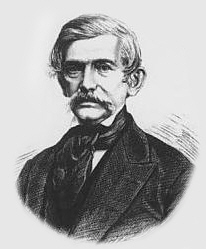
Prof. J. G. Kohl (Wikimedia Images)
Johann Georg Kohl is a familiar name to readers of the Chequamegon History website. Kohl’s Kitchi Gami, originally published in his native Germany, is a standard of Ojibwe cultural history and anthropology. His astute observations and willingness to actually ask questions about unfamiliar cultural practices of the people practicing them, created a work that has stood the test of time much better than those of his contemporaries. The modern reader will find Kohl’s depiction of Ojibwe people as actual intelligent human beings stands in refreshing contrast to most 19th-century works. Kohl also wrote some untranslated articles for German newspapers mentioning his time at La Pointe. One of these, on the subject of the death and conversion of Chief Buffalo, partially appeared on this site back in April.
Johann Kohl was atypical of the steamboat tourists, but he was a steamboat tourist nonetheless:
Prof. Kohl, professor in Dresden University has been rusticating for a few weeks past, in the Lake Superior Country, collecting matter for a forthcoming work, which he intends publishing after his return to Germany. He expressed himself highly pleased with his visit, and remarked that the more familiar he became with the American people and the resources of our country, the better satisfied he was that America had fallen into the hands of those who were perfectly competent to develop her riches and improve the natural sources of wealth and prosperity, which nature has given her.
Grace Greenwood has also been paying her respects to the Lake Superior region, and came down on the North Star with Prof. Kohl.
[Milwaukee] Daily Free Democrat, September 15, 1855

Sara Jane Lippincott, a.k.a. Grace Greenwood (Wikimedia Images).
“Grace Greenwood” was the pseudonym of Sara Jane Lippincott, and a household name in 1855. Though more forgotten to history than some of the other names in this post, the New York native was probably the biggest celebrity to visit La Pointe in the summer of 1855. As an acclaimed poet, she had risen to the highest rungs of American literary society and was a strong advocate of abolitionism and women’s rights. However, she was probably best known as the editor of The Little Pilgrim, a popular children’s magazine. She is mentioned in several accounts of the 1855 payment, but none mention an important detail, considered improper for the time, detail. Sara was very pregnant. Annie Grace Lippincott was born less than two months after her mother left Lake Superior on the North Star.
Although much of her work is digitized and online for the public, the only mention of the trip I’ve found from her pen is this blurb from the front page of the September 1855 edition of The Little Pilgrim:
Our little readers will please forgive whatever delay there may be in the coming of our paper this month, for we are among the wild Indians away up in Lake Superior on the island of La Pointe; and the mails from this far region are so slow and irregular that our articles may not reach Philadelphia till two or three weeks after they should do so (The Little Pilgrim: Google Books).
Dr. Richard F. Morse was one of the chroniclers of the 1855 payment who made sure to mention Lippincott. Morse’s essay, The Chippewas of Lake Superior, published in the third volume of the Collections of the State Historical Society of Wisconsin (1857), is entirely about the payment. It is also the clearest example of the abrupt shift in narrative discussed above. It is full of the suffocating racism of benevolent paternalism. Morse arrogantly portrays himself as an advocate for the Lake Superior bands, but his analysis shows how little he knows of the Ojibwe and their political situation in 1855. Unlike Kohl, he doesn’t seem to care enough to ask and learn.
In fairness, Morse’s account is a valuable document, excerpted in several posts on this website (see People Index). It is also the document that years ago inspired the first steps toward this research by planting the question, “Where did all these fancy people at the 1855 annuity come from?” Chippewas of Lake Superior is too long and too well-known to bother reproducing on this site, but it can be read in it’s entirety on Google Books.

Crockett McElroy (Cyclopedia of Michigan [1890])
After the Civil War, McElroy would go on to find wealth in the Great Lakes shipping industry and be elected as a Republican to several offices in the State of Michigan. In the summer of 1855, however, he was only nineteen years old and looking for work. Crockett’s father, Francis McElroy appears in several later 19th-century censuses as a resident of Bayfield. Apparently, Francis (along with Crockett’s younger brothers) split time between Bayfield and Michigan. Young Crockett did not stay in Bayfield, but his biography in the Cyclopedia of Michigan (1890) suggest his account can be considered that of a semi-local laborer in contrast to the fancier visitors he would have shared a steamboat with:
Crocket McElroy, the subject of this sketch, received his early education at Gait, Ontario; and, when twelve years of age, removed to Detroit. Here he attended one of. the public schools of that city for a short time, and, afterwards, a commercial academy. When thirteen years of age, he began to act as clerk in a wholesale and retail grocery store, remaining three years; he then, for two years, sold small beer. In 1853 he went to Ira, St. Clair County, as clerk, to take charge of a general store; and for the next five years served as clerk and taught school, spending the summer months of 1854-55 in the Lake Superior region (pg. 310).

Lewis Cass (Wikimedia Images)
Another Michigan-based politician, considerably more famous than McElroy, Lewis Cass’ excursion to Lake Superior in 1855 was portrayed as a homecoming of sorts. The 72 year-old Michigan senator had by then occupied several high-level cabinet and congressional positions, and was the Democratic nominee for president in 1848, but those came after he had already entered the American popular imagination. Thirty-five years earlier, as a little known governor of the Michigan Territory (which included Wisconsin and the arrowhead of Minnesota) he led an American expedition to Red Cedar (Cass) Lake near the headwaters of the Mississippi. Thirty-seven years after the Treaty of Paris, and seven years after the death of Tecumseh, it was the first real attempt by the United States to assert dominion over the Lake Superior country. In some ways, 1855 marked the end of that colonization process and brought the Cass Expedition full-circle, the significance of which was not lost on the editors of the Superior Chronicle:
The Predictions of Gen. Cass.: At the opening of the Wabash and Erie Canal, which unites the waters of Lake Erie with those of the Mississippi, the celebration of which took place at Fort Wayne, Indiana, in 1844, Gen. Cass in his address subsequently predicted the union of Lake Michigan from Chicago to the Mississippi; this prediction was fulfilled in 1850. At the same time he said that there were then present those who would witness the settlement of the region at the southwest extremity of Lake Superior, and lay the foundation for a similar union of the waters of that lake with the Mississippi.
On the last trip of the steamer Illinois to this place, Gen. Cass was among the passengers, and witnessed the fulfillment of his prediction in respect to the settlement of this region. May he live to be present at the opening of the channel which will connect this end of the lake with the Mississippi, and witness the consummation of all his prophesies.
Superior Chronicle, August 21, 1855
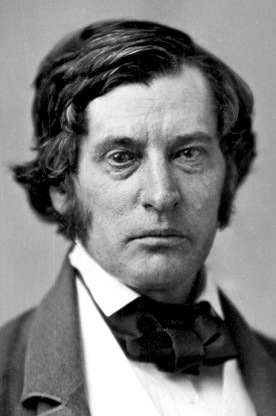
Charles Sumner in 1855 (Wikimedia Images)
A political opponent of western Democrats like Cass, Charles Sumner has gone down in history as the only man to be nearly beaten to death on the floor of the United States senate. Less than a year before Rep. Preston Brooks of South Carolina would attack him with a cane, sending the country hurtling ever-faster toward civil war, the Massachusetts senator visited La Pointe to watch the annuity payment. By 1855, Sumner already had a reputation as a staunch abolitionist, and he even wrote a letter to the Anti-Slavery Reporter while on board the North Star. Aside from a handful of like-minded native New Englanders like Edmund Ely and Leonard Wheeler, Sumner was not in a part of the country where most voters shared his views (the full-blood and most mix-blood Ojibwe were not considered citizens and therefore ineligible to vote). The Lake Superior country was overwhelmingly Democratic, and the Superior Chronicle praised the “popular sovereignty” views of Stephen Douglas in the midst of the violence following the Kansas-Nebraska Act. Sumner, whose caning resulted from his fierce criticism of popular sovereignty, was among those “radical Bostonians” the Chronicle warned its readers about. However, the newspaper was kind and uncritical when the senator appeared in its city:
Senator Sumner at Superior and La Pointe.: In our last number we neglected to announce the visit of Hon. Charles Sumner, Bishop McClosky, and other distinguished persons to Superior. They came by the North Star, and staying but a few hours, had merely time to hastily view our thriving town. They expressed gratfication at its admirable location and rapidity of its growth.
At La Pointe, the heat stopped to allow the passengers an opportunity to see that pretty village and the large number of Indians and others congregating there to the last great payment at this station of the Lake Superior Chippewas. Here Mr. Sumner was the guest of the reverend Catholic missionary, whose successful endeavors to gratify the numerous visitors at La Pointe we have frequently heard commended.
Superior Chronicle, August 14, 1855

Jesse D. Bright (Wikimedia Images)
Staying a little longer at Superior, another U.S. senator, Jesse Bright the President pro tempore Indiana, also appeared on Lake Superior in the summer of 1855. For Bright, however, this was more than a pleasure excursion. He had a chance to make real money in the real estate boom of the 1850s. Superior, at the head of the lake with ship traffic through the Soo, and military road and potential railroad connection to St. Paul, looked poised to be the next great gateway to the west. He invested and apparently lost big when the Great Lakes real-estate boom busted in the Panic of 1857.
Bright would go on to be a Southern sympathizer and a “Copperhead” during the Civil War and was the only northerner to be expelled from the Senate for supporting the Confederacy. In 1855, he was already a controversial figure in the partisan (Democrat, Whig, Know-Nothing) newspapers:
The Buffalo Commercial, upon the authority of the Cincinnati Gazette, states “that Mr. Bright, of Indiana, President of the Senate, pro tem lately made a Sunday speech, an hour and a half long to the people of a town on Lake Superior, and the passengers of the steamer in which he was travelling. He discoursed most eloquently on the virtues and glories of modern Democracy, whose greatest exemplar, he said, was the administration of Franklin Pierce.” The Know Nothing press, of which the Commercial and the Gazette are leading journals, must be rather hard up for material, when recourse to such misrepresentation as the above becomes necessary…
…The speaker did not allude to politics, and did not speak over ten minutes.
And out of this mole hill the Commercial manufactures a mountain of speculation, headed “Jesse D. Bright–The Presidency.” –Sandusky Mirror.
Fort Wayne [IN] Sentinel, September 5, 1855

Promoters & Proprietors of Old Superior: (Clockwise from upper left) U.S. Senator W[illiam]. A. Richardson, Sen. R[obert] M. T. Hunter, Sen. Jesse Bright, Sen. John C. Breckinridge, Benjamin Brunson, Col. John W. Fourney, Henry M. Rice (Flower, Frank A. Report of the City Statistician [1890] Digitized by Google Books)

John C. Breckinridge (Wikimedia Images)
It may also be uncomfortable for the modern northern reader to see how cozy the politicians of our area were with unabashedly pro-slavery Democrats and future Confederates. The biggest name among these Lake Superior investors and 1855 visitors would be John C. Breckinridge. Breckinridge, coming off a stint as U.S. Representative from Kentucky, would go on to be Vice President of the United States under James Buchanan, and Secretary of War for the Confederacy. However, he is most famous for finishing second to Abraham Lincoln in the pivotal presidential election of 1860. Chequamegon Bay residents will probably find another investment of the future vice-president more interesting even than the Superior scheme:
A PLEASANT SUMMER RESIDENCE–The senior editor of the Chicago Press writes from Lake Superior:
Basswood Island, one of the group of Apostle Island has been entered by Mr. Breckinridge of Kentucky, who, I am told, contemplates the erection of a summer residence upon it. We landed at this Island for wood. There is deep water up to its base, and our steamer lay close alongside the rocky shore as though it had been a pier erected for the purpose. There is deep water, I am told, in the channels between most of the Islands of the group furnished an excellent shelter for vessels in tempestuous weather.
[Milwaukee] Weekly Wisconsin, August 15, 1855
Hon J. C. Breckenridge, of Kentucky, has purchased Basswood Island, one of the group of Apostle Islands, in Lake Superior, and intends erecting a summer residence thereon.
Boston Post, August 23, 1855

Captain John Wilson (Frank Leslie’s Illustrated)
The Whig/Free Soil press’ condemnation of Senator Bright for allegedly forgetting the Sabbath and to keep it holy may remind the Chequamegon History reader of the A.B.C.F.M missionaries’ obsession with that particular commandment in their efforts among the Ojibwe people. However, it seems to be one of those features of 19th-Century America that was fussed about more than it was actually observed.
A good example of this comes from Captain John Wilson, who led the steamer Illinois to La Pointe in the summer of 1855. He seems to have been one of those larger-than-life characters, and he is often mentioned in newspaper accounts from the various Great Lakes ships he commanded. Wilson died off the shore of Milwaukee in the sinking of the Lady Elgin, in 1860 along with over 300 passengers. “The Titanic of the Great Lakes,” as the disaster came to be known, is still the greatest loss of life in the history of the lakes (this article gives a good overview). Other than the North Star, the Lady Elgin, which began its runs to the “Upper Lake” in 1855, was probably the most famous steamer on Lake Superior before its sinking. Captain Wilson was afterwards praised for his character heroism during the ordeal, which was blamed on the captain of the schooner that collided with the Elgin.
Captain Wilson’s charisma shines through in the following 1855 Lake Superior account, but I’ll let the reader be the judge of his character:
A MAN FOR ALL OCCASIONS–TWO AMUSEMENTS–Capt Wilson, of the steamer Illinois, on the Upper Lakes is proverbially a man for all occasions and is equally at home in a horse-race or a dance. During a recent excursion of his beautiful boat to Lake Superior, he happened to arrive at a place on Sunday, where several tribes of Indians were soon to receive their annuity from the General Government and where a large number were already present. As soon as the breakfast table was cleared Capt. W. commenced arrangements for religious services in the ladies’ cabin, agreeably to the request of a preacher on board. Chairs and sofa were placed across the hall and the piano, with a large bible on it, represented a pulpit. The large bell of the boat was tolled, and in a short time quite a respectable congregation occupied the seats. As soon as service had fairly begun, the Captain came upon the forward deck where a number of gentlemen were enjoying their pipes and meerschaum, and thus addressed them.
Gentlemen–I come to let you know that meetin‘ is now going on in the aft cabin, where all of you in need of prayers and who wish to hear a good sermon had better retire. I would also state that in accordance with the desire of several passengers , I intend to get up an Indian foot race on shore for a barrel of flour.–You can make your own selection of the two amusements.”
The foot race did come off, and it was fortunate that all the lady passengers were at “meetin,” as one of the Indians who started with nothing on him but a calico shirt came in minus that! He won the flour, however. Good for you! —Spirit of the Times
[Milwaukee] Weekly Wisconsin, October 3, 1855

Joseph R. Williams (Wikimedia Images)
Finally, we get back to Joseph R. Williams. The reason so many stories like Captain Wilson’s made it into the papers that summer was that each of the steamboats seemed to be carrying one or more Midwestern newspaper editors. Williams, the editor of the Toledo Blade, arrived on the Planet in time to witness the La Pointe payment.
Williams would go on to become the first president of what would become Michigan State University and serve in multiple positions in the state government in Michigan. His letters and notes from Lake Superior turned into multiple articles that made their way back up to the Superior Chronicle. In a later post, I may transcribe his record of C. C. Trowbridge’s account of the 1820 Cass Expedition or his description of Superior, but in the name of brevity, I’ll limit this post to his a article on the payment itself:
From La Pointe–Indian Payment, etc.
The following interesting incidents of the recent meeting of Chippeways at La Pointe are taken from the letters of Mr. Williams, editor of the Toledo Blade. Mr. W. was among those who visited Lake Superior on the last excursion of the steamer Planet. In another portion of this week’s paper will be made an account of General Cass’ expedition to the Northwest, from the pen of the same gentleman. We commend it and the following extracts, to the perusal of our readers.
This is one of the old American Fur Company’s stations, a village such as formerly existed at Detroit and Mackinac. Indian huts with bark roofs, the long low warehouse, the half dressed and painted Indians, here and there a Frenchman speaking his mother tongue, his whole air indicating his lineage plainly that he was the descendant of an old voyager, revive the reflection of those days so graphically described by Washington Irving in his Astoria. La Pointe is upon an island, and the harbor gracefully curves around us from the north.
Here we find Colonel Manypenny, Commissioner of Indian Affairs; H. C. Gilbert, Indian Agent for Michigan; Hon. D. A. Noble and Hon. H. L. Stevens, late members of Congress, and other gentlemen, who are awaiting the Indian payment to take place the beginning of next month. Grace Greenwood, who came up on the Illinois a few days since is also excursioning here. The store houses are full of the goods provided for the payment, piles of [?] and provisions, [?], plows, spades, [?] carts, mattresses, bedsteads, blankets, clothing, and [?] a well [?] supply of such articles as are calculated to promote the comfort and civilization of the ill-fated remnant of the former lords of these [many] isles scattered around us, and [the] “forests primeval,” on either shore of this vast inland sea.
Colonel Manypenny deserves great credit for the [ind?bility] with which he has endeavoured to carry into wholesale effect the [?] method adopted of paying the Indians their annuities. Formerly, the unfortunate [race] were paid in specie, and close on the tract of the dispenser of the payment came a swarm of cormorant and heartless Indians traders, who, for whisky and trinkets, and inferior arms and implements, including perhaps blankets and some useful articles of dress, obtained the dollars as soon as they were paid. The Indian dances followed by wild drunken orgies, were a perpetual accompaniment. The Indian, besotted by liquor, parted with almost everything of value, and returned to his home and his hunting grounds, poor and in worse condition than he came. Many years since I attended a payment at Grand Rapids, Michigan, and it was a mournful spectacle. One hardly knew whether to pity the weakness of the victims or abhor the heartlessness of the destroyers most. As late as 1833 the last Indian payment was made on the Maumee in the immediate vicinity of Toledo, on the point below Manhattan. One Lloyd was Indian Agent in 1830. It is said that he purloined from each of the thousand dollar boxes paid the Indians one or two hundred dollars, and that during the night whites went around among the wigwams and cut off the portion of the dresses of the Indians in which the specie was tied up. But the picture before us is relieved of features so disgraceful and disgusting. We saw no drunken Indian on shore. Indeed several of the Caucasian lords of these fading tribes, whom we had on board, might have taken a useful lesson in sobriety from the red men. The traders however are here. They mutter curses upon Colonel Manypenny, because he does not wink at their robberies. It is supposed abundance of whisky is concealed on the island, which will be unwrapped and sold, to besot the Indians, as soon at the valuables are distributed among them.
***
On his arrival here, the Indians proposed a dance. As dances end in Bacchanalian revels, the colonel has set his face against them. Enlivened and excited, however, by our band of music, the Indians could resist no longer. A dozen or more emerged from their cabins, bearing before them their war flag, which was a staff with a fringe of long feathers extending its length, and with bells attached to it, and engaged in a war dance. Their bodies were nearly naked and painted. The dance was a pantomimic description of war scenes. The leading brave struck the flagstaff to stop the dance, and made a speech describing how he had, less than thirty days ago, killed and scalped a Sioux, and he held up in his clenched fist, in triumph before us, the almost yet reeking scalp of his victim. His speech was accompanied by vigorous and appropriate [motion]. It was the imprompt and natural movement of body, [hands], and features from this brief specimen, it was easy enough to imagine that the Indian is often eloquent. This small band of dancers were splendid physical specimens of men, and the dance was real exultation over a late actual achievement. The Chippeways–and they are all Chippeways in these regions–maintain a traditional hostility to the Sioux, and are rarely at peace. It was only a few months since a band of Chippeways pioneered down into the village of St. Paul, and killed a Sioux woman trading in a store. Before the witnesses had recovered from the terror excited, the band had fled as rapidly as they appeared. The Sioux remain on the lands beyond, and the Chippeways this side of the Mississippi.
After the war dance was finished, they danced a beggar’s dance, the purport of which was that they wanted three beeves of Colonel Manypenny. At its close, the brave presented a pipe to Captain Ward, who smoked it in a token of amity. He then forced through the surrounding crowd, and sought Colonel M., who stood at a distance. The Colonel rejected the proffered pipe. His acceptance would have been a sanction of the dances he disapproved, and a concession of the three beeves. The Chief returned to the ring, and made a brief vehement speech, evidently a concentration of indignant scorn. Mrs. A., of Monroe, Michigan, an educated lady of Indian blood, informed me that it was full of defiance, bitterness and mortification.
******
In speaking of the Indians assembled at the payment in my last, I said they were a motley crew, and indeed they are. The braves, engaged in the dances described, were fine specimens of manhood. Their erect forms, developed chests, and symmetry, and general health, as developed in every muscle and feature, illustrate the perfection to which physical man is brought in savage life. But in sad contrast, we see around us pitiable specimens of humanity, crouching, lazy, filthy, besotted beings, who possess all the vices of both the white and the red races, and none of the virtues of either.
Canoes are marshalled along the beach, which have wafted here the tenants of both shores of Superior. Indians have dotted their clusters of wigwams over the vicinity, and seem to have brought along all their aged and infirm as well as infants.
I think one Indian woman here is the oldest human being I ever saw. The deep furrows, the folds of skin which have lost almost the appearance of vitality, so withered and dead as to resemble gutta percha, eye sight lost, hearing gone, no sense left except touch, which was indicated by the avidity with which she seized small pieces of money thrown into her lap, all these proofs convinced me that she was older by ten or fifteen years than any person I ever saw. A son and daughter were near her, apparently kind and affectionate, and proud to protect her, who themselves, were verging upon old age, an illustrative example of these [?ate] savages, to unnatural whites of whom melancholy tales of ingratitude are told. Even her children could not tell her age. All they could say was that she was “the oldest Indian.” Old Buffalo, the Chief, who was ninety years old, looked like a young man compared with her.
Nothing more surprised our party than the great proportion of their children, of all sizes, and I may add, shades of color, for the infusion of French blood from a long series of successive intermarriages, is found in every tribe. Infants fastened on boards, with the children and youth under sixteen, outnumber the adults. The children are all plump, all have rounded and full muscles, all good chests, thus showing that their life, vicious as it is, is more favorable to health and development, in consequence of their freedom of motion, perpetual exercise in the open air. Their gregariousness, flocking together where impulse carried them, as self reliant as their parents who seemed to allow them perfect freedom, even though strangers were so numerous among them, bore a pleasing, and to us instructive contrast to the entire and melancholy helplessness to which white children, especially in cities, are doomed.
Many of the Indians wore a feather or feathers in their cap, indicating the number of Sioux they had scalped. One displayed six feathers. He told us that he had in battle killed two, and taken the scalps of four others, killed by unknown hands of his band. The last victim he had slain but a month ago. One erect youth, of not more than eighteen, with a fresh and handsome face, bore proudly a single feather as a token of his early prowess. One man, in answer to the question, whether he had ever taken a scalp, replied gravely, without a smile, that he had not, and was of no more account that a woman in his tribe. An illustration of their generosity and savage ferocity is afforded by a sub-Chief who had an interview with Mr. Gilbert, the Indian Agent, a few days since. He presented Mr. G. an elegant cloak, made entirely of beaver skins, in expectation of nothing but a large medal in return. He was intent in speech, and animated and pleasant in address. No trace of savage ferocity lingered in his face. Yet it was stated that this man had actually killed and eaten his own child.
Sometimes their earnings if economically used would afford them a comfortable subsistence. The whites, even in their ordinary trade have practiced habitually heartless extortion. When Gov. Cass’s expedition visited this country in 1820, the Indians were in the habit of paying the traders a beaver skin, worth sixteen dollars, for a gill of powder; the same for a shirt; the same for thirty balls; and three beaver skins for a single blanket. I inquired of the Chief, Old Buffalo, what was the highest price he had ever paid for tobacco. He replied that they formerly made purchases of the Hudson Bay Company, tobacco was coiled up in ropes of about three quarters of an inch in diameter, and that he had paid ten beaver skins for a fathom, or at least ten dollars for a foot in length. But when the poor creatures became maniacs or idiots from drink, no possession was so prized that they would not part with it for a single cup of fire water. That the trader availed himself of the imbecility he created, is acknowledged. A large share of the boundless wealth of Mr. Astor was based on acquisitions, through his instruments and agents of this questionable and indeed diabolical character. Well might Burns exclaim in sorrow,
“Man’s inhumanity to man.
Makes countless thousands mourn.”
for whether among men and families of the same blood, or between civilized and savage men, either in peace or in the antagonism of war, the whole world and all time has teemed with sickening, heart-rending examples of its melancholy truth.
By chance we have been able to witness what can not be seen, a few years hence on this side of the “Father of waters,” or indeed on the continent. Here in our magnificent floating palace and the crowd of intellectual and cultivated people on board, surrounded by the refinements of life, we have the highest triumphs of civilization, side by side and in contrast with the rudest manifestations of primitive savage life.–An interesting episode in human affairs, though prompting [a] thousand sad reflections. The doom of entire extirpation of the red man seems surely and gradually to approach. The perpetual warfare among tribes on the extreme frontier annually declinates their most vigorous braves, and consequently it is manifest that among this tribe at least there were far more women than men between the ages of twenty and forty. Many perish from ignorance of the laws of nature, and many from excessive exposure and famine. Rapacity of the whites, and whiskey, finish the merciless work. They fade, they perish, as the grass of the prairies withers before the devouring element. The officers of our government, in their conference, have been accustomed to talk about the protection their Great Father vouchsafes to them, but it is the protection which the vulture affords the sparrow. Whatever may be the intentions of our professedly paternal government, no alternative seems to remain to the Indian, but submission to its crushing and onward march.

Dr. Bethune Duffield (Detroit–biographical sketches by Walter Buell [1886] Google Books)
1855 as a Turning Point: A plea to today’s Chequamegon Bay residents
Williams’ quote about the vulture and the sparrow, excerpted at the very top of this post, is about as succinct a statement about Manifest Destiny as I have ever read. If it weren’t surrounded by so many grossly-ignorant and disgusting statements about Ojibwe people, one might almost take it as sympathy for the Ojibwe cause. Still, the statement holds the key to our understanding of the story of 1855.
In the grand scheme of our region’s history, the payment was less significant than the treaty itself or the tragic removal politics of the early 1850s. Sure, it was the first payment under the final treaty and it featured the visit of Indian Affairs Commissioner George Manypenny to La Pointe, but ultimately it was largely like the rest of the 30-plus annuity payments that took place in our area in the middle of the 19th century. The death of Chief Buffalo in September 1855, and visit of Manypenny who shifted American Indian policy from removal to assimilation, represented both real and symbolic breaks with the past, but ultimately the great shift of 1855 is only one of tone.
Ultimately, however, this shift is only superficial and the reality of life for most Chequamegon residents didn’t change overnight in 1855. The careers of men like Blackbird, Vincent Roy Jr., Julius Austrian, Naaganab, and others show the artificiality of such a line. To them, the tourists on the Planet and North Star were probably just a distraction or curiosity.
Williams was wrong. The Ojibwe did not perish before the “devouring element,” and neither did that earlier history. Somehow, though, since then those of us who live in this area have allowed outsiders to write the story. Maybe it’s comfortable for those, like myself, of European ancestry to focus on shipwrecks and lighthouses rather than colonialism and dispossession, but in doing so we deny ourselves the most significant events of our area’s history and an understanding of its legacy on today.
By all means, learn the names of Grace Greenwood, John Breckinridge, and the Lady Elgin, but understand the fleeting impact of those names on our area’s history. Then, read up on Blackbird, Jechiikwii’o, Leonard Wheeler, Benjamin Armstrong and other players in 1855 politics who really did leave a lasting legacy.
Off my soapbox for now…
The bulk of this article comes from newspaper articles found on two digital archives. Access Newspaper Archive is available to Wisconsin library card holders through badgerlink.net. The Library of Congress Chronicling America site is free at http://chroniclingamerica.loc.gov/. Other sources are linked within the post.
John Johnston Describes La Pointe (1807-09)
June 12, 2014

Susan Johnston, or Ozhaawashkodewekwe, the wife of John Johnston ( Chicago Newberry Library)
The name of John Johnston will be familiar to those who have read the works of his son-in-law Henry Schoolcraft. Johnston (1762-1828) was born into the Anglo-Protestant gentry of Northern Ireland and came to the Chequamegon region in 1791. After marrying Ozhaawashkodewekwe, the daughter of Waabojiig, he cemented his alliance with a prominent Ojibwe trading family. The Johnstons settled at Sault Ste. Marie, and their influence as a fur-trade power couple in the eastern part of Lake Superior parallels that of Michel and Madeline (Ikwezewe) Cadotte around La Pointe. The Johnstons played a key role in resistance to American encroachment in Lake Superior during the War of 1812 but later became centrally-connected to the United States Government efforts to establish a foothold in the northern country. A nice concise biography of John Johnston is available in the Dictionary of Canadian Biography Online.

Roderick MacKenzie (Wikimedia Commons)
In 1806, John Johnston was trading at the Soo for the North West Company when he received a printed request from Roderick MacKenzie, one of the heads of the Company. It called for information on the physical and cultural geography of the different parts of North America where the NWC traded. Johnston took it upon himself to describe the Lake Superior region and prepared An Account of Lake Superior, an 82-page manuscript.
By the end of the 19th century, the manuscript had found its way to Louis Rodrigue Masson (a grandson-in-law of MacKenzie) who edited it and published it in Les Bourgeois de la Compagnie du Nord-Ouest; recits de voyages, lettres et rapports inedits relatifs au Nord-Ouest Canadien (1889-90). The Masson archives were later donated to the McGill University Library in Montreal and are now digitized.
Much of Johnston’s account concerns the Sault and the eastern part of Lake Superior. However, he does include some information from his time at La Pointe, which is reproduced below. While it doesn’t say much about the political topics that I tend to focus on, this document is fascinating for its geographic toponyms and terminology, which is much more reflective of the 18th century than the 19th. Enjoy:
[Ojibwe names for geographic locations are taken from Gidakiiminaan: An Anishinaabe Atlas of the 1836 (Upper Michigan), 1837, and 1842 Treaty Ceded Territories (GLIFWC 2007)].
[pg. 49-56]
…The coast runs almost due West from the Kakewiching or Porcupine Mountain to the Montreal River a distance of fifteen leagues, and the beach is a shelving rock the same as the Mountain all the way with here and there a little gravelly strand. There is but one river, and that a very small one, from the Black to the Montreal River. This last takes its rise from the Wa[s]wagonnis or flambeau Lake about 80 leagues to the Southwest: it is one continued rapid from within ten leagues of its source, and a few hundred yards from the entrance has a fall of fifteen or twenty feet: – there are two high clay banks which distinguish the entrance. The lands tends to the Northwest and is a stiff clay for three leagues rent into deep gutters at short distances; it then gradually declines to a sandy beach for three leagues farther until you arrive at the Mouskissipi or bad river so called from its broad and shallow stream in which it is almost impossible to mount even an Indian Canoe.
It takes its rise from the Ottawa Lake about 125 leagues to the Westward: the Lake has its waters divided very partially as the chief part takes a southerly course and falls into the Mississipi and is called Ottawa River.
The Flambeau Lake has its waters also, the better part taking a southeasterly direction to the Mississipi and is called Ouisconsin or the medicine River. From the bad river the coast runs north four leagues to Chogowiminan or La Pointe; it is a fine strand all the way, behind which are sand hills covered with bent and sand cherry shrubs – and behind the hills there runs all the length a shallow bay which is a branch from the Bay of St Charles.
At Lapointe you are nearly opposite the Anse or Keegwagnan the distance I should conjecture to be twenty leagues in a straight line.
The Bay of St Charles runs southwest from La Pointe and is four leagues in depth and better than a league broad at the entrance. Opposite Lapointe to the Northeast is the Island of Montreal, one of the largest of those called the twelve Apostles. On the main land the Indians had once a Village amounting to 200 huts but since the Traders have multiplied, they no longer assemble at Netoungan or the sand beach, but remain in small bands near their hunting grounds. When you double the Point of Netoungan the coast tends nearly west and is composed of high rocky points of Basaltes with some freestone; there is one place in particular which is an humble imitation of the Portals but not near so high: it is about a leagues from La Pointe and is a projection from the highest mountain from Porcupine bay to fond du lac, a distance of more than 45 leagues. From the Summit of the Mountain; you can count twenty six Islands extending to the North and North east, Islands which has never been visited by the boldest Indians and lying out of the way of the N.W.Co’s Vessel: have a chance of never being better known. Of the Islands opposite La pointe ten or twelve have been visited by the Indians, some of which have a rich soil covered with oak and beech, and round all of them there is deep water and fine fishing for Trout. The Trout in this part of the Lake are equal to those of Mackinac in size & richness – I myself saw one taken off the Northeast end of Montreal Island that weighed fifty two Pounds. How many Islands this Archipelago actually contains will not be easily ascertained; but I take Carribou Island to be the eastern end of the chain. It lies a little to the Southward of the course of the Co’s Vessel, is about three miles round, has a flat shore and good anchorage, and is allowed to be half passage from Camanitiquia to St. Mary’s. However, no other land is seen from it by the Vessel; but that may be owing to the Islands being low and lying too much to the Southward of the course. It is to be observed this account of the number of Islands is upon Indian Authority, which though not the best, is still less apocryphal than that of the Canadians.
There are several rivers between Lapointe and Fond du Lac, the distance is allowed to be thirty leagues, and the breadth of the bay from a high Rocky point within a leagues of Netoungan to the roche deboute, or the upright rock, which is a lofty Mountain right opposite, cannot be less than twenty leagues.
The Metal River is within ten leagues of Fond du Lac; it is only remarkable from the Old Chief of Lapointe’s having once found a large piece of Silver ore in descending it. The Burnt river is three leagues to the Westward of Metal river; it issues from one of the Lakes of the little wild Oats Country about thirty leagues to the Southward, and is only navigable for small Canoes: it has several rapids and the Portages are dangerous, several of them lying along the edge of the river, and over precipices where one false step would be fatal. It empties itself into the Bay of Fond du Lac through a stiff Clay Bank which continues all along the shore until it joins the sands of Fond du Lac river.
About sixteen years ago, Wabogick, or the Whitefisher, the Chief of Lapointe, made his sugar on the skirt of a high mountain four days march from the entrance of the river to the south west, his eldest daughter then a girl of fourteen with a cousin of hers who was two or three years older, rambling one day up the eastern side of the Mountain came to a perpendicular Cliff, which exactly fronted the rising sun, and had an apparently artificial level before it, on which near the base of the Cliff they found a pieces of yellow metal as they called it, about eighteen inches long, a foot broad, and four inches thick; and perfectly Smooth: – it was so heavy that they could raise it with great difficulty: – after amusing themselves with examining it for some time, it occured to the eldest girl that it belonged to the Gitchi Manitou or the great spirit; upon which they abandoned the place with precipitation. As the Chipeways are not Idolators, it occurs to me that some of the Southern tribes must have once Migrated thus far to the North, and that the piece, either of copper or gold, is part of an alter dedicated to the sun. If my conjecture is right, the slab is most probably gold as the Mexicans have more of that Metal than they have of copper. I have often regretted the premature death of the Chief the same autumn that he told me the story, as he had promised to go and bring it to me if he recovered: and circumstances since have precluded my making any attempt to procure it.
The river of Fond du Lac is deep, wide and serpentine, but is only navigable for four or five leagues from its entrance. The Portages are many and different until you arrive at the sand Lake, where the tribe of Chipeways, called the Pillagers, reside. The furs from this country are the best assorted of any on the Continent; and the quantity would much increase were it possible to repress the mutual incursions of the Scieux and Chipeways, who caray on perpetual war. The tract of country lying between the two nations for near 150 leagues in length and from thirty to forty in breadth is only visited by stealth, and if peaceably hunted would be more productive than the richest mine of Peru…
[pg. 75-76]
…The wild Vine is not found at St Mary’s nor any where along the lake except at Lapointe, where however it is scarce. The wild Hop is very abundant at Lapointe but I do not recollect to have seen it elsewhere. There are three distinct species of Whortleberry. The blue or real whortleberry is by far the most wholesome and agreeable: the abundance of this fruit on the borders of Lake Superior is incredible; the Indians dry great quantities of them which they preserve during the winter, and which make an agreeable taste when repeatedly washed in warm water to take away the smoky taste from them. The black Whortleberry grows much higher than the blue; its seeds are very hard and astringent – the largest species the Indians call Hareberry; it grows to 2 or 3 feet high and bears a fruit as large as a cherry, but it is neither so agreeable nor so wholesome as either of the others…
 Poisson Blanc (whitefish), Broche (pike) and Truite Comune (Lake Trout) from the Codex Canadensis.
 (Photo: Wikimedia Images)
 This is all for now on John Johnston, but this document is a potential jumping-off point for several potential research topics. Look for an upcoming post on the meaning of “La Pointe” and “La Pointe Band.”
Sources:
Armour, David A. “JOHNSTON, JOHN,” in Dictionary of Canadian Biography, vol. 6, University of Toronto/Université Laval, 2003–, accessed June 12, 2014, http://www.biographi.ca/en/bio/johnston_john_6E.html.
Gidakiiminaan = Our Earth. Odanah, WI: Great Lakes Indian Fish & Wildlife Commission, 2007. Print.
Masson, L. R. Les Bourgeois De La Compagnie Du Nord-Ouest: Recits De Voyages, Lettres Et Rapports Inedits Relatifs Au Nord-ouest Canadien. Québec: A. Côté, 1889. Print.
Schoolcraft, Henry Rowe. Oneóta, or Characteristics of the Red Race of America. New York: Wiley & Putnam, 1845. Print
Schoolcraft, Henry Rowe. The Indian in His Wigwam, Or, Characteristics of the Red Race of America from Original Notes and Manuscripts. New York: W.H. Graham, 1848. Print.
Warren, William W., and Theresa M. Schenck. History of the Ojibway People. St. Paul: Minnesota Historical Society, 2009. Print.
CAUTION: This translation was made using Google Translate by someone who neither speaks nor reads German. It should not be considered accurate by scholarly standards.
When we last left Moritz Wagner and Carl Scherzer, the two Austrian adventurers who traveled across Lake Superior in 1852, they had avoided certain death when caught in a storm halfway through the crossing between Bad River and La Pointe. In this post, we find them on Madeline Island in the wee hours of the morning, looking for a place to stay.
In the three days they spent in La Pointe, they produced a description of the island as colorful as any I’ve come across. Enjoy:

A View of La Pointe from Report of a Geological Survey of Wisconsin, Iowas, and Minnesota (1852) by David Dale Owen (Digitized by Google Books)
XXI
From Ontonagon to the mouth of the Bois-brule River–Canoe ride to Magdalen Island–Porcupine Mountains–Camping in the open air–A dangerous canoe landing at night–A hospitable Jewish family–The island of La Pointe–The American Fur Company–The voyageurs or courriers de bois–Old Buffalo, the 90 year-old Chippewa chief–A schoolhouse and an examination–The Austrian Franciscan monk–Sunday mass and reflections on the Catholic missions–Continuing the journey by sail–Nous sommes degrades–A canoeman and apostle of temperance–Fond du lac–Sauvons-nous!
It was 1 o’clock in the morning, and the whole settlement was in a deep sleep. We were at a loss as to which door to knock at. Among 200 Indians, only a few white families live there. One of the boatmen gave us a name, with which we found Mr. Austrian (a name meaning Oestreicher) a descendent of the Mosaic.
We knocked confidently by rattling at the window showing the distinguishing hemp of Austrian. We have always had a favorable bias for our Jewish countrymen in this nation. They have brought over so many ancient patriarchal customs of antiquity unadulterated, faithful, and pure in their sympathetic breasts. Here the noble manners of hospitality sweep away the cold breath of selfishness found among the Americans. The Jews are always ready to welcome strangers and donate a warm and magnanimous hand with every occasion.
They opened and the young doorman yelled out to the person in the next room, “Joe, steh auf, Leut from below, sind da!” and because it could not be doubted that we were, “One of our people!” We were then bombarded with all the tastes of the kosher delicatessen: belek, kugel, kindeln, and other tidbits of the Jewish frying pan. We were offered a nice, clean room and did not suspect that the close Yom Kippur (Jewish fast day) should frustrate our feast.
Jewish-immigrant brothers, Julius and Joseph Austrian, were prominent La Pointe residents at this time. This image depicts an incident from Benjamin Armstrong’s Early Life Among the Indians (Engraving by Marr & Richards Co.).
17 September, early, 61° Fahr. The actual owner of the home was absent. However, his younger brother received us with all the warmth of a Bayreuth Jew. He had only been in the country a short time, and spoke English with a Spanish-sounding accent as he called to us in the room, “Waken sie!” He showed us a pair of Indian snowshoes, and asked, “Haben sie snow shoes noch nie geused?*” He finally told of the fish trade in the same mixed gibberish, “Below werden die Fische umgepakt, inspected, und dann weider vereignepakt again.”
(*German immigrants all have a peculiar manner of acquiring the English language. As they hear a strange new name, they mix it together immediately with the words of their native language, without regard for how the expression works in English. A carpenter told us, “Wenn sie ein loghouse bauen wollen un dasselbe inwendig geplastered und von außen geclapboarded wird, so wird es 700 dollars kosten!”
In Pennsylvania, all counties speak an unintelligible German-English slang. It may be that after a few generations, a whole new language is emerging. So, some German immigrants are a tragic example of how one can forget his native language without having to learn another language as a substitute.)
La Pointe is the largest of several islands known under the collective name of Isles des Apotres. It has an unusual history. One of the earliest points on Lake Superior where men of faith planted the cross of salvation in 1665, it wasn’t until a century later that the progress of civilization began to push the two and four-legged forest dwellers further and further west . For several years it was the home depot (post) of the Fur Trading Company. This trading company was founded in 1808 by John Jacob Astor as the American Fur Trading Company, by an act of law of the State of New York. It granted exclusive right of trade and intercourse with the Indians, and in earlier times, provided an immense source of power and wealth. Currently, the business is divided between a Company of the West and the North West, of which the latter united with the Hudson’s Bay Company* and created unrestricted competition and limited the field of activity. The company of the west, currently under the leadership of J. Chouteau and Company, trades with the Indians of the Missouri and Mississippi. Its headquarters are at the upper Mississippi. The company owns 25 stations (trading posts) employing 200 voyageurs who take care of transporting commodities in the business season and bring the furs to the businesses located in St. Paul, Mendota, and Crow Wing in the Minnesota Territory.
(*[This footnote goes on for several pages on the history and structure of the Hudson Bay Company. As it interrupts the narrative, and can be found in other sources, I’ve omitted it.])
The different Indian tribes will kill the animals of the forest in the course of the year and then gather at certain points for the individual bands. Every year there is a caravan of agents (traders) of the fur company who obtain this rich quantity of valuable animal skins from the ignorant Indians for a lowly price of trade items.
This commercial agent will bring birch canoes full of presents across Lake Superior, and usually in 26 to 30 days will bring back the skins of bears, wolves, silver and other foxes, beavers, raccoon, martens, wolverine, otters, muskrats, weasels, and buffalos. Whether their fate is to be a winter covering for the delicate lady’s hands or the lining of a skirt in the princely salons is yet to be determined.
Next door, in perhaps richer numbers and selection, but certainly of far less value, are items of the clever broker. The eyes glare as he flaunts his manufactures. One sees, woolen blankets, cloth fabrics, firearms, ammunition, tin kettles, earrings, finger rings, brass buttons, breastplates, wampum, chopping knives, birch canoes, and mirrors. There is makeup of red, blue, black, and green color, but all the items together carry only one color, that of speculation and dizzying purpose.
Although the furs are barter items, they have an adopted value determined so that the price of the animal fur always corresponds with a certain number of exchanged wares. But the furs are usually valued very low and in contrast, the reverse items are priced very high. The total traffic area with the Indians in the West should produce 1 million dollars annually. Together, the furs are shipped, via New York, to London which is the main market for the American fur trade.
Since we did not visit these remote areas during the season of barter, we could not bear witness to this certainly most-interesting and instructive spectacle, but we cannot omit some words and impart some pressure as we become aware of the facts which throw a sad light on the business of the whites with the Indians. We believe it is the same, and more truthful, to be told as it is by Schoolcraft, the highly-respected American historian, on his travels among the tribes on Lake Superior.
A shotgun worth 10 guineas was sold by an agent to an Indian chief for 120 pounds of beaver skins, or 480 dollars of value. A caravan of 6 bales of barter commodities was traded for $2000. In Athabasca, 96 sacks of beaver skins weighing 8640 pounds brought back four dollars of value when their real worth was $34,560!
Another scholarly researcher, Coldon,writing in 1741 in the area of the Five Nations, describes how the whites in general and the traders in particular, create debts. The vice of drunkenness among the wild Indians occurs so frequently because the greed of the traders allows them to shrink to the lowest means and intentionally put the foolish aborigines in a state of intoxication causing an even more advantageous position for fraud. This evil passion has wreaked more havoc among the Indians than disease or war. It has destroyed more than instruction in Christianity could ever be capable of building up.
Among the Indian tribes there is a strongly-held opinion that if you murder a fur trader, he will retaliate by intentionally bringing back infected goods.* This belief probably arose from the sensitivity caused by the way the whiteskins associate with the redskins. They treat the actual natives of American soil as their subjects and servants, and consider it their privilege to satisfy their greed and passion and claim material and bodily impunity.**
(*[Here the authors insert an extensive footnote about smallpox infections in the Lake Superior region. As it disrupts the narrative and is information that can be found in Schoolcraft’s Narrative of an Expedition Through the Upper Mississippi River to Itasca Lake, I’ve omitted it here.])
(**Two residents of La Pointe told us how a former agent convinced several Indians and mix-bloods to entrust him with their savings due to them from the sale of the Indian country to the government. He used the advantage of his position to gain their trust and did not issue receipts for the borrowed. He had about $800 from everyone but when it was claimed, the fraudulent agent told them they would have to be content with repayment in commodities, flour, sausage, and potatoes, for which the he charged an exorbitant price. We started this narrative not wanting to believe it, but two good Catholics swore on the host. The agent has since left this island, to general contempt, taking the gold pieces of the Indians with him.)

The Voyageurs (1846) by Charles Deas (Wikimedia Images)
After this discussion of the of the rates of the American Fur Company and its agents, we want to add some details about the men whose labor and time exerted such a great influence on the fate and culture of the Indian tribes. We wish to add a few explanatory words about the sad presence on La Pointe of the voyageurs or courriers du bois.
This peculiar class of people, which is like a vein of metal that suddenly disappears within the bedrock and reappears many hundreds of miles away under the same geological conditions, their light reaches the borders of the eastern Canadas. The British people, with their religion and customs, reappeared on the shores of these northern lakes only in 1808 with the Fur Company. For labor they drew on those who could carry their wares across the lakes and communicate with the Indians.
Many young men of adventurous natures left the old wide streets of Montreal and moved into the trackless primeval forests of the West. Young and strong as laborers, they soon started to adopt the lifestyle and language of the aborigines. They married with the Indians and inhabit small settlements scattered throughout those mighty lands which begin at Mackinow Island and come up the upper lake to the region of Minnesota. They almost all speak the Canadian patois along with the language of the Chippewas, the tribe with which they came into kinship. We found only a few, even among the younger generation, who understood English.
Since then, every day the population of the otherwise deserted shore of Lake Superior increases with the discovery of copper mines. The animals driven away by the whirlwind of civilization toward the west, attract the Indians with their sensitive guns, leaving La Pointe, abandoned by the Company for their headquarters at St. Paul in Minnesota. Most voyageurs left the island, having seen their business in ruins and lacking their former importance. Just a few families remain here, making a meager livelihood of hunting, fishing, and the occasional convoy of a few travelers led by business, science, or love of nature who purchase their limited resources.*
(*Except for us, this year they had only two travelers visit this area for scientific interest. The scarcity of this type of tourist seems to be the reason why the price the voyageurs and their companions ask is high. We paid all our leaders one and one half dollars a day and just as many for the days necessary for their return. The voyageurs are democratic and truly similar to those Alpine villagers who charged the emperor two Louis d’or for a breakfast of two eggs.)
A devout Franciscan friar, the family of a Methodist preacher, a school teacher, and a skilled tradesman, together with some old canoe houses, remains of the once large voyageur legion, make up the small numbers of the white population.
The island is 15 miles long, 5.6 miles wide, and has 30 miles in circumference. The main formation is sandstone and red clay. Vegetation proliferates in spruce, pine, cedar, birch, tamarack (Larix americana), etc. The oval horseshoe shape of the island makes it one of the best ports of the entirety of Lake Superior, and this, despite current unemployment, promises hope for a comfortable future.
Add to that, the infinite abundance of fish on their shores. Delicious, but only edible in the spring, are the Siscawit (Salmo siscowet), and the trout (Salmo amethystus). The whitefish (Coregonus albus) are available in uncommon quantities. The most successful fishmonger here sent during the past years, 300 barrels of various species of fish, each 200 pounds, to the markets of Cleveland and Detroit.

The Siscowet, or Fat Trout, is a subspecies of Lake Trout (Drawn by David Starr Jordan, and Barton Warren Evermann, 1911; Digitized by University of Washington)
At the invitation of the zealous schoolteacher*, we toured the schoolhouse. Here we met Old Buffalo (Chi Waishki or Pezhickee), the 90-year-old hereditary chief of the Chippewa band. He was wrapped in a blue striped shirt and a wool blanket. He carried a royal scepter made from a broken wooden base of a bed as a symbol of his authority. He was looking for some glue to repair a garment for a young Indian. We find it necessary here to mention that of the many Chippewas on this island, very few are full-blood Indians. Having crossed frequently with the European race, and through the efforts of Christian missionaries, they have adopted the habits of civilization. They inhabit the abandoned wooden shacks of the Fur Company, and are even given to industrial employment.
(*Mr. Pulcifer, the schoolmaster is a highly-educated teacher. He gives the Sabbath service in the absence of the Methodist preacher. The Methodist mission on the island of La Pointe was founded in 1831).
The Indian chief, worthy by his age, heredity, and his imposing figure, told us he was born near the island and left the area only once to travel in the matters of his tribe to the Great Father* in Washington. His stay was accompanied by many consoling words but little actual success. Since then, he’s been back to the chase. One winter, he brought in 150 fox skins. Despite this wealth of skins in a game-rich area, he is now poor. Here we have the hereditary Chippewa chief, whose generations (totem) are carved in the ancient birch bark,** giving us profuse thanks for just a modest silver coin and a piece of dry cloth. What time can bring to a ruler!
(*”Great Father” is what the Indians call the President and other agents of the United States government.)
(**Almost all Indian tribes have the custom of preserving their lineage from oblivion by carving characters, that correspond to the names of their tribe, on trees, canoes, weapons and everywhere else.
Strangely, we later learned that the majestic Old Buffalo was violently opposed for years to the education and spiritual progress of the Indians. Probably, it’s because he suspected a better instructed generation would no longer obey. Presently, he tacitly accepts the existence of the school and even visits sometimes, where like ourselves, he has the opportunity to see the gains made in this school with its stubborn, fastidious look of an old German high council.)
Although made of simple planks, the school hall is clean and well-ventilated. The youth, consisting of 25 mix-blooded children, are instructed by the Methodist teachers in reading, writing, arithmetic, geography, and natural history. The teacher takes 6 to 8 children to the teacher’s desk and tells them to read their lessons or recite them from memory. Most often, there are questions which are subjected to discussion, questions that relate to the everyday world. This gives the youth the advantage of preparation for practical life.*
(*One of these practical textbooks is similar to Guide to Knowledge, a popular textbook in England: Conversations on common things by a teacher. Boston, Munroe and Francis. 1849.)
For example, a student may read a sentence in which the word “lead” occurs. This immediately gives rise to an instructive conversation about this noble metal, such as where lead is most found, what it is used for, the compounds in which it is used, etc. The youth, by learning this way about various natural phenomena, learns at the same time to know and admire the sources of a country’s wealth. It is an early and delicate way to teach the students the important parts of the geographical, physical, and political history of the country before their own history.

The front page of the Kladderadatsh, a German-languague satirical newspaper published in Berlin. Despite it’s popularity among the masses in Europe, I’m not sure the kids in La Pointe had subscriptions (Wikimedia Images).
At the conclusion of the lesson, the older children, by their own reflection but encouraged by their teacher, asked us several questions about European life: if many European children went to school, and what they learned there…
It was shamefully difficult answering these simple questions asked by the children.
We told these smart young half-Indians that here in Europe the same God lives and moves as in their hemisphere, and that His sun is the only true light that rises for the peoples of the East. We replied further that children learn a tremendous amount but usually know incredibly little, and finally, that the Berliner Kladderadatsch is the most widely read political journal. This last answer left the little indigene who asked the pointed questions bewildered and seemed to discourage the asking of any further information about Europe. At that point, the school meeting was cancelled to our great relief.
Another no-less worthy host received us with warm greetings of the heart. It was the worthy Franciscan monk, Father Scolla, from Rudolphswerth in Carinthia. We went to deliver the pleasure of a recommendation to our pious countryman. We knocked at the meager gate of the little boarded house that grew out from the rear part of the church. We are now almost ashamed of the worldly manner in which we approached, given the distinguished reception we received at the hands of such a pious priest.

Alternate translation of this passage found in History of the diocese of Sault Ste, Marie and Marquette (1906) by Antoine Ivan Rezek pg.367 (Digitized by Google Books)
Our traveling way of life often finds us witness to scenes of parting, separation, and reunion, but we have never seen any man become so pale, taken, and overcome with intimate emotion as this Franciscan when he learned through language and handshake that we were compatriots from the Imperial City.
We can reasonably account for this surprise in that almost 20 years had passed since the lone missionary had seen a countryman “of the Imperial City” and had been addressed in his language, and felt the warm shake of an Austrian hand. His whole religious intercourse with the faithful, be it preaching the gospel at the pulpit, forgiving sin in confessional, or donating food for the journey to the deathbed, happens in a foreign tongue, in French and Indian language.
What troubled us most about his monastic life was the poverty and helplessness with which this devout priest remains continually fights to preach the Way. The greater part of his church consists of converted Indians and mix-bloods, who all live in such poor circumstances that there is no thought of support for this priest. The maintenance costs for the church and its priests must therefore be restricted to those means which fall from the general missionary funds of the Catholic Church.
The quota, that makes its way to the Church of Our Lady of La Pointe, is extremely low, and sometimes isn’t received for so many years that one gets the impression that the bishop in Milwaukee has forgotten the lonely forests of Madeline Island, its Lady, and Father Scolla. The pious Franciscan, whose destitution has denied him any assistance in church and house, must therefore do as priests and lay ministers do. He decorates and adorns the high altar, paints the images of saints, rings the bell, and worries about the upkeep of his small house at the same time.

cntd. translation in Rezek pg.368
On the Sunday before we left, we attended the service. The small church was quite filled with Indian women, mix-bloods, and Canadian voyageurs. The women wore long cloth of dark green, blue, and black covering them from hips to head and wrapping them in one whole soft shape. The men were all dressed in European clothing. During the vicarious sacrifice of the mass, four half-Indians in white surplices sang the Latin text shouldering such edification that you would have sworn they understood every word.
The sermon was held in French, the most common language of the island, and it was appropriate for the comprehension of the people in the audience. In the afternoon, the tireless Franciscan monk preaches in Indian for his neophytes, which prevents age from weakening his intellectual ability to learn a foreign tongue.
Much more edification of the faithful would have prevailed if not for the wailing cries of the infants disturbed by the devotion, who were brought along on the backs of the countless “squaws.” But these grumpy little citizens of the world seemed to understand even less than the adult choir of the plot of the Latin score.

Fr. Otto Skolla was from Novo Mesto (Rudolfswert) in today’s Slovenia not far from the Slovenian homeland of his fellow Lake Superior priest, Bishop Frederick Baraga (Rezek pg. 360)
When we speak of the conviction in his calling and pure enthusiasm of the priest’s benediction, of the faithful community dropping to their knees, covering their faces, and reverently making the sign of the cross, we could not help but feel sadness that such a worthy and pious work could not flourish better due to a lack of temporal goods.
What ability to spread blessings the Catholic missionary would have if equipped with the necessary material resources: a teacher for the youth, a doctor for the sick, a support for the poor. How can the Church win over humanity when right now the distressing spectacle is such that the Catholic youth, lacking the funds for a teacher, get no education, and the narrow-minded principles of their spiritual board keep them from getting permission to attend the Methodist school?
If you watch the incredible speed of the other religious sects, such as the Methodists, Baptists, and Presbyterians, and the extraordinary sums taken in and put out for education and missionary purposes– they have missionaries in all ports in the Union–and how without consideration of their religion, they receive immigrants, comfort the sick, the suffering, and take care of the children, while the Herald of Catholic teaching to foreign lands moves slowly. It may not surprise you, especially here in the United States that foreign religious sects are gaining converts while the ranks of the Catholic Church, despite the massive influx of Catholic populations from Ireland and Germany, not only aren’t increasing, but are actually seeing a decrease in numbers.

The Catholic church on Madeline Island as drawn by Skolla (Rezek pg.361).
CAUTION: This translation was made using Google Translate by someone who neither speaks nor reads German. It should not be considered accurate by scholarly standards.
Sandy Lake Letters: Sherman Hall to the Wheelers
July 11, 2013

“Chippewa Indians Fishing on the Ice” (Digitized by New York Public Library from Heroes and hunters of the West : comprising sketches and adventures of Boone, Kenton, Brady, Logan, Whetzel, Fleehart, Hughes, Johnston, etc. Philadelphia : H. C. Peck & Theo. Bliss, 1859.)
On June 9th, I transcribed and posted two letters related to the Sandy Lake Tragedy (the attempted removal of the Lake Superior Ojibwe in the fall of 1850, which claimed as many as 400 innocent lives). The letters, digitized by the Wisconsin Historical Society, were from the Warren Family Papers. One was from missionary Leonard Wheeler to William Warren before the tragedy, and another was from Indian Agent John Watrous to Warren during a second removal attempt a year later.
That post sought to assess how much responsibility Warren and Watrous bear for the 400 deaths. It also touched on the role of the Protestant A.B.C.F.M. missionaries in the region. This post continues those thoughts. This time, we’re looking at two more letters and evaluating one of the missionaries himself.
Both of these letters are from the Wheeler Family Papers, held by the Wisconsin Historical Society at the Ashland Area Research Center. I went directly to the original documents for these, and while I’ve seen them referenced in published works, I believe this is the first time these particular letters have been transcribed or posted online.
The first is from Sherman Hall, the founder of the La Pointe Mission, to his colleague Leonard Wheeler, who operated the satellite mission at Odanah. Hall traveled to Sandy Lake for the annuity payments and sent this letter to Wheeler, who was visiting family back in Massachusetts, after returning to La Pointe.
Lapointe. Dec. 28th 1850
Brother Wheeler:
I wrote you while at Sandy Lake and promised to write again when I should reach Lapointe. That promise I now redeem. I started from Sandy Lake on the fourth inst. and reached home on the 16th having been absent from home just eight weeks. I was never more heartily glad to leave a place than I was Sandy Lake, nor more glad to reach home after an absence. Of course winter here has justly begun. The snow was some ten inches deep on the Savannah Portage. On reaching the East Savannah River we found the ice good and clear of snow and water. This continued to be the case most of the way to the Grand Portage at Fond du Lac. From Fond du Lac to Lapointe the traveling most of the way was hard, and it was not till the seventh day from F. du L. that I reached home. Besides bad traveling I had to carry a pack which I found, when I got home weighed 60 pounds. With this however I found it not difficult to keep up with most of my traveling companions who were much heavier loaded than I. This is my first experience of carrying a heavy pack on a long journey and I am fully satisfied with the experiment. I had no alternative however, bet either to throw away my blankets and clothes, or carry them. Every body was loaded with a heavy pack, and I could employ no one. I however got through well—did not get lame as many others did, nor do I feel any furious[?] by ill effects of my journey since my arrival.
I found the mission family well on my arrival. They had felt somewhat lonesome while so many were absent from this place. Things in the community here are generally in a quiet state at present. I apprehend that there will be considerable pinching for provisions before spring. It has been a very windy and stormy fall. The people have taken but little fish. Many nets have been lost. The traders have but a small quantity of provisions, and if they had the people have but little to buy with. The bay opposite to this island is now principally covered with ice so that the Indians are on the ice some to spear fish. The ice has once broken up since it first closed, and a heavy wind would break it up again, as it is yet very thin, and the weather mild. If the lake is frozen the Inds will probably get considerable fish; but if it should be open they must suffer.
Our Indian meetings are pretty well attended, and I feel that there is ground for encouragement. Simon I think is exerting a good influence. His Catholic friends have tried to draw him back to their church; but seems stable. His oldest brother, who has recently lost his wife, has expressed a wish to hear the word of God. I hope he will yet become a sincere listener.
Our English exercises are attended by a smaller number than formerly since many have left this place. I think however for our own good, as well as on account of others, we ought to keep them up. Mr. Van Tassel has returned to remain here till spring. I have heard nothing from Bad River for some time past. I had formed a design to go there this week, but have been prevented by the state of the ice. I intend going as soon as the ice gets a little stronger. I suppose there are very few Indians there. More are about the Lake.
I heard that Mr. Leihy has lost both his horses which will be a serious inconvenience to him in this mill enterprise I presume.
Mr. Pulsifer has received one letter from you, and by our last mail he heard through his correspondent at Lowell that you had arrived at that place.
I suppose you find some changes have taken place in the wide world during the times you have been shut up in the wilderness. Do you find calls enough to keep you busy? I have been expecting a letter from you. I want to hear what you have to say about the things you see, and how you like visiting, etc.
I have just had a letter from Mr. Ely, who says, “We are [snugly by quarters?] in St. Paul. My home is full of music—am employed as choir leader in Mr. [Mill’s?] (Prs.) church—sing two evenings a week at Stillwater, and the rest of my time is well filled with the private scholars & tuning Pianos, of which there are 7 or 8 at St. Paul.” Perhaps Br. Ely will find this a more lucrative business than cutting and hauling pine logs. I am glad he has found employment.
Our children all attend school except Harriet. Marydoes very well. Please give my regards to your friends at Lowell. I am writing to Mr. Treat by this opportunity. [Wish?] kind regards to Mrs. W. I remain
yours
S. Hall.
 The Old Mission Church, La Pointe, Madeline Island. (Wisconsin Historical Society Image ID: 24827)
 Harriet Wheeler, pictured about forty years after receiving this letter. (Wisconsin Historical Society: Image ID 36771)
“…your note to Harriet” Harriet Hall was Sherman’s oldest daughter, about 19 years old at this time.
 Many Ojibwe leaders, including Hole in the Day, blamed the rotten pork and moldy flour distributed at Sandy Lake for the disease that broke out. The speech in St. Paul is covered on pages 101-109 of Theresa Schenck’s William W. Warren: The Life, Letters, and Times of an Ojibwe Leader, my favorite book about this time period. (Photo from Whitney’s Gallery of St. Paul: Wisconsin Historical Society Image ID 27525)
 Mary Warren (1835-1925), was a teenager at the time of the Sandy Lake Tragedy. She is pictured here over seventy years later. Mary, the sister of William Warren, had been living with the Wheelers but stayed with Hall during their trip east. (Photo found on University of Connecticut Radio website, scanned from Frances Densmore photos in the Smithsonian Bureau of Ethnology)
Lapointe, Feb. 24th 1851.
Mrs. Wheeler,
By our last mail I wrote to Mr Wheeler, and by this I will address a few lines to you. From your note to Harriet I suppose you are happy among your friends. I am glad you are so, and hope you will not only spend your winter pleasantly, but that you will find the present season of relaxation from the severe duties of your station here, the occasion of reconnecting[?] your health and spirits.
I do not feel that the time has yet come when the churches ought to close their efforts to save these Indians. I do not think they are entirely beyond the reach of hope. The prospect however looks dark. But I think the greatest cause of discouragement arises from their character, and not from their present political condition. Generally they do not want to improve their condition. They are satisfied with their ignorance and degradation. All they think of is to supply for their present wants without their own exertions, while they wish to live in idleness and sin. This is the cause of their keeping so much aloof from the influence of the missions. Their minds are dreadfully dark respecting the things of the future world. They seem to have no ideas of happiness superior to that derives from the gratification of the lowest animal appetites and passions. This is the reason why the truths of the gospel so little effect on them. These things present to my mind much stronger grounds of discouragement than their present political difficulties, though those at present are not inconsiderable.
But as stupid as is the conscience, and as dark as is the understanding and the heart, and as much as they are given up to [?]ality and sin, I believe there is a Power that can quicken them into life. My only hope is that He who has made them, and has power to save them, will come and add his blessing to the preaching of his own gospel, and make it to them the power and wisdom of God. Thousands of others as dead in trespasses and sins, have been saved. Why may not they be saved? Come back home and let us try still to do something for them. Tell Christians to remember them and pray for them, that the word of God among them may have free course and be glorified.
It is a time of great scarcity of food among the Indians. There is some one in our houses almost every hour of the day begging for food. Very few get more than a meal a day; many not half of one. I have been told by several individuals, that they have tried three or four days in succession to catch fish, and have been obliged to return to their starving families each night with nothing for them. I am frequently importuned to spare a little provisions till I am obliged to go away out of sight to get rid of their pleading. I have spared the last potatoes I dare let go. Corn we have none. We have but a small quantity of flour over what will be required to sustain our families till we can expect to obtain a new supply. For a long time I have not known fish so scarce as the present winter. That is almost the only dependence of this people. For a month to come there will be many hungry ones. Many of the French and half-breeds are but little better off than the Indians. All we can do is to divide a little morsel with the hungry ones who come to beg. We have not much to give to those who importune for something to carry to their families. But as long as they continue to waste their summers in idleness they must starve in the winter.
The young Hole-in-the-day has been down to St Paul and there made a public speech in which he attributes the sickness at the payment last fall to the bad provisions which were dealt out to the Indians, and imparts much blame to the officers of the government for the way in which they [were with?]. In time they had some flour dealt out to them which was much damaged. But I think there were other causes for the sickness which prevailed besides the bad provisions. I think however that in some [aspects?] the Indians were wronged. Treaty stipulations were not carried out. H is very confident that many of the Indians are not satisfied with the manner in which they have been dealt with, and recent events have not served to strengthen their attachment to the Government.
We had our communion yesterday. I think there is a [?]ably good state of feeling among the native church members at this time. Simon has been frequently sick this winter. But his trials appear to bring nearer to God. He appears to be growing in the knowledge of God and in piety.
You will probably recollect Mo-ko-kun-ens-ish, an Indian with a bunch[?] between his shoulders, married into the family of the Little-current. He is, by profession, a Catholic. About a week ago, he made me a visit, and said his priest had offended him, and he wished to join us. A short time since he lost a child, and when the priest came to bury it, he said he “scolded him” because he had not cleaned away the snow from the gate of the burying yard, and made a better path for him to come to the grave. He told a long story. I suspected his object was to get some provisions of me. I told him we should be happy to see him at our meetings, and told him where and when they would be held. He said he should attend only sometimes he might be obliged to fish to get something to eat, and be occasionally away. I said a few words to him on religious subjects, and he left without asking for anything. The next day he came with a small piece of cloth and asked me to give him provisions for it. I told I had not provisions to trade. He then enquired about meeting. I told him we were to hold one that evening in the school-house. He said he should attend. The evening came, the meeting was held—but he was not there. Nor have we seen him at any other meeting. Such are the methods the heathens & Catholics take to deceive us. We could make many converts with flour and pork, especially at this time.
Yours Truly,
S. Hall
[Written in margins]
All send love though I have not room to write it.
Mary goes to school and is doing very well.

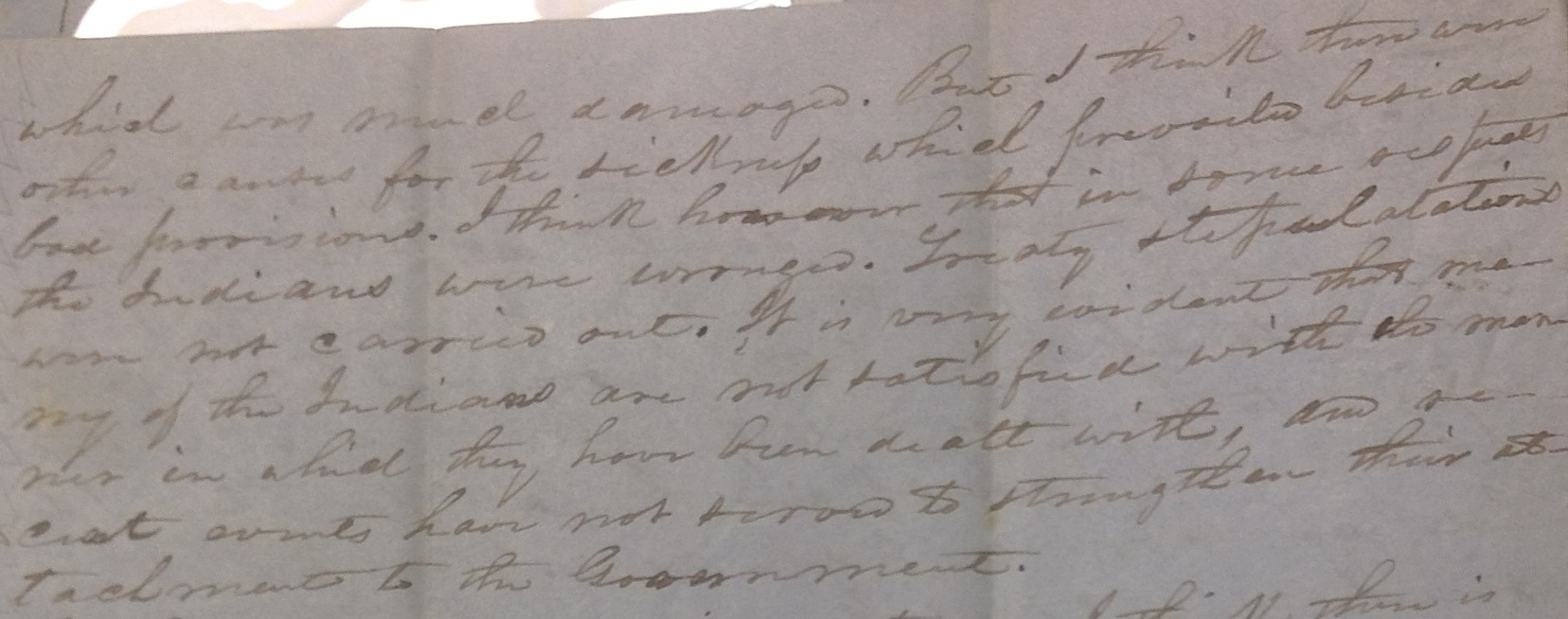
These are the originals of the paragraph about Hole in the Day’s speech in St. Paul. I couldn’t quite decipher all of it. Let me know what you see (Wheeler Family Papers, Personal Correspondence 1851, Wisconsin Historical Society Ashland Area Research Center).
In the June 9th post, we tried to determine how much William Warren and John S. Watrous were at fault for the deaths resulting from the 1850 Sandy Lake removal attempt. In this post, we will do the same for Sherman Hall.
Before we begin, it’s worth reviewing the facts. By 1850, Hall had lived at La Pointe for twenty years. He knew the people who lived here, and he knew the promises the Ojibwe were given at the Treaty of 1842. He was certainly aware of the Ojibwe position on the removal.
Rev. Hall did not order the removal. Compared with the government and Fur Company officials, he was fairly powerless within the Lake Superior region. However, he had a power of a different sort. As the primary voice of the ABCFM in Ojibwe country, he had powerful friends in the eastern states. Many Americans perceived the missionaries as the only neutral voice in the area. Hall admits in the December 28th letter that the Ojibwe were wronged. He could have advocated for their cause in the summer of 1850 as the illegal removal was unfolding. Instead, he largely went along with government efforts.
To his credit, in other letters Hall did blame the government for the failure of the Sandy Lake payment. The best book I’ve encountered about this time period is William W. Warren: The Life, Letters, and Times of an Ojibwe Leader by Theresa Schenck (Nebraska UP, 2007). On page 94, Dr. Schenck quotes a letter from Hall to ABCFM Secretary S.B. Treat. It is dated December 30, and is probably the letter referred to in the letter to Leonard Wheeler above. Hall is honest about Ojibwe feelings on the removal and seems to empathize somewhat. On page 155, Schenck details how the La Pointe mission did eventually turn against government removal efforts later in 1851.
So, it probably seems that I am defending Sherman Hall. Why? Truthfully, it’s because I want to have some balance in this post because, quite frankly, these two letters are some of the most disgusting, horrifying documents I’ve ever read. I felt especially sick typing up the February 24th letter to Harriet Wheeler. For a man who claimed to be “saving” the Ojibwe to be so heartless in the midst of so much suffering is appalling.
Was the mission running low on food? Sure, but doesn’t true Christian charity demand sharing to the last?
Should Hall’s language be judged by the standards of the racist times he lived in? Absolutely, but to say the things he says about human beings, his neighbors of twenty years, is inexcusable in any time period.
Is it possible he was traumatized by his experience at Sandy Lake, and this was a way of dealing with his personal guilt? This is possible. He does seem to be speaking to himself in the letter as much as he is to the Wheelers.
There is a danger in judging too much from just two letters, but I think Hall needs to be held to the same standard as Warren and Watrous were in the June 9th post. He could have spoken out against the removal to begin with. He didn’t. He was an eyewitness to Sandy Lake. He knew what the Ojibwe had been promised, and he saw the consequences of the government breaking those promises. His letters to the Wheelers in Boston could have been used to help right those wrongs by uniting the missions behind the Ojibwe cause. Instead, he chose to blame the people who had been wronged to the point of 400 deaths. For these reasons, I think when we list the villains of Sandy Lake, the Reverend Sherman Hall needs to be among them.
 Chequamegon History