Blackbird’s Speech at the 1855 Payment
January 20, 2014
“We sold our land for our graves–that we might have a home, where the bones of our fathers are buried. We were not willing to sell the ashes of our relatives which are so dear to us. This was the reason why we sold our lands. It was not to pay debts over and over again, but to benefit the living, those of us who yet remain upon earth, our young men & women & children.”
~Makade-binesi (Blackbird)

Scene at Indian Payment–Odanah, Wis. This image is from a later payment than the one described below (Whitney & Zimmerman c.1870)
Most of us have heard Chief Joseph’s “Fight No More Forever” speech and Chief Seattle’s largely-fictional plea for the environment, but very few will know that a outstanding example of Native American oratory took place right here in the Chequamegon Region in the summer of 1855.
It was exactly eleven months after the Lake Superior Ojibwe bands gave up the Arrowhead region of Minnesota, in their final treaty with the United States, in exchange for permanent reservations. Already, the American government was trying to back out of a key provision of the agreement. It concerned a clause in Article Four of the 1854 Treaty of La Pointe that reads:
The United States will also pay the further sum of ninety thousand dollars, as the chiefs in open council may direct, to enable them to meet their present just engagements.
The inclusion of clauses to pay off trade debts was nothing new in Ojibwe treaties. In 1837, $70,000 went to pay off debts, and in 1842 another $75,000 went to the traders. Personal debts would often be paid out of annuity funds by the government directly to the creditors and certain Ojibwe families would never see their money. However, from the beginning there were accusations that these debts were inflated or illegitimate, and that it was the traders rather than the Ojibwe themselves, who profited from the sale of the lands. Therefore, in 1854, when $90,000 in claims were inserted in the treaty, the chiefs demanded that they be the ones to address the claims of the creditors.
However, less than a year later, at the first post-1854 payment, the government was pressured to back off of the language in the treaty. George Manypenny, the Commissioner of Indian Affairs, came to La Pointe to oversee the payment where he was asked by Indian Agent Henry Gilbert to let the Agency oversee the disbursement of the $90,000. Most white inhabitants, and many of the white tourists in town to view the spectacle that was the 1855 payment, supported the agent’s plan, as did most of the mix-blooded Ojibwe (most of whom were employed in the trading business in one way or another) and a substantial minority of the full-bloods.
However, the clear majority of the Lake Superior chiefs insisted they keep the right to handle their own debt claims. As we saw in this post, the Odanah-based missionary Leonard Wheeler also felt the Government needed to honor its treaties to the letter. This larger faction of Ojibwe rallied around one chief. He was from the La Pointe Band and was entrusted to speak for Ojibwe with one voice. From this description, you might assume it was Chief Buffalo. However, Buffalo, in the final days of his life, found himself in the minority on this issue. The speaker for the majority was the Bad River chief Blackbird, and he may have delivered one of the greatest speeches ever given in the Chequamegon Bay region.
Unfortunately, the Ojibwe version of the speech has not survived, and it’s English version, originally translated by Paul Bealieu, exists in pieces recorded by multiple observers. None of these accounts captures all the nuances of the speech, so it is necessary to read all of them and then analyze the different passages to see its true brilliance.
The first reference to Blackbird’s speech I remember seeing appeared in the eyewitness account of Dr. Richard F. Morse of Detroit who visited La Pointe that summer specifically to see the payment. His article, The Chippewas of Lake Superior appeared in the third volume of the Collections of the State Historical Society of Wisconsin. As you’ll read, it doesn’t speak very highly of Blackbird or the speech, celebrating instead the oratory of Naaganab, the Fond du Lac chief who was part of the minority faction and something of a celebrity among the visiting whites in 1855:


From Morse’s clear bias against Ojibwe culture, I thought there may have been more to this story, but my suspicions weren’t confirmed until I transcribed another account of the payment for Chequamegon History. An Indian Payment written by another eyewitness, Crocket McElroy, paints a different picture of Blackbird and quotes part of his speech:

Paul H. Beaulieu translated the speeches at the 1855 annuity payment (Minnesota Historical Society Collections).
In August 1855 about three thousand Chippewa Indians gathered at the village of Lapointe, on Lapointe Island, Lake Superior, for an Indian Payment and also to hold a council with the commissioner of Indian affairs, who at that time was George W. Monypenny of Ohio. The Indians selected for their orator a chief named Blackbird, and the choice was a good one, as Blackbird held his own well in a long discussion with the commissioner. Blackbird was not one of the haughty style of Indians, but modest in his bearing, with a good command of language and a clear head. In his speeches he showed much ingenuity and ably pleaded the cause of his people. He spoke in Chippewa stopping frequently to give the interpreter time to translate what he said into English. In beginning his address he spoke substantially as follows:
“My great white father, we are pleased to meet you and have a talk with you We are friends and we want to remain friends. We expect to do what you want us to do, and we hope that you will deal kindly with us. We wish to remind you that we are the source from which you have derived all your riches. Our furs, our timber, our lands, everything that we have goes to you; even the gold out of which that chain was forged (pointing to a heavy watch chain that the commissioner carried) came from us, and now we hope that you will not use that chain to bind us.”
These conflicting accounts of the largely-unremembered Bad River chief’s speech made me curious, and after I found the Blackbird-Wheeler-Manypenny letters written after the payment, I knew I needed to learn more about the speech. Luckily, digging further into the Wheeler Papers uncovered the following. To my knowledge, this is the first time it has been transcribed or published in any form.
[Italics, line breaks, and quotation marks added by transcriber to clearly differentiate when Wheeler is quoting a speaker. Blackbird’s words are in blue.]
O-da-nah Jan 18, 1856.
L. H. Wheeler to Richard M. Smith
Dear Sir,
The following is the substance of my notes taken at the Indian council at La Pointe a copy of which you requested. Council held in front of Mr. Austrian’s store house Aug 30. 1855.
Short speech first from Kenistino of Lac du Flambeau.
My father, I have a little to say to you & to the Indians. There is no difference between myself and the other chiefs in regard to the subject upon which we wish to speak. Our chiefs and young men & old men & even the women & children are all of the same mind. Blackbird our chief will speak for us & express our sentiments.
The Commissioner, Col Manypenny replied as follows.
My children I suppose you have come to reply to what I said to you day before yesterday. Is this what you have come for?
“Ah;” or yes, was the reply.
I am happy to see you, but would suggest whether you had not better come tomorrow. It is now late in the day and is unpleasant & you have a great deal to say and will not have time to finish, but if you will come tomorrow we shall have time to hear all you have to say. Don’t you think this will be the best way?
“Ah!” yes was the response.
Think well about what you want to say and come prepared to speak freely & fully about all you wish to say. I would like not only to hear the chiefs and old men speak, but the young men talk, and even the women, if they wish to come, let them come and listen too. I want the women to understand all that is said and done. I understand that some of the Indians were drunk last night with the fire-water. I hope we shall hear nothing more of it. If any body gives you liquor let me know it and I will deal with him as he deserves. I hope we shall have a good time tomorrow and be able to explain all about your affairs.
Aug 31. Commissioner opened the council by saying that he wanted all to keep order.
Let the whites and others sit down on the ground and we will have a pleasant time. If you have anything to say I hope you will speak to the point.
Black Bird. To the Indians.
My brother chiefs, head men & young men & children. I have listened well to all the men & women & others who have spoken in our councils and shall now tell it to my father. I shall have but one mouth to speak your will.
Nose [noose (no-say) “my father”]. My father. We present you our salutations in your heart. We salute you in the name of our great father the President, whose representative you are. We want the Great Spirit now to bless us. The Day is clear, and we hope our thoughts will be clear too. My intention is to tell you what the owner of life has done for us. He has provided for the life of us all. When the Lord made us he provided for us here upon earth he invested it (ie, he made provision for our wants) in the running streams, in the woods & lakes which abound with fish and in the wild animals. We regard you as if men like a spirit, perhaps it is because of your education, because you are so much wiser than we, but if we can trace our tradition right the Great Spirit has not made the white man to cheat us. There is a difference of opinion as it regards different colors among, as to which shall have the preeminence, but the Great Spirit made us to be happy before you discovered us.
I will now tell you about how it was with us before our payments, and before we sold any land. Our furs that we took we sold to our traders. We were then paid 4 martin skins for a dollar. 4 bears skins also & 4 beaver skins for $1.00 too. Can you wonder that we are poor? I say this to show you what our condition was before we had any payments. I[t] was by our treaties that we learned the use of money. I see you White men that sit here how you are dressed. I see your watch chains & seals and your rich clothing. Now I will tell you how it is with our traders. When they first came among us they were very poor, but by & by they became very fat & rich, and wear rich clothing and had their watches & gold chains such as I see you wear. But they got their things out of us. They were made rich at our expense. My father, you told us to bring our women here too. Here they are, and now behold them in their poverty, and pity their condition (at this juncture in the speech several old women stood dressed in their worn out blankets and tattered garments as if designed to appeal to his humanity[)].
My father, I am now coming to the point. We are here to protect our own interests. Our land which we got from our forefathers is ours & we must get what we can for it. Our traders step between us & our father to controll our interests, and we have been imposed upon. Mr. Gilbert was the one I shook hands with last year when he was sent here to treat for our lands. He was the one who was sent to uphold us in our poverty. We are thankful to see you both here to attend to our interests, and that we are permitted to express to you our wants. Last year you came here to treat for our lands we are now speaking about. We sold them because we were poor. We thank our father for bringing clothing to pay for them. We sold our land for our graves–that we might have a home, where the bones of our fathers are buried. We were not willing to sell the ashes of our relatives which are so dear to us. This was the reason why we sold our lands. It was not to pay debts over and over again, but to benefit the living, those of us who yet remain upon earth, our young men & women & children.
You said you wanted to see them. They have been sent for and are now here. Behold them in their poverty & see how poor they look.
They are poor because so much of our money is taken to pay old debts. We want the 90,000 dollars to be paid as we direct. We know that it is just and right that it should be so. We want to have the money paid in our own hands, and we will see that our just debts are paid. We want the 90,000 to feed our poor women, and after paying our just debts we want the remainder to buy what we want. This is the will of all present. The chiefs, & young men & old men & the women & children.
Let what I have now said, my father, enter your head & heart; and let it enter the head of our great father the President, that it may be as we have now said. We own no more land. We must hereafter provide for ourselves. We want to profit by all the provisions of the treaty we have now made. We want the whole annuity paid to us as stipulated in the treaty. I am now done. After you have spoken, perhaps there are others who would like to speak.
This is the first time my father that I have appeared dressed in a coat & pants & I must confess I feel a little awkward.
The Commissioner replied as follows
We have all heard & noted down what you have said. If any others wish to speak they had better speak first and I will reply to all at once.
The Grand Portage Indian [Adikoons] then spoke as follows.
My father, I have a few words to say, and I wish to speak what I think. We have long coveted the privilege of seeing our Great Father. Why not now embrace the opportunity to speak freely while he is here? This man will speak my mind. He is old enough to speak and is a man endowed with good sense. He will speak our minds without reserve.
When we look around us, we think of our God who is the maker of us all. You have come here with the laws of that God we have talked about, and you profess to be a Christian and acknowledge the authority of God. The word of God ought to be obeyed not only by the Indians, but by all. When we see you, we think you must respect that word of God, who gives life to all. Your advice is like the law of God. Those who listen to his law are like God–firm as a rock, (not fickle and vacilating). When the word of the Great Spirit ends. When there is an end to life, we are all pleased with the advice you have given us, and intend to act in accord with it. If we are one here, and keep the word of the Great Spirit we shall be one here after. In what Blackbird said he expressed the mind of a majority of the chiefs now present. We wish the stipulations of the treaty to be carried out to the very letter.
I wish to say our word about our reserves. Will these reserves made for each of our bands, be our homes forever?
When we took credits of our trader last winter, and took no furs to pay him, and wish to get hold of this 90,000 dollars, that we may pay him off of that. This is all we came here for. We want the money in our own hands & we will pay our own traders. We do not think it is right to pay what we do not owe. I always know how I stand my acct. and we can pay our own debts. From what I have now said I do not want you to think that we want the money to cheat our creditors, but to do justice to them I owe. I have my trader & know how much I owe him, & if the money is paid into the hands of the Indians we can pay our own debts.
Naganub.
We have 90,000 dollars set apart to pay our traders, for my part I think it is just that the money should go for this object. We all know that the traders help us. We could not well do without them.
Buffalo.
We who live here are ready to pay our just debts. Some have used expressions as though these debts were not just. I have lived here many years and been very poor. There are some here who have been pleased to assist me in my poverty. They have had pity on me. Those we justly owe I don’t think ought to be defrauded. The trader feeds our women & children. We cannot live one winter without him. This is all I have to say.
 [Wheeler does not identify a new speaker here, but marks a a star (right). Kohl (below) attributes the line about the “came out of the water” to Blackbird, but the line about the copper diggings contradicts Blackbird’s earlier statement, in Kohl, about not knowing their value. This, and Wheeler’s marking of Blackbird as the one who spoke after this speech would indicate this is Buffalo still talking].
Our rights ought to be protected. When commissioners have come here to treat for our lands, we have always listened well to their words. Not because we did not know ourselves the worth of our lands. We have noticed the ancient copper diggings, and know their worth. We have never refused to listen to the words of our Great Father. He it is true has had the power but we have made him rich. The traders have always wanted pay for what we do not remember to have bought. At Crow [W]ing River when our lands were ceded there, then there was a large sum demanded to pay old debts. We have always paid our traders we have acted fair on our part. At St. Peters also there was a large amount of old debts to be paid–many of them came from places unknown–for what I know they came out of the water. We think many of them came out of the same bag, and are many of them paid over & over again at every treaty.
Black Bird.
I get up no[w] to finish what you have put into my heart. The night would be heavy on my breast should I retain any of the words of them with whom I have councilled & for whom I speak. I speak no[w] of farmers, carpenters, & other employees of Govt. Where is the money gone to for them? We have not had these laborers for several years that has been appropriated. Where is the money that has been set apart to pay them? You will not probably see your Red Children again in after years to council with them. So we protest by the present opportunity to speak to you of our wants & grievances. We regard you as standing in the place of our great father at Washington, and your judgement must be correct. This is all I have to say about our arrearages, we have not two tongues.
As exciting as it was to have the full speech, as I transcribed some of the passages, some of them seemed very familiar. Sure enough, on page 53 of Johann Georg Kohl’s Kitchi-Gami: Life Among the Lake Superior Ojibway, there is another whole version. Kitchi-Gami is one of the standards of Ojibwe cultural history, and I use it for reference fairly often, but it had been so long since I had read the book cover to cover that I forgot that Kohl had been another witness that August day in 1855:


When one considers that Paul Beaulieu, the man giving the official English translation was probably speaking in his third language, after Ojibwe and Metis-French, and that Kohl was a native German speaker who understood English but may have been relying on his own mix-blood translator, it is remarkable how similar these two accounts are. This makes the parts where they differ all the more fascinating. Undoubtedly there are key parts of this speech that we could only understand if we had the original Ojibwe version and a full understanding of the complicated artistry of Ojibwe rhetoric with all its symbolism and metaphor. Even so, there are enough outstanding passages here for me to call it a great speech.
“My father…great Father…We regard you as if men like a spirit, perhaps it is because of your education, because you are so much wiser than we…”
The ritual language of kinship and humility in traditional Ojibwe rhetoric can be off-putting to those who haven’t read many Ojibwe speeches, and can be mistaken as by-product of American arrogance and paternalism toward Native people. However, the language of “My Father” predates the Americans, going all the way back to New France, and does not necessarily indicate any sort weakness or submission on the part of the speaker. Richard White, Michael Witgen, and Howard Paap, much smarter men than I, have dedicated pages to what Paap calls “fur-trade theater,” so I won’t spend too much time on it other than to say that 1855 was indeed a low point in Ojibwe power, but Blackbird is only acting the ritual part of the submissive child here in a long-running play. He is not grovelling.
On the contrary, I think Blackbird is playing Manypenny here a little bit. George Manypenny’s rise to the head of Indian Affairs coincided with the end of American removal policy and the ushering in of the reservation era. In the short term, this was to the political advantage of the Lake Superior Ojibwe. In Manypenny the Ojibwe got a “Father” who would allow them to stay in their homelands, but they also got a zealous believer in the superiority of white culture who wanted to exterminate Indian cultures as quickly as possible.
In a future post about the 1855 treaty negotiations with the Minnesota Ojibwe we will see how Commissioner Manypenny viewed the Ojibwe, including masterful politicians like Flat Mouth and Hole in the Day, as having the intelligence of children. Blackbird shows himself a a savvy politician here by playing into these prejudices as a way to get the Commissioner off his guard. Other parts of the speech lead me to doubt that Blackbird sincerely believed that the Americans were “so much wiser” than he was.
My intention is to tell you what the owner of life has done for us. He has provided for the life of us all. When the Lord made us he provided for us here upon earth he invested it (ie, he made provision for our wants) in the running streams, in the woods & lakes which abound with fish and in the wild animals… There is a Great Spirit from whom all good things here on earth come. He has given them to mankind–to the white as to the red man; for He sees no distinction of colour…but if we can trace our tradition right the Great Spirit has not made the white man to cheat us. There is a difference of opinion as it regards different colors among, as to which shall have the preeminence, but the Great Spirit made us to be happy before you discovered us…
This part varies slightly between Wheeler and Kohl, but in both it is very eloquent and similar in style to many Ojibwe speeches of the time. One item that piqued my interest was the line about the “difference of opinion.” Many Americans at the time understood the expansion of the United States and the dispossession of Native peoples in religious terms. It was Manifest Destiny. The Ojibwe also sought answers for their hardships in prophecy. On pages 117 and 118 of History of the Ojibwe People, William Warren relates the following:

Warren, writing in the late 1840s and early 1850s, contrasts this tradition with the popularity of the prophecies of Tenskwatawa, brother of Tecumseh, in Ojibwe country forty years earlier. Tenskwatawa taught that Indians would inherit North America and drive whites from the continent. Blackbird seems to be suggesting that in 1855 this question of prophecy was not settled among the Lake Superior Ojibwe. Presumably there would have been fertile ground for a charismatic millenarian Native spiritual leader along the lines of Neolin, Tenskwatawa, or Wovoka to gain adherents among the Lake Superior Ojibwe at that time.

Johann Georg Kohl recorded Blackbird’s speech in his well known account of Lake Superior in the Summer of 1855, Kitchi-Gami: Life Among the Lake Superior Ojibway.
Our furs, our timber, our lands, everything that we have goes to you; even the gold out of which that chain was forged…Now I will tell you how it is with our traders. When they first came among us they were very poor, but by & by they became very fat & rich, and wear rich clothing and had their watches & gold chains such as I see you wear. But they got their things out of us. They were made rich at our expense…and now we hope that you will not use that chain to bind us…
The gold chain appears in each of McElroy, Wheeler, and Kohl’s accounts. It acts as a symbol on multiple levels. To Blackbird, the gold represents the immense wealth produced during the fur trade on the backs of Indian trappers. By 1855, with the fur trade on its last legs, some of the traders are very wealthy while the Ojibwe are much poorer than they were when the trade started. The gold also stands in for the value of the ceded territory itself, specifically the lakeshore lands (ceded in 1842), which thirteen years later were producing immense riches from that other shiny metal, copper. Finally, in McElroy’s account, we also see the chain acting as the familiar symbol of bondage.
…We sold our land for our graves–that we might have a home, where the bones of our fathers are buried…Our debts we will pay. But our land we will keep. As we have already given away so much, we will, at least, keep that land you have left us, and which is reserved for us. Answer us, if thou canst, this question. Assure us, if thou canst, that this piece of land reserved for us, will really always be left to us…
This passage of Blackbird’s speech, and a similar statement by the “Grand Portage Indian” (identified by Morse as Adikoons or Little Caribou), indicate that perhaps, the actual disbursement of the $90,000 was a secondary to the need to hold Agent Gilbert and the Government to their word. It was very important to the Ojibwe that words of the Treaty of 1854 be rock-solid, not for a need to pay off debts or to get annuity payments, but because the Government absolutely needed to keep its promise to grant reservations around the ancestral villages. The memory of the Sandy Lake Tragedy, less than five years earlier, cast a long shadow over this decade. Paap argues in Red Cliff, Wisconsin that the singular goal of the treaty, from the Ojibwe perspective, was to end the removal talk forever, a goal that had seemingly been accomplished. To hear the Government trying to weasel out of a provision of the 1854 Treaty must have been very frightening to those who heard Robert Stuart’s promises in 1842. This time, the chiefs had to make sure a promise of a permanent homeland for their people wouldn’t turn out to be another lie.
This is the first time my father that I have appeared dressed in a coat & pants & I must confess I feel a little awkward.
You can argue that a great speech can’t end with the line, “I must confess I feel a little awkward.” However, I will argue that this might be the best line of all. It is another example of the political brilliance of Blackbird. The Bad River chief knew who his allies were, knew who his opponents were, and knew how to take advantage of the Commissioner’s prejudices. Clothing played a role in all of this.
George Manypenny despised Indian cultures. In fact, the whole council had almost derailed a few days before the speeches when the Commissioner refused to smoke the pipe presented to him by the chiefs in open ceremony. He remedied this insult somewhat by smoking it later while indoors, but he let it be known that he had no use for Ojibwe songs, dances, rituals or clothing. This put Blackbird, an unapologetic traditionalist and practitioner of the midewiwin at a distinct disadvantage, when compared with chiefs like Naaganab who were known to wear European clothes and profess to be Christians.
Although he had the majority of the people behind him, Blackbird had very little negotiating power. He had to persuade Manypenny that he was in the right. He had no chance unless he could appear to the Commissioner that he was trying to become “civilized” and was therefore worthy enough to be listened to. However, by wearing European clothes, he ran the risk of alienating the majority of the people in the crowd who preferred traditional ways and dress. Furthermore, the chiefs most likely to oppose him, Naaganab and Jayjigwyong (Little Buffalo) had been dressing like whites (I would argue also largely for political reasons) for years and were much more likely to come across as “civilized” in the Commissioner’s eyes.
How did the chief solve these dilemmas? In the same way he turned Manypenny’s request to see the Ojibwe women to his advantage, he used the clothing to demonstrate that he had gone out of his way to work with the Commissioner’s wishes, while still solidifying the backing of the traditional Ojibwe majority and putting his opponents on the defensive all with one well-timed joke. Although this joke seems to have gone over Wheeler’s head, and likely Manypenny’s as well, Kohl’s mention of the “applauding laughter of the entire assembly,” shows it reached its target audience. So, contrary to first appearances, the crack about the awkward pants is anything but an awkward ending to this speech.
Conclusion
In the 1840s and early 1850s, Blackbird rarely appears in the historical record. Here and there he is mentioned as a second chief to Chief Buffalo or as leading the village at Bad River. Many mentions of him by English-speaking authors are negative. He is referred to as a rascal, scoundrel, or worse, and I’ve yet to find any mention of his father or other family members as being prominent chiefs.
However, in the late 1850s and early 1860s, he was clearly the most important speaker for not just the La Pointe Band, but for the other Lake Superior Bands as well. This was a mystery to me. I temporarily hypothesized his rise was due to the fact that Chequamegon was seen as the center of the nation and that when Buffalo died, Blackbird succeeded to the position by default. However, this view doesn’t really fit what I understood as Ojibwe leadership.
This speech puts that interpretation to rest. Blackbird earned his position by merit and by the will of the people.
He did not, however, win on the question of the $90,000. A Chequamegon History reader recently sent me a document showing it was eventually paid to the creditors directly by the Agent. However, if my argument is correct, the more important issue was that the Government keep its word that the reservations would belong to the Ojibwe forever. The land question wasn’t settled overnight, and it required many leaders over the last 160 years to hold the United States to its word. But today, Blackbird’s descendants still live beside the swamps of Mashkiziibii at least partially because of the determination of their great ogimaa.
Sources:
Kohl, J. G. Kitchi-Gami: Wanderings round Lake Superior. London: Chapman and Hall, 1860. Print.
McClurken, James M., and Charles E. Cleland. Fish in the Lakes, Wild Rice, and Game in Abundance: Testimony on Behalf of Mille Lacs Ojibwe Hunting and Fishing Rights / James M. McClurken, Compiler ; with Charles E. Cleland … [et Al.]. East Lansing, MI: Michigan State UP, 2000. Print.
McElroy, Crocket. “An Indian Payment.” Americana v.5. American Historical Company, American Historical Society, National Americana Society Publishing Society of New York, 1910 (Digitized by Google Books) pages 298-302.
Morse, Richard F. “The Chippewas of Lake Superior.” Collections of the State Historical Society of Wisconsin. Ed. Lyman C. Draper. Vol. 3. Madison: State Historical Society of Wisconsin, 1857. 338-69. Print.
Paap, Howard D. Red Cliff, Wisconsin: A History of an Ojibwe Community. St. Cloud, MN: North Star, 2013. Print.
Satz, Ronald N. Chippewa Treaty Rights: The Reserved Rights of Wisconsin’s Chippewa Indians in Historical Perspective. Madison, WI: Wisconsin Academy of Sciences, Arts and Letters, 1991. Print.
Schenck, Theresa M. The Voice of the Crane Echoes Afar: The Sociopolitical Organization of the Lake Superior Ojibwa, 1640-1855. New York: Garland Pub.,1997. Print.
—————— William W. Warren: The Life, Letters, and times of an Ojibwe Leader. Lincoln: University of Nebraska, 2007. Print.
Warren, William W., and Theresa M. Schenck. History of the Ojibway People. St. Paul: Minnesota Historical Society, 2009. Print.
White, Richard. The Middle Ground: Indians, Empires, and Republics in the Great Lakes Region, 1650-1815. Cambridge: Cambridge UP, 1991. Print.
Witgen, Michael J. An Infinity of Nations: How the Native New World Shaped Early North America. Philadelphia: University of Pennsylvania, 2012. Print.
CAUTION: This translation was made using Google Translate by someone who neither speaks nor reads German. It should not be considered accurate by scholarly standards.
When we last left Moritz Wagner and Carl Scherzer, the two Austrian adventurers who traveled across Lake Superior in 1852, they had avoided certain death when caught in a storm halfway through the crossing between Bad River and La Pointe. In this post, we find them on Madeline Island in the wee hours of the morning, looking for a place to stay.
In the three days they spent in La Pointe, they produced a description of the island as colorful as any I’ve come across. Enjoy:

A View of La Pointe from Report of a Geological Survey of Wisconsin, Iowas, and Minnesota (1852) by David Dale Owen (Digitized by Google Books)
XXI
From Ontonagon to the mouth of the Bois-brule River–Canoe ride to Magdalen Island–Porcupine Mountains–Camping in the open air–A dangerous canoe landing at night–A hospitable Jewish family–The island of La Pointe–The American Fur Company–The voyageurs or courriers de bois–Old Buffalo, the 90 year-old Chippewa chief–A schoolhouse and an examination–The Austrian Franciscan monk–Sunday mass and reflections on the Catholic missions–Continuing the journey by sail–Nous sommes degrades–A canoeman and apostle of temperance–Fond du lac–Sauvons-nous!
It was 1 o’clock in the morning, and the whole settlement was in a deep sleep. We were at a loss as to which door to knock at. Among 200 Indians, only a few white families live there. One of the boatmen gave us a name, with which we found Mr. Austrian (a name meaning Oestreicher) a descendent of the Mosaic.
We knocked confidently by rattling at the window showing the distinguishing hemp of Austrian. We have always had a favorable bias for our Jewish countrymen in this nation. They have brought over so many ancient patriarchal customs of antiquity unadulterated, faithful, and pure in their sympathetic breasts. Here the noble manners of hospitality sweep away the cold breath of selfishness found among the Americans. The Jews are always ready to welcome strangers and donate a warm and magnanimous hand with every occasion.
They opened and the young doorman yelled out to the person in the next room, “Joe, steh auf, Leut from below, sind da!” and because it could not be doubted that we were, “One of our people!” We were then bombarded with all the tastes of the kosher delicatessen: belek, kugel, kindeln, and other tidbits of the Jewish frying pan. We were offered a nice, clean room and did not suspect that the close Yom Kippur (Jewish fast day) should frustrate our feast.
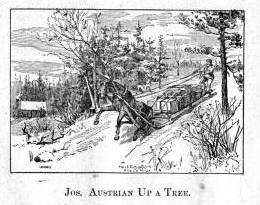
Jewish-immigrant brothers, Julius and Joseph Austrian, were prominent La Pointe residents at this time. This image depicts an incident from Benjamin Armstrong’s Early Life Among the Indians (Engraving by Marr & Richards Co.).
17 September, early, 61° Fahr. The actual owner of the home was absent. However, his younger brother received us with all the warmth of a Bayreuth Jew. He had only been in the country a short time, and spoke English with a Spanish-sounding accent as he called to us in the room, “Waken sie!” He showed us a pair of Indian snowshoes, and asked, “Haben sie snow shoes noch nie geused?*” He finally told of the fish trade in the same mixed gibberish, “Below werden die Fische umgepakt, inspected, und dann weider vereignepakt again.”
(*German immigrants all have a peculiar manner of acquiring the English language. As they hear a strange new name, they mix it together immediately with the words of their native language, without regard for how the expression works in English. A carpenter told us, “Wenn sie ein loghouse bauen wollen un dasselbe inwendig geplastered und von außen geclapboarded wird, so wird es 700 dollars kosten!”
In Pennsylvania, all counties speak an unintelligible German-English slang. It may be that after a few generations, a whole new language is emerging. So, some German immigrants are a tragic example of how one can forget his native language without having to learn another language as a substitute.)
La Pointe is the largest of several islands known under the collective name of Isles des Apotres. It has an unusual history. One of the earliest points on Lake Superior where men of faith planted the cross of salvation in 1665, it wasn’t until a century later that the progress of civilization began to push the two and four-legged forest dwellers further and further west . For several years it was the home depot (post) of the Fur Trading Company. This trading company was founded in 1808 by John Jacob Astor as the American Fur Trading Company, by an act of law of the State of New York. It granted exclusive right of trade and intercourse with the Indians, and in earlier times, provided an immense source of power and wealth. Currently, the business is divided between a Company of the West and the North West, of which the latter united with the Hudson’s Bay Company* and created unrestricted competition and limited the field of activity. The company of the west, currently under the leadership of J. Chouteau and Company, trades with the Indians of the Missouri and Mississippi. Its headquarters are at the upper Mississippi. The company owns 25 stations (trading posts) employing 200 voyageurs who take care of transporting commodities in the business season and bring the furs to the businesses located in St. Paul, Mendota, and Crow Wing in the Minnesota Territory.
(*[This footnote goes on for several pages on the history and structure of the Hudson Bay Company. As it interrupts the narrative, and can be found in other sources, I’ve omitted it.])
The different Indian tribes will kill the animals of the forest in the course of the year and then gather at certain points for the individual bands. Every year there is a caravan of agents (traders) of the fur company who obtain this rich quantity of valuable animal skins from the ignorant Indians for a lowly price of trade items.
This commercial agent will bring birch canoes full of presents across Lake Superior, and usually in 26 to 30 days will bring back the skins of bears, wolves, silver and other foxes, beavers, raccoon, martens, wolverine, otters, muskrats, weasels, and buffalos. Whether their fate is to be a winter covering for the delicate lady’s hands or the lining of a skirt in the princely salons is yet to be determined.
Next door, in perhaps richer numbers and selection, but certainly of far less value, are items of the clever broker. The eyes glare as he flaunts his manufactures. One sees, woolen blankets, cloth fabrics, firearms, ammunition, tin kettles, earrings, finger rings, brass buttons, breastplates, wampum, chopping knives, birch canoes, and mirrors. There is makeup of red, blue, black, and green color, but all the items together carry only one color, that of speculation and dizzying purpose.
Although the furs are barter items, they have an adopted value determined so that the price of the animal fur always corresponds with a certain number of exchanged wares. But the furs are usually valued very low and in contrast, the reverse items are priced very high. The total traffic area with the Indians in the West should produce 1 million dollars annually. Together, the furs are shipped, via New York, to London which is the main market for the American fur trade.
Since we did not visit these remote areas during the season of barter, we could not bear witness to this certainly most-interesting and instructive spectacle, but we cannot omit some words and impart some pressure as we become aware of the facts which throw a sad light on the business of the whites with the Indians. We believe it is the same, and more truthful, to be told as it is by Schoolcraft, the highly-respected American historian, on his travels among the tribes on Lake Superior.
A shotgun worth 10 guineas was sold by an agent to an Indian chief for 120 pounds of beaver skins, or 480 dollars of value. A caravan of 6 bales of barter commodities was traded for $2000. In Athabasca, 96 sacks of beaver skins weighing 8640 pounds brought back four dollars of value when their real worth was $34,560!
Another scholarly researcher, Coldon,writing in 1741 in the area of the Five Nations, describes how the whites in general and the traders in particular, create debts. The vice of drunkenness among the wild Indians occurs so frequently because the greed of the traders allows them to shrink to the lowest means and intentionally put the foolish aborigines in a state of intoxication causing an even more advantageous position for fraud. This evil passion has wreaked more havoc among the Indians than disease or war. It has destroyed more than instruction in Christianity could ever be capable of building up.
Among the Indian tribes there is a strongly-held opinion that if you murder a fur trader, he will retaliate by intentionally bringing back infected goods.* This belief probably arose from the sensitivity caused by the way the whiteskins associate with the redskins. They treat the actual natives of American soil as their subjects and servants, and consider it their privilege to satisfy their greed and passion and claim material and bodily impunity.**
(*[Here the authors insert an extensive footnote about smallpox infections in the Lake Superior region. As it disrupts the narrative and is information that can be found in Schoolcraft’s Narrative of an Expedition Through the Upper Mississippi River to Itasca Lake, I’ve omitted it here.])
(**Two residents of La Pointe told us how a former agent convinced several Indians and mix-bloods to entrust him with their savings due to them from the sale of the Indian country to the government. He used the advantage of his position to gain their trust and did not issue receipts for the borrowed. He had about $800 from everyone but when it was claimed, the fraudulent agent told them they would have to be content with repayment in commodities, flour, sausage, and potatoes, for which the he charged an exorbitant price. We started this narrative not wanting to believe it, but two good Catholics swore on the host. The agent has since left this island, to general contempt, taking the gold pieces of the Indians with him.)

The Voyageurs (1846) by Charles Deas (Wikimedia Images)
After this discussion of the of the rates of the American Fur Company and its agents, we want to add some details about the men whose labor and time exerted such a great influence on the fate and culture of the Indian tribes. We wish to add a few explanatory words about the sad presence on La Pointe of the voyageurs or courriers du bois.
This peculiar class of people, which is like a vein of metal that suddenly disappears within the bedrock and reappears many hundreds of miles away under the same geological conditions, their light reaches the borders of the eastern Canadas. The British people, with their religion and customs, reappeared on the shores of these northern lakes only in 1808 with the Fur Company. For labor they drew on those who could carry their wares across the lakes and communicate with the Indians.
Many young men of adventurous natures left the old wide streets of Montreal and moved into the trackless primeval forests of the West. Young and strong as laborers, they soon started to adopt the lifestyle and language of the aborigines. They married with the Indians and inhabit small settlements scattered throughout those mighty lands which begin at Mackinow Island and come up the upper lake to the region of Minnesota. They almost all speak the Canadian patois along with the language of the Chippewas, the tribe with which they came into kinship. We found only a few, even among the younger generation, who understood English.
Since then, every day the population of the otherwise deserted shore of Lake Superior increases with the discovery of copper mines. The animals driven away by the whirlwind of civilization toward the west, attract the Indians with their sensitive guns, leaving La Pointe, abandoned by the Company for their headquarters at St. Paul in Minnesota. Most voyageurs left the island, having seen their business in ruins and lacking their former importance. Just a few families remain here, making a meager livelihood of hunting, fishing, and the occasional convoy of a few travelers led by business, science, or love of nature who purchase their limited resources.*
(*Except for us, this year they had only two travelers visit this area for scientific interest. The scarcity of this type of tourist seems to be the reason why the price the voyageurs and their companions ask is high. We paid all our leaders one and one half dollars a day and just as many for the days necessary for their return. The voyageurs are democratic and truly similar to those Alpine villagers who charged the emperor two Louis d’or for a breakfast of two eggs.)
A devout Franciscan friar, the family of a Methodist preacher, a school teacher, and a skilled tradesman, together with some old canoe houses, remains of the once large voyageur legion, make up the small numbers of the white population.
The island is 15 miles long, 5.6 miles wide, and has 30 miles in circumference. The main formation is sandstone and red clay. Vegetation proliferates in spruce, pine, cedar, birch, tamarack (Larix americana), etc. The oval horseshoe shape of the island makes it one of the best ports of the entirety of Lake Superior, and this, despite current unemployment, promises hope for a comfortable future.
Add to that, the infinite abundance of fish on their shores. Delicious, but only edible in the spring, are the Siscawit (Salmo siscowet), and the trout (Salmo amethystus). The whitefish (Coregonus albus) are available in uncommon quantities. The most successful fishmonger here sent during the past years, 300 barrels of various species of fish, each 200 pounds, to the markets of Cleveland and Detroit.

The Siscowet, or Fat Trout, is a subspecies of Lake Trout (Drawn by David Starr Jordan, and Barton Warren Evermann, 1911; Digitized by University of Washington)
At the invitation of the zealous schoolteacher*, we toured the schoolhouse. Here we met Old Buffalo (Chi Waishki or Pezhickee), the 90-year-old hereditary chief of the Chippewa band. He was wrapped in a blue striped shirt and a wool blanket. He carried a royal scepter made from a broken wooden base of a bed as a symbol of his authority. He was looking for some glue to repair a garment for a young Indian. We find it necessary here to mention that of the many Chippewas on this island, very few are full-blood Indians. Having crossed frequently with the European race, and through the efforts of Christian missionaries, they have adopted the habits of civilization. They inhabit the abandoned wooden shacks of the Fur Company, and are even given to industrial employment.
(*Mr. Pulcifer, the schoolmaster is a highly-educated teacher. He gives the Sabbath service in the absence of the Methodist preacher. The Methodist mission on the island of La Pointe was founded in 1831).
The Indian chief, worthy by his age, heredity, and his imposing figure, told us he was born near the island and left the area only once to travel in the matters of his tribe to the Great Father* in Washington. His stay was accompanied by many consoling words but little actual success. Since then, he’s been back to the chase. One winter, he brought in 150 fox skins. Despite this wealth of skins in a game-rich area, he is now poor. Here we have the hereditary Chippewa chief, whose generations (totem) are carved in the ancient birch bark,** giving us profuse thanks for just a modest silver coin and a piece of dry cloth. What time can bring to a ruler!
(*”Great Father” is what the Indians call the President and other agents of the United States government.)
(**Almost all Indian tribes have the custom of preserving their lineage from oblivion by carving characters, that correspond to the names of their tribe, on trees, canoes, weapons and everywhere else.
Strangely, we later learned that the majestic Old Buffalo was violently opposed for years to the education and spiritual progress of the Indians. Probably, it’s because he suspected a better instructed generation would no longer obey. Presently, he tacitly accepts the existence of the school and even visits sometimes, where like ourselves, he has the opportunity to see the gains made in this school with its stubborn, fastidious look of an old German high council.)
Although made of simple planks, the school hall is clean and well-ventilated. The youth, consisting of 25 mix-blooded children, are instructed by the Methodist teachers in reading, writing, arithmetic, geography, and natural history. The teacher takes 6 to 8 children to the teacher’s desk and tells them to read their lessons or recite them from memory. Most often, there are questions which are subjected to discussion, questions that relate to the everyday world. This gives the youth the advantage of preparation for practical life.*
(*One of these practical textbooks is similar to Guide to Knowledge, a popular textbook in England: Conversations on common things by a teacher. Boston, Munroe and Francis. 1849.)
For example, a student may read a sentence in which the word “lead” occurs. This immediately gives rise to an instructive conversation about this noble metal, such as where lead is most found, what it is used for, the compounds in which it is used, etc. The youth, by learning this way about various natural phenomena, learns at the same time to know and admire the sources of a country’s wealth. It is an early and delicate way to teach the students the important parts of the geographical, physical, and political history of the country before their own history.

The front page of the Kladderadatsh, a German-languague satirical newspaper published in Berlin. Despite it’s popularity among the masses in Europe, I’m not sure the kids in La Pointe had subscriptions (Wikimedia Images).
At the conclusion of the lesson, the older children, by their own reflection but encouraged by their teacher, asked us several questions about European life: if many European children went to school, and what they learned there…
It was shamefully difficult answering these simple questions asked by the children.
We told these smart young half-Indians that here in Europe the same God lives and moves as in their hemisphere, and that His sun is the only true light that rises for the peoples of the East. We replied further that children learn a tremendous amount but usually know incredibly little, and finally, that the Berliner Kladderadatsch is the most widely read political journal. This last answer left the little indigene who asked the pointed questions bewildered and seemed to discourage the asking of any further information about Europe. At that point, the school meeting was cancelled to our great relief.
Another no-less worthy host received us with warm greetings of the heart. It was the worthy Franciscan monk, Father Scolla, from Rudolphswerth in Carinthia. We went to deliver the pleasure of a recommendation to our pious countryman. We knocked at the meager gate of the little boarded house that grew out from the rear part of the church. We are now almost ashamed of the worldly manner in which we approached, given the distinguished reception we received at the hands of such a pious priest.

Alternate translation of this passage found in History of the diocese of Sault Ste, Marie and Marquette (1906) by Antoine Ivan Rezek pg.367 (Digitized by Google Books)
Our traveling way of life often finds us witness to scenes of parting, separation, and reunion, but we have never seen any man become so pale, taken, and overcome with intimate emotion as this Franciscan when he learned through language and handshake that we were compatriots from the Imperial City.
We can reasonably account for this surprise in that almost 20 years had passed since the lone missionary had seen a countryman “of the Imperial City” and had been addressed in his language, and felt the warm shake of an Austrian hand. His whole religious intercourse with the faithful, be it preaching the gospel at the pulpit, forgiving sin in confessional, or donating food for the journey to the deathbed, happens in a foreign tongue, in French and Indian language.
What troubled us most about his monastic life was the poverty and helplessness with which this devout priest remains continually fights to preach the Way. The greater part of his church consists of converted Indians and mix-bloods, who all live in such poor circumstances that there is no thought of support for this priest. The maintenance costs for the church and its priests must therefore be restricted to those means which fall from the general missionary funds of the Catholic Church.
The quota, that makes its way to the Church of Our Lady of La Pointe, is extremely low, and sometimes isn’t received for so many years that one gets the impression that the bishop in Milwaukee has forgotten the lonely forests of Madeline Island, its Lady, and Father Scolla. The pious Franciscan, whose destitution has denied him any assistance in church and house, must therefore do as priests and lay ministers do. He decorates and adorns the high altar, paints the images of saints, rings the bell, and worries about the upkeep of his small house at the same time.

cntd. translation in Rezek pg.368
On the Sunday before we left, we attended the service. The small church was quite filled with Indian women, mix-bloods, and Canadian voyageurs. The women wore long cloth of dark green, blue, and black covering them from hips to head and wrapping them in one whole soft shape. The men were all dressed in European clothing. During the vicarious sacrifice of the mass, four half-Indians in white surplices sang the Latin text shouldering such edification that you would have sworn they understood every word.
The sermon was held in French, the most common language of the island, and it was appropriate for the comprehension of the people in the audience. In the afternoon, the tireless Franciscan monk preaches in Indian for his neophytes, which prevents age from weakening his intellectual ability to learn a foreign tongue.
Much more edification of the faithful would have prevailed if not for the wailing cries of the infants disturbed by the devotion, who were brought along on the backs of the countless “squaws.” But these grumpy little citizens of the world seemed to understand even less than the adult choir of the plot of the Latin score.

Fr. Otto Skolla was from Novo Mesto (Rudolfswert) in today’s Slovenia not far from the Slovenian homeland of his fellow Lake Superior priest, Bishop Frederick Baraga (Rezek pg. 360)
When we speak of the conviction in his calling and pure enthusiasm of the priest’s benediction, of the faithful community dropping to their knees, covering their faces, and reverently making the sign of the cross, we could not help but feel sadness that such a worthy and pious work could not flourish better due to a lack of temporal goods.
What ability to spread blessings the Catholic missionary would have if equipped with the necessary material resources: a teacher for the youth, a doctor for the sick, a support for the poor. How can the Church win over humanity when right now the distressing spectacle is such that the Catholic youth, lacking the funds for a teacher, get no education, and the narrow-minded principles of their spiritual board keep them from getting permission to attend the Methodist school?
If you watch the incredible speed of the other religious sects, such as the Methodists, Baptists, and Presbyterians, and the extraordinary sums taken in and put out for education and missionary purposes– they have missionaries in all ports in the Union–and how without consideration of their religion, they receive immigrants, comfort the sick, the suffering, and take care of the children, while the Herald of Catholic teaching to foreign lands moves slowly. It may not surprise you, especially here in the United States that foreign religious sects are gaining converts while the ranks of the Catholic Church, despite the massive influx of Catholic populations from Ireland and Germany, not only aren’t increasing, but are actually seeing a decrease in numbers.

The Catholic church on Madeline Island as drawn by Skolla (Rezek pg.361).
CAUTION: This translation was made using Google Translate by someone who neither speaks nor reads German. It should not be considered accurate by scholarly standards.
 Chequamegon History