Penokee Survey Incidents: Number V
March 4, 2015
By Amorin Mello

December 15, 1877.
The Survey of the Penoka Range and Incidents Connected with its Early History.
—
Number V.
~ History of Milwaukee, pg. 358
Friend Fifield:- The reader will no doubt remember that my last left us all anxiously awaiting the completion of the township surveys, which, up to this time, we had hoped would have been accomplished as soon, at least, as we were ready on our part, to “prove up.” But still the work lagged, and instead of being through and home in three months, as at first anticipated, it was now plainly seen that such was not to be the case. Three months had already elapsed since the work was commenced, yet the goal was apparently as far distant as over, and as we could not discharge our men, it was finally decided to explore the country south and west of the Range for the purpose of ascertaining, as far as possible, its adaption for a railroad from Milwaukee to the Range, as well as from the Range to Ashland, the latter of which must, of necessity, be built to move the iron. And in order that it might be properly done, Mr. Albert W. Whitcomb, a civil engineer of considerable experience, was sent up from Milwaukee, to superintend the work, who, after making one trip to the Range returned to Ashland and commenced his work by running what was afterwards known as the “Transit Line,” on account of its being run with that instrument. This line followed principally what was known as the Coburn Trail, which was the only one in use at that time by the company; crossing White River at Welton‘s mill, the Marengo at Sibley‘s, (now Martin Rhiem‘s.) and the outlet of Dr. Brunschweiler‘s old copper location, and thence to Ashland “Pond.” When it became evident that no good route could be found from that point to the Range on account of the heavy grades to be overcome, the work by transit was abandoned, and the balance was run by compass and chain only, simply to ascertain the exact distance in miles. This work, which should under ordinary circumstances, have been completed in ten days, occupied over a month, besides involving a large expenditure of money which might as well have been sunk in the ocean, as far as the Company was concerned, as no benefit whatever resulted from it except to the men employed in the work.
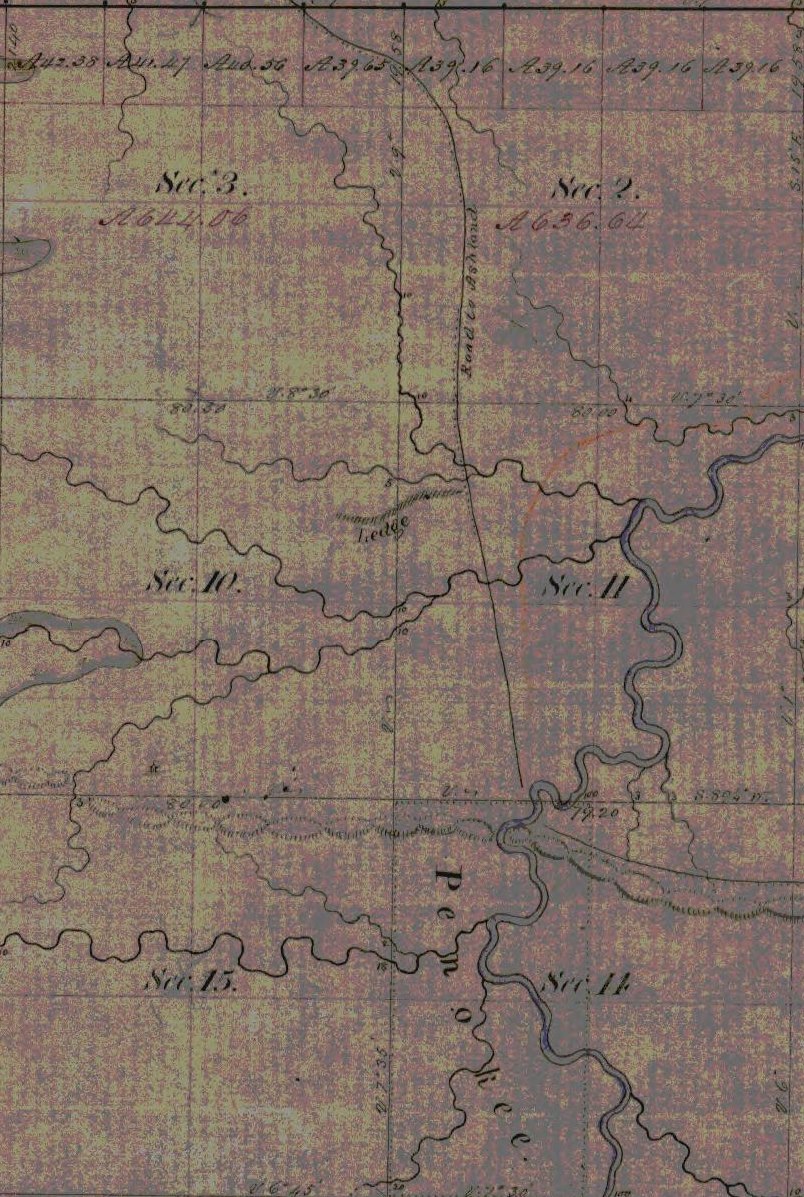
Palmer’s townsite claim located near Penokee Gap on Bad River with the “Coburn Trail” to Ashland. (Detail from Stuntz’s survey during May of 1858)
Subsequent, however, to the close of the survey upon the Transit Line, and the return of Mr. Whitcomb to Milwaukee, several extensive explorations were made to the south and west of the Range, by Gen. Cutler and myself, accompanied by Wheelock, Chas. Stevens, French Joe, (Joe Le Roy, with Big Joe as packer, and a Halfbreed called Little Alic as cook.) in one case nearly to the head waters of the Chippewa. These explorations, which were made with compass and chain, were by far the pleasantest part of my labors that summer, relieving us, as they did, not only of the monotony of camp life while awaiting the completion of the survey, but they also added largely to our knowledge of the topography, as well as the resources of the country south of the Range, then an unbroken wilderness, filled with beaver ponds, many of which were seen, but which is today, thanks to the energy and business tact of the gentlemen in charge of the Wisconsin Central railroad, beginning, metaphorically speaking, to bloom like the rose, and is destined, at no distant period, to take rank as one of the most wealthy and prosperous portions of our fair state. All honor to them for the same.
In this way our time was spent until September, when all homes of Stuntz being able to complete his work that season, unless some special providence should intervene, were abaonded, and preparations for spending the winter upon the Range were at once commenced. Gen Cutler immediately left for Milwaukee after additional supplies, first placing me in charge of the work. A pack train consisting of Stuntz’s pony, (old Jack) and Bascom‘s mare, were at once put upon the trail, in charge of Geo. Miller, a wild, harum-scarum Canuck from Canada West, who quickly stocked the Range with supplies.
But in order that the survey might yet be completed, if possible, additional men were put on, among whom was Wilhelm Goetzenburg, a Mechlinberger, at that time domiciled at Bay City and August Eckee, an old Courier de Bois, including all of our spare men, leaving me to keep camp at Penoka, which I did from about the middle of September to the 12th of October, during which time I saw no one except those who came in from the different claims at stated intervals, for supplies.
I see in your number of December 1, a reference by Hon. Asaph Whittlesey, to my sketch of Sibley and Lazarus, in which he not only confirms my statement, but goes one better in assigning him the belt as the champion liar, also which belt he (Sibley) was subsequently, however, compelled to surrender to John Beck. In consequence of Mr. Whittlesey’s statement I will relate one of Sibley’s yarns, told in the presence of Gen. Cutler, myself, Wheelock and a young man from St. Paul, by the name of Fargo, while eating dinner at his house on the Marengo, in August, 1857, which not only illustrates his powers as a yarn spinner, but the wonderful acoustic properties of his ears as well; being seated at the table, Sibley at once asked a blessing upon the food, for he could pray as well as lie, after which the question was asked by some one, how far it was possible to hear the human voice, upon which Sibley stated that he had not only heard the shouts of the people, but the words of the speaker also, distinctly, that were made at a political barbeque held in Ohio, in the fall of 1844, one hundred miles distant from where he was. Mr. Fargo, although no slouch of a liar himself, was so affected by this statement as to nearly faint, and finally made the remark that if that was not a lie, it came very near it; them lugs of Sibley’s were lugs as was lugs. Can John Beck beat that?

Harvey “Harry” Fargo was a cabinet maker, George R. Stuntz’s neighbor on the Minnesota Point in Duluth, an early mail carrier, and was in the 1853 census of Superior as “Arfargo.” ~ Duluth and St. Louis County, Minnesota; Their Story and People: An Authentic Narrative of the Past, with Particular Attention to the Modern Era in the Commercial, Industrial, Educational, Civic and Social Development, Volume 1, edited by Walter Van Brunt, 1921.
I wish to state at this time, also, a little incident in connection with Eckee, mentioned above, related to me by himself, which was this: That in the fall of 1846, he, in company with three others, in the employ of the Sigourney Lumber Co., of Quebec, ascended the river of the name three hundred miles in an open boat, for the purpose of cutting timber during the winter, and that when within three miles of their journey’s end, their boat was upset in a rapid, they barely escaping with their lives, but with the loss of the boat and all its contents, axes, fishing tackle and supplies. His companions, horrified at their situation, started immediately on their return, following the sinuosities of the river. He however, chose to remain, which he did until spring, never seeing a human face for six entire months. There were four oxen and two horses at the camp the care of which he claimed, kept him from going insane. It is needless to state that his companions were never heard from again. Although this incident has no immediate connection with my history, yet it serves to illustrate the hardships to which the class of men he belonged to are often called to suffer. He could never speak of that winter and its horrors, without tears.
But to return to the Range. Although I can truthfully say that the whole time spent upon the Range was to me one of unalloyed pleasure, yet that engaged during the latter part of September and up to the 20th of October, exceeded all the rest. The forest has, at all times, a charm for me, and the autumnal months doubly so; It is then and then only that its full glories can be seen; and in no country or section of country that it has ever been my privilege to visit, is the handiwork of Dame Nature’s gelid pencil, so grandly displayed as upon Lake Superior, and more particularly is this so, in and around the Range. No doubt the good people of Ashland think the scenery at the Gap very fine, and so it is. Yet that at the west end is far more so. Here the range terminates in a bold escarpment some 300 feet above the surrounding country, giving to an observer an unobstructed view east, west and south, for forty miles.
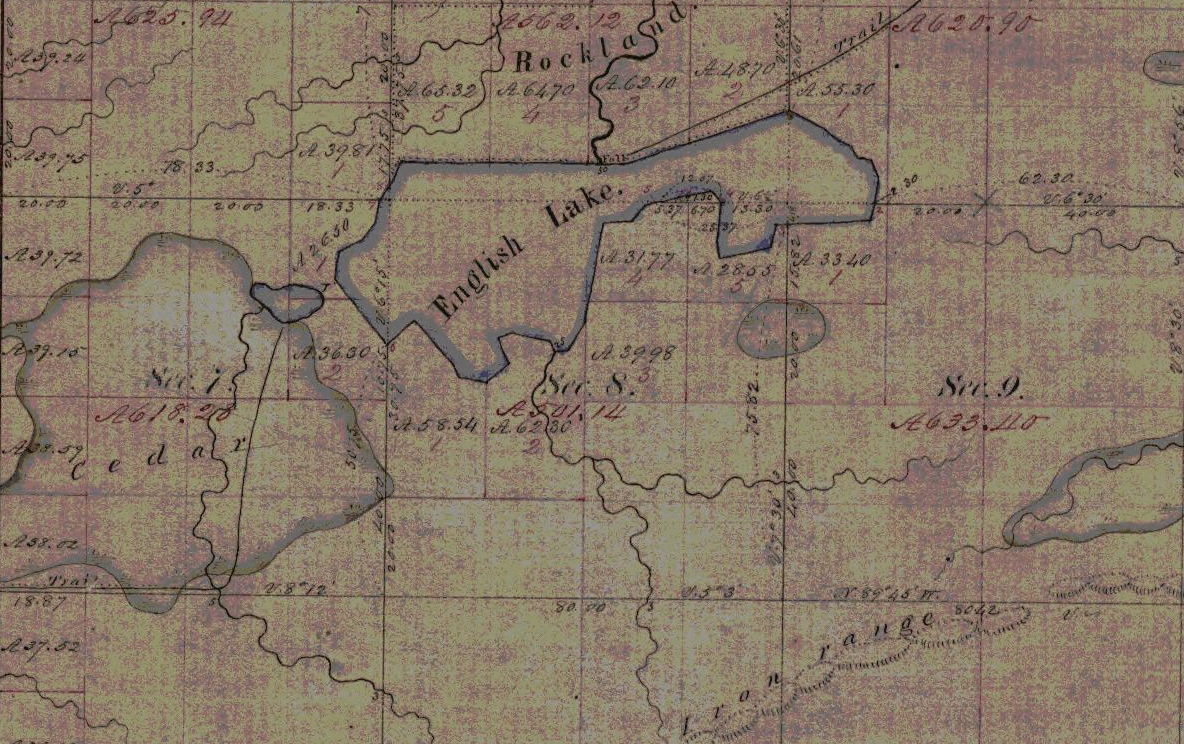
Indian trails to the “Rockland” townsite claim overlooking English Lake and the west end of the Penoka Range. Julius Austrian later claimed the “Rockland” site for his daughter’s estate.(Detail from Stuntz’s survey from May of 1858)
This was my favorite resort in those beautiful autumn mornings, where, seated upon the edge of the bluff, I would feast my eyes for hours upon that matchless panorama. Neither could I ever divest myself of the feeling that, while there, I was alone with God. I have seen, in the course of my life, many landscape paintings that were very beautiful, but never one that could at all compare with the views I enjoyed in the months of October 1857, from the west end of the Penoka Range. J.S.B.
Penokee Survey Incidents: Number II
February 12, 2015
By Amorin Mello
November 24, 1877.
The Survey of the Penoka Range and Incidents Connected with its Early History
—
Number II.
Friend Fifield:– Notwithstanding the work upon the Range was delayed very much on account of the unwoodsman like conduct of the Milwaukee boys, referred to in my first communication, yet it did not cease,- the company having a few white men, previous employed, as well as a large number who were “to the Mannor born” that did not show the “white feather” on account of the mosquitos, gnats, gad flies and other vermin with which the woods were filled,– most of whom remained with us to the end.
Prominent among these last named was Joseph Houle, or “Big Joe” as he was usually called,– a giant halfbreed, (now dead), who was invaluable as a woodsman and packer. Some idea of Joe’s immense strength and power of endurance may be formed from the fact that he carried upon one occasion the entire contents, (200 lbs.) of a barrel of pork from Ironton to the Range without seeming to think it much of a feat. Among the party along on this trip was a young man taking his first lesson in woodcraft, whose animal spirits cropped out to such a degree that the leader caused to be placed upon his back a bushel of dried apples (33 lbs.), simply to keep him from climbing the trees, but before he reached the Range, his load, light as it was, proved too much for him, when Joe, in charity, relieved him of it, adding it to his own pack – making it 233 lbs. This was, without doubt the largest pack ever carried to the Range by any one man. There was an Indian, however, in the employ of the company, as a packer, (“Old Batteese“), who left Sidebotham‘s claim one morning at 7 A.M., went to Ironton and was back again to camp at 7 P.M. with 126 lbs. of pork, having traveled forty-two miles in ten hours. This was in July ’57, and was what I considered the biggest day’s work ever done for the company. The usual load, however, for a packer, was from sixty to eighty pounds.

Ironton townsite claim at Saxon Harbor with trails to Odanah and the Penoka Iron Range. (Detail from Wisconsin Public Land Survey Records)
The halfbreeds were sulky and mutinous at times, giving us some trouble, until Gen. Cutler, who was a strict disciplinarian, gave them a lesson that they did not soon forget and which occurred at follows:
The General and myself left Ironton just before the removal of our supplies to Ashland, with four of these boys, with provisions for the Range, to be delivered at Lockwood’s Station. But upon reaching Sidebotham’s, two of them refused to proceed any further, threw down their packs, and started on their return to Ironton. The General’s blood was up in a moment, and directing me to remain with the others until he returned, at once started after them. Reaching Ironton at 11 A.M., about an hour after their arrival, they were quite surprised at seeing him, but said nothing. The General at once directed Duncan Sinclair, who had charge of the supplies at that time, to make up two packs of one hundred pounds each, with ropes in place of the usual leathern strap, which was quickly done, the “rebels” looking sullenly on all the while. When all was ready he drew his revolver and ordered them to pick them up and start. They did not wait for a second order, but took them and started, he followed immediately behind. Nor did he let them lay them down again until they reached Lockwood’s at sunset, a distance of twenty-six miles. – That evening they were the most completely used up men I ever saw on the Range, and from that time forward were as submissive and obedient as could be desired. After that we never had any trouble. It was a lesson they never forgot.
Among the whites referred to in this article, was James Stephenson, a young man from Virginia, who came up with Stuntz as a surveyor. He was of light build, wiry and muscular – full of fun – very excitable and nervous, – but a good man for the woods. He had some knowledge of the compass, but not sufficient education to make a good surveyor. “Jim” got lost once and was out three days before he came into camp, which he did just as the party was starting out to find him. “Jim” would not have made a good rope walker. He was no Blondin. On the ground he was all right, but let him attempt to cross a stream of water, be it ever so small, upon a log, no matter if the log was six feet in diameter, and he would fall in sure. He fell in twice while lost and came near perishing with wet and cold in consequence of it. He left the company in the fall of ’57.
But the best man we had on the range that summer, as a surveyor, (except Albert Stuntz, and I very much doubt if he could beat him), was George E. Stuntz, a nephew of Albert’s, known among the boys as “Lazarus.” He was tall and slim, with a long thin face, blue eyes, long dark brown hair, stooped slightly when walking; walked with a swinging motion, spoke slow and loud – was fond of the woods, prided himself on his skill with the compass, and was, I think, the laziest man at that time in the county, except “Sibly,” who could discount him fifty and then beat him. But notwithstanding all this Albert could not have completed his survey that season without him. His lines never required any corrections. George was a singer – or thought he was, which is all the same. The recollections of some of his attempts in this line almost brings tears to my eyes from laughter, even now. Nearly every night in camp, the boys, after getting into a position where they could laugh without his seeing them, would coax him to sing. His favorite piece was a song called “The Frozen Limb.” What it meant I have no idea, and do not think he had. One verse of this only can I recall to mind, which ran as follows:
“One cold, frosty evening as Mary was sleeping –
Alone in her chamber, all snugly in bed. – She woke with a noise that did sorely affright her.
‘Who’s that at my window?’ she fearfully said.”
You can easily imagine how this would sound when sung through the nose in the hard shell style – each syllable ending with a jerk, something like this:
“Who’s-that-at-my-win-dow-she-fear-ful-ly-said-ud.”
George had a suit of clothes for the woods made of bed ticking, cap and all complete – all but the cap in one piece. The cap was after the “Dunce” pattern, ie, it ran to a point. The stripes instead of running up and down as they should have done, ran diagonally around him, giving him the appearance of a walking barber’s pole. He was a nice looking boy – he was.
Shortly after donning this beautiful suit, while crossing the Range, he suddenly found himself face to face with a full grown bear. It was no doubt a surprise to both parties,– it certainly was to the bear. For he took one square look and left for distant lands at a speed which, if kept up, would have carried him to Mexico in two days. “Not any of that in mine” was probably what was passing through his massive brain, but he made no sign. The boys who were surveying some fifteen miles south of the Range claimed to have met him that day, still on the jump. J.S.B.
By Leo Filipczak
Joseph Oesterreicher was only eighteen years old when he arrived at La Pointe in 1851. Less than a year earlier, he had left his native Germany for Mackinac, where he’d come to work for the firm of his older brother Julius and their in-laws, the Leopolds, another Bavarian Jewish family trading on Lake Superior.
In America, the Oesterreichers became the Austrians, but in his time at Mackinac, Joseph Austrian picked up very little English and even less of the Ojibwe and Metis-French that predominated at La Pointe. So, when Joseph made the move to his brother’s store at Madeline Island, it probably felt like he was immigrating all over again.
In the spring of 1851, he would have found at La Pointe, a society in flux. American settlement intensified as the fur trade economy made its last gasps. The island’s mix-blooded voyageurs found it harder and harder to make a living, and the Fur Company, and smaller traders like Julius Austrian, began to focus more on getting Ojibwe money from treaty annuity payments than they did from the actual trade in fur. This competition for Indian money had led to the deaths of hundreds of Ojibwe people in the Sandy Lake tragedy just a few months earlier.
The uncertainty surrounding Ojibwe removal would continue to hang heavily over the Island for both of Joseph’s years at La Pointe, as the Ojibwe leadership scrambled to process the horror of Sandy Lake and tried to secure a permanent homeland on the lakeshore.
The Austrians, however, found this an opportune time to be at the forefront of all the new business ventures in the Lake Superior country. They made money in merchandise, real estate, shipping, mining, lumber, government contracts, and every other way they could. This was not without controversy, and the name of Julius Austrian is frequently attached to documents showing the web of corruption and exploitation of Native people that characterized this era.
It’s difficult to say whether Joseph realized in 1851, while sweeping out his brother’s store or earning his unfortunate nickname, but he would become a very wealthy man. He lived into the 20th century and left a long and colorful memoir. I plan to transcribe and post all the stories from pages 26-66, which consists of Joseph’s time at La Pointe. Here is the first fourth [our original] installment:
Memoirs of Doodooshaboo
… continued from Mackinac 1850-1851.
Left for La Point: My First Trip on Lake Superior
1851

Julius Austrian
~ Madeline Island Museum
Mr. Julius Austrian was stationed at La Pointe, Madaline Island, one of the Apostle Group in Lake Superior, where he conducted an Indian Trading post, buying large quantities of fur and trading in fish on the premises previously occupied by the American Fur Co. whose stores, boats etc. the firm bought.
Julius Austrian, one of the partners had had charge of the store at La Point for five years past, he was at this time expected at Mackinaw and it had been arranged that I should accompany him back to La Pointe when he returned there, on the first boat of the season leaving the Sault Ste. Marie. I was to work in the store and to assist generally in all I was capable of at the wages of $10 a month. I gladly accepted the proposition being anxious for steady employment. Shortly after, brother Julius, his wife (a sister of H. Leopold) and I started on the side wheel steamer Columbia for Sault Ste. Marie, generally called “The Soo,” and waited there five days until the Napoleon, a small propellor on which we intended going to La Point, was ready to sail. During this time she was loading her cargo which had all to be transported from the Soo River to a point above the rapids across the Portage (a strip of land about ¾ of a mile connecting the two points) on a train road operated with horses. At this time there were only two propellers and three schooners on the entire Lake Superior, and those were hauled out below the rapids and moved up and over the portage and launched in Lake Superior. Another propeller Monticello, which was about half way across the Portage, was soon to be added to the Lake Superior fleet, which consisted of Independence & Napoleon and the Schooners Algonquin, Swallow, and Sloop Agate owned by my brother Julius. Quite different from the present day, where a very large number of steel ships on the chain of Lakes, some as much as 8000 tons capacity, navigate through the canal to Lake Superior from the lower lakes engaged in transporting copper, iron ore, pig iron, grain & flour from the various ports of Marquette, Houghton, Hancock, Duluth, and others. It was found necessary in later years to enlarge the locks of the canal to accomodate the larger sized vessels that had been constructed.
Building Sault Ste. Marie Canal. 1851.

Map of proposed Soo canal and locks 1852 (From The Honorable Peter White by Ralph D. Williams, 1910 pg. 121)
The ship canal at that time had not been constructed, but the digging of it had just been started. The construction of this canal employed hundreds of laborers, and it took years to complete this great piece of work, which had to be cut mostly through the solid rock. The State of Michigan appropriated thousands of sections of land for the purpose of building this canal, for the construction of which a company was incorporated under the name of Sault Ste. Marie Ship Canal & Land Co., who received the land in payment for building this canal, and which appropriation entitled the Co. to located in any unsold government land in the State of Michigan. The company availed itself of this privilege and selected large tracts of the best mineral and timber land in Houghton, Ontonagan & Kewanaw Counties, locating some of the land in the copper district, some of which proved afterwards of immense value, and on which were opened up some of the richest copper mines in the world, namely: Calumet, Hecla, and Quincy mines, and others. There were also very valuable timber lands covered by this grant.
The canal improved and enlarged as it now stands, is one of the greatest and most important artificial waterways in the world. A greater tonnage is transported through it annually that through the Suez or any other canal. In later years the canal was turned over by the State of Mich. to the General Government, which made it free of toll to all vessels and cargoes passing through it, even giving Canadian vessels the same privilege; whereas when operated by the State of Mich. toll was exacted from all vessels and cargoes using it.
The Napoleon, sailed by Capt. Ryder, had originally been a schooner, it had been turned into a propeller by putting in a small propeller engine. She had the great (?) speed of 8 miles an hour in calm weather, and had the reputation of beating any boat of the Lake in rolling in rough weather, and some even said she had rolled completely over turning right side up finally.

To return to my trip, after passing White Fish Point, the following day and getting into the open lake, we encountered a strong north wind raising considerable sea, causing our boat to toss and pitch, giving us our first experience of sea sickness on the trip. Beside the ordinary crew, we had aboard 25 horses for Ontonogan where we arrived the third day out. The Captain finding the depth of water was not sufficient to allow the boat to go inside the Ontonogan river and there being no dock outside, he attempted to land the horses by throwing them overboard, expecting them to swim ashore, to begin with, he had three thrown overboard and had himself with a few of his men lowered in the yawl boat to follow, he caught the halter of the foremost horse intending to guide him and the others ashore. The lake was exceedingly rough, and the poor horses became panic stricken and when near the shore turned back swimming toward the boat with hard work. The Captain finally succeeded in land those that had been thrown overboard, but finding it both hazardous to the horses and the men he concluded to give up the attempt to land the other horses in this way, and ordered the life boat hoisted up aboard. She had to be hoisted up the stern, in doing so a heavy wave struck and knocked it against the stern of the boat before she was clear of the water with such force as to endanger the lives of the Capt. and men in it, and some of the passengers were called on to assist in helping to hoist the life boat owing to its perilous position. Captain and the men were drenched to the skin, when they reached the deck. Capt. vented his rage in swearing at the hard luck and was so enraged that he did not change his wet clothing for some time afterward. The remaining horses were kept aboard to be delivered on the return trip, and the boat started for her point of destination La Point.
Arrived at La Point and Started in Employ of Brother Julius. 1851
Next morning we sighted land, which proved to be the outer island of the Apostle Group. Captain flew into the wheel room and found the wheelsman fast asleep. He grasped the wheel and steered the boat clear of the rocks, just in time to prevent the boat from striking. Captain lost no time in changing wheelsman. We arrived without further incidents at La Point the same afternoon. When she unloaded her cargo, work was at once begun transferring goods to the store, in which I assisted and thus began my regular business career. These goods were hauled to the store from the dock in a car, drawn by a horse, on wooden rails.
There were only about 6 white American inhabitants on the Island, about 50 Canadian Frenchmen who were married to squaws, and a number of full blooded Indians, among whom was chief Buffalo who was a descendant of chiefs & who was a good Indian and favorably regarded by the people.

Fr. Otto Skolla (self-portrait contained in History of the diocese of Sault Ste, Marie and Marquette (1906) by Antoine Ivan Rezek; pg.360; Digitized by Google Books)
The most conspicuous building in the place was an old Catholic Church which had been created more than 50 years before by some Austrian missionaries. This church contained some very fine and valuable paintings by old masters. The priest in charge there was Father Skolla, an Austrian, who himself was quite an artist, and spent his leisure hours in painting Holy pictures. The contributions to the church amounted to a mere pittance, and his consequent poverty allowed him the most meager and scant living. One Christmas he could not secure any candles to light up his church which made him feel very sad, my sister-in-law heard of this and sent me with a box of candles to him, which made him the happiest of mortals. When I handed them to him, his words were inadequate to express his gratitude and praise for my brother’s wife.
There was also a Methodist church of which a man by the name of Hall was the preacher. He had several sons and his family and my brother Julius and his wife were on friendly terms and often met.
The principle man of the place was Squire Bell, a very genial gentleman who held most of the offices of the town & county, such as Justice of the Peace & Supervisor. He also was married to a squaw. This was the fashion of that time, there being no other women there.

 John W. Bell, “King of the Apostle Islands” as described by Benjamin Armstrong (Digitized by Google Books) .
There was a school in the place for the Indians and half breeds, there being no white children there at this time. I took lessons privately of the teacher of this school, his name was Pulsevor. I was anxious to perfect myself in English. I also picked up quite a bit of the Chippewa language and in very short time was able to understand enough to enable me to trade with the Indians.
My brother Julius was a very kind hearted man, of a very sympathetic and indulgent nature, and to his own detriment and loss he often trusted needy and hungry Indians for provisions and goods depending on their promise to return the following year with fur in payment for the goods. He was personally much liked and popular with the Indians, but his business with them was not a success as the fur often failed to materialize. The first morning after my arrival, my brother Julius handed me a milk pail and told me to go to the squaws next door, who having a cow, supplied the family with the article. He told me to ask for “Toto-Shapo” meaning in the Indian language, milk.
I repeated this to myself over and over again, and when I asked the squaw for “Toto Shapo” she and all the squaws screamed with delight and excitement to think that I had just arrived and could make myself understood in the Indian tongue. This fact was spread among the Indians generally and from that day on while I remained on the Island I was called “Toto Shapo.” One of the Indian characteristics is to name people and things by their first impression–for instance on seeing the first priest who work a black gown, they called him “Makada-Conyeh,” which means a black gown, and that is the only name retained in their language for priests. The first soldier who had a sword hanging by his side they called “Kitchie Mogaman” meaning “a big knife” in their language. The first steamboat they saw struck them as a house with fire escaping through the chimney, consequently they called it “Ushkutua wigwam” (Firehouse) which is also the only name in their language for steamboat. Whiskey they call “Ushkutua wawa” meaning “Fire Water.”
My brother Julius had the United States mail contract between La Point & St. Croix. The mail bag had to be taken by a man afoot between these two places via Bayfield a distance of about 125 miles, 2 miles of these being across the frozen lake from the Island to Bayfield.
Dangerous Crossing on the Ice.
An Indian named Kitchie (big) Inini (man) was hired to carry it. Once on the way on he started to cross on the ice but found it very unsafe and turned back. When my brother heard this, he made up his mind to see that the mail started on its way across the Lake no matter what the consequence. He took a rope about 25 ft. long tying one end around his body and the other about mine, and he and I each took a long light pole carrying it with two hands crosswise, which was to hold us up with in case we broke through the ice. Taking the mail bag on a small tobogan sled drawn by a dog, we started out with the Indian. When we had gone but a short way the ice was so bad that the Indian now thoroughly frightened turned back again, but my brother called me telling me not to pay any attention to him and we went straight on. This put him to shame and he finally followed us. We reached the other side in safety, but had found the crossing so dangerous, that we hesitated to return over it and thought best to wait until we could return by a small boat, but the time for this was so uncertain that after all we concluded to risk going back on the ice taking a shorter cut for the Island, and we were lucky to get back all right.
In the summer when the mail carrier returned from these trips, he would build a fire on the shore of the bay about 5 miles distant, as a signal to send a boat to bring him across to the Island. Once I remember my brother Julius not being at home when a signal was given. I with two young Indian boys (about 12 yrs. of age) started to cross over with the boat, when about two miles out a terrific thunder and hail storm sprang up suddenly. The hail stones were so large that it caused the boys to relax their hold on the oars and it was all I could do to keep them at the oars. I attempted to steer the boat back to the Island, and barely managed to reach there. The boat was over half full of water when we reached the shore. When I landed we were met by the boys’ mothers who were greatly incensed at my taking their boys on this perilous trip, nearly resulting in drowning them. They didn’t consider I had no idea of this terrible thunder storm which so suddenly came up and had I known it for my own safety would not dreamed of attempting the trip.
Nearly Capsize in a Small Boat.
Once I went out in a small sail boat with two Frenchmen to collect some barrels of fish near the Island at the fishing ground near La Point. We got two barrels of fish which they stood up on end, when a sudden gust of wind caused the boat to list to one side so that the barrels fell over on the side and nearly capsized the boat. By pulling the barrels up the boat was finally righted after being pretty well filled with water. I could not swim, and as a matter of self-preservation grabbed the Frenchman nearest me. He was furious, expressing his anger half in French and half in English, saying, “If I had drowned, I would have taken him with me.” which no doubt was true.
A Young Indian Locked up for Robbery
One day brother Julius went to the Indian payment. During his absence I with another employee, Henry Schmitz, were left in charge. A young Indian that night burglarized the store stealing some gold coins from the cash drawer. The same were offered to someone in the town next day who told me, which led to his detection. He admitted theft and was committed to jail by the Indian agent Mr. Watrous, which the Indians consider a great disgrace.
Some inquisitive boys peering through the window discovered that the young Indian had attempted to commit suicide and spread the alarm. His father was away at the time and his mother and friends were frenzied and their threats of vengeance were loud. The jailer was found but he had lost the key to the jail (the jail was in a log hut) the door of which was finally forced open with an axe, and the young culprit with his head bleeding was handed over to his people who revived him in their wigwam. The next day the money was returned and we and the authorities were glad to call it quits.
To be continued at La Pointe 1851-1852 (Part 2)…
Special thanks to Amorin Mello and Joseph Skulan for sharing this document and their important research on the Austrian brothers and their associates with me. It is to their credit that these stories see the light of day. The original handwritten memoir of Joseph Austrian is held by the Chicago History Museum.
 Chequamegon History