Treaty Allotments at Copper Falls
February 17, 2022
Collected & edited by Amorin Mello

Chippewa Treaty (blue) and Sioux Script (red) treaty land allotments in the Penokee Mountains located along mineral deposits near Mellen, Wisconsin.
[LaPointe County Register of Deeds: Volume 2 Deeds Page 419]

Julius Austrian had better success entering lands with Chippewa Certificates along the iron range for the Leopold & Austrian family’s La Pointe Iron Company than here along the copper range.
Be it known to all men that I Julius Austrian of Lapointe County State of Wisconsin am held and firmly Bound unto Julius [Bernault?], Peter King, Abraham Comartin, John W Bell & Henry Merryweather and to Each of them Separately in the Sum of One thousand Dollars for which payment will and truly to be made I bind my self my heirs executors and administrators firmly by these presents.
The condition of the above obligations are such that whereas the above mentioned Julius [Bernault?], Peter King, Abraham Comartin, John W Bell & Henry Merryweather having Squatted and improved the following mentioned Lands in Lapointe County with the intent of Claiming the Same as a Town Site namely the East half of Section No Seventeen (17) of Township number Forty five (45) of Range no two (2) and have agreed with the said Julius Austrian that he may enter the above described lands by Chippewa Script or otherwise at his option.

The “East half of Section No Seventeen (17) …” is where the Bad River and Tyler Forks River join spectacularly at what is now Brownstone Falls in Copper Falls State Park.
Now if the said Julius Austrian shall with due diligence enter the same as provided and obtain a Patent or Patents as Early as possible from the United States, and within 10 Days from the time he may procure and obtain said Patent or Patents for the above mentioned lands whether in his name or in the names of other parties, make execute & deliver or cause so to be done, to each of the above mentioned parties a Good & Sufficient Deed of warrantee clear of all incumbrances of an undivided Four ninetieths part of the whole mentioned East half of said Section no 17 as above specified. Then this obligation to be null & voice, otherwise to Remain in full force and virtue.
Given under my hand and seal at Lapointe this 30th day of April 1858.
Julius Austrian {Seal}
In presence of
Henry Smitz
M H Mandelbaum
State of Wisconsin } S.S.
County of Lapointe }
Personally came before the undersigned a Notary Public in & For the County of Lapointe the within named Julius Austrian to me well known who acknowledged that he did execute sign & seal the within Bond as his free Act and Deed.
{Seal} M H Mandelbaum
Notary Public
[Ashland County Register of Deeds: Volume 1 Deeds Pages 264-268]
{$180.00 Stamp Int Revenue U.S.}
This Indenture made the twenty fifth day of May in the year one thousand eight hundred and sixty four Between Louis Stein of the City and State of New York individually, Margaret Dupuis by Loius Stein her attorney, Charlotte Mercier by Louis Stein her attorney, Hypolite Auger by Louis Stein her attorney, Julia Renville by Louis Stein her attorney and Louise Moreau by Louis Stein her attorney, parties of the first part, and the Ashland Copper Mining Company, a Corporation created under and by virtue of the laws of the State of Wisconsin, party of the second part.
Whereas the north half of the North East quarter of Section Seventeen (17) in Township number Forty five (45) of Range Two (2) west in the District of Lands subject to Sale at Bayfield Wisconsin containing eighty acres according to the Government Survey was located on the 14th day of October 1863 with Chippewa Half Breed Scrip No 228 by John B Corbin,
and also the South Half of the North East Quarter of of Section Seventeen (17) Township Forty Five (45) Range Two (2) in the District of Lands subject to Sale at Bayfield Wisconsin containing eighty acres according to Government Survey was located on the 28th day of September 1863 with Chippewa Scrip Number 209 by John P Hamlin attorney for John Baptiste Denomie,
and also the North East half of South East quarter of Section Seventeen (17) Township Forty five (45) Range two (2) West in the District of Lands subject to Sale at Bayfield Wisconsin containing eighty acres according to the Government Survey was located October 14th 1863 with Chippewa Half Breed Scrip No 161 issued to John Haskins by John P Hamlin attorney,
and also the North East Quarter of South West quarter of Section Seventeen (27) Township Forty Five (45) Range Two (2) west in the District of lands subject to sale at Bayfield Wisconsin containing Forty acres according to the Government Survey was located October 20th 1863 with Sioux Scrip No 212 B by Louis Stein attorney for Margaret Dupuis,
And also the North West Quarter of South West quarter of Section Seventeen (17) Township number Forty five North of Range Two (2) West in the District of Lands subject to Sale at Bayfield Wisconsin containing Forty acres according to the Government Survey was located on November 25th 1863 with Sioux Half Breed Scrip No 102 B by Louis Stein attorney for Charlotte Mercier,
And also the South East Quarter of Section Eighteen (18) Township Forty five (45) North of Range Two (2) West in the District of Lands subject to Sale at Bayfield Wisconsin containing one hundred and sixty acres according to the Government Survey, was located on the 25th day of November 1863 with Sioux Half Breed Scrip No 487 C by Louis Stein attorney for Hypolite Auger,
And also the South half of South West Quarter of Section Seventeen (17) Township Forty five (45) Range Two (2) in the District of Lands subject to Sale at Bayfield Wisconsin containing eighty acres according to the Government Survey was located October 18th 1863 with Sioux Half Breed Scrip No 212 Letter C by Louis Stein attorney for Margaret Dupuis,
And also the North half of the North West quarter of Section Twenty (20) Township Forty five (45) North of Range 2 west in the District of lands subject to Sale at Bayfield Wisconsin containing eighty acres according to the Government Survey was located September 10th 1863 with Chippewa Half Breed Scrip No 158 by Julius Austrian attorney,
And also the South Half of South East Quarter of Section Seventeen (17) Township Forty five (45) Range Two (2) West in the District of Lands subject to Sale at Bayfield Wisconsin containing eighty acres according to the Government Survey was located on the 14th day of October 1863 with Chippewa Half Breed Scrip No 281 issued to Michael Lambert by John P Hamlin attorney,
And also the North East quarter of Section nineteen (19) Township No Forty five (45) Range Two (2) West in the District of Lands subject to Sale at Bayfield Wisconsin containing one hundred and Sixty acres according to the Government Survey was located on the 19th day of October 1863 with Sioux Half Breed Scrip No 29 by Louis Stein attorney for Julia Renville,
And also the North half of South East quarter and East Half of the South West quarter of Section Number nineteen (19) Township No Forty five (45) Range Two (2) West in the District of Lands subject to Sale at Bayfield Wisconsin containing One hundred and Sixty acres according to the Government Survey was located on the 19th day of October 1963 with Sioux Half Breed Scrip No 17 C by Louis Stein attorney for Louise Moreau.
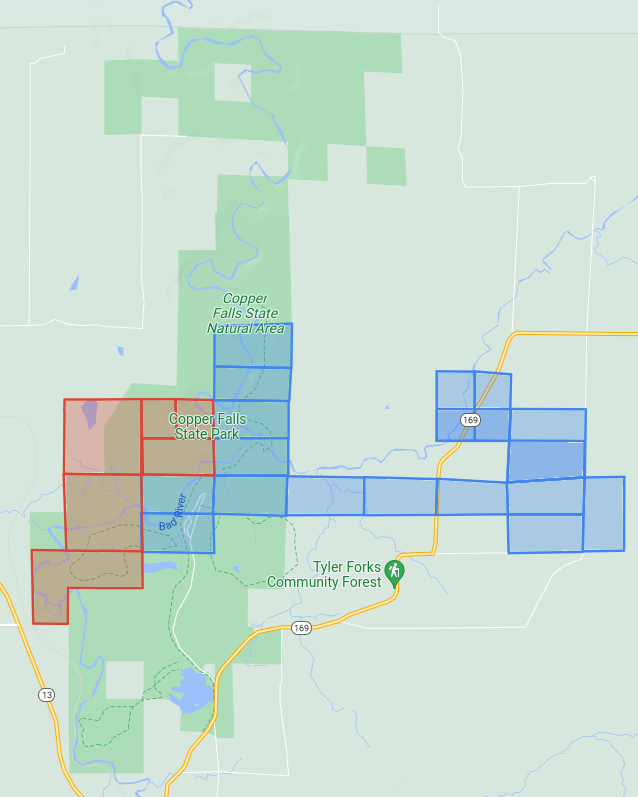
Chippewa and Sioux treaty land allotments in and contiguous to Copper Falls State Park. There are more Chippewa allotments here than those claimed by Ashland Copper Mining Company. Others went to Robert Morrin, Joseph Roy, Francis S. Gurnoe, John Chapman, Francis Fournier, Rosalie Trocquer, John Baptiste Visneau, Henry Davenport, Edward Ashman, Henry Graham, Mary Graham, Joseph Blanchard, and Reuben Chapman.
And whereas said North Half of North East Quarter of Section Seventeen (17) in Township No Forty five (45) of Range Two west was conveyed by John B Corbin and Wife to John P Hamlin by Deed dated October 17th 1863, and Recorded in the Office of Register of Deeds of Ashland County Wisconsin in Book of Deeds Vol 1 pages 218 & 219 October 18, 1863 and was further conveyed by said John P Hamlin to Louis Stein by Deed dated October 31st 1863, and Recorded in said Registers office in Book of Deeds Vol 1 Page 225 November 9th 1863,

John Baptiste Denomie Jr of Odanah; son of allottee Jean Baptiste Denomie Sr.
~ Noble Lives of a Noble Race, A Series of Reproductions by the Pupils of Saint Mary’s, Odanah, Wisconsin, 1909, page 213-217.
And whereas said South Half of the North east quarter of Section Seventeen (17) Township Forty five (45) Range Two (2) has been conveyed by the said John Baptiste Denomie to Louis Stein by Deed dated May 25th 1864,
and said North East Half of South East Quarter of Section Seventeen (17) Township Forty five (45) Range Two(2) west has been conveyed by said John Haskins to said Louis Stein by Deed dated May 25th 1864,
and said South East Quarter of Section Eighteen (18) Township Forty five (45) North of range two (2) west has been conveyed by Hypolite Auger to said Louis Stein by Deed Dated January 1, 1862 and recorded in said Office of Register of Deeds in Vol 1 of Deeds page 227 January 23 1864,

The Ashland Copper Mine was mapped by Irving in 1873 for the Geology of Wisconsin: Volume III. This was located at what is now the main picnic area on Michael Lambert’s Chippewa Allotment in Copper Falls State Park.
and said South Half of South East quarter of Section Seventeen (17) Township Forty five (45) Range two (2) West has been conveyed by the said Michael Lambert to the said Louis Stein by Deed dated May 25th 1864,
and the said Louis Stein has also acquired the title of the said North Half of the North West quarter of Section twenty (20) Township Forty five (45) North of Range two (2) West from the said Julius Austrian.
And whereas the said parties of the first part to these presents have sold and agreed to convey to the said party of the second part to these presents a tract of land situated in the County of Ashland in the State of Wisconsin which includes the whole or parts of the several tracts pieces and parcels of land herein before described which said tract of land so sold and agreed to be conveyed to the said party of the second part is hereinafter particularly described.
Now Therefore this Indenture Witnesseth that the said parties of the first part for and in consideration of Twenty thousand shares of the Capital Stocks of the said party of the second part of the value of five dollars for each Share, which have been issued or transferred and assigned to them the said parties of the first part or as they have appointed and directed, the receipt of which is hereby acknowledged, have granted, bargained, sold, released, conveyed, and confirmed and by these presents do grant, bargain, sell, release, convey and confirm unto the said party of the second part its successors and assigns forever

Copper Falls by Emily Fritts, August 2016.
~ WikiMedia Commons
All that certain tract and parcel of Land situate, lying and being in the County of Ashland in the State of Wisconsin, known bounded and described as follows to wit;
Beginning at a point in the center of Bad River in Township Number Forty five (45) North Range Number Two (2) West of the Fourth Meridian where said river crosses the northerly boundary of Section number Seventeen (17) in the North East quarter, thence running west eight hundred (800) feet more or less to the North West corner of said North East quarter Section; thence South twenty six hundred and forty (2640) feet to the center of Section number Seventeen (17); thence West Five thousand two hundred and eighty feet (5280) to the center of Section number eighteen (18); thence South Five thousand two hundred and eighty (5280) feet to the center of Section number nineteen (18); thence west thirteen hundred and twenty (1320) feet; thence South twenty six hundred and forty (2640) feet; thence East thirteen hundred and twenty (1320) feet; thence North twenty three hundred and ninety (2390) feet more or less to the center of said Bad River and thence North Easterly along the center of said Bad River as it runs to the place of beginning, containing six hundred and fifty three acres (653) more or less and being portions of Section numbers seventeen (17), eighteen (18), nineteen (19) and twenty (20) in the aforesaid Township.

Brownstone Falls in Copper Falls State Park by Yinan Chen.
~ WikiMedia Commons
To have and to hold the above described and hereby granted premises and every part and parcel thereof together with all and singular the tenements hereditaments and appurtenances thereunto belonging or in anywise appertaining unto the said party of the second part its successors and assigns to its and their own purpose, use, benefit and behoof forever. And the said parties of the first part severally for himself and herself and not the one for the other, and for his and her heirs executors and administrators do hereby covenant promise and agree to and with the said party of the second part, its successors and assigns to make, execute, sign, seal, acknowledge and deliver at the Cost and expense of the said party of the second part its successors and assigns all such other and further Deeds, grants, conveyances and instruments in writing as the said party of the second part its successors and assigns or its or their Counsel learned in the law shall at any times advise, devise or require for the [more?] effectually conveying to and vesting in the said party of the second part its successors and assigns the fee simple of the above described and hereby granted, promised and every part thereof with the appurteances. And the said Margaret DuPuis, Charlotte Mercier, Hypolite Auger, Julia Renville and Louise Moreau severally and not the one for the other and each of them only in respect to so much of the hereby conveyed premises as is located by or for him or her as herein before stated and set forth and is hereby conveyed by him or her or intended so to be for himself and herself, his and her heirs, executors and administrators covenant and agree to and with the said party of the second part its successors and assigns in the manner and form following that is to say That he or she at the time of the ensealing and delivery of these presents is the true, lawful and rightful owner of the said hereby conveyed premises, and has therein a good sure, perfect and indefeasible estate in fee simple; and that he and she has full right, power and authority to grant, bargain, sell, remise, release, convey and confirm the said premises unto the said party of the second part its successors and assigns in manner and form aforesaid and that the said party of the second part its successors and assigns shall quietly enjoy and possess the said premises and that he and she will Warrant and Defend the title to the same against all lawful claims.
In Witness Whereof the said parties of the first part have hereunto set their hands and Seals they day and year first above written
Louis Stein {S.S.}
Margaret Dupuis by Louis Stein atty {S.S.}
Charlotte Mercier by Louis Stein atty {S.S.}
Hypolite Auger by Louis Stein attorney {S.S.}
Julia Renville by Louis Stein Attorney {S.S.}
Louis Moreau by Louis Stein attorney {S.S.}
Sealed and delivered in Presence
A H Wallis
Andrew Clerk
State of New York } S.S.
County of New York }
Be it Remembered that on this seventh day of June in the year eighteen hundred and sixty four before the subscriber a Commissioner in and for the said State, appointed by the Governor of the State of Wisconsin to take acknowledgment and proof of the execution of Deeds, or other conveyances or leases and of any contract, letter of attorney or other writing under seal or not administer oaths and take and certify depositions to be used or recorded in the said State of Wisconsin appeared Louis Stein whom I know to be the person described in and who executed the foregoing instrument and acknowledged that he executed the same in his own behalf as his own act and deed and also acknowledged that he executed the same as the act and deed of Margaret Dupuis, Charlotte Mercier, Hypolite Auger, Julia Renville & Louise Moreau therein descried by virtue of a Power of Attorney severally executed by them authorizing the same, and which Power of Attorney have been duly exhibited to me by the said Louis Stein.
Given under my hand and Official Seal
{Seal} Charles E Jenkins Commissioner for the State of Wisconsin, residing in the city of New York.
An Incident of Chegoimegon
November 26, 2016
By Amorin Mello
This is a reproduction of “An Incident of Chegoimegon – 1760” from Report and Collections of the State Historical Society of Wisconsin: For the years 1877, 1878 and 1879. Volume VIII., pages 224-226.
—
AN INCIDENT OF CHEGOIMEGON – 1760.*
—
We have been permitted to extract the following from the journal of a gentleman who has seen a large portion of the country to the north and west of this place, and to whose industry our readers have been often indebted for information relating to the portion of country over which he has passed, and to transactions among the numerous tribes, within the limits of this territory, which tend to elucidate their characteristics, and lay open the workings of their untaught minds:
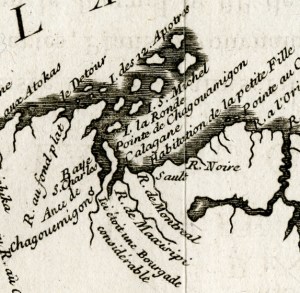
Detail of Isle de la Ronde from Carte des lacs du Canada by Jacques-Nicolas Bellin; published in Charlevoix’s Histoire et Description Générale de Nouvelle France, Paris, 1744.
Monecauning (abbreviated for “Monegoinaic-cauning,” the Woodpecker Island, in Chippewa language) – which is sometimes called Montreal Island, Cadott’s Island, or Middle Island, and is one of “the Apostles” mentioned by Charlevoix. it is situated in Lake Superior, about ninety miles from Fond du Lac, at the extremity of La Pointe, or Point Chegoimegon.
On this island the French Government had a fort, long previous to its surrender to the English, in 1763. It was garrisoned by regular soldiers, and was the most northern post at which the French king had troops stationed. It was never re-occupied by the English, who removed everything valuable to the Sault de St. Marie, and demolished the works. It is said to have been strongly fortified, and the remains of the works may yet be seen.
In the autumn of 1760, all of the traders except one, who traded from this post, left it for their wintering grounds. He who remained had with him his wife, who was a lady from Montreal, his child – a small boy, and one servant. During the winter, the servant, probably for the purpose of plunder, killed the trader and his wife; and a few days after their death, murdered the child. He continued at the fort until the spring. When the traders came, they enquired for the gentleman and his family; and were told by the servant, that in the month of March, they left him to go to their sugar camp, beyond the bay, since which time he had neither seen nor heard them. The Indians, who were somewhat implicated by this statement, were not well satisfied with it, and determined to examine into its truth. They went out and searched for the family’s tracks; but found none, and their suspicions of the murderer increased. They remained perfectly silent on the subject; and when the snow had melted away, and the frost left the ground, they took sharp stakes and examined around the fort by sticking them into the ground, until they found three soft spots a short distance from each other, and digging down they discovered the bodies.
The servant was immediately seized and sent off in an Indian canoe, for Montreal, for trial. When passing the Longue Saut, in the river St. Lawrence, the Indians who had him in charge, were told of the advances of the English upon Montreal, and that they could not in safety proceed to that place. They at once became a war party, – their prisoner was released, and he joined and fought with them. Having no success, and becoming tired of the war, they sought their own land – taking the murderer with them as one of their war party.
They had nearly reached the Saut de St. Marie, when they held a dance. During the dance, as is usual, each one “struck the post,” and told, in his manner, of his exploits. The murderer, in his turn, danced up to the post, and boasted that he had killed the trader and his family – relating all the circumstances attending the murder. The chief heard him in silence, saving the usual grunt, responsive to the speaker. The evening passed away, and nothing farther occurred.
The next day the chief called his young men aside, and said to them: “Did you not hear this man’s speech last night? He now says that he did the murder with which we charged him. He ought not to have boasted of it. We boast of having killed our enemies – never our friends. Now he is going back to the place where committed the act, and where we live – perhaps he will again murder. He is a bad man – neither we nor our friends are safe. If you are of my mind, we will strike this man on the head.” They all declared themselves of his opinion, and determined that justice should be rendered him speedily and effectually.
They continued encamped, and made a feast, to which the murderer was invited to partake. They filled his dish with an extravagant quantity, and when he commenced his meal, the chief informed him, in a few words, of the decree in council, and that as soon as he had finished his meal, either by eating the whole his dish contained, or as much as he could, the execution was to take place. The murderer, now becoming sensible of his perilous situation, from the appearance of things around him, availed himself of the terms of the sentence he had just heard pronounced, and did ample justice to the viands. He continued, much to the discomfiture of the “phiz” of justice (personified by the chief, who all the while sat smoking through his nose), eating and drinking until he had sat as long as a modern alderman at a corporation dinner. But it was of no avail – when he ceased eating he ceased breathing.
The chief cut up the body of the murderer, and boiled it for another feast – but his young men would touch none of it – they said, “he was not worthy to be eaten – he was worse than a bad dog. We will not taste him, for if we do, we shall be worse than dogs ourselves.”
Mr. Morrison, who gave me the above relation, told me he had it from a very old Indian, who was present at the death of the murderer.
* – This paper was originally published in the Detroit Gazette, Aug. 30, 1822. Hon. C. C. Throwbridge of Detroit, a resident of that place for sixty years, states that Mr. Schoolcraft, without doubt, contributed this sketch to the Gazette; that Mr. Schoolcraft, at the time of its publication, was residing at the Saut St. Marie: and Mr. Morrison, who was one of Mr. Astor’s most trusted agents at “L’Anse Qui-wy-we-nong,” came down to Mackinaw every summer, and thus gave Mr. Schoolcraft the information.
L. C. D.
Perrault, Curot, Nelson, and Malhoit
March 8, 2014

Click to enlarge (it can only be read when the image is full size).
I’ve been getting lazy, lately, writing all my posts about the 1850s and later. It’s easy to find sources about that because they are everywhere, and many are being digitized in an archival format. It takes more work to write a relevant post about the earlier eras of Chequamegon History. The sources are sparse, scattered, and the ones that are digitized or published have largely been picked over and examined by other researchers. However, that’s no excuse. Those earlier periods are certainly as interesting as the mid-19th Century. I needed to just jump in and do a project of some sort.
I’m someone who needs to know the names and personalities involved to truly wrap my head around a history. I’ve never been comfortable making inferences and generalizations unless I have a good grasp of the specific. This doesn’t become easy in the Lake Superior country until after the Cass Expedition in 1820.
But what about a generation earlier?
The dawn of the 19th-century was a dynamic time for our region. The fur trade was booming under the British North West Company. The Ojibwe were expanding in all directions, especially to west, and many of familiar French surnames that are so common in the area arrived with Canadian and Ojibwe mix-blooded voyageurs. Admittedly, the pages of the written record around 1800 are filled with violence and alcohol, but that shouldn’t make one lose track of the big picture. Right or wrong, sustainable or not, this was a time of prosperity for many. I say this from having read numerous later nostalgic accounts from old chiefs and voyageurs about this golden age.
We can meet some of the bigger characters of this era in the pages of William W. Warren and Henry Schoolcraft. In them, men like Mamaangazide (Mamongazida “Big Feet”) and Michel Cadotte of La Pointe, Beyazhig (Pay-a-jick “Lone Man) of St. Croix, and Giishkiman (Keeshkemun “Sharpened Stone”) of Lac du Flambeau become titans, covered with glory in trade, war, and influence. However, there are issues with these accounts. These two authors, and their informants, are prone toward glorifying their own family members. Considering that Schoolcraft’s (his mother-in law, Ozhaawashkodewike) and Warren’s (Flat Mouth, Buffalo, Madeline and Michel Cadotte Jr., Jean Baptiste Corbin, etc.) informants were alive and well into adulthood by 1800, we need to keep things in perspective.
The nature of Ojibwe leadership wasn’t different enough in that earlier era to allow for a leader with any more coercive power than that of the chiefs in 1850s. Mamaangazide and his son Waabojiig may have racked up great stories and prestige in hunting and war, but their stature didn’t get them rich, didn’t get them out of performing the same seasonal labors as the other men in the band, and didn’t guarantee any sort of power for their descendants. In the pages of contemporary sources, the titans of Warren and Schoolcraft are men.
Finally, it should be stated that 1800 is comparatively recent. Reading the journals and narratives of the Old North West Company can make one feel completely separate from the American colonization of the Chequamegon Region in the 1840s and ’50s. However, they were written at a time when the Americans had already claimed this area for over a decade. In fact, the long knife Zebulon Pike reached Leech Lake only a year after Francois Malhoit traded at Lac du Flambeau.
The Project
I decided that if I wanted to get serious about learning about this era, I had to know who the individuals were. The most accessible place to start would be four published fur-trade journals and narratives: those of Jean Baptiste Perrault (1790s), George Nelson (1802-1804), Michel Curot (1803-1804), and Francois Malhoit (1804-1805).
The reason these journals overlap in time is that these years were the fiercest for competition between the North West Company and the upstart XY Company of Sir Alexander MacKenzie. Both the NWC traders (such as Perrault and Malhoit) and the XY traders (Nelson and Curot) were expected to keep meticulous records during these years.
I’d looked at some of these journals before and found them to be fairly dry and lacking in big-picture narrative history. They mostly just chronicle the daily transactions of the fur posts. However, they do frequently mention individual Ojibwe people by name, something that can be lacking in other primary records. My hope was that these names could be connected to bands and villages and then be cross-referenced with Warren and Schoolcraft to fill in some of the bigger story. As the project took shape, it took the form of a map with lots of names on it. I recorded every Ojibwe person by name and located them in the locations where they met the traders, unless they are mentioned specifically as being from a particular village other than where they were trading.
I started with Perrault’s Narrative and tried to record all the names the traders and voyageurs mentioned as well. As they were mobile and much less identified with particular villages, I decided this wasn’t worth it. However, because this is Chequamegon History, I thought I should at least record those “Frenchmen” (in quotes because they were British subjects, some were English speakers, and some were mix-bloods who spoke Ojibwe as a first language) who left their names in our part of the world. So, you’ll see Cadotte, Charette, Corbin, Roy, Dufault (DeFoe), Gauthier (Gokee), Belanger, Godin (Gordon), Connor, Bazinet (Basina), Soulierre, and other familiar names where they were encountered in the journals. I haven’t tried to establish a complete genealogy for either, but I believe Perrault (Pero) and Malhoit (Mayotte) also have names that are still with us.
For each of the names on the map, I recorded the narrative or journal they appeared in:
JBP= Jean Baptiste Perrault
GN= George Nelson
MC= Michel Curot
FM= Francois Malhoit

Red Lake-Pembina area: By this time, the Ojibwe had started to spread far beyond the Lake Superior forests and into the western prairies. Perrault speaks of the Pillagers (Leech Lake Band) being absent from their villages because they had gone to hunt buffalo in the west. Vincent Roy Sr. and his sons later settled at La Pointe, but their family maintained connections in the Canadian borderlands. Jean Baptiste Cadotte Jr. was the brother of Michel Cadotte (Gichi-Mishen), the famous La Pointe trader.

Leech Lake and Sandy Lake area: The names that jump out at me here are La Brechet or Gaa-dawaabide (Broken Tooth), the great Loon-clan chief from Sandy Lake (son of Bayaaswaa mentioned in this post) and Loon’s Foot (Maangozid). The Maangozid we know as the old speaker and medicine man from Fond du Lac (read this post) was the son of Gaa-dawaabide. He would have been a teenager or young man at the time Perrault passed through Sandy Lake.

Fond du Lac and St. Croix: Augustin Belanger and Francois Godin had descendants that settled at La Pointe and Red Cliff. Jean Baptiste Roy was the father of Vincent Roy Sr. I don’t know anything about Big Marten and Little Marten of Fond du Lac or Little Wolf of the St. Croix portage, but William Warren writes extensively about the importance of the Marten Clan and Wolf Clan in those respective bands. Bayezhig (Pay-a-jick) is a celebrated warrior in Warren and Giishkiman (Kishkemun) is credited by Warren with founding the Lac du Flambeau village. Buffalo of the St. Croix lived into the 1840s. I wrote about his trip to Washington in this post.
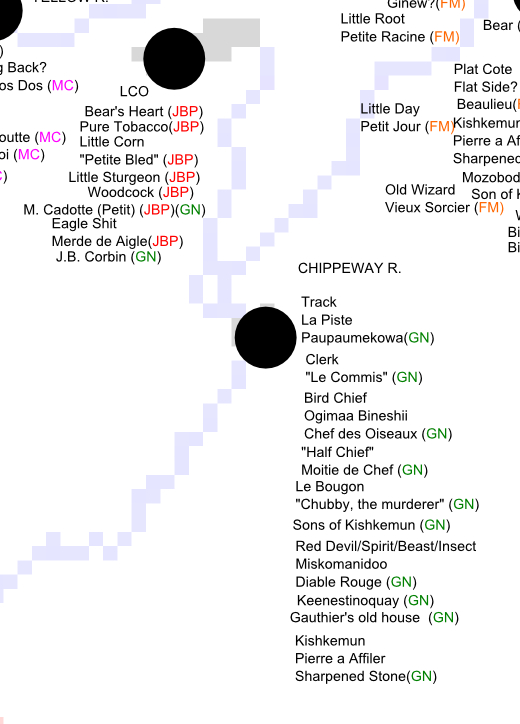
Lac Courte Oreilles and Chippewa River: Many of the men mentioned at LCO by Perrault are found in Warren. Little (Petit) Michel Cadotte was a cousin of the La Pointe trader, Big (Gichi/La Grande) Michel Cadotte. The “Red Devil” appears in Schoolcraft’s account of 1831. The old, respected Lac du Flambeau chief Giishkiman appears in several villages in these journals. As the father of Keenestinoquay and father-in-law of Simon Charette, a fur-trade power couple, he traded with Curot and Nelson who worked with Charette in the XY Company.

La Pointe: Unfortunately, none of the traders spent much time at La Pointe, but they all mention Michel Cadotte as being there. The family of Gros Pied (Mamaangizide, “Big Feet”) the father of Waabojiig, opened up his lodge to Perrault when the trader was waylaid by weather. According to Schoolcraft and Warren, the old war chief had fought for the French on the Plains of Abraham in 1759.

Lac du Flambeau: Malhoit records many of the same names in Lac du Flambeau that Nelson met on the Chippewa River. Simon Charette claimed much of the trade in this area. Mozobodo and “Magpie” (White Crow), were his brothers-in-law. Since I’ve written so much about chiefs named Buffalo, I should point out that there’s an outside chance Le Taureau (presumably another Bizhiki) could be the famous Chief Buffalo of La Pointe.

L’Anse, Ontonagon, and Lac Vieux Desert: More Cadottes and Roys, but otherwise I don’t know much about these men.

At Mackinac and the Soo, Perrault encountered a number of names that either came from “The West,” or would find their way there in later years. “Cadotte” is probably Jean Baptiste Sr., the father of “Great” Michel Cadotte of La Pointe.

Malhoit meets Jean Baptiste Corbin at Kaministiquia. Corbin worked for Michel Cadotte and traded at Lac Courte Oreilles for decades. He was likely picking up supplies for a return to Wisconsin. Kaministiquia was the new headquarters of the North West Company which could no longer base itself south of the American line at Grand Portage.
Initial Conclusions
There are many stories that can be told from the people listed in these maps. They will have to wait for future posts, because this one only has space to introduce the project. However, there are two important concepts that need to be mentioned. Neither are new, but both are critical to understanding these maps:
1) There is a great potential for misidentifying people.
Any reading of the fur-trade accounts and attempts to connect names across sources needs to consider the following:
- English names are coming to us from Ojibwe through French. Names are mistranslated or shortened.
- Ojibwe names are rendered in French orthography, and are not always transliterated correctly.
- Many Ojibwe people had more than one name, had nicknames, or were referenced by their father’s names or clan names rather than their individual names.
- Traders often nicknamed Ojibwe people with French phrases that did not relate to their Ojibwe names.
- Both Ojibwe and French names were repeated through the generations. One should not assume a name is always unique to a particular individual.
So, if you see a name you recognize, be careful to verify it’s reall the person you’re thinking of. Likewise, if you don’t see a name you’d expect to, don’t assume it isn’t there.
2) When talking about Ojibwe bands, kinship is more important than physical location.
In the later 1800s, we are used to talking about distinct entities called the “St. Croix Band” or “Lac du Flambeau Band.” This is a function of the treaties and reservations. In 1800, those categories are largely meaningless. A band is group made up of a few interconnected families identified in the sources by the names of their chiefs: La Grand Razeur’s village, Kishkimun’s Band, etc. People and bands move across large areas and have kinship ties that may bind them more closely to a band hundreds of miles away than to the one in the next lake over.
I mapped here by physical geography related to trading posts, so the names tend to group up. However, don’t assume two people are necessarily connected because they’re in the same spot on the map.
On a related note, proximity between villages should always be measured in river miles rather than actual miles.
Going Forward
I have some projects that could spin out of these maps, but for now, I’m going to set them aside. Please let me know if you see anything here that you think is worth further investigation.
Sources:
Curot, Michel. A Wisconsin Fur Trader’s Journal, 1803-1804. Edited by Reuben Gold Thwaites. Wisconsin Historical Collections, vol. XX: 396-472, 1911.
Malhoit, Francois V. “A Wisconsin Fur Trader’s Journal, 1804-05.” Collections of the State Historical Society of Wisconsin. Ed. Reuben Gold Thwaites. Vol. 19. Madison: State Historical Society of Wisconsin, 1910. 163-225. Print.
Nelson, George, Laura L. Peers, and Theresa M. Schenck. My First Years in the Fur Trade: The Journals of 1802-1804. St. Paul, MN: Minnesota Historical Society, 2002. Print.
Perrault, Jean Baptiste. Narrative of The Travels And Adventures Of A Merchant Voyager In The Savage Territories Of Northern America Leaving Montreal The 28th of May 1783 (to 1820) ed. and Introduction by, John Sharpless Fox. Michigan Pioneer and Historical Collections. vol. 37. Lansing: Wynkoop, Hallenbeck, Crawford Co., 1900.
Schoolcraft, Henry Rowe. Information Respecting The History,Condition And Prospects OF The Indian Tribes Of The United States. Illustrated by Capt. S. Eastman. Published by the Authority of Congress. Part III. Philadelphia: Lippincott, Grambo & Company, 1953.
Schoolcraft, Henry Rowe, and Philip P. Mason. Expedition to Lake Itasca; the Discovery of the Source of the Mississippi. East Lansing: Michigan State UP, 1958. Print.
Warren, William W., and Theresa M. Schenck. History of the Ojibway People. St. Paul: Minnesota Historical Society, 2009. Print.
Chief Buffalo, Flat Mouth, and Tecumseh
April 28, 2013
 The Shawnee Prophet, Tenskwatawa painted by Charles Bird King c.1820 (Wikimedia Commons)
In contrast with other Great Lakes nations, the Lake Superior Ojibwe are often portrayed as not having had a role in the Seven Years War, Pontiac’s War, Tecumseh’s War, or the War of 1812. The Chequamegon Ojibwe are often characterized as being uniformly friendly toward whites, peacefully transitioning from the French and British to the American era. The Ojibwe leaders Buffalo of La Pointe and Flat Mouth of Leech Lake are seen as men who led their people into negotiations rather than battle with the United States.
No one tried harder to promote the idea of Ojibwe-American friendship than William W. Warren (1825-1853), the Madeline Island-born mix-blooded historian who wrote History of the Ojibway People. Warren details Ojibwe involvement in all of these late-18th and early 20th-century imperial conflicts, but then repeatedly dismisses it as solely the work of more easterly Ojibwe bands or a few rogue warriors. The reality was much more complicated.
It is true, the Lake Superior Ojibwe never entered into these wars as a single body, but the Lake Superior Ojibwe rarely did anything as a single body. Different bands, chiefs, and families pursued different policies. What is clear from digging deeper into the sources, however, is that the anti-American resistance ideologies of men like the Tecumseh and his brother Tenskwatawa (The Prophet) had more followers around here than Warren would have you believe. The passage below, from none other than Warren himself, shows that these followers included Buffalo and Flat Mouth.
History of the Ojibway People is available free online, but I’m not going to link to it. I want you to check out or buy the second edition, edited and annotated by Theresa Schenck and published by the Minnesota Historical Society in 2009. It is not the edition I first read this story in, but this post does owe a great debt to Dr. Schenck’s footnotes. Also, if you get the book, you will find the added bonus of a second account of these same events from Julia Warren Spears, William’s sister (Appendix C). The passage that is reproduced here can be read on pages 227-231.
“… no event of any importance occured on the Chippeway and Wisconsin Rivers till the year 1808, when, under the influence of the excitement which the Shaw-nee prophet, brother of Tecumseh, succeeded in raising, even to the remotest village of the Ojibways, the men of the Lac Coutereille village, pillaged the trading house of Michel Cadotte at Lac Coutereilles, while under charge of a clerk named John Baptiste Corbin. From the lips of Mons. Corbin, who is still living at Lac Coutereille, at the advanced age of seventy-six years, and who has now been fifty-six years in the Ojibway country, I have obtained a reliable account of this transaction…”
“…In the year 1808, during the summer while John B. Corbin had charge of the Lac Coutereille post, messengers, whose faces were painted black, and whose actions appeared strange, arrived at the different principal villages of the Ojibways. In solemn councils they performed certain ceremonies, and told that the Great Spirit had at last condescended to hold communion with the red race, through the medium of a Shawano prophet, and that they had been sent to impart the glad tidings.
The Shawano sent them word that the Great Spirit was about to take pity on his red children, whom he had long forsaken for their wickedness. He bade them to return to the primitive usages and customs of their ancestors, to leave off the use of everything which the evil white race had introduced among them. Even the fire-steel must be discarded, and fire made as in ages past, by the friction of two sticks. And this fire, once lighted in their principal villages, must always be kept sacred and burning. He bade them to discard the use of fire-water—to give up lying and stealing and warring with one another. He even struck at some of the roots of the Me-da-we religion, which he asserted had become permeated with many evil medicines, and had lost almost altogether its original uses and purity. He bade the medicine men to throw away their evil and poisonous medicines, and to forget the songs and ceremonies attached thereto, and he introduced new medicines and songs in their place. He prophesied that the day was nigh, when, if the red race listened to and obeyed his words, the Great Spirit would deliver them from their dependence on the whites, and prevent their being finally down-trodden and exterminated by them. The prophet invited the Ojibways to come and meet him at Detroit, where in person, he would explain to them the revelations of the “Great Master of Life.” He even claimed the power of causing the dead to arise, and come again to life.
It is astonishing how quickly this new belief obtained possession in the minds of the Ojibways. It spread like wild-fire throughout their entire country, and even reached the remotest northern hunters who had allied themselves with the Crees and Assiniboines. The strongest possible proof which can be adduced of their entire belief, is in their obeying the mandate to throw away their medicine bags, which the Indian holds most sacred and inviolate. It is said that the shores of Sha-ga-waum-ik-ong were strewed with the remains of medicine bags, which had been committed to the deep. At this place, the Ojibways collected in great numbers. Night and day, the ceremonies of the new religion were performed, till it was at last determined to go in a body to Detroit, to visit the prophet. One hundred and fifty canoes are said to have actually started from Pt. Shag-a-waum-ik-ong for this purpose, and so strong was their belief, that a dead child was brought from Lac Coutereille to be taken to the prophet for resuscitation.
This large party arrived on their foolish journey, as far as the Pictured Rocks, on Lake Superior, when, meeting with Michel Cadotte, who had been to Sault Ste. Marie for his annual outfit of goods, his influence, together with information of the real motives of the prophet in sending for them, succeeded in turning them back.
The few Ojibways who had gone to visit the prophet from the more eastern villages of the tribe, had returned home disappointed, and brought back exaggerated accounts of the suffering through hunger, which the proselytes of the prophet who had gathered at his call, were enduring, and also giving the lie to many of the attributes which he had assumed. It is said that at Detroit he would sometimes leave the camp of the Indians, and be gone, no one knew whither, for three and four days at a time. On his return he would assert that he had been to the spirit land and communed with the master of life. It was, however, soon discovered that he only went and hid himself in a hollow oak which stood behind the hill on which the most beautiful portion of Detroit City is now built. These stories became current among the Ojibways, and each succeeding year developing more fully the fraud and warlike purpose of the Shawano, the excitement gradually died away among the Ojibways, and the medicine men and chiefs who had become such ardent believers, hung their heads in shame whenever the Shawano was mentioned.

 Two men of “strong minds and unusual intelligence,” Buffalo of La Pointe (top) and Eshkibagikoonzhe or “Flat Mouth” of Leech Lake. (Wisconsin Historical Society) (Minnesota Historical Society)
At this day it is almost impossible to procure any information on this subject from the old men who are still living, who were once believers and preached their religion, so anxious are they to conceal the fact of their once having been so egregiously duped. The venerable chiefs Buffalo, of La Pointe, and Esh-ke-bug-e-coshe, of Leech Lake, who have been men of strong minds and unusual intelligence, were not only firm believers of the prophet, but undertook to preach his doctrines.
One essential good resulted to the Ojibways through the Shawano excitement–they threw away their poisonous roots and medicines, and poisoning, which was formerly practiced by their worst class of medicine men, has since become entirely unknown.
So much has been written respecting the prophet and the new beliefs which he endeavored to inculcate amongst his red brethren, that we will no longer dwell on the merits or demerits of his pretended mission. It is now evident that he and his brother Tecumseh had in view, and worked to effect, a general alliance of the red race, against the whites, and their final extermination from the ‘Great Island which the great spirit had given as an inheritance to his red children.’”
From 1805 to 1811, the Shawnee Prophet Tenskwatawa and his brother Tecumseh spread a religious and political message from the Canadas in the north, to the Gulf of Mexico in the south, to the prairies of the west. They called for all Indians to abandon white ways, unite as one people, and create a British-protected Indian country between the Ohio and the Great Lakes. While he seldom convinced entire nations (including the Shawnee) to join him, Tecumseh gained followers from all over.
 This picture of Tecumseh in British uniform was painted decades after his death by Benson John Lossing (Wikimedia Commons)
His coalition came apart, however, at the Battle of Tippecanoe on November 7, 1811. Tecumseh was away recruiting more followers when American forces under William Henry Harrison defeated Tenskwatawa. Accounts suggest it was a closely-fought battle with the Americans suffering the most casualties. However, in the end Harrison prevailed due to his superior numbers.
With Tenskwatawa discredited, Tecumseh ended up raising a new coalition to fight alongside the British against the Americans in the War of 1812. He was killed in the Battle of the Thames, October 5, 1813, when the British forces under General Henry Procter abandoned their Indian allies on the battlefield.
After the War of 1812, British traders pulled out of their posts in American territory. However, the Ojibwe of Lake Superior continued to trade across the line in Canada. In 1822, the American agent Henry Schoolcraft’s gave his first description of Buffalo, a man he would come to know well over the next thirty-five years. He described “a chief decorated with British insignia.” Ten years later, Flat Mouth was telling Schoolcraft he had no right or ability to stop the Ojibwe from allying with the British. These chiefs were not men who were unwavering friends of the United States for their whole lives.
Buffalo and Flat Mouth lived to be very old men, and lived to see the Ojibwe cede their lands in treaties, suffer the tragic 1850-51 removal to Sandy Lake, and see the beginnings of a paternalist American regime on the newly-created reservations. Their Shawnee contemporary, Tecumseh, did not live that long.
Tecumseh’s life and death are documented in the second episode of the 2009 television miniseries American Experience: We Shall Remain. The episode, Tecumseh’s Vision, is very good throughout. The most interesting part comes at the very end when several of the expert interviewees comment on the meaning of Tecumseh’s death:
“I think Tecumseh is, in a sense, saved by his death. He’s saved for immortality through death on the battlefield.”
Stephen Warren, Augustana College
“One of the great things in icons is to bow out at the right time, and one of the things Tecumseh does is he never lets you down. He was there, articulating his position — uncompromisingly pro-Native American position. He never signs the treaties. He never reneges on those basic as principles of the sacrosanct aboriginal holding of this territory. He bows out at the peak of this great movement he is leading. He’s there, right at the end, whatever the odds are, fighting for it into the dying moments.”
John Sugden, author Tecumseh: A Life
“For some people, they may call him a troublemaker. And I think that’s because, in the end, he lost. Had he won, he’d have been, you know, a hero. But I think, to a degree, he still has to be recognized as a hero, for what he attempted to do. If he had a little more help, maybe he would have got a little farther down the line. If the British would have backed him up, like they were supposed to have, maybe the United States is only half as big as it is today.”
Sherman Tiger, Absentee Shawnee Tribe of Oklahoma
Stephen Warren and John Sugden indicate that he is a hero because of the way he died. Sherman Tiger seems to say that Tecumseh’s death, in part, is what kept him from being a hero, and that if he had more men, maybe his “vision” of a united Indian nation would have come true.
In 1811, the Ojibwe of Lake Superior and the upper Mississippi had hundreds of warriors experienced in battle with the Dakota Sioux. They were heirs to a military tradition that defeated the Iroquois and the Meskwaki (Fox). A handful of Ojibwe did fight beside Tecumseh, and according to John Baptiste Corbine through Warren, many more could have. It’s possible they could have tipped the balance and caused Tippecanoe or Thames to end differently. It is also possible that Buffalo, Flat Mouth, and other future Ojibwe leaders could have died on the battlefield.
Tecumseh died young and uncompromised. Buffalo and Flat Mouth faced many tough decisions and lived long enough to see their people lose their independence and most of their land. However, they were there to lead their people through the hard times of the removal period. Tecumseh wasn’t.
Ultimately, it’s hard to say which is more heroic? What do you think?
Sources:
Schenck, Theresa M., William W. Warren: The Life, Letters, and times of an Ojibwe Leader. Lincoln: University of Nebraska, 2007. Print.
Schoolcraft, Henry Rowe, and Philip P. Mason. Expedition to Lake Itasca; the Discovery of the Source of the Mississippi,. [East Lansing]: Michigan State UP, 1958. Print.
Schoolcraft, Henry R. Personal Memoirs of a Residence of Thirty Years with the Indian Tribes on the American Frontiers: With Brief Notices of Passing Events, Facts, and Opinions, A.D. 1812 to A.D. 1842. Philadelphia: Lippincott, Grambo and, 1851. Print.
Warren, William W., and Theresa M. Schenck. History of the Ojibway People. St. Paul: Minnesota Historical Society, 2009. Print.
White, Richard. The Middle Ground: Indians, Empires, and Republics in the Great Lakes Region, 1650-1815. Cambridge: Cambridge UP, 1991. Print.
Witgen, Michael J. An Infinity of Nations: How the Native New World Shaped Early North America. Philadelphia: University of Pennsylvania, 2012. Print.
 Chequamegon History