Penokee Survey Incidents: Number VI
March 14, 2015
By Amorin Mello

December 22, 1877.
The Survey of the Penoka Range and Incidents Connected with its Early History.
—
Number VI.
At length, somewhere about the 25th of October, the General returned from below, accompanied by his son, Joseph Cutler, George Spaulding, a young man who had formerly been in his employ in Maine, and Henry C. Palmer of Milwaukee, a son of President Palmer, who all came to hold claims for the Company, if wanted. He also brought two cook stoves and two metal kettles, the stoves for housekeeping, the kettles for sugar making. Both of the kettles and one of the stoves were subsequently sent to the Range, where they did good service during the winter and following spring, and are no doubt in use somewhere in the country today.
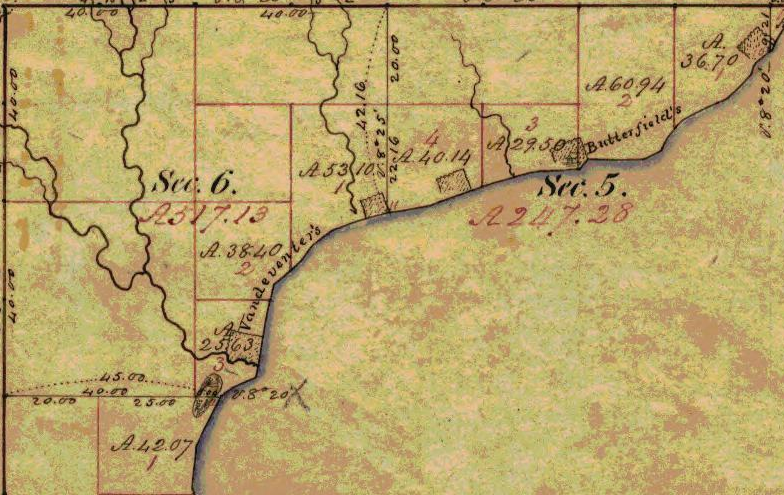
Houghton was a small settlement in the Town of BayPort, located northeast of what is now the City of Washburn. Captain Steven Butterfield and Peter B Vanderventer lived at what is now Washburn. (Detail from Augustus H. Barber’s survey during August of 1855)

Antoine Gordon from Noble Lives of a Noble Race (pg. 207) published by the St. Mary’s Industrial School in Odanah.
These kettles and stoves came very near sending Gen. Cutler, myself and Mr. Sidebotham, who had been stopping at La Pointe for several weeks, awaiting events, to a watery grave, during the run from that place to Ashland, in the Jane, a large two-masted boat formerly used by the Government upon the lake coast survey. Nothing but the coolness and skill of Captain Steve Butterfield, who was at the helm, saved us from going to the bottom. It was a long time before the recollections of that November day ceased to haunt us. The idea of going down in 150 feet of water with such a load, was not a pleasant thing to contemplate. Mr. Sidebotham was wholly unconscious, until after he reached the shore, of the peril we were in, owing to his ignorance of nautical affairs, but not so the General. He realized it as keenly as I did, not a word was spoken for over an hour, but in that hour we lived a lifetime. At length we succeeded in reaching the land at Houghton, where the high rocky shore furnished a lee. I shall never forget that ride while I live. We stopped for dinner at Antoine Gordon‘s, who lived at that time a little to the westward of Houghton, after which we ran down the shore to Pete Vanderventer‘s old place before venturing to cross the Bay to Ashland, which however, we finally did, reaching there in safety about sunset. Here we left Mr. Sidebotham to remain until wanted, and with J. Cutler, Palmer, and Spaulding, started the next morning for the Range, reaching there the second day at noon. Immediately upon our arrival, an interview was had with Stuntz, who informed us that if the fine weather we were then enjoying should continue for three weeks more, the survey to complete which he was making every possible exertion, would be finalized. This was to us indeed joyful news, as we were getting very anxious to return to our homes for the winter; whereupon all of our spare men were at once detailed to assist him, leaving me alone at Penoka, the General, in the meantime, visiting the different locations, and arranging for the winter, during which a blockhouse was to be built at Penoka, and one at the Gorge, which was done, the lumber for both being manufactured upon the ground, with a whip saw. Up to this time there had been no snow except the usual light fall we had every year, about the 1st of November. This, however, had all disappeared in three days after it fell, after which the weather was beautiful. In this way the time passed along, I seeing no one except Gen. Cutler, who came occasionally, or some of Stuntz’s men, who came for supplies, which were at this time kept mostly at Penoka, until the 12th of November, when it being certain that one week more would finish the survey, General Cutler left for Ashland, after Mr. Sidebotham, who by the requirements of the pre-emption law, must sleep upon his claim the 30th, in order to hold it, at least we so understood it at the time, leaving me entirely alone.
The weather continued fair up to the 18th, when there came a change. Saturday, the 17th, was as fine an Indian summer day as I ever saw, nearly all of which I slept seated upon a log in front of the cabin, listening to the singing of the birds, many of them not yet having left us for their homes in the south, and watching them as they were fitting around me, in search of food. At length old Sol sunk in the west, and night once more spread her dark mouth over the surrounding landscape. A strange feeling of loneliness, such as I had never felt before, crept over me as I closed the door of the cabin for the night, and sought my couch of balsam boughs, where I slept soundly until 6 o’clock the following morning, when presto! what a change met my eye! The air so soft and clear the previous evening, was now filled with snow, while upon the ground it was two and a half feet in depth, and increasing rapidly. You can easily imagine that I was not a little startled at the outlook, as being snowed in upon Lake Superior was no joke; and from the rapidity with which it was falling, it was apparent that it would be six feet in depth in twenty-four hours, if it kept on. I quickly saw that the first thing to be done was to lay in a supply of wood, the nearest pile of which was thirty rods distant. To this a track was quickly made, and the work of moving it commenced; neither did it stop until 2 P.M., at which time the whole pile, one and a half cords was in the cabin. The snow was now three feet in depth, but very light. My wood secured, I proceeded to cook some food, of which I felt the need, after which my thoughts began to wander after Stuntz and party, who were fifteen miles south. Neither did they reach the Range until the fourth day, as they had but one mile to run, in order to complete, when the storm came. This done, they started, and were three days in making that fifteen miles, during one of which, the last, they had nothing to eat, and one of them, Wilhelm Goetzenburg, literally nothing to wear, being clad in duck pants, hickory shirt, and stoga boots, no stockings, coat or vest. They were all badly used up when they got in; Stevens, in particular, who gave out when within only three miles of the Range, where he remained until his companions had reached the cabin, and two of them returned to him with some food, after which he came in, but as weak as to render it necessary to lead him. It was several days before he fully recovered his former strength. Goetzenburg, although nearly naked, stood it the best of them all. Perhaps a short sketch of this curious mortal, who certainly exhibited upon this occasion, powers of endurance equal to the gay and festive mule may not be inopportune, in this connection, before closing this article.
Wilhelm Goetzenburg, or Gutsenburg, as George Miller once spelt it when directing a letter for him to his “bruder” in Ontonagon, was not an Adonis, in the strict sense of the term. No sir! his keel was laid for a jumping jack, but from some unexplained cause, that plan was abandoned by his builder, who finally modeled him after the tubs the performing elephants use in the circus, broad at the base; in fact, his basement story was the largest part of him, in fact, nearly all of him; his legs, which were bowed, were short; his arms were long; his chest was short, and shaped like the dummies we see in the windows of ladies’ furnishing stores; his shoulders were broad, upon which a head covered with a thick mat of coarse hair, in color like that of a North Carolina clay-eater; a short nose, and a mouth that if open would have fooled a badger. Taken as a whole, he looked like a mixture of Low Dutch, Esquimaux and New Zealander combined. But beneath that iron frame, beat as honest a heart as ever beat in Ashland, or any other land. Good luck to thee, honest Wilhelm, I shall never see thy like again, but wherever thou arts or goest, may beans be plenty and clothing cheap. But en resume.
The fifth day brought Gen. Cutler from Ashland, accompanied by Mr. Sidebotham, George Kilburn, Sibley, Steve Sanborn, and George Miller, with the pack horses, who all came to break the road, except Sanborn, who came to stay through the winter. The boys had also now got in from the different claims, and the old cabin was full. Here they all remained for two days, when there came a thaw and melted the snow, after which Uncle George and Sibley returned to the Marengo, and George Miller with the horses to Ashland. The rest remained until the 30th, when their claims secured, and the arrangements for the winter completed. Mr. Arthur E. Wheelock was placed in charge of the week with J. Culter, Palmer, Steve Sanborn, Spaulding, and Elie Valliant, a French Canuck, formerly a resident at Ironton, a ship and house carpenter by trade, as companions. This done, Gen. Cutler and myself, Sidebotham, McClelland, Chase, and Al. Stevens accompanied by two of Stuntz’s men, whose names I have forgotten, left for home. We camped the first night at the Marengo, where the boys, as usual, hid the sugar from Mr. Sidebotham, reaching Ashland the second day. Here we remained for two days, when leaving Mr. Sidebotham, as previous stated, we took our departure, going directly across the bay upon the ice, for Pete Vanderventer’s. Before reaching the shore, however, Chase, who led the party, broke in, and came very near drowning, as in addition to his pack and snowshoes, which were also carried, he had on rubber boots, the legs of which held water enough to run a milk factory for a week. He was finally pulled out and inverted a few moments to let him drain, after which we proceeded, reaching Antoine Gordon’s at dark, and reached Bayfield the second day, the last six miles being made in an open boat, obtained, from the Indians at Sioux River, which was returned by Wheelock and William Pell, who had accompanied us thus far on the way.
From Bayfield to Superior City on snow shoes, occupied seven days, during which we camped on the snow every night. This, although a hard tramp, was very much enjoyed by all. The last three days our route lay along the shore of the lake, where many laughable scenes occurred in the way of tumbles from the ice bergs that lined the shore. From Superior City via St. Paul and La Crosse, to New Lisbon by stage, occupied nine days. From New Lisbon by cars to Milwaukee, one day, reaching that place Dec. 25, 1857. J.S.B.
Penokee Survey Incidents: Number IV
February 22, 2015
By Amorin Mello
December 8, 1877.
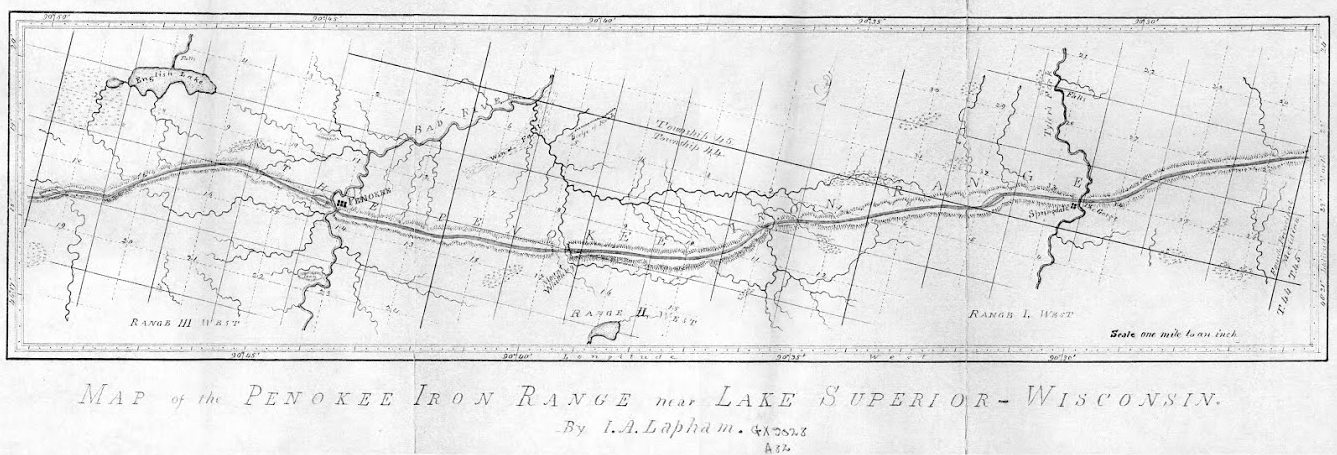
Increase Allen Lapham surveyed the Penokee Iron Range in September of 1858 for the Wisconsin & Lake Superior Mining and Smelting Company. Years later, Lapham’s experience was published as “Mountain of Iron Ore: The buried wealth of Northern Wisconsin“ in the Milwaukee Evening Wisconsin newspaper on February 21, 1887. (Image courtesy of the University of Wisconsin Geography Department)
~ 1978 Marsden Report for US Steel.
~ Railroad History, Issues 54-58, pg. 26
The Penoka Iron Range consists, as is well known, of a sharp ridge, some fifteen miles in length, by from one to one and one half in breadth, with a mean elevation of 700 feet above Lake Superior, from which is a distance about twenty-two miles, as the crow flies, its general trend being nearly east and west, it is densely covered with timber consisting of sugar maple, (of which nearly every tree is birdseye or curly) elm, red cedar, black, or yellow birch, some of which are of an enormous girth, among which are intermixed a few white pine and balsams, for it is traversed from north to south at three different points, by running streams, upon each of which the company had a station, the western being known in the vernacular of the company, as Palmer’s, (now Penoka); the center, as Lockwood’s, in honor of John Lockwood, who was at the time a prominent member of the Company, and upon its executive board; and the eastern, as Sidebotham’s, or “The Gorge.” These were the principal stations or centers, where supplies and men were always kept, and as which, as before stated, more or less work had been done the previous year. Penoka, as which the most work had been done, being considered by far the most valuable. This post was, at the time of my first visit, by charge of S.R. Marston, of whom mention was made in my last, and two young boys from Portsmouth, N.H., who had come west on exhibition, I should say, from the way they acted. They soon left, however, too many mosquitoes for them. “Lockwood’s,” as previously stated, was garrisoned by one man, whose name I have forgotten, and although a great amount of work had been done here as yet, it was nevertheless considered a very valuable claim, on account of the feasibility with which it could be reached by the rail Mr. Herbert had in contemplation to build from Ironton, and which would, in passing along the north side of the Range, come in close proximity to this station; besides, it had the additional advantages of a fine water power. At the east end were two half-breeds employed by the company, and George Chase, a young man from Derby, Vermont, a nephew of ex-Mayor Horace, and Dr. Enoch Chase, of Milwaukee, an employee of Stuntz, who, with James Stephenson, was awaiting the return of Gen. Cutler with reinforcements, in order to continue the survey. Chase subsequently made a claim which he was successful in securing – selling it finally to the Mr. Cogswell, of Milwaukee.
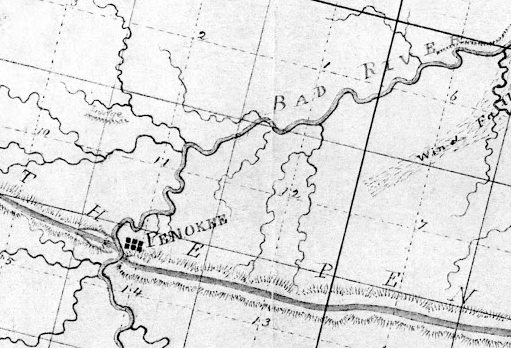
Penoka, aka Penokee, is Palmer’s station near the Bad River Gap.
It is also proper to state in addition to what has been already mentioned, that at, or about this time, a road was opened by Mr. Herbert’s order, from the Hay Marsh, six miles out from Ironton, to which point one had been previously opened, to the Range, which it struck about midway between Sidebotham’s and Lockwood’s Stations, over which, I suppose, the 50,000 tons as previously mentioned, was to find its way to Ironton, (in a horn). For this work, however, the Company refused to pay, as they had not authorized it; neither had Mr. Herbert, at that time, any authority to contract for it, except at his own risk; his appointment as agent having already been revoked; although his accounts had not, as yet, been fully settled. This work, which was without doubt, intended to commit the company still further in favor of Ironton as an outlet for the iron, was done by Samuel Champner, a then resident of Ashland and who if living is probably that much out of pocket today. No use was ever made of this road by the Company, not one of their employees, to my knowledge, ever passing over it.

The location of Lockwood’s station was not mapped by Lapham or by Stuntz. City Creek and Ballou Creek are the two water gaps on either side of Mount Whittlesey, midway between the gaps of Bad River and Tyler’s Fork.
This description will, I think, give your readers a very good understanding of the condition as well as the true inwardness of the affairs of the Wisconsin & Lake Superior Mining and Smelting Co., in the month of June, 1857.
At length, after remaining on the Range nearly three weeks, awaiting, Micawber like, for something to turn up, a change came with the arrival of Gen. Cutler from Milwaukee with the expected reinforcements. Mr. Herbert at once left the Range, went to Milwaukee and settled up with the Company, after which, to use a scriptural expression, “he walked no more with us.”

Springdale is Sidebotham’s station at The Gorge of Tyler Fork’s River.
“A special defense in contract law to allow a person to avoid having to respect a contract that she or he signed because of certain reasons such as a mistake as to the kind of contract.”
~ Duhaime.org
Wheelock, Smith, and McClellan were at once placed upon claims – McClellan in the interest of John Cummings, (whose name by an oversight was also omitted from the list of stockholders, given in my first paper), and Wheelock and Smith for the Company generally. Subsequently, A.S. Stacy, of Canada, was also employed to hold a claim. How well he performed this duty, will be seen further on. This done, the improvements necessary to be made in order to entitle us to the benefits of the preemption law were at once commenced. These improvements consisted of log cabins, principally, of which some twenty in all were erected upon the different claims. These cabins would have been a study for Michel Angelo, or Sir Christopher Wren. They had more angles than the Forty-seventh Problem of Euclid, with an average inclination of fifteen degrees to the Ecliptic. O, but they were “fearfully and wonderfully made,” were these cabins. Their construction embodied all the principle points of architecture in the Ancient as well as Modern–Milesian-Greek, mixed with the “hoop skirt” and Heathen Chimee. Probably ten dollars a month would have been considered a high rent for any of them. No such cabins as those were in exhibition at the Centennial, no sir. Rome was not built in a day, but most of these cabins were. I built four myself near the Gorge, in a day, with the assistance of two halfbreeds, but was not able to find them a week afterwards. This is not only a mystery but a conundrum. I think some traveling showman must have stolen them; but although they were non est we could swear that we had built them, and did.
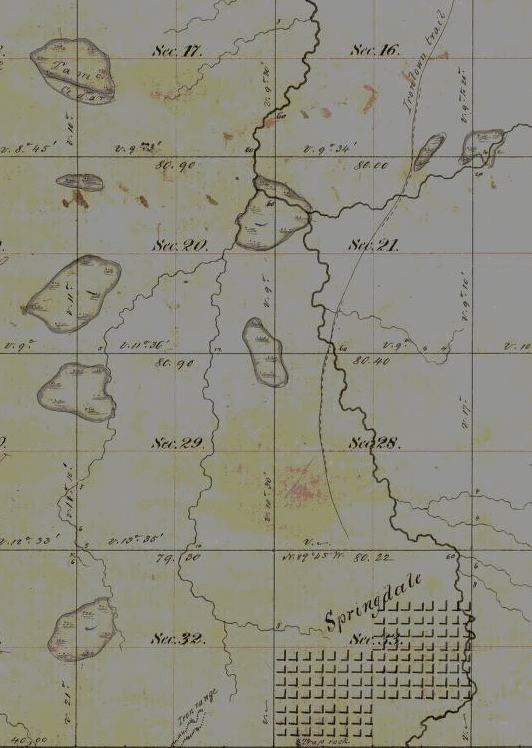
Springdale townsite plan at Sidebotham’s station by The Gorge of Tyler’s Fork in close proximity to the Ironton Trail and Iron Range. (Detail of Stuntz’s survey during August of 1857.)
Three were accordingly platted — one at Penoka, one at Lockwood‘s and one at the Gorge. And in order that it might be done without interfering with the regular survey, Gen. Cutler decided to place S.R. Marston who, in addition to his other accomplishments, claimed to be a full-fledged surveyor, in charge of the work, assisted by Wheelock, Smith and myself. He commenced at the Gorge, run three lines and quit, fully satisfied that he had greatly overestimated his abilities. We were certainly satisfied that he had. A drunken man could have reeled it off in the dark and come nearer the corner than he did. He was a complete failure in every thing he undertook. He left in the fall after the failure of the Sioux Scrip plot. Where he went I never knew. George E. Stuntz was subsequently put upon the work, which he was not long in doing, after which he rejoined Albert on the main work. This main work, however, for the completion of which we were all so anxious, was very much delayed, the cause for which we did not at the time fully understand, but we did afterwards. J.S.B.
 Chequamegon History