Chief Buffalo Picture Search: The Island Museum Painting
November 9, 2013
This post is one of several that seek to determine how many images exist of Great Buffalo, the famous La Pointe Ojibwe chief who died in 1855. To learn why this is necessary, please read this post introducing the Great Chief Buffalo Picture Search.

(Wisconsin Historical Society, Image ID: 3957)
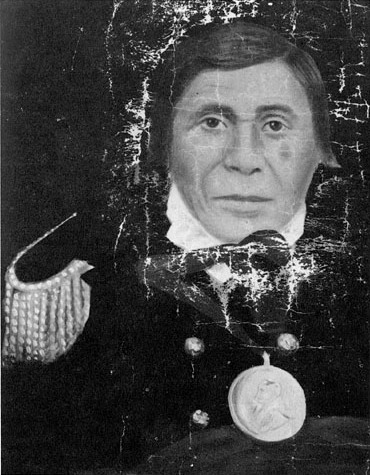
Wisconsin Historical Society WHI(x3)41266
If any image has been as closely tied to Chief Buffalo from La Pointe as the the bust of the Leech Lake Buffalo in Washington, it is an image of a kindly but powerful-looking man in a U.S. Army jacket with a medal around his neck. This image appears on the cover of the 1999 edition of Walleye Warriors, by treaty-rights activist Walter Bresette and Rick Whaley. It is identified as Buffalo in both Ronald Satzʼs Chippewa Treaty Rights, and Patty Loewʼs Indian Nations of Wisconsin. It occupies a prominent position in the collections of the Wisconsin Historical Society and hangs in the Madeline Island Museum, but in spite of the enduring popularity of this image, very little is known about it.
As I have not been able to thoroughly examine the originals or find any information whatsoever about their creation, chain of custody, or even when they entered the Historical Society’s collections, this post will be the most speculative of the Chief Buffalo Picture Search.
There are two versions of this image. One appears to be an early type of photograph. The Wisconsin Historical Society describes it as “over-painted enlargement, possibly from a double-portrait (possibly an ambrotype).” I’ve been told by staff that the painting that hangs in the museum is a copy of this earlier version.
A photograph of the original image is in the Societyʼs archives as part of the Hamilton Nelson Ross collection. On the back of the photo, “Chief Buffalo, Grandson of Great Chief Buffalo” is handwritten, presumably by Ross. This description would seem to indicate that the image shows one of Chief Buffaloʼs grandsons. However, we need to be careful trusting Ross as a source of information about Buffalo’s family.
Ross, a resident of Madeline Island, gathered volumes of information on his home community in preparation for his book La Pointe Village Outpost on Madeline Island (1960). Although the book is exhaustively researched and highly detailed about the white and mix-blooded populations of the Island, it contains precious little information about individual Indians. The image of Buffalo is not in the book. In fact, the only mention of the chief comes in a footnote about his grave on page 177:
O-Shaka was also known as O-Shoga and Little Buffalo, and he was the son of Chief Great Buffalo. The latter’s Ojibway name was Bezhike, but he was also known as Kechewaishkeenh–the latter with a variety of spellings. Bezhike’s tombstone, in the Indian cemetery, has had the name broken off…
Oshogay was not Buffalo’s son (though he may have been a son-in-law), and he was not the man known as “Little Buffalo,” but until his untimely death in 1853, he seemed destined to take over leadership of Buffalo’s “Red Cliff” faction of the La Pointe Band. The one who did ultimately step into that role, however, was Buffalo’s son Jayjigwyong (Che-chi-gway-on):

Drew, C.K. Report of the Chippewa Agency of Lake Superior. 26 Oct. 1858. Printed in Report of the Commissioner of Indian Affairs. 1858 (Digitized by Google Books)
We will return to Jayjigwyong later in the post, but for now, let’s examine the image itself.
The man in the picture wears an early 19th-century army jacket and a medal. This is consistent with the practices of Chief Buffalo’s day. The custom of handing out flags, jackets, and medals goes back at least to the 1700s with the French. The practice continued under the British and Americans as a way of recognizing certain individuals as chiefs and asserting imperial claims. For the chiefs, the items were symbolic of agreements and alliances. Large councils, treaty signings, and diplomatic missions were all occasions where they were given out. Buffalo had received medals and jackets from the British, and between 1820 and 1855, he took part in the negotiations of at least five treaties, many council meetings and annuity payments, visited Washington, and frequently went back and forth to the agency at Sault Ste. Marie. The United States Government favored Buffalo over the more forcefully-independent chiefs on the Ojibwe-Dakota frontier in Minnesota. Considering all this, it is likely that Buffalo received many jackets, flags, and medals from the Americans over the course of his long interaction with them. An excerpt from a letter by teacher Granville Sproat, who lived in the Lake Superior region in the 1830s reads:
Ke-che Be-zhe-kee, or Big Buffalo, as he was called by the Americans, was then chief of that band of Ogibway Indians who dwell on the south-west shores of Lake Superior, and were best known as the Lake Indians. He was wise and sagacious in council, a great orator, and was much reverenced by the Indians for his supposed intercourse with the Man-i-toes, or spirits, from whom they believed he derived much of his eloquence and wisdom in governing the affairs of the tribe.
“In the summer of 1836, his only son, a young man of rare promise, suddenly sickened and died. The old chief was almost inconsolable for his loss, and, as a token of his affection for his son, had him dressed and laid in the grave in the same military coat, together with the sword and epaulettes, which he had received a few months before as a present from the great father [president] at Washington. He also had placed beside him his favorite dog, to be his companion on his journey to the land of souls (qtd. in Peebles 107).
It is strange that Sproat says Buffalo had only one son given that his wife Florantha Sproat references another son in her description of this same funeral, but sorting out Buffalo’s descendants has never been an easy task. There are references to many sons, daughters, and wives over the course of his very long life.
Another description from the Treaty of 1842 reads:
On October 1 Buffalo appeared, wearing epaulettes on his shoulders, a hat trimmed with tinsel, and a string of bear claws about his neck (Dietrich qtd. in Paap 177-78).
From these accounts we know that Buffalo had these kinds of coats, but dozens of other Ojibwe chiefs would have had similar ones, so the identification cannot be made based on the existence of the coat alone. Consider Naaganab at the 1855 annuity payment:
Na-gon-ub is head chief of the Fond du Lac bands; about the age of forty, short and close built, inclines to ape the dandy in dress, is very polite, neat and tidy in his attire. At first, he appeared in his native blanket, leggings, &c. He soon drew from the Agent a suit of rich blue broadcloth, fine vest, and neat blue cap,–his tiny feet in elegant finely-wrought moccasins. Mr. L., husband of Grace G., with whom he was a special favorite, presented him with a pair of white kid gloves, which graced his hands on all occasions. Some two or three years since, he visited Washington, a delegate from his tribe. Upon this journey, some one presented him with a pair of large and gaudy epaulettes, said to be worth sixty dollars. These adorned his shoulders daily; his hair was cut shorter than their custom. He quite inclined to be with, and to mingle in the society, of the officers, and of white men. These relied on him more, perhaps, than any other chief, for assistance among the Chippewas… (Morse pg. 346)
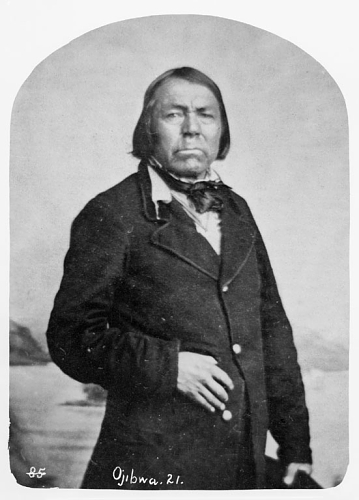
Portrait of Naw-Gaw-Nab (The Foremost Sitter) n.d by J.E. Whitney of St. Paul (Smithsonian)
In many ways, this description of Naaganab fits the image better than any description of Buffalo I’ve seen. The man is dressed in European fashion, has short hair, and large epaulets. We also know that Naaganab had presidential medals, since he continued to display them until his death in the 1890s. The image isn’t dated, but if it truly is an ambrotype, as described by the State Historical Society, that is a technique of photography used mostly in the late 1850s and 1860s. When Buffalo died in 1855, he was reported to be in his nineties. Naaganab would have been in his forties or fifties at that time. To me, the man in the image appears middle-aged rather than elderly.
So is Naaganab the man in the picture? I don’t think so. For one, there are multiple photographs of the Fond du Lac chief out there. The clothing and hairstyle largely match, but the face is different. The other thing to consider is that this image, to my knowledge, has never been identified with Naaganab. Everything I’ve ever seen associates it with the name Buffalo.
However, there is a La Pointe chief who was a political ally of Naaganab, also dressed in white fashion, could have easily owned a medal and fancy army jacket, would have been middle-aged in the 1850s, and bore the English name of “Buffalo.” It was Jayjigwyong, the son of Chief Buffalo.
Alfred Brunson recorded the following in 1843:

(pg. 158) From elsewhere in the account, we know that the “fifty” year-old is Chief Buffalo. This is odd, as most sources had Buffalo in his eighties at that time.
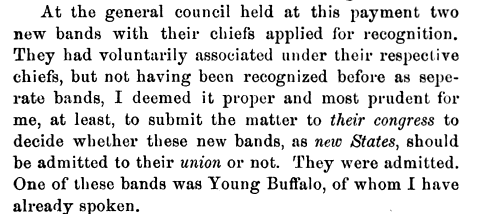
(pg. 191)
Unlike his famous father, Jayjigwyong, often recorded as “Little Buffalo,” is hardly remembered, but he is a significant figure in the history of our region. He was a signatory of the treaties of 1837, 1847, and 1854. He led the faction of the La Pointe Band that felt that rapid assimilation represented the best chance for the Ojibwe to survive and keep their lands. In addition to wearing white clothing and living in houses, Jayjigwyong was Catholic and associated more with the mix-blooded population of the Island than with the majority of the La Pointe band who sought to maintain their traditions at Bad River.
According to James Blackbird, whose father Makadebineshiinh (Black Bird) led the Bad River faction, it was Jayjigwyong who chose where the Red Cliff reservation was to be. James Blackbird, about eleven or twelve at the time of the Treaty of 1854, would have known both the elder and younger Buffalo.
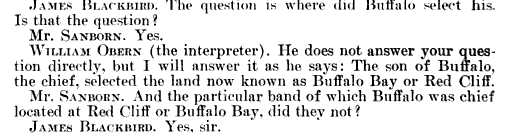
Statement of James Blackbird in the Matters of the Allotments on the Bad River Reservation, Wis. Odanah, 23 Sep. 1909. Published in Condition of Indian affairs in Wisconsin: hearings before the Committee on Indian Affairs, United States Senate, [61st congress, 2d session], on Senate resolution, Issue 263. United States Congress. 1910. Pg. 202.
The younger Blackbird, offered more information about the younger Buffalo in another publication.
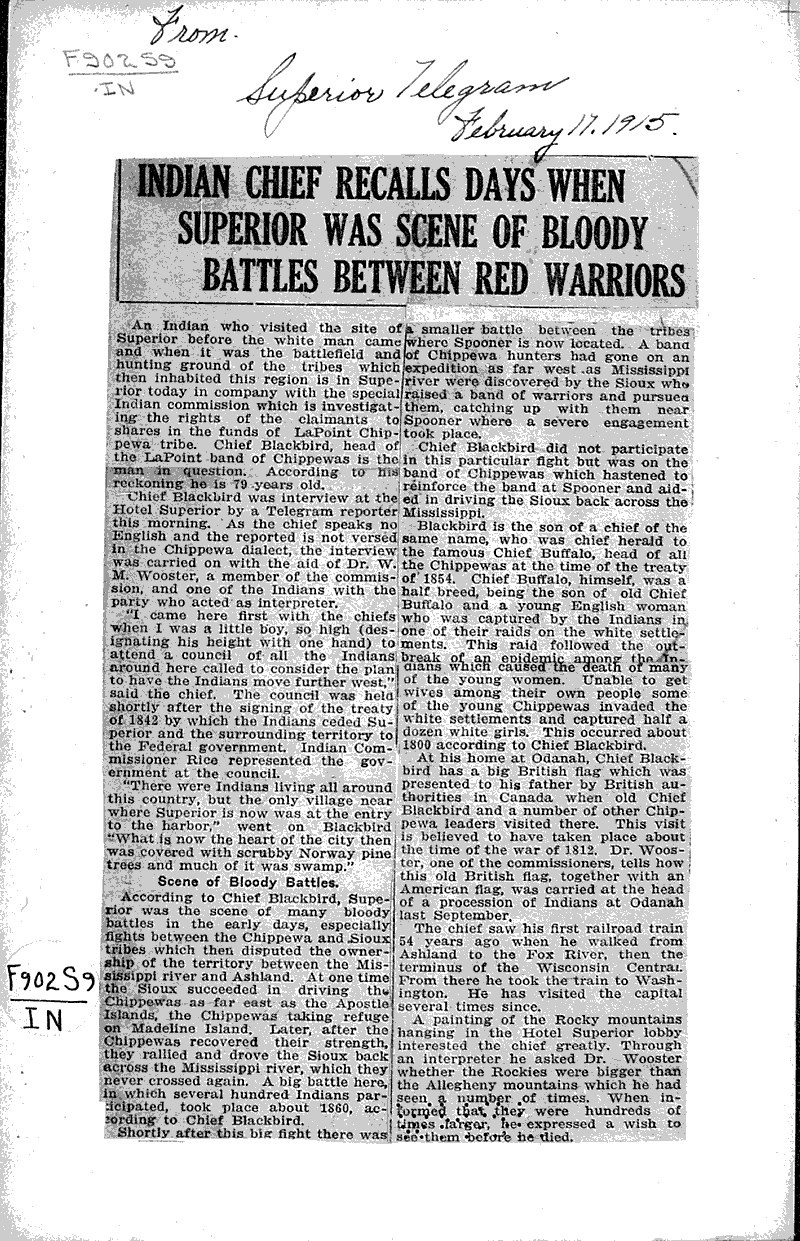
Superior Telegram. 17 Sep. 1915. (Digitized by Wisconsin Historical Society)
Even though it is from 1915, there are a number of items in this account that if accurate are very relevant to pre-1860 history. For this post, I’ll stick to the two that involve Jayjigwyong. This is the only source I’ve ever seen that refers to Chief Buffalo marrying a white woman captured on a raid. This lends further credence to the argument explored by Dietrich and Paap that Chief Buffalo fought in the Ohio Valley wars of the 1790s. It also begs the question of whether being perceived as a “half-breed” had an impact on Jayjigwyong’s decisions as an adult.
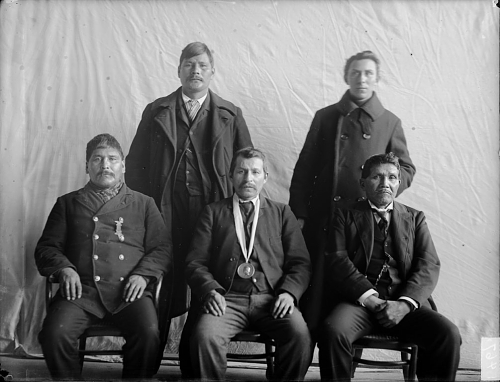
James Blackbird (seated) with interpreter John Medeguan in Washington, 1899. (Photo by Gil DeLancy, Smitsonian Collections)
The other interesting part of the statement is that James Blackbird says his father was pipe carrier for Jayjigwyong. This would be surprising as Blackbird was the most influential La Pointe chief after the death of Buffalo. However, this idea of Jayjigwyong, inheriting the symbolic “head chief” title from his father can also be seen in the following document from 1857:
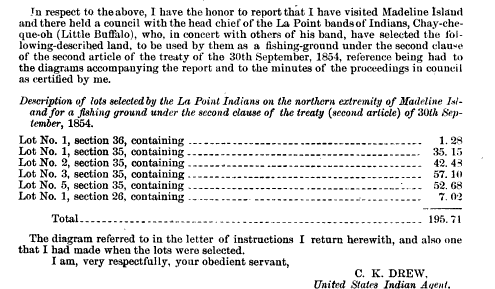
Published in Annual Report of the Commissioner of Indian Affairs to the Secretary of the Interior. Office of Indian Affairs. 1882. pg. 299. (Digitized by Google Books)
Today the fishing ground at the tip of Madeline Island is now considered part of the Bad River Reservation, but it was the Red Cliff chief who picked it out. This shows how the political division of the La Pointe Band into two distinct entities took several years to take shape, and was not an abrupt split at the Treaty of 1854.
Jayjigwyong continued to be regarded as a chief until his death in 1860:

Drew, C.K. Report on the Chippewas of Lake Superior. Red Cliff Agency. 29 Oct. 1860. Pg. 51 of Annual Report of the Commissioner of Indian Affairs. Bureau of Indian Affairs. 1860. (Digitized by Google Books). Zhingob (Shing-oop) was Naaganab’s cousin and the hereditary chief at Fond du Lac. Also known as Nindibens, he figures prominently in Edmund F. Ely’s journals of the mid-1830s.
Future generations of the Buffalo family continued to be looked at as hereditary chiefs in Red Cliff, and sources can be found calling these grandsons and great-grandsons “Chief Buffalo.”
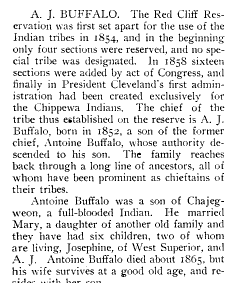
J.H. Beers and Co. Commemorative Biographical Record of the Upper Lake Region. 1905. Pg. 379. (Digitized by Google Books).
Antoine brings us full circle. If we remember, Hamiton Ross wrote that the image of the chief in the army jacket was Chief Buffalo’s grandson. And while we don’t know where Ross got his information, and he made mistakes about Buffalo’s family elsewhere, we have to consider that Antoine Buffalo was an adult by 1852 and he could have inherited his father’s, or grandfather’s, medal and coat.
The Verdict
Although we’ve uncovered several lines of inquiry for this image, all the evidence is circumstantial. Until we know more about the creation and chain of custody, it’s impossible to rule Chief Buffalo in or out. My gut tells me it’s Buffalo’s son, Jajigwyong, but it could be his grandson, Naaganab, or and entirely different chief. We don’t know.
Inconclusive: It could be Chief Buffalo, but there is also evidence pointing to others.
Sources:
Brunson, Alfred. A Western Pioneer, Or, Incidents of the Life and times of Rev. Alfred Brunson Embracing a Period of over Seventy Years. Cinncinnati: Hitchchock and Walden, 1872. Print.
Commemorative Biographical Record of the Upper Lake Region. Chicago: J. H. Beers &, 1905. Print.
Ely, Edmund Franklin, and Theresa M. Schenck. The Ojibwe Journals of Edmund F. Ely, 1833-1849. Lincoln: University of Nebraska, 2012. Print.
KAPPLER’S INDIAN AFFAIRS: LAWS AND TREATIES. Ed. Charles J. Kappler. Oklahoma State University Library, n.d. Web. 21 June 2012. <http:// digital.library.okstate.edu/Kappler/>.
Loew, Patty. Indian Nations of Wisconsin: Histories of Endurance and Renewal. Madison: Wisconsin Historical Society, 2001. Print.
Morse, Richard F. “The Chippewas of Lake Superior.” Collections of the State Historical Society of Wisconsin. Ed. Lyman C. Draper. Vol. 3. Madison: State Historical Society of Wisconsin, 1857. 338-69. Print.
Paap, Howard D. Red Cliff, Wisconsin: A History of an Ojibwe Community. St. Cloud, MN: North Star, 2013. Print.
Peebles, J. M. Immortality, and Our Employments Hereafter. With What a Hundred Spirits, Good and Evil, Say of Their Dwelling Places. Boston: Colby and Rich, 1880. Print.
Ross, Hamilton Nelson. La Pointe, Village Outpost. St. Paul: North Central Pub., 1960. Print
Satz, Ronald N. Chippewa Treaty Rights: The Reserved Rights of Wisconsin’s Chippewa Indians in Historical Perspective. Madison, WI: Wisconsin Academy of Sciences, Arts and Letters, 1991. Print.
Schenck, Theresa M. The Voice of the Crane Echoes Afar: The Sociopolitical Organization of the Lake Superior Ojibwa, 1640-1855. New York: Garland Pub.,1997. Print.
Warren, William W., and Theresa M. Schenck. History of the Ojibway People. St. Paul: Minnesota Historical Society, 2009. Print.
Whaley, Rick, and Walter Bresette. Walleye Warriors: The Chippewa Treaty Rights Story. Warner, NH: Tongues of Green Fire, Writers Pub. Cooperative, 1999. Print.
The banner at the top of this website reads “Primary history of the Chequamegon Region before 1860. In the About page, I explain that 1860 is really an arbitrary round number, and what I’m really focusing on is this area before it became dominated by an English-speaking American society. This is not an easy date to pinpoint, though I think most would argue it happened between 1842 and 1855. While the Treaty of La Pointe in 1854 is an easy marker of separation between the two eras, I would argue that the annuity payments that took place on the island the next summer, can also be seen as a watershed moment in history.

Crocket McElroy from a short biography in the Cyclopedia of Michigan: historical and biographical, comprising a synopsis of general history of the state, and biographical sketches of men who have, in their various spheres, contributed toward its development. Ed. John Bersey. Western Engraving and Publishing; 1890 (Digitized by Google Books)
The 1855 payment, in many ways, illustrates the change in the relationship between the United States and the Ojibwe people that would characterize the rest of the 19th century and early 20th century. The threats of Ojibwe removal or military conflict between the two nations largely ended with the treaty and the establishment of reservations. However, in their place was a paternalistic and domineering government that felt a responsibility to “civilize the Indian.” No one at this time embodied this idea more than George Manypenny, the Commissioner of Indian Affairs, and it was Manypenny, himself, who presided over the 1855 payment.
The days were over when master politicians like Buffalo and Flat Mouth could try to negotiate with the Americans as equals while playing them off of the British in Canada at the same time. In fact, Buffalo died during the 1855 payment, and the new generation of chiefs were men who had spent their youth in a time of Ojibwe power, but who would grow old in an era where government Indian Agents would rule the reservations like petty dictators. The men of this generation, Jayjigwyong (“Little Buffalo”) of Red Cliff, Blackbird of Bad River, and Naaganab of Fond du Lac, were the ones who were prominent during the summer of 1855.
Until this point, our knowledge of the 1855 payment cams largely from the essay The Chippewas of Lake Superior by a witness named Richard Morse. Dr. Morse’s writing includes a number of speeches by the Ojibwe leadership and a number of smaller accounts of items that piqued his interest, including the story of Hanging Cloud the female warrior, and the deaths of Buffalo and Oshogay. However, when reading Morse, one gets the sense that he or she is not getting stray observations of an uninformed visitor rather than a complete story.
It was for this reason that I got excited today when I stumbled across a second memoir of the 1855 payment. It comes from Volume 5 of Americana, a turn-of-the-century historical journal. Crocket McElroy, the author, is writing around fifty years after he witnessed the 1855 payment as a young clerk in Bayfield.
We still do not have a full picture of the 1855 payment, since we will never have full written accounts from Blackbird, Naaganab, and the rest of the Ojibwe leadership, but McElroy’s essay does provide an interesting contrast to Morse’s. The two men saw many of the same events but interpreted them very differently. And while McElroy’s racist beliefs skew his observations and make his writing hard to stomach, in some ways his observations are as informative as Morse’s even though his work is considerably shorter:
From Americana v.5 American Historical Company, American Historical Society, National Americana Society Publishing Society of New York, 1910 (Digitized by Google Books) pages 298-302.
AN INDIAN PAYMENT
By Crocket McElroy
In August 1855 about three thousand Chippewa Indians gathered at the village of Lapointe, on Lapointe Island, Lake Superior, for an Indian Payment and also to hold a council with the commissioner of Indian affairs, who at that time was George W. Monypenny of Ohio. The Indians selected for their orator a chief named Blackbird, and the choice was a good one, as Blackbird held his own well in a long discussion with the commissioner. Blackbird was not one of the haughty style of Indians, but modest in his bearing, with a good command of language and a clear head. In his speeches he showed much ingenuity and ably pleaded the cause of his people. He spoke in Chippewa stopping frequently to give the interpreter time to translate what he said into English. In beginning his address he spoke substantially as follows:
“My great white father, we are pleased to meet you and have a talk with you We are friends and we want to remain friends. We expect to do what you want us to do, and we hope that you will deal kindly with us. We wish to remind you that we are the source from which you have derived all your riches. Our furs, our timber, our lands, everything that we have goes to you; even the gold out of which that chain was forged (pointing to a heavy watch chain that the commissioner carried) came from us, and now we hope that you will not use that chain to bind us.”

Buffalo’s death in 1855 marked the end of an era. Jayjigwyong (Young Buffalo) was no young man when he took over from his father. The connection between Buffalo and Buffalo, New York also appears in Morse on page 368, although he says the names are not connected. If Buffalo did indeed live in the Niagara region, it may lend credence to the hypothesis explored in Paap’s Red Cliff Wisconsin, that Buffalo fought the Americans in the Indian Wars of the 1790s and signed the Treaty of Greenville (Photo: Wikimedia Images).
The commissioner was an amiable man and got along pleasantly with his savage friends, besides managing the council skilfully.
Among the prominent chiefs attending the payment was Buffalo, then called “Old Buffalo,” as he had a son called “Young Buffalo” who was also an old man. Old Buffalo was said to be over one hundred years old. He died during the council and the writer witnessed the funeral. He was buried in the Indian grave yard near the Indian church in Lapointe village. The body was laid on a stretcher formed of two poles laid lengthwise and several poles laid crosswise. The stretcher was carried on the shoulders of four Indians. Following the corpse was a long procession of Indians in irregular order. It was claimed for Buffalo, that he maintained a camp many years before at the mouth of Buffalo Creek on the Niagara River, and that the creek and the present large and flourishing city of Buffalo were named after him.

Naaganab’s (above) comments about Wheeler being ungenerous with food echoed a common Ojibwe complaint about the ABCFM missionaries. Wheeler’s Protestant Ethic of upward mobility and self-reliance made little sense in a tribal society where those who had extra were expected to share. Read The Ojibwe Journals of Edmund F. Ely, edited by Theresa Schenck, for Naaganab’s experience with another missionary two decades earlier. Read this post if you don’t understand why the Ojibwe resented the missionaries over the issue of food (Photo from Newberry Library Collections, Chicago).
Another prominent chief attending the conference was Ne-gon-up, head chief of the Fond du lac Indians. Negonup’s camp was on the south side of the St Louis River in Wisconsin, about where the city of Superior now stands. Negonup was a shrewd, practical Indian and had considerable influence. The writer saw him going to the Indian church one Sunday, there was a squaw on each side of him and one behind, they were said to be his wives. A good and zealous Methodist minister named Wheeler desired to talk to Negonup and his tribe about the Great Spirit. Negonup it is said expressed himself in regard to Mr. Wheeler in this manner:
“Mr. Wheeler comes to us and says he wants to do us good. He looks like a good man and we think he is and we believe his intentions are good, but he does not bring us any proof. Now if Mr. Wheeler will bring to me a good supply of barrels of flour and barrels of pork, for distribution among my people, then I shall be convinced that he is a good man.”
The sessions of the council began on August 30th and were held in the open air on a grass common. On the second day the special police acting under directions from the Indian agent H. Gilbert, seized two barrels of whisky that was being secretly sold to the half-breeds and Indians. The proceedings of the council were suspended and the two barrels of whisky were rolled into the center of the common. Mr. Gilbert then took a hatchet, chopped a hole into each barrel and poured the whiskey out on the ground. A few half-breeds and Indians in the outer edge of the crowd dropped on their knees and sucked some of the whisky out of the grass.
In accordance with the stipulations of a treaty, the government was distributing among the Indians a large quantity of blankets, cotton cloth, calico, and other kinds of cloth to be used for clothing or bedding. Also provisions, farming implements, cooking utensils, and other articles supposed to be useful to the Indians The Indians were entitled to a certain value per head in goods and also in cash. The cash payment was I think two dollars and fifty cents per head. The goods were distributed first to the heads of families. After the goods were disposed of the money was paid in gold and silver.
Notwithstanding the care exercised by the Indian agent to prevent the sale of liquor to Indians they were still able to find it, and occasionally some would be found drunk. One who was acting badly was arrested and confined in a log lockup, and while there created a great disturbance. He pounded his head against the logs and yelled so loud and continuously as to excite the other Indians and some of them became very angry. It was feared they would make trouble and a rumor spread through the village that the Indians would rise that night, break into the jail, release the prisoner and then murder all the white people on the island. As the Indians outnumbered the whites ten to one the excitement became painfully intense and a meeting of whites and half breeds was called to take action. A company of volunteers was organized to assist the Indian agent in searching for and destroying liquors. A systematic and thorough search was made of nearly every building in the village, from attic to cellar. A good deal of liquor was found and promptly destroyed. After two days of this kind of work the danger of murders being committed by drunken Indians was supposed to be past and quiet was restored. Either the laws of the United States give the Indian agent in such cases arbitrary power, or the agent assumed it at any rate it was courageously exercised.

Rev. Leonard Wheeler’s mission was Congregational-Presbyterian, not Methodist as McElroy states. The Fond du Lac Indians were familiar with both Protestant sects, but the “civilized” Fond du Lac chiefs Zhingob (Nindibens) and Naaganab, much like Jayjigwyong in Red Cliff, aligned with the Catholics. This represented a major threat to Wheeler and his virulently anti-Catholic colleagues who envisioned a fully-assimilated Protestant future for the Ojibwe (Photo: Wisconsin Historical Society).
A good many of the Indians were warriors, who were frequently, in fact, almost constantly at war with the Sioux. They were pure savages, totally uncivilized, and the faces of some of them had an expression as utterly destitute of human kindness as I have ever seen in wild beasts. A small portion of them were partially civilized and a very few could talk a little English. Nearly all the Indians came to the island in their own canoes bringing along the entire family.
The agent completed his work in about twenty-five days.
There is hardly anything that a savage Indian has less use for than money and when it comes into his hands he hastens to spend it. It goes quickly into the hands of traders, half-breeds and the partially civilized Indians.
A few days previous to the opening of the council, the Indians gave a war dance which was attended by a large crowd of Indians and whites. A ring about twenty feet in diameter was formed by male Indians and squaws sitting cross legged around it, a number of whom had small unmusical drums. The ceremony commenced with the Indians in the circle singing: “Hi yi yi, i e, i o.” This was the whole song and it was repeated over and over with tiresome monotony, and the drums were beaten to keep time with the singing. After the singing had been going on for some minutes a warrior bounced into the ring and began to talk. Instantly the singing stopped. The orator showed great agitation, no doubt for the purpose of convincing his hearers that he was a brave warrior. He hopped and jumped about the ring, swung his arms violently and pointed toward his enemies in the west. He was apparently telling how badly the Sioux had been beaten in the last fight, or how they would be whipped in the next one, and perhaps also how many scalps he had taken. So soon as the talking stopped the singing would begin again and after a little more of the ridiculous music, another warrior would bounce into the ring and begin his speech.
For this occasion some of the Indians were painted with different colored paints, made out of clay and other coarse materials daubed on without much regard to order or taste. A good many males were entirely naked except that they wore breech clouts. One Indian had one leg painted black and the other red, and his face was daubed with various colored paints, so that except in the form of his body, he looked like anything but a human being. When a few speeches had been made the war dance ended.
During the council a begging party of Indians went the rounds of the camps to solicit donations for a squaw widow with four children, whose husband had been killed by the Sioux. At every tent something was given and the articles were carried along by the party. One of the presents was a dead dog, a rope was tied to the dog’s legs and an Indian put the rope over his head and let the dog hang on his back. The widow marched in the procession she was a large strong woman with long hair in a single braid hanging down her back. To the end of the braid was tied two scalps which dangled about one foot below. It was said she had killed two Sioux in revenge for their killing her husband and had taken their scalps.
Among the notable persons in attendance at the council, was a lady distinguished as a writer of fiction under the pen name of Grace Greenwood. She had been recently married to a Mr. Lippincott and was accompanied by her husband. Mrs. Lippincott. did not look like a healthy woman, but she lived to be forty-nine years older and to be highly respected and honored before she died in the year 1904.
Hopefully this document will contribute to the understanding of our area in the earliest years after the Treaty of 1854. Look for an upcoming post with a letter from Blackbird himself on issues surrounding the payment.
Sources:
Ely, Edmund Franklin, and Theresa M. Schenck. The Ojibwe Journals of Edmund F. Ely, 1833-1849. Lincoln: University of Nebraska, 2012. Print.
McElroy, Crocket. “An Indian Payment.” Americana v.5. American Historical Company, American Historical Society, National Americana Society Publishing Society of New York, 1910 (Digitized by Google Books) pages 298-302.
Morse, Richard F. “The Chippewas of Lake Superior.” Collections of the State Historical Society of Wisconsin. Ed. Lyman C. Draper. Vol. 3. Madison: State Historical Society of Wisconsin, 1857. 338-69. Print.
Paap, Howard D. Red Cliff, Wisconsin: A History of an Ojibwe Community. St. Cloud, MN: North Star, 2013. Print.
Western Publishing and Engraving. Cyclopedia of Michigan: historical and biographical, comprising a synopsis of general history of the state, and biographical sketches of men who have, in their various spheres, contributed toward its development. John Bersey Ed. Western Publishing and Engraving Co., 1890.
Oshogay
August 12, 2013
At the most recent count, Chief Buffalo is mentioned in over two-thirds of the posts here on Chequamegon History. That’s the most of anyone listed so far in the People Index. While there are more Buffalo posts on the way, I also want to draw attention to some of the lesser known leaders of the La Pointe Band. So, look for upcoming posts about Dagwagaane (Tagwagane), Mizay, Blackbird, Waabojiig, Andeg-wiiyas, and others. I want to start, however, with Oshogay, the young speaker who traveled to Washington with Buffalo in 1852 only to die the next year before the treaty he was seeking could be negotiated.
I debated whether to do this post, since I don’t know a lot about Oshogay. I don’t know for sure what his name means, so I don’t know how to spell or pronounce it correctly (in the sources you see Oshogay, O-sho-ga, Osh-a-ga, Oshaga, Ozhoge, etc.). In fact, I don’t even know how many people he is. There were at least four men with that name among the Lake Superior Ojibwe between 1800 and 1860, so much like with the Great Chief Buffalo Picture Search, the key to getting Oshogay’s history right is dependent on separating his story from those who share his name.
In the end, I felt that challenge was worth a post in its own right, so here it is.
Getting Started
According to his gravestone, Oshogay was 51 when he died at La Pointe in 1853. That would put his birth around 1802. However, the Ojibwe did not track their birthdays in those days, so that should not be considered absolutely precise. He was considered a young man of the La Pointe Band at the time of his death. In my mind, the easiest way to sort out the information is going to be to lay it out chronologically. Here it goes:
1) Henry Schoolcraft, United States Indian Agent at Sault Ste. Marie, recorded the following on July 19, 1828:
Oshogay (the Osprey), solicited provisions to return home. This young man had been sent down to deliver a speech from his father, Kabamappa, of the river St. Croix, in which he regretted his inability to come in person. The father had first attracted my notice at the treaty of Prairie du Chien, and afterwards received a small medal, by my recommendation, from the Commissioners at Fond du Lac. He appeared to consider himself under obligations to renew the assurance of his friendship, and this, with the hope of receiving some presents, appeared to constitute the object of his son’s mission, who conducted himself with more modesty and timidity before me than prudence afterwards; for, by extending his visit to Drummond Island, where both he and his father were unknown, he got nothing, and forfeited the right to claim anything for himself on his return here.
I sent, however, in his charge, a present of goods of small amount, to be delivered to his father, who has not countenanced his foreign visit.
Oshogay is a “young man.” A birth year of 1802 would make him 26. He is part of Gaa-bimabi’s (Kabamappa’s) village in the upper St. Croix country.
2) In June of 1834, Edmund Ely and W. T. Boutwell, two missionaries, traveled from Fond du Lac (today’s Fond du Lac Reservation near Cloquet) down the St. Croix to Yellow Lake (near today’s Webster, WI) to meet with other missionaries. As they left Gaa-bimabi’s (Kabamappa’s) village near the head of the St. Croix and reached the Namekagon River on June 28th, they were looking for someone to guide them the rest of the way. An old Ojibwe man, who Boutwell had met before at La Pointe, and his son offered to help. The man fed the missionaries fish and hunted for them while they camped a full day at the mouth of the Namekagon since the 29th was a Sunday and they refused to travel on the Sabbath. On Monday the 30th, the reembarked, and Ely recorded in his journal:
The man, whose name is “Ozhoge,” and his son embarked with us about 1/2 past 9 °clk a.m. The old man in the bow and myself steering. We run the rapids safely. At half past one P. M. arrived at the mouth of Yellow River…
Ozhoge is an “old man” in 1834, so he couldn’t have been born in 1802. He is staying on the Namekagon River in the upper St. Croix country between Gaa-bimabi and the Yellow Lake Band. He had recently spent time at La Pointe.
3) Ely’s stay on the St. Croix that summer was brief. He was stationed at Fond du Lac until he eventually wore out his welcome there. In the 1840s, he would be stationed at Pokegama, lower on the St. Croix. During these years, he makes multiple references to a man named Ozhogens (a diminutive of Ozhoge). Ozhogens is always found above Yellow River on the upper St. Croix.
Ozhogens has a name that may imply someone older (possibly a father or other relative) lives nearby with the name Ozhoge. He seems to live in the upper St. Croix country. A birth year of 1802 would put him in his forties, which is plausible.

Ke-che-wask keenk (Gichi-weshki) is Chief Buffalo. Gab-im-ub-be (Gaa-bimabi) was the chief Schoolcraft identified as the father of Oshogay. Ja-che-go-onk was a son of Chief Buffalo.
4) On August 2, 1847, the United States and the Mississippi and Lake Superior Ojibwe concluded a treaty at Fond du Lac. The US Government wanted Ojibwe land along the nation’s border with the Dakota Sioux, so it could remove the Ho-Chunk people from Wisconsin to Minnesota.
Among the signatures, we find O-sho-gaz, a warrior from St. Croix. This would seem to be the Ozhogens we meet in Ely.
Here O-sho-gaz is clearly identified as being from St. Croix. His identification as a warrior would probably indicate that he is a relatively young man. The fact that his signature is squeezed in the middle of the names of members of the La Pointe Band may or may not be significant. The signatures on the 1847 Treaty are not officially grouped by band, but they tend to cluster as such.
5) In 1848 and 1849 George P. Warren operated the fur post at Chippewa Falls and kept a log that has been transcribed and digitized by the University of Wisconsin Eau Claire. He makes several transactions with a man named Oshogay, and at one point seems to have him employed in his business. His age isn’t indicated, but the amount of furs he brings in suggests that he is the head of a small band or large family. There were multiple Ojibwe villages on the Chippewa River at that time, including at Rice Lake and Lake Shatac (Chetek). The United States Government treated with them as satellite villages of the Lac Courte Oreilles Band.
Based on where he lives, this Oshogay might not be the same person as the one described above.
6) In December 1850, the Wisconsin Supreme Court ruled in the case Oshoga vs. The State of Wisconsin, that there were a number of irregularities in the trial that convicted “Oshoga, an Indian of the Chippewa Nation” of murder. The court reversed the decision of the St. Croix County circuit court. I’ve found surprisingly little about this case, though that part of Wisconsin was growing very violent in the 1840s as white lumbermen and liquor salesmen were flooding the country.

Pg 56 of Containing cases decided from the December term, 1850, until the organization of the separate Supreme Court in 1853: Volume 3 of Reports of Cases Argued and Determined in the Supreme Court of the State of Wisconsin: With Tables of the Cases and Principal Matters, and the Rules of the Several Courts in Force Since 1838, Wisconsin. Supreme Court Authors: Wisconsin. Supreme Court, Silas Uriah Pinney (Google Books).
The man killed, Alexander Livingston, was a liquor dealer himself.
Alexander Livingston, a man who in youth had had excellent advantages, became himself a dealer in whisky, at the mouth of Wolf creek, in a drunken melee in his own store was shot and killed by Robido, a half-breed. Robido was arrested but managed to escape justice.
~From Fifty Years in the Northwest by W.H.C Folsom
Several pages later, Folsom writes:
At the mouth of Wolf creek, in the extreme northwestern section of this town, J. R. Brown had a trading house in the ’30s, and Louis Roberts in the ’40s. At this place Alex. Livingston, another trader, was killed by Indians in 1849. Livingston had built him a comfortable home, which he made a stopping place for the weary traveler, whom he fed on wild rice, maple sugar, venison, bear meat, muskrats, wild fowl and flour bread, all decently prepared by his Indian wife. Mr. Livingston was killed by an Indian in 1849.
Folsom makes no mention of Oshoga, and I haven’t found anything else on what happened to him or Robido (Robideaux?).
It’s hard to say if this Oshoga is the Ozhogen’s of Ely’s journals or the Oshogay of Warren’s. Wolf Creek is on the St. Croix, but it’s not far from the Chippewa River country either, and the Oshogay of Warren seems to have covered a lot of ground in the fur trade. Warren’s journal, linked in #4, contains a similar story of a killing and “frontier justice” leading to lynch mobs against the Ojibwe. To escape the violence and overcrowding, many Ojibwe from that part of the country started to relocate to Fond du Lac, Lac Courte Oreilles, or La Pointe/Bad River. La Pointe is also where we find the next mention of Oshogay.
7) From 1851 to 1853, a new voice emerged loudly from the La Pointe Band in the aftermath of the Sandy Lake Tragedy. It was that of Buffalo’s speaker Oshogay (or O-sho-ga), and he spoke out strongly against Indian Agent John Watrous’ handling of the Sandy Lake payments (see this post) and against Watrous’ continued demands for removal of the Lake Superior Ojibwe. There are a number of documents with Oshogay’s name on them, and I won’t mention all of them, but I recommend Theresa Schenck’s William W. Warren and Howard Paap’s Red Cliff, Wisconsin as two places to get started.
Chief Buffalo was known as a great speaker, but he was nearing the end of his life, and it was the younger chief who was speaking on behalf of the band more and more. Oshogay represented Buffalo in St. Paul, co-wrote a number of letters with him, and most famously, did most of the talking when the two chiefs went to Washington D.C. in the spring of 1852 (at least according to Benjamin Armstrong’s memoir). A number of secondary sources suggest that Oshogay was Buffalo’s son or son-in-law, but I’ve yet to see these claims backed up with an original document. However, all the documents that identify by band, say this Oshogay was from La Pointe.
The Wisconsin Historical Society has digitized four petitions drafted in the fall of 1851 and winter of 1852. The petitions are from several chiefs, mostly of the La Pointe and Lac Courte Oreilles/Chippewa River bands, calling for the removal of John Watrous as Indian Agent. The content of the petitions deserves its own post, so for now we’ll only look at the signatures.

November 6, 1851 Letter from 30 chiefs and headmen to Luke Lea, Commissioner of Indian Affairs: Multiple villages are represented here, roughly grouped by band. Kijiueshki (Buffalo), Jejigwaig (Buffalo’s son), Kishhitauag (“Cut Ear” also associated with the Ontonagon Band), Misai (“Lawyerfish”), Oshkinaue (“Youth”), Aitauigizhik (“Each Side of the Sky”), Medueguon, and Makudeuakuat (“Black Cloud”) are all known members of the La Pointe Band. Before the 1850s, Kabemabe (Gaa-bimabi) and Ozhoge were associated with the villages of the Upper St. Croix.

November 8, 1851, Letter from the Chiefs and Headmen of Chippeway River, Lac Coutereille, Puk-wa-none, Long Lake, and Lac Shatac to Alexander Ramsey, Superintendent of Indian Affairs: This letter was written from Sandy Lake two days after the one above it was written from La Pointe. O-sho-gay the warrior from Lac Shatac (Lake Chetek) can’t be the same person as Ozhoge the chief unless he had some kind of airplane or helicopter back in 1851.

Undated (Jan. 1852?) petition to “Our Great Father”: This Oshoga is clearly the one from Lake Chetek (Chippewa River).

Undated (Jan. 1852?) petition: These men are all associated with the La Pointe Band. Osho-gay is their Speaker.
In the early 1850s, we clearly have two different men named Oshogay involved in the politics of the Lake Superior Ojibwe. One is a young warrior from the Chippewa River country, and the other is a rising leader among the La Pointe Band.

Washington Delegation July 22, 1852 This engraving of the 1852 delegation led by Buffalo and Oshogay appeared in Benjamin Armstrong’s Early Life Among the Indians. Look for an upcoming post dedicated to this image.
8) In the winter of 1853-1854, a smallpox epidemic ripped through La Pointe and claimed the lives of a number of its residents including that of Oshogay. It had appeared that Buffalo was grooming him to take over leadership of the La Pointe Band, but his tragic death left a leadership vacuum after the establishment of reservations and the death of Buffalo in 1855.
Oshogay’s death is marked in a number of sources including the gravestone at the top of this post. The following account comes from Richard E. Morse, an observer of the 1855 annuity payments at La Pointe:
The Chippewas, during the past few years, have suffered extensively, and many of them died, with the small pox. Chief O-SHO-GA died of this disease in 1854. The Agent caused a suitable tomb-stone to be erected at his grave, in La Pointe. He was a young chief, of rare promise and merit; he also stood high in the affections of his people.
Later, Morse records a speech by Ja-be-ge-zhick or “Hole in the Sky,” a young Ojibwe man from the Bad River Mission who had converted to Christianity and dressed in “American style.” Jabegezhick speaks out strongly to the American officials against the assembled chiefs:
…I am glad you have seen us, and have seen the folly of our chiefs; it may give you a general idea of their transactions. By the papers you have made out for the chiefs to sign, you can judge of their ability to do business for us. We had but one man among us, capable of doing business for the Chippewa nation; that man was O-SHO-GA, now dead and our nation now mourns. (O-SHO-GA was a young chief of great merit and much promise; he died of small-pox, February 1854). Since his death, we have lost all our faith in the balance of our chiefs…
This O-sho-ga is the young chief, associated with the La Pointe Band, who went to Washington with Buffalo in 1852.
9) In 1878, “Old Oshaga” received three dollars for a lynx bounty in Chippewa County.

Report of the Wisconsin Office of the Secretary of State, 1878; pg. 94 (Google Books)
It seems quite possible that Old Oshaga is the young man that worked with George Warren in the 1840s and the warrior from Lake Chetek who signed the petitions against Agent Watrous in the 1850s.
10) In 1880, a delegation of Bad River, Lac Courte Oreilles, and Lac du Flambeau chiefs visited Washington D.C. I will get into their purpose in a future post, but for now, I will mention that the chiefs were older men who would have been around in the 1840s and ’50s. One of them is named Oshogay. The challenge is figuring out which one.

Ojibwe Delegation c. 1880 by Charles M. Bell. [Identifying information from the Smithsonian] Studio portrait of Anishinaabe Delegation posed in front of a backdrop. Sitting, left to right: Edawigijig; Kis-ki-ta-wag; Wadwaiasoug (on floor); Akewainzee (center); Oshawashkogijig; Nijogijig; Oshoga. Back row (order unknown); Wasigwanabi; Ogimagijig; and four unidentified men (possibly Frank Briggs, top center, and Benjamin Green Armstrong, top right). The men wear European-style suit jackets and pants; one man wears a peace medal, some wear beaded sashes or bags or hold pipes and other props.(Smithsonian Institution National Museum of the American Indian).
- Upper row reading from the left.
- 1. Vincent Conyer- Interpreter 1,2,4,5 ?, includes Wasigwanabi and Ogimagijig
- 2. Vincent Roy Jr.
- 3. Dr. I. L. Mahan, Indian Agent Frank Briggs
- 4. No Name Given
- 5. Geo P. Warren (Born at LaPointe- civil war vet.
- 6. Thad Thayer Benjamin Armstrong
- Lower row
- 1. Messenger Edawigijig
- 2. Na-ga-nab (head chief of all Chippewas) Kis-ki-ta-wag
- 3. Moses White, father of Jim White Waswaisoug
- 4. No Name Given Akewainzee
- 5. Osho’gay- head speaker Oshawashkogijig or Oshoga
- 6. Bay’-qua-as’ (head chief of La Corrd Oreilles, 7 ft. tall) Nijogijig or Oshawashkogijig
- 7. No name given Oshoga or Nijogijig
The Smithsonian lists Oshoga last, so that would mean he is the man sitting in the chair at the far right. However, it doesn’t specify who the man seated on the right on the floor is, so it’s also possible that he’s their Oshoga. If the latter is true, that’s also who the unknown writer of the library caption identified as Osho’gay. Whoever he is in the picture, it seems very possible that this is the same man as “Old Oshaga” from number 9.
11) There is one more document I’d like to include, although it doesn’t mention any of the people we’ve discussed so far, it may be of interest to someone reading this post. It mentions a man named Oshogay who was born before 1860 (albeit not long before).
For decades after 1854, many of the Lake Superior Ojibwe continued to live off of the reservations created in the Treaty of La Pointe. This was especially true in the St. Croix region where no reservation was created at all. In the 1910s, the Government set out to document where various Ojibwe families were living and what tribal rights they had. This process led to the creation of the St. Croix and Mole Lake reservations. In 1915, we find 64-year-old Oshogay and his family living in Randall, Wisconsin which may suggest a connection to the St. Croix Oshogays. As with number 6 above, this creates some ambiguity because he is listed as enrolled at Lac Courte Oreilles, which implies a connection to the Chippewa River Oshogay. For now, I leave this investigation up to someone else, but I’ll leave it here for interest.

United States. Congress. House. Committee on Indian Affairs. Indian Appropriation Bill: Supplemental Hearings Before a Subcommittee. 1919 (Google Books).
This is not any of the Oshogays discussed so far, but it could be a relative of any or all of them.
In the final analysis
These eleven documents mention at least four men named Oshogay living in northern Wisconsin between 1800 and 1860. Edmund Ely met an old man named Oshogay in 1834. He is one. A 64-year old man, a child in the 1850s, was listed on the roster of “St. Croix Indians.” He is another. I believe the warrior from Lake Chetek who traded with George Warren in the 1840s could be one of the chiefs who went to Washington in 1880. He may also be the one who was falsely accused of killing Alexander Livingston. Of these three men, none are the Oshogay who went to Washington with Buffalo in 1852.
That leaves us with the last mystery. Is Ozhogens, the young son of the St. Croix chief Gaa-bimabi, the orator from La Pointe who played such a prominent role in the politics of the early 1850s? I don’t have a smoking gun, but I feel the circumstantial evidence strongly suggests he is. If that’s the case, it explains why those who’ve looked for his early history in the La Pointe Band have come up empty.
However, important questions remain unanswered. What was his connection to Buffalo? If he was from St. Croix, how was he able to gain such a prominent role in the La Pointe Band, and why did he relocate to La Pointe anyway? I have my suspicions for each of these questions, but no solid evidence. If you do, please let me know, and we’ll continue to shed light on this underappreciated Ojibwe leader.
Sources:
Armstrong, Benj G., and Thomas P. Wentworth. Early Life among the Indians: Reminiscences from the Life of Benj. G. Armstrong : Treaties of 1835, 1837, 1842 and 1854 : Habits and Customs of the Red Men of the Forest : Incidents, Biographical Sketches, Battles, &c. Ashland, WI: Press of A.W. Bowron, 1892. Print.
Ely, Edmund Franklin, and Theresa M. Schenck. The Ojibwe Journals of Edmund F. Ely, 1833-1849. Lincoln: University of Nebraska, 2012. Print.
Folsom, William H. C., and E. E. Edwards. Fifty Years in the Northwest. St. Paul: Pioneer, 1888. Print.
KAPPLER’S INDIAN AFFAIRS: LAWS AND TREATIES. Ed. Charles J. Kappler. Oklahoma State University Library, n.d. Web. 12 August 2013. <http:// digital.library.okstate.edu/Kappler/>.
Nichols, John, and Earl Nyholm. A Concise Dictionary of Minnesota Ojibwe. Minneapolis: University of Minnesota, 1995. Print.
Paap, Howard D. Red Cliff, Wisconsin: A History of an Ojibwe Community. St. Cloud, MN: North Star, 2013. Print.
Redix, Erik M. “The Murder of Joe White: Ojibwe Leadership and Colonialism in Wisconsin.” Diss. University of Minnesota, 2012. Print.
Schenck, Theresa M. The Voice of the Crane Echoes Afar: The Sociopolitical Organization of the Lake Superior Ojibwa, 1640-1855. New York: Garland Pub., 1997. Print.
———–William W. Warren: The Life, Letters, and times of an Ojibwe Leader. Lincoln: University of Nebraska, 2007. Print.
Schoolcraft, Henry Rowe. Personal Memoirs of a Residence of Thirty Years with the Indian Tribes on the American Frontiers: With Brief Notices of Passing Events, Facts, and Opinions, A.D. 1812 to A.D. 1842. Philadelphia, [Pa.: Lippincott, Grambo and, 1851. Print.
Warren, William W., and Theresa M. Schenck. History of the Ojibway People. St. Paul: Minnesota Historical Society, 2009. Print.
 Chequamegon History