Barber Papers: “Houghton” Fall of 1857
February 17, 2016
By Amorin Mello
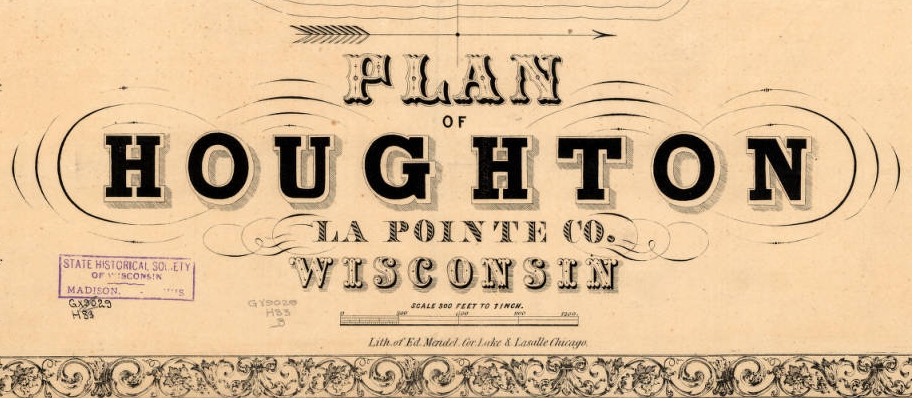
Selected letters of the Joel Allen Barber Papers
… continued from the Summer of 1857.
Sandusky Oct 24th 1857
Dear Son
At length your father and I have both reached this place but how soon we shall be able to leave it is uncertain. He arrived here last Monday night in a most miserable state. I did not get here ’till Wednesday morning when I found him much worse than I had supposed he had been, and I believe worse than he had been at any time with his lameness. He probably exerted himself too much and produced a relapse of his fever and swelling of the limbs.
He got to Detroit Thursday at night – when he got ashore he found his carpet sack was missing – he being to sick to bring it off himself. Friday morning he sent round to the hotels to look for it but got no trace and concluded to go without it – but found he was a few minutes too late for the boat. Saturday morning he went down to the wharf, then the driver pretended, or was told, that the boat would not come and go that morning but at 4 P.M. so he was carried back the house again and paid the scamp 50 cts. Soon after he saw a bill posted saying the “Bay City” would leave that day at 7 oclock but before he could get to it, they told him it was gone so he was obligated to remain over till Monday.

Michigan Exchange Hotel in Detroit, circa 1884.
~ Burton Historical Collection.
He put up at the Michigan Exchange where he was on the second floor and had to climb stairs until his limb became very lame and considerably swollen the whole length. He had some fever and no appetite all the way after leaving La P. and probably when he started. The day after he got here Hamilton procured a Homeopathic Physician who has called to “treat” him every day since. He had intermitent fever all the time. Broke a fever every afternoon and night till yesterday and today, when it seems to be leaving him – his appetite is returning. I think tho he is very weak and can bear but very little food and the of the simplest kind. The Dr thinks he will get up soon if he can get the pain out of his limbs, but that will probably take some time to conquer. Says it is probably a rheumatic affliction and might have been produced by taking Quinine. But he is decidedly better now than three days since – in all respects I believe that had he called an Alopathic Dr, he would surely had a Typhoid fever, but if he is quiet and patient I think he will escape this time. But I fear it will take a long time for him to recover sufficiently to go home in cold weather. He had set up a little the last three days but cannot get off nor on the bed without help, and cannot walk without great paid to his limbs – indeed, he has not walked a step since Wednesday. It has certainly been a very unfortunate season with him and with us all, but I must consider it very fortunate that he has fallen in to so good a place to be be sick, and is in the care of an experienced Homeopathist, who I believe will cure him.
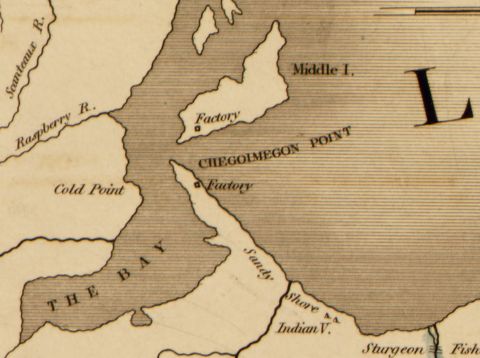
Houghton Point aka “Cold Point”,“Stony Pointe” , and “Point Prospect”.
~ Detail of Map of Michigan & Part of Wisconsin Territory, Exhibiting the Post Offices, Post Roads, Canals, Rail Roads, &c from the 1839 Burr Atlas of Postal Maps.
It is very strange you did not receive any letters from me before father came away as I had sent, certainly three – some of which you may have got before now. And I got but two short letters from you and none from your father after you left me. He wrote to Mr Burr when first taken sick and I heard nothing more from him untill one reached us of Oct 3d saying he wished me to meet him at Sandusky as he was too sick to get to L. Of course, I suffered a good deal of anxiety to know what had become of him and how I was to get home alone – supposing he had gone home without sending me word – I had been so long waiting to hear from him that I had concluded to start in company with Miss Julia Hyde, when I rec’d his letter.

Detail of early settlements and footpaths near Houghton Point from the Barber brothers’ 1855 survey of Chequamegon Bay. Giles and Allen lived with the Maddocks family during 1856 and 1857 at what is now the Houghton Falls State Natural Area.
I had promised a visit to Mrs. Baker at Janesville, so not knowing how soon he would be here, or that he was much ill then, I concluded to stop there and I started Thursday morning from L – and spent three days at Ja – left there Monday at Midnight – that being the express train expecting to get here the next eve but did not till Wed Morning 4O.C.. There being but no train each day from Toledo to this place. I got along very well alone – without losing any thing of consequence. I am afraid that carpet-sack of father’s will never be found tho. Uncle H has written to some one who was on the boat – whom he knows and perhaps it may come again. If not it will be one more loss added to the many we have suffered within two years. When the tide of misfortune will turn with us is yet in the anxious and uncertain future. I yet hope our lives will all be spared to meet again. When I left Lancaster many people were having a sort of influence which they called “colds”. Grandpa – Thode Burr and Mary B. had it and since reaching here Martha has sent a letter saying that Addison – Mame. Lil and Em. in her house – Mother and Lucy – Lib and the two youngest children, and Mary Parker – and Father at Allen’s, Mr. Phelp’s son quite sick; and about half the people in town had the disease. I had the good luck to escape it entirely, tho’ I rode to Boscobel in the stage the worst day there has been this fall. I am afraid we shall not be able to go home without exposing father so much that he will be very sick. I am sure he cannot recover sufficiently to start with safety in less than four weeks if he has very good luck and no relapse on account of the season. But if good nursing & good medicine can cure him he will be well before winter.
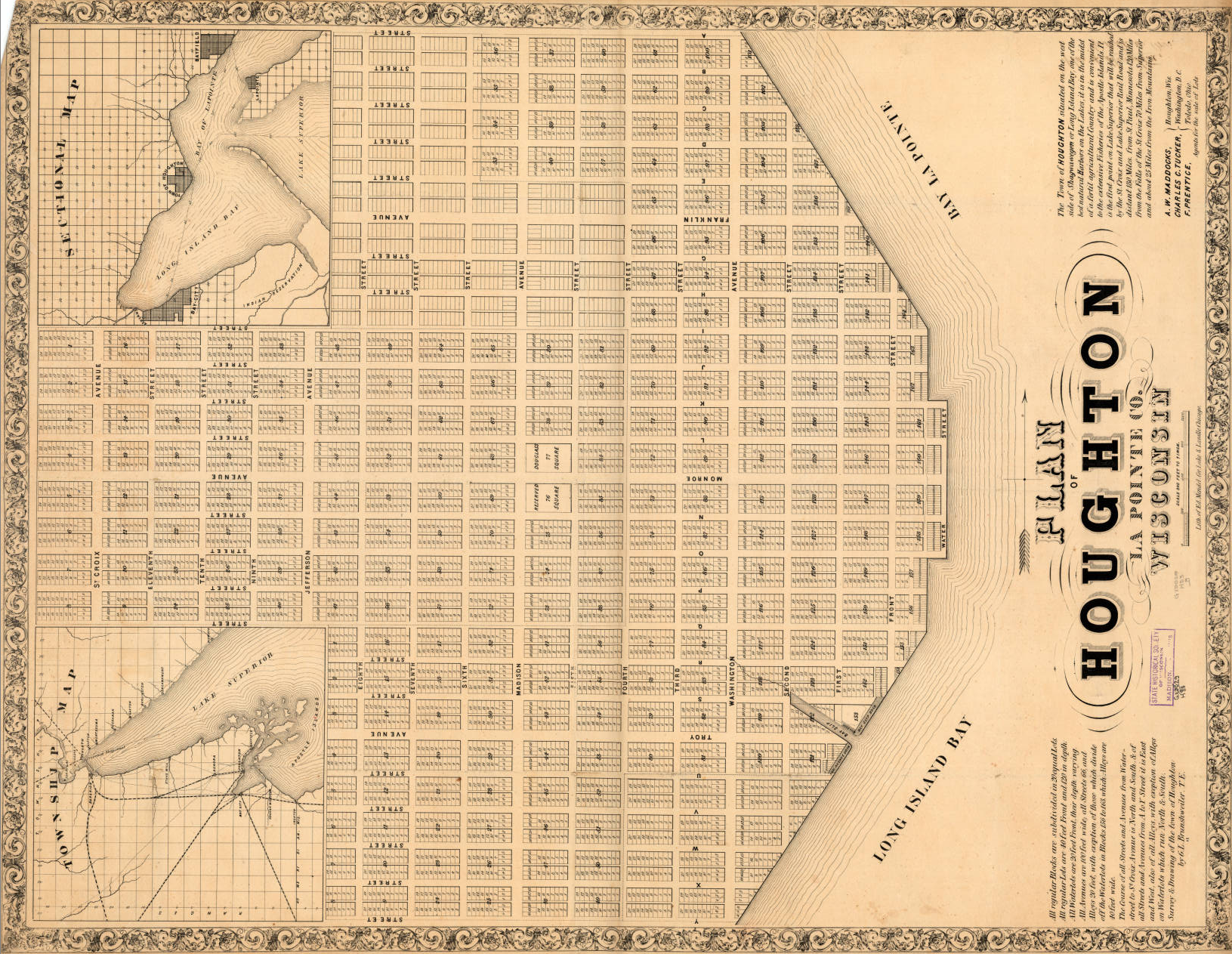
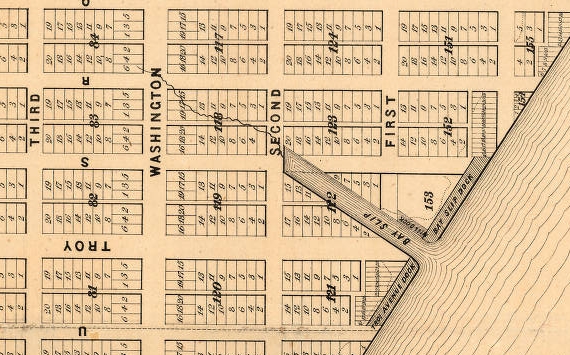
Plan of Houghton, La Pointe County, Wisconsin, 1858.
~ Wisconsin Historical Society
Aunt Emeline is absent, with Frank at Columbus, but the rest of the family are here and show us every kindness. This is a most delightful – comfortable and convenient place to be sick in, if one must be sick. How I wish I could think of our house as possessing half the attractions for a family residence that this does. But, poor as it is I should be very glad to see it once more and be where I could call it home.
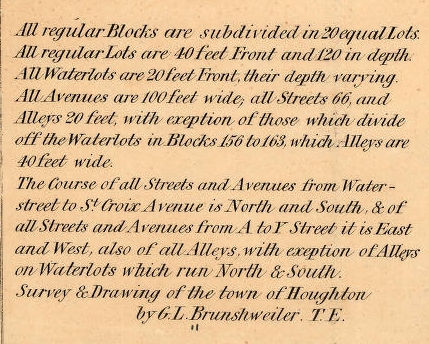
“Survey & Drawing of the town of Houghton
by G. L. Brunschweiler, T.E.”
I am sorry to hear that you have had to wait so long for your money – consequently could not go on with your work. I do hope you will not try to stay there through the winter unless you are sure of money, and that there will be plenty of provisions to be got at. What could have been the reason that your money did not come to you? I did not know that Uncle Sam has suspended payment or lost by the failure of the banks. Perhaps you did not keep reminding them of your case or give them your “address”.
You must write oftener to me and give me an account of your affairs – of all your pleasures and your pains – your disappointments and vexations and be assured no one can feel a deeper interest or more truely sympathize in all that concerns her you than your affectionate parents.
G. A. Barber and M. G. Barber
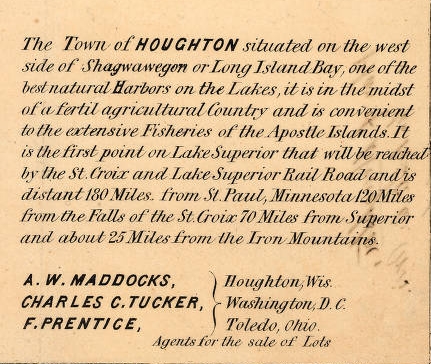
“A. W. Maddocks – Houghton, Wis.
Charles C. Tucker – Washington, D.C.
F. Prentice – Toledo, Ohio.”
Your father wishes you to say to Mrs. Maddocks that he feels under infinite obligations to her for the kindness shown him while sick at her house – that he wishes to express a thousand times more thanks than he was able, when parting from her in the Steam boat, to do. I congratulate you on having the privilege of making it your home at so nice and comfortable a place, with such kind people as father describes those to be. May you have the good fortune or good taste and disposition to make your presence in that, or any other kind hearted family, agreeable – is the wish of your Mother.
Houghton Falls State Natural Area within the Town of Houghton.
Monday morning
Your father rested better last night than before and had no fever thro the night but sweat a good deal as before – is very cool and comfortable this morning. Has some appetite – does not like to get up as it hurts his limbs. But much less than when I first came here.
Sandusky Nov 1st 1857
Dear Son,
Last sunday I wrote you about your father’s sickness and hope you have rec’d it, or will in good time; but as my letters of the past summer have failed wholey to reach you, perhaps the last has also failed. I shall continue to write to you often while he continues sick – and unless while navigation lasts and you may direct yours here until the last boat leaves your place as I see no prospects now of your father’s being able to move on for some time to come. I told you about the chill he had which made me fear he had got a regular chill fever but he did not have another tho he had pretty severe intermittent fever for three days last week. – indeed it continues somewhat yet, but much lighter. But his lameness is much worse than when he left you – that is – he cannot walk or step because his limbs are so painful and much weaker than when he had more fever. I believe he would never have got here alive had he not been sustained by tonics and morphine, but they would never have cured him, and I do think that had he fallen too sick to get here and had employed another Alopathist he would have gone into a typhoid fever and probably have died, as did the hon. R.C. Benton Sen. a short time since – at Rockford Ill. I met his son – our Johnson teacher one at Janesville who told me the sad news. – He was informed of his father’s sickness but did not reach there ’till after his death. His body was carried to Vt. for interment.
Nov. 2
~ “Business Directory” published in the Superior Chronicle, June 26th, 1855.
Your father wishes to ask you if you know anything about that Geo Perry concern – the present shape of it. And if you have heard any thing farther from the Aminacon claim?
Did you get the money of Jack so as to save your compass? If so – how does it prove? Has Herbert got home since yet? If so, how do the boys fare – do they get any money of him? Does old Whacken let John have his paper? Do you hear anything from your money?
When father left the boat at Detroit he told the porter to get his Carpet bag in his room and send it ashore with his trunk – showing him the trunk. – but when he got to the Michigan Exchange it was not to be found – neither at that house nor any other in the city. In looking for it he was detained so as to lose the boat for Sandusky, Friday morning – Saturday he started in a carriage but was told at the wharf by the driver that the boat would not go – (had not arrived) till afternoon, so he was taken back again when soon word came that it had came, but before he could get started – he being unable to walk – it was off again, so he was obliged to stay ’till Monday.
Thus he was detained nearly four days – sick and lame and obliged to climb a long flight of stairs and take long walks to his meals and other necessities, which all together brought on his fever and rheumatism in the muscles worse than ever. He thinks it almost a miracle that he got through so long a journey – sick as he was when he left you, and without any one to assist or care for him – alive. His lameness is now in the left limb – the other being quite free from pain when kept in a horizontal position, but both pain him extremely yet if put down so that he does not attempt to step on his feet. Ham, Jay, and I brought him up stairs last Saturday where we have every thing we need for convenience and family are all as kind and attentive to one wants as people can be. I do not believe there is any better family, or one happier, than this. It is two weeks today since father came here and I know not how many more he may have to stay – the prospect looks rather dark for a speedy departure.

The “Geo Perry concern” related to Albert McEwen’s death and fraud during the 1856 LaPointe County election. This was investigated by the Wisconsin Assembly.
~ Journal of the Assembly of Wisconsin, Volume 9, 1857, page 191.
We got a letter from Am. Saturday in answer to one from me here, says he is well but I should judge he had not done much this fall but watch and wait for us. I do not wonder the poor boy is out patience as well as every things else, as he says.
Write often to your afflicted parents.
G.A.B. and M.G.B.
Sandusky Friday Nov 13 – 1857
Dear Son.
You will at once perceive that we are stationary since I wrote you last. And when we shall be able to move on, is as much a question of uncertainty as ever. Your father remains sick yet – and I cannot – dare not say that he is even convalescent, tho’ I have a little more courage to think that the medicine now being administered is breaking up his fever. He has had a most singular sickness – having – as I think – more or less fever – with or without chills every day – probably since he was first taking – certainly since coming here. [??] the Dr would not acknowledge – or believe it because his visits would be in the forenoon when the intermissions would occur. But the past week he convinced him that chills and fever do actually exist as he has been [presedest?] to break it up. His sickness is so unlike anything in the experience of the Dr. that he appears to be entirely mistified with [reward?] to the proper course to pursue. I have, and do, doubt his judgement – and sometimes have even put a harsher construction upon his course and doubted his honesty. But he has all along said he had not the least doubt of his ultimate recovery tho it would take considerable time to entirely remove his lameness. As to that lameness I hardly know what to say. He is now free from soreness and only his feet swolen; but he cannot straighten his knees as the cords appear to be contracted and are painful when strained and if his feet are brought lower than his body it brings on the same old tearing pain in the muscles.
But I believe that when his fever leaves him and he begins to gain strength his limbs will improve fast. This week past I have felt more discouraged than ever, as the chills would come on every day about noon – continue an hour – sometimes with a hearty shake – then fever – pulse 120 hr. m. – then a hot sweat most of the night with pulse at 85 at the least pain.
This lasted about 5 days – But the Dr has at length “come in with a Tonic” which appears to work right. It is the most powerful sweating medicine I ever saw. He has taken it two nights and one day – and now the 2nd day – 3 P.M. – he has fairly escaped the chill and fever. I feel greatly encouraged – that he is in a way to recover. He has all the time been quite confined to his bed except as he could manage to get into a great chair once a day and sit up – from two hours to half an hour – this several days he has not got in the chair as he was unwilling to exert himself so much. I have been with him – his only nurse – night and day for 3½ weeks, and I hope and expect to granted health and strength to continue to perform the duties of nurse so long as he shall need my assistance. I cannot but think that he was in just as good condition to receive the medicine, which is working so well over two weeks ago – when the billious fever first left him, as he was two days ago. But the Dr thought not, as his limbs were so bad then, and it might make them worse. It has been altogether an unique case, and the Dr has appeared liked one groping in the dark.
I told you in my letter of last week that father lost his carpet-bag – and intended to tell you to see if it was not returned to La Pointe and left there – he thinks the label on it directed there – tho’ at first he said it was to Lancaster. He can hear nothing from it since and I fear it was stolen by the darkies on the boat. This has truely been an unfortunate year for us as well as for thousands of others.
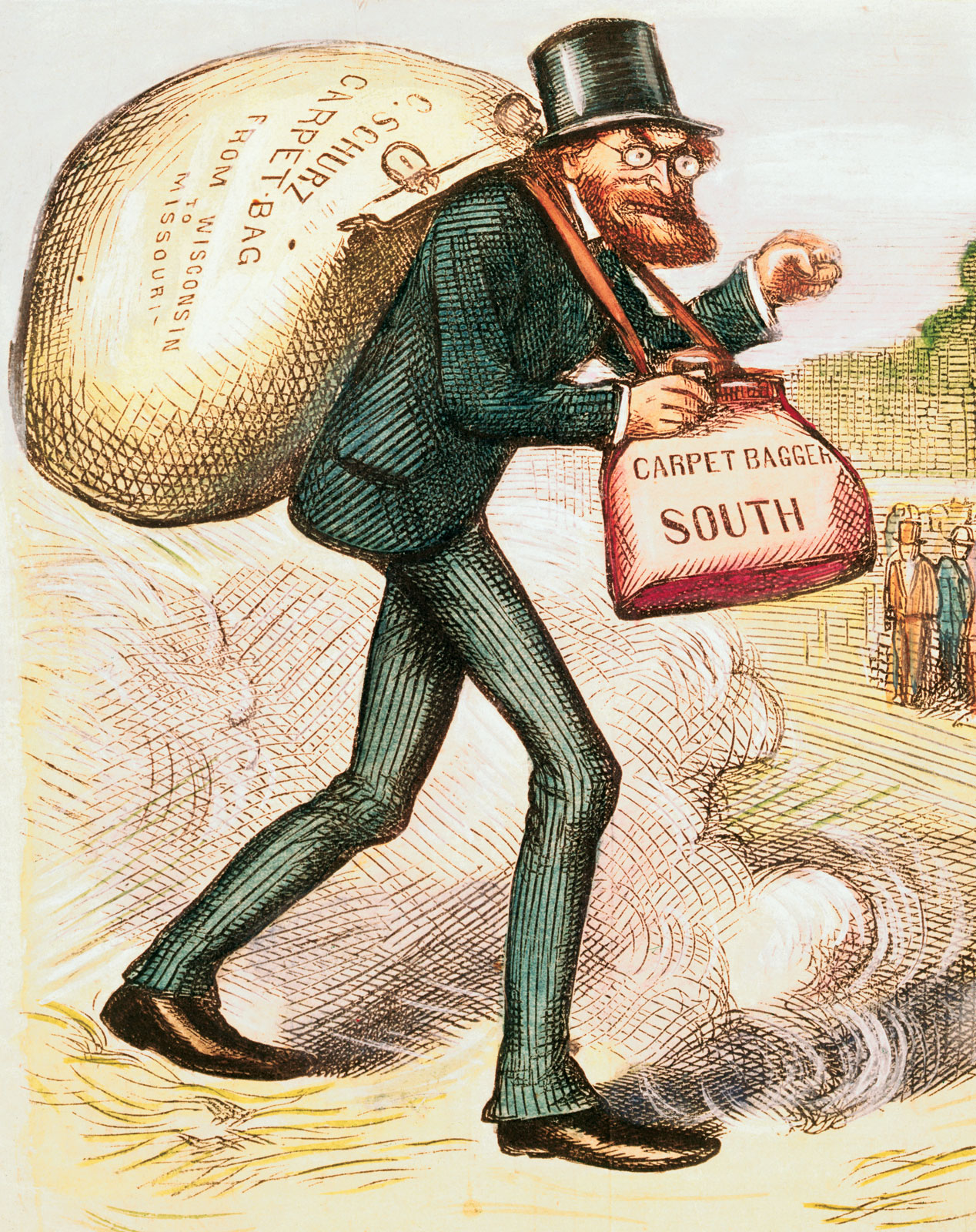
1872 cartoon of Wisconsinite Carl Schurz by Thomas Nast.
Wikipedia.com definition of a Carpetbagger:
In United States history, a carpetbagger was a Northerner who moved to the South after the American Civil War, during the Reconstruction era (1865–1877). White Southerners denounced them fearing they would loot and plunder the defeated South. Sixty Carpetbaggers were elected to Congress, and they included a majority of Republican governors in the South during Reconstruction. Historian Eric Foner argues:
“… most carpetbaggers probably combine the desire for personal gain with a commitment to taking part in an effort “to substitute the civilization of freedom for that of slavery”. … Carpetbaggers generally supported measures aimed at democratizing and modernizing the South – civil rights legislation, aid to economic development, the establishment of public school systems.”
“Carpetbagger” was a pejorative term referring to the carpet bags (a form of cheap luggage at the time) which many of these newcomers carried. The term came to be associated with opportunism and exploitation by outsiders. The term is still used today to refer to a parachute candidate, an outsider who runs for public office in an area where he or she does not have deep community ties, or has lived only for a short time.
We get nothing yet from you. Why is it that you remain so silent? I think it probable we may have to stay here four weeks longer – waiting for him to get well. You may direct here if you send by return mail or by any boat.
You cannot know, nor be told the amount of distress in the country this money panic has produced. I presume you do not see the papers so often as we do, and perhaps do not realize at all. You father warns you to be careful what you do this winter. – not to meddle with any thing – in Ironton shares – or any kind of property – even if you can buy it for a “song” – Every thing is “dead broke” and the less you have to do with Lake Superior property, the better.
Father sends his best love along with mine to you and his respects to Mrs. Maddocks and family.
I am very sorry to think that you will stay up in that wilderness this winter. I wish you could get your money – settle up every thing – come down here and go home with us. It would be a great relief to us to have your assistance for your father if he should continue too lame to walk without help.
We are under a great many obligations to Uncle H. and family for their kindness.
It is growing dark, so good night
Mother
Sandusky Dec 6th 1857
My Dear Son.
Yesterday we rec’d a letter from Am. containing one from you. I was greatly surprised and grieved to learn that you had not got one of my letters since you left Lancaster. I have sent you three from there and as many from here. Neither had you rec’d your draft. I am really suspicious that some one watches the mails and steals your letters hoping to get money or the draft – which, it is possible he has taken out – forged your name &c and taken the money out. In such case you might not discover the theft for a long time – and would be subjected to a great deal of trouble in consequence. I shall have a deal of anxiety in your account this winter, or until I hear that your money has reached you and that provisions are to be had at reasonable prices – which I fear they will and be this since the loss of that new boat must make quite a difference with that region in supplies.

American carpetbag circa 1860; wool with leather handles.
~ Wikimedia.org
I have before written you an account of your father’s journey and continued sickness which you may have yet [??] now. Lest you have not I will briefly say that he got safely to Detroit where he lost his carpet-sack – was detained there three days – arrived here Monday night 19th ult. Oct. 19th where he has remained ever since, confined to his bed. The fatigue of the journey probably somewhat increased his lameness which has been very severe, and he has not been entirely free from chills and fever and sweats until the last week. He has been improving fast for a few days, but just now he is having a little more fever which I presume is caused by some impending diet – either in quantity or quality.
His disease – a very uncommon one – is, in fact, inflamation of the veins extending from the Loins throug the whole limbs – the left much the most – to the toes. He has not been able to put his feet to the floor without extreme pain since he got here, until the last week, and even now, but a few minutes at a time. The cords under the knees have been considerably constrainted but are getting relaxed a little so that his legs make nearly straightened, tho he cannot begin to bear his weight on them.
The disease has been so complicated and so badly treated before he got here that the Dr has been very much perplexed with it. If you have not got my former letters you do not know that we have had a Homeopathist – one whom Uncle H. and Aunt B. think knows enough for all cases but we think that had he possessed a knowledge of anatomy equal to his partner in business who has called twice with him of late, he would have discovered the seat of the disease at first from the symptoms then apparent. But for four weeks he seemed to be in a state of uncertainty, and baffled at every step. But since he discovered the seat of it he has treated it with very good success.
Your father is much reduced in flesh and strength. I cannot now give you a full description of his case but when he gets able to write much I presume he will amuse himself by giving you the particulars if you should feel interested in the subject. Uncle H and family are very kind and obliging and we have every thing our necesities demand at present, but that does not make me contented to remain so long from home. I wish to be in my own house, but it is impossible to leave here until he can walk enough to help himself a little. We have been here 7 weeks, and I fear it will be many more before it will be safe for him to leave or proper for me to leave him for others to wait on. My health is very good so that no one has had to assist me day or night, in nursing.
Your Aff’nt Mother
I suppose this will never reach you unless I direct to some other person for you.
All well at Lancaster last Sunday. Monday morning Aunt Lucy saw a fine little daughter added to her family.
Sandusky Dec 18th 1857
Dear Son
~ Wikipedia.com
You will see that we are here yet, now nearly 9 weeks since I landed here in an almost insensible state from the effects of morphine which I had to take constantly to allay or drown the pain in my limbs. I have been quite sick much of the time. Three or four weeks were spent in treating my sore before the [rest seat became?] of my disease was ascertained, since which time there has been steady progress toward health. My legs had become crooked at the knees, absent at an angle of 45*. My ankles and feet swollen, white, cold & as useless as though made of putty, but I found the pain that had so long affected them was gone & by much exertion, rubbing &c I got so as to bear any weights, & [thoutes who?] crutches, & I have now got so that I can go twice the width of the house at a time on them. My appetite has returned & I am gaining rapidly. My real disease was what is called Spormator [hea?] or a disease of the Spormation vessels or cord on the left side of my body, which the Drs & your Uncle Ham think was the origin of my sickness & all my pain. Sir Astley Cooper [in thing?] authority, giving all the symptoms of my case. We hope to be able in a week or two to go home to Vt. Your mother wants to start in my present helpless condition when I cannot stand alone in a minute without support to save my life, but I have sworn that I will not go to be jostled around & in the can till I am better able to take of my self than now. I cannot get up or down stairs or sit at all weight with crutches, & as neither of my legs are reliable I assure you it is ticklish business to dare go on them (the crutches).
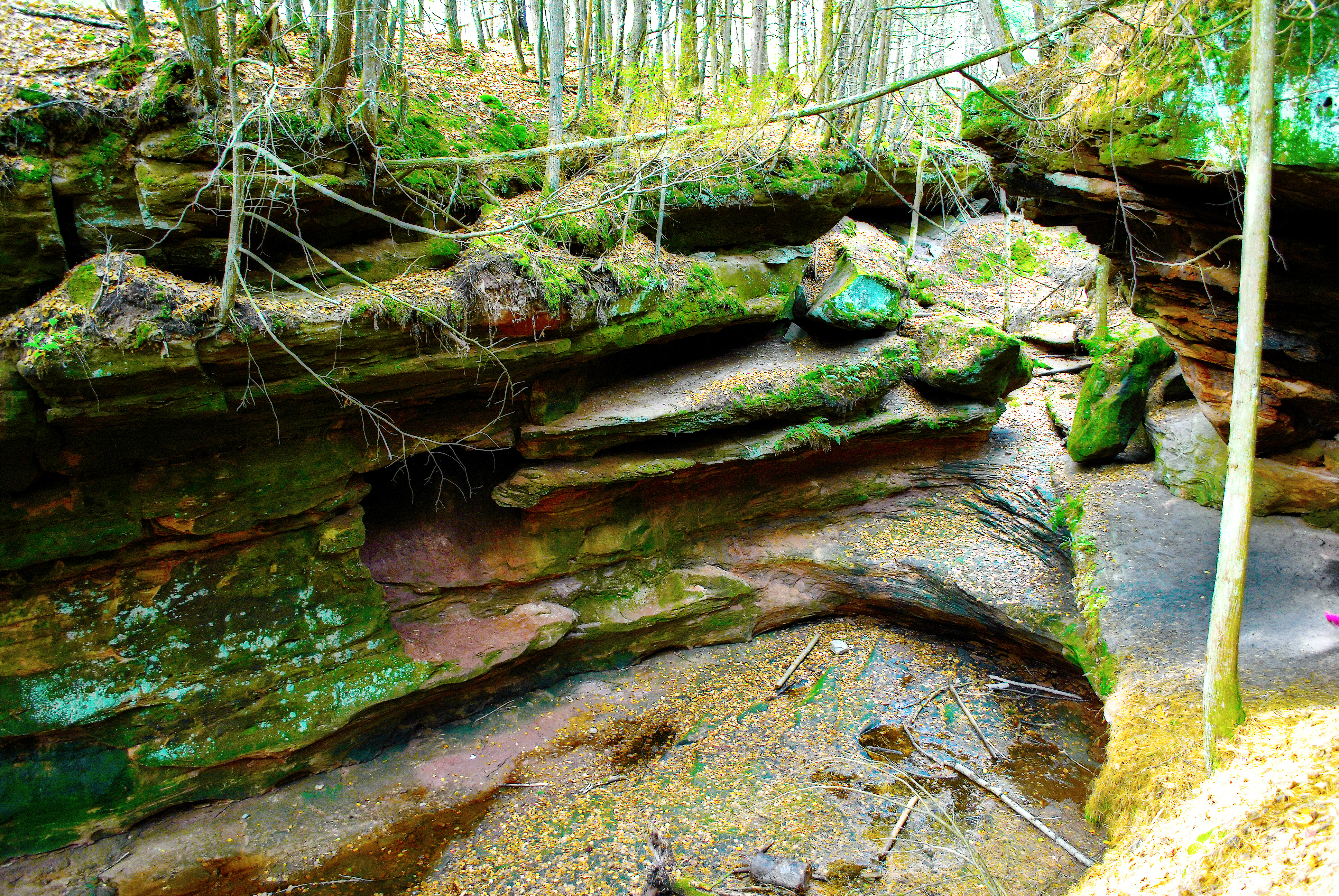
Echo Dells at Houghton Falls State Natural Area.
~ Shared under Creative Commons from Aaron Carlson © 2011
Coming down the lakes from La Pointe I had a pretty hard time of it, was quite sick, had chills, kept my berth most of the time, & when I got to Detroit I was detained by losing my carpet bag and one thing & another because I was unable to help myself, from Thursday P.M. ill Monday A.M. when I came here. Lucky that I had such a refuge to [want?] to in my extremity, had I tried to reach home, my life would have paid the forfeit of I might have had a long sickness among strangers without any of the comforts or conveniences I now enjoy, and insured an enormous train of affection.

Map inset of Chequamegon Bay with Town of Houghton, LaPointe, Bayfield, Ashland, Bay City, and the LaPointe Indian Reservation.
We get letters from Amherst occasionally, he is well & in good spirits boarding at Mr Griswolds, is very anxious for our return to Vermont. By him I learn that Ambrose Chase died after about an hour illness in Nov, & that John Burcham of Johnson died still more suddenly being found dead in the privy. Old Mr Dorsker died lately & that is all he has told of to us. On opening my new trunk here I find some books are missing. Who do you suppose is the rogue? I hope he will russ some amusements & instruction from the books, if so I am content.
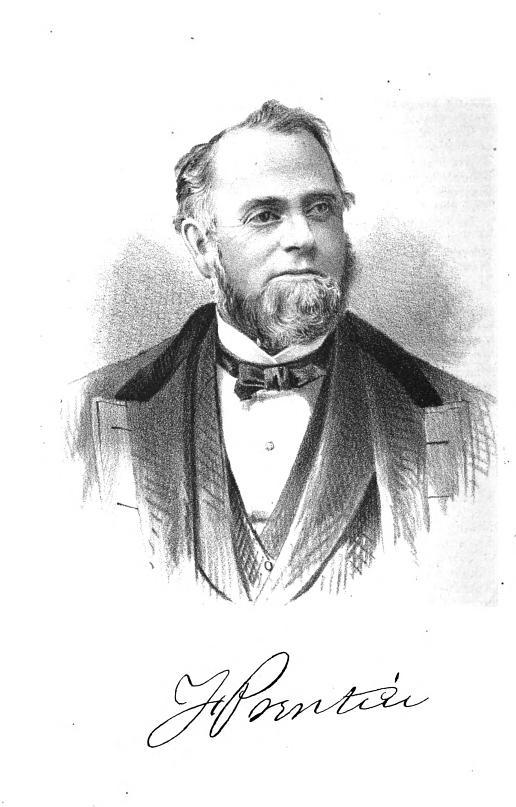
Frederick Prentice (“Man of Money and Mystery”) was an “Indian interpreter for Indian agents and traders”, and owned extensive properties in the Chequamegon Bay region during the 1850s. Prentice started the City of Houghton around the same time he cofounded Bay City (Ashland) during 1854, purchased the Buffalo Tract (Duluth) from Benjamin Armstrong during 1856, and cofounded the City of Houghton (near Washburn) during 1857. Prentice returned to Houghton in 1887 and organized the Prentice Brownstone Company, becoming “the most famous quarryman in northern Wisconsin”. Houghton had a “population of about 250 people, a school house and a sawmill with 25,000 foot capacity” by 1888.
~ This portrait and a profile of Frederick Prentice (the “first white child born” in Toledo, Ohio) is available from History of the Maumee Valley by Horace S Knapp, 1872, pages 560-563.
~ “Business Directory” published in the Superior Chronicle, June 26th, 1855.
August 22nd, 1857
“John H Osborn,
Banker and Land Agent,
And Dealer in Exchange, Superior, Wis.
REFERENCES, — J. B. Ramsay & Co., Cincinnati; J. R. Morton & Co., do; E. Jenkins & Son, Baltimore; A. R. Van Nest & Co., N. Y.; Heston & Druckla, Phila; Holiday & Coburn, St. Louis; John H. Richmon, Esq., Maysville, Kentucky.”
Have you recd your draft yet? Was your compass saved to you? Have you got at work on the reservation yet? If so how do you prosper? How does Herbert make it, does he still remain agent? Does he sell any shares, if so, for how much? Is the work still going on at the City of Houghton, or has the news of the general crash and prostration of all kinds of business failed of reaching Stony Pointe? I recd a letter from Prentiss last week who says, there are some going from Toledo next spring to live there, & he appeared to feel as well as ever.
He said he sent 50 bbls Ham & a lot of Pork to Detroit to go up, but it arrived too late for the last boat to Lake Superior. I have written to Hayes that if the Ammanicon case is decided against me to take an appeal to Washington at once & I will go there & see if testimony has been supplied or any unfair things have been done by the clerks in the office.
I have now sat up [little?] hours, read Douglas’ speech & written this much to you but I feel that I have over taxed my powers and must go to my heated bed for rest. Douglas has come out against the Administration policy toward Kansas & will make a split in the party not easily healed. I will send you his speech.
Tell Mr. Maddock’s folks that Judge John Fitch of Toledo was shot yesterday [????] once of his family by one T.G. Mellon, the ball entering his mouth, lodging in the back of his neck, some hopes are entertained of his life. If this is a ½ sheet it is as long as your letters. Be careful of yourself. I remain your affectionate father.
G.A. Barber
Give my respects to Mr & Mrs Maddocks, & to John Cosborn.
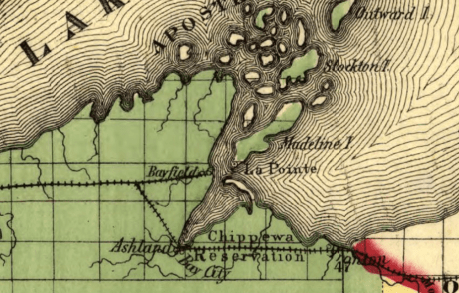
Detail from the 1857 “Township map of Wisconsin showing The Milwaukee & Horicon Rail Road and its connections“. The town-sites of LaPointe County shown here are Ironton, Boyd’s at Old Fort (mislabeled as “La Pointe”), Bay City, Ashland, and Houghton (mislabeled here as “Bayfield” and later as “Lower Bayfield” in the 1865 Colton Atlas). The railroad shown on the LaPointe Indian Reservation correlates to Barber/Wheeler/Stuntz details from “the Gardens“.
~ Library of Congress
To be continued in the Winter of 1858…
By Amorin Mello
In our Penoka Survey Incidents series earlier this year, we followed some of the adventures and schemes of Albert Conrad Stuntz circa 1857. The legacy of Albert’s influential survey still defines the geopolitical landscape of the Penokee Mountains to this day. However, Albert’s work during the late 1850s was relatively minor in comparison to that of his brother, George Riley Stuntz, during the early 1850s. The surveying work of George and his employees started in 1852 and enabled the infamous land speculators and townsite promotors of Superior City to manifest their schemes by early 1854 (months before the Treaty of La Point occurred later that year).
Among the men that worked with George was Augustus Hamilton Barber. Sometime around 1850, Augustus had followed his Grandparents, Aunts, Uncles, and Cousins from the Barber family of Lamoille County, Vermont, to Lancaster in Grant County, Wisconsin. After a short career as a school teacher in Grant County, Augustus came to Lake Superior in 1852 employed by George as a Chainman under his contract with the United States General Land Office to survey lands at the Head of Lake Superior.
Before taking a closer look at the Barber Papers, let’s examine the lives and affairs of other surveyors and speculators along the southwest shore of Lake Superior, starting with George Riley Stuntz and his production of these Exterior Field Notes (June of 1852):


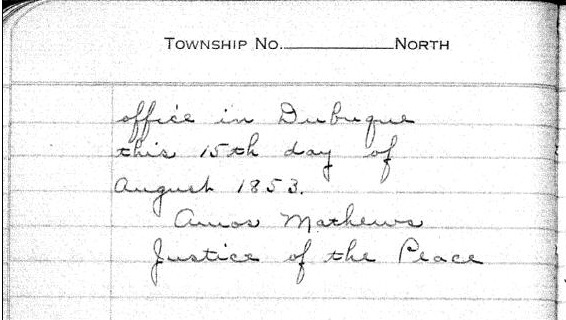
Duluth and St. Louis County, Minnesota;
Their Story and People
By Walter Van Brunt, 1921, pages 64-65.

Portrait of George Nettleton’s cabin on Minnesota Point in 1852 on page 75.
First Settler.– The honor, for both Superior and Duluth, must presumably go to George R. Stuntz. He came in 1852, and settled in 1853. Several were earlier of course, but can hardly be considered to have been legitimate independent settlers. Carlton had been on the ground, at Fond du Lac, for some years, but he was Indian agent; Borup and Oaks had spent their time between La Pointe and Fond du Lac, but were then at St. Paul, and mainly interested in the development of that city, and in fur trading. Wm. R. Marshall stated that he “was on the lake as early as 1848,” but not to settle and he did not come again until 1857. Wm. R. Marshall and George R. Stuntz were fellow-surveyors, in federal pay, “back in the ’40s,” but Marshall did not seek to take the place of Stuntz as premier pioneer at the head of Lake Superior. As a matter of fact, although “on the lake as early as “1848,” Marshall did not then get nearer to Duluth than La Pointe, where he met “Borup and Oaks, the principal traders, Truman Warren, George Nettleton, Cruttenden, Wattrous, Rev. Sherman Hall, E. F. Ely and others.” It is quite possible that Stuntz was with Marshall in 1848, for that was the year in which Stuntz first entered Minnesota territory “having charge of a surveying party that was working near Lake Pepin and in what is now Washington County.”
The “Heart of the Continent.”– George R. Stuntz prepared the way for the first attempt at white settlement at the head of Lake Superior. He surveyed the land on the Wisconsin side, within a year of beginning which survey, in 1852, the first settlers began to appear. George R. Stuntz came by direction of George B. Sargent, who at the time was surveyor-general of the Iowa, Wisconsin and Minnesota district for the federal government, his headquarters being at Davenport, Iowa. In that year, states Carey, “he surveyed and definitely located a portion of the northeastern boundary line between Minnesota and Wisconsin, starting from the head of navigation on the St. Louis River, at Fond du Lac, and running south to the St. Croix River.” Stuntz himself stated: “I came in 1852. I saw the advantages of this point (Minnesota Point) as clearly then as I do now (1892). On finishing the survey for the government, I went away to make a report, and returned the next spring and came for good. I saw as surely then as I do now that this was the heart of the continent commercially, and so I drove my stakes.”
![Group of people, including a number of Ojibwe at Minnesota Point, Duluth, Minnesota [featuring William Howenstein] ~ University of Minnesota Duluth, Kathryn A. Martin Library](https://chequamegonhistory.com/wp-content/uploads/2015/06/howenstein-minnesota-point.jpg)
Group of people, including a number of Ojibwe at Minnesota Point, Duluth, Minnesota [featuring William Howenstein in 1872?] ~ University of Minnesota Duluth
The Vanguard.– He did not come alone, needing of course assistants in the work of surveying, but he was in charge of the work, Gand necessarily takes first place in the accounting. William C. Sargent, son of George B. Sargent, stated in 1916, that his father “came here (Duluth) first in 1852 with George R. Stuntz and Bill Howenstein,” and goes on to state “a word of those two grand men, George R. Stuntz and Bill Howenstein.” He believed that “to George R. Stuntz, more than to any other man belongs the honor (of) opening up that region,” and of Howenstein, he said: “And old Bill Howenstein, one of the best ever, and always my very good friend, a kindly body, with a quaint dry humor unsurpassed and seldom met with in these later days. I had many an interesting chat with him, in his home on Minnesota Point, that he built in 1852, and lived in until his death, some years ago.” Bill Howenstein, undoubtedly was of Stuntz’ party in 1852, but it is doubtful whether he built a log house on Minnesota Point in that year. As to General Sargent’s visit in 1852. If he did come then, it was probably only a flying visit. His interest in the head of Lake Superior in 1852 reached only to the extent of directing Stuntz to survey it. He, himself, had the surveying business of three states to attend to.
The New York Times
[December 11, 1852]
The Region about the Southwest End of Lake Superior.
Mr. Stuntz, of Grant County, Wis., has been deputed by the general Land Surveyor of this Northwest District to lay off such a tract of land about the southwest point of the lake into townships and sections, as emigrants will earliest require. He returned via La Pointe and Stillwater last week. We have obtained from him some new views of that region. From Fond du Lac, a trading post situated 11 miles inland on the St. Louis River, eastward, for perhaps 50 miles, the margin of the lake is a flat strip of land reaching back to a rocky ridge about 11 miles off. The soil of this flat land is a rich red clay. The wood is white cedar and pine of the most magnificent growth. The American line is beyond the mouth of the St. Louis and Pigeon rivers. It evidently abounds in copper, iron and silver. The terrestrial compass cannot be used there, so strong is the attraction to the earth. The needle rears and plunges “like mad.” Points of survey have to be fixed by the solar compass.
The Indian and half breed packmen have astonishing strength. One Indian, who is described by the others as being as large as two men, carried for a company of 11 men provisions for ten days, viz: one barrel of flour, half barrel of pork and something else, beside the utensils. Mirage is a common phenomenon is Spring and Summer. For the bays not opening as soon as the main lake, or not cooling so early, an object out on the lake, is viewed from the shore, through a dense medium of air and a thin medium. Hence is a refraction of rays which gives so many wonderful sights that the Chippewas call that the spirit or enchanted land. Sail vessels which are really 40 miles off, are seen flapping and bellying about almost within touch. Turreted Islands, look heavy and toppling towards the zenith. Forests seem to leap from their stems and go a soaring like thistles for the very sport of it.
The ice did not leave some of the bays till the 10th of June. The fish are delicious, especially the salmon trout. But little land game. Mr. Stunts calculates on wonderful enterprises in that country after the opening of the Saut Canal.
Mr. S. describes La Pointe a town of the Lake, as being situated at the head of a bay some 25 miles from the high lake, and secluded from the lake by several islands. He saw there a warehouse 300 feet long, built of tamarac poles, and roofed with bark. This building is very much warped by the pressure of age ; it is entered by a wooden railway. The town is dingy and dreary. He saw a most luxurious garden by the former residence of Dr. Borup. It contained a variety of fruit trees and shrubs, such as plums, cherries, apples, pears, currants, &c.

Cover of Stuntz’s Exterior Field Notes (August-October 1852) ~ Wisconsin Public Land Survey Records: Original Field Notes and Plat Maps

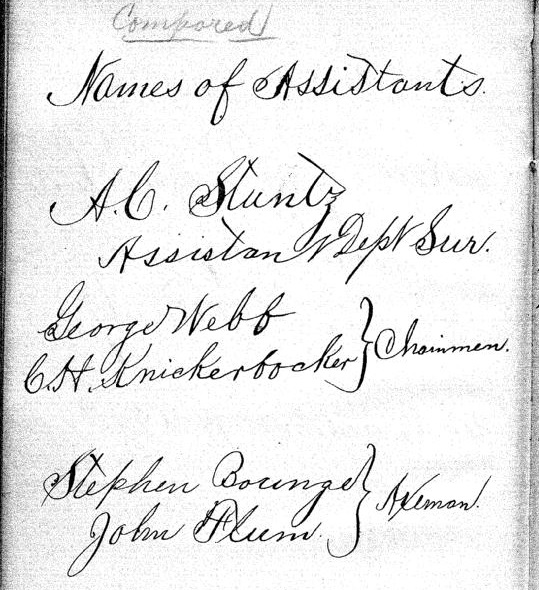
George Riley Stuntz was also assisted by his brother Albert Conrad Stuntz as well as the African-Chippewa mixed-blood Stephen Bonga employed as an Axeman. To learn more about the interesting Bonga (Bonza) family and Stephen as “the first white child born at the head of Lake Superior,” read pages 39-41 of The Black West by William Loren Katz (1971), and pages 131-34 of Black Indians also by Katz (2012).
The Eye of the North-west: First Annual Report of the Statistician of Superior, Wisconsin
By Frank Abial Flower, 1890

Portrait of Stephen Bonga, page 7.
GEORGE R. STUNTZ, DEPUTY U. S. SURVEYOR [pages 50-52]

Portrait of George Riley Stuntz, page 26.
In 1852 George R. Stuntz took a contract to run the township lines in this part of the country, including the state boundary, and filed with the land-office at Dubuque a rude map of the head of the lake, on the Wisconsin side, in December of that year. He took a new contract and returned in the spring of 1853 to survey the copper range around Black River, a few miles south of Superior. He brought seeds with him and planting them on the Namdji, raised a quantity of vegetables; they grew to great size. he also built a trading-post on Minnesota point near the present light-house, and a mill on Iron River in Bayfield county. In respect of these operations W. W. Ward writes from Morley, Mo.:
The first lumber of any description produced locally, other than by “Whip sawing”, was at Iron River, Wisconsin about forty miles from Superior on the South Shore of Lake Superior.
George R. Stuntz with William C. Howenstein, Andrew Reefer and George Falkner built and operated a water power “up and down” sawmill at the falls on Iron River about a half a mile from the Lake, capable of cutting three thousand feet of lumber a day. The writer has several 1 1/4 inch absolutely “clear” White Pine boards 24 and 26 inches wide and 18 feet long that were originally stored in a loft to be used in building a skiff. This mill was built in 1854 and the lumber was floated up the Lake to Superior, Oneota and Fond du Lac…
~ Superior, Wisconsin, papers, 1831-1942 ([unpublished])
From “A Pioneer of Old Superior” by Lillian Kimball Stewart
“In the summer of ’54 the Sam Ward plying between the Sault and any port on Lake Superior, brought on every trip a goodly number of emigrants, speculators, and tourists, bent on seeing the new “city” of Superior. Stuntz’s dock was located near an Indian village, so that every traveler as well as every piece of freight or baggage was subject to inspection by braves, squaws, and papooses before receiving a passport to the shore across the bay…”
~ Superior, Wisconsin, papers, 1831-1942 ([unpublished])
“It was in the spring of 1853 that Mr. Stuntz, Deputy U. S. Surveyor, received his second contract to survey and run the township lines taking in the range around Black River Falls, a portion of Left-hand River country and that part where Superior now is. In the latter part of April that year he organized a party – viz., Nat. W. Kendall, James McKinzie, Pain Bradt, James McBride, Harvey Fargo, Wm. H. Reed, John Chisholm, Joseph Latham, Augustus Barber, and your humble servant. Procured three birch-bark canoes and supplies at Stillwater, Minn.: left there the first day of May, passed up the St. Croix River to its head, made a portage of about two and a half miles into the headwaters of the Brule River, down said river into Lake Superior, thence up the lake to what was called the entry of St. Louis Bay [now Superior Bay], and landed on Minnesota Point in the early part of June. At that time there were no white settlers in this end of the lake – all Chippewa Indians and ‘breeds’ – scarcely a stick missing on that side of the bay where Superior City now stands. We finished the surveying contract and went in early fall down to Iron River, built a double log-shanty, and made other preparations for the construction of a saw mill. Here the first lumber was made at the head of the lake and the first road opened through to the settlement on the St. Croix. The following February, Mr. Stuntz having a trading-post on Minnesota Point [then Stuntz’s Point], I went there and assisted in building a block-house and steamboat pier, and found improvements and a few log-shanties built where old Superior now is located.”
[…]
HUSTLING FOR TOWNSITES [pages 58-60]
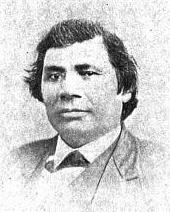
Vincent Roy Jr. ~ Life and Labors of Rt. Rev. Frederic Baraga by Chrysostom Verwyst,
VI. – Superior.
Vincent [Roy Jr.] had barely emerged from the trouble just described when it was necessary for him to exert himself in another direction. A year or so previously he had taken up a claim of land at the headwaters of Lake Superior and there was improvement now on foot for that part of the country, and danger for his interests.
The ship canal at Sault St Marie was in course of construction and it was evidently but a question of days that boats afloat on Lakes Huron and Michigan would be able to run up and unload their cargo for regions further inland somewhere on the shore at the further end of Lake Superior, at which a place, no doubt, a city would be built. The place now occupied by the city of Superior was suitable for the purposes in view but to set it in order and to own the greatest possible part of it, had become all at the same time the cherished idea of too many different elements as that developments could go on smoothly. Three independent crews were struggling to establish themselves at the lower or east end of the bay when a fourth crew approached at the upper or west end, with which Vincent, his brother Frank, and others of LaPointe had joined in. As this crew went directly to and began operations at the place where Vincent had his property it seems to have been guided by him, though it was in reality under the leadership of Wm. Nettleton who was backed by Hon. Henry M. Rice of St. Paul. Without delay the party set to work surveying the land and “improving” each claim, as soon as it was marked off, by building some kind of a log-house upon it. The hewing of timber may have attracted the attention of the other crews at the lower end about two or three miles off, as they came up about noon to see what was going on. The parties met about halfway down the bay at a place where a small creek winds its way through a rugged ravine and falls into the bay. Prospects were anything but pleasant at first at the meeting; for a time it seemed that a battle was to be fought, which however did not take place but the parceling out of ‘claims’ was for the time being suspended. This was in March or April 1854. Hereafter some transacting went on back the curtain, and before long it came out that the interests of the town-site of Superior, as far as necessary for efficient action, were united into a land company of which public and prominent view of New York, Washington, D.C. and other places east of the Mississippi river were the stockholders. Such interests as were not represented in the company were satisfied which meant for some of them that they were set aside for deficiency of right or title to a consideration. The townsite of the Superior of those days was laid out on both sides of the Nemadji river about two or three miles into the country with a base along the water edge about half way up Superior bay, so that Vincent with his property at the upper end of the bay, was pretty well out of the way of the land company, but there were an way such as thought his land a desirable thing and they contested his title in spite of his holding it already for a considerable time. An argument on hand in those days was, that persons of mixed blood were incapable of making a legal claim of land. The assertion looks more like a bugaboo invented for the purpose to get rid of persons in the way than something founded upon law and reason, yet at that time some effect was obtained with it. Vincent managed, however, to ward off all intrusion upon his property, holding it under every possible title, ‘preemption’ etc., until the treaty of LaPointe in the following September, when it was settled upon his name by title of United States scrip so called, that is by reason of the clause, as said above, entered into the second article of that treaty.
The subsequent fate of the piece of land here in question was that Vincent held it through the varying fortune of the ‘head of the lake’ for a period of about thirty six years until it had greatly risen in value, and when the west end was getting pretty much the more important complex of Superior, an English syndicate paid the sum of twenty five thousand dollars, of which was then embodied in a tract afterwards known as “Roy’s Addition”.
~ Biographical Sketch – Vincent Roy Jr; Vincent Roy Jr. Papers.
Up to the time of the survey in the spring of 1854 all was chaos as to lands west of the claims of Robertson, Nelson, Baker and their party. There could be no titles or bona fide purchases, as only the mouth of the Nemadji had been surveyed. There were really three “townsite” companies— Robertson, Nelson and Baker, with their associates J. A. Bullen, J. T. Morgan, E. Y. Shelly, August Zachau, C. G. Pettys, Abraham Emmett, and perhaps others, forming one which had the surveyed lands next to the Nemadji. West of them were Francis Roy, Benjamin Cadotte, Robert Bothwick, Basil Dennis, Charles Knowlton and nearly a dozen half-breeds, mostly brought from Crow Wing by Nettleton in the interest of what was known as the “Hollinshead crowd”—Edmund and Henry M. Rice, George L. Becker, Wm. and George W. Nettleton, Benjamin Thompson, James Stinson and W. H. Newton. Still farther west were Benjamin W. Brunson, A. A. Parker, R. F. Slaughter, C. D. Kimball, Rev. E. F. Ely, George R. Stuntz, Bradley Salter, Joseph Kimball, Calvin Hood, and others who proposed to call their town Endion—”Ahn-dy-yon,” the Chippewa for “home.”
B. W. Brunson, still a resident of St. Paul, has described the contest in writing. He says:
“Believing Superior would become of importance I went there in February, 1854, with R. F. Slaughter. We found some Ontonagon parties had claimed on the bay and we bought an interest in their claims and began to lay out a city and make improvements. While surveying the town, and when we had the same so far completed as to make a plat of it, the township having been subdivided by a good surveyor, then it was that Vincent Roy, Basil Dennis, Charles Brissette and Antoine Warren, accompanied by twenty-one other half-breeds and some four or five white men, headed, led and directed by one Stinson and one Thompson, who were acting for themselves and as agents of the company, came upon the lands to make their claims and avail themselves of pre-emption rights as citizens of the United States. These men were in the employ of the company for the purpose of making claims, and there was a claimant for each and every quarter-section as fast as the surveyor set the quarter-post. They had commenced the day before, with or at the same time the surveyor commenced his work. The timber being dense and there being a strong force, they were able to build an 8×10 cabin and cover it with boughs, upon each quarter, and then overtake the surveyor before he could establish the next quarter, thus taking the land as they went, and in that manner were progressing when they came upon the land marked out and occupied by us.“
The meeting of the two hostile parties occurred on the banks of the deep slough in what is now called Central Park. Nothing but the timidity of the half-breeds prevented bloodshed. Brunson was armed and intended to, and did stand his ground. Thompson, one of the pluckiest of men, was also armed, having two revolvers, and was prepared and intended to proceed. The Indians, not being armed, did not wish to engage in a battle where the leaders only were prepared to fight; and so there was no physical conflict, though a state of chaos and bad feeling continued for some time. Several cabins were demolished, Brunson’s party entirely cutting in pieces a house built by Basil Dennis on the ground now occupied by Dr. Conan’s fine residence.
A long legal contest followed. Finally in 1862-63 patents issued from the government to three men—S. W. Smith, Lars Lenroot and Oliver Lemerise—chosen as trustees of the townsite for the benefit of actual occupants. Thus those who claimed to be proprietors of, but not settlers on the townsite, lost their lands as well as their labor. In the winter of 1853-54 Henry M. Rice asked the Commissioner of the General Land Office whether, when lands which had not been surveyed were claimed for a townsite they would be liable to pre-emption as soon as the survey should be made. The answer was in favor of pre-emption; and that is how those who with Brunson put money into Superior City townsite lost it. The actual settlers got the townsite, the patent being made to the three trustees named who divided the plat, containing 240 acres with riparian rights in Superior Bay, and deeded lots to occupants and purchasers. It may be proper to mention here that a little plat of thirty-four acres, with riparian rights in the bay, and known as Middletown, went through a similar siege of litigation and was finally patented to three trustees —Urguelle Gouge, Louis Morrisette and Nicholas Poulliott—for the benefit of actual occupants. These decisions did not come until the “city” had collapsed and the land become nearly worthless.
The New York Times
[June 19th, 1858]
WESTERN LAND FRAUDS.
More Blood in the Body than Shows in the Face – Land Frauds in the Northwest – The Superior City Controversy – Pre-emptions by Swedes and Indians
Washington, Thursday, June 17, 1858.
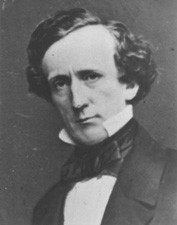
Senator Henry Mower Rice
~ United States Senate Historical Office
There are some interesting matters here besides what takes place in Congress, and I propose from time to time to touch upon them. An expenditure of $60,000,000 per annum does not cover all the pickings and stealings that “prevail” in our hereabouts. Senator RICE did not tell all he knew about land-office operations, when he testified to the value of the Fort Snelling property. Nobody is better aware than he that the tract would be much better to cut up into town lots than Bayfield was when he bought it for a few cents an acre, and sold it for hundreds of dollars. If we could find out all that Senator BRIGHT knows of these matters, one could learn how to become a millionaire at very small expense of brains or labor. Indian treaties and land-office jobbing have made more men rich than care to tell of it – ask General CASS if this is not so.
Seeing a bushel-basket of papers in the Interior Department the other day, I was curious to know what the kernel might be to all that rind, and made inquiry in the premises. I was told that they enveloped the case of Superior City. I cast my eye over some of them, and noticed that an argument was filed on behalf of one of the parties by Mr. Senator BRIGHT – or rather with Senator BRIGHT’S indorsement. This whetted my desire of knowledge, and I ran my eye over the paper in question, which was from the pen of a Minnesota Judge and was without exception the richest document I ever saw intended for a judicial or administrative tribunal. The substance of it was that the opinion of the Attorney-General CUSHING in the case was absurd, the adoption of his views by the Interior Department preposterous, and the action of the local Land office at Superior, in defining the status of certain half-breed Indians on the most abundant testimony, corrupt. It was clear enough that such a document required at least a senatorial indorsement to justify its reception. Nobody can suppose for a moment that Senator BRIGHT has any interest in the result of the case, or that he expected to influence the judgement of his friend, HENDRICKS, (Commissioner of the General Land Office,) by appearing in it. That would be too strong an inference to draw from so meek a fact ; and yet the malicious might suggest it as an apprehension.

Original Proprietors of Superior featuring James Stinson, Benjamin Thomson, Dr. W.W. Coran, U.S. Senator Robert J Walker, George W. Cass, and Horace Bridge. Featured in The Eye of the North-west, pg. 8.
From the printed argument of Senator BRIGHT’S friend, and from a private abstract of the testimony in the case, and a few items I have picked up in the Land Office, I think it will be in my power to indite an epistle that may excite some attention. At the Southwestern extremity of Lake Superior, there is a tract of land, which is expected some day to become the cite of a large city. Being aware of its great advantages for this purpose, a St. Paul speculator by the name of THOMPSON, and a Canadian operator by the name of STINSON, undertook to possess themselves of it as long as as in the early part of General PIERCE‘S administration, by vicarious preemptions. In this plan they were assisted by some official gentlement, who shared in the spoils, and patents were ground out in double-quick time, or certificates issued to Swedes and Indians for the benefit of this STINSON and THOMPSON, and their associate speculators.
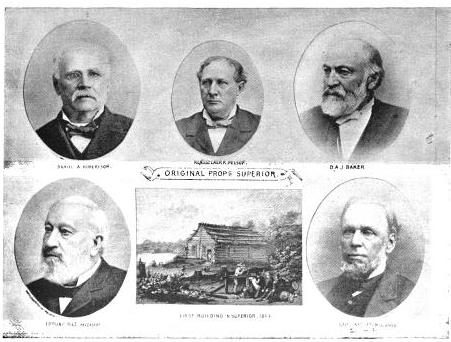
More Proprietors of Supeior from The Eye of the North-west, pg. 9.
In the Summer of 1854, this Mr. STINSON, headed a gang of Swedes and led them from Swede Lake, in the Territory of Minnesota, to Lake Superior, guiding them in person to the tracts he wished them to preempt. These men were ignorant of our language and of our laws, and were used by STINSON to “settle” their tracts, “prove up” their claims, and “convey” to him, the said STINSON, without knowing either the frauds they were practicing, or the rights which they might have secured to themselves if they had been acting in good faith. In the Land Office at Hudson, where these frauds were perpetrated, there was a notary public, who drew the deeds to STINSON, got the signatures of the Swedes to them and took the acknowledgements, immediately after the preemption oath had been administered – the Swedes thinking the whole operation a part of the preemption process. The terms were said to be $30 a month, and a bonus of $15 on the consummation of the bargain. The names of these Swedes were Aaron Peterson, Martin Larson, Peter Nelson, John Johnson, Sven Magnassan, Lorenz Johnson, Peter Norell, Sven Larson, Andreas Senson, Johannes Helon, Johannes Peterson, and Peter Erickson. These “preemptors,” for their own benefit, all “proved up” at Hudson, and the very same day they made conveyances to STINSON. The same thing is true of another Swedish invasion that was made in the Summer of 1855. In that year three Swedes – Old Westerland, Andrew Walmart, and Israel Janssen – commenced their settlements June 11, proved up June 22, and conveyed to STINSON June 22 – eleven days being sufficient for the whole operation. The records of the Land Office at Superior, and of the Register of Deeds of Douglas County, show these facts. They are well known in the General Land Office.
But Mr. STINSON did not operate through Swedes alone. He and his friend THOMPSON worked with half-breed Indians also. In March, 1854, he and THOMPSON followed up the Government Surveys with a gang of Chippewa half-breed Indians. The whole gang made preemptions in Douglas County, under the guidance of THOMPSON and STINSON, who hired them at La Pointe, and convered a large portion of a township with their fraudulent pre-emptions, which were proved up simultaneously, and simultaneously conveyed to the attorney of THOMPSON and STINSON. The names of all of this gang appear on the tract books in the General Land Office. These were Joseph Lamoureaux, Joseph Defaut, Joseph Dennis, Joseph Gauthier, Francis Decoteau, John B. Goslin, George D. Morrison and Levi B. Coffee, all preemptors for these land-sharks. There were three or four more half-breeds in the gang, who ran foul of some eight or ten American citizens who were seeking to save a slice of this Territory from Swedish and Indian preemption, and lay out a town site there under the law. This was the origin of the Superior City controversy, which has been pending some three or four years in the various land offices, and which has accumulated the basket of papers which first drew my attention to a case of such interesting dimensions. The contest is nominally between three or four Chippewa half-breeds claiming some three hundred acres as a town site. But the Indians are not merely bogus citizens, they are bogus pre-emptors in the bargain, for they were the hired men of THOMPSON & STINSON.
Mr. CUSHING decided in this controversy, before it was so settled by the Dred Scott case, that a half-breed Indian, receiving annuities as such, recognized as a dependent of a tribe, and the beneficiary of treaty stipulations, could become a citizen of the United States only by some positive act of Federal legislation ; that he could not, of his own volition, or by the laws of a State, change his condition from that of an Indian to that of a Federal citizen. Strange as it may seem, it appears that this part of the Dred Scott is repudiated by Mr. Commissioner HENDRICKS, who thinks a state cannot make a Federal citizen of a man with a drop of negro blood in his veins, but that the Commissioner of the General Land Office may naturalize Indians, ad libitum, without statute or judgement to sustain him.
I am curious to see how this controversy will be decided. The General Land Office upheld STINTSON’S Swedish preemption, on the ground that the frauds were discovered too late for the Commissioner to interefere. Whether or not STINSON hasmade any negro preemptions does not appear. It was too cold at the end of the lake for negroes to flourish much. But now it is to be settled in a case where the attempted frauds have been seasonably discovered, whether or not a Canadian adventurer can preempt whole townships of the Public Lands by the agency of a gang of half-breed Indians, and procure patents for them when the facts are known to the Federal authorities.
The pre-emptive right. Homesteads.
~ Superior, Wisconsin, papers, 1831-1942 ([unpublished])

Detail of Superior City townsite at the head of Lake Superior from Stuntz’s 1854 Plat Map of Township 49 North Range 14 West.
Early history of Superior should make mention of this right of acquisition, since there under, titles to government land were derived. Any qualified person might acquire title to one hundred and sixty acres of land by settling thereon, erecting a dwelling and making other improvements. Such person was to be twenty-one years of age, either male or female, or the head of a family whether man or woman.
Proof of each settlement was required to be made on a certain day at the United State Land Office and upon the payment of two hundred dollars with the taking of a required oath, the preemptioner got his one hundred and sixty acres of land.
But the whole proceeding, was far from straight, as a general thing, and in fact often amounted to a fraud.
“In the first place, Superior was backed by a powerful company of Democratic politicians and Government bankers in Washington, while the northern and northeastern portions of the state were still held by the Indians. This Superior company sought a connection with the Mississippi river, to obtain which they urged in congress the passage of a land grant bill, offering ten sections to the mile to aid in the construction of a railroad from Milwaukee to some point on Lake St. Croix, on the western boundary of the state of Wisconsin.”
~ History of Duluth and St. Louis County, Past and Present,
Volume 1, page 230.
Hence the whole country, in and about Superior, was dotted with preemption cabins, which were little more than logs piles up in walls, without floors, or windows, often with brush for a roof, a hole therein for a chimney and perhaps for a door. A slashing of half an acre or so of trees was the “improvement” so called. A very barbarous travesty, it was, upon a white man’s home and farm. Here is an instance, where as was said, a certain doctor of divinity laid claim to a quarter section of land, now in the midst of this city.
One day he sought “to prove up” his preemption, and one Alfred Allen was his witness, and they asked Allen, “Was the pre-emptions shanty good to live in?“, the law requiring a good habitable house on the claim. And Alf said “Yes, good for mosquitoes.” The Reverend said “Pshaw! Pshaw!” Meanding to upbraid or caution the witness who thereupon only protested and adjured the harder. The difficulty was somehow smoothed over, through some mending of the proofs, and perhaps connivance on the part of persons charged with administration of the United States land laws.
Nevertheless, it is interesting to member that upon rude and rough proceedings, such as are herein alluded to, rest at bottom the titles and claims to everything we own in the nature of lots, blocks, and land.
From: Statements of Hiram Hayes. Mr. Hayes came to Superior in 1854.
History of Duluth and St. Louis County, Past and Present, Volume 1
By Dwight Edwards Woodbridge, et al, 1910
GEORGE R. STUNTZ. [pages 229-231]
One of the earliest settlers at the head of the lakes was Mr. George E. Stuntz, who a short time ago joined the great majority. Before his death Mr. Stuntz wrote of his pioneer experiences as follows:
“In July, 1852, I came to the head of Lake Superior to run the land lines and subdivide certain townships. When I arrived at the head of the lakes there was nothing in Duluth or Superior. There was no settlement. The old American Fur Company had a post at La Pointe, at the west side of Madeline Island.
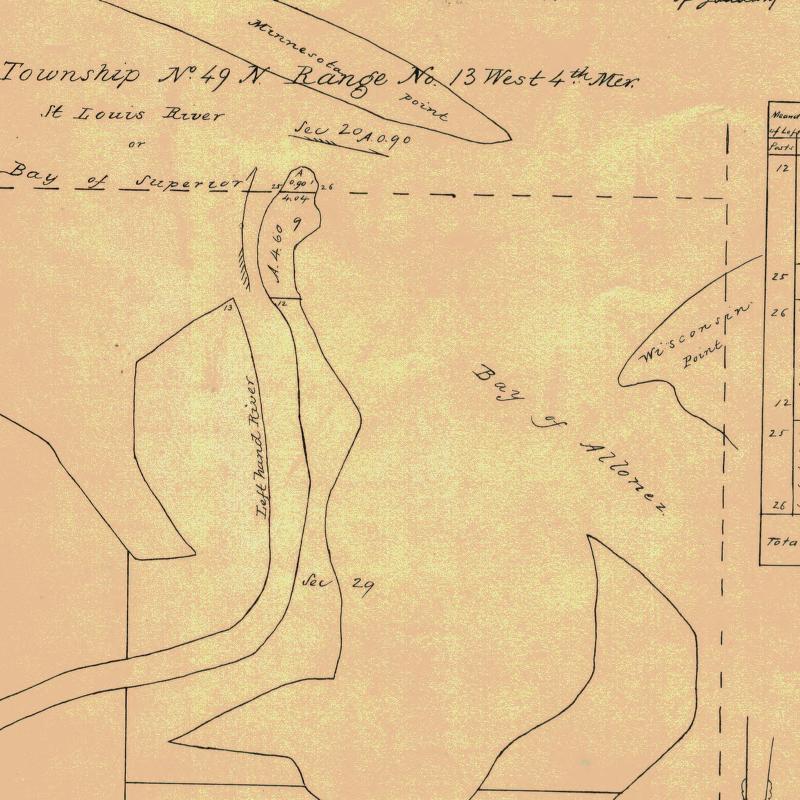
Detail of Minnesota Point from Stuntz’s Exterior Field Notes (August-October of 1852).
“In 1853 I got the range subdivided, and also in Superior, townsite 49, range 13. During the same year, later, in my absence, there came parties from the copper district of upper Michigan and located claims upon the range. They were principally miners. During the same year I built a residence on Minnesota Point under treaty license before the territory was sold to the Government. At that time there were only missionaries or license traders in the tract, as it belonged to the original Indian territory. In 1852, at Fond du Lac, there was a trading post and warehouse, in which I stored my goods on my arrival. In the fall of 1853 I bought three yoke of cattle and two cows at St. Croix Falls and brought them to the mouth of the Iron river, and had to cut a road thirty miles through the dense forest so as to get the oxen, cows and cart through. Later in the fall of 1853 I came through with an extra yoke of oxen, buying provisions, etc., and on coming up to Superior I found quite a settlement of log cabins. These settlers were anxious to get to the United States land office, then at Hudson, Wis. A dense forest intervened. We organized a volunteer company in January, 1854, to cut a road from old Superior to the nearest lumber camp on the St. Croix river, I furnishing two barrels of flour, provisions, pony and dog train, necessary to carry the provisions for a gang of seventeen men. The road was completed in twenty days, the snow being at that time two feet deep. This cut through a direct road to Taylor’s Falls and Stillwater. In 1854 I completed a mill on the Iron river and employed a man to superintend it, and I remained at Minnesota Point, my trading post, where I had first taken out the license. In the same year I took a contract to subdivide two townships located in Superior, townships 48-49, range 15, and afterward I attended the treaty at the time the Indians sold this country to the Government.
Before the 1854 Treaty of La Pointe could be ratified in Washington, D.C., the oral description agreed upon during the negotiations for exterior boundaries of the Chippewa treaties had to be surveyed with the tribe, documented, and delivered to Washington, D.C. before 1855. It is not clear who was involved with the exterior boundaries of these reservations; whether it was Stuntz, Barber, and/or others from their party.
“There were 5,000 Indians present with their chiefs. It was the biggest assemblage of Indians ever held at Lake Superior at this period of the country’s history. It took a month to pacify the troubles that grew among the different tribes in regard to their proportionate rights. This treaty was sent to congress September [30], 1854, and was ratified and became law in January, 1855.
To be continued in 1854…
 Chequamegon History