1839 Petitions against Payments at La Pointe
October 10, 2025
Collected & edited by Amorin Mello
Previously we featured 1837 Petitions from La Pointe to the President about $100,000 Payments to Chippewa Mixed-Bloods from the 1837 Treaty of Saint Peters, and 1838 more Petitions from La Pointe to the President about relocating the Payments from St. Croix River to Lake Superior. Those earlier Petitions were from Chief Buffalo and dozens of Mixed-Bloods from the Lake Superior Chippewa Bands, setting precedence for La Pointe to host the 1842 Treaty and 1854 Treaty in later decades.
Today’s post features 1839 Petitions against Payments at La Pointe. These petitioners appear to be looking to get a competitive edge against the American Fur Company monopoly at La Pointe, by moving the payments south across the Great Divide into the Mississippi River Basin.
For more information about the $100,000 Payments at La Pointe in 1839, we strongly recommend Theresa M. Schenck’s excellent book All Our Relations: Chippewa Mixed-Bloods and the Treaty of 1837.
Letters Received by the Office of Indian Affairs:
La Pointe Agency 1831-1839
National Archives Identifier: 164009310

April 9, 1839
from Joseph Rolette at Prairie du Chien
to the Superintendent of Indian Affairs
Received April 27, 1839
Prairie du Chiene 9th April 1839
T.H. Crawford Esq’r
Commissioner of Ind’n affairs
Washington
You must excuse the liberty I take in addressing you once more – presuming you are not well acquainted yet with this Country, I am requested by the Chippewaw half Breeds that remain in this Country, that it is with regret they have heard that the payment allowed to them in the treaty of the 29th July 1837 is to be made on Lake Superior. They have to State, that it will be impossible for them to reach that place as the American Fur Co. are the only Co. who have vessels on Lake Superior & Notwithstanding they could procure on Passage Gratis on the Lake.
This distance between Sault Ste Mary, and the Mississippi is great and expensive. They also represent that the half Breeds born on Lake Superior are not entitled to any Share of the money allowed.
Whereas if the Payment was made at the Falls of St. Croix, there would be Competition amongst traders, whereas in Lake Superior they can be done none. They humbly beseech that you will have Mercy on them and not allow them to be deprived by intrigue of the Sum due them. So Justly to go in other hands but the real owners.
Respectfully
your most obd’t Serv’t
Joseph Rolette
on behalf of the Chippewaw
Half Breeds of
Prairie du Chiens

June 21, 1839
from the Indian Agent at Saint Peters
via the Governor of Wisconsin Territory
to the Superintendent of Indian Affairs
Received July 16, 1839
Answered July 24, 1839
Superintendency of Indn Affairs
for the Territory of Wisconsin
Mineral Point June 20, 1839
Sir,

Henry Dodge
Governor of Wisconsin Territory
I have the honor to transmit, enclosed herewith, three letters from Major Taliaferro, Indian Agent at St Peters, dated 10th, 16th, & 17th inst, with two Indian talks of 3rd & 14th, for the information of the Department.
Very respectfully
Yours obedt sevt
Henry Dodge
Supt Ind Agy
T Hartley Crawford Esq
Com. of Indian Affairs
North Western Agency St Peters
Upper Mississippi June 10th 1839
Governor,
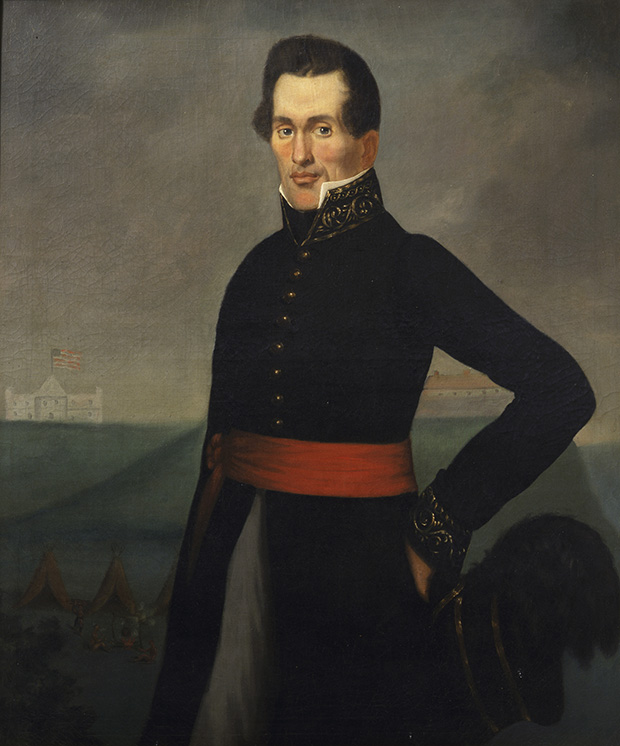
Lawrence Taliaferro
Indian Agent at Fort Snelling
I deem it to be most adviseable that the enclosed paper, addressed to the Agent, and Commanding Officer on this Station from the Chippewa Chief “Hole in the Day” should be forwarded to you, the Indians addressing us being within your Excellency’s Superintendency. It may be well to add that a similar document proceeding from the Chippewa Chiefs of St Croix was on the 4th inst forwarded for the information of the Office of Indian Affairs at Washington.
The consolidation of the two Chippewa Sub Agencies and located at Lapointe, it is feared may lead to rather unpleasant results. I know the Chippewas well, and may have as much influence with those of the Mississippi particularly as most men, yet were I to say “you are not to have an agent in your Country, and you must go to Lapointe in all time to come for your Annuity, and treaty Stipulations.” I should not expect to hold their confidence for one day.
With high respect Sir
Your mo obt Serv
Law Taliaferro
Indian Agent
at S. Peters
His Excellency
Governor Henry Dodge
Suprt of Indi Affairs
at Mineral Point
For Wisconsin
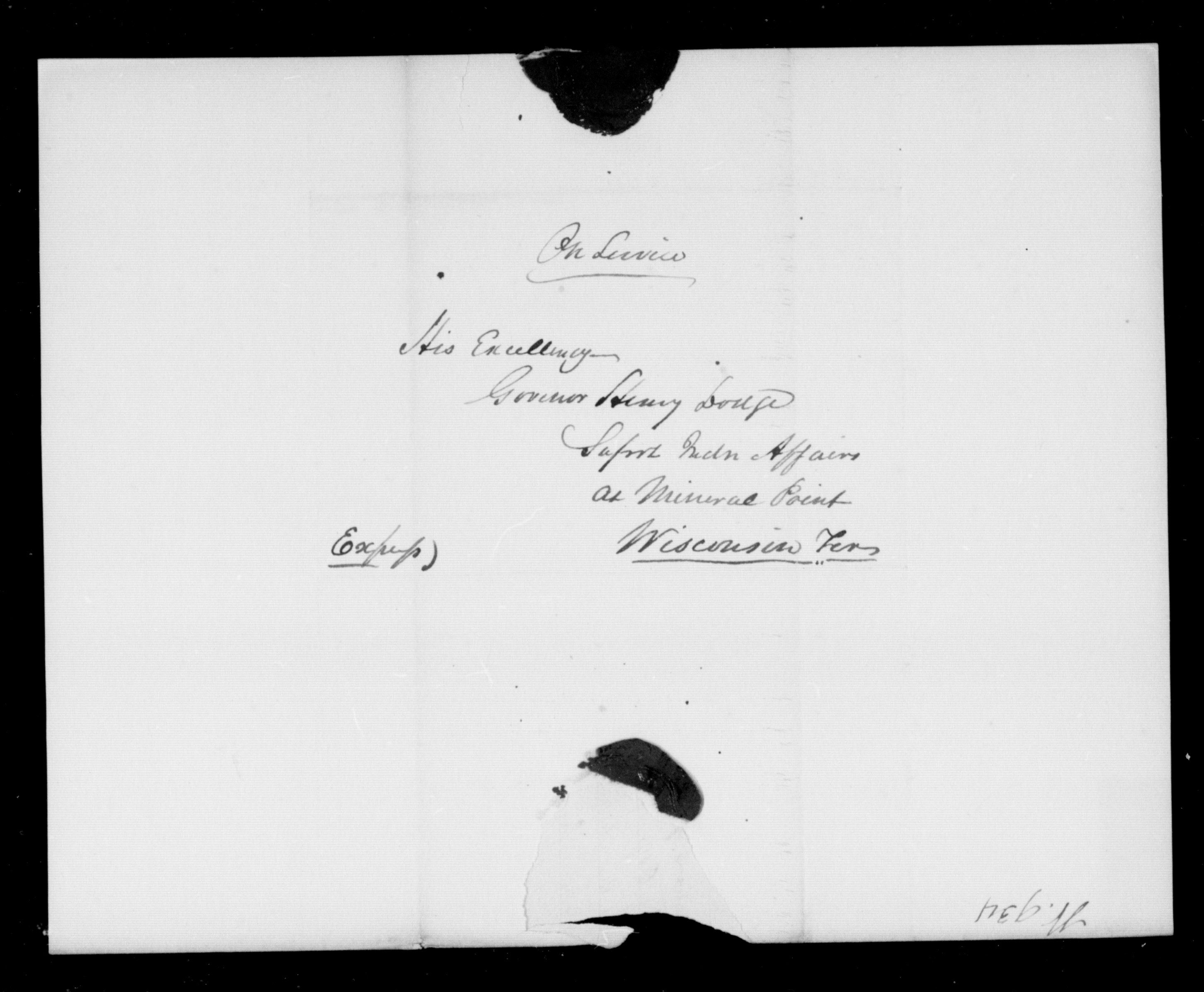
North Western Agency S. Peters
Upper Mississippi June 16th, 1839
Governor
I have been earnestly selected by a number of the respectable half breed Chippewas resident, and others of the Mississippi, interested in the $100,000 set apart in the treaty of July 29, 1837 of S. Peters, to ask for such information as to their final disposal of this Sum, as may be in your possession.
The claimants referred to have learned through the medium of an unofficial letter from the Hon Lucius Lyon to H. H. Sibley Esqr. of this Post, that the funds in question as well as the Debts of the Chippewas to the traders was to be distributed by him as the Commissioner of the United States at Lapointe on Lake Superior, and for this purpose should reach that place on or about the 10th of July. The individuals Seeking this information are those who were were so greatly instrumental in bungling your labours at the treaty aforesaid to a successful issue in opposition to the combinations formed to defeat the objects of the government.
There remains 56,000$ in specie at this post being the one half of the sum appropriated or applicable to the objects in contemplation, and upon which the authorities here have had as yet no official instructions to transfer some special information would relieve the minds of a miserably poor class of people and who fear the entire loss of their just claims.
With high respect, Sir
your mo obt Sevt
Law Taliaferro
Indn Agent
at S. Peters
His Excellency
Gov Henry Dodge
Suprt of Ind. Affairs
for Wisconsin
North Western Agency S. Peters
Upper Mississippi June 17th 1839
Governor
On the 20th of May past I dispatched Peter Quin Express to the Chippewas of the Upper Mississippi with a letter from Maj D. P. Bushnell agent for this tribe at Lapointe notifying the Indians, and half breeds that they would be paid at Lapointe hereafter, and at an earlier period than the last year. I informed you of the result of his mission on the 10th inst. enclosing at the same time the written sentiments of the principle Chief for his people. I now forward by Express a second communication from the Same Source received late last night. I would make a plain copy, but have not time. So the original is Sent.
In four days there will be a large body of Chippwas here, and they cannot be Stopped. There are now also 880 Sioux from remote Sections of the Country at this Post and of course we may calculate on some difficulty between these old enemies. Your presence is deemed essential, or such instructions as may soothe the Angry feelings of the Chippewas, on account of the direction given to their annuity, & treaty Stipulations.
With high respect Sir
Your mo ob Sevt
Law Taliaferro
Indn Agent
at S Peters
His Excellency
Governor Henry Dodge
Suprt of Indi Affairs
Mineral Point
(NB) The Chippewas are to be understood as to the point of payment indicated to be the St.Croix, and not the S.Peters, as deemed by the written Talks. It never could be admited in the present state of the Tribes to pay the Chippewas at this Post, but they might with safety to all parties be paid at or above the Falls of S.Croix, by an agent who they ought to have or some special person assigned to this duty.
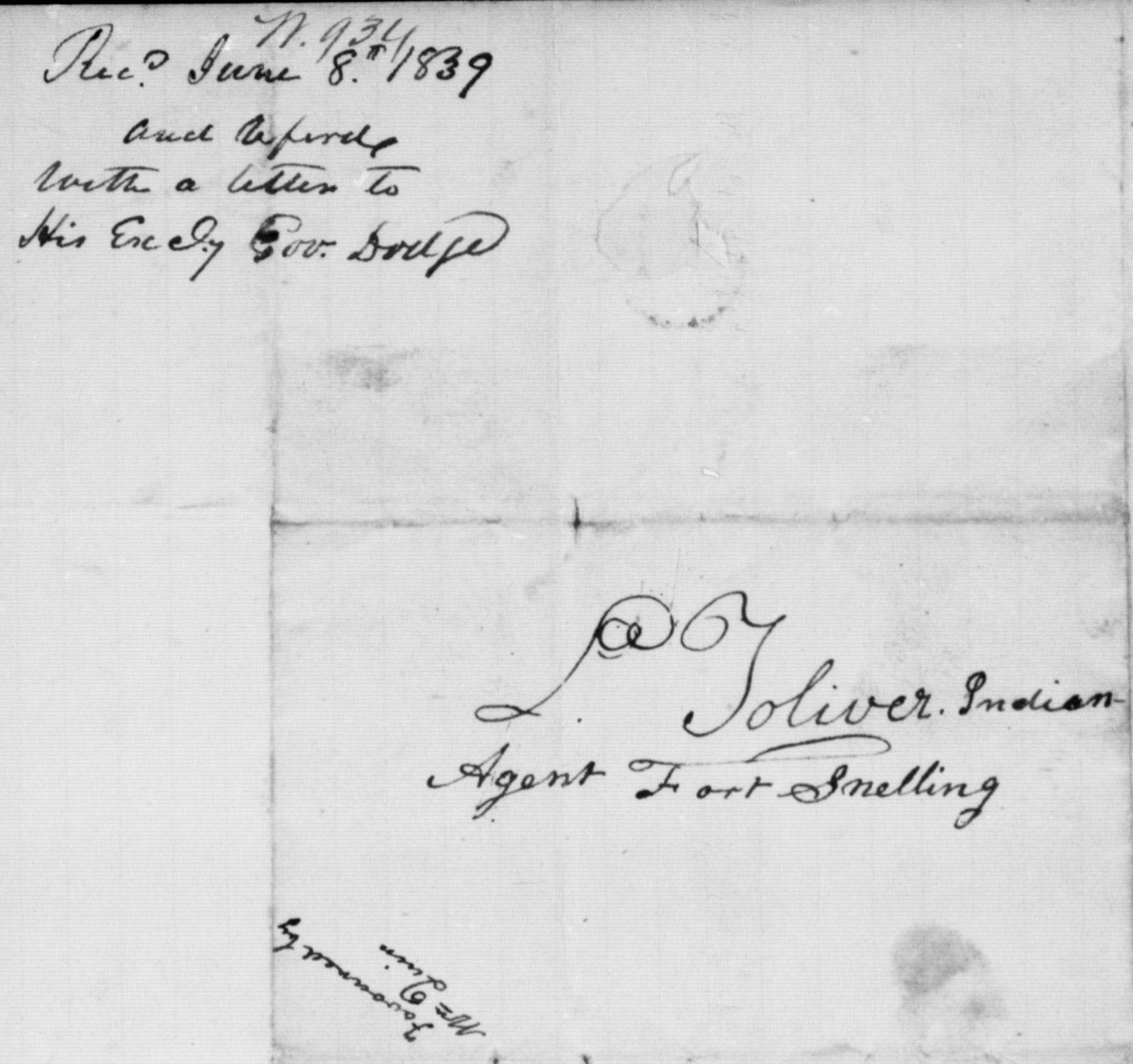
Elk River, June 3rd 1839
Maj Toliver. Maj Plimpton.
My respects to you both, and my hand: I am to let you know that I intend to pay you a visit, with my chiefs as braves, the principle of my warriors are verry anxious to pay you a visit.
The above mentioned men are verry anxious to see Gov. Dodge with whom we made the treaty, that we may have a talk with him. It was with him commissioner of the United-States we made the treaty, and we are verry much disappointed to hear the newes, we hear this day (IE that we must go to Lake Sup. for our pay) which we have this day decided we will not do; that we had rather die first: it is on this account we wish to pay you a visit, and have a talk with Gov. Dodge. You sir, Maj Toliver know verry well our situation, and that the distance is so great for us to go to Lake Sup. for to get our pay &c. or even a gun repaired; that it is inconsistent for such a thing to be required of us; even if we did literally place the matter in the hands of Government. We are all living yet that was present at the treaty when we ceded the land to the Unitedstates, and remember well what was our understanding in the agreement.
We now wish Maj Toliver; to mention to your children that it is a fals report that we had any intention to have more difficulty with the Sioux, as our Missionaries can attest as far as they understand us. We will be at the Fort in seventeen days to pay you a friendly visit as soon as we received the news; we sent expressed to our brethren to meet us at the mouth of Rum Riv. and accompany us to the Fort.
It is my desire that Maj Plimpton would keep fast hold of the money appropriated for my children the half breeds, in this section, and not let it go to Lake Sup. as they are like ourselves and it would cost them a great deal to go there for it.
Pah-ko-ne-ge-zeck or Hole in the Day
Maj Toliver
Maj Plimpton

Elk River June 14 1839
Maj L. Toliphero,
My hand, It is twelve dayes since we have the newes and are all qouiet yet. My father I shall not forget what was promiced us below, I think of what you promiced us when you were buing our lands.
My father this is the thing that you & we me to take care of when you bougt our lands & I remember all that you said to me. My father I am the cheif of all the Indians that sold there land and this is the time when all of your children are coming down to receive their payment where you promiced to pay us.
My father I am the cheif and hold the paper containing the promices that you made us. The Gov. D. promised us that in one year from the date of the treaty that we should receive our first payment and so continue anually.
My father; I have done for manny years what the white men have told me and have done well, and now I must look before we are to know what I have to do.
When I buy anything I pay immediately the Great Spirit knows this Now when we get below we are expecting all that you promiced us Ministers and Black Smiths and cattle.
I say my father that we want our payment at St Peters where you promiced us. I said that I wanted the half breeds to be payed there with us. I told you that when the half breeds were payed that there was some French that should have something ((ie) of the half breed money) because they had lived with us for many years and allways gave us some thing to eat when we went to their houses.
My father all of your children are displeased because you are to pay us in another place and not at St Peters it is to hard and far for us to be payed at Lapointe.
My father I did not know that the payment was to be made at Lapointe until we heard by Mr Quin.
My father it is so far to Lapointe that we should lose all of our children before we could get their and if we should brake our Gun we may throw it in the water for we cannot go there to get it mended, and if we have a [illegible] holding a coppy of the Treaty in his hand
Black Smith we want him here and not at Lapoint.
My father I want that you should tell me who it was told you that we all wanted our payment at Lapoint. All of the Cheifs are alive that hear what you said to us below. You Mr Toliphero hear me ask Gov Do’ for an Agen and to have him located here and he promiced that it should be so. I want that the Agent should be here because our enemies come here sometimes and if he was here perhaps they would not come. My father we are all of us very sorry that we did not ask you to come and be our Agent. I don’t know who made all of the nois about our being payed at Lapoint. I don’t look above where we should all starve for our payment but below where the Treaty was made.
My father give my compliments to all of the officers at the Fort.
Hole in The Day X
Maj L Toliphereo
1848 La Pointe Annuity Payments
March 2, 2016
By Amorin Mello

American Fur Company Papers: “Map of La Pointe”
drawn by Lyman Marcus Warren, 1834.
~ Wisconsin Historical Society
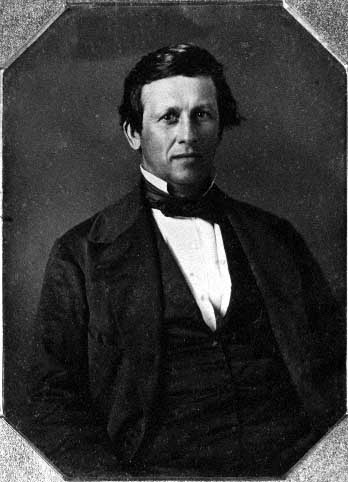
Hercules Louis Dousman
“In 1827, the American Fur Company (AFC) achieved a monopoly on the fur trade in what is now Minnesota. The Company suddenly increased its prices by 300 percent; American Indians, returning from the hunt with expectations of trading for their yearly supplies, found themselves cast into a debt cycle that would increase in the decades ahead. American Indians would receive virtually unlimited credit as long as they maintained the most precious collateral: land.
As game was overhunted and demands for furs changed, the system collapsed under a burden of debt. In 1834, AFC departments were sold to partners who included the Chouteaus, Henry Sibley, and Hercules Dousman. The business strategy of the reorganized companies changed from fur trading to treaty making. In 1837, economically stressed Dakota and Ojibwe people began selling land in what became Minnesota. Fur traders, through their political connections, were able to divert government payments for American Indian land into their own pockets. In effect, land cession treaties became a vast government bailout of fur trade corporations.”
~ Relations: Dakota & Ojibwe Treaties
Henry Hastings Sibley Papers 1826-1848

Henry Hastings Sibley
~ Minnesota Historical Society
Northern Great Lakes Visitor Center
History Center & Archives
“Papers of Minnesota’s first governor during his years as a fur trader, consisting primarily of correspondence among the various American Fur Company agents located in the Wisconsin Territory. Correspondence concerns internal company business; business with Hudson Bay Fur Company; company agreements with the Dakota Indians; company interest in United States government treaties with the Dakota, Ojibwa, and Winnebago Indians; attempts by the company to prevent war between the Dakota and the Sauk and Fox Indians; relations with missionaries to the Indians of the region; and company disputes with Indian agents Henry R. Schoolcraft and Lawrence Taliaferro.
Correspondents prominent in the early history of Minnesota and Wisconsin include William Aitken, Frederick Ayer, Alexis Bailly, Bernard Brisbois, Ramsay Crooks, Henry Dodge, James Doty, Hercules Dousman, Jean Faribault, Alexander Faribault, Joseph Nicollet, Henry Rice, Joseph Rolette, Henry Schoolcraft, Lawrence Taliaferro, and Lyman Warren.”
New York April 17, 1848
To Geo Ebninger Esq.
Assignee Am. Fur Co.
Dear Sir,

Pierre Chouteau, Jr.; son of French Creole fur trader, merchant, politician, and slaveholder Jean-Pierre Chouteau.
~ Wikipedia.org
We hasten to reply to you, of this date offering to sell “The American Fur Co Establishments at Lapointe” all the Northern Outfit Posts: – “The whole for twenty five hundred dollars ($2500)” provided we will take the goods remaining on hand there after this spring’s trade at New York cash for sound Merchantable goods everything else as its fair actual value & say that we regret you waited until the moment our senior was leaving for the west before making the above proposition & also some days after the departure of Mr. Rice. It is probable, if your letter had been received during his stay here, that we would have accepted it or made other propositions which would have been agreeable. We thought if you were desirous of selling the Establishments & goods that you would have apprised us earlier of your intentions & given us time to consult or reflect upon it. And we expect, and hope that you will give us time to communicate your proposition to the persons interested with us in Upper Mississippi & particularly with Mr. Rice who alone has visited the posts & has a correct idea of their value.
Believing that the delay we ask will not or cannot be prejudicial to your interests we will wait your answer.
Very respectfully
yr obd svt
P Chouteau Junr
New York 28th June, 1848
Mister P Chouteau Jr & Co
New York
Gentlemen,
Agreeably to what I had the pleasure to address you on the 14th April last, copy of which letter is annex I will sell you the late American Fur Company’s Establishment at La Pointe & as the terms and conditions as before named, delivery to be made to you or your agent on a date to be hereafter agreed upon between the First day of September and Fifteenth day of October next and ending Payments for the same to be made in New York to me in October or November next.
Please let me have your written reply to this proposition.
I am gentlemen bestly
Your Obedt Servt
George Ebninger
Assignee to P Chouteau Jr, St Louis
New York 30th June, 1848
To George Ebninger Esq.
Assignee Am Fur Co.Dear Sir,

View of La Pointe, circa 1843.
“American Fur Company with both Mission churches. Sketch purportedly by a Native American youth. Probably an overpainted photographic copy enlargement. Paper on a canvas stretcher.”
~ Wisconsin Historical Society
In reply to yours of 28th inst (with copy annexed of similar letters under date 14th April last) we have to say that under advises lately received from our Saint Louis house we accept in general terms your proposition for the sale of the American Fur Co’s trading Establishment at Lapointe and interior for the sum offered, of Twenty Five Hundred dollars. It may be well enough to observe how ever that we consider the sale as dating only from the time of delivery to our authorized agents. Until then received we shall consider the posts as the property of Late American Fur Co and to be as their risk and any destruction of property between now and the time you may fix for delivery to be their loss and not ours.
The terms of payments proposed by you are entirely acceptable. But we think it might be better to make it more definite and accordingly suggest that our agents who received the property draw upon us as forty days & nights for the amount. Hoping that these slights exchanged may meet your sanctions and that you will name an early day for the delivery of posts & we remain very truly,
Your Obedt Servt
P. Chouteau Jr & Co
New York 5th July 1848
P Chouteau Jr Esq
Saint LouisDear Sir

“Ramsey Crooks (also spelled Ramsay) was born in Scotland in 1787. He immigrated to Canada in 1803 where he worked as a fur trader and explorer around the Great Lakes. He began working for the American Fur Company, which was started by John Jacob Astor, America’s first multi-millionaire, and made an expedition to the Oregon coast from 1809-1813 for the company. By doing so he also became a partner in the Pacific Fur Company. In 1834 he became acting president of the American Fur Company following Astor’s retirement to New York. A great lakes sailing vessel the Ramsey Crooks was constructed in 1836 by the American Fur Co. A nearly identical sister ship was built in the same year and was called the Astor. Both ships were sold by the dissolving fur company in 1850. Ramsay Crooks passed away in 1859, but had made a name for himself in the fur trade not only in Milwaukee and the Great Lakes, but all the way to the Pacific Ocean.” ~ Milwaukee County Historical Society
On the 28th June I sold to your house the Establishments of the late American Fur Company at Lapointe agreeably to the letter I had written to you on the 14th April. Cash delivery to be made at some period to be agreed upon hereafter between the first day of September and fifteenth day of October next. I hope that it may be in my power to get to Lapointe and attend to the delivery to your agents but if not we must select some other to act for me, Mr. Crooks and myself are not on good terms in [cou-bethee?] ease as he has been opposed to the sale being made by from the bush. I have lately heard that Mr. Crooks has written the Establishment & at Lapointe (Mr. [Ludgem?] of Detroit told me so while in the city lately) and he must have written to him shortly after the offer was made to you here, and it remains to be seen what authority he can have to dish use of the property which has been assigned to me and over which I have acted as assignee for nearly the last six years. Mr. Crooks acts of leaving here shortly for the Northern Posts. Before then I shall know what he proposes to do to annul the sale I have (under the authority vested in me as assignee) made to you, and which has been made agreeably to his only Suggestions on the 14th day of April last, and the only objection he can make to the Sale is that you did not as once accepts of his but required only a reasonable time to reply to which I was willing to grant and would again give under such circumstances you being there on the eve of leaving here, but it was clear enough that Mr. Crooks never wished that you should have the Northern Outfit Establishment, but that his friend Borrup should. I shall however do all that I can to oppose his injust views on that score.
I am In Most Truly
Your Obedt Servt
George Ebninger
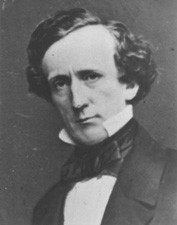
Aspring politician and future Senator Henry Mower Rice represented the Chippewas at the 1847 Treaty of Fond du Lac, and appears frequently here on Chequamegon History.
~ United States Senate Historical Office
St. Louis July 14, 1848
Mr.s Sibley & Rice
St. PetersDr. Sirs
We had this pleasure of the 7th inst by [Shamus Highland Many?] enclosing Invoice & Bill of Landing of C.O. English goods which we hope you will have received in good order and due time – The same day and as the time the boat was pushing off we addressed you a few lines in haste, advising you of the purchase made by our House in New York, of the posts at Lapointe. We have just received several documents in relation to that purchase of which you will find copies herewithin.
You will perceive from their contents how Mr. Crooks has acted in the matter, and that it has become urgent for us to take such steps as will answer the possession of the said posts. How we will be able to succeed, Doctr. Borrup being now in possession & having apparently purchased from Mr. Crooks, is a matter of doubt and can only be ascertained at Lapointe. We have purchased Bona Fide from Mr. G. Ebninger, the only person authorized to make sale, as the assigner of the late American F. Co. Mr. Borrup we are afraid, will (as you can see by Mr. Sanford’s letter) refuses to give possession, and in that case, in a country where there is no way of enforcing law, we may not be able to obtain possession before next year. Now, would it be desirable or advantageous to make the purchase and not get possession before that time? We think not.

Oil painting of Doctor Charles William Wulff Borup from the Minnesota Historical Society:
“Borup and Oakes were headmen for the [American Fur Company]. All voyageurs, ‘runners,’ as they were called, were employed by said company. They would leave La Pointe about the beginning of September, stay away all fall and winter among the Indians in their respective districts, collect furs, and return about the beginning of June. They would take along blankets, clothes, guns, etc., to trade with the Indians for their furs. They took along very little provisions, as they depended mostly on hunting, fishing, wild reice, and trade with the Indians for their support. There were several depots for depositing goods and collecting furs, for instance at Fond du Lac (Minnesota,) Sandy Lake, Courtes Oreilles, Lac du Flambeau Mouth of Yellow River, etc.”
~ Proceedings of the [Wisconsin Historical] Society at its Sixty-fourth Annual Meeting, 1917, pages 177-9
We are writing this day to our home in New York and to Mr. G. Ebninger that he must proceed immediately to Lapointe so as to be here from the 1st to the 15th September, and claim himself & in person the delivery of the posts. Any agent would not probably succeed, or objections would no doubt be made by Doctr. Borrup which said agent could not face or answer. You will therefore do the necessity of either of you going to Lapointe and meet them with Mr. Ebninger on the time appointed above.
Very truly yours,
P. Chouteau Jr & Co
It was only on the 10th inst that we were handed your forms of 25 june enclosing packing ‘℅’ of the U.S. postal M.R. #01037 for ℅ St Louis ℅ Chippewa outfit. Capt. Ludwick ought to be more particular with papers confided to his care.
Bernard Walter Brisbois was an agent for the American Fur Company.
Duplicates of this letter and documents enclosed, sent to the care of Mr. Brisbois of Prairie du Chien, by mail
You will notice by copy of telegraphic dispatch of the 10th that the Chippewa annuity will be paid at Lake Superior as heretofore.
[Illegible]
The New York Times
September 29, 1851
“Indian Moneys”
There is no greater abuse in the governmental policy of the United States, than the past and present system of Indian payments; and the Indians would be benefited if the money thus appropriated were cast into the Lakes, rather than made the cause of such much distress and swindling as it is.
The author of this article is not identified.
In the August of 1848 we were present at a payment at La Pointe, and we have no hesitation in saying that every dollar paid to the Indians there was a disadvantage rather than a benefit to them.
The payment was fixed for August, and Indians from West of the Mississippi were called together at La Pointe to receive it. They gathered at the appointed time, and the payment was not made for three weeks after the time specified.
The money collected at the Saut Ste. Marie Land Office, the most convenient point, had been transported, as per Government order, to Chicago, and the Paymaster received drafts on that point where he was compelled to go for the specie, and the payment was thus delayed.

La Pointe Beaver Money of the American Fur Company’s Northern Outfit from “The Beaver in Early Wisconsin” by A. W. Schorger, Wisconsin Academy of Science, Arts, & Letters, Volume 54, page 159.
Meantime, the Indians gathered at La Pointe were without the necessaries of life, and the agents of the North American Fur Company, and a few old traders who were posted in the business, supplied them with provisions at exorbitant rates, and forced them to buy with every ounce of pork or flour which they needed, an equal amount of dry-goods and gewgaws, which had no value for them. These sales were made on credit, to be settled at the pay-table. At the payment, some $30,000 in cash, and a stipulated quantity of blankets, guns, powder, tin pails, calicoes, ribbons, &c., were distributed; and this American Fur Company, and the favored traders, raked from the Paymaster’s table as it was counted out to the bands, over $12,000 for provisions furnished to, and trash forced upon the Indians, while they were delayed after being summoned to the payment.
Some $14,000 more was spent among forty traders and the remaining $4,000 the Indians carried home; about one dollar each.
Their blankets, about the only valuable thing they received in the way of dry goods, were on the night after payment, mostly transferred to a mercenary set of speculators, at a cost of a pint of whiskey each, and came down to the Saut as private property on the same propeller that took them up as government gratuity.
Such was the result of a payment for which thousands of Indians traversed many miles of forest, wasted six weeks’ time, and lost the crop of wild rice upon which they depended for their winter’s subsistence.
If a white man with a white soul, writes the history of the Indians of the West, the American government will gain little credit from his record of Indian payments.
For more context about these American Fur Company partners and their affairs following the 1848 La Pointe annuity payments, please read pages 133-136 of Last Days of the Upper Mississippi Fur Trade by Rhonda R. Gilman, Minnesota History, Winter 1970.
But the swindle of 1848 was not gross enough to suit certain grasping parties. La Pointe was too easy of access. So many traders sought a market for their goods there, that the old monopolists could not obtain a thousand per cent on the goods they sold; and even in 1848, it was whispered that they were using all their influence to have the future payments made at some point so far West that competition would not force them to be content with moderate profits.
For more context about the Lake Superior Chippewa following the 1848 La Pointe annuity payments, please read our The Sandy Lake Tragedy and Ojibwe Removal series here on Chequamegon History.
To effect this it was necessary to remove the Chippewas further West, and by some influence, not, perhaps, distinctly marked, but yet more than suspected, this order of removal was secured.
It was uncalled for, useless, and abominable; and we are glad, for the sake of humanity and justice, that the Administration have resolved that for the present the edict shall not be enforced. We trust it may never be.
 Chequamegon History