Edwin Ellis Incidents: Number VII
April 9, 2023
Collected & edited by Amorin Mello

Originally published in the August 25th, 1877, issue of The Ashland Press. Transcribed with permission from Ashland Narratives by K. Wallin and published in 2013 by Straddle Creek Co.
… continued from Number VI.

Plat of Prentice’s Addition to Ashland:
“It is in this addition, that, the Chippewa River and the St. Croix Indian trails reach the Bay.”
My Dear Press: – Recollections of Ashland which should forget to mention Martin Roehm, would leave out a material part – in truth a connecting link in the “chain of events.” He came to the Bay in the summer of 1856 – a hearty industrious young man, not many years from the “Fader Land.” He pre-empted a quarter section of land near the town site – which he still owns. He was not long in discovering the worth and beauty of a comely young widow, who, like himself, had left the “Fader Land” to improve her worldly condition. – After a somewhat lengthy courtship, they were married by “Esquire Bell” in their own home. The ruins of the house may be seen in Prentice’s Addition on the flats between “town” and the mouth of Fish Creek. The bride herself cooked with her own hands the marriage feast, while the guests were gathering. The ceremony was concluded by a grand gallopade, the music being under the direction of that master of the Terpsichorean art, Conrad Goeltz, assisted by his brother Adam, himself a master of the art.

Photograph from obituary of Martin Roehm:
Ashland Daily Press,
April 17, 1898
Martin and his worthy wife still live in Ashland, having witnessed and participated in its varied fortunes for more than twenty years. They may be said to form the connecting link between the Old and New Ashland; for when all others had been, by the force of circumstance, compelled to abandon their homes, they alone remained “monarchs of all they surveyed.” They were in possession of an improved estate in their beautiful valley of Marengo twelve miles from Ashland. This was their favorite winter retreat; while upon the shores of the bay their palaces exceeded in number the residences of the richest kings of the old world. For years they were sovereigns alone, in possession of territory rivaling in extent some of the Kingdoms of Europe.
Their herds of cattle increased year by year and in time patriarchal style, were driven from one part of the vast estate to another, as the necessities of forage might require.
And now, although the revival of Ashland has somewhat restricted the extent of Martin’s possessions, he still owns a valuable herd of cows, and finds a sure source of revenue in the milk supply of Ashland, to the mutual satisfaction of his patrons and himself. His experiments have shown that our soil and climate are adapted to cattle raising and dairy purposes.

Robert Dundas Boyd
Register of Deeds
La Pointe County
Robert D. Boyd, unknown to most of the present generation, came to Ashland in 1855. He was a native of the island of Mackinac – the son of an Indian Agent there stationed. His father was connected by marriage with a distinguished ex-President, to whom he owed his appointment. Rob’t D. as the report was, had, from the effects of a sudden outbreak of passion been guilty of a high crime, and to escape the penalty of the law, had fled to Lake Superior – then almost inaccessible – and safe from invasions of sheriffs and wicked men of that sort. At La Pointe he married a French mixed blood girl by the name of Cadotte, by whom he had several children. Except when under the influence of liquor, his conduct was good and his manner gentlemanly and polite. When partially intoxicated he was thought to be somewhat dangerous if not desperate.

Detail of settlement at Boyd Creek from Augustus Barber’s 1855 survey:
“There is a house in the NE quarter and another in the SE quarter of Section 25.”
He laid claim to a piece of land on the west side of the bay opposite to Ashland, of which a plat was made, to which he gave the name of “Menard,” in memory of the lamented French Jesuit Priest, who, according to tradition, labored for a while at an Indian village then located at this spot, – the point where the old St. Croix Indian trail reached the water of the Great Lake, and which in early years was a well beaten path – but now deserted. No traces of the village are now visible. The storms of nearly two hundred and fifty winters have obliterated all traces, of what from its position, must have been an important point among the Ojibwas of the northwest. According to the tradition, Father Menard left the bay for a missionary tour inland, from which he never returned and no trace of him was ever found.

La Pointe County Deeds Book A Page 577:
Plat of Mesnard
Surveyed, certified, and recorded in 1857 by Edward L. Baker, as power of attorney for Thomas H. Hogan of La Pointe:
“the SE¼ of the SW¼, the SW¼ of the SE¼, and Lot 3 in Section 24, and Lots 1 & 2 and the NE¼ of the NW¼ and west½ half of the NW¼ of Section 25, all in Township 48 North of Range 5 West of the 4th principal meridian of the State of Wisconsin“
Boyd erected a house in 1857 in the western part of Beaser’s Division which still stands, but unoccupied.
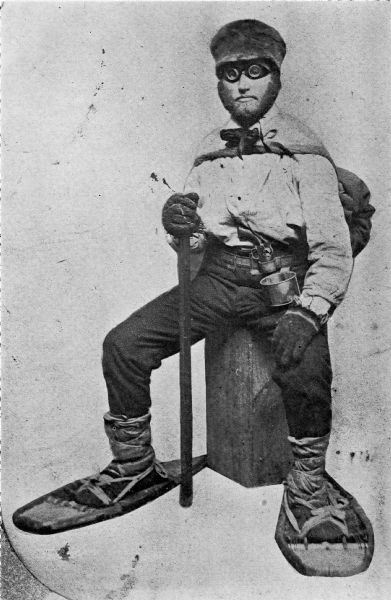
Wisconsin Representative Asaph Whittlesey also wrote about this tragedy.
In the latter part of 1857 he became unusually dispirited; his drunken sprees became frequent and long continued; and he was often under arrest for his disorderly and quarrelsome conduct. Finally in January 1858 he fell into a drunken debauch of several days duration. He was then living in the old log cabin on Main Street – Mr. Whittlesey’s first house – with one bachelor companion by the name of Cross. Having passed the night in drunken carousals, in the early morning – irritated by some real or imaginary insult from Cross – he approached the latter with a drawn butcher knife in his hand, holding it up in a threatening manner, as if about to strike. Cross drew a revolver and fired – two balls passed into the chest – one entering the heart. Boyd fell and in five minutes had breathed his last. This tragic event produced a profound sensation in our little community. A coroner’s inquest was held by Asaph Whittlesey, then a justice of the peace, – and although the evidence seemed to show that Cross might have retreated and saved himself without taking Boyd’s life, still Cross was judged by the jury to have acted in self-defense and was acquitted, Boyd’s known desperate character doubtless contributed to this result.
Boyd’s wife had died some years before, and several children were left orphans; and the writer will always carry in his mind the affecting scene as the little daughter three years old was held up in the arms of Mrs. Angus to take a last view of, and imprint a last kiss on the cold brow of her only natural protector. But God – who is ever the Father of the fatherless, – took care of the orphans, and they are now grown up to manhood and womanhood, and twenty years have effaced from most the memory of this sad event.
To be continued in Number VIII…
Asaph Whittlesey Incidents: Number IV
April 11, 2017
By Amorin Mello

Originally published in the March 9th, 1878, issue of The Ashland Press. Transcribed with permission from Ashland Narratives by K. Wallin and published in 2013 by Straddle Creek Co.
… continued from Number III.
Early Recollections of Ashland: Number IV
by Asaph Whittlesey
In our last number we referred to “the most aristocratic house” with lumber floors, etc. Though it was the third cabin built upon the “town site,” it was in reality the first cabin built, designed as a permanent residence. The foundation logs of this house were laid Sept. 20th, 1854. The record made by Martin Beaser, (evidently made from recollection,) calls this the first building erected, (giving the size of it,) whereas we had lived in two buildings previous to the building of this one.

Rev. Leonard Hemenway Wheeler
~ In Unnamed Wisconsin by Silas Chapman, 1895, cover image.
The “Whittlesey Post Office” was kept therein from the date of its establishment, March 12th, 1855 to Nov. 1858. The first dancing done within the “town site” was in this house in Nov. 1854, and during the winter religious services were held therein by Rev. L. H. Wheeler, of the Odanah Mission. It was the birthplace of Delia Elizabeth, second daughter to Mr. And Mrs. Asaph Whittlesey, born May 21st, 1856, being the first American child born within the limits of the “town site.” The first celebration of the Fourth of July was held in this house July 4th, 1855, further reference to which will hereafter be made. The first general election of county officers in the county of Ashland, was held in this building Nov. 4th, 1856, at which time Samuel S. Vaughn received eleven votes for the office of County Clerk, and M. H. Mandelbaum receive twelve. Francis McElroy was elected District Attorney and Asaph Whittlesey County Judge. It was in this house that Robert D. Boyd was shot and instantly killed by Henry Cross, January 10th, 1858, for which a verdict of justifiable homicide was rendered at an inquest, held by Asaph Whittlesey, Justice of the Peace, acting as Coroner.
ARRIVAL OF THE SECOND FEMALE UPON THE TOWN SITE.
Mr. and Mrs. John P. T. Haskell, with their family, parents of Mrs. Whittlesey, made a landing at Ashland, Nov. 2nd, 1854, and made their home with us during the winter following. In the early spring they made a home of their own in a cabin located upon the site of the present residence of G. M. Willis, Esq., a little to the east of Vaughn’s Dock, in Vaughn’s addition to Ashland, which was originally known as Haskell’s pre-emption claim. Mr. Haskell and family remained in the country only a single year, when they returned to Illinois, where Mr. Haskell died in 1873. Mrs. Haskell is still living and is unusually active for one of her age.
I next call your attention to the
FIRST CELEBRATION OF THE 4TH OF JULY
upon the “town site” July 4th, 1855.
Under an understanding had between Mr. and Mrs. Austin Corser and Mr. And Mrs. John Corser, (then living at Fish Creek,) and being the owners of the only cows nearer than Odanah, an agreement was made whereby the Corsers were to furnish milk, while Mrs. Haskell and Mrs. Whittlesey, (then living in the log house still visible on lot 6, of block 6,) were to do the necessary cooking in the celebrated “mud oven” attached thereto, marvelous for its baking capacity and for the quality of its production.
On the day referred to, the Declaration of Independence was read by Asaph Whittlesey, and this with the delivery of an oration by A. W. Burt, with singing and amusements, constituted the first public celebration of the 4th of July in the history of Ashland. The exercises were had at Whittlesey’s house in the after part of the day, and extended late in the evening, when music and dancing were added to the festivities of the day. The ladies present were Mrs. Haskell, Mrs. Whittlesey, the two Mrs. Corsers and Mrs. Farley. The gentlemen present were J. P. T. Haskell, George Kilborn, Lawrence Farley, Austin and John Corser, Asaph Whittlsey, A. W. Burt, A. J. Barckley, Adam Goeltz, John Donaldson, Conrad Goeltz, Andrew Scobie, and Duncan Sinclaire. The children present were Eugenia E. Whittlesey, (less than three years old,) George, son of Mr. and Mrs. Austin Corser, also a child of Mr. and Mrs. John Corser and William, John Joseph and Hattie Haskell, children and Mr. and Mrs. J. P. T. Haskell.
I shall never forget Mrs. Haskell’s “classic step” on that occasion, discounting many of those present much younger than herself. At intervals during the night the party were very highly entertained with singing by Conrad and Adam Goeltz.
FIRST POST OFFICE ESTABLISHED AT ASHLAND, MARCH 12TH, 1855.
As there was no opportunity for doubt as to the rapid growth of the city the establishment of a Post Office was the result of our first raid upon the general government, though for nearly one year following no provision whatsoever was made for furnishing this office with mail service, and mails were received by chance from La Pointe up to the opening of semi-monthly service, upon a new route established between La Pointe via Ashland to Chippewa Falls, and was soon after, during the winter months, supplied with weekly service upon the route from Ontonagon, Mich., to Superior, Wis. On both of these routes the mails were carried by packers and upon dog teams.

Detail of La Pointe County from a map of Wisconsin published by J. H. Colton & Co., New York, 1856.
~ MapofUS.org
In the petition forwarded to Washington asking for the establishment of an office at Ashland, La Pointe county, Wisconsin, the request was made that it be given the name of Ashland, and that Asaph Whittlesey be appointed postmaster. The sequel showed that as there was an office by the name of Ashland within the State, it was not lawful to attach the name to this office and therefore the appointing officers at Washington attached the name of Whittlesey thereto, by which the office was known until July 30th, 1860, when the obstacle to change in the name being removed, it was then given the name of Ashland, and was also designated as being in Ashland County, Wisconsin. I well remember how difficult a task I found it to be to satisfactorily explain to them how the place could one day be known as Whittlesey, La Pointe county and the next as Ashland, Ashland county. But they soon admitted it rather than be longer afflicted with my letters upon the subject.
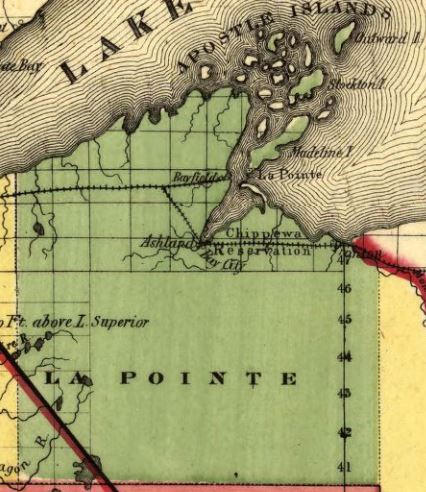
Detail of La Pointe County from a map of Wisconsin by The Milwaukee & Horicon Rail Road, 1857.
~ Library of Congress
The office of Whittlesey was kept in the cabin still in existence on lot 6 of block 6, “original Ashland,” until in Nov. 1857, when it was removed to lot 3 of block 3, into what was known as the Tomkins House, which then became the residence of myself and family until Nov. 1860. The case in which the books and papers connected with the office were kept, (which was made by myself,) is now in the “farm house” at “Pleasant Valley,” and will be delivered to any public organization in Ashland desiring to preserve the same. I continued to serve as postmaster until Nov. 21st, 1860, when I resigned the office and Andrew J. Barckley’s was appointed as my successor. Barckley’s term as postmaster expired Sept. 9th, 1861, by the appointment of Martin Beaser as successor in office to Barckley. Mr. Beaser served as postmaster until his death in Nov. 1866.
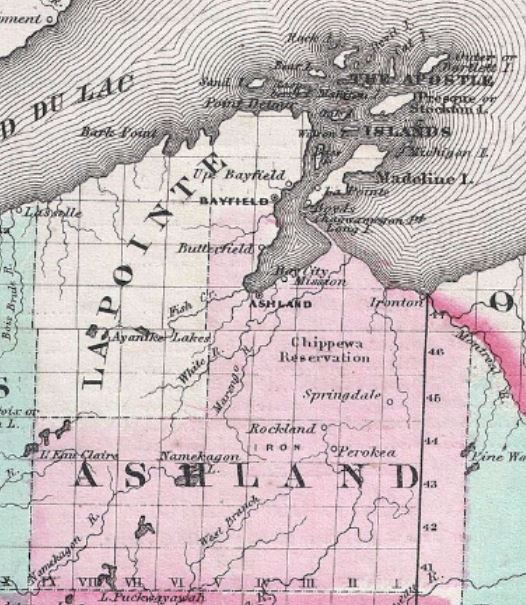
Detail of La Pointe and Ashland Counties from a map of Wisconsin and Michigan by A. J. Johnson and Ward, 1864.
~ Geographicus.org
The post office of Ashland was re-established Dec. 18th, 1871, and James A. Wilson, (the present incumbent,) being appointed postmaster.
The amount of post office money turned over to the Government by me at the close of my term of service was $8.53. My commissions upon this amount, together with the “franking privilege” vested upon postmasters, laid the foundation for my future fortunes, the balance was taken in waitings upon William Gotzenberg, who made daily inquiries for his mail, though he was aware that no mails were received oftener than once a week.
 Chequamegon History