Steamboats, Celebrities, Soo Shipping, and Superior Speculation: Joseph R. Williams’ Account of the 1855 Payment
July 30, 2014
By Leo
“They fade, they perish, as the grass of the prairies withers before the devouring element. The officers of our government, in their conference, have been accustomed to talk about the protection their Great Father vouchsafes to them, but it is the protection which the vulture affords the sparrow. Whatever may be the intentions of our professedly paternal government, no alternative seems to remain to the Indian, but submission to its crushing and onward march.”
-Joseph R. Williams, 1855

When Joseph R. Williams stepped out from the steamboat Planet onto the dock at La Pointe in August of 1855 he tried to make sense out of the scene before him. The arrival of the Toledo-based newspaper editor and hundreds of his fellow passengers, including dignitaries, celebrities, and politicians at Madeline Island coincided with the arrival of thousands of members of the Lake Superior Ojibwe bands for the first annuity payment under the Treaty of 1854.
The portrayal of the Chequamegon region in history would never be the same.
Prior to that year, the main story depicted in the written record is the expansion of the indigenous Ojibwe and Ojibwe-French mix-blood populations, their interactions with the nations of France, Britain, and the Dakota Sioux, and ultimately their attempt to defend their lands and sovereignty against an ever-encroaching United States.
After 1855, the Ojibwe and even the first-wave white settlers appear in the written history only as curious relics of a bygone age. They are an afterthought to the story of “progress”: shipping, real estate, mining, logging, and tourism. This second version of history, what I often call “Shipwrecks and Lighthouses” still dominates today. Much of it has been written by outsiders and newcomers, and it is a more sanitary history. It’s heavy on human triumph and light on controversy, but ultimately it conceals the earlier more-interesting history and its legacy.
If we could pick one event to mark this shift, what would it be? Was it the death of Chief Buffalo that summer of 1855? Was it the creation of the reservations? Was it the new Indian policies in Washington? While those events are related, and each is significant in its own right, none explains why the ideology of Manifest Destiny (as expressed by men like Williams) so swiftly and thoroughly took over the written record.
No, if there is one event that gets credit (or I would argue blame) for changing the tone of history in the summer of 1855, it was that the first vessels passed through the new canal at Sault Ste. Marie.
The Soo Locks and Superior
The St. Mary’s Falls Canal, or the Soo Locks as we commonly call them today, had been a dream of Great Lakes industrialists and the State of Michigan for years. In their view, Lake Superior was essentially cut off from the rest of the United States because all its water passes through Sault Ste. Marie, dropping over twenty feet as it drains into Lake Huron.
These falls, or more accurately rapids, were of immense economic, symbolic, and strategic value to the Ojibwe people. The French, British, and American governments also recognized their significance as a gateway to Lake Superior and beyond. However, for the merchants of Detroit, Cleveland, and Buffalo, drawn to Lake Superior by the copper mines of the Upper Peninsula or the rich iron deposits on the North Shore (opened up by the Treaty of 1854), the falls were only an obstacle to be overcome. Traders and speculators in the western part of Lake Superior also stood to gain from increased shipping traffic and eagerly watched the progress on the canal. We can see this in the amount of space Joseph Austrian, brother of La Pointe merchant Julius Austrian, gave the canal in his memoirs.
For the young city of Superior, the opening of the canal was seen as one of the critical steps toward becoming the next St. Louis or Chicago. In 1855, Duluth did not exist. Squatters had made claims on the Minnesota side under the Preemption Act, but the real action was on the Wisconsin side where a faction of Americans led by Col. D. A. Robinson was locked in a full-on real estate speculation battle with Sen. Henry M. Rice of Minnesota. Rice, had many La Pointe traders including Vincent Roy Jr. wrapped up in his scheme, but without the lifeline of the canal, neither faction would have the settlers, goods, or commerce necessary to grow the city beyond its few hundred residents.

Steamer North Star: From American Steam Vessels, page 40 by Samuel Ward Stanton (Wikimedia Images)
The Steamers

Port of Superior Arrivals Up to Sept. 25, 1855 (Superior Chronicle, 25 Sep. 1855)
When the first steamboats embarked on the lower Great Lakes in the 1810s, few large sailing vessels had ever appeared on Lake Superior. Birchbark canoes and Mackinac boats provided virtually all the shipping traffic. Brought by the copper rush in the Upper Peninsula, a few steamers appeared on Lake Superior in the late 1840s and early 1850s but these were modified from earlier sailing ships or painfully brought overland around the Sault. Once on Lake Superior, these vessels were confined and could no longer go back and forth to Mackinaw, Detroit, or beyond. These steamers did carry passengers, but primarily their job was to go back and forth from the copper mines to the Sault.
The opening of the canal on June 22, 1855, however, brought a new type of steamer all the way to the western end of Lake Superior. The North Star, Illinois, and Planet were massive, brightly-painted, beauties with grand dining halls with live music. They could luxuriously carry hundreds of passengers from Cleveland to Superior and back in a little over a week, a trip that had previously taken three weeks.
Decrease travel time also meant that news could travel back and forth much more quickly. Chequamegon Bay residents could get newspaper articles about unfolding war in the Crimea and the bloody fallout from the Kansas-Nebraska Act. And on June 12, 1855 the first issue of the weekly Superior Chronicle appeared off the presses of John C. Wise and Washington Ashton of Superior. The paper printed literature, world news, local events and advertisements, but large portions of its pages were devoted to economic opportunities and descriptions of the Superior area. Conspicuously absent from its pages is much mention at all of the politics of the local Ojibwe bands or any indication whatsoever that Ojibwe and mix-blooded families made up the largest percentage of the area’s population. In this way, the Chronicle, being backed by Henry Rice, was as much about promoting Superior to the outside world as it was about bringing news in.
Advertisements began to appear in the eastern papers…

New-York daily tribune. August 04, 1855 (Image provided by Library of Congress, Washington, DC Persistent link: http://chroniclingamerica.loc.gov/lccn/sn83030213/1855-08-04/ed-1/seq-3/)
…and the press took notice:
THE NEW YORK MIRROR says: “The fashionable watering places are not nearly as full as they were a year ago at this season; one reason for the falling off is, that thousands who have hitherto summered at these resorts have gone to Europe; and another is that the hard times of last autumn and winter have left their pinching reminiscences in many men’s purses.” The editor of the Sandusky Register seems to think that if these “fashionables” would cease to frequent Saratoga, Newport and Niagra, where $100 goes just far enough to make a waiter smile, there would be no cause for complaints of “too poor to spend the season North.”–When the snobs and devotees at the shrine of show and fashion learn that there are such places as Lake Superior, as the Islands in Lake Erie, as St. Catherines in Canada, where to live costs no more than a residence at home, we might suppose no further cause for complaint of poverty would exist. But the fact is, “go where the crowd goes or go not at all” is the motto with the fashionables; and until the places above named become popular resorts they will receive the attention only of those whose good sense leads them to prefer pure air, quiet, the pleasures of boating, bathing, fishing, &c., to the follies of Saratoga or Newport. To those who would enjoy a healthful and truly agreeable resort we can but commend the islands in Lake Erie, with a trip to the Upper Lake of Superior.
Bedford [IN] White River Standard, July 26, 1855

North Star: from American Steam Vessels by Samuel Ward Stanton, 1895 (Google Books).
By the time the August payment rolled around, steamers carrying hundreds of passengers from the highest rungs of American society. Chequamegon Bay had become a tourist destination.
The Tourists
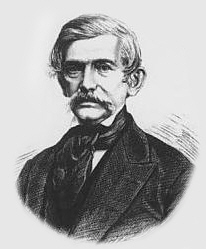
Prof. J. G. Kohl (Wikimedia Images)
Johann Georg Kohl is a familiar name to readers of the Chequamegon History website. Kohl’s Kitchi Gami, originally published in his native Germany, is a standard of Ojibwe cultural history and anthropology. His astute observations and willingness to actually ask questions about unfamiliar cultural practices of the people practicing them, created a work that has stood the test of time much better than those of his contemporaries. The modern reader will find Kohl’s depiction of Ojibwe people as actual intelligent human beings stands in refreshing contrast to most 19th-century works. Kohl also wrote some untranslated articles for German newspapers mentioning his time at La Pointe. One of these, on the subject of the death and conversion of Chief Buffalo, partially appeared on this site back in April.
Johann Kohl was atypical of the steamboat tourists, but he was a steamboat tourist nonetheless:
Prof. Kohl, professor in Dresden University has been rusticating for a few weeks past, in the Lake Superior Country, collecting matter for a forthcoming work, which he intends publishing after his return to Germany. He expressed himself highly pleased with his visit, and remarked that the more familiar he became with the American people and the resources of our country, the better satisfied he was that America had fallen into the hands of those who were perfectly competent to develop her riches and improve the natural sources of wealth and prosperity, which nature has given her.
Grace Greenwood has also been paying her respects to the Lake Superior region, and came down on the North Star with Prof. Kohl.
[Milwaukee] Daily Free Democrat, September 15, 1855

Sara Jane Lippincott, a.k.a. Grace Greenwood (Wikimedia Images).
“Grace Greenwood” was the pseudonym of Sara Jane Lippincott, and a household name in 1855. Though more forgotten to history than some of the other names in this post, the New York native was probably the biggest celebrity to visit La Pointe in the summer of 1855. As an acclaimed poet, she had risen to the highest rungs of American literary society and was a strong advocate of abolitionism and women’s rights. However, she was probably best known as the editor of The Little Pilgrim, a popular children’s magazine. She is mentioned in several accounts of the 1855 payment, but none mention an important detail, considered improper for the time, detail. Sara was very pregnant. Annie Grace Lippincott was born less than two months after her mother left Lake Superior on the North Star.
Although much of her work is digitized and online for the public, the only mention of the trip I’ve found from her pen is this blurb from the front page of the September 1855 edition of The Little Pilgrim:
Our little readers will please forgive whatever delay there may be in the coming of our paper this month, for we are among the wild Indians away up in Lake Superior on the island of La Pointe; and the mails from this far region are so slow and irregular that our articles may not reach Philadelphia till two or three weeks after they should do so (The Little Pilgrim: Google Books).
Dr. Richard F. Morse was one of the chroniclers of the 1855 payment who made sure to mention Lippincott. Morse’s essay, The Chippewas of Lake Superior, published in the third volume of the Collections of the State Historical Society of Wisconsin (1857), is entirely about the payment. It is also the clearest example of the abrupt shift in narrative discussed above. It is full of the suffocating racism of benevolent paternalism. Morse arrogantly portrays himself as an advocate for the Lake Superior bands, but his analysis shows how little he knows of the Ojibwe and their political situation in 1855. Unlike Kohl, he doesn’t seem to care enough to ask and learn.
In fairness, Morse’s account is a valuable document, excerpted in several posts on this website (see People Index). It is also the document that years ago inspired the first steps toward this research by planting the question, “Where did all these fancy people at the 1855 annuity come from?” Chippewas of Lake Superior is too long and too well-known to bother reproducing on this site, but it can be read in it’s entirety on Google Books.

Crockett McElroy (Cyclopedia of Michigan [1890])
After the Civil War, McElroy would go on to find wealth in the Great Lakes shipping industry and be elected as a Republican to several offices in the State of Michigan. In the summer of 1855, however, he was only nineteen years old and looking for work. Crockett’s father, Francis McElroy appears in several later 19th-century censuses as a resident of Bayfield. Apparently, Francis (along with Crockett’s younger brothers) split time between Bayfield and Michigan. Young Crockett did not stay in Bayfield, but his biography in the Cyclopedia of Michigan (1890) suggest his account can be considered that of a semi-local laborer in contrast to the fancier visitors he would have shared a steamboat with:
Crocket McElroy, the subject of this sketch, received his early education at Gait, Ontario; and, when twelve years of age, removed to Detroit. Here he attended one of. the public schools of that city for a short time, and, afterwards, a commercial academy. When thirteen years of age, he began to act as clerk in a wholesale and retail grocery store, remaining three years; he then, for two years, sold small beer. In 1853 he went to Ira, St. Clair County, as clerk, to take charge of a general store; and for the next five years served as clerk and taught school, spending the summer months of 1854-55 in the Lake Superior region (pg. 310).

Lewis Cass (Wikimedia Images)
Another Michigan-based politician, considerably more famous than McElroy, Lewis Cass’ excursion to Lake Superior in 1855 was portrayed as a homecoming of sorts. The 72 year-old Michigan senator had by then occupied several high-level cabinet and congressional positions, and was the Democratic nominee for president in 1848, but those came after he had already entered the American popular imagination. Thirty-five years earlier, as a little known governor of the Michigan Territory (which included Wisconsin and the arrowhead of Minnesota) he led an American expedition to Red Cedar (Cass) Lake near the headwaters of the Mississippi. Thirty-seven years after the Treaty of Paris, and seven years after the death of Tecumseh, it was the first real attempt by the United States to assert dominion over the Lake Superior country. In some ways, 1855 marked the end of that colonization process and brought the Cass Expedition full-circle, the significance of which was not lost on the editors of the Superior Chronicle:
The Predictions of Gen. Cass.: At the opening of the Wabash and Erie Canal, which unites the waters of Lake Erie with those of the Mississippi, the celebration of which took place at Fort Wayne, Indiana, in 1844, Gen. Cass in his address subsequently predicted the union of Lake Michigan from Chicago to the Mississippi; this prediction was fulfilled in 1850. At the same time he said that there were then present those who would witness the settlement of the region at the southwest extremity of Lake Superior, and lay the foundation for a similar union of the waters of that lake with the Mississippi.
On the last trip of the steamer Illinois to this place, Gen. Cass was among the passengers, and witnessed the fulfillment of his prediction in respect to the settlement of this region. May he live to be present at the opening of the channel which will connect this end of the lake with the Mississippi, and witness the consummation of all his prophesies.
Superior Chronicle, August 21, 1855
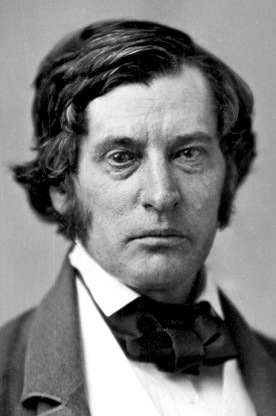
Charles Sumner in 1855 (Wikimedia Images)
A political opponent of western Democrats like Cass, Charles Sumner has gone down in history as the only man to be nearly beaten to death on the floor of the United States senate. Less than a year before Rep. Preston Brooks of South Carolina would attack him with a cane, sending the country hurtling ever-faster toward civil war, the Massachusetts senator visited La Pointe to watch the annuity payment. By 1855, Sumner already had a reputation as a staunch abolitionist, and he even wrote a letter to the Anti-Slavery Reporter while on board the North Star. Aside from a handful of like-minded native New Englanders like Edmund Ely and Leonard Wheeler, Sumner was not in a part of the country where most voters shared his views (the full-blood and most mix-blood Ojibwe were not considered citizens and therefore ineligible to vote). The Lake Superior country was overwhelmingly Democratic, and the Superior Chronicle praised the “popular sovereignty” views of Stephen Douglas in the midst of the violence following the Kansas-Nebraska Act. Sumner, whose caning resulted from his fierce criticism of popular sovereignty, was among those “radical Bostonians” the Chronicle warned its readers about. However, the newspaper was kind and uncritical when the senator appeared in its city:
Senator Sumner at Superior and La Pointe.: In our last number we neglected to announce the visit of Hon. Charles Sumner, Bishop McClosky, and other distinguished persons to Superior. They came by the North Star, and staying but a few hours, had merely time to hastily view our thriving town. They expressed gratfication at its admirable location and rapidity of its growth.
At La Pointe, the heat stopped to allow the passengers an opportunity to see that pretty village and the large number of Indians and others congregating there to the last great payment at this station of the Lake Superior Chippewas. Here Mr. Sumner was the guest of the reverend Catholic missionary, whose successful endeavors to gratify the numerous visitors at La Pointe we have frequently heard commended.
Superior Chronicle, August 14, 1855

Jesse D. Bright (Wikimedia Images)
Staying a little longer at Superior, another U.S. senator, Jesse Bright the President pro tempore Indiana, also appeared on Lake Superior in the summer of 1855. For Bright, however, this was more than a pleasure excursion. He had a chance to make real money in the real estate boom of the 1850s. Superior, at the head of the lake with ship traffic through the Soo, and military road and potential railroad connection to St. Paul, looked poised to be the next great gateway to the west. He invested and apparently lost big when the Great Lakes real-estate boom busted in the Panic of 1857.
Bright would go on to be a Southern sympathizer and a “Copperhead” during the Civil War and was the only northerner to be expelled from the Senate for supporting the Confederacy. In 1855, he was already a controversial figure in the partisan (Democrat, Whig, Know-Nothing) newspapers:
The Buffalo Commercial, upon the authority of the Cincinnati Gazette, states “that Mr. Bright, of Indiana, President of the Senate, pro tem lately made a Sunday speech, an hour and a half long to the people of a town on Lake Superior, and the passengers of the steamer in which he was travelling. He discoursed most eloquently on the virtues and glories of modern Democracy, whose greatest exemplar, he said, was the administration of Franklin Pierce.” The Know Nothing press, of which the Commercial and the Gazette are leading journals, must be rather hard up for material, when recourse to such misrepresentation as the above becomes necessary…
…The speaker did not allude to politics, and did not speak over ten minutes.
And out of this mole hill the Commercial manufactures a mountain of speculation, headed “Jesse D. Bright–The Presidency.” –Sandusky Mirror.
Fort Wayne [IN] Sentinel, September 5, 1855

Promoters & Proprietors of Old Superior: (Clockwise from upper left) U.S. Senator W[illiam]. A. Richardson, Sen. R[obert] M. T. Hunter, Sen. Jesse Bright, Sen. John C. Breckinridge, Benjamin Brunson, Col. John W. Fourney, Henry M. Rice (Flower, Frank A. Report of the City Statistician [1890] Digitized by Google Books)

John C. Breckinridge (Wikimedia Images)
It may also be uncomfortable for the modern northern reader to see how cozy the politicians of our area were with unabashedly pro-slavery Democrats and future Confederates. The biggest name among these Lake Superior investors and 1855 visitors would be John C. Breckinridge. Breckinridge, coming off a stint as U.S. Representative from Kentucky, would go on to be Vice President of the United States under James Buchanan, and Secretary of War for the Confederacy. However, he is most famous for finishing second to Abraham Lincoln in the pivotal presidential election of 1860. Chequamegon Bay residents will probably find another investment of the future vice-president more interesting even than the Superior scheme:
A PLEASANT SUMMER RESIDENCE–The senior editor of the Chicago Press writes from Lake Superior:
Basswood Island, one of the group of Apostle Island has been entered by Mr. Breckinridge of Kentucky, who, I am told, contemplates the erection of a summer residence upon it. We landed at this Island for wood. There is deep water up to its base, and our steamer lay close alongside the rocky shore as though it had been a pier erected for the purpose. There is deep water, I am told, in the channels between most of the Islands of the group furnished an excellent shelter for vessels in tempestuous weather.
[Milwaukee] Weekly Wisconsin, August 15, 1855
Hon J. C. Breckenridge, of Kentucky, has purchased Basswood Island, one of the group of Apostle Islands, in Lake Superior, and intends erecting a summer residence thereon.
Boston Post, August 23, 1855

Captain John Wilson (Frank Leslie’s Illustrated)
The Whig/Free Soil press’ condemnation of Senator Bright for allegedly forgetting the Sabbath and to keep it holy may remind the Chequamegon History reader of the A.B.C.F.M missionaries’ obsession with that particular commandment in their efforts among the Ojibwe people. However, it seems to be one of those features of 19th-Century America that was fussed about more than it was actually observed.
A good example of this comes from Captain John Wilson, who led the steamer Illinois to La Pointe in the summer of 1855. He seems to have been one of those larger-than-life characters, and he is often mentioned in newspaper accounts from the various Great Lakes ships he commanded. Wilson died off the shore of Milwaukee in the sinking of the Lady Elgin, in 1860 along with over 300 passengers. “The Titanic of the Great Lakes,” as the disaster came to be known, is still the greatest loss of life in the history of the lakes (this article gives a good overview). Other than the North Star, the Lady Elgin, which began its runs to the “Upper Lake” in 1855, was probably the most famous steamer on Lake Superior before its sinking. Captain Wilson was afterwards praised for his character heroism during the ordeal, which was blamed on the captain of the schooner that collided with the Elgin.
Captain Wilson’s charisma shines through in the following 1855 Lake Superior account, but I’ll let the reader be the judge of his character:
A MAN FOR ALL OCCASIONS–TWO AMUSEMENTS–Capt Wilson, of the steamer Illinois, on the Upper Lakes is proverbially a man for all occasions and is equally at home in a horse-race or a dance. During a recent excursion of his beautiful boat to Lake Superior, he happened to arrive at a place on Sunday, where several tribes of Indians were soon to receive their annuity from the General Government and where a large number were already present. As soon as the breakfast table was cleared Capt. W. commenced arrangements for religious services in the ladies’ cabin, agreeably to the request of a preacher on board. Chairs and sofa were placed across the hall and the piano, with a large bible on it, represented a pulpit. The large bell of the boat was tolled, and in a short time quite a respectable congregation occupied the seats. As soon as service had fairly begun, the Captain came upon the forward deck where a number of gentlemen were enjoying their pipes and meerschaum, and thus addressed them.
Gentlemen–I come to let you know that meetin‘ is now going on in the aft cabin, where all of you in need of prayers and who wish to hear a good sermon had better retire. I would also state that in accordance with the desire of several passengers , I intend to get up an Indian foot race on shore for a barrel of flour.–You can make your own selection of the two amusements.”
The foot race did come off, and it was fortunate that all the lady passengers were at “meetin,” as one of the Indians who started with nothing on him but a calico shirt came in minus that! He won the flour, however. Good for you! —Spirit of the Times
[Milwaukee] Weekly Wisconsin, October 3, 1855

Joseph R. Williams (Wikimedia Images)
Finally, we get back to Joseph R. Williams. The reason so many stories like Captain Wilson’s made it into the papers that summer was that each of the steamboats seemed to be carrying one or more Midwestern newspaper editors. Williams, the editor of the Toledo Blade, arrived on the Planet in time to witness the La Pointe payment.
Williams would go on to become the first president of what would become Michigan State University and serve in multiple positions in the state government in Michigan. His letters and notes from Lake Superior turned into multiple articles that made their way back up to the Superior Chronicle. In a later post, I may transcribe his record of C. C. Trowbridge’s account of the 1820 Cass Expedition or his description of Superior, but in the name of brevity, I’ll limit this post to his a article on the payment itself:
From La Pointe–Indian Payment, etc.
The following interesting incidents of the recent meeting of Chippeways at La Pointe are taken from the letters of Mr. Williams, editor of the Toledo Blade. Mr. W. was among those who visited Lake Superior on the last excursion of the steamer Planet. In another portion of this week’s paper will be made an account of General Cass’ expedition to the Northwest, from the pen of the same gentleman. We commend it and the following extracts, to the perusal of our readers.
This is one of the old American Fur Company’s stations, a village such as formerly existed at Detroit and Mackinac. Indian huts with bark roofs, the long low warehouse, the half dressed and painted Indians, here and there a Frenchman speaking his mother tongue, his whole air indicating his lineage plainly that he was the descendant of an old voyager, revive the reflection of those days so graphically described by Washington Irving in his Astoria. La Pointe is upon an island, and the harbor gracefully curves around us from the north.
Here we find Colonel Manypenny, Commissioner of Indian Affairs; H. C. Gilbert, Indian Agent for Michigan; Hon. D. A. Noble and Hon. H. L. Stevens, late members of Congress, and other gentlemen, who are awaiting the Indian payment to take place the beginning of next month. Grace Greenwood, who came up on the Illinois a few days since is also excursioning here. The store houses are full of the goods provided for the payment, piles of [?] and provisions, [?], plows, spades, [?] carts, mattresses, bedsteads, blankets, clothing, and [?] a well [?] supply of such articles as are calculated to promote the comfort and civilization of the ill-fated remnant of the former lords of these [many] isles scattered around us, and [the] “forests primeval,” on either shore of this vast inland sea.
Colonel Manypenny deserves great credit for the [ind?bility] with which he has endeavoured to carry into wholesale effect the [?] method adopted of paying the Indians their annuities. Formerly, the unfortunate [race] were paid in specie, and close on the tract of the dispenser of the payment came a swarm of cormorant and heartless Indians traders, who, for whisky and trinkets, and inferior arms and implements, including perhaps blankets and some useful articles of dress, obtained the dollars as soon as they were paid. The Indian dances followed by wild drunken orgies, were a perpetual accompaniment. The Indian, besotted by liquor, parted with almost everything of value, and returned to his home and his hunting grounds, poor and in worse condition than he came. Many years since I attended a payment at Grand Rapids, Michigan, and it was a mournful spectacle. One hardly knew whether to pity the weakness of the victims or abhor the heartlessness of the destroyers most. As late as 1833 the last Indian payment was made on the Maumee in the immediate vicinity of Toledo, on the point below Manhattan. One Lloyd was Indian Agent in 1830. It is said that he purloined from each of the thousand dollar boxes paid the Indians one or two hundred dollars, and that during the night whites went around among the wigwams and cut off the portion of the dresses of the Indians in which the specie was tied up. But the picture before us is relieved of features so disgraceful and disgusting. We saw no drunken Indian on shore. Indeed several of the Caucasian lords of these fading tribes, whom we had on board, might have taken a useful lesson in sobriety from the red men. The traders however are here. They mutter curses upon Colonel Manypenny, because he does not wink at their robberies. It is supposed abundance of whisky is concealed on the island, which will be unwrapped and sold, to besot the Indians, as soon at the valuables are distributed among them.
***
On his arrival here, the Indians proposed a dance. As dances end in Bacchanalian revels, the colonel has set his face against them. Enlivened and excited, however, by our band of music, the Indians could resist no longer. A dozen or more emerged from their cabins, bearing before them their war flag, which was a staff with a fringe of long feathers extending its length, and with bells attached to it, and engaged in a war dance. Their bodies were nearly naked and painted. The dance was a pantomimic description of war scenes. The leading brave struck the flagstaff to stop the dance, and made a speech describing how he had, less than thirty days ago, killed and scalped a Sioux, and he held up in his clenched fist, in triumph before us, the almost yet reeking scalp of his victim. His speech was accompanied by vigorous and appropriate [motion]. It was the imprompt and natural movement of body, [hands], and features from this brief specimen, it was easy enough to imagine that the Indian is often eloquent. This small band of dancers were splendid physical specimens of men, and the dance was real exultation over a late actual achievement. The Chippeways–and they are all Chippeways in these regions–maintain a traditional hostility to the Sioux, and are rarely at peace. It was only a few months since a band of Chippeways pioneered down into the village of St. Paul, and killed a Sioux woman trading in a store. Before the witnesses had recovered from the terror excited, the band had fled as rapidly as they appeared. The Sioux remain on the lands beyond, and the Chippeways this side of the Mississippi.
After the war dance was finished, they danced a beggar’s dance, the purport of which was that they wanted three beeves of Colonel Manypenny. At its close, the brave presented a pipe to Captain Ward, who smoked it in a token of amity. He then forced through the surrounding crowd, and sought Colonel M., who stood at a distance. The Colonel rejected the proffered pipe. His acceptance would have been a sanction of the dances he disapproved, and a concession of the three beeves. The Chief returned to the ring, and made a brief vehement speech, evidently a concentration of indignant scorn. Mrs. A., of Monroe, Michigan, an educated lady of Indian blood, informed me that it was full of defiance, bitterness and mortification.
******
In speaking of the Indians assembled at the payment in my last, I said they were a motley crew, and indeed they are. The braves, engaged in the dances described, were fine specimens of manhood. Their erect forms, developed chests, and symmetry, and general health, as developed in every muscle and feature, illustrate the perfection to which physical man is brought in savage life. But in sad contrast, we see around us pitiable specimens of humanity, crouching, lazy, filthy, besotted beings, who possess all the vices of both the white and the red races, and none of the virtues of either.
Canoes are marshalled along the beach, which have wafted here the tenants of both shores of Superior. Indians have dotted their clusters of wigwams over the vicinity, and seem to have brought along all their aged and infirm as well as infants.
I think one Indian woman here is the oldest human being I ever saw. The deep furrows, the folds of skin which have lost almost the appearance of vitality, so withered and dead as to resemble gutta percha, eye sight lost, hearing gone, no sense left except touch, which was indicated by the avidity with which she seized small pieces of money thrown into her lap, all these proofs convinced me that she was older by ten or fifteen years than any person I ever saw. A son and daughter were near her, apparently kind and affectionate, and proud to protect her, who themselves, were verging upon old age, an illustrative example of these [?ate] savages, to unnatural whites of whom melancholy tales of ingratitude are told. Even her children could not tell her age. All they could say was that she was “the oldest Indian.” Old Buffalo, the Chief, who was ninety years old, looked like a young man compared with her.
Nothing more surprised our party than the great proportion of their children, of all sizes, and I may add, shades of color, for the infusion of French blood from a long series of successive intermarriages, is found in every tribe. Infants fastened on boards, with the children and youth under sixteen, outnumber the adults. The children are all plump, all have rounded and full muscles, all good chests, thus showing that their life, vicious as it is, is more favorable to health and development, in consequence of their freedom of motion, perpetual exercise in the open air. Their gregariousness, flocking together where impulse carried them, as self reliant as their parents who seemed to allow them perfect freedom, even though strangers were so numerous among them, bore a pleasing, and to us instructive contrast to the entire and melancholy helplessness to which white children, especially in cities, are doomed.
Many of the Indians wore a feather or feathers in their cap, indicating the number of Sioux they had scalped. One displayed six feathers. He told us that he had in battle killed two, and taken the scalps of four others, killed by unknown hands of his band. The last victim he had slain but a month ago. One erect youth, of not more than eighteen, with a fresh and handsome face, bore proudly a single feather as a token of his early prowess. One man, in answer to the question, whether he had ever taken a scalp, replied gravely, without a smile, that he had not, and was of no more account that a woman in his tribe. An illustration of their generosity and savage ferocity is afforded by a sub-Chief who had an interview with Mr. Gilbert, the Indian Agent, a few days since. He presented Mr. G. an elegant cloak, made entirely of beaver skins, in expectation of nothing but a large medal in return. He was intent in speech, and animated and pleasant in address. No trace of savage ferocity lingered in his face. Yet it was stated that this man had actually killed and eaten his own child.
Sometimes their earnings if economically used would afford them a comfortable subsistence. The whites, even in their ordinary trade have practiced habitually heartless extortion. When Gov. Cass’s expedition visited this country in 1820, the Indians were in the habit of paying the traders a beaver skin, worth sixteen dollars, for a gill of powder; the same for a shirt; the same for thirty balls; and three beaver skins for a single blanket. I inquired of the Chief, Old Buffalo, what was the highest price he had ever paid for tobacco. He replied that they formerly made purchases of the Hudson Bay Company, tobacco was coiled up in ropes of about three quarters of an inch in diameter, and that he had paid ten beaver skins for a fathom, or at least ten dollars for a foot in length. But when the poor creatures became maniacs or idiots from drink, no possession was so prized that they would not part with it for a single cup of fire water. That the trader availed himself of the imbecility he created, is acknowledged. A large share of the boundless wealth of Mr. Astor was based on acquisitions, through his instruments and agents of this questionable and indeed diabolical character. Well might Burns exclaim in sorrow,
“Man’s inhumanity to man.
Makes countless thousands mourn.”
for whether among men and families of the same blood, or between civilized and savage men, either in peace or in the antagonism of war, the whole world and all time has teemed with sickening, heart-rending examples of its melancholy truth.
By chance we have been able to witness what can not be seen, a few years hence on this side of the “Father of waters,” or indeed on the continent. Here in our magnificent floating palace and the crowd of intellectual and cultivated people on board, surrounded by the refinements of life, we have the highest triumphs of civilization, side by side and in contrast with the rudest manifestations of primitive savage life.–An interesting episode in human affairs, though prompting [a] thousand sad reflections. The doom of entire extirpation of the red man seems surely and gradually to approach. The perpetual warfare among tribes on the extreme frontier annually declinates their most vigorous braves, and consequently it is manifest that among this tribe at least there were far more women than men between the ages of twenty and forty. Many perish from ignorance of the laws of nature, and many from excessive exposure and famine. Rapacity of the whites, and whiskey, finish the merciless work. They fade, they perish, as the grass of the prairies withers before the devouring element. The officers of our government, in their conference, have been accustomed to talk about the protection their Great Father vouchsafes to them, but it is the protection which the vulture affords the sparrow. Whatever may be the intentions of our professedly paternal government, no alternative seems to remain to the Indian, but submission to its crushing and onward march.

Dr. Bethune Duffield (Detroit–biographical sketches by Walter Buell [1886] Google Books)
1855 as a Turning Point: A plea to today’s Chequamegon Bay residents
Williams’ quote about the vulture and the sparrow, excerpted at the very top of this post, is about as succinct a statement about Manifest Destiny as I have ever read. If it weren’t surrounded by so many grossly-ignorant and disgusting statements about Ojibwe people, one might almost take it as sympathy for the Ojibwe cause. Still, the statement holds the key to our understanding of the story of 1855.
In the grand scheme of our region’s history, the payment was less significant than the treaty itself or the tragic removal politics of the early 1850s. Sure, it was the first payment under the final treaty and it featured the visit of Indian Affairs Commissioner George Manypenny to La Pointe, but ultimately it was largely like the rest of the 30-plus annuity payments that took place in our area in the middle of the 19th century. The death of Chief Buffalo in September 1855, and visit of Manypenny who shifted American Indian policy from removal to assimilation, represented both real and symbolic breaks with the past, but ultimately the great shift of 1855 is only one of tone.
Ultimately, however, this shift is only superficial and the reality of life for most Chequamegon residents didn’t change overnight in 1855. The careers of men like Blackbird, Vincent Roy Jr., Julius Austrian, Naaganab, and others show the artificiality of such a line. To them, the tourists on the Planet and North Star were probably just a distraction or curiosity.
Williams was wrong. The Ojibwe did not perish before the “devouring element,” and neither did that earlier history. Somehow, though, since then those of us who live in this area have allowed outsiders to write the story. Maybe it’s comfortable for those, like myself, of European ancestry to focus on shipwrecks and lighthouses rather than colonialism and dispossession, but in doing so we deny ourselves the most significant events of our area’s history and an understanding of its legacy on today.
By all means, learn the names of Grace Greenwood, John Breckinridge, and the Lady Elgin, but understand the fleeting impact of those names on our area’s history. Then, read up on Blackbird, Jechiikwii’o, Leonard Wheeler, Benjamin Armstrong and other players in 1855 politics who really did leave a lasting legacy.
Off my soapbox for now…
The bulk of this article comes from newspaper articles found on two digital archives. Access Newspaper Archive is available to Wisconsin library card holders through badgerlink.net. The Library of Congress Chronicling America site is free at http://chroniclingamerica.loc.gov/. Other sources are linked within the post.
Photos, Photos, Photos
February 10, 2014
The queue of Chequamegon History posts that need to be written grows much faster than my ability to write them. Lately, I’ve been backed up with mysteries surrounding a number of photographs. Many of these photos are from after 1860, so they are technically outside the scope of this website (though they involve people who were important in the pre-1860 era too.
Photograph posts are some of the hardest to write, so I decided to just run through all of them together with minimal commentary other than that needed to resolve the unanswered questions. I will link all the photos back to their sources where their full descriptions can be found. Here it goes, stream-of-consciousness style:

Ojibwa Delegation by C.M. Bell. Washington D.C. 1880 (NMAI Collections)
This whole topic started with a photo of a delegation of Lake Superior Ojibwe chiefs that sits on the windowsill of the Bayfield Public Library. Even though it is clearly after 1860, some of the names in the caption: Oshogay, George Warren, and Vincent Roy Jr. caught my attention. These men, looking past their prime, were all involved in the politics of the 1850s that I had been studying, so I wanted to find out more about the picture.
As I mentioned in the Oshogay post, this photo is also part of the digital collections of the Smithsonian, but the people are identified by different names. According to the Smithsonian, the picture was taken in Washington in 1880 by the photographer C.M. Bell.
I found a second version of this photo as well. If it wasn’t for one of the chiefs in front, you’d think it was the same picture:
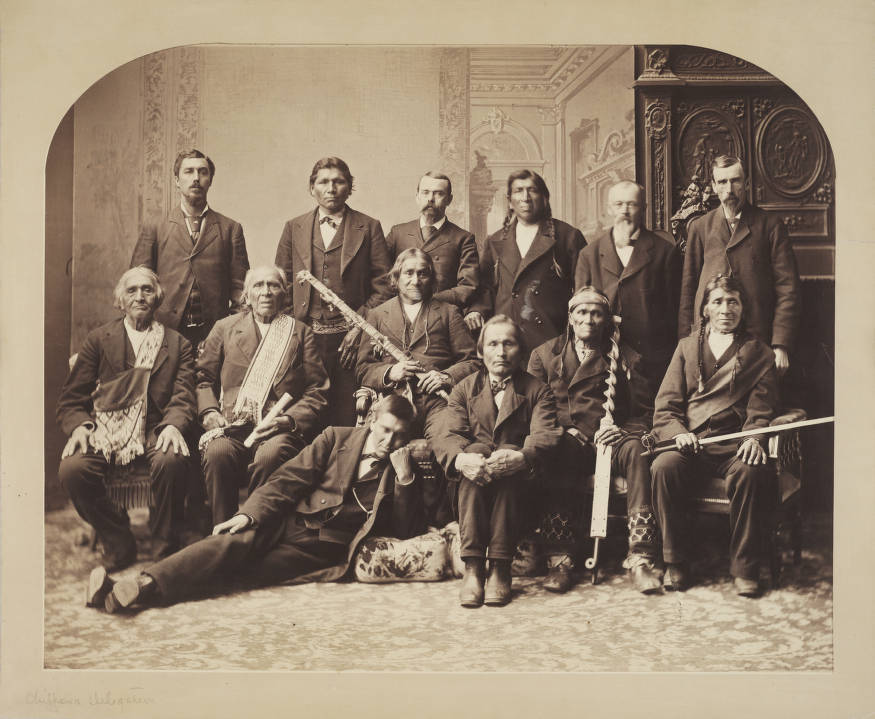
Chippewa Delegation (Denver Public Library Digital Collections)
While my heart wanted to believe the person, probably in the early 20th century, who labelled the Bayfield photograph, my head told me the photographer probably wouldn’t have known anything about the people of Lake Superior, and therefore could only have gotten the chiefs’ names directly from them. Plus, Bell took individual photos:
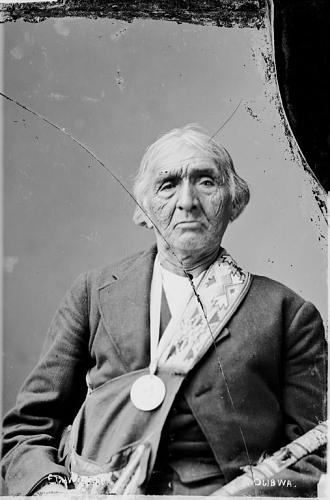
Edawigijig (Edawi-giizhig “Both Sides of the Sky”), Bad River chief and signer of the Treaty of 1854 (C.M. Bell, Smithsonian Digital Collections)
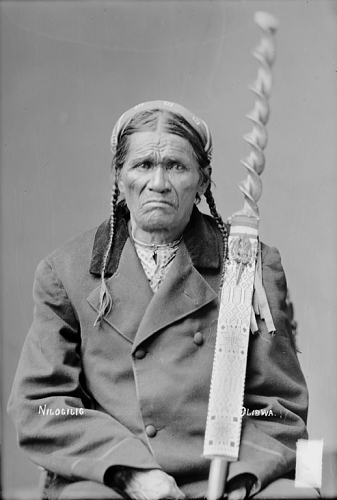
Niizhogiizhig: “Second Day,” (C.M. Bell, Smithsonian Digital Collections)
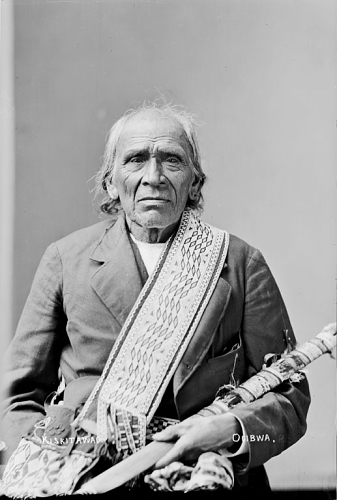
Kiskitawag (Giishkitawag: “Cut Ear”) signed multiple treaties as a warrior of the Ontonagon Band but afterwards was associated with the Bad River Band (C.M. Bell, Smithsonian Digital Collections).
By cross-referencing the individual photos with the names listed with the group photo, you can identify nine of the thirteen men. They are chiefs from Bad River, Lac Courte Oreilles, and Lac du Flambeau.
 According to this, the man identified by the library caption as Vincent Roy Jr., was in fact Ogimaagiizhig (Sky Chief). He does have a resemblance to Roy, so I’ll forgive whoever it was, even if it means having to go back and correct my Vincent Roy post:
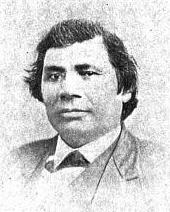
Vincent Roy Jr. From C. Verwyst’s Life and Labors of Rt. Rev. Frederic Baraga, First Bishop of Marquette, Mich: To which are Added Short Sketches of the Lives and Labors of Other Indian Missionaries of the Northwest (Digitized by Google Books)

Top: Frank Roy, Vincent Roy, E. Roussin, Old Frank D.o., Bottom: Peter Roy, Jos. Gourneau (Gurnoe), D. Geo. Morrison. The photo is labelled Chippewa Treaty in Washington 1845 by the St. Louis Hist. Lib and Douglas County Museum, but if it is in fact in Washington, it was probably the Bois Forte Treaty of 1866, where these men acted as conductors and interpreters (Digitized by Mary E. Carlson for The Sawmill Community at Roy’s Point).
So now that we know who went on the 1880 trip, it begs the question of why they went. The records I’ve found haven’t been overly clear, but it appears that it involved a bill in the senate for “severalty” of the Ojibwe reservations in Wisconsin. A precursor to the 1888 Allotment Act of Senator Henry Dawes, this legislation was proposed by Senator Thaddeus C. Pound of Wisconsin. It would divide the reservations into parcels for individual families and sell the remaining lands to the government, thereby greatly reducing the size of the reservations and opening the lands up for logging.
Pound spent a lot of time on Indian issues and while he isn’t as well known as Dawes or as Richard Henry Pratt the founder of the Carlisle Indian School, he probably should be. Pound was a friend of Pratt’s and an early advocate of boarding schools as a way to destroy Native cultures as a way to uplift Native peoples.
I’m sure that Pound’s legislation was all written solely with the welfare of the Ojibwe in mind, and it had nothing to do with the fact that he was a wealthy lumber baron from Chippewa Falls who was advocating damming the Chippewa River (and flooding Lac Courte Oreilles decades before it actually happened). All sarcasm aside, if any American Indian Studies students need a thesis topic, or if any L.C.O. band members need a new dartboard cover, I highly recommend targeting Senator Pound.
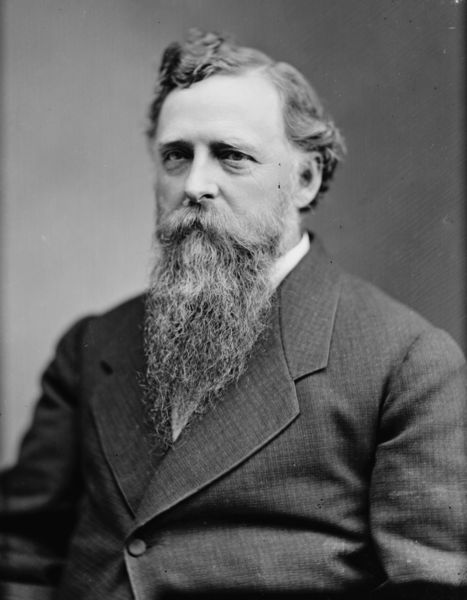
Like many self-proclaimed “Friends of the Indian” in the 1880s, Senator Thaddeus C. Pound of Wisconsin thought the government should be friendly to Indians by taking away more of their land and culture. That he stood to make a boatload of money out of it was just a bonus (Brady & Handy: Wikimedia Commons).
While we know Pound’s motivations, it doesn’t explain why the chiefs came to Washington. According to the Indian Agent at Bayfield they were brought in to support the legislation. We also know they toured Carlisle and visited the Ojibwe students there. There are a number of potential explanations, but without having the chiefs’ side of the story, I hesitate to speculate. However, it does explain the photograph.
Now, let’s look at what a couple of these men looked like two decades earlier:
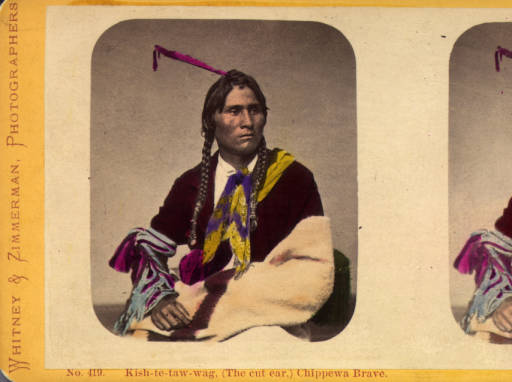
This stereocard of Giishkitawag was produced in the early 1870s, but the original photo was probably taken in the early 1860s (Denver Public Library).

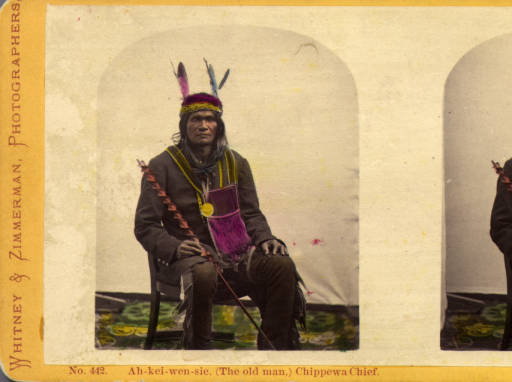
By the mid 1850s, Akiwenzii (Old Man) was the most prominent chief of the Lac Courte Oreilles Band. This stereocard was made by Whitney and Zimmerman c.1870 from an original possibly by James E. Martin in the late 1850s or early 1860s (Denver Public Library).
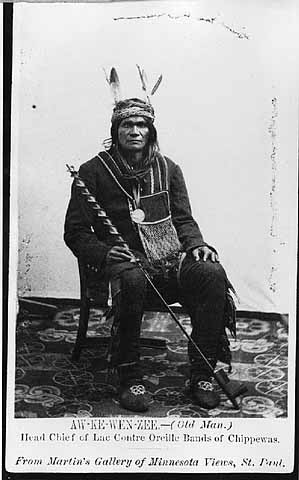
Giishkitawag and Akiwenzii are seem to have aged quite a bit between the early 1860s, when these photos were taken, and 1880 but they are still easily recognized. The earlier photos were taken in St. Paul by the photographers Joel E. Whitney and James E. Martin. Their galleries, especially after Whitney partnered with Charles Zimmerman, produced hundreds of these images on cards and stereoviews for an American public anxious to see real images of Indian leaders.
Giishkitawag and Akiwenzii were not the only Lake Superior chiefs to end up on these souvenirs. Aamoons (Little Bee), of Lac du Flambeau appears to have been a popular subject:

Aamoons (Little Bee) was a prominent chief from Lac du Flambeau (Denver Public Library).
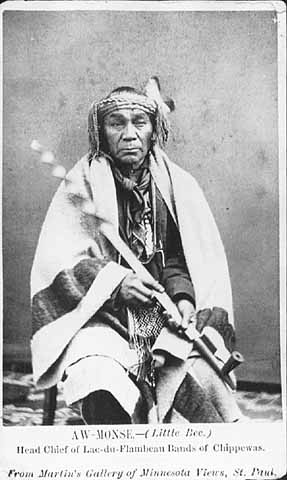
As the images were reproduced throughout the 1870s, it appears the studios stopped caring who the photos were actually depicting:

One wonders what the greater insult to Aamoons was: reducing him to being simply “Chippewa Brave” as Whitney and Zimmerman did here, or completely misidentifying him as Na-gun-ub (Naaganab) as a later stereo reproduction as W. M. McLeish does here:
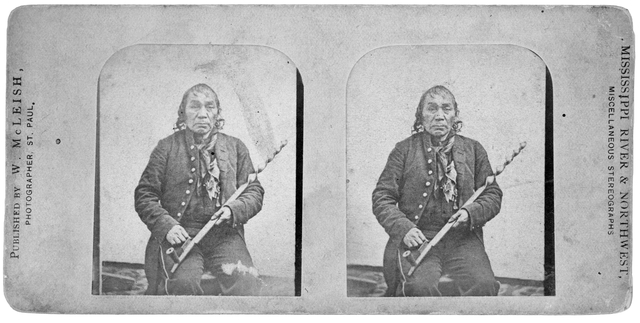
Chief identified as Na-gun-ub (Minnesota Historical Society)
Aamoons and Naaganab don’t even look alike…

Naaganab (Minnesota Historical Society)
…but the Lac du Flambeau and Fond du Lac chiefs were probably photographed in St. Paul around the time they were both part of a delegation to President Lincoln in 1862.

Chippewa Delegation 1862 by Matthew Brady? (Minnesota Historical Society)
Naaganab (seated middle) and Aamoons (back row, second from left) are pretty easy to spot, and if you look closely, you’ll see Giishkitawag, Akiwenzii, and a younger Edawi-giizhig (4th, 5th, and 6th from left, back row) were there too. I can’t find individual photos of the other chiefs, but there is a place we can find their names.
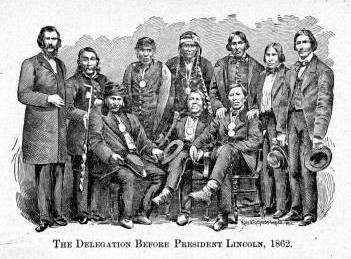
(From Early Life Among the Indians by Benjamin Armstrong)
Benjamin Armstrong, who interpreted for the delegation, included a version of the image in his memoir Early Life Among the Indians. He identifies the men who went with him as:
Ah-moose (Little Bee) from Lac Flambeau Reservation, Kish-ke-taw-ug (Cut Ear) from Bad River Reservation, Ba-quas (He Sews) from Lac Courte O’Rielles Reservation, Ah-do-ga-zik (Last Day) from Bad River Reservation, O-be-quot (Firm) from Fond du Lac Reservation, Sing-quak-onse (Little Pine) from La Pointe Reservation, Ja-ge-gwa-yo (Can’t Tell) from La Pointe Reservation, Na-gon-ab (He Sits Ahead) from Fond du Lac Reservation, and O-ma-shin-a-way (Messenger) from Bad River Reservation.
It appears that Armstrong listed the men according to their order in the photograph. He identifies Akiwenzii as “Ba-quas (He Sews),” which until I find otherwise, I’m going to assume the chief had two names (a common occurrence) since the village is the same. Aamoons, Giishkitawag, Edawi-giizhig and Naaganab are all in the photograph in the places corresponding to the order in Armstrong’s list. That means we can identify the other men in the photo.
I don’t know anything about O-be-quot from Fond du Lac (who appears to have been moved in the engraving) or S[h]ing-guak-onse from Red Cliff (who is cut out of the photo entirely) other than the fact that the latter shares a name with a famous 19th-century Sault Ste. Marie chief. Travis Armstrong’s outstanding website, chiefbuffalo.com, has more information on these chiefs and the mission of the delegation.
Seated to the right of Naaganab, in front of Edawi-giizhig is Omizhinawe, the brother of and speaker for Blackbird of Bad River. Finally, the broad-shouldered chief on the bottom left is “Ja-ge-gwa-yo (Can’t Tell)” from Red Cliff. This is Jajigwyong, the son of Chief Buffalo, who signed the treaties as a chief in his own right. Jayjigwyong, sometimes called Little Chief Buffalo, was known for being an early convert to Catholicism and for encouraging his followers to dress in European style. Indeed, we see him and the rest of the chiefs dressed in buttoned coats and bow-ties and wearing their Lincoln medals.
Wait a minute… button coats?… bow-ties?… medals?…. a chief identified as Buffalo…That reminds me of…
This image is generally identified as Chief Buffalo (Wikimedia Commons)

Anyway, with that mystery solved, we can move on to the next one. It concerns a photograph that is well-known to any student of Chequamegon-area history in the mid 19th century (or any Chequamegon History reader who looks at the banners on the side of this page).Noooooo!!!!!!! I’ve been trying to identify the person in The above “Chief Buffalo” photo for years, and the answer was in Armstrong all along! Now I need to revise this post among others. I had already begun to suspect it was Jayjigwyong rather than his father, but my evidence was circumstantial. This leaves me without a doubt. This picture of the younger Chief Buffalo, not his more-famous father.
The photo showing an annuity payment, must have been widely distributed in its day, because it has made it’s way into various formats in archives and historical societies around the world. It has also been reproduced in several secondary works including Ronald Satz’ Chippewa Treaty Rights, Patty Loew’s Indian Nations of Wisconsin, Hamilton Ross’ La Pointe: Village Outpost on Madeline Island, and in numerous other pamphlets, videos, and displays in the Chequamegon Region. However, few seem to agree on the basic facts:
When was it taken?
Where was it taken?
Who was the photographer?
Who are the people in the photograph?
We’ll start with a cropped version that seems to be the most popular in reproductions:
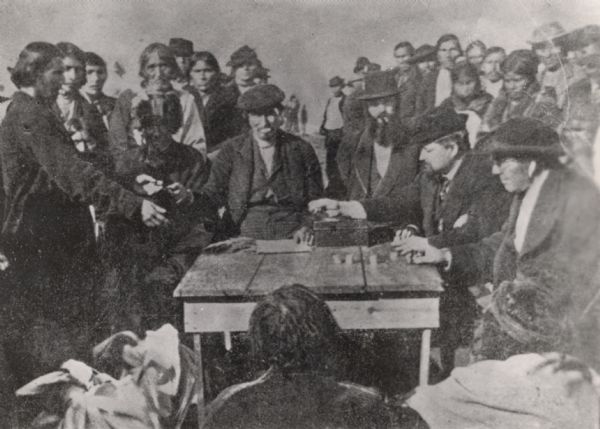
According to Hamilton Ross and the Wisconsin Historical Society: “Annuity Payment at La Pointe: Indians receiving payment. Seated on the right is John W. Bell. Others are, left to right, Asaph Whittlesey, Agent Henry C. Gilbert, and William S. Warren (son of Truman Warren).” 1870. Photographer Charles Zimmerman (more info).
In the next one, we see a wider version of the image turned into a souvenir card much like the ones of the chiefs further up the post:
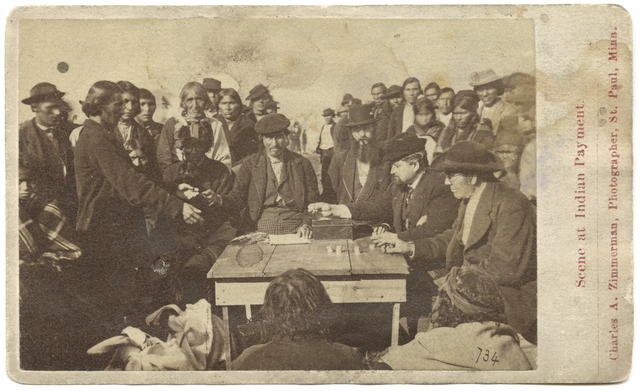
According to the Minnesota Historical Society “Scene at Indian payment, Wisconsin; man in black hat, lower right, is identified as Richard Bardon, Superior, Wisconsin, then acting Indian school teacher and farmer” c.1871 by Charles Zimmerman (more info).
In this version, we can see more foreground and the backs of the two men sitting in front.

According to the Library of Congress: “Cherokee payments(?). Several men seated around table counting coins; large group of Native Americans stand in background.” Published 1870-1900 (more info).
The image also exists in engraved forms, both slightly modified…

According to Benjamin Armstrong: “Annuity papment [sic] at La Pointe 1852” (From Armstrong’s Early Life Among the Indians)
…and greatly-modified.
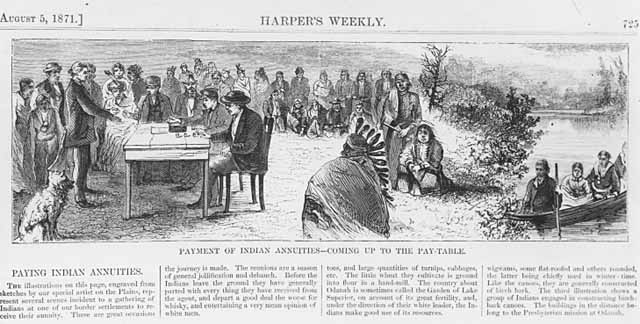
Harper’s Weekly August 5, 1871: “Payment of Indian Annuities–Coming up to the Pay Table.” (more info)
It should also be mentioned that another image exists that was clearly taken on the same day. We see many of the same faces in the crowd:
Scene at Indian payment, probably at Odanah, Wisconsin. c.1865 by Charles Zimmerman (more info)
We have a lot of conflicting information here. If we exclude the Library of Congress Cherokee reference, we can be pretty sure that this is an annuity payment at La Pointe or Odanah, which means it was to the Lake Superior Ojibwe. However, we have dates ranging from as early as 1852 up to 1900. These payments took place, interrupted from 1850-1852 by the Sandy Lake Removal, from 1837 to 1874.
Although he would have attended a number of these payments, Benjamin Armstrong’s date of 1852, is too early. A number of secondary sources have connected this photo to dates in the early 1850s, but outside of Armstrong, there is no evidence to support it.
Charles Zimmerman, who is credited as the photographer when someone is credited, became active in St. Paul in the late 1860s, which would point to the 1870-71 dates as more likely. However, if you scroll up the page and look at Giishkitaawag, Akiwenzii, and Aamoons again, you’ll see that these photos, (taken in the early 1860s) are credited to “Whitney & Zimmerman,” even though they predate Zimmerman’s career.
What happened was that Zimmerman partnered with Joel Whitney around 1870, eventually taking over the business, and inherited all Whitney’s negatives (and apparently those of James Martin as well). There must have been an increase in demand for images of Indian peoples in the 1870s, because Zimmerman re-released many of the earlier Whitney images.
So, we’re left with a question. Did Zimmerman take the photograph of the annuity payment around 1870, or did he simply reproduce a Whitney negative from a decade earlier?
I had a hard time finding any primary information that would point to an answer. However, the Summer 1990 edition of the Minnesota History magazine includes an article by Bonnie G. Wilson called Working the Light: Nineteenth Century Professional Photographers in Minnesota. In this article, we find the following:
“…Zimmerman was not a stay-at-home artist. He took some of his era’s finest landscape photos of Minnesota, specializing in stereographs of the Twin Cities area, but also traveling to Odanah, Wisconsin for an Indian annuity payment…”
In the footnotes, Wilson writes:
“The MHS has ten views in the Odanah series, which were used as a basis for engravings in Harper’s Weekly, Aug. 5, 1871. See also Winona Republican, Oct. 12, 1869 p.3;”
Not having access to the Winona Republican, I tried to see how many of the “Odanah series” I could track down. Zimmerman must have sold a lot of stereocards, because this task was surprisingly easy. Not all are labelled as being in Odanah, but the backgrounds are similar enough to suggest they were all taken in the same place. Click on them to view enlarged versions at various digital archives.
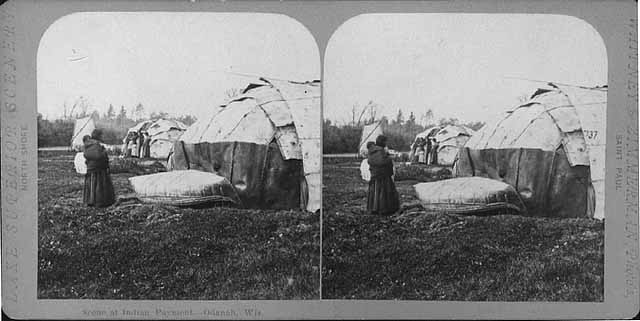
Scene at Indian Payment, Odanah Wisconsin (Minnesota Historical Society)


Chippewa Wedding (British Museum)

Domestic Life–Chippewa Indians (British Museum)
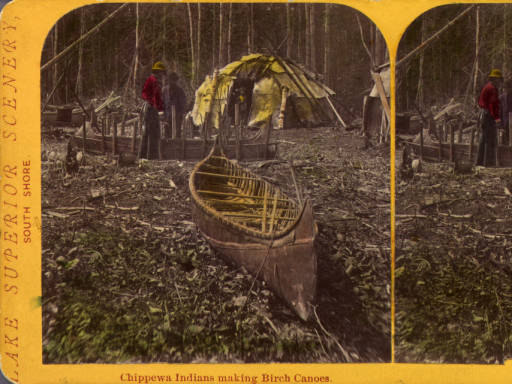
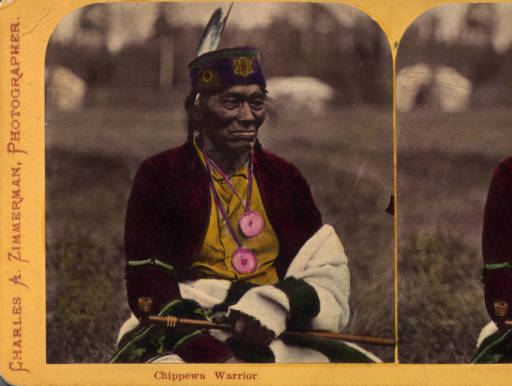

Chippewa Wedding (British Museum)

Finally…

Scene at Indian Payment–Odanah, Wis. (Wikimedia Images)
So, if Zimmerman took the “Odanah series” in 1869, and the pay table image is part of it, then this is a picture of the 1869 payment. To be absolutely certain, we should try to identify the men in the image.
This task is easier than ever because the New York Public Library has uploaded a high-resolution scan of the Whitney & Zimmerman stereocard version to Wikimedia Commons. For the first time, we can really get a close look at the men and women in this photo.
They say a picture tells a thousand words. I’m thinking I could write ten-thousand and still not say as much as the faces in this picture.


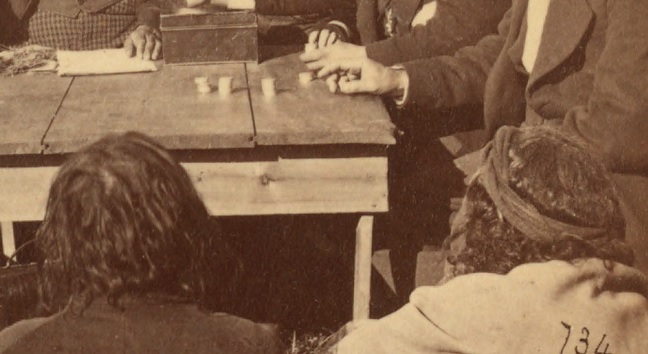
To try to date the photo, I decided to concentrate the six most conspicuous men in the photo:
1) The chief in the fur cap whose face in the shadows.
2) The gray-haired man standing behind him.
3) The man sitting behind the table who is handing over a payment.
4) The man with the long beard, cigar, and top hat.
5) The man with the goatee looking down at the money sitting to the left of the top-hat guy (to the right in our view)
6) The man with glasses sitting at the table nearest the photographer
According to Hamilton Ross, #3 is Asaph Whittlesey, #4 is Agent Henry Gilbert, #5 is William S. Warren (son of Truman), and #6 is John W. Bell. While all four of those men could have been found at annuity payments as various points between 1850 and 1870, this appears to be a total guess by Ross. Three of the four men appear to be of at least partial Native descent and only one (Warren) of those identified by Ross was Ojibwe. Chronologically, it doesn’t add up either. Those four wouldn’t have been at the same table at the same time. Additionally, we can cross-reference two of them with other photos.

Asaph Whittlesey was an interesting looking dude, but he’s not in the Zimmerman photo (Wisconsin Historical Society).

Henry C. Gilbert was the Indian Agent during the Treaty of 1854 and oversaw the 1855 annuity payment, but he was dead by the time the “Zimmerman” photo was taken (Branch County Photographs)
Whittlesey and Gilbert are not in the photograph.
The man who I label as #5 is identified by Ross as William S. Warren. This seems like a reasonable guess, though considering the others, I don’t know that it’s based on any evidence. Warren, who shares a first name with his famous uncle William Whipple Warren, worked as a missionary in this area.
The man I label #6 is called John W. Bell by Ross and Richard Bardon by the Minnesota Historical Society. I highly doubt either of these. I haven’t found photos of either to confirm, but the Ireland-born Bardon and the Montreal-born Bell were both white men. Mr. 6 appears to be Native. I did briefly consider Bell as a suspect for #4, though.
Neither Ross nor the Minnesota Historical Society speculated on #1 or #2.
At this point, I cannot positively identify Mssrs. 1, 2, 3, 5, or 6. I have suspicions about each, but I am not skilled at matching faces, so these are wild guesses at this point:
#1 is too covered in shadows for a clear identification. However, the fact that he is wearing the traditional fur headwrap of an Ojibwe civil chief, along with a warrior’s feather, indicates that he is one of the traditional chiefs, probably from Bad River but possibly from Lac Courte Oreilles or Lac du Flambeau. I can’t see his face well enough to say whether or not he’s in one of the delegation photos from the top of the post.
#2 could be Edawi-giizhig (see above), but I can’t be certain.
#3 is also tricky. When I started to examine this photo, one of the faces I was looking for was that of Joseph Gurnoe of Red Cliff. You can see him in a picture toward the top of the post with the Roy brothers. Gurnoe was very active with the Indian Agency in Bayfield as a clerk, interpreter, and in other positions. Comparing the two photos I can’t say whether or not that’s him. Leave a comment if you think you know.
#5 could be a number of different people.
#6 I don’t have a solid guess on either. His apparent age, and the fact that the Minnesota Historical Society’s guess was a government farmer and schoolteacher, makes me wonder about Henry Blatchford. Blatchford took over the Odanah Mission and farm from Leonard Wheeler in the 1860s. This was after spending decades as Rev. Sherman Hall’s interpreter, and as a teacher and missionary in La Pointe and Odanah area. When this photo was taken, Blatchford had nearly four decades of experience as an interpreter for the Government. I don’t have any proof that it’s him, but he is someone who is easy to imagine having a place at the pay table.
Finally, I’ll backtrack to #4, whose clearly identifiable gray-streaked beard allows us to firmly date the photo. The man is Col. John H. Knight, who came to Bayfield as Indian Agent in 1869.
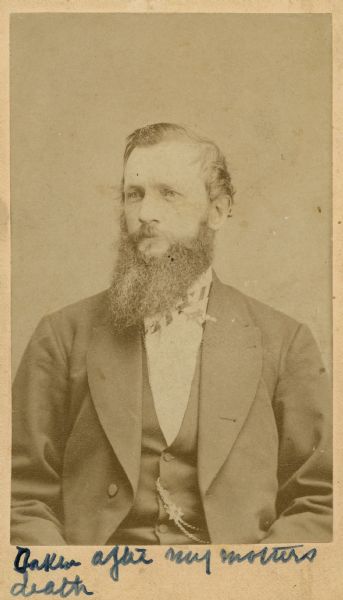
Col. John H. Knight (Wisconsin Historical Society)
Knight oversaw a couple of annuity payments, but considering the other evidence, I’m confident that the popular image that decorates the sides of the Chequamegon History site was indeed taken at Odanah by Charles Zimmerman at the 1869 annuity payment.
Do you agree? Do you disagree? Have you spotted anything in any of these photos that begs for more investigation? Leave a comment.
As for myself, it’s a relief to finally get all these photo mysteries out of my post backlog. The 1870 date on the Zimmerman photo reminds me that I’m spending too much time in the later 19th century. After all, the subtitle of this website says it’s history before 1860. I think it might be time to go back for a while to the days of the old North West Company or maybe even to Pontiac. Stay tuned, and thanks for reading,
Blackbird’s Speech at the 1855 Payment
January 20, 2014
“We sold our land for our graves–that we might have a home, where the bones of our fathers are buried. We were not willing to sell the ashes of our relatives which are so dear to us. This was the reason why we sold our lands. It was not to pay debts over and over again, but to benefit the living, those of us who yet remain upon earth, our young men & women & children.”
~Makade-binesi (Blackbird)

Scene at Indian Payment–Odanah, Wis. This image is from a later payment than the one described below (Whitney & Zimmerman c.1870)
Most of us have heard Chief Joseph’s “Fight No More Forever” speech and Chief Seattle’s largely-fictional plea for the environment, but very few will know that a outstanding example of Native American oratory took place right here in the Chequamegon Region in the summer of 1855.
It was exactly eleven months after the Lake Superior Ojibwe bands gave up the Arrowhead region of Minnesota, in their final treaty with the United States, in exchange for permanent reservations. Already, the American government was trying to back out of a key provision of the agreement. It concerned a clause in Article Four of the 1854 Treaty of La Pointe that reads:
The United States will also pay the further sum of ninety thousand dollars, as the chiefs in open council may direct, to enable them to meet their present just engagements.
The inclusion of clauses to pay off trade debts was nothing new in Ojibwe treaties. In 1837, $70,000 went to pay off debts, and in 1842 another $75,000 went to the traders. Personal debts would often be paid out of annuity funds by the government directly to the creditors and certain Ojibwe families would never see their money. However, from the beginning there were accusations that these debts were inflated or illegitimate, and that it was the traders rather than the Ojibwe themselves, who profited from the sale of the lands. Therefore, in 1854, when $90,000 in claims were inserted in the treaty, the chiefs demanded that they be the ones to address the claims of the creditors.
However, less than a year later, at the first post-1854 payment, the government was pressured to back off of the language in the treaty. George Manypenny, the Commissioner of Indian Affairs, came to La Pointe to oversee the payment where he was asked by Indian Agent Henry Gilbert to let the Agency oversee the disbursement of the $90,000. Most white inhabitants, and many of the white tourists in town to view the spectacle that was the 1855 payment, supported the agent’s plan, as did most of the mix-blooded Ojibwe (most of whom were employed in the trading business in one way or another) and a substantial minority of the full-bloods.
However, the clear majority of the Lake Superior chiefs insisted they keep the right to handle their own debt claims. As we saw in this post, the Odanah-based missionary Leonard Wheeler also felt the Government needed to honor its treaties to the letter. This larger faction of Ojibwe rallied around one chief. He was from the La Pointe Band and was entrusted to speak for Ojibwe with one voice. From this description, you might assume it was Chief Buffalo. However, Buffalo, in the final days of his life, found himself in the minority on this issue. The speaker for the majority was the Bad River chief Blackbird, and he may have delivered one of the greatest speeches ever given in the Chequamegon Bay region.
Unfortunately, the Ojibwe version of the speech has not survived, and it’s English version, originally translated by Paul Bealieu, exists in pieces recorded by multiple observers. None of these accounts captures all the nuances of the speech, so it is necessary to read all of them and then analyze the different passages to see its true brilliance.
The first reference to Blackbird’s speech I remember seeing appeared in the eyewitness account of Dr. Richard F. Morse of Detroit who visited La Pointe that summer specifically to see the payment. His article, The Chippewas of Lake Superior appeared in the third volume of the Collections of the State Historical Society of Wisconsin. As you’ll read, it doesn’t speak very highly of Blackbird or the speech, celebrating instead the oratory of Naaganab, the Fond du Lac chief who was part of the minority faction and something of a celebrity among the visiting whites in 1855:


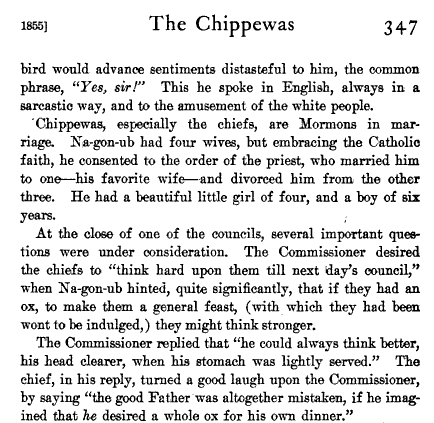
From Morse’s clear bias against Ojibwe culture, I thought there may have been more to this story, but my suspicions weren’t confirmed until I transcribed another account of the payment for Chequamegon History. An Indian Payment written by another eyewitness, Crocket McElroy, paints a different picture of Blackbird and quotes part of his speech:

Paul H. Beaulieu translated the speeches at the 1855 annuity payment (Minnesota Historical Society Collections).
In August 1855 about three thousand Chippewa Indians gathered at the village of Lapointe, on Lapointe Island, Lake Superior, for an Indian Payment and also to hold a council with the commissioner of Indian affairs, who at that time was George W. Monypenny of Ohio. The Indians selected for their orator a chief named Blackbird, and the choice was a good one, as Blackbird held his own well in a long discussion with the commissioner. Blackbird was not one of the haughty style of Indians, but modest in his bearing, with a good command of language and a clear head. In his speeches he showed much ingenuity and ably pleaded the cause of his people. He spoke in Chippewa stopping frequently to give the interpreter time to translate what he said into English. In beginning his address he spoke substantially as follows:
“My great white father, we are pleased to meet you and have a talk with you We are friends and we want to remain friends. We expect to do what you want us to do, and we hope that you will deal kindly with us. We wish to remind you that we are the source from which you have derived all your riches. Our furs, our timber, our lands, everything that we have goes to you; even the gold out of which that chain was forged (pointing to a heavy watch chain that the commissioner carried) came from us, and now we hope that you will not use that chain to bind us.”
These conflicting accounts of the largely-unremembered Bad River chief’s speech made me curious, and after I found the Blackbird-Wheeler-Manypenny letters written after the payment, I knew I needed to learn more about the speech. Luckily, digging further into the Wheeler Papers uncovered the following. To my knowledge, this is the first time it has been transcribed or published in any form.
[Italics, line breaks, and quotation marks added by transcriber to clearly differentiate when Wheeler is quoting a speaker. Blackbird’s words are in blue.]
O-da-nah Jan 18, 1856.
L. H. Wheeler to Richard M. Smith
Dear Sir,
The following is the substance of my notes taken at the Indian council at La Pointe a copy of which you requested. Council held in front of Mr. Austrian’s store house Aug 30. 1855.
Short speech first from Kenistino of Lac du Flambeau.
My father, I have a little to say to you & to the Indians. There is no difference between myself and the other chiefs in regard to the subject upon which we wish to speak. Our chiefs and young men & old men & even the women & children are all of the same mind. Blackbird our chief will speak for us & express our sentiments.
The Commissioner, Col Manypenny replied as follows.
My children I suppose you have come to reply to what I said to you day before yesterday. Is this what you have come for?
“Ah;” or yes, was the reply.
I am happy to see you, but would suggest whether you had not better come tomorrow. It is now late in the day and is unpleasant & you have a great deal to say and will not have time to finish, but if you will come tomorrow we shall have time to hear all you have to say. Don’t you think this will be the best way?
“Ah!” yes was the response.
Think well about what you want to say and come prepared to speak freely & fully about all you wish to say. I would like not only to hear the chiefs and old men speak, but the young men talk, and even the women, if they wish to come, let them come and listen too. I want the women to understand all that is said and done. I understand that some of the Indians were drunk last night with the fire-water. I hope we shall hear nothing more of it. If any body gives you liquor let me know it and I will deal with him as he deserves. I hope we shall have a good time tomorrow and be able to explain all about your affairs.
Aug 31. Commissioner opened the council by saying that he wanted all to keep order.
Let the whites and others sit down on the ground and we will have a pleasant time. If you have anything to say I hope you will speak to the point.
Black Bird. To the Indians.
My brother chiefs, head men & young men & children. I have listened well to all the men & women & others who have spoken in our councils and shall now tell it to my father. I shall have but one mouth to speak your will.
Nose [noose (no-say) “my father”]. My father. We present you our salutations in your heart. We salute you in the name of our great father the President, whose representative you are. We want the Great Spirit now to bless us. The Day is clear, and we hope our thoughts will be clear too. My intention is to tell you what the owner of life has done for us. He has provided for the life of us all. When the Lord made us he provided for us here upon earth he invested it (ie, he made provision for our wants) in the running streams, in the woods & lakes which abound with fish and in the wild animals. We regard you as if men like a spirit, perhaps it is because of your education, because you are so much wiser than we, but if we can trace our tradition right the Great Spirit has not made the white man to cheat us. There is a difference of opinion as it regards different colors among, as to which shall have the preeminence, but the Great Spirit made us to be happy before you discovered us.
I will now tell you about how it was with us before our payments, and before we sold any land. Our furs that we took we sold to our traders. We were then paid 4 martin skins for a dollar. 4 bears skins also & 4 beaver skins for $1.00 too. Can you wonder that we are poor? I say this to show you what our condition was before we had any payments. I[t] was by our treaties that we learned the use of money. I see you White men that sit here how you are dressed. I see your watch chains & seals and your rich clothing. Now I will tell you how it is with our traders. When they first came among us they were very poor, but by & by they became very fat & rich, and wear rich clothing and had their watches & gold chains such as I see you wear. But they got their things out of us. They were made rich at our expense. My father, you told us to bring our women here too. Here they are, and now behold them in their poverty, and pity their condition (at this juncture in the speech several old women stood dressed in their worn out blankets and tattered garments as if designed to appeal to his humanity[)].
My father, I am now coming to the point. We are here to protect our own interests. Our land which we got from our forefathers is ours & we must get what we can for it. Our traders step between us & our father to controll our interests, and we have been imposed upon. Mr. Gilbert was the one I shook hands with last year when he was sent here to treat for our lands. He was the one who was sent to uphold us in our poverty. We are thankful to see you both here to attend to our interests, and that we are permitted to express to you our wants. Last year you came here to treat for our lands we are now speaking about. We sold them because we were poor. We thank our father for bringing clothing to pay for them. We sold our land for our graves–that we might have a home, where the bones of our fathers are buried. We were not willing to sell the ashes of our relatives which are so dear to us. This was the reason why we sold our lands. It was not to pay debts over and over again, but to benefit the living, those of us who yet remain upon earth, our young men & women & children.
You said you wanted to see them. They have been sent for and are now here. Behold them in their poverty & see how poor they look.
They are poor because so much of our money is taken to pay old debts. We want the 90,000 dollars to be paid as we direct. We know that it is just and right that it should be so. We want to have the money paid in our own hands, and we will see that our just debts are paid. We want the 90,000 to feed our poor women, and after paying our just debts we want the remainder to buy what we want. This is the will of all present. The chiefs, & young men & old men & the women & children.
Let what I have now said, my father, enter your head & heart; and let it enter the head of our great father the President, that it may be as we have now said. We own no more land. We must hereafter provide for ourselves. We want to profit by all the provisions of the treaty we have now made. We want the whole annuity paid to us as stipulated in the treaty. I am now done. After you have spoken, perhaps there are others who would like to speak.
This is the first time my father that I have appeared dressed in a coat & pants & I must confess I feel a little awkward.
The Commissioner replied as follows
We have all heard & noted down what you have said. If any others wish to speak they had better speak first and I will reply to all at once.
The Grand Portage Indian [Adikoons] then spoke as follows.
My father, I have a few words to say, and I wish to speak what I think. We have long coveted the privilege of seeing our Great Father. Why not now embrace the opportunity to speak freely while he is here? This man will speak my mind. He is old enough to speak and is a man endowed with good sense. He will speak our minds without reserve.
When we look around us, we think of our God who is the maker of us all. You have come here with the laws of that God we have talked about, and you profess to be a Christian and acknowledge the authority of God. The word of God ought to be obeyed not only by the Indians, but by all. When we see you, we think you must respect that word of God, who gives life to all. Your advice is like the law of God. Those who listen to his law are like God–firm as a rock, (not fickle and vacilating). When the word of the Great Spirit ends. When there is an end to life, we are all pleased with the advice you have given us, and intend to act in accord with it. If we are one here, and keep the word of the Great Spirit we shall be one here after. In what Blackbird said he expressed the mind of a majority of the chiefs now present. We wish the stipulations of the treaty to be carried out to the very letter.
I wish to say our word about our reserves. Will these reserves made for each of our bands, be our homes forever?
When we took credits of our trader last winter, and took no furs to pay him, and wish to get hold of this 90,000 dollars, that we may pay him off of that. This is all we came here for. We want the money in our own hands & we will pay our own traders. We do not think it is right to pay what we do not owe. I always know how I stand my acct. and we can pay our own debts. From what I have now said I do not want you to think that we want the money to cheat our creditors, but to do justice to them I owe. I have my trader & know how much I owe him, & if the money is paid into the hands of the Indians we can pay our own debts.
Naganub.
We have 90,000 dollars set apart to pay our traders, for my part I think it is just that the money should go for this object. We all know that the traders help us. We could not well do without them.
Buffalo.
We who live here are ready to pay our just debts. Some have used expressions as though these debts were not just. I have lived here many years and been very poor. There are some here who have been pleased to assist me in my poverty. They have had pity on me. Those we justly owe I don’t think ought to be defrauded. The trader feeds our women & children. We cannot live one winter without him. This is all I have to say.
 [Wheeler does not identify a new speaker here, but marks a a star (right). Kohl (below) attributes the line about the “came out of the water” to Blackbird, but the line about the copper diggings contradicts Blackbird’s earlier statement, in Kohl, about not knowing their value. This, and Wheeler’s marking of Blackbird as the one who spoke after this speech would indicate this is Buffalo still talking].
Our rights ought to be protected. When commissioners have come here to treat for our lands, we have always listened well to their words. Not because we did not know ourselves the worth of our lands. We have noticed the ancient copper diggings, and know their worth. We have never refused to listen to the words of our Great Father. He it is true has had the power but we have made him rich. The traders have always wanted pay for what we do not remember to have bought. At Crow [W]ing River when our lands were ceded there, then there was a large sum demanded to pay old debts. We have always paid our traders we have acted fair on our part. At St. Peters also there was a large amount of old debts to be paid–many of them came from places unknown–for what I know they came out of the water. We think many of them came out of the same bag, and are many of them paid over & over again at every treaty.
Black Bird.
I get up no[w] to finish what you have put into my heart. The night would be heavy on my breast should I retain any of the words of them with whom I have councilled & for whom I speak. I speak no[w] of farmers, carpenters, & other employees of Govt. Where is the money gone to for them? We have not had these laborers for several years that has been appropriated. Where is the money that has been set apart to pay them? You will not probably see your Red Children again in after years to council with them. So we protest by the present opportunity to speak to you of our wants & grievances. We regard you as standing in the place of our great father at Washington, and your judgement must be correct. This is all I have to say about our arrearages, we have not two tongues.
As exciting as it was to have the full speech, as I transcribed some of the passages, some of them seemed very familiar. Sure enough, on page 53 of Johann Georg Kohl’s Kitchi-Gami: Life Among the Lake Superior Ojibway, there is another whole version. Kitchi-Gami is one of the standards of Ojibwe cultural history, and I use it for reference fairly often, but it had been so long since I had read the book cover to cover that I forgot that Kohl had been another witness that August day in 1855:


When one considers that Paul Beaulieu, the man giving the official English translation was probably speaking in his third language, after Ojibwe and Metis-French, and that Kohl was a native German speaker who understood English but may have been relying on his own mix-blood translator, it is remarkable how similar these two accounts are. This makes the parts where they differ all the more fascinating. Undoubtedly there are key parts of this speech that we could only understand if we had the original Ojibwe version and a full understanding of the complicated artistry of Ojibwe rhetoric with all its symbolism and metaphor. Even so, there are enough outstanding passages here for me to call it a great speech.
“My father…great Father…We regard you as if men like a spirit, perhaps it is because of your education, because you are so much wiser than we…”
The ritual language of kinship and humility in traditional Ojibwe rhetoric can be off-putting to those who haven’t read many Ojibwe speeches, and can be mistaken as by-product of American arrogance and paternalism toward Native people. However, the language of “My Father” predates the Americans, going all the way back to New France, and does not necessarily indicate any sort weakness or submission on the part of the speaker. Richard White, Michael Witgen, and Howard Paap, much smarter men than I, have dedicated pages to what Paap calls “fur-trade theater,” so I won’t spend too much time on it other than to say that 1855 was indeed a low point in Ojibwe power, but Blackbird is only acting the ritual part of the submissive child here in a long-running play. He is not grovelling.
On the contrary, I think Blackbird is playing Manypenny here a little bit. George Manypenny’s rise to the head of Indian Affairs coincided with the end of American removal policy and the ushering in of the reservation era. In the short term, this was to the political advantage of the Lake Superior Ojibwe. In Manypenny the Ojibwe got a “Father” who would allow them to stay in their homelands, but they also got a zealous believer in the superiority of white culture who wanted to exterminate Indian cultures as quickly as possible.
In a future post about the 1855 treaty negotiations with the Minnesota Ojibwe we will see how Commissioner Manypenny viewed the Ojibwe, including masterful politicians like Flat Mouth and Hole in the Day, as having the intelligence of children. Blackbird shows himself a a savvy politician here by playing into these prejudices as a way to get the Commissioner off his guard. Other parts of the speech lead me to doubt that Blackbird sincerely believed that the Americans were “so much wiser” than he was.
My intention is to tell you what the owner of life has done for us. He has provided for the life of us all. When the Lord made us he provided for us here upon earth he invested it (ie, he made provision for our wants) in the running streams, in the woods & lakes which abound with fish and in the wild animals… There is a Great Spirit from whom all good things here on earth come. He has given them to mankind–to the white as to the red man; for He sees no distinction of colour…but if we can trace our tradition right the Great Spirit has not made the white man to cheat us. There is a difference of opinion as it regards different colors among, as to which shall have the preeminence, but the Great Spirit made us to be happy before you discovered us…
This part varies slightly between Wheeler and Kohl, but in both it is very eloquent and similar in style to many Ojibwe speeches of the time. One item that piqued my interest was the line about the “difference of opinion.” Many Americans at the time understood the expansion of the United States and the dispossession of Native peoples in religious terms. It was Manifest Destiny. The Ojibwe also sought answers for their hardships in prophecy. On pages 117 and 118 of History of the Ojibwe People, William Warren relates the following:

Warren, writing in the late 1840s and early 1850s, contrasts this tradition with the popularity of the prophecies of Tenskwatawa, brother of Tecumseh, in Ojibwe country forty years earlier. Tenskwatawa taught that Indians would inherit North America and drive whites from the continent. Blackbird seems to be suggesting that in 1855 this question of prophecy was not settled among the Lake Superior Ojibwe. Presumably there would have been fertile ground for a charismatic millenarian Native spiritual leader along the lines of Neolin, Tenskwatawa, or Wovoka to gain adherents among the Lake Superior Ojibwe at that time.

Johann Georg Kohl recorded Blackbird’s speech in his well known account of Lake Superior in the Summer of 1855, Kitchi-Gami: Life Among the Lake Superior Ojibway.
Our furs, our timber, our lands, everything that we have goes to you; even the gold out of which that chain was forged…Now I will tell you how it is with our traders. When they first came among us they were very poor, but by & by they became very fat & rich, and wear rich clothing and had their watches & gold chains such as I see you wear. But they got their things out of us. They were made rich at our expense…and now we hope that you will not use that chain to bind us…
The gold chain appears in each of McElroy, Wheeler, and Kohl’s accounts. It acts as a symbol on multiple levels. To Blackbird, the gold represents the immense wealth produced during the fur trade on the backs of Indian trappers. By 1855, with the fur trade on its last legs, some of the traders are very wealthy while the Ojibwe are much poorer than they were when the trade started. The gold also stands in for the value of the ceded territory itself, specifically the lakeshore lands (ceded in 1842), which thirteen years later were producing immense riches from that other shiny metal, copper. Finally, in McElroy’s account, we also see the chain acting as the familiar symbol of bondage.
…We sold our land for our graves–that we might have a home, where the bones of our fathers are buried…Our debts we will pay. But our land we will keep. As we have already given away so much, we will, at least, keep that land you have left us, and which is reserved for us. Answer us, if thou canst, this question. Assure us, if thou canst, that this piece of land reserved for us, will really always be left to us…
This passage of Blackbird’s speech, and a similar statement by the “Grand Portage Indian” (identified by Morse as Adikoons or Little Caribou), indicate that perhaps, the actual disbursement of the $90,000 was a secondary to the need to hold Agent Gilbert and the Government to their word. It was very important to the Ojibwe that words of the Treaty of 1854 be rock-solid, not for a need to pay off debts or to get annuity payments, but because the Government absolutely needed to keep its promise to grant reservations around the ancestral villages. The memory of the Sandy Lake Tragedy, less than five years earlier, cast a long shadow over this decade. Paap argues in Red Cliff, Wisconsin that the singular goal of the treaty, from the Ojibwe perspective, was to end the removal talk forever, a goal that had seemingly been accomplished. To hear the Government trying to weasel out of a provision of the 1854 Treaty must have been very frightening to those who heard Robert Stuart’s promises in 1842. This time, the chiefs had to make sure a promise of a permanent homeland for their people wouldn’t turn out to be another lie.
This is the first time my father that I have appeared dressed in a coat & pants & I must confess I feel a little awkward.
You can argue that a great speech can’t end with the line, “I must confess I feel a little awkward.” However, I will argue that this might be the best line of all. It is another example of the political brilliance of Blackbird. The Bad River chief knew who his allies were, knew who his opponents were, and knew how to take advantage of the Commissioner’s prejudices. Clothing played a role in all of this.
George Manypenny despised Indian cultures. In fact, the whole council had almost derailed a few days before the speeches when the Commissioner refused to smoke the pipe presented to him by the chiefs in open ceremony. He remedied this insult somewhat by smoking it later while indoors, but he let it be known that he had no use for Ojibwe songs, dances, rituals or clothing. This put Blackbird, an unapologetic traditionalist and practitioner of the midewiwin at a distinct disadvantage, when compared with chiefs like Naaganab who were known to wear European clothes and profess to be Christians.
Although he had the majority of the people behind him, Blackbird had very little negotiating power. He had to persuade Manypenny that he was in the right. He had no chance unless he could appear to the Commissioner that he was trying to become “civilized” and was therefore worthy enough to be listened to. However, by wearing European clothes, he ran the risk of alienating the majority of the people in the crowd who preferred traditional ways and dress. Furthermore, the chiefs most likely to oppose him, Naaganab and Jayjigwyong (Little Buffalo) had been dressing like whites (I would argue also largely for political reasons) for years and were much more likely to come across as “civilized” in the Commissioner’s eyes.
How did the chief solve these dilemmas? In the same way he turned Manypenny’s request to see the Ojibwe women to his advantage, he used the clothing to demonstrate that he had gone out of his way to work with the Commissioner’s wishes, while still solidifying the backing of the traditional Ojibwe majority and putting his opponents on the defensive all with one well-timed joke. Although this joke seems to have gone over Wheeler’s head, and likely Manypenny’s as well, Kohl’s mention of the “applauding laughter of the entire assembly,” shows it reached its target audience. So, contrary to first appearances, the crack about the awkward pants is anything but an awkward ending to this speech.
Conclusion
In the 1840s and early 1850s, Blackbird rarely appears in the historical record. Here and there he is mentioned as a second chief to Chief Buffalo or as leading the village at Bad River. Many mentions of him by English-speaking authors are negative. He is referred to as a rascal, scoundrel, or worse, and I’ve yet to find any mention of his father or other family members as being prominent chiefs.
However, in the late 1850s and early 1860s, he was clearly the most important speaker for not just the La Pointe Band, but for the other Lake Superior Bands as well. This was a mystery to me. I temporarily hypothesized his rise was due to the fact that Chequamegon was seen as the center of the nation and that when Buffalo died, Blackbird succeeded to the position by default. However, this view doesn’t really fit what I understood as Ojibwe leadership.
This speech puts that interpretation to rest. Blackbird earned his position by merit and by the will of the people.
He did not, however, win on the question of the $90,000. A Chequamegon History reader recently sent me a document showing it was eventually paid to the creditors directly by the Agent. However, if my argument is correct, the more important issue was that the Government keep its word that the reservations would belong to the Ojibwe forever. The land question wasn’t settled overnight, and it required many leaders over the last 160 years to hold the United States to its word. But today, Blackbird’s descendants still live beside the swamps of Mashkiziibii at least partially because of the determination of their great ogimaa.
Sources:
Kohl, J. G. Kitchi-Gami: Wanderings round Lake Superior. London: Chapman and Hall, 1860. Print.
McClurken, James M., and Charles E. Cleland. Fish in the Lakes, Wild Rice, and Game in Abundance: Testimony on Behalf of Mille Lacs Ojibwe Hunting and Fishing Rights / James M. McClurken, Compiler ; with Charles E. Cleland … [et Al.]. East Lansing, MI: Michigan State UP, 2000. Print.
McElroy, Crocket. “An Indian Payment.” Americana v.5. American Historical Company, American Historical Society, National Americana Society Publishing Society of New York, 1910 (Digitized by Google Books) pages 298-302.
Morse, Richard F. “The Chippewas of Lake Superior.” Collections of the State Historical Society of Wisconsin. Ed. Lyman C. Draper. Vol. 3. Madison: State Historical Society of Wisconsin, 1857. 338-69. Print.
Paap, Howard D. Red Cliff, Wisconsin: A History of an Ojibwe Community. St. Cloud, MN: North Star, 2013. Print.
Satz, Ronald N. Chippewa Treaty Rights: The Reserved Rights of Wisconsin’s Chippewa Indians in Historical Perspective. Madison, WI: Wisconsin Academy of Sciences, Arts and Letters, 1991. Print.
Schenck, Theresa M. The Voice of the Crane Echoes Afar: The Sociopolitical Organization of the Lake Superior Ojibwa, 1640-1855. New York: Garland Pub.,1997. Print.
—————— William W. Warren: The Life, Letters, and times of an Ojibwe Leader. Lincoln: University of Nebraska, 2007. Print.
Warren, William W., and Theresa M. Schenck. History of the Ojibway People. St. Paul: Minnesota Historical Society, 2009. Print.
White, Richard. The Middle Ground: Indians, Empires, and Republics in the Great Lakes Region, 1650-1815. Cambridge: Cambridge UP, 1991. Print.
Witgen, Michael J. An Infinity of Nations: How the Native New World Shaped Early North America. Philadelphia: University of Pennsylvania, 2012. Print.
The Enemy of my Enemy: The 1855 Blackbird-Wheeler Alliance
November 29, 2013
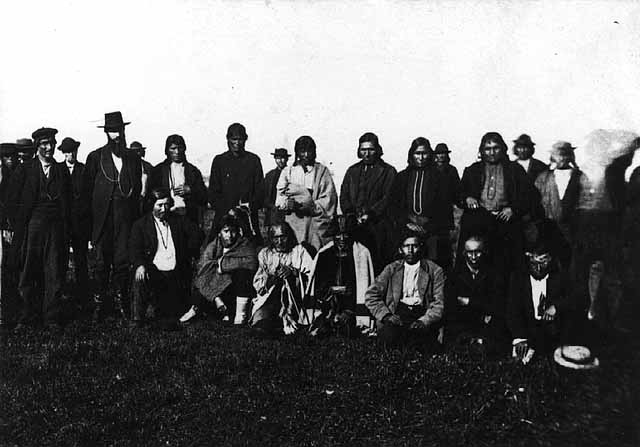
Identified by the Minnesota Historical Society as “Scene at Indian payment, probably at Odanah, Wisconsin. c. 1865.” by Charles Zimmerman. Judging by the faces in the crowd, this is almost certainly the same payment as the more-famous image that decorates the margins of the Chequamegon History site (Zimmerman MNHS Collections)
A staunch defender of Ojibwe sovereignty, and a zealous missionary dedicating his life’s work to the absolute destruction of the traditional Ojibwe way of life, may not seem like natural political allies, but as Shakespeare once wrote, “Misery acquaints a man with strange bedfellows.”
In October of 1855, two men who lived near Odanah, were miserable and looking for help. One was Rev. Leonard Wheeler who had founded the Protestant mission at Bad River ten years earlier. The other was Blackbird, chief of the “Bad River” faction of the La Pointe Ojibwe, that had largely deserted La Pointe in the 1830s and ’40s to get away from the men like Wheeler who pestered them relentlessly to abandon both their religion and their culture.
Their troubles came in the aftermath of the visit to La Pointe by George Manypenny, Commissioner of Indian Affairs, to oversee the 1855 annuity payments. Many readers may be familiar with these events, if they’ve read Richard Morse’s account, Chief Buffalo’s obituary (Buffalo died that September while Manypenny was still on the island), or the eyewitness account by Crockett McElroy that I posted last month. Taking these sources together, some common themes emerge about the state of this area in 1855:
- After 200 years, the Ojibwe-European relationship based on give and take, where the Ojibwe negotiated from a position of power and sovereignty, was gone. American government and society had reached the point where it could by impose its will on the native peoples of Lake Superior. Most of the land was gone and with it the resource base that maintained the traditional lifestyle, Chief Buffalo was dead, and future chiefs would struggle to lead under the paternalistic thumb of the Indian Department.
- With the creation of the reservations, the Catholic and Protestant missionaries saw an opportunity, after decades of failures, to make Ojibwe hunters into Christian farmers.
- The Ojibwe leadership was divided on the question of how to best survive as a people and keep their remaining lands. Some chiefs favored rapid assimilation into American culture while a larger number sought to maintain traditional ways as best as possible.
- The mix-blooded Ojibwe, who for centuries had maintained a unique identity that was neither Native nor European, were now being classified as Indians and losing status in the white-supremacist American culture of the times. And while the mix-bloods maintained certain privileges denied to their full-blooded relatives, their traditional voyageur economy was gone and they saw treaty payments as one of their only opportunities to make money.
- As with the Treaties of 1837 and 1842, and the tragic events surrounding the attempted removals of 1850 and 1851, there was a great deal of corruption and fraud associated with the 1855 payments.
This created a volatile situation with Blackbird and Wheeler in the middle. Before, we go further, though, let’s review a little background on these men.
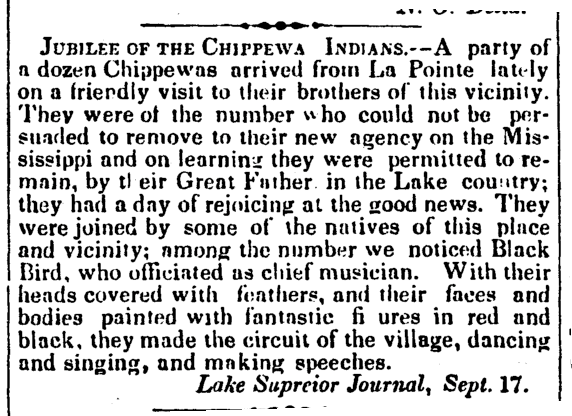
This 1851 reprint from Lake Superior Journal of Sault Ste. Marie shows how strongly Blackbird resisted the Sandy Lake removal efforts and how he was a cultural leader as well as a political leader. (New Albany Daily Ledger, October 9, 1851. Pg. 2).
Who was Blackbird?
Makadebineshii, Chief Blackbird, is an elusive presence in both the primary and secondary historical record. In the 1840s, he emerges as the practical leader of the largest faction of the La Pointe Band, but outside of Bad River, where the main tribal offices bear his name, he is not a well-known figure in the history of the Chequamegon area at all.
Unlike, Chief Buffalo, Blackbird did not sign many treaties, did not frequently correspond with government officials, and is not remembered favorably by whites. In fact, his portrayal in the primary sources is often negative. So then, why did the majority of the Ojibwe back Blackbird at the 1855 payment? The answer is probably the same reason why many whites disliked him. He was an unwavering defender of Ojibwe sovereignty, he adhered to his traditional culture, and he refused to cooperate with the United States Government when he felt the land and treaty rights of his people were being violated.
One needs to be careful drawing too sharp a contrast between Blackbird and Buffalo, however. The two men worked together at times, and Blackbird’s son James, later identified his father as Buffalo’s pipe carrier. Their central goals were the same, and both labored hard on behalf of their people, but Buffalo was much more willing to work with the Government. For instance, Buffalo’s response in the aftermath of the Sandy Lake Tragedy, when the fate of Ojibwe removal was undecided, was to go to the president for help. Blackbird, meanwhile, was part of the group of Ojibwe chiefs who hoped to escape the Americans by joining Chief Zhingwaakoons at Garden River on the Canadian side of Sault Ste. Marie.
Still, I hesitate to simply portray Blackbird and Buffalo as rivals. If for no other reason, I still haven’t figured out what their exact relationship was. I have not been able to find any reference to Blackbird’s father, his clan, or really anything about him prior to the 1840s. For a while, I was working under the hypothesis that he was the son of Dagwagaane (Tugwaganay/Goguagani), the old Crane Clan chief (brother of Madeline Cadotte), who usually camped by Bad River, and was often identified as Buffalo’s second chief.
However, that seems unlikely given this testimony from James Blackbird that identifies Oshkinawe, a contemporary of the elder Blackbird, as the heir of Guagain (Dagwagaane):
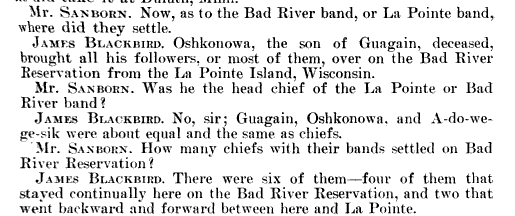
Statement of James Blackbird: Condition of Indian affairs in Wisconsin: hearings before the Committee on Indian Affairs, United States Senate, [61st congress, 2d session], on Senate resolution, Issue 263. pg 203. (Digitized by Google Books).
It seems Commissioner Manypenny left La Pointe before the issue was entirely settled, because a month later, we find a draft letter from Blackbird to the Commissioner transcribed in Wheeler’s hand:
Mushkesebe River Oct. 1855
Blackbird. Principal chief of the Mushkisibi-river Indians to Hon. G. Manepenny Com. of Indian Affairs Washington City.
Father; Although I have seen you face to face, & had the privilege to talking freely with you, we did not do all that is to be attended to about our affairs. We have not forgotten the words you spoke to us, we still keep them in our minds. We remember you told us not to listen to all the foolish stories that was flying about–that we should listen to what was good, and mind nothing about anything else. While we listened to your advice we kept one ear open and the other shut, & [We?] kept retained all you spoke said in our ears, and. Your words are still ringing in our ears. The night that you left the sound of the paddles in boat that carried you away from us was had hardly gone ceased before the minds of some of the chiefs was were tuned by the traders from the advice you gave, but we did not listen to them. Ja-jig-wy-ong, (Buffalo’s son) son says that he & Naganub asked Mr. Gilbert if they could go to Washington to see about the affairs of the Indians. Now father, we are sure you opened your heart freely to us, and did not keep back anything from us that is for our good. We are sure you had a heart to feel for us & sympathise with us in our trials, and we think that if there is any important business to be attended to you would not have kept it secret & hid it from us, we should have knew it. If I am needed to go to Washington, to represent the interests of our people, I am ready to go. The ground that we took against about our old debts, I am ready to stand shall stand to the last. We are now in Mr. Wheelers house where you told us to go, if we had any thing to say, as Mr. W was our friend & would give us good advice. We have done so. All the chiefs & people for whom I spoke, when you were here, are of the same mind. They all requested before they left that I should go to Washington & be sure & hold on to Mr. Wheeler as one to go with me, because he has always been our steadfast friend and has al helped us in our troubles. There is another thing, my father, which makes us feel heavy hearted. This is about our reservation. Although you gave us definite instructions about it, there are some who are trying to shake our reserve all to pieces. A trader is already here against our will & without any authority from Govt, has put him up a store house & is trading with our people. In open council also at La Pointe when speaking for our people, I said we wanted Mr. W to be our teacher, but now another is come which whom we don’t want, and is putting up a house. We supposed when you spoke to us about a teacher being permitted to live among us, you had reference to the one we now have, one is enough, we do not wish to have any more, especially of the kind of him who has just come. We forbid him to build here & showed him the paper you gave us, but he said that paper permitted him rather than forbid him to come. If the chiefs & young men did not remember what you told them to keep quiet there would already be have been war here. There is always trouble when there two religions come together. Now we are weak and can do nothing and we want you to help us extend your arms to help us. Your arms can extend even to us. We want you to pity & help us in our trouble. Now we wish to know if we are wanted, or are permitted, three or four of us to come to which Washington & see to our interests, and whether our debts will be paid. We would like to have you write us immediately & let us know what your will is, when you will have us come, if at all. One thing further. We do not want any account to be allowed that was not presented to us for us to pass our opin us to pass judgement on, we hear that some such accounts have been smuggled in without our knowledge or consent.
The letter is unsigned, lacks a specific date, and has numerous corrections, which indicate it was a draft of the actual letter sent to Manypenny. This draft is found in the Wheeler Family Papers in the collections of the Wisconsin Historical Society at the Northern Great Lakes Visitor Center. As interesting as it is, Blackbird’s letter raises more questions than answers. Why is the chief so anxious to go to Washington? What are the other chiefs doing? What are these accounts being smuggled in? Who are the people trying to shake the reservation to pieces and what are they doing? Perhaps most interestingly, why does Blackbird, a practitioner of traditional religion, think he will get help from a missionary?
For the answer to that last question, let’s take a look at the situation of Leonard H. Wheeler. When Wheeler, and his wife, Harriet came here in 1841, the La Pointe mission of Sherman Hall was already a decade old. In a previous post, we looked at Hall’s attitudes toward the Ojibwe and how they didn’t earn him many converts. This may have been part of the reason why it was Wheeler, rather than Hall, who in 1845 spread the mission to Odanah where the majority of the La Pointe Band were staying by their gardens and rice beds and not returning to Madeline Island as often as in the past.
When compared with his fellow A.B.C.F.M. missionaries, Sherman Hall, Edmund Ely, and William T. Boutwell, Wheeler comes across as a much more sympathetic figure. He was as unbending in his religion as the other missionaries, and as committed to the destruction of Ojibwe culture, but in the sources, he seems much more willing than Hall, Ely, or Boutwell to relate to Ojibwe people as fellow human beings. He proved this when he stood up to the Government during the Sandy Lake Tragedy (while Hall was trying to avoid having to help feed starving people at La Pointe). This willingness to help the Ojibwe through political difficulties is mentioned in the 1895 book In Unnamed Wisconsin by John N. Davidson, based on the recollections of Harriet Wheeler:

From In Unnamed Wisconsin pg. 170 (Digitized by Google Books).
So, was Wheeler helping Blackbird simply because it was the right thing to do? We would have to conclude yes, if we ended it here. However, Blackbird’s letter to Manypenny was not alone. Wheeler also wrote his own to the Commissioner. Its draft is also in the Wheeler Family Papers, and it betrays some ulterior motives on the part of the Odanah-based missionary:
example not to meddle with other peoples business.
Mushkisibi River Oct. 1855
L.H. Wheeler to Hon. G.W. Manypenny
Dear Sir. In regard to what Blackbird says about going to Washington, his first plan was to borrow money here defray his expenses there, & have me start on. Several of the chiefs spoke to me before soon after you left. I told them about it if it was the general desire. In regard to Black birds Black Bird and several of the chiefs, soon after you left, spoke to me about going to Washington. I told them to let me know what important ends were to be affected by going, & how general was the desire was that I should accompany such a delegation of chiefs. The Indians say it is the wish of the Grand Portage, La Pointe, Ontonagun, L’anse, & Lake du Flambeaux Bands that wish me to go. They say the trader is going to take some of their favorite chiefs there to figure for the 90,000 dollars & they wish to go to head them off and save some of it if possible. A nocturnal council was held soon after you left in the old mission building, by some of the traders with some of the Indians, & an effort was made to get them Indians to sign a paper requesting that Mr. H.M. Rice be paid $5000 for goods sold out of the 90,000 that be the Inland Indians be paid at Chippeway River & that the said H.M. Rice be appointed agent. The Lake du Flambeau Indians would not come into the [meeting?] & divulged the secret to Blackbird. They wish to be present at [Shington?] to head off [sail?] in that direction. I told Blackbird I thought it doubtful whether I could go with him, was for borrowing money & starting immediately down the Lake this fall, but I advised him to write you first & see what you thought about the desirability of his going, & know whether his expenses would be born. Most of the claimants would be dread to see him there, & of course would not encourage his going. I am not at all certain certain that I will be [considered?] for me to go with Blackbird, but if the Dept. think it desirable, I will take it into favorable consideration. Mr. Smith said he should try to be there & thought I had better go if I could. The fact is there is so much fraud and corruption connected with this whole matter that I dread to have anything to do with it. There is hardly a spot in the whole mess upon which you can put your finger without coming in contact with the deadly virus. In regard to the Priest’s coming here, The trader the Indians refer to is Antoine [Gordon?], a half breed. He has erected a small store house here & has brought goods here & acknowledges that he has sold them and defies the Employees. Mssrs. Van Tassel & Stoddard to help [themselves?] if they can. He is a liquer-seller & a gambler. He is now putting up a house of worship, by contract for the Catholic Priest. About what the Indians said about his coming here is true. In order to ascertain the exact truth I went to the Priest myself, with Mr. Stoddard, Govt [S?] man Carpenter. His position is that the Govt have no right to interfere in matters of religion. He says he has a right to come here & put up a church if there are any of his faith here, and they permit him to build on his any of their claims. He says also that Mr. Godfrey got permission of Mr. Gilbert to come here. I replied to him that the Commissioner told me that it was not the custom of the Gov. to encourage but one denomination of Christians in a place. Still not knowing exactly the position of Govt upon the subject, I would like to ask the following questions.
1. When one Missionary Society has already commenced labors a station among a settlement of Indians, and a majority of the Indians people desire to have him for their religious teacher, have missionaries of another denomination a right to come in and commence a missionary establishment in the same settlement?
Have they a right to do it against the will of a majority of the people?
Have they a right to do it in any case without the permission of the Govt?
Has any Indian a right, by sold purchase, lease or otherwise a right to allow a missionary to build on or occupy a part of his claim? Or has the same missionary a right to arrange with several missionaries Indians for to occupy by purchase or otherwise a part of their claims severally? I ask these questions, not simply with reference to the Priest, but with regard to our own rights & privileges in case we wish to commence another station at any other point on the reserve. The coming of the Catholic Priest here is a [mere stroke of policy, concocted?] in secret by such men as Mssrs. Godfrey & Noble to destroy or cripple the protestant mission. The worst men in the country are in favor of the measure. The plan is under the wing of the priest. The plan is to get in here a French half breed influence & then open the door for the worst class of men to come in and com get an influence. Some of the Indians are put up to believe that the paper you gave Blackbird is a forgery put up by the mission & Govt employ as to oppress their mission control the Indians. One of the claimants, for whom Mr. Noble acts as attorney, told me that the same Mr. Noble told him that the plan of the attorneys was to take the business of the old debts entirely out of your hands, and as for me, I was a fiery devil they when they much[?] tell their report was made out, & here what is to become of me remains to be seen. Probably I am to be hung. If so, I hope I shall be summoned to Washington for [which purpose?] that I may be held up in [t???] to all missionaries & they be [warned?] by my […]
The dramatic ending to this letter certainly reveals the intensity of the situation here in the fall of 1855. It also reveals the intensity of Wheeler’s hatred for the Roman Catholic faith, and by extension, the influence of the Catholic mix-blood portion of the La Pointe Band. This makes it difficult to view the Protestant missionary as any kind of impartial advocate for justice. Whatever was going on, he was right in the middle of it.
So, what did happen here?
From Morse, McElroy, and these two letters, it’s clear that Blackbird was doing whatever he could to stop the Government from paying annuity funds directly to the creditors. According to Wheeler, these men were led by U.S. Senator and fur baron Henry Mower Rice. It’s also clear that a significant minority of the Ojibwe, including most of the La Pointe mix-bloods, did not want to see the money go directly to the chiefs for disbursement.
I haven’t uncovered whether the creditors’ claims were accepted, or what Manypenny wrote back to Blackbird and Wheeler, but it is not difficult to guess what the response was. Wheeler, a Massachusetts-born reformist, had been able to influence Indian policy a few years earlier during the Whig administration of Millard Fillmore, and he may have hoped for the same with the Democrats. But this was 1855. Kansas was bleeding, the North was rapidly turning toward “Free Soil” politics, and the Dred Scott case was only a few months away. Franklin Pierce, a Southern-sympathizer had won the presidency in a landslide (losing only Massachusetts and three other states) in part because he was backed by Westerners like George Manypenny and H. M. Rice. To think the Democratic “Indian Ring,” as it was described above, would listen to the pleas coming from Odanah was optimistic to say the least.
“[E]xample not to meddle with other peoples business” is written at the top of Wheeler’s draft. It is his handwriting, but it is much darker than the rest of the ink and appears to have been added long after the fact. It doesn’t say it directly, but it seems pretty clear Wheeler didn’t look back on this incident as a success. I’ll keep looking for proof, but for now I can say with confidence that the request for a Washington delegation was almost certainly rejected outright.
So who are the good guys in this situation?
If we try to fit this story into the grand American narrative of Manifest Destiny and the systematic dispossession of Indian peoples, then we would have to conclude that this is a story of the Ojibwe trying to stand up for their rights against a group of corrupt traders. However, I’ve never had much interest in this modern “Dances With Wolves” version of Indian victimization. Not that it’s always necessarily false, but this narrative oversimplifies complex historical events, and dehumanizes individual Indians as much as the old “hostile savages” framework did. That’s why I like to compare the Chequamegon story more to the Canadian narrative of Louis Riel and company than to the classic American Little Bighorn story. The dispossession and subjugation of Native peoples is still a major theme, but it’s a lot messier. I would argue it’s a lot more accurate and more interesting, though.
So let’s evaluate the individuals involved rather than the whole situation by using the most extreme arguments one could infer from these documents and see if we can find the truth somewhere in the middle:

Henry Mower Rice (Wikimedia Images)
Henry M. Rice
The case against: H. M. Rice was businessman who valued money over all else. Despite his close relationship with the Ho-Chunk people, he pressed for their 1847 removal because of the enormous profits it brought. A few years later, he was the driving force behind the Sandy Lake removal of the Ojibwe. Both of these attempted removals came at the cost of hundreds of lives. There is no doubt that in 1855, Rice was simply trying to squeeze more money out of the Ojibwe.
The case for: H. M. Rice was certainly a businessman, and he deserved to be paid the debts owed him. His apparent actions in 1855 are the equivalent of someone having a lien on a house or car. That money may have justifiably belonged to him. As for his relationship with the Ojibwe, Rice continued to work on their behalf for decades to come, and can be found in 1889 trying to rectify the wrongs done to the Lake Superior bands when the reservations were surveyed.
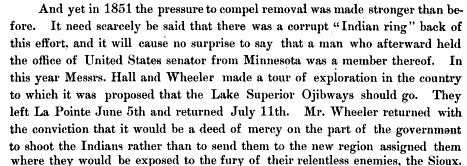
From In Unnamed Wisconsin pg. 168. It’s not hard to figure out which Minnesota senator is being referred to here in this 1895 work informed by Harriet Wheeler. (Digitized by Google Books).
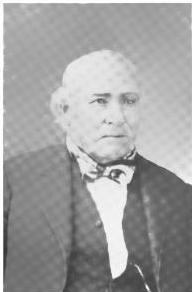
Antoine Gordon from Noble Lives of a Noble Race (pg. 207) published by the St. Mary’s Industrial School in Odanah.
Antoine Gordon
The case against: Antoine Gaudin (Gordon) was an unscrupulous trader and liquor dealer who worked with H. M. Rice to defraud his Ojibwe relatives during the 1855 annuities. He then tried to steal land and illegally squat on the Bad River Reservation against the expressed wishes of Chief Blackbird and Commissioner Manypenny.
The case for: Antoine Gordon couldn’t have been working against the Ojibwe since he was an Ojibwe man himself. He was a trader and was owed debts in 1855, but most of the criticism leveled against him was simply anti-Catholic libel from Leonard Wheeler. Antoine was a pious Catholic, and many of his descendants became priests. He built the church at Bad River because there were a number of people in Bad River who wanted a church. Men like Gordon, Vincent Roy Jr., and Joseph Gurnoe were not only crucial to the development of Red Cliff (as well as Superior and Gordon, WI) as a community, they were exactly the type of leaders the Ojibwe needed in the post-1854 world.
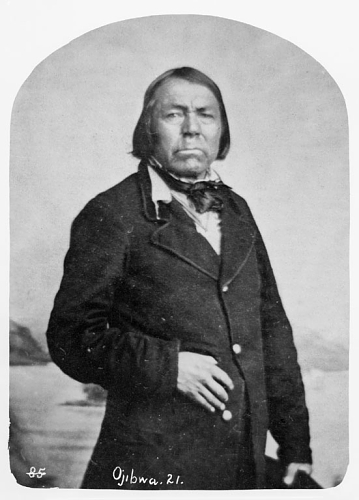
Portrait of Naw-Gaw-Nab (The Foremost Sitter) n.d by J.E. Whitney of St. Paul (Smithsonian)
Naaganab
The case against: Chiefs like Naaganab and Young Buffalo sold their people out for a quick buck. Rather than try to preserve the Ojibwe way of life, they sucked up to the Government by dressing like whites, adopting Catholicism, and using their favored position for their own personal gain and to bolster the position of their mix-blooded relatives.
The case for: If you frame these events in terms of Indians vs. Traders, you then have to say that Naaganab, Young Buffalo, and by extension Chief Buffalo were “Uncle Toms.” The historical record just doesn’t support this interpretation. The elder Buffalo and Naaganab each lived for nearly a century, and they each strongly defended their people and worked to preserve the Ojibwe land base. They didn’t use the same anti-Government rhetoric that Blackbird used at times, but they were working for the same ends. In fact, years later, Naaganab abandoned his tactic of assimilation as a means to equality, telling Rice in 1889:
“We think the time is past when we should take a hat and put it on our heads just to mimic the white man to adopt his custom without being allowed any of the privileges that belong to him. We wish to stand on a level with the white man in all things. The time is past when my children should stand in fear of the white man and that is almost all that I have to say (Nah-guh-nup pg. 192).”
Leonard H. Wheeler

L. H. Wheeler (WHS Image ID 66594)
The case against: Leonard Wheeler claimed to be helping the Ojibwe, but really he was just looking out for his own agenda. He hated the Catholic Church and was willing to do whatever it took to keep the Catholics out of Bad River including manipulating Blackbird into taking up his cause when the chief was the one in need. Wheeler couldn’t mind his own business. He was the biggest enemy the Ojibwe had in terms of trying to maintain their traditions and culture. He didn’t care about Blackbird. He just wanted the free trip to Washington.
The case for: In contrast to Sherman Hall and some of the other missionaries, Leonard Wheeler was willing to speak up forcefully against injustice. He showed this during the Sandy Lake removal and again during the 1855 payment. He saw the traders trying to defraud the Ojibwe and he stood up against it. He supported Blackbird in the chief’s efforts to protect the territorial integrity of the Bad River reservation. At a risk to his own safety, he chose to do the right thing.
Blackbird
The case against: Blackbird was opportunist trying to seize power after Buffalo’s death by playing to the outdated conservative impulses of his people at a time when they should have been looking to the future rather than the past. This created harmful factional differences that weakened the Ojibwe position. He wanted to go to Washington because it would make him look stronger and he manipulated Wheeler into helping him.
The case for: From the 1840s through the 1860s, the La Pointe Ojibwe had no stronger advocate for their land, culture, and justice than Chief Blackbird. While other chiefs thought they could work with a government that was out to destroy them, Blackbird never wavered, speaking consistently and forcefully for land and treaty rights. The traders, and other enemies of the Ojibwe, feared him and tried to keep their meetings and Washington trip secret from him, but he found out because the majority of the people supported him.
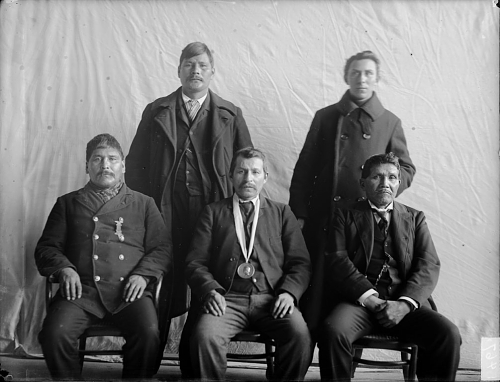
I’ve yet to find a picture of Blackbird, but this 1899 Bad River delegation to Washington included his son James (bottom right) along with Henry and Jack Condecon, George Messenger, and John Medegan–all sons and/or grandsons of signers of the Treaty of 1854 (Photo by De Lancey Gill; Smithsonian Collections).
Final word for now…
An entire book could be written about the 1855 annuity payments, and like so many stories in Chequamegon History, once you start the inquiry, you end up digging up more questions than answers. I can’t offer a neat and tidy explanation for what happened with the debts. I’m inclined to think that if Henry Rice was involved it was probably for his own enrichment at the expense of the Ojibwe, but I have a hard time believing that Buffalo, Jayjigwyong, Naaganab, and most of the La Pointe mix-bloods would be doing the same. Blackbird seems to be the hero in this story, but I wouldn’t be at all surprised if there was a political component to his actions as well. Wheeler deserves some credit for his defense of a position that alienated him from most area whites, but we have to take anything he writes about his Catholic neighbors with a grain of salt.
As for the Blackbird-Wheeler relationship, showcasing these two fascinating letters was my original purpose in writing this post. Was Blackbird manipulating Wheeler, was Wheeler manipulating Blackbird, or was neither manipulating the other? Could it be that the zealous Christian missionary and the stalwart “pagan” chief, were actually friends? What do you think?
Sources:
Davidson, J. N., and Harriet Wood Wheeler. In Unnamed Wisconsin: Studies in the History of the Region between Lake Michigan and the Mississippi. Milwaukee, WI: S. Chapman, 1895. Print.
Ely, Edmund Franklin, and Theresa M. Schenck. The Ojibwe Journals of Edmund F. Ely, 1833-1849. Lincoln: University of Nebraska, 2012. Print.
McElroy, Crocket. “An Indian Payment.” Americana v.5. American Historical Company, American Historical Society, National Americana Society Publishing Society of New York, 1910 (Digitized by Google Books) pages 298-302.
Morse, Richard F. “The Chippewas of Lake Superior.” Collections of the State Historical Society of Wisconsin. Ed. Lyman C. Draper. Vol. 3. Madison: State Historical Society of Wisconsin, 1857. 338-69. Print.
Paap, Howard D. Red Cliff, Wisconsin: A History of an Ojibwe Community. St. Cloud, MN: North Star, 2013. Print.
Pupil’s of St. Mary’s, and Franciscan Sisters of Perpetual Adoration. Noble Lives of a Noble Race. Minneapolis: Brooks, 1909. Print.
Satz, Ronald N. Chippewa Treaty Rights: The Reserved Rights of Wisconsin’s Chippewa Indians in Historical Perspective. Madison, WI: Wisconsin Academy of Sciences, Arts and Letters, 1991. Print.
The banner at the top of this website reads “Primary history of the Chequamegon Region before 1860. In the About page, I explain that 1860 is really an arbitrary round number, and what I’m really focusing on is this area before it became dominated by an English-speaking American society. This is not an easy date to pinpoint, though I think most would argue it happened between 1842 and 1855. While the Treaty of La Pointe in 1854 is an easy marker of separation between the two eras, I would argue that the annuity payments that took place on the island the next summer, can also be seen as a watershed moment in history.
Crocket McElroy from a short biography in the Cyclopedia of Michigan: historical and biographical, comprising a synopsis of general history of the state, and biographical sketches of men who have, in their various spheres, contributed toward its development. Ed. John Bersey. Western Engraving and Publishing; 1890 (Digitized by Google Books)
The 1855 payment, in many ways, illustrates the change in the relationship between the United States and the Ojibwe people that would characterize the rest of the 19th century and early 20th century. The threats of Ojibwe removal or military conflict between the two nations largely ended with the treaty and the establishment of reservations. However, in their place was a paternalistic and domineering government that felt a responsibility to “civilize the Indian.” No one at this time embodied this idea more than George Manypenny, the Commissioner of Indian Affairs, and it was Manypenny, himself, who presided over the 1855 payment.
The days were over when master politicians like Buffalo and Flat Mouth could try to negotiate with the Americans as equals while playing them off of the British in Canada at the same time. In fact, Buffalo died during the 1855 payment, and the new generation of chiefs were men who had spent their youth in a time of Ojibwe power, but who would grow old in an era where government Indian Agents would rule the reservations like petty dictators. The men of this generation, Jayjigwyong (“Little Buffalo”) of Red Cliff, Blackbird of Bad River, and Naaganab of Fond du Lac, were the ones who were prominent during the summer of 1855.
Until this point, our knowledge of the 1855 payment cams largely from the essay The Chippewas of Lake Superior by a witness named Richard Morse. Dr. Morse’s writing includes a number of speeches by the Ojibwe leadership and a number of smaller accounts of items that piqued his interest, including the story of Hanging Cloud the female warrior, and the deaths of Buffalo and Oshogay. However, when reading Morse, one gets the sense that he or she is not getting stray observations of an uninformed visitor rather than a complete story.
It was for this reason that I got excited today when I stumbled across a second memoir of the 1855 payment. It comes from Volume 5 of Americana, a turn-of-the-century historical journal. Crocket McElroy, the author, is writing around fifty years after he witnessed the 1855 payment as a young clerk in Bayfield.
We still do not have a full picture of the 1855 payment, since we will never have full written accounts from Blackbird, Naaganab, and the rest of the Ojibwe leadership, but McElroy’s essay does provide an interesting contrast to Morse’s. The two men saw many of the same events but interpreted them very differently. And while McElroy’s racist beliefs skew his observations and make his writing hard to stomach, in some ways his observations are as informative as Morse’s even though his work is considerably shorter:
From Americana v.5 American Historical Company, American Historical Society, National Americana Society Publishing Society of New York, 1910 (Digitized by Google Books) pages 298-302.
AN INDIAN PAYMENT
By Crocket McElroy
In August 1855 about three thousand Chippewa Indians gathered at the village of Lapointe, on Lapointe Island, Lake Superior, for an Indian Payment and also to hold a council with the commissioner of Indian affairs, who at that time was George W. Monypenny of Ohio. The Indians selected for their orator a chief named Blackbird, and the choice was a good one, as Blackbird held his own well in a long discussion with the commissioner. Blackbird was not one of the haughty style of Indians, but modest in his bearing, with a good command of language and a clear head. In his speeches he showed much ingenuity and ably pleaded the cause of his people. He spoke in Chippewa stopping frequently to give the interpreter time to translate what he said into English. In beginning his address he spoke substantially as follows:
“My great white father, we are pleased to meet you and have a talk with you We are friends and we want to remain friends. We expect to do what you want us to do, and we hope that you will deal kindly with us. We wish to remind you that we are the source from which you have derived all your riches. Our furs, our timber, our lands, everything that we have goes to you; even the gold out of which that chain was forged (pointing to a heavy watch chain that the commissioner carried) came from us, and now we hope that you will not use that chain to bind us.”

Buffalo’s death in 1855 marked the end of an era. Jayjigwyong (Young Buffalo) was no young man when he took over from his father. The connection between Buffalo and Buffalo, New York also appears in Morse on page 368, although he says the names are not connected. If Buffalo did indeed live in the Niagara region, it may lend credence to the hypothesis explored in Paap’s Red Cliff Wisconsin, that Buffalo fought the Americans in the Indian Wars of the 1790s and signed the Treaty of Greenville (Photo: Wikimedia Images).
The commissioner was an amiable man and got along pleasantly with his savage friends, besides managing the council skilfully.
Among the prominent chiefs attending the payment was Buffalo, then called “Old Buffalo,” as he had a son called “Young Buffalo” who was also an old man. Old Buffalo was said to be over one hundred years old. He died during the council and the writer witnessed the funeral. He was buried in the Indian grave yard near the Indian church in Lapointe village. The body was laid on a stretcher formed of two poles laid lengthwise and several poles laid crosswise. The stretcher was carried on the shoulders of four Indians. Following the corpse was a long procession of Indians in irregular order. It was claimed for Buffalo, that he maintained a camp many years before at the mouth of Buffalo Creek on the Niagara River, and that the creek and the present large and flourishing city of Buffalo were named after him.
Naaganab’s (above) comments about Wheeler being ungenerous with food echoed a common Ojibwe complaint about the ABCFM missionaries. Wheeler’s Protestant Ethic of upward mobility and self-reliance made little sense in a tribal society where those who had extra were expected to share. Read The Ojibwe Journals of Edmund F. Ely, edited by Theresa Schenck, for Naaganab’s experience with another missionary two decades earlier. Read this post if you don’t understand why the Ojibwe resented the missionaries over the issue of food (Photo from Newberry Library Collections, Chicago).
Another prominent chief attending the conference was Ne-gon-up, head chief of the Fond du lac Indians. Negonup’s camp was on the south side of the St Louis River in Wisconsin, about where the city of Superior now stands. Negonup was a shrewd, practical Indian and had considerable influence. The writer saw him going to the Indian church one Sunday, there was a squaw on each side of him and one behind, they were said to be his wives. A good and zealous Methodist minister named Wheeler desired to talk to Negonup and his tribe about the Great Spirit. Negonup it is said expressed himself in regard to Mr. Wheeler in this manner:
“Mr. Wheeler comes to us and says he wants to do us good. He looks like a good man and we think he is and we believe his intentions are good, but he does not bring us any proof. Now if Mr. Wheeler will bring to me a good supply of barrels of flour and barrels of pork, for distribution among my people, then I shall be convinced that he is a good man.”
The sessions of the council began on August 30th and were held in the open air on a grass common. On the second day the special police acting under directions from the Indian agent H. Gilbert, seized two barrels of whisky that was being secretly sold to the half-breeds and Indians. The proceedings of the council were suspended and the two barrels of whisky were rolled into the center of the common. Mr. Gilbert then took a hatchet, chopped a hole into each barrel and poured the whiskey out on the ground. A few half-breeds and Indians in the outer edge of the crowd dropped on their knees and sucked some of the whisky out of the grass.
In accordance with the stipulations of a treaty, the government was distributing among the Indians a large quantity of blankets, cotton cloth, calico, and other kinds of cloth to be used for clothing or bedding. Also provisions, farming implements, cooking utensils, and other articles supposed to be useful to the Indians The Indians were entitled to a certain value per head in goods and also in cash. The cash payment was I think two dollars and fifty cents per head. The goods were distributed first to the heads of families. After the goods were disposed of the money was paid in gold and silver.
Notwithstanding the care exercised by the Indian agent to prevent the sale of liquor to Indians they were still able to find it, and occasionally some would be found drunk. One who was acting badly was arrested and confined in a log lockup, and while there created a great disturbance. He pounded his head against the logs and yelled so loud and continuously as to excite the other Indians and some of them became very angry. It was feared they would make trouble and a rumor spread through the village that the Indians would rise that night, break into the jail, release the prisoner and then murder all the white people on the island. As the Indians outnumbered the whites ten to one the excitement became painfully intense and a meeting of whites and half breeds was called to take action. A company of volunteers was organized to assist the Indian agent in searching for and destroying liquors. A systematic and thorough search was made of nearly every building in the village, from attic to cellar. A good deal of liquor was found and promptly destroyed. After two days of this kind of work the danger of murders being committed by drunken Indians was supposed to be past and quiet was restored. Either the laws of the United States give the Indian agent in such cases arbitrary power, or the agent assumed it at any rate it was courageously exercised.

Rev. Leonard Wheeler’s mission was Congregational-Presbyterian, not Methodist as McElroy states. The Fond du Lac Indians were familiar with both Protestant sects, but the “civilized” Fond du Lac chiefs Zhingob (Nindibens) and Naaganab, much like Jayjigwyong in Red Cliff, aligned with the Catholics. This represented a major threat to Wheeler and his virulently anti-Catholic colleagues who envisioned a fully-assimilated Protestant future for the Ojibwe (Photo: Wisconsin Historical Society).
A good many of the Indians were warriors, who were frequently, in fact, almost constantly at war with the Sioux. They were pure savages, totally uncivilized, and the faces of some of them had an expression as utterly destitute of human kindness as I have ever seen in wild beasts. A small portion of them were partially civilized and a very few could talk a little English. Nearly all the Indians came to the island in their own canoes bringing along the entire family.
The agent completed his work in about twenty-five days.
There is hardly anything that a savage Indian has less use for than money and when it comes into his hands he hastens to spend it. It goes quickly into the hands of traders, half-breeds and the partially civilized Indians.
A few days previous to the opening of the council, the Indians gave a war dance which was attended by a large crowd of Indians and whites. A ring about twenty feet in diameter was formed by male Indians and squaws sitting cross legged around it, a number of whom had small unmusical drums. The ceremony commenced with the Indians in the circle singing: “Hi yi yi, i e, i o.” This was the whole song and it was repeated over and over with tiresome monotony, and the drums were beaten to keep time with the singing. After the singing had been going on for some minutes a warrior bounced into the ring and began to talk. Instantly the singing stopped. The orator showed great agitation, no doubt for the purpose of convincing his hearers that he was a brave warrior. He hopped and jumped about the ring, swung his arms violently and pointed toward his enemies in the west. He was apparently telling how badly the Sioux had been beaten in the last fight, or how they would be whipped in the next one, and perhaps also how many scalps he had taken. So soon as the talking stopped the singing would begin again and after a little more of the ridiculous music, another warrior would bounce into the ring and begin his speech.
For this occasion some of the Indians were painted with different colored paints, made out of clay and other coarse materials daubed on without much regard to order or taste. A good many males were entirely naked except that they wore breech clouts. One Indian had one leg painted black and the other red, and his face was daubed with various colored paints, so that except in the form of his body, he looked like anything but a human being. When a few speeches had been made the war dance ended.
During the council a begging party of Indians went the rounds of the camps to solicit donations for a squaw widow with four children, whose husband had been killed by the Sioux. At every tent something was given and the articles were carried along by the party. One of the presents was a dead dog, a rope was tied to the dog’s legs and an Indian put the rope over his head and let the dog hang on his back. The widow marched in the procession she was a large strong woman with long hair in a single braid hanging down her back. To the end of the braid was tied two scalps which dangled about one foot below. It was said she had killed two Sioux in revenge for their killing her husband and had taken their scalps.
Among the notable persons in attendance at the council, was a lady distinguished as a writer of fiction under the pen name of Grace Greenwood. She had been recently married to a Mr. Lippincott and was accompanied by her husband. Mrs. Lippincott. did not look like a healthy woman, but she lived to be forty-nine years older and to be highly respected and honored before she died in the year 1904.
Hopefully this document will contribute to the understanding of our area in the earliest years after the Treaty of 1854. Look for an upcoming post with a letter from Blackbird himself on issues surrounding the payment.
Sources:
Ely, Edmund Franklin, and Theresa M. Schenck. The Ojibwe Journals of Edmund F. Ely, 1833-1849. Lincoln: University of Nebraska, 2012. Print.
McElroy, Crocket. “An Indian Payment.” Americana v.5. American Historical Company, American Historical Society, National Americana Society Publishing Society of New York, 1910 (Digitized by Google Books) pages 298-302.
Morse, Richard F. “The Chippewas of Lake Superior.” Collections of the State Historical Society of Wisconsin. Ed. Lyman C. Draper. Vol. 3. Madison: State Historical Society of Wisconsin, 1857. 338-69. Print.
Paap, Howard D. Red Cliff, Wisconsin: A History of an Ojibwe Community. St. Cloud, MN: North Star, 2013. Print.
Western Publishing and Engraving. Cyclopedia of Michigan: historical and biographical, comprising a synopsis of general history of the state, and biographical sketches of men who have, in their various spheres, contributed toward its development. John Bersey Ed. Western Publishing and Engraving Co., 1890.
Chief Buffalo Picture Search: The Armstrong Engraving
October 3, 2013
This post is one of several that seek to determine how many images exist of Great Buffalo, the famous La Pointe Ojibwe chief who died in 1855. To learn why this is necessary, please read this post introducing the Great Chief Buffalo Picture Search.
In 1892, thirty-seven years after the death of the La Pointe Chief Buffalo, a curious book appeared on the market. It was printed by A.W, Bowron of Ashland, Wisconsin, just south of Madeline Island at the end of Chequamegon Bay. It was titled Early Life Among the Indians: Reminiscences From the Life of Benj. G. Armstrong. More than any other book, this work has informed the public about the life of Buffalo, and it contains the only complete account of his famous 1852 journey to Washington D.C.
Benjamin Armstrong was born in Alabama. As a young man, he travelled throughout the South and up the Mississippi River eventually making it to Wisconsin. He learned Ojibwe, settled on Madeline Island, and married one of Buffalo’s nieces. Over time, he became Buffalo’s personal interpreter and accompanied him to Washington. His work translating the 1854 Treaty of La Pointe, which established reservations in Wisconsin on largely favorable terms to the Ojibwe, led Buffalo to refer to him as an adopted son. The chief even inserted a provision for a section of land for Armstrong within the ceded territory. The land Armstrong chose was at the site where downtown Duluth would rise.
Over the next several decades, Armstrong battled poverty, temporary blindness, and alcohol. He was duped into trading away his claim on Duluth and lost his bid to regain it in the U.S. Supreme Court. Had he hung on to the land, it would have made him very wealthy, but instead, he remained poor in the Chequamegon region. As he neared the end of his life, he decided to team with Thomas P. Wentworth of Ashland to record his memoirs. The work was completed in 1891 and went to press the following year.
Early Life Among the Indians is a complex work. Much of it contains rich details that could only have come from the true experiences of an insider. Other parts appear to be wholly fabricated. Armstrong’s tone is more that of a northwoods storyteller than it is of a academic historian. Faced with this dilemma, modern scholars of Ojibwe history have either fully embraced Armstrong or have completely rejected him. For the purposes of this study, we cannot do either.
Some of the images in Armstrong’s memior seem to have been created especially for the work and were not derived from earlier photographs (Marr and Richards Co.).
In the first two chapters, Armstrong describes the trip to Washington. He mentions himself, Buffalo, and the young orator Oshogay, making the trip along with four other Ojibwe men. From other sources, we know that a young mixed-blood from La Pointe, Vincent Roy Jr., was also part of the delegation. Within these two chapters, there are two images. Each may contain a representation of Buffalo.
All of the images in the book are from engravings produced by the Marr and Richards Engraving Company of Milwaukee. Born and trained in Germany, master engraver John Marr had started the company with the American-born George Richards in 1888. Their highly-precise maps, and illustrations appeared throughout the upper Midwest during this time period. For Early Life Among the Indians, it appears that Marr and Richards produced two types of engravings. One type was derived from original photographs, and the others were original designs to illustrate incidents from Armstrong’s stories. Of the latter type, a plate between pages 32 and 33 shows an image of five Indians huddled around a fire during a fierce thunderstorm. A bearded figure in a raincoat, presumably Armstrong, stands in the background.
This image, called Encountered on the Tpip [sic] to Washington., illustrates a part of Armstrong’s story where the delegation had to pull their canoe out of the water during a storm on the south shore of Lake Superior on the first leg of the journey. Of the five Ojibwe men shown, the one with the most feathers, nearest the viewer with his back and profile visible is the most prominent. However, all five are simple renderings that play into Indian stereotypes of the day and do not appear to be based on any real images. So, while the illustrators may have intended one to show Buffalo, this image was produced long after his death and does nothing to suggest what he would have looked like.
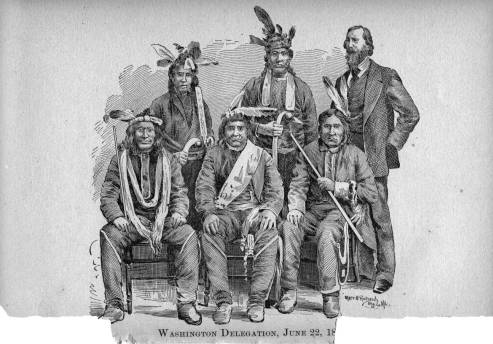
Washington Delegation, June 22, 1852: Chief Buffalo led this famous Ojibwe delegation to Washington, so it is assumed he is one of the men in this engraving, but which one? The original photograph has not been located (Marr and Richards Co.).
The image labelled Washington Delegation, June 22,1852, between pages 16 and 17, is much more intriguing. It shows three seated men in front of three standing men. The man standing on the right appears to be Armstrong, but the rest of them are not identified. There has been a lot of speculation whether or not this image shows Chief Buffalo. The man seated in the middle with the large white sash across his chest was featured on on poster of Buffalo released by the Minnesota Historical Society in the 1980s. He does appear to be the oldest and most prominent of the group. However, the man holding a pipe sitting to his left (bottom right in the picture)was used as the model for the large outdoor mural of Buffalo on the corner of Highways 2 and 13 in Ashland.
Besides the title and the engraver’s mark, there is no other information to identify the origin of this image. It almost certainly came from a photograph. Two similar engravings, found elsewhere in the book can be traced to specific photos. One Armstrong identifies as being the 1862 Ojibwe delegation to President Lincoln. In the engraving, seven chiefs stand behind three who sit. Again, the men are not identified, but Armstrong lists the names of the chiefs who accompanied him on pages 66 and 67. The Fond du Lac chief, Naaganab (Sits in Front) is identifiable from other photographs. As his name would suggest, he is seated in front in the center.


The photograph this engraving was made from was taken by the famous Civil War photographer Matthew Brady, and it can be found in the collections of the Minnesota Historical Society. From the postures and facial expressions of the men, it is clear the engraving was made from this photo. However, the two images are not exact duplicates. The man standing third from the left in the photo appears to have been moved to the far right in the engraving, and to the right of him, we see another man who is not in the photo. Because the photograph from MHS cuts off immediately to the right of the man who is third from the right in the engraving, it is impossible to know whether or not anyone stood there when the photo was taken.
The other engraving based on a photograph appears between pages 134 and 135. Armstrong identifies it as Annuity papement [sic] at La Pointe, 1852. The photograph it comes from, by Charles Zimmerman, is well known to scholars of this time period, and it appears in many secondary works. One copy is held by the Wisconsin Historical Society. It shows four government officials from La Pointe seated at a table surrounded by Ojibwe men and women waiting to receive their treaty payments. Sources vary on the date. The Historical Society identifies it as 1870 and describes it as “Indians receiving payment. Seated on the right is John W. Bell. Others are, left to right, Asaph Whittlesey, Agent Henry C. Gilbert, and William S. Warren (son of Truman Warren).”

While the engraving of the 1852 Delegation is clearly also from a photograph, the original has not been located. If it exists, and contains any more identifying information, it represents possibly the best opportunity to see what Buffalo looked like. We need to find the photo!
The Verdict
Inconclusive: One of these men could be Buffalo from La Pointe, but more information is needed.
Sources:
Armstrong, Benj G., and Thomas P. Wentworth. Early Life among the Indians: Reminiscences from the Life of Benj. G. Armstrong : Treaties of 1835, 1837, 1842 and 1854 : Habits and Customs of the Red Men of the Forest : Incidents, Biographical Sketches, Battles, &c. Ashland, WI: Press of A.W. Bowron, 1892. Print.
Ashland Chamber of Commerce. “Ashland Mural Walk.” Ashland Wisconsin. N.p., n.d. Web. 28 June 2012. <http://www.visitashland.com/>.
Brady, Matthew. Ojibwe Men (Possibly at 1857 or 1862 Treaty Signing at Washington D.C.). c.1862. Photograph. Minnesota Historical Society, Washington. MHS Visual Resource Database. Minnesota Historical Society, 2012. Web. 28 June2012. <http://collections.mnhs.org/visualresources/>.
Loew, Patty. Indian Nations of Wisconsin: Histories of Endurance and Renewal. Madison: Wisconsin Historical Society, 2001. Print.
Merrill, Peter C. German Immigrant Artists in America: A Biographical Dictionary. Lanham, MD: Scarecrow, 1997. Print.
Morse, Richard F. “The Chippewas of Lake Superior.” Collections of the State Historical Society of Wisconsin. Ed. Lyman C. Draper. Vol. 3. Madison: State Historical Society of Wisconsin, 1857. 338-69. Print.
Satz, Ronald N. Chippewa Treaty Rights: The Reserved Rights of Wisconsin’s
Chippewa Indians in Historical Perspective. Madison, WI: Wisconsin Academy of
Sciences, Arts and Letters, 1991. Print.
Schenck, Theresa M. William W. Warren: The Life, Letters, and times of an Ojibwe Leader. Lincoln: University of Nebraska, 2007. Print.
Warren, William W., and Theresa M. Schenck. History of the Ojibway People. St. Paul: Minnesota Historical Society, 2009. Print.
Zimmerman, Charles A. Annuity Payment at La Pointe. c.1852-1870. Photograph. Wisconsin Historical Society, La Pointe, WI. Wisconsin Historical Images. Wisconsin Historical Society, 1996-2012. Web. 28 June 2012. <http://http://www.wisconsinhistory.org/whi>.
Vincent Roy Jr. (From Life and Labors of Rt. Rev. Frederic Baraga by Chrysostom Verwyst: Digitized by Google Books)
Chief Buffalo’s 1852 delegation to Washington D.C. is an iconic moment in the history of the Chequamegon region. As the story goes, the 92 year-old chief made the difficult journey by canoe, steamship, rail and foot all the way to the capital city, met with President Millard Fillmore, and came back with an order to stop the removal of the Wisconsin Ojibwe. Despite its continuing popularity, and its special importance to the Red Cliff community, recent scholarship has called into question several key details of this story. Central to this controversy is whether or not Buffalo actually met the president. However, I recently found a document in the archives of an early Red Cliff resident, Vincent Roy Jr. It confirms what Red Cliff residents already know. Chief Buffalo did travel to Washington and met the president in June of 1852.
Benjamin Armstrong
According to the popular Buffalo story, some of the young men of the La Pointe Band were ready to fight the United States in early 1852. The government removal efforts that led to the Sandy Lake Tragedy in the fall of 1850 were ongoing, and the future of the Ojibwe bands in Wisconsin was in doubt. To maintain the peace, and gain title to reservations in Wisconsin, Buffalo and a small group of chiefs and headmen (including Oshogay Buffalo’s speaker and Benjamin Armstrong his interpreter), left La Pointe that spring. They encountered bad weather and negative government officials along the way, but they were able to gather signatures on their petition from several prominent Lake Superior whites. In New York and Washington, they ran short on money and had to count on the kindness of wealthy Americans who were amazed by the culture and appearance of the Ojibwe from the western country. In Washington, the Indian Affairs department refused to hear their petition and ordered them to return to La Pointe, but through luck, they met a congressman who arranged a special meeting with the president. As the story goes, Buffalo smoked with Fillmore and Oshogay delivered a long speech laying out the Ojibwe grievances. In a second meeting, Fillmore declared the removal efforts over. The delegation then returned to La Pointe via St. Paul and stopped at several Ojibwe villages causing “great rejoicing” as they announced the news. Two years later the Treaty of La Pointe (1854) confirmed forever the promises made to Buffalo by Fillmore.

Washington Delegation, June 22 1852: The man in the upper right is assumed to be Armstrong. (Engraved from unknown photograph by Marr and Richards Co. for B. Armstrong Early Life Among the Indians). Look for an upcoming post about this image
The hero, along with Buffalo, in this version story is often Benjamin Armstrong. That shouldn’t be too surprising because all the details of it come from Armstrong’s 1891 memoir Early Life Among the Indians. This entire work is freely available online on the website of the Wisconsin Historical Society. Another well-made website, chiefbuffalo.com, has several additional primary documents related to Buffalo and Armstrong. I consider Early Life required reading for anyone who lives in the Chequamegon Bay area. However, the reader has to be careful with Armstrong. As I mentioned in the post on Hanging Cloud, the female warrior of the Chippewa River country, the memoir should be treated like a work of literature rather than scholarly piece. It wasn’t unusual for 19th-century autobiographies to contain fictional parts, and Early Life is no exception. The details that the elderly Armstrong (who admitted to a fuzzy memory) dictated to Thomas P. Wentworth in 1891, don’t always match the details found in the documents of the 1850s. This is the case with the Buffalo-Fillmore story.
Recent Scholarly Work and Primary Sources about the 1852 Delegation
In his extremely thorough scholarly overview of the pro-Treaty Rights position, Chippewa Treaty Rights (1991), Ronald Satz admitted that “Armstrong’s reminiscences contain some factual errors” and that anti-Treaty Rights anthropologist James Clifton attacked Armstrong’s credibility in an attempt to undermine the Treaty Rights argument. Still, Satz’ story of the 1852 delegation is straight out of Armstrong with the admission that “Scholars have not located a decree by Fillmore specifically rescinding President Taylor’s removal order.” Patty Loew’s Indian Nations of Wisconsin (2001) also gives the story Chief Buffalo’s journey largely the way it appeared in Armstrong. At that time, it appeared that the popular story, the Armstrong story, and the mainstream scholarship all matched up.
However, recent years have seen a shift in the interpretation of the Buffalo story Bruce M. White’s The Regional Context of the Removal Order of 1850, published in Fish in the Lakes, Wild Rice, and Game in Abundance: Testimony on Behalf of Mille Lacs Ojibwe Hunting and Fishing Rights (2000; Michigan State University Press), is a highly comprehensive account of the time period and the players involved. He devotes an entire chapter to the 1852 delegation. He does not dismiss Armstrong entirely, writing:
Some questions have been raised about the accuracy of Armstrong’s account. Some details, including dates, in Armstrong’s memories of events that had occurred 40 years before, appear to be mistaken. This, of course, is true of many autobiographical accounts written without the benefit of written documentation. Nonetheless, many key features of Armstrong’s account find corroboration in Indian office records, though not always in the exact way or order in which Armstrong describes them. (pg. 245)
Despite this nod to Armstrong, White’s examination of historical records from the National Archives, the American Board of Commissioners of Foreign Missions, Minnesota Territorial records, and other sources, paint a different picture from that in Early Life Among the Indians. He produces letters from federal officials saying the Indian Office sent the delegation home “with a flea in their ear,” while John Watrous, the Indian Agent the delegation came to complain about, received “flying colors.” White also uncovered a letter that Bad River missionary Leonard Wheeler wrote after Buffalo’s return to La Pointe. It stated the delegation “accomplished nothing.” Most significantly, on page 253, White reproduces a letter from Buffalo and Oshogay to Minnesota Territorial governor Alexander Ramsey. The letter is written in July 1852, after the delegation returned. The chiefs inform the governor that the decision is his whether or not to remove the Ojibwe. They plead with Ramsey to let them stay on the lake shore. This a far cry from the situation described by Armstrong where Buffalo received a promise from Fillmore and spread “rejoicing” to all the Ojibwe bands.
In fact, the very existence of the Buffalo-Fillmore meeting is called into question. For all the documents White produces saying the delegation was unsuccessful, he fails to produce one that even speaks of a meeting with the president. He leaves the possibility open for such a meeting, using some notations indicating chain of custody of the delegation’s petition as circumstantial evidence. However he uses language like “Whether or not the Ojibwe actually met with Fillmore…” for an important symbolic event taken for granted in Ojibwe history up until that point.
If White’s investigation of the original sources calls into question the success of the delegation and its ability to meet the president, Theresa Schenck’s William W. Warren: The Life, Letters, and Times of an Ojibwe Leader (2007; U. of Nebraska Press) makes one question Armstrong’s importance in the group. In Early Life Among the Indians, Armstrong is the star of the show. He claims the delegation was his idea, that he conducted it, made all the arrangements along the way, and was generally responsible for its success. The historical record does not back these claims up. Even before the Sandy Lake Tragedy, Ojibwe chiefs were doubting the truth of the removal order as stated by Agent Watrous and Governor Ramsey. They demanded to hear it directly from the president himself. By the end of 1852, after seeing hundreds of their fellow Ojibwe die in two botched removal attempts, and having missed out on two crucial years of annuity payments, the demands of the chiefs for a meeting with the president grew louder. It was William Warren who wanted to lead and interpret for an officially-sanctioned delegation. As Ramsey used stalling tactics, Warren’s health failed, and the hope of official approval waned, Buffalo took matters into his own hands and arranged his own delegation. The elderly chief wanted to bring Leonard Wheeler along, but the missionary objected to the inclusion of a certain “half-breed” who was “incapable of doing justice to their affairs.” White speculates that Wheeler meant Armstrong, but Armstrong was a white man from Alabama. A June 24, 1852 letter, from William Warren to his cousin George, reveals who the mix-blooded interpreter likely was. This letter, as quoted in Schenck (2007) reads:
…Old Beauf [Buffalo] with others having V. Roy Jr for Intpr have gone on to Washington. All nonsense. They can effect nothing going off like fools with poor interpreters and representing only the Lapointe band (pg. 162).
Warren had included Vincent Roy Jr. in his original plan for a Washington delegation, so it seems his objections to Buffalo’s choice of interpreter have more to do with the chief not following Warren’s plan than on any reflection on the merits of Roy himself. Roy, who later in life was described as a man of outstanding character, may have earned the enmity of Wheeler because he was a strong Catholic. Wheeler and the other ABCFM missionaries were working intensely at this time to counter Roman Catholic influence in the area. In either case, Armstrong isn’t even mentioned. Though his presence isn’t supported by these documents, I believe the details of Armstrong’s memoir show he was part of the delegation. However, the claims that he “conducted” it seem grossly exaggerated.
Local Response to the Questioning of the Chief Buffalo Story
Bruce White’s primary goal was to argue the Mille Lacs Treaty-Rights case rather than maintain the popular history of this area, and Theresa Schenck has never been one to shy away from challenging long-cherished myths, but what do scholars with a bigger stake in the Chief Buffalo story say?
On the Chequamegon History website, I’ve written a lot on Buffalo, and I’ve taken part in various projects related to Buffalo’s trip, so I was disappointed when I first heard from Dr. Schenck that our region’s defining historical event may have never happened. Unfortunately, my primary research only seemed to confirm that the 1852 trip was a failure. The only new document I could find was an untranslated German travelogue Reisen in Nordamerika in den Jahren 1852 and 1853 (Travels in North America in the Years 1852 and 1853) by the noted Austrian travel writers Moritz Wagner and Karl Ritter von Scherzer. On page 336 of Volume 2, Wagner and Scherzer describe meeting Buffalo. I don’t read German, so I had to work through Google Translate:
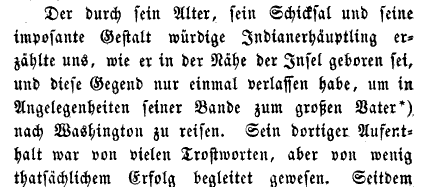
From page 336 of Reisen in Nordamerika Vol. 2 by Wagner and Scherzer. Look for an upcoming post with more from this obscure 19th-century travelogue (Digitized by Google Books).
“The Indian chief, worthy by his age, heredity, and his imposing figure, told us he was born near the island and left the area only once to travel in the matters of his tribe to the Great Father [president] in Washington. His stay was accompanied by words of comfort but little success.” (My rough Google-aided translation of above)
This source, combined with the work of Schenck and White, and other issues I’ve had with Armstrong, led me to believe that perhaps the Chief Buffalo story was just a myth. Then, this summer saw two locally-linked authors publish works.
This summer, Patty Loew released an updated version of her fantastic introduction to Wisconsin Indian history, Indian Nations of Wisconsin. It revises the Armstrong-based section on the 1852 trip from the first edition to admit that Buffalo may not have met the president. Loew lives in Madison but is a Bad River tribal member and a Chief Buffalo fan.
Howard Paap, who is married into the Red Cliff community, has written extensively about it. His new book, Red Cliff, Wisconsin: A History of an Ojibwe Community, also came out this summer. He extends White’s arguments and thoroughly evaluates Armstrong’s story against the other primary sources. Paap’s conclusions are bold for someone writing a history on behalf of a reservation community established for Buffalo’s descendants:
We are left with the question of whether or not the Buffalo and Oshaga delegation really did have an audience with President Fillmore in the summer of 1852, and if so, what actually transpired during such a meeting…
…perhaps the easiest solution to the question of whether or not such a meeting occurred is to believe Benjamin Armstrong’s recollections, along with contemporary Ojibwe oral traditions about the trip, and leave it at that.
However, given the reality of the errors in Armstrong’s memoir, and much more importantly, the hard evidence of the trip’s paper trail as recently uncovered by Charles Cleland and Bruce White, we are confronted with a dilemma. In today’s popular history the scene of Buffalo and President Fillmore standing eye to eye, as crafted in the Carl Gawboy painting wherein Fillmore is handing Buffalo a paper canceling the removal order, is compelling, but the surviving papers that document another scenario cannot be ignored (pg. 241).
Paap goes on to describe the Buffalo story as “folkloric,” but he suggests that while the 1852 delegation did not single-handedly end the threat of Ojibwe removal, the most symbolic part of the myth remains the meeting with the president. Following White, Paap admits the possibility that the Buffalo-Fillmore meeting happened, reiterating that primary sources suggested the delegation did not achieve its objectives, but there was nothing that explicitly said there was no meeting with the president.
The Vincent Roy Jr. Account of the 1852 Trip
In browsing the online catalog of the Wisconsin Historical Society archives this spring, I discovered the society had some of Vincent Roy Jr.’s papers. The catalog description mentioned a fur trade journal, a description of early ships on Lake Superior, and some manuscript biographies of Roy from some Catholic priests. Roy, who was raised in an Ojibwe-French mix-blood family, was a fur trader and government interpreter in his early years. Still a young man at the time of the Treaty of 1854, he lived into the 20th century and was notable for several reasons including making multiple trips to Washington with Ojibwe delegations, being the namesake of Roy’s Point in Red Cliff, leading area mix-blooded Ojibwe in the cause of the “half-breed land claims,” and being one of the earliest and wealthiest settlers of Superior. He was a commanding figure in the Catholic Church and Democratic Party of Wisconsin, and there is a lot out there about him.
The wonderful staff at Wisconsin Historical Society Research Center in Ashland agreed to have the papers sent up from Madison for me. The arrived in early August, mere days after I had the chance to read Paap and Loew. Since the scope of Chequamegon History is pre-1860, I went in mostly interested in seeing the fur trade journal. I assumed the biography would be identical to the biographical information about Roy published in Life and Labors of Rt. Rev. Frederic Baraga by Chrysostom Verwyst. The Holland-born Verwyst was a priest who knew Roy personally and considered him “The Greatest Indian of the Northwest.” I didn’t think there would be anything new in this part of the archive, but I was wrong:
[Letter accompanying manuscript biography written in Verwyst’s hand]
St. Agnes’ Church
205 E. FRONT ST.
Ashland, Wis., June 27, 1903
Reuben G. Thwaites,
Sec. Wis. Hist. Soc. Madison, Wis.
Dear Sir,
I herewith send you personal memories of Hon. Vincent Roy, lately deceased, as put together by Rev. Father Valentine O.F.M. Should your society find them of sufficient historical interest to warrant their publication, you will please correct them properly before getting them printed.
Yours very respectfully,
Fr Chrysostom Verwyst O.F.M.
[From Page one of manuscript biography in Valentine’s handwriting]
~ Biographical Sketch – Vincent Roy ~
~ T. Apr. 2. 1896 – Superior Wis. ~
[Sections 1-3 (Roy’s early years) omitted. Transcription picks up on page 5 (section 4). Valentine lists his sources in the left margin. I will put them in parentheses before each paragraph].
(Mr. Roy to V.)
IV. His first Visit to Washington, D.C. – The Treaty of La Pointe.
At the instance of Chief Buffalo and in his company Vincent made his first trip to Washington, D.C. It was in the spring of the year 1852. Buffalo (Kechewaishke), head chief of the Lake Superior Ojibways had seen the day when his people, according to indian estimation, was wealthy and powerful, but now he was old and his people sickly and starving poor. Vincent referring once to the incidents of that time spoke about in this way “He (Buffalo) and the other old men of the tribe, his advisers, saw quite well that things could not go on much longer in the way they had done. The whites were crowding in upon them from all sides and the U.S. government said and did nothing. It appeared to these indians their land might be taken from them without they ever getting anything for it. They were scant of food and clothing and the annuities resulting from the sale of their land might keep them alive yet for a while. The desire became loud that it might be tried to push the matter at Washington admitting that they had to give up the land but insisting they be paid for it. Buffalo was willing to go but there was no one to go with him. He asked me to go with him. As I had no other business just then on hand I went along.”
(Sources: Cournoyer or Mr. Roy to V.) [Vincent Cournoyer was V. Roy’s brother-in-law]
They went by way of the lakes. Arriving in Washington, they found the City and the capitol in a garb of mourning and business suspended. Henry Clay, the great statesman and orator, had died (June 29) and his body was lying in state. Vincent said: “we shook hands and spoke with the President (Fillmore) and with some of the headmen of the government. They told us that they could not do anything at the moment, but that our petition should be attended to as soon as possible. Unable to obtain any more, we looked around a few days and returned home.” The trip had entailed a considerable drain on their private purses and the result towards the point at issue for them, the selling of the land of the indians, was not very apparent.
(the treaty doct.)
After repeated urging and an interval of over two years, during which Franklin Pierce had become President of the United States, the affairs of these Indians were at last taken up and dealt with at La Pointe by Henry C. Gilbert and David B. Herriman, commissioners on the part of the United States. A treaty was concluded, September 30th 1854. The Lake Superior Ojibways thereby relinquished their last claims to the soil of north west Michigan, north east Wisconsin, and an adjoining part of Minnesota, and, whilst it was understood that the reserves at L’Anse Michigan, Odanah, Court Oreille Wisconsin and Fondulac Minnesota were set apart for them, they received in consideration of the rest the aggregate sum of about four hundred and seventy five thousand dollars, which, specified as to money and material, ran into twenty years rations.
(Cournoyer)
Chief Buffalo in consideration of services rendered was allowed his choice of a section of land anywhere in the ceded terrain. The choice he made, it is said, were the heights of the city of Duluth, but never complying with the incident law formalities, it matters little that the land became the site of a city, his heirs never got the benefit of it. Of Vincent who had been also of service to the indians from the first to the last of the deal, it can only be said that he remained not just without all benefit from it. A clause was inserted in the treaty (Art. 2. n. 7.) by which heads of families and single persons over twenty one years of mixed blood were each entitled to take and hold free of further charge eighty acres of the ceded lands:- this overruled in a simple and direct way the difficulties Vincent had met with of late in trying to make good his claim to such a property. The advantages here gained was however common to others with him. For the sacrifices he made of time and money in going with Chief Buffalo to Washington he was not reimbursed, so it is believed, and is very likely true judgeing from what was the case when later on he made the same trip a second time.
[End of Section 4, middle of page 7 of Valentine’s manuscript]
In my mind, this document is proof that the Buffalo-Fillmore meeting did happen. We know Roy went on the trip, and his account (unlike Armstrong’s) supports rather than contradicts the documents from the time period. It wasn’t two scheduled ceremonial meetings that permanently settled the removal question. In fact, it may have only been a handshake and a few words, but the central image of the two leaders, ogimaa and president, meeting remains part of the Chief Buffalo story.

Identified as Vincent Cournoyer and Vincent Roy Jr. c. 1880 in photo at Bayfield Library. See the Photos, Photos, Photos post for an alternative identification. (Charles Bell, Washington: Collections of the Smithsonian Institution)
For Vincent Roy Jr., I hope this inquiry will lead to more attention. His life spanned two key eras in Ojibwe history and he was often at the center of it. His name is all over the primary sources, but compared with Armstrong, the Warrens, and the Beaulieus, we don’t see him much in the secondary scholarship.
For Benjamin Armstrong, I think the Roy documents require us to take a fresh look at Early Life Among the Indians. If the Fillmore meeting can be verified after a long look, there’s a good chance some of the other details in the memoir can be as well. I’m a Benjamin Armstrong fan, and he’s taken a beating in this post and some of the recent scholarship, but I still maintain that there is a lot of truth in Early Life.
For Chief Buffalo, it is gratifying to find out that the 1852 meeting with the president isn’t complete fiction. Buffalo may not have been satisfied with the results of his trip, but I feel the ultimate appeal of his story is the fight to keep an Ojibwe homeland in Wisconsin. We may not be able to point to a single event and say, “That’s where the removal died,” but ultimately, the Ojibwe leadership prevailed. For that reason, we should continue to celebrate the 1852 delegation, all the people who were part of it, and all those who were part of the larger struggle for justice it represented.
Sources:
Armstrong, Benj G., and Thomas P. Wentworth. Early Life among the Indians: Reminiscences from the Life of Benj. G. Armstrong : Treaties of 1835, 1837, 1842 and 1854 : Habits and Customs of the Red Men of the Forest : Incidents, Biographical Sketches, Battles, &c. Ashland, WI: Press of A.W. Bowron, 1892. Print.
Loew, Patty. Indian Nations of Wisconsin: Histories of Endurance and Renewal. Madison: Wisconsin Historical Society, 2001. Print.
———— Indian Nations of Wisconsin: Histories of Endurance and Renewal. 2nd ed. Madison: Wisconsin Historical Society, 2013. Print.
McClurken, James M., and Charles E. Cleland. Fish in the Lakes, Wild Rice, and Game in Abundance: Testimony on Behalf of Mille Lacs Ojibwe Hunting and Fishing Rights / James M. McClurken, Compiler ; with Charles E. Cleland … [et Al.]. East Lansing, MI: Michigan State UP, 2000. Print.
Paap, Howard D. Red Cliff, Wisconsin: A History of an Ojibwe Community. St. Cloud, MN: North Star, 2013. Print.
Satz, Ronald N. Chippewa Treaty Rights: The Reserved Rights of Wisconsin’s Chippewa Indians in Historical Perspective. Madison, WI: Wisconsin Academy of Sciences, Arts and Letters, 1991. Print.
Schenck, Theresa M. William W. Warren: The Life, Letters, and times of an Ojibwe Leader. Lincoln: University of Nebraska, 2007. Print.
Verwyst, Chrysostom and Father Valentine. Biographical Sketch – Vincent Roy Jr. 1896-1903. MS. Vincent Roy Jr. Papers. Wisconsin Historical Society Archives, n.p.
Verwyst, Chrysostom. Life and Labors of Rt. Rev. Frederic Baraga: First Bishop of Marquette, Mich., to Which Are Added Short Sketches of the Lives and Labors of Other Indian Missionaries of the Northwest. Milwaukee, WI: M.H. Wiltzius, 1900. Print.
Wagner, Moritz, and Karl Von Scherzer. Reisen in Nordamerika in Den Jahren 1852 Und 1853. Leipzig: Arnold, 1854. Print.
Warren, William W., and Theresa M. Schenck. History of the Ojibway People. St. Paul: Minnesota Historical Society, 2009. Print.
Thank you to Theresa Schenck, Howard Paap, Linda Mittlestadt, Pam Ekholm, Larry Balber, and Betty Johnson for help and encouragement in this research.
 Chequamegon History