1855 Inquest on the Body of Louis Gurnoe
April 11, 2019
By Amorin Mello
The following is a set of three articles collected and edited from the Superior Chronicle newspaper, followed by my personal thoughts on this matter :

Superior Chronicle newspaper July 7th, 1855, page 2.
Lake News.
We find in the Lake Superior Journal the following paragraphs of lake news:

“The brig Columbia, which carried the first cargo of ore through the Sault Ste. Marie Canal.”
~ The Honorable Peter White, by Ralph D. Williams, 1907, Chapter XIV.
Johnson & Tisdale, of Cleveland, have just built a small side-wheel steamer, for J. H. Garrett, of Ontonagon, and intended to be used on that river as a passenger boat, and also for towing between the mouth of the river and the mines. Her dimensions are : length of keel, 85 feet; beam, 14 feet; depth of hold, 2 feet. She has two engines, and will draw about fifteen inches water.
The Garrison stable at the Sault Ste. Marie, containing two horses was set on fire on the morning of the 29th ult., and, with its contents, totally consumed.
The Canal Company showed their patriotism on the Fourth of July, by exploding about one hundred and fifty barrels of damaged powder.
The first locomotive for the Iron Mountain Railroad, from Lake Superior to the Iron Mountains, left Buffalo on Tuesday by the brig Columbia, for Marquette.
Superior Chronicle newspaper, October 23rd, 1855, page 2.
Man Shot.

George Riley Stuntz
Deputy U.S. Surveyor, and Chequamegon Bay land and minerals speculator.
On Tuesday night last an affray occurred on Minnesota Point, which resulted in the shooting of a sailor, attached to the brig Columbia. The vessel was lying at the wharf of Messrs. Stuntz & Co., and the crew, under the influence of liquor, went on shore for the purpose of having a frolic; in the course of their spree they came across some Indians, encamped on the Point, and one of the men soon provoked a quarrel with an Indian. The Indian was being beaten severely, when the captain coming up, interfered, whereupon he was attached by the man. The captain, being small in statue, and unable otherwise to defend himself, drew a pistol and fired at his assailant, the ball entering his side. The wounded man was brought to town, his wound dressed, and is now said to be doing well, the ball not having penetrated to any serious depth.
Superior Chronicle newspaper, November 6th, 1855, page 2.
Death of Louis Gurnoe — Inquest by a Coronors’ Jury — Verdict, etc.
There were more than one Chippewa mixed-blood named Louis Gurnoe.
man living alone in Superior City during the 1855 Wisconsin Census. No further sources about J. Baker could be found.
Several weeks ago we gave an account of the shooting of a half-breed named Louis Gurnoe by Captain Wells, of the brig Columbia. The affray occurred on Minnesota Point, opposite Superior. It appears that Gurnoe was a man of very intemperate habits, and several nights previous to his difficulty with the captain, was engaged in a row at a low groggery on First street, kept by a negro named Baker. A dance was being held at that place, and Gurnoe, under the influence of liquor, challenged those present to a fight; he was then set upon, knocked down, and kicked and beaten in a cruel manner. The injuries he sustained, aided by excessive dissipation, ensued his death, just as the vessel was leaving our port. At La Pointe, a coronor’s inquest was held on the body, and the verdict rendered was that death was caused by bruises received at Baker’s house. We hope this matter will be brought before the grand jury at the next sitting of our circuit court, and while we may not expect to see the murderers brought to justice, we hope, at least, that sufficient cause may be shown why this miserable den should be removed. It has been tolerated too long already, and for the good order and character of our town, if for no other consideration, some effect should be made to put a stop to the disgraceful proceedings there enacted.
We publish the entire testimony elicited at the inquest, verdict of the jury, and an affidavit made by Gurnoe previous to his death, exhonorating Captain Wells from all blame whatsoever.
Joseph Stone, one of the hands on board, being duly sworn said:
That on Tuesday evening last, the brig Columbia, Captain Justus Wells, from St. Clair, was opposite Superior; there was a noise between [Sandy?] and deceased, Louis Gurnoe; Louis wanted to fight; captain wished him to stop; deceased knocked captain down; Louis then challenged captain to fight; he then got hold of the captain by the hair of the head; captain told him several times to let go; captain said if he did not let go he would shoot him; told him five or six times to let him go; he did not let go; the first thing I heard was the report of a pistol; [Sandy?], captain, and myself carried him to a tent; I stopped there till four o’clock; captain directly sent two men away to get a physician; deceased was in liquor at the time; he had been very quarrelsome; he shipped at Saut Ste. Marie this trip; he had been bruised on the face the Saturday previous; on the Monday previous when leaving Superior wharf he was so intoxicated that he fell off the provision chest; he was sick coming up; he was unable to do duty after Saturday.
Simeon Nelsonn being duly sworn said:
We went on shore at Superior, on Saturday evening last; at Baker’s there was a dance; the dance went on nicely till about twelve o’clock; Louis said something to the effect that no one in the room was able to fight him; with that a little Irishman took it up; I went in and hauled Louis back; some one took me off from him, shoved me on one side and commenced at Louis; knocked him down with his fist, and several men piled on him; they then commenced kicking him in the side, breast, and once or twice in the face; after a while they were parted; then Louis commenced drinking again – had been drinking during the evening. After having got all pacified we went on board about two o’clock in the morning; he went to sleep; when he woke he swore he would have a row with somebody before he left the place; on going on shore he commenced drinking; we unloaded the vessel on Monday and Tuesday, and on that afternoon we went over to Minnesota Point; in the evening all went ashore to have some sport; Louis said, before he went ashore, he was bound to have a row with the captain; after going on shore, everything went on well till about two o’clock in the morning. (Wednesday;) I was lying in the lodge; Louis came in and commenced at me; I told him that I did not want any fuss with him and that everything he said I was bound to knock under to save a row; at that the captain heard the words from Louis and came out from another lodge; as Louis was going to come in at me, the captain grabbed him by the shoulders, hauled him back, and said to him, “Louis we did not come here for a row, we came to have sport;” Louis turned on him, and knocked him down; they were then parted; the captain balloed “enough;” Louis was going at him again; the captain stepped back, pulled out a revolver, and said, “If you don’t leave me alone I will shoot you;” Louis opened his breast to him, and said, “Here’s a clean breast shoot;” captain stepped back, and Louis went at him again; caught the captain by the hair of the head; captain told him if he did not let go he would shoot him; we tried to part them again; couldn’t part them; captain wanted to let go, but Louis wouldn’t; captain again said “If you do not let go I will shoot you;” as Louis was drawing back his foot to kick the captain in the face, he being down about knee high, the captain again repeated his caution, gave him one minute to let go, and then shot him; Louis then let go; says he, “I’m dead’ I’m dead.” – Captain said “I thought it would turn out that way – I told you I would shoot but you would not mind me;” captain said “If there is anything I can do I will do it;” the captain, Joseph Stone and myself, carried him into the lodge; the other two boys that were with him commenced dressing his wounds; captain sent John Scott and myself aboard the vessel after the boat to go for a physician; we went aboard and got the boat; got the second mate and Benj. Rassau to go for the doctor; went to Superior; couldn’t find a physician; captain, second mate, Joseph Chapman, a Frenchman living on the point, and myself, got the deceased into the boat and brought him aboard; before we got him aboard a physician came; about eight o’clock in the morning I saw deceased lying in the cabin; said he felt better; about four o’clock p.m. we endeavored to put him into one of the berths; he seemed to be in convulsions; on Wednesday night he got out of his berth, went on deck, and walked fore and aft; Thursday morning he left the cabin and sat on the rail aft; I said “Louis, you will be falling overboard;” he said “there is no fear of that;” he then left the rail; I was standing at the helm; he came up; looked me very hard in the face; I said, “what is the matter?” he gave no answer, but went directly into the boat; deceased had been very quarrelsome all the way up; he remained in the boat about three minutes; he was sitting in the boat with his arm on the taffrail; I took him to be asleep, and tried to wake up; I lifted his arm up, and eased him down into the boat to keep him from falling overboard, and went down after a lantern, (about five o’clock a.m.;) before I had time to time to come with a lantern, some one hard me talking to him and was there before me with one; the captain was also there; I looked at him, and said he was dead; then we took him out of the boat, and laid him forward of the cabin, and put a mattress under him; he was warm at the time, and we thought he might recover; one of the passengers then said life was not gone but he was dying; deceased frequently complained of his bruises received on Saturday night.

James Chapman
~ Madeline Island Museum
James Chapman, being duly sworn, said:
The quarrel commenced about a squaw; in other respect; he corroborated the testimony of the previous witness.
Daniel Weihl, a passenger, being duly sworn, said:
I saw the doctor probe the wound, and he followed the rib, one or one and a half inches; I turned away as he found the ball; I do not think the wound was sufficient to cause his death; no inflamation existed; deceased went forward so many times that I concluded he had the diarrhea.
A. W. [Groveract?], being sworn, said:
I told the captain not to use the weapon there; after the shot, saw the deceased standing by a tree; he vomited blood; had not seen deceased vomit blood previous to the shot; he bled very near a pint; the blood from the bruise on his face might have got into his mouth and he threw it up.
John [Babner?], being sworn, said:
I corroborate the testimony given by Mr. Nelsonn.
Mr. Hancock, (a passenger,) being sworn, said:
I corroborate the testimony given by Mr. Nelsonn.
Calvin Ripley, being sworn, said:
Deceased had been sick about six weeks previous to his shipping, and was sick again when about two days out; was drunk every night, while at Superior, that I saw him; kept the forecastle a day after the fight at Superior; doctor said the wound would not injure him at all – that deceased was worse off in other respects; doctor said it was better for deceased to be on shore; he might suffer from the bruises; deceased wished to come on board and go down.
E. M. Raymond, being duly sworn, said:
I saw the doctor drawing the ball out, and left; saw nothing out of the way till last evening; noticed that deceased thrashed about the chains, and made unnecessary noise; I think deceased was not in his right mind last evening.
Daniel Weihl, being recalled, said:
The wound did not cause mortification; the worst bruise is the one at the rim of the belly; have seen a person kicked in the same place vomit about a quart of blood.
J. E. Rogers, (passenger,) being sworn, said:
That he observed that that deceased, during the time he lay in the cabin, hawked and spit, and about one-third of it appeared to be blood and the rest yellowish matter.
At the conclusion of the testimony, the following verdict was rendered by the jury:
An inquisition taken on board the brig Columbia, Captain Justus Wells, in the port of La Pointe, on the 18th day of October, 1855, before John W. Bell, one of the justices of the peace for La Pointe county, Wisconsin, upon the view of the body of Louis Gurnoe, there dead, by the jurors whose names are hereunto subscribed, who being duly sworn to inquire on behalf of the people of this State, where, in what manner, and by what means the said Louis Gurnoe came to his death, upon their oaths do say:
That the deceased came to his death in consequence of bruises received at Superior, at Baker’s residence, from the hands of individuals to the jury unknown, but with whom he was engaged in a fight;
That he was at the same time, and had been, suffering from the effects of continued hard drinking, following sickness, from which he had only partially recovered previous to shipping;
That we acquit Captain Wells of all guilt as to the shot fired by him, and that we do not deem it as a mortal wound, or one that accelerated the death of the deceased.
In witness whereof, the said Justice of the peace and the jurors of this inquest have hereunto set their hands the day and year aforesaid.
JOHN W. BELL Justice of Peace,
S. S. VAUGHN, Foreman,
M. H. MENDELBAUM,
R. D. BOYD,
JOHN M. BRADFORT,
JULIUS AUSTRIAN,
A. CARPENTIER.
Copy of a settlement made at Minnesota Point for assault and battery:
Minnesota Territory, Superior county,
Dock at Minnesota Point,
October 17, 1855.Know all men by these presents, That whereas the brig Columbia, of one hundred and seventy-six tons, commanded by Capt. Justus Wells, from St. Clair, Michigan, District of Detroit, laying at Minnesota Point now and for a few days previous, and among other hands on board said brig was one Louis Gurnoe, a half-breed, and this man was in a state of intoxication, and was making a quarrel with other parties; and whereas, the said captain interfered for the purpose of introducing peace measures, and the said Gurnoe opposed the said captain, and they came to blows and a clinch; and whereas Gurnoe held the said captain firm by the hair of the head, and the said captain requested the said Gurnoe to let go of him, and he would not, and the said captain shot the said Gurnoe in the skin of the side to get clear of him, which would was only a flesh wound, entering the skin against the rib and running along under the skin outside of the rib; and the said captain sent a boat to Superior City for a doctor, and he came and dressed the said wound, and said captain paid said doctor five dollars for his fee for crossing St. Louis river from Wisconsin; and the said Louis Gurnoe having [diver?] other fights, was badly bruised before this; and whereas the said captain has made arrangements in Superior City for the taking care of said Gurnoe to the amount of twenty-five dollars, which we receive of the said Captain Justus Wells, and discharge him of all expense whatever that may arise in an action of assault and battery or any other action for the said causes as the said Gurnoe has received a full compensation for all injuries by the said captain on the ground that the said captain seems not to have done anything more than to defend him or his own personal safety, and what he gives is of good heart and a charitable act received by me.
This settlement is to be construed no further than the said parties have a right by law to settle actions and causes of action. In this settlement the said captain does not mean to have it understood that he acknowledged that he has done anything or [ac?] whereby he may be liable to the law, but for the purpose to buy his peace and a general good will to the said Gurnoe.
(Signed)
LOUIS (his X mark) GURNOE,
In presence of JOSEPH GURNOE,
[DORUS MARCUS?], and CALVIN RIPLEY.
Amorin’s Commentary
Hi, Amorin here again. I don’t always add commentary to my reproductions of Chequamegon History, but when I do… it is because I am still trying to understand the rest of the story.
First and foremost, the death of Louis Gurnoe was horrific. It is unfortunate that these articles disrespected him and served him no justice. The October article doesn’t even mention his name. The only real biographical information gleaned from the November article about Louis Gurnoe is that he was a Chippewa mixed-blood who came aboard the brig Columbia at Sault Ste. Marie. Apparently, his death was far more newsworthy than his life to Americans.
The language stereotyping Louis as a drunk Indian is disgraceful, and makes me question whether the references to the negro and little Irishman were perjury. To be clear, yes, I do believe this entire inquest was a fraud. One red flag, for example, is that the doctor was never identified by any of the witnesses for verification.
Besides dishonoring Louis’ life, it seems that the sole purpose of the Verdict in the November article was to acquit George Riley Stuntz and Captain Justus O. Wells of any guilt with the incident as reported in the October article. The Judge and Jury of the mystery Louis were all white Euroamerican settlers of La Pointe that were very involved with Lake Superior Chippewa mixed-bloods by marriage and/or business, yet there does not seem to be any amount of empathy expressed by them for Louis Gurnoe.
Although these articles dishonored Louis (and failed to identify exactly which Louis Gurnoe he was) they revealed just enough information to hint at what his life may have been like before boarding the brig Columbia at Sault Ste. Marie in 1855. The Gurnoe/Garneau/Gournon/Gornow/Gaunaux/etc. families of Chippewa mixed-bloods (a.k.a. Metis) were very active in the cosmopolitan politics of Lake Superior throughout the mid-1800’s. There is more than one Louis Gurnoe this could have been, so unfortunately the Louis Gurnoe that boarded the brig in 1855 may only be known as a mystery to Chequamegon History.
Consider, for example, the Louis Genereaux [Gurnoe] that authored an August 29, 1855 letter to Indian Affairs Commissioner George W. Manypenny via the Mackinac Indian Agency on behalf of Saginaw Chippewa/Odawa Tribe trying to locate their reservation lands in lower Michigan. While it may have been possible for someone to travel from lower Michigan to western Lake Superior within this time frame, there doesn’t seem to be any compelling correlation suggesting that this Louis Genereaux would be the same Louis Gurnoe from the brig Columbia.
Another example Louis Gurnoe that we may consider is the one featured in the bottom right of the following photograph from 1855 at Sault Ste. Marie;
the elder Louis Gurnoe.
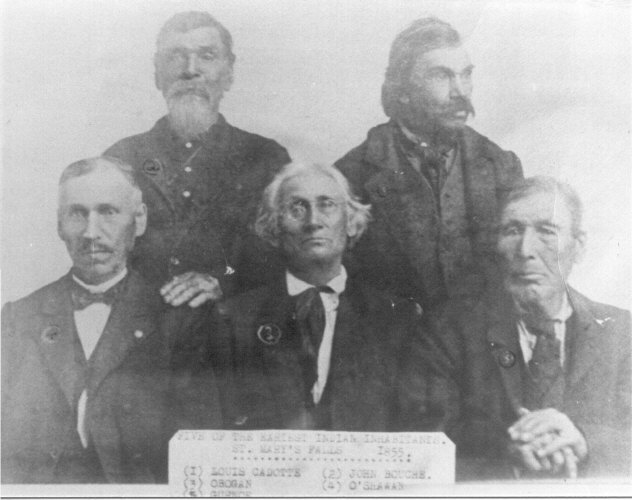
1855 photograph from the Soo Evening newspaper labeled “Five of the Earliest Indian Inhabitants of St. Mary’s Falls” [Sault Ste. Marie] and identified from left to right:
1) Louis Cadotte; 2) John Bouche; 3) Obogan; 4) O’Shawn;
5) [Louis] Gurnoe.
Read Metis-History.info/ by Richard Garneau (Gurnoe) for other possible identities of the first four men in this photograph.
It is possible that the Louis Gurnoe from these articles was one of this elder Louis Gurnoe’s sons. Louis Gurnoe’s Settlement at the end of the November article was signed by another son, who is featured in the bottom center of the following photograph:
the Indian Agency interpreter Joseph D. Gurnoe.

Top: Frank Roy, Vincent Roy, E. Roussin, Old Frank D.o., Bottom: Peter Roy, Jos. Gourneau [Joseph Gurnoe], D. Geo. Morrison. The photo is labelled “Chippewa Treaty in Washington” and dated 1845 by the St. Louis Hist. Lib and Douglas County Museum, but also dated 1855 by the Northeast Minnesota Historical Center. It was probably taken during the Bois Forte Treaty of 1866, which was these men acted as conductors and interpreters in Washington, D.C. Photograph digitized by Mary E. Carlson for her book The Sawmill Community at Roy’s Point.

Superior Chronicle newspaper November 4, 1856
I will share details about Joseph D. Gurnoe’s life, and his professional relationship to James Chapman, but these details will have to wait to be published in another post in the future. This concludes my thoughts for this post.
Until next time,
Amorin
Edwin Ellis Incidents: Number IV
August 31, 2018
By Amorin Mello

Originally published in the July 14th, 1877, issue of The Ashland Press. Transcribed with permission from Ashland Narratives by K. Wallin and published in 2013 by Straddle Creek Co.
… continued from Number III.
EARLY RECOLLECTIONS OF ASHLAND.
“OF WHICH I WAS A PART.”
Number IV
My Dear Press: – In March 1855, Conrad and Adam Goeltz – then young men, came to Ashland. They were natives of Wittenberg, and Conrad had served six years in the Cavalry of that Kingdom; but liking freedom, he bade adieu to the King, his master, and came to the “Land of the Free.” They both cleared land near the town site, which they afterwards pre-empted, and bought from the U.S. Government. For several years both of them lived in Michigan, but upon the revival of Ashland they came back to their early home. Katy Goeltz, Conrad’s Daughter, was the first white child born in this town, in the fall of 1855. Henry Dretler, Mrs. Conrad Goeltz’s father, came early and bought a quarter section of land. He died here in 1858 and was buried near the present residence of Mr. Durfee.
In June 1855, Dr. Myron Tompkins (brother-in-law of Mr. Whittlsey) came to the bay in search of health. He had been driven from Illinois by ague and rheumatism. The climate cured the ague, and accidentally falling off from a raft in the bay – the severe shock cured the rheumatism. Being thus cured by our climate and water, he has ever since lived on the lake. He is a well-educated physician. At present he is the physician of the Silver Islet Mining Company, on the North Shore of the Lake.
I recall others who came in 1855; Andrew Scobie, now of Ontonagon, Thomas Danielson, Charles Day, (now farming on Fish Creek,) Joseph Webb, Bernard Hoppenjohn, Duncan Sinclair, Lawrence Farley, and Austin Corser. Farley died many years ago, but his widow, after years of absence, has again returned to Ashland. Austin Corser in the summer of 1855 began a farm on the east side of Fish Creek, about half a mile above the mouth. Remaining only two or three years, he went to Ontonagon and afterwards to Iron River – in a wild lonely glen – where in after years from 1873 to 1876. He sold his homestead on which the Scranton Mining Company was formed for a snug little fortune, on which he settled down on a farm near Waukegan, Illinois.
John Beck, also coming in the early days of Ashland. He pre-empted and lived upon the spot now laid out and occupied as our cemetery. His wife was the first adult person who died in this town. The remains of the house in which she died may be seen near the Ashland Lumber Company’s store. He was for many years an active explorer for minerals, was the originator of the Montreal River Copper Mining Company. Subsequently he discovered silver lodes on the North Shore, in Canada. He is now engaged in gold mining in California.
Albert C. Stuntz was also one of our early settlers. He is a brother of Geo. R. Stuntz, to whom reference has already been made. He was here engaged in practicing surveying and ran many hundred miles of township and section lines in this and neighboring counties. The townships embracing our Penoka Iron Range were subdivided by him in 1856 and ’57. He once represented this district in the Legislature. His old home is in ruins on the east bank of Bay City creek. Mrs. Stuntz, who endured much hardship and privation died here in 1862. Mr. S. at present lives at Monroe, in this State.
Geo. E. Stuntz. nephew of A.C. and great grandson of the old Hessian Soldier mentioned in a former chapter, also came to Ashland early. In connection with his uncle and on his own account he did a great deal in the subdivision of the lands on the South Shore of the Lake. Soon after the outbreak of our civil war he enlisted in defense of the Union – was severely wounded and died, as it is supposed, in consequence of his wounds.
~ Sarah Adah Ashe – Part IV – San Bernardino by Marta Tilley Belanger

Welton’s mill and Sibley’s farm were both located along the trail south from Ashland to the Penokee Mountains on the 1860 Geological Map of the Penokie Range by Charles Whittlesey.
~ Geology of Wisconsin. Survey of 1873-1879.
Volume III., 1880, Plate XX, page 214.
J. T. Welton and T.P. Sibley, though never living in Ashland, were yet closely identified with its early history. Mr. Welton came about 1850 to Bad River, where he was Government Farmer among the Indians. He was an ingenious mechanic, and could build a water mill. He was on the lookout for a mill site, and finally in 1854 discovered the falls on White River, six miles south of Ashland. It was an unfailing supply of water, with abundant head and fall, and the river was not subject to great rises. As a mill site it has few rivals. His resolution was quickly formed. The rising town on the bay would afford a ready market for all the lumber he could make. The mill should be built. He corresponded with his brother-in-law, Mr. Sibley, and he was eager to come and make his fortune in this new country; and in Nov. 1855, Mr. Sibley and his wife and one little daughter, about a year old, landed upon our shores. During the summer of 1855 Mr. Welton had built a log house at White River. It still stands, though in ruins. Thither late in Nov. 1855, the two families removed. The sisters were refined, cultivated and Christian ladies from the Western Reserve, in Ohio – a spot itself favored by counting among its early settlers some of the best families of New England, and which had been the new center in the west, whence have validated those influences which have tended to improve and elevate the moral and religious condition of the millions of this new empire. They were of Puritan stock. An unbroken wilderness was around them and their nearest neighbors were at Ashland, six miles away. No time was lost. The work of opening up a farm and building a mill was at once begun. They had little money and the labor must be done with their own hands. The casting for the mill must be brought a thousand miles – from Detroit. Nearly a year of toil had passed, when in October, 1856, a few days before the election of James Buchanan to the Presidency – all the able bodied men were invited to go the mill raising at White River. We went and the frame was up, but it was not until 1857 that they could set the mill running. They were greatly impeded for want of capital in cutting logs and floating down the logs to the mill and sawing a few thousand feet of lumber. But before anything could be realized from it they must either haul it over bad roads to Ashland (6 miles) or raft it down many miles to the Lake. But the river was full of jams and “flood wood” – enough to discourage puny men.
The panic of 1857 and resulting hard times put an end to all building at Ashland, and so their hopes of selling their lumber near home were blasted and after struggling vainly for some time longer, Mr. Welton was finally compelled to abandon his home, which he had labored so hard to establish. He found friends and employment in the copper mines of Michigan, and after somewhat improving his fortunes finally settled in south western Iowa, where he now resides.
In some subsequent chapter I will, with your leave, recur to Mrs. Sibley and the circumstances connected with her death.
To be continued in Number V…
Edwin Ellis Incidents: Number II
March 26, 2017
By Amorin Mello

Originally published in the June 30th, 1877, issue of The Ashland Press. Transcribed with permission from Ashland Narratives by K. Wallin and published in 2013 by Straddle Creek Co.
… continued from Number I.
EARLY RECOLLECTIONS OF ASHLAND.
“OF WHICH I WAS A PART.”
Number II
My Dear Press: – At the close of my last scribblings, we had arrived on the present site of Ashland, near where the railroad dock reaches the shore and were sheltered in a log shanty, built by Lusk, Prentice & Co., a kind of land company who had plans of starting a town here, of building a dock, and who had a small stock of merchandise and provisions to aid in their proposed work. The members of the firm were David S. Lusk, of New York, Frederick Prentice, of Toledo, Ohio, Capt. J. D. Angus, of Ontonagon, and Geo. R. Stuntz, then of Superior City.
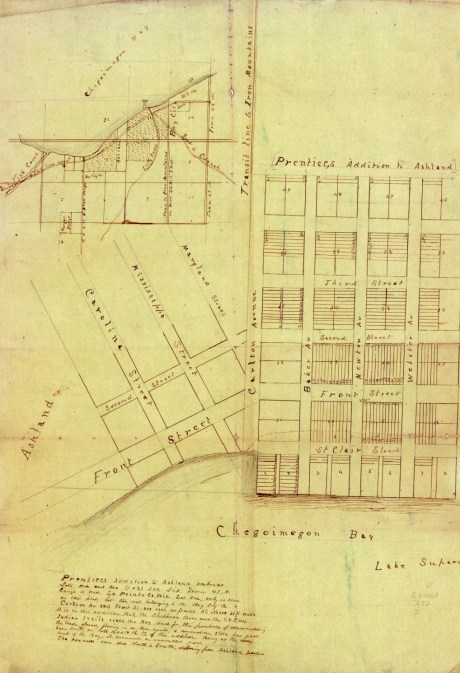
1850s survey of Frederick Prentice Addition of Ashland at/near the ancient village site of Gichi-wiikwedong. “It is in this addition, that, the Chippewa River and the St. Croix Indian trails reach the Bay.”
~ Wisconsin Historical Society
Mr. Lusk left the lake in 1856, and I think died some years since in California.

Frederick Prentice
~ History of the Maumee Valley by Horace S Knapp, 1872, pages 560-562.
Mr. Prentice, a man of great energy and business enterprise, now resides in Toledo, and is largely engaged in the production and refining of coal oil, being one of the great operators in that enlightening civilizer. He has accumulated an ample fortune, and is still largely interested in real estate in our town and country.
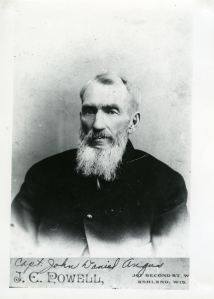
Captain John Daniel Angus
~ Madeline Island Museum
Capt. J. D. Angus, and old salt, familiar with all the oceans as well as our inland seas – having circumnavigated the globe; able to build any water craft from a Mackinaw boat to a ship of war; a man with an exhaustless store of anecdotes; who was acquainted with “Sinbad, the Sailor” – having passed through many vicissitudes- is now living in our country, full of life and activity.

George Riley Stuntz
~ The Eye of the North-west: First Annual Report of the Statistician of Superior, Wisconsin, by Frank Abial Flower, 1890, page 26.
George R. Stuntz now resides in Duluth, a civil engineer by profession, who came to the west end of the lake thirty year ago; who has done more surveying of government land than any other man on the lake. He is a descendant from the third generation of a Hessian soldier, hired by George III to fight against the American Colonies in the war of our Revolution; but who after fighting one battle on the side of the Despot, was convinced of the wrong of the British cause, became an active rebel and a sincere defender of American liberty. He and his children and children’s children have ever been true American patriots, and have done good service to the cause of the Republic. He is the owner of much real estate on Lake Superior, in both Wisconsin and Minnesota.
These men had also been attracted by the situation of our bay as the outlet of an extensive country, abounding in minerals and timber. They had perfected no plans for the acquisition of title to the land. It is true several claims had been made reaching from Fish Creek nearly to the Indian Reserve – a narrow strip on the bay, but the claimants gained no rights thereby, for the lands had not been surveyed, and we were all in the eye of the law, trespassers. The Land Office, which was then at Hudson, on the St. Croix river, was not allowed to receive and entertain declaratory pre-emption statements.
Still Lusk, Prentice & Co. were even then engaged in building a dock and clearing off the site of an expected city, to which even then they gave the name of “Bay City” – by which name the larger part of the present site of Ashland was known for many years. It is now in legal description as “Ellis Division of Ashland.” The timber was cut into cord wood and piled upon the dock, in anticipation of the wants of the numerous steamboats soon expected to throng the docks of the rising city.
Some twenty acres of land were thus cut over, reaching from near Dr. Ellis’ present residence to the Bay City creek, and from the bay shore nearly back to the Railroad depot.
The dock extended from the low point about a hundred yards east of the Door and Sash Factory of White & Perinier, about five hundred feet into the water, and reaching a depth of about eleven feet. It was made of cribs of round logs, pinned together with wooden pins. The cribs were about 25×30 feet, and about 25 feet apart. They had no filling of any kind. They were connected with stringers, which served as the foundation of the road-way, made by laying round poles crosswise upon the stringers.
It may seem stranger to us with the results of many years’ observation and experience of the force of waves and currents and ice pressure in the bay, that such a dock should ever have been built. But hind sight is always clearer than fore sight, and recent dock builders have had the benefit of the costly experience of the pioneers.
They labored under the impression that the ice melted in the bay and did not move out in large fields. They soon had this error corrected. On the last day of March, 1855, the ice in Ashland bay was broken for two or three hundred feet from shore only the body of the ice had not moved, and gave no signs of moving. It looked as though it might remain for weeks. The morning sun of April 1st shone upon the smooth, classy surface of the water. The ice had disappeared in a single night, and the dock and wood piled upon it – the result of so many hard days’ work – had passed away also. The remains might be seen for many years scattered along the bay shore and far up the Kau-kau-gon. The present dwellers here can hardly realize the depressing effect of this loss to the little squad of settlers.
To be continued in Number III…
An Old Indian Settler
January 15, 2017
By Amorin Mello

“Joe Stoddard 1941″
~ Bad River Tribal Historic Preservation Office
United States. Works Progress Administration:
Chippewa Indian Historical Project Records 1936-1942
Envelope 19, Item 1
An Old Indian Settler
Statement of Joseph Stoddard
by James Scott
On the afternoon of Sunday, February 28, 1937, I visited Joseph Stoddard, one of the oldest residents of the Bad River Reservation. He is a man of full blood Indian descent, and a full-fledged member of the Bad River Band of Lake Superior Chippewas. He has always been respected for his wisdom concerning matters affecting his fellow Chippewas; as always recognized as a headman in the councils of the band, and is today an outstanding figure. He related to me many experiences of his early days, and has a distinct recollection of the incidents attending the closing deliberations leading up to the signing of the last treaty affecting the Bad River Band of Chippewas, which was concluded at Madeline Island, Sept. 30, 1854.
He relates: In this treaty with the Lake Superior Chippewas, Henry C. Gilbert and David B. Harriman represented the United States. According to Mr. Stoddard‘s version, Mr. Gilbert stood at one end of a small writing table, and Chief Buffalo on the other end, joining hands in mutual grip of friendship.

Henry C. Gilbert
Mackinac Indian Agent
~ Branch County Photographs
Commissioner Gilbert held in his hand the signed treaty, which was rolled and tied with red, white and blue ribbons. He expressed confidence that the Chippewas of Lake Superior and the Mississippi would always remain friendly toward the United States, and assured the Indians that the obligations of the United States under this treaty would be fulfilled to the latter. Using the rolled treaty as a pointer, Mr. Gilbert pointed to the East, to the West, to the North and to the South. The gesture circumscribing the Great White Father’s domain, explaining that the treaty just concluded was backed by the integrity of the U.S. and promising that the Great Father would see that the stipulations in the document would be taken care of at the time indicated. Mr. Stoddard asks: “Has the government carried out the promises embraced in the treaties?” And he answers his own question by saying, “No. Many of the most important provisions which were agreed upon at Madeline Island were stricken from the treaty, not at the Island, perhaps, but at some other point; and the whole document was so changed that every provision leaned to the advantage of the United States.” Mr. Stoddard says further, “As a Christian, I dislike to say that the field representatives of the United States were grafters and crooks, but the stories related about unfulfilled treaties, stipulations entirely ignored, and many other things that the Indians have just cause to complain about, seem to bear out my impressions in this respect.”
~ Wikipedia.org
The experience of the Indians in dealing with the United States government, contends Mr. Stoddard, has been anything but satisfactory, and this is the reason why the Reorganization Act does not appeal to many of our Indians, and the experience of Indians in different parts of the country must have been similar, as on some reservations of other tribes, the Reorganization Act has not even been given serious consideration. The Indians fear that this is just another ruse on the part of the Government to further exploit the Indians; that there is a hidden meaning between the lines, and that the Act, as a whole, is detrimental to the Indians’ interests and development.
For a person of his age, Mr. Stoddard has a wonderful memory and gives a clear portrayal of incidents connected with the treaty. He states that:
“Chief Buffalo worked so hard during the drafting of the treaty of 1854, that he suffered a general health break-down, and lived only a short time after the completion and signing of the document. The Chief felt highly elated after the work was completed, thinking that every word of the treaty would be carried out, affording permanence and security to his people.
“At the death of this venerable old chief, the funeral service attending his burial was very impressive. The pall bearers were all leading warriors who had seen and experienced the strife of battle. Those who paid tribute formed
[line(s) of text missing from bottom of page 2]
the mortal remains of the famous chief were laid to rest.

“Kiskitawag” in Washington D.C. circa 1880.
Which Giishkitawag is this?
Joseph‘s grandfather,
or Joe White?
~ C.M. Bell, Smithsonian Digital Collections
“After the death of Chief Buffalo, my grandfather, Kishketuhwig, became a leader of the Chippewa tribe. He was widely known throughout the Indian country, and well did the Sioux nation know him for this bravery and daring, having out-generalled the Sioux on many different occasions. To the whites he was known as “Cut-ear,” that being the interpretation of his Indian name, Kishketuhwig. He was born in 1770 and died in 1868.
“When nearing his ninetieth milestone, he would call me to his bed-side many times in the evenings, and often during the day, to advise and counsel me. Once he said, “My son, I can foresee the path that is leading straight ahead of you. I can see that you are going to be of great value and assistance to your people. You must make a serious effort, therefore, to familiarize yourself with the contents and stipulations of the different Chippewa treaties. My first experience in treaty negotiations was in 1785, at early dawn one day, there far off on the blue waters of Lake Superior several strange canoes. They were first sighted by a couple of fishermen, who were raising their nets at this early hour, on the east side of Madeline Island. When the fishermen were sure that the approaching canoes were those of strangers, their coming was immediately reported to the thousands of Chippewa who made their homes on the west shores of the island. The alarm was given, and a number of the most daring warriors were instructed to meet the party, and be prepared for the worst. Chief Buffalo was also notified.
“As the party came nearer, it was noted that the fleet consisted of five large, strangely designed canoes, and at the bow of the leading canoe, stood a stalwart brave in great dignity. In front of him, upon an upright rack, a war council pipe could be plainly seen, and as they approached the shore line the sounding of war drums were heard, and sacred peace songs were being sung as the party
[line(s) of text missing from bottom of page 3]
his hand high above his head, the gesture indicating the question, “Are we welcome to enter your land of liberty?” One of the Chippewa warriors acting as a lieutenant, answered in similar fashion, conveying the message, “you are welcome.”
These were visitors from the Algonquin-speaking Odawa nation. Their ancestors once lived at Grant’s Point on Madeline Island with the Wyandot people as refugees during the mid-17th century.
“After the strangers pulled their canoes onto high land, the Ojibways and the visitors clasped hands in a bond of friendship, saying Na-gay-ma, meaning ‘welcome, my friend.’ After the lieutenant was satisfied that there was no mischief connected with this party, he extended them the welcome of the village. With an apparent feeling of deep appreciation, the newcomers accepted the invitation, but indicated the wish that they preferred to prepare and eat their breakfasts first before entering the great Chippewa village. The spokesman explained that their ancestors once lived here.
“After their breakfast was over they were escorted to the village and lead to the lodge of Chief Buffalo. They explained the purpose of their visit, and Chief Buffalo indicated an open space where the meeting was to take place on the day following. Runners of the village were instructed to pass this information from lodge to lodge.
“On the day of the council, there emerged from the numerous lodges, naked figures of Chippewa warriors, looking fit for whatever the occasion required, wrapped close in their gaudy blankets, and their heads adorned with American Eagle feathers. The war-paint make-up was also conspicuous, and over the back of every brave, ‘quivers‘ were slung, while resting in the shallow of their arms were war-clubs stained with human blood.
“All were soon seated in a very wide circle upon the green grass, row after row, forming a grim assemblage. Each warrior’s face seemed carved in stone, and no one could have detected the deep and fiery emotions hidden beneath the surface of their expressionless faces.
“In the customary manner, pipes with ornamented stems were lighted and of the visitors, a young brave, arose, and walked into the midst of the council assemblage. He was not tall, but the symmetrical lines of his body spoke loudly of great strength and vigor. In complexion, he was darker than the average of his race, which we learned later was due to the fact that he belonged to the black bear clan or totem. The men and women of the Chippewa nation who belonged to the same clan accepted him as a brother and as one of the family.
“His expression was bold and confident, and as he stood in the middle of the circle, he pointed towards the heavens saying,
(Beaver, Pennsylvania)
“Constructed in 1778, it was the first fort built by the Continental Army north of the Ohio River, as a direct challenge to the British stronghold at Detroit. It was the headquarters of the largest army to serve west of the Alleghenies. Its purpose was to protect the western frontier from possible attacks by the British and from raids by their Native American allies. The fort, large for a frontier setting, at one time had a garrison of about 1,500 men.
[…]
“The fort was the scene of a historic event in January 1785 — the signing of the ‘Treaty of Fort McIntosh‘ by chiefs of the Delaware, Wyandot, Ottawa and Chippewa nations, along with treaty commissioners George Rogers Clark, Richard Butler and Arthur Lee. As a direct result, the way was cleared for Congress to enact the Land Ordinance of 1785. This became the pattern for ultimately opening all the western territories to boundary surveys and orderly settlement, and marked the real beginning of the westward migration that continued for the next 100 years.“
~ Beaver Area Heritage Foundation
‘My faith is in God, who is the creator of mankind, the maker of the heavens, the earth, the trees, the lakes and the rivers. I am very proud that the opportunity to address you is mine. I never thought that I would ever be accorded this privilege. I am sent here by my father to deliver a most humble message to your chief and to your nation. My father did not dare to leave. He is guarding his people in the East. The white man is encroaching upon our lands, and if he is not stopped, his invasion will soon reach you. My father needs your assistance. Will you join him, or will you remain passive and watch your children suffer? It is an invitation to a national council of the Algonquin nation, and it also means that you should prepare for the worst. The Grand National Council will take place as Sog-ga-nash-she Ah-ka-wob-be-win-ning, or English Look-out Tower, at Fort MacIntosh, on the last quarter of Gitche Manitou Gee-sis, meaning January.’
“The wampum belt consisted of cylindrical pieces of sea shells, a quarter of an inch long and in diameter less than the width of an ordinary pipe stem. These were drilled lengthwise to permit stringing on a sinew thread. The wampum belt was an article in general use among many tribes, not merely for ornamentation, but for graver purposes. They played an important part in national councils and in treaty negotiations. They were made of fragments of shells
[line(s) of text missing from bottom of page 5]
The color scheme was that of white, black with white tips, dark purple and violet. The only time these belts were exposed was on public gatherings, such as general councils effecting the welfare of the tribes. Only an Indian of distinction was permitted to administer the rites of the wampum belt ceremonies, and to perpetuate the history of the relation they bore to the particular council in which they were used, the belts were stored away, like other important documents. They were generally kept in custody of some old man who could interpret their meaning.
“The brave from the East continued in loud, clarion tones:
‘My father has received a message from the Great White Father. He said that he heard the voices of his red children pleading that they were in dire want, and in response to their entreaties he will come with a cargo of merchandise with his war vessels as soon as navigation opens.
‘The Algonquin Nation had agreed at one time to eat out of the same dish, so this will be our first opportunity to see what kind of a dish we are going to be offered. I thank God for the privilege of being able to deliver this message to you.’
“The speaker raised his right hand and looked straight into the heavens. He pivoted, and executing a right-turn, and with his right hand still held in the same position, walked back to his place and sat down.
“Chief Buffalo ordered that the Lake Superior Chippewa War Pipe be lighted and passed around. As it made a complete circle, the servant then presented the pipe to the strange young man. Chief Buffalo then arose, and as he walked in the midst of the council, he pointed into the heavens, saying, ‘I leave everything to God who rules my destiny. This is the very first time that this sacred war pipe is ever to leave this island.’ Chief Buffalo continued,
‘Shortly after the creation of mankind, the Great Spirit, or Gitche-manitou, sent a message to his red children, that, to insure their future security, they should establish a government of their own. The advices of the Great Spirit were
[line(s) of text missing from bottom of page 6]
regarded sacred, and the substance of the whole was carved in a pink colored agate, a rare and beautiful stone, and buried in Madeline Island. Incorporated in this document are the ten moral laws: Religion, tobacco, pipe, earth, wampum, herbs, water, fire, animals and forest. The law embracing religion stipulated that a chief shall be created, selecting one whose clan is of the Albina Loon, or Ah-ah-wek or mong. He is designated as the emancipator of the Indian race. One selected from the bear clan, is to be a leading war general; one selected from the Bull-head fish clan, a captain; wolf clan, a lieutenant, and so on down the line.’
“Like the former speaker, Chief Buffalo, at the conclusion of his speech, raised his hand heavenward and walked to his seat.
“The leading war general, Ah-num-me-me Wan-na-kwad, meaning Thunder Head Cloud, rose to his feet and walked to the center of the assemblage. Gently addressing the young brave from the visiting nation, he said,
‘This sacred pipe has been presented to you. You may take it back with you and interpret the statement you have just heard to your father, and say to your people that my great chief and his people will be fully prepared to come and assist your father. He will bring back with him the invitation emblem, your wampum peace belt, and your war pipe.’
“Immediately one of the announcers of the tribe stepped forward and announced that on the following day a feast in honor of the visitors would be had. The sounding of the war drums would be heard and a brave dance would take place. He told the people that provisions were being collected for the use of their friends upon their return voyage. Early in the morning, the day after the banquet, the strangers embarked, pointing their canoes homeward.
“During that fall many young braves were preparing to join the proposed war party. I was making clandestine preparations myself, being then about sixteen or seventeen years of age. I begged my grandmother to make me t least a dozen pairs of moccasins. When I advised her of my intentions, she shed tears saying, ‘Son, you are much too young.’ I was very anxious to see real action. Through rumors I learned that there were already eight thousand volunteers, ready to take up arms, if anything happened. If war was inevitable, it would be the first time in the history of the Lake Superior Chippewas that they would bear arms against their white brothers. There were more rumors to the effect that various bands were forming war parties to join their head chief at his command.
“Chief Buffalo told the runners of the various bands to deliver his message: that he needed only a few men at the outset. He promised that he would contact someone at the Island through his spiritual power to determine the exact time he would need his army. He advised them, however, to be on the alert. Everyone was apparently satisfied with the plans made by the chief.
“It was shortly after New Years that the alarm was given by the leading war general, Neg-ga-neg O Gitch dow, that when the moon attained a certain size, the journey should be started. Four or five days before the departure, war ceremonial dances should be held. The chief intimated that he needed a party of only one hundred to make up a visiting party. How I hated to ask permission from my grandfather to join this party, or even to tell him that I was planning on going. I finally decided to keep the information from him, because I knew that I would be terribly disappointed if he refused to allow me to join the party. Of course my grandmother was my confidant, and secretly we made the preparations. The tension of my anxiety was so high that I was unable to sleep nights. I would lie awake nights, listening to the beat of the war-drums, thinking that any moment the party might begin the journey. About two days before the appointed time, Chief Buffalo selected his visiting party, which was composed of orators and councilmen.
“The night previous to the day of departure, I went on ahead. It
[line(s) of text missing from bottom of page 8]
as far as the eye could discern. I started in the direction of Porcupine Mountains, and arrived there early the next day. After preparing, and having something to eat, I resumed my journey, my next objective being Ontonagon, or do-nagon-ning. There I waited for the party to arrive.
“I hunted and killed four deer, and when I saw them coming I sliced the meat, and placed it on hardwood sticks, standing the meat through which the stick ran, close to the fire to roast. I knew that my smoke would attract the party and guide them to my temporary camping place. When the party landed, I handed a piece of meat to each of the party, and to Chief Buffalo, who gave me a grunt and a smile in acknowledgement to my greeting, I gave a piece of meat which I had especially selected for him. I also gave him a large piece of plug tobacco, and after bestowing these favors I felt more confident that my request to join his party would be favorably considered. I told the chief that I desired to join his party, and he gave me his assent, saying that inasmuch as I was such a good cook I might join the party. I felt highly elated over the compliment the Chief paid me.
“After the repast, we started in the direction of Ontonagon. For a while we walked on the ice, and then cut across the country. It seemed that luck was with us. On the second day of our journey we ran across a group of Indian families, and as the afternoon was well on, our leader decided to camp with them that night. A couple of the men from this group presented tobacco to our chief, declaring that they had decided to join our party. The women were busy making extra pairs of moccasins, and before we retired for the night, war songs were sung, and a dance was started in one of the larger wigwams.
“The following morning saw us again on our way. We hugged the shore line closely, but very often the leader would make a short cut through the forest. The snow as not deep enough to hinder good traveling, and on the way the men hunted for fresh meat. A camping site was always located before the night.
“After traveling several days we came upon an Indian village, occupied by Indians called ‘Ba-we-tigo-we-ni-ning-wug,’ meaning Salt Ste. Marie men. We stopped at their village for a few days, and on our resuming the journey several of the men joined our party. They seemed to know all about our journey. I recall that on the morning of the day before we reached Fort MacIntosh, our leader commanded that we were not to travel very far that day, as he desired to arrive at Sog-ga-nash-she ak-ka-wab-be-we-ning, or the English Look-out Tower.
“During that night I got up to put some more wood into the fire place. Pausing, I could hear a dog barking in the far distance, and I concluded that there must be an encampment of some kind in the direction from whence the dog’s bark proceeded. I noticed also that all was talking in subdued tones. After resuming our journey the following morning, we had not traveled very far when we came to a river. Smoke was issuing from many different places. One of the younger members of our party told me that the smoke rose from the camp fires of a large Indian encampment on many tribes. In obedience to orders issued by our commander, we were to remain where we were until we received further orders. Each man had a pack of provisions weighing about twenty pounds. A camping site was immediately started. We built a hundred-foot wigwam, covering it with pine, cedar, spruce, and balsam boughs. For mattresses we used cedar boughs. We built about ten fire places, which furnished plenty of heat when the fires were all burning. Some gathered fuel, while others engaged in making water pails, dishes and cups, out of birch bark. In a short time everything was ship-shape: our lodge was in complete readiness, fuel gathered and the dishes and other receptacles required were made.
“Chief Pe-she-kie then sent one of his warriors to make inquiry where the leading chief of the Ottawa Nation resided. It wasn’t too long before the warrior returned with two strange braves, who came to invite our chief to the Ottawa camping ground. Chief Buffalo refused, saying, ‘Not until you have held your grand council, as you said when you invited my people.’ ‘Yes,’ they answered. ‘Our chief has been awaiting your arrival. We shall again come, and let you know when we shall hold the grand council.’ They returned to their encampment, and the length of time they were gone was about the time it would require to burn two pipe-fulls of tobacco. They reported back saying, ‘Not today, but tomorrow. When the morning sun shall have reached the tree tops, the grand council shall be called to order.’ This would mean about nine o’clock in the morning.
“That evening a funny thing happened. Two braves were placed on sentry duty, one on each end of our wigwam which was built long and narrow, the single door-ways on each end being covered with blankets. That night everything was quiet, and the occasional hoot of an owl, or the call of the whip-per-will were the only sounds that disturbed the deep silence of the night. I was not asleep and as I listened, I could distinctly hear a noise such as might be made by dragging some object on the ground. I gave this matter no serious thought, as I was under the impression that one of our tribesmen was dragging poles for the fires which needed more fuel. I found out later that one of our sentries located on the east side of the wigwam, saw someone peeping in the door-way. The sentry was covered up with a blanket in a sitting position, and underneath his blanket he held his light war-club. Like a flash we sprang, and taking the peeping person entirely by surprise, he tapped him on the head with his war-club, not hard enough to kill him, but with sufficient force to knock him in a state of coma for a few moments. Tying his victim with his pack-strap, he dragged him in his wigwam and laid him lengthwise in the center of the lodge. With the coming of day-light the next morning, some of the men rekindled the fires after which they sad down for their morning smoke. For centuries it has been the habit of the Indians to have their morning smoke first before anything else was attempted. Every one saw the strange Indian laying there, but nothing was said. The party soon began the preparation of breakfast, and while all were busy, it was noticed that one of the warriors was busy, sharpening his famous scalping knife, and was edging closer and closer to the stranger. Someone asked him why he was sharpening his knife, and he replied saying, ‘Oh, I’m going to have a good breakfast this morning. I think I will have some nice roast meat,’ and so saying, he started to feel and examine the leg of the victim lying in the wigwam, indicating he would supply the fresh roast. The captive became so frightened that he let out a howl and began to scream. A couple of men then came over with a large load of fish, which they presented to the chief. Seeing the stranger thus tied, screaming and begging for mercy, the two men who brought the fish began to show uneasiness. The sentry who captured this man then explained just what had taken place during the night. He said that there were two of them, but one got away. The two braves were requested to report to their people just what happened during the night at the Chippewa camping site, find out what tribe the victim belonged, and ask them to come over and get him, or that he would die on the spot if he was lying. It was not long before a party came with a large load of blankets and many other useful things which were offered to the chief with an apology and an expression of hope that he would overlook and forgive the actions of their two tribesmen.
~ Wikipedia.org
They belonged to the Kickapoo tribe. Our chief interfered, saying, ‘We did not come here to collect ransom. Go and take your child back to your home,’ and he ordered his release immediately.
“Early the next morning a runner came in our wigwam and lighted a large peace pipe. First he made inquiry as to where the leading chief sat.
[line(s) of text missing from bottom of page 12]
him first, and invited him to the national council, then he passed the pipe around the rest of us.
“We started across the river just before the position of the sun attained the tree tops. The Chippewas wore blankets of bright and many colors. Their weapons were concealed, and the quivers were the only things visible. These were slung over the backs of the warriors. As they arrived in the council ring, they were seated in the order of their arrival. In the center, was a rack, which was regarded as a sacred stand, and upon this lay a large peace pipe. This was made from light blue granite, decorated with selected eagle feathers. The pipe itself bore an engraving of the American Eagle.
“Along towards noon twenty men entered the ring, each carrying a large kettle. They served us three of the kettles, which were filled with well cooked food, consisting of fresh meat, fish, potatoes, squash and other edibles, which I cannot just now recall. The ceremonial invocation was said by Chief Ottawerriri, or Ottawa Race, who walked to the center of the ring and spoke in a loud clear voice. Saluting the heavens, he said:
‘I have faith in God, the Creator of mankind, and I hope that he will protect and guide us. In two days we are invited to meet our great White Father’s children. They tell me that they have a message which they wish to convey to us: that this message is directly from Washington.’
“According to the white man’s measurements of distance, I would say that we were about two miles from Fort MacIntosh, which the Indians called Sog-ga-nash-she Ak-ka-wob-be-we-ning, or English Look-out Tower.
“It was almost noon when the Ottawa chief called upon his war general, Neg-ga-neg-o-getche-dow, to deliver the Lake Superior War Pipe to the Chippewa chief. The general rose to his feet and walked to the center of the ring. In his hand he held the noted pipe. He filled it with tobacco and lit a good sized punk, in Chippewa Sug-ga-tog-gone, which was to be used in lighting the pipe later. As the general placed the punk in the pipe, he made four circles around the council ring and ended by handing the pipe to Chief Buffalo. The Chief took the pipe, and after drawing three or four puffs or whiffs from the pipe, and after drawing three or four puffs or whiffs from the pipe, handed it to one of his attendant chiefs, Nah-sho-ah-ade, the interpretation of whose name being ‘Three Sounding Winds.’ This chief rose to his feet, and coming to an erect position, addressed the assembly saying:
‘I trust in God. He has heard me. What pledge I made to you and my people, I am here ready to carry out and to stand by you. Whatever may happen, my people, and the other Indian nation, are ready to obey my command.’
“He then ordered his leading war general to light up the Ottawa war pipe, which he did. Then he went through the same performance as the Ottawa war general, except in the hollow of his are the Ottawa Wampum peace belt and presented both the pipe and the peace belt to the Ottawa war chief who accepted them, smoked for a minute or two, then stood up and thanked our chief. A short prayer was offered by one of the Ottawa headmen, at the conclusion of which everyone said: ‘Oh’, meaning ‘Amen’. Then all the people assembled for the morning meal. The prayer uttered by the Ottawa headman was a festive ceremonial offering. After dinner the chief of the Ottawa nation bid all to adjourn and return to their camping sites until summoned to visit the fort.
Early one bright morning, shortly after the break of day, we heard the sound of the Indian War Eagle, Kie-shik-kie-be-be-gwan. The meaning of this was clearly understood by all of the Algonquin nations. Shortly after the bugle call, a runner came to tell the chief that each tribe was to leave immediately after finishing breakfast for the white man’s council house. We hurried with our breakfasts and as soon as we were through we started out for Sog-ga-nash-she Ak-ak-wob-be-we-ning, or the English Look-out Tower. When we got near there, all I could observe was a sea of eagle feathers, which were really the head-gears of those already there. So magnificent were the head-gears, and so numerous were the eagle feathers adorning them, that a birds-eye view of the assembled group presented rather a field of eagle feathers than a group of warriors, or counselors.
“We were about the last party to arrive, and in a few minutes the meeting was called to order. This white man’s wigwam was a packed house. No business was taken up that day, the purpose of the meeting being to promote better acquaintance among the different bands. Runners from the various bands were invited to follow a few She-mog-gun-ne-shug, or soldiers. Our runners asked me to accompany them, and the white men brought us to another white man’s wigwam. I was never so surprised in all of my life, and in all of my days I never saw so much food stuffs. The soldiers told us through interpreters that our Great White Father was going to feed us from now on. They invited us to take anything that our chiefs and warriors could eat. Out of pure astonishment I hesitated for a moment. I didn’t know which way to move, or how to get started.
“I saw before me a large quantity of fresh pork, and spreading the top blanket I had on me, upon the ground, I placed several large pieces of the meat on the blanket, as well as tea, sugar, tobacco, and some bread which was as hard as the hip bone of a horse. The interpreter laughed at me, and told me to take some, saying
‘When you cook your meat, put the bread in with it. I know you will like it. The white man likes it that way, and calls it Ba-tay-be-qua-zhe-gun or hard-tack.’
“Just as we were about to go, one of our men came in and offered to [??? ??? ???] told him to take a couple of the large kettles to cook with which he did. He told us that we might just as well go to our camping grounds, as he had been instructed to come and tell us that nothing further would be done officially by the conference for several days. Arriving at our camp site, we cooked a bountiful meal, including meat, potatoes and hominy, which we brought from the fort earlier in the afternoon, and when the rest of the party arrived we had our supper.
“In about a week or so we were again notified that the council was to convene the following morning, that matters of vital importance were to be taken up, and that the council would be called to order by one of the white father’s children. We started early on the morning of the day indicated. When we got there, everything was in readiness and the council began in earnest. Johnson, representing the United States government, arose, and after making his salutation, he said:
‘I bid you a hearty welcome to this place, and I ask, pray and trust that the Great Spirit will allow us to meet in this friendly spirit more frequently. The Great White Father has now let down the bars, thus enabling all the tribes to meet his representatives in one common community, for the purpose of discussing the problems which affects them individually or as a tribe. The Great White Father is your guardian and adviser, and henceforth all of you are under his protection.’
“Mr. Johnson remained standing as Chief Ha-ro-en-yan, of the Wyandot Nation, arose and began to speak: ‘I respectfully request that the Lake Superior Chief, Ne-gie-chi ne-cieh (meaning my great brother), make the opening address.’ He also remained standing until Chief Buffalo stood up and addressed the gathering, thus: ‘Ne-she-may-yence-see-doug’ (my young brothers), and turning to Commissioner Johnson, he continued, ‘Ne-gie-ki-wayzis,’ (my friendly brother), ‘
If your intentions are right and earnest, the Great Spirit will know; and if you neglect these promises in the future, he will punish you severely. I have in my right hand a peace pipe made from a birth rights of the blue-blood clans of the Lake Superior Chippewas. I am going to fill this sacred pipe, but before I light it I am going to tell you what my ancestors conveyed to my forefathers, and that is this: Many generations ago, long before the white man ever conceived the idea that the world was round, and that across the Atlantic new lands might be found, our great ancestors knew of the white man’s coming in the future. Standing on the shores of the great Atlantic, they saw the coming of a strange craft, fluttering many white wings, and at the bow of the craft they saw a white man standing, holding in his hand a book — the word of God. The build of this white man was the same as the Indians’, the only difference being that his complexion was light, or white, and that hair grew on his face. Gitche-manitou, the Great Spirit, spoke to these old Indians, telling them that those they could see coming from the far East were their brothers, and that they should treat they courteously when they landed. I shall light this noble pipe, and pledge again our friendship to the White Man, if you will carry our your promises.’
“Chief Buffalo then lit the sog-ga-tog-gon (punk), placed it on top of the tobacco in the pipe bowl, and making a circle with the pipe covering the four points of the compass, he presented the pipe to Mr. Johnson. He received it with bowed head, and after taking a few whiffs, he returned it to Chief Buffalo, who in turn handed it to the Wyandot chief. After the Wyandot had taken several puffs, he returned the pipe to Chief Buffalo, who now also took a few whiffs from it. The Chippewa war general then stepped up, and the peace pipe was handed to him to pass to the chiefs and warriors, and to the other white men participating in the council. Commissioner Johnson still stood up, and requesting the attention of the assembly, reached out his right hand to Chief Buffalo in token of friendship, saying
‘I am the proudest man that ever stood on two legs. The pleasure of grasping your hand in this friendly spirit is all mine; and I only hope that we, as well as the rising and future generations, will always continue in this spirit of harmony. Before returning to the Great White Father I must have some evidence to show what I have accomplished here, and I have therefore prepared a document for your acknowledgement. In this document are embodied the promises the Great White Father has made to you through me. It describes the boundary lines of your lands wherein you may hunt at will and in peace, and you may rest assured that the promises held out in this document shall be fulfilled to the letter.’
“After the treaty had been signed, a peace pipe ceremonial was performed, as a sanctification of the work done there. Immediately thereafter the distribution of goods and food began, and the leading chiefs of each tribe were instructed to deliver a message to their people, that as soon as the water-ways became navigable, more goods would be delivered to various points for distribution to the Indians who were parties to this treaty.
“We lost no time in returning to our homes in Madeline Island. It was then the latter part of February. To handle their loads better, the Indians made tobaggons, or Nab-bug-gie-dob-bon. I had a large load of goods on my tobaggon, and when I got home a distribution was made to our relatives and friends, making an equal division of the goods and food I had brought. As far as I can now recall, that was the last benefit we ever got out of the treaty so solemnly concluded.”
“The foregoing is an account of the activities of the Indians within the dates mentioned, part of which was related to me by my grandfather, and a part relating my own experiences. In conclusion, I wish to state a few facts concerning the establishment of the Bad River Reservation.
“In the winter of 1854 a general survey was made of the Bad River Indian Reservation. My father was a member of the survey crew, but was unable to take up his work on account of the fact that he injured himself while he
[line(s) of text missing from bottom of page 18]
“As he could not join the survey crew, and realizing that I owed my parents a debt for the many sacrifices they made in my behalf in the early period of my life, I determined to join this party if possible. I asked my father to speak to the foreman for me, and when my application was accepted, no one in the world was happier than I was. I was happy in the thought that I would be able to support my family, and reciprocate to a small extent, at least, for their care of me from infancy.
“A half-breed Frenchman, named Antoine Soulier, was the cook. The crew consisted of five white men, and about the same number of Indians. My duties were to provide water for the crew, and to attend to the chores around the camp.
2nd Clause of Article 2;
“For the La Pointe band, and such other Indians as may see fit to settle with them, a tract of land bounded as follows: Beginning on the south shore of Lake Superior, a few miles west of Montreal River, at the mouth of a creek called by the Indians Ke-che-se-be-we-she, running thence south to a line drawn east and west through the centre of township forty-seven north, thence west to the west line of said township, thence south to the southeast corner of township forty-six north, range thirty-two west, thence west the width of two townships, thence north the width of two townships, thence west one mile, thence north to the lake shore, and thence along the lake shore, crossing Shag-waw-me-quon Point, to the place of beginning. Also two hundred acres on the northern extremity of Madeline Island, for a fishing ground.”
“It did not take very long to run the original boundary line of the reservation. There was a crew of surveyors working on the west side, within the limits of the present city of Ashland, and we were on the east side. The point of beginning was at a creek called by the Indians Ke-che-se-be-we-she (large creek), which is located east of Grave Yard Creek. The figure of a human being was carved on a large cedar tree, which was allowed to stand as one of the corner posts of the original boundary lines of the Bad River Reservation.
“After the boundary line was established, the head surveyor hastened to Washington, stating that they needed the minutes describing the boundary for insertion in the treaty of 1854.
“We kept on working. We next took up the township lines, then the section lines, and lastly the quarter lines. It took several years to complete the survey. As I grew older in age and experience, I learned to read a little, and when I ready the printed treaty, I learned to my surprise and chagrin that the description given in that treaty was different from the minutes submitted as the original survey. The Indians today contend that the treaty description of the boundary is not in accord with the description of the boundary lines established by our crew, and this has always been a bone of contention between the Bad River Band and the government of the United States.”
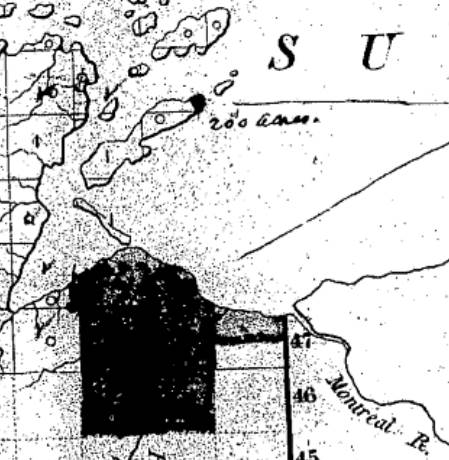
Detail of La Pointe Band Reservation including Gichi-ziibiiwishenhnyan (Saxon Harbor) in a letter dated March 30th, 1855, from the Commissioner John Wilson of the General Land Office to General Surveyor Warner Lewis at Dubuque, Iowa:
“For the Lapointe and other Indians, the body of land on the shore of Lake Superior, immediately west of Montreal river together with 200 acres on the Northern extremity of Madeline Island (all full colored blue on diagram A.) under the 2nd clause of the 2nd Article of the Treaty.”
~ National Archives Microfilm Publications; Microcopy No. 27; Roll 16; Volume 16.
Copper Creek Mining Location
November 18, 2016
By Amorin Mello

—
COPPER CREEK MINING LOCATION.
—
This location embraces the east half of the southeast quarter of Section 15, and the west half of the southwest quarter of Section 14, in Township 47, Range 14 west, being 160 acres in Douglas County, Wisconsin. It is about thirteen and one-half miles by the County road from the town and harbor of Superior, and at an elevation of 300 feet above the level of the lake.
The Aminecon Trap Range, in crossing it from southwest to northeast, is cut by Copper Creek, a rapid and never-failing stream, exposing at several points veins of native copper.
~ Mine Register: Successor to the Mines Handbook; Volumes 8-9, page 205.
“We all lived in the log house until December 31, 1845, when I left for Iron River [Michigan] under agreement to mine for the Boston North American Mining company, organized by the American Fur company, under the management of Messrs. Borup and Oakes.”
~ Michigan Historical Collections: Volume 2; page 688.
These surface exposures attracted, at an early day, the attention of the agents of the American Fur Company, then the only civilized occupants of that part of the country, and in the years 1846 and 1847 some attempts at mining were made under their direction. A particular description of their operations will be found in another part of this pamphlet. As they had no title to the land and were working at great expense in a region which was at that time wholly remote from civilization, it is not surprising that like many other pioneers in Lake Superior copper-mining, they abandoned their enterprise, or postponed it to a more convenient season.
Eight years afterwards, the whole southern shore of Lake Superior had ceased to be exclusively known to hunters and trappers. The land had been surveyed and brought into market, and settlement had extended to the extreme western end of the lake.

James H. C. McKinzey was issued his patent to the Copper Creek Mining Location by the Willow River Land Office on August 1st, 1854.
~ General Land Office Records
The Copper Creek location was then entered under a preëmption claim by J. H. C. McKinzey, and after a litigation at the Land Office with a rival preëmptor in the interest of members of the Fur Company (who now made a persistent effort to secure a title to the land), McKinzey’s claim was sustained, and a patent was duly issued to him. From him the title passed, with but one intervening link, to the present proprietor.
The location has been visited from time to time by explorers, practical miners, and geologists; numerous rich specimens have been taken from it, and it has long been reputed to be the most promising mining location west of Ontonagon. During the past season a regular exploration has been made upon it, with the view of ascertaining more definitely its value for mining purposes.
“This Township has a clay soil. The small streams are all muddy and go nearly dry in summer. A copper bearing trap range extends through the middle of Township. On the south side of these hills it is well timbered with valuable Pine Cedar Sugar & Black Ash. Copper has been obtained on the SE 1/2 of Section 21 & upon Sections 14 & 15. The streams [reaching?] into Black River are all very rapid.”
~ Wisconsin Public Land Survey Records
A Report of this exploration is presented herewith. Mr. George R. Stuntz, under whose superintendence it was conducted, is an explorer of great experience, with a knowledge of the geological formations characteristic of the copper-bearing districts of Lake Superior, acquired by careful study in the field. He was the original surveyor, under government contract, of the whole Wisconsin shore of the lake, and has, perhaps, a more thorough acquaintance with that region than any person could be named. His Report is a plain statement of facts, and as the undersigned was himself present and taking part in the exploration, he is able to vouch for its accuracy. In connection with the maps, and with the specimens to which it refers (which were marked and packed on the ground by the writer’s own hand), it will furnish a correct idea of the character of the location.
It will be seen that there are three well-defined veins, two of which, including the one from which the richest specimens were obtained, run with the formation. This last mentioned lode rests upon a foot-wall of the most productive veins of the Minnesota mine. Although only three veins have been actually traced, there is reason to believe that others would be discovered by a further exploration, as many points inviting examination were passed by, owing to the lateness of the season.
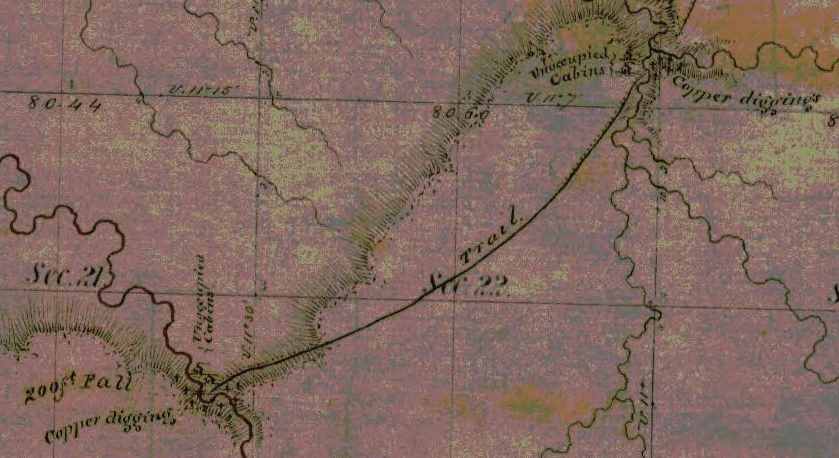
Detail from George Riley Stuntz’s original survey map of Township 47 North, Range 14 West: copper mines, abandoned cabins, and a tote road in what is now Pattison State Park. The northeast feature is Copper Creek and the southwest feature is Big Manitou Falls.
~ Wisconsin Public Land Survey Records
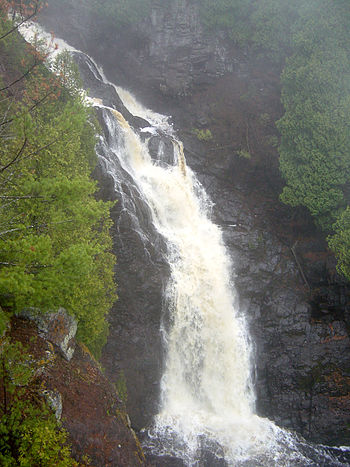
“Big Manitou Falls, the tallest waterfall in Wisconsin, in Pattison State Park just south of Superior, Wisconsin, USA.” Photograph from
Bobak Ha’Eri shared with a Creative Commons license.
The facilities furnished by Copper Creek for stamping purposes will be apparent from an inspection of the map. The town of Superior, having a good harbor, with piers and warehouses, erected by private enterprise, presents every convenience for shipping copper and obtaining supplies. Beef cattle, driven over from Minnesota, on the military road, can be purchased here much cheaper than at the Michigan mines, which are now largely supplied from this point. Pork can be advantageously procured in the same way. Another advantage is found in the price of lumber, an article for which the pineries and sawmills in this region now find a market at the lower mines. One of the finest bodies of pine in the north-west is found on the Brulé and Iron Rivers, about twenty-four miles east of this point.
With reference to the transportation between Superior and Copper Creek, it may be mentioned that, besides the wagon road (which is now available during the winter, and at no great expense can be made so at all times), the Nemadji River which, at ordinary stages of water is navigable for small boats to a point within four miles of the location, affords an additional route.
There is reason to believe that the whole country at the westerly end of Lake Superior will receive a new stimulus to its development before many years, by the opening of railroad communication with the Mississippi River, an enterprise which is becoming the absolute necessity to the interests of Minnesota. Meanwhile communication is kept open by means of the Point Douglas military road and a regular line of stages between St. Paul and Superior, which place is thus rendered accessible at all seasons.
JAMES O. SARGENT.
Boston, Dec. 8th, 1863.
—
REPORT OF EXPLORATION.
(ACCOMPANYING SPECIMENS.)
—
Superior, Oct. 17, 1863.
JAMES O. SARGENT, ESQ.
SIR : Under instructions from you, I have made a survey of the east half of the southeast quarter of Section 15, and the west half of the southwest quarter of Section 14, Township 47 north, Range 14 west, in Douglas county, Wisconsin, and have explored the same as thoroughly as the limited time and the small force under my direction would permit.
I herewithin submit a copy of the field-notes of the survey, and a map of the location.
In making the exploration I had the services of Mr. George Walker, an English miner, who has had several years’ experience in the various copper mines on this lake.
The tract is thickly timbered with spruce, fir, aspen, sugar, oak, white pine, and birch. This timber is small in size.

The Aminecon Trap Range crosses the location. This Range makes its appearance above the sandstone on the east side of Township 48 north, Range 12 west, about the middle of the township, runs in a southeasterly course across the township, and across Township 47, Range 13, Township 47, Range 14, Township 46, Range 15, and leaves Wisconsin. It is cut by the Aminecon River, Copper Creek, and Black River, and numerous small streams. Throughout the extent described it gives promise of being a productive mining district.
Two small streams unite near the centre of the location, forming Copper Creek, which runs in a northwest direction, and leaves the tract about twenty rods south of the northwest corner. Owing to the extremely dry season, this stream was lower at the time of my examination than it has been known to be in ten years; but it affords at all times abundance of water for the purposes of a mine employing steam power.
By a measurement, taken October 1st, I found the amount of water passing through it to be 58 5/10 cubic feet per minute, and this is very much below the average. In ordinary seasons the amount of fall in the stream (which is from fifty to a hundred feet within the location) would give a water power sufficient for all the purposes of a mine.
From my examination I believe that there are three veins, as represented in the map, in all of which we obtained native copper.
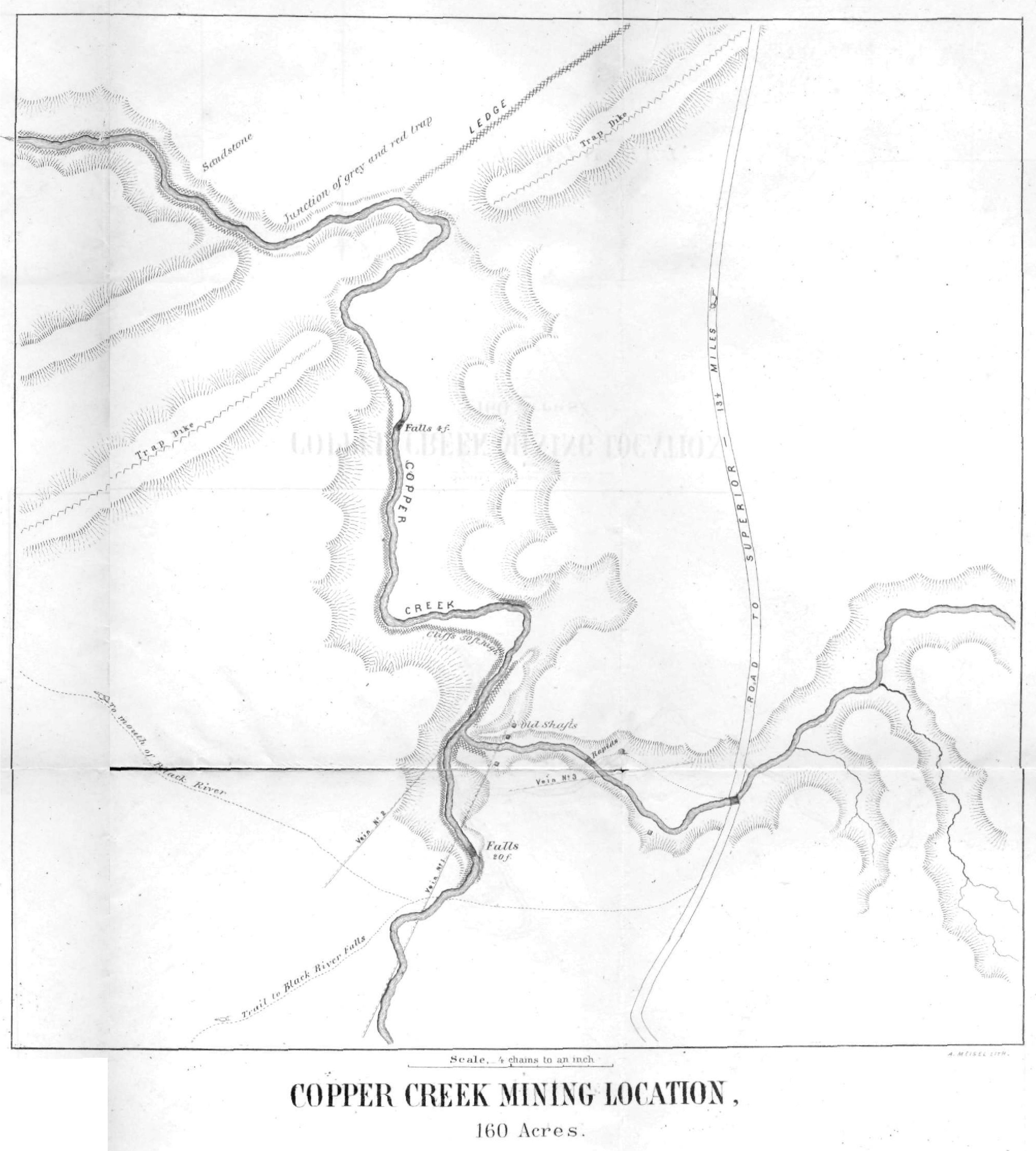
Vein No. 1 shows a breast in the east bank of the west branch of the stream, of nearly twenty feet wide, and bears south twenty-four degrees west. The specimens taken from this locality are numbered, and, as you will perceive, exhibit a quality of vein-stone which gives promise of productiveness. This vein has been traced to the southwest and adjoining location. It dips to the southeast at an angle of thirty-three degrees. The productive part of the lode lies upon the foot-wall, specimens of which I furnish with this Report, as also of the hanging wall.
Vein No. 2 shows a breast of over thirty feet in the bluff east of the stream, and appears to run in a northeast course. My explorations were not carried far enough to fully define its course in that direction. Surface specimens of the vein and of the adjacent trap are furnished herewith.
Vein No. 3 cuts the east branch of the creek, and bears north eighty-two degrees east. We opened this vein in four places at the creek, within two hundred feet. It has the appearance of being very much disturbed. On the west side of the stream, it is very compact and filled with quartz-lined cavities interspersed with crystals supposed to be malachite. It dips to the northwest. Specimens from this locality, a full collection of which is furnished, warrant a more thorough examination.
Vein No. 2, before referred to, as showing a breast of thirty feet in the east bluff, appears to branch or to be thrown out about eighty feet in crossing the creek bottom; my limited time and means did not permit me to determine which.

About two hundred feet below the junction of the two branches of the creek it shows at the foot-wall in the bed of the stream. A few feet west of this, the lode rises in the bluff on the west side of the stream. Course of stream at this point north twenty-eight degrees east. Course of vein north forty-two and one-half degrees east. At this junction of the streams, the lode, stripped of its hanging-wall, rises to the top of the cliff, a height of forty or fifty feet. At this point, we blasted into the lode, and found it rich in copper, some pieces weighing from six to fifteen pounds, and with rich stamp-work. See specimens marked Vein No. 2, west of stream.
About fifty feet above the forks of the stream the lode rests upon a bed of conglomerate. This conglomerate is highly metamorphosed, and is amygdaloidal. See specimens.
About one hundred feet west of this, we opened the vein on the brow of the hill. It there shows a breast of twenty feet, and dips to the southeast at an angle of thirty-five degrees.
~ Duluth and St. Louis County, Minnesota: Their Story and People; Volume 1, page 66.
This location was worked to some extent in the years 1846 and 1847, under a lease from the General Government, by the American Fur Company. They sunk four shafts, but appear to have done very little surface exploring.
Three of these shafts are sunk on the course of Vein No. 1, and from my examination appear to have been perpendicular. Their location is given on the map. The timbering is so much decayed that I did not venture to work in them. From soundings, I found the shaft between the streams forty-six feet deep, the next one on the east side of east branch twenty-eight feet deep, and the one east of section line twenty-eight feet deep. All of them have water to within about twelve feet of the surface. The fourth shaft is sunk at the bend of the east branch. This is thirty-five feet deep, and does not appear from the burrow to have been upon any vein.
The first three shafts above described were sunk perpendicularly upon the outcrop of a vein dipping thirty-three degrees, and therefore pass into a foot-wall. Had they been continued, they would have cut Vein No. 2. They may perhaps be made available in a further exploration.
Upon the adjoining location, to the westward, is a vein discovered by John Parry, some years ago. I have taken some specimens from it which are herewithin furnished. This vein runs north eighty-two degrees east, and intersects your western boundary six chains north of the southwest corner. It appears to be a continuation of Vein No. 3.
At the junction of the trap with the sandstone, in the northwest corner of the location, in the bed of Copper Creek, a bed of bluish-white grindstone grit of first-rate quality is found. The layers are from one inch to several inches in thickness. This white sandstone appears to belong to a different period from the red sandstone of Lake Superior. It only shows to the height of a few feet, and is overlaid by sixty feet of the red sandstone.
In the vicinity of the trap dike it is bent and fractured and considerably hardened. Near the junction, as marked on the map, it is tilted until some of the layers stand perpendicular. There are no ripple-marks on this white sandstone, while the red, resting upon it, shows evidence of a strong current.
Portrait of George Riley Stuntz from The Eye of the North-west: First Annual Report of the Statistician of Superior, Wisconsin, by Frank Abial Flower, 1890, page 26.
This tract of land is thirteen and one-half miles from the town of Superior, at the west end of Lake Superior. It is on a County Road which has been nearly completed, is now practicable for winter use, and can be made a good summer road at an expenditure not exceeding $2,000.
The soil is a sandy loam, with a subsoil of red clay containing a large per centage of marl, and is quite productive, being capable of producing a large portion of the vegetables needed by the operatives at a mine. It is especially adapted to the cultivation of grass and oats. Timber for lumber and fuel can be obtained conveniently and in unlimited quantity.
Respectfully submitted,
GEORGE R. STUNTZ,
Surveyor in charge of Exploration.
Barber Papers: “The Gardens” Fall of 1856
December 29, 2015
By Amorin Mello
Selected letters of the Joel Allen Barber Papers
… continued from the Summer of 1856.
Lapoint Oct. 12th 1856
Dear Mother
This afternoon I returned from Bad River where I have been attending an Indian payment. Father will tell you all about it. I will only say I had a good time, saw many old friends and made some acquaintances among the government officials that I deem very portinate. I also got a contract from the Indian agent on which I ought to make more than a thousand dollars.
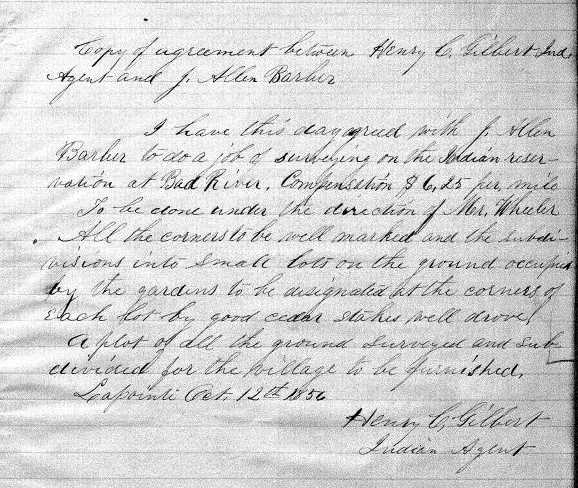
Copy of contract between the LaPointe Indian Agency and Joel Allen Barber to survey the LaPointe Indian Reservation and “the gardens” town-site (Old Odanah), to be done under the direction of Reverend Leonard Wheeler.
~ Board of Commissioners of Public Lands
~ History of Northern Wisconsin, page 64.
I could easily if I had means to carry it on to my liking. It is surveying at $6.25 per mile.
Father has gone to Ironton. I could not go as I wished to stay and conclude my business with the agent.
[You might?] I have been offered $50.00 per share for Ironton I took on which I have only paid 25 dollars per share, but I refused to take it. It may cause you pain to see that I am everyday becoming more and more fastened to this country but I cannot think of deserting it yet. As yet I have not realized one cent for my sojourn in the wilderness but I am far from being discouraged. I have seen fortunes made and have seen men make tens of thousands by taking chances that I might as well have had but I was green and could not read the future.
I am not in a mood for writing my thoughts to you [see rum?] principally upon many matters. Perhaps that is because I have been to payment and and because there is a gambling table in full opperation in the room where I am writing.
It is strange that father never told you the facts in regards to the $600.
There was never any mystery about it to me. Stuntz & Dr. Ellis had the money and returned over $400 of it. It is all right or will be. I nearly forgot to mention that I just got a letter from you to Father of Sept. 25th.
We are both well. Please excuse haste and carelessness.
Your affectionate Son
Allen
[Incomplete copy of letter]
~ Scope and Summary of Joel Allen Barber Papers
There is a young Englishman aboard who has been quite a tourist. He was in the Crimeran? army, went East of there to Ferlizand through Syria to their Holy land to Jerusalem to Egypt the Pyramids the Catacombs. Through all the Country in the South of Europe and northward through Scotland to the [Shetwood Jelas?], has been travelling in the U.S. the past season & is now returning from Superior, got there the day we left [songs her?] visited that poor [Ratefu?] that lost his foot every day till he died. He is a rich land lord & nobleman as I suppose and has a happy way of communicating information upon all subjects especially upon Geology, Mineralogy, Geography [overrated spy?] as well as all other “ologies” He is laying [w/a Speciation?] & [conavasated ??? ??? from?] to England.

1860 photograph of the Paddle Steamboat “Lady Elgin”.
~ Ship-Wrecks.net
The boat has just put to the Canal & [???? ? ????] Do be careful of your life & health and let us hear from you as often as you can.
May God bless and preserve you for many
yearsG. A. Barber
Give my respect to Jo & William.
Interior Field Notes
La Pointe Indian Reservation
Township 47 North, Range 2 West
Notebook ID: [N/a]

Contract awarded by La Pointe Indian Agency to Joel Allen Barber on October 12th, 1856. These survey notes are not available from the General Land Office or the Wisconsin Board of Commissioners of Public Lands.
Lapoint Nov 9th 1856
Dear Mother
I start today for Bad river with four others to commence my job of surveying on the reserve. I am well and in pretty good spirits. Father left on the S.b. Lady Elgin last week.
I am in such a hurry that I can scarcely write legibly. I was elected county Surveyor of this county last Tuesday. My term of office commences Jan 2nd.
I would not like to have this known in Lancaster as it might cause me a little difficulty. I am writing this in a [gragshop?] where there are several men talking so I couldn’t write very sensibly so you must excuse levity. I will write as often as possible but don’t expect me every week as the mails are very irregular and it will be very inconvenient for me to write sometimes. I expect to have a good time this winter. Shall not be far from the very best kind of folks about the Mission and I beg of you don’t grieve because I remain here this winter.
I am very anxious to go home but you see I had something to stay for.
With best love to Am, Aunt Betsy and yourself.
I remain your affectionate Son
Allen
Lapoint Wis. Nov. 9th 1856
Dear Father
Joel Allen Barber;
William W Ward;
Larry Marston;
Joseph Latham.
I expect to get away today for Bad River with one party – Bill & I Larry Marston and Joseph Latham.
I went to Ironton on Saturday before election so I was not there on that interesting day. That mound of earth has scarcely changed at all and will not materially in years. Business is going on pretty well at Ironton. The house is probably up [?? this?].
Joel Allen Barber;
Asaph Whittlesey;
Major McAboy;
[Fremont?];
James Buck;
and others.
The election came off here all right as far as I am concerned. Whittlesey 11 or 12 and McAboy 1. Whole number of votes 108. [Fremont?] got ten votes. The Buck ticket was carried throughout. We only start with one party because no steamboat has come yet and it is doubtful where we shall get a large supply of provisions.
We are all well and prospering. Give my love to all friends in Lancaster
Your affectionate Son
Allen
Excuse haste.
Interior Field Notes
La Pointe Indian Reservation
Township 48 North, Range 2 West
Notebook ID: [N/a]

Contract awarded by La Pointe Indian Agency to Joel Allen Barber on October 12th, 1856. These survey notes are not available from the General Land Office or the Wisconsin Board of Commissioners of Public Lands.
Cambridge Nov 9th 1856
Dear Son.
Now that your father has left you I suppose you will be very glad to hear from Am and me sometimes; at least I hope you have not so much forgotten us that you do not look for a letter whenever the boat arrives and have one prepared to send home by every one. But I forgot that there will be no boats for 5 or 6 long tedious months to come and I fear we shall hear from you but seldom. Let me entreat you to have a letter ready to send to me at least by every visit that leaves your region. I cannot imagine how any one can think of surveying in the deep, dark forest during the winter months to be exposed to storms, day and night without shelter – how you lived do tell me. I am sure no one could live here through the winter in the woods without a pretty warm house and a good fire. Were it not that I know you have had some experience in the business & manner of living I should feel certain you would be frozen or perish in some way. But I suppose you have no such fears.
I have sent 2 or 3 letters for you and father to Lancaster supposing he would be there and hoping you would also. In one I mentioned the happy marriage of M. C. Heath to a most excellent pious young lady who taught school in the village center last summer named Mott. No one suspected his intention – not even his own family till he brought her home and presented her as his wife. Every body is much pleased at the matter.
Mr. J Woodruff has departed this life after lingering and suffering much longer than his friends expected. He tried every possible remedy, but nothing – not even Dr. Hunter’s boasted inhaling method could arrest the fated disease. The latter remedy has been tried in several cases of Consumption in Johnson and equally failed in every case.
You have never said any thing about the trouble in your head and throught since you left home. How is it – does it increase or has that climate proved beneficial in that affliction, as in other respects, to your health?
I am pained to have to announce the death of one more of your dear friends and school mates. Julia Whiting has gone to the spirit world to join the happy throng of the young the beautiful and the good who have passed on before. This is the fourth daughter that afflicted family have been called to mourn – they have but one left. I mentioned the sickness of the rest of the family before – at last Julia was taken unwell with slow fever – then Typhoid symptoms which ended in death. We heard of it the morning of the funeral and Amherst and I went to J to attend it, and do some errands.
I have had a little good fortune –. Mr. Pike has at length drawn a small sum from the pensions office for me on account of my father’s services so [Serjeant?]. He only drew 80 dollars a year as private when he was entitled to 100 dollars as [Serjeant?]. The sum drawn was $209.86 out of which Pike takes about 25.00 for the expenses of getting it. I never expected to get so much if I get anything – but trouble and expense.
If you stay at the lake this winter what will become of your title to the land you bought in Grant? You will have to improve it some before June or you will lose it. I wrote to you about Lewis Wilson. I understand he has gone into the Blake house for this winter but has bought nothing. I have not seen him since I wrote you but would go to see them if we had a horse we could drive. “Old Grey” is so lame in her fore foot she cannot go farther than a walk so we do not drive her far and [Fate?] has a bad trick of starting and turning short about when she is a little frightened so that Dow thinks her unsafe for Am or I to drive. She is a large, beautiful beast and perfectly gentle when not mad.
Oh, how I do wish you were going to spend the winter at home – you would have such nice times riding about and visiting the young people here. There are several young ladies still single that would no doubt like to take a side. There is not a large number to be sure but some of them are worthy of the attention of any good young man. There is Miss Anna Bryant who is said to be a prodigy of learning and good sense – and Carry C – your old school mate – lovely as a rose – accomplished in all domestic affairs, and, as you well know, an excellent schollar. But of all those with which we are acquainted there is no one so perfectly amiable and good – who would, if I am not deceived and misinformed be so desirable a companion for life as Miss C Griswold. I believe she is beloved by old and young – one of the excellent of the earth. And M. A. Chadwick who is always with her. But I suppose none but little David can come near her.
According to your father’s description of the people in your country, you must see a great deal of vice – drunkenness, gambling, quarreling, and I should expect fighting. But I hope and pray with a strong faith that you in no way participate in such scenes. With all my fears for your personal safety I have never had the sorrow of knowing or fearing that my dear sons would be tempted from the path of virtue.
What must be the agony of parents who have vicious children. I believe that whenever a man conforms to the will of his Maker by using all in his own power – through the exercise of all his faculties he may safely trust in his protection.
That you may be as protected is the prayer of your affectionate Mother
Nov 10th 56
Dear brother Allen,
I have but little to write at this time but I thought I would put in a few lines to let you know that I still read [lest?] you & can write to you. We suppose by father’s letters that you are yet to remain at the lake through the winter. We were in hopes that you would go to Lancaster, or come home with father, but I don’t know but it will be best that you stay there. But I wish you were to spend the winter in some more congenial & convenient situation if possible. It is already pretty cold weather here & it freezes considerably. Mother & I have been living in the old west room pretty comfortably this fall. I have provided wood as fast as we needed it but I guess Dow will have to get it for us after this. I am going to the Centre school now and enjoy it quite well. Mr. Ed. Bryant, my teacher, is very well liked here, & is going to stay & teach select school through the winter. We have a tolerable good [Scycum?] here now & I have some speaking & writing to do for it. Last week was appointed to get up a dissertation, which I am now writing. My subject is Noses. There is not much going on here but the school & [Scycum?]. & it’s pretty dull times now. Hardly any one here will talk polities except the business of whom there are 74 in town. We got partial returns from election Saturday night which set the Democrats all right greatly. That day we heard cannon all over the country.
Atwood’s folks are over here occasionally; all is well as usual; & Levi is I think improving in health as he works considerably now. The Johnson school is flourishing nicely under their new teacher. Old Bent, the former preceptor is now 2nd clerk of the Senate at Montpelier. Mother & things at Johnson are getting along about as usual & the same in Cambridge. Allen, I have not written near as much as I ought, but some other time I’ll write a longer & better letter. Now father is gone do let us hear from you often. We will write you often.
Good bye
A. W. Barber
Lancaster 13th Nov 1856
Dear Son
I [improve?] this 1st Mail to inform you of my safe arrival here night before last at 8 P.M. & that all the friends here are well &c &c
November 25, 1856
“Nov. 11 – The Steamer Lady Elgin, which left the St. Mary’s River for Chicago, Nov. 1st, had not, at latest advices, reached her port or been heard from elsewhere.”
~ MarinetimeHistoryOfTheGreatLakes.ca
I wrote you from the Sault by which you will learn my progress to that place. Left there at 1 P.M. & ran down the river 40 miles when wind & fog threatened an unpleasant night & the Capt ran to a Sawmill dock & tied up for the night. Next morning showed the wisdom of stopping for it was that awful snow storm Election day. We land there 2 nights & on Wednesday started again stopped at Mackinaw 3 hours & then put out again against a dead head wind that increased in violence till 3 next morning when the Capt put about & ran 15 miles back for shelter under the North Manitou where we laid till 7 o’clock drifting down the shore & then storming up to the head of the Island. Anchor was then thrown over & held untill 2 next morning when the boat drifted off with the anchor & we drifted down & steamed up the east shore till toward night when we made the dock on the Island the wind heaving about & changed from South to N.E. & blew like the D’l till just night next day (Saturday) when we started again for the [west?] shore of the Lake & [p????ed] our voyage till we reached Chicago toward might Sunday night.

These locations are on a page of this letter to Allen from his Father.
The handwriting appears to be of Allen’s, not of his Father’s:
“Lot 1 Sec 19 Town 48 R 4 con 44.37
Lot 1 39.99 and NE 1/4 of NE 1/4 39.99
Sec 24 Town 48 R 5 W containing 40.00
Lots 124.36
Lots 1 and 2 Sec 36 and NE 1/4 of SE 1/4
And SE 1/4 of NE 1/4 Sec 25 Town 48 R 5 West”
These locations are along the shoreline of Barksdale on either side of Boyd Creek (and underneath Chequamegon Bay). Was this “Barbers Camp“?
Monday I came to [Galena?]. Found on the [car?] John [Muskler?] & Sarah [Le???] on her way to live with Mr. L.O. Stevens in Iowa. From them I heard direct from Johnson. There is much sickness there this fall. Dexter Whiting had been sick unto death of Typhoid fever but was getting well but had his upper lip all eaten off. Mrs. W had also been sick & poor Julian was sick & died of some fever rather unexpectedly. She had been asleep 30 hours & died [?] Sarah said she saw Mother & Amherst at the Funeral. Mr. Woodruff died 3 or 4 weeks ago. It is about Mail time & I cannot be brief. Tell Jo that Jay paid his taxes last spring so that he is all right there.
Algebra equations on the backside of a sheet from this letter.
“Dexter Ward was born in Chittenden VT and came to Grant County on February 8, 1843. He settled in Lancaster where he was a carpenter and builder. He was elected Counstable in 1857 (? Possibly 1847) and held that job for 5 years. He was a deputy sheriff under Matthew Woods and George Stuntz.”
~ GrantCountySheriffWisconsin.com
Take good care of your life & health and do as well as you can for yourself. I will write you again before leaving for VT. You may be [apsment?] that it looks rather better about here where there are [lesasy?] crops all about me than about the Lake where there is nothing. I called at the Sherriffs & left William’s letter, found all well.
In haste your affectionate father
G. A. Barber
Interior Field Notes
Odanah Townsite aka “The Gardens”
La Pointe Indian Reservation
Township 48 North, Range 3 West
November, 1856
Notebook ID: [N/a?]
!["For Plat of Townsite Odanah LaPointe Indian Reservation [...] See Large Plat Book [s]Next to last page[/s] Middle of Book" ~ Board of Commissioners of Public Lands](https://chequamegonhistory.com/wp-content/uploads/2015/12/1856-odanah-town-plat.jpg)
“For Plat of Townsite Odanah
LaPointe Indian Reservation
and Resurvey of Sec 23, 24, 25, 26, 35, & 36
See Large Plat BookNext to last page
Middle of Book”
~ Board of Commissioners of Public Lands

“*Note Sections 23, 24, 25, 26, 35 & 36 having been previous surveyed by Mr George R Stuntz have been omitted by J. Allen Barber Dept. Surveyor, under Henry C. Gilbert, Indian Agent, so says Mr Barber but no evidence can be found to support his declaration either in the Gen’l L. Office or Indian Bureau. Secs 23, 24, 25, 26, 35 & 36 were recently surveyed by A.C. Stuntz so says the Comm’r Indian Affairs in his letter of Feb’y 6, 1865, inclosing a diagram thereof.”
~ General Land Office Records
LaPoint Nov. 22nd 1856
Dear Mother

Detail of the “Chippewa Gardens” at Odanah from Summary narrative of an exploratory expedition to the sources of the Mississippi River, in 1820, by Henry Rowe Schoolcraft, page 105.
—
The steamer Superior was lost near Grand Island, Lake Superior, October 29, 1856, during a violent storm. Her rudder was carried away and the boat fell into the trough of the sea. She commenced making, the fires were put out and she struck the rocks, soon after going to pieces. Thirty-five lives, including 11 passengers, were lost, and 16, including five passengers, were saved. Capt. Hiram J. Jones was among the lost. The Superior was considered one of the best sea boats in the trade, and had lived through many a storm. She left Chicago October 25, loaded principally with supplies for miners.”
~ History of the Great Lakes, Chapter 37.
Yesterday I arrived here from Bad River in a Macinaw boat with two fair men, we have been surveying nearly two weeks although we have scarcely made a beginning. Thus far we have been at work at “the Gardens” as the settlement at Bad River is called to layout out an Indian Village. I was over to Bay City [???] Wednesday to see about getting provisions for the winter but got [clism?] appointed and found others in the same fix. Mr. Stuntz had promised to furnish us with provisions but all his supplies were last on the Superior. You have probably seen an account of that said disaster. The boat was last on the pictured rocks in the night, 45 or 50 lives were lost, only 16 saved. As for us I have heard no one was lost that I know personally. No one may prove Superior with [3 Sisters?] were lost. [This?] father lived in Superior – his name is [Mentar?]. I have not much news to make. I think my prospects [to get?] surveying are pretty fair. I have been successful in getting a fair supply of provisions and if anything happened I believe we will do a pretty fair lot of work within the next month or two. My provisions are not thought to be scarce but so navigation is closed prices will be high.
Pork is 30 dollars per Barrel, Sugar 15 or 15 cents per pound.
I have not yet decided when to go below but I should probably see Lancaster before many months.
Last night I attended a half breed ball – not as a participant but as a spectator. The balls are rather an important affair as they generally last three days.
Last night was the third night and was necessarily the last as the ball was very suddenly “broken” by the Catholic priest about 8 o’clock. The priest and Bishop came to the door and demanded admittance and the priest went in and after asking a few questions commanded them to disperse and you may depend on it there was a scattering.
Ironton is prospering finally. Today I sold 6 shares at $60 per share. They were sold to two men who are at work for me and are good men. I am writing this in Squire Bell’s office and the others present are getting [warm?] and it is getting dark so I will fold this up.
Your affectionate Son
Allen
Interior Field Notes
La Pointe Indian Reservation
Township 47 North, Range 3 West
December, 1856
Notebook ID: [N/a]
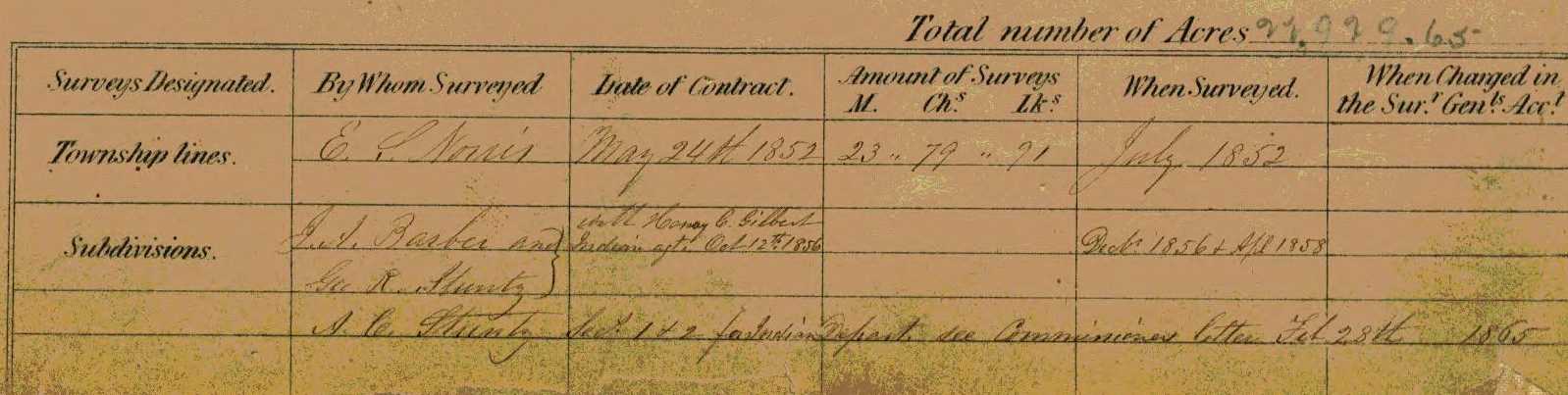
Contract awarded by La Pointe Indian Agency to Joel Allen Barber and George R Stuntz on October 12th, 1856. Survey partially completed by Barber and Stuntz during December, 1856. These survey notes are not available from the General Land Office or the Wisconsin Board of Commissioners of Public Lands.

Detail of Sturgeon Falls on the Bad River omitted from Barber’s resurvey during 1858.

Detail of the White River omitted from Barber’s resurvey during 1858.
Lancaster, Sunday Dec 7th 1856
Dear Son Allen
Here I am yet, amid my friends in this beautiful country. It was far from my intention to have spent so long a time here, but one hindrance after another has prevented my getting away. It is my design to leave the present week & stop at Sandusky probably over next Sunday. I have now passed by my friends three times, and feel as though to do so any more would look like studied neglect of them.
My disappointment at not getting any thing from you up to this time is great, & I now begin to hope you have sent a letter or two to Vermont instead of here, & that I shall find them all right when I get there. Though to tell the truth I am in some concern for your safety, fearing that you have been wrecked on your journey from La Pointe to Ironton or Bad River. I am still in hopes to get a letter from you tomorrow or before I leave the place. Your friends are all well hereabouts, and everything carry on swimmingly.
Thode Burr was dismissed from Ryland & Swab’s employment last Monday, not for any fault but because Ryland has got well enough to work in the Store “[the St Louis?]” are able to do all their business. He is doing nothing at present though he could have $30.00 per Month to go into a school at [Baserbol?]. I mistake perhaps in saying that he is doing nothing, for he is attending [any/my?] [earnestly?] to his [hymn?] & nothing else.
George Parker & Lincoln of [Midden?] (you know him) are in DTP [stom?]. Lincoln was in College 2 years & had to quit on account of sore eyes after trying to resume study twice. He gave me the following items concerning some of the Johnson Boys.
[Thuler?] was expelled last June for participating in the annual mock training contrary to the command of the College Officers. He talked of going to [knive Coll. Schunistudy?], but has not yet. Hotchkiss had to quit College & has gone to work on the farm. [Spurr?] is Married to a Miss [Denny?] of [Largage?] a real visage and was teaching in Mass. receiving $1000. for his & his wife’s services for [canninor?].
This is all that he told me of them. Had there been any thing else worthy of note, he would have told of it.
I wrote you about the Small pox being in the town & that there had been some deaths. Whether there have been any since my last I cannot say. Only 3 in all. There are no new cases for some 10 days or more & it is hoped that it will spread no further. Mr. James Mc[Gonigal?] brother to William from Tennessee was was buried last Sunday. He was taken sick of fever the Sunday previous, & went to bed saying, that was the last time, & was expecting to die untill he breathed his last on Friday night at 10’o’clock. He was a very fine young man, had lost a wife & only child, before he came here, & has been clerk for D.T.P. for some time.
Wm Carter & Miss [Rawdon?] were married last Thursday.
I should feel much better if you were living in this country than I do now, when my mind is constantly worried by thoughts of you suffering from cold, fatigue, hunger & all sorts of privations, to say nothing of being deprived of all society congenial to your natural taste.
I cannot sit down to a good meal or get into one of the warm soft comfortable beds, without thinking of my poor son who is where all such things are unknown, and may be suffering for want of the comforts that here so much abound and especially did I think of you last Sunday when there was the worst storm of snow from the N.E. ever known in the Western part of Wisconsin, so said by all the badgers. Snow fell 18 in deep in the timber, but it piled up in the roads & streets like it does in Vermont. The snow was drifted into one place East of Galena 40 feet on the track with a freight train beneath. They got the [cars?] through yesterday. The weather has been very cold here for this time of the year. Thursday Morning 4th Therm 11* below 0, Friday 14* below 0, & Saturday 6th at 14* below 0. I do not believe Vermont ever beat that in the 1st week of December, & in all that time I have been thinking how you & your company must suffer if out in the woods surveying.
I hope you keep warm nights, if so, you can do enough in the day to keep from suffering. My greatest fears at present for your [sloping?].
Allen Hyde has been very swift to purchase the little farm and has offered $35.00 per acre by my taking $415.00 of it in two lots of land. One of five acres South of the burying grounds at $315, & directly opposite the new schoolhouse. The other is a meadow of 8 acres out towards where [Sprader?] used to live at $[6.00/600?] which is cheap for either place. But I shall not be in great haste about selling for I should prefer that that little piece of land should remain in the family even if I do not live to come on it myself. There is quite a stir about farms at present. There was a Mr. Hayward from N.Y. State wishing to purchase & bartered for Jay’s farm & I think would have paid $50.00 per acre for it but Jay would not sale without he could put in his 2 ½ acres of an out lot with it. Mr. H. offered Frank Hyde $36.40 per acre for his land, East of Hollaway’s & did buy Hyde’s new brick house built the summer past near Esq. Philp’s new house, at $1,000.
Tell Jo that I think I shall want to buy his land when I can see him. I went to it soon after I got here, but I was sick all the time so I could scarcely move, consequently did not see much of it & cared very little for what I did see. Tell Wm. W. Ward that I did as I promised to do, & went to his Father’s and had a good meal that would astonish any body from Lake Superior. I have been there three times since I came, I wish you boys could have had some of the chicken din & other fixings… Wm’s eldest sister played on the [a Melodron?] & sang a number of [piren?]… Mr. Richard [Myers?], an old country Dutchman who married Martha Phelps’ sister to your Aunt [Lucy?], is erecting a steam Sawmill just across the brook due East from your Uncle Allen’s & intends to have it ready for business in the spring & Mr. [Kirke?] of Philadelphia talks of coming here to erect a Steam Gristmill in the springs.
Some things are as dear here as in the country around you. Coffe 6 lbs per $1.00. Sugar 7 lbs per 1 doll. Butter 25¢ for [good/gevd?] but Pork sells for 5. to 5.50 [gevd?] fat beef rather better than [Cousin?] Ox for [?] for [foze grs?] & 5. for Hind do. Flour $2.50 per 100 lbs, &c. Venison is brought in and sold frequently & on the whole I think there is more comfort in living here than there you can be on the Lake.
I find considerable difficulty in settling off with Old Black for the proceeds of the little farm but shall get through with him tomorrow I now hope he has drawn some [manners?] on the orchard & and done some [plervisy?] for [Sish?] he charges exorbitantly, all done before I came & he had harvested most of the corn, but I am confident the dishonest whelp will cheat me out of a good deal any way I can fix it, but I will get shut of him some way and remain so ever afterward. He has sold his tavern stand today & taken a farm 4 miles north of the Village in payment of a Mr. Wilhinson. There is a new store opened in the [forver?] East of the Burnett House where J. M. Otis over traded by two men under the firm of Baily & Carroll who are giving the build a new Gristmill below Handall’s Sawmill.

Portrait of Uncle Joel Allen Barber from page 199 of the Proceedings of the State Bar Association of Wisconsin, Volume 1900.
The prospect now is that your Uncle Allen will be elected U.S. Senator for the next 6 years after the 4th March next. I would not write this had I not good reasons for believing that it will be so. And now in regard to yourself, I do hope you will be careful of your life and health, that you will avoid exposure to the dangers of the cold & the treacherous ice as much as possible. That you will not trust yourself on the ice, long distances in the cold or storms, or alone. Finally I beseech you to take all possible care of yourself. If you have not got blankets enough to keep you sufficiently warm nights do so & get more & not suffer or be uncomfortable without or for want of them. I do not feel reconciled to the thought of going home without hearing from you, & knowing that you are alive & well. I overhauled the trunk of our dear lamented Augustus yesterday and [leave?] nearly every thing as I found it. There are some good clothes, that may be of service to you, should God spare you to ever come down here. I have rec’d a number of letters from home since I got here, but none lately, as they are probably expecting me home about this time, all were well. I do not know whether I mentioned in my letter to you that your mother had drawn $209. from Government additional pension money.
Adieu my dear son.
That our Heavenly father will bless and preserve you is the daily prayer of your affectionate as well as afflicted father.
Giles A. Barber
To be continued in the Winter of 1857…
Barber Papers: “In a Little Trouble” Winter of 1856
October 9, 2015
By Amorin Mello
Selected letters of the Joel Allen Barber Papers
… continued from Fall of 1855.
Minnesota Point Jan [23rd?] 1856
Dear Parents
It is sometime since I have wrote to you and for a fortnight or more
[???] [two lines on this copy are illegible] [??? ?????]
On arriving at Lapoint we found sheets from home and a good lot of newspapers.
We left Lapoint Thursday afternoon [on a firm of ?????? ? ?? head?] of [?????????] Nagonup the principal chief of all the Chippewas, Augustus and myself [??? ??? ?????] drawn by by two dogs on a dogtrain. At [????? ???????] were joined by one of Nagonup’s [??????].

Photograph of Naagaanab (Minnesota Historical Society).
They were on their way to Washington. Several of them are going accompanied by a gentleman from Lapointe as interpreter. The first night out we stayed in a wigwam with old Chingoon and his interesting family. Friday night we camped. Saturday reached Iron river. Sunday left and [comfortable?] – Monday came here. Augustus has a sore througt, not severe – otherwise we are well as usual notwithstanding our tramp of over [100?] miles. I must now quit writing and try to find one of our dogs which has strayed over to [???].
Under the old permit system, many locations, three miles square, were made on Lake Superior;- several on and near the Montreal river – some on Bad River, south of La Pointe – three on the main land, opposite La Pointe – two or three were made near Superior City, on the Nemadji, or Left Hand river, and one settler’s claim about twenty miles north of Superior.”
~ Mineral Regions of Lake Superior: As Known From Their First Discovery to 1865, by Henry Mower Rice, 1865[?].
Perhaps you wonder what we have made this journey for – perhaps you hope we are going below but that is not the case. Why should we [?????]. It is warmer here than at many places two or three hundred miles south of here. True – one or two thermometers froze up at this place but others did not while at Fort Snelling, the spirit thermometer inside the walls indicated 44 degrees below zero. Augustus wanted to see to his preemption and I had nothing to do but to come along with him. I also wanted to find out a few things concerning a place that I should like to preempt. I suppose there is not a better copper show on the south shore of the lake, but the land is not surveyed and my only sure way to get it is to settle on it and stick to it until it can be legally claimed.
The town lines will be run next summer.
Augustus is in a little trouble about his claim. It appears his declatory statement never reached the land office. But I guess it will all be explained and made right. The dutchman who was to contest his claim has left the country and would stand no chance if he was here. We have a land office here now which saves a great many journeys to Hudson near St. Paul. We shall go back in a few days and commence surveying around the islands. Now don’t fancy that we cannot survey in the winter, for we have tried it and know better.
Detail from the Stuntz/Barber survey of T47N R14W.
“J.H. Bardon, a Superior pioneer, stated that ‘at Copper Creek and Black River Falls, twelve or fifteen miles south of Superior, and also near the Brule River, a dozen miles back from Lake Superior, Mr. Stuntz found evidences of mining and exploring for copper on a considerable scale carried on by the American Fur Company, under the direction of Borup and Oaks of La Pointe, in 1845-46. A tote road for the mines was opened from a point ten miles up the Nemadji River to Black River Falls.‘”
~ Duluth and St. Louis County, Minnesota; Their Story and People: An Authentic Narrative of the Past, with Particular Attention to the Modern Era in the Commercial, Industrial, Educational, Civic and Social Development, Volume 1, by Walter Van Brunt, 1921, page 66.
At Bad river we were at work during the coldest weather, and only lost two or three days because of cold but when the thermometer was up to 20* below zero we worked right ahead – sometimes in swamps where we stepped through the snow into the water,
[last line on this page of this copy is cut off]
The weather for a week or more has been fine. Cold enough to cover us with frost but not severe.
Provisions are very scarce – no flour or pork can be had.
They will begin to bring them through from St. Paul in a few days. Flour it is hoped can then be bought for $20 per barrel. Fish are not exactly plenty but they can be obtained for money or labor which is not the case with anything else. The country is flooded with dry goods, [p??y] articles and everything but provisions because they can be bought on time but eatables could only be got by paying cash down.
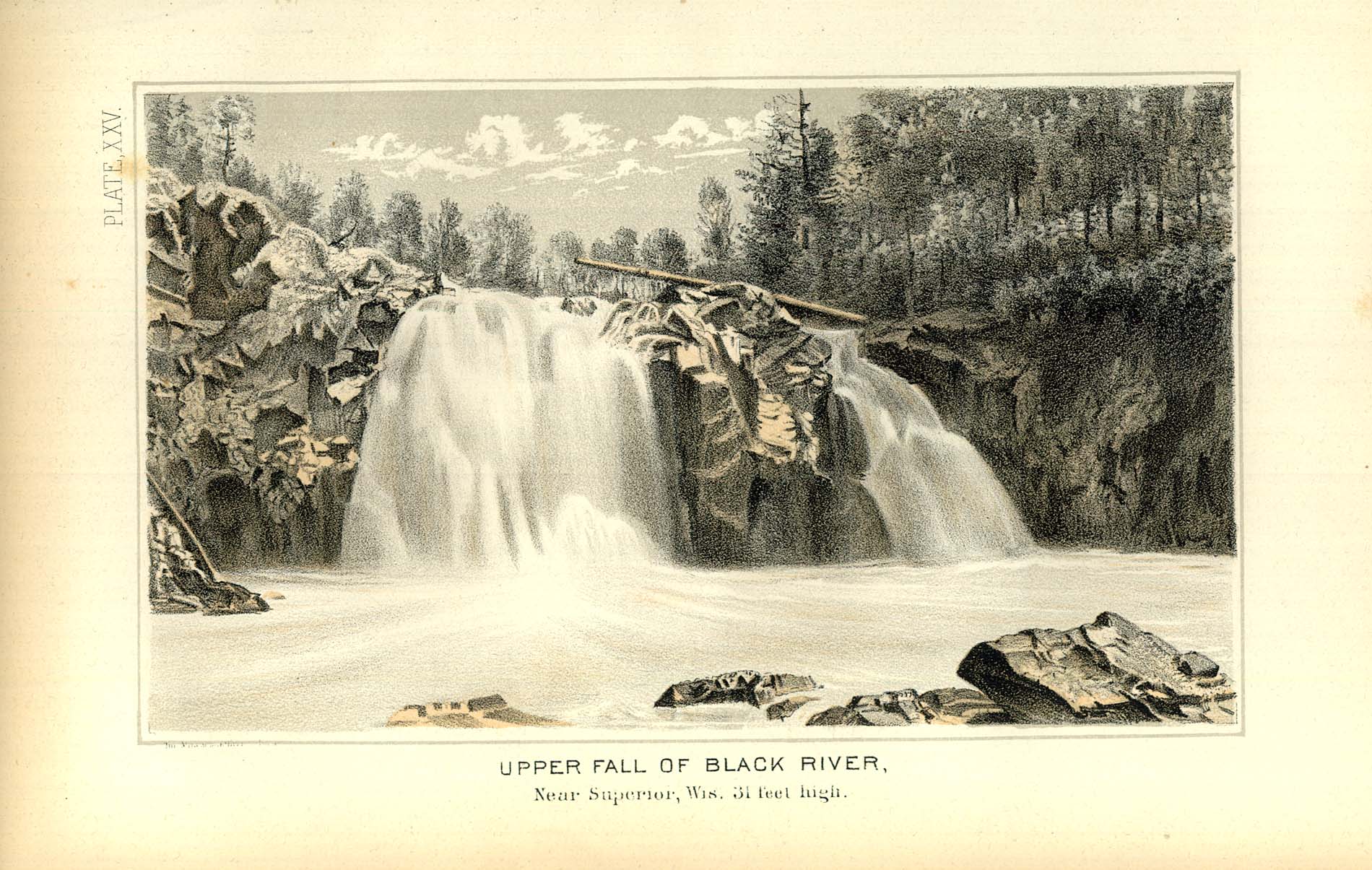
Geology of Wisconsin: Survey of 1873-1879,
Volume III, 1880, page 342[?].

Geology of Wisconsin: Volume 3, page 341.
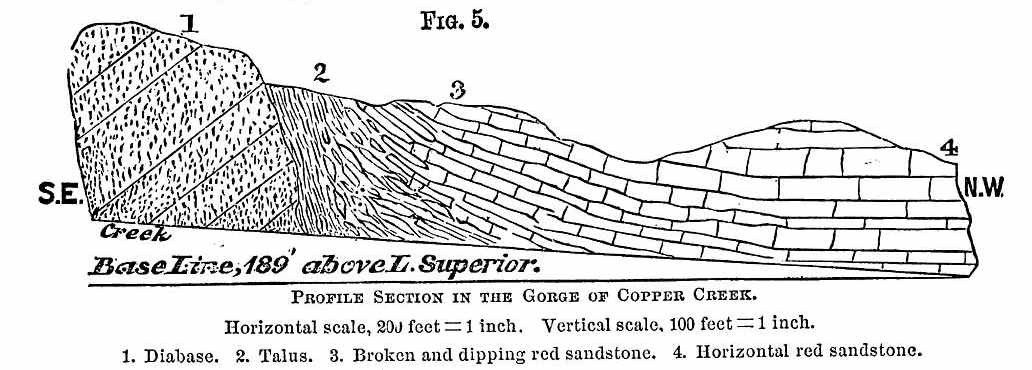
Geology of Wisconsin: Volume 3, page 345.
The Fon du Lac mine has commenced operations with tolerable fair prospects. It is the only mine in operation this side of Montreal river. Augustus’ claim is on the same vein and for aught anyone knows just as good besides having abundance of water power. All the copper excitement since I come to the country has been directed toward the north shore. This morning I signed 2 petitions, one to congress for the early survey of the north shore and another for a road down that way. I have made a little map of the islands and last summers survey and some other things that I will enclose.
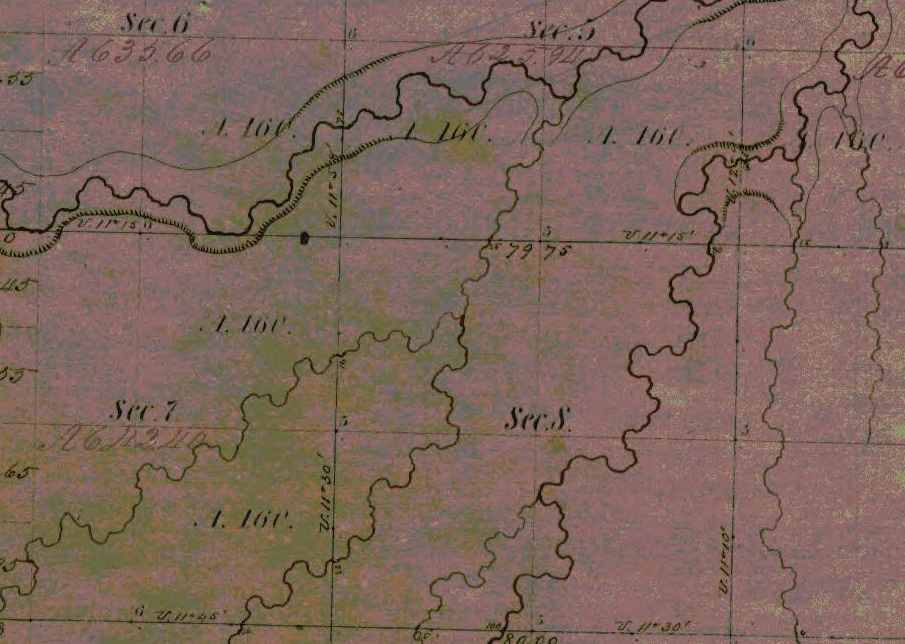
The Fond du Lac copper prospect was located near a small tributary of the Left Hand River on this map detail from T47N R14W, near Pattison State Park. Augustus’ claim was along the same vein of copper but had not been surveyed yet; perhaps it was at Amnicon Falls State Park.
Augustus has begun a letter to send with this. He has just come home with letters now about his claim.
No more at present from
Your affectionate son
J. Allen Barber
Direct to Lapoint
Minnesota Point
Superior County
Minn. Terr.
Sunday Feb 10th 1856
Dear Mother
Augustus has written a letter, and left it for me to enclose and dispatch so I thought I would ship in a few lines before sending it off.
Augustus started today with a young man and two dogs for Lapointe. I shall probably go there in a two or three weeks to return immediately. There are two men going down with a tamlins pony team with provisions from St. Paul for Augustus. The men are going to work for him and I shall probably bring the team back and use it a while. I have at last fixed my mind on a place that I mean to claim. The location is a point at the mouth of Left hand river, known as Left hand point. It contains only 5 or 6 acres in low & swampy and covered only with bushes coarse grass and floodwood. Nothing but the fact of its being a part of Superior city is of any value whatever.

Barber’s sketch of his land claim at the mouth of Left Hand River. This location is now an industrial neighborhood of Superior on the Nemandji River.
As it is $1,000.00 per acre is not an overestimate of its marketable price at present. It joins or is part of the grounds intended for the Railroad buildings when the survey was made here this point was cut off by the meander lines instead of meandered. Therefore according to the [rearns/records?] no such land exists.

A resurvey is to be made and I mean to fasten it by a preemption which is the only way to obtain it before the land sale. I may get cheated out of it and I may throw away my time and money but such chances are scarce and should it transpire that my claim is good I want to have my dish right side up for once. I have written for Uncle Allen’s advice and should I ever find it advisable to drop the matter I can do so without forfeiting my preemption right.
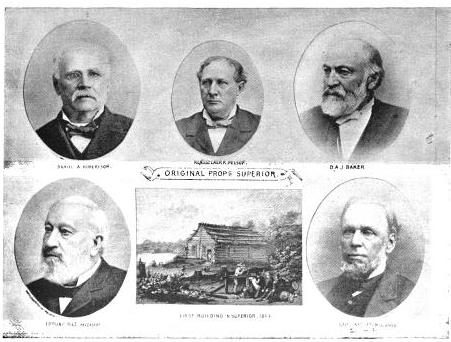
The Eye of the North-west, page 9.
The Superior Company with Company with which I shall probably have to contend is rich, influential, and on good terms with the administration. All that can be done by fair means or foul to defeat any claim will probably be done, but some things can be done as well as others, at any rate we shall see what we shall see.
So my head is so full of business just [snow?] you will please excuse the shortness of this letter and look for more when I have more time.
Your affectionate son
J Allen Barber
Superior Feb. 17th 1856
Dear Brother
It is sometime since I have written anything to you but you have heard of me so often that I suppose it makes no particular difference. It will be nearly sugaring time when you get this.

Makak: a semi-rigid or rigid container: a basket (especially one of birch bark), a box (Ojibwe People’s Dictionary) Photo: Densmore Collection; Smithsonian
I have once more got into a country where sugar is made but not by white men. The Indians make pretty good sugar which is generally done hard and [sinted?] dry and put into birch bark “mo’kucks” holding from 50 to 75 lbs. This bark is also used exclusively for buckets, store trays, gathering pails, &c. The timber in this country is not as equally distributed as in Vermont. The land is mostly covered with evergreens but there are some located portions of country where maple abounds. These “sugar bushes” as they are called are often quite extensive covering several sections and and [they?] only at intervals of 8 or 10 miles, but this is just as well for the Indians are both migratory and gregarious in their habits.
Detail of an Lake Superior Chippewa “sugar bush” from the Barber brothers’ survey of T48N R5W.
I hope you will eat plenty of sugar next spring and take some of the girls to a sugar party or two like I used to. I am doing nothing now most of the time but shall have business enough in a few days when I begin to build my house that is if I conclude to grab for the price of land I am now watching. I am waiting to hear from Uncle Allen and for some other things to transpire. There is not a man in the country whom I could trust that could give me any reliable information such as I want. I want you to hurry and become of age as soon as possible and come out here this spring and make a preemption.
There are some good places left yet, but don’t get married before you make a preemption for it might not be convenient to take your wife out into the woods 30 or 40 miles to live on the place as you would have to do in order to “prove up.” I am going to get up an ice boat before long which will be very useful as I mean to do considerable boating yet this winter, and I might use it to carry lumber and other things up and down the lake. With such winds as we have had a few days ago I could easily go to Lapointe and back in two days. I suppose Augustus got a party started by this time and he will be at it himself in a few days. I am living with a man named Fargo, you have heard of him before. We are living in Stuntz’ store. Board at the hotel is ten dollars per week. Old Steven Bonga is living on the point, he has been something of a traveller having been to Montreal, Hudson Bay, [Oregon?], Prairie du Chien, and all intermediate places.
He is half indian and half negro so you may suppose he is not very white.

Portrait of Stephen Bonga (USDA Forest Service). Additional information about Bonga is available from the Wisconsin Historical Society.
A railroad has been laid out from here to St. Paul and my claim covers the terminus at this end. There have two or three new towns started into existence along its route in imagination. Perhaps they are [surveyed?]. This making towns in a new country is a great business.
What happened in your good town on Christmas and New years eve
Were there any stockings left.
I want to inquire about lots of girls and boys in Johnson and Cambridge but I conclude you will tell me as much as you can in your next letter so with respects to all enquiring friends I remain
Your affectionate brother
Allen
Superior, Douglas Co. Feb. 25th 56
Dear Parents

Detail of Superior City from T49N R1W.
Night before last I got a letter and some papers from Augustus also 2 letters from home which he had read. They were dated Dec. [21st?] & Jan 2nd.
Sad and startling was the news of the death of George Hill. Who could have thought three years ago that such a dark future lay before that family. Every day some sad event warns me of the uncertainty of life. Men have died here who had no friends to mourn their loss, and their death is hardly noticed. I always ask myself why was it not me instead of them and will not my turn come soon. Yes, let it come soon or late as the world reckon, and it will be soon to me.
There is just as much danger or accidents in this country as in any other and no more but as to health there is no better place in the world than this. You seem shocked at the idea of surveying in the winter, but it will be nothing but fun to survey during the rest of the winter. It has been moderate pleasant weather now about two weeks. The snow is going off a little lately and it seems a little like spring. We had some pretty cold weather about new years but we shall have no more such. The lake is more open than it ever was known to be at this season before.
It sometimes freezes across at Lapointe but now it is open within six or eight miles of here. Flour is only $20 per bbl‑ with prospect of falling lower. The Indians chiefs have returned having only been to St. Paul where they found a letter telling them to delay their visit a while.
Poor creatures! They are fooled around by traders and speculators who are with the government in robbing and dwindling them. Any thing like a full account of their wrongs would astonish even them. About my claim I have not [???] today. There is another man after it and it will be no easy thing to carry my point.
Valuable property is troublesome stuff in this country. There is a townsight three miles from there now in litigation for which there is a standing offer of $200,000.
I am still living with Fargo on Minnesota point. I expect to go to Lapointe before long with Albert Stuntz who is going down with some supplies for Augustus which he brought from St. Paul.
It is too dark to write
Good bye
Allen
Superior, March 4th 56
Dear Parents
Not much has happened in this vicinity worth recording. The principle circumstances of note is the burning of a house and all the worldly possessions of a poor [Indian?].
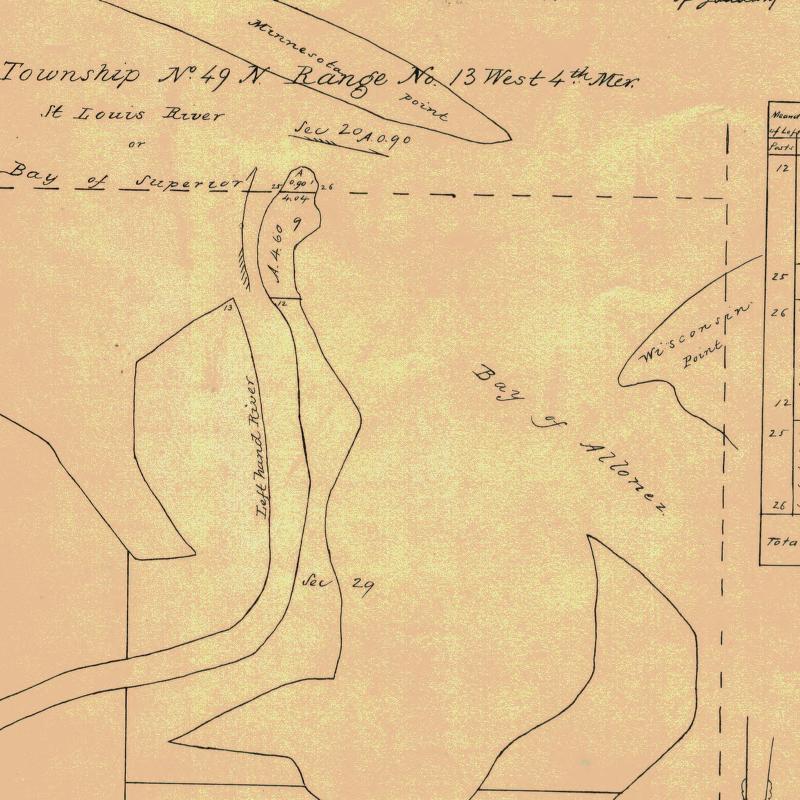
Detail of Left Hand River from Stuntz’s survey; where Barber’s land claim was located.
I have heard nothing of Augustus since writing last but expect to when anybody comes up the lake. About my claim I can say but little my chance is but dull still I don’t mean to give up so large a prize without good reasons.
I have had it surveyed and the notes sent to the Surveyor General with a memorial stating the facts and asking him to [appraise?] the [notes?].
The price contains over 8 acres (8.695).
Perhaps it occurred to you that I am was 22 years old last Sunday. Well such is unquestionably the case although nothing was done to celebrate the day only I had my hair cut for the third time after leaving Vermont. I think I shall have to go to Lancaster this spring but unless I get ousted here it will be difficult to leave.
I wish I could multiply myself by about a dozen in order to hold several valuable claims which are not occupied by any one who can legally hold them. I can’t write here two children [pretting?] and several people [telling?] Albert Stuntz and family are here today. I am perched on a sawhorse writing on a work bench loaded with all manner of [marbles?].
Evening – quiet once more since dark I have written a letter to the Surveyor General to accompany a memorial that I have been circulating. O I wish there was a person in the country that I could depend on to assist me in regard to that claim. There are one or two that I counsel with who know no more than I do and then I do as I think best.
I expect [Lowener?] to find out I have no show, and that will be the last of it I shall [not feel?] that I had lost it for I never had it, but if I don’t get it some body else will get 15 or 20 thousand dollars worth of land that I want.
Provisions are still high and will be higher again before navigation opens which cannot be expected before the 1st of May. Flour is $20/barrel, fresh pork 18 ¾ cents per lb, beef 20 cts milk 20 to 25 cts per qt. &c, &c. Eatables must be higher because there will be little or no sleighing after this over the barrens between here and St. Paul. My mind has been on the [rock?] so much today that I am not in a mood to think much about home so please excuse the shortness and dryness of this letter.
I remain your affectionate son
J Allen Barber
Went to Iron River Thursday 13
Returned 15th
Superior , Douglas Co. March 11 1856
Dear Parents
Yesterday I read a package of letters from Augustus containing one from him & from home one from Albe and one from [Caldridge?]. As Augustus was in town (Lapointe) when he recd. your letters I suppose he has answered them so I cannot tell you much news about him. I am still staying with Fargo – not doing much but hoping to get pay for my time and expense by securing the prize I am after. There is some excitement in town about it, but mighty little is said to me. The Register at the land office gives me good encouragement and says a preemption will hold it. I have taken some steps toward building on it. Today I bought a sack of flour ½ barrel for 12 dollars, I shall get some fish from Lapoint where they are very plenty and cheap and then I shall be almost ready to try housekeeping alone.

I am sorry to hear of the disastrous results of the low price of hops. Although farmers must suffer in consequence yet I believe speculators will make fortunes out of it. If I was in the business of raising them I should stick to it. No articles is so liable to fluctuations in prices as hops but it is well known that the risk fails once in five years on an average so they must come up sometime.
I see you are inclined to believe our country and climate are more in hospitable & forbidding than yours. Such I believe is not the case. We have had some very cold weather but the changes are so moderate and so seldom that we pay but little attention to the weather – in fact we call most all of it very fine weather, as it is. The lake is a great equalizer of temperatures and our cool lake atmosphere in summer causes showers to fall from all the warm, sweaty winds that come here to wash their faces in this big blue pond. People in this country go much better prepared for cold than they ever do in Vermont. I have not worn a boot since leaving Lancaster. We wear shoes in the summer and moccasins in winter.
Boots won’t do for surveyors – they carry too much water unless we stop to empty them after crossing every stream or marsh.
While speaking of clothes perhaps I might as well go on with a few more items of the same sort.
Shoes for this country should have no lining or binding as they are quicker and ae not as stiffwhen dry. We never apply anything to soften them and nothing can preserve them from wearing out in about two months of hard service. They [sell?] about $1.50 per pair. We can get plenty of wool hats which are the only ones we wear.
All manners of shirts can be bought, even the very best quality of red flannel ones, which are universally warm, outside, i.e. by common folks.
The gentry of Superior dress most distressingly.
It is difficult to get good socks any where on the country. I have worn out 6 or 7 pair this summer and lost some more – they cost high bests we don’t wear. I have none. The only cost I have is of [Gihon?] cloth and made by Mrs. Sheldon. Cost are not much more except as an extra garment to wear occasionally.
Good durable pants I find it difficult to get. They are generally poor [ashnet?] and not half put together. Good your mittens would be very acceptable but for want thereof buckskin or blanket mittens are generally warm.
You speak about bringing Kate [in?] to Wisconsin. My advice is to it without fail if you intend coming out to live, nothing should prevent it if I were in your place. The horse that Uncle [Jay?] brought out with him is smarter and tougher than any one he can find to use with him. There is nothing that I regard as more necessary for a family than a first rate horse. I think [Kelty?] will be a very good serviceable animal for work besides being one that you might be proud to ride [after?] over the prairies. Probably Augustus has told you what he thinks about Amherst and other boys coming out here to survey. Butler was so badly disappointed in this country that I have had but little thoughts of [enough?] any one else to come here. Such a disappointment I think would be the fate of 4 out of every 5 that try the business.
A person to be a surveyor must be able to travel all day through the woods and sometimes carry a pack. I would not prevent any from coming here as there is generally business enough besides surveying. A surveyor can make no greater mistake than by hiring any but the best of men. Perhaps Augustus has not told you that he will be out of the business as soon as his present job is done and will devote his time to the improvement of his claim &c. I should like very much to [have?] Amherst here but I dislike to have my parents left entirely alone. As I have [???] two half [sheets?] – when I only [illegible] mind up for the [present?].
[Incomplete copy of letter]
To be continued in the Spring of 1856…
Barber Papers: “Barbers Camp” Fall of 1855
September 19, 2015
By Amorin Mello
Selected letters of the Joel Allen Barber Papers
… continued from Summer of 1855.
Johnson Sept 26th 1855
Dear Son
Although but two days have elapsed since I wrote to you & Augustus jointly, the spirit moves me to try it again, first to correct a very great error I committed at that time by enclosing the handbill issued by your Uncle Burr for the apprehension of the murderer of Abial Chase, I merely sent it that you might see it as I would have handed it to you to look at, if you had been here, but the soul & essence of all propriety chid me smartly for it calling it “foolish, childish & very improper” so I suppose it was, and if this will answer for an apology, I will pass on to the 2nd article. That is the bursting up of the Bobkin concern, which took place this morning.
“The murder of Abial Chase by Jefferson Fulton : on the 6th day of Sept. A.D. 1855, at Fletcher, and the suicide of Fulton on the 10th. With an explanatory account of the original difficulties between them, and the circumstances attending the death of each party.”
~ by Wilson & Henderson; published by Messenger Print, St. Albans, VT; 1855.
There is considerable mystery attending the transactions for they have been making money rapidly and there is apparently no cause for such a move, I worked hard from breakfast to now removing property from their shop to my barn. It looks as though they had got sick of their location and wanted to get away to some other. Their stock of hides of all kinds are all done up & sent to market & their [pits?] empty, the copper boiler taken out, and sent off. Old Bobin has been out west this summer & has probably found a place where he & Frank are going & perhaps Phelps too & they cut up this [shine?] to get rid of the place and turn their [???????] in to pay their debt to [Sen?] Knight about $230.
The Barber brothers, Augustus and Allen, surveyed the first three of six townships for the General Land Office during the Summer of 1855, which included what are now the Cities of Ashland and Washburn. The Barber brothers continued their survey contract with the second three of six townships into the Fall of 1855; before, during, and after the 1855 Annuity Payment.
Hiram has been up to the cattle show at Hydepark to day and has got home just at dusk pretty well used up having been up on foot, as did Benton & Leo Hyde, though they are coming down by stage & Am footed it back. I had no notion of going up there as I have long been sick of going there, so I took my name off and bode them a final adieu. I go to Hydepark as seldom as possible because I love the place and people so well.
As I said in my last, I expected a letter from you at the same time my letter started, so I found it, for yesterday Morning I found one from Augustus which was right welcome as it brought news of the continued good health of you both.
“At Vanderventer’s Creek, near Washburn, was the Celebrated Gigito-Mikana, or “council-trail,” so called because here the Chippewas once held a celebrated council; hence the Indian name Gigito-Mikana-Sibiwishen, meaning “Council-trail Creek.” At the mouth of this creek, there was once a large Indian village.”
~ Collections of the State Historical Society of Wisconsin, Volume 13, pages 432
I am glad Augustus is so punctual in writing and it seems as if you could give us a few lines once in a while as well as he.
Will you try it? Benton delivered a lecture last evening to a full house. Subject, the proper course of Education in relation to the remarkable progress of the age, as necessary to the requisite training & diciplining of the mind.
It rains & I have got to go and carry this to the office, so you must excuse my brevity.
May God bless you both
G.A. Barber
PS. Some groaning about writing so often
Johnson Sept 30th 1855
“Nedobikag-Sibiwishen is the Indian name for Bay City Creek, within the limits of Ashland. Here Tagwagane, a celebrated Indian chief of the Crane totem, used occasionally to reside. Warren gives us a speech of his, at the treaty of La Pointe in 1842. This Tagwagane had a copper plate, an heirloom handed down in his family from generation to generation, on which were rude indentations and hieroglyphics deonting the number of generations of that family which had passed away since they first pitched their lodges at Shagawamking [Chequamegon] and took possession of the adjacent country, including Madelaine Island. From this original mode of reckoning time, Warren concludes that the ancestors of said family first came to La Pointe circa A.D. 1490.“
~ Collections of the State Historical Society of Wisconsin, Volume 13, pages 430Dear Sons
Having written twice within the last week I have but very little to say now that may be interesting to you, but as I have determined to write as often as once a week and oftener if any thing transpires worthy of the mention of it, I again set myself to the work. In my letter of last Wednesday night I mentioned the [vainose?] of Mr Bobkin from these diggings and the attachment of all the effects of [Phelps ?] Bobkin on the debts of sundry individuals. Thursday morning B’s little wife Jane went over to Montpelier to his father’s to go with them westward the Lord knows where.
Charles [Judivene?] who has lived in the house with them is going soon. People think Phelps is soon to follow. [Hawley?] Smith & family & [Hm?] Smith & family go this week. I sent you a Methodist Paper with the notice for the dedication of our new Chapel therein and also was scribbled on it the startling news of the fall of Sevastapol which was telegraphed from Halifax the day before. Some doubted but Boston Papers brought the news yesterday morning & this morning the [Sumlokg?] Tribune brought a full confirmation, with some of the particulars of the bloody encounter.
The Barber brothers included many details in their surveys, including this one of an Indian Sugar Camp (T48N R5W).
The Bombardment commenced upon the [Malakoff?] Little Redan at [Carediring Bay?] by the French & the Redan by the English at day break on the 5th & continued to Morn the 8th when the assault commenced.
You will receive the news of the battle by papers to be printed this week & probably this will reach you first. So that I may be the means of giving you intelligence of great importance sooner than you would otherwise get it.
“According to Blatchford there was formerly another considerable village at the mouth of Whittlesey’s Creek, called by the Indians Agami-Wikwedo-Sibiwishen, which signifies “a creek on the other side of the bay,” from agaming (on the other side of a river, or lake), wikwed (a bay), and sibiwishen (a creek).”
~ Collections of the State Historical Society of Wisconsin, Volume 13, pages 430-1
Mum always says that it is useless to try to give early news because you will hear of it sooner or later, and what is the use of writing again so soon? I always that if anything transpires worth relating that then is the time to tell it. I have been to Meeting to hear Mr D all day as I usually do when at home, especially since the baptists [rave?] got their new man Mr Mirriman to preach to them and all creation are running to hear him on the new broom principle. Mum and Am have gone to Cambridge to day to try to find a girl, & I see by her letter to you that she is complaining that I do not [figosure rup?] for her, & that She has too much to do &c&c. I would at any time get a girl for her did I not know that it would only furnish [new?] grounds of complaints. If I got a little girl then there would be trouble for thinking that She could get along with such help, that it was no help at all & made her as much work as it saved, while should I get an older girl she would soon discover certainly as soon as she got rested that she could get along without any or with a little [one?]. It is a fact, that her mind is not as stable and unchanging as the Green Mountains, and in regard to what she says of my not telling her my plans, I will barely say that so long as she does not know them she cannot combat them, which she surely would, whatever they were and in regard to my having run through all the [offices?] &c & taking a pretty clerkshop, it is all news to me coming from her [diseased brain?]
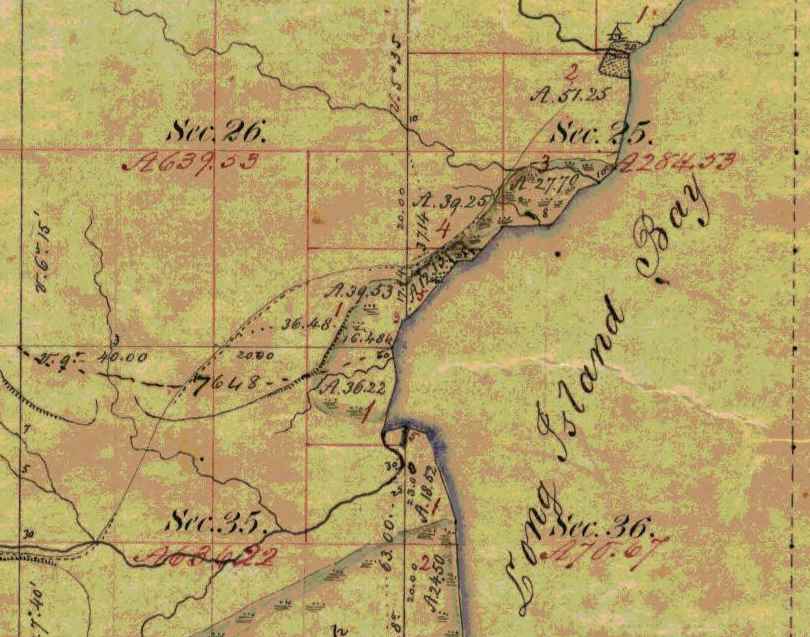
Detail of T48N R5W:
Chequamegon Bay;
an named settlement at the mouth of Boyd Creek;
the Whittlesey Creek National Wildlife Refuge;
and the trailhead of the Grand Footpath.
“Boyd’s Creek is called in Chippewa, Namebinikanensi-Sibiwishen, meaning “Little Sucker Creek.” A man named [Robert] Boyd once resided there, married to an Indian woman. He was shot in a quarrel with another man.”
~ Collections of the State Historical Society of Wisconsin, Volume 13, pages 431-2
“From this place northward, there were Indian hamlets strung along the western shore of the bay. Father Allouez mentions visiting various hamlets two, three, or more (French leagues away from his chapel. Marquette mentions five clearings, where Indian villages were located.“
~ Collections of the State Historical Society of Wisconsin, Volume 13, pages 431
I have been talking with the [boiv’s?] about making my way into cloth for me: and I am convinced that by so doing I can realize 45 or 50 cents per lb for my [westwhoaor?] should I sell it now I could get 34 ¢ per lb for 20 [place?] and only 25 cent per lb for the remainder. It is the very thing that Mum proposed and urged to me weeks ago when I talked of selling it. But now I have concluded to do so she is in distress for fear I shall have to go out there to sell it. I have been thinking of going in [December?] to buy lumber & get it in the ground & make preparations for some improvements on the little farm and I think some good [G??? ???] into [franned?] will be good articles in [enough?] a [country?]. I am in hopes to have [on yes?] cloth or perhaps [?????] cloth & [?????? ?????? or more?]. So my object is to spend my money. Mum says [???] when she sees in prospect [thall?] I [???] go [while?] no longer ago than yesterday she [pevondered?] why I did not go and be doing something on the place in Lancaster and garden from day to day [having?] down one day the plans she had built u the day before &c &c.
The hop harvest is about through and there is not only a small crop but the prices will be low this season – [same when?] I was at the Institute last week and was much surprised with Am’s performance as [cutic?], and if I can get it, will copy it for you that you may see how he is improving.

Detail of a trail between Chequamegon Bay and the Saint Croix River National Scenic Riverway (T48N R5W). This is the Grand Footpath that was discussed in the Comments section of our Oshogay post.
“A short distance from Whittlesey’s Creek, at the western bend of the bay, where is now Shore’s Landing, there used to be a large Indian village and trading post, kept by a Frenchman. Being at the head of the by a, it was the starting point of the Indian trail to the St. Croix country.”
~ Collections of the State Historical Society of Wisconsin, Volume 13, pages 431
I have just looked for it & cannot find it, but I think you will say when you see if that it is pretty tall for one only 14 years of age. I think he is making pretty good progress in his studies though his mother is in great affliction if he is not bowed down to his books every moment. She thinks he should be kept as close to his books as a hired man or girl at their work and if anything closer, because it is not work.
I shall have some [curly?] to carry with me when I leave this town and would like to get it into [law/land?] in some good place for in that way do I think it would be surest and increase fastest.

Detail of a sand stone boulder (T48N R5W).
Still I know not what I shall do. Perhaps I may live and die in Vermont after all, but I want to be in some more productive vicinity than Johnson and some more pleasant place than our old farm in Cambridge. I can work yet but but as for [eritubing?] those hills & rocks I should beg to be [exensed?], though I should regret to have the wood land & sugar place more them all the rest for they [ground me aplenty?] in this or any other place. But oh [such wish her?] the river has made with the banks within the [two ????] years. It makes me sick when I see it and know that it cannot be helped.
“Further north is Kitchi-Namebinikani-Sibiwishen, meaning “Large Sucker Creek,” but whites now call it Bonos Creek. [Boyd and Bono] creeks are not far apart, and once there was a village of Indians there. It was noted as a place for fishing at a certain time of the year, probably in spring, when suckers and other fish would go up these creeks to spawn.
~ Collections of the State Historical Society of Wisconsin, Volume 13, pages 432
I have got to get supper for [Mrs?] Benton and milk and shall have to close this stupid letter. What do you think of having Am & I out there through the winter? Could we find room any where to lie down and could we find [syinge teethes being?] used to say ??. You will see that I am economical of my paper I cast such an enormous square for postage THREE whole cents a week. It is thought any [exlaws out?] Had I been as intent on (spending money as [reprebuted?] I should have gone to Quebec [last ??? in?] Excursion fare only $3.50 from Essex to Quebec & back again. I am sorry that I did not go, as I am chgd with such a desire to spend money.
May you both prosper in all Laudable pursuits & live long is blessing to your parents & the world
G.A.B.
Interior Field Notes
Township 48 North, Range 5 West
Oct. 1855
Notebook ID: INT049W06

Original plat map of T48N R5W. Today, this is the Town of Barksdale.

Survey of T48N R5W by:
Augustus H. Barber, U.S. Deputy Surveyor.

First page of affidavit; continued below.

Chainmen: J. Allen Barber 2nd & George I. Butler
Axeman: Joseph Dennis
(Joseph Dennis was a mixed-blood member of the Lake Superior Chippewa tribe and eligible for a land grant under the seventh clause of the second article of the 1854 Treaty of La Pointe.)

The Barbers’ original field notes for this township were reproduced in 1891 “…for the reason that the original record is becoming illegible by the fading of the inks.“
[c. Oct 12, 1855]
Barbers Camp Oct 1855
Dear Parents
Being unemployed today I have an opportunity though a poor one to write to you once more.
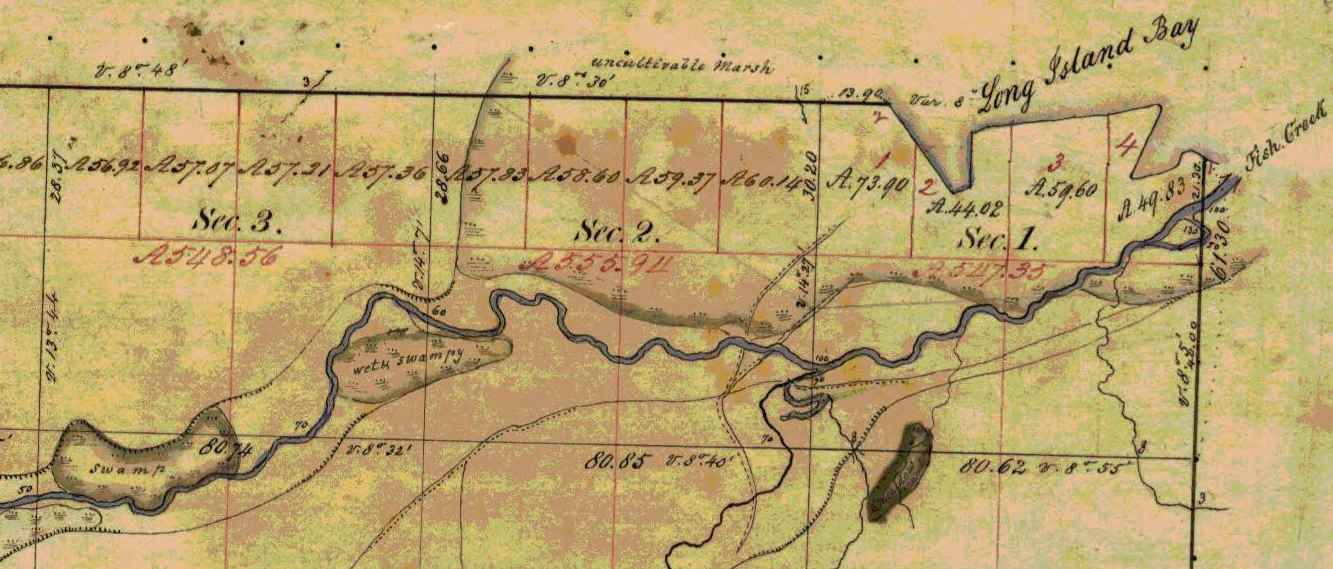
Detail of Fish Creek Slough (T47N R5W).
My health for a few days past has not been good – in fact I have been obliged to be idle the last two days from a kind of disentery very common here and apt to turn to bloody flux. But I am much better today and hope to resume work tomorrow.

Detail of Metabikitigweiag-Sibiwishen; now known as South Fish Creek (T47N R5W).
~ Collections of the State Historical Society of Wisconsin, Volume 13, page 430.
Our party now contains 3 halfbreeds, two to keep camp and one to ax. At first I did not like the idea of having such looking fellows to work for us but they get up good victuals. I don’t inquire how. I have to cook occasionally but I can’t tell how I make it go. Still my pancakes and fried pork and bean soup are generally devoured with an assiduity not often seen out of the woods. The survey is going on pretty well lately. The fourth town will be finished in 4 or 5 days. Then there will be only two more. We are having very good weather now, perhaps it is the beginning of our indian summer which they say is very fine on this lake. I have not yet made up my mind what I shall do this coming winter.

Details of a spring and trails along Fish Creek; and the footpath from Chequamegon Bay to the Mississippi River via Lac Courte Oreilles (T47N R5W).
~ Collections of the State Historical Society of Wisconsin, Volume 13, page 430.
If I make a claim I shall probably live and work on it. I know of a place near the bay for as good a farm as can be made on the lake, good bottom land — some of it producing good hay now. During the summer there has been some emigration to this country but there is room for more yet. The only settlements about this end of the lake are at Superior, Iron river 27 miles this side, Bark Point bay, La point, this bay, Bad river, & Montreal river. At Bark point there is only a fishery and at Bad river a mission.
Lapointe is a queer old town. Standing in the midst of an almost unknown country it presents the appearance of and is in fact about the oldest town I ever saw. Not a horse or carriage track can be seen in the streets and there is not a carriage road leading from the town. The buildings were mostly constructed without sawed lumber and are mostly enclosed with high fences of sharpened posts. Squaws, half breed children, indian dogs and lice are the principal commodities. French and Ojibway are the principal languages spoken.

Detail of water bodies and trails in the vicinity of the Badgerwood CAFO being proposed by Reicks View Farms in current events, described in 1855 by the Barber brothers as “an elevated ridge, much resembling the Mineral ranges of this region” (T47N R5W).
But a more beautiful bay can’t be found than La point bay. I think it is always a safe and accessible harbour.
Oct. 21st. Since writing the above I have recovered my health and been at work about a week.
Love to all
Allen
[Incomplete copy of letter]
[ca. 1855] Nov. 1
Father’s“letter of November 3, 1856, was written during a rough voyage down Lake Superior and Lake Michigan in the famed steamboat ‘Lady Elgin.'”
This incomplete letter was misfiled as 1855; it was from the Fall of 1858. Stay tuned.
Nov 1st The weather is quite different now from what it was 2 years ago yesterday when I left you to come down on the Lady Elgin & to day when we lay shut in by a NorthEaster at Copper harbor.
I have this A.M. recd a letter from Maime Burr & one from her bother. Maime is a beautiful writer both as to matter & manner.
The folks at Lancaster were well except Cyrus who I fear is consumptive.
It is time for me to go to the House & almost time for the Mail to close.
May Heaven bless & protect you
G.A. Barber
Interior Field Notes
Township 47 North, Range 5 West
Oct. 1855-Nov. 1855
Notebook ID: INT049W05

Original plat map of T47N R05W. Today this is the Town of Eileen.
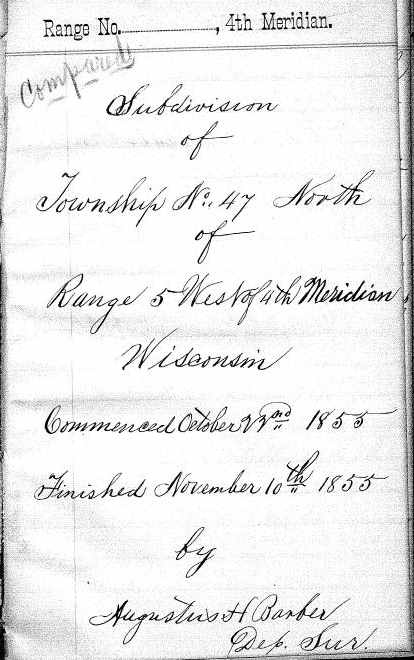
Survey of T47N R5W by:
Augustus H. Barber, U.S. Deputy Surveyor.
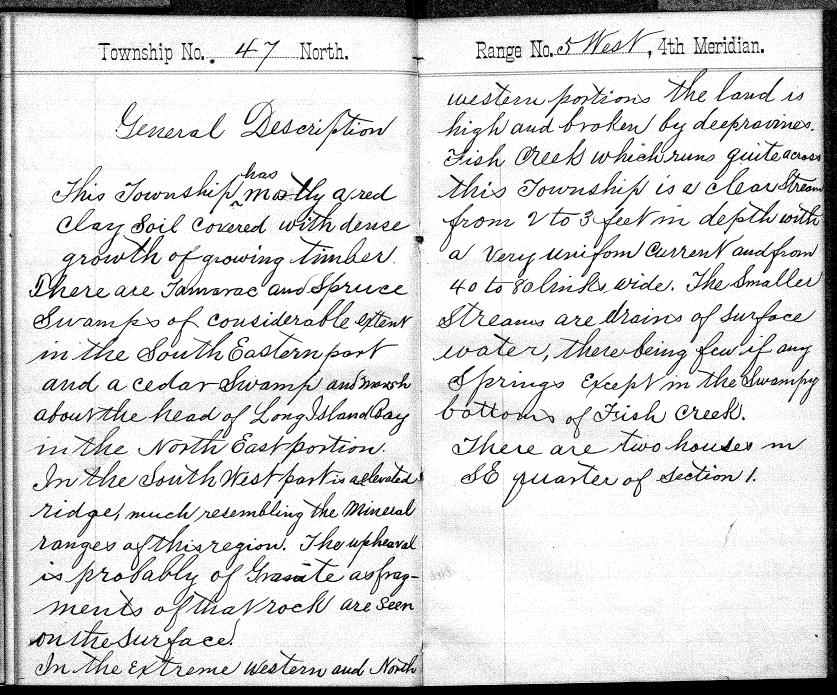
General description of T47N R5W.

Chainmen: J. Allen Barber 2nd & George I. Butler
Axeman: Joseph (his mark) Dennis
Affidavit signed by: John W. Bell, Justice of the Peace for LaPointe County.
The Barbers’ original field notes for this township were reproduced in 1885 “… for the reason that the original record is becoming illegible by the fading of the ink.”
Ashland Wisconsin Dec. 16th 1855
Dear Parents
Once more I am seated to assure you of my continued good health and warm affection for the loved recipients of this letter.

Detail of Ashland townsite, Wikwedong, and Fish Creek (T47N R4W).
“Fish Creek is called by the Indians Wikwedo-Sibiwishen, which means ‘Bay Creek,’ from wikwed, Chippewa for bay; hence the name Wikwedong, the name they have to Ashland, meaning ‘at the bay.'”
~ Collections of the State Historical Society of Wisconsin, Volume 13, page 430.
Asaph Whittlesey founded Ashland in 1854 near the ancient village of Wikwedong.
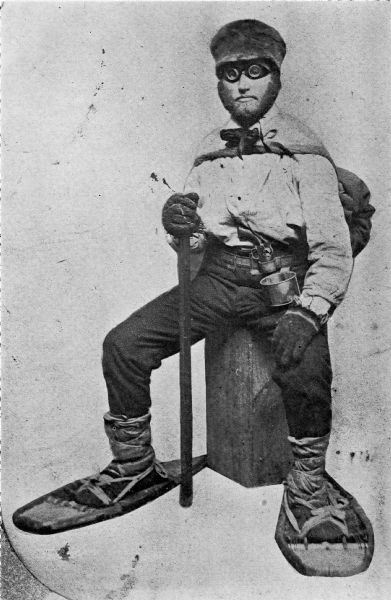
I suppose Augustus has informed you of the completion of his contract. Our summers work hung on rather late as nearly all of the last township was surveyed after the winter had fairly set in. But we are having an easy time of it now. We are keeping house in a little cabin at Ashland about two miles from Bay City. I do all the house work as well as I can by a little stove exactly like our parlor stove and Augustus works at his notes preparing them for the office. As yet I don’t know what I shall do this winter. Between working with Augustus, going below, making a claim and a few other things, I must decide before long. People are pitching upon claims all around me which I might have claimed when surveyed — yet I hold onto to my preemption right in hopes to find a more valuable location. With my knowledge of the country I could make better selections than most of them do and with the means I could secure several valuable tracts. (Eve.) This evening Augustus and I have been singing with Mr. Whittlesey’s folks, who live only a few steps from us. They are intelligent pious folks and very neighborly. Mrs. W. brought us some apple dumplings the other night and has since sent us a whitefish nicely cooked. I suppose they pity our want of skill in the culinary department of housekeeping. I do some baking in the stove which I find a great help. In regard to dish-washing I am rather fortunate as we have dishes enough for six men and can’t use them all at once so I only wash about once in two days.
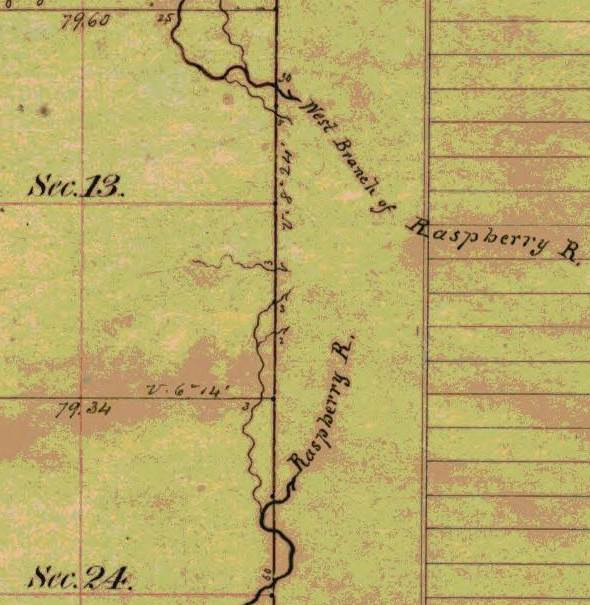
Detail of Raspberry River and West Branch of Raspberry River upstream from Sioux River Slough (T49N R5W).
“Sioux River is a stream located just 4.3 miles from Washburn, in Bayfield County, in the state of Wisconsin, United States, near Sioux, WI. Alternate names for this stream include Miskwimin, Raspberry River and Miskwi Minikan.”
In the Ojibwemowin language, Miskwiwim is Raspberry and Miskwi Minikan is Blood Seed.
The propeller Ogontz survived numerous accidents and a lawsuit upon the Great Lakes.
Butler has left us and gone to Superior intending to go to St. Antony. He did not appear to like the woods very much. Dan Damon of Waterbury had just gone there (to St. Antony). It is announced that there will be preaching here next Sunday by Mr. Warren a young Methodist minister at Bad river mission. I may not be here as we intend to go to La Pointe and probably Superior in two or three days. Provisions are scarce all round the lake I guess. At Superior pork is 25¢ per pound. Here nothing can be obtained by the quantity. At Ontonagon prices are very high. Two cargoes of provisions for Ontonagon have been discharged at some lower port on account of storms. The propeller Ogonts began to unload at Ontonagon but a storm arising she was obliged to put out for a safer harbor and vessel and cargo were much damaged. Last fall a steamboat with passengers for Superior and La pointe landed them at Ontonagon and started back for the Sault but was met by a northeaster and driven back to La pointe. So you see vessels on this lake have to stand round for storms. The bay is partly frozen over. Thermometer this morning 2*-0.

Detail of Sioux River; also labeled as the main branch of the Raspberry River (T49N R5W)
Joseph Alcorn was featured in the Spring of 1855. He appears to have been close to George Riley Stuntz.
Heard today that Jo is at work at Iron River for Stuntz.
I do not know what Augustus will do about surveying this winter. He could probably make it pay better than anything else, I suppose the job lies among the islands which will give plenty of meandering which could be done on the ice at the rate of 9 or 10 miles per day. But nothing can be done about it yet until the channels are frozen over as the water is so full of icebergs part of the time that no small boat could live.
“From all this we see that the bay was from most ancient times the seat of a large aboriginal population. Its geographical position towards the western end of the great lake, its rich fisheries and hunting grounds, all tended to make it the home of thousands of Indians.”
~ Collections of the State Historical Society of Wisconsin, Volume 13, page 433.
The trader of Allen’s yarn was likely present at the 1855 Annuity Payment.
I wish I had time to tell you a lot of yarns about the Indians and indian traders. A Bad River indian came over here today to trade off a beaver skin for whiskey — he got about two quarts for it which made him feel pretty rich yet feeling he had not quite enough he bought a pint more for 50¢ which the trader brought and poured into his keg — but the last pint fortunately was nothing but pure brack water. The same trader one night just after payment took about 75 dollars with only 8 gallons of whiskey well watered.
If we go to La pointe soon this letter will be mailed soon. If not it may stay in this office a week or two.
Please excuse the bad writing, &c, &c.
Your affectionate son
J Allen Barber

Detail of a spring along trail from the Sioux River Valley into the Bayfield Peninsula (T49N R5W).
Dear Mother
I am somewhat in arrears of my usual and promised amount of letter writing but I cannot help it.
Detail of sink holes (T49N R5W).
In a short time I expect to have more favorable opportunities and a better chance to tell you what I shall do and where I shall be this winter. If I stay about here you must not look for letters every week for it will be quite impossible for me to dispatch them oftener than once in two weeks; perhaps longer times will unavoidably intervene. Am well and sound and feel pretty well able to stand a winter here on the lake, though I must own that to survey in mid-winter seems to me like undertaking a pretty [cool?] job. Never mind, to be at work in the woods here is less tedious and less dangerous than to be on the black prairies of southern Wisconsin where roads are covered deep in an hour or two and no sheltering forest nor even fuel to protect the traveler from the bitter winds. You may, I think, be tolerably easy about my health and safety, recollecting that I have been some time in this wild country and enjoyed better health than [two words illegible] others claim, and as for accidents, no place is known to be safe between the walls of the universe, but the peaceable prudent and prompt men may expect to walk in safety in all places as anybody. Besides, there are men here who have shown that they are disposed to remember sundry little accommodations, and if I should need the care of friends at any time I doubt not I should receive all the attention that well disposed strangers could give.
At present I don’t know much about my operations for the immediate future, but expect to know as I go along. We are woefully neglected by the mails of late, but are no worse off in that respect than others.
Hoping this letter will not be as unsatisfactory to you as it looks to me. I am as
Ever Your Affectionate Son
Augustus H. Barber
Interior Field Notes
Township 49 North, Range 5 West
Nov. 1855-Dec. 1855
Notebook ID: INT050W01

Original plat map for T49N R5W.

Survey of T47N R5W by:
Augustus H. Barber, U.S. Deputy Surveyor.

General description of T49N R5W.

Chainmen: J. Allen Barber 2nd & George I. Butler
Axeman: Joseph (his mark) Dennis
Affidavit signed by: John W. Bell, Justice of the Peace for LaPointe County.

The Barber brothers’ original field notes for this township were reproduced in 1891 “… for the reason that the original record is becoming illegible by the fading of the ink.”
[Incomplete copy of letter]
[undated circa 1855]

Detail of Ironton town property with trails to Odanah and to the Penokee Mountains (T47N R1W). This was not part of the Barber brother’s survey in 1855. Today this property is known as Saxon Harbor.
Is there not danger that by the decisions of the Secretary of the Interior lately rendered, you may be thrown out of your Ironton Town property? Or is there perfect immunity from such loss in the hardship of the times that for the present render the property valueless & no temptation to sharks to seize upon them? You can make your shares perfectly safe by ostensibly making your home there & from what you have hinted about the agent I presume it would be no great displeasure for you to sojourn occasionally with his family, at least enough to have your residence called at Ironton.
And this reminds me of seeing the name of your plan in one of the N.E. Counties of Wis. I think in Marquette it was in an advertisement for proposals for carrying mails in Wis. When do you suppose property of any kind will be saleable again about Lake Superior?
One thing is certain, it must be after [this?], if ever, I would like to hear how some of my acquaintances along down the northern shore are thriving & whether property in & around Burlington, Encampments, Rockville, Beaver Bay are commanding fabulous prices as they did last years. I presume thousands of dollars were paid last year to be shown claims & for building shanties on them, by those who are forced to abandon them, & remain where they are in no danger of starving. Has Perry told you that that note could not be paid for lack of money enough in Superior? What did he say about it? How did he expect I want him to get my pay? I expect nothing but that I should lose all that debt, for I am fearful that Carleton will find some way to avoid the payment of it.
Did Perry talk or not as though he wished to have me paid up? & what did he say about its ever being paid? Does he gamble & drink yet? & how do they all appear in Superior? Does the hardship of the time prevent the consumption of such quantities of rot gut as were formerly used?
Are Mr. [Barmite?] & Mr. [McCorble?] there? Is Frasier there? & Mr. Hall the young lawyer, Charly Port, White Perkins & Bradford? If I can only get my affairs in Superior straightened out I can note if the whole place sinks to the “bottom of the sea, the sea, the sea” & half of its inhabitants with it if I could chose who should be saved.
I have written more than I intended, as times hangs so heavily on my hands that I resort to writing as a pasttime.
Again good bye,
G. A. B.
I send you a blank % sheet for your use. I bought squires like this for 34¢ last week & wish I could get some of it to you.
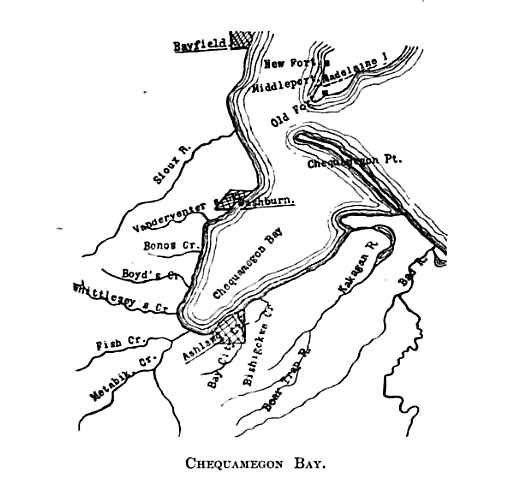
This map is an image from Collections of the State Historical Society of Wisconsin, Volume 13, page 419.
Published in 1895, this map features the area surveyed by the Barber brothers during 1855 surrounded by Bayfield, LaPointe, and Bad River.
After 1855, the Society’s annual reports were included in its Proceedings.
In 1855, the Barber brothers surveyed six townships (216 square miles) along Chequamegon Bay between Bayfield and Bad River.
The available mix of original documents and reproductions of the Barber brothers’ field notes feature these water/land routes; but do not feature any of these ancient villages.
During 1855, did the Barber brothers record these details separately for the State Historical Society of Wisconsin?
To be continued in the Winter of 1856…
Barber Papers: “I shall not go without Jo” Spring of 1855
September 4, 2015
By Amorin Mello
Selected letters of the Joel Allen Barber Papers
… continued from Winter of 1855.
Lancaster March 23rd, 1855
Dear Father,
It is not long since I wrote to you but I thought I would write just a word though it may not do any good. Uncle Allen says you would do better to send land [????] than money. So many will be drawing land under this new bounty land law, that you can probably get them cheap.
Pine lands may be better in the eastern part of the state [?? ???????] but not worth half as much as in the western part. Lumber that sells in Oshkosh for 8 or 10 dollars brings 18 to 23 or 4 dollars here or any where along the river. Do you know anything about the culture of [osiers?] for willow baskets.
I saw an advertisement in the Tribune which says they will yield 100 to 150 dollars proffit per acre. This would be a good place to raise them I should think. Willow baskets are used here more than any other for all purposes. This I suppose is because there are so many [foreigners?] here who understand making them.
This is a beautiful warm day and the snow is going off in torrents.
Was it not [fl??ging?] smart that Thode Burr could not come out with Uncle Thode. His folks were swift to have him come but as the time approached had to give it up. Grand Mother has just come in, walked up. We are pretty well all but Aunt [Lib?], who was sick yesterday but better today. Have not seen anything of Cad yet. Jo. Alcorn has taken Dr. Woods farm.
Love to all
J. Allen Barber 2nd
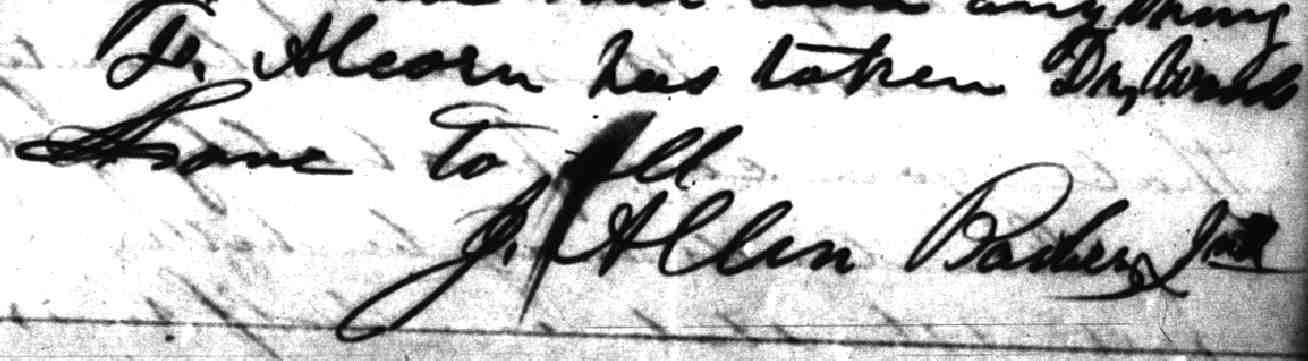
This letter appears to be written by Allen, using the name of his Cousin Allen 2nd.
Johnson April 1st, 1855
Dear Son
I do think you hurt yourself writing so often and so much as you do to us. Once in two weeks is a short time to you I suppose to intervene between the times of writing home, but it seems very long to me to wait for news from my absent children. The last letter from Augustus was dated Jan 17th but he is where he cannot write and at a distance of 30 miles from any P.O. as Mr. Stuntz has probably told you. But you are where you could write oftener and more if you would, and as we cannot hear from Augustus do let us here from you. Yet if you do not want to hear from home but seldom, just set the pattern and I will write as often as you do, and relieve you from the trouble of writing, or reading my letters any oftener than you choose. Everything is going on at the usual snail pace about here.
[…]
There was a great dance in the Town Hall Friday 23rd at the Public at the [close?] of the [dancing?] school. Somewhere from 60 to 70 couples in attendance, and what was strangest of all, some of those little lambs in the flock who have recently passed from death unto life, instead of giving living evidence of their having been with Jesus, showed their preference for gayer company & went to see the show.
It was but two days before the holy commission and Mr. Caldwell and [men?] somehow or other concluded not to show their faces there before their august teachers and the mangled remains of their adorable savior so soon after patronizing the company of Jake Dodge, Henry Daniels, Frank Atwell, [Morse’s & Patrk’s?] boys [Jo Read?] and [Almy Ferrier?]. Oh the folly of Sinners.
I thought it would look just as well for old cripples who were just ready to emigrate to the kingdom come to stay away and let the young, the wealthy, proud & gay have their [partihase?] & recreation to themselves and not betray our weakness by going to gaze at them and thereby evince to them & to the world our regrets that we are no longer fit associates for [Jo. Reads?] &c. But some folks act curiously at times like there was a partial insanity in their case.
I felt very well at home & so did Am as we did when Ossian & Dodge was here & Mum went. It is getting to be mad times. Give my love to Mother and to my other Friends if I have any. I have written about twice as much now as you write and have not got half through but time forbids more at present.
G. A. Barber
[ca. 1855] Apr.
Lancaster Apr.
Dear Mother,
Having rec’d several lines from you and Amherst without sending any full equivalent I will now try to write a few words though they may not be very interesting. Today is a beautiful Sunday.
It is now about two o’clock. I have not been to meeting. Shall probably go this evening.
You see my prejudice in favor of evening meetings is not altogether overcome.
I am dressed up in my new vest and boots, clean shirt, thin brown coat and brown hat &c. This morning Uncle Allen drove up with his carriage with his children, [and?] Ham. and three other children. I took Thody and got in (Myron was at meeting) and had a delightful ride on the prairie. Such beautiful spring weather I never saw before. Every day seems unequated. The earth has got green in spite and there are some flowers out. They look just like yellow daisies only they grow as low and humble as violets.
Night before last I got a letter from Augustus at Galena. They are having colera considerable and a number have died on the river or been put ashore in consequence of colera. You may not see anything of it in the papers as they try to keep it mum but John [Henry?] who was down there says it is so. No wonder for he says the mercury stood at 90* one day that he was there. Every boat up the river has 6 or 800 passengers.
Augustus appears to be in fine spirits. He is swift to have me come up that way.
The ground here is warm and dry as any ever need to be, gardens are being made and crops are being put in with all delight.
Uncle Jay and Cyrus will have splendid gardens in a short time. In fact, Uncle Jays garden now is the finest I know of about here, he has enlarged it this spring.
Aunt Fanny has considerable of a start in her garden because the place was made by a fellow who took great pains to have everything that he could get growing.
I am quite anxious to go up the river and see the elephants and would like not a little to see Augustus. Uncle Thode is farming and sleeps in his house and that is all I have got to say about him at present. Father requires me to write so much to him that I can hardly find any thing more to write to any one else. Little Thody is not very well – has a bad cold. My love to all. We expect Uncle Ham here every day.
Your affectionate Son
Allen
Lancaster May 2nd 1855
Dear Father
Perhaps I have neglected writing to you too long but as I have been rather busy of late and have written to mother not long since I hope to be [?????]
[…]
~ FamilySearch.org
Day before yesterday I made Jo. Alcorns folks a visit. They appear to feel pretty well. The girls were all at home.
I took dinner there and looked over the farm some. Jo is building stone wall on the farm for Dr. Wood. I begin to think we have about all the herbs here that grow in Vermont. [Spikenard?], bloodroot, coltsfoot, leeks, wild onions, wild summer savoury, balm, and a great many more grow in abundance.
Uncle Allen has spoken to me about studying law but nothing deffinite has been proposed on either side. Two fellows start from here today to go to Lake Superior. They have to walk over 200 miles so I suppose they would not wish to carry any extra burden and Jo says he thinks Augustus would not care anything about that vest up there. I am really anxious to go up there but I guess I shall not this summer.
[…]
Must close rather abruptly for want of time. Have been looking some days for a letter from you.
Love to all
Allen
All is well but Aunt Fanny who is most [used?] up with a severe cold
Lancaster May 14th /55
Dear Father
It seems to me I have not written to you for about a week and as there is just 25 minutes between [illegible words] a few words. I have nothing of special interest to write but dont want to keep you waiting for a letter. For some time we have been wishing for a little rain for which we would be very thankful although a great deal is needed. We now have a prospect for a good shower.
[…]
~ 15th Uncle Vest Phelps and all his family have arrived in town today I understand. I am most tired to death, have been planting corn all day with Cyrus and I have about a days work more to do alone to finish it and fix the apple trees. I have a wet cloth on my neck to cure a sunburn. Whatever the effort may be ultimately, it saves me a great deal of pain at present. I am thinking quite [strong?] nowadays of pottering off up to the lake.
Jo is here yet and would go with me. I should want no better companion.
There is no serious obstacle that I know of to hinder. While I wish to go for many reasons.
So far as I know I have had excellent success in grafting although I have not done a great deal only about 600. I cant tell exactly about the wheat there was not much of it all a great deal of that was wasted. I have never said a word to Shoemaker and dont want to. He is a foolish howling Methodist and nothing else. I sold 5 bushels of
[Incomplete copy of letter]

MOTHER
Lancaster Wis. May 20th 1855
Dear Mother
Last night I was much gratified by the reception of another Salvo of letters all in one envelope from home.
It is pleasing to thus find myself kindly remembered at home but letters written in the spirit of one I received from father last Tuesday are not quite so agreeable and allow me to say I think they are rather tend to defeat their object. The accounts of the season in Vermont seem rather dismal.
Can it be possible that no leaves were visible on the 13th of May. Here fruit trees were going out of blossom. A fortnight Three weeks ago today (April 26th) the poplar trees appeared to be in full foliage but the leaves were not fully grown wild plum trees were white and crabapple trees were blossoming.
Lilacs are now out of blossom. Gooseberries plums currants and cherries are about as [as peas?] – plums rather larger apples are as large as beans.
I ate rhubarb pie at Uncle Jays May 3rd made of new plants. it is somewhat doubtful about my going up to the lake this summer. Jo dont wish to go untill after harvest or about the last of August but I guess I could get him started now if I [???] really anxious about it.
It is principally on account of my health that I prefer going up there to reading law at present. Today is a beautiful [??????] I have not been to any meeting this forenoon but guess I shall go to the choir meeting this afternoon.
Aunt L is not very well yet. Yesterday I cut out a lot of willows that grew around the best spring on the east side of the farm.
It is a noble spring and might easily be made to run to go building spot on the South end of the farm on the road near the S.E. corner Cyrus thinks of selling his place in town and building on his farm but Aunt Fanny is strongly opposed to it. Going to Lake Superior is not so much of an undertaking as when Augustus first went. I should have to foot it about 200 miles. A great many people are going through every few days but probably I shall not go without Jo as he understands all the minutia of providing necessary articles and food, coaching, camping out &c &c. Well I must close this and write a few words to Father.
Receive with this the Love of
Your affectionate Son
J Allen Barber
Lancaster May 20th 1855
Dear Father
It was my good luck to receive a letter last Tuesday and another on Saturday so I must write again soon or get behind in my correspondence. Uncle Allen says I can find plenty of land though not very near town but the country is filling up so fast that it will all be worth the [??] government price. He says he will go out with me in a day or two [a?] land hunting as he has some plots only a few days old and wants more land. I should not be able to enter more than 80 acres at present but if I dont go to the lake you can send me more money and I will try to make the best disposal of it (21st) Old Ben’s auction goes off today.
There is undoubtedly money to be made in village property here but not near so much as on wild land. Well Old Bens auction has come off and proved to be a kind of mock auction – all but one bargain was struck to off to his bidder, Jim [?evens?].
I got Jo to promise to day to go to the lake in two weeks but he will alter his mind before night I am afraid. There is a terrible amount of sickness on the Mississippi and Missouri boats. The boats are all overloaded often carrying over 600.
This is a very warm day. We had a little rain this morning but not enough to do any good. Other places not 11 miles from here have plenty of rain.
It is common here to have thunder here whenever it rains. If it rains 3 days the thunder cracks around all the time night and day. Then look out for cholera. There are a lot of old telegraph posts standing between here and [Potosi?] and more than half of those that stand in open country are split down by lightning. Jo is fiddling here while I write he remains firm in his resolution to go to the lake in two weeks.
If I go I intend to come back next fall if nothing prevents still as far as health and comfort are concerned I had rather winter there than here if I could have as good accommodations.
I am glad to hear that some of the old faces once so familiar have again visited Johnson although I was not there see them. It really does me good to see their names written. How we are scattered. Albe reminds me of fast day two years ago.
He and John Cook & Charlie and I ate sugar on the catnip farm and had a good time. Now each breathes the air of a different state. It would give me great pleasure to attend the commencement at Burlington this summer. Probably at no other place in the world should I ever meet so old friends. Where is Homer [Wetherly?] now? I had a letter from when he was in Glover and would answer it sometime if I knew where to direct. Aunt Fanny wants me to tell you she is all well and anunt Lucy says when her pen gets started it will with a vengence! They think I write home so often there is no use of any ones writing any more. It may be a disappointment to you to have no more land entered but I shall not have time to receive any money from Vermont if I go up country this summer. What land there is now in market about here is of course of poorer quality and some and I think I had rather enter land north of Wisconsin where there is plenty and lumber cheaper timber plentier.
However I dont know what I shall do. I want to enter a half section all that I can enter under the graduation [act?] and it must all be adjoining or adjoining land I now own.
If I find any land very tempting perhaps I had better borrow the money of Uncle [?????] and you could remit the amount to him.
The interest would not be much for a [month?] or two – at any rate it appears that I have got to act as I think best. A Mrs. [?tig?] opened a lot of bonnets and other goods for sale this morning and the streets are full of women all crazy for a new bonnet. I hope it will have a good effect on the weather as we need rain badly.
Today I had a talk with Shoemaker. He raised 9 bushels of wheat and says he will give up your share if I will sign a receipt in full of all demands. He suffered considerable waste and ought to smart for it. But I suppose he lost money by taking the farm, of about 50 bushels of oats his share after paying for threshing and other helping was only 6 bushels. I can have things well enough this summer. The corn I planted among the hops and appletrees I shall let Cyrus have to remunerate him for the trouble I have made him. I have not done near enough here to pay my board as he has been so situated I could not very well. There are two or three other boys here that want to go up to the lake and perhaps will go with us. If you dont get this in season to answer before the 4th of June direct to Superior. I think this with Mothers and Ams will do for one letter. Shall probably write again before I leave and look for about two more letters from you.
Your affectionate Son
J. Allen Barber
Johnson June 17th 1855
Dear Sons
I expect you are now together and I will address this to you both thereby saving some scribbling paper, postage &c which is no small consideration with some folks, and I must acknowledge is to me a convenience I went to St Albans last Monday to see my father previous to his departure from this country perhaps forever, though I did not then know how so soon he was going but on arriving there found that he had fixed on the Wednesday following for leaving. I accordingly remained till that time & then accompanied him as far as [Run??’s] Point & there parted with him. Thode Burr goes to Sandusky with him, & from thence I expect your Uncle Ham will escort him to Lancaster.
Father felt very much affected at parting with your Uncle B’s folks and they as much so as though they were consigning him to the grave. Returning from St Albans I came to D Fairchild’s and stayed over night & made one more visit on my way through [Georgia?] & arrived at Johnson Thursday night in safety, but I [presumed?] not many hours before Father & Thode reached Sandusky. I found that Am. had recd a letter from Augustus & one from [me?] requesting a deposition to establish your his age. I have made it and also one for Allen thinking that he might want to make a preemption claim in that region, and if he would be deferred from making such claim on account of owning land, would it not be best for him to convey his title to his lands in Wisconsin to me or some other person to be held for him whenever he might wish to resume the ownership again. Augustus will best know how that business can be managed. I have a draft that I shall forward by mail tomorrow morning to J. Allen B. Esq. for the sum of $80.00. I think Allen’s purchase a very good one.
You will see by the Tribune that Messrs Bell & Hale are [listed?] to the U.S. Senate by the Legislature of N.H. & probably will [eybise thereat?] & further that the National [R.N.?] Convention are having hot times on the subject of slavery, & that the whole pro slavery concern will be blown sky high, as all attempts to silence freedom of discussion should be now and forevermore Amen.
[…]
I am now thinking of going to Burlington on the 27th to attend a State Convention [the call?] for which you will see in the [Freeman?]. It is now almost 3 years since I have been there to step my feet on the ground & for that as well as a wish to participate in the doings of the convention I shall like to be there very well.
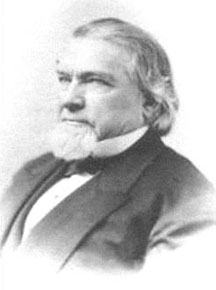
Portrait of U.S. Representative Cadwallader Colden Washburn (Wisconsin); in office between 1855-61.
~ Wikipedia.com
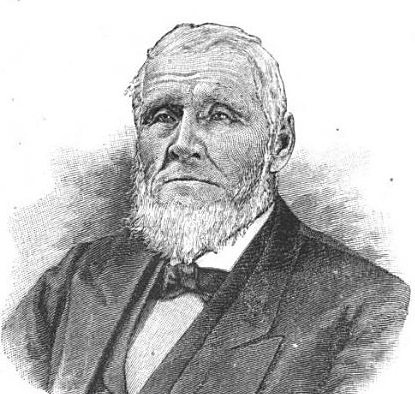
Portrait of U.S. Representative Alvah Sabin (Vermont); in office between 1853-57.
~ Wikipedia.com
This morning I recd a [Pub. Doc.?] from Hon. A Sabin ‘sectry of the [Amaroo?] [pant ???] by [Lieut?] [Gibbon?] with an atlas, also another [Corernoned?] at the presentation of the [swant?] of Gen Jackson, [??? Brainiere? into?] me a Biggon’s battery of the [Amaroo?] just the same thing last winter so that I now have two & if you do not receive one from Mr Sabin I will give you one of mine when you come. I think you will continue to require favors from Mr S. while you [remain?] at the Lake & that Mr C.C. Washburn will not neglect you. If Allen has arrived at the lake how does he like it & how does he propose to spend the summer? He is so great a [mineral agent?] and so patient an explorer I shall look for great exploits by him, & certainly I hope you will both be fortunate in discoveries, and that you may realize ample remuneration for all your privations and toils.
I hope to hear soon of Allen’s safe arrival and hope you will both write often and I will try to do likewise.
Accept my best wishes for your welfare and happiness.
G.A. Barber
A.W.B & J.A. Barber
[fragment, c. 1855, June]
thought but to not enter it without knowing that it was worth something. I have not seen it but Uncle Allen says it is first rate.
I am glad to hear that Am is no worse off but cannot conceive why he should continue at school this summer. The letter r in the map represents a high sand rock like a monument about 12 feet high standing on the point of a bluff. It is biggest at the top and looks very picturesque. That 40 would be a first-rate meadow just as it is and would produce 2 ½ or 3 tons of hay every year, plenty of water could be had on it by digging a few feet.
But what is of some consequence is the land is the very richest quality much better than prairie land will average and it is not more than two miles from a first rate gristmill.
I hope you will come out here and see my great purchase before many years and enter as much more some where. The land in [Richland?] in a short time will come down to .75 ¢ per acre.
I wish the old farm could be sold so that you could all come out here. I should feel a great deal better and I know you all would like your new home. Jo is more than half undecided about going to the lake but I guess he will go.
He thinks now he can’t go so soon as Wednesday. Perhaps I cannot but I want to. Hoping to hear from you once more before I leave I remain
Your affectionate Son
Allen
To be continued in the Summer of 1855…
Barber Papers: “Come up here!” Winter of 1855
August 22, 2015
By Amorin Mello
Selected letters of the Joel Allen Barber Papers
… continued from 1854.
Charlotte Wis. Jan 21st 1855
Dear Parents
You may not like the looks of this small paper but the fact is I have no other, my last sheet of large paper was used for my last letter to you and if I had been aware that I was not going to have any other I would have mentioned it so as in some measure to have modified the shock it must occasion. This is [onerely?] preface as I have not yet been to the office for your letter this week being somewhat distant having no time except today when it is tremendous cold and blustering.
I have three letters ready to mail one to Grandfather one to Uncle Cyrus and one to Albe Whiting. I have written but very few letters this winter except to you, for in fact you have monopolized most of my time for writing. The weather has continued just the same – mild, open, and clear untill today when we have a hard northwind. Prairie fires were running last night in Iowa in many directions and some in this state.
There is not a particle of snow – the brooks are icebound and the ground is frozen and cracked up like it never cracks in Vermont. X X X
Well I have been to the PO and found no letter – shall expect two by next mail. It is snowing some today (Jan 25th).
My health continues as good as could be expected under like circumstances. At the two last places where have the unvarying diet is fried pork and hot biscuits and nothing else to speak of.
Had Johnny Cake yesterday noon, made with all the bran in. It was about the best thing I have seen in the West. I went to a party a few nights ago. It was a miserable trashy affair, nothing but a great barbecue for supper, early, and then dancing untill daylight.
All the rough characters in the country were there. I went at a late hour and retired at about half past 9 oclock, satisfied that I shall not want to attend another such very soon. At Lancaster, the parties are about right, but out here they are a pretty good index of the newness of the country.
It is now impossible to get this to the P.O. unless I go myself and as it blows and snows a perfect old fashioned snow storm I think I shant go but will keep this for another time X X Sat. 27th
Am boarding with a Vermonter two miles from the school house. He is a real Vermonter named Howard one of the best and smartest men on the prairie. He has a good farm which he wants to sell. If any body wants to buy a farm out this way just tell them of this. It will be advertised in the Herald soon. It is a good farm and contains 260 acres, tillable land and firewood enough for two families, the best and most extensive start of fruit in the country. 250 apple trees 20 green gauge plums and innumerable gooseberries [redberries?] currants strawberries and some grapes. The house & barn are new and well built but small. He asks only $2000, is doing well here but wants to leave for other business.
I wish Albe Whiting would see this place; less than half would have to be paid down – good title given.
[Gov.?] Dewy has bought out Cassville or part of it. Prairie La Porte is changed to Guttenburg. Do you know where Sullivan Pierce stopped. He was in company with Hyde coming out but they got separated. Have just been out to the chicken trap found five all alive any fluttering. We killed those and retired and they [lineanes?] have just turned to the [fiels?] again. [scribble] Sunday Three more chickens caught. Went to meeting with Howards folks in a sleigh or rather on a sled – no meeting pretty cold – snow scarcely sufficient for sleighing. If I get a chance I shall try to send some to Lancaster.
I have three more weeks to keep school. 4 more places to board. I like Howards and his folks best of any people on the prairie. They are pious and attend to family worship regularly.
Monday
Have just been to the Post office and got two letters one from you and one from Augustus – He writes nothing except a few business items.
In haste
Yours affectionately
Allen
Johnson, January 27th 1855
Dear Son
Yours of the 11th arrived night before last and contrary to my usual custom I have deferred answering over two mails, but it [will hi?] forwarded now some days sooner than it would have gone by trail, for Ames Dodge will take it along to Galena and by him I shall forward those vests that I bought in the fall for you & Augustus on the very [day?] that I recd your letter saying that Augustus was to be in Lancaster in a few days. Though he has not come & probably will not for some time, [Still,?] you may [be?] your Choice out of the two and send the other to him in the spring if there any going up to the Lake. There are as many who prefer the one as the other, and though I intended to give Aug his choice [????] the danger of his being [wronged?] by your having it [for ?in to ????] he did not take one & you the other. The vests are something nice, only that the style is new and there will not probably be many among the “[Badgers?].” Amos is here after [his monday?] due him [??] estate from Dr [M????] & gets between 700 & 800 & takes west with him. He hails from [Boise?] City, [90?] miles from Dubuque, but he says that he should prefer the Northern front of Ill. or the southern part of West Iowa. Were you or Augs at Lancaster I should try to have him go up there, but he would not go [southwest?]. I know of nothing very new or strange that has happened of late. There is a funeral in [Locon?] to day, of Daniel Mills who lived beyond the Main. You have seen the poor man I suppose. A very hard working & honest man was he.
It is a general time of health in Johnson, I know not of one sick person now except Rob’ Hill who is evidently on his [last?] legs, though around the streets every day. The poor devil had a [time?] in the fore part of Dec. and has been rapidly going down with the consumption ever since. He can have one source of consolation beyond what most men are blessed with, that there will be no excess of grief at his death, and another, that nobody or even the world will ever be able to discover the road that [his?] departure will occasion, & still another, that for his dearest & best friends & companions whose comforts & happiness are undoubted, his strongest & most earnest desire, there will be a greater abundance and at a greatly [demenostred?] price of the blessed creature that has so long stood between [???] & all [witch?] cares. Yesterday Dr C. & I removed two loads of corn fodder and eight loads of hay which with two loads, drawn [before?] makes all the hay I have left, [ample sufficient as?] I think to carry me through with [???] & the old cow. I have some more [slulh?] to [draw?] & two or three loads of wood dry wood in the shed [&?] the [??????] & farming tools, sleigh, waggon, &c to it [??] home yet. Mr Clark from [Miss.?] has moved into the old house & Phelps is going in with him to occupy the part that Dr C did when he was there with us. [Phil??? is?] about buying out [???????] takes a [fusin?] in Wolcott. Sam [Wilson?] has sold or will soon & Bill Smith buys out the Widow Wilson, & [esrnard?] has bought the [Feelting?] farm [in Herling?]. [Gotn?] will probably have the [Muikler?] farm & let Patrk have the Bixley house.
Capt Sam has elected one of the directors of the Bank of Waterbury and keeps a deposit of their money as well as a deposit of [Irusburgh?] money & he is in fact a bank discounting to people like any bank would, & if he keeps it up it will greatly curtail the business of the new bank at Hydepark that will probably go into operation about May 1st. The Hydepark bank stock went off [any?] heavily. Not a dollar take below here & only 46 shares taken here & 26 of them to trade away for other Bank Stocks. The Hydepark folks have sworn vengence against the lower part of the County declaring that no County officer shall come below their [?????]. Let them squirt their dye stuff, it will make them feel better. It is getting to be pretty hard times for almost everything here. Money is scarce & hard to be got. Still prices for everything but [???] & pork are exorbitantly high, wool [no sale?], Pork $[650?] for the [best?] & less in proportion to weight. But corn is $1.25, oats 50¢ Flour $11.00 Beef $5. per [????], & 6 per hind. Butter 20 to 22′ [Churned?] 11 ¢ Hay $15.00 and none to be had at that so that is feared that some poor men will have to kill their cows or see them starve. Wood is from 1.50 to 1.75, Tallow from 14¢ &c &c. If about 1/2 the folks in Johnson were well settled in Grant County I think it would be much better for them and for those who choose to remain on these bleak hills. I should have mentioned Potatoes which are scarce at 50 ¢. Now all who are not producers had better go where they can get the necessaries of life cheaper & wages as good that would be my advice to all, and which I will convince them I am sincere in one of these days.
Your Mother is anxious that you should work with your Uncle Cyrus the ensuing season and learn the builders trade so that you can build a house on our place or one for yourself if you should ever feel the need of one. You have over estimated to us what you thought [??] doing another year, whether to try again to study Medicine, Law, or go to Lake Superior, or teach school, or work around Lancaster. There are many inducements to either course. Ponder the subject well and take the advice of your friends especially of Augustus about going where he is, perhaps he would want you there with him to explore the country for copper. And when you have selected some good place to pursue, why then you may inform us. I intended to [fell????] this [page?] out, but have not time to do it to night, perhaps I may do it in the morning.
So for the present [????] you will [Go & Barber?] I wish you would enquire what timber land can be had for near Lancaster, especially in that grove that was [G??] Dewey’s & do it in a way to not have any one think that your motive is any thing but idle curiosity. I regret that I did not buy 40 or 80 acres of it before he sold it. I am going to Cambridge to day or to morrow and perhaps may pick up some news, that will be interesting to you. If so you may rely on having it forwarded to you soon. You enquired who were Benton’s assistant. Helen Whiteny [tah?] & the small fry Rebeccah [Merriam?] & [Diana?] have [classes?]. I think you will be satisfied with the length of this and can afford to give me one half as long at least. I hope you will continue to write every week and I will endeavour to do the same by you.
G. A. B.
Iron River Falls, LaPointe Co.
Feb. 10th 1855Dear Brother Allen

Survey detail of Iron River Falls, LaPointe County, Wisconsin. A review of this location and survey (T50N R9W) is featured in our series prologue; Stuntz Surveys Superior City 1852-54.
Your [welcome line?] was duly received and at last I find an occasion to write you a word in answer. I am very sorry to learn of your poor health but presume you will improve this winter if you as careful as circumstances will allow, which is generally careful enough. I don’t know how to advise in regard to your future operations but I tell you as I have before told our parents that I wish both yourself and I to obtain a thorough education. Your poor health is at present an obstacle to the pursuit of that object and I do not know that you are resolved on it provided your health was good. I have said so much in my letters about the good efforts of the kind of life I have adopted on the health of consumption or dystrophic men that you will be expecting me to recommend it for you without knowing much about your ailments so I think [is?] almost useless to say to you.
Come up here! I am confident that our season spent in surveying, voyaging, or exploring in this region or any healthy country would do your whole system, constitution, mind & body more good than all the medicines in the universe.
If I could see you I think we might arrange to spend next summer in the woods together. I have seen some experience in frontier-life and the tendency always is (with feeble persons) to giving good health and greatly increasing bodily vigor.
What the changes will be for making a raise in this country next season I can hardly tell you now but I expect they will be pretty good.
I hope you will see Mr. Stuntz when he is in Lancaster this winter, and for I think you would come up with him. I may see you in your schoolhouse before spring, as several things make me wish to visit Lancaster this winter. I don’t know the place where you are teaching, but I wish you all the success you can wish with all my heart. As for your toothache, I wish you as speedy deliverance from it as you would experience if I had a good hold on the offending tooth and hope you will consider the applicability of the “Wellerism” about the [“boy as svollered a fardin”?]
So you don’t like Lancaster? – well, I do! i.e. I like it pretty well generally, and some of the folks in it particularly; and if I supposed my appearance there would excite half the curiosity my supposed advent did last fall I would surely hazard the experiment of confronting those terrific batteries of eyes, for those batteries are not “masked” though I apprehend some of them are case-mated. I received a letter from Father last evening, saying all were well &c.
I wrote to you about the farm, but as you are not in L. you will not find it convenient to attend to it, so you can just let it be if you should not finish your school and return to L. before I return go down or write again. If you should have done anything about it before this reaches you all right or otherwise – all right. I am [well?] and well provided with work so I stand [it?] pretty well although our quarters here are not just as one would like them. I could write better if the idea had [yet?] not taken possession of my mind that I shall see you in mere weeks, so you will excuse imperfections and believe me.
Your affectionate brother
Augustus H. Barber
P.S. I admit that I may err in advising you to undertake the labors of a trip to this region, and that some other vocation in sight be more advantageous in all respects; and I do not wish you to adopt my course simply on the strength of my recommendation. Think about it, and in your ruminations keep this idea before your mind – “Health is the vital principle of bliss. And exercise of health.”
A.H.B.
Patch Grove Wis. Feb. 18, /55
Dear Parents
I have nothing to do this evening to amuse myself unless it is to write a letter.
Closed my school last night and have got this far from the scene of my labors although it may seem that I am not much nearer Lancaster. It is no nearer but there is a stage from here there tomorrow morning.
Had a good chance to ride to L. Saturday morning but only sent my trunk. Got my pay last night in gold. Sold my clock at cost for the gold, and stayed over night at [Basfords?].
[…]
The [????] is There several of meanest roughest imps here I have yet seen in the [state?]. I guess I will wait untill I get to L. before I finish this so as to report my luck in getting home.
X X X X Lancaster Feb 20th
Got here yesterday all safe. Found the good people all well. Uncle Thode went off in the morning so I did not see him. Augustus has written something about the produce of the farm. There is considerable corn which [????] pigs have been living on lately. There are several who want to rent the place and one man wants the house without the land. He is one of the Shoemaker tribe, and I dont want him within ten miles of it. Wheeler who lives on the [place?] now and wants to rent it has a good [team?] and promises to do well with it.
[…]
I mean to get my hair cut today for the first time after leaving Vermont. It has got pretty long and looks “first rate.” There are 40 rabbits to the square rod around here – At least there are so many tracks. From what I can learn I should think Augustus was doing about as much this winter as he did last winter. There are no liquor shops open in town they say and nothing, read and spell better than could be expected of him. Have not time to write another sheet.
Allen
I will try to get some larger paper before I write to you again
1855, [Feb.] 16
Lancaster Wis. 16th 1855
Dear Father & Mother
Knowing myself to much indebted to you for the promptness and length of your letters it is my intent to reciprocate as far as lies in my poor abilities by writing as often and fully as possible. My health still appears to be good and we have all been pretty well except Myron who alarmed us very much night before last by having a fit. He had been sick all day occasionally eating too many new doughnuts and other things. The fit commenced about six o’clock P.M. and lasted 10 or 12 minutes and was stupid until 10, and will occasionaly [??????ahing?] untill next morning.
He was sick all day yesterday but got up this morning smarter than ever and continues well. Uncle Ham. has got back from the north. All the land he went after particularly he found entered but he says he got [????t] of first rate land.
Uncle Allen wants me to enter some [land?] which I think I shall do when I hear of some good [??????]. I suppose I could find land north 2 or three dollars per. acre.
I could easily sell out at any time for 20 or 30 per cent, more than cost. Ben. C. Eastman has returned. He has some timber land for which he asks about 7 dollars per acre, which I suppose is about as well as well you can do. I have some thoughts of applying for a school in [Morrisson8?] district.
The school has got to bad for any female to teach and want a man. That is just the kind of school I would like to try for the sake of variety. They pay $12. per mo to female teachers.
Uncle ham has entered 8 sections on black river, he thinks in 5 years will be worth more than all the other lands he owns.
G. R. Stuntz is in town. We have good sleighing now and have had since Sunday [Sat. 11th?]. More Snow- about a foot of new snow and about 3* below freezing cold.
[…]
Rec’d your letter
of March 6th today. Uncle Allen had got it as he does [most?] of any mail matter. The [???] cannot see the 2nd it appears. The good people here are considerably incensed by their disappointment in not seeing Grandfathers out here this spring. I know of no reason for his not coming out with uncle Thode as far as Sandusky where they would want him to stay untill into summer. I think he will yet be allowed to visit this western paradise and meet his children, grandchildren, and other friends. I did not make so good a bargain as you wished in regards to the farm but I think it was as good as could be made.
[…]
Sunday 18th. Have not been to meeting today.
~ Wikipedia.com
Last night I went up to Rowdens beyond Uncle Jays to see about that school. I guess they dont want any more school this spring. It is rather surprising that the Know Nothings have got such power in [Cambridge?].
I had heard of their strength and [power?] by way of [??] [Heath?] in a letter to Augustus which fell into the hands of Uncle Ham. There are none of them here.
I hope [Wyman?] and Charles Stanly will come out here. This is not a very good place for [??????] but they would go to Lake Superior or St Croix river and [get good wages?]. If they get here soon perhaps they could work with Stuntz.
[Incomplete copy of letter]
Home March 1st 1855
Friend Allen,
It is some time since I rec’d your last and I should have replied earlier but for several weighty reasons. Even now my eyes promise to close and carry the spirit to dream land instead of the western world, but though the flesh is willing the will is not ready to resign itself to the arms of the [dreary?] old night god, till it talks awhile with you.
My [“???”] says I last wrote you (Dec 1st) well, if tis so I ought to have a few to say to this now, but my heart is as barren as no matter what. Could I be blessed with your company tonight we might lay awake and talk till the roosters crowed; and then not say it all, but now I really do not think of anything worthwhile to write.
As I have written west from once to twice a week all winter, to three or more people. I have to repeat the news that way till they become as stale as – new crackers.
[…]
Tis a time of general health here, if we except the small pox, which is in to help the Frenchmen this hard season. Where are you going this summer? what to do? I may go west in April – may not till fall – or never. I wish to go this spring but wish to study a term or two first, still may go soon. Please write very soon, and I may see you before May if I know where to find you. Time hastens – and with a hope for your welfare and prayers for your happiness I am the same old friend.
Albe
A J Barber
Lancaster March 2nd, 1855
Dear Father,
Yours of Jan. 18th was duly received and I hasten to reply.
I have written to Augustus [lately?] all I could think of especially about his getting kissed by a squaw. The next time you write to him you can ask him about the particulars.
I am glad Cad. is going to leave Johnson.

Detail of an abandoned copper exploration of the American Fur Company at Black River Falls (Big Manitou Falls) from the T47N R14W survey in Douglas County, which Augustus worked on with Stuntz in 1852.
If I could do anything to help him to useful and profitable employment God knows I would be glad to do it. Uncle [Ham?] started yesterday for Black river falls after pine lands. [He?] expects to be out in the woods some and perhaps camp out, will be gone from here about twenty days. [Tody?] has been writing [where?], he says it is a [“tow”-(cow)?]
[written in margin] he talks most everything [/margin]
[…]
I cannot express my gratitude for the amount of reading matter I have read from home lately in letter form.
[Jake Moorn?] is very slim has been sick some time. I must close to write Am and others
Good Bye
Allen
P.S. I have lent Cyrus $50. He has bought two cows and wants to buy more
Aunt [Lila?] has been sick over a week with strange and alarming symptoms. Constant headache splitting [leload?] and the exact appearance of being [Calivated?] but she is now better.
I want to write a letter to Am. about his [cars?] and some other things but guess I will wait till some other time
J. Allen Barber
Aunt Fanny thought sending a line in this but concludes not to. She says she has a right wait a while as you did.
A Masonic lodge has been started here lately so you will not miss the privelege of meeting your Morgan killing brethren at Cadys falls when you come out here.
Aunt Fanny wants you to send her some [Russian] turnip seed. Soon as possible. If you could send some two or three years old it would be better and perhaps purer blooded.
I once had a [pear?] spruce seeds which I wish I had here They [more?] in a [papa?] and [labely?]. And I would not care if I had some spruce [germ?]
 Chequamegon History