Chief Buffalo Picture Search: Conclusion
December 7, 2013
This post concludes the Chief Buffalo Picture Search, a series of posts attempting to determine which images of Chief Buffalo are of the La Pointe Ojibwe leader who died in 1855, and which are of other chiefs named Buffalo. To read from the beginning, click here to read Chief Buffalo Picture Search: Introduction.
 This is Chief Buffalo from St. Croix, not Chief Buffalo from La Pointe.
This lithograph from McKenney and Hall’s History of the Indian Tribes, was derived from an original oil painting (now destroyed) painted in 1824 by Charles Bird King.Buffalo from St. Croix was in Washington in 1824. Buffalo from La Pointe was not. Read:
Chief Buffalo Picture Search: The King and Lewis Lithographs

This could be Chief Buffalo from La Pointe. It could also be Chief Buffalo from St. Croix
This lithograph from James Otto Lewis’ The Aboriginal Port-Folio is based on a painting done by Lewis at the Treaty of Prairie du Chien in 1825 or at the Treaty of Fond du Lac in 1826 (Lewis is inconsistent in his own identification). The La Pointe and St. Croix chiefs were at both treaties. Read:
Chief Buffalo Picture Search: The King and Lewis Lithographs

This is not Chief Buffalo of La Pointe. This is the clan marker of Oshkaabewis, a contemporary chief from the headwaters of the Wisconsin River.
The primary sources clearly indicate that this birch bark petition was carried by Oshkaabewis to Washington in 1849 as part of a delegation of Lake Superior Ojibwe protesting Government removal plans. Read:

One of these men could be Chief Buffalo of La Pointe.
This engraving from Benjamin Armstrong’s Early Life Among the Indians appears to depict the 1852 Washington Delegation led by Buffalo. However, the men aren’t identified individually, and the original photograph hasn’t surfaced. Read:
Chief Buffalo Picture Search: The Armstrong Engraving

 This is not Chief Buffalo of La Pointe. This is Buffalo the war chief from Leech Lake.
Buffalo and Flatmouth, two Pillager (Leech Lake) leaders had their faces carved in marble in Washington in 1855. Buffalo was later copied in bronze, and both busts remain in the United States capitol. The chiefs were part of a Minnesota Ojibwe delegation making a treaty for reservations in Minnesota. Buffalo of Leech Lake was later photographed in St. Paul. Read:
Chief Buffalo Picture Search: The Capitol Busts
 This could be Chief Buffalo of La Pointe.
Very little is known about the origin of this image. It is most likely Chief Buffalo’s son Jayjigwyong, who was sometimes called “The Little Buffalo.” Read:
Chief Buffalo Picture Search: The Island Museum Painting
As it currently stands, out of the seven images investigated in this study, four are definitely not Chief Buffalo from La Pointe, and the other three require further investigation. The lithograph of Pee-che-kir from McKenney and Hallʼs History of the Indian Tribes, based on the original painting by Charles Bird King, is Buffalo from St. Croix. The marble and bronze busts in Washington D.C., as well as the carte-d-visite from Whitneyʼs in St. Paul, show Bizhiki the war chief from Leech Lake. The pictograph of the crane, once identified with Buffalo, is actually the Crane-clan chief Oshkaabewis. There is not enough information yet to make a determination on the lithograph of Pe-schick-ee from James Otto Lewisʻ Aboriginal Port Folio, on the image of the 1852 delegation in Armstrongʼs Early Life Among the Indians, or on the photo and painting of the man in the military coat.
In the end, the confusion about all of these images can be attributed to authors with motivations other than recording an accurate history of these men, authors who were not familiar enough with this time period to realize that there was more than one Buffalo. Charles Bird King and Francis Vincenti created some beautiful work in the national capital, but their ultimate goal was to make a record of the look of a supposedly vanishing people. The Pillager Bizhiki was chosen to sit for the sculpture not for who he was, but for what he looked like. The St. Croix Buffalo was chosen because he happened to be in Washington when King was painting. Over a century later, scholars like Horan and Holzhueter being more concerned with the art itself than the people depicted, furthered the confusion. Unfortunately, these mistakes had consequences for the study of history.
While this new information, especially in regard to the busts in Washington, may be discouraging to the people of Red Cliff and other descendants of Buffalo from La Pointe, there is also cause for excitement. The study of these images opens up new lines of inquiry into the last three decades of the chief’s life, a pivotal time in Ojibwe history. Inaccuracies about his life can be corrected, and people will stop having to come up with stories to connect Buffalo to images that were never him to begin with.
My hope is that this investigation will encourage people to learn more about all three Chief Buffalos, all of whom represented their people in Washington, as well as the other Ojibwe leaders from this time period. It is this hopeful story, as well as the possibility of further investigation into the three remaining images, that should lead Chief Buffaloʼs descendants to feel optimism rather than disappointment.
For now, this concludes the Great Chief Buffalo Picture Search. I will update in the future, however, if new evidence surface. Thanks for reading, and feel free to add your thoughts in the comments.
Chief Buffalo Picture Search: The Capitol Busts
July 17, 2013
This post is one of several that seek to determine how many images exist of Great Buffalo, the famous La Pointe Ojibwe chief who died in 1855. To learn why this is necessary, please read this post introducing the Great Chief Buffalo Picture Search.
Posts on Chequamegon History are generally of the obscure variety and are probably only interesting to a handful of people. I anticipate this one could cause some controversy as it concerns an object that holds a lot of importance to many people who live in our area. All I can say about that is that this post represents my research into original historical documents. I did not set out to prove anybody right or wrong, and I don’t think this has to be the last word on the subject. This post is simply my reasoned conclusions based on the evidence I’ve seen. Take from it what you will.
Be sheekee, or Buffalo by Francis Vincenti, Marble, Modeled 1855, Carved 1856 (United States Senate)
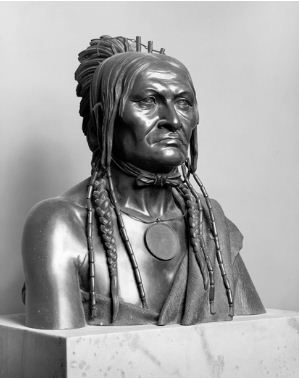
Be Sheekee: A Chippewa Warrior from the Sources of the Mississippi, bronze, by Joseph Lassalle after Francis Vincenti, House wing of the United States Capitol (U.S. Capitol Historical Society).
“A Chippewa Warrior from the Sources of the Mississippi”
There is no image that has been more widely identified with Chief Buffalo from La Pointe than the marble bust and bronze copy in the U.S. Capitol Building in Washington D.C. Red Cliff leaders make a point of visiting the statues on trips to the capital city, the tribe uses the image in advertising and educational materials, and literature from the United States Senate about the bust includes a short biography of the La Pointe chief.
I can trace the connection between the bust and the La Pointe chief to 1973, when John O. Holzhueter, editor of the Wisconsin Magazine of History wrote an article for the magazine titled Chief Buffalo and Other Wisconsin-Related Art in the National Capitol. From Holzhueterʼs notes we can tell that in 1973, the rediscovery of the story of the La Pointe Buffalo was just beginning at the Wisconsin Historical Society (the publisher of the magazine). Holzhueter deserves credit for helping to rekindle interest in the chief. However, he made a critical error.

English: Aysh-ke-bah-ke-ko-zhay ojibwa chief (Photo credit: Wikipedia)
In the article he briefly discusses Eshkibagikoonzhe (Flat Mouth), the chief of the Leech Lake or Pillager Ojibwe from northern Minnesota. Roughly the same age as Buffalo, Flat Mouth is as prominent a chief in the history of the upper Mississippi as Buffalo is for the Lake Superior bands. Had Holzhueter investigated further into the life of Flat Mouth, he may have discovered that at the time the bust was carved, the Pillagers had another leader who had risen to prominence, a war chief named Buffalo.
Holzhueter clearly was not aware that there was more than one Buffalo, and thus, he had to invent facts to make the history fit the art. According to the article (and a book published by Holzhueter the next year) the La Pointe Buffalo visited President Pierce in Washington in January of 1855. Buffalo did visit Washington in 1852 in the aftermath of the Sandy Lake Tragedy, but the old chief was nowhere near Washington in 1855. In fact, he was at home on the island in declining health having secured reservations for his people in Wisconsin the previous summer. He would die in September of 1855. The Buffalo who met with Pierce, of course, was the war chief from Leech Lake.
“He wore in his headdress 5 war-eagle feathers“
The Pillager Buffalo was in Washington for treaty negotiations that would transfer most of the remaining Ojibwe land in northern Minnesota to the United States and create reservations at the principal villages. The minutes of the February 1855 negotiations between the Minnesota chiefs and Indian Commissioner George Manypenny are filled with Ojibwe frustration at Manypennyʼs condescending tone. The chiefs, included the powerful young Hole-in-the-Day, the respected elder Flat Mouth, and Buffalo, who was growing in experience and age, though he was still considerably younger than Flat Mouth or the La Pointe Buffalo. The men were used to being called “red children” in communications with their “fathers” in the government, but Manypennyʼs paternalism brought it to a new low. Buffalo used his clothing to communicate to the commissioner that his message of assimilation to white ways was not something that all Ojibwes desired. Manypennyʼs words and Buffaloʼs responses as interpreted by the mix- blooded trader Paul Beaulieu follow:
The commissioner remarked to Buffalo, that if he was a young man he would insist upon his dispensing with his headdress of feathers, but that, as he was old, he would not disturb a custom which habit had endeared to him.
Buffalo repoled ithat the feathered plume among the Chippewas was a badge of honor. Those who were successful in fighting with or conquering their enemies were entitled to wear plumes as marks of distinction, and as the reward of meritorious actions.The commissioner asked him how old he was.
Buffalo said that was a question which he could not answer exactly. If he guessed right, however, he supposed he was about fifty. (He looked, and was doubtless, much
older).Commissioner. I would think, my firend, you were older than that. I would like to philosophise with you about that headdress, and desired to know if he had a farm, a house, stock, and other comforts about him.
Buffalo. I have none of those things which you have mentioned. I live like other members of the tribe.
Commissioner. How long have you been in the habit of painting—thirty years or more?
Buffalo. I can not tell the number of years. It may have been more or it may have been less. I have distinguished myself in war as well as in peace among my people and the whites, and am entitled to the distinction which the practice implies.
Commissioner. While you, my firend, have been spending your time and money in painting your face, how many of your white brothers have started without a dollar in the world and acquired all those things mentioned so necessary to your comfort and independent support. The paint, with the exception of what is now on my friend’s face, has disappeared, but the white persons to whom I alluded by way of contrast are surrounded by all the comforts of life, the legitimate fruits of their well-directed industry. This illustrates the difference between civilized and savage life, and the importance of our red brothers changing their habits and pursuits for those of the white.

Major General Montgomery C. Meigs was a Captain before the Civil War and was in charge of the Capitol restoration, As with Thomas McKenney in the 1820s, Meigs was hoping to capture the look of the “vanishing Indian.” He commissioned the busts of the Leech Lake chiefs during the 1855 Treaty negotiations. (Wikimedia Images)
While Manypenny clearly did not like the Ojibwe way of life or Buffaloʼs style of dress, it did catch the attention of the authorities in charge of building an extension on the U.S. Capitol. Captain Montgomery Meigs, the supervisor, had hired numerous artists and much like Thomas McKenney two decades earlier, was looking for examples of the indigenous cultures that were assumed to be vanishing. On February 17th, Meigs received word from Seth Eastman that the Ojibwe delegation was in town.
The Captain met Bizhiki and described him in his journal:
“He is a fine-looking Indian, with character strongly marked. He wore in his headdress 5 war-eagle feathers, the sign of that many enemies put to death by his hand, and sat up, an old murderer, as proud of his feathers as a Frenchman of his Cross of the Legion of Honor. He is a leading warrior rather than a chief, but he has a good head, one which would not lead one, if he were in the Senate, to think he was not fit to be the companion of the wise of the land.”
Buffalo was paid $5.00 and sat for three days with the skilled Italian sculptor Francis Vincenti. Meigs recorded:
“Vincenti is making a good likeness of a fine bust of Buffalo. I think I will have it put into marble and placed in a proper situation in the Capitol as a record of the Indian culture. 500 years hence it will be interesting.”
Vincenti first formed clay models of both Buffalo and Flat Mouth. The marbles would not be finished until the next year. A bronze replica of Buffalo was finished by Joseph Lassalle in 1859. The marble was put into the Senate wing of the Capitol, and the bronze was placed in the House wing.
Clues in the Marble
The sculptures themselves hold further clues that the man depicted is not the La Pointe Buffalo. Multiple records describe the La Pointe chief as a very large man. In his obituary, recorded the same year the statue was modeled, Morse writes:
Any one would recognize in the person of the Buffalo chief, a man of superiority. About the middle height, a face remarkably grave and dignified, indicating great thoughtfulness; neat in his native attire; short neck, very large head, and the most capacious chest of any human subject we ever saw.
At the time of his death, he was thought to have been over ninety years old. The man in the sculpture is lean and not ninety. In addition, there is another clue that got by Holzhueter even though he printed it in his article. There is a medallion around the neck of the bronze bust that reads, “Beeshekee, the BUFFALO; A Chippewa Warrior from the Sources of the Mississippi…” This description works for a war chief from Leech Lake, but makes no sense for a civil chief and orator from La Pointe.
Another Image of the Leech Lake Bizhiki

Be-She-Kee (Buffalo), Head Chief of the Leech Lake Chippewas (Whitney and Zimmerman St. Paul)
The Treaty of 1855 was signed on February 22, and the Leech Lake chiefs returned to Minnesota. By the outbreak of the Civil War, Flat Mouth had died leaving Buffalo as the most prominent Pillager chief. Indian-White relations in Minnesota grew violent in 1862 as the U.S.- Dakota War (also called the Sioux Uprising) broke out in the southern part of the state. The Gull Lake chief, Hole in the Day, who had claimed the title of head of the Ojibwes, was making noise about an Ojibwe uprising as well. When he tried to use the Pillagers in his plan, Buffalo voiced skepticism and Hole in the Dayʼs plans petered out. In 1863, Buffalo returned to Washington for a new treaty. Ironically, he was still very much alive in the midst of complicated politics in a city where his bust was on display as monument to the vanishing race.
At some point during these years, the Pillager Buffalo had his photograph taken by Whitneyʼs Gallery in St. Paul. Although the La Pointe Buffalo was dead by this time, internet sites will occasional connect it with him even with an original caption that reads “Head Chief of the Leech Lake Chippewas.”
The Verdict
Although it wasn’t the outcome I was hoping for, my research leads me to definitively conclude that the busts in the U.S. Capitol are of Buffalo the Leech Lake war chief. It’s disappointing for our area to lose this Washington connection, but our loss it Leech Lake’s gain. Though less well-known than the La Pointe band’s chief, their chief Buffalo should also be remembered for his role in history.
Not Chief Buffalo from La Pointe: This is Chief Buffalo from Leech Lake.

Not Chief Buffalo from La Pointe: This is Chief Buffalo from Leech Lake.
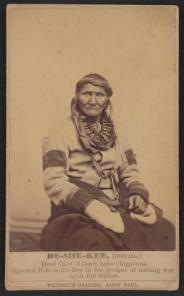
Not Chief Buffalo from La Pointe: This is Chief Buffalo from Leech Lake.
 Chequamegon History