Judge Bell Incidents: King No More
October 16, 2025
Collected & edited by Amorin Mello
This post is the second of a series featuring newspaper items about La Pointe’s infamous Judge John William Bell. Today we explore obituaries of Judge Bell that described his life at La Pointe. Future posts of this series will feature articles about the late Judge Bell written by his son-in-law George Francis Thomas née Gilbert Fayette Thomas a.k.a G.F.T.
… continued from King of the Apostle Islands.

Wisconsin State Journal
Saturday, December 31, 1887, Page 1
King of the Apostle Islands No More
ASHLAND, Wis., Dec. 31. – Judge Bell, known far and wide as “King of the Apostle Islands,” died yesterday. For nearly half a century he governed what was practically a little monarchy in the wilderness. He was 83 years old, and was the oldest living settler on the historic spot where Marquette founded his mission, two hundred years ago.

The Saint Paul Globe
Saturday, December 31, 1887, Page 1
KING OF THE ISLANDS.
Judge Bell,
“King of the Apostle Islands,”
Has Given Up His Crown.
The Oldest Living Pioneer
of the Historic Spot
Dies in Apparent Poverty,
Special to the Globe.

San Francisco Examiner
Wednesday, January 3, 1888, Page 2
ASHLAND, Wis., – “The king of the Apostle islands” is dead. He passed away at an early hour this morning at La Pointe, on Madeline, the largest of the group, where he has lived for forty-four years, the oldest living pioneer of the historic spot where Pere Marquette founded his little Indian mission 200 years ago. Judge Bell was a character in the early history of the Lake Superior region, known far and wide as the “king” of the country known as La Pointe, which was organized in 1846 by Judge Bell. The area of the country was as large as many states of the Union, its borders including nearly all of Wisconsin north of the Chippewa river, the Apostle islands and to an almost
ENDLESS DISTANCE WEST.

Wisconsin Historical Society’s copy of Lyman Warren’s 1834 “Map of La Pointe” from the American Fur Company Papers at New York Historical Society.
The population of whites consisted only of a small handful of French voyagers, traders and trappers, most of whom rendezvous at La Pointe. The country was hardly known by the state, and Bell’s county was practically a young monarchy. He bossed everything and everybody, but in such a way that every Indian and every white was his friend and follower. Judge Bell came here in 1832, from Canada, in the employ of the American Fur company, which at that time was a power here. He had rarely left the island, except in years gone by to make occasional pilgrimages through the settlements. During his eventful life he held every office in the county, and for many years, served as county judge. He was a man of great native ability, possessed of a courage that controlled the rough element which surrounded him in the early days when there was no law except his will. He was honest, fearless,
A NATURAL-BORN RULER

Fargo Daily Argus
Sunday, January 1, 1888, Page 1
of men, and through his efforts the poor and needy were cared for, and in no instance did he fail to befriend them. For this reason among those who survive him, and who lived in the good old pioneer days, all were his firm friends. His power departed only when the advance guard of civilization reached the great inland sea, through the medium of the iron horse, and opened a new era in the history of the new Wisconsin. For many years he has been old and feeble and has suffered for the comforts of life, having become a charge upon the town. He squandered thousands for the people and died poor but not friendless. He was eighty-three years of age.

The Ashland News
Wednesday, January 4, 1888, Page 7
ANOTHER PIONEER GONE
DEATH OF “SQUIRE” BELL, “THE KING OF LAPOINTE.”
Sketch of the Life of the Oldest Settler in the Lake Superior Region.
He comes to La Pointe With John Jacob Astor for the American Fur Co.
Judge John W. Bell died Friday morning at seven o’clock at his home at La Pointe, on Madeline Island, aged eighty-four years.
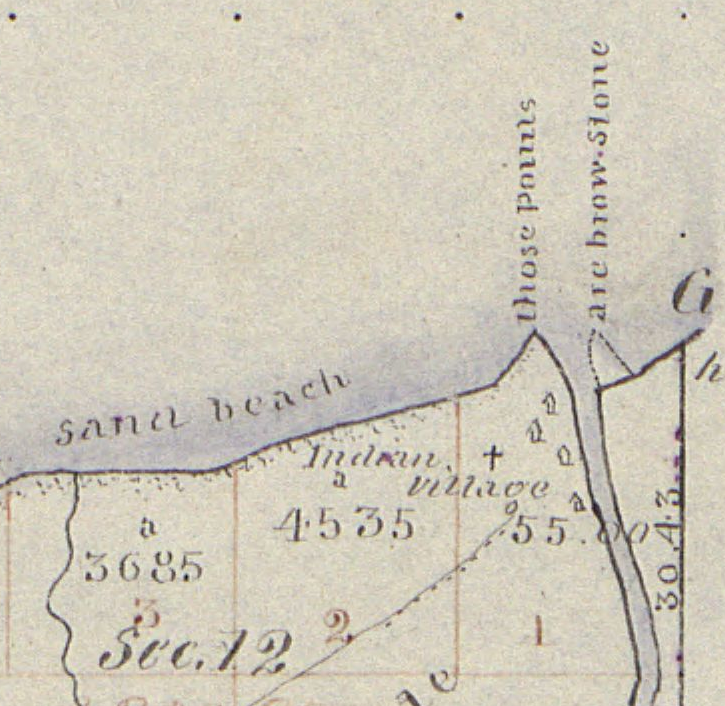
1847 PLSS survey map detailing the mouth of Iron River at what is now Silver City, Michigan along the east entrance to the Porcupine Mountains.
John W. Bell was born in New York City on May 3, 1803, and was consequently eighty-four years and seven months old. He learnt the trade of a cooper, and in this capacity in the year 1835, he came to the Lake superior country for the United States Fur company. He first settled at the mouth of Iron river, in Michigan, about twenty miles west of Ontonagon. Here, at that time, was one of the principal trading and fishing posts of the American Fur company, La Pointe being its headquarters. Remaining at Iron river for a few years, he came to La Pointe about 1840, where he continued to reside till the time of his death.

1845 United States map by John Dower, with the northernmost area of Wisconsin Territory that became La Pointe County.
At the time he came upon this lake its shores were an unbroken wilderness. At the Sault was a United States fort, but from the foot of Lake Superior to the Pacific ocean, no white settlement existed. The American and Northwest Fur companies were lords of this vast empire, and their trading posts and a few mission stations connected with them, held control. A small detachment of United States soldiers formed the distant outposts of Ft. Snelling. The state of Wisconsin had not been organized. No municipal government existed upon this lake. It was many years before Wisconsin was organized.
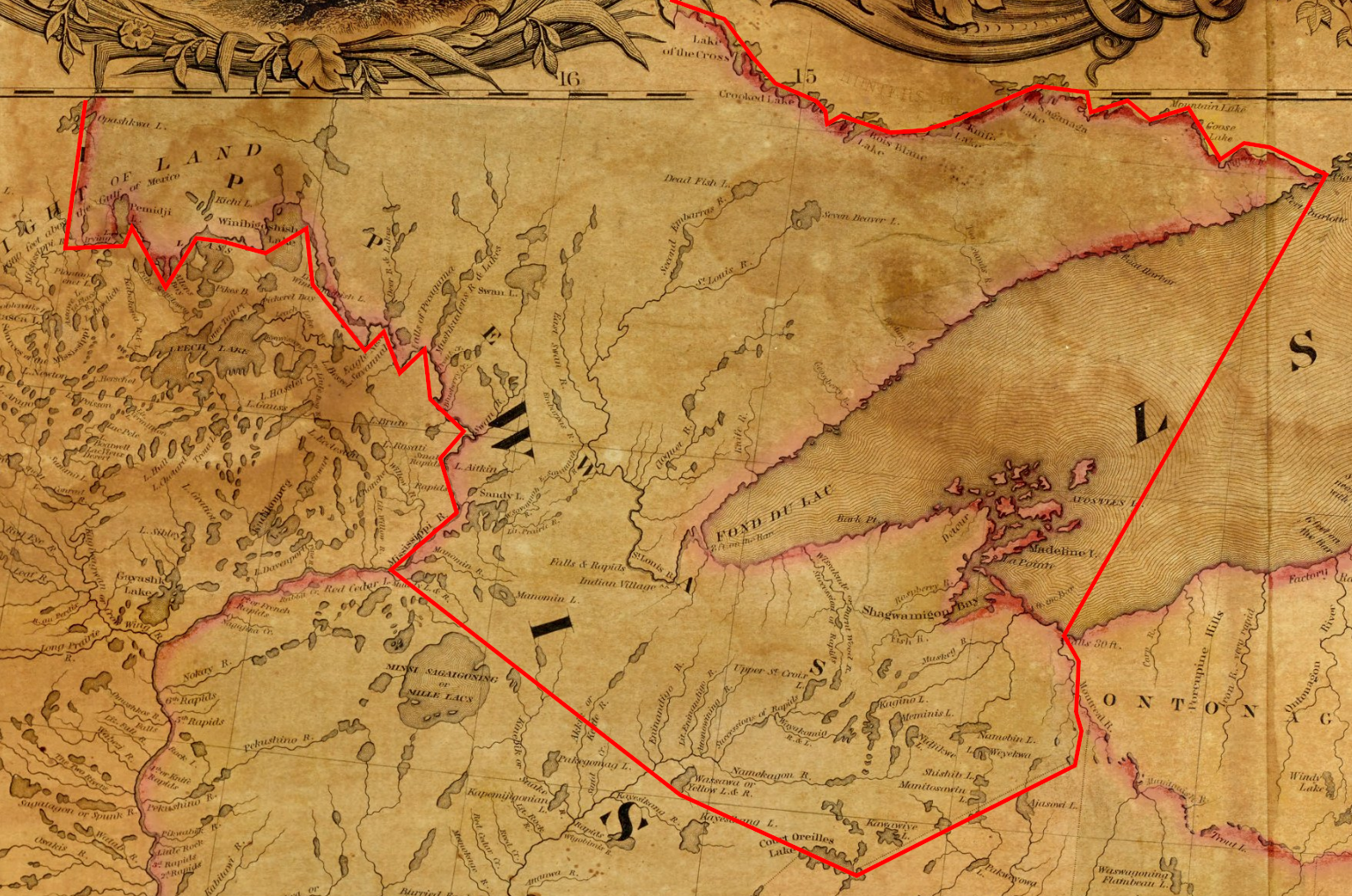
1845 United States map by J. Calvin Smith, with the original 1845 boundaries of La Pointe County added in red outline.
“beginning at the mouth of Muddy Island river [on the Mississippi River], thence running in a direct line to Yellow Lake, and from thence to Lake Courterille, so to intersect the eastern boundary line at that place, of the county of St Croix, thence to the nearest point on the west fork of Montreal river, thence down said river to Lake Superior.”
Finally the county of La Pointe was formed, embracing all Wisconsin bordering upon the lake and extending to town forty north. “Squire Bell,” as he was always called, became one of the county as well as town officers of the town and county of La Pointe, and for more than thirty years continued to hold office, being at different times chairman of supervisors, register of deeds, justice of the peace, clerk of the circuit court and county judge. This last office he held for many years.
He was a man of genial nature and robust frame. About four years ago, while in Ashland he fell and fractured his thigh, and was never able to walk again. His sufferings from this accident were great and his pleasant face was never seen again in Ashland. He enjoyed the esteem and friendship of his neighbors, so far as is known without exception. He was clear headed and of commanding appearance. His influence among the Indians and the French who for many years were the only inhabitants in the country was very great, and continued to the last. For years his dictum was the last resort for the settlement of the quarrels in this primitive community, and it seems to have been just and satisfactory. He was often called “The King of La Pointe,” and for years no one disputed his supremacy.

Edwin Ellis, M.D.
Dr. Edwin Ellis, of this city, said in speaking of the dead old pioneer:
“Thus one by one the early settlers are passing away, and ere long an entirely new generation will occupy the old haunts. He will rest upon the beautiful isle overlooking Chequamegon bay, where the landscape has been familiar to him for more than a generation. We a little longer linger on the shores of time, waiting the summons to cross the river. While we consign the body of an old friend to the earth we will in all heartfelt sorrow say: ‘Requiescat in Pace.'”

Superior Times
Saturday, January 7, 1888, Page 2
The Lake Superior Monarch
Judge Bell, the ‘king of the Apostle islands,’ who died the other day on Madeline Island at the age of eighty-three, was a conspicuous character in the early history of the Lake Superior region. He was the “king” of the county known as La Pointe, which was organized in 1846 by himself. The county was as large as many states of the Union, its borders including nearly all of Wisconsin north of the Chippewa river, the Apostle islands, and to an almost endless distance west. The white population consisted of a handful of French voyagers, traders and trappers, most of whom made their rendezvous at La Pointe. The country was hardly known by the state, and Bell’s realm was practically a little monarchy. He “bossed” everything and everybody, but in such a way that every Indian and every white was his friend and follower. Judge Bell rarely left the island except to make occasional pilgrimages through the settlements. During his eventful life he held every office in the county, and of late years had served as county judge. He was a man of great native ability, and was possessed of a courage that controlled the rough element that surrounded him in the early days when there was no law except his will. He was an honest, fearless, natural-born ruler of men. Through his efforts the poor and needy were cared for. His power departed only when the advanced guard of civilization reached the great inland sea. For many years he had been feeble, and of late had become a charge upon the town. He spent thousands upon the people.
To be continued in Fooled the Austrian Brothers…
Edwin Ellis Incidents: Number VIII
February 11, 2024
Collected & edited by Amorin Mello

Originally published in the September 1st, 1877, issue of The Ashland Press.
Transcribed with permission from Ashland Narratives by K. Wallin and published in 2013 by Straddle Creek Co.
… continued from Number VII.
My Dear Press: – Among the early names associated with Ashland, I must not omit to mention a few others.
1. E. F. Prince

came to Ashland early in 1857. He was brother-in-law to Martin Beaser and was induced by him to come from Buffalo to this place. He had been employed as clerk in a large ship building establishment, and when he left the employees of the yard showed their regard for him by presenting to him an elaborate and valuable set of silver service. He erected, in the same year, the house in which he now lives, on Main Street, in Beaser’s Division. From 1861 to 1872, he resided in Ontonagon and Duluth, but upon the commencement of work on the W.C.R.R., at Ashland, he returned to his old home, where he now resides.
Though still young and vigorous, he is entitled to be reckoned as one of the “Old Folk” of Ashland.
2. Oliver St. Germain
came to this place in 1856, and built a home on Main Street, adjoining Mr. Prince’s place. The house, with all its contents, was burnt down in the spring of 1858, inflicting a heavy loss upon Mr. St. Germain. He pre-empted a quarter section of land adjoining the town site, and cleared about twenty acres in 1858. The railroad passes through this clearing about a mile from town.
In the general wreck which followed the crash of 1857, he was compelled to abandon his Ashland home, and for some fifteen years lived at Ontonagon, Carp Lake, and Superior City. In 1872 he returned to his early home, and was among the first to build a house in Vaughn’s Division, in which he now resides. Though like the rest of us, he has encountered hard times, still, in the midst of discouragements, he is ever cheerful and hopeful, and determined never to give up, as long as a plank is left in the ship.
3.
I approach with reluctance another name, for I am conscious of my inability to do justice to his memory; nor fairly exhibit to this generation, his manly social, and religious character; nor make clear, in its true extent, the important part he acted in moulding and elevating the society, not of Ashland alone, but of the Counties of Ashland and Bayfield. In the annals of that History recorded by God himself, upon the tablets of Eternity, I doubt not his name will eclipse in true greatness and glory, those of Caesar and Napoleon.
I allude to
Rev. Hemenway Wheeler.

Reverend Leonard Hemenway Wheeler of the ABCFM Mission.
He was a native of Vermont, educated at Middlebury College, and at Andover Theological Seminary.

Reverend Sherman Hall of the ABCFM Mission.
~ Madeline Island Museum

Bishop Frederick Baraga of the Catholic Mission.
~ Madeline Island Museum
At the time of the completion of his course in theology, he had nearly decided to devote his life to the foreign mission field, in which he had near relatives. At this juncture, his attention was directed to the condition of the Chippewa Indians on Lake Superior. He offered his services to the American Board of Foreign Missions, who, besides the foreign work, had charge of the missions among the American Indians. His offer was accepted, and he was directed to join the Mission at La Pointe, then one of the stations of the Board, under the care of Rev. Sherman Hall, who still survives, at a very advanced age, at Sauk Rapids, in the state of Minnesota. Mr. Wheeler, in the early part of 1841, was married to Miss Harriet Wood, of Lowell, Mass., a refined and cultivated young lady, who, like her husband, was thoroughly imbued with the spirit of missions, and with true heroism, she left her cultivated home, and society, and went into what seemed banishment from civilization. We of this day, with our numerous steamboats, from Chicago, Detroit, Cleveland and Buffalo, – with the iron horse, drinking the waters of the lake at our very doors, and with the streams of commerce, and of social life sweeping by and among us in a constant flow, can have no idea of what it involved to come here for a life work, forty years ago.
At that time, there was a small settlement at the Sault. The site of the present beautiful and substantial city of Marquette was Indian hunting grounds. L’Anse, Houghton, Hancock, Calumet, Eagle harbor, Eagle River, Ontonagon, Ashland, Bayfield, Superior and Duluth were then in the unknown future. La Pointe was at that time the most important town on the Great Lakes. It had, in the 17th century, attracted the notice of the French explorers, and of the Jesuit missionaries, who made choice of it, as a trading post and as a mission station. The mission had been continued for near two centuries, and the trading post still held, though now under another race of men, was now the headquarters of the American Fur Company, where a factor resided, and where great warehouses were erected for the reception of the vast supplies of goods to be used in the Indian trade, which were brought once a year in the company’s vessel. From La Pointe these goods were distributed to various trading posts, scattered around the basin of Lake Superior, for more than four hundred miles, and extending inland indefinitely. Among these posts may be mentioned L’Anse and Iron River, in Michigan; Lake Flambeau, Montreal River, Lac Court Oreille, and St. Croix, in Wisconsin; Fond du Lac, Grand Portage, Vermillion Lake and Crow Wing, in the Territory of Minnesota, thus embracing the largest part of the waters flowing into the gulf.

View of La Pointe, circa 1843.
“American Fur Company with both Mission churches. Sketch purportedly by a Native American youth. Probably an overpainted photographic copy enlargement. Paper on a canvas stretcher.”
~ Wisconsin Historical Society
La Pointe was the emporium, the metropolitan city of this vast extent of country. It was the Mecca of the Ojibwas, occupying the extensive country I have named. To reach La Pointe and be buried there, was to be close to the gate of entrance to the “happy hunting grounds.” It was to him the “sweet Island of the blest.” With joy he hailed its sight, as he emerged from the forests in which months had been spent, gathering his pack of furs; and with regret he turned his lingering look upon it, as he again plunged into the wild wastes for his solitary hunt of half a year.

“Boardwalk leading to St. Joseph’s Catholic Church in La Pointe.” Photograph by Whitney & Zimmerman, circa 1870.
~ Wisconsin Historical Society
It was the scene of some of the most important treaties made with the Chippewas of the Northwest, by which they ceded to the United States, lands in extent sufficient to form respectable states. It was also the gathering place where the annual Indian payments were made for many years, and where the native chiefs, with their braves, delighted to hold their great councils.
Fifty years ago, no other place in this part of the West afforded access to so large a number of natives as did La Pointe. The truths made known to these “untutored minds,” and the light flashed into their dark understandings, by the preaching of the simple story of the Cross, could soon be carried to the head waters of the Mississippi, or to the dwellers on the tributaries of Hudson’s Bay, or of the Arctic Ocean. As a central point for carrying on this work of benevolence and love, it was unsurpassed.

Undated photograph of Hall & Wheeler’s ABCFM Mission Church at it’s original location on Sandy Bay (Middleport) before it was moved uphill onto Mission Hill.
~ Madeline Island Museum
It was the consideration of these facts that induced the American Board to establish a mission station at La Pointe, and to send thither for this purpose, about fifty years ago, the Rev. Sherman Hall. He had successfully planted the mission, and established a school at the time of the arrival of Mr. Wheeler.
Mr. Wheeler immediately entered actively upon his life work devoting himself to learning the Ojibwa language, and preaching by means of an interpreter, teaching in the school, and striving, in every way, to promote the spiritual and material welfare of the people.
To be continued in Number IX…
Asaph Whittlesey Incidents: Number VIII
April 20, 2023
Collected & edited by Amorin Mello
Originally published in the April 6, 1878, issue of The Ashland Press. Transcribed with permission from Ashland Narratives by K. Wallin and published in 2013 by Straddle Creek Co.
… continued from Number VII.
Early Recollections of Ashland: Number VIII
by Asaph Whittlesey
We now offer a few comments upon our experience in common, and our appreciation of Doctor Edwin Ellis. I observe first that the inherent modesty of the man left him with next to no thought of himself in his “Early Recollections of Ashland,” and therefore the weightier of the task falling upon me. Had the question been raised “who is Dr. Ellis?” a proper reply would have been “Dr. Ellis is Dr. Ellis.”
In all my acquaintance I find no person more clearly identified than is this man. His manner of shaking hands, the music of his voice, and his unconscious habit of setting his hair on end, belong to no one but the man Edwin Ellis. For near a quarter of a century have I known him in the relationship of neighbor, physician, oarsman, farmer, speculator, preacher, merchant and as one skilled in back gammon, and can testify that he is a man who does with his might whatsoever his hands find to do. Those of us who were known as pre-emptors or town site claimants had occasion to regard the arrival of Dr. Ellis with no little suspicion, as certainly an emergency only would have induced him to make the trip from La Pointe during the most inclement season of the year. I remember well my anxiety to know whether or not he was a married man, and so direct were my inquiries as to this, that seemingly there was no way left but for him to satisfy our curiosity by simply saying yes or no. However we soon discovered that we were only wasting words in pressing the subject, and abandoned all further inquiry regarding it. Is it not strange that so good a man and one possessing so admirable a wife should be found so unwilling to satisfy our inquisitive minds in regard to this matter?
There was still another peculiarity noticeable in the Doctor, and that was his proclivity for secret organizations. He was chosen Chairman of a secret organization having for its object protection to pre-emptors from having their claims jumped, though one writer informs us that in the eye of the law they were all trespassers, – but by this means those holding claims felt a security in being absent from them the greater portion of their time. Perhaps the existence of this organization may explain why there has been so many little acres of early clearings discovered by brother Pratt, in the vicinity of Ashland.
Again, Dr. Ellis is one who thinks for himself, but is ever free to weigh the arguments of others, that he may be convinced of the right, and having formed his conclusion is outspoken, so that no one can mistake his position. Being of a hopeful and cheerful turn of mind, his company is courted. All in all whether as to his fitness for the life of a pioneer or as a neighbor and Christian friend I never knew a better.
I have been with him also in times of very great peril, when seemingly we were destined to a watery grave. But through presence of mind and well directed effort we succeeded in reaching the shore amid a feeling of profound gratitude toward our Great Protector above, for sparing our lives. As it is my intention hereafter to refer briefly to the history of a few of the ladies who first settled in and about Ashland. I will omit any special reference to Mrs. Ellis at this time.
HON. SAMUEL S. VAUGHN
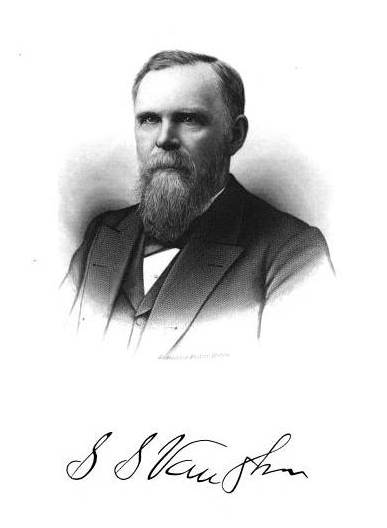
First arrived at La Pointe in 1852. At the time of my arrival there in 1854, I found him running a one horse store in an old frame building, standing in the sand near the present residence of George A. Stahl. So far as I am enabled to bring to mind the succession of events, my first sight of this man was at his own store where I invested in a very poor pocket compass, and this I soon after deposited on the copper range while upon an exploring trip with Ervin Leihy, Esq. Mr. Vaughn, however, claims that he first caught sight of me on the occasion of my aiding Rev. L. H. Wheeler in a social talk with the La Pointe people upon the subject of temperance one Sunday afternoon, in the store of Julias Austrian, Esq.

Reverend
Leonard H Wheeler
The leading man then engaged in the grocery business, as it was called, was one Peter B. Vanderventer, who subsequently left the country at a midnight hour rather than remain and meet a worse doom. Vanderventer was a large sized man and more a hellish countenance, and in exhibition of his bravery at the temperance meeting to which I have referred, he planted himself directly in front of me, and not more than three feet distant, so that I presume he did not mistake my language.

I cannot let slip the opportunity now furnished for informing the public of what seemed to me a rather severe practical joke inflicted upon Vaughn and Vanderventer, as it is too good to be lost, we will mention it right here. It seems that at the time Mr. Austrian made so extended entries of land upon the island, Messrs. Vaughn and Vanderventer discovered that Austrian had failed to enter a fraction shown upon the official plot, as reaching quite a distance into the bay, from what was known as Boyd’s Point and containing some forty acres or more. As La Pointe seemed likely to hold prominence as a business place, they saw the necessity of forthwith securing the tract of land in question. The two therefore suddenly disappeared amid the coldest days of a Lake Superior winter, and footed it under very adverse circumstances through to Willow River, something like one hundred and seventy-five miles, and returned, but yet were quite satisfied to know that they had secured to themselves what they had started for. From this time forward for several years these gentlemen paid their taxes promptly, until they finally employed a surveyor to re-survey and plot their promising possessions. Right here is where they discovered the point of the joke, by being informed that there was not a single foot of their land left, but all and much more had been washed away. Perhaps it was cruel in me to do so, but I could not resist making frequent inquiries as to their real estate.

Section 6 from 1852 GLO PLSS survey of T49N-R3W-4PM showing Boyds Point (now Grants Point) on Madeline Island.
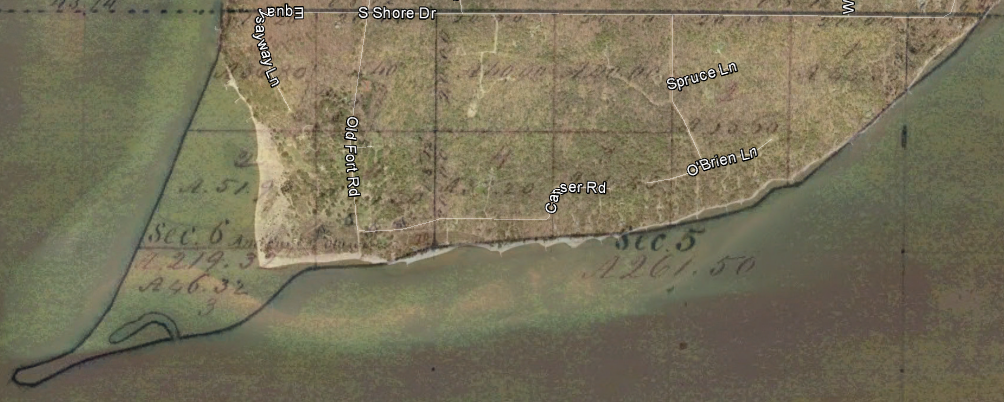
Modern aerial imagery overlay showing Vanderventer & Vaughn’s Lot 3 lost to the sands of time (along with parts of Boyd & Rowley’s Lots 1 & 2).
In 1855 Vaughn removed his stock of goods to a building near where Thomas Stahl, Esq., now resides, where I often shared his bed and board, and it remains a pleasure to me to this day to testify to his qualities as a No. one cook, while biscuits of his make were entitled to special mention. It was a standing rule with him to have a controversy of words with Mr. McElroy, neither being specially noted for the refinement of their language. I think it was during the August term of the Circuit Court in 1860 that Mr. Vaughn and Andrew Tate were admitted to the practice of law before the Hon. S.N. Fuller, Judge of the Eighth Circuit of Wisconsin. It is said that they passed a very creditable examination.
This was the first term of Circuit Court held in the County of La Pointe, Elisha Pike being honored as foreman of the first grand jury convened within the county. Although Mr. Vaughn is but forty-eight years of age he can boast of having held the following positions of trust: Post-master, Justice of the Peace, Chairman of Town and County Boards, also member of the Wisconsin legislature in 1871, (having a constituency of 6,365 souls). In the practice of law his maiden effort was that of procuring papers of divorce in a somewhat renowned case. It is thought that but for the public trust which he held as a Chairman of the School Board he probably would never have known married life, – but as it was so foreordained they accepted the situation, while the people shouted, Amen!
On the arrival of business at Ashland in 1873, Mr. Vaughn removed his family to that place where he once more engaged as trader and forwarding and commission merchant.
To be continued in Number IX…
Edwin Ellis Incidents: Number VII
April 9, 2023
Collected & edited by Amorin Mello
Originally published in the August 25th, 1877, issue of The Ashland Press. Transcribed with permission from Ashland Narratives by K. Wallin and published in 2013 by Straddle Creek Co.
… continued from Number VI.

Plat of Prentice’s Addition to Ashland:
“It is in this addition, that, the Chippewa River and the St. Croix Indian trails reach the Bay.”
My Dear Press: – Recollections of Ashland which should forget to mention Martin Roehm, would leave out a material part – in truth a connecting link in the “chain of events.” He came to the Bay in the summer of 1856 – a hearty industrious young man, not many years from the “Fader Land.” He pre-empted a quarter section of land near the town site – which he still owns. He was not long in discovering the worth and beauty of a comely young widow, who, like himself, had left the “Fader Land” to improve her worldly condition. – After a somewhat lengthy courtship, they were married by “Esquire Bell” in their own home. The ruins of the house may be seen in Prentice’s Addition on the flats between “town” and the mouth of Fish Creek. The bride herself cooked with her own hands the marriage feast, while the guests were gathering. The ceremony was concluded by a grand gallopade, the music being under the direction of that master of the Terpsichorean art, Conrad Goeltz, assisted by his brother Adam, himself a master of the art.

Photograph from obituary of Martin Roehm:
Ashland Daily Press,
April 17, 1898
Martin and his worthy wife still live in Ashland, having witnessed and participated in its varied fortunes for more than twenty years. They may be said to form the connecting link between the Old and New Ashland; for when all others had been, by the force of circumstance, compelled to abandon their homes, they alone remained “monarchs of all they surveyed.” They were in possession of an improved estate in their beautiful valley of Marengo twelve miles from Ashland. This was their favorite winter retreat; while upon the shores of the bay their palaces exceeded in number the residences of the richest kings of the old world. For years they were sovereigns alone, in possession of territory rivaling in extent some of the Kingdoms of Europe.
Their herds of cattle increased year by year and in time patriarchal style, were driven from one part of the vast estate to another, as the necessities of forage might require.
And now, although the revival of Ashland has somewhat restricted the extent of Martin’s possessions, he still owns a valuable herd of cows, and finds a sure source of revenue in the milk supply of Ashland, to the mutual satisfaction of his patrons and himself. His experiments have shown that our soil and climate are adapted to cattle raising and dairy purposes.

Robert Dundas Boyd
Register of Deeds
La Pointe County
Robert D. Boyd, unknown to most of the present generation, came to Ashland in 1855. He was a native of the island of Mackinac – the son of an Indian Agent there stationed. His father was connected by marriage with a distinguished ex-President, to whom he owed his appointment. Rob’t D. as the report was, had, from the effects of a sudden outbreak of passion been guilty of a high crime, and to escape the penalty of the law, had fled to Lake Superior – then almost inaccessible – and safe from invasions of sheriffs and wicked men of that sort. At La Pointe he married a French mixed blood girl by the name of Cadotte, by whom he had several children. Except when under the influence of liquor, his conduct was good and his manner gentlemanly and polite. When partially intoxicated he was thought to be somewhat dangerous if not desperate.

Detail of settlement at Boyd Creek from Augustus Barber’s 1855 survey:
“There is a house in the NE quarter and another in the SE quarter of Section 25.”
He laid claim to a piece of land on the west side of the bay opposite to Ashland, of which a plat was made, to which he gave the name of “Menard,” in memory of the lamented French Jesuit Priest, who, according to tradition, labored for a while at an Indian village then located at this spot, – the point where the old St. Croix Indian trail reached the water of the Great Lake, and which in early years was a well beaten path – but now deserted. No traces of the village are now visible. The storms of nearly two hundred and fifty winters have obliterated all traces, of what from its position, must have been an important point among the Ojibwas of the northwest. According to the tradition, Father Menard left the bay for a missionary tour inland, from which he never returned and no trace of him was ever found.

La Pointe County Deeds Book A Page 577:
Plat of Mesnard
Surveyed, certified, and recorded in 1857 by Edward L. Baker, as power of attorney for Thomas H. Hogan of La Pointe:
“the SE¼ of the SW¼, the SW¼ of the SE¼, and Lot 3 in Section 24, and Lots 1 & 2 and the NE¼ of the NW¼ and west½ half of the NW¼ of Section 25, all in Township 48 North of Range 5 West of the 4th principal meridian of the State of Wisconsin“
Boyd erected a house in 1857 in the western part of Beaser’s Division which still stands, but unoccupied.
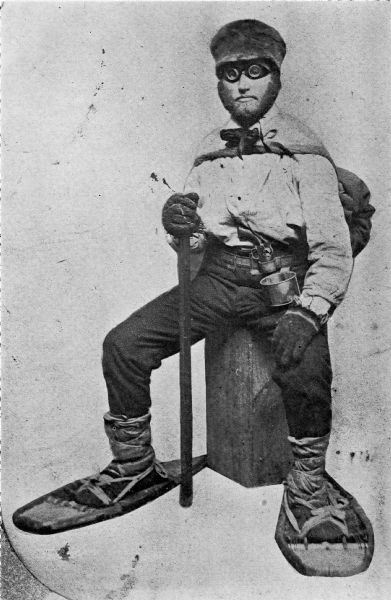
Wisconsin Representative Asaph Whittlesey also wrote about this tragedy.
In the latter part of 1857 he became unusually dispirited; his drunken sprees became frequent and long continued; and he was often under arrest for his disorderly and quarrelsome conduct. Finally in January 1858 he fell into a drunken debauch of several days duration. He was then living in the old log cabin on Main Street – Mr. Whittlesey’s first house – with one bachelor companion by the name of Cross. Having passed the night in drunken carousals, in the early morning – irritated by some real or imaginary insult from Cross – he approached the latter with a drawn butcher knife in his hand, holding it up in a threatening manner, as if about to strike. Cross drew a revolver and fired – two balls passed into the chest – one entering the heart. Boyd fell and in five minutes had breathed his last. This tragic event produced a profound sensation in our little community. A coroner’s inquest was held by Asaph Whittlesey, then a justice of the peace, – and although the evidence seemed to show that Cross might have retreated and saved himself without taking Boyd’s life, still Cross was judged by the jury to have acted in self-defense and was acquitted, Boyd’s known desperate character doubtless contributed to this result.
Boyd’s wife had died some years before, and several children were left orphans; and the writer will always carry in his mind the affecting scene as the little daughter three years old was held up in the arms of Mrs. Angus to take a last view of, and imprint a last kiss on the cold brow of her only natural protector. But God – who is ever the Father of the fatherless, – took care of the orphans, and they are now grown up to manhood and womanhood, and twenty years have effaced from most the memory of this sad event.
To be continued in Number VIII…
Edwin Ellis Incidents: Number VI
April 13, 2022
By Amorin Mello

Originally published in the August 11th, 1877, issue of The Ashland Press. Transcribed with permission from Ashland Narratives by K. Wallin and published in 2013 by Straddle Creek Co.
… continued from Number V.
EARLY RECOLLECTIONS OF ASHLAND
“OF WHICH I WAS A PART.”
Number VI
Edwin Ellis, M.D.
photograph from Magazine of Western History: Volume IX, No.1, page 20.
My Dear Press: – The history of the first attempt at dock building was told in a former chapter, and also the sudden disappearance of the dock one night in April, 1855.
The early settlers did not, upon their first arrival here, have any fair appreciation of the difficulties in the way of constructing docks, which should be able to resist the several forces to which they would be exposed, and which would certainly tend to their overthrow. They had not had, as this generation has, the advantage of years of observation of the force of ice as affected by winds, as floating in great fields and driven by wind and tide, nor of the great force arising from expansion. We now understand better what is the strength of these destructive forces. Some of us watched them with intense and eager anxiety for years; for no commercial town could be here built up without docks.
It may not be uninteresting to consider in a few words, the varying modes in which the heavy accumulation of ice, during our long winters, is got rid of in the spring, and navigation opened.
Some seasons the water in the bay seems to stand at the same level, not moving by winds or tides for many days in succession. The ice melts away under the rays of the sun and by the warmth of the south wind. It is a slow but gentle process. Any dock is safe in such a season. At other times there are sudden and great changes in the elevation of the surface of the ice or water, either from the force of wind on the open water in the outside lake, or from barometric pressure, or both combined, a great influx of water is driven under the ice into the bay. At that juncture the ice having been melted away near the shore all around the bay, the whole mass is lifted up several inches and held us on the top of a great wave. But the reflux of the water must soon occur – when this great field of ice moves down upon a heavy grade. Its speed will often be accelerated by a strong southwest wind. The force thus generated is well-nigh irresistible unless there be such a conformation of the shore as shall save the dock from its full effect, and such, fortunately, is the case with our shore.
Another force, also operating with great power and effect upon the first docks built here and from which they suffered severely, was the expansive power of ice, resulting from changes of temperature. The water in early winter freezes with level surface and is fast to both shores. But as the cold becomes more intense and the ice thickens, it also sensibly expands, and crowds with great power upon the shore. It is easy to perceive that docks fully exposed to this force would need to be very firmly bolted together, and covered with heavy loads, or they must be pushed over. Our docks were thus in the more exposed cribs, broken, and afterwards easily carried away by floating ice and waves. Our first docks having been carried away; though somewhat alarmed, we did not at once give up.

Martin Beaser
portrait from Magazine of Western History: Volume IX, No.1, page 24.
In December 1855, two docks were commenced, one called the Bay City Dock, near the sash factory – and the other at the foot of Main Street in Beaser’s Division of Ashland, in front of the present residence of James A. Wilson. This last was built by Mr. Beaser. His plan was to build cribs with flattened timber, fitted closely together so as to hold the clay with which they were filled as ballast, instead of rock, for rock could only be obtained at great cost. We had no steam tugs then, with which to tow scows, as at present. The cribs were carried out some five or six hundred feet and filled with clay. Stringers connected the cribs, over which poles were laid as a roadway.
The Bay City Dock was also built out into deep water with an L running east. The cribs near the shore were filled with rocks, but for want of time the outer cribs and the L were not filled before the spring break up. The cribs were, however, constructed with stringers and covered, and some two hundred cords of cord wood were piled upon the dock to prevent the moving of the cribs.
The ice in the bay had not moved, but was melted away and broken up for a few hundred feet from the shore. There was a great influx of water from the Lake, raising the whole body of the ice. In a short time there was a greater reflux of the water, and the vast field of ice was seen to be in motion. All eyes were watching the docks, nor was it needed to watch long. Mr. Beaser’s was the first to give way. The cribs did not seem to offer any resistance to the moving mass. The most of them were carried away in less time than it takes to describe it. Only a few cribs near the shore escaped.
Nor was the attack on Bay City Dock long delayed; steadily onward came the mass. And the outer portion was soon in ruins, and the great pile of wood was floating upon the water. The cribs forming the approach for about three hundred feet, being filled with rock were not carried away. Thus in one hour were swept away the labors of many months, and several thousand dollars. The sight was discouraging to men who had come here to make their homes, and whose all was involved in the ruins. The elements seemed in league against us. The next day the steamer Superior arrived and effected a landing upon the broken timbers of our dock. Capt. Jones was in command of her, who, together with his boat were soon to go down in death beneath the waters of the Great Lake.

1860 photograph of the steamer Lady Elgin from the Chicago History Museum and digitized by Ship-Wrecks.net
During the summer and fall of 1856 the Bay City Dock was repaired and extended further into the bay, and the cribs filled with rocks, and the steamer Lady Elgin made several landings alongside. But during the winter of 1856 and ’57 the expansive power of the ice, showing against the cribs pushed off the timbers at the water line of several of the outer cribs, which, at the opening of navigation in 1857, were carried away, leaving only sunken cribs. The dock was never rebuilt, as the financial storm of 1857 began already to lower upon us. The sunken cribs still remain, as has been proved by the exploration of Capts. Patrick and Davidson, in command of the tugs Eva Wadsworth and Agate.
The experience of the “new Ashland” have demonstrated that pile docks can be built so as successfully to resist all the opposing forces to which they are exposed. The result of all our experience seems to show that the best dock which can be built is the pile dock filled in between piles with logs or slabs, or what would be better to drive piles close together, capping them and filling in with rocks which will, beyond doubt, be done so soon as our Penoka iron mountains shall be worked. The time when, must depend upon an improved demand for iron.
To be continued in Number VII…
Asaph Whittlesey Incidents: Number VI
April 17, 2019
By Amorin Mello
Originally published in the March 23, 1878, issue of The Ashland Press. Transcribed with permission from Ashland Narratives by K. Wallin and published in 2013 by Straddle Creek Co.
… continued from Number V.
Early Recollections of Ashland: Number VI
by Asaph Whittlesey
—
During 1856 the steamers Lady Elgin, Illinois, and Superior landed freight and passengers upon a steamboat dock constructed at Bay City, now Ellis division of Ashland.

1860 photograph of the sidewheel steamer Lady Elgin.
~ Ship-Wrecks.net
Ashland’s first saloon was opened by James Whitney in June 1856, and during the same month the first store was opened by Martin Beaser, on the corner of block one hundred and one.
The patent to Ashland, issued by the United States, bears the date June 23rd, 1862.
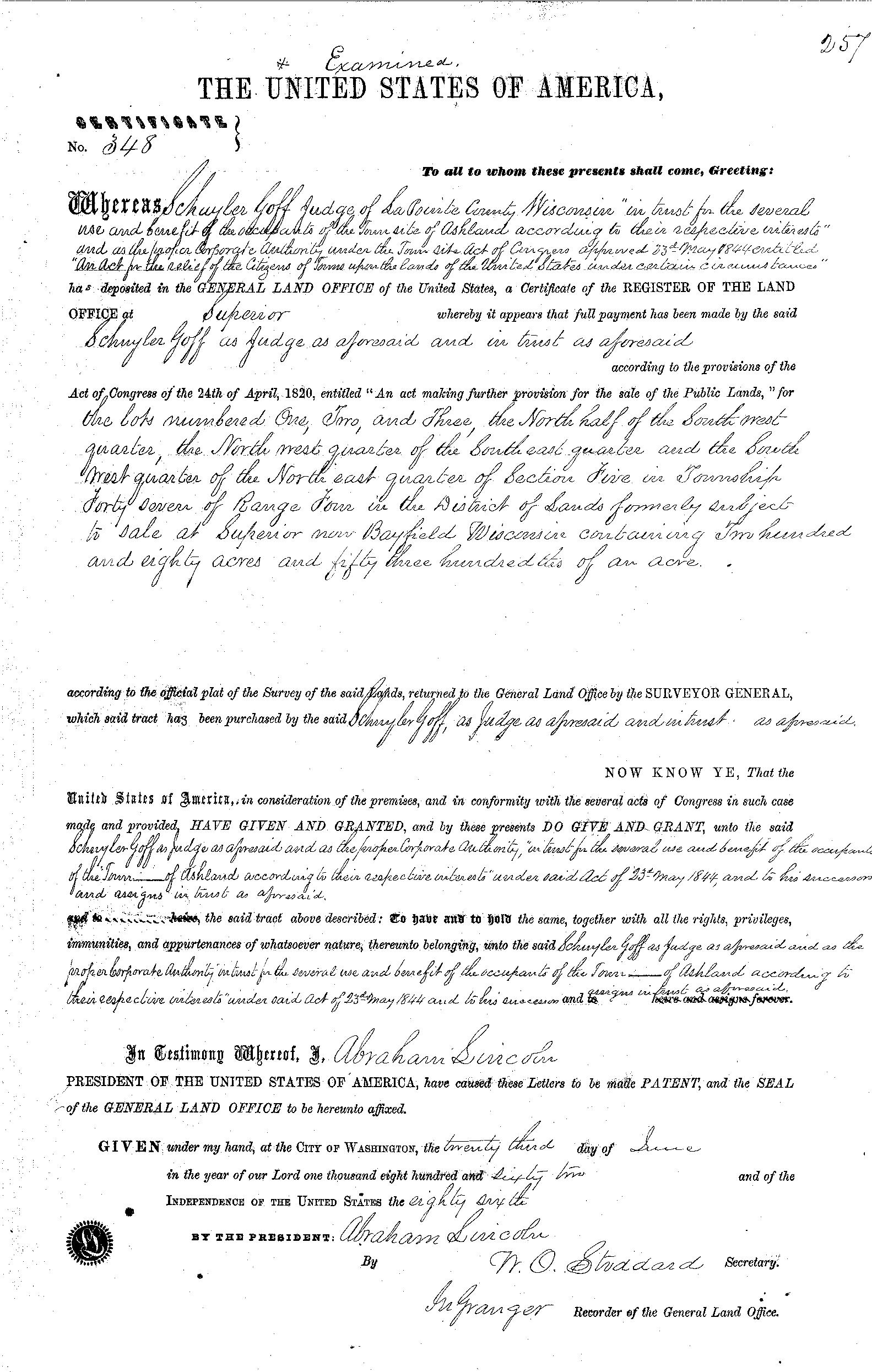
Land patent for the town site of Ashland issued by President Abraham Lincoln on June 23rd, 1862 to Schuyler Goff:
“The contract between the three was, that Mr. Whittlesey and Mr. Kilborn were to receive each an eighth interest in the land, while the residue was to go to Mr. Beaser. The patent for the land was issued to Schuyler Goff, as county Judge of La Pointe county, Wisconsin, who was the trustee for the three men, under the law then governing the location of town sites.”
~ Biographic sketch of Martin Beaser
OF THE OPENING OF ROADS IN THE EARLY DAYS OF ASHLAND.
In reporting upon this subject it is very possible that our town authorities of the present day may be put somewhat to the blush by the manner in which these and other like improvements were made. And I will guarantee the re-election of any Town Board, or other town officer who will carry out the program of former days for the opening of roads, which was simply this:
Whenever a road was needed such men as Edwin Elllis, Martin Beaser, George Kilbourn and myself, (I came near overlooking the latter,) and others who mainly volunteered their work, shouldered their axes and served in person until roads contemplated were completed. There was also this peculiarity attached to this class of individuals; they did not hang about the steps of the town house the balance of the year for the purpose of getting bills audited for work done upon the highways. It was in this manner that the road leading to Odanah and also that leading south to White River Falls were first opened. Even Indians partook of the same spirit in volunteering their labor, as Aid-de-camp to their Great Leader, Rev. L. H. Wheeler.
I have no doubt Dr. Ellis still bears in mind how the woods at Bear Trap were made to echo the yells of the Indians as they collided with the party from Ashland on the very day agreed upon, and I think I may safely say that the citizens of Odanah and of Ashland looked upon the opening of this road as a momentous event, and one which cemented us together even more firmly as friends and neighbors, though I have no doubt many of my readers will stand ready to declare that the foot race existed not very far back.
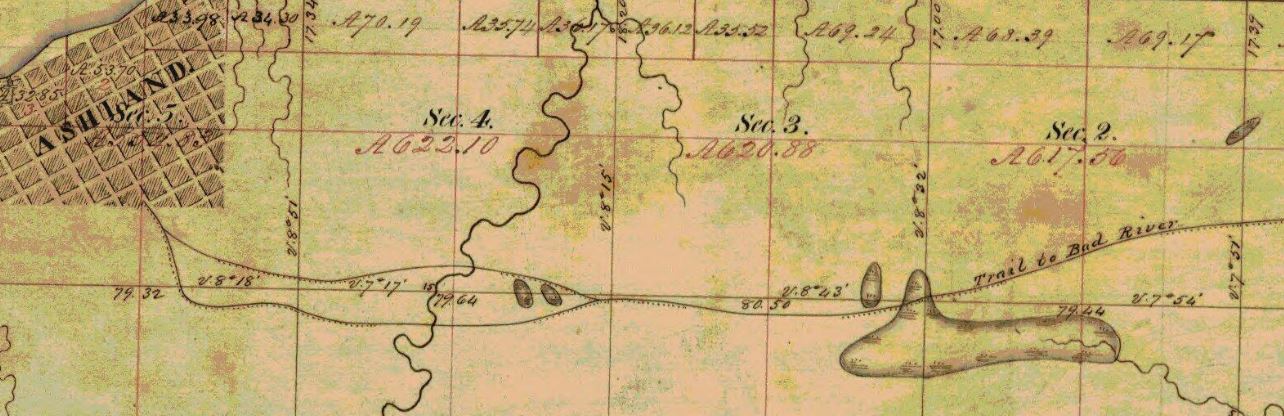
Detail of trail from Ashland to Bad River on Barbers’ survey during the Summer of 1855.
We wore good countenances, slept well nights, and paid one hundred cents on the dollar of our obligations. We were not ashamed to eat salt pork (those of us who could get it,) while our faithful wives vied with each other in the different styles of cooking this staple article of diet.
Next to this comes the everlasting pancake, without which neither town site nor pre-emptions could be legally established.
~ History of the Soo Line by James Lyden, chapter 9.
~ History of Northern Wisconsin by the Western Historical Company, 1881, page 82.
On the second day of June, 1877, I had the honor of driving the last spike, which took place at Chippewa Station, amid the shoutings of a large assemblage of people, including laborers upon the road, and in a few moments thereafter the first train from Milwaukee passed over the road on its way to Ashland, amid great rejoicing and demonstrations of joy over the victory won. At Ashland also the excitement became intense and though it was late on a Saturday evening on which our train reached the town, the illumination of the place brought to our view a field of faces, crazy with excitement over the event they were celebration. As for myself, I confess I felt very much like saying, “Now let thy servant depart in peace.” No longer were we to be informed of what was to be done, but we now knew it to be actually accomplished, and the Wisconsin Central Railroad remained a standing monument to the good name of Gardner Colby, Charles L. Colby and E. B. Phillips, all other efforts being secondary to that of these individuals. I have in my possession a map of this section of country, published by Charles C. Tucker in 1858, on which he laid down an imaginary line of railroad as being likely to be constructed from Madison via Portage and Stevens Point to Ashland, and strange to say it lays down the precise route of the Wisconsin Central Railroad, the very first to be constructed.
Having received by our last mail an important official statement from the Railroad Commissioner for the State of Wisconsin, I will insert the same here rather than to fail to have it published:
He says “the number of miles of railroad now constructed within the State of Wisconsin is two thousand six hundred and fifty-nine and 6-100, while there are seventy-one thousand seven hundred and fifty-nine miles of railroad now operated within the United States, with a capital and debt amounting to four billion six hundred and fifty-eight million two hundred and eight thousand six hundred and thirty dollars.”
STATISTICS IN GENERAL
In furnishing these I desire specially to acknowledge the obligation I am under to Mrs. James Wilson, for granting me access to early records of the place kept by Martin Beaser, Esq., though I find some discrepancies between his record and my own, which I think can be explained by the fact that he did not commence his record until some years after the first settlement of the place, and made it from memory along. For instance he says “the town site of Ashland was located by Martin Beaser, Asaph Whittlesey and George Kilbourn in August, 1854,” whereas Mr. Kilbourn and myself commenced the settlement of the town site July 5th, while Mr. Beaser first visited the place in August when he became an owner therein, the town site being from this time forward owned three fourths by Martin Beaser and one eighth each Kilbourn and Whittlesey.
Again Mr. Beaser’s record states that “the first house was built by Asaph Whittlesey in October, 1854, and was twenty by thirty feet square,” while the fact is I had erected two cabins upon the town site previous to the erection of this one and had lived in them.
Following cabin built by Kilbourn and Whittlesey, foundation laid July 5th, 1854, was twelve by fourteen feet square and was erected on lot number two in block one hundred and five. The foundation to the second cabin built was laid by Kilbourn and Whittlesey Sept. 9th 1854. This cabin was thirteen by fifteen feet square and was erected on lot five of block six. The outline of this building may still be traced. – The third house erected was that erected by Asaph Whittlesey on lot six in block six and was twenty by thirty feet square and this building constituted the residence of the Whittlesey family until the fall of 1857 when I removed to what is known as the Tompkins house on lots five and six in block three. I have in my possession very correct sketches of the first three cabins built, which I hope eventually to have lithographed for preservation. The fourth house was erected by Conrad Goeltz. The fifth house by Martin Beaser. The sixth house by Myron Tompkins. The seventh house by Lawrence Farley. The eighth house by Charles Malmet. The ninth house by Anthony Fisher. The tenth house by Frederick Bauman. Beyond this I am unable to give the order in which buildings were erected.
Conrad and Adam Goeltz first arrived at Ashland in March, 1855, and were employed by me in chopping and delivering cord wood upon the bay shore. As we were without a team we improvised one by harnessing these two Dutchmen and myself in the form of a spike team to a large sized hand-sled with which we banked twenty cords of wood per day.
P.S. – Adam had it twenty-two cords per day, but I think we had better throw off the two cords and try to save our reputation for veracity.
The first chickens brought into town were those brought by A. Whittlesey from Ohio in 1854.
John Beck butchered the first hogs in town, though he left a few which he did not butcher.
Martin Beaser brought the first yoke of oxen, and in 1855 raised about two hundred bushels of potatoes upon the town site. On the third of December, 1855, the schooner Algonquin landed at Ashland two hundred and twenty-five barrels of freight, seventy-five thousand feet of lumber and a yoke of oxen.
Ashland Bay froze over Dec. 7th, 1855. The two first steamboat docks were built during the winter of 1855-6, one by Martin Beaser at the foot of Main Street and one by the Bay City Company. These were carried away by the ice May 1st, 1856.
To be continued in Number VII…
Edwin Ellis Incidents: Number V
January 16, 2019
By Amorin Mello
… continued from Number IV.
EARLY RECOLLECTIONS OF ASHLAND.
“OF WHICH I WAS A PART.”
Number V
Mr. Dear Press: – As has been already stated, the land on which Ashland now stands, had not, at the time of its first settlement, in 1854, been surveyed. The town lines had only been laying off the country into blocks six miles square.
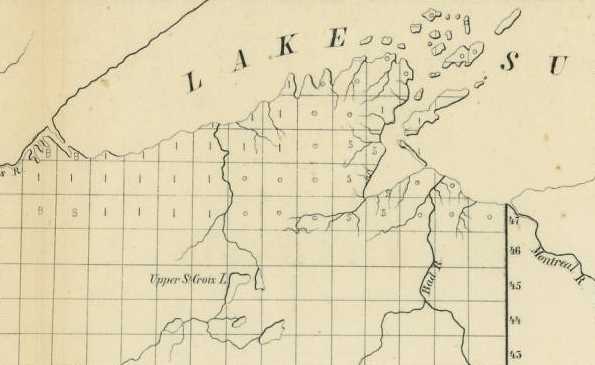
Detail from Sketch of the Public Surveys in Wisconsin and Territory of Minnesota by the Surveyor General’s Office, Dubuque, Oct. 21, 1854 as presented in Senate Executive Document No. 1, 34th Congress, 1st Session.
~ Wisconsin Historical Society
When the settlers made their claims, as most of us did, near the town lines, we were able, by the use of pocket compasses approximately to fix the boundaries of our claims. But no title could be obtained, nor even any safe foundation for a title laid, until the lands should be subdivided into sections, and the returns of that survey made to the Surveyor General’s Office, and by that officer platted or mapped, and then plats and notes sent to the General Land Office at Washington, and from there transmitted to the Local Land office. At that date the local office was at the town of Hudson, on Lake St. Croix, two hundred miles away. But early in 1855 an office was established at Superior, at the west end of the Lake, – and though this was nearly a hundred miles from Ashland, – with no roads, compelling settlers in summer to cost in open boats, and winter to walk this distance. Still it was a very great favor to settlers here, and greatly lessened their hardships, and facilitated the acquisition of their lands.
Wisconsin, Iowa and Minnesota, then were embraced in one Surveyor’s District, with the office at Dubuque, Iowa. It was the duty of the Surveyor General to provide for the details of the Government Surveys in his district, as fast as the settlement of the country might require. Gen’l Warner Lewis was then Surveyor General of this District.

Detail of Ashland City, LaPointe County, from the Barber Brother’s survey during the Joel Allen Barber Papers: Summer of 1855.
These memoirs are classic examples of Edwin Ellis, M.D. writing in the third person when crediting himself for achievements during Ashland’s early days.
No steps having been taken or any order given for the survey of the shore of Chequamegon Bay, in June 1855, Dr. Ellis left in an open boat for Superior, then on foot through the wilderness to St. Paul, following not far from the route over which many years later was constructed the Lake Superior & Mississippi R.R., – then by boat down the river to Dubuque. The situation of our affairs and the people of an early settlement here induced Gen. Lewis to order an immediate subdivision of Towns 47 and 48, North of Range 4 and 5 West, both sides of our bay, and all the lands on which squatters had settled.
Early in September of that year, (1855), Augustus H. Barber began the survey, and pushed the work rapidly, so that he had completed 47 and 48 of Range 4 in October, and the returns had been made and plats prepared and forwarded to the local land office by the first of December.
Spring of 1856
—
Last known letter from Augustus
—
“There is a conspiracy, or combination of old preemptors here who have no right to make claims. Their object is to secure each member a claim on the North shore, and to drive off and keep off by knives and pistols any who may wish to make legal preemptions on the lands they choose to appropriate to themselves.
“There may be some fighting up here this season and there is certain to be considerable laming before the business is settled. Let ‘em rip.
“I can send half a dozen to Jehanum in about as many seconds, but don’t want to do it & will avoid trouble if possible but butcher knife companies must not meddle with any claim when I have made one.“
The Pre-emptors now, for the first time, could file claims to their lands and receive assurance that they were likely to be the owners of their homes.
During December many pre-emption claims were filed, and during the closing days of the year and in the first days of 1856, quite a number proved up those claims and received duplicates, upon which patents were afterwards issued. These were the earliest titles to the present site of Ashland. Unlike many towns in the West at that period our site was not cursed with complicating claims, and it is cause for congratulations that Ashland property has no cloud upon its title and that every buyer may, with little trouble, assure himself of this fact. The title to a portion of the site of Superior was bitterly contested involving years of delay and thousands of dollars of cost and much acrimony of feeling; and it is possible that this may have had its influence in carrying the railroad to Duluth rather than to Superior. Quarrels over title are a curse to any town, especially a new one.
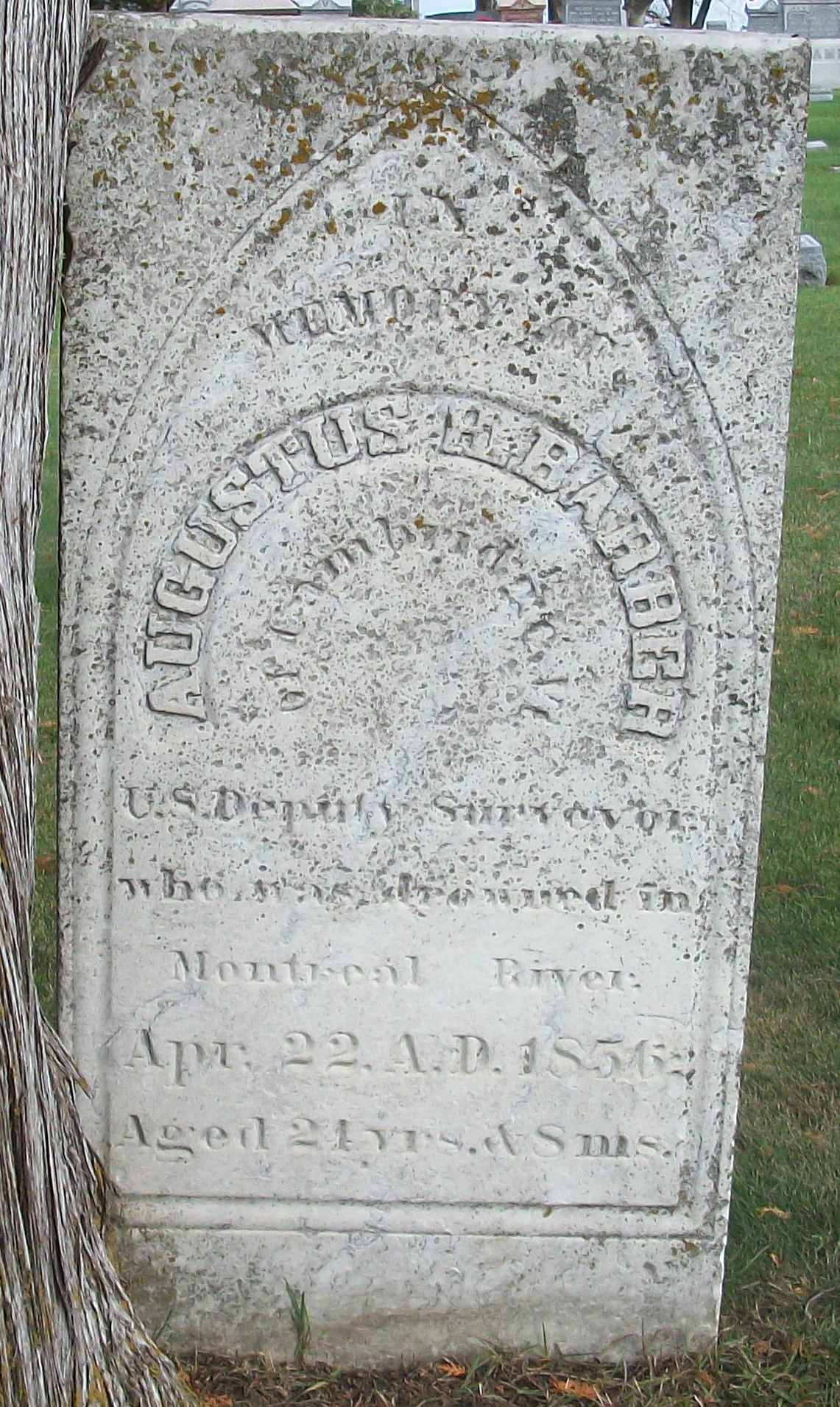
“IN MEMORY OF AUGUSTUS H. BARBER of Cambridge, Vt. U.S. Deputy Surveyor who was drowned in Montreal River
Apr. 22. A.D. 1856
Aged 24 yrs. & 8 ms.”
~ FindAGrave.com
Of Augustus Barber the early Surveyor of this vicinity, who is unknown to a larger part of this generation, a few words ought to be said:
He was a native of Vermont of an excellent family. At this time he was about 22 years of age, well educated, gentle as a Lady, refined and easy in his manners and very amiable in his temper. Like many other young men from the east, of active and enterprising habits, he had come into this outer verge of civilization to make this his home and to grow up with its institutions. He was the nephew of Hon. J. Allen Barber, of Lancaster, in this State, who once represented his District in Congress. He continued in the surveys of this part of the Lake until in the summer or fall of 1856, when he, with others, conceived of the idea of founding a city at the mouth of the Montreal River – the dividing line between Wisconsin and Michigan about thirty miles east of Ashland.
The iron range approaches nearer the Lake at that point than it does at Ashland. And though the country is much rougher and more difficult for construction of roads than between Ashland and the Range, yet the shorter route, it was argued, would more than compensate for the heavier grades. – The town was laid out and platted by Mr. Barber.
Spring of 1857
—
“This has been a sorgawful day to me, feeling more impressed with the awful calamity that befel over dear lamented Augustus and all our family in his loss One year ago to day.”
[…]
“It must remain a sealed book to us, how Augustus was hurried out of the woods, and why it was so ordained if there, was any ordination about it, till we meet him in another world, which I devoutly hope we may do though I am sorry to say more hoping than expecting.“
The Montreal, not far from its mouth, leaps down a perpendicular descent of nearly a hundred feet presenting a wild and picturesque view. Being an enthusiastic lover of the beautiful of nature and desiring to reach a position underneath the falls, Mr. Barber in a canoe with two companions, approaching too close, were drawn in by the eddying whirlpool, the canoe was capsized, and before help could reach him he and one of his boatmen were drowned. His body was recovered and was buried on a sand hillock near the mouth of the same river in whose waters he met his death. Ironton has long been deserted, and Barber’s grave with its marble headstone, is the sole make of that civilization, which twenty years ago there essayed to lay the foundation of a mart of commerce.
Summer of 1857
—
“One man working in the interest of the company the year before, had been discovered, after being missed for some weeks, dead in the forest, near the range. Bruises and other indications of violence on the body gave strong ground for the belief that he had been murdered.“
The surf of the waves of the lake in summer and fierce driving snow storms in winter, with solitude presiding over the grand orchestra, are perpetually chanting his mournful requiem, while a fond father and mother on the slopes of the distant Green Mountains are mourning bitterly the early death of their first born son.
To be continued in Number VI…
Asaph Whittlesey Incidents: Number V
October 2, 2018
By Amorin Mello
Originally published in the March 16, 1878, issue of The Ashland Press. Transcribed with permission from Ashland Narratives by K. Wallin and published in 2013 by Straddle Creek Co.
… continued from Number IV.
Early Recollections of Ashland: Number V
by Asaph Whittlesey
—
FIRST ELECTION IN THE TOWN OF BAY PORT.
The order of the County Board creating the Town of Bay Port was made March 11th, 1856, and the store of Schuyler Goff in Bay City was designated as the place for holding the first election for town officers, the election to be held April 1st, 1856.
The journal containing this order (which was in pamphlet form,) was destroyed by fire at the burning of the Webb House in Bayfield, Wis., June 4th, 1874.

Detail of La Pointe County from a map of Wisconsin published by J. H. Colton & Co., New York, 1856.
~ David Rumsey Map Collection
The new town comprised all that portion of La Pointe county, Wis., laying south of the north line of town 48 north, in all over sixty eight townships, including the Bad River Indian Reservation, which was, on the 8th of Nov. 1859, made a precinct by itself.
At the election held April 1, 1856, there were twenty-four votes cast, resulting as follows: For Chairman of Town Board, Schuyler Goff; remaining member of Town Board, J. T. Welton and Asaph Whittlesey. Schuyler Goff, Chairman elect, was the first to qualify, his oath of office being administered by Asaph Whittlesey, Justice of the Peace.
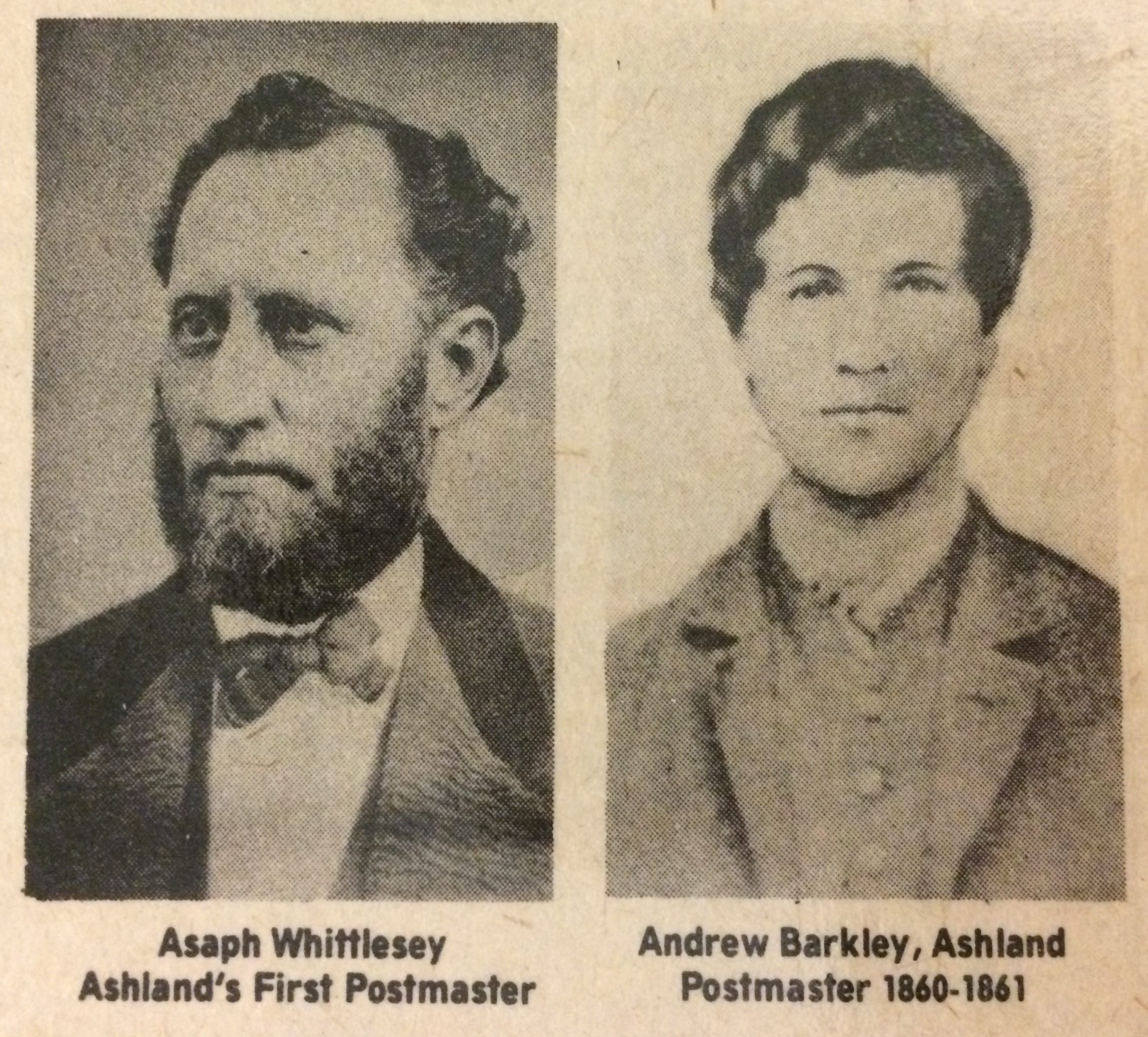
Photographs of Asaph Whittlesey and Andrew J Barkley reproduced from the Ashland Daily Press – national bicentennial issue (July 1976).
The annual statement made in April, 1857, showed the outstanding indebtedness of the town to be $25.00. The report submitted in April, 1858, showed highway orders issued during the year previous $57.50. Town indebtedness in April, 1858, was $22.75, and at that election there was levied the sum of $195.59, to meet the town expenses for the ensuing year. The following were the bills allowed by the town meeting in April, 1857: The first allowed was the bill of Edwin Ellis for $9.25; 2nd, J. T. Welton, $9.00; 3rd, A. J. Barkley, $5.50. In those days no bills were allowed nor orders drawn to cover them until the same had been approved at the town meeting. They had not yet learned to audit accounts with the marvelous rapidity known to Town Boards of more recent dates. However the Town Clerk comprehending this groans out as follows: “The vaults of the Treasuring are declared empty, and the servants of the town will therefore be obliged to wait for their pay until money shall be assessed and collected.”
Again. By referring to the Records of La Pointe, (being two years previous to the organization of the town of Bay Port,) Charles Pulcifer, acting as town treasurer, certifies that “the only unpaid personal property tax was that of J. W. Bell, amounting to $33.00, and that he was unable to find any goods on chattels belonging to the said Bell to enable him to collect the tax.
The assessment for 1857 made by Edwin Ellis for which allowance of $6.00 was made. At the annual town meeting in 1858 the first bill acted upon was that of Asaph Whittlesey, Superintendent of schools, amounting to 75 cents, though it was not allowed as they claimed it was out of their jurisdiction. – Bills of Edwin Ellis and Rev. L. H. Wheeler, for work done on the highway was rejected. It was resolved at this meeting that thereafter one shilling per hour be allowed for work on the highway.
OUR EXPERIENCE IN RAILROAD MATTERS.
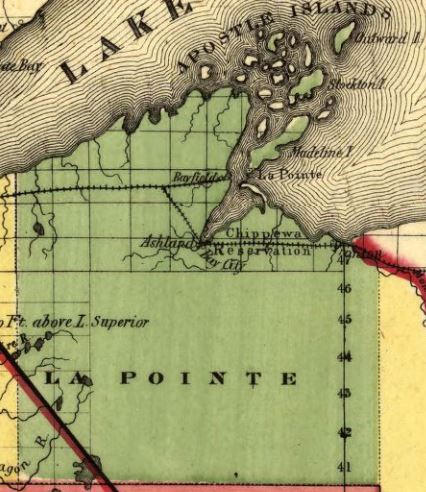
Detail of La Pointe County from a map of Wisconsin published by The Milwaukee & Horicon Rail Road, 1857.
~ Library of Congress
We often fall into the habit of complaining because things move so slow, and especially is this system of fault finding associated with the delays usually experienced in the construction of railroads in the west. However, upon reflecting I find that my time in life embraces the entire history of railroads in the United States, nearly the first roads put into operation, (if not the very first,) were one from Baltimore to Washington and one from Albany to Schenectady, N.Y., over which it was my good fortune to pass before reaching my majority, and about the time I became of age, it was my fortune to ride over not only the first railroad constructed in Illinois, bu the first built in the Mississippi valley, to wit: from Meredosia, on the Illinois River, to Springfield, a distance of forty miles, which, in its day, was regarded something not to be sneezed at, as the roads I have named were at least suggestions of the great systems of roads today. Governor Donenn, of Illinois, in his message of 1835-6, referred in the most glowing language to the triumph of the canal boat and the locomotive in almost annihilating time, burden, and space in other parts of the country and wanted to known if the Patriot bosoms of Illinois did not beat high to emulate such examples of internal improvement.
There were at different times two locomotive run over the Illinois roads mentioned, and finally mule power was resorted to. – The following year an Internal Improvement Bill was passed and roads were laid out for every quarter of the State, the results of which was to bankrupt the State. But the movement was not without its advantages, as by the following spring the forty miles reaching to Springfield was graded and ready for the track to be laid. The track was laid by putting down a piece of square timber called a mud sill on the top of which cross ties were laid. On these a wooden rail was laid and flat bars of iron were spiked on the top of the rail. These bars were tow and one half inches wide and one inch thick, and upon this track turned the wheel of the first locomotive brought into the Mississippi valley.
It might be called a curious contrivance, since the locomotive was simply a piece of clumsiness and of no practical use, the driving wheels being only about two and a half feet in diameter, and the engine itself having very little power. This road finally passed out of the hands of the State for a consideration of $100,000, in State indebtedness, while the actual cost to the State was $1,000,000.
I have dwelt somewhat long and in general terms upon the subject of railroads in the United States, to show to my readers that there has been no want of energy in their construction, but on the contrary the rapidity with which they have penetrated the wilderness is simply marvelous, converting Indian wilds into prosperous cities or fields of golden harvest. My own connection with the building of railroads dates no farther back then the time of my landing here in 1854, since which, I have in my way left no stone unturned looking to the introduction of railroads into this country. I was for a time a director in the St. Croix and Lake Superior Railroad Company, during which (but for the complications of the road,) Gardner Colby would have undertaken its construction instead of turning his attention to the Wisconsin Central Railroad.
To be continued in Number VI…
Edwin Ellis Incidents: Number III
April 9, 2017
By Amorin Mello
Originally published in the July 7th, 1877, issue of The Ashland Press. Transcribed with permission from Ashland Narratives by K. Wallin and published in 2013 by Straddle Creek Co.
… continued from Number II.
EARLY RECOLLECTIONS OF ASHLAND.
“OF WHICH I WAS A PART.”
Number III
Dear Press: – My last jottings brought us to the sweeping away of the first dock ever attempted in Ashland, April 1, 1855. Before relating any of the further attempts in the construction of docks, I will recall the names of some of the settlers who came here in 1855 to 1856.
1. George Kilbourn was then over fifty years old, from the Western Reserve, Ohio – a man of great energy and iron constitution, whose greatest joy was hard work, (and if we had a few hundred such men in our country now, who were not afraid to dive into our forests and open farms, the success of Ashland would soon be assured), and who was ever battling with the woods in this, his new home. No one man who ever came to Ashland ever did half as much as he did, with his own strong arm, to clear up our beautiful town site. His favorite spot is now occupied by the house built by Alex. Livingston, Esq. Ashland was “Uncle George’s” pet, and he loved it with an undying love, and when stricken down by death a few years since, he was on his way from Ohio to Ashland. He merits a monument, and his name should always be held in grateful remembrance.
Asaph Whittlesey was Charles Whittlesey’s younger brother.
~ Wisconsin Historical Society
2. Asaph Whittlesey, then about thirty years of age, a native of Ohio, but who had for several years been engaged in business in Peoria, Ill., where the fruits of years of toil were swept away by fire in a single hour, was, in 1854, looking for a place to try anew his fortune. He belonged to one of the oldest and most respectable families of the Buckeye State – an energetic, lively, genial, whole-souled man, whom to know is to esteem. He was active in all the early years of Ashland; was its first Postmaster, (when the office bore his name) in compliment to his venerable uncle, the Hon. Elisha Whittlesey, for many years connected with the U.S. Treasury. And though he now resides at Bayfield, his interests are still largely in our town, and his pleasant face still occasionally gladdens our homes. In his present ill health he has our heartfelt sympathies. May he soon be well again and may his iter ad coctum be postponed yet many years.
~ The Eye of the North-west: First Annual Report of the Statistician of Superior, Wisconsin by Frank Abial Flower, 1890, page 251.
Mrs. Whittlesey, with her mother, Mrs. Haskell, were the first white women who passed the winter on this shore. Her house, though built of logs, was neat and comfortable, and was the resort of all new confers, where we were all made welcome; and the writer will always remember her singing of “The little tailor with the broadcloth under his arm,” and the dancing of her little Eugenia, a flaxen-haired girl of two year, but who, in later years, matured into a beautiful and accomplished woman, and happily settled in life, was, in 1874, called to the “sweet fields beyond the swelling flood.” Mrs. Whittlesey endured much privation, but she was brave and full of life. She is still spared to adorn and cheer her pleasant home at Bayfield.
Her father, Mr. Haskell, who passed the first winter in Mr. Whittlesey’s family, died a few years ago, but Mrs. Haskell still lives in green old age, and in 1875 re-visited the scenes of her pioneer life.

Martin Beaser
~ Western Reserve Historical Society
3. Martin Beaser, though he did not bring his family to Ashland till 1856, he is entitled, nevertheless, to be ranked among the very first settlers of Ashland, for he had chosen this for his home in 1854; had aided by his means and counsel, Messrs. Whittlesey and Kilbourn, and came from Ontonagon several times during the year 1855 to assist in carrying out their plans. He employed and brought with him early in 1855, Dr. Brunschweiler, a Civil Engineer, who surveyed and platted the first site on this bay, which is now known as “Old Ashland” or “Beaser’s Division of Ashland.” Brunschweiler River, twelve miles from Ashland, perpetuates his name.
Mr. Beaser was a native of the State of New York, who, in early life, had passed several years on a whaler in the Pacific Ocean and being an acute observer of men and things, had accumulated a vast amount of useful and entertaining knowledge. He was familiar with the ports of Central and South American and our Northwest coast, not ours then, for the Star Spangled Banner then floated only over a narrow strip of land near the mouth of the Columbia River.
The vast stretch of coast now embraced in the State of California was then Mexican territory and the Russian Bear was the emblem of power extending over forty degrees of longitude and from the fifty-fifth to the seventy-second degree of latitude, or more than eleven hundred miles, from south to north, and sixteen hundred miles from east to west. By the diplomacy of Mr. Seward and the payment of seven million dollars in gold, the vast extent of coast came under our flag.
No one could listen to Mr. Beaser’s recital of what he saw and heard on the Pacific coast without being entertained, and receiving much useful knowledge.
Mr. Beaser came to Ontonagon about 30 years ago, soon after the discovery of copper in that country. Very few settlers had preceded him there; but for several years, from 1858, they came in rapidly.
But here were no regular lines of boats as at present from Lake Erie and Michigan. All the supplies for the population must be brought by water a thousand miles. They were brought to the Sault and transferred across the portage, re-loaded on vessels and distributed to the infant settlements along the coast. As a result of the scanty and uncertain means of conveyance, the early northern winter often found the settlers without their winter’s supply of flour, pork and groceries. They must be brought to Ontonagon from Copper Harbor or Eagle River in open boats, which in the late fall and early winter was a work of hardship and danger. Mr. Beaser’s skill and bravery as a sailor was more than once instrumental in saving Ontonagon from starvation and want.
In the fall of 1856, Mr. Beaser brought his family to Ashland. Here he was closely identified with all enterprises calculated to aid in the opening up of this country. He had accumulated a competence at Ontonagon which he here freely expended.
He was a man of sound discretion and great good common sense, and was one of Ashland’s most useful citizens. Through discouragements and long deferred hope he persevered; while nearly all the rest of us were compelled to retreat. His hope seemed never to forsake him and like the heroes of the Cumberland who went down with their colors flying, he stuck to Ashland in its hours of greatest depression and finally found his grave in the waters of our Bay – while attempting to come from Bayfield to Ashland in an open boat alone during a severe storm in November, 1866. He rests on the Island of La Pointe, but the home of his life should be the home of his mortal remains and I doubt not they will be transferred hither at an early day.
To be continued in Number IV…
Edwin Ellis Incidents: Number II
March 26, 2017
By Amorin Mello
Originally published in the June 30th, 1877, issue of The Ashland Press. Transcribed with permission from Ashland Narratives by K. Wallin and published in 2013 by Straddle Creek Co.
… continued from Number I.
EARLY RECOLLECTIONS OF ASHLAND.
“OF WHICH I WAS A PART.”
Number II
My Dear Press: – At the close of my last scribblings, we had arrived on the present site of Ashland, near where the railroad dock reaches the shore and were sheltered in a log shanty, built by Lusk, Prentice & Co., a kind of land company who had plans of starting a town here, of building a dock, and who had a small stock of merchandise and provisions to aid in their proposed work. The members of the firm were David S. Lusk, of New York, Frederick Prentice, of Toledo, Ohio, Capt. J. D. Angus, of Ontonagon, and Geo. R. Stuntz, then of Superior City.
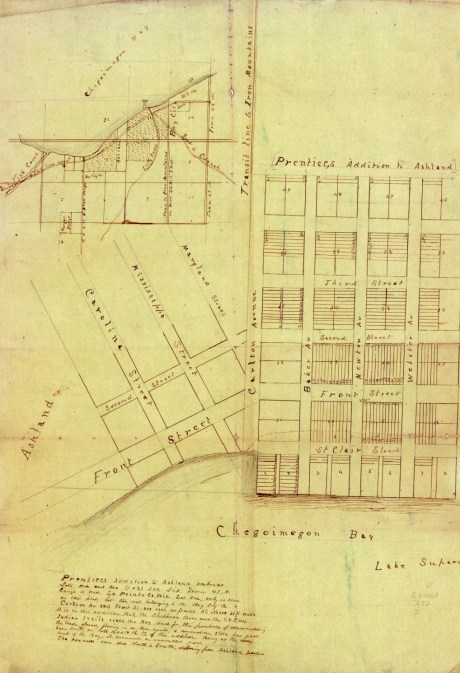
1850s survey of Frederick Prentice Addition of Ashland at/near the ancient village site of Gichi-wiikwedong. “It is in this addition, that, the Chippewa River and the St. Croix Indian trails reach the Bay.”
~ Wisconsin Historical Society
Mr. Lusk left the lake in 1856, and I think died some years since in California.

Frederick Prentice
~ History of the Maumee Valley by Horace S Knapp, 1872, pages 560-562.
Mr. Prentice, a man of great energy and business enterprise, now resides in Toledo, and is largely engaged in the production and refining of coal oil, being one of the great operators in that enlightening civilizer. He has accumulated an ample fortune, and is still largely interested in real estate in our town and country.
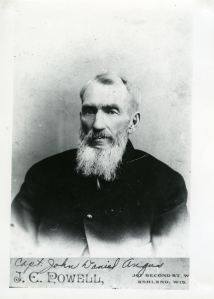
Captain John Daniel Angus
~ Madeline Island Museum
Capt. J. D. Angus, and old salt, familiar with all the oceans as well as our inland seas – having circumnavigated the globe; able to build any water craft from a Mackinaw boat to a ship of war; a man with an exhaustless store of anecdotes; who was acquainted with “Sinbad, the Sailor” – having passed through many vicissitudes- is now living in our country, full of life and activity.

George Riley Stuntz
~ The Eye of the North-west: First Annual Report of the Statistician of Superior, Wisconsin, by Frank Abial Flower, 1890, page 26.
George R. Stuntz now resides in Duluth, a civil engineer by profession, who came to the west end of the lake thirty year ago; who has done more surveying of government land than any other man on the lake. He is a descendant from the third generation of a Hessian soldier, hired by George III to fight against the American Colonies in the war of our Revolution; but who after fighting one battle on the side of the Despot, was convinced of the wrong of the British cause, became an active rebel and a sincere defender of American liberty. He and his children and children’s children have ever been true American patriots, and have done good service to the cause of the Republic. He is the owner of much real estate on Lake Superior, in both Wisconsin and Minnesota.
These men had also been attracted by the situation of our bay as the outlet of an extensive country, abounding in minerals and timber. They had perfected no plans for the acquisition of title to the land. It is true several claims had been made reaching from Fish Creek nearly to the Indian Reserve – a narrow strip on the bay, but the claimants gained no rights thereby, for the lands had not been surveyed, and we were all in the eye of the law, trespassers. The Land Office, which was then at Hudson, on the St. Croix river, was not allowed to receive and entertain declaratory pre-emption statements.
Still Lusk, Prentice & Co. were even then engaged in building a dock and clearing off the site of an expected city, to which even then they gave the name of “Bay City” – by which name the larger part of the present site of Ashland was known for many years. It is now in legal description as “Ellis Division of Ashland.” The timber was cut into cord wood and piled upon the dock, in anticipation of the wants of the numerous steamboats soon expected to throng the docks of the rising city.
Some twenty acres of land were thus cut over, reaching from near Dr. Ellis’ present residence to the Bay City creek, and from the bay shore nearly back to the Railroad depot.
The dock extended from the low point about a hundred yards east of the Door and Sash Factory of White & Perinier, about five hundred feet into the water, and reaching a depth of about eleven feet. It was made of cribs of round logs, pinned together with wooden pins. The cribs were about 25×30 feet, and about 25 feet apart. They had no filling of any kind. They were connected with stringers, which served as the foundation of the road-way, made by laying round poles crosswise upon the stringers.
It may seem stranger to us with the results of many years’ observation and experience of the force of waves and currents and ice pressure in the bay, that such a dock should ever have been built. But hind sight is always clearer than fore sight, and recent dock builders have had the benefit of the costly experience of the pioneers.
They labored under the impression that the ice melted in the bay and did not move out in large fields. They soon had this error corrected. On the last day of March, 1855, the ice in Ashland bay was broken for two or three hundred feet from shore only the body of the ice had not moved, and gave no signs of moving. It looked as though it might remain for weeks. The morning sun of April 1st shone upon the smooth, classy surface of the water. The ice had disappeared in a single night, and the dock and wood piled upon it – the result of so many hard days’ work – had passed away also. The remains might be seen for many years scattered along the bay shore and far up the Kau-kau-gon. The present dwellers here can hardly realize the depressing effect of this loss to the little squad of settlers.
 Chequamegon History