Edwin Ellis Incidents: Number IV
August 31, 2018
By Amorin Mello

Originally published in the July 14th, 1877, issue of The Ashland Press. Transcribed with permission from Ashland Narratives by K. Wallin and published in 2013 by Straddle Creek Co.
… continued from Number III.
EARLY RECOLLECTIONS OF ASHLAND.
“OF WHICH I WAS A PART.”
Number IV
My Dear Press: – In March 1855, Conrad and Adam Goeltz – then young men, came to Ashland. They were natives of Wittenberg, and Conrad had served six years in the Cavalry of that Kingdom; but liking freedom, he bade adieu to the King, his master, and came to the “Land of the Free.” They both cleared land near the town site, which they afterwards pre-empted, and bought from the U.S. Government. For several years both of them lived in Michigan, but upon the revival of Ashland they came back to their early home. Katy Goeltz, Conrad’s Daughter, was the first white child born in this town, in the fall of 1855. Henry Dretler, Mrs. Conrad Goeltz’s father, came early and bought a quarter section of land. He died here in 1858 and was buried near the present residence of Mr. Durfee.
In June 1855, Dr. Myron Tompkins (brother-in-law of Mr. Whittlsey) came to the bay in search of health. He had been driven from Illinois by ague and rheumatism. The climate cured the ague, and accidentally falling off from a raft in the bay – the severe shock cured the rheumatism. Being thus cured by our climate and water, he has ever since lived on the lake. He is a well-educated physician. At present he is the physician of the Silver Islet Mining Company, on the North Shore of the Lake.
I recall others who came in 1855; Andrew Scobie, now of Ontonagon, Thomas Danielson, Charles Day, (now farming on Fish Creek,) Joseph Webb, Bernard Hoppenjohn, Duncan Sinclair, Lawrence Farley, and Austin Corser. Farley died many years ago, but his widow, after years of absence, has again returned to Ashland. Austin Corser in the summer of 1855 began a farm on the east side of Fish Creek, about half a mile above the mouth. Remaining only two or three years, he went to Ontonagon and afterwards to Iron River – in a wild lonely glen – where in after years from 1873 to 1876. He sold his homestead on which the Scranton Mining Company was formed for a snug little fortune, on which he settled down on a farm near Waukegan, Illinois.
John Beck, also coming in the early days of Ashland. He pre-empted and lived upon the spot now laid out and occupied as our cemetery. His wife was the first adult person who died in this town. The remains of the house in which she died may be seen near the Ashland Lumber Company’s store. He was for many years an active explorer for minerals, was the originator of the Montreal River Copper Mining Company. Subsequently he discovered silver lodes on the North Shore, in Canada. He is now engaged in gold mining in California.
Albert C. Stuntz was also one of our early settlers. He is a brother of Geo. R. Stuntz, to whom reference has already been made. He was here engaged in practicing surveying and ran many hundred miles of township and section lines in this and neighboring counties. The townships embracing our Penoka Iron Range were subdivided by him in 1856 and ’57. He once represented this district in the Legislature. His old home is in ruins on the east bank of Bay City creek. Mrs. Stuntz, who endured much hardship and privation died here in 1862. Mr. S. at present lives at Monroe, in this State.
Geo. E. Stuntz. nephew of A.C. and great grandson of the old Hessian Soldier mentioned in a former chapter, also came to Ashland early. In connection with his uncle and on his own account he did a great deal in the subdivision of the lands on the South Shore of the Lake. Soon after the outbreak of our civil war he enlisted in defense of the Union – was severely wounded and died, as it is supposed, in consequence of his wounds.
~ Sarah Adah Ashe – Part IV – San Bernardino by Marta Tilley Belanger

Welton’s mill and Sibley’s farm were both located along the trail south from Ashland to the Penokee Mountains on the 1860 Geological Map of the Penokie Range by Charles Whittlesey.
~ Geology of Wisconsin. Survey of 1873-1879.
Volume III., 1880, Plate XX, page 214.
J. T. Welton and T.P. Sibley, though never living in Ashland, were yet closely identified with its early history. Mr. Welton came about 1850 to Bad River, where he was Government Farmer among the Indians. He was an ingenious mechanic, and could build a water mill. He was on the lookout for a mill site, and finally in 1854 discovered the falls on White River, six miles south of Ashland. It was an unfailing supply of water, with abundant head and fall, and the river was not subject to great rises. As a mill site it has few rivals. His resolution was quickly formed. The rising town on the bay would afford a ready market for all the lumber he could make. The mill should be built. He corresponded with his brother-in-law, Mr. Sibley, and he was eager to come and make his fortune in this new country; and in Nov. 1855, Mr. Sibley and his wife and one little daughter, about a year old, landed upon our shores. During the summer of 1855 Mr. Welton had built a log house at White River. It still stands, though in ruins. Thither late in Nov. 1855, the two families removed. The sisters were refined, cultivated and Christian ladies from the Western Reserve, in Ohio – a spot itself favored by counting among its early settlers some of the best families of New England, and which had been the new center in the west, whence have validated those influences which have tended to improve and elevate the moral and religious condition of the millions of this new empire. They were of Puritan stock. An unbroken wilderness was around them and their nearest neighbors were at Ashland, six miles away. No time was lost. The work of opening up a farm and building a mill was at once begun. They had little money and the labor must be done with their own hands. The casting for the mill must be brought a thousand miles – from Detroit. Nearly a year of toil had passed, when in October, 1856, a few days before the election of James Buchanan to the Presidency – all the able bodied men were invited to go the mill raising at White River. We went and the frame was up, but it was not until 1857 that they could set the mill running. They were greatly impeded for want of capital in cutting logs and floating down the logs to the mill and sawing a few thousand feet of lumber. But before anything could be realized from it they must either haul it over bad roads to Ashland (6 miles) or raft it down many miles to the Lake. But the river was full of jams and “flood wood” – enough to discourage puny men.
The panic of 1857 and resulting hard times put an end to all building at Ashland, and so their hopes of selling their lumber near home were blasted and after struggling vainly for some time longer, Mr. Welton was finally compelled to abandon his home, which he had labored so hard to establish. He found friends and employment in the copper mines of Michigan, and after somewhat improving his fortunes finally settled in south western Iowa, where he now resides.
In some subsequent chapter I will, with your leave, recur to Mrs. Sibley and the circumstances connected with her death.
To be continued in Number V…
Asaph Whittlesey Incidents: Number IV
April 11, 2017
By Amorin Mello

Originally published in the March 9th, 1878, issue of The Ashland Press. Transcribed with permission from Ashland Narratives by K. Wallin and published in 2013 by Straddle Creek Co.
… continued from Number III.
Early Recollections of Ashland: Number IV
by Asaph Whittlesey
In our last number we referred to “the most aristocratic house” with lumber floors, etc. Though it was the third cabin built upon the “town site,” it was in reality the first cabin built, designed as a permanent residence. The foundation logs of this house were laid Sept. 20th, 1854. The record made by Martin Beaser, (evidently made from recollection,) calls this the first building erected, (giving the size of it,) whereas we had lived in two buildings previous to the building of this one.

Rev. Leonard Hemenway Wheeler
~ In Unnamed Wisconsin by Silas Chapman, 1895, cover image.
The “Whittlesey Post Office” was kept therein from the date of its establishment, March 12th, 1855 to Nov. 1858. The first dancing done within the “town site” was in this house in Nov. 1854, and during the winter religious services were held therein by Rev. L. H. Wheeler, of the Odanah Mission. It was the birthplace of Delia Elizabeth, second daughter to Mr. And Mrs. Asaph Whittlesey, born May 21st, 1856, being the first American child born within the limits of the “town site.” The first celebration of the Fourth of July was held in this house July 4th, 1855, further reference to which will hereafter be made. The first general election of county officers in the county of Ashland, was held in this building Nov. 4th, 1856, at which time Samuel S. Vaughn received eleven votes for the office of County Clerk, and M. H. Mandelbaum receive twelve. Francis McElroy was elected District Attorney and Asaph Whittlesey County Judge. It was in this house that Robert D. Boyd was shot and instantly killed by Henry Cross, January 10th, 1858, for which a verdict of justifiable homicide was rendered at an inquest, held by Asaph Whittlesey, Justice of the Peace, acting as Coroner.
ARRIVAL OF THE SECOND FEMALE UPON THE TOWN SITE.
Mr. and Mrs. John P. T. Haskell, with their family, parents of Mrs. Whittlesey, made a landing at Ashland, Nov. 2nd, 1854, and made their home with us during the winter following. In the early spring they made a home of their own in a cabin located upon the site of the present residence of G. M. Willis, Esq., a little to the east of Vaughn’s Dock, in Vaughn’s addition to Ashland, which was originally known as Haskell’s pre-emption claim. Mr. Haskell and family remained in the country only a single year, when they returned to Illinois, where Mr. Haskell died in 1873. Mrs. Haskell is still living and is unusually active for one of her age.
I next call your attention to the
FIRST CELEBRATION OF THE 4TH OF JULY
upon the “town site” July 4th, 1855.
Under an understanding had between Mr. and Mrs. Austin Corser and Mr. And Mrs. John Corser, (then living at Fish Creek,) and being the owners of the only cows nearer than Odanah, an agreement was made whereby the Corsers were to furnish milk, while Mrs. Haskell and Mrs. Whittlesey, (then living in the log house still visible on lot 6, of block 6,) were to do the necessary cooking in the celebrated “mud oven” attached thereto, marvelous for its baking capacity and for the quality of its production.
On the day referred to, the Declaration of Independence was read by Asaph Whittlesey, and this with the delivery of an oration by A. W. Burt, with singing and amusements, constituted the first public celebration of the 4th of July in the history of Ashland. The exercises were had at Whittlesey’s house in the after part of the day, and extended late in the evening, when music and dancing were added to the festivities of the day. The ladies present were Mrs. Haskell, Mrs. Whittlesey, the two Mrs. Corsers and Mrs. Farley. The gentlemen present were J. P. T. Haskell, George Kilborn, Lawrence Farley, Austin and John Corser, Asaph Whittlsey, A. W. Burt, A. J. Barckley, Adam Goeltz, John Donaldson, Conrad Goeltz, Andrew Scobie, and Duncan Sinclaire. The children present were Eugenia E. Whittlesey, (less than three years old,) George, son of Mr. and Mrs. Austin Corser, also a child of Mr. and Mrs. John Corser and William, John Joseph and Hattie Haskell, children and Mr. and Mrs. J. P. T. Haskell.
I shall never forget Mrs. Haskell’s “classic step” on that occasion, discounting many of those present much younger than herself. At intervals during the night the party were very highly entertained with singing by Conrad and Adam Goeltz.
FIRST POST OFFICE ESTABLISHED AT ASHLAND, MARCH 12TH, 1855.
As there was no opportunity for doubt as to the rapid growth of the city the establishment of a Post Office was the result of our first raid upon the general government, though for nearly one year following no provision whatsoever was made for furnishing this office with mail service, and mails were received by chance from La Pointe up to the opening of semi-monthly service, upon a new route established between La Pointe via Ashland to Chippewa Falls, and was soon after, during the winter months, supplied with weekly service upon the route from Ontonagon, Mich., to Superior, Wis. On both of these routes the mails were carried by packers and upon dog teams.

Detail of La Pointe County from a map of Wisconsin published by J. H. Colton & Co., New York, 1856.
~ MapofUS.org
In the petition forwarded to Washington asking for the establishment of an office at Ashland, La Pointe county, Wisconsin, the request was made that it be given the name of Ashland, and that Asaph Whittlesey be appointed postmaster. The sequel showed that as there was an office by the name of Ashland within the State, it was not lawful to attach the name to this office and therefore the appointing officers at Washington attached the name of Whittlesey thereto, by which the office was known until July 30th, 1860, when the obstacle to change in the name being removed, it was then given the name of Ashland, and was also designated as being in Ashland County, Wisconsin. I well remember how difficult a task I found it to be to satisfactorily explain to them how the place could one day be known as Whittlesey, La Pointe county and the next as Ashland, Ashland county. But they soon admitted it rather than be longer afflicted with my letters upon the subject.
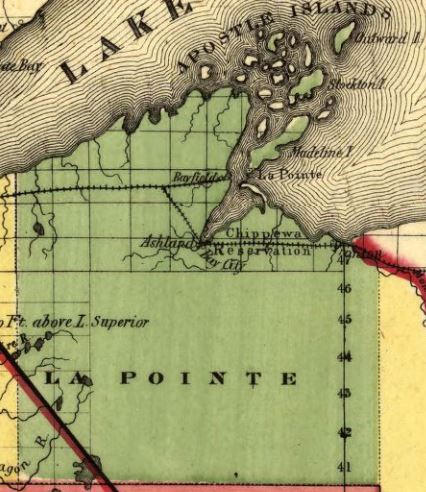
Detail of La Pointe County from a map of Wisconsin by The Milwaukee & Horicon Rail Road, 1857.
~ Library of Congress
The office of Whittlesey was kept in the cabin still in existence on lot 6 of block 6, “original Ashland,” until in Nov. 1857, when it was removed to lot 3 of block 3, into what was known as the Tomkins House, which then became the residence of myself and family until Nov. 1860. The case in which the books and papers connected with the office were kept, (which was made by myself,) is now in the “farm house” at “Pleasant Valley,” and will be delivered to any public organization in Ashland desiring to preserve the same. I continued to serve as postmaster until Nov. 21st, 1860, when I resigned the office and Andrew J. Barckley’s was appointed as my successor. Barckley’s term as postmaster expired Sept. 9th, 1861, by the appointment of Martin Beaser as successor in office to Barckley. Mr. Beaser served as postmaster until his death in Nov. 1866.
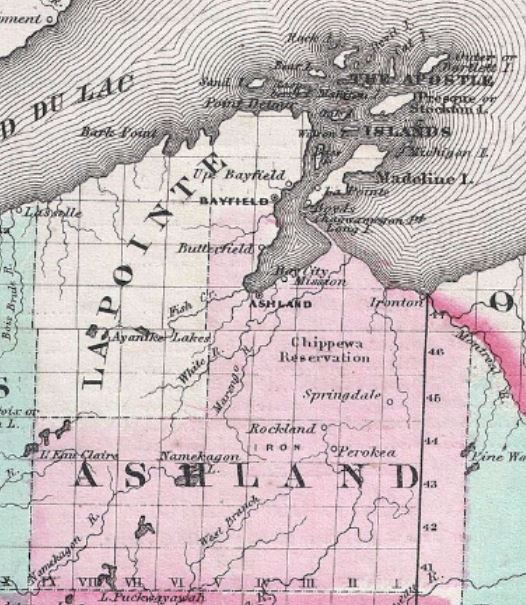
Detail of La Pointe and Ashland Counties from a map of Wisconsin and Michigan by A. J. Johnson and Ward, 1864.
~ Geographicus.org
The post office of Ashland was re-established Dec. 18th, 1871, and James A. Wilson, (the present incumbent,) being appointed postmaster.
The amount of post office money turned over to the Government by me at the close of my term of service was $8.53. My commissions upon this amount, together with the “franking privilege” vested upon postmasters, laid the foundation for my future fortunes, the balance was taken in waitings upon William Gotzenberg, who made daily inquiries for his mail, though he was aware that no mails were received oftener than once a week.
To be continued in Number V…
Penokee Survey Incidents: Number II
February 12, 2015
By Amorin Mello
November 24, 1877.
The Survey of the Penoka Range and Incidents Connected with its Early History
—
Number II.
Friend Fifield:– Notwithstanding the work upon the Range was delayed very much on account of the unwoodsman like conduct of the Milwaukee boys, referred to in my first communication, yet it did not cease,- the company having a few white men, previous employed, as well as a large number who were “to the Mannor born” that did not show the “white feather” on account of the mosquitos, gnats, gad flies and other vermin with which the woods were filled,– most of whom remained with us to the end.
Prominent among these last named was Joseph Houle, or “Big Joe” as he was usually called,– a giant halfbreed, (now dead), who was invaluable as a woodsman and packer. Some idea of Joe’s immense strength and power of endurance may be formed from the fact that he carried upon one occasion the entire contents, (200 lbs.) of a barrel of pork from Ironton to the Range without seeming to think it much of a feat. Among the party along on this trip was a young man taking his first lesson in woodcraft, whose animal spirits cropped out to such a degree that the leader caused to be placed upon his back a bushel of dried apples (33 lbs.), simply to keep him from climbing the trees, but before he reached the Range, his load, light as it was, proved too much for him, when Joe, in charity, relieved him of it, adding it to his own pack – making it 233 lbs. This was, without doubt the largest pack ever carried to the Range by any one man. There was an Indian, however, in the employ of the company, as a packer, (“Old Batteese“), who left Sidebotham‘s claim one morning at 7 A.M., went to Ironton and was back again to camp at 7 P.M. with 126 lbs. of pork, having traveled forty-two miles in ten hours. This was in July ’57, and was what I considered the biggest day’s work ever done for the company. The usual load, however, for a packer, was from sixty to eighty pounds.

Ironton townsite claim at Saxon Harbor with trails to Odanah and the Penoka Iron Range. (Detail from Wisconsin Public Land Survey Records)
The halfbreeds were sulky and mutinous at times, giving us some trouble, until Gen. Cutler, who was a strict disciplinarian, gave them a lesson that they did not soon forget and which occurred at follows:
The General and myself left Ironton just before the removal of our supplies to Ashland, with four of these boys, with provisions for the Range, to be delivered at Lockwood’s Station. But upon reaching Sidebotham’s, two of them refused to proceed any further, threw down their packs, and started on their return to Ironton. The General’s blood was up in a moment, and directing me to remain with the others until he returned, at once started after them. Reaching Ironton at 11 A.M., about an hour after their arrival, they were quite surprised at seeing him, but said nothing. The General at once directed Duncan Sinclair, who had charge of the supplies at that time, to make up two packs of one hundred pounds each, with ropes in place of the usual leathern strap, which was quickly done, the “rebels” looking sullenly on all the while. When all was ready he drew his revolver and ordered them to pick them up and start. They did not wait for a second order, but took them and started, he followed immediately behind. Nor did he let them lay them down again until they reached Lockwood’s at sunset, a distance of twenty-six miles. – That evening they were the most completely used up men I ever saw on the Range, and from that time forward were as submissive and obedient as could be desired. After that we never had any trouble. It was a lesson they never forgot.
Among the whites referred to in this article, was James Stephenson, a young man from Virginia, who came up with Stuntz as a surveyor. He was of light build, wiry and muscular – full of fun – very excitable and nervous, – but a good man for the woods. He had some knowledge of the compass, but not sufficient education to make a good surveyor. “Jim” got lost once and was out three days before he came into camp, which he did just as the party was starting out to find him. “Jim” would not have made a good rope walker. He was no Blondin. On the ground he was all right, but let him attempt to cross a stream of water, be it ever so small, upon a log, no matter if the log was six feet in diameter, and he would fall in sure. He fell in twice while lost and came near perishing with wet and cold in consequence of it. He left the company in the fall of ’57.
But the best man we had on the range that summer, as a surveyor, (except Albert Stuntz, and I very much doubt if he could beat him), was George E. Stuntz, a nephew of Albert’s, known among the boys as “Lazarus.” He was tall and slim, with a long thin face, blue eyes, long dark brown hair, stooped slightly when walking; walked with a swinging motion, spoke slow and loud – was fond of the woods, prided himself on his skill with the compass, and was, I think, the laziest man at that time in the county, except “Sibly,” who could discount him fifty and then beat him. But notwithstanding all this Albert could not have completed his survey that season without him. His lines never required any corrections. George was a singer – or thought he was, which is all the same. The recollections of some of his attempts in this line almost brings tears to my eyes from laughter, even now. Nearly every night in camp, the boys, after getting into a position where they could laugh without his seeing them, would coax him to sing. His favorite piece was a song called “The Frozen Limb.” What it meant I have no idea, and do not think he had. One verse of this only can I recall to mind, which ran as follows:
“One cold, frosty evening as Mary was sleeping –
Alone in her chamber, all snugly in bed. – She woke with a noise that did sorely affright her.
‘Who’s that at my window?’ she fearfully said.”
You can easily imagine how this would sound when sung through the nose in the hard shell style – each syllable ending with a jerk, something like this:
“Who’s-that-at-my-win-dow-she-fear-ful-ly-said-ud.”
George had a suit of clothes for the woods made of bed ticking, cap and all complete – all but the cap in one piece. The cap was after the “Dunce” pattern, ie, it ran to a point. The stripes instead of running up and down as they should have done, ran diagonally around him, giving him the appearance of a walking barber’s pole. He was a nice looking boy – he was.
Shortly after donning this beautiful suit, while crossing the Range, he suddenly found himself face to face with a full grown bear. It was no doubt a surprise to both parties,– it certainly was to the bear. For he took one square look and left for distant lands at a speed which, if kept up, would have carried him to Mexico in two days. “Not any of that in mine” was probably what was passing through his massive brain, but he made no sign. The boys who were surveying some fifteen miles south of the Range claimed to have met him that day, still on the jump. J.S.B.
 Chequamegon History