Copper Creek Mining Location
November 18, 2016
By Amorin Mello

—
COPPER CREEK MINING LOCATION.
—
This location embraces the east half of the southeast quarter of Section 15, and the west half of the southwest quarter of Section 14, in Township 47, Range 14 west, being 160 acres in Douglas County, Wisconsin. It is about thirteen and one-half miles by the County road from the town and harbor of Superior, and at an elevation of 300 feet above the level of the lake.
The Aminecon Trap Range, in crossing it from southwest to northeast, is cut by Copper Creek, a rapid and never-failing stream, exposing at several points veins of native copper.
~ Mine Register: Successor to the Mines Handbook; Volumes 8-9, page 205.
“We all lived in the log house until December 31, 1845, when I left for Iron River [Michigan] under agreement to mine for the Boston North American Mining company, organized by the American Fur company, under the management of Messrs. Borup and Oakes.”
~ Michigan Historical Collections: Volume 2; page 688.
These surface exposures attracted, at an early day, the attention of the agents of the American Fur Company, then the only civilized occupants of that part of the country, and in the years 1846 and 1847 some attempts at mining were made under their direction. A particular description of their operations will be found in another part of this pamphlet. As they had no title to the land and were working at great expense in a region which was at that time wholly remote from civilization, it is not surprising that like many other pioneers in Lake Superior copper-mining, they abandoned their enterprise, or postponed it to a more convenient season.
Eight years afterwards, the whole southern shore of Lake Superior had ceased to be exclusively known to hunters and trappers. The land had been surveyed and brought into market, and settlement had extended to the extreme western end of the lake.

James H. C. McKinzey was issued his patent to the Copper Creek Mining Location by the Willow River Land Office on August 1st, 1854.
~ General Land Office Records
The Copper Creek location was then entered under a preëmption claim by J. H. C. McKinzey, and after a litigation at the Land Office with a rival preëmptor in the interest of members of the Fur Company (who now made a persistent effort to secure a title to the land), McKinzey’s claim was sustained, and a patent was duly issued to him. From him the title passed, with but one intervening link, to the present proprietor.
The location has been visited from time to time by explorers, practical miners, and geologists; numerous rich specimens have been taken from it, and it has long been reputed to be the most promising mining location west of Ontonagon. During the past season a regular exploration has been made upon it, with the view of ascertaining more definitely its value for mining purposes.
“This Township has a clay soil. The small streams are all muddy and go nearly dry in summer. A copper bearing trap range extends through the middle of Township. On the south side of these hills it is well timbered with valuable Pine Cedar Sugar & Black Ash. Copper has been obtained on the SE 1/2 of Section 21 & upon Sections 14 & 15. The streams [reaching?] into Black River are all very rapid.”
~ Wisconsin Public Land Survey Records
A Report of this exploration is presented herewith. Mr. George R. Stuntz, under whose superintendence it was conducted, is an explorer of great experience, with a knowledge of the geological formations characteristic of the copper-bearing districts of Lake Superior, acquired by careful study in the field. He was the original surveyor, under government contract, of the whole Wisconsin shore of the lake, and has, perhaps, a more thorough acquaintance with that region than any person could be named. His Report is a plain statement of facts, and as the undersigned was himself present and taking part in the exploration, he is able to vouch for its accuracy. In connection with the maps, and with the specimens to which it refers (which were marked and packed on the ground by the writer’s own hand), it will furnish a correct idea of the character of the location.
It will be seen that there are three well-defined veins, two of which, including the one from which the richest specimens were obtained, run with the formation. This last mentioned lode rests upon a foot-wall of the most productive veins of the Minnesota mine. Although only three veins have been actually traced, there is reason to believe that others would be discovered by a further exploration, as many points inviting examination were passed by, owing to the lateness of the season.
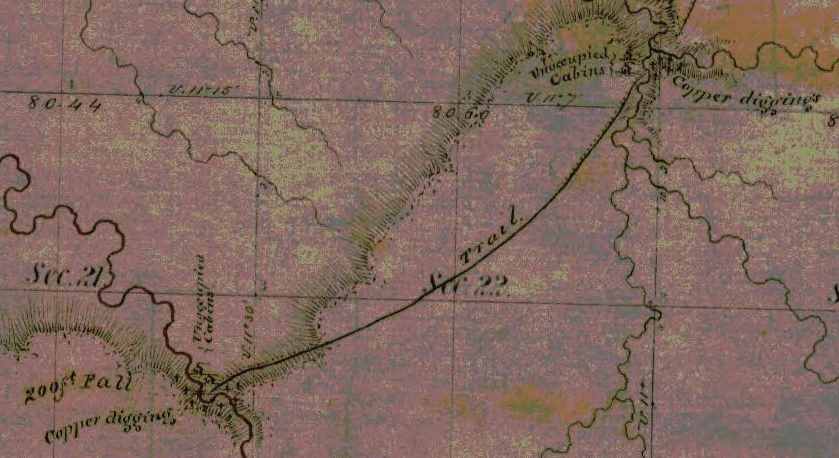
Detail from George Riley Stuntz’s original survey map of Township 47 North, Range 14 West: copper mines, abandoned cabins, and a tote road in what is now Pattison State Park. The northeast feature is Copper Creek and the southwest feature is Big Manitou Falls.
~ Wisconsin Public Land Survey Records
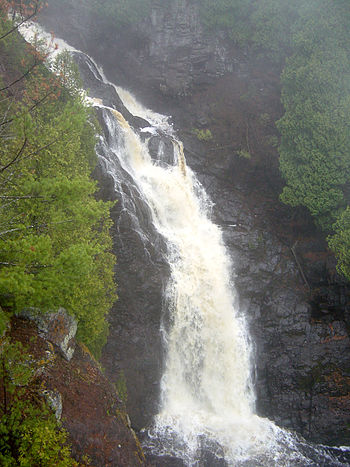
“Big Manitou Falls, the tallest waterfall in Wisconsin, in Pattison State Park just south of Superior, Wisconsin, USA.” Photograph from
Bobak Ha’Eri shared with a Creative Commons license.
The facilities furnished by Copper Creek for stamping purposes will be apparent from an inspection of the map. The town of Superior, having a good harbor, with piers and warehouses, erected by private enterprise, presents every convenience for shipping copper and obtaining supplies. Beef cattle, driven over from Minnesota, on the military road, can be purchased here much cheaper than at the Michigan mines, which are now largely supplied from this point. Pork can be advantageously procured in the same way. Another advantage is found in the price of lumber, an article for which the pineries and sawmills in this region now find a market at the lower mines. One of the finest bodies of pine in the north-west is found on the Brulé and Iron Rivers, about twenty-four miles east of this point.
With reference to the transportation between Superior and Copper Creek, it may be mentioned that, besides the wagon road (which is now available during the winter, and at no great expense can be made so at all times), the Nemadji River which, at ordinary stages of water is navigable for small boats to a point within four miles of the location, affords an additional route.
There is reason to believe that the whole country at the westerly end of Lake Superior will receive a new stimulus to its development before many years, by the opening of railroad communication with the Mississippi River, an enterprise which is becoming the absolute necessity to the interests of Minnesota. Meanwhile communication is kept open by means of the Point Douglas military road and a regular line of stages between St. Paul and Superior, which place is thus rendered accessible at all seasons.
JAMES O. SARGENT.
Boston, Dec. 8th, 1863.
—
REPORT OF EXPLORATION.
(ACCOMPANYING SPECIMENS.)
—
Superior, Oct. 17, 1863.
JAMES O. SARGENT, ESQ.
SIR : Under instructions from you, I have made a survey of the east half of the southeast quarter of Section 15, and the west half of the southwest quarter of Section 14, Township 47 north, Range 14 west, in Douglas county, Wisconsin, and have explored the same as thoroughly as the limited time and the small force under my direction would permit.
I herewithin submit a copy of the field-notes of the survey, and a map of the location.
In making the exploration I had the services of Mr. George Walker, an English miner, who has had several years’ experience in the various copper mines on this lake.
The tract is thickly timbered with spruce, fir, aspen, sugar, oak, white pine, and birch. This timber is small in size.

The Aminecon Trap Range crosses the location. This Range makes its appearance above the sandstone on the east side of Township 48 north, Range 12 west, about the middle of the township, runs in a southeasterly course across the township, and across Township 47, Range 13, Township 47, Range 14, Township 46, Range 15, and leaves Wisconsin. It is cut by the Aminecon River, Copper Creek, and Black River, and numerous small streams. Throughout the extent described it gives promise of being a productive mining district.
Two small streams unite near the centre of the location, forming Copper Creek, which runs in a northwest direction, and leaves the tract about twenty rods south of the northwest corner. Owing to the extremely dry season, this stream was lower at the time of my examination than it has been known to be in ten years; but it affords at all times abundance of water for the purposes of a mine employing steam power.
By a measurement, taken October 1st, I found the amount of water passing through it to be 58 5/10 cubic feet per minute, and this is very much below the average. In ordinary seasons the amount of fall in the stream (which is from fifty to a hundred feet within the location) would give a water power sufficient for all the purposes of a mine.
From my examination I believe that there are three veins, as represented in the map, in all of which we obtained native copper.
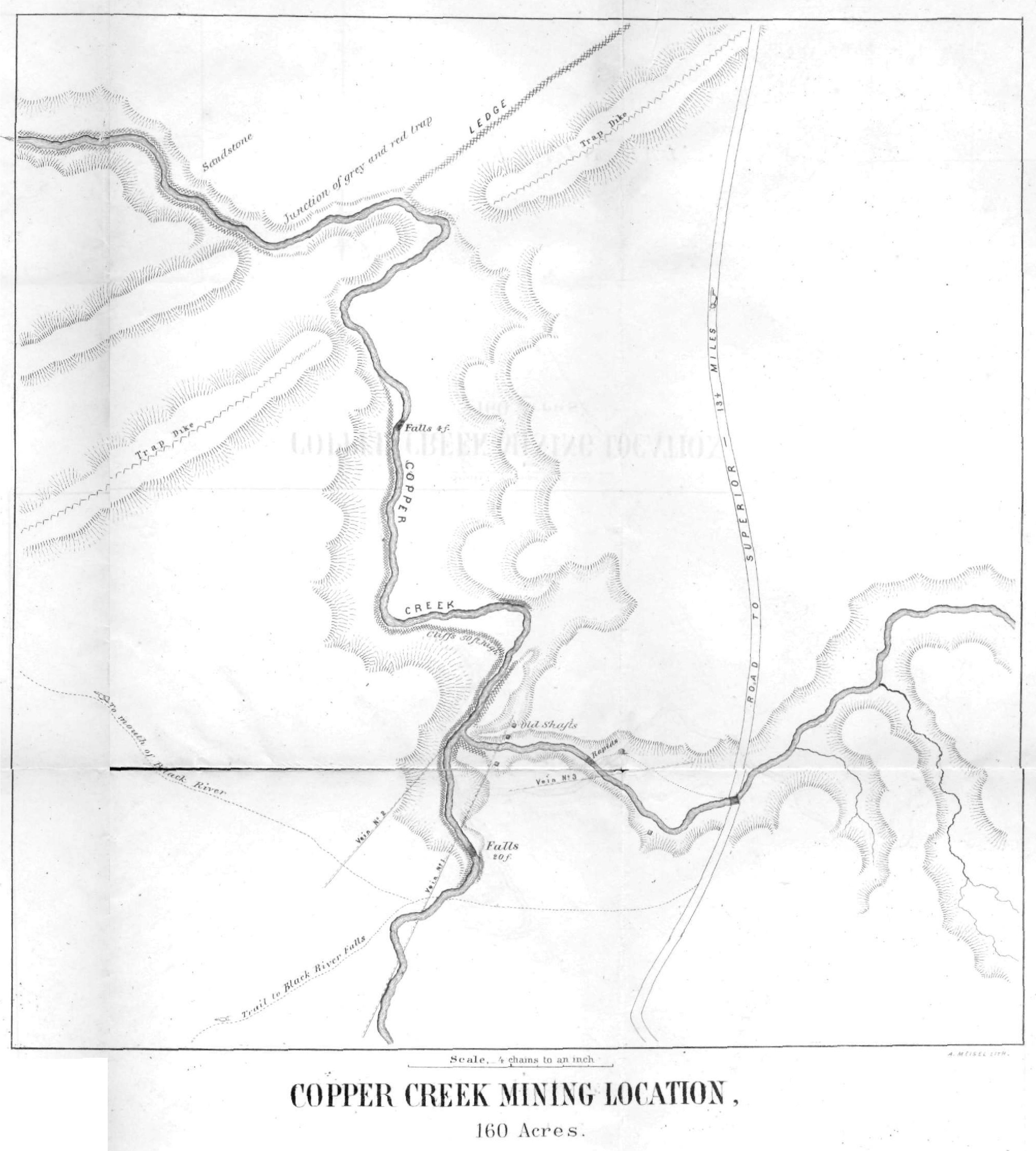
Vein No. 1 shows a breast in the east bank of the west branch of the stream, of nearly twenty feet wide, and bears south twenty-four degrees west. The specimens taken from this locality are numbered, and, as you will perceive, exhibit a quality of vein-stone which gives promise of productiveness. This vein has been traced to the southwest and adjoining location. It dips to the southeast at an angle of thirty-three degrees. The productive part of the lode lies upon the foot-wall, specimens of which I furnish with this Report, as also of the hanging wall.
Vein No. 2 shows a breast of over thirty feet in the bluff east of the stream, and appears to run in a northeast course. My explorations were not carried far enough to fully define its course in that direction. Surface specimens of the vein and of the adjacent trap are furnished herewith.
Vein No. 3 cuts the east branch of the creek, and bears north eighty-two degrees east. We opened this vein in four places at the creek, within two hundred feet. It has the appearance of being very much disturbed. On the west side of the stream, it is very compact and filled with quartz-lined cavities interspersed with crystals supposed to be malachite. It dips to the northwest. Specimens from this locality, a full collection of which is furnished, warrant a more thorough examination.
Vein No. 2, before referred to, as showing a breast of thirty feet in the east bluff, appears to branch or to be thrown out about eighty feet in crossing the creek bottom; my limited time and means did not permit me to determine which.

About two hundred feet below the junction of the two branches of the creek it shows at the foot-wall in the bed of the stream. A few feet west of this, the lode rises in the bluff on the west side of the stream. Course of stream at this point north twenty-eight degrees east. Course of vein north forty-two and one-half degrees east. At this junction of the streams, the lode, stripped of its hanging-wall, rises to the top of the cliff, a height of forty or fifty feet. At this point, we blasted into the lode, and found it rich in copper, some pieces weighing from six to fifteen pounds, and with rich stamp-work. See specimens marked Vein No. 2, west of stream.
About fifty feet above the forks of the stream the lode rests upon a bed of conglomerate. This conglomerate is highly metamorphosed, and is amygdaloidal. See specimens.
About one hundred feet west of this, we opened the vein on the brow of the hill. It there shows a breast of twenty feet, and dips to the southeast at an angle of thirty-five degrees.
~ Duluth and St. Louis County, Minnesota: Their Story and People; Volume 1, page 66.
This location was worked to some extent in the years 1846 and 1847, under a lease from the General Government, by the American Fur Company. They sunk four shafts, but appear to have done very little surface exploring.
Three of these shafts are sunk on the course of Vein No. 1, and from my examination appear to have been perpendicular. Their location is given on the map. The timbering is so much decayed that I did not venture to work in them. From soundings, I found the shaft between the streams forty-six feet deep, the next one on the east side of east branch twenty-eight feet deep, and the one east of section line twenty-eight feet deep. All of them have water to within about twelve feet of the surface. The fourth shaft is sunk at the bend of the east branch. This is thirty-five feet deep, and does not appear from the burrow to have been upon any vein.
The first three shafts above described were sunk perpendicularly upon the outcrop of a vein dipping thirty-three degrees, and therefore pass into a foot-wall. Had they been continued, they would have cut Vein No. 2. They may perhaps be made available in a further exploration.
Upon the adjoining location, to the westward, is a vein discovered by John Parry, some years ago. I have taken some specimens from it which are herewithin furnished. This vein runs north eighty-two degrees east, and intersects your western boundary six chains north of the southwest corner. It appears to be a continuation of Vein No. 3.
At the junction of the trap with the sandstone, in the northwest corner of the location, in the bed of Copper Creek, a bed of bluish-white grindstone grit of first-rate quality is found. The layers are from one inch to several inches in thickness. This white sandstone appears to belong to a different period from the red sandstone of Lake Superior. It only shows to the height of a few feet, and is overlaid by sixty feet of the red sandstone.
In the vicinity of the trap dike it is bent and fractured and considerably hardened. Near the junction, as marked on the map, it is tilted until some of the layers stand perpendicular. There are no ripple-marks on this white sandstone, while the red, resting upon it, shows evidence of a strong current.

Portrait of George Riley Stuntz from The Eye of the North-west: First Annual Report of the Statistician of Superior, Wisconsin, by Frank Abial Flower, 1890, page 26.
This tract of land is thirteen and one-half miles from the town of Superior, at the west end of Lake Superior. It is on a County Road which has been nearly completed, is now practicable for winter use, and can be made a good summer road at an expenditure not exceeding $2,000.
The soil is a sandy loam, with a subsoil of red clay containing a large per centage of marl, and is quite productive, being capable of producing a large portion of the vegetables needed by the operatives at a mine. It is especially adapted to the cultivation of grass and oats. Timber for lumber and fuel can be obtained conveniently and in unlimited quantity.
Respectfully submitted,
GEORGE R. STUNTZ,
Surveyor in charge of Exploration.
Lake Superior in 1840
September 1, 2016
By Amorin Mello
“Soon after removing to Detroit, Bela Hubbard became acquainted with Douglas[s] Houghton, then State Geologist of Michigan, and in 1837, was appointed Assistant Geologist on the State Geological Survey, a position which he held until 1841. He accompanied Douglass Houghton on an important expedition to the southern shore of Lake Superior, in 1840, an account of which is given in his ‘Memorials of half a century.’ It is this book more than anything else that will preserve the memory of its author. It is his most fitting and most enduring monument and entitles the name of Bela Hubbard to a place on the short list of American authors who may be justly termed ‘nature writers.'”
Quote from Report of the Michigan Academy of Science, Volume 4,
by Michigan Academy of Science Council, 1904, page 163.

This is a reproduction of “Lake Superior in 1840” and illustrations from Memorials of a Half-Century, by Bela Hubbard, 1887, pages 21-62.
LAKE SUPERIOR IN 1840.*
* Read before the Detroit Pioneer Society, Jan., 1874.
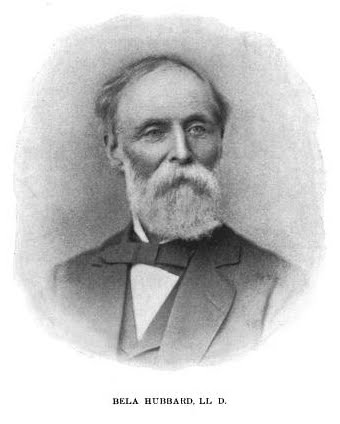
Portrait and biographic sketch of Bela Hubbard are available in Report of the Michigan Academy of Science, Volume 4, by Michigan Academy of Science Council, 1904, pages 163-165. See the Bela Hubbard Papers: 1837-1893 for more information.
Among the pleasantest of all my reminiscences of travel is that of the exploration, in connection with the geological survey of Michigan, of the coasts of our upper peninsula, in 1840.

Portrait and biographic sketch of Douglass Houghton are available in Report of the Michigan Academy of Science, Volume 4, by Michigan Academy of Science Council, 1904, pages 160-162. See the Douglass Houghton Papers: 1829-1845 for more information.
The party for this expedition was composed of the State geologist, Dr. Douglass Houghton; his two assistants, C. C. Douglass and myself; Fredk. Hubbard, in charge of instrumental observations; and, for a part of the way, H. Thielson, a civil engineer, and Charles W. Penny, a young merchant of Detroit, supernumeraries.
We left Detroit in the steamer “Illinois,” arriving at Mackinac, May 23. Here two boat crews were made up, consisting of six Canadians. These belonged to that class so famous in the palmy days of the fur trade and the French régime, now extinct, and known to history as “coureurs de bois.” They were of mixed blood, in some, the French, in others, the Indian, predominating. Bred to the business, they would row without fatigue from daybreak until dark,—twelve or fourteen hours,—unlade the boats, pitch the tents for the bourgeois, pile up the baggage, prepare the evening meal, and then creep under their blankets in the open air and enjoy the sound sleep that labor bestows.
The principal dependence of these voyageurs for food—we had no leisure for hunting and little for fishing— was upon a soup of beans, with a most liberal supply of water, into which a piece of pork was dropped. A cake of hard-bread was allowed to each.
The boats for the passage of the Sault were each about twenty feet long by four broad, lightly constructed of pine and cedar, with sharp bows, and were drawn out of the water at night. At the Sault, to which provisions had been forwarded, one of these boats was exchanged for a “Mackinac barge,” sufficiently large to carry two months’ provisions and all our baggage.
A voyage to and upon our great lake at the time of my story was by no means the easy journey it is now. North of Mackinac, no steamers and no regular line of sail-vessels traversed the waters. The ship-canal around the waters of the Sault had not then been projected. Furs and fish constituted the only commerce, and the latter found too few customers to make the trade profitable. The American Fur Company had its headquarters at Sault Ste. Marie, where was a village of some twenty or thirty houses, mostly of logs, and the United States maintained a garrison. On the opposite shore was a small English settlement, consisting of a few white-washed cabins and Episcopal and Baptist mission establishments. Here also the Hudson’s Bay Company had a post.
At L’Anse had been established for many years a factory of the American Fur Company, the only buildings being a log house, storehouse, and barn, and near by a Baptist mission, consisting of a dozen neat huts of logs and bark. Near the extreme west end of the lake this company had another factory or trading-post, at La Pointe.
These were the only white settlements on the south shore of this great lake. At two or three points, transient fishing-camps might be met with. Else, all this region was wild and solitary almost as when, a century earlier, it was traversed by the canoe of the Jesuit missionary or echoed to the rude songs of the wild employees of the fur traders. In a large part of the country, on the southern border, within the territory of the United States, the Indian title had not been extinguished. But the settlements of the aboriginal race were rare; probably the whole region did not number 1000 souls.
Apart from the scientific animus of the expedition, our party, in the ardor of youth, could not but look forward to the new and strange scenes which awaited us with somewhat of the enthusiasm that inspired the first explorers of this region of vast forests and inland seas. We were to voyage almost in the same mode as those travellers, to witness scenes as yet little changed, and partaking of the same character of solitude and mystery.
Though I wander from my narrative, I must linger a moment over the impression produced by the romantic island which was our starting-point, Michilimackinac.
Connected with the story of the early wanderings of the French, their perilous missions in the far wilderness, the fur trade, with its fort, its agents, its coureurs de bois and numerous employees, its bustle, show, and dissipation, its traffic and its enormous profits, and with the numerous native tribes which here rendezvoused,—no place in the North-west possesses greater historic and traditionary interest. The town retained, as it still does, much of its old-time character. The crescent bay in front was still a lounging-place for the American Ishmaelite, whose huts often covered the beach; and this was the last place on the frontier where the Mackinac barge might manned and equipped, as a century ago, by a motley crew of half-breed voyageurs.
The natural beauties and wildness of the island, its situation, enthroned at the apex of the peninsula of Michigan and embracing magnificent views of water and island, its lake breezes and pure cold air, and the excellence of its white-fish and trout, have long made it one of the most attractive of watering-places. The proposal to conserve it as a national park is worthy of its character, and it is to be hoped that thus its natural beauties, and what remains of its woods, will be preserved forever to the nation.
On the morning of May 26 we took our departure from Mackinac, with a moderate breeze and a clear sky,—a thing to be noted where fogs are so frequent,—and coasting by St. Martin’s Island, entered les Cheneaux.
The river, or more properly Strait of Ste. Marie, is a series of channels, winding amid innumerable islands. Some of these, as St. Joseph and Drummond, cover many square miles, but the greater number are much smaller, and often occupy only a few acres. They line the whole northern coast of Lake Huron, and are occasioned by the junction between the silurian lime rocks and the azoic or primary rocks of Canada.
These islands are but little elevated above the water, and are wooded to the edge with cedar, fir and birch. The evergreen trees are completely shrouded in a tapestry of parasitic moss. This is a true lichen, and is not allied to the great Southern epiphyte which it so strongly resembles. It hangs in long festoons, giving the woods a fantastic and gloomy appearance, but the effect is very beautiful. What are called “les Cheneaux” are passages among islands of this description. They are seldom wide enough to admit any but the smallest craft, and so intricate as to form a perfect labyrinth, where any but the practised mariner might wander long, “in endless mazes lost.”
To the north and east of St. Joseph Island the Ste. Marie parts the two systems of rocks, and an instant change takes place in the character of the scenery. Instead of low, timbered shores, the islands rise in abrupt cones, rounded and water-worn, to the height of twenty to one hundred feet, presenting bare knobs of hornblende and quartz. The surfaces are worn smooth, by the action of glaciers, and are frequently covered with a thick carpet of lichens. Among these is, in profusion, the beautiful reindeer moss. A few miles to the right, in Canada, hills of granite rise to a height of 500 to 1000 feet, and form a background to the view.
To the geologist these low hills and rounded knobs have an absorbing interest. Agassiz tells us that America has been falsely denominated the new world; that “hers was the first dry land lifted out of the waters; hers the first shore washed by the ocean that enveloped all the earth beside.” The antiquary finds in this portion of America a very respectable antiquity. To its known civil history he adds evidence of the existence of a race of men familiar with this region ages before its discovery by the French, who were by no means despicable cultivators of the arts, and he infers a human history—could he but gather the full record—possibly as ancient as the pyramids. But science points a period infinitely more remote. We had reached and stood upon what was the skeleton of our earth, when but a crust above the seething fires beneath, not only ages before man had a being upon its surface, but probably ages before what we call the “Old World” had been raised by the forces of nature above the universal ocean. Here was antiquity unmeasured by any human standard. Time itself was young then. This backbone of the earliest continent still stretches unbroken, from the Atlantic to the western plains. During the unnumbered years in which the surface of the earth has been changed by successive upheavals and depressions it has stood unmoved.
Around the base of these low granite and metamorphic hills, in the bed of the river, lies a sandstone rock, which we shall find rising into cliffs along the coast of the lake above. It is the lowest of the paleozoic series, the first rock which brings to our eyes evidence of life upon this continent, and, if geologists speak truth, the first which bears witness to the dawn of life upon our earth. Of the earliest forms of organic life two only have with certainty been found in this rock, the lingula and the trilobite. And these, in the perfection and adaptation of their structure, equal the most perfect beings of their kind which exist at the present day. Thus the first record of the earliest life, upon the most ancient sea beach which the earth affords, is in apparent condemnation of the development hypothesis of Darwin. Are they then evidence of sudden and independent creation, or must we believe that these forms had their origin in some yet more remote and obscure past, and that we behold in these silurian rocks only their perfect development?
Following the northerly channel, the Ste. Marie soon expands into a broad and lovely sheet of water, twelve miles long, called Lake St. George. We have escaped from the labyrinth of rocky isles, the southern shores are again densely wooded, while the azoic rocks are seen on the Canada side, stretching off to the north-west, and terminating in a series of mountainous knobs,—the vertebræ of the world before the Flood. To this lake the Narrows succeed, and here for the first time the Ste. Marie assumes the appearance of a river, being contracted to less than 1000 feet, with a current and occasional rapids.
We passed frequent memorials of the Indian inhabitants. It is not to be wondered at that this region abounds with them, since with an eye to natural beauty this poetical race selects the loveliest spots for the resting-places, both of the living and the dead. The graves were close cabins of logs, thatched with bark, and the places selected are among the most beautiful and elevated sites, as if the souls of the departed braves could hear the echoing paddle and watch the approach of the distant canoe. The burial-place of the chief is designated by a picketed enclosure, and here it is customary for the voyaging Indian to stop, kindle his camp-fire at the head of the grave, and, on departing, to leave within the enclosure a small portion of the provisions he has cooked, for the use of the occupant. A flat cedar stake at the head exhibits in red paint the figure of some bird or brute,—the family totem of the deceased. Often is seen a small cross, erected as an emblem of his faith in Holy Catholic Church, while close by, in strange contrast, is that evidence of his unalterable attachment to the creed of his fathers,—the basket of provisions that is to support his journeying to the land of spirits.
The camping-ground of the voyageur has been that of the Indian from time immemorial. The wigwam poles are recognized from a distance, in some open glade along the shore, left standing after the vagabond inmates have departed. And there is often to be found an old canoe, a camp-kettle, a cradle swinging from the poles, and invariably a litter of picked bones and dirty rags, completely covering the spot, with the burnt brands and ashes of the cabin fire in the midst. Sometimes we meet a rude altar of stones, on which are laid bits of tobacco and other petty offerings to the Manitou. Sometimes the scene is varied by the cabin of a Canadian Frenchman, who, unable to resist the charm of savage life, is bringing up his family of half-breed children in a condition little akin to civilization.
Early on the morning of May 30 we reached the Sault, and proceeded to encamp at the head of the rapids. This required a portage of several rods. The remainder of the day was spent at the village, in witnessing the novel mode of fishing, and other sights pertaining to this remote frontier post.

Page 29: “Sault Ste. Marie, from the Canada shore.”
Preparations for our expedition being completed, on the first of June we took our departure from the head of the rapids. Here lay at anchor a beautiful light brig belonging to the American Fur Company, and which bore the name of its founder, John Jacob Astor. Close by its side was a schooner, which had been built by the Ohio Fishing and Mining Company, at Cleveland, and had just made the portage around the rapids. Another vessel was preparing for a similar transportation. With three such crafts floating on its bosom, our great lake seemed to have already lost something of its old-time character, when, a wide waste of waters, it was traversed only by the canoe of the Indian and voyageur. Its importance as a great commercial highway had thus begun to be foreshadowed, but, in fact, its waters still laved a savage wilderness.*
* The immense commerce since built up will appear from the statement, that in 1886 the number of vessels which passed through the Ste. Mary’s Falls Canal was 6203, carrying 3,701,000 tons and over 50,000 passengers.
Some natural phenomena pertaining to a high northern latitude had begun to exhibit what were marvels to our unaccustomed eyes. One of these was the lengthened twilight, the sun continuing to irradiate the horizon with a bright flash, until nearly midnight. In fact, it was quite possible to tell the hour of the night at any time, by the light which indicated the sun’s position. The Auroras, too, were surpassingly brilliant; often the electric rays streamed up from every point of the horizon, meeting at the zenith and waving like flame. I note these simple and common phenomena because they were novel to us, and it is only those who travel and encamp in the open air who enjoy to the full such scenes of beauty and wonder.
A summer temperature had now set in, and we witnessed another characteristic of this high latitude,—the sudden advance of the season. During the three days of our stay at this place, vegetation, which a week before had hardly commenced, sprung into active life. Trees then bare were now in full leaf. This phenomenon, though common to our side of the Atlantic, we had nowhere else seen so conspicuously displayed.
Time will not permit a narrative of our journey, a two-months’ coasting voyage along the whole southern side of Lake Superior. Nor can I speak, except briefly, of the beauties of the scenery, most of which is now so well known; of Gros Cap and Point Iroquois, those rock-built pillars of Hercules that guard the entrance, and
“like giants stand, To sentinel enchanted land;”
of White-fish Point and its surroundings; of the grand, wild and varied rocky coast; of the many beautiful streams, flashing with cascades, and filled with the speckled trout; or of our scientific researches and observations. I will venture only to relate an occasional incident, and to delineate some features of the coast scenery which seem to me to have been to little noticed or too imperfectly described by others.
Westward from White-fish Point stretch for many miles broad beaches of sand and gravel, backed by hills clothed with Norway-pines, spruce, hemlock, cedar, and birch. These beaches form extensive fishing-grounds, of which parties had already availed themselves. Every one knows the superiority of Lake Superior white-fish, in size and flavor, over those of the lower waters. Yet in relating the following experience I am aware of the risk which I run of being set down as the retailer of a “fish story.”
As we were rowing along the beach, some object was descried at a distance, making out of the water. All, at once, gave vigorous chase. On our near approach, the animal, which proved to be an otter, dropped upon the sand a fish which he had just hauled out, and retreated into the lake. This fish, which was scarcely dead, was of a size so extraordinary that it might truly be called—the fish, not the story—a whopper! It measured two and a half feet in length, and one foot five inches in circumference. We had no accurate means of weighing, but its weight was fairly estimated at fifteen pounds! The flesh was delicious in proportion, and made our whole party several capital meals.
These beaches terminate at a deep harbor called the Grand Marais. Hitherto the hills of dunes of sand have been of no great elevation. But now occurs a phenomenon which, though it seems not to have been classed among the wonders of this region, nor described in any books of travel, so far as I am aware, may well be called extraordinary, and worthy a place among the scenic wonders of America. It is a miniature Sahara, several miles in extent, and in many of its peculiar features resembling those lifeless, sandy deserts which are so distinguishing phenomena in some parts of the world. It is known to the French voyageurs as “Le Grand Sable.”

Page 33: “Grandes Sables.”
Steep cliffs are first observed rising from the water with a very uniform face, of about 200 feet in height, beyond which are visible barren dunes, rising still higher in the distance. On our approach the whole appeared like lofty hills enveloped in fog. This proved to be nothing less than clouds of sand, which the winds were constantly sweeping towards the lake, and which formed a mist so dense as to conceal completely the real character of the coast.
On ascending these steep and wasting cliffs, a scene opens to view which has no parallel except in the great deserts. For an extent of many miles nothing is visible but a waste of sand; not under the form of a monotonous plain, but rising into lofty cones, sweeping in graceful curves, hurled into hollows and spread into long-extended valleys. A few grass roots and small shrubs in some places find a feeble subsistence, and are the only vegetation. But thrusting through the sand are several tops of half-buried pines, barkless, and worn dry and craggy by the drifting soil, while below the surface their bodies appear to be in perfect preservation. To our imagination they seem the time-worn columns of an antique temple, whose main structure has long ago tumbled into dust, or been buried, like the ruins of Egypt, beneath the drift of many centuries.
The surface sand is mostly packed quite hard, and may be trod as a solid floor. This, in many places, is strewed thickly with pebbles; the deep hollows present vast beds of them. Among these are a great variety of precious stones common to the rocks of the country; agates, chalcedony, jasper, quartz of every shade of color and transparency, with hornstone, trap, and other minerals. All are worn smooth, and often beautifully polished by the sharp, drifting sands, and many rich specimens were obtained. We were reminded of the valley of diamonds in the Arabian tales, which it was the fortune of Sinbad to discover, in a scarcely less singular depository.
In the rear of this desert, about two miles from the coast, timber is again met with. Here, just at the edge of the wood, a small and beautiful lake lies embosomed; on the one side, a rich tract of maple forest; on the other, barren and shifting sand. It broke on our view, from amidst the realm of desolation, as did the unexpected fountain to which Saladin led the weary cavalier, Sir Kenneth, over the sandy plains of Palestine, as told in the magic pages of Scott. We named it, not inaptly, I think, “the diamond of the desert.” Around this sheet of water we found snow, on the tenth of June, in large quantities, buried beneath a few inches of sand.
From the diamond lake issues a small stream, which, after making its way through the sand, reaches the clay that constitutes the base of these dunes, and tumbles a perfect cascade into the greater lake. This rivulet separates the dense maple forest which lies on the east from cliffs of driven sand, which rise abruptly to a height that far overlooks the woodland, and are the commencement of the grand and leafless sables.
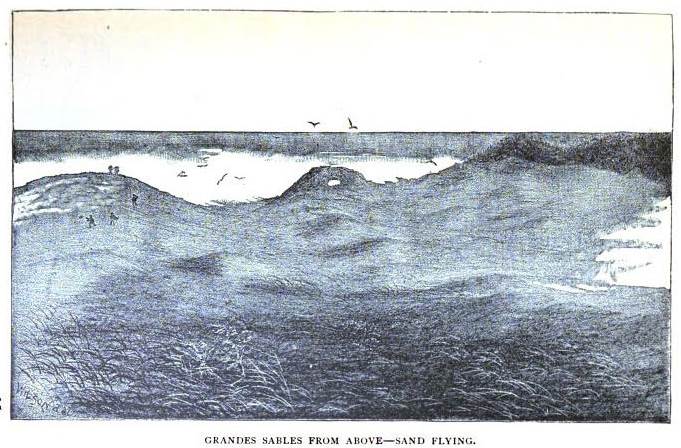
Page 35: “Grandes Sables from above – sand flying.”
The view on ascending these is most entrancing. On the one side stretches beneath, and far away, the verdant forest; while, by a transition as sudden as it is opposite in character, on the other side every feature of the landscape seems as if buried beneath hills of snow. The desert surface might be likened to that of an angry ocean, only that the undulations are far more vast, and the wave crests more lofty than the billows of the sea in its wildest commotion. Looking upward from one of these immense basins, where only the sandwave meets the sky, the beholder is impressed with a sublimity of a novel kind, unmixed with the terror which attends a storm upon the Alps or on the ocean. The scene, wild and unique, may well claim this brief praise, though hitherto unsung, and lacking the charm of historical association,—“the consecration and the poet’s dream.”
Twelve miles beyond this singular region the beaches terminate, and the sand-rock makes its appearance on the coast, in a range of abrupt cliffs. These are “The Pictured Rocks.” They have been often described, but no description that I have seen conveys to my mind a satisfactory impression of their bold, wild, and curious features. In attempting to convey some dear comprehension of them, I can only hope to impart a faithful, though it be a feeble conception of the peculiar features of this marvel of the Northern Lakes.
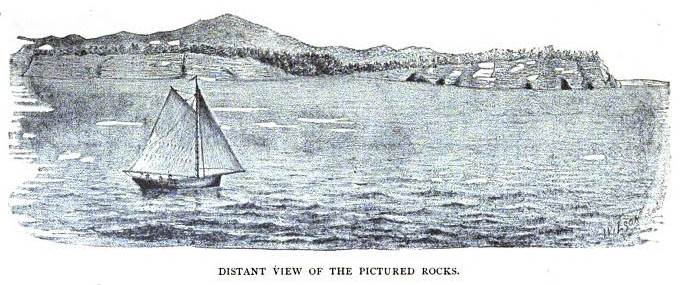
Page 37: “Distant view of the Pictured Rocks.”
These cliffs are composed of the same gray-and-red sand-rock which I have alluded to as the lowest of the paleozoic or silurian rocks. It appears in many places on the coast, and probably forms a large part of the bed of the lake. The cliffs here rise into a mural precipice, springing perpendicularly from the deep waters to the height of from 80 to 250 feet; and for the distance of fifteen miles, except in one or two places, are destitute of a beach upon which even a canoe may be landed. So dangerous is the coast that vessels all give it a wide berth, passing at too great distance for accurate view. A small boat that lingers runs imminent risks, from the liability of this lake to sudden gales, and the traverse is attempted only during a perfect calm. The sandrock lies in thick strata of varying degrees of hardness, from a coarse crag of the hardest cemented pebbles to a friable rock of aggregated sand. The predominant color is gray, sometimes light, often dark and rusty, and stained by oxides of iron and copper, with which the materials are charged. Bearing in mind these characteristics, the variety of aspects and the strange forms that these cliffs assume will find a ready explanation.
The great diversity of hues that give so beautiful and variegated an appearance to large portions of the surface, and from which the cliffs derive their name, are owing to the metallic oxides which have filtered through the porous stone in watery solutions and left their stains upon the surface. Beautiful as is the effect, it is due to candor to say that to my eyes there appeared but very imperfect representations of those various forms in the vegetable and animal kingdoms which figure in the highly-colored and fanciful descriptions in travellers’ tales. Too extravagant an idea could scarcely be conveyed of the exceeding brilliancy of the coloring; but in regard to what artists style the “laying on,” the picture presented a much closer resemblance to a house-painter’s bucket, upon the outside of which paints of all colors have trickled down in tapering streams. They represent not so much the picture which Nature has painted, as the palette upon which she has cleaned her pencils. Every hue of the rainbow, besides black and white, and in every possible circumstance of shade and alternation, are drawn in long lines, covering thousands of feet of surface.
Near the western extremity of the range, these colors assume a surpassing brilliancy, with a metallic lustre. Streaming over a gracefully curved surface, having an area of several thousand yards, they mimic, on a gigantic scale, the stripes on our national flag, as it waves in the breeze; or, passing down a fractured ledge, are contorted into long zigzag lines.
Upon close examination, these colors are found to proceed from slimy exudations, and to retain their brilliance only while fresh. When the face of the cliff has become dry, they possess a more faint and often mottled appearance. Then may sometimes be found depicted, upon a background of white, yellow or dun, as if rudely dabbed in by the artist, those vague similitudes, in which the imagination may realize verdant landscapes or fierce battle scenes; perhaps, if sufficiently vivid, a full set of Raphael’s Cartoons. As a whole, the general effect of the coloring is so striking, that the appellation conferred upon these cliffs is well deserved. Thus strangely drawn, upon as strange a canvas, they add, at least, wonderful beauty and effect to the greater wonders which Nature has here displayed.
But color is far from being the most notable feature of the Pictured Rocks. The disintegrating material of which the rock is composed renders it very susceptible to the effects of the elements. These cliffs present indubitable evidence that the lake once washed them at a height many feet above its present level. And as the strata are of differing degrees of hardness, they have been worn by the waves into a variety of forms. Huge cavernous fissures penetrate the massive wall, often to the distance of several hundred feet, piercing through its great projecting buttresses, and leaving the solid mountain supported by bare pillars. These, in turn, are worn by the eddying waters into cylindrical columns, connected by arches that sometimes spring with great regularity to a vast height.

Page 41: “La Portaille.”
An immense angular projection of the cliff, known to voyageurs as “La Portaille,” exhibits on its three sides arches of this construction, one of which springs to a height of about 150 feet. The openings form passages into a great cavern, or more properly a vestibule, the roof of which is beyond the reach of our longest oars, and which conducts through the entire projecting mass,—a distance of not less than 500 feet. Entering with our boat into this natural rock-built hall, its yawning caverns and overhanging walls strike a sudden awe into the soul. Echo gives back the voice in loud reverberations, and the discharge of a musket produces a roar like a clap of thunder. “Even the slight motion of the waves,” writes Governor Cass, “which in the most profound calm agitates these internal seas, swept through the deep caverns with a noise of distant thunder, and died upon the ear, as it rolled forward in the dark recesses inaccessible to human observation; no sound more melancholy or more awful ever vibrated upon human nerves. Resting in a frail canoe, upon the limpid waters, we seemed almost suspended in air, so pellucid is the element upon which we floated. In gazing upon the towering battlements which impended over us, and from which the smallest fragment would have destroyed us, we felt, and felt intensely, our own insignificance. No splendid cathedral, no temple built with human hands, no pomp of worship, could ever impress the spectator with such deep humility, and so strong a conviction of the immense distance between him and the Almighty Architect.”* Enthusiastic language! and yet it cannot be deemed exaggerated.
* Discourse before Detroit Historical Society.
The number and perfection of the wave-created pillars meeting the eye at every turn,— and which seem formed to support the immense weight above,—the various forms of the arches and of the overhanging rock, bear a close resemblance to the orders of human architecture. The rotundity of the columns is, in general, well preserved, and their tops swell into capitals. The supported mass, which is seldom less than 100 feet in thickness, often assumes characteristic forms, corresponding to the mock design. In one instance, for nearly half a mile, it resembles a vast entablature, of which the cornice,—jutting at least 20 feet, with a curve whose grace is not excelled by the best sculpture,—the pictured frieze, the mouldings, metopes, medallions, and other of those forms which pertain to Grecian architecture, are struck out, with a master, but giant hand, in magnificent relief, and with a perfection truly admirable. A portion of the structure had fallen, and lay at the base in heaps of ruins. But even the imperfections appear as if due to the gradual process of decay. It requires little stretch of the imagination to conceive the whole fabric to be an enormous edifice, the grandest of man’s construction, of which the main body has by some convulsion been suck and engulfed in the waters. We thought of these monuments of ancient art which the volcanic rain of Vesuvius has overwhelmed; but such a temple as this would have enclosed half of Pompeii!!

Page 43: “The gothic rock.”
The mind naturally inquires, Are the beautiful forms of ancient architecture the result of long and laborious study, or was some marvel like this exhibited in that distant era, from which cunning sculptors borrowed those designs that immortalized the Parthenon? And if—as the learned have supposed—the marble structures of that age received the addition of a coat of glowing colors,—of which time has left some traces—we here view the prototype, not only of the graceful forms upon which they labored so successfully, but of the overlay of colorings, in the glory of their original freshness!
These are but single features in the scenic display. The line of cliffs is not uniformly regular, but curves gradually to the south-west, and presents many angles and projecting points. Passing on to harder portions of the rock, the voyageur may encounter at the next angle a vertical and unbroken wall, rearing its solid front from the bed of the lake to the height of from 200 to 300 feet above the surface. The sharpness of the angular projection equals that created by the square and plummet; while the immense thickness of the strata causes the wall to appear as laid in immense blocks, a hundred feet in length. No such blocks were built into their mausolea by the proudest of the Pharaohs.
New changes present themselves as the traveller proceeds. Suddenly he is before the walls of an impregnable fortress, complete with glacis, bastion, and towers. The western cape of Miner’s River exhibits a curious display of this kind. It resembles the dilapidated tower of some timeworn castle. The base rests upon a series of short columns, connected by groined arches, through many of which a boat may pass with ease. There are eight or ten of these pillars; several have large entrances above, and the tower rears its broken battlements to the height of 120 feet.

Page 45: “La Chapelle, from the Lake.”
Among the characteristic features, none is more extra-ordinary than one to which the French voyageurs have appropriately given the name of “La Chapelle.” This rock was originally part of the solid cliff, of which the greater portion has been swept away, causing a valley about half a mile in breadth, through which a considerable stream enters the lake, falling over the rocks in a sheet of foam. Close by, reared upon the rocky platform, about twenty feet above the lake, and conspicuous from its isolation, stands the chapel. It consists of a tabular mass of sandstone, raised upon five columns, whose capitals swell into a uniform arch and support the ceiling or dome of the edifice. Its whole height is 56 feet. The pillars are somewhat irregular in form and position; including their bases, they are about 25 feet in height, and from 4 to 6 feet diameter in the swell. Regular proportion are not altogether preserved, for in most of them the central portion has the smallest diameter, like an hour-glass. Two uphold the front, and from these the arch springs to the height of 30 feet, allowing to the roof a thickness of five or six feet. The span of this arch is 32 feet, as viewed from the water, in which direction the spectator looks completely through the temple into the woodland beyond. The strength of the roof thus upheld must be considerable, since it is clothed with timber, and from the very centre shoots, spire-like, a lofty pine. The cliff on which the edifice stands forms a proportionate pedestal, ascending from the water in steps, which may be easily mounted.
This solemn natural temple might contain a congregation of several hundred persons. Nor are the usual accommodations for the preacher wanting. A column, the upper half of which has been broken, projects from a recess in the walls, and is worn into a curve behind, like the half of a letter S, creating a stand which would serve the purpose as admirably as it strikingly resembles the old-fashioned pulpit, the base of the column affording convenient steps.
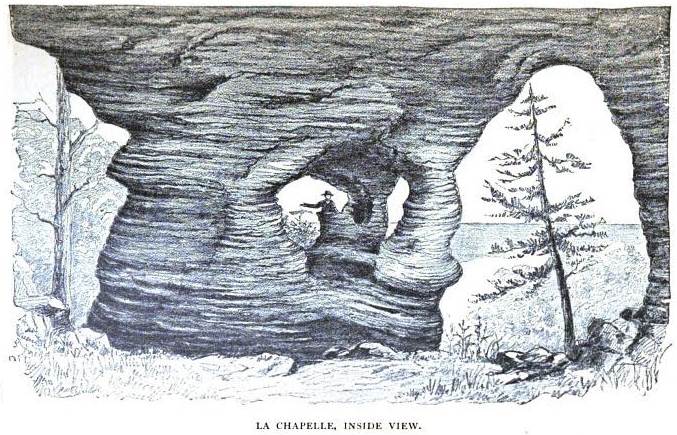
Page 47: “La Chapelle, inside view.”
Upon the cliff, just without, a column stands detached, and worn into the form of an urn, no bad representation of the baptismal font.
At what epoch of the world, or for what class of worshippers, this almost perfect temple was created, we might ask in vain of geologist or theologian. Certainly it is well designed to raise in the beholders thoughts of adoration for its all-skillful Architect, while they assign to it a chief place among the wonders of his workmanship.
An urn-shaped mass, similar to the one here observed, of great regularity and beauty of form, and not less than 50 feet in height, may ben seen at another point of the coast. Several rills of water leap from the very top of these precipitous cliffs, and add much to the charm of the view. Indeed, taken in connection with the wide-sweeping lake, the distant mountain ranges, and the woodland, crowning the cliff, the scene presented is of the most picturesque and wildest character.
“Where’er we gaze, around, above, below, What rainbow tints, what magic charms are found! Rock, river, forest, mountain, all abound, And bluest skies that harmonize the whole; Beneath, the distant torrent’s rushing sound Tells where the volumed cataract doth roll, Between those hanging rocks, that shock yet please the soul.”
Against these huge ramparts in the hour of the storm the billows of this impetuous lake dash with terrific fury, rumbling beneath the open arches, until, from the hollow caverns within, the sounds return like distant echoes, and at times their spray is thrown to the very summits of the cliff. Woe betide the bark that is overtaken by the tempest before these hopeless barriers!
But when the winds are down, lulling the lake to gentlest murmurs, the cautious boatman piles along the lone rampart, and with beating heart ventures to explore its awe-inspiring recesses, those.
“Worn and wild receptacles, Worked by the storms, yet work’d as it were planned, In hollow halls, with sparry roof and cells.”
From this sketch some correct idea may perhaps be gathered of a few of those strange forms which Nature, in her sportive hours, has here carved out of the solid fabric of the globe, as if in mockery of the efforts of man, gigantic monuments of that immeasurable Power who formed the wonders of the universe.
Thirty miles west form the Pictured Rocks, at Chocolate and Carp rivers, we first met, in their approach to the shore, the azoic or primary rocks, which from here onward constitute so interesting and important a feature in the geology of the country. Of their scientific or their economical character it is not my purpose to speak, further than to say that to them belong the iron beds, which are such a mine of wealth to our State. Here, a few years after our visit, sprang into being the busy and thriving city of Marquette. But at the time of which I speak, all was a solitude.
From hence to Keweenaw Bay ranges of granite knobs rise into considerable hills, and around them lie a series of quartzites, slates, and metamorphosed sandstones. The granites are pierced by dykes of trap, which in some cases form straight, narrow, and often lofty walls, in others have overflowed in irregular masses. Here Pluto, not Neptune, has been the controlling spirit, and has left the witness of his rule upon the face of the country. Ascending the knobs of granite and quartz, the change is most striking. To the east the eye embraces a tract lying in immense broad steppes of the sandstone, extending beyond the Pictured Rocks; while to the west are seen only rolling hills and knobs, terminating in the Huron Mountains.
I can add nothing to what is so well known of the mineral riches of this part of the country. But there is in its building-stones a wealth that is hardly yet begun to be realized. No more beautiful and serviceable material than the easily-worked and variously-tinted sandstones is found in the West; and her granites, already broken by natural forces into convenient block, and as yet untried, will command a market in the time coming, when the solid and durable shall be regarded a chief requisites to good architecture.
Following our westerly direction to Point Keweenaw, we find the dominion of Pluto established on a most magnificent scale. Not only is his energy displayed in the stern and rock-bound coast, but in the lofty ranges of trap, which rise into rugged hills of from 400 to 900 feet above the lake. Within these are secreted, but scarcely concealed, those wonderful veins of native copper, here quarried rather than mined, in masses such as the world has nowhere else produced.
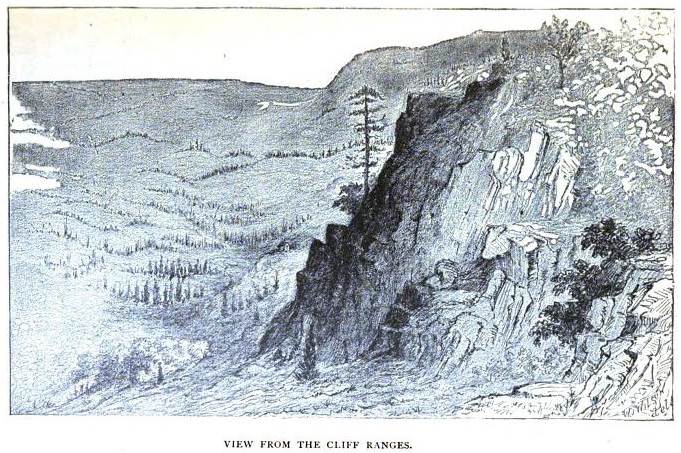
Page 51: “View from the cliff ranges.”
But of all this wealth nothing was then known, except that traces of copper were visible at a few places along the coast, and that a large mass of the native metal lay in the bed of Ontonagon River, long revered by the Indians as a Manitou, and mentioned in the relations of the early French historians.
I will but add, as the result of this season’s explorations, that the report of the State geologist, published the ensuing winter, unravelled the whole subject of the mode of occurrence of the copper and its associated minerals, in the most complete and scientific manner. It first made known the immense value which Michigan possessed in its hitherto despised Upper Peninsula; and its immediate effect was to arouse an interest in this then wild and uninhabited Indian territory, which has led to the opening up of its mines, and its present teeming prosperity.
On the third of July we encamped at Copper Harbor, and spent several days in exploration of the surrounding country, and in blasting for ores. Several blasts were got ready for the great national jubilee, which we commemorated in the noisy manner usual with Americans, by a grand discharge from the rocks. We succeeded in producing a tremendous report, and the echo, resounding from the placid water as from a sounding-board, pealed forth in corresponding reverberations for several minutes. Later in the day we retired to our camp and partook of an equally grand dinner. It consisted of pigeons, fried and stewed, corn and bean soup, short-cake and hard-tack, pork, and—last but not least—a can of fine oysters, which had been brought along for the occasion. Truly a sumptuous repast for a party of wilderness vagrants, even on a Fourth of July anniversary!
But time warns me to hasten my journey. I will therefore proceed at once to the Ontonagon, where an adventure befel, which it becomes a true knight-errant to relate. It was our purpose to pass up this river to the large mass of copper already alluded to. As we landed at the mouth there were noticed, on the opposite side of the river, several Indian lodges. As soon as we had dined, a few of the occupants crossed over in canoes, shook hands with us, giving the usual greeting of “Bo jou,” and received a small gift of tobacco and bread. Accompanying were half a dozen young boys, some of whom had remarkably fine features. We could not but notice, as an usual circumstance, that several of the men were painted black. One athletic fellow in particular, in this grimy coloring, and naked except the clout, made a very grotesque though savage appearance. The devil himself, however, is said not to be so black as he is painted, and this fellow seemed rather to act the buffoon than the noble warrior.
~ Douglass Houghton Papers: 1829-1845
“It is at this place, the Chegoimegon of early writers, that tradition places the ancient council fire of the Chippewa nation. […] The present chieftain, Chi Waishki, alias Pizhickee, or the Buffalo, is the representative of this line. He said to the Indian Agent, who, by direction of the commissioners at the treaty of Fond du Lac, in 1826, invested him with a silver medal. “What need I of this! It is known whence I am descended. […] Chi Waishki, the chief above alluded to, was met at Keweena, on his way to visit the Agency.”
~ Narrative of an expedition through the upper Mississippi to Itasca Lake, the actual source of this river : embracing an exploratory trip through the St. Croix and Burntwood (or Broule) Rivers, in 1832, by Henry Rowe Schoolcraft, 1834, pages 20-21.
The party proved to belong to the Buffaloes, whose chief we had met at River Tequamenon, near the eastern end of the lake, and were under the command of the son of that chief. The latter was a resolute-looking fellow, of about 26 or 30 years of age. His face was painted red, and he wore a medal bearing the likeness of John Quincy Adams. We paid little attention to the Indians, although aware that on several occasions exploring parties had been stopped at the mouth of this river and turned back.
We had made but two of three miles progress up the stream when the rapid stroke of paddles was heard, and a canoe, manned with Indians, shot quickly around a bend below and came into slight. The savages were seated, as their custom is, in the bottom of their bark, so that only heads and shoulders were visible. As each applied his whole strength the canoe skimmed over the surface like a young duck, while the dashing of so many paddles caused her to seem propelled by a water-wheel.
“”By a comparison of the number of Indians vaccinated upon the borders of Lake Superior, with the actual population, it will be seen that the proportion who have passed through the vaccine disease is so great as to secure them against any general prevalence of the small-pox; and perhaps it is sufficient to prevent the introduction of the disease to the bands beyond, through this channel. But in the Folle Avoine country it is not so. Of the large bands of Indians residing in that section of country, only a small fraction of been vaccinated; while of other bands not a single person has passed through the disease.”
~ Narrative of an expedition through the upper Mississippi to Itasca Lake, the actual source of this river : embracing an exploratory trip through the St. Croix and Burntwood (or Broule) Rivers, in 1832, by Henry Rowe Schoolcraft, 1834, page 253.
Our leader’s boat, which was ahead, immediately lay to and raised her American flag. “If they want to fight,” said the Doctor, “we’ll give them a chance.” Our two boats moved into line, and the doctor’s assistants armed themselves, one with a revolver, the other with a rusty shot-gun, our entire military resource. The canoe was soon alongside, and the heads and shoulders proved to belong the bodies of eight stout natives, headed by the young chief. Dr. Houghton held out his hand to be shaken as before. He then asked, through an interpreter, if they recollected the man who had put something into their arms when they were sick, a number of years ago. This something was vaccine for the small-pox, Doctor H. having accompanied the Schoolcraft expedition, in the capacity of physician and botanist. To this the chief, who doubtless well knew, made no reply, but demanded our errand up the river, and said that he and his men had been stationed at the mouth by his father, the head of the tribe, with orders to allow no boat to pass up without that chief’s permission. He added further, that we had not paid him, the son, the respect that was his due, by calling at his lodge and leaving a present. Our leader replied that he was sent hither by their great Father, whose instructions he should obey; that he should ascend the river as far as suited him, and that he did not recognize in them any authority to stop him.

Is this a photo of Jechiikwii’o wearing the 1826 medal in 1856-7? You be the judge.
~ Error Correction: Photo Mystery Still Unsolved
Chief. You must wait at the mouth until the Buffalo comes up. Else I and my band shall go with you, and see that you take nothing.
Doctor. I have been here before, and shall go now, as I am ordered by your great Father. I know the country and do not need a guide.
Chief. This country belongs to us.
Doctor. I know that the country is Indian territory, but the treaty of 1826 allows citizens of the United States to visit it. Neither shall I ask consent of the chief to take what I please. But, being acquainted with the Buffalo, I have no objection to showing him what I bring away.
At this stage of the alteration another canoe came in sight, which proved to contain the boys. By this time two of the Indians had made free to step into our small boat, where they seated themselves with great appearance of familiarity. The affair would have had enough of the ludicrous mingled with its serious aspect to warrant us in making light of it, and holding no further parley, but for two considerations, which we could not afford to overlook. Owing to the numerous rapids, the barge, which contained our whole stock, could be got up only ten miles, while we had to proceed to the forks, twenty miles further, in our smaller boat, and thence five miles by foot. And in case of a trial of strength with the Indians, no dependence could be placed upon our hired voyageurs, most of whom were allied to the opposite party, both in blood and training.
Pointing to a bend in the river, our detainers now said, “We are determined that you shall not go beyond that point to-night.” This audacious order determined us to at once break off all conference, so asserting our intention to be no longer hindered or delayed, we prepared for immediate departure. After some consultation among themselves, the chief answered, that if we would then and there make them a present of a keg of pork and a barrel of flour we would be allowed to proceed, but should be expected to bestow a further present to the head chief on our return.
To this bold demand, which plainly appeared to be a levy of blackmail, an act of piracy, Dr. Houghton replied that he would give them as a present such things as they stood in immediate need of, but nothing more. Nor should he recognize the shadow of a right to demand even that. Accordingly, a bag filled with flour, and some pork and tobacco were offered, and the leader agreed to accept his present in powder, lead, and provisions at La Pointe, whither we were bound.
The parley being at an end, we drew off and pushed up the stream. The hostiles remained awhile in consultation, and then withdrew in the opposite direction. A few miles above we encamped for the night.
It was a necessity, as I have stated, to leave our barge behind with all our stores, while the exploring party were absent for two days and a night. Of course this dilemma was known to the enemy. Holding a council of war the next morning, it was resolved to leave with our goods four of the men, together with the gun. They received most positive orders to fire upon the first Indian who touched the baggage, in case any of them should return, as we had reason to expect. And our captain added with solemn emphasis, that if any man failed in fidelity, his own life should pay the forfeit. Having thus played upon their fears, we pursued our laborious journey, reached the Copper Rock at nightfall, and tired with the day’s toils, laid down beneath the cover of the forest and slept soundly.
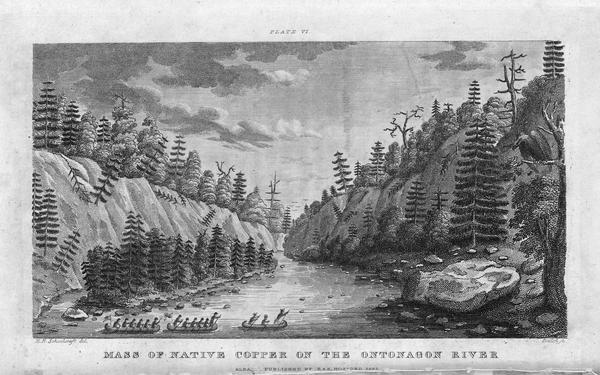
“Engraving depicting the [1820] Schoolcraft expedition crossing the Ontonagon River to investigate a copper boulder.”
~ Wisconsin Historical Society
But to conclude the narrative: on reaching camp, on our return, we learned that the chief, with several of this band, had been there, but had touched nothing, and according to his own account, had taken the trail for Lake Flambeau, in order to join a war-party, then organizing, of the Chippewas against the Sioux. Notwithstanding this story we fully expected to meet these fellows again at the mouth, and to whip them there if we could. But when we reached the place all was silent, and the lodges deserted.

Page 57: “Falls at the mouth of Montreal River.”
I will only add to this long story, that our captain’s order was never presented. We learned further, on reaching La Pointe, that the party which waylaid us had known of our journey from the first; that they had “smoked over it,” had dogged us the whole way up the lake, subsisting themselves by fishing, and that when we met they were nearly starved.
I will take my hearers but one stage further before closing this excursive ramble.
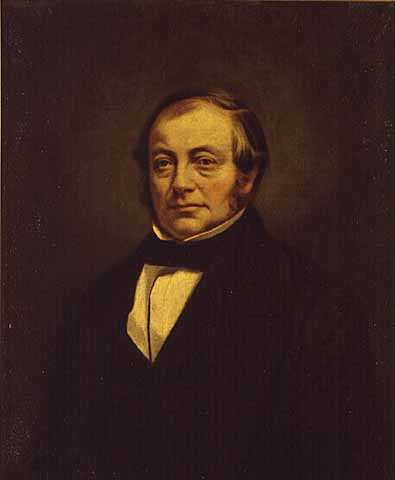
Charles William Wulff Borup
~ Minnesota Historical Society

Charles Henry Oakes
~ Findagrave.com
A few days brought us to the islands called by Carver “The Apostles.” On one of the largest of these, Madeline, at La Pointe, is located a general depot of the American Fur Company, for all the western parts of the lake, and the chain of lakes and rivers leading into it. It had become, in consequence, an asylum for all the old traders of that part of the country, and the temporary abode to great numbers of Indians. After pitching our tents on the beach, in front of the fort, amid a crowd of Indians and equally idle half-breeds, we were welcomed by the company’s factor, Dr. Borup, Mr. Oakes, the factor from Fond-dulac, and Mr. Bushnell, the Indian agent, and invited to all the hospitalities of the place.
During our whole voyage from the Sault we had not seen the face of a white man, except at the mission of L’Anse, and a casual fishing party. But here, at the end of our wandering, far from what we had been accustomed to consider the limits of civilization, we were greeted, in the families of these gentlemen, not only by features to which we had been so long strangers, but by all the attendant civilized refinements. The dress and manners of the East, the free converse with friendly voices of our own and the gentler sex, the music of a piano, the sound of the church-going bell and Christian services, seemed to us rather like a return to our homes than the extreme of a two-months’ journey in the wilderness.
It may interest my hearer to know in more detail what composed a post so remote, and which was to me so much a surprise.
La Pointe at that period was one of those peculiar growths known only to a era which has long passed away, or been banished to regions still more remote. What is called the company’s “fort” consisted of two large stores painted red, a long storehouse for fish, at the wharf, and row of neat frame buildings painted white. The latter were occupied by the half dozen families in the company’s employ. These dwellings, with the two stores, formed opposite sides of a broad street, in the centre square of which was planted a large flag-pole. Upon this street also clustered sundry smaller and unpainted log tenements of the French and half-breeds. Half a mile from the fort were the Protestant and Catholic missions. The former boasted a good frame mansion of two stories, attached to which was a school, numbering thirty scholars. The Catholic mission had a large number of followers, including the French and Indians. In all, the settlement contained about fifty permanent tenements. Beside these were perhaps an equal number of Indian lodges, irregularly disposed in vacant spaces, and adding to the size and picturesque character of the village. Several hundred Indians usually found constant employ in the fisheries at this place.
This was the oldest, as well as most remote, of the Jesuit missions in the North-west, having been established by Father Allouez, in 1665. It was then a gathering place of many Indian nations, and was hundreds of miles from the nearest French settlement.
It has additional interest from the fact that it witnessed the youthful and zealous labors of Pere Marquette, who came, in 1669, to take the place of Father Allouez, among the Ottawas, Hurons, and other tribes of the neighborhood. It was at La Pointe that Marquette planned that voyage of first discovery, exploration and missionary enterprise down the Mississippi which has rendered his name illustrious.

Page 61: “Pere Marquette. (From the statue at City Hall, Detroit.)”
In the families I have mentioned might be detected an intermixture of Indian blood, which detracts little even from the fairness of the daughters, and the ladies as well as the gentlemen are intelligent and highly educated. Their lives, when not occupied in business, are spent in reading and music; and during the long, cold winter, frequent rides are taken on the ice, upon which they pass from island to island in sledges drawn by dogs.
I could not but picture to my mind, outside of this intelligent circle, the festivities which marked this distant post, at that season, in the more palmy days of the fur trade; when it would be crowded with the hangers-on of such an establishment, returned-returned from their sojourn in the trapping grounds, or their toilsome voyages to and from Montreal and Quebec, bent on lavishing away their season’s earnings in days of idleness or debauch, and in “long nights of revelry and ease.”
Much of this old-time character still remained. The motley population, the unique village, the fisheries and furs, the Indian dances and pow-wows, the mixture of civilization and barbarism, the isolation, broken only be occasional and irregular arrivals from the world below,—made up a scene for which we were little prepared, which will not be easily forgotten, but of which I can give only this meagre description.
Wisconsin Territory Delegation: La Pointe
April 23, 2016
By Amorin Mello
A curious series of correspondences from “Morgan”
… continued from The Copper Region.
The Daily Union (Washington D.C.)
“Liberty, The Union, And The Constitution.”
August 9, 1845.
La Pointe, Lake Superior
July 26, 1845
To the Editor of the Union:

View of La Pointe, circa 1843.
“American Fur Company with both Mission churches. Sketch purportedly by a Native American youth. Probably an overpainted photographic copy enlargement. Paper on a canvas stretcher.”
~ Wisconsin Historical Society
I have just time to state that, having spent five days at Copper Harbor, examining the copper mine, &c. at that place, and having got everything in readiness, we set off for this place, along the coast, in an open Mackinac boat, travelling by day, and camping out at night. We reached this post on yesterday, the 25th instant. We have now been under tents 21 nights. In coming up the shore of the lake, we on one occasion experienced a tremendous rain accompanied with thunder, which wetted our things to a considerable extent, and partly filled the boat with water.
On our way we spent a good part of a day at Eagle river, and examined the mine in the process of being worked at that place, but found it did not equal our expectations.
We also stopped at the Ontonagon, the mineral region bordering which, some fifteen miles from the lake, promises to be as good as any other portion of the mineral region, if not better.
I have not time at present to enter fully into the results of observations I have made, or to describe the incidents and adventures of the long journey I have performed along the lake shore for the distance of about 500 miles, from Sault Ste. Marie to La Pointe. There are many things I wish to say, and to describe, &c.; but as the schooner “Uncle Tom,” by which I write, is just about leaving, I have not time at present. I must reserve these things for a future opportunity.
I am, very respectfully,
Your obedient servant,
MORGAN.
P.S. – I set off in a day or two for the Mississippi and Falls of St. Anthony, via the Brulé and St. Croix rivers.
Yours, &c., M.
The Daily Union (Washington D.C.)
“Liberty, The Union, And The Constitution.”
August 25, 1845
EDITOR’S CORRESPONDENCE
—
[From our regular Northern correspondant.]
La Pointe, Lake Superior,
July 28, 1845.

Map of the Mineral Lands Upon Lake Superior Ceded to the United States by the Treaty of 1842 With the Chippeway Indians.
~ Wisconsin Historical Society
In what I said in my last letter of this date, in relation to the extent, value, and prospects of the copper-mines opened on Lake Superior, I had no wish to dampen the ardor, would the feelings or injure the interest of any one concerned. My only wish is to state facts. This, in all cases, I feel it my duty to do; although, in so doing, as in the present case, my individual interest suffers thereby. Could I have yielded to the impulses and influences prevailing in the copper region, I might have been greatly benefited in a pecuniary point of view by pursuing a different course ; but, knowing those whom I represented, as well as the public and the press for which I write, wanted the truth, the whole truth, and nothing but the truth, I could do nothing less than make the statement I did. Previous to visiting the country, I could, of course, know nothing of its real character. I had to judge, like others, from published reports of its mineral wealth, accompanied with specimens, &c., which appeared very flattering; but which, I am now convinced, have been rather overdrawn, and the mineral region set out larger and richer than it really is. The authors of the reports were, doubtlessly, actuated by pure motives. They, no doubt, had a wish, in laying down the boundaries of the mineral region, so to extend it as to leave out no knoll or range of trap-rock, or other formation, if any indicative of mineral deposites, which usually appear in connexion with them, occurred.
I consider, in conclusion, that the result thus far is this: that the mines opened may possibly, in their prosecution, lead to rich and permanent veins; and probably pay or yield something, in some cases, while exploring them. But, however rich the specimens of one raised, at present there is nothing in them, geologically speaking, that indicates, conclusively, that they have reached a vein, or that the mines will continue permanently as rich as they are at present. This would be my testimony, according to the best of “my knowledge and belief,” on the witness’s stand, under oath.
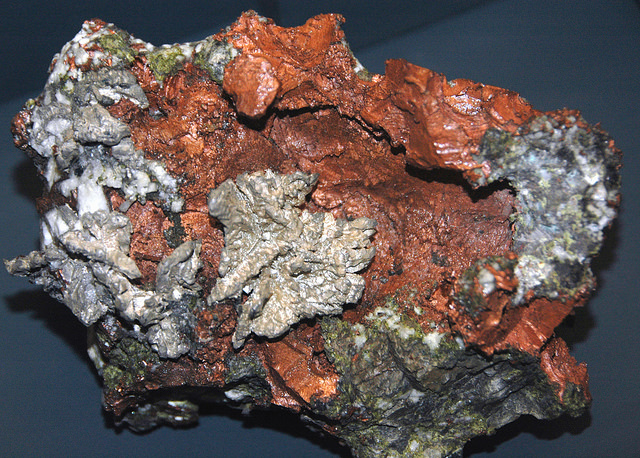
“The remarkable copper-silver ‘halfbreed’ specimen shown above comes from northern Michigan’s Portage Lake Volcanic Series, an extremely thick, Precambrian-aged, flood-basalt deposit that fills up an ancient continental rift valley.”
~ Creative Commons from James St. John
That the region, as before said, is rich in copper and silver ores, cannot be denied. And I think the indications that veins may or do exist somewhere in great richness, are sufficiently evident to justify continued explorations in search of them, by those who have the means and leisure to follow them up for several years. To find the veins, and most permanent deposites, must be the work of time; and as the season is short, on Lake Superior, for such operations, several years may be necessary before a proper and practical examination can be made of the country.
The general features of Lake Superior are very striking, and differ very much in appearance from what I have ever met with in any other part of the continent. The vastness and depth of such a body of pure fresh cold water so far within the continent, is an interesting characteristic. When we consider it is over 900 feet deep, with an area of over 30,000 square miles, and yet that, throughout its whole extent, it presents as pure and as fresh-tasted water as though it were taken from a mountain brook, the question naturally arises, Where can such a vast supply of pure water come from? It is true, it has great many streams flowing into it, but they are nearly all quite small, and would seem to be wholly inadequate to supply such a vast mass of water, and preserve it in such a state of purity. The water supplied by most of the rivers is far less pure than that in the lake itself. East of Keweena point, we found the water of the rivers discolored, being tinged by pine and other roots, clay, &c., often resembling the hue of New England rum. Such rivers, or all combined, would seem to be inadequate to supply such a vast quantity of pure clear water as fills this inland ocean!
~ United States Geological Survey
It is possible that this great lake is freely supplied with water from subterranean springs opening into it from below. The river St. Mary’s also seems inadequate, from its size, to discharge as much water as comes into the lake from the rivers which it receives. In this case, evaporation may be so great as to diminish the water that would otherwise pass out at it.
As relates to tides in the other lakes, we have nothing to say; but, as far as Lake Superior is concerned, we feel assured, from observation, as well as from the reports of others upon whom we can rely, that there are tides in it – variously estimated at from 8 to 12 inches; influenced, we imagine, by the point of observation, and the season of the year at which such tides are noticed.
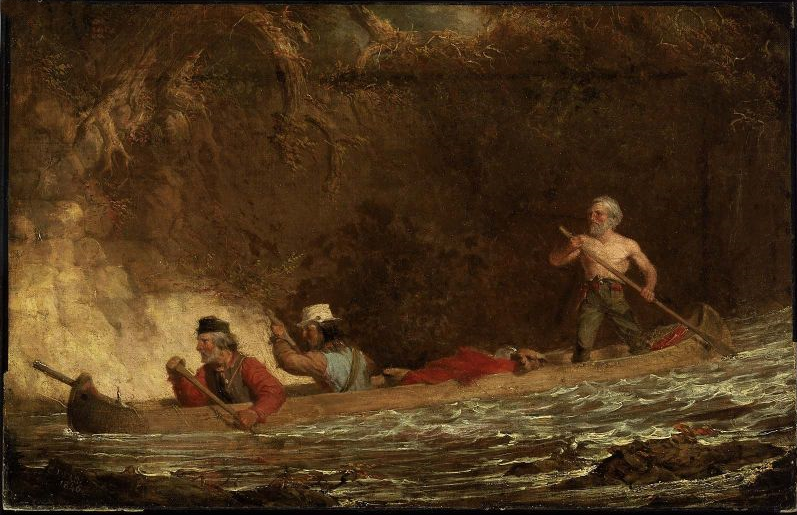
The Voyageurs (1846) by Charles Deas.
~ Commons.Wikimedia.org
What strikes the voyageur with the most interest, in the way of scenery, is the wild, high, bold, and precipitous coast of the southern shore, for such much of the whole distance between Grand Sable and La Pointe, and, indeed, for some distance beyond La Pointe ; the picturesque appearance of which often seemed heightened to us, as on a clear morning, or late afternoon, or voyageurs would conduct our boat for miles near their bases. Above us, the cliffs would rise in towering heights, while the bald eagle would be soaring in grand circular flights above their summits; our voyageurs, at the same time, chanting in chorus many of their wildest boat songs, as we glided along on the smooth and silent bosom of the lake. I have heard songs among various nations, and in various parts of the world; but, whether it was the wild scenery resting in solemn grandeur before me, with the ocean-like waste of water around us, which lent wilderness to the song, I never listened to any which appeared to sing a verse in solo, and then repeat a chorus, in which the whole crew would join. This would often be continued for several miles at a time, as the boat glided forward over smooth water, or danced along over the gentle swells of a moderate sea; the voyageurs, at the same moment, keeping time with their oars.
Jean Baptiste, our pilot, had an excellent voice, full, loud, and strong. He generally led off, in singing; the others falling in at the choruses. All their songs were in French, sometimes sentimental or pathetic, sometimes comic, and occasionally extempore, made, as sung, from the occurrences of the preceding day, or suggested by passing scenes.
The Chippewa Indians are poor singers; yet they have songs (such as they are) among them; one of which is a monotonous air repeated at their moccasin games.
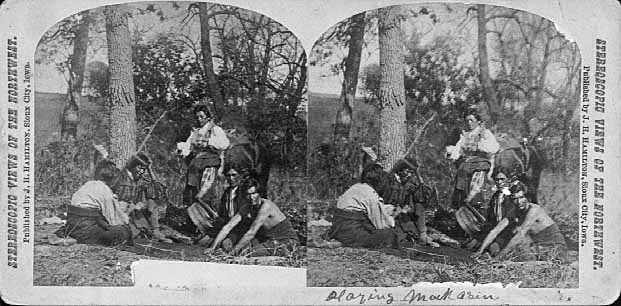
Stereographic view of a moccasin game, by J. H. Hamilton, 1880.
~ University of Minnesota Duluth
Next to the love of liquor, many of the Indians have a most unconquerable passion for gambling. While at La Pointe, I had an opportunity of seeing them play their celebrated moccasin game. They were to the number of two, or three aside, seated on the ground opposite to each other, which a blanket spread out between them, on which were placed four or five moccasins. The had two lead bullets, one of which was made rough, while the other remained smooth. Two f the gamesters were quite young men, with their faces painted with broad horizontal red and blue stripes, their eyelashes at the same time being dyed of a dark color. They played the game, won and lost, with as much sang froid as old and experienced gamblers. Those who sat opposite, especially one of them, was much older, but no means a match, at the time of my visit, for the young rascals, his antagonists. One takes the balls in his hands, keeps his eye directly on the countenance of the opposite party, at the same time tossing the balls in his hands, and singing, in a changing voice, words which sound somewhat like “He-he-hy-er-he-he-hy-er-haw-haw-haw-yer. He-he-hy-er,” &c. During which he keeps raising, shifting, and putting down the moccasins, till, finally, he raises his hands, having succeeded in concealing the balls under two of the moccasins, for which the other proceeds to search; and if he succeeds, on the first trial, in finding the rough ball, he wins. Then he takes the balls to hide, and commences singing himself. If he fails, he loses; and the first party repeats the song and the secretion of the balls. They hold in their hands small bundles of splinters of wood. When one loses, he gives to the winner so many sticks of wood. A certain number of them gained by any one of the party, wins the game. When I saw them, they had staked up their beads, belts, garters, knife-cases, &c. Their love of gaming is so strong, as to cause them to bet and lose everything they possess in the world – often stripping the last blanket from their naked backs, to stake on the game. It is said that some Indians acquire so much dexterity at this game, that others addicted to it refuse to play with them. In playing the game, they keep up a close watch on each other’s eyes, as being the best index to the movement of the hands. The song is repeated, no doubt, to diver the attention of the antagonists.
Among other peculiarities of Lake Superior, and one of its greatest recommendations, is the abundance and superiority of its fish, consisting of trout of large size, white fish, siskomit, ( a species of salmon,) and bass. The trout and siskomit are the finest and noblest fresh-water fish I ever saw. Almost every day we could catch trout by trailing a hook and line in the water behind out boat. In this way we caught one fine siskomit. Its meat, when fresh-cooked, we found about the color of salmon. The fish itself is about as heavy as a common-sized salmon, but less flat, being more round in form.

Detail of “The 12 Apostles” from Captain Jonathan Carver’s journal of his travels with maps and drawings, 1766.
~ Boston Public Library
If you will look at a map of Lake Superior, you will find, near its upper end, a labyrinth of islands, called by the early French voyageurs, of whom P. Charlevoix was one, (a Jesuit,) “the Madelaine islands.” They are sometimes called “the Twelve Apostles.” The largest island is now generally known as “the Madelaine island” – being the largest of the group. Just inside, and near its southern extremity, at the head of a large, regular bay, with a sandy beach, with an open and gently-rising scattered pine and spruce land in the rear of the beach, stands La Pointe – one of the most pleasant, beautiful, and desirable places for a residence on Lake Superior, and the very place where Fort Wilkins should have been placed, instead of its present location, which must be conceded, by every impartial person, to be among the very worst that could have been selected on the whole lake.
The garrison at Copper harbor, located, as it is, upon the rocky surface of trap conglomerate, affording a surface so scantily supplied with soil amidst masses of pebbly rock and trap fragments as to be wholly unfit for any sort of cultivation whatever, is altogether out of place. It is wholly inaccessible by land, and can only be reached by water in summer. It is at a spot where Indians usually never passed within forty miles of it, till since its occupation.
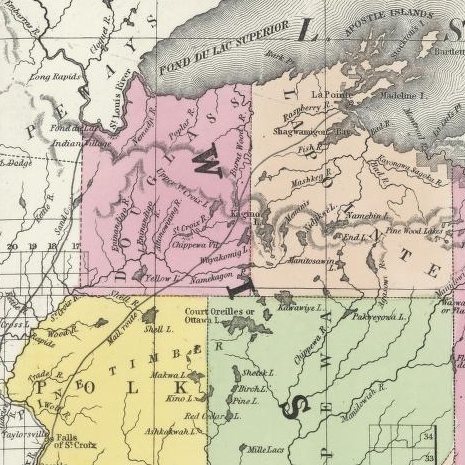
Detail of the Indian trail or “mail route” between La Pointe and St. Anthony Falls.
~ A new map of the State of Wisconsin, by Thomas, Cowperthwait & Co., 1850
The very next Congress should direct its prompt removal to La Pointe. Here, from the foot of the bay in front of the Madelaine island, there is an Indian trail, connecting La Pointe with St. Anthony’s Falls, and over which the mail is carried in winter by voyageurs on foot. La Pointe is the favorite resort of the Indians. Their lodges, in villages, bark canoes, &c. are found here the year round.
They delight to paddle and sail their canoes about the beautiful bays, harbors, &c. of these islands, employing their time in canoe building, hunting, fishing, &c. At every annual payment of their annuities, they flock to La Pointe in great numbers. Not only is that section of the great Chippewa nation sharing in the annuities brought together, but large parties of the same tribe, who receive no annuity, come at the same time from the British possessions to the north of Pigeon river. The Chippewas, called the “Pillageurs,” (so called from their thievish propensities,) inhabiting the country about Mille and Leech lakes, also attend – to meet relations, to traffic , and, perhaps, to steal a little. The great advantage of a government outpost is felt in the moral effect it exercises over the Indians. I know of no place where this influence would be more decidedly and beneficially exerted than at La Pointe. here should be daily unfurled the “stars and stripes,” and the sound of the evening gun be heard over the beautiful bays, and along the shores of the Twelve Apostles, which the Indians would learn to reverence with little less respect than they do the voice of the Manitou – the guardian spirit of the mines, embowelled in the dark trap hills of the lake.
Here, too, is an exceedingly healthy place, a good soil, and every convenience for raising the finest potatoes, turnips, and every kind of garden stuff.

1856 oil painting of Doctor Charles William Wulff Borup, a native of Copenhagen, Denmark. Borup married Elizabeth Beaulieu, a Lake Superior Chippewa daughter of Bazil Hudon Beaulieu and Ogimaagizzhigokwe. Borup and his brothers-in-law Charles Henry Oakes and Clement Hudon Beaulieu were co-signers of the 1842 Treaty with the Chippewa at La Pointe. Borup and Oakes became the first bankers of Minnesota.
Dr. Borup, the agent for the American Fur Company, (who have an extensive trading-post at this place,) has a superb garden. In walking through it with him, I saw very fine crops of the usual garden vegetables growing in it. His red currant bushes were literally bent down beneath their weight of ripe fruit. His cherry-trees had also borne well. Gooseberries also succeed well. The doctor also had some young apple-trees, that were in a thriving condition. Poultry, likewise, does well. Mrs. B. had her yard well stocked with turkeys, geese, ducks, and chickens. There was also a good garden at the mission-house of the American board.
However infinitely better is such a place for a United States garrison than Copper harbor, located, as it were, on a barren rock, where no Indians are seen, unless induced to go there by the whites – where there is nothing to protect – where intercourse is cut off in winter, and food can only reach it in summer – where there is no soil on which to raise a potato or a cabbage. I can only say that a greater blunder, in the location of a military post, was probably never committed. And if made (of which I am assured it was not) by a military man, he ought to be court-martialed and cashiered.
The mouth of the Ontonagon river is a far better spot for the fort than Copper harbor. It has a good soil, and a beautiful site for a fort. Furthermore, the country between it and Fort Winnebago, on the Wisconsin river, is favorable to the construction of a military road, which ought, at no distant day, to be opened. Another road should be cut from Fort Snelling, near the falls of St. Anthony, to La Pointe. In cutting these roads, it would seem to me as if the United States soldiers themselves might be usefully employed.
~ FortWiki.com
While at Copper harbor, I frequently visited Fort Wilkins, in command of Captain Cleary, whom I consider in every way an ornament and an honor to the service. In the brief space of time he has been at this post, and with the slender materials at command afforded by the country, he has nevertheless succeeded in making an “oasis” in a wilderness. He has erected one of the neatest, most comfortable, and best-planned garrisons it has been my lot to enter on the western frontier. He keeps all in excellent condition. His men look clean, healthy, and active. He drills them daily, and keeps them under most excellent discipline. He seems to take both pleasure and ride in the service. He says he never has any difficulty with is soldiers while he can exclude ardent spirits from them, as he succeeds in doing here, notwithstanding the great number of visitors to Copper harbor this summer.
To all travellers who are interested in objects of leading curiosity, the character of the Indians they fall in with cannot fail to arrest a share of attention.
The Chippewas are the only Indians now met with from the Sault Ste. Marie and Mackinac, extending from thence west along the southern shore of Lake Superior, to Fond du Lac, and from thence, in the same direction, to the Mississippi river. Within the United States they extend over the country south from the British boundary, to the country low down on the St. Croix and Chippewa rivers. The same tribe extends from our boundary northwest of the lake, entirely around its northern shore on British territory, till they reach the Sault Ste. Marie, opposite the American shore. It is said this tribe, spread over such a vast tract of country, is a branch of the powerful race of the Algonquins. They are sometimes called O-jib-was. They do not exist as a consolidated nation, or strictly as a confederation of bands. The entire nation on both sides of the line is divided into a great number of bands, with a chief at the head of each, which not uncommonly go by his name, such as “Old Martin’s band,” “Hole in the Day’s band,” &c.
The chief’s son, especially if he exhibits the right qualities, is expected to succeed his father at the head of the band; but very frequently the honor is reached by usurpation. The whole nation, which widely differ in circumstances, according to the part of the country they inhabit, nevertheless all speak the Chippewa language, and have extensive connexion by marriage, &c. The bands inhabiting the southern shore of Lake Superior are by far the best of any others. Though polygamy still prevails among them, and especially among their chiefs, it is nevertheless said to be becoming less common, especially where they are much influenced by Catholic and other missions. While at La Pointe, an Indian wedding was consummated, being conducted according to the ceremonies of the Catholic church, and performed by the missionary priest of that persuasion stationed at the Pointe.
There is one trait of character possessed by the Chippewas, (if we except, perhaps, the band of “pillageurs,” who have a kind of “Bedouin Arab” reputation among their countrymen,) which, I am sorry to say, the whites do not possess in an equal degree – that is, “very great honesty.”
White men can travel among them with the most perfect safety as to life and property. I will venture to say, that a man may carry baskets filled with gold and silver, and set them down in Indian villages, or leave them lying where he likes, or go to sleep by them, with Indians encamped all around him, and not one cent will be touched. Such a thing as a house being broken open and robbed at a Chippewa Indian trading-post was never heard of – within between two and three years’ intercourse with them – in time of peace. Dr. Borup said he would not be afraid, if concealed to look on, to leave his store door open all night; and the fact alone of its being left open, might be made known to the Indians at the Pointe. He would expect to see no Indian enter the store, nor would he expect to lose anything; such was his confidence in their honesty!!
Last winter, flour at the Pointe rose to $40 per barrel. The poor Indians were nearly famished for bread, but were unable to purchase it at such a price. They knew the American Fur Company had a considerable lot in store, guarded by nothing stronger than a padlock, yet they never offered the least violence towards the company’s agents or store! Would white people have acted as honestly? The poor Indians, by nature honest, have too often known the whites by the wrongs inflicted upon them, which God can forgive, but time can never blot out! They are very superstitious, but not as basely and insanely so, but a great deal, as the Mormons, Millerites, and other moon-stricken sects among the whites. They believe in one Great and Good Spirit, or a Being who can at will inflict good or evil on mankind; and there’s an end of it. They often denominate the mysterious spirit of evil import the Manitou, making him to dwell in the wild hills, islands, grottoes, and caves of Lake Superior.
From these huge birds the Indians obtained their first knowledge of fire, which they kindled with fire-sticks. These mythical birds were the most powerful of the animal deities of the Indians of the woodlands and of the plains. When the weather was stormy they flew about high in the heavens. When they flapped their great wings, one heard the crashes of thunder, when they opened and closed their eyes flashes of lightning were seen. Some carried lakes of water on their backs, these slopped over and caused downpours of rain. Their arrows, or thunderbolts, were the eggs which they dropped in their flight. These shattered the rocks and set fire to the forests and prairies.
A Chippewa Indian hunter, who was carried away to his nest by a Thunderer, saved his life by killing one of the young birds and flying back to earth in its feathered hide.
In the Smoky Mountains, a wild and rugged region in the southwestern part of Bayfield County, was the home of Winneboujou (Nenebozho), the fabled hero of the Ojibwa Indians. This all-powerful manitou was a blacksmith, and had his forge on the flat top of the highest mountain. Here he shaped the native copper of the Lake Superior region into useful implements for his Indian children. Much of his work at his forge was done at night, and the ringing blows of his great hammer could be heard throughout the Brule Valley and Lake Superior region. The fire of his forge reddened the sky. When he was not busy at his forge he was away hunting or seeking other adventures. Many stories of the exploits of this giant manitou have been told by the Chippewa and other Wisconsin Algonquian tribes.”
~ Legends of the Hills of Wisconsin by Dorothy Moulding Brown; The Wisconsin Archaeologist, Volume 18, Number 1, 1937, pages 20-21.
At times, it is said, a peculiar noise issues from the Porcupine mountains, and from the high hills on the main land, both east and west of La Pointe, some distance off. It is said to resemble the distant discharge of ordnance, or thunder. At one time, they said it was so loud and frequent, that they mistook it for signal guns fired from the brig Astor, which they thought might be in distress, and actually sent out a boat in search of her.
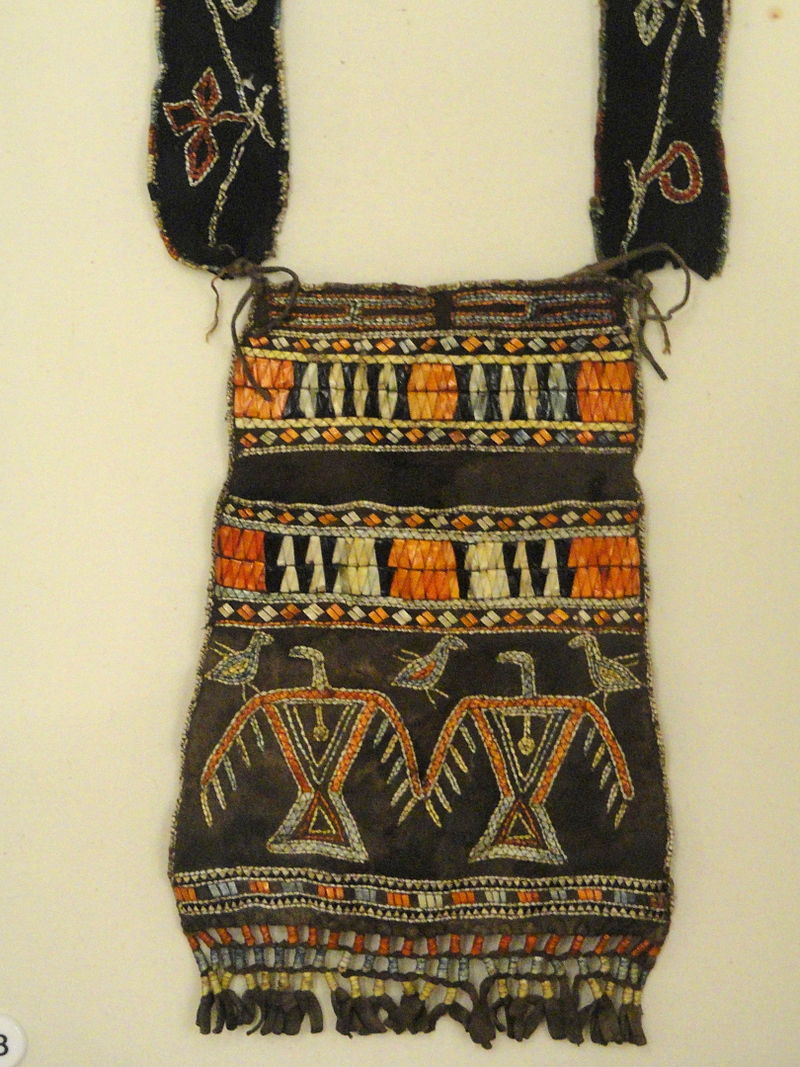
“Ojibwe shoulder pouch depicting two thunderbirds in quillwork, Peabody Museum, Harvard University.”
~ Commons.Wikimedia.org
These sounds the Indians believe to be the voice of the spirit “Manitou,” who guards the deposites of mineral wealth embowelled beneath the hills, and to whom any attempt made to dig them up, and carry them off, would be highly offensive, and followed by some kind of punishment. I have never yet heard of an Indian’s leading a white man to a locality of copper, or telling where he has found a piece when picked up!
Some have supposed that the noise in question arises from volcanic action; but, as no vibration is felt in the earth, and no other proof exists of such being the case, we are led to believe that the noise is produced by the lashing of the waves of the lake after a storm, as they are driven forward into the grottoes, caves, &c. of the tall sandstone cliffs, formed at their bases by the disintegrating effects of water and ice. Some distance east of La Pointe, about the Little Girl’s Point and Montreal river, as well as west of the same place, some fifteen or twenty miles, high red sandstone cliffs occur. At their bases, near the water’s edge, a great many curiously-shaped caves and grottoes appeared. In places, the sandstone had been so cut away, that only pillars remained standing at some ten or fifteen feet in the lake, from the top of which a high rude arch would extend to the main shore, and beneath which boats could easily pass. This was particularly the case near where the islands are parted with going west up the southern shore of the lake. Some caves, with small openings for mouths, run for a long distance back beneath the hills, expanding, likely, into large halls with high vaulted roofs, &c. After a storm, a heavy sea continues to roll into these grottoes and caverns, the waves lashing themselves against their sides and roofs – thus producing sounds resembling those heard at La Pointe, &c.
As the weather is generally calm after a storm, before the sea goes down, it is likely at such times these sounds are heard.
We had occasion to pass these places when a considerable sea would be on, close to the cliffs, and could hear the hollow heavy sounds of the waves as they broke into the caverns within the cliffs and hills. Every day, while we remained, parties of Indians continued to arrive, to be present at the payment.
We finally became prepared to leave for the Mississippi, having bought two bark canoes, and hired four new voyageurs – two for each canoe – one Indian, one half-breed, and two descendants of Canadian French; and, with a stock of provisions, we were ready to be off. From this place, I sent back three voyageurs to the Sault Ste. Marie, all that I hired to come as far as La Pointe. So, after paying our respects to Mr. Hays, our worthy Indian agent, and to Dr. Borup, (to both of whom I had borne letters of introduction,) and having many “bon voyages” heaped upon us by our friends and the friends of the voyageurs, we bade adieu to La Pointe.
You will not hear from me again till I reach the Falls of St. Croix.
I am yours, very truly, &c.
MORGAN.
To be continued in Saint Croix Falls…
1848 La Pointe Annuity Payments
March 2, 2016
By Amorin Mello

American Fur Company Papers: “Map of La Pointe”
drawn by Lyman Marcus Warren, 1834.
~ Wisconsin Historical Society
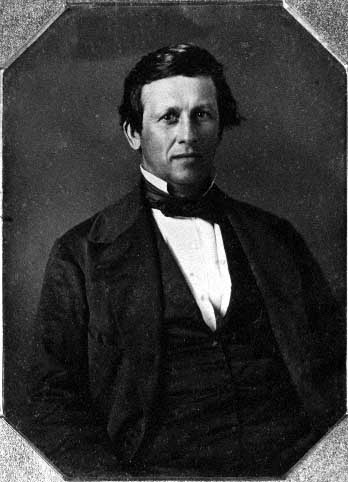
Hercules Louis Dousman
“In 1827, the American Fur Company (AFC) achieved a monopoly on the fur trade in what is now Minnesota. The Company suddenly increased its prices by 300 percent; American Indians, returning from the hunt with expectations of trading for their yearly supplies, found themselves cast into a debt cycle that would increase in the decades ahead. American Indians would receive virtually unlimited credit as long as they maintained the most precious collateral: land.
As game was overhunted and demands for furs changed, the system collapsed under a burden of debt. In 1834, AFC departments were sold to partners who included the Chouteaus, Henry Sibley, and Hercules Dousman. The business strategy of the reorganized companies changed from fur trading to treaty making. In 1837, economically stressed Dakota and Ojibwe people began selling land in what became Minnesota. Fur traders, through their political connections, were able to divert government payments for American Indian land into their own pockets. In effect, land cession treaties became a vast government bailout of fur trade corporations.”
~ Relations: Dakota & Ojibwe Treaties
Henry Hastings Sibley Papers 1826-1848

Henry Hastings Sibley
~ Minnesota Historical Society
Northern Great Lakes Visitor Center
History Center & Archives
“Papers of Minnesota’s first governor during his years as a fur trader, consisting primarily of correspondence among the various American Fur Company agents located in the Wisconsin Territory. Correspondence concerns internal company business; business with Hudson Bay Fur Company; company agreements with the Dakota Indians; company interest in United States government treaties with the Dakota, Ojibwa, and Winnebago Indians; attempts by the company to prevent war between the Dakota and the Sauk and Fox Indians; relations with missionaries to the Indians of the region; and company disputes with Indian agents Henry R. Schoolcraft and Lawrence Taliaferro.
Correspondents prominent in the early history of Minnesota and Wisconsin include William Aitken, Frederick Ayer, Alexis Bailly, Bernard Brisbois, Ramsay Crooks, Henry Dodge, James Doty, Hercules Dousman, Jean Faribault, Alexander Faribault, Joseph Nicollet, Henry Rice, Joseph Rolette, Henry Schoolcraft, Lawrence Taliaferro, and Lyman Warren.”
New York April 17, 1848
To Geo Ebninger Esq.
Assignee Am. Fur Co.
Dear Sir,

Pierre Chouteau, Jr.; son of French Creole fur trader, merchant, politician, and slaveholder Jean-Pierre Chouteau.
~ Wikipedia.org
We hasten to reply to you, of this date offering to sell “The American Fur Co Establishments at Lapointe” all the Northern Outfit Posts: – “The whole for twenty five hundred dollars ($2500)” provided we will take the goods remaining on hand there after this spring’s trade at New York cash for sound Merchantable goods everything else as its fair actual value & say that we regret you waited until the moment our senior was leaving for the west before making the above proposition & also some days after the departure of Mr. Rice. It is probable, if your letter had been received during his stay here, that we would have accepted it or made other propositions which would have been agreeable. We thought if you were desirous of selling the Establishments & goods that you would have apprised us earlier of your intentions & given us time to consult or reflect upon it. And we expect, and hope that you will give us time to communicate your proposition to the persons interested with us in Upper Mississippi & particularly with Mr. Rice who alone has visited the posts & has a correct idea of their value.
Believing that the delay we ask will not or cannot be prejudicial to your interests we will wait your answer.
Very respectfully
yr obd svt
P Chouteau Junr
New York 28th June, 1848
Mister P Chouteau Jr & Co
New York
Gentlemen,
Agreeably to what I had the pleasure to address you on the 14th April last, copy of which letter is annex I will sell you the late American Fur Company’s Establishment at La Pointe & as the terms and conditions as before named, delivery to be made to you or your agent on a date to be hereafter agreed upon between the First day of September and Fifteenth day of October next and ending Payments for the same to be made in New York to me in October or November next.
Please let me have your written reply to this proposition.
I am gentlemen bestly
Your Obedt Servt
George Ebninger
Assignee to P Chouteau Jr, St Louis
New York 30th June, 1848
To George Ebninger Esq.
Assignee Am Fur Co.Dear Sir,
View of La Pointe, circa 1843.
“American Fur Company with both Mission churches. Sketch purportedly by a Native American youth. Probably an overpainted photographic copy enlargement. Paper on a canvas stretcher.”
~ Wisconsin Historical Society
In reply to yours of 28th inst (with copy annexed of similar letters under date 14th April last) we have to say that under advises lately received from our Saint Louis house we accept in general terms your proposition for the sale of the American Fur Co’s trading Establishment at Lapointe and interior for the sum offered, of Twenty Five Hundred dollars. It may be well enough to observe how ever that we consider the sale as dating only from the time of delivery to our authorized agents. Until then received we shall consider the posts as the property of Late American Fur Co and to be as their risk and any destruction of property between now and the time you may fix for delivery to be their loss and not ours.
The terms of payments proposed by you are entirely acceptable. But we think it might be better to make it more definite and accordingly suggest that our agents who received the property draw upon us as forty days & nights for the amount. Hoping that these slights exchanged may meet your sanctions and that you will name an early day for the delivery of posts & we remain very truly,
Your Obedt Servt
P. Chouteau Jr & Co
New York 5th July 1848
P Chouteau Jr Esq
Saint LouisDear Sir

“Ramsey Crooks (also spelled Ramsay) was born in Scotland in 1787. He immigrated to Canada in 1803 where he worked as a fur trader and explorer around the Great Lakes. He began working for the American Fur Company, which was started by John Jacob Astor, America’s first multi-millionaire, and made an expedition to the Oregon coast from 1809-1813 for the company. By doing so he also became a partner in the Pacific Fur Company. In 1834 he became acting president of the American Fur Company following Astor’s retirement to New York. A great lakes sailing vessel the Ramsey Crooks was constructed in 1836 by the American Fur Co. A nearly identical sister ship was built in the same year and was called the Astor. Both ships were sold by the dissolving fur company in 1850. Ramsay Crooks passed away in 1859, but had made a name for himself in the fur trade not only in Milwaukee and the Great Lakes, but all the way to the Pacific Ocean.” ~ Milwaukee County Historical Society
On the 28th June I sold to your house the Establishments of the late American Fur Company at Lapointe agreeably to the letter I had written to you on the 14th April. Cash delivery to be made at some period to be agreed upon hereafter between the first day of September and fifteenth day of October next. I hope that it may be in my power to get to Lapointe and attend to the delivery to your agents but if not we must select some other to act for me, Mr. Crooks and myself are not on good terms in [cou-bethee?] ease as he has been opposed to the sale being made by from the bush. I have lately heard that Mr. Crooks has written the Establishment & at Lapointe (Mr. [Ludgem?] of Detroit told me so while in the city lately) and he must have written to him shortly after the offer was made to you here, and it remains to be seen what authority he can have to dish use of the property which has been assigned to me and over which I have acted as assignee for nearly the last six years. Mr. Crooks acts of leaving here shortly for the Northern Posts. Before then I shall know what he proposes to do to annul the sale I have (under the authority vested in me as assignee) made to you, and which has been made agreeably to his only Suggestions on the 14th day of April last, and the only objection he can make to the Sale is that you did not as once accepts of his but required only a reasonable time to reply to which I was willing to grant and would again give under such circumstances you being there on the eve of leaving here, but it was clear enough that Mr. Crooks never wished that you should have the Northern Outfit Establishment, but that his friend Borrup should. I shall however do all that I can to oppose his injust views on that score.
I am In Most Truly
Your Obedt Servt
George Ebninger
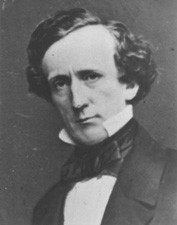
Aspring politician and future Senator Henry Mower Rice represented the Chippewas at the 1847 Treaty of Fond du Lac, and appears frequently here on Chequamegon History.
~ United States Senate Historical Office
St. Louis July 14, 1848
Mr.s Sibley & Rice
St. PetersDr. Sirs
We had this pleasure of the 7th inst by [Shamus Highland Many?] enclosing Invoice & Bill of Landing of C.O. English goods which we hope you will have received in good order and due time – The same day and as the time the boat was pushing off we addressed you a few lines in haste, advising you of the purchase made by our House in New York, of the posts at Lapointe. We have just received several documents in relation to that purchase of which you will find copies herewithin.
You will perceive from their contents how Mr. Crooks has acted in the matter, and that it has become urgent for us to take such steps as will answer the possession of the said posts. How we will be able to succeed, Doctr. Borrup being now in possession & having apparently purchased from Mr. Crooks, is a matter of doubt and can only be ascertained at Lapointe. We have purchased Bona Fide from Mr. G. Ebninger, the only person authorized to make sale, as the assigner of the late American F. Co. Mr. Borrup we are afraid, will (as you can see by Mr. Sanford’s letter) refuses to give possession, and in that case, in a country where there is no way of enforcing law, we may not be able to obtain possession before next year. Now, would it be desirable or advantageous to make the purchase and not get possession before that time? We think not.
Oil painting of Doctor Charles William Wulff Borup from the Minnesota Historical Society:
“Borup and Oakes were headmen for the [American Fur Company]. All voyageurs, ‘runners,’ as they were called, were employed by said company. They would leave La Pointe about the beginning of September, stay away all fall and winter among the Indians in their respective districts, collect furs, and return about the beginning of June. They would take along blankets, clothes, guns, etc., to trade with the Indians for their furs. They took along very little provisions, as they depended mostly on hunting, fishing, wild reice, and trade with the Indians for their support. There were several depots for depositing goods and collecting furs, for instance at Fond du Lac (Minnesota,) Sandy Lake, Courtes Oreilles, Lac du Flambeau Mouth of Yellow River, etc.”
~ Proceedings of the [Wisconsin Historical] Society at its Sixty-fourth Annual Meeting, 1917, pages 177-9
We are writing this day to our home in New York and to Mr. G. Ebninger that he must proceed immediately to Lapointe so as to be here from the 1st to the 15th September, and claim himself & in person the delivery of the posts. Any agent would not probably succeed, or objections would no doubt be made by Doctr. Borrup which said agent could not face or answer. You will therefore do the necessity of either of you going to Lapointe and meet them with Mr. Ebninger on the time appointed above.
Very truly yours,
P. Chouteau Jr & Co
It was only on the 10th inst that we were handed your forms of 25 june enclosing packing ‘℅’ of the U.S. postal M.R. #01037 for ℅ St Louis ℅ Chippewa outfit. Capt. Ludwick ought to be more particular with papers confided to his care.
Bernard Walter Brisbois was an agent for the American Fur Company.
Duplicates of this letter and documents enclosed, sent to the care of Mr. Brisbois of Prairie du Chien, by mail
You will notice by copy of telegraphic dispatch of the 10th that the Chippewa annuity will be paid at Lake Superior as heretofore.
[Illegible]
The New York Times
September 29, 1851
“Indian Moneys”
There is no greater abuse in the governmental policy of the United States, than the past and present system of Indian payments; and the Indians would be benefited if the money thus appropriated were cast into the Lakes, rather than made the cause of such much distress and swindling as it is.
The author of this article is not identified.
In the August of 1848 we were present at a payment at La Pointe, and we have no hesitation in saying that every dollar paid to the Indians there was a disadvantage rather than a benefit to them.
The payment was fixed for August, and Indians from West of the Mississippi were called together at La Pointe to receive it. They gathered at the appointed time, and the payment was not made for three weeks after the time specified.
The money collected at the Saut Ste. Marie Land Office, the most convenient point, had been transported, as per Government order, to Chicago, and the Paymaster received drafts on that point where he was compelled to go for the specie, and the payment was thus delayed.

La Pointe Beaver Money of the American Fur Company’s Northern Outfit from “The Beaver in Early Wisconsin” by A. W. Schorger, Wisconsin Academy of Science, Arts, & Letters, Volume 54, page 159.
Meantime, the Indians gathered at La Pointe were without the necessaries of life, and the agents of the North American Fur Company, and a few old traders who were posted in the business, supplied them with provisions at exorbitant rates, and forced them to buy with every ounce of pork or flour which they needed, an equal amount of dry-goods and gewgaws, which had no value for them. These sales were made on credit, to be settled at the pay-table. At the payment, some $30,000 in cash, and a stipulated quantity of blankets, guns, powder, tin pails, calicoes, ribbons, &c., were distributed; and this American Fur Company, and the favored traders, raked from the Paymaster’s table as it was counted out to the bands, over $12,000 for provisions furnished to, and trash forced upon the Indians, while they were delayed after being summoned to the payment.
Some $14,000 more was spent among forty traders and the remaining $4,000 the Indians carried home; about one dollar each.
Their blankets, about the only valuable thing they received in the way of dry goods, were on the night after payment, mostly transferred to a mercenary set of speculators, at a cost of a pint of whiskey each, and came down to the Saut as private property on the same propeller that took them up as government gratuity.
Such was the result of a payment for which thousands of Indians traversed many miles of forest, wasted six weeks’ time, and lost the crop of wild rice upon which they depended for their winter’s subsistence.
If a white man with a white soul, writes the history of the Indians of the West, the American government will gain little credit from his record of Indian payments.
For more context about these American Fur Company partners and their affairs following the 1848 La Pointe annuity payments, please read pages 133-136 of Last Days of the Upper Mississippi Fur Trade by Rhonda R. Gilman, Minnesota History, Winter 1970.
But the swindle of 1848 was not gross enough to suit certain grasping parties. La Pointe was too easy of access. So many traders sought a market for their goods there, that the old monopolists could not obtain a thousand per cent on the goods they sold; and even in 1848, it was whispered that they were using all their influence to have the future payments made at some point so far West that competition would not force them to be content with moderate profits.
For more context about the Lake Superior Chippewa following the 1848 La Pointe annuity payments, please read our The Sandy Lake Tragedy and Ojibwe Removal series here on Chequamegon History.
To effect this it was necessary to remove the Chippewas further West, and by some influence, not, perhaps, distinctly marked, but yet more than suspected, this order of removal was secured.
It was uncalled for, useless, and abominable; and we are glad, for the sake of humanity and justice, that the Administration have resolved that for the present the edict shall not be enforced. We trust it may never be.
Barber Papers: “In a Little Trouble” Winter of 1856
October 9, 2015
By Amorin Mello
Selected letters of the Joel Allen Barber Papers
… continued from Fall of 1855.
Minnesota Point Jan [23rd?] 1856
Dear Parents
It is sometime since I have wrote to you and for a fortnight or more
[???] [two lines on this copy are illegible] [??? ?????]
On arriving at Lapoint we found sheets from home and a good lot of newspapers.
We left Lapoint Thursday afternoon [on a firm of ?????? ? ?? head?] of [?????????] Nagonup the principal chief of all the Chippewas, Augustus and myself [??? ??? ?????] drawn by by two dogs on a dogtrain. At [????? ???????] were joined by one of Nagonup’s [??????].

Photograph of Naagaanab (Minnesota Historical Society).
They were on their way to Washington. Several of them are going accompanied by a gentleman from Lapointe as interpreter. The first night out we stayed in a wigwam with old Chingoon and his interesting family. Friday night we camped. Saturday reached Iron river. Sunday left and [comfortable?] – Monday came here. Augustus has a sore througt, not severe – otherwise we are well as usual notwithstanding our tramp of over [100?] miles. I must now quit writing and try to find one of our dogs which has strayed over to [???].
Under the old permit system, many locations, three miles square, were made on Lake Superior;- several on and near the Montreal river – some on Bad River, south of La Pointe – three on the main land, opposite La Pointe – two or three were made near Superior City, on the Nemadji, or Left Hand river, and one settler’s claim about twenty miles north of Superior.”
~ Mineral Regions of Lake Superior: As Known From Their First Discovery to 1865, by Henry Mower Rice, 1865[?].
Perhaps you wonder what we have made this journey for – perhaps you hope we are going below but that is not the case. Why should we [?????]. It is warmer here than at many places two or three hundred miles south of here. True – one or two thermometers froze up at this place but others did not while at Fort Snelling, the spirit thermometer inside the walls indicated 44 degrees below zero. Augustus wanted to see to his preemption and I had nothing to do but to come along with him. I also wanted to find out a few things concerning a place that I should like to preempt. I suppose there is not a better copper show on the south shore of the lake, but the land is not surveyed and my only sure way to get it is to settle on it and stick to it until it can be legally claimed.
The town lines will be run next summer.
Augustus is in a little trouble about his claim. It appears his declatory statement never reached the land office. But I guess it will all be explained and made right. The dutchman who was to contest his claim has left the country and would stand no chance if he was here. We have a land office here now which saves a great many journeys to Hudson near St. Paul. We shall go back in a few days and commence surveying around the islands. Now don’t fancy that we cannot survey in the winter, for we have tried it and know better.
Detail from the Stuntz/Barber survey of T47N R14W.
“J.H. Bardon, a Superior pioneer, stated that ‘at Copper Creek and Black River Falls, twelve or fifteen miles south of Superior, and also near the Brule River, a dozen miles back from Lake Superior, Mr. Stuntz found evidences of mining and exploring for copper on a considerable scale carried on by the American Fur Company, under the direction of Borup and Oaks of La Pointe, in 1845-46. A tote road for the mines was opened from a point ten miles up the Nemadji River to Black River Falls.‘”
~ Duluth and St. Louis County, Minnesota; Their Story and People: An Authentic Narrative of the Past, with Particular Attention to the Modern Era in the Commercial, Industrial, Educational, Civic and Social Development, Volume 1, by Walter Van Brunt, 1921, page 66.
At Bad river we were at work during the coldest weather, and only lost two or three days because of cold but when the thermometer was up to 20* below zero we worked right ahead – sometimes in swamps where we stepped through the snow into the water,
[last line on this page of this copy is cut off]
The weather for a week or more has been fine. Cold enough to cover us with frost but not severe.
Provisions are very scarce – no flour or pork can be had.
They will begin to bring them through from St. Paul in a few days. Flour it is hoped can then be bought for $20 per barrel. Fish are not exactly plenty but they can be obtained for money or labor which is not the case with anything else. The country is flooded with dry goods, [p??y] articles and everything but provisions because they can be bought on time but eatables could only be got by paying cash down.
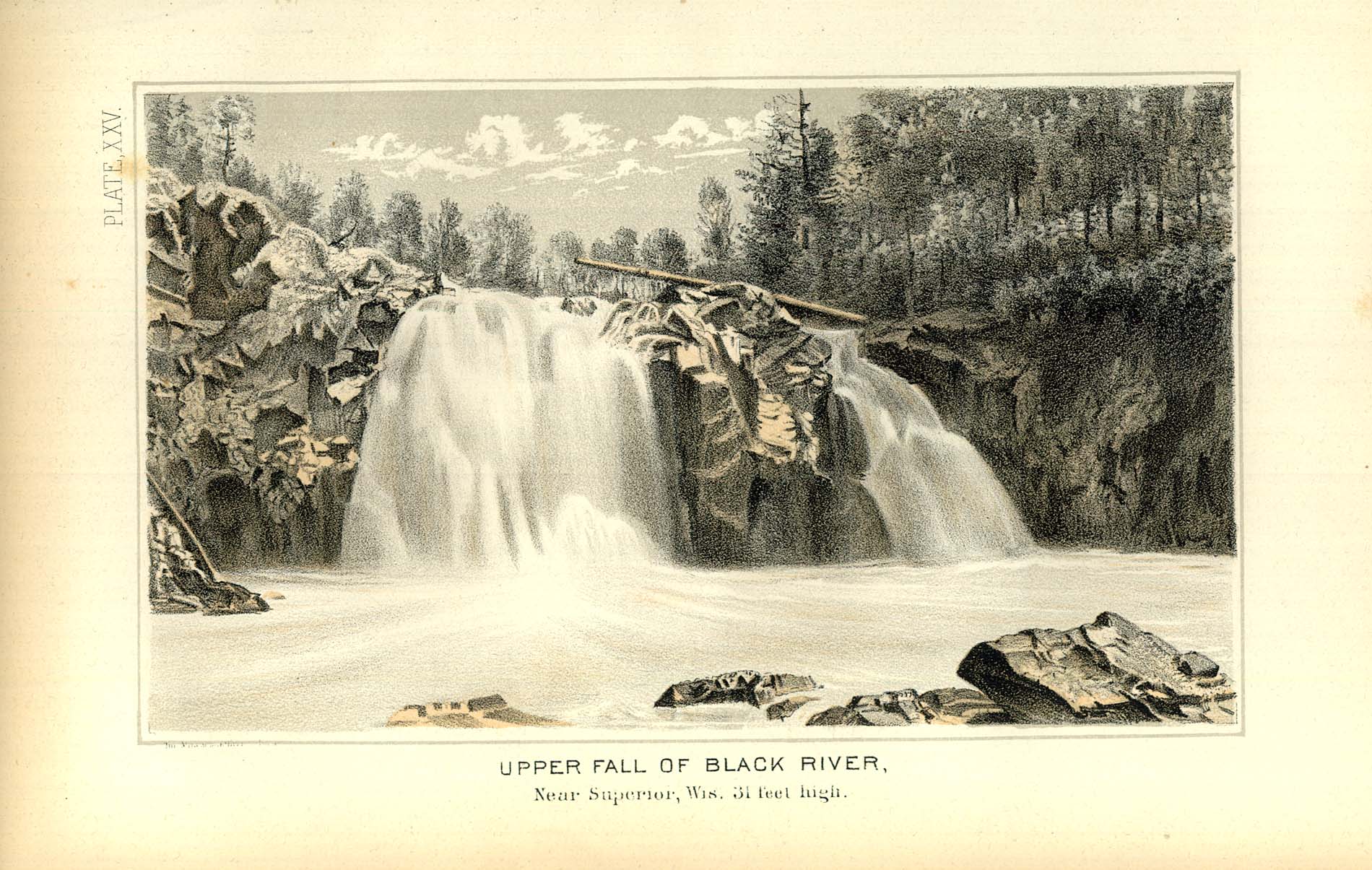
Geology of Wisconsin: Survey of 1873-1879,
Volume III, 1880, page 342[?].

Geology of Wisconsin: Volume 3, page 341.
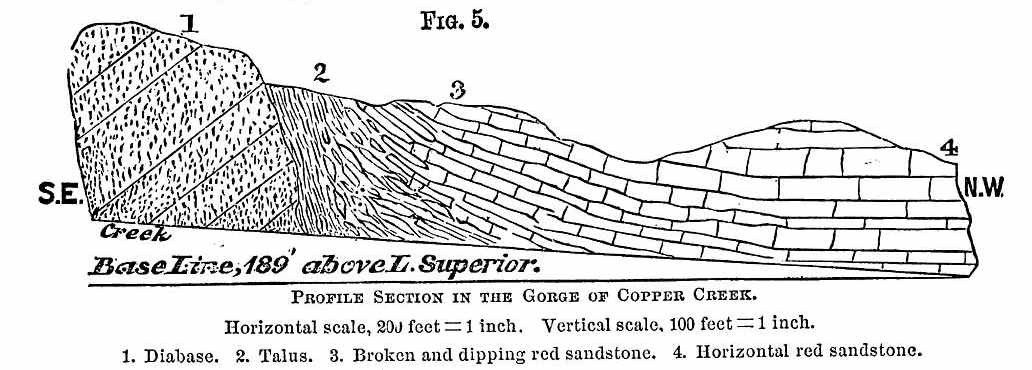
Geology of Wisconsin: Volume 3, page 345.
The Fon du Lac mine has commenced operations with tolerable fair prospects. It is the only mine in operation this side of Montreal river. Augustus’ claim is on the same vein and for aught anyone knows just as good besides having abundance of water power. All the copper excitement since I come to the country has been directed toward the north shore. This morning I signed 2 petitions, one to congress for the early survey of the north shore and another for a road down that way. I have made a little map of the islands and last summers survey and some other things that I will enclose.
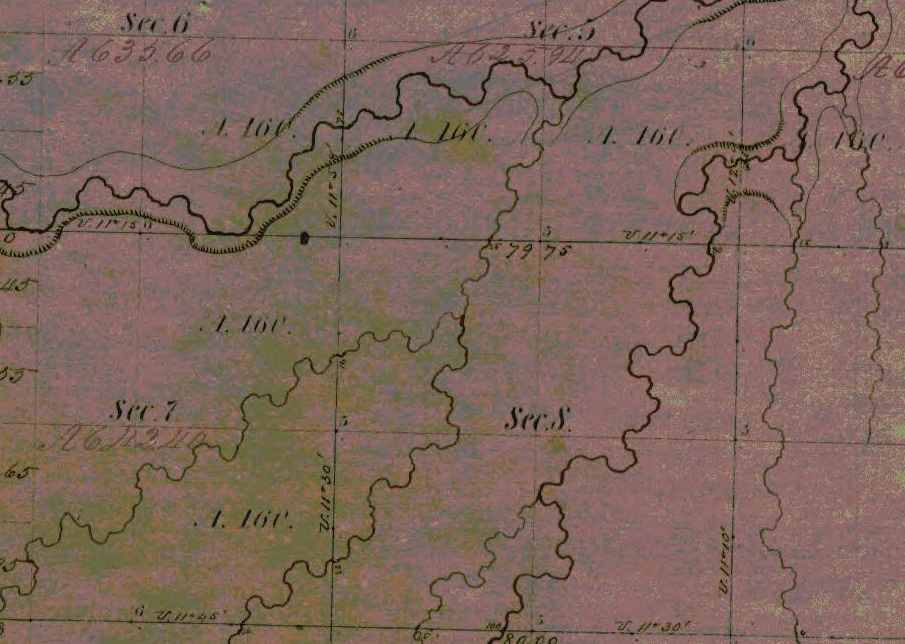
The Fond du Lac copper prospect was located near a small tributary of the Left Hand River on this map detail from T47N R14W, near Pattison State Park. Augustus’ claim was along the same vein of copper but had not been surveyed yet; perhaps it was at Amnicon Falls State Park.
Augustus has begun a letter to send with this. He has just come home with letters now about his claim.
No more at present from
Your affectionate son
J. Allen Barber
Direct to Lapoint
Minnesota Point
Superior County
Minn. Terr.
Sunday Feb 10th 1856
Dear Mother
Augustus has written a letter, and left it for me to enclose and dispatch so I thought I would ship in a few lines before sending it off.
Augustus started today with a young man and two dogs for Lapointe. I shall probably go there in a two or three weeks to return immediately. There are two men going down with a tamlins pony team with provisions from St. Paul for Augustus. The men are going to work for him and I shall probably bring the team back and use it a while. I have at last fixed my mind on a place that I mean to claim. The location is a point at the mouth of Left hand river, known as Left hand point. It contains only 5 or 6 acres in low & swampy and covered only with bushes coarse grass and floodwood. Nothing but the fact of its being a part of Superior city is of any value whatever.

Barber’s sketch of his land claim at the mouth of Left Hand River. This location is now an industrial neighborhood of Superior on the Nemandji River.
As it is $1,000.00 per acre is not an overestimate of its marketable price at present. It joins or is part of the grounds intended for the Railroad buildings when the survey was made here this point was cut off by the meander lines instead of meandered. Therefore according to the [rearns/records?] no such land exists.
A resurvey is to be made and I mean to fasten it by a preemption which is the only way to obtain it before the land sale. I may get cheated out of it and I may throw away my time and money but such chances are scarce and should it transpire that my claim is good I want to have my dish right side up for once. I have written for Uncle Allen’s advice and should I ever find it advisable to drop the matter I can do so without forfeiting my preemption right.
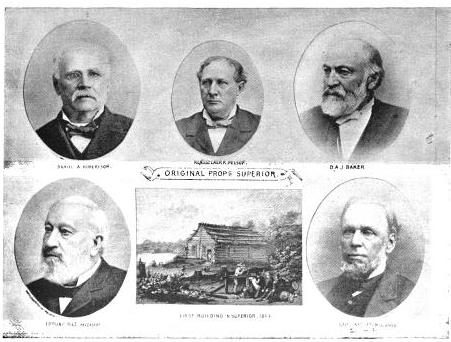
The Eye of the North-west, page 9.
The Superior Company with Company with which I shall probably have to contend is rich, influential, and on good terms with the administration. All that can be done by fair means or foul to defeat any claim will probably be done, but some things can be done as well as others, at any rate we shall see what we shall see.
So my head is so full of business just [snow?] you will please excuse the shortness of this letter and look for more when I have more time.
Your affectionate son
J Allen Barber
Superior Feb. 17th 1856
Dear Brother
It is sometime since I have written anything to you but you have heard of me so often that I suppose it makes no particular difference. It will be nearly sugaring time when you get this.

Makak: a semi-rigid or rigid container: a basket (especially one of birch bark), a box (Ojibwe People’s Dictionary) Photo: Densmore Collection; Smithsonian
I have once more got into a country where sugar is made but not by white men. The Indians make pretty good sugar which is generally done hard and [sinted?] dry and put into birch bark “mo’kucks” holding from 50 to 75 lbs. This bark is also used exclusively for buckets, store trays, gathering pails, &c. The timber in this country is not as equally distributed as in Vermont. The land is mostly covered with evergreens but there are some located portions of country where maple abounds. These “sugar bushes” as they are called are often quite extensive covering several sections and and [they?] only at intervals of 8 or 10 miles, but this is just as well for the Indians are both migratory and gregarious in their habits.
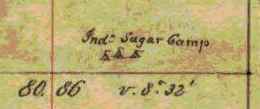
Detail of an Lake Superior Chippewa “sugar bush” from the Barber brothers’ survey of T48N R5W.
I hope you will eat plenty of sugar next spring and take some of the girls to a sugar party or two like I used to. I am doing nothing now most of the time but shall have business enough in a few days when I begin to build my house that is if I conclude to grab for the price of land I am now watching. I am waiting to hear from Uncle Allen and for some other things to transpire. There is not a man in the country whom I could trust that could give me any reliable information such as I want. I want you to hurry and become of age as soon as possible and come out here this spring and make a preemption.
There are some good places left yet, but don’t get married before you make a preemption for it might not be convenient to take your wife out into the woods 30 or 40 miles to live on the place as you would have to do in order to “prove up.” I am going to get up an ice boat before long which will be very useful as I mean to do considerable boating yet this winter, and I might use it to carry lumber and other things up and down the lake. With such winds as we have had a few days ago I could easily go to Lapointe and back in two days. I suppose Augustus got a party started by this time and he will be at it himself in a few days. I am living with a man named Fargo, you have heard of him before. We are living in Stuntz’ store. Board at the hotel is ten dollars per week. Old Steven Bonga is living on the point, he has been something of a traveller having been to Montreal, Hudson Bay, [Oregon?], Prairie du Chien, and all intermediate places.
He is half indian and half negro so you may suppose he is not very white.

Portrait of Stephen Bonga (USDA Forest Service). Additional information about Bonga is available from the Wisconsin Historical Society.
A railroad has been laid out from here to St. Paul and my claim covers the terminus at this end. There have two or three new towns started into existence along its route in imagination. Perhaps they are [surveyed?]. This making towns in a new country is a great business.
What happened in your good town on Christmas and New years eve
Were there any stockings left.
I want to inquire about lots of girls and boys in Johnson and Cambridge but I conclude you will tell me as much as you can in your next letter so with respects to all enquiring friends I remain
Your affectionate brother
Allen
Superior, Douglas Co. Feb. 25th 56
Dear Parents

Detail of Superior City from T49N R1W.
Night before last I got a letter and some papers from Augustus also 2 letters from home which he had read. They were dated Dec. [21st?] & Jan 2nd.
Sad and startling was the news of the death of George Hill. Who could have thought three years ago that such a dark future lay before that family. Every day some sad event warns me of the uncertainty of life. Men have died here who had no friends to mourn their loss, and their death is hardly noticed. I always ask myself why was it not me instead of them and will not my turn come soon. Yes, let it come soon or late as the world reckon, and it will be soon to me.
There is just as much danger or accidents in this country as in any other and no more but as to health there is no better place in the world than this. You seem shocked at the idea of surveying in the winter, but it will be nothing but fun to survey during the rest of the winter. It has been moderate pleasant weather now about two weeks. The snow is going off a little lately and it seems a little like spring. We had some pretty cold weather about new years but we shall have no more such. The lake is more open than it ever was known to be at this season before.
It sometimes freezes across at Lapointe but now it is open within six or eight miles of here. Flour is only $20 per bbl‑ with prospect of falling lower. The Indians chiefs have returned having only been to St. Paul where they found a letter telling them to delay their visit a while.
Poor creatures! They are fooled around by traders and speculators who are with the government in robbing and dwindling them. Any thing like a full account of their wrongs would astonish even them. About my claim I have not [???] today. There is another man after it and it will be no easy thing to carry my point.
Valuable property is troublesome stuff in this country. There is a townsight three miles from there now in litigation for which there is a standing offer of $200,000.
I am still living with Fargo on Minnesota point. I expect to go to Lapointe before long with Albert Stuntz who is going down with some supplies for Augustus which he brought from St. Paul.
It is too dark to write
Good bye
Allen
Superior, March 4th 56
Dear Parents
Not much has happened in this vicinity worth recording. The principle circumstances of note is the burning of a house and all the worldly possessions of a poor [Indian?].
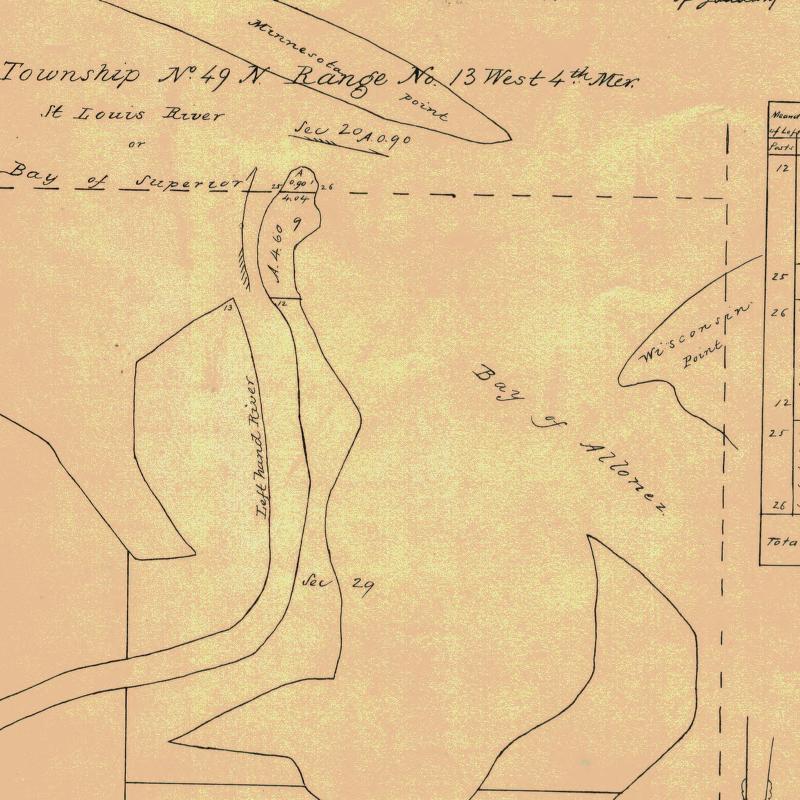
Detail of Left Hand River from Stuntz’s survey; where Barber’s land claim was located.
I have heard nothing of Augustus since writing last but expect to when anybody comes up the lake. About my claim I can say but little my chance is but dull still I don’t mean to give up so large a prize without good reasons.
I have had it surveyed and the notes sent to the Surveyor General with a memorial stating the facts and asking him to [appraise?] the [notes?].
The price contains over 8 acres (8.695).
Perhaps it occurred to you that I am was 22 years old last Sunday. Well such is unquestionably the case although nothing was done to celebrate the day only I had my hair cut for the third time after leaving Vermont. I think I shall have to go to Lancaster this spring but unless I get ousted here it will be difficult to leave.
I wish I could multiply myself by about a dozen in order to hold several valuable claims which are not occupied by any one who can legally hold them. I can’t write here two children [pretting?] and several people [telling?] Albert Stuntz and family are here today. I am perched on a sawhorse writing on a work bench loaded with all manner of [marbles?].
Evening – quiet once more since dark I have written a letter to the Surveyor General to accompany a memorial that I have been circulating. O I wish there was a person in the country that I could depend on to assist me in regard to that claim. There are one or two that I counsel with who know no more than I do and then I do as I think best.
I expect [Lowener?] to find out I have no show, and that will be the last of it I shall [not feel?] that I had lost it for I never had it, but if I don’t get it some body else will get 15 or 20 thousand dollars worth of land that I want.
Provisions are still high and will be higher again before navigation opens which cannot be expected before the 1st of May. Flour is $20/barrel, fresh pork 18 ¾ cents per lb, beef 20 cts milk 20 to 25 cts per qt. &c, &c. Eatables must be higher because there will be little or no sleighing after this over the barrens between here and St. Paul. My mind has been on the [rock?] so much today that I am not in a mood to think much about home so please excuse the shortness and dryness of this letter.
I remain your affectionate son
J Allen Barber
Went to Iron River Thursday 13
Returned 15th
Superior , Douglas Co. March 11 1856
Dear Parents
Yesterday I read a package of letters from Augustus containing one from him & from home one from Albe and one from [Caldridge?]. As Augustus was in town (Lapointe) when he recd. your letters I suppose he has answered them so I cannot tell you much news about him. I am still staying with Fargo – not doing much but hoping to get pay for my time and expense by securing the prize I am after. There is some excitement in town about it, but mighty little is said to me. The Register at the land office gives me good encouragement and says a preemption will hold it. I have taken some steps toward building on it. Today I bought a sack of flour ½ barrel for 12 dollars, I shall get some fish from Lapoint where they are very plenty and cheap and then I shall be almost ready to try housekeeping alone.

I am sorry to hear of the disastrous results of the low price of hops. Although farmers must suffer in consequence yet I believe speculators will make fortunes out of it. If I was in the business of raising them I should stick to it. No articles is so liable to fluctuations in prices as hops but it is well known that the risk fails once in five years on an average so they must come up sometime.
I see you are inclined to believe our country and climate are more in hospitable & forbidding than yours. Such I believe is not the case. We have had some very cold weather but the changes are so moderate and so seldom that we pay but little attention to the weather – in fact we call most all of it very fine weather, as it is. The lake is a great equalizer of temperatures and our cool lake atmosphere in summer causes showers to fall from all the warm, sweaty winds that come here to wash their faces in this big blue pond. People in this country go much better prepared for cold than they ever do in Vermont. I have not worn a boot since leaving Lancaster. We wear shoes in the summer and moccasins in winter.
Boots won’t do for surveyors – they carry too much water unless we stop to empty them after crossing every stream or marsh.
While speaking of clothes perhaps I might as well go on with a few more items of the same sort.
Shoes for this country should have no lining or binding as they are quicker and ae not as stiffwhen dry. We never apply anything to soften them and nothing can preserve them from wearing out in about two months of hard service. They [sell?] about $1.50 per pair. We can get plenty of wool hats which are the only ones we wear.
All manners of shirts can be bought, even the very best quality of red flannel ones, which are universally warm, outside, i.e. by common folks.
The gentry of Superior dress most distressingly.
It is difficult to get good socks any where on the country. I have worn out 6 or 7 pair this summer and lost some more – they cost high bests we don’t wear. I have none. The only cost I have is of [Gihon?] cloth and made by Mrs. Sheldon. Cost are not much more except as an extra garment to wear occasionally.
Good durable pants I find it difficult to get. They are generally poor [ashnet?] and not half put together. Good your mittens would be very acceptable but for want thereof buckskin or blanket mittens are generally warm.
You speak about bringing Kate [in?] to Wisconsin. My advice is to it without fail if you intend coming out to live, nothing should prevent it if I were in your place. The horse that Uncle [Jay?] brought out with him is smarter and tougher than any one he can find to use with him. There is nothing that I regard as more necessary for a family than a first rate horse. I think [Kelty?] will be a very good serviceable animal for work besides being one that you might be proud to ride [after?] over the prairies. Probably Augustus has told you what he thinks about Amherst and other boys coming out here to survey. Butler was so badly disappointed in this country that I have had but little thoughts of [enough?] any one else to come here. Such a disappointment I think would be the fate of 4 out of every 5 that try the business.
A person to be a surveyor must be able to travel all day through the woods and sometimes carry a pack. I would not prevent any from coming here as there is generally business enough besides surveying. A surveyor can make no greater mistake than by hiring any but the best of men. Perhaps Augustus has not told you that he will be out of the business as soon as his present job is done and will devote his time to the improvement of his claim &c. I should like very much to [have?] Amherst here but I dislike to have my parents left entirely alone. As I have [???] two half [sheets?] – when I only [illegible] mind up for the [present?].
[Incomplete copy of letter]
To be continued in the Spring of 1856…
By Amorin Mello
In our Penoka Survey Incidents series earlier this year, we followed some of the adventures and schemes of Albert Conrad Stuntz circa 1857. The legacy of Albert’s influential survey still defines the geopolitical landscape of the Penokee Mountains to this day. However, Albert’s work during the late 1850s was relatively minor in comparison to that of his brother, George Riley Stuntz, during the early 1850s. The surveying work of George and his employees started in 1852 and enabled the infamous land speculators and townsite promotors of Superior City to manifest their schemes by early 1854 (months before the Treaty of La Point occurred later that year).
Among the men that worked with George was Augustus Hamilton Barber. Sometime around 1850, Augustus had followed his Grandparents, Aunts, Uncles, and Cousins from the Barber family of Lamoille County, Vermont, to Lancaster in Grant County, Wisconsin. After a short career as a school teacher in Grant County, Augustus came to Lake Superior in 1852 employed by George as a Chainman under his contract with the United States General Land Office to survey lands at the Head of Lake Superior.
Before taking a closer look at the Barber Papers, let’s examine the lives and affairs of other surveyors and speculators along the southwest shore of Lake Superior, starting with George Riley Stuntz and his production of these Exterior Field Notes (June of 1852):


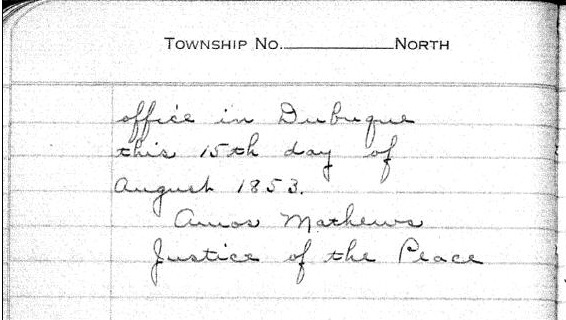
Duluth and St. Louis County, Minnesota;
Their Story and People
By Walter Van Brunt, 1921, pages 64-65.

Portrait of George Nettleton’s cabin on Minnesota Point in 1852 on page 75.
First Settler.– The honor, for both Superior and Duluth, must presumably go to George R. Stuntz. He came in 1852, and settled in 1853. Several were earlier of course, but can hardly be considered to have been legitimate independent settlers. Carlton had been on the ground, at Fond du Lac, for some years, but he was Indian agent; Borup and Oaks had spent their time between La Pointe and Fond du Lac, but were then at St. Paul, and mainly interested in the development of that city, and in fur trading. Wm. R. Marshall stated that he “was on the lake as early as 1848,” but not to settle and he did not come again until 1857. Wm. R. Marshall and George R. Stuntz were fellow-surveyors, in federal pay, “back in the ’40s,” but Marshall did not seek to take the place of Stuntz as premier pioneer at the head of Lake Superior. As a matter of fact, although “on the lake as early as “1848,” Marshall did not then get nearer to Duluth than La Pointe, where he met “Borup and Oaks, the principal traders, Truman Warren, George Nettleton, Cruttenden, Wattrous, Rev. Sherman Hall, E. F. Ely and others.” It is quite possible that Stuntz was with Marshall in 1848, for that was the year in which Stuntz first entered Minnesota territory “having charge of a surveying party that was working near Lake Pepin and in what is now Washington County.”
The “Heart of the Continent.”– George R. Stuntz prepared the way for the first attempt at white settlement at the head of Lake Superior. He surveyed the land on the Wisconsin side, within a year of beginning which survey, in 1852, the first settlers began to appear. George R. Stuntz came by direction of George B. Sargent, who at the time was surveyor-general of the Iowa, Wisconsin and Minnesota district for the federal government, his headquarters being at Davenport, Iowa. In that year, states Carey, “he surveyed and definitely located a portion of the northeastern boundary line between Minnesota and Wisconsin, starting from the head of navigation on the St. Louis River, at Fond du Lac, and running south to the St. Croix River.” Stuntz himself stated: “I came in 1852. I saw the advantages of this point (Minnesota Point) as clearly then as I do now (1892). On finishing the survey for the government, I went away to make a report, and returned the next spring and came for good. I saw as surely then as I do now that this was the heart of the continent commercially, and so I drove my stakes.”
![Group of people, including a number of Ojibwe at Minnesota Point, Duluth, Minnesota [featuring William Howenstein] ~ University of Minnesota Duluth, Kathryn A. Martin Library](https://chequamegonhistory.com/wp-content/uploads/2015/06/howenstein-minnesota-point.jpg)
Group of people, including a number of Ojibwe at Minnesota Point, Duluth, Minnesota [featuring William Howenstein in 1872?] ~ University of Minnesota Duluth
The Vanguard.– He did not come alone, needing of course assistants in the work of surveying, but he was in charge of the work, Gand necessarily takes first place in the accounting. William C. Sargent, son of George B. Sargent, stated in 1916, that his father “came here (Duluth) first in 1852 with George R. Stuntz and Bill Howenstein,” and goes on to state “a word of those two grand men, George R. Stuntz and Bill Howenstein.” He believed that “to George R. Stuntz, more than to any other man belongs the honor (of) opening up that region,” and of Howenstein, he said: “And old Bill Howenstein, one of the best ever, and always my very good friend, a kindly body, with a quaint dry humor unsurpassed and seldom met with in these later days. I had many an interesting chat with him, in his home on Minnesota Point, that he built in 1852, and lived in until his death, some years ago.” Bill Howenstein, undoubtedly was of Stuntz’ party in 1852, but it is doubtful whether he built a log house on Minnesota Point in that year. As to General Sargent’s visit in 1852. If he did come then, it was probably only a flying visit. His interest in the head of Lake Superior in 1852 reached only to the extent of directing Stuntz to survey it. He, himself, had the surveying business of three states to attend to.
The New York Times
[December 11, 1852]
The Region about the Southwest End of Lake Superior.
Mr. Stuntz, of Grant County, Wis., has been deputed by the general Land Surveyor of this Northwest District to lay off such a tract of land about the southwest point of the lake into townships and sections, as emigrants will earliest require. He returned via La Pointe and Stillwater last week. We have obtained from him some new views of that region. From Fond du Lac, a trading post situated 11 miles inland on the St. Louis River, eastward, for perhaps 50 miles, the margin of the lake is a flat strip of land reaching back to a rocky ridge about 11 miles off. The soil of this flat land is a rich red clay. The wood is white cedar and pine of the most magnificent growth. The American line is beyond the mouth of the St. Louis and Pigeon rivers. It evidently abounds in copper, iron and silver. The terrestrial compass cannot be used there, so strong is the attraction to the earth. The needle rears and plunges “like mad.” Points of survey have to be fixed by the solar compass.
The Indian and half breed packmen have astonishing strength. One Indian, who is described by the others as being as large as two men, carried for a company of 11 men provisions for ten days, viz: one barrel of flour, half barrel of pork and something else, beside the utensils. Mirage is a common phenomenon is Spring and Summer. For the bays not opening as soon as the main lake, or not cooling so early, an object out on the lake, is viewed from the shore, through a dense medium of air and a thin medium. Hence is a refraction of rays which gives so many wonderful sights that the Chippewas call that the spirit or enchanted land. Sail vessels which are really 40 miles off, are seen flapping and bellying about almost within touch. Turreted Islands, look heavy and toppling towards the zenith. Forests seem to leap from their stems and go a soaring like thistles for the very sport of it.
The ice did not leave some of the bays till the 10th of June. The fish are delicious, especially the salmon trout. But little land game. Mr. Stunts calculates on wonderful enterprises in that country after the opening of the Saut Canal.
Mr. S. describes La Pointe a town of the Lake, as being situated at the head of a bay some 25 miles from the high lake, and secluded from the lake by several islands. He saw there a warehouse 300 feet long, built of tamarac poles, and roofed with bark. This building is very much warped by the pressure of age ; it is entered by a wooden railway. The town is dingy and dreary. He saw a most luxurious garden by the former residence of Dr. Borup. It contained a variety of fruit trees and shrubs, such as plums, cherries, apples, pears, currants, &c.

Cover of Stuntz’s Exterior Field Notes (August-October 1852) ~ Wisconsin Public Land Survey Records: Original Field Notes and Plat Maps

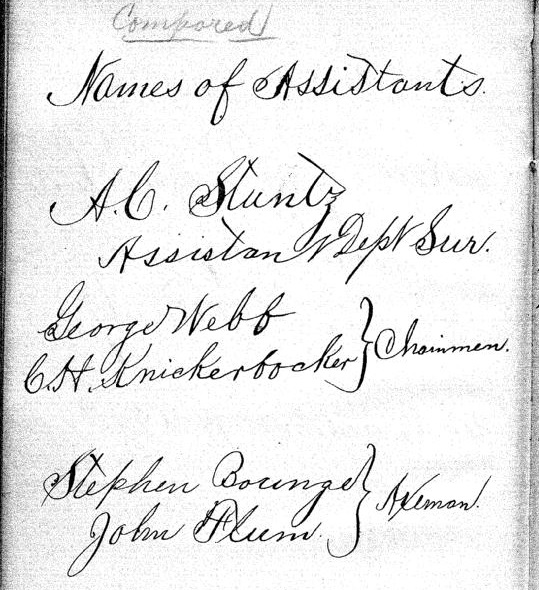
George Riley Stuntz was also assisted by his brother Albert Conrad Stuntz as well as the African-Chippewa mixed-blood Stephen Bonga employed as an Axeman. To learn more about the interesting Bonga (Bonza) family and Stephen as “the first white child born at the head of Lake Superior,” read pages 39-41 of The Black West by William Loren Katz (1971), and pages 131-34 of Black Indians also by Katz (2012).
The Eye of the North-west: First Annual Report of the Statistician of Superior, Wisconsin
By Frank Abial Flower, 1890

Portrait of Stephen Bonga, page 7.
GEORGE R. STUNTZ, DEPUTY U. S. SURVEYOR [pages 50-52]
Portrait of George Riley Stuntz, page 26.
In 1852 George R. Stuntz took a contract to run the township lines in this part of the country, including the state boundary, and filed with the land-office at Dubuque a rude map of the head of the lake, on the Wisconsin side, in December of that year. He took a new contract and returned in the spring of 1853 to survey the copper range around Black River, a few miles south of Superior. He brought seeds with him and planting them on the Namdji, raised a quantity of vegetables; they grew to great size. he also built a trading-post on Minnesota point near the present light-house, and a mill on Iron River in Bayfield county. In respect of these operations W. W. Ward writes from Morley, Mo.:
The first lumber of any description produced locally, other than by “Whip sawing”, was at Iron River, Wisconsin about forty miles from Superior on the South Shore of Lake Superior.
George R. Stuntz with William C. Howenstein, Andrew Reefer and George Falkner built and operated a water power “up and down” sawmill at the falls on Iron River about a half a mile from the Lake, capable of cutting three thousand feet of lumber a day. The writer has several 1 1/4 inch absolutely “clear” White Pine boards 24 and 26 inches wide and 18 feet long that were originally stored in a loft to be used in building a skiff. This mill was built in 1854 and the lumber was floated up the Lake to Superior, Oneota and Fond du Lac…
~ Superior, Wisconsin, papers, 1831-1942 ([unpublished])
From “A Pioneer of Old Superior” by Lillian Kimball Stewart
“In the summer of ’54 the Sam Ward plying between the Sault and any port on Lake Superior, brought on every trip a goodly number of emigrants, speculators, and tourists, bent on seeing the new “city” of Superior. Stuntz’s dock was located near an Indian village, so that every traveler as well as every piece of freight or baggage was subject to inspection by braves, squaws, and papooses before receiving a passport to the shore across the bay…”
~ Superior, Wisconsin, papers, 1831-1942 ([unpublished])
“It was in the spring of 1853 that Mr. Stuntz, Deputy U. S. Surveyor, received his second contract to survey and run the township lines taking in the range around Black River Falls, a portion of Left-hand River country and that part where Superior now is. In the latter part of April that year he organized a party – viz., Nat. W. Kendall, James McKinzie, Pain Bradt, James McBride, Harvey Fargo, Wm. H. Reed, John Chisholm, Joseph Latham, Augustus Barber, and your humble servant. Procured three birch-bark canoes and supplies at Stillwater, Minn.: left there the first day of May, passed up the St. Croix River to its head, made a portage of about two and a half miles into the headwaters of the Brule River, down said river into Lake Superior, thence up the lake to what was called the entry of St. Louis Bay [now Superior Bay], and landed on Minnesota Point in the early part of June. At that time there were no white settlers in this end of the lake – all Chippewa Indians and ‘breeds’ – scarcely a stick missing on that side of the bay where Superior City now stands. We finished the surveying contract and went in early fall down to Iron River, built a double log-shanty, and made other preparations for the construction of a saw mill. Here the first lumber was made at the head of the lake and the first road opened through to the settlement on the St. Croix. The following February, Mr. Stuntz having a trading-post on Minnesota Point [then Stuntz’s Point], I went there and assisted in building a block-house and steamboat pier, and found improvements and a few log-shanties built where old Superior now is located.”
[…]
HUSTLING FOR TOWNSITES [pages 58-60]
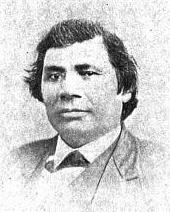
Vincent Roy Jr. ~ Life and Labors of Rt. Rev. Frederic Baraga by Chrysostom Verwyst,
VI. – Superior.
Vincent [Roy Jr.] had barely emerged from the trouble just described when it was necessary for him to exert himself in another direction. A year or so previously he had taken up a claim of land at the headwaters of Lake Superior and there was improvement now on foot for that part of the country, and danger for his interests.
The ship canal at Sault St Marie was in course of construction and it was evidently but a question of days that boats afloat on Lakes Huron and Michigan would be able to run up and unload their cargo for regions further inland somewhere on the shore at the further end of Lake Superior, at which a place, no doubt, a city would be built. The place now occupied by the city of Superior was suitable for the purposes in view but to set it in order and to own the greatest possible part of it, had become all at the same time the cherished idea of too many different elements as that developments could go on smoothly. Three independent crews were struggling to establish themselves at the lower or east end of the bay when a fourth crew approached at the upper or west end, with which Vincent, his brother Frank, and others of LaPointe had joined in. As this crew went directly to and began operations at the place where Vincent had his property it seems to have been guided by him, though it was in reality under the leadership of Wm. Nettleton who was backed by Hon. Henry M. Rice of St. Paul. Without delay the party set to work surveying the land and “improving” each claim, as soon as it was marked off, by building some kind of a log-house upon it. The hewing of timber may have attracted the attention of the other crews at the lower end about two or three miles off, as they came up about noon to see what was going on. The parties met about halfway down the bay at a place where a small creek winds its way through a rugged ravine and falls into the bay. Prospects were anything but pleasant at first at the meeting; for a time it seemed that a battle was to be fought, which however did not take place but the parceling out of ‘claims’ was for the time being suspended. This was in March or April 1854. Hereafter some transacting went on back the curtain, and before long it came out that the interests of the town-site of Superior, as far as necessary for efficient action, were united into a land company of which public and prominent view of New York, Washington, D.C. and other places east of the Mississippi river were the stockholders. Such interests as were not represented in the company were satisfied which meant for some of them that they were set aside for deficiency of right or title to a consideration. The townsite of the Superior of those days was laid out on both sides of the Nemadji river about two or three miles into the country with a base along the water edge about half way up Superior bay, so that Vincent with his property at the upper end of the bay, was pretty well out of the way of the land company, but there were an way such as thought his land a desirable thing and they contested his title in spite of his holding it already for a considerable time. An argument on hand in those days was, that persons of mixed blood were incapable of making a legal claim of land. The assertion looks more like a bugaboo invented for the purpose to get rid of persons in the way than something founded upon law and reason, yet at that time some effect was obtained with it. Vincent managed, however, to ward off all intrusion upon his property, holding it under every possible title, ‘preemption’ etc., until the treaty of LaPointe in the following September, when it was settled upon his name by title of United States scrip so called, that is by reason of the clause, as said above, entered into the second article of that treaty.
The subsequent fate of the piece of land here in question was that Vincent held it through the varying fortune of the ‘head of the lake’ for a period of about thirty six years until it had greatly risen in value, and when the west end was getting pretty much the more important complex of Superior, an English syndicate paid the sum of twenty five thousand dollars, of which was then embodied in a tract afterwards known as “Roy’s Addition”.
~ Biographical Sketch – Vincent Roy Jr; Vincent Roy Jr. Papers.
Up to the time of the survey in the spring of 1854 all was chaos as to lands west of the claims of Robertson, Nelson, Baker and their party. There could be no titles or bona fide purchases, as only the mouth of the Nemadji had been surveyed. There were really three “townsite” companies— Robertson, Nelson and Baker, with their associates J. A. Bullen, J. T. Morgan, E. Y. Shelly, August Zachau, C. G. Pettys, Abraham Emmett, and perhaps others, forming one which had the surveyed lands next to the Nemadji. West of them were Francis Roy, Benjamin Cadotte, Robert Bothwick, Basil Dennis, Charles Knowlton and nearly a dozen half-breeds, mostly brought from Crow Wing by Nettleton in the interest of what was known as the “Hollinshead crowd”—Edmund and Henry M. Rice, George L. Becker, Wm. and George W. Nettleton, Benjamin Thompson, James Stinson and W. H. Newton. Still farther west were Benjamin W. Brunson, A. A. Parker, R. F. Slaughter, C. D. Kimball, Rev. E. F. Ely, George R. Stuntz, Bradley Salter, Joseph Kimball, Calvin Hood, and others who proposed to call their town Endion—”Ahn-dy-yon,” the Chippewa for “home.”
B. W. Brunson, still a resident of St. Paul, has described the contest in writing. He says:
“Believing Superior would become of importance I went there in February, 1854, with R. F. Slaughter. We found some Ontonagon parties had claimed on the bay and we bought an interest in their claims and began to lay out a city and make improvements. While surveying the town, and when we had the same so far completed as to make a plat of it, the township having been subdivided by a good surveyor, then it was that Vincent Roy, Basil Dennis, Charles Brissette and Antoine Warren, accompanied by twenty-one other half-breeds and some four or five white men, headed, led and directed by one Stinson and one Thompson, who were acting for themselves and as agents of the company, came upon the lands to make their claims and avail themselves of pre-emption rights as citizens of the United States. These men were in the employ of the company for the purpose of making claims, and there was a claimant for each and every quarter-section as fast as the surveyor set the quarter-post. They had commenced the day before, with or at the same time the surveyor commenced his work. The timber being dense and there being a strong force, they were able to build an 8×10 cabin and cover it with boughs, upon each quarter, and then overtake the surveyor before he could establish the next quarter, thus taking the land as they went, and in that manner were progressing when they came upon the land marked out and occupied by us.“
The meeting of the two hostile parties occurred on the banks of the deep slough in what is now called Central Park. Nothing but the timidity of the half-breeds prevented bloodshed. Brunson was armed and intended to, and did stand his ground. Thompson, one of the pluckiest of men, was also armed, having two revolvers, and was prepared and intended to proceed. The Indians, not being armed, did not wish to engage in a battle where the leaders only were prepared to fight; and so there was no physical conflict, though a state of chaos and bad feeling continued for some time. Several cabins were demolished, Brunson’s party entirely cutting in pieces a house built by Basil Dennis on the ground now occupied by Dr. Conan’s fine residence.
A long legal contest followed. Finally in 1862-63 patents issued from the government to three men—S. W. Smith, Lars Lenroot and Oliver Lemerise—chosen as trustees of the townsite for the benefit of actual occupants. Thus those who claimed to be proprietors of, but not settlers on the townsite, lost their lands as well as their labor. In the winter of 1853-54 Henry M. Rice asked the Commissioner of the General Land Office whether, when lands which had not been surveyed were claimed for a townsite they would be liable to pre-emption as soon as the survey should be made. The answer was in favor of pre-emption; and that is how those who with Brunson put money into Superior City townsite lost it. The actual settlers got the townsite, the patent being made to the three trustees named who divided the plat, containing 240 acres with riparian rights in Superior Bay, and deeded lots to occupants and purchasers. It may be proper to mention here that a little plat of thirty-four acres, with riparian rights in the bay, and known as Middletown, went through a similar siege of litigation and was finally patented to three trustees —Urguelle Gouge, Louis Morrisette and Nicholas Poulliott—for the benefit of actual occupants. These decisions did not come until the “city” had collapsed and the land become nearly worthless.
The New York Times
[June 19th, 1858]
WESTERN LAND FRAUDS.
More Blood in the Body than Shows in the Face – Land Frauds in the Northwest – The Superior City Controversy – Pre-emptions by Swedes and Indians
Washington, Thursday, June 17, 1858.
Senator Henry Mower Rice
~ United States Senate Historical Office
There are some interesting matters here besides what takes place in Congress, and I propose from time to time to touch upon them. An expenditure of $60,000,000 per annum does not cover all the pickings and stealings that “prevail” in our hereabouts. Senator RICE did not tell all he knew about land-office operations, when he testified to the value of the Fort Snelling property. Nobody is better aware than he that the tract would be much better to cut up into town lots than Bayfield was when he bought it for a few cents an acre, and sold it for hundreds of dollars. If we could find out all that Senator BRIGHT knows of these matters, one could learn how to become a millionaire at very small expense of brains or labor. Indian treaties and land-office jobbing have made more men rich than care to tell of it – ask General CASS if this is not so.
Seeing a bushel-basket of papers in the Interior Department the other day, I was curious to know what the kernel might be to all that rind, and made inquiry in the premises. I was told that they enveloped the case of Superior City. I cast my eye over some of them, and noticed that an argument was filed on behalf of one of the parties by Mr. Senator BRIGHT – or rather with Senator BRIGHT’S indorsement. This whetted my desire of knowledge, and I ran my eye over the paper in question, which was from the pen of a Minnesota Judge and was without exception the richest document I ever saw intended for a judicial or administrative tribunal. The substance of it was that the opinion of the Attorney-General CUSHING in the case was absurd, the adoption of his views by the Interior Department preposterous, and the action of the local Land office at Superior, in defining the status of certain half-breed Indians on the most abundant testimony, corrupt. It was clear enough that such a document required at least a senatorial indorsement to justify its reception. Nobody can suppose for a moment that Senator BRIGHT has any interest in the result of the case, or that he expected to influence the judgement of his friend, HENDRICKS, (Commissioner of the General Land Office,) by appearing in it. That would be too strong an inference to draw from so meek a fact ; and yet the malicious might suggest it as an apprehension.

Original Proprietors of Superior featuring James Stinson, Benjamin Thomson, Dr. W.W. Coran, U.S. Senator Robert J Walker, George W. Cass, and Horace Bridge. Featured in The Eye of the North-west, pg. 8.
From the printed argument of Senator BRIGHT’S friend, and from a private abstract of the testimony in the case, and a few items I have picked up in the Land Office, I think it will be in my power to indite an epistle that may excite some attention. At the Southwestern extremity of Lake Superior, there is a tract of land, which is expected some day to become the cite of a large city. Being aware of its great advantages for this purpose, a St. Paul speculator by the name of THOMPSON, and a Canadian operator by the name of STINSON, undertook to possess themselves of it as long as as in the early part of General PIERCE‘S administration, by vicarious preemptions. In this plan they were assisted by some official gentlement, who shared in the spoils, and patents were ground out in double-quick time, or certificates issued to Swedes and Indians for the benefit of this STINSON and THOMPSON, and their associate speculators.
More Proprietors of Supeior from The Eye of the North-west, pg. 9.
In the Summer of 1854, this Mr. STINSON, headed a gang of Swedes and led them from Swede Lake, in the Territory of Minnesota, to Lake Superior, guiding them in person to the tracts he wished them to preempt. These men were ignorant of our language and of our laws, and were used by STINSON to “settle” their tracts, “prove up” their claims, and “convey” to him, the said STINSON, without knowing either the frauds they were practicing, or the rights which they might have secured to themselves if they had been acting in good faith. In the Land Office at Hudson, where these frauds were perpetrated, there was a notary public, who drew the deeds to STINSON, got the signatures of the Swedes to them and took the acknowledgements, immediately after the preemption oath had been administered – the Swedes thinking the whole operation a part of the preemption process. The terms were said to be $30 a month, and a bonus of $15 on the consummation of the bargain. The names of these Swedes were Aaron Peterson, Martin Larson, Peter Nelson, John Johnson, Sven Magnassan, Lorenz Johnson, Peter Norell, Sven Larson, Andreas Senson, Johannes Helon, Johannes Peterson, and Peter Erickson. These “preemptors,” for their own benefit, all “proved up” at Hudson, and the very same day they made conveyances to STINSON. The same thing is true of another Swedish invasion that was made in the Summer of 1855. In that year three Swedes – Old Westerland, Andrew Walmart, and Israel Janssen – commenced their settlements June 11, proved up June 22, and conveyed to STINSON June 22 – eleven days being sufficient for the whole operation. The records of the Land Office at Superior, and of the Register of Deeds of Douglas County, show these facts. They are well known in the General Land Office.
But Mr. STINSON did not operate through Swedes alone. He and his friend THOMPSON worked with half-breed Indians also. In March, 1854, he and THOMPSON followed up the Government Surveys with a gang of Chippewa half-breed Indians. The whole gang made preemptions in Douglas County, under the guidance of THOMPSON and STINSON, who hired them at La Pointe, and convered a large portion of a township with their fraudulent pre-emptions, which were proved up simultaneously, and simultaneously conveyed to the attorney of THOMPSON and STINSON. The names of all of this gang appear on the tract books in the General Land Office. These were Joseph Lamoureaux, Joseph Defaut, Joseph Dennis, Joseph Gauthier, Francis Decoteau, John B. Goslin, George D. Morrison and Levi B. Coffee, all preemptors for these land-sharks. There were three or four more half-breeds in the gang, who ran foul of some eight or ten American citizens who were seeking to save a slice of this Territory from Swedish and Indian preemption, and lay out a town site there under the law. This was the origin of the Superior City controversy, which has been pending some three or four years in the various land offices, and which has accumulated the basket of papers which first drew my attention to a case of such interesting dimensions. The contest is nominally between three or four Chippewa half-breeds claiming some three hundred acres as a town site. But the Indians are not merely bogus citizens, they are bogus pre-emptors in the bargain, for they were the hired men of THOMPSON & STINSON.
Mr. CUSHING decided in this controversy, before it was so settled by the Dred Scott case, that a half-breed Indian, receiving annuities as such, recognized as a dependent of a tribe, and the beneficiary of treaty stipulations, could become a citizen of the United States only by some positive act of Federal legislation ; that he could not, of his own volition, or by the laws of a State, change his condition from that of an Indian to that of a Federal citizen. Strange as it may seem, it appears that this part of the Dred Scott is repudiated by Mr. Commissioner HENDRICKS, who thinks a state cannot make a Federal citizen of a man with a drop of negro blood in his veins, but that the Commissioner of the General Land Office may naturalize Indians, ad libitum, without statute or judgement to sustain him.
I am curious to see how this controversy will be decided. The General Land Office upheld STINTSON’S Swedish preemption, on the ground that the frauds were discovered too late for the Commissioner to interefere. Whether or not STINSON hasmade any negro preemptions does not appear. It was too cold at the end of the lake for negroes to flourish much. But now it is to be settled in a case where the attempted frauds have been seasonably discovered, whether or not a Canadian adventurer can preempt whole townships of the Public Lands by the agency of a gang of half-breed Indians, and procure patents for them when the facts are known to the Federal authorities.
The pre-emptive right. Homesteads.
~ Superior, Wisconsin, papers, 1831-1942 ([unpublished])
Detail of Superior City townsite at the head of Lake Superior from Stuntz’s 1854 Plat Map of Township 49 North Range 14 West.
Early history of Superior should make mention of this right of acquisition, since there under, titles to government land were derived. Any qualified person might acquire title to one hundred and sixty acres of land by settling thereon, erecting a dwelling and making other improvements. Such person was to be twenty-one years of age, either male or female, or the head of a family whether man or woman.
Proof of each settlement was required to be made on a certain day at the United State Land Office and upon the payment of two hundred dollars with the taking of a required oath, the preemptioner got his one hundred and sixty acres of land.
But the whole proceeding, was far from straight, as a general thing, and in fact often amounted to a fraud.
“In the first place, Superior was backed by a powerful company of Democratic politicians and Government bankers in Washington, while the northern and northeastern portions of the state were still held by the Indians. This Superior company sought a connection with the Mississippi river, to obtain which they urged in congress the passage of a land grant bill, offering ten sections to the mile to aid in the construction of a railroad from Milwaukee to some point on Lake St. Croix, on the western boundary of the state of Wisconsin.”
~ History of Duluth and St. Louis County, Past and Present,
Volume 1, page 230.
Hence the whole country, in and about Superior, was dotted with preemption cabins, which were little more than logs piles up in walls, without floors, or windows, often with brush for a roof, a hole therein for a chimney and perhaps for a door. A slashing of half an acre or so of trees was the “improvement” so called. A very barbarous travesty, it was, upon a white man’s home and farm. Here is an instance, where as was said, a certain doctor of divinity laid claim to a quarter section of land, now in the midst of this city.
One day he sought “to prove up” his preemption, and one Alfred Allen was his witness, and they asked Allen, “Was the pre-emptions shanty good to live in?“, the law requiring a good habitable house on the claim. And Alf said “Yes, good for mosquitoes.” The Reverend said “Pshaw! Pshaw!” Meanding to upbraid or caution the witness who thereupon only protested and adjured the harder. The difficulty was somehow smoothed over, through some mending of the proofs, and perhaps connivance on the part of persons charged with administration of the United States land laws.
Nevertheless, it is interesting to member that upon rude and rough proceedings, such as are herein alluded to, rest at bottom the titles and claims to everything we own in the nature of lots, blocks, and land.
From: Statements of Hiram Hayes. Mr. Hayes came to Superior in 1854.
History of Duluth and St. Louis County, Past and Present, Volume 1
By Dwight Edwards Woodbridge, et al, 1910
GEORGE R. STUNTZ. [pages 229-231]
One of the earliest settlers at the head of the lakes was Mr. George E. Stuntz, who a short time ago joined the great majority. Before his death Mr. Stuntz wrote of his pioneer experiences as follows:
“In July, 1852, I came to the head of Lake Superior to run the land lines and subdivide certain townships. When I arrived at the head of the lakes there was nothing in Duluth or Superior. There was no settlement. The old American Fur Company had a post at La Pointe, at the west side of Madeline Island.
Detail of Minnesota Point from Stuntz’s Exterior Field Notes (August-October of 1852).
“In 1853 I got the range subdivided, and also in Superior, townsite 49, range 13. During the same year, later, in my absence, there came parties from the copper district of upper Michigan and located claims upon the range. They were principally miners. During the same year I built a residence on Minnesota Point under treaty license before the territory was sold to the Government. At that time there were only missionaries or license traders in the tract, as it belonged to the original Indian territory. In 1852, at Fond du Lac, there was a trading post and warehouse, in which I stored my goods on my arrival. In the fall of 1853 I bought three yoke of cattle and two cows at St. Croix Falls and brought them to the mouth of the Iron river, and had to cut a road thirty miles through the dense forest so as to get the oxen, cows and cart through. Later in the fall of 1853 I came through with an extra yoke of oxen, buying provisions, etc., and on coming up to Superior I found quite a settlement of log cabins. These settlers were anxious to get to the United States land office, then at Hudson, Wis. A dense forest intervened. We organized a volunteer company in January, 1854, to cut a road from old Superior to the nearest lumber camp on the St. Croix river, I furnishing two barrels of flour, provisions, pony and dog train, necessary to carry the provisions for a gang of seventeen men. The road was completed in twenty days, the snow being at that time two feet deep. This cut through a direct road to Taylor’s Falls and Stillwater. In 1854 I completed a mill on the Iron river and employed a man to superintend it, and I remained at Minnesota Point, my trading post, where I had first taken out the license. In the same year I took a contract to subdivide two townships located in Superior, townships 48-49, range 15, and afterward I attended the treaty at the time the Indians sold this country to the Government.
Before the 1854 Treaty of La Pointe could be ratified in Washington, D.C., the oral description agreed upon during the negotiations for exterior boundaries of the Chippewa treaties had to be surveyed with the tribe, documented, and delivered to Washington, D.C. before 1855. It is not clear who was involved with the exterior boundaries of these reservations; whether it was Stuntz, Barber, and/or others from their party.
“There were 5,000 Indians present with their chiefs. It was the biggest assemblage of Indians ever held at Lake Superior at this period of the country’s history. It took a month to pacify the troubles that grew among the different tribes in regard to their proportionate rights. This treaty was sent to congress September [30], 1854, and was ratified and became law in January, 1855.
To be continued in 1854…
Who doesn’t love a good mystery?
In my continuing goal to actually add original archival research to this site, rather than always mooching off the labors of others, I present to you another document from the Wheeler Family Papers. Last week, I popped over to the Wisconsin Historical Society collections at the Northern Great Lakes Visitor Center in Ashland, and brought back some great stuff. Unlike the somber Sandy Lake letters I published July 11th, this first new document is a mysterious (and often hilarious) journal from 1843 and 1844.
It was in the Wheeler papers, but it was neither written by nor for one of the Wheelers. There is no name on it to indicate an author, and despite a year of entries, very little to indicate his occupation (unless he was a weatherman). He starts in Fond du Lac, Wisconsin, bound for Fond du Lac, Minnesota–though neither was a state yet. Our guy reaches Lake Superior at a time of great change. The Ojibwe have just ceded the land in the Treaty of 1842, commercial traffic is beginning to start on Lake Superior, and the old fur-trade economy is dying out.
Our guy doesn’t seem to be a native of this area. He’s not married. He doesn’t seem to be strongly connected to the fur trade. If he works for the government, he isn’t very powerful. He is definitely not a missionary. He doesn’t seem to be a land speculator or anything like that.
Who is he, and why did he come here? I have some hunches, but nothing solid. Read it and let me know what you think.
1843
Aug. 24th 1843. left Taycheedah for Milwaukie on my route to Lake Superior, drove to Cases[?] in Fond du Lac
25th Drove to Cases on Milwaukie road, commenced rowing before we arrived, and we put up for the night.
26th Started in the rain, drove to Vinydans[?], rain all the time. wet my carpet bag and clothes—we put out 12 O’clock m. took clothes out of my traveling bag and dried them.
27th sunday Left early in the morning. arrived at Milwaukie at 12 O clock M. stayed at the Fountain house, had good fun.

Arch Rock, Mackinac Island (Jeffness upload to Wikimedia Commons CC)
28th Purchased provisions and other articles of outfit and embarked aboard the Steamboat Chesapeake for Mackinac 9 O’clock P. M. had a pleasant time.
30th Arrived at Mackinac 6 O’clock A.M. put up at Mr. Wescott’s had excellent fare and good company, charges reasonable. four Thousand Indian men encamped on the Island for Payment—very warm weather—Slept with windows raised, and uncomfortably warm. There are a few white families, but the mass of the people are a motley crowd “from snowy white to sooty[?],” I visited the curiosities, the old fort Holmes, the sugar loaf rock the arched rock—heard some good stories well told by Mr. Wescott and a gentleman from Philadelphia.
Sept 4th Left Mackinac on board the Steamer Gen. Scott 8 O’clock A. M. arrived at Sault St, Marie same night 6 O’clock—very pleasant weather. gardens look well. Put up at Johnsons. had good fare fish eggs fowls and garden vegetables.
7th Embarked on board the Brig John Jacob Astor for La Pointe. Sailed fifty miles. at midnight the wind shifted suddenly into the N.W. and blew a hurricane and we were obliged to run back into the St. Marie’s river, and lay there at Pine Point until Sunday.
10th when we best[?] out of the river, and proceeding on
1843
Sept 11th Monday heading against hard wind all day—
 makak: a semi-rigid or rigid container: a basket (especially one of birch bark), a box (Photo: Smithsonian Institution; Definition: Ojibwe People’s Dictionary).
12th Warm cloudless brilliant morning, a perfect calm—10 O’clock fair wind, and with every sail our vessel plows the deep, with majesty.
13th cloudy—fair wind, we arrive at La Pointe 9 O’clock P.M. when a cannon fired from on board the vessel announced our arrival.
Mr. Wheeler of the Presbyterian Mission was very kind in receiving me to room with him, and I am indebted to him and family for many acts of kindness during my stay at La Pointe, and I fell under [?] for about 15 lbs boiled beef and a small Mokuk of sugar, which they insisted on my taking on my departure for Fond du Lac, and which men[?] very p[?]able while wind on my way upon the shore of Lake Superior.
27th Left La Pointe about 4 O clock P. M. in small boat in company with the farmer & Blacksmith stationed at Fond du Lac. we rowed to Raspberry river and encamped.
28th Head wind—rowed to Siscowet Bay and encamped.
29th Rain and fair wind, we embarked about 8 O clock in the rain—in doubling Bark Point we got an Ocean more, but our little boat rides it nobly. the wind and rain increase, and we run into Pukwaekah river, the wind blowing directly on shore and the waves dashing to an enormous height, it was by miracle, our men chose, that struck the mouth of that small river, and entered in safety, After we had pitched our tent, we saw eight canoes with sails making directly for the river. they could not strike the entrance at the mouth of the river, and were driven on shore upon the beach and filled. We assisted in hauling our some of the first that came, and they assisted the rest.
1843
Sept 30th High wind and rain. We remained at this place until wednesday.
Oct 4th At 1 O clock A. M. the wind having abated we again embarked and rowed into the mouth of the St. Louis at 1 O clock P. M. I threw myself upon the bank, completely exhausted, and thankful to be once more on Terra firma, and determined to stay there until my strength should be reignited, however having taken dinner upon the bank and a cup of tea, the wind sprang up favorably and we sailed up the river ten miles and encamped upon an island.
5th Arrived at the A.M.F.’s Trading Post the place of our destination, at 10 O’clock A.M. (mild and pleasant from this time to the 24th weather has been remarkably.
24th Cold—snow and some ice in the river
26th The river froze over at this place.
27th Colder the ice makes fast in the river
Nov 1st Crossed the river on the ice—winter weather—
2nd Moderate
5th Sunday warm the ice is failing in the river dangerous crossing on foot
7th and 8th Warm and pleasant—the ice is melting
9th Warm and misty—thawing fort
20th Warm—rains a little—the river is nearly clean of ice—
Dec. 3rd The weather up to this date has been very mild. No snow, the ice on the river scarcely sufficient to bear a horse and train—
Jan 1st 1844 Warm and misty—more like April fool than New years day
1844
Jan 1st On this day I must record the honor of being visited by some half dozen pretty squaws expecting a New Years present and a kiss, not being aware of the etiquette of the place, we were rather taken by surprise, in not having presents prepared—however a few articles were mustered, an I must here acknowledge that although, out presents were not very valuable, we were entitled to the reward of a kiss, which I was ungallant enough not to claim, but they’ll never slip through my fingers in that way again.
March 2nd New sugar, weather pleasant
3rd Cloudy chilly wind

Bebiizigindibe (Curly Head) signed the Treaty of 1842 as 2nd Chief from Gull Lake. According to William Warren, he was known as “Little Curly Head.” “Big Curly Head” was a famous Gull Lake war chief who died in 1825 while returning home from the Treaty of Prairie du Chien. The younger chief was the son of Niigaani-giizhig (also killed by the Dakota), and the half-brother of Gwiiwizhenzhish or Bad Boy (pictured). According to Warren, this incident broke a truce between the two nations (Photo by Whitney’s of St. Paul, Collections of the Minnesota Historical Society).
17th Pleasant, two Indians arrive and bring the news that the chief of the Gull Lake band of Chippeways has been killed by the Sioux—there appears to be not much excitement among the Indians here upon the subject. The name of the chief that is killed is Babezegondeba (Curly Head)
The winter has been remarkably mild and pleasant—but little snow—no tedious storms and but two or three cold days.
31st A cloudy brilliant day—The frogs are singing
April 1st A lovely spring morning—warm—the Ducks are flying
Afternoon a little cloudy but warm
Evening, moonlight—beautiful and bright
2nd Warm morning. afternoon high wind rain
A pleasant moonlight evening—warm
3rd Briliant morning—warm afternoon appearance of rain. the ice is moving out of the river Ducks & Geese are flying and we have fresh fish
4th Clean cold morning wind N.E. afternoon high wind chilly. The clear of ice at this place.
5th Cold cloudy morning. Wind NE. After noon wind and rain from the N.E.
1844
April
6th Wind N.E. continues to rain moderately again—thunder and rain during the past night.
7th Sunday. warm rainy day—attended church
8th Cloudy morning and warm, afternoon very fair.
9th Fair frosty morning, afternoon very warm.
10th Cloudy and warm—thunder lightning and rain during the past night, afternoon fair and warm.
11th Rainy warm morning, with thunder and lightning afternoon fair and very warm.
12th Fair warm morning, after noon, cloudy with a little rain thunder and lightning—Musketoes appear
13th Most beautiful spring morning—fair warm day, wind S.W.
14th Cool cloudy day—Wind N.E. (Sunday)
15th Rainy, warm day
16th Fair cool morning—after noon warmer
17th Fair and warm day (Striker started for La Pointe Bellanger with the Blacksmith)
18th Another beautiful day.
19th Warm rainy day
20th Rainy day
21st Sunday fair and cool—high wind from N.E.
22nd Cool morning—some cloudy—P.M. high wind and rain
23rd High wind and rain from the N.E.—tremendous storm;
24th Fair morning moderately warm—afternoon fair. Musketoes
25th Rainy day
26th Cool cloudy morning
27th} fair & warm
28th
29th Beautiful April day
30th Rainy day
May 1st Warm with high wind
2nd Do. a little rain
3rd Warm—sunshine and showers
4th} Beautiful warm day
5th
6th Most beautiful brilliant day
the woods have already a shade of green
1844
May 7th Warm rainy day
June 21st Since the last date the weather has been good for the season—during the month of may occasionally a frosty night with sufficient variety of sunshine and shower. On this day I started for La Pointe in company with the farmer, the Blacksmith & Striker, and Indian, named Red Bird, in a small boat. we rowed to the River Aminicon and encamped.
22nd Three O’clock A.M. Struck our tent and embarked—took the oars, (about 6 O’clock met a large batteau from La Pointe Bound for Fond du Lac with seed Potatoes for the Indians, it also had letters for Fond du Lac, among which was one for my self—The farmer returned to Fond du Lac to attend to the distribution of the Potatoes. We breakfasted at Burnt wood River. about 7 O’clock The wind sprang up favorably and blew a steady strong blast all day, and we arrived at La Pointe about sun set.
23rd Sunday, attended church
24th Did nothing in particular—weather very warm
28th Was taken suddenly with crick in the back which laid me up for a week
July 4th Independence day—Just able to get about The batteaus were fitted out by Dr. Borup for a pleasure ride, by way of celebrating the birth day of American Independence—These boats were propelled by eight sturdy Canadian voyagers each, nearly all the inhabitants of La Pointe were on board, and I was among the number, we were conveyed , amidst the firing of pocket pistols, rifles, shot guns & the music and mirth of the half-breeds and the mild cadence of the Canadian Boat songs, to one of the Islands of the Apostles about ten miles distant from La Pointe. Here we disembarked and partook of a sumptuous dinner which had been prepared and brought on board the boats.

The brig John Jacob Astor, named for the fur baron pictured above, was one of the earliest commercial vessels on Lake Superior. It sank near Copper Harbor about two months after the La Pointe Independence Day celebration (Painting by Gilbert Stuart, Wikimedia Images).
Just as we had finished the repast, having done ample justice to the viands which were placed before us, Some one, by means of a large spy glass discovered the Brig Astor supposed to be about 10 or 15 miles distant beating for La Pointe in thirty minutes we were all on board our boats and bound to meet the Astor. The Canadians were all commotion, and rowed and sung with all their might for about eight miles when finding that we yet a long distance from the vessel, she making little head way, and it being past middle of the afternoon, the question arose whether we should go forward or return to La Pointe. a vote was taken, but as the chairman was unable to decide which party carried the point, he said he should be under the necessity of dividing the boat. this was accordingly done, and all those who were desirous to go a head, took one boat, and those who wished to return the other. I was anxious to go and meet the vessel, but being unwell was advised to return, and did so, and arrived at La Pointe at dusk.
July 11th Started from La Pointe for Fond du Lac with Mr. Johnson & Lady missionaries at Leech Lake. Mr. Hunter the Blacksmith, and two Indians, in our small boat. sailed about three miles a squall came up suddenly and drove us back to La Pointe—Started again after noon and rowed to Sandy River and encamped next
12th day rowed to Burnt wood (Iron) river.
13th Arrived at Fond du Lac 9 O’clock P.M.
Aug 6th Since I arrived the weather has been intensely warm Yesterday Mr. Hunter started for La Pointe to attend the Payment. I am alone

Erethizon dorsatum, North American Porcupine: I’m going to assume our author devoured one of these guys. Hedgehogs are exclusively an Old World animal (J. Glover, Wikimedia Images, CC)
Aug 27th The weather fair, the nights begin to be cooler. Musketoes and gnats have given up the contest and left us in full and peaceable possession of the country. Since Mr. hunter left for the payment I have been unwell, no appetite, foul stomac, after trying various remedies, in order to settle my stomac, I succeeded in effecting it at last by devouring a large portion of roast Hedge hog But was immediately taken down with a rheumatism in my back, which has held me to the present time and from which I am just recovering.
An Indian has just arrived from Leech Lake bringing news that the Sioux have killed a chippeway and that the Chippeways in retaliation have killed eight Sioux.
29th Johnson arrived from La Pointe—Rainy day.
31st The farmer and Blacksmith arrived from La Pointe
The weather is very warm—
Sept 5 Weather continues warm. Mr. Wright Mr Coe and wife start for Red Lake (they are Missionaries)
10 Frosty night
11 Do. “
12 Cloudy and warm
13 Do. Do. “
14 Do. Do. Do. Batteau arrived from La Pointe
15 Sunday foggy morning—very warm fair day
16 Warm
22 Do.
29 fair
Oct 3rd Warm and fair
Sunday 13th fair days & frosty nights, this month, thus far
14-15 Rainy days
19th cold
20 Snow covers the ground—the river is nightly frozen over at some places—
21 fine day
22&23 fair & warm thunder & lightning at night
24th Do. Do. (Agent arrived from La Pointe 28th)
28th Cold—snow in the afternoon and night
—————————————————————————————————————–
END OF 1843-44 JOURNAL
The last two pages of the document are written in the same handwriting, a few years later in 1847, and take the form of a cash ledger.
________________________________________________________________
| 1847 | Madam Defoe [?][?] 1847 | ||||
| Dec 3rd | [?] | [?] | |||
| p/o 4 lbs Butter | 1 | 00 | |||
| “ | “ 3 Gallons Soap | 1 | 00 | ||
| 15th | By Making 2 pr Moccasins | 50 | |||
| “ | [Washing 2 Down pieces ?] | 1 | 00 | ||
| “ | Mending pants [?] | 25 | |||
| Joseph Defoe Jr | |||||
| p/o 50 lbs Candles | 1 | 50 | |||
| “ 10 “ Pork | 1 | 50 | |||
| “ 20 “ flour | 1 | 25 | |||
| By three days work by self and son | 3 | 75 | |||
| p/o Pork 4 lbs | 50 | ||||
____________________________________________________________________________
| 1847 | Memorandum | ||||
| Aug | Went to La Pointe with Carleton | ||||
| Staid four days | |||||
| Oct 9th | Went to La Pointe (Monday) | ||||
| 12 | Returned 4 O’clock P.M. | ||||
| 16 | Went to La Pointe. returned same night | ||||
| 24th | Do. Do. | ||||
| 25th | Returned | ||||
| Nov. 28th | Lent Mr. Wood 10 lbs nails– | ||||
| 5 lbs 4[?] 5 lbs 10[?] previous to this time 12 lbs | |||||
| 4[?] Total= 22 lbs | |||||
| By three days work by self and son | |||||
| p/o Pork 4 lbs | |||||
| Nov | T.A. Warren Due to Cash | 2 | 00 | ||
 Truman A. Warren, son of Lyman Warren and Marie Cadotte Warren, brother of Willam W. (Wisconsin Historical Society Image ID: 28289)
____________________________________________________________________________
While not overly significant historically, I enjoyed typing up this anonymous journal. The New Years, Independence Day, and “Hedge Hog” stories made me laugh out loud. You just don’t get that kind of stuff from an uptight missionary, greedy trader, or boring government official. It really makes me want to know who this guy was. If you can identify him, please let me know.
Sources:
 Chequamegon History