Asaph Whittlesey Incidents: Number V
October 2, 2018
By Amorin Mello

Originally published in the March 16, 1878, issue of The Ashland Press. Transcribed with permission from Ashland Narratives by K. Wallin and published in 2013 by Straddle Creek Co.
… continued from Number IV.
Early Recollections of Ashland: Number V
by Asaph Whittlesey
—
FIRST ELECTION IN THE TOWN OF BAY PORT.
The order of the County Board creating the Town of Bay Port was made March 11th, 1856, and the store of Schuyler Goff in Bay City was designated as the place for holding the first election for town officers, the election to be held April 1st, 1856.
The journal containing this order (which was in pamphlet form,) was destroyed by fire at the burning of the Webb House in Bayfield, Wis., June 4th, 1874.

Detail of La Pointe County from a map of Wisconsin published by J. H. Colton & Co., New York, 1856.
~ David Rumsey Map Collection
The new town comprised all that portion of La Pointe county, Wis., laying south of the north line of town 48 north, in all over sixty eight townships, including the Bad River Indian Reservation, which was, on the 8th of Nov. 1859, made a precinct by itself.
At the election held April 1, 1856, there were twenty-four votes cast, resulting as follows: For Chairman of Town Board, Schuyler Goff; remaining member of Town Board, J. T. Welton and Asaph Whittlesey. Schuyler Goff, Chairman elect, was the first to qualify, his oath of office being administered by Asaph Whittlesey, Justice of the Peace.
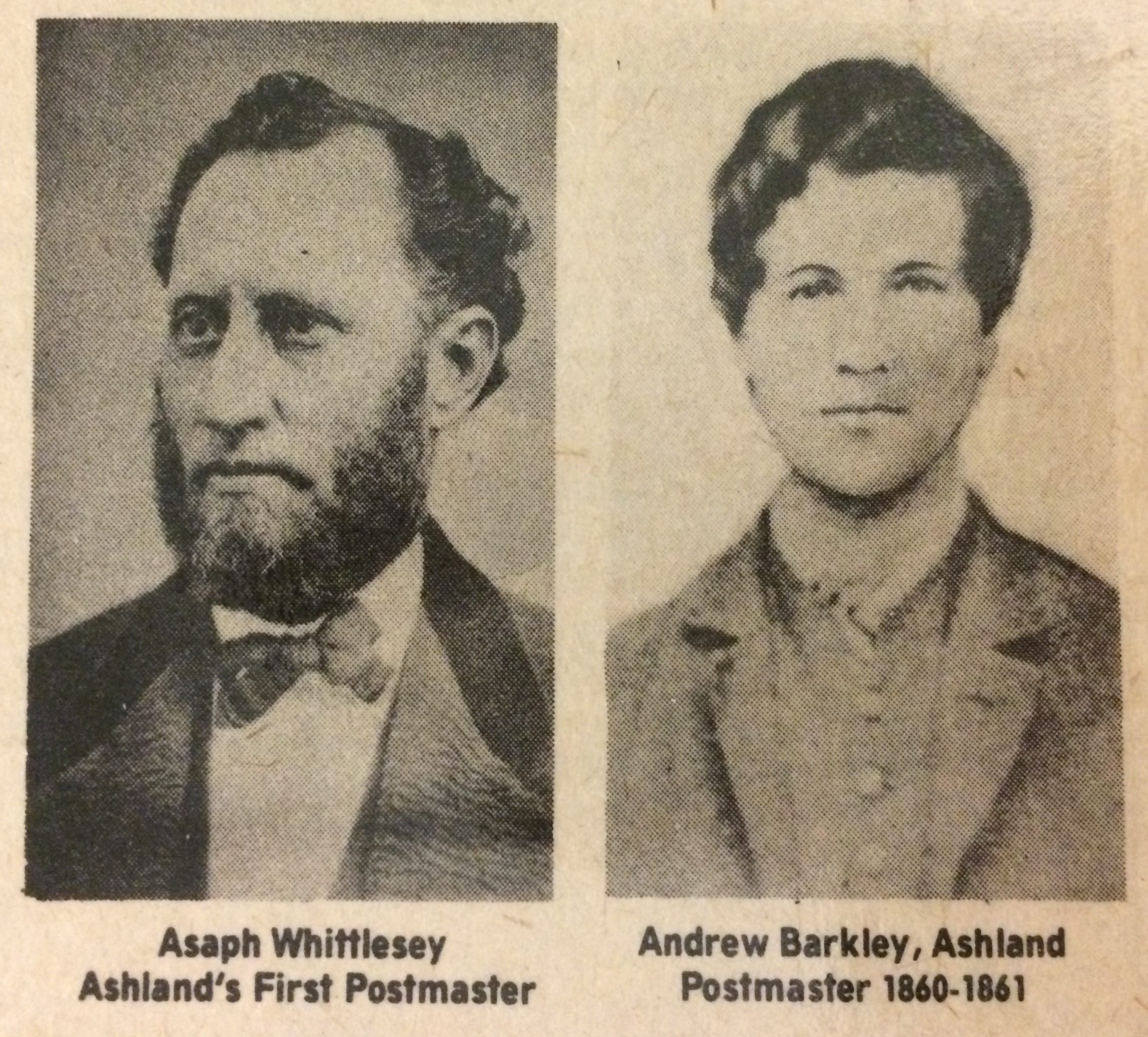
Photographs of Asaph Whittlesey and Andrew J Barkley reproduced from the Ashland Daily Press – national bicentennial issue (July 1976).
The annual statement made in April, 1857, showed the outstanding indebtedness of the town to be $25.00. The report submitted in April, 1858, showed highway orders issued during the year previous $57.50. Town indebtedness in April, 1858, was $22.75, and at that election there was levied the sum of $195.59, to meet the town expenses for the ensuing year. The following were the bills allowed by the town meeting in April, 1857: The first allowed was the bill of Edwin Ellis for $9.25; 2nd, J. T. Welton, $9.00; 3rd, A. J. Barkley, $5.50. In those days no bills were allowed nor orders drawn to cover them until the same had been approved at the town meeting. They had not yet learned to audit accounts with the marvelous rapidity known to Town Boards of more recent dates. However the Town Clerk comprehending this groans out as follows: “The vaults of the Treasuring are declared empty, and the servants of the town will therefore be obliged to wait for their pay until money shall be assessed and collected.”
Again. By referring to the Records of La Pointe, (being two years previous to the organization of the town of Bay Port,) Charles Pulcifer, acting as town treasurer, certifies that “the only unpaid personal property tax was that of J. W. Bell, amounting to $33.00, and that he was unable to find any goods on chattels belonging to the said Bell to enable him to collect the tax.
The assessment for 1857 made by Edwin Ellis for which allowance of $6.00 was made. At the annual town meeting in 1858 the first bill acted upon was that of Asaph Whittlesey, Superintendent of schools, amounting to 75 cents, though it was not allowed as they claimed it was out of their jurisdiction. – Bills of Edwin Ellis and Rev. L. H. Wheeler, for work done on the highway was rejected. It was resolved at this meeting that thereafter one shilling per hour be allowed for work on the highway.
OUR EXPERIENCE IN RAILROAD MATTERS.
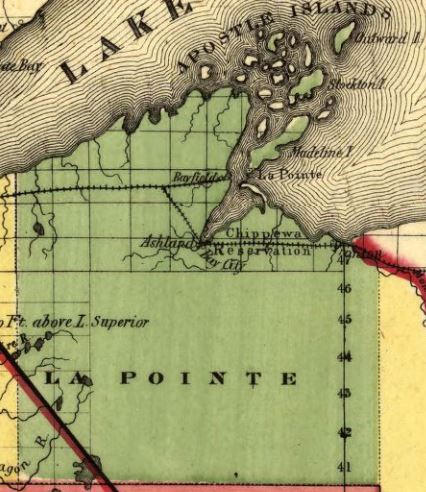
Detail of La Pointe County from a map of Wisconsin published by The Milwaukee & Horicon Rail Road, 1857.
~ Library of Congress
We often fall into the habit of complaining because things move so slow, and especially is this system of fault finding associated with the delays usually experienced in the construction of railroads in the west. However, upon reflecting I find that my time in life embraces the entire history of railroads in the United States, nearly the first roads put into operation, (if not the very first,) were one from Baltimore to Washington and one from Albany to Schenectady, N.Y., over which it was my good fortune to pass before reaching my majority, and about the time I became of age, it was my fortune to ride over not only the first railroad constructed in Illinois, bu the first built in the Mississippi valley, to wit: from Meredosia, on the Illinois River, to Springfield, a distance of forty miles, which, in its day, was regarded something not to be sneezed at, as the roads I have named were at least suggestions of the great systems of roads today. Governor Donenn, of Illinois, in his message of 1835-6, referred in the most glowing language to the triumph of the canal boat and the locomotive in almost annihilating time, burden, and space in other parts of the country and wanted to known if the Patriot bosoms of Illinois did not beat high to emulate such examples of internal improvement.
There were at different times two locomotive run over the Illinois roads mentioned, and finally mule power was resorted to. – The following year an Internal Improvement Bill was passed and roads were laid out for every quarter of the State, the results of which was to bankrupt the State. But the movement was not without its advantages, as by the following spring the forty miles reaching to Springfield was graded and ready for the track to be laid. The track was laid by putting down a piece of square timber called a mud sill on the top of which cross ties were laid. On these a wooden rail was laid and flat bars of iron were spiked on the top of the rail. These bars were tow and one half inches wide and one inch thick, and upon this track turned the wheel of the first locomotive brought into the Mississippi valley.
It might be called a curious contrivance, since the locomotive was simply a piece of clumsiness and of no practical use, the driving wheels being only about two and a half feet in diameter, and the engine itself having very little power. This road finally passed out of the hands of the State for a consideration of $100,000, in State indebtedness, while the actual cost to the State was $1,000,000.
I have dwelt somewhat long and in general terms upon the subject of railroads in the United States, to show to my readers that there has been no want of energy in their construction, but on the contrary the rapidity with which they have penetrated the wilderness is simply marvelous, converting Indian wilds into prosperous cities or fields of golden harvest. My own connection with the building of railroads dates no farther back then the time of my landing here in 1854, since which, I have in my way left no stone unturned looking to the introduction of railroads into this country. I was for a time a director in the St. Croix and Lake Superior Railroad Company, during which (but for the complications of the road,) Gardner Colby would have undertaken its construction instead of turning his attention to the Wisconsin Central Railroad.
To be continued in Number VI…
Wheeler Papers: 1854 La Pointe before the Treaty
August 7, 2017
By Amorin Mello
Selected letters from the
Wheeler Family Papers,
Box 3, Folders 11-12; La Pointe County.
Crow-wing, Min. Ter.
Jan. 9th 1854
Brother Wheeler,

Reverend Leonard Hemenway Wheeler ~ In Unnamed Wisconsin by Silas Chapman, 1895, cover image.
Though not indebted to you just now on the score of correspondence, I will venture to intrude upon you a few lines more. I will begin by saying we are all tolerably well. But we are somewhat uncomfortable in some respects. Our families are more subject to colds this winter than usual. This probably may be attributed in part at least to our cold and open houses. We were unable last fall to do any thing more than fix ourselves temporarily, and the frosts of winter find a great many large holes to creep in at. Some days it is almost impossible for us to keep warm enough to be comfortable.
Our prospects for accomplishing much for the Indians here I do not think look more promising than they did last fall. There are but few Indians here. These get drunk every time they can get whiskey, of which there is an abundance nearby. Among the white people here, none are disposed to attend meetings much except Mr. [Welton?]. He and his wife are discontented and unhappy here, and will probably get away as soon as they can. We hear not a word from the Indian Department. Why they are minding us in this manner I cannot tell. But I should like it much better, if they would tell us at once to be gone. I have got enough of trying to do anything for Indians in connection with the Government. We can put no dependence upon any thing they will do. I have tried the experiment till I am satisfied. I think much more could be done with a boarding school in the neighborhood of Lapointe than here And my opinion is, that since things have turned out as they have here, we had better get out of it as soon as we can. With such an agent as we now have, nothing will prosper here. He is enough to poison everything, and will do more moral evil in such a community, as this, than a half a dozen missionaries can do good. My opinion is, that if they knew at Washington how things are and have been managed here, there would be a change. But I do not feel certain of this. For I sometimes am tempted to adopt the opinion that they do not care much there how things go here. But should there be a change, I have little hope that is would would make things materially better. The moral and social improvement of the Indians, I fear, has little to do with the appointment of agents and superintendents. I do not think I ought to remain here very long and keep my family here, as things are now going. If we were not involved with the Government with regard to the school matter, I would advise the Committee to quit here as soon as we can find a place to go to. My health is not very good. The scenes, and labors and attacks of sickness which I have passed through during the past two years have made almost a wreck of my constitution. It might rally under some circumstances. But I do not think it will while I stay here, so excluded from society, and so harassed with cares and perplexities as I have been and as I am likely to be in future, should we go on and try to get up a school. My wife is in no better spirits than I am. She has had several quite ill turns this winter. the children all wish to get away from here, and I do not know that I shall have power to keep them here, even if I am to stay.
But what to do I do not know. The Committee say they do not wish to abandon the Ojibwas. I cannot in future favor the removal of the lake Indians. I believe that all the aid they will receive from the Government will never civilize or materially benifit them. I judge from the manner in which things have been managed here. Our best hope is to do what we can to aid them where they are to live peaceably with the whites, and to improve and become citizens. The idea of the Government sending infidels and heathens here to civilize and Christianize the Indians is rediculous.
I always thought it doubtful whether the experiment we are trying would succeed. In that case it was my intention to remove somewhere below here, and try to get a living, either by raising my potatoes or by trying to preach to white people, or by uniting both. but I do not hardly feel strong enough to begin entirely anew in the wilderness to make me a home. I suppose my family would be as happy at Lapointe, as they would any where in the new and scattered settlements for fifty or a hundred miles below here. And if thought I could support myself then, I might think of going back there. There are our old friends for whose improvement we have laborred so many years. I feel almost as much attachment for them as for my won children. And I do not think they ought to be left like sheep upon the mountains without a shepherd. And if the Board think it best to expend money and labor for the Ojibwas, they had better expend it there than here, as things now are at least. I think we were exerting much much more influence there before we left, then we have here or are likely to exert. I have no idea that the lake Indians will ever remove to this place, or to this region.

Reverend Sherman Hall
~ Madeline Island Museum
What do you think of recommending to the Board to day to exert a greater influence on the people in the neighborhood of Lapointe[?/!] I feel reluctant to give up the Indians. And if I could get a living at Lapointe, and could get there, I should be almost disposed to go back and live among those few for whom I have labored so long, if things turn out here as I expect they will. I have not much funds to being life with now, nor much strength to dig with. But still I shall have to dig somewhere. The land is easier tilled in this region than that about the lake. But wood is more scarce. My family do not like Minesota. Perhaps they would, if they should get out of the Indian country. Edwin says he will get out of it in the spring, and Miles says he will not stay in such a lonesome place. I shall soon be alone as to help from my children. My boys must take care of themselves as soon as they arrive at a suitable age, and will leave me to take care of myself. We feel very unsettled. Our affairs here must assume a different aspect, or we cannot remain here many months longer. Is there enough to do at Lapointe; or is there a prospect that there will soon be business to draw people enough then, to make it an object to try to establish the institution of the gospel there? Write me and let me know your views on such subjects as these.
[Unsigned, but appears to be from Sherman Hall]
Crow-wing Feb. 10th 1854
Brother Wheeler:
I received your letter of jan. 16th yesterday, and consequently did not sleep as much as usual last night. We were glad to hear that you are all well and prosperous. We too are well which we consider a great blessing, as sickness in present situation would be attended with great inconvenience. Our house is exceedingly cold and has been uncomfortable during some of the severe cold weather have had during the last months. Yet we hope to get through the winter without suffering severely. In many respects our missionary spirit has been put to a severer test than at any previous time since we have been in the Indian country, during the past year. We feel very unsettled, and of course somewhat uneasy. The future does not look very bright. We cannot get a word from the Indian Department whether we may go on or not. If we cannot get some answer from them before long I shall be taking measures to retire. We have very little to hope, I apprehend, from all the aid the Government will render to words the civilization and moral and intellectual improvement of the Indians. For missionaries or Indians to depend on them, is to depend on a broken staff.
~ Minnesota Historical Society
“The American Fur Company therefore built a ‘New Fort’ a few miles farther north, still upon the west shore of the island, and to this place, the present village, the name La Pointe came to be transferred. Half-way between the ‘Old fort’ and the ‘New fort,’ Mr. Hall erected (probably in 1832) ‘a place for worship and teaching,’ which came to be the centre of Protestant missionary work in Chequamegon Bay.”
~ The Story of Chequamegon Bay
I do not see that our house is so divided against itself, that it is in any great danger of falling at present. My wife never did wish to leave Lapointe and we have ever, both of us, thought that the station ought not to be abandoned, unless the Indians were removed. But this seemed not to be the opinion of the committee or of our associates, if I rightly understood them. I had a hard struggle in my mind whether to retire wholly from the service of the Board among the Indians, or to come here and make a further experiment. I felt reluctant to leave them, till we had tried every experiment which held out any promise of success. When I remove my family here our way ahead looked much more clear than it does now. I had completed an arrangement for the school which had the approval of Gov. Ramsey, and which fell through only in consequence of a little informality on his part, and because a new set of officers just then coming into power must show themselves a little wiser than their predecessors. Had not any associates come through last summer, so as to relieve me of some of my burdens and afford some society and counsel in my perplexities I could not have sustained the burden upon me in the state of my health at that time. A change of officers here too made quite an unfavorable change in our prospects. I have nothing to reproach myself with in deciding to come here, nor in coming when we did, though the result of our coming may not be what we hoped it would be. I never anticipated any great pleasure in being connected with a school connected in any way with the Government, nor did I suppose I should be long connected with it, even if it prospered. I have made the effort and now if it all falls, I shall feel that Providence has not a work for us to do here. The prospects of the Indians look dark, what is before me in the future I do not know. My health is not good, though relief from some of the pressure I had to sustain for a time last fall and the cold season has somewhat [?????] me for the time being. But I cannot endure much excitement, and of course our present unsettled affairs operate unfavorably upon it. I need for a time to be where I can enjoy rest from everything exciting, and when I can have more society that I have here, and to be employed moderately in some regular business.

Antoine Gordon [Gaudin]
~ Noble Lives of a Noble Race by the St. Mary’s Industrial School (Bad River Indian Reservation), 1909, page 207.

Charles Henry Oakes
~ Findagrave.com
As to your account I have not had time to examine it, but will write you something about it by & by. As to any account which Antoine Gaudin has against me, I wish you would have him send it to me in detail before you pay it. I agreed with Mr. Nettleton to settle with him, and paid him the balance due to Antoine as I had the account. I suppose he made the settlement, when he was last at Lapointe. As to the property at Lapointe, I shall immediately write to Mr. Oakes about it. But I suppose in the present state of affairs, it will be perhaps, a long time before it will be settled so as to know who does own it. It is impossible for me to control it, but you had better keep posession of it at present. I cannot send Edwin [??] through to cultivate the land & take care of it. He will be of age in the spring, and if he were to go there I must hire him. He will probably leave us in the spring. Please give my best regards to all. Write me often.
Yours truly
S. Hall
Crow-wing, Min. Ter.
Feb. 21st 1854
Brother Wheeler,
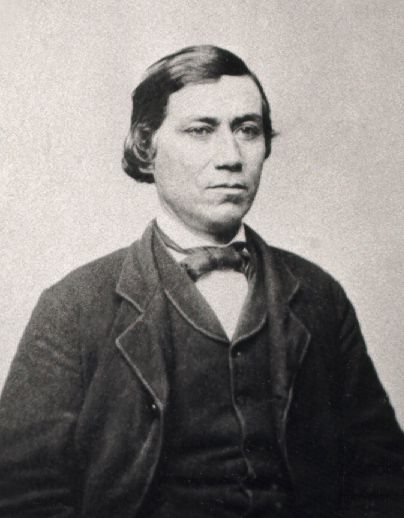
Paul Hudon Beaulieu
~ FamilySearch.org
I wrote you a few days ago, and at the same time I wrote to Mr. Oakes inquiring whether he had got possession of the Lapointe property. I have not yet got a reply from him, but Mr. Beaulieu tells me that he heard the same report which you mentioned in your letter, and that he inquired of Mr. Oakes about it when he saw him on a recent visit to St. Paul, and finds that it is all a humbug. Oakes has nothing to do with it. Mr. Beaulieu said that the sale of last spring has been confirmed, and that Austrian will hold Lapointe. So farewell to all the inhabitants’ claims then, and to anything being done for the prosperity of the peace for the present, unless it gets out of his hands.
I have written to Austrian to try to get something for our property if we can. But I fear there is not much hope. If he goes back to Lapointe in the spring, do the best you can to make him give us something. I feel sorry for the inhabitants there that they are left at his mercy. He may treat them fairly, but it is hardly to be expected.

Clement Hudon Beaulieu
~ TreatiesMatter.org
As to our affairs here, there has been no particular change in their aspects since I wrote a few days ago. There must be a crisis, I think, in a few weeks. We must either go on or break up, I think, in the spring. We are trying to get a decision. I understand our agent has been threatened with removal if he carries on as he has done. I believe there is no hope of reformation in his case, and we may get rid of him. Perhaps God sent us here to have some influence in some such matters, so intimately connected with the welfare of the Indians. I have never thought I [????] can before I was sent in deciding to come here. Some trials and disappointments have grown out of my coming, but I feel conscious of having acted in accordance with my convictions of duty at this time.
If all falls through, I know not what to do in the future. The Home Missionary Society have got more on their hands now than they have funds to pay, if I were disposed to offer myself to labor under them. I may be obliged to build me a shanty somewhere on some little unoccupied piece of land and try to dig out a living. In these matters the Lord will direct by his providence.
You must be on your guard or some body will trip you up and get away your place. There are enough unprincipled fellows who would take all your improvements and send you and all the Indians into the Lake if they could make a dollar by it. I should not enlarge much, without getting a legal claim to the land. Neither would I advise you to carry on more family than is necessary to keep what team you must have, and to supply your family with milk and vegetables. It will be advantage/disadvantage to you in a pecuniary point of view, it will load you with and tend to make you worldly minded, and give your establishment the air of secularity in the eyes of the world. If I were to go back again to my old field, I would make my establishment as small as I could & have enough to live comfortable. I with others have thought that your tendency was rather towards going to largely into farming. I do not say these things because I wish to dictate or meddle with your affairs. Comparing views sometimes leads to new investigations in regard to duty.
May the Lord bless you and yours, and give you success and abundant prosperity in your labours of love and efforts to Save the Souls around you.
Give my best regards to Mrs. W., the children, Miss S and all.
Yours truly,
S. Hall
I forgot to say that we are all well. Henry and his family have enjoyed better health here, then they used to enjoy at Lapointe.
Feb 27
Brother Wheeler.
My delay to answer your note may require an explanation. I have not had time at command to attend to it conveniently at an earlier period. As to your first questions. I suppose there will be no difference of opinion between us as to the correctness of the following remarks.
- The Gospel requires the members of a church to exercise a spirit of love, meekness and forbearance towards an offending brother. They are not to use unnecessary severity in calling him to account for his errors. Ga. 6:1.
- The Object of Church discipline is, not only to [pursue/preserve?] the Church pure in doctrine & morals, that the contrary part may have no evil thing to say of them; but also to bring the offender to a right State of mind, with regard this offense, and gain him back to duty and fidelity.
- If prejudice exist in the mind of the offender towards his brethren for any reason, the spirit of the gospel requires that he be so approached if possible as to allay that prejudice, otherwise we can hardly expect to gain a candid hearing with him.
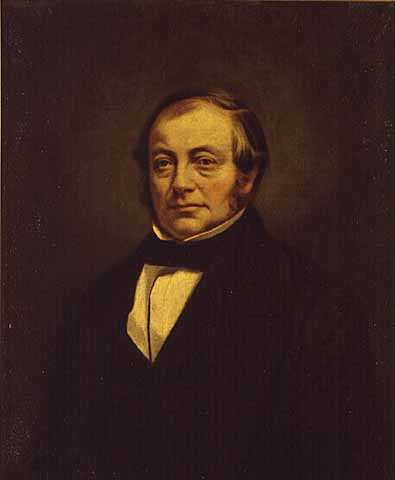
Charles William Wulff Borup, M.D. ~ Minnesota Historical Society
I consider that these remarks have some bearing on the case before us. If it was our object to gain over Dr. B. to our views of the Sabbath, and bring him to a right State of mind with regard this Sabbath breaking, the manner of approaching him would have, in my view, much to do with the offence. He may be approached in a Kind and [forbearing?] manner, when one of sternness and dictation will only repel him from you. I think we ought, if possible, and do our duty, avoid a personal quarrel with him. To have brought the subject before the Church & made a public affair of it, before [this/then?] and more private means have been tried to get satisfaction, would, I am sure, have resulted in this. I found from my own interviews with him, that there was hope, if the rest of the brethren would pursue a similar course. I felt pretty sure they would obtain satisfaction. IF they had [commenced?] by a public prosecution before the church, it would only have made trouble without doing any good. The peace of our whole community would have been disturbed. I thought one step was gained when I conversed with him, and another when you met him on the subject. I knew also that prejudices existed both in his mind towards us, & in our minds towards him which were likely to affect the settlement of this affair, and which as I thought, would be much allayed by individuals going to him and speaking face to face on this subject in private. He evidently expected they would do so. Mutual conversations and explanations allay these feelings very much. At least it has been so in my experience.

Reverend Edmund Franklin Ely.
~ Duluth Public Library
As to your second question. I do not say that it was Mr. Ely’s duty to open the subject to Doc. Borup at the preparatory lecture. If he had done so, it would have been only a private interview; for there [was?] not enough present to transact business. All I meant to affirm respecting that occasion is, that it afforded a good opportunity to do so, if he wishes, and that Dr. B. expected he would have done so, as I afterwards learnt, if he has any objection to make against his coming to the communion.
As to your third question. I have no complaint to make of the church, that I have urged them to the performance of any “duties“ in this case they have refused to perform.
And now permit me to ask in my turn.
What “duties” have they urged me to perform in this case, which I “have been unwilling, or manifested a reluctance to perform?”
Did you intend by anything which wrote to me or said verbally, to request me to commence a public prosecution of Doc. Borup before the Church?
Will you have the goodness to state in writing, the substance of what you said to me in your study as to your opinion and that of others suspecting my delinquency in maintaining church discipline.
A reply to these questions would be gratefully received.
Your brother in Christ
S. Hall
Crow Wing. March 12th 1854
Brother Wheeler:
Your letter of Feb 17th came to hand by our last mail; and though I wrote you but a short time ago, I will say a few words in relation to one or two topics to which you allude. Shortly after I received your former letter I wrote to Mr. Oakes enquiring about the property at Lapointe. In reply, says that himself and some others purchased Mr. Austrian’s rights at Lapointe of Old Hughes on the strength of a power of attorney which he held. Austrian asserts the power of attorney to be fraudulent, and that they cannot hold the property. Oakes writes as if he did not expect to hold it. Some time ago I wrote to Mr. Austrian on the same subject, and said to him that if I could get our old place back, I might go back to Lapointe. He says in reply —

Julius Austrian
~ Madeline Island Museum
“I should feel much gratified to see you back at Lapointe again, and can hold out to you the same inducements and assurances as I have done to all other inhabitants, that is, I shall be at Lapointe early in the spring and will have my land surveyed and laid out into lots, and then I shall be ready to give to every one a deed for the lot he inhabits, at a reasonable price, not paying me a great deal more than cost trouble, and time. But with you, my dear Sir, will be no trouble, as I have always known you a just and upright man, and have provided ways to be kind towards us, therefore take my assurance that I will congratulate myself to see you back again; and it shall not be my fault if you do not come. If you come to Lapointe, at our personal interview, we will arrange the matter no doubt satisfactory.”
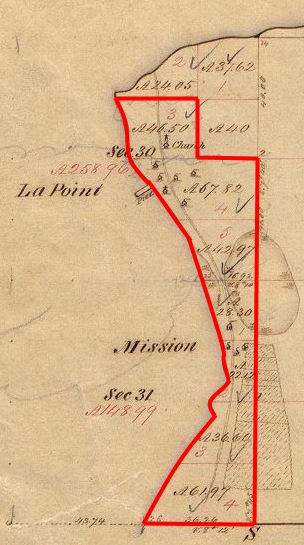
“The property” from the James Hughes Affair is outlined in red. This encompassed the Church at La Pointe (New Fort) and the Mission (Middleport) of Madeline Island. 1852 PLSS survey map by General Land Office.
I suppose Austrian will hold the property and probably we shall never realize anything for our improvements. You must do the best you can. Make your appeal to his honor, if he has any. It will avail nothing to reproach him with his dishonesty. I do not know what more I can do to save anything, or for any others whose property is in like circumstances with ours.
You speak discouragingly of my going back to Lapointe. I do not think the Home Miss. Soc. would send a missionary there only for the few he could reach in the English language. If the people want a Methodist, encourage them to get one. It is painful to me to see the place abandoned to irreligion and vices of every Kind, and the labours I have expended there thrown away. I can hardly feel that it was right to give up the station when we did. If I thought I could support myself there by working one half the time and devoting the rest to ministerial labors for the good of those I still love there, I should still be willing to go back, if could get there & had a shelter for my head, unless there is a prospect of being more useful here. But the land at Lapointe is so hard to subdue that I am discouraged about making an attempt to get a living there by farming. I am not much of a fisherman. There is some prospect that we may be allowed to go on here. Mr. Treat has been to Washington, and says he expects soon to get a decision from the Department. We have got our school farm plowed, and the materials are drawn out of the woods for fencing it. If I have no orders to the contrary, I intend to go on & plant a part of it, enough to raise some potatoes. We may yet get our school established. If we can go ahead, I shall remain here, but if not, I think it is not my duty to remain here another year, as I have the past. In other circumstances, I could do more towards supporting myself and do more good probably.
I have felt much concerned for the people of Lapointe and Bad River on account of the small pox. May the Lord stay this calamity from spreading among you. Write us every mail and tell us all. It is now posted here today that the Old Chief [Kibishkinzhugon?] is dead. I hardly credit the report, though I should suppose he might be one of the first victims of the disease.
I can write no more now. We are all very well now. Give my love to all your family and all others.
Tell Robert how the matters stands about the land. It stands him in how to be on good terms with the Jew just now.
Yours truly,
S. Hall
The snow is nearly all off the ground and the weather for two or three weeks has been as mild as April.
Crow Wing M.H. Apr. 1 1854
Dear Br. & Sr. Wheeler.
I have received a letter from you since I wrote to you & am therfore in your debt in that matter. I have also read your letters to Br. & Sr. Welton I suppose you have received my letter of the 13th of Feb. if so, you have some idea of our situation & I need say no more of that now; & will only say that we are all well as usual & have been during the winter. Mrs. P_ is considerably troubled with her old spinal difficulty. She has got over her labors here last summer * fall. Harriet is not well I fear never will be, because the necessary means are not likely to be used, she has more or less pain in her back & side all the time, but she works on as usual & appears just as she did at LaPointe, if she could be freed from work so as to do no more than she could without injury & pursue uninterruptedly & proper medical course I think she might regain pretty good health. (Do not, any of you, send back these remarks it would not be pleasing to her or the family.) We have said what we think it best to say) –
Br. Hall is pretty well but by no means the vigorous man he once was. He has a slight – hacking cough which I suppose neither he nor his family have hardly noticed, but Mrs. P_ says she does not like the sound of it. His side troubles him some especially when he is a good deal confined at writing. Mr. & Mrs. W_ are in usual health. Henry’s family have gone to the bush. They are all quite well. He stays here to assist br. H_ in the revision & keeps one or two of his children with him. They are now in Hebrews, with the Revision. Henry I suppose still intends to return to Lapointe in the spring. –
Now, you ask, in br. Welton’s letter, “are you all going to break up there in the spring.” Not that I know of. It would seem to me like running away rather prematurely. When the question is settled, that we can do nothing here, then I am willing to leave, & it may be so decided, but it is not yet. We have not had a whisper from Govt. yet. Wherefore I cannot say.
It looks now as if we must stay this season if no longer. Dr. Borup writes to br. Hall to keep up good courage, that all will come out right by & by, that he is getting into favor with Gov. Gorman & will do all he can to help us. (Br. Hall’s custom is worth something you know).

Henry C. Gilbert
~ Branch County Photographs
By advise of the Agent, we got out (last month) tamarack rails enough to fence the school farm (which was broke last summer) of some 80 acres & it will be put up immediately. Our great father turned out the money to pay for the job. These things look some like our staying awhile I tell br H_ I think we had better go as far as we can, without incurring expense to the Board (except for our support) & thus show our readiness to do what we can. if we should quit here I do not know what will be done with us. Br Hall would expect to have the service of the Board I suppose. Should they wish us to return to Bad River we should not say nay. We were much pleased with what we have heard of your last fall’s payment & I am as much gratified with the report of Mr. H. C. Gilbert which I have read in the Annual Report of the Com. of Indian Affairs. He recommends that the Lake Superior Indians be included in his Agency, that they be allowed to remain where they are & their farmers, blacksmith & carpenter be restored to them. If they come under his influence you may expect to be aided in your efforts, not thwarted , by his influence. I rejoice with you in your brightening prospects, in your increased school (day & Sabbath) & the increased inclination to industry in those around you. May the lord add his blessing, not only upon the Indians but upon your own souls & your children, then will your prosperity be permanent & real. Do not despise the day of small things, nor overlook especially neglect your own children in any respect. Suffer them not to form idle habits, teach them to be self reliant, to help themselves & especially you, they can as well do it as not & better too, according to their ability & strength, not beyond it, to fear God & keep his commandments & to be kind to one another (Pardon me these words, I every day see the necessity of what I have said.) We sympathize with you in your situation being alone as you are, but remember you have one friend always near who waits to [commence?] with you, tell Him & all with you from Abby clear down to Freddy.
Affectionately yours
C. Pulsifer
Write when you can.
Crow wing Min. Ter.
April 3d 1854
Brother Wheeler

George E. Nettleton and his brother William Nettleton were pioneers, merchants, and land speculators at what is now Duluth and Superior.
~ Image from The Eye of the North-west: First Annual Report of the Statition of Superior, Wisconsin by Frank Abial Flower, 1890, page 75.
Since I wrote you a few days ago, I have received a letter from Mr. G. E. Nettleton, in which he says, that when he was at Lapointe in December last, he was very much hurried and did not make a full settlement with Antoine. He says further, that he showed him my account, and told him I had settled with him, and that he would see the matter right with Antoine. A. replied that all was right. I presume therefore all will be made satisfactory when Mr. N. comes up in the Spring, and that you will have need to make yourself no further trouble about this matter.
I have also received a short note from Mr. Treat in which he says,
“I have not replied to your letters, because I have been daily expecting something decisive from Washington. When I was there, I had the promise of immediate action; but I have not heard a word from them”.
“I go to Washington this Feb, once more. I shall endeavor to close up the whole business before I return. I intend to wait till I get a decision. I shall propose to the Department to give up the school, if they will indemnify us. If I can get only a part of what we lose, I shall probably quit the concern”.
Thus our business with the Government stood on March the 9th, I have lost all confidence in the Indian Department of our Government under this administration, to say nothing of the rest of it. If the way they have treated us is an index to their general management, I do not think they stand very high for moral honesty. The prospects for the Indians throughout all our territories look dark in the extreme. The measures of the Government in relation to them are not such as will benefit and save many of them. They are opening the floodgates of vice and destruction upon them in every quarter. The most solemn guarantees that they shall be let alone in the possession of domains expressly granted them mean nothing.
Our prospects here look dark. For some time past I have been rather anticipating that we should soon get loose and be able to go on. But all is thrown into the dark again. What I am to do in future to support my family, I do not know. If we are ordered to quit here and turn over the property, it would turn [illegible] out of doors.
Mr. Austrian expects us back to Lapointe in the Spring & Mr. Nettleton proposes to us to go to Fond du Lac, (at the Entry). He says there will be a large settlement then next season. A company is chartered to build a railroad through from the Southern boundary of this territory to that place. It is probable that Company [illegible] will make a grant of land for that purpose. If so, it will probably be done in a few years. That will open the lake region effectually. I feel the need of relaxation and rest before I do anything to get established anywhere.
We are still working away at the Testament, it is hard work, and we make lately but slow progress. There is a prospect that the Bible Society will publish it but it is not fully decided. I wish I could be so situated that I could finish the grammar.
But I suppose I am repeating what I have said more than once before. We are generally in good health and spirits. We hope to hear from by next mail.
Yours truly
S. Hall
What do you think about the settlements above Lapointe and above the head of the Lake?
Detroit July 10th 1854
Rev. Dr. Bro.
At your request and in fulfilment of my promise made at LaPointe last fall so after so long a time I write: And besides “to do good & to communicate” as saith the Apostle “forget not, for with such sacrifices God is well pleased.”
We did not close up our Indian payments of last year until the middle of the following January, the labors, exposures and excitements of which proved too much for me and I went home to New York sick & nearly used up about the last of February & continued so for two months. I returned here about a week ago & am now preparing for the fall pay’ts.
The Com’sr. has sent in the usual amounts of Goods for the LaPointe Indians to Mr. Gilbert & I presume means to require him to make the payment at La P. that he did last fall, although we have received nothing from the Dep’t. on the subject.

“George Washington Manypenny (1808-1892) was the Director of the Bureau of Indian Affairs of the United States from 1853 to 1857.”
~ Wikipedia.org
In regard to the Treaty with the Chipp’s of La Sup’r & the Miss’i, the subject is still before Congress and if one is made this fall it has been more than intimated that Com’r Manypenny will make it himself, either at LaP’ or at F. Dodge or perhaps at some place farther west. Of course I do not speak from authority or any of the points mentioned above, for all is rumour & inference beyond the mere arrival here of the Goods to Mr G’s care.
From various sources I learn that you have passed a severe winter and that much sickness has been among the Indians and that many of them have been taken away by the Small Pox.
This is sad and painful intelligence enough and I can but pray God to bless & overrule all to the goods of his creasures and especially to the Missionaries & their families.
Notwithstanding I have not written before be assured that I have often [???] of and prayed for you and yours and while in [Penn.?] you made your case my own so far as to represent it to several of our Christian brethren and the friends of missions there and who being actuated by the benevolent principles of the Gospel, have sent you some substanted relief and they promise to do more.
The Elements of the political world both here and over the waters seem to be in fearful & [?????] commotion and what will come of it all none but the high & holy one can know. The anti Slavery Excitement with us at the North and the Slavery excitement at the South is augmenting fact and we I doubt not will soon be called upon to choose between Slavery & freedom.
If I do not greatly misjudge the blessed cause of our holy religion is or seems to be on the wane. I trust I am mistaken, but the Spirit of averice, pride, sensuality & which every where prevails makes me think otherwise. The blessed Christ will reign [recenth-den?] and his kingdom will yet over all prevail; and so may it be.
Let us present to him daily the homage of a devout & grateful heart for his tender mercies [tousward?] and see to it that by his grace we endure unto the end that we may be saved.
My best regards to Mrs. W. to Miss Spooner to each of the dear children and to all the friends & natives to each of whom I desire to be remembered as opportunity occurs.
The good Lord willing I may see you again this fall. If I do not, nor never see you again in this world, I trust I shall see and meet you in that world of pure delight where saints immortal reign.
May God bless you & yours always & ever
I am your brother
In faith Hope & Charity
Rich. M. Smith
Rev Leonard H. Wheeler
LaPointe
Lake Superior
Miss. House Boston
Augt’ 31, 1854
Rev. L. H. Wheeler,
Lake Superior
Dear Brother
Yours of July 31 I laid before the Com’sr at our last meeting. They have formally authorized the transfer of Mr & Mrs Pulsifer to the Lake, & also that of Henry Blatchford.

Robert Stuart was formerly an American Fur Company agent and Acting Superintendent on Mackinac Island during the first Treaty at La Pointe in 1842.
~ Wikipedia.org
In regard to the “claims” their feeling is that if the Govt’ will give land to your station, they have nothing to say as to the quantity. But if they are to pay the usual govt’ price, the question requires a little caution. We are clear that we may authorize you to enter & [???] take up so much land as shall be necessary for the convenience of the [mission?] families; but we do not see how we can buy land for the Indians. Will you have the [fondness?] to [????] [????] on these points. How much land do you propose to take up in all? How much is necessary for the convenience of the mission families?
Perhaps you & others propose to take up the lands with private funds. With that we have nothing to do, so long as you, Mr P. & H. do not become land speculators; of which, I presume, there is no danger.
As to the La Pointe property, Mr Stuart wrote you some since, as you know already I doubt not, and replied adversely to making any bargain with Austrian. I took up the opinion of the Com’sr after receiving your letter of July 31, & they think it the wise course. I hope Mr Stewart will get this matter in some shape in due time.
I will write to him in reference to the Bad River land, asking him to see it once if the gov’ will do any thing.
Affectionate regards to Mrs W. & Miss Spooner & all.
Fraternally Yours
S. B. Treat
P.S. Your report of July 31 came safely to hand, as you will & have seen from the Herald.
By Leo Filipczak
Joseph Oesterreicher was only eighteen years old when he arrived at La Pointe in 1851. Less than a year earlier, he had left his native Germany for Mackinac, where he’d come to work for the firm of his older brother Julius and their in-laws, the Leopolds, another Bavarian Jewish family trading on Lake Superior.
In America, the Oesterreichers became the Austrians, but in his time at Mackinac, Joseph Austrian picked up very little English and even less of the Ojibwe and Metis-French that predominated at La Pointe. So, when Joseph made the move to his brother’s store at Madeline Island, it probably felt like he was immigrating all over again.
In the spring of 1851, he would have found at La Pointe, a society in flux. American settlement intensified as the fur trade economy made its last gasps. The island’s mix-blooded voyageurs found it harder and harder to make a living, and the Fur Company, and smaller traders like Julius Austrian, began to focus more on getting Ojibwe money from treaty annuity payments than they did from the actual trade in fur. This competition for Indian money had led to the deaths of hundreds of Ojibwe people in the Sandy Lake tragedy just a few months earlier.
The uncertainty surrounding Ojibwe removal would continue to hang heavily over the Island for both of Joseph’s years at La Pointe, as the Ojibwe leadership scrambled to process the horror of Sandy Lake and tried to secure a permanent homeland on the lakeshore.
The Austrians, however, found this an opportune time to be at the forefront of all the new business ventures in the Lake Superior country. They made money in merchandise, real estate, shipping, mining, lumber, government contracts, and every other way they could. This was not without controversy, and the name of Julius Austrian is frequently attached to documents showing the web of corruption and exploitation of Native people that characterized this era.
It’s difficult to say whether Joseph realized in 1851, while sweeping out his brother’s store or earning his unfortunate nickname, but he would become a very wealthy man. He lived into the 20th century and left a long and colorful memoir. I plan to transcribe and post all the stories from pages 26-66, which consists of Joseph’s time at La Pointe. Here is the first fourth [our original] installment:
Memoirs of Doodooshaboo
… continued from Mackinac 1850-1851.
Left for La Point: My First Trip on Lake Superior
1851
Julius Austrian
~ Madeline Island Museum
Mr. Julius Austrian was stationed at La Pointe, Madaline Island, one of the Apostle Group in Lake Superior, where he conducted an Indian Trading post, buying large quantities of fur and trading in fish on the premises previously occupied by the American Fur Co. whose stores, boats etc. the firm bought.
Julius Austrian, one of the partners had had charge of the store at La Point for five years past, he was at this time expected at Mackinaw and it had been arranged that I should accompany him back to La Pointe when he returned there, on the first boat of the season leaving the Sault Ste. Marie. I was to work in the store and to assist generally in all I was capable of at the wages of $10 a month. I gladly accepted the proposition being anxious for steady employment. Shortly after, brother Julius, his wife (a sister of H. Leopold) and I started on the side wheel steamer Columbia for Sault Ste. Marie, generally called “The Soo,” and waited there five days until the Napoleon, a small propellor on which we intended going to La Point, was ready to sail. During this time she was loading her cargo which had all to be transported from the Soo River to a point above the rapids across the Portage (a strip of land about ¾ of a mile connecting the two points) on a train road operated with horses. At this time there were only two propellers and three schooners on the entire Lake Superior, and those were hauled out below the rapids and moved up and over the portage and launched in Lake Superior. Another propeller Monticello, which was about half way across the Portage, was soon to be added to the Lake Superior fleet, which consisted of Independence & Napoleon and the Schooners Algonquin, Swallow, and Sloop Agate owned by my brother Julius. Quite different from the present day, where a very large number of steel ships on the chain of Lakes, some as much as 8000 tons capacity, navigate through the canal to Lake Superior from the lower lakes engaged in transporting copper, iron ore, pig iron, grain & flour from the various ports of Marquette, Houghton, Hancock, Duluth, and others. It was found necessary in later years to enlarge the locks of the canal to accomodate the larger sized vessels that had been constructed.
Building Sault Ste. Marie Canal. 1851.

Map of proposed Soo canal and locks 1852 (From The Honorable Peter White by Ralph D. Williams, 1910 pg. 121)
The ship canal at that time had not been constructed, but the digging of it had just been started. The construction of this canal employed hundreds of laborers, and it took years to complete this great piece of work, which had to be cut mostly through the solid rock. The State of Michigan appropriated thousands of sections of land for the purpose of building this canal, for the construction of which a company was incorporated under the name of Sault Ste. Marie Ship Canal & Land Co., who received the land in payment for building this canal, and which appropriation entitled the Co. to located in any unsold government land in the State of Michigan. The company availed itself of this privilege and selected large tracts of the best mineral and timber land in Houghton, Ontonagan & Kewanaw Counties, locating some of the land in the copper district, some of which proved afterwards of immense value, and on which were opened up some of the richest copper mines in the world, namely: Calumet, Hecla, and Quincy mines, and others. There were also very valuable timber lands covered by this grant.
The canal improved and enlarged as it now stands, is one of the greatest and most important artificial waterways in the world. A greater tonnage is transported through it annually that through the Suez or any other canal. In later years the canal was turned over by the State of Mich. to the General Government, which made it free of toll to all vessels and cargoes passing through it, even giving Canadian vessels the same privilege; whereas when operated by the State of Mich. toll was exacted from all vessels and cargoes using it.
The Napoleon, sailed by Capt. Ryder, had originally been a schooner, it had been turned into a propeller by putting in a small propeller engine. She had the great (?) speed of 8 miles an hour in calm weather, and had the reputation of beating any boat of the Lake in rolling in rough weather, and some even said she had rolled completely over turning right side up finally.

To return to my trip, after passing White Fish Point, the following day and getting into the open lake, we encountered a strong north wind raising considerable sea, causing our boat to toss and pitch, giving us our first experience of sea sickness on the trip. Beside the ordinary crew, we had aboard 25 horses for Ontonogan where we arrived the third day out. The Captain finding the depth of water was not sufficient to allow the boat to go inside the Ontonogan river and there being no dock outside, he attempted to land the horses by throwing them overboard, expecting them to swim ashore, to begin with, he had three thrown overboard and had himself with a few of his men lowered in the yawl boat to follow, he caught the halter of the foremost horse intending to guide him and the others ashore. The lake was exceedingly rough, and the poor horses became panic stricken and when near the shore turned back swimming toward the boat with hard work. The Captain finally succeeded in land those that had been thrown overboard, but finding it both hazardous to the horses and the men he concluded to give up the attempt to land the other horses in this way, and ordered the life boat hoisted up aboard. She had to be hoisted up the stern, in doing so a heavy wave struck and knocked it against the stern of the boat before she was clear of the water with such force as to endanger the lives of the Capt. and men in it, and some of the passengers were called on to assist in helping to hoist the life boat owing to its perilous position. Captain and the men were drenched to the skin, when they reached the deck. Capt. vented his rage in swearing at the hard luck and was so enraged that he did not change his wet clothing for some time afterward. The remaining horses were kept aboard to be delivered on the return trip, and the boat started for her point of destination La Point.
Arrived at La Point and Started in Employ of Brother Julius. 1851
Next morning we sighted land, which proved to be the outer island of the Apostle Group. Captain flew into the wheel room and found the wheelsman fast asleep. He grasped the wheel and steered the boat clear of the rocks, just in time to prevent the boat from striking. Captain lost no time in changing wheelsman. We arrived without further incidents at La Point the same afternoon. When she unloaded her cargo, work was at once begun transferring goods to the store, in which I assisted and thus began my regular business career. These goods were hauled to the store from the dock in a car, drawn by a horse, on wooden rails.
There were only about 6 white American inhabitants on the Island, about 50 Canadian Frenchmen who were married to squaws, and a number of full blooded Indians, among whom was chief Buffalo who was a descendant of chiefs & who was a good Indian and favorably regarded by the people.

Fr. Otto Skolla (self-portrait contained in History of the diocese of Sault Ste, Marie and Marquette (1906) by Antoine Ivan Rezek; pg.360; Digitized by Google Books)
The most conspicuous building in the place was an old Catholic Church which had been created more than 50 years before by some Austrian missionaries. This church contained some very fine and valuable paintings by old masters. The priest in charge there was Father Skolla, an Austrian, who himself was quite an artist, and spent his leisure hours in painting Holy pictures. The contributions to the church amounted to a mere pittance, and his consequent poverty allowed him the most meager and scant living. One Christmas he could not secure any candles to light up his church which made him feel very sad, my sister-in-law heard of this and sent me with a box of candles to him, which made him the happiest of mortals. When I handed them to him, his words were inadequate to express his gratitude and praise for my brother’s wife.
There was also a Methodist church of which a man by the name of Hall was the preacher. He had several sons and his family and my brother Julius and his wife were on friendly terms and often met.
The principle man of the place was Squire Bell, a very genial gentleman who held most of the offices of the town & county, such as Justice of the Peace & Supervisor. He also was married to a squaw. This was the fashion of that time, there being no other women there.

 John W. Bell, “King of the Apostle Islands” as described by Benjamin Armstrong (Digitized by Google Books) .
There was a school in the place for the Indians and half breeds, there being no white children there at this time. I took lessons privately of the teacher of this school, his name was Pulsevor. I was anxious to perfect myself in English. I also picked up quite a bit of the Chippewa language and in very short time was able to understand enough to enable me to trade with the Indians.
My brother Julius was a very kind hearted man, of a very sympathetic and indulgent nature, and to his own detriment and loss he often trusted needy and hungry Indians for provisions and goods depending on their promise to return the following year with fur in payment for the goods. He was personally much liked and popular with the Indians, but his business with them was not a success as the fur often failed to materialize. The first morning after my arrival, my brother Julius handed me a milk pail and told me to go to the squaws next door, who having a cow, supplied the family with the article. He told me to ask for “Toto-Shapo” meaning in the Indian language, milk.
I repeated this to myself over and over again, and when I asked the squaw for “Toto Shapo” she and all the squaws screamed with delight and excitement to think that I had just arrived and could make myself understood in the Indian tongue. This fact was spread among the Indians generally and from that day on while I remained on the Island I was called “Toto Shapo.” One of the Indian characteristics is to name people and things by their first impression–for instance on seeing the first priest who work a black gown, they called him “Makada-Conyeh,” which means a black gown, and that is the only name retained in their language for priests. The first soldier who had a sword hanging by his side they called “Kitchie Mogaman” meaning “a big knife” in their language. The first steamboat they saw struck them as a house with fire escaping through the chimney, consequently they called it “Ushkutua wigwam” (Firehouse) which is also the only name in their language for steamboat. Whiskey they call “Ushkutua wawa” meaning “Fire Water.”
My brother Julius had the United States mail contract between La Point & St. Croix. The mail bag had to be taken by a man afoot between these two places via Bayfield a distance of about 125 miles, 2 miles of these being across the frozen lake from the Island to Bayfield.
Dangerous Crossing on the Ice.
An Indian named Kitchie (big) Inini (man) was hired to carry it. Once on the way on he started to cross on the ice but found it very unsafe and turned back. When my brother heard this, he made up his mind to see that the mail started on its way across the Lake no matter what the consequence. He took a rope about 25 ft. long tying one end around his body and the other about mine, and he and I each took a long light pole carrying it with two hands crosswise, which was to hold us up with in case we broke through the ice. Taking the mail bag on a small tobogan sled drawn by a dog, we started out with the Indian. When we had gone but a short way the ice was so bad that the Indian now thoroughly frightened turned back again, but my brother called me telling me not to pay any attention to him and we went straight on. This put him to shame and he finally followed us. We reached the other side in safety, but had found the crossing so dangerous, that we hesitated to return over it and thought best to wait until we could return by a small boat, but the time for this was so uncertain that after all we concluded to risk going back on the ice taking a shorter cut for the Island, and we were lucky to get back all right.
In the summer when the mail carrier returned from these trips, he would build a fire on the shore of the bay about 5 miles distant, as a signal to send a boat to bring him across to the Island. Once I remember my brother Julius not being at home when a signal was given. I with two young Indian boys (about 12 yrs. of age) started to cross over with the boat, when about two miles out a terrific thunder and hail storm sprang up suddenly. The hail stones were so large that it caused the boys to relax their hold on the oars and it was all I could do to keep them at the oars. I attempted to steer the boat back to the Island, and barely managed to reach there. The boat was over half full of water when we reached the shore. When I landed we were met by the boys’ mothers who were greatly incensed at my taking their boys on this perilous trip, nearly resulting in drowning them. They didn’t consider I had no idea of this terrible thunder storm which so suddenly came up and had I known it for my own safety would not dreamed of attempting the trip.
Nearly Capsize in a Small Boat.
Once I went out in a small sail boat with two Frenchmen to collect some barrels of fish near the Island at the fishing ground near La Point. We got two barrels of fish which they stood up on end, when a sudden gust of wind caused the boat to list to one side so that the barrels fell over on the side and nearly capsized the boat. By pulling the barrels up the boat was finally righted after being pretty well filled with water. I could not swim, and as a matter of self-preservation grabbed the Frenchman nearest me. He was furious, expressing his anger half in French and half in English, saying, “If I had drowned, I would have taken him with me.” which no doubt was true.
A Young Indian Locked up for Robbery
One day brother Julius went to the Indian payment. During his absence I with another employee, Henry Schmitz, were left in charge. A young Indian that night burglarized the store stealing some gold coins from the cash drawer. The same were offered to someone in the town next day who told me, which led to his detection. He admitted theft and was committed to jail by the Indian agent Mr. Watrous, which the Indians consider a great disgrace.
Some inquisitive boys peering through the window discovered that the young Indian had attempted to commit suicide and spread the alarm. His father was away at the time and his mother and friends were frenzied and their threats of vengeance were loud. The jailer was found but he had lost the key to the jail (the jail was in a log hut) the door of which was finally forced open with an axe, and the young culprit with his head bleeding was handed over to his people who revived him in their wigwam. The next day the money was returned and we and the authorities were glad to call it quits.
To be continued at La Pointe 1851-1852 (Part 2)…
Special thanks to Amorin Mello and Joseph Skulan for sharing this document and their important research on the Austrian brothers and their associates with me. It is to their credit that these stories see the light of day. The original handwritten memoir of Joseph Austrian is held by the Chicago History Museum.
CAUTION: This translation was made using Google Translate by someone who neither speaks nor reads German. It should not be considered accurate by scholarly standards.
When we last left Moritz Wagner and Carl Scherzer, the two Austrian adventurers who traveled across Lake Superior in 1852, they had avoided certain death when caught in a storm halfway through the crossing between Bad River and La Pointe. In this post, we find them on Madeline Island in the wee hours of the morning, looking for a place to stay.
In the three days they spent in La Pointe, they produced a description of the island as colorful as any I’ve come across. Enjoy:

A View of La Pointe from Report of a Geological Survey of Wisconsin, Iowas, and Minnesota (1852) by David Dale Owen (Digitized by Google Books)
XXI
From Ontonagon to the mouth of the Bois-brule River–Canoe ride to Magdalen Island–Porcupine Mountains–Camping in the open air–A dangerous canoe landing at night–A hospitable Jewish family–The island of La Pointe–The American Fur Company–The voyageurs or courriers de bois–Old Buffalo, the 90 year-old Chippewa chief–A schoolhouse and an examination–The Austrian Franciscan monk–Sunday mass and reflections on the Catholic missions–Continuing the journey by sail–Nous sommes degrades–A canoeman and apostle of temperance–Fond du lac–Sauvons-nous!
It was 1 o’clock in the morning, and the whole settlement was in a deep sleep. We were at a loss as to which door to knock at. Among 200 Indians, only a few white families live there. One of the boatmen gave us a name, with which we found Mr. Austrian (a name meaning Oestreicher) a descendent of the Mosaic.
We knocked confidently by rattling at the window showing the distinguishing hemp of Austrian. We have always had a favorable bias for our Jewish countrymen in this nation. They have brought over so many ancient patriarchal customs of antiquity unadulterated, faithful, and pure in their sympathetic breasts. Here the noble manners of hospitality sweep away the cold breath of selfishness found among the Americans. The Jews are always ready to welcome strangers and donate a warm and magnanimous hand with every occasion.
They opened and the young doorman yelled out to the person in the next room, “Joe, steh auf, Leut from below, sind da!” and because it could not be doubted that we were, “One of our people!” We were then bombarded with all the tastes of the kosher delicatessen: belek, kugel, kindeln, and other tidbits of the Jewish frying pan. We were offered a nice, clean room and did not suspect that the close Yom Kippur (Jewish fast day) should frustrate our feast.
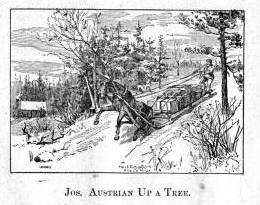
Jewish-immigrant brothers, Julius and Joseph Austrian, were prominent La Pointe residents at this time. This image depicts an incident from Benjamin Armstrong’s Early Life Among the Indians (Engraving by Marr & Richards Co.).
17 September, early, 61° Fahr. The actual owner of the home was absent. However, his younger brother received us with all the warmth of a Bayreuth Jew. He had only been in the country a short time, and spoke English with a Spanish-sounding accent as he called to us in the room, “Waken sie!” He showed us a pair of Indian snowshoes, and asked, “Haben sie snow shoes noch nie geused?*” He finally told of the fish trade in the same mixed gibberish, “Below werden die Fische umgepakt, inspected, und dann weider vereignepakt again.”
(*German immigrants all have a peculiar manner of acquiring the English language. As they hear a strange new name, they mix it together immediately with the words of their native language, without regard for how the expression works in English. A carpenter told us, “Wenn sie ein loghouse bauen wollen un dasselbe inwendig geplastered und von außen geclapboarded wird, so wird es 700 dollars kosten!”
In Pennsylvania, all counties speak an unintelligible German-English slang. It may be that after a few generations, a whole new language is emerging. So, some German immigrants are a tragic example of how one can forget his native language without having to learn another language as a substitute.)
La Pointe is the largest of several islands known under the collective name of Isles des Apotres. It has an unusual history. One of the earliest points on Lake Superior where men of faith planted the cross of salvation in 1665, it wasn’t until a century later that the progress of civilization began to push the two and four-legged forest dwellers further and further west . For several years it was the home depot (post) of the Fur Trading Company. This trading company was founded in 1808 by John Jacob Astor as the American Fur Trading Company, by an act of law of the State of New York. It granted exclusive right of trade and intercourse with the Indians, and in earlier times, provided an immense source of power and wealth. Currently, the business is divided between a Company of the West and the North West, of which the latter united with the Hudson’s Bay Company* and created unrestricted competition and limited the field of activity. The company of the west, currently under the leadership of J. Chouteau and Company, trades with the Indians of the Missouri and Mississippi. Its headquarters are at the upper Mississippi. The company owns 25 stations (trading posts) employing 200 voyageurs who take care of transporting commodities in the business season and bring the furs to the businesses located in St. Paul, Mendota, and Crow Wing in the Minnesota Territory.
(*[This footnote goes on for several pages on the history and structure of the Hudson Bay Company. As it interrupts the narrative, and can be found in other sources, I’ve omitted it.])
The different Indian tribes will kill the animals of the forest in the course of the year and then gather at certain points for the individual bands. Every year there is a caravan of agents (traders) of the fur company who obtain this rich quantity of valuable animal skins from the ignorant Indians for a lowly price of trade items.
This commercial agent will bring birch canoes full of presents across Lake Superior, and usually in 26 to 30 days will bring back the skins of bears, wolves, silver and other foxes, beavers, raccoon, martens, wolverine, otters, muskrats, weasels, and buffalos. Whether their fate is to be a winter covering for the delicate lady’s hands or the lining of a skirt in the princely salons is yet to be determined.
Next door, in perhaps richer numbers and selection, but certainly of far less value, are items of the clever broker. The eyes glare as he flaunts his manufactures. One sees, woolen blankets, cloth fabrics, firearms, ammunition, tin kettles, earrings, finger rings, brass buttons, breastplates, wampum, chopping knives, birch canoes, and mirrors. There is makeup of red, blue, black, and green color, but all the items together carry only one color, that of speculation and dizzying purpose.
Although the furs are barter items, they have an adopted value determined so that the price of the animal fur always corresponds with a certain number of exchanged wares. But the furs are usually valued very low and in contrast, the reverse items are priced very high. The total traffic area with the Indians in the West should produce 1 million dollars annually. Together, the furs are shipped, via New York, to London which is the main market for the American fur trade.
Since we did not visit these remote areas during the season of barter, we could not bear witness to this certainly most-interesting and instructive spectacle, but we cannot omit some words and impart some pressure as we become aware of the facts which throw a sad light on the business of the whites with the Indians. We believe it is the same, and more truthful, to be told as it is by Schoolcraft, the highly-respected American historian, on his travels among the tribes on Lake Superior.
A shotgun worth 10 guineas was sold by an agent to an Indian chief for 120 pounds of beaver skins, or 480 dollars of value. A caravan of 6 bales of barter commodities was traded for $2000. In Athabasca, 96 sacks of beaver skins weighing 8640 pounds brought back four dollars of value when their real worth was $34,560!
Another scholarly researcher, Coldon,writing in 1741 in the area of the Five Nations, describes how the whites in general and the traders in particular, create debts. The vice of drunkenness among the wild Indians occurs so frequently because the greed of the traders allows them to shrink to the lowest means and intentionally put the foolish aborigines in a state of intoxication causing an even more advantageous position for fraud. This evil passion has wreaked more havoc among the Indians than disease or war. It has destroyed more than instruction in Christianity could ever be capable of building up.
Among the Indian tribes there is a strongly-held opinion that if you murder a fur trader, he will retaliate by intentionally bringing back infected goods.* This belief probably arose from the sensitivity caused by the way the whiteskins associate with the redskins. They treat the actual natives of American soil as their subjects and servants, and consider it their privilege to satisfy their greed and passion and claim material and bodily impunity.**
(*[Here the authors insert an extensive footnote about smallpox infections in the Lake Superior region. As it disrupts the narrative and is information that can be found in Schoolcraft’s Narrative of an Expedition Through the Upper Mississippi River to Itasca Lake, I’ve omitted it here.])
(**Two residents of La Pointe told us how a former agent convinced several Indians and mix-bloods to entrust him with their savings due to them from the sale of the Indian country to the government. He used the advantage of his position to gain their trust and did not issue receipts for the borrowed. He had about $800 from everyone but when it was claimed, the fraudulent agent told them they would have to be content with repayment in commodities, flour, sausage, and potatoes, for which the he charged an exorbitant price. We started this narrative not wanting to believe it, but two good Catholics swore on the host. The agent has since left this island, to general contempt, taking the gold pieces of the Indians with him.)

The Voyageurs (1846) by Charles Deas (Wikimedia Images)
After this discussion of the of the rates of the American Fur Company and its agents, we want to add some details about the men whose labor and time exerted such a great influence on the fate and culture of the Indian tribes. We wish to add a few explanatory words about the sad presence on La Pointe of the voyageurs or courriers du bois.
This peculiar class of people, which is like a vein of metal that suddenly disappears within the bedrock and reappears many hundreds of miles away under the same geological conditions, their light reaches the borders of the eastern Canadas. The British people, with their religion and customs, reappeared on the shores of these northern lakes only in 1808 with the Fur Company. For labor they drew on those who could carry their wares across the lakes and communicate with the Indians.
Many young men of adventurous natures left the old wide streets of Montreal and moved into the trackless primeval forests of the West. Young and strong as laborers, they soon started to adopt the lifestyle and language of the aborigines. They married with the Indians and inhabit small settlements scattered throughout those mighty lands which begin at Mackinow Island and come up the upper lake to the region of Minnesota. They almost all speak the Canadian patois along with the language of the Chippewas, the tribe with which they came into kinship. We found only a few, even among the younger generation, who understood English.
Since then, every day the population of the otherwise deserted shore of Lake Superior increases with the discovery of copper mines. The animals driven away by the whirlwind of civilization toward the west, attract the Indians with their sensitive guns, leaving La Pointe, abandoned by the Company for their headquarters at St. Paul in Minnesota. Most voyageurs left the island, having seen their business in ruins and lacking their former importance. Just a few families remain here, making a meager livelihood of hunting, fishing, and the occasional convoy of a few travelers led by business, science, or love of nature who purchase their limited resources.*
(*Except for us, this year they had only two travelers visit this area for scientific interest. The scarcity of this type of tourist seems to be the reason why the price the voyageurs and their companions ask is high. We paid all our leaders one and one half dollars a day and just as many for the days necessary for their return. The voyageurs are democratic and truly similar to those Alpine villagers who charged the emperor two Louis d’or for a breakfast of two eggs.)
A devout Franciscan friar, the family of a Methodist preacher, a school teacher, and a skilled tradesman, together with some old canoe houses, remains of the once large voyageur legion, make up the small numbers of the white population.
The island is 15 miles long, 5.6 miles wide, and has 30 miles in circumference. The main formation is sandstone and red clay. Vegetation proliferates in spruce, pine, cedar, birch, tamarack (Larix americana), etc. The oval horseshoe shape of the island makes it one of the best ports of the entirety of Lake Superior, and this, despite current unemployment, promises hope for a comfortable future.
Add to that, the infinite abundance of fish on their shores. Delicious, but only edible in the spring, are the Siscawit (Salmo siscowet), and the trout (Salmo amethystus). The whitefish (Coregonus albus) are available in uncommon quantities. The most successful fishmonger here sent during the past years, 300 barrels of various species of fish, each 200 pounds, to the markets of Cleveland and Detroit.

The Siscowet, or Fat Trout, is a subspecies of Lake Trout (Drawn by David Starr Jordan, and Barton Warren Evermann, 1911; Digitized by University of Washington)
At the invitation of the zealous schoolteacher*, we toured the schoolhouse. Here we met Old Buffalo (Chi Waishki or Pezhickee), the 90-year-old hereditary chief of the Chippewa band. He was wrapped in a blue striped shirt and a wool blanket. He carried a royal scepter made from a broken wooden base of a bed as a symbol of his authority. He was looking for some glue to repair a garment for a young Indian. We find it necessary here to mention that of the many Chippewas on this island, very few are full-blood Indians. Having crossed frequently with the European race, and through the efforts of Christian missionaries, they have adopted the habits of civilization. They inhabit the abandoned wooden shacks of the Fur Company, and are even given to industrial employment.
(*Mr. Pulcifer, the schoolmaster is a highly-educated teacher. He gives the Sabbath service in the absence of the Methodist preacher. The Methodist mission on the island of La Pointe was founded in 1831).
The Indian chief, worthy by his age, heredity, and his imposing figure, told us he was born near the island and left the area only once to travel in the matters of his tribe to the Great Father* in Washington. His stay was accompanied by many consoling words but little actual success. Since then, he’s been back to the chase. One winter, he brought in 150 fox skins. Despite this wealth of skins in a game-rich area, he is now poor. Here we have the hereditary Chippewa chief, whose generations (totem) are carved in the ancient birch bark,** giving us profuse thanks for just a modest silver coin and a piece of dry cloth. What time can bring to a ruler!
(*”Great Father” is what the Indians call the President and other agents of the United States government.)
(**Almost all Indian tribes have the custom of preserving their lineage from oblivion by carving characters, that correspond to the names of their tribe, on trees, canoes, weapons and everywhere else.
Strangely, we later learned that the majestic Old Buffalo was violently opposed for years to the education and spiritual progress of the Indians. Probably, it’s because he suspected a better instructed generation would no longer obey. Presently, he tacitly accepts the existence of the school and even visits sometimes, where like ourselves, he has the opportunity to see the gains made in this school with its stubborn, fastidious look of an old German high council.)
Although made of simple planks, the school hall is clean and well-ventilated. The youth, consisting of 25 mix-blooded children, are instructed by the Methodist teachers in reading, writing, arithmetic, geography, and natural history. The teacher takes 6 to 8 children to the teacher’s desk and tells them to read their lessons or recite them from memory. Most often, there are questions which are subjected to discussion, questions that relate to the everyday world. This gives the youth the advantage of preparation for practical life.*
(*One of these practical textbooks is similar to Guide to Knowledge, a popular textbook in England: Conversations on common things by a teacher. Boston, Munroe and Francis. 1849.)
For example, a student may read a sentence in which the word “lead” occurs. This immediately gives rise to an instructive conversation about this noble metal, such as where lead is most found, what it is used for, the compounds in which it is used, etc. The youth, by learning this way about various natural phenomena, learns at the same time to know and admire the sources of a country’s wealth. It is an early and delicate way to teach the students the important parts of the geographical, physical, and political history of the country before their own history.

The front page of the Kladderadatsh, a German-languague satirical newspaper published in Berlin. Despite it’s popularity among the masses in Europe, I’m not sure the kids in La Pointe had subscriptions (Wikimedia Images).
At the conclusion of the lesson, the older children, by their own reflection but encouraged by their teacher, asked us several questions about European life: if many European children went to school, and what they learned there…
It was shamefully difficult answering these simple questions asked by the children.
We told these smart young half-Indians that here in Europe the same God lives and moves as in their hemisphere, and that His sun is the only true light that rises for the peoples of the East. We replied further that children learn a tremendous amount but usually know incredibly little, and finally, that the Berliner Kladderadatsch is the most widely read political journal. This last answer left the little indigene who asked the pointed questions bewildered and seemed to discourage the asking of any further information about Europe. At that point, the school meeting was cancelled to our great relief.
Another no-less worthy host received us with warm greetings of the heart. It was the worthy Franciscan monk, Father Scolla, from Rudolphswerth in Carinthia. We went to deliver the pleasure of a recommendation to our pious countryman. We knocked at the meager gate of the little boarded house that grew out from the rear part of the church. We are now almost ashamed of the worldly manner in which we approached, given the distinguished reception we received at the hands of such a pious priest.

Alternate translation of this passage found in History of the diocese of Sault Ste, Marie and Marquette (1906) by Antoine Ivan Rezek pg.367 (Digitized by Google Books)
Our traveling way of life often finds us witness to scenes of parting, separation, and reunion, but we have never seen any man become so pale, taken, and overcome with intimate emotion as this Franciscan when he learned through language and handshake that we were compatriots from the Imperial City.
We can reasonably account for this surprise in that almost 20 years had passed since the lone missionary had seen a countryman “of the Imperial City” and had been addressed in his language, and felt the warm shake of an Austrian hand. His whole religious intercourse with the faithful, be it preaching the gospel at the pulpit, forgiving sin in confessional, or donating food for the journey to the deathbed, happens in a foreign tongue, in French and Indian language.
What troubled us most about his monastic life was the poverty and helplessness with which this devout priest remains continually fights to preach the Way. The greater part of his church consists of converted Indians and mix-bloods, who all live in such poor circumstances that there is no thought of support for this priest. The maintenance costs for the church and its priests must therefore be restricted to those means which fall from the general missionary funds of the Catholic Church.
The quota, that makes its way to the Church of Our Lady of La Pointe, is extremely low, and sometimes isn’t received for so many years that one gets the impression that the bishop in Milwaukee has forgotten the lonely forests of Madeline Island, its Lady, and Father Scolla. The pious Franciscan, whose destitution has denied him any assistance in church and house, must therefore do as priests and lay ministers do. He decorates and adorns the high altar, paints the images of saints, rings the bell, and worries about the upkeep of his small house at the same time.

cntd. translation in Rezek pg.368
On the Sunday before we left, we attended the service. The small church was quite filled with Indian women, mix-bloods, and Canadian voyageurs. The women wore long cloth of dark green, blue, and black covering them from hips to head and wrapping them in one whole soft shape. The men were all dressed in European clothing. During the vicarious sacrifice of the mass, four half-Indians in white surplices sang the Latin text shouldering such edification that you would have sworn they understood every word.
The sermon was held in French, the most common language of the island, and it was appropriate for the comprehension of the people in the audience. In the afternoon, the tireless Franciscan monk preaches in Indian for his neophytes, which prevents age from weakening his intellectual ability to learn a foreign tongue.
Much more edification of the faithful would have prevailed if not for the wailing cries of the infants disturbed by the devotion, who were brought along on the backs of the countless “squaws.” But these grumpy little citizens of the world seemed to understand even less than the adult choir of the plot of the Latin score.

Fr. Otto Skolla was from Novo Mesto (Rudolfswert) in today’s Slovenia not far from the Slovenian homeland of his fellow Lake Superior priest, Bishop Frederick Baraga (Rezek pg. 360)
When we speak of the conviction in his calling and pure enthusiasm of the priest’s benediction, of the faithful community dropping to their knees, covering their faces, and reverently making the sign of the cross, we could not help but feel sadness that such a worthy and pious work could not flourish better due to a lack of temporal goods.
What ability to spread blessings the Catholic missionary would have if equipped with the necessary material resources: a teacher for the youth, a doctor for the sick, a support for the poor. How can the Church win over humanity when right now the distressing spectacle is such that the Catholic youth, lacking the funds for a teacher, get no education, and the narrow-minded principles of their spiritual board keep them from getting permission to attend the Methodist school?
If you watch the incredible speed of the other religious sects, such as the Methodists, Baptists, and Presbyterians, and the extraordinary sums taken in and put out for education and missionary purposes– they have missionaries in all ports in the Union–and how without consideration of their religion, they receive immigrants, comfort the sick, the suffering, and take care of the children, while the Herald of Catholic teaching to foreign lands moves slowly. It may not surprise you, especially here in the United States that foreign religious sects are gaining converts while the ranks of the Catholic Church, despite the massive influx of Catholic populations from Ireland and Germany, not only aren’t increasing, but are actually seeing a decrease in numbers.

The Catholic church on Madeline Island as drawn by Skolla (Rezek pg.361).
CAUTION: This translation was made using Google Translate by someone who neither speaks nor reads German. It should not be considered accurate by scholarly standards.
Sandy Lake Letters: Sherman Hall to the Wheelers
July 11, 2013

“Chippewa Indians Fishing on the Ice” (Digitized by New York Public Library from Heroes and hunters of the West : comprising sketches and adventures of Boone, Kenton, Brady, Logan, Whetzel, Fleehart, Hughes, Johnston, etc. Philadelphia : H. C. Peck & Theo. Bliss, 1859.)
On June 9th, I transcribed and posted two letters related to the Sandy Lake Tragedy (the attempted removal of the Lake Superior Ojibwe in the fall of 1850, which claimed as many as 400 innocent lives). The letters, digitized by the Wisconsin Historical Society, were from the Warren Family Papers. One was from missionary Leonard Wheeler to William Warren before the tragedy, and another was from Indian Agent John Watrous to Warren during a second removal attempt a year later.
That post sought to assess how much responsibility Warren and Watrous bear for the 400 deaths. It also touched on the role of the Protestant A.B.C.F.M. missionaries in the region. This post continues those thoughts. This time, we’re looking at two more letters and evaluating one of the missionaries himself.
Both of these letters are from the Wheeler Family Papers, held by the Wisconsin Historical Society at the Ashland Area Research Center. I went directly to the original documents for these, and while I’ve seen them referenced in published works, I believe this is the first time these particular letters have been transcribed or posted online.
The first is from Sherman Hall, the founder of the La Pointe Mission, to his colleague Leonard Wheeler, who operated the satellite mission at Odanah. Hall traveled to Sandy Lake for the annuity payments and sent this letter to Wheeler, who was visiting family back in Massachusetts, after returning to La Pointe.
Lapointe. Dec. 28th 1850
Brother Wheeler:
I wrote you while at Sandy Lake and promised to write again when I should reach Lapointe. That promise I now redeem. I started from Sandy Lake on the fourth inst. and reached home on the 16th having been absent from home just eight weeks. I was never more heartily glad to leave a place than I was Sandy Lake, nor more glad to reach home after an absence. Of course winter here has justly begun. The snow was some ten inches deep on the Savannah Portage. On reaching the East Savannah River we found the ice good and clear of snow and water. This continued to be the case most of the way to the Grand Portage at Fond du Lac. From Fond du Lac to Lapointe the traveling most of the way was hard, and it was not till the seventh day from F. du L. that I reached home. Besides bad traveling I had to carry a pack which I found, when I got home weighed 60 pounds. With this however I found it not difficult to keep up with most of my traveling companions who were much heavier loaded than I. This is my first experience of carrying a heavy pack on a long journey and I am fully satisfied with the experiment. I had no alternative however, bet either to throw away my blankets and clothes, or carry them. Every body was loaded with a heavy pack, and I could employ no one. I however got through well—did not get lame as many others did, nor do I feel any furious[?] by ill effects of my journey since my arrival.
I found the mission family well on my arrival. They had felt somewhat lonesome while so many were absent from this place. Things in the community here are generally in a quiet state at present. I apprehend that there will be considerable pinching for provisions before spring. It has been a very windy and stormy fall. The people have taken but little fish. Many nets have been lost. The traders have but a small quantity of provisions, and if they had the people have but little to buy with. The bay opposite to this island is now principally covered with ice so that the Indians are on the ice some to spear fish. The ice has once broken up since it first closed, and a heavy wind would break it up again, as it is yet very thin, and the weather mild. If the lake is frozen the Inds will probably get considerable fish; but if it should be open they must suffer.
Our Indian meetings are pretty well attended, and I feel that there is ground for encouragement. Simon I think is exerting a good influence. His Catholic friends have tried to draw him back to their church; but seems stable. His oldest brother, who has recently lost his wife, has expressed a wish to hear the word of God. I hope he will yet become a sincere listener.
Our English exercises are attended by a smaller number than formerly since many have left this place. I think however for our own good, as well as on account of others, we ought to keep them up. Mr. Van Tassel has returned to remain here till spring. I have heard nothing from Bad River for some time past. I had formed a design to go there this week, but have been prevented by the state of the ice. I intend going as soon as the ice gets a little stronger. I suppose there are very few Indians there. More are about the Lake.
I heard that Mr. Leihy has lost both his horses which will be a serious inconvenience to him in this mill enterprise I presume.
Mr. Pulsifer has received one letter from you, and by our last mail he heard through his correspondent at Lowell that you had arrived at that place.
I suppose you find some changes have taken place in the wide world during the times you have been shut up in the wilderness. Do you find calls enough to keep you busy? I have been expecting a letter from you. I want to hear what you have to say about the things you see, and how you like visiting, etc.
I have just had a letter from Mr. Ely, who says, “We are [snugly by quarters?] in St. Paul. My home is full of music—am employed as choir leader in Mr. [Mill’s?] (Prs.) church—sing two evenings a week at Stillwater, and the rest of my time is well filled with the private scholars & tuning Pianos, of which there are 7 or 8 at St. Paul.” Perhaps Br. Ely will find this a more lucrative business than cutting and hauling pine logs. I am glad he has found employment.
Our children all attend school except Harriet. Marydoes very well. Please give my regards to your friends at Lowell. I am writing to Mr. Treat by this opportunity. [Wish?] kind regards to Mrs. W. I remain
yours
S. Hall.
 The Old Mission Church, La Pointe, Madeline Island. (Wisconsin Historical Society Image ID: 24827)
 Harriet Wheeler, pictured about forty years after receiving this letter. (Wisconsin Historical Society: Image ID 36771)
“…your note to Harriet” Harriet Hall was Sherman’s oldest daughter, about 19 years old at this time.
 Many Ojibwe leaders, including Hole in the Day, blamed the rotten pork and moldy flour distributed at Sandy Lake for the disease that broke out. The speech in St. Paul is covered on pages 101-109 of Theresa Schenck’s William W. Warren: The Life, Letters, and Times of an Ojibwe Leader, my favorite book about this time period. (Photo from Whitney’s Gallery of St. Paul: Wisconsin Historical Society Image ID 27525)
 Mary Warren (1835-1925), was a teenager at the time of the Sandy Lake Tragedy. She is pictured here over seventy years later. Mary, the sister of William Warren, had been living with the Wheelers but stayed with Hall during their trip east. (Photo found on University of Connecticut Radio website, scanned from Frances Densmore photos in the Smithsonian Bureau of Ethnology)
Lapointe, Feb. 24th 1851.
Mrs. Wheeler,
By our last mail I wrote to Mr Wheeler, and by this I will address a few lines to you. From your note to Harriet I suppose you are happy among your friends. I am glad you are so, and hope you will not only spend your winter pleasantly, but that you will find the present season of relaxation from the severe duties of your station here, the occasion of reconnecting[?] your health and spirits.
I do not feel that the time has yet come when the churches ought to close their efforts to save these Indians. I do not think they are entirely beyond the reach of hope. The prospect however looks dark. But I think the greatest cause of discouragement arises from their character, and not from their present political condition. Generally they do not want to improve their condition. They are satisfied with their ignorance and degradation. All they think of is to supply for their present wants without their own exertions, while they wish to live in idleness and sin. This is the cause of their keeping so much aloof from the influence of the missions. Their minds are dreadfully dark respecting the things of the future world. They seem to have no ideas of happiness superior to that derives from the gratification of the lowest animal appetites and passions. This is the reason why the truths of the gospel so little effect on them. These things present to my mind much stronger grounds of discouragement than their present political difficulties, though those at present are not inconsiderable.
But as stupid as is the conscience, and as dark as is the understanding and the heart, and as much as they are given up to [?]ality and sin, I believe there is a Power that can quicken them into life. My only hope is that He who has made them, and has power to save them, will come and add his blessing to the preaching of his own gospel, and make it to them the power and wisdom of God. Thousands of others as dead in trespasses and sins, have been saved. Why may not they be saved? Come back home and let us try still to do something for them. Tell Christians to remember them and pray for them, that the word of God among them may have free course and be glorified.
It is a time of great scarcity of food among the Indians. There is some one in our houses almost every hour of the day begging for food. Very few get more than a meal a day; many not half of one. I have been told by several individuals, that they have tried three or four days in succession to catch fish, and have been obliged to return to their starving families each night with nothing for them. I am frequently importuned to spare a little provisions till I am obliged to go away out of sight to get rid of their pleading. I have spared the last potatoes I dare let go. Corn we have none. We have but a small quantity of flour over what will be required to sustain our families till we can expect to obtain a new supply. For a long time I have not known fish so scarce as the present winter. That is almost the only dependence of this people. For a month to come there will be many hungry ones. Many of the French and half-breeds are but little better off than the Indians. All we can do is to divide a little morsel with the hungry ones who come to beg. We have not much to give to those who importune for something to carry to their families. But as long as they continue to waste their summers in idleness they must starve in the winter.
The young Hole-in-the-day has been down to St Paul and there made a public speech in which he attributes the sickness at the payment last fall to the bad provisions which were dealt out to the Indians, and imparts much blame to the officers of the government for the way in which they [were with?]. In time they had some flour dealt out to them which was much damaged. But I think there were other causes for the sickness which prevailed besides the bad provisions. I think however that in some [aspects?] the Indians were wronged. Treaty stipulations were not carried out. H is very confident that many of the Indians are not satisfied with the manner in which they have been dealt with, and recent events have not served to strengthen their attachment to the Government.
We had our communion yesterday. I think there is a [?]ably good state of feeling among the native church members at this time. Simon has been frequently sick this winter. But his trials appear to bring nearer to God. He appears to be growing in the knowledge of God and in piety.
You will probably recollect Mo-ko-kun-ens-ish, an Indian with a bunch[?] between his shoulders, married into the family of the Little-current. He is, by profession, a Catholic. About a week ago, he made me a visit, and said his priest had offended him, and he wished to join us. A short time since he lost a child, and when the priest came to bury it, he said he “scolded him” because he had not cleaned away the snow from the gate of the burying yard, and made a better path for him to come to the grave. He told a long story. I suspected his object was to get some provisions of me. I told him we should be happy to see him at our meetings, and told him where and when they would be held. He said he should attend only sometimes he might be obliged to fish to get something to eat, and be occasionally away. I said a few words to him on religious subjects, and he left without asking for anything. The next day he came with a small piece of cloth and asked me to give him provisions for it. I told I had not provisions to trade. He then enquired about meeting. I told him we were to hold one that evening in the school-house. He said he should attend. The evening came, the meeting was held—but he was not there. Nor have we seen him at any other meeting. Such are the methods the heathens & Catholics take to deceive us. We could make many converts with flour and pork, especially at this time.
Yours Truly,
S. Hall
[Written in margins]
All send love though I have not room to write it.
Mary goes to school and is doing very well.

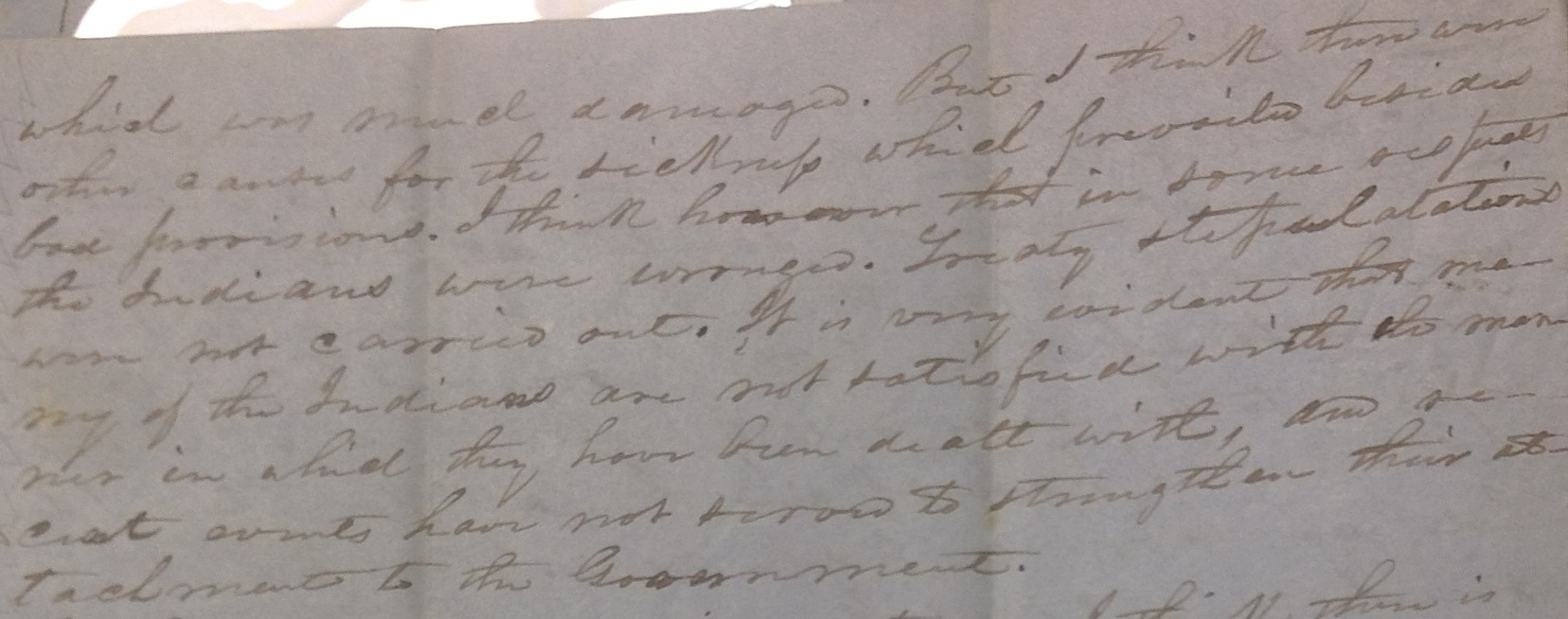
These are the originals of the paragraph about Hole in the Day’s speech in St. Paul. I couldn’t quite decipher all of it. Let me know what you see (Wheeler Family Papers, Personal Correspondence 1851, Wisconsin Historical Society Ashland Area Research Center).
In the June 9th post, we tried to determine how much William Warren and John S. Watrous were at fault for the deaths resulting from the 1850 Sandy Lake removal attempt. In this post, we will do the same for Sherman Hall.
Before we begin, it’s worth reviewing the facts. By 1850, Hall had lived at La Pointe for twenty years. He knew the people who lived here, and he knew the promises the Ojibwe were given at the Treaty of 1842. He was certainly aware of the Ojibwe position on the removal.
Rev. Hall did not order the removal. Compared with the government and Fur Company officials, he was fairly powerless within the Lake Superior region. However, he had a power of a different sort. As the primary voice of the ABCFM in Ojibwe country, he had powerful friends in the eastern states. Many Americans perceived the missionaries as the only neutral voice in the area. Hall admits in the December 28th letter that the Ojibwe were wronged. He could have advocated for their cause in the summer of 1850 as the illegal removal was unfolding. Instead, he largely went along with government efforts.
To his credit, in other letters Hall did blame the government for the failure of the Sandy Lake payment. The best book I’ve encountered about this time period is William W. Warren: The Life, Letters, and Times of an Ojibwe Leader by Theresa Schenck (Nebraska UP, 2007). On page 94, Dr. Schenck quotes a letter from Hall to ABCFM Secretary S.B. Treat. It is dated December 30, and is probably the letter referred to in the letter to Leonard Wheeler above. Hall is honest about Ojibwe feelings on the removal and seems to empathize somewhat. On page 155, Schenck details how the La Pointe mission did eventually turn against government removal efforts later in 1851.
So, it probably seems that I am defending Sherman Hall. Why? Truthfully, it’s because I want to have some balance in this post because, quite frankly, these two letters are some of the most disgusting, horrifying documents I’ve ever read. I felt especially sick typing up the February 24th letter to Harriet Wheeler. For a man who claimed to be “saving” the Ojibwe to be so heartless in the midst of so much suffering is appalling.
Was the mission running low on food? Sure, but doesn’t true Christian charity demand sharing to the last?
Should Hall’s language be judged by the standards of the racist times he lived in? Absolutely, but to say the things he says about human beings, his neighbors of twenty years, is inexcusable in any time period.
Is it possible he was traumatized by his experience at Sandy Lake, and this was a way of dealing with his personal guilt? This is possible. He does seem to be speaking to himself in the letter as much as he is to the Wheelers.
There is a danger in judging too much from just two letters, but I think Hall needs to be held to the same standard as Warren and Watrous were in the June 9th post. He could have spoken out against the removal to begin with. He didn’t. He was an eyewitness to Sandy Lake. He knew what the Ojibwe had been promised, and he saw the consequences of the government breaking those promises. His letters to the Wheelers in Boston could have been used to help right those wrongs by uniting the missions behind the Ojibwe cause. Instead, he chose to blame the people who had been wronged to the point of 400 deaths. For these reasons, I think when we list the villains of Sandy Lake, the Reverend Sherman Hall needs to be among them.
 Chequamegon History