Judge Bell Incidents: Fooled the Austrian Brothers
October 30, 2025
Collected & edited by Amorin Mello
This is the third post in a series featuring The Ashland News items about La Pointe’s infamous Judge John William Bell, written mainly by his son-in-law George Francis Thomas née Gilbert Fayette Thomas a.k.a G.F.T. In today’s post we explore stories about real estate transactions negotiated between Judge Bell and Julius Austrian.
… continued from King No More.

The Ashland News
Wednesday, January 11, 1888, Page 5
STORIES OF JUDGE BELL
HOW HE FOOLED THE AUSTRIAN BROTHERS IN A LAND DEAL.
“Incidents in the life of Judge John W. Bell. – A Half Century in Old La Pointe – by Geo. Francis Thomas.”
Such is the proposed title to a forth-coming historical work which will prove wonderfully interesting, especially to the older residents in this vicinity. The author begins with the year 1835, when the brig “John Jacob Astor,” the first vessel built upon the shores of Lake Superior, first cast her anchor in the bay at La Pointe, and ends with the death of the old pioneer, John W. Bell, which occurred but a few days since. In speaking of the pioneer the author says:
“From the day that Mr. Bell stepped ashore at La Pointe from ‘The Astor,’ June 23, 1835, to the day of his death, he was a character possessing a most positive individuality; and it was not until his later years, and then when he had become financially distressed, that his wonderful spirit became at all broken; but even then he was never known to as a favor.”
The old judge, or “Squire” as he was usually called, was always ready to relate some incident of early days in which he was usually a participant. There are also a great many equally interesting incidents related by others, where the old judge would not justify his telling the story himself. The author says:

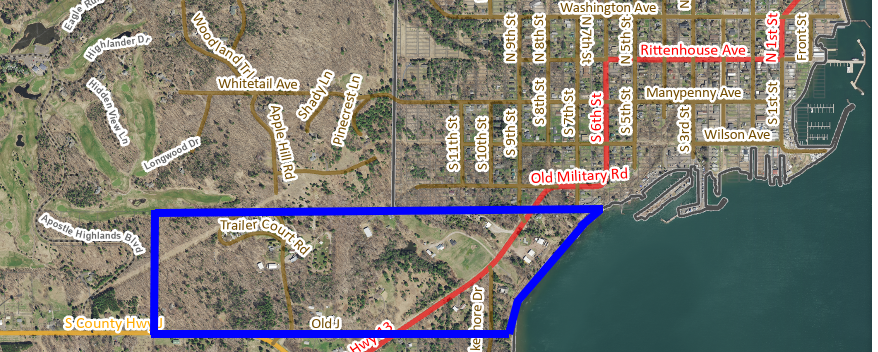
Detail from Julius Austrian’s 1854 Plan of the Town of La Pointe with Judge Bell’s Block 35 and four small Lots.
~ Wisconsin Historical Society
“[…] except a small portion in the North West Corner claimed and enclosed by Edwin Connor, and so much of the South West Corner as is claimed by P. B. Vanderventer, and the enclosure of Barboo & Meletle in the South East Corner”
“The old man always liked to have things done on the square, so when Julius Austrian was platting the village of La Pointe and proposed to Mr. Bell to give him the block he already occupied for a nominal consideration, Mr. Bell insisted that his block, number thirty-five, be exactly square – all the four streets crossing at right angles. A square block or lot was quite a novelty where each squatter’s garden-patch had been fenced in and called a lot, regardless of street lines or quantity of land.”
Memoirs of Doodooshaaboo: Joseph Austrian’s Time at La Pointe 1851-52 (Pt. 2)
“Our blind brother Marx Austrian with brother Julius’ assistance at that time, preempted 160 acres of land near Bayfield from La Point, complying with preemption laws. He built a small log house living there with his wife. One night during their first winter in their new house, there was a knock at the door, and when opened they were confronted by a number of Indians, who were evidently under the influence of liquor and who swinging their tomahawks vigorously, making all sorts of threatening demands. An old Indian who knew Marx interceded and enabled him and his wife to escape without injury who thoroughly scared fled panic stricken in the dark about two miles at night, over the ice, on the Bay which was covered with a foot of snow to La Point for safety. The poor woman having the hazardous task of leading her blind husband over this long and difficult road, not to come back again and glad to escape with their lives and thus abandoning their right of preemption. This place was later on platted and is now known as the Bayfield Addition.”
Mr. Bell was an acute judge of human nature, and made it an invariable rule to deal with his fellowmen according to each one’s individual peculiarity. Before Bayfield was located, or in fact thought of as a town site, a Hebrew by the name of Marx Austrian pre-empted the 126 acres of land now known as Austrian’s clearing, and which adjoins Bayfield on the south. After a short residence upon the claim Mr. Austrian’s family became sick, and in order that proper care might be given them they were compelled to move to La Pointe, where a physician could be had. A speculator, noticing the apparent irregularity, tried to jump the claim. The case was taken to Superior for trial, and Mr. Bell, being the only available witness, the Austrian brothers and Louis Leopold proposed to give him a one-fourth interest in the land as compensation for making the trip to Superior. Mr. Bell accordingly accompanied the party, to Superior, and on arriving at the hotel as was his custom, he immediately began to make himself at home with the guests of the house, most of whom he was well acquainted with. At length when the case was called, Mr. Bell seemed so entirely unconcerned that he was urged to come forward by some one of the interested parties; but Mr. Bell carelessly said,
“Oh! I believe I will not attend court today.”

Julius Austrian
~ Madeline Island Museum
The Austrians wildly expostulated, and at last agreed to pay all the old “Judge’s” expenses for the trip, besides giving him a one-fourth interest in the 126 acres of land. This brought him all right and Marx Austrian gained his point. A few years later, when the town of Bayfield was laid out by the Hon. Henry M. Rice, the Austrians, Julius and Marx, concluded that they ought to buy back the one-fourth interest in the 126 acres held by “Squire” Bell, and accordingly Julius approached him on the subject. Mr. Bell was a man of few words and no give-in to his dictum. He told Austrian that $1,000 would buy his interest if taken by noon the next day. Austrian claimed the price was exorbitant but finally went off to get the cash. on the morrow at noon, or a few minutes before, Austrian called on Bell and said he could only give him $800. Mr Bell insisted on $1,000, which Julius Austrian finally agreed to pay;
“but,” says Mr. Bell, “now you are too late. It is fully a minute past the time which I specified, now I will not take less than $1,250, and that must be forthcoming within two hours from now.”
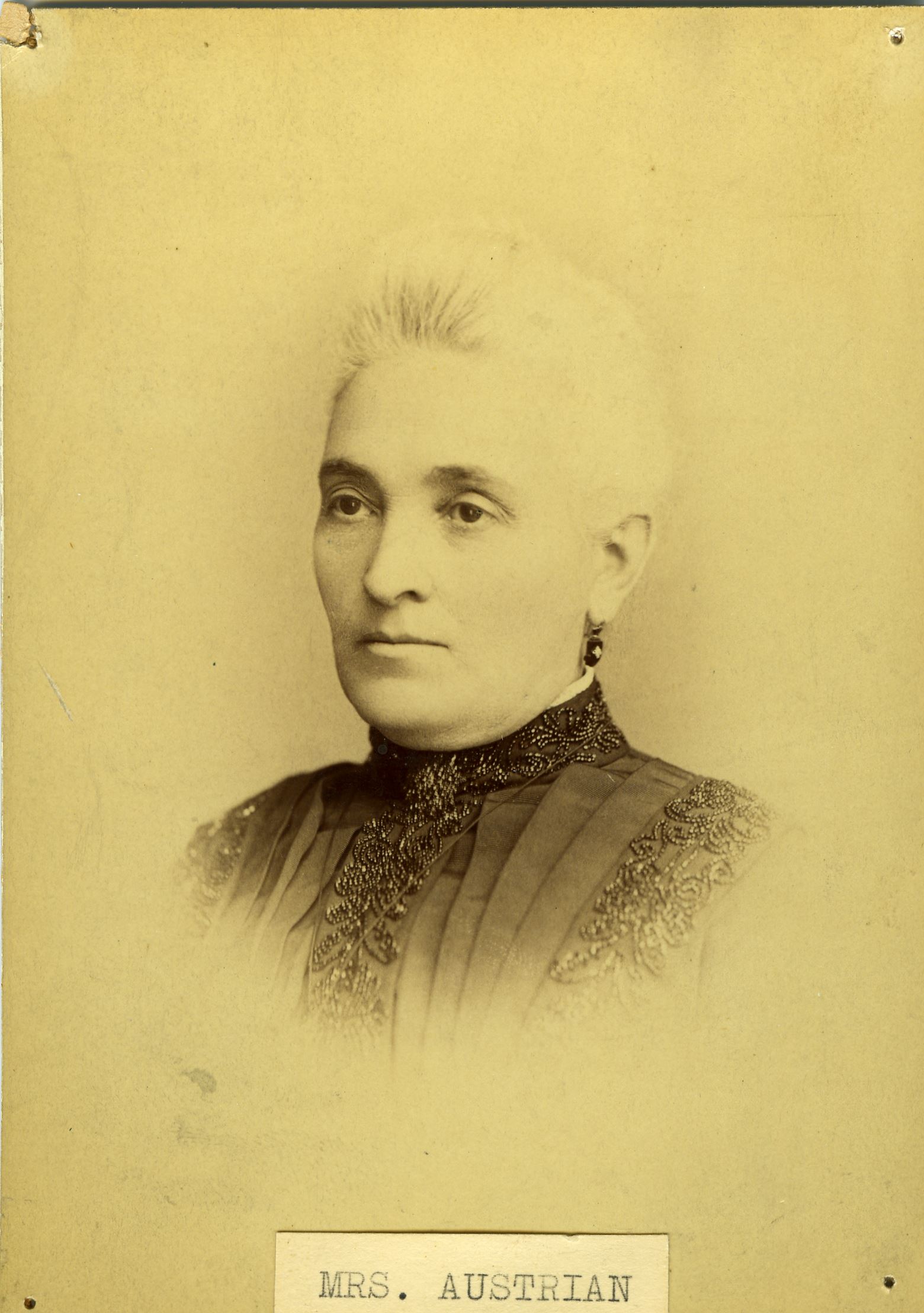
Hannah Leopold Austrian
~ Madeline Island Museum.
This time Austrian kept away, thinking Mr. Bell would go back to his $1,000 offer if he did not seem too anxious. In that Mr. Austrian misjudged his man, for when Austrian again approached the “squire” his price was $1,500 spot cash. Things now looked dubious to the Austrians, a conference was held with Mrs. Hannah Austrian and together they raised $1,300, all the cash which was available at that moment. This they handed over to Mr. Bell with a sight due bill for $200, secured by a deposit of all Mrs. Austrian’s jewels, including her diamond earrings. They got back the one quarter interest in the 126 acres, and they have paid taxes on it ever since, yet the whole is hardly worth now what the quarter cost them.
“This recalls an incident back in ’61 or ’62,” said one of the jurymen at a recent trial in this city. “It was a case against a trader who was accused of selling whiskey to an Indian. The jury was drawn, and after hearing the evidence they retired to a back room to determine on a verdict. It was about four o’clock in the afternoon. At six o’clock the jury was about evenly divided. About midnight, after continuous balloting, the vote stood ten for acquittal and two for conviction. There was no fire in the room, and it was very cold. The ten jurors who stood for acquittal made one final request to the other two to vote with them, but they persistently refused. The ten then got a long pine board and laying it across two stools proceeded to play an interesting game of freeze-out. About two o’clock one of the two came over on the other side and joined the rest in the game of freezing out the other juror. At three o’clock in the morning he gave up.”
To be continued…
By Amorin Mello
The original handwritten memoir of Joseph Austrian is held by the Chicago History Museum. We saw some interesting stories and insights about La Pointe in Part I through the eyes of Doodooshaaboo (milk) as Joseph was known there during 1851 and 1852. The later La Pointe stories in Part II, however, are where the really good stuff is about white settlement and land speculation prior to the Treaty of 1854. When we last checked in with Joseph, he had just been ordered by brother-in-law Louis F. Leopold to terminate his business career at brother Julius Austrian’s Indian trading post at La Pointe, and to immediately relocate to Keweenaw Peninsula to co-manage brother-in-law Henry F. Leopold’s store in Eagle River.

Joseph Austrian’s land purchase at La Pointe during 1852.
~ General Land Office Records
In this installment we follow pages 66-78 of Joseph Austrian’s memoir about his reassignment to Eagle River. While there he engages with the Leopolds’ business affairs with copper mines and miners of the Keweenaw Peninsula before the opening of the Soo Locks. Joseph is quick to succeed in his new position as a trusted business partner during 1852-54.
A mysterious omission from this memoir is the fact that, during the summer of 1852, Doodooshaboo purchased 183 acres in La Pointe from the U.S. General Land Office in Willow River. In other words, this was the first federal sale of any land in La Pointe County. We will take a closer look at this critical shift in La Pointe’s political landscape as the subject of a future post on Chequamegon History. But for now, Joseph’s stories about 1852-54 provide us with glimpses of the Austrian family’s affairs at La Pointe during these pivotal years before the 1854 Treaty of La Pointe.
Memoirs of Doodooshaboo
… continued from La Pointe 1851-1852 (Part 2).

Outline Map showing the position of the ancient mine-pits of Point Keweenaw, Michigan.
~ Ancient Mining on the Shores of Lake Superior, by Charles Whittlesey
Reached Eagle River by Sleigh. 1852.
~ CopperCountryExplorer.com
Mr. H. F. Leopold, who hearing that the boat had passed by during the night and expecting me on her, came over with a sleigh for me. Eagle River was a small settlement of not over one hundred inhabitants situated in Houghton County, Michigan. It depended entirely for its business patronage on the adjacent copper mines, principally the Cliff Mine, North American, Phoenix & Garden City mines, some of which at that time were just in course of development. In the place there were but two stores the smaller one 18 x 24 situated on top of a hill facing the Lake was Leopolds. The other larger store was owned by Tenter and Mandelbaum. There were a number of saloons and boarding houses combined and this constituted the business portion of the town.

Simon Mandelbaum was an employee of the Phoenix Mine, the successor of the the Lake Superior Copper Company (the first regularly organized corporation to engage in Lake Superior Copper mining).
~ Annual Report by the Michigan Department of Mineral Statistics, 1900, pg. 240-41
Started Work at Eagle River. 1852.
I was at once installed in my work after my arrival, and the next day went to the Cliff Mine to attend to some collections. Mr. H. F. Leopold was an uneducated man not able to read or write English, the business correspondence and keeping of accounts therefore devolved entirely on me.
After becoming thoroughly acquainted with the business I resolved to enlarge the same and my efforts to do so succeeded well. A short time after my arrival at Eagle River a letter was received by the Leopolds containing the sad news of the death of my father. He died suddenly Sept 17th, 1852 from a stroke of apoplexy at the age of 75 years. This was naturally a cause of great grief and worry to me, as there was besides my mother, my blind brother Marx, a younger sister and brother at home to be cared for.
The next spring a larger stock was ordered than had ever been carried before and new departments added, namely: groceries, grain, and provisions, heretofore, only dry goods had been carried, from this time on the business as a matter of course showed a decided increase, and at the next annual inventory the profits showed a much better result than ever before. We boarded at Joseph Lang’s place who had a saloon in connection with his boarding house and poor as it was we had no choice to better ourselves. Mr. Leopold spent his evenings generally at the boarding house enjoying a game of cards with some of his friends, while I had to pass my evenings alone at the store playing watchman. We had no fire insurance on the store or on its contents, as firstly there were no insurance companies taking risks there at the time, and secondly even if they had I doubt that we could had placed any, owing to the dangerous condition of the heating apparatus. The store was heated by a box wood stove with the pipe running through the entire length of the store to the chimney, and it was necessary to be very careful and watchful under the circumstances. The store was hard to get comfortably warm, and I often sat there cold and shivering wrapped up in a blanket waiting for Mr. Leopold to come in for the night.
We slept up stairs over the store, and here it was most cheerless and dismal, not being heated at all.
The winters were very severe and extremely cold which did not add to our comfort and during our first winter there we had to put up with many hardships.
Dug Tunnel Under Snow to Stable.
We had frequently severe blizzards one I well remember, it lasted over a week. The depth of the snow that fell at that time was so great that with the drifts it reached high as the roof of the stable and we had to dig a tunnel through the snow to get from the store to the stable, and the horses were led out some weeks through this tunnel. Our store was exposed to the full force of the severe Lake Superior gales which some times shook the building threatening to demolish it.
Tough Boarding House Experiences.
During the winter there was no fresh meat to be had. In the Fall the boats would bring some, but having no refrigerators it was hung up on the boom of the Schooner to preserve it during transportation and when it reached the table it was anything but tempting. However, it was kept and used for weeks after, strong vinegar was used in preparing it by our land lord’s cook to hide the flavor. When this “so called” fresh meat gave out for the rest of the winter they substituted salted meat.
The Cliff Mine store had a large supply which it had had on hand for several years, our land lord bought of this firstly because it was cheap and secondly because he could not get any other. Eggs were not to be had either and turnips and potatoes were about the only vegetable procurable. This diet caused scurvy more or less. In the Spring when navigation opened, the first boat of the season was hailed with delight it was the signal for eggs and other delicacies we had been deprived of so long. Our land lord bought a barrel of eggs and fed us on them three times a day, while they lasted. During the summer we were also regaled with a variety of fresh vegetables and some fresh meat that could be had at times.
Brother Julius Brings our Family to America. 1853.
Secretary of State
Office of Indian Affairs
June 30th, 1853
Dear Sir,
In the absence of the Commissioner of Indian Affairs, to whom the bearer, Mr. Julius Austrian of Cleveland, Ohio, has letters of introduction and whose business here pertains to your Department in connection with an intended visit to Europe with his family, I beg leave respectfully to salient for him such courtesies as the case demands.
I have the honor to be
Very respectfully
Your obedient
Charles E. Mix
Acting Comm.”
~ Ancestry.com
Things went on satisfactorily in the business and in the summer of 1853 brother Julius, who was stationed at La Point started with his wife, a sister of the Leopolds, for Germany in accordance with a conclusion we had come to, to bring mother and the rest of the family to this country, and at the same time to visit the native village of his wife – “Rḯchen,” in the Grand Dukedom of Baden. It was a mission combined with a great deal of hardship and trouble for Julius, as it meant for him to convert all the real & personal property of my late father’s estate into money, which was in itself very difficult besides getting the family ready for this long voyage for their destination in the new world after having lived all their lifetime in Wittelshofen. Brother Marx especially was disinclined to go on account of his affliction from loss of eyesight.
My mother not having any special ties there to keep her, was in a measure glad to go where the most of her children were living, and did everything in her power to get ready without unnecessary delay.
They had a safe voyage and arrived at Cleveland Sept 1853.

U.S.M. Steamship Atlantic, James West, Commander.
~ Library of Congress Prints and Photographs Division Washington, D.C.
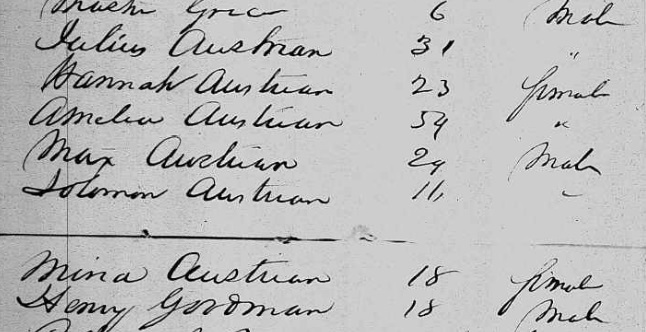
Julius Austrian returned from Europe on the U.S.M. Steamer Atlantic to America on October 17th, 1853 with his family: Hannah Leopold Austrian (Wife); Malka Heule Austrian (Mother); Marx Austrian (Brother); Samuel Solomon Austrian (Brother); Mina (Sister); and Henry Guttman aka Goodman (Cousin).
~ New York, Passenger Lists, 1820-1891, pg. 499, FamilySearch.org
Mother took a small house in Cleveland on Ohio St. and started house keeping with my sister Mina and necessary help when she was comfortably located. My brother Sol for the time being lived with my sister Babette. During this winter my sister Mina became engaged to Levi Jordan of Baltimore, where he was in business. He came from the same place where we were born, and therefore the families were well acquainted. Their marriage took place the next summer (1854) and afterward they resided in Baltimore.
Store Sold by Mistake.
The business had kept on increasing steadily. Mr. Louis F. Leopold had removed from Mackinaw and was living in Cleveland Ohio. In sending the annual inventory to Mr. L. F. L., through a mistake of his, he did not think the result satisfactory and peremptorily ordered his brother Henry to close out the business in Eagle River and sell the store. Henry boy like regardless of his own individual ideas and judgement at once obeyed his controlling brother, and sold out to his competitor, Mandelbaum, but soon regretted having done so.
I Spend Winter of 1853 in Cleveland.
After selling the store Henry Leopold and I went to Cleveland. I was anxious to meet my mother and the rest of the family from Germany. That winter I spent in Cleveland visiting my mother and the others. One of the first things we did was to get brother Solomon (then about 13 yrs- old) to learn a trade, and decided on shoe making as he was also eager to do something. We arranged for him to go into the service of a certain Weidenthal who agreed to instruct him in the trade at a small remuneration.
He took his place at once, living for the time being with our sister Babette. He took a good hold of the work and progressed very well in the trade to the entire satisfaction of his employer.
During the winter my brother Julius came through from Lake Superior, also Aaron and Sam F. Leopold for a conference between the Leopold brothers and me about the future program of our business. We all decided it had been a mistake to sell the store as the profits when correctly viewed was quite satisfactory with good prospects ahead. It was ascertained that Mr. Louis F. Leopold had taken it for granted that the inventory sent him showed him the result of two years profit since the business had existed; whereas it in reality was a statement of the one year of my management. We all agreed to open up again in the Spring on a larger scale. During the winter I contracted with a carpenter at Eagle River, and had the store enlarged to more than double its size and had the second story fitted up as living rooms, and a good cellar put under the store.
During this winter my sister Ida was engaged to Henry F. Leopold, and Jan 23rd, 1854, was married to him. The wedding was an enjoyable family affair.
As soon as navigation opened up in Spring, in May 1854, Henry Leopold, his wife, and I returned to Eagle River with a good stock of goods.
“We had already made the acquaintance of Mr. and Mrs. Julius Austrian, having had the pleasure of their company up the Lakes, and had made many inquiries of them as to the place of our destination. From this time forward we found Mr. and Mrs. Austrian to be most agreeable neighbors and associates, and
these young ‘brides’ spent much of their time together…”
~ The Ashland Press, Feb. 16, 1878.
At this time brother Julius and wife returned to La Point taking Brother Marx with them, who about a year later married Caroline Milner of Cleveland, and settled for the time being in La Pointe. That same year I sent him a small amount of goods from Eagle River, which enabled him to do a little something in trading with the same to the Indians for furs. After the episode with the Indians as I have previously narrated Marx was anxious to get away from La Point, and I had him and his wife come to Eagle River where I built them a cottage, conveniently arranged for him to live in with a small crockery store attached which he and his wife attended.
Some years later when brother Julius moved to St. Paul by his advice Marx and his wife went there also, and lived in a house next to Julius which he had had fitted up for the purpose. As far as business is concerned he acquired an interest in a butcher shop there.
After brother Solomon had finished his apprenticeship in the shoe business, the following year he also went up to La Pointe by advice of brother Julius where he stayed but a short time and then went to Hancock & opened a shoe store in which he did a good business.
 Chequamegon History