Ervin Leihy Incidents: At the Falls of Bad River
February 24, 2017
By Amorin Mello
This is a reproduction of a memoir published by Ervin Barnes Leihy, who became known as Nigigoons (Little Otter) by the Chippewas of Bad River. Leihy is emerging as of the more colorful characters from the post-1842 Treaty of La Pointe era in Chequamegon History, when he was one of the first non-natives to settle on the newly Ceded Territory surrounding La Pointe. Leihy moved to the Falls of Bad River in 1846 where he built his sawmill. After the 1854 Treaty, Leihy became associated with the Early Settlement of the Bad River Indian Reservation. During the post-1860’s era, Leihy moved to Bayfield where he became a successful business person. Leihy’s general store and brownstone house are still prominent buildings in Bayfield today.
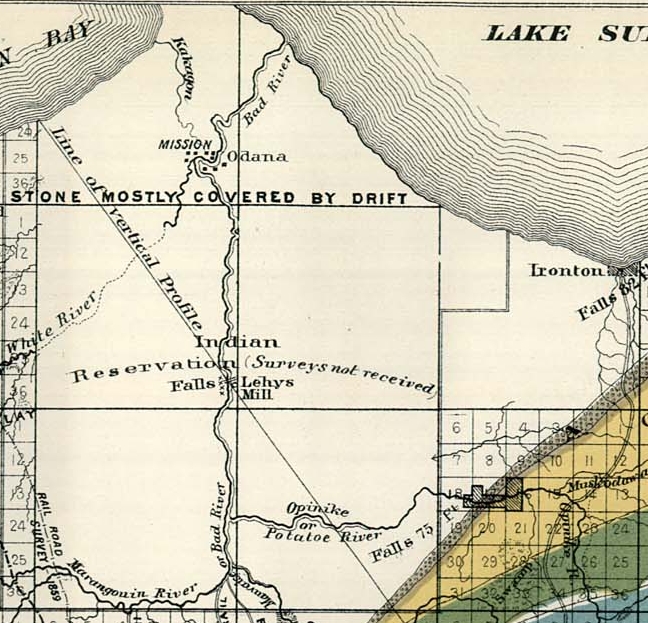
Details of Ervin Leihy’s sawmill on the La Pointe Reservation from Charles Whittlesey‘s 1860 Geological Map of the Penokie Range from Geology of Wisconsin: Volume III, plate XX-214. Also shown are the Opinike (or Potatoe) River Property, Ironton, and McEwen’s Sawmill.
Bayfield County Press
March 31, 1900
[Transcribed and shared by Robert J. Nelson, 2016]
Incidents of Early Days on Lake Superior
At the Falls of Bad River
By Ervin Leihy
– Ervin Leihy, one of the first white settlers to come to the northern part of Wisconsin died at his home in this city last week. He was born in Oswego county, N. Y., October 12, 1822. His early life was passed on a farm and at 18 moved to Illinois. Later he bought a farm at Bad River, Ashland county, and in 1846 moved onto it. In 1870 he moved to Bayfield, built his present home and opened a general store which he conducted for a number of years. While living at Bad River he was a member of the town and county boards of Ashland county for a number of years and in 1871 and 1872 was a member of the town board of Bayfield. Besides these he held numerous other offices. He was a public-spirited man, had plenty of means and was always ready to assist in anything that would tend to advance the interests of the town in which he resided.”
~ Wisconsin Weekly Advocate, June 6, 1901.
Next day our arrival at the Falls (October 5, 1846) was spent in looking over the surroundings. The murmur of the stream, the stream itself and the surrounding scenery, reminded me of the scenes of my earliest recollections on the banks of the Salmon River, Oswego County, New York. Here to his game in the forest, fish and the stream and sugar in the trees; and the soil is good.
Potatoes are worth one dollar per bushel and corn two dollars per bushel. Those were my musings as I sat on a big rock at the head of the falls. Here were many of the necessaries and some of the luxuries of life and all for the taking and no taxes to pay – all as free as air.
To say that I was delighted would be putting it mildly. I asked the captain what were his plans. He had none; he simply liked to live in the woods. Here, let me digress. Captain Wood was a man about 53 years old, had gained perhaps earned the prefix to his name during what was termed the “Toledo War,” early a squabble between the states of Ohio and Michigan for jurisdiction over a strip of land in which Toledo was the principal town. Wood being deputy sheriff of Monroe County at that time was put in command of a company of Michigan troops to help all the claims of the state of Michigan. Withal, a genial and agreeable companion. Not much time was lost.

Detail of Leihy’s sawmill and Bad River Falls omitted from the Barber brothers’ survey of the La Pointe (Bad River) Reservation.
I have soon acquired a half interest in the “Hermitage” which consisted of a long, hut about 14 feet square, a fireplace in one corner, and covered with shakes; nearly an acre of cleared land, 20 or 30 bushels of potatoes and perhaps as many more of rutabaga; a couple of axes and a hoe or two.
Brother George had gone with his boat and men. I began to talk to Capt. Wood about LaPointe of which I heard so much. He finally said, “perhaps you would like to go there?” I told him I certainly would.
Well, we found our way to LaPointe, and an interesting place. It certainly was. Here the North American fur company was in full bloom, under the efficient management of Messrs. Borup and Oakes. The traders, had already left with their outfits for their various stations at Lac du Flambeau, Lake Courerille, Sandy Lake, Leech Lake, Grand Portage and other points, not to return until May or June when they were expected to return laden with bear, beaver, otter, Fischer, Martin, mink and other valuable fur.

Reverend Sherman Hall
~ Madeline Island Museum
Here to was established a Catholic mission under the care of father Baraga; also a Presbyterian mission in under the care of Rev. Sherman Hall, and all in flourishing condition.
Fishing was also carried on to a considerable extent among the islands by the Fur company. The side-wheeler Julia Palmer, have been hauled over the portage at the Soo and had just made one trip as far West as LaPointe. The rest of the fleet on Lake Superior consisted of five small sail vessels, viz. the Merchant, Swallow, Algonquin, Fur Trader and the Chippewa.
A Mr. Hays was subbing in agent and Mr. Van Tassel was the government blacksmith at that time at LaPointe.
We stayed but a few days, procured a few necessary tools, some supplies for the winter and return to the Falls.
There were now [four] in camp. Captain Joseph Wood, Charlie Rowley, John Smith and myself. Wood, Smith and I went to work on the second house built in what is now Ashland County outside of LaPointe.
 Chequamegon History