Judge Bell Incidents: Fooled the Austrian Brothers
October 30, 2025
Collected & edited by Amorin Mello
This is the third post in a series featuring The Ashland News items about La Pointe’s infamous Judge John William Bell, written mainly by his son-in-law George Francis Thomas née Gilbert Fayette Thomas a.k.a G.F.T. In today’s post we explore stories about real estate transactions negotiated between Judge Bell and Julius Austrian.
… continued from King No More.

The Ashland News
Wednesday, January 11, 1888, Page 5
STORIES OF JUDGE BELL
HOW HE FOOLED THE AUSTRIAN BROTHERS IN A LAND DEAL.
“Incidents in the life of Judge John W. Bell. – A Half Century in Old La Pointe – by Geo. Francis Thomas.”
Such is the proposed title to a forth-coming historical work which will prove wonderfully interesting, especially to the older residents in this vicinity. The author begins with the year 1835, when the brig “John Jacob Astor,” the first vessel built upon the shores of Lake Superior, first cast her anchor in the bay at La Pointe, and ends with the death of the old pioneer, John W. Bell, which occurred but a few days since. In speaking of the pioneer the author says:
“From the day that Mr. Bell stepped ashore at La Pointe from ‘The Astor,’ June 23, 1835, to the day of his death, he was a character possessing a most positive individuality; and it was not until his later years, and then when he had become financially distressed, that his wonderful spirit became at all broken; but even then he was never known to as a favor.”
The old judge, or “Squire” as he was usually called, was always ready to relate some incident of early days in which he was usually a participant. There are also a great many equally interesting incidents related by others, where the old judge would not justify his telling the story himself. The author says:

Detail from Julius Austrian’s 1854 Plan of the Town of La Pointe with Judge Bell’s Block 35 and four small Lots.
~ Wisconsin Historical Society
“[…] except a small portion in the North West Corner claimed and enclosed by Edwin Connor, and so much of the South West Corner as is claimed by P. B. Vanderventer, and the enclosure of Barboo & Meletle in the South East Corner”
“The old man always liked to have things done on the square, so when Julius Austrian was platting the village of La Pointe and proposed to Mr. Bell to give him the block he already occupied for a nominal consideration, Mr. Bell insisted that his block, number thirty-five, be exactly square – all the four streets crossing at right angles. A square block or lot was quite a novelty where each squatter’s garden-patch had been fenced in and called a lot, regardless of street lines or quantity of land.”
Memoirs of Doodooshaaboo: Joseph Austrian’s Time at La Pointe 1851-52 (Pt. 2)
“Our blind brother Marx Austrian with brother Julius’ assistance at that time, preempted 160 acres of land near Bayfield from La Point, complying with preemption laws. He built a small log house living there with his wife. One night during their first winter in their new house, there was a knock at the door, and when opened they were confronted by a number of Indians, who were evidently under the influence of liquor and who swinging their tomahawks vigorously, making all sorts of threatening demands. An old Indian who knew Marx interceded and enabled him and his wife to escape without injury who thoroughly scared fled panic stricken in the dark about two miles at night, over the ice, on the Bay which was covered with a foot of snow to La Point for safety. The poor woman having the hazardous task of leading her blind husband over this long and difficult road, not to come back again and glad to escape with their lives and thus abandoning their right of preemption. This place was later on platted and is now known as the Bayfield Addition.”
Mr. Bell was an acute judge of human nature, and made it an invariable rule to deal with his fellowmen according to each one’s individual peculiarity. Before Bayfield was located, or in fact thought of as a town site, a Hebrew by the name of Marx Austrian pre-empted the 126 acres of land now known as Austrian’s clearing, and which adjoins Bayfield on the south. After a short residence upon the claim Mr. Austrian’s family became sick, and in order that proper care might be given them they were compelled to move to La Pointe, where a physician could be had. A speculator, noticing the apparent irregularity, tried to jump the claim. The case was taken to Superior for trial, and Mr. Bell, being the only available witness, the Austrian brothers and Louis Leopold proposed to give him a one-fourth interest in the land as compensation for making the trip to Superior. Mr. Bell accordingly accompanied the party, to Superior, and on arriving at the hotel as was his custom, he immediately began to make himself at home with the guests of the house, most of whom he was well acquainted with. At length when the case was called, Mr. Bell seemed so entirely unconcerned that he was urged to come forward by some one of the interested parties; but Mr. Bell carelessly said,
“Oh! I believe I will not attend court today.”

Julius Austrian
~ Madeline Island Museum
The Austrians wildly expostulated, and at last agreed to pay all the old “Judge’s” expenses for the trip, besides giving him a one-fourth interest in the 126 acres of land. This brought him all right and Marx Austrian gained his point. A few years later, when the town of Bayfield was laid out by the Hon. Henry M. Rice, the Austrians, Julius and Marx, concluded that they ought to buy back the one-fourth interest in the 126 acres held by “Squire” Bell, and accordingly Julius approached him on the subject. Mr. Bell was a man of few words and no give-in to his dictum. He told Austrian that $1,000 would buy his interest if taken by noon the next day. Austrian claimed the price was exorbitant but finally went off to get the cash. on the morrow at noon, or a few minutes before, Austrian called on Bell and said he could only give him $800. Mr Bell insisted on $1,000, which Julius Austrian finally agreed to pay;
“but,” says Mr. Bell, “now you are too late. It is fully a minute past the time which I specified, now I will not take less than $1,250, and that must be forthcoming within two hours from now.”
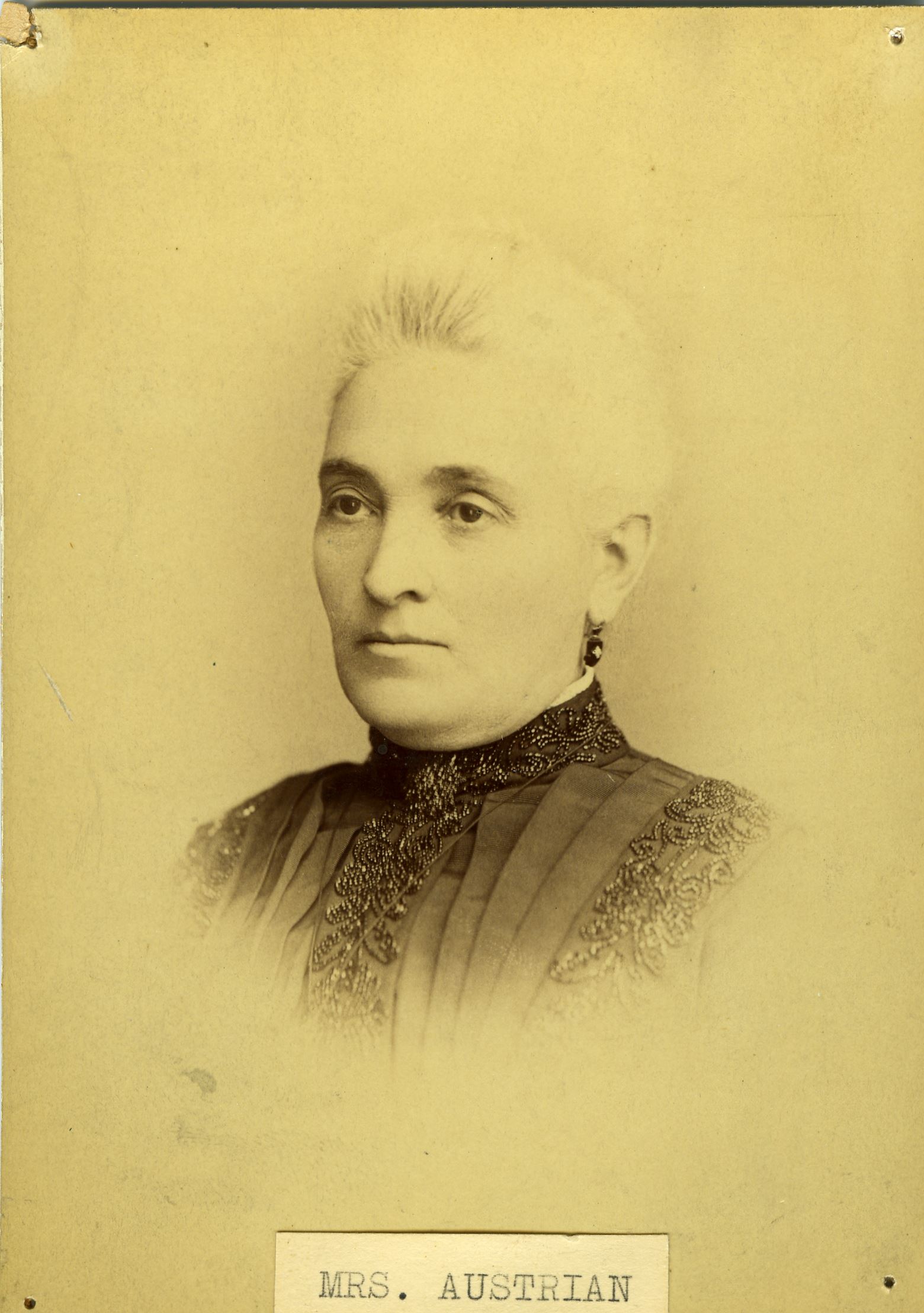
Hannah Leopold Austrian
~ Madeline Island Museum.
This time Austrian kept away, thinking Mr. Bell would go back to his $1,000 offer if he did not seem too anxious. In that Mr. Austrian misjudged his man, for when Austrian again approached the “squire” his price was $1,500 spot cash. Things now looked dubious to the Austrians, a conference was held with Mrs. Hannah Austrian and together they raised $1,300, all the cash which was available at that moment. This they handed over to Mr. Bell with a sight due bill for $200, secured by a deposit of all Mrs. Austrian’s jewels, including her diamond earrings. They got back the one quarter interest in the 126 acres, and they have paid taxes on it ever since, yet the whole is hardly worth now what the quarter cost them.
“This recalls an incident back in ’61 or ’62,” said one of the jurymen at a recent trial in this city. “It was a case against a trader who was accused of selling whiskey to an Indian. The jury was drawn, and after hearing the evidence they retired to a back room to determine on a verdict. It was about four o’clock in the afternoon. At six o’clock the jury was about evenly divided. About midnight, after continuous balloting, the vote stood ten for acquittal and two for conviction. There was no fire in the room, and it was very cold. The ten jurors who stood for acquittal made one final request to the other two to vote with them, but they persistently refused. The ten then got a long pine board and laying it across two stools proceeded to play an interesting game of freeze-out. About two o’clock one of the two came over on the other side and joined the rest in the game of freezing out the other juror. At three o’clock in the morning he gave up.”
To be continued…
Bayfield’s Early Days
December 22, 2016
By Amorin Mello
This is a reproduction of “Bayfield’s Early Days;” a paper read at Bayfield’s 50th Anniversary by Nazaire LaBonte, as printed in the Bayfield County Press on April 6th, 1906.

“Map of Bayfield situate in La Pointe County, Wisconsin.” By Major McAboy for the Bayfield Land Company in 1856.
~ Wisconsin Historical Society
BAYFIELD’S EARLY DAYS

Nazaire LaBonte
~ FindaGrave.com
Mr. Toast Master, the Bayfield Commercial Club and Ladies and Gentlemen: We are here this evening, as you all know, to commemorate Bayfield’s fiftieth birthday, and I am duly grateful and exceedingly happy to be in your midst this evening, and at the request of the club, to make an accounting of the fifty years just past which was spent here. In order to prepare you for the ordeal, it might be well to remind you that I am not an orator of note, and if I hear some one say, “That man LaBONTE is a cracker Jack of a talker,” don’t you think for a moment I will believe it.
If you are prepared for the worst, I will proceed. I am one of a family of eleven (five boys and six girls) and the son of Francis and Angeline LaBONTE. I was born at Quebec, Canada April 6, 1836, and lived on a farm adjoining that city until I departed for Bayfield which occurred when I was twenty years of age, taking passage at Detroit on the side wheel steamer, Superior, Capt. SWEET commanding the boat. I am not sure, but believe the folks around felt pretty bad when I left, and I have heard since that lots of people in Canada cried when they learned I had quit that country, and it was said I was a brainy man and it was a shame to see me go, and that it would be hard to replace me. I cannot say whether they ever replaced me or not.
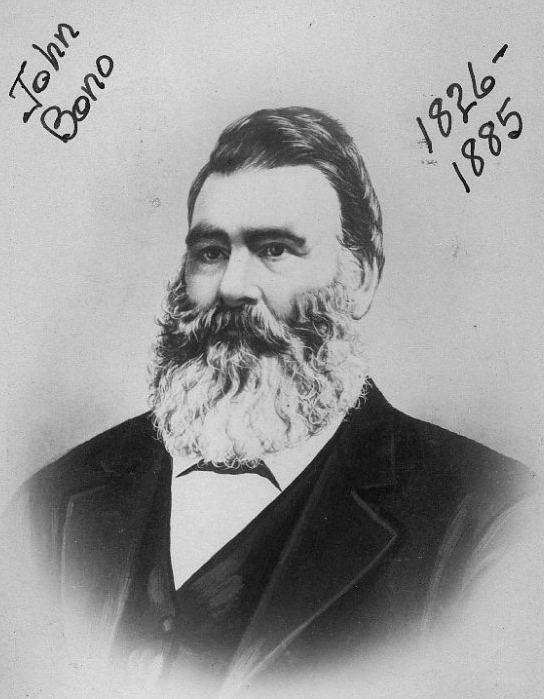
John Baptiste Bonneau was the father-in-law of LaBonte, and the namesake of Bono Creek on Chequamegon Bay.
~ FinaGrave.com
Among those who were fellow passengers with me for Bayfield were Benjamin BICKSLER, Frank DAVIDSON, John T. CAHO, and a Mr. WYMAN and a Mr. STEADMAN. Our boat’s cargo consisted of a little of everything including a lot of cattle for Ontonagon, Mich., but on account of a heavy sea that prevailed we were unable to make that port and came on through to LaPointe, Wis., then a stirring village and headquarters of the American Fur Company, where we arrived June 9th 1856, being en route four days as I remember it. The boat did not stop at Bayfield for the reason there was no dock here at that time.
I was anxious to continue on to Superior, but my cash was running low, and when I struck the captain for a ride to that port on the strength of my good looks, or pay fare on the installment, (and all I could scrape up was seventeen cents) the captain, in a gruff way said: “You walk, you pea souper!” I never liked Capt. Sweet since.
The following morning in company with those mentioned, I came over from LaPointe to Bayfield in a rowboat which landed us at the present site of the Dormer BOUTIN Fish Co.’s plant, where there was a dock being built, owned by a Mr. Charles CHILDS of Sault St. Mary, who sometime afterward sold the same to H. M. RICE, C. P. RUDD, and S. L. VAUGHN, and afterwards known as the Vaughn dock, until sold to W. F. DALRYMPLE.
The only building here then was a log house located where M. RYDER’s store now stands, built and owned by the Bayfield Land Company for the accommodation of the men employed by this concern. This company consisted of H. M. RICE, John D. LIVINGSTON, RITTENHOUSE, DAVIDSON and PAYNE. There was not a woman here and it makes me lonesome to make this statement.
That part of the town site lying on the flat was covered by a scattering growth of small Norway pine with an occasional large white pine; and the only thoroughfare was a trail leading from the dock site to the log house mentioned. The hills now dotted with buildings were covered with mixed woods, mostly hardwood.
I found employment here with the Bayfield Land Co., on a mill that was building on the site upon which now stands the R. D. PIKE Lumber Co. mill. The mill was completed and operating in October of that year and about two months afterwards burned down after which I turned my attention to cutting cord wood which was sold to the steamers for fuel purposes.
In the Spring of fifty-seven, I with others started to cut out the Bayfield and St. Paul stage road as far as Yellow Lake, a distance of about 140 miles; the balance of the route to St. Paul was by way of Wood River to Sunrise over logging roads. Sunrise (50 miles from St. Paul) was a junction where the St. Paul stage met both the Bayfield and Superior stages and took their freight and passengers. It required six days to make the trip from Bayfield to St. Paul and the fare was twenty dollars, meals extra at 50 cents each and lodgings the same.
From this time until about 1880, I cut cord wood, logs and made fish barrel staves of clear white pine that was so plentiful at that time.

Matilda Davis; wife of LaBonte and stepdaughter of Bono.
~ FindaGrave.com
On April 4, 1861, I was married to Miss Matilda DAVIS [Bono], Father John CHEBULE officiating.
In the summer of ’61, I went to work in the Red Cliff saw mill (the property of Uncle Sam), which had just been built under contract with the government by Colonel John BANFIELD. I worked there for twelve years in the capacity of sawyer, filer, and scaler on a salary of $3.00 per day. My family and myself resided there about half of the time and the balance of the time in Bayfield. Six men, including myself, constituted the mill crew and the capacity of the mill was six thousand feet per day, which was measured, marked and piled as fast as it left the saw. My neighbor (Commodore Bob INGLIS) was engineer in the mill part of one season, Bob was a good mechanic, a trim, good-looking fellow, and of course was a favorite of the maids on the reservation, and I never found out why he quit that good job and pleasant surroundings so soon. I am told Bob likes the girls yet, but of course, one must not believe all he hears, and allowing that it is the truth, I cannot blame him, for I like the girls myself.
The mill was sold to Duluth parties after operating twelve years, after which I built and kept a summer boarding place known as the LaBONTE house at Bayfield which house was open to the public for many years. I raised a family of four children (Mrs. N. BACHAND and Mrs. CHURCH) who are both here with their families at the present time, and lost a son at the age of six and one half years and also an infant daughter.
My health has always been good, and as far as I know, I am a better man than my wife today. I am seventy years of age, have lived here fifty years and expect to live here fifty years longer, at the expiration of which time if the politics are too corrupt or conditions don’t just suit, I shall move West and grow up with the country.
I am yours very respectfully,
N. LaBONTE
Bayfield’s Beginnings
March 6, 2016
By Amorin Mello
This is a reproduction of Captain Robinson Darling Pike’s speech for the 50th anniversary celebrations of Bayfield, Wisconsin on March 24th, 1906. It was originally digitized and reproduced onto RootsWeb.com by John Griener, a great-grandson of Currie G. Bell. The Bayfield County Press was in the Bell family from the Fall of 1882 until July of 1927. Pike’s obituary was not included in this reproduction.

Portrait of Bayfield from History of Northern Wisconsin, by the Western Historical Company, 1881, page 80.
Capt. R. D. PIKE on
Bayfield’s Beginnings
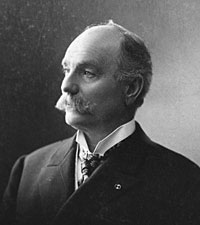
Captain Robinson Derling Pike
~ A gift that spawns Great Lakes fisheries:The legacy of Bayfield pioneer R.D. Pike, by Julia Riley, Darren Miller and Karl Scheidegger for the Wisconsin Department of Natural Resources, October 2011.
Robinson Darling PIKE, son of Judge Elisha and Elizabeth Kimmey PIKE, was a lumbering giant in early Bayfield history. Capt. R. D. Pike, as his name appeared weekly in the Press, was one of the most influential men in the county, associated not only with timber interests, but with the Bayfield Brownstone Company, the electric light company, the fish hatchery, etc. Just before his death on March 27, 1906, he wrote the following recollections of early Bayfield. The paper was read at the Bayfield 50th anniversary celebrations and was published in the March 30, 1906 issue of the Press along with Capt. PIKE’s obituary:
I regret very much not being able to be with you at the celebration of the fiftieth anniversary of the town of Bayfield. As you may be aware, I have been ill for the past few weeks, but am pleased to state at this time I am on the gain and hope to be among you soon. If my health permitted I would take great pleasure in being present with you this evening.
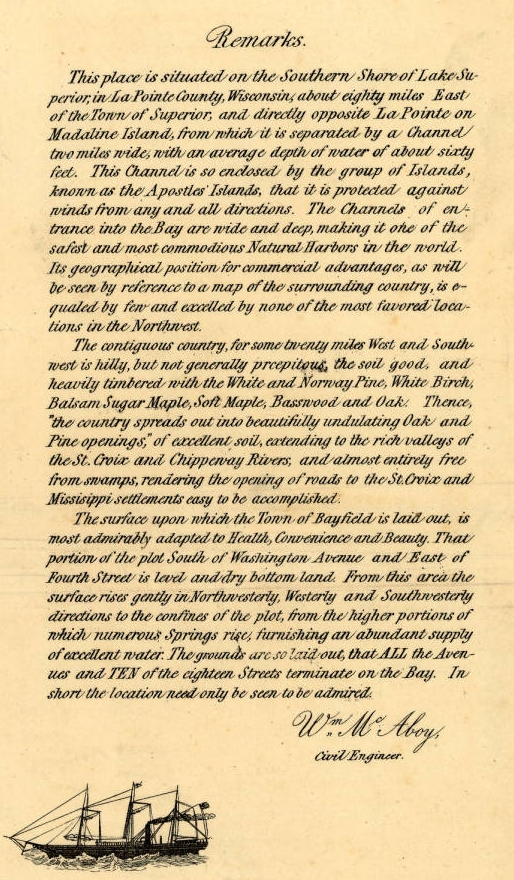
Detail from Major William McAboy‘s 1856 Map of Bayfield.
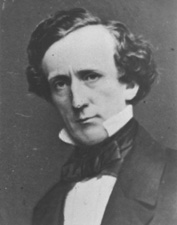
Senator Henry Mower Rice
~ United States Senate Historical Office
I remember very distinctly that the first stake was driven in the town of Bayfield by Major McABOY who was employed by the Bayfield Townsite Company to make a survey and plat same, (the original plat being recorded at our county seat.) This Bayfield Townsite Company was organized with Hon. Henry M. RICE of St. Paul at the head and some very enterprising men from Washington D.C. Major McABOY arrived here about the first of March and made his headquarters with Julius AUSTRIAN of LaPointe. Julius AUSTRIAN in those days being the Governor General of all that part of the country west of Ontonagon to Superior; Ashland and Duluth being too small to count The major spent probably two weeks at LaPointe going back and forth to Bayfield with a team of large bay horses owned by Julius AUSTRIAN, being the only team of horses in the country.
For more information about Julius Austrian, see other Austrian Papers.
I remember very well being in his office at LaPointe with father, (I being then a mere lad of seventeen,) and I recollect hearing them discuss with Mr. AUSTRIAN the question of running the streets in Bayfield north and south and avenues east and west, or whether they should run them diagonally due to the topography of the country, but he decided on the plan as the town is now laid out. Mr. AUSTRIAN and quite a little party from LaPointe came over here on the 24th of March, 1856, when they officially laid out the town, driving the first stake and deciding on the name Bayfield, named after Lieutenant Bayfield of the Royal Navy who was a particular friend of Senator RICE, and it was he who made the first chart for the guidance of boats on Lake Superior.
“Map of Bayfield situate in La Pointe County, Wisconsin” by Major William McAboy, 1856 for the Bayfield Land Company.
~ Wisconsin Historical Society

For more information about Indian interpreter Frederick Prentice, see his appearances in the Barber Papers.
~ Portrait of Prentice from History of the Maumee Valley by Horace S Knapp, 1872, pages 560-562.
The summer of 1855 father was in poor health, filled up with malaria from the swamps of Toledo, and he was advised by Mr. Frederick PRENTICE, now of New York, and known by everybody here as “the brownstone man,” to come up here and spend the summer as it was a great health resort, so father arrived at LaPointe in June, 1855, on a little steamer that ran from the Soo to the head of the lakes, the canal at that time not being open, but it was opened a little later in the season.

Detail of “Austrian’s Saw Mill” on Pike’s Creek, Chequamegon Bay, Lake Superior, circa 1852.
~ Wisconsin Public Land Survey Records
Upon arrival at LaPointe father entered into an agreement with Julius AUSTRIAN to come over to Pike’s creek and repair the little water mill that was built by the North American Fur Company, which at that time was owned by Julius AUSTRIAN. He made the necessary repairs on the little mill, caught plenty of brook trout and fell in love with the country on account of the good water and pure air and wrote home to us at Toledo glowing letters as to this section of the country. Finally he bought the mill and I think the price paid was $350 for the mill and forty acres of land, and that largely on time; however the mill was not a very extensive affair. Nearly everything was made of wood, except the saw and crank-pin, but it cut about two thousand feet of lumber in twelve hours. Some of the old shafting and pulleys can be seen in the debris at the old mill site now. Remember these were not iron shafts as we used wooden shafts and pulleys in those days. This class of the mill at the time beat whip-sawing, that being the usual way of sawing lumber.
Father left LaPointe some time in September 1855 for Toledo to move his family to Pike’s creek, which stream was named after we moved up here. Onion river and Sioux river were named before that time. On father’s arrival from Toledo from this country we immediately began to get ready to move. We had a large fine yoke of red oxen and logging trucks. He sold out our farm at Toledo, packed up our effects, and boarded a small steamer which took us to Detroit. Our family then consisted of father, mother, grandma PIKE, and my sister, now Mrs. BICKSLER, of Ashland. We stayed several days in Detroit to give father time to buy supplies for the winter; that is feed for the oxen and cow and groceries for the family to carry us through until Spring.
We then boarded the steamer Planet, which was a new boat operated by the Ward Line, considered the fastest on the lake. It was about two hundred fifty tons capacity. We came to Sault Ste. Marie, it being the Planet‘s first trip through the Soo, the canal as I remember was completed that fall. During this year the Lady Elgin was running from Chicago and the Planet and North Star running from Detroit, they being about the only boats which were classed better than sail boats of the one hundred and fifty tons.

Portrait of the Steamer North Star from American Steam Vessels, by Samuel Ward Stanton, page 40.
~ Wikimedia.org
We arrived at LaPointe the early part of October, 1855. On our way up we stopped at Marquette, Eagle Harbor, Eagle River, and Ontonagon. We left Ontonagon in the evening expecting to arrive at LaPointe early the next morning, but a fearful storm arose and the machinery of the Planet became disabled off Porcupine mountains and it looked for a while as though we were never going to weather the storm, but arrived at LaPointe the next day. There were some parties aboard for Superior who left LaPointe by sail.
We remained at LaPointe for a week or ten days on account of my mother’s health and then went to Pike’s bay with all our supplies, oxen and cow on what was known as the Uncle Robert MORRIN’s bateau. Uncle Robert and William MORRIN now of Bayfield, and if I remember rightly, each of the boys pulled an oar taking us across. We landed in Pike’s bay just before sundown, hitched up the oxen and drove to the old mill. Now, this was all in the fall of 1855.

Detail from William McAboy‘s 1856 Map of Bayfield.
“HON. JOHN W. BELL, retired, Madeline Island, P.O. La Pointe, was born in New York City, May 3, 1805, where he remained till he was eight years of age. His parents then took him to Canada, where his father died. He had gotten his education from his father and served an apprenticeship at three trades – watchingmaking, shipbuilding, and coopering. He then moved to Ft. La Prairie, and started a cooper shop, where he remained till 1835, when he came to La Pointe, on the brig “Astor,” in the employ of the American Furn Company as cooper, for whom he worked six months, when he took the business into his own hands, and continued to make barrels as late as 1870. It was in 1846 or 1847 that Robert Stewart, then Commissioner, granted him a license, and he opened a trading post at Island River, and became interested in the mines. he explored and struck a lead in the Porcupine Range, on Onion River, which he sold to the Boston Company, and then came back to La Pointe. In 1854 he was at the treaty between the Chippewas of Lake Superior and the Mississippi River, and was appointed Enrolling Agent on their new reservation, on the St. Louis River, where he went, but soon came back, as the Indians were not willing to stay there. He was then appointed by the Indians to look up their arrearages, and while at this work visited the national capital. He was appointed to County Judge for La Pointe County, and helt till 1878. He was elected on the town board in 1880. Has been Register of Deeds a great many years. Has held most all the different county and town offices, and at one time held or did principally the business for the whole county. He has seen La Pointe in all of its glory dwindle down to a little fishing hamlet; is now Postmaster at his island home, where he occupies a house put up by the old fur company. He was married in 1837 to Miss Margaret Brebant, in the old Catholic Church, by Rev. Bishop Baraga. They had seven children – John(deceased), Harriette (now Mrs. La Pointe), Thomas (deceased), Alfred (now Town Clerk), Sarah F., Margaret (deceased), and Mary (now Mrs. Denome).”
~ History of Northern Wisconsin, by the Western Historical Company, 1881.
As I said before, the town was laid out on March 24th, 1856, and record made same at LaPointe by John W. BELL, who at that time was the “Witte” of all the country between Ontonagon and Superior; Julius AUSTRIAN being the “Czar” of those days and both God’s noblemen. [Note: This was a reference to Count Sergei Witte and Tsar Nicholas II, contemporaries of Capt. Pike. Witte was responsible for much industrial development of Tsarist Russia in the 1890’s.] The Territory now comprising the town of Bayfield was taken from LaPointe county. There were a number of very prominent men interested in laying out the townsite and naming our avenues and streets, such as Hon. H. M. RICE and men of means from Washington after whom some of our avenues were named.
Very soon after this they wished to build a large mill in order to furnish lumber necessary for building up the town. The Washington people decided upon a man by the name of CAHO, an old lumberman of Virginia, so he was employed to come up here and direct the building of the mill. A hotel was built directly across from the courthouse by the Mr. BICKSLER who afterwards married my sister. The saw mill was built about a block west of where my saw mill now stands. The mill had a capacity of five or six thousand feet per day and I think the machinery came from Alexandria, Virginia. Joe LaPOINTE was the only man recognized as being capable of running a mill from the fact that he could do his own filing and sawing. While they were constructing the mill they had a gang of men in the woods getting out hard wood for fuel, not thinking of using any of the sawdust, and they piled the sawdust out with the slabs as useless. Charley DAY, whom many of you will remember, who was the party who got out the hardwood as fuel for the mill.
Time has wrought many changes in our midst. As far as I know, I am the only white man living who was here at the time the town was laid out.
In conclusion I wish to say that at a banquet given in Bayfield some two or three years ago, I made the statement that when the last pine tree was cut from the peninsula on which Bayfield is located the prosperity of our town and vicinity will have just commenced. The pine has gone and now we are cutting the hemlock and hardwood which will last ten to fifteen years; and long before this is exhausted the cut over lands will be taken up and farms tilled, as is the history of other sections of the country.

“Elisha and R.D. Pike owned a private fish hatchery [at Julius Austrian’s former sawmill] in Bayfield County from the 1860s to 1895. The Wisconsin State Legislature mandated the construction of a fish hatchery in northern Wisconsin in 1895, so R.D. Pike donated 405 acres (1.64 km2) from his hatchery to serve as the state hatchery. The state built the main hatchery building in 1897 using brownstone from nearby Pike’s Quarry. The Chicago, St. Paul, Minneapolis and Omaha Railway built a siding to the hatchery, and a special railcar known as The Badger brought fish from the hatchery to Wisconsin waterbodies. In 1974, new buildings and wells were constructed to modernize the hatchery. The hatchery was renamed in honor of longtime Wisconsin Department of Natural Resources secretary Les Voigt in 2006, and the main building was named for R.D. Pike in 2011. The hatchery currently spawns five types of trout and salmon and also includes a visitor’s center and aquarium.”
~ Wikipedia.org
 Chequamegon History