Asaph Whittlesey Incidents: Number VII
March 27, 2023
Collected & edited by Amorin Mello

Originally published in the March 30, 1878, issue of The Ashland Press. Transcribed with permission from Ashland Narratives by K. Wallin and published in 2013 by Straddle Creek Co.
… continued from Number VI.
Early Recollections of Ashland: Number VII
by Asaph Whittlesey
—
I am now brought to the more difficult task of making suitable mention of those who were associated with me as original proprietors of the place, some of whom have already passed the bounds of time.
Charles Whittlesey whote about Martin Beaser working for the Algonquin Company of Detroit during 1845 in Two Months In The Copper Range:
“… Martin, a sailor just from the whaling grounds of the Northwest Coast …”
Martin Beaser, was a man of much more than ordinary ability. I am not informed as to his opportunities for education in early life, but judge that they were somewhat limited, while his individual experiences were wide spread. Nothing ever passed his notice, nor would he abandon a subject until he fully comprehended it. In form he was compact, and as he was capable of great endurance, no obstacle in his life seemed too great for him to surmount. A look at his extended library will itself evince his inclination for the best of literature. – When I first met him (in August, 1854,) I took him to be something like forty-two or forty-three years of age. I had often heard his name mentioned by my brother Charles, as having been associated with him during the season of 1846 in his geological explorations of the Lake region for the General Government in connection with Dr. Houghton, – but we had never met until in August, 1854. Mr. Beaser had been very successful in business during the “palmy days” of Ontonagon, and was abundantly able to meet the expense of opening the town site of Ashland.
I think Mrs. Beaser first made Ashland her home in 1856. On the 7th of June, 1855, there landed a large sized mackinaw at Ashland, (the boat being named Ashland,) containing the following persons:
~ Edwin Ellis Incidents: Part III
Martin Beaser, Captain and owner; G. L. Brunschweiler, civil engineer and draftsman, Charles Day, J. S. Norton, Jonas Whitney, a man by the name of Weiber and a Menominie Half Breed from Green Bay. This event was a signal for an onward movement, and during that season the town was greatly improved.
I think portions of the boat named may yet be seen near the base of Durfee’s Dock in Ashland. An amusing incident took place during this trip from Ontonagon which is deserving of notice. The boat, besides passengers, was heavily loaded with provisions, groceries, &c., so that the passengers were somewhat cramped for room. As the wind was fair the party kept under way all night long, reaching the mouth of Bad River about day break. Brunschweiler, who was a very passionate man, had passed the night in a very uncomfortable manner, on account of a box of saleratus taking up the room he needed for his comfort. He had evidently felt it as a very great annoyance to him the live-long night, and he could restrain himself no longer. He therefore, with an oath, pitches overboard the box of saleratus, and in doing so lost a very valuable meerschaum pipe belonging to himself, which created a roar of laughter from the party, Mr. Beaser himself joining therein. I will only add regarding our association with Mr. Beaser and his family, that we found them to be most excellent, and accommodating neighbors.

Detail of Ashland and Bay City from inset map on Plat of Prentice’s Addition to Ashland circa late 1850s or early 1860s.
~ Wisconsin Historical Society
Mr. Beaser was drowned in Ashland Bay November 4th, 1866, having evidently reached near the center of the bay before falling overboard. The wind was in the north east so that his boat landed a little south of Whittlesey’s landing at the head of the bay. – When the boat was found the sail was set and the boat contained the purchases he had made at Bayfield. Immediate search was made for his body, but it was not found until the following spring, when a Half Breed first discovered it near the mouth of Boyd’s Creek on the west side of the bay. The citizens of Bayfield gave the body a suitable burial, first at Bayfield, and subsequently it was removed to the Protestant burying ground on La Pointe Island.
Mr. Beaser was noted for his unusual good temper, and often indulged in practical jokes. At one time he was inquired of as to the provisions made for the poor in the town of Ashland. His answer was “we starve them out.”
BRIEF SKETCH OF THE LIFE OF GEORGE KILBOURN, JR.
While I lack much in his history to enable me to be as precise in my statements regarding him as I would like to be, I am, nevertheless, in a general way, fully acquainted with his entire history. Long before I was born, George Kilbourn, Senior, (father to the subject of this notice,) purchased a farm in my native town in Ohio, and here it was that George, Jr., first displayed his qualities as an axeman, evincing the grudge he steadfastly bore towards growing timber. Even before attaining his majority George, Jr., had cleared the principle portion of his father’s farm, and after his marriage he removed to Hudson, Ohio, where he purchased for himself a heavily timbered tract of 160 acres, the clearing of which afforded him the greatest comfort. Unfortunately he married very unhappily, and in due time his wife and children virtually drove him from his own home. I chanced to meet him something like two weeks previous to my leaving Ohio for this place, and informed him of the time I intended to stay, and bade him goodbye. But on my passing through Hudson on the cars for Cleveland as the appointed time, Mr. Kilbourn came on board the train and informed me he had decided to accompany me on my trip to Lake Superior, that he could not endure it to remain at home any longer. This was, in brief, his history up to the time of our leaving Ohio in 1854. – The Kilbourns are known as a long lived race, while the “old stocks” were all hard workers. George, Jr., (better known as Uncle George,) was not far from fifty-five years of age when he first came to this country. He died suddenly in July, 1870, while visiting a daughter then living at East Hartford, Michigan, being not far from seventy-one years of age. His father and mother lived together at Hudson, Ohio, quite a number of years after Uncle George left Ohio, and lived to pass something over seventy years together in married life.
~ Edwin Ellis Incidents: Part IV
Had it not been for Uncle George’s proclivity and skill in clearing land, the clearings in and about original Ashland would have been much more limited than they are now. I have often known him to chop all day long, and during bright nights he not unfrequently left his bed and put in from one third to one half of the night felling timber. He often requested me, in case I out-lived him, to bury a good axe and grind stone with him. He had also another peculiarity belonging strictly to himself and that was a ravenous appetite, and usually ate the most and worked the hardest during his sick days. At one time when he was boarding with Conrad Goeltz, he started out just at day break to get to his chopping, and as he passed through the dining room caught sight of extended preparations upon the table which had been specially arranged the evening previous for a party of six persons who had ordered their breakfast at an early hour, but without giving it a thought Uncle George placed himself outside of all there was in sight, and poor Conrad has not to this day forgotten how infernally mad he felt when he found out how he had been victimized. I will add further that Uncle George called this a lunch only, and was on hand for breakfast at the usual hour. We all regarded him as being a hardworking, conscientious and strictly honest man. The settlers, whites, half breeds or Indians all addressed him by the familiar title of Uncle George.
To be continued in Number VIII…
Edwin Ellis Incidents: Number VI
April 13, 2022
By Amorin Mello

Originally published in the August 11th, 1877, issue of The Ashland Press. Transcribed with permission from Ashland Narratives by K. Wallin and published in 2013 by Straddle Creek Co.
… continued from Number V.
EARLY RECOLLECTIONS OF ASHLAND
“OF WHICH I WAS A PART.”
Number VI

Edwin Ellis, M.D.
photograph from Magazine of Western History: Volume IX, No.1, page 20.
My Dear Press: – The history of the first attempt at dock building was told in a former chapter, and also the sudden disappearance of the dock one night in April, 1855.
The early settlers did not, upon their first arrival here, have any fair appreciation of the difficulties in the way of constructing docks, which should be able to resist the several forces to which they would be exposed, and which would certainly tend to their overthrow. They had not had, as this generation has, the advantage of years of observation of the force of ice as affected by winds, as floating in great fields and driven by wind and tide, nor of the great force arising from expansion. We now understand better what is the strength of these destructive forces. Some of us watched them with intense and eager anxiety for years; for no commercial town could be here built up without docks.
It may not be uninteresting to consider in a few words, the varying modes in which the heavy accumulation of ice, during our long winters, is got rid of in the spring, and navigation opened.
Some seasons the water in the bay seems to stand at the same level, not moving by winds or tides for many days in succession. The ice melts away under the rays of the sun and by the warmth of the south wind. It is a slow but gentle process. Any dock is safe in such a season. At other times there are sudden and great changes in the elevation of the surface of the ice or water, either from the force of wind on the open water in the outside lake, or from barometric pressure, or both combined, a great influx of water is driven under the ice into the bay. At that juncture the ice having been melted away near the shore all around the bay, the whole mass is lifted up several inches and held us on the top of a great wave. But the reflux of the water must soon occur – when this great field of ice moves down upon a heavy grade. Its speed will often be accelerated by a strong southwest wind. The force thus generated is well-nigh irresistible unless there be such a conformation of the shore as shall save the dock from its full effect, and such, fortunately, is the case with our shore.
Another force, also operating with great power and effect upon the first docks built here and from which they suffered severely, was the expansive power of ice, resulting from changes of temperature. The water in early winter freezes with level surface and is fast to both shores. But as the cold becomes more intense and the ice thickens, it also sensibly expands, and crowds with great power upon the shore. It is easy to perceive that docks fully exposed to this force would need to be very firmly bolted together, and covered with heavy loads, or they must be pushed over. Our docks were thus in the more exposed cribs, broken, and afterwards easily carried away by floating ice and waves. Our first docks having been carried away; though somewhat alarmed, we did not at once give up.

Martin Beaser
portrait from Magazine of Western History: Volume IX, No.1, page 24.
In December 1855, two docks were commenced, one called the Bay City Dock, near the sash factory – and the other at the foot of Main Street in Beaser’s Division of Ashland, in front of the present residence of James A. Wilson. This last was built by Mr. Beaser. His plan was to build cribs with flattened timber, fitted closely together so as to hold the clay with which they were filled as ballast, instead of rock, for rock could only be obtained at great cost. We had no steam tugs then, with which to tow scows, as at present. The cribs were carried out some five or six hundred feet and filled with clay. Stringers connected the cribs, over which poles were laid as a roadway.
The Bay City Dock was also built out into deep water with an L running east. The cribs near the shore were filled with rocks, but for want of time the outer cribs and the L were not filled before the spring break up. The cribs were, however, constructed with stringers and covered, and some two hundred cords of cord wood were piled upon the dock to prevent the moving of the cribs.
The ice in the bay had not moved, but was melted away and broken up for a few hundred feet from the shore. There was a great influx of water from the Lake, raising the whole body of the ice. In a short time there was a greater reflux of the water, and the vast field of ice was seen to be in motion. All eyes were watching the docks, nor was it needed to watch long. Mr. Beaser’s was the first to give way. The cribs did not seem to offer any resistance to the moving mass. The most of them were carried away in less time than it takes to describe it. Only a few cribs near the shore escaped.
Nor was the attack on Bay City Dock long delayed; steadily onward came the mass. And the outer portion was soon in ruins, and the great pile of wood was floating upon the water. The cribs forming the approach for about three hundred feet, being filled with rock were not carried away. Thus in one hour were swept away the labors of many months, and several thousand dollars. The sight was discouraging to men who had come here to make their homes, and whose all was involved in the ruins. The elements seemed in league against us. The next day the steamer Superior arrived and effected a landing upon the broken timbers of our dock. Capt. Jones was in command of her, who, together with his boat were soon to go down in death beneath the waters of the Great Lake.

1860 photograph of the steamer Lady Elgin from the Chicago History Museum and digitized by Ship-Wrecks.net
During the summer and fall of 1856 the Bay City Dock was repaired and extended further into the bay, and the cribs filled with rocks, and the steamer Lady Elgin made several landings alongside. But during the winter of 1856 and ’57 the expansive power of the ice, showing against the cribs pushed off the timbers at the water line of several of the outer cribs, which, at the opening of navigation in 1857, were carried away, leaving only sunken cribs. The dock was never rebuilt, as the financial storm of 1857 began already to lower upon us. The sunken cribs still remain, as has been proved by the exploration of Capts. Patrick and Davidson, in command of the tugs Eva Wadsworth and Agate.
The experience of the “new Ashland” have demonstrated that pile docks can be built so as successfully to resist all the opposing forces to which they are exposed. The result of all our experience seems to show that the best dock which can be built is the pile dock filled in between piles with logs or slabs, or what would be better to drive piles close together, capping them and filling in with rocks which will, beyond doubt, be done so soon as our Penoka iron mountains shall be worked. The time when, must depend upon an improved demand for iron.
To be continued in Number VII…
Ashland, Wisconsin: Its Early Days
November 29, 2016
By Amorin Mello

Magazine of Western History Illustrated
November 1888
as republished in
Magazine of Western History: Volume IX, No. 1, pages 12-17.
—
ASHLAND, WISCONSIN:
ITS EARLY AND PRESENT DAYS.
—
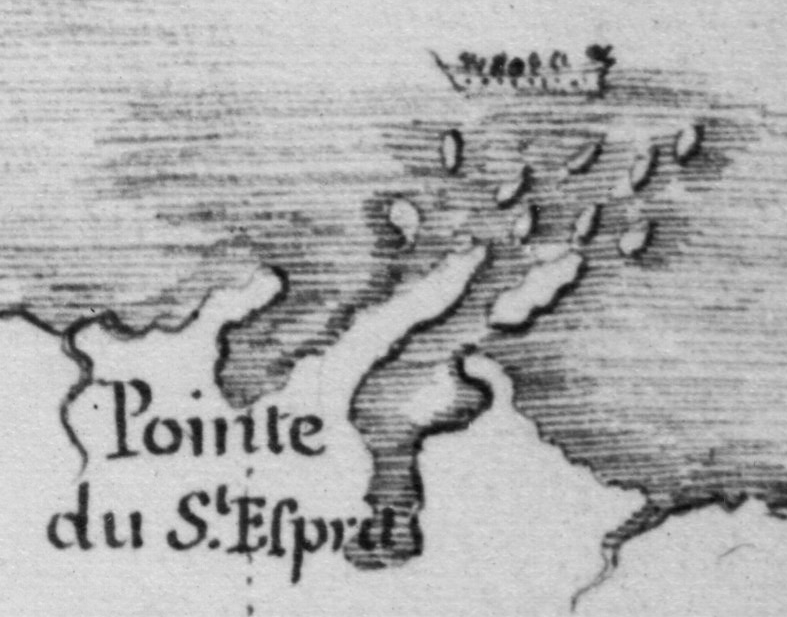
Detail of Lapointe du Saint Espirit and Mission du Saint Espirit from Claude Allouez Map of New France, 1669.
~ Research Laboratories of Archaeology
If the reader will look at the map of the United States, he will see on its northern boundary the largest body of fresh water in the world – Lake Superior, called by the Ojibways Kitche Gumi, “The Big Water.” It lies between 46 and 47 degrees north latitude, and stretches east and west through eight degrees of longitude. Its coast-line is nearly two thousand miles in extent, forming some of the finest natural harbors in the world. Its surface is six hundred and thirty feet above the ocean level, while its bottom in the deepest parts is four hundred feet below the level of the tide-waters. As you come from the east end of the lake, St. Mary’s river, approaching its western extremity, you will, from the deck of the steamer, notice a group of beautiful islands – the same islands which, more than two hundred years ago, met the gaze of Fathers Marquette, Allouez and Mesnard, and which, in their religious zeal, they named the “Apostles’ Islands,” thinking that in number they corresponded with the number of our Savior’s disciples. One of these they named “Madeline,” from a favorite saint of their own “Belle France,” and to commemorate one of the most noted churches of Paris.

Detail of “The 12 Apostles” from Captain Jonathan Carver’s journal of his travels with maps and drawings, 1766.
~ Boston Public Library
These islands in ancient times were doubtless a part of the main, as was also the land now lying under Ashland bay. Underlying them was sandstone, rising from twenty to one hundred feet above the water, and horizontal. The great glaciers coming from the north, and moving in a southwest direction, cut channels in the sandstone, forming these islands, and scooping out of the solid rock the large basin which, in after years, received the name of Chaquamegon bay, and which is now known as Ashland bay. This was the first prophecy of the city of Ashland. In the times, millions of years before this, the vast deposits of iron ore had been upheaved and stored along the south shore of the lake, to subserve the designs of the Mighty Builder in the development of that commerce of which we now see but the earliest down, and of whose future extent we can form but a faint comprehension. Chaquamegon, Le Anse and Marquette bays are the natural outlets on Lake Superior for the rich mineral deposits which line its southern shore.
The formation of Ashland bay was therefore not accidental, but in harmony with Eternal plans. It is protected from the storms of the lake by a long, low, sandy point, and also by the Apostles’ islands. Into it open from the lake three broad channels, with a depth of water ample for the largest vessels, called the North, Middle and South channels. Under these islands, vessels coming from the wild storms of the open lake are secure. It is the sailor’s haven of safety.

1834 Map of LaPointe by Lyman Warren for the American Fur Company.
~ Wisconsin Historical Society
The first settlement on the bay was made by the American Fur company in the early part of the present century, on the beautiful Madeline island, and named La Pointe. It continued for many years the headquarters of a flourishing fur and fishing trade. About 1830 a Protestant and, soon after, a Catholic mission were established there, and churches built by them, in which devoted missionaries labored to Christianize and civilize the Indians whose homes were here and in the surrounding country. Here toiled Rev. Sherman Hall, a missionary of the American board, and Rev. L. H. Wheeler, and also that devoted man, now known to us as Bishop Baraga. These have all passed away. La Pointe, then the most populous and active village on the lake, is now, alas, “The deserted village,” and is visited alone in veneration of its past memories.

Map inset of Chequamegon Bay with Houghton, LaPointe, Bayfield, Ashland, and Bay City.
~ Wisconsin Historical Society
On the west shore of the bay, opposite La Pointe, is the beautiful town of Bayfield, founded by Honorable Henry. M. Rice in 1856. It is the terminus of the C., St. P., M. & O. railroad and the headquarters of a flourishing fish and lumber trade, and one of the most charming summer resorts on the lake.
On the west shore of the bay is also the flourishing town of Washburn – named in honor of Wisconsin’s governor, Cadwallader C. Washburn. It is the favorite town of the Omaha railroad, and has several large saw-mills, and is an active and enterprising town.
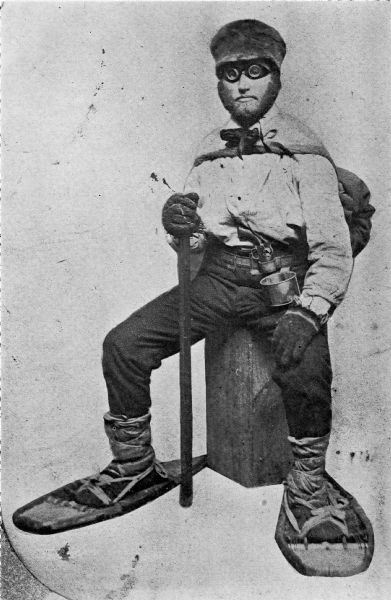
Asaph Whittlesey circa 1860.
~ Wisconsin Historical Society
The first settlement on the spot where Ashland now stands was made, in 1854, by Asaph Whittlesey and George Kilborn, both natives of the Western Reserve, Ohio. The lands were not as yet surveyed, so that they could not preëmpt them, and there was as yet no Homestead law. For this reason they, with Martin Beaser, then living in Ontonagon, Michigan, laid claim, under the “Town Site” law, to about three hundred acres, embracing their log houses and small clearing. They platted this into town lots in 1855, and subsequently were allowed to enter their lands as claimed, and in due course received their title. In February, 1855, Edwin Ellis, a graduate in medicine, in the University of the City of New York, of the class of 1846, came on foot through the woods from St. Paul to the bay. He had been engaged in the practice of his profession in his native state – Maine – till 1854, when, attracted by the prospect of wider fields for enterprise in the new west, and by the advice of Judge D. A. J. Baker, his brother-in-law, then living in St. Paul, he came to Minnesota.

Edwin Ellis, M.D.
~ Commemorative Biographical Record of the Upper Lake Region by J.H. Beers & Co., 1905, pages 16-18.
The years 1853 to 1857 were years of wild speculation. The states of Wisconsin and Minnesota especially were covered with rising cities – at least on paper. Fabulous stories of rich silver, copper and iron mines on the south shore of Lake Superior attracted a multitude of active young men from the eastern states. The city of Superior had been laid out, and its lots were selling for fabulous prices. The penniless young man of to-day became the millionaire to-morrow. The consequent excitement was great, and in the event demoralizing.
The Bay of Ashland, stretching far in-land, the known vast deposits of iron near the Penokee Gap, whose natural route to market was evidently by Chaquamegon bay, indicated with moral certainty that at its head would rise a commercial mart which should command a wide extent of country. The vast forests of pine were then hardly thought of, and no efforts made to obtain them. The lands were unsurveyed, and all the “squatters” were, in the eye of the law, trespassers. Nevertheless, the new-comers ran “spotted” lines around their claims and built log-cabins to hold them, and began to clear up the land. In June, 1855, Dr. Ellis went on foot to St. Paul, and thence to Dubuque, Iowa, and secured from the surveyor-general an order to survey four townships about the bay, embracing the site of the present city of Ashland. In the meantime, many settlers had come in and preëmpted lands in the neighborhood. In the fall of 1855 many of them were enabled to prove up and get titles to their lands.
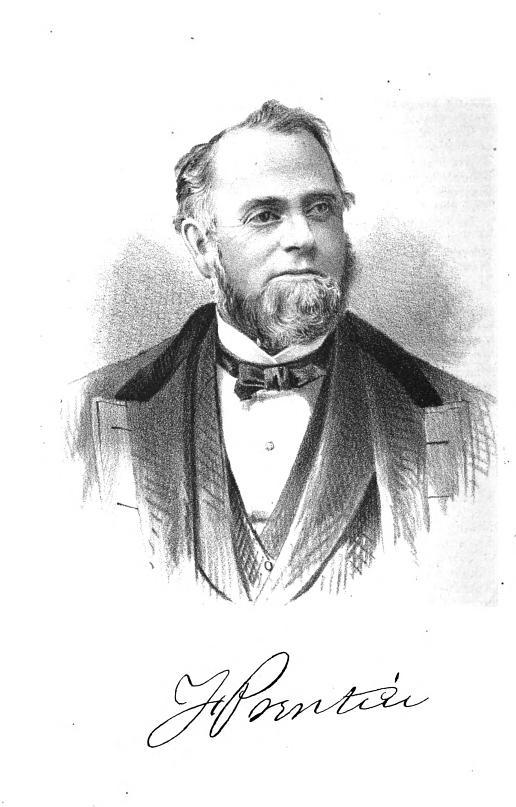
Portrait and biography of Frederick Prentice; the “first white child born in … Toledo.”
~ History of the Maumee Valley by Horace S Knapp, 1872, pages 560-562.
In the winter of 1855 Lusk, Prentice & Company, who had a trading-post within the present limits of Ellis’ division of Ashland, built a dock for the accommodation of the settlers coming to the new town. It was built of cribs, made of round logs sunk in the water about twenty feet apart. From one crib to another were stringers, made of logs, flattened on the upper surface, all covered with small logs to make a roadway. On the docks were piled several hundred cords of wood for the purpose of “holding” the dock from floating away, and to be sold in the summer to the steamboats which should come to bring supplies and begin the commerce of the town. The evening of the second day of April, 1855, saw the bay full of ice, slightly detached for a few feet from the shore, but with no sign of an immediate opening of navigation.

Portrait of Martin Beaser on page 24.
The next morning no ice was in sight, nor a vestige of the dock to be seen. Floating timber and cord-wood covered the bay. Till then the settlers had no idea the power of the floating ice moved by the tide of the bay. But they were not discouraged. The following winter two other docks were constructed – one by Martin Beaser, at the foot of what is now called “Beaser Avenue,” and the other by Edwin Ellis, near where Seyler’s foundry now stands.
These were also crib-docks, but the effort was made to anchor the cribs. There were no rocks to be had on the side of the bay where the docks were built, for which reason Mr. Beaser filled his cribs with clay, dug out of the banks. Dr. Ellis hauled stone across the bay, and filled as many of his cribs as possible, and on the top of the dock also piled several hundred cords of wood, and the settlers with anxious faces watched the departure of the ice. The shock came, and the docks afforded little resistance. The cribs filled with clay were easily carried. Those filled with stone stood better, but that part of those above water, and near the outer end, were swept away. The labors of many weary days and much money was thus swept away. There was, however, enough of the Ellis dock left to afford a landing to the few boats that came with supplies for the people.

Survey of Frederick Prentice‘s Addition of Ashland near the Gichi-wiikwedong village.
“It is in this addition, that, the Chippewa River and the St. Croix Indian trails reach the Bay, and for the purpose of accomodating the trade, already flowing in on their routes, a commodious store has just been built”
~ Wisconsin Historical Society
Translates as “Big Bay” in Ojibwemowin.
Traditional place-name for Ashland, WI.
Anglicized version of Gichi-wiikwedong.
Prentice Park and Maslowski Beach.
Area is famous for artesian wells.
“This was all Indian land then, but [Asaph] Whittlesey believed in take time for the forelock, looking he said, for a place that ‘might prove to be the most available point for a town, at or near Equadon (pronounced E Quay don, the second syllable emphasized.) The word ‘Equadon,’ is the Chippewa word meaning ‘settlement near the head of the bay.'”
~ The Ashland Daily Press, July 6, 1933, by Guy M. Burnham, reproduced on TurtleTrack.org. Read the full article for an interesting stories about how the town-site for Ashland was allegedly negotiated between Reverend Wheeler and Little Current.
During the years 1855, ’56 and ’57 many settlers had come to Ashland and built homes, and were all young men full of bright hopes for the future. In the spring of 1856 a township organization was formed, embracing more than forty townships of six miles square, and was called Bayport. The usual township officers were elected. The year 1857 opened with bright prospects. In Ashland streets were cleared and several frame houses were built. A steam saw-mill was begun and brought near completion. But in September of that year the great financial storm came, involving the whole country in ruin. The little village of Ashland was overwhelmed. The people had but little money, and in making their improvements had contracted debts which they could not at once pay. There had been so such speculation that the settlers had paid but little attention to the cultivation of the soil, depending upon supplies brought by water a thousand miles. We had no wagon roads nor railroads within three hundred miles. Winter was coming on, and many of the settlers – in truth, all who could get away – left the place. The few who remained saw hard times, whose memory is not pleasant to recall. Some of them, in making improvements, had assumed liabilities which well-nigh ruined them. If the county had then been organized for judicial purposes, so that judgements and execution could have been easily obtained, scarcely anyone would have saved a dollar from the wreck. But this fortunate circumstance gave them time, and their debts were finally paid, and they had their land left; but it then was without value in the market. Town lots in the village, which are now selling for five thousand to six thousand dollars, could then be sold for enough to buy a barrel of flour. The years following “’57” were hard years, and the settlers, one by one, moved away, so that in 1862 only two remained – Martin Beaser and Martin Roehn. In 1866 Mr. Beaser undertook to come alone from Bayfield to Ashland in an open sail-boat. It was a stormy day, and he never reached home. His boat was found soon afterwards at the head of the bay, and his body was found the following spring on the beach on the west side of the bay. Ashland was now left desolate and alone. Mr. Roehn, with a few cows, migrated backward and forward between Ashland and the Marengo river, finding hay and pasture for his cows, selling his produce and butter at Bayfield and La Pointe, and thus eked out an existence. The first railroad to reach Ashland was the Wisconsin Central, completed in 1877, connecting Ashland with Milwaukee. Work at the Ashland end was begun in 1872, and in 1873 finished to Penokee, twenty-nine miles south from Ashland. It had been built from the south to within about eighty-five miles of Ashland, and then came the panic of 1873, and all work stopped. The building in 1872 in Ashland was quite extensive, and village property sold at good prices, and everybody was hopeful. But the crisis of 1873 coming on, all enterprises at once stopped. Not till 1877 was the railroad completed. Its completion established Ashland on a substantial basis. In 1877 the Wisconsin Central company completed the Chaquamegon hotel, one of the finest in the country, which has added greatly to the attractions of Ashland.
The building of the Chicago, St. Paul, Minneapolis & Omaha road to this place, in 1883, gave a short outlet to the west and southwest, greatly benefiting the lumber trade.
The Northern Pacific, whose eastern terminus is at Ashland, soon after completed, gave it new importance as in the direct line of transcontinental commerce.
But the advent of the Milwaukee, Lake Shore & Western railroad had done more, perhaps to stimulate the growth of Ashland than any one of its great enterprises.
It runs northerly from Milwaukee to Manitowoc, where, turning in northwesterly course, it traverses vast tracts of valuable timber and farming lands, running for fifty miles along the Gogebic range – the richest iron region in the world.
This company has built two large and costly ore docks for the shipment of the vast amount of iron ore which it brings over its road.
South From Ashland
“The promoters decided to make Ashland the north end of their iron. It was a mere clearing, in the woods in 1870, formerly known as Equadon which was founded in 1854 and abandoned in 1863. The Ashland site was located on the bank of a splendid natural harbor called Cheguamegon Bay.”
…
“The clearing, grubbing and grading of the 30-mile Ashland-Penokee Gap Division had been practically complete in 1872. The iron rails were not laid into the Gap until October 1873, and there the railroad stopped for 4 long years.”
…
“Penokee Gap, 1000 feet above Lake Superior, is a break in the rough country, a regular gap where the Bad River breaks through the Iron Range Hills on its way to Lake Superior. The Gap is an historic pathway through which the copper workers from Mexico and South America came to Lake Superior centuries ago enroute to the copper deposits on Isle Royal in Lake Superior.”
~ History of the Soo Line, by James Lyden.
The Wisconsin Central Railroad company has also built a very fine ore dock, over which it ships the iron brought from the same range by its own line – the “Penokee Railroad” – built easterly along the northern base of the Gogebic range to Bessemer, in Michigan.
Notwithstanding the depression in the iron trade, more than a million tons of ore will be shipped from Ashland the present season.
Ashland has also two coal docks – one operated by the Ohio Coal company and the other by the Columbus & Hocking Valley Coal company – both of whom are doing a large business. The Lake Shore railroad and the Wisconsin Central obtain their coal for their engines, on the northern two hundred miles, by their docks at Ashland. The same rates for coal going west prevail as from Duluth and Washburn, and a large trade is springing up over the Omaha & Northern Pacific lines.
Ashland has three National and one private bank, all of which are conservative and carefully managed. It has also a street railway, two miles in length, with six fine cars and about forty horses, and is rendering very satisfactory service. We have also a “Gas and Electric Light Plant,” which affords abundant light for the streets, stores, dwellings and the ore docks. Ashland has also the Holly system of water-works, with about two miles of pipe laid, affording ample protection against fire and an abundant supply of water for domestic purposes. The pump-house has two ponderous engines, one being kept in reserve in case of accident.
As a point for the distribution of manufactured goods of all kinds, Ashland stands among the foremost. With practically the same rates as by the roads leading from Duluth west, it is prepared to compete with that lively town for part of the trade of the great northwest – now in its infancy but destined soon to attain great proportions; whose beginnings we can measure, but whose vast results we cannot now comprehend.
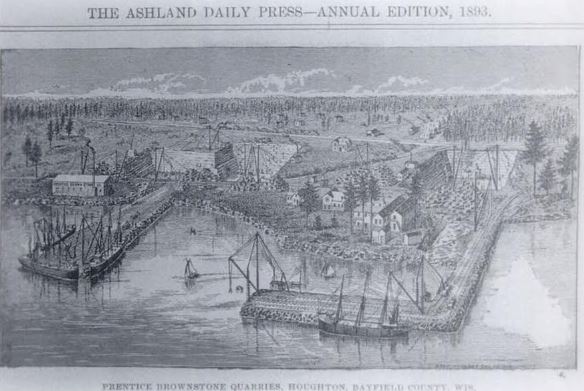
Portrait of Prentice’s brownstone quarries at Houghton Point.
~ Ashland Daily Press, circa 1893.
A Great Brownstone Industry Established At Houghton Point.
What Frederick Prentice Has Accomplished During The Season.“
~ Ashland Daily Press article in the Washburn Itemizer, October 18, 1888, reproduced on BattleAxCamp.tripod.com
One industry on Ashland bay is the brown stone, which exists along the water’s edge for many miles on the shore of the mainland and on the islands. It can be quarried in inexhaustible quantities within a few hundred feet of navigable waters of Lake Superior. It is of fine texture and beautiful color, and hardens by exposure. Large quantities have already been shipped and the demand is rapidly increasing. It can be shipped by rail at about four dollars per ton to Cincinnati. This stone, used for trimmings in buildings built of white brick, makes a very beautiful appearance.
The vast quantities of pine and hardwood timber in the vicinity of Ashland, and its advantages as a point of distribution for manufactured articles in wood, render it one of the best locations for manufacturing industries. For tanneries its location is unrivaled; the supply of hemlock bark is ample, while hides can be cheaply brought from Minnesota and the northwest, and the products can be shipped in all directions at low rates.
The schools of Ashland afford the best of opportunities for the education of our youth. Our school buildings are large, new and commodious, with all modern improvements. Our schools are graded and the attendance is large.
In the churches, most denominations are represented. The Catholic is the finest church edifice in the city, built of our own brown stone at a cost of over thirty thousand dollars. There are Presbyterian, Congregational, Episcopal, Baptist, Methodist, Lutheran and several Scandinavian churches.
As a summer resort, Ashland and the Apostles’ islands afford unrivaled attractions. Sail-boats, tugs and steamboats make daily excursions in all directions. They busy men from Chicago, St. Louis, St. Paul, Cincinnati and other cities can, in one day, escape from the sweltering heat and sleep on the cool ore of Lake Superior, and with our lines of railroad and telegraph stretching in all directons, they can be in constant and instant communication with their counting-rooms a thousand miles away. Its advantages in this line are already drawing many persons of wealth and leisure, as well as invalids, who come here to spend the hot season and at the close of the summer return home with new health and vigor.
Portrait of Edwin Ellis, M.D. on page 20.
Ashland has just two daily and three weekly newspapers, models of enterprise and very newsy, contributing much to the prosperity of the city.
The population of Ashland is about fifteen thousand, composed principally of persons under thirty-five years of age, and full of push and activity, who have come to stay and built up fortunes.
With all these and many other advantages Ashland seems to have a bright future, and many of us think it bids fair, in the near future, to become the second city in the state of Wisconsin. And we will labor that she shall be worthy of her rank.
 Chequamegon History