Asaph Whittlesey Incidents: Number V
October 2, 2018
By Amorin Mello

Originally published in the March 16, 1878, issue of The Ashland Press. Transcribed with permission from Ashland Narratives by K. Wallin and published in 2013 by Straddle Creek Co.
… continued from Number IV.
Early Recollections of Ashland: Number V
by Asaph Whittlesey
—
FIRST ELECTION IN THE TOWN OF BAY PORT.
The order of the County Board creating the Town of Bay Port was made March 11th, 1856, and the store of Schuyler Goff in Bay City was designated as the place for holding the first election for town officers, the election to be held April 1st, 1856.
The journal containing this order (which was in pamphlet form,) was destroyed by fire at the burning of the Webb House in Bayfield, Wis., June 4th, 1874.

Detail of La Pointe County from a map of Wisconsin published by J. H. Colton & Co., New York, 1856.
~ David Rumsey Map Collection
The new town comprised all that portion of La Pointe county, Wis., laying south of the north line of town 48 north, in all over sixty eight townships, including the Bad River Indian Reservation, which was, on the 8th of Nov. 1859, made a precinct by itself.
At the election held April 1, 1856, there were twenty-four votes cast, resulting as follows: For Chairman of Town Board, Schuyler Goff; remaining member of Town Board, J. T. Welton and Asaph Whittlesey. Schuyler Goff, Chairman elect, was the first to qualify, his oath of office being administered by Asaph Whittlesey, Justice of the Peace.
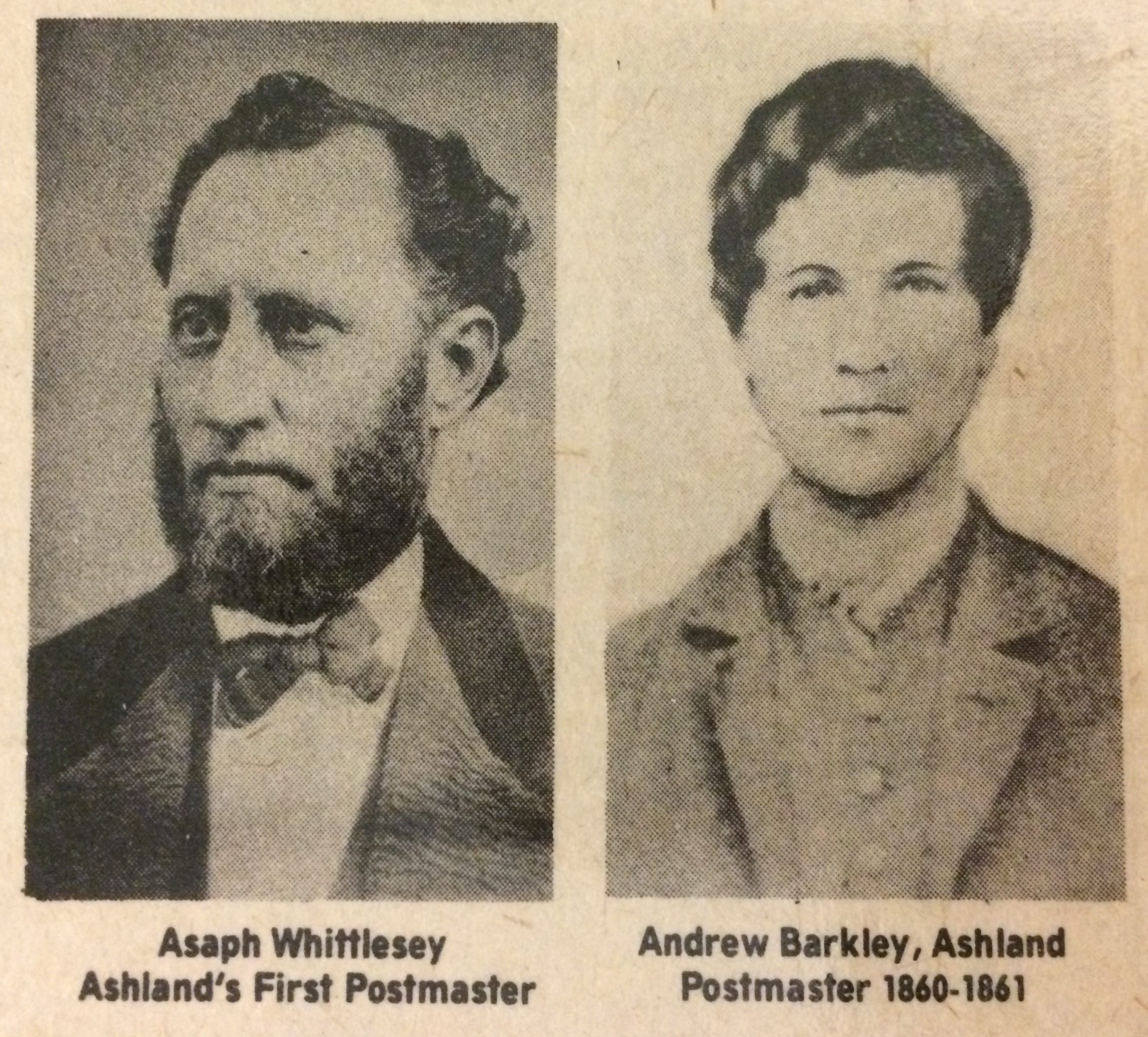
Photographs of Asaph Whittlesey and Andrew J Barkley reproduced from the Ashland Daily Press – national bicentennial issue (July 1976).
The annual statement made in April, 1857, showed the outstanding indebtedness of the town to be $25.00. The report submitted in April, 1858, showed highway orders issued during the year previous $57.50. Town indebtedness in April, 1858, was $22.75, and at that election there was levied the sum of $195.59, to meet the town expenses for the ensuing year. The following were the bills allowed by the town meeting in April, 1857: The first allowed was the bill of Edwin Ellis for $9.25; 2nd, J. T. Welton, $9.00; 3rd, A. J. Barkley, $5.50. In those days no bills were allowed nor orders drawn to cover them until the same had been approved at the town meeting. They had not yet learned to audit accounts with the marvelous rapidity known to Town Boards of more recent dates. However the Town Clerk comprehending this groans out as follows: “The vaults of the Treasuring are declared empty, and the servants of the town will therefore be obliged to wait for their pay until money shall be assessed and collected.”
Again. By referring to the Records of La Pointe, (being two years previous to the organization of the town of Bay Port,) Charles Pulcifer, acting as town treasurer, certifies that “the only unpaid personal property tax was that of J. W. Bell, amounting to $33.00, and that he was unable to find any goods on chattels belonging to the said Bell to enable him to collect the tax.
The assessment for 1857 made by Edwin Ellis for which allowance of $6.00 was made. At the annual town meeting in 1858 the first bill acted upon was that of Asaph Whittlesey, Superintendent of schools, amounting to 75 cents, though it was not allowed as they claimed it was out of their jurisdiction. – Bills of Edwin Ellis and Rev. L. H. Wheeler, for work done on the highway was rejected. It was resolved at this meeting that thereafter one shilling per hour be allowed for work on the highway.
OUR EXPERIENCE IN RAILROAD MATTERS.
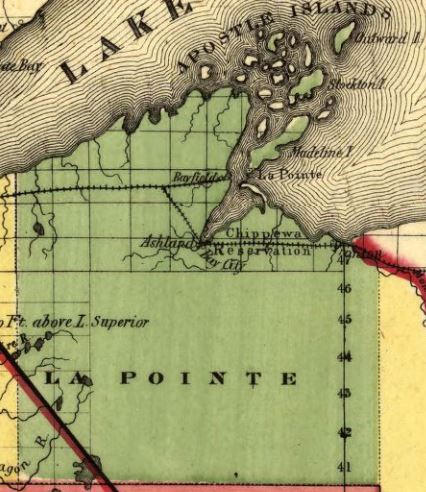
Detail of La Pointe County from a map of Wisconsin published by The Milwaukee & Horicon Rail Road, 1857.
~ Library of Congress
We often fall into the habit of complaining because things move so slow, and especially is this system of fault finding associated with the delays usually experienced in the construction of railroads in the west. However, upon reflecting I find that my time in life embraces the entire history of railroads in the United States, nearly the first roads put into operation, (if not the very first,) were one from Baltimore to Washington and one from Albany to Schenectady, N.Y., over which it was my good fortune to pass before reaching my majority, and about the time I became of age, it was my fortune to ride over not only the first railroad constructed in Illinois, bu the first built in the Mississippi valley, to wit: from Meredosia, on the Illinois River, to Springfield, a distance of forty miles, which, in its day, was regarded something not to be sneezed at, as the roads I have named were at least suggestions of the great systems of roads today. Governor Donenn, of Illinois, in his message of 1835-6, referred in the most glowing language to the triumph of the canal boat and the locomotive in almost annihilating time, burden, and space in other parts of the country and wanted to known if the Patriot bosoms of Illinois did not beat high to emulate such examples of internal improvement.
There were at different times two locomotive run over the Illinois roads mentioned, and finally mule power was resorted to. – The following year an Internal Improvement Bill was passed and roads were laid out for every quarter of the State, the results of which was to bankrupt the State. But the movement was not without its advantages, as by the following spring the forty miles reaching to Springfield was graded and ready for the track to be laid. The track was laid by putting down a piece of square timber called a mud sill on the top of which cross ties were laid. On these a wooden rail was laid and flat bars of iron were spiked on the top of the rail. These bars were tow and one half inches wide and one inch thick, and upon this track turned the wheel of the first locomotive brought into the Mississippi valley.
It might be called a curious contrivance, since the locomotive was simply a piece of clumsiness and of no practical use, the driving wheels being only about two and a half feet in diameter, and the engine itself having very little power. This road finally passed out of the hands of the State for a consideration of $100,000, in State indebtedness, while the actual cost to the State was $1,000,000.
I have dwelt somewhat long and in general terms upon the subject of railroads in the United States, to show to my readers that there has been no want of energy in their construction, but on the contrary the rapidity with which they have penetrated the wilderness is simply marvelous, converting Indian wilds into prosperous cities or fields of golden harvest. My own connection with the building of railroads dates no farther back then the time of my landing here in 1854, since which, I have in my way left no stone unturned looking to the introduction of railroads into this country. I was for a time a director in the St. Croix and Lake Superior Railroad Company, during which (but for the complications of the road,) Gardner Colby would have undertaken its construction instead of turning his attention to the Wisconsin Central Railroad.
To be continued in Number VI…
Asaph Whittlesey Incidents: Number IV
April 11, 2017
By Amorin Mello

Originally published in the March 9th, 1878, issue of The Ashland Press. Transcribed with permission from Ashland Narratives by K. Wallin and published in 2013 by Straddle Creek Co.
… continued from Number III.
Early Recollections of Ashland: Number IV
by Asaph Whittlesey
In our last number we referred to “the most aristocratic house” with lumber floors, etc. Though it was the third cabin built upon the “town site,” it was in reality the first cabin built, designed as a permanent residence. The foundation logs of this house were laid Sept. 20th, 1854. The record made by Martin Beaser, (evidently made from recollection,) calls this the first building erected, (giving the size of it,) whereas we had lived in two buildings previous to the building of this one.

Rev. Leonard Hemenway Wheeler
~ In Unnamed Wisconsin by Silas Chapman, 1895, cover image.
The “Whittlesey Post Office” was kept therein from the date of its establishment, March 12th, 1855 to Nov. 1858. The first dancing done within the “town site” was in this house in Nov. 1854, and during the winter religious services were held therein by Rev. L. H. Wheeler, of the Odanah Mission. It was the birthplace of Delia Elizabeth, second daughter to Mr. And Mrs. Asaph Whittlesey, born May 21st, 1856, being the first American child born within the limits of the “town site.” The first celebration of the Fourth of July was held in this house July 4th, 1855, further reference to which will hereafter be made. The first general election of county officers in the county of Ashland, was held in this building Nov. 4th, 1856, at which time Samuel S. Vaughn received eleven votes for the office of County Clerk, and M. H. Mandelbaum receive twelve. Francis McElroy was elected District Attorney and Asaph Whittlesey County Judge. It was in this house that Robert D. Boyd was shot and instantly killed by Henry Cross, January 10th, 1858, for which a verdict of justifiable homicide was rendered at an inquest, held by Asaph Whittlesey, Justice of the Peace, acting as Coroner.
ARRIVAL OF THE SECOND FEMALE UPON THE TOWN SITE.
Mr. and Mrs. John P. T. Haskell, with their family, parents of Mrs. Whittlesey, made a landing at Ashland, Nov. 2nd, 1854, and made their home with us during the winter following. In the early spring they made a home of their own in a cabin located upon the site of the present residence of G. M. Willis, Esq., a little to the east of Vaughn’s Dock, in Vaughn’s addition to Ashland, which was originally known as Haskell’s pre-emption claim. Mr. Haskell and family remained in the country only a single year, when they returned to Illinois, where Mr. Haskell died in 1873. Mrs. Haskell is still living and is unusually active for one of her age.
I next call your attention to the
FIRST CELEBRATION OF THE 4TH OF JULY
upon the “town site” July 4th, 1855.
Under an understanding had between Mr. and Mrs. Austin Corser and Mr. And Mrs. John Corser, (then living at Fish Creek,) and being the owners of the only cows nearer than Odanah, an agreement was made whereby the Corsers were to furnish milk, while Mrs. Haskell and Mrs. Whittlesey, (then living in the log house still visible on lot 6, of block 6,) were to do the necessary cooking in the celebrated “mud oven” attached thereto, marvelous for its baking capacity and for the quality of its production.
On the day referred to, the Declaration of Independence was read by Asaph Whittlesey, and this with the delivery of an oration by A. W. Burt, with singing and amusements, constituted the first public celebration of the 4th of July in the history of Ashland. The exercises were had at Whittlesey’s house in the after part of the day, and extended late in the evening, when music and dancing were added to the festivities of the day. The ladies present were Mrs. Haskell, Mrs. Whittlesey, the two Mrs. Corsers and Mrs. Farley. The gentlemen present were J. P. T. Haskell, George Kilborn, Lawrence Farley, Austin and John Corser, Asaph Whittlsey, A. W. Burt, A. J. Barckley, Adam Goeltz, John Donaldson, Conrad Goeltz, Andrew Scobie, and Duncan Sinclaire. The children present were Eugenia E. Whittlesey, (less than three years old,) George, son of Mr. and Mrs. Austin Corser, also a child of Mr. and Mrs. John Corser and William, John Joseph and Hattie Haskell, children and Mr. and Mrs. J. P. T. Haskell.
I shall never forget Mrs. Haskell’s “classic step” on that occasion, discounting many of those present much younger than herself. At intervals during the night the party were very highly entertained with singing by Conrad and Adam Goeltz.
FIRST POST OFFICE ESTABLISHED AT ASHLAND, MARCH 12TH, 1855.
As there was no opportunity for doubt as to the rapid growth of the city the establishment of a Post Office was the result of our first raid upon the general government, though for nearly one year following no provision whatsoever was made for furnishing this office with mail service, and mails were received by chance from La Pointe up to the opening of semi-monthly service, upon a new route established between La Pointe via Ashland to Chippewa Falls, and was soon after, during the winter months, supplied with weekly service upon the route from Ontonagon, Mich., to Superior, Wis. On both of these routes the mails were carried by packers and upon dog teams.
Detail of La Pointe County from a map of Wisconsin published by J. H. Colton & Co., New York, 1856.
~ MapofUS.org
In the petition forwarded to Washington asking for the establishment of an office at Ashland, La Pointe county, Wisconsin, the request was made that it be given the name of Ashland, and that Asaph Whittlesey be appointed postmaster. The sequel showed that as there was an office by the name of Ashland within the State, it was not lawful to attach the name to this office and therefore the appointing officers at Washington attached the name of Whittlesey thereto, by which the office was known until July 30th, 1860, when the obstacle to change in the name being removed, it was then given the name of Ashland, and was also designated as being in Ashland County, Wisconsin. I well remember how difficult a task I found it to be to satisfactorily explain to them how the place could one day be known as Whittlesey, La Pointe county and the next as Ashland, Ashland county. But they soon admitted it rather than be longer afflicted with my letters upon the subject.
Detail of La Pointe County from a map of Wisconsin by The Milwaukee & Horicon Rail Road, 1857.
~ Library of Congress
The office of Whittlesey was kept in the cabin still in existence on lot 6 of block 6, “original Ashland,” until in Nov. 1857, when it was removed to lot 3 of block 3, into what was known as the Tomkins House, which then became the residence of myself and family until Nov. 1860. The case in which the books and papers connected with the office were kept, (which was made by myself,) is now in the “farm house” at “Pleasant Valley,” and will be delivered to any public organization in Ashland desiring to preserve the same. I continued to serve as postmaster until Nov. 21st, 1860, when I resigned the office and Andrew J. Barckley’s was appointed as my successor. Barckley’s term as postmaster expired Sept. 9th, 1861, by the appointment of Martin Beaser as successor in office to Barckley. Mr. Beaser served as postmaster until his death in Nov. 1866.
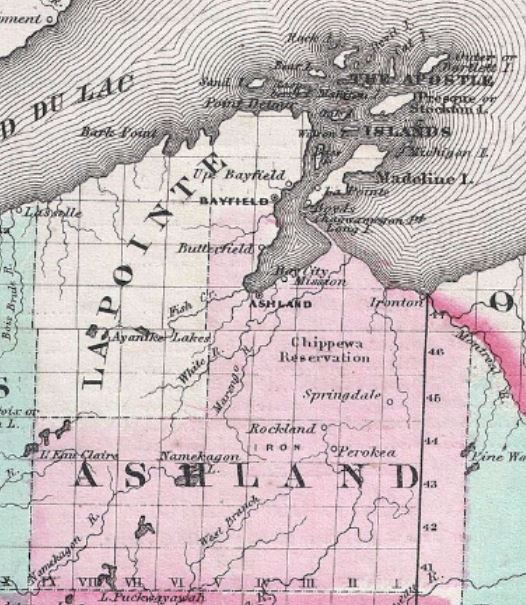
Detail of La Pointe and Ashland Counties from a map of Wisconsin and Michigan by A. J. Johnson and Ward, 1864.
~ Geographicus.org
The post office of Ashland was re-established Dec. 18th, 1871, and James A. Wilson, (the present incumbent,) being appointed postmaster.
The amount of post office money turned over to the Government by me at the close of my term of service was $8.53. My commissions upon this amount, together with the “franking privilege” vested upon postmasters, laid the foundation for my future fortunes, the balance was taken in waitings upon William Gotzenberg, who made daily inquiries for his mail, though he was aware that no mails were received oftener than once a week.
 Chequamegon History