Barber Papers: “Houghton” Fall of 1857
February 17, 2016
By Amorin Mello

Selected letters of the Joel Allen Barber Papers
… continued from the Summer of 1857.
Sandusky Oct 24th 1857
Dear Son
At length your father and I have both reached this place but how soon we shall be able to leave it is uncertain. He arrived here last Monday night in a most miserable state. I did not get here ’till Wednesday morning when I found him much worse than I had supposed he had been, and I believe worse than he had been at any time with his lameness. He probably exerted himself too much and produced a relapse of his fever and swelling of the limbs.
He got to Detroit Thursday at night – when he got ashore he found his carpet sack was missing – he being to sick to bring it off himself. Friday morning he sent round to the hotels to look for it but got no trace and concluded to go without it – but found he was a few minutes too late for the boat. Saturday morning he went down to the wharf, then the driver pretended, or was told, that the boat would not come and go that morning but at 4 P.M. so he was carried back the house again and paid the scamp 50 cts. Soon after he saw a bill posted saying the “Bay City” would leave that day at 7 oclock but before he could get to it, they told him it was gone so he was obligated to remain over till Monday.

Michigan Exchange Hotel in Detroit, circa 1884.
~ Burton Historical Collection.
He put up at the Michigan Exchange where he was on the second floor and had to climb stairs until his limb became very lame and considerably swollen the whole length. He had some fever and no appetite all the way after leaving La P. and probably when he started. The day after he got here Hamilton procured a Homeopathic Physician who has called to “treat” him every day since. He had intermitent fever all the time. Broke a fever every afternoon and night till yesterday and today, when it seems to be leaving him – his appetite is returning. I think tho he is very weak and can bear but very little food and the of the simplest kind. The Dr thinks he will get up soon if he can get the pain out of his limbs, but that will probably take some time to conquer. Says it is probably a rheumatic affliction and might have been produced by taking Quinine. But he is decidedly better now than three days since – in all respects I believe that had he called an Alopathic Dr, he would surely had a Typhoid fever, but if he is quiet and patient I think he will escape this time. But I fear it will take a long time for him to recover sufficiently to go home in cold weather. He had set up a little the last three days but cannot get off nor on the bed without help, and cannot walk without great paid to his limbs – indeed, he has not walked a step since Wednesday. It has certainly been a very unfortunate season with him and with us all, but I must consider it very fortunate that he has fallen in to so good a place to be be sick, and is in the care of an experienced Homeopathist, who I believe will cure him.
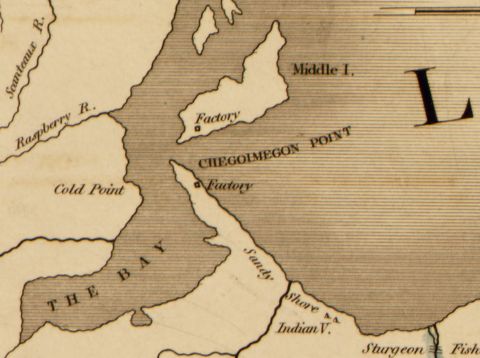
Houghton Point aka “Cold Point”,“Stony Pointe” , and “Point Prospect”.
~ Detail of Map of Michigan & Part of Wisconsin Territory, Exhibiting the Post Offices, Post Roads, Canals, Rail Roads, &c from the 1839 Burr Atlas of Postal Maps.
It is very strange you did not receive any letters from me before father came away as I had sent, certainly three – some of which you may have got before now. And I got but two short letters from you and none from your father after you left me. He wrote to Mr Burr when first taken sick and I heard nothing more from him untill one reached us of Oct 3d saying he wished me to meet him at Sandusky as he was too sick to get to L. Of course, I suffered a good deal of anxiety to know what had become of him and how I was to get home alone – supposing he had gone home without sending me word – I had been so long waiting to hear from him that I had concluded to start in company with Miss Julia Hyde, when I rec’d his letter.

Detail of early settlements and footpaths near Houghton Point from the Barber brothers’ 1855 survey of Chequamegon Bay. Giles and Allen lived with the Maddocks family during 1856 and 1857 at what is now the Houghton Falls State Natural Area.
I had promised a visit to Mrs. Baker at Janesville, so not knowing how soon he would be here, or that he was much ill then, I concluded to stop there and I started Thursday morning from L – and spent three days at Ja – left there Monday at Midnight – that being the express train expecting to get here the next eve but did not till Wed Morning 4O.C.. There being but no train each day from Toledo to this place. I got along very well alone – without losing any thing of consequence. I am afraid that carpet-sack of father’s will never be found tho. Uncle H has written to some one who was on the boat – whom he knows and perhaps it may come again. If not it will be one more loss added to the many we have suffered within two years. When the tide of misfortune will turn with us is yet in the anxious and uncertain future. I yet hope our lives will all be spared to meet again. When I left Lancaster many people were having a sort of influence which they called “colds”. Grandpa – Thode Burr and Mary B. had it and since reaching here Martha has sent a letter saying that Addison – Mame. Lil and Em. in her house – Mother and Lucy – Lib and the two youngest children, and Mary Parker – and Father at Allen’s, Mr. Phelp’s son quite sick; and about half the people in town had the disease. I had the good luck to escape it entirely, tho’ I rode to Boscobel in the stage the worst day there has been this fall. I am afraid we shall not be able to go home without exposing father so much that he will be very sick. I am sure he cannot recover sufficiently to start with safety in less than four weeks if he has very good luck and no relapse on account of the season. But if good nursing & good medicine can cure him he will be well before winter.
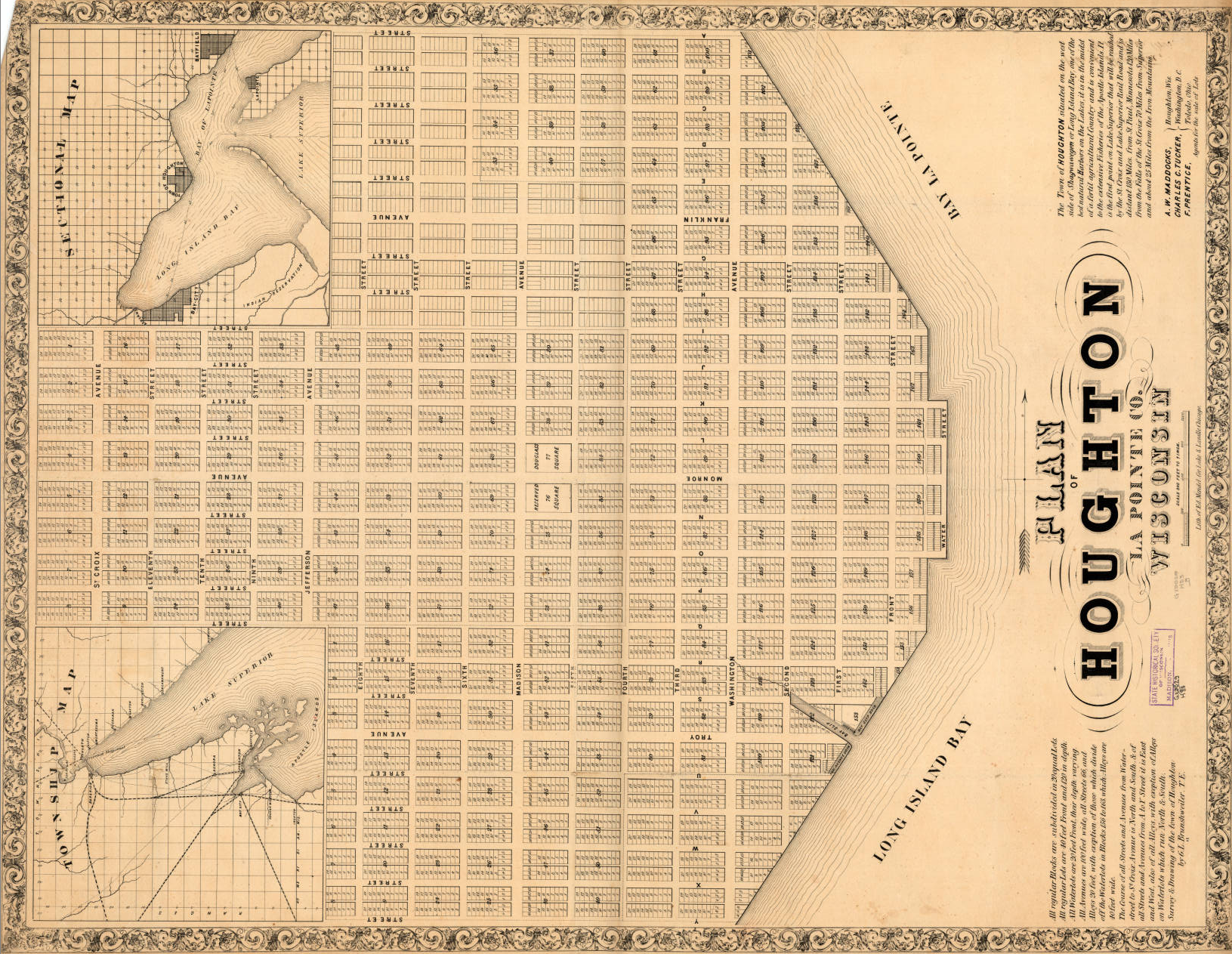
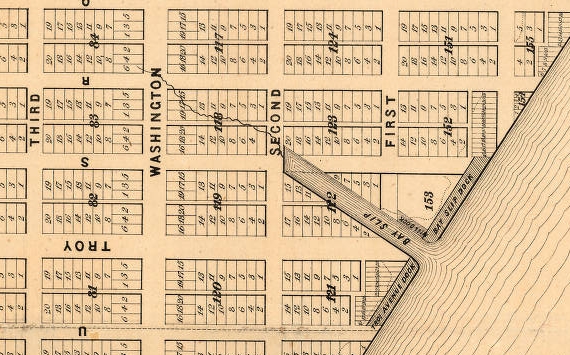
Plan of Houghton, La Pointe County, Wisconsin, 1858.
~ Wisconsin Historical Society
Aunt Emeline is absent, with Frank at Columbus, but the rest of the family are here and show us every kindness. This is a most delightful – comfortable and convenient place to be sick in, if one must be sick. How I wish I could think of our house as possessing half the attractions for a family residence that this does. But, poor as it is I should be very glad to see it once more and be where I could call it home.
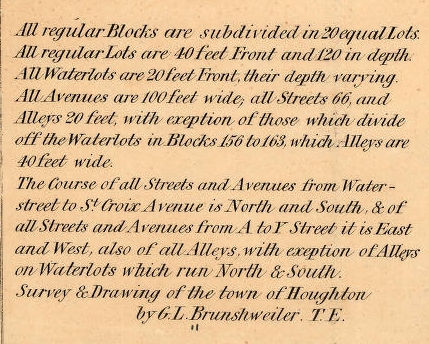
“Survey & Drawing of the town of Houghton
by G. L. Brunschweiler, T.E.”
I am sorry to hear that you have had to wait so long for your money – consequently could not go on with your work. I do hope you will not try to stay there through the winter unless you are sure of money, and that there will be plenty of provisions to be got at. What could have been the reason that your money did not come to you? I did not know that Uncle Sam has suspended payment or lost by the failure of the banks. Perhaps you did not keep reminding them of your case or give them your “address”.
You must write oftener to me and give me an account of your affairs – of all your pleasures and your pains – your disappointments and vexations and be assured no one can feel a deeper interest or more truely sympathize in all that concerns her you than your affectionate parents.
G. A. Barber and M. G. Barber
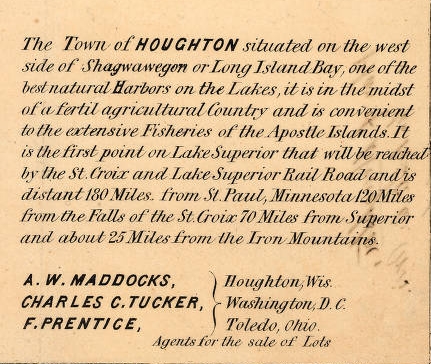
“A. W. Maddocks – Houghton, Wis.
Charles C. Tucker – Washington, D.C.
F. Prentice – Toledo, Ohio.”
Your father wishes you to say to Mrs. Maddocks that he feels under infinite obligations to her for the kindness shown him while sick at her house – that he wishes to express a thousand times more thanks than he was able, when parting from her in the Steam boat, to do. I congratulate you on having the privilege of making it your home at so nice and comfortable a place, with such kind people as father describes those to be. May you have the good fortune or good taste and disposition to make your presence in that, or any other kind hearted family, agreeable – is the wish of your Mother.
Houghton Falls State Natural Area within the Town of Houghton.
Monday morning
Your father rested better last night than before and had no fever thro the night but sweat a good deal as before – is very cool and comfortable this morning. Has some appetite – does not like to get up as it hurts his limbs. But much less than when I first came here.
Sandusky Nov 1st 1857
Dear Son,
Last sunday I wrote you about your father’s sickness and hope you have rec’d it, or will in good time; but as my letters of the past summer have failed wholey to reach you, perhaps the last has also failed. I shall continue to write to you often while he continues sick – and unless while navigation lasts and you may direct yours here until the last boat leaves your place as I see no prospects now of your father’s being able to move on for some time to come. I told you about the chill he had which made me fear he had got a regular chill fever but he did not have another tho he had pretty severe intermittent fever for three days last week. – indeed it continues somewhat yet, but much lighter. But his lameness is much worse than when he left you – that is – he cannot walk or step because his limbs are so painful and much weaker than when he had more fever. I believe he would never have got here alive had he not been sustained by tonics and morphine, but they would never have cured him, and I do think that had he fallen too sick to get here and had employed another Alopathist he would have gone into a typhoid fever and probably have died, as did the hon. R.C. Benton Sen. a short time since – at Rockford Ill. I met his son – our Johnson teacher one at Janesville who told me the sad news. – He was informed of his father’s sickness but did not reach there ’till after his death. His body was carried to Vt. for interment.
Nov. 2
~ “Business Directory” published in the Superior Chronicle, June 26th, 1855.
Your father wishes to ask you if you know anything about that Geo Perry concern – the present shape of it. And if you have heard any thing farther from the Aminacon claim?
Did you get the money of Jack so as to save your compass? If so – how does it prove? Has Herbert got home since yet? If so, how do the boys fare – do they get any money of him? Does old Whacken let John have his paper? Do you hear anything from your money?
When father left the boat at Detroit he told the porter to get his Carpet bag in his room and send it ashore with his trunk – showing him the trunk. – but when he got to the Michigan Exchange it was not to be found – neither at that house nor any other in the city. In looking for it he was detained so as to lose the boat for Sandusky, Friday morning – Saturday he started in a carriage but was told at the wharf by the driver that the boat would not go – (had not arrived) till afternoon, so he was taken back again when soon word came that it had came, but before he could get started – he being unable to walk – it was off again, so he was obliged to stay ’till Monday.
Thus he was detained nearly four days – sick and lame and obliged to climb a long flight of stairs and take long walks to his meals and other necessities, which all together brought on his fever and rheumatism in the muscles worse than ever. He thinks it almost a miracle that he got through so long a journey – sick as he was when he left you, and without any one to assist or care for him – alive. His lameness is now in the left limb – the other being quite free from pain when kept in a horizontal position, but both pain him extremely yet if put down so that he does not attempt to step on his feet. Ham, Jay, and I brought him up stairs last Saturday where we have every thing we need for convenience and family are all as kind and attentive to one wants as people can be. I do not believe there is any better family, or one happier, than this. It is two weeks today since father came here and I know not how many more he may have to stay – the prospect looks rather dark for a speedy departure.

The “Geo Perry concern” related to Albert McEwen’s death and fraud during the 1856 LaPointe County election. This was investigated by the Wisconsin Assembly.
~ Journal of the Assembly of Wisconsin, Volume 9, 1857, page 191.
We got a letter from Am. Saturday in answer to one from me here, says he is well but I should judge he had not done much this fall but watch and wait for us. I do not wonder the poor boy is out patience as well as every things else, as he says.
Write often to your afflicted parents.
G.A.B. and M.G.B.
Sandusky Friday Nov 13 – 1857
Dear Son.
You will at once perceive that we are stationary since I wrote you last. And when we shall be able to move on, is as much a question of uncertainty as ever. Your father remains sick yet – and I cannot – dare not say that he is even convalescent, tho’ I have a little more courage to think that the medicine now being administered is breaking up his fever. He has had a most singular sickness – having – as I think – more or less fever – with or without chills every day – probably since he was first taking – certainly since coming here. [??] the Dr would not acknowledge – or believe it because his visits would be in the forenoon when the intermissions would occur. But the past week he convinced him that chills and fever do actually exist as he has been [presedest?] to break it up. His sickness is so unlike anything in the experience of the Dr. that he appears to be entirely mistified with [reward?] to the proper course to pursue. I have, and do, doubt his judgement – and sometimes have even put a harsher construction upon his course and doubted his honesty. But he has all along said he had not the least doubt of his ultimate recovery tho it would take considerable time to entirely remove his lameness. As to that lameness I hardly know what to say. He is now free from soreness and only his feet swolen; but he cannot straighten his knees as the cords appear to be contracted and are painful when strained and if his feet are brought lower than his body it brings on the same old tearing pain in the muscles.
But I believe that when his fever leaves him and he begins to gain strength his limbs will improve fast. This week past I have felt more discouraged than ever, as the chills would come on every day about noon – continue an hour – sometimes with a hearty shake – then fever – pulse 120 hr. m. – then a hot sweat most of the night with pulse at 85 at the least pain.
This lasted about 5 days – But the Dr has at length “come in with a Tonic” which appears to work right. It is the most powerful sweating medicine I ever saw. He has taken it two nights and one day – and now the 2nd day – 3 P.M. – he has fairly escaped the chill and fever. I feel greatly encouraged – that he is in a way to recover. He has all the time been quite confined to his bed except as he could manage to get into a great chair once a day and sit up – from two hours to half an hour – this several days he has not got in the chair as he was unwilling to exert himself so much. I have been with him – his only nurse – night and day for 3½ weeks, and I hope and expect to granted health and strength to continue to perform the duties of nurse so long as he shall need my assistance. I cannot but think that he was in just as good condition to receive the medicine, which is working so well over two weeks ago – when the billious fever first left him, as he was two days ago. But the Dr thought not, as his limbs were so bad then, and it might make them worse. It has been altogether an unique case, and the Dr has appeared liked one groping in the dark.
I told you in my letter of last week that father lost his carpet-bag – and intended to tell you to see if it was not returned to La Pointe and left there – he thinks the label on it directed there – tho’ at first he said it was to Lancaster. He can hear nothing from it since and I fear it was stolen by the darkies on the boat. This has truely been an unfortunate year for us as well as for thousands of others.
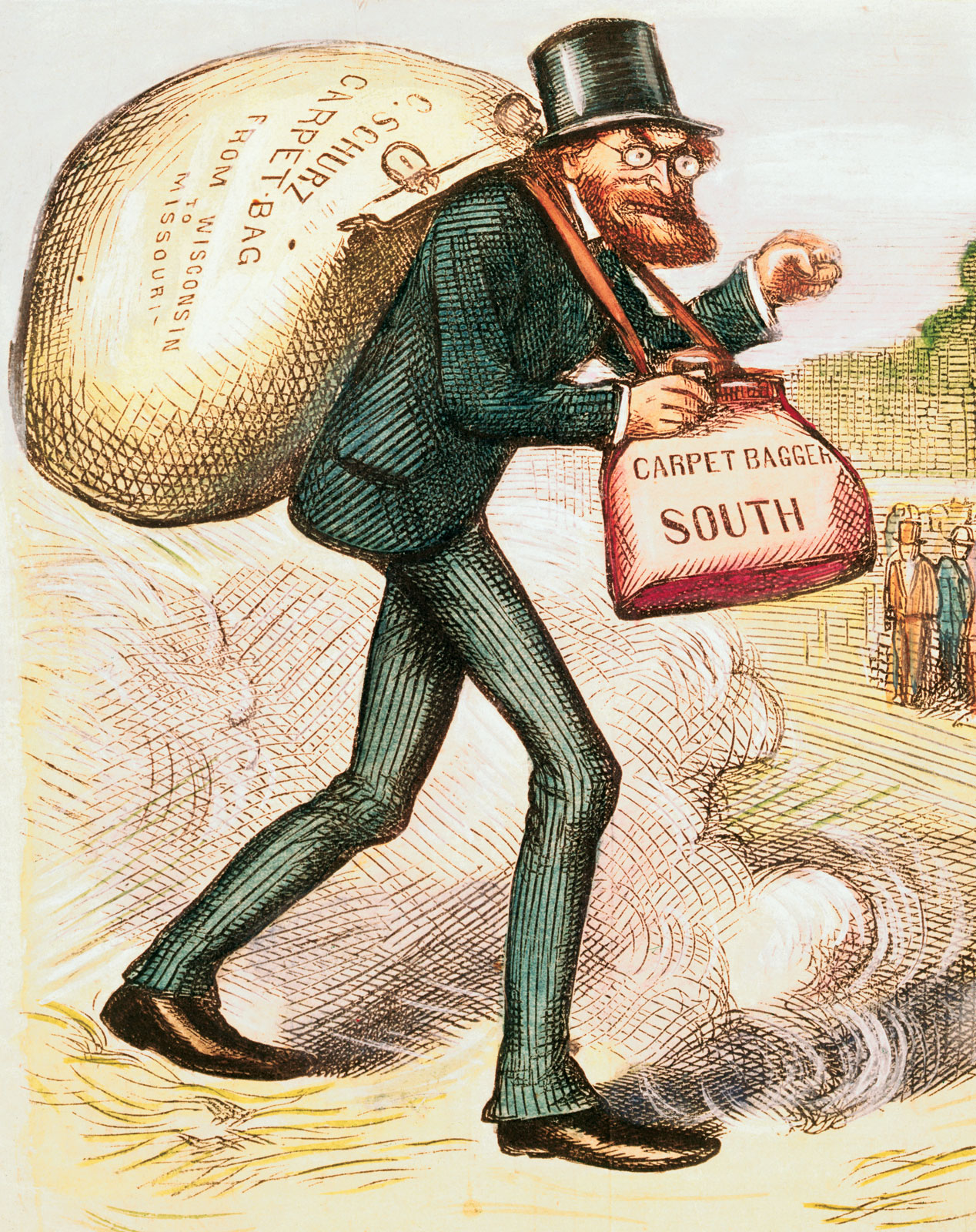
1872 cartoon of Wisconsinite Carl Schurz by Thomas Nast.
Wikipedia.com definition of a Carpetbagger:
In United States history, a carpetbagger was a Northerner who moved to the South after the American Civil War, during the Reconstruction era (1865–1877). White Southerners denounced them fearing they would loot and plunder the defeated South. Sixty Carpetbaggers were elected to Congress, and they included a majority of Republican governors in the South during Reconstruction. Historian Eric Foner argues:
“… most carpetbaggers probably combine the desire for personal gain with a commitment to taking part in an effort “to substitute the civilization of freedom for that of slavery”. … Carpetbaggers generally supported measures aimed at democratizing and modernizing the South – civil rights legislation, aid to economic development, the establishment of public school systems.”
“Carpetbagger” was a pejorative term referring to the carpet bags (a form of cheap luggage at the time) which many of these newcomers carried. The term came to be associated with opportunism and exploitation by outsiders. The term is still used today to refer to a parachute candidate, an outsider who runs for public office in an area where he or she does not have deep community ties, or has lived only for a short time.
We get nothing yet from you. Why is it that you remain so silent? I think it probable we may have to stay here four weeks longer – waiting for him to get well. You may direct here if you send by return mail or by any boat.
You cannot know, nor be told the amount of distress in the country this money panic has produced. I presume you do not see the papers so often as we do, and perhaps do not realize at all. You father warns you to be careful what you do this winter. – not to meddle with any thing – in Ironton shares – or any kind of property – even if you can buy it for a “song” – Every thing is “dead broke” and the less you have to do with Lake Superior property, the better.
Father sends his best love along with mine to you and his respects to Mrs. Maddocks and family.
I am very sorry to think that you will stay up in that wilderness this winter. I wish you could get your money – settle up every thing – come down here and go home with us. It would be a great relief to us to have your assistance for your father if he should continue too lame to walk without help.
We are under a great many obligations to Uncle H. and family for their kindness.
It is growing dark, so good night
Mother
Sandusky Dec 6th 1857
My Dear Son.
Yesterday we rec’d a letter from Am. containing one from you. I was greatly surprised and grieved to learn that you had not got one of my letters since you left Lancaster. I have sent you three from there and as many from here. Neither had you rec’d your draft. I am really suspicious that some one watches the mails and steals your letters hoping to get money or the draft – which, it is possible he has taken out – forged your name &c and taken the money out. In such case you might not discover the theft for a long time – and would be subjected to a great deal of trouble in consequence. I shall have a deal of anxiety in your account this winter, or until I hear that your money has reached you and that provisions are to be had at reasonable prices – which I fear they will and be this since the loss of that new boat must make quite a difference with that region in supplies.

American carpetbag circa 1860; wool with leather handles.
~ Wikimedia.org
I have before written you an account of your father’s journey and continued sickness which you may have yet [??] now. Lest you have not I will briefly say that he got safely to Detroit where he lost his carpet-sack – was detained there three days – arrived here Monday night 19th ult. Oct. 19th where he has remained ever since, confined to his bed. The fatigue of the journey probably somewhat increased his lameness which has been very severe, and he has not been entirely free from chills and fever and sweats until the last week. He has been improving fast for a few days, but just now he is having a little more fever which I presume is caused by some impending diet – either in quantity or quality.
His disease – a very uncommon one – is, in fact, inflamation of the veins extending from the Loins throug the whole limbs – the left much the most – to the toes. He has not been able to put his feet to the floor without extreme pain since he got here, until the last week, and even now, but a few minutes at a time. The cords under the knees have been considerably constrainted but are getting relaxed a little so that his legs make nearly straightened, tho he cannot begin to bear his weight on them.
The disease has been so complicated and so badly treated before he got here that the Dr has been very much perplexed with it. If you have not got my former letters you do not know that we have had a Homeopathist – one whom Uncle H. and Aunt B. think knows enough for all cases but we think that had he possessed a knowledge of anatomy equal to his partner in business who has called twice with him of late, he would have discovered the seat of the disease at first from the symptoms then apparent. But for four weeks he seemed to be in a state of uncertainty, and baffled at every step. But since he discovered the seat of it he has treated it with very good success.
Your father is much reduced in flesh and strength. I cannot now give you a full description of his case but when he gets able to write much I presume he will amuse himself by giving you the particulars if you should feel interested in the subject. Uncle H and family are very kind and obliging and we have every thing our necesities demand at present, but that does not make me contented to remain so long from home. I wish to be in my own house, but it is impossible to leave here until he can walk enough to help himself a little. We have been here 7 weeks, and I fear it will be many more before it will be safe for him to leave or proper for me to leave him for others to wait on. My health is very good so that no one has had to assist me day or night, in nursing.
Your Aff’nt Mother
I suppose this will never reach you unless I direct to some other person for you.
All well at Lancaster last Sunday. Monday morning Aunt Lucy saw a fine little daughter added to her family.
Sandusky Dec 18th 1857
Dear Son
~ Wikipedia.com
You will see that we are here yet, now nearly 9 weeks since I landed here in an almost insensible state from the effects of morphine which I had to take constantly to allay or drown the pain in my limbs. I have been quite sick much of the time. Three or four weeks were spent in treating my sore before the [rest seat became?] of my disease was ascertained, since which time there has been steady progress toward health. My legs had become crooked at the knees, absent at an angle of 45*. My ankles and feet swollen, white, cold & as useless as though made of putty, but I found the pain that had so long affected them was gone & by much exertion, rubbing &c I got so as to bear any weights, & [thoutes who?] crutches, & I have now got so that I can go twice the width of the house at a time on them. My appetite has returned & I am gaining rapidly. My real disease was what is called Spormator [hea?] or a disease of the Spormation vessels or cord on the left side of my body, which the Drs & your Uncle Ham think was the origin of my sickness & all my pain. Sir Astley Cooper [in thing?] authority, giving all the symptoms of my case. We hope to be able in a week or two to go home to Vt. Your mother wants to start in my present helpless condition when I cannot stand alone in a minute without support to save my life, but I have sworn that I will not go to be jostled around & in the can till I am better able to take of my self than now. I cannot get up or down stairs or sit at all weight with crutches, & as neither of my legs are reliable I assure you it is ticklish business to dare go on them (the crutches).
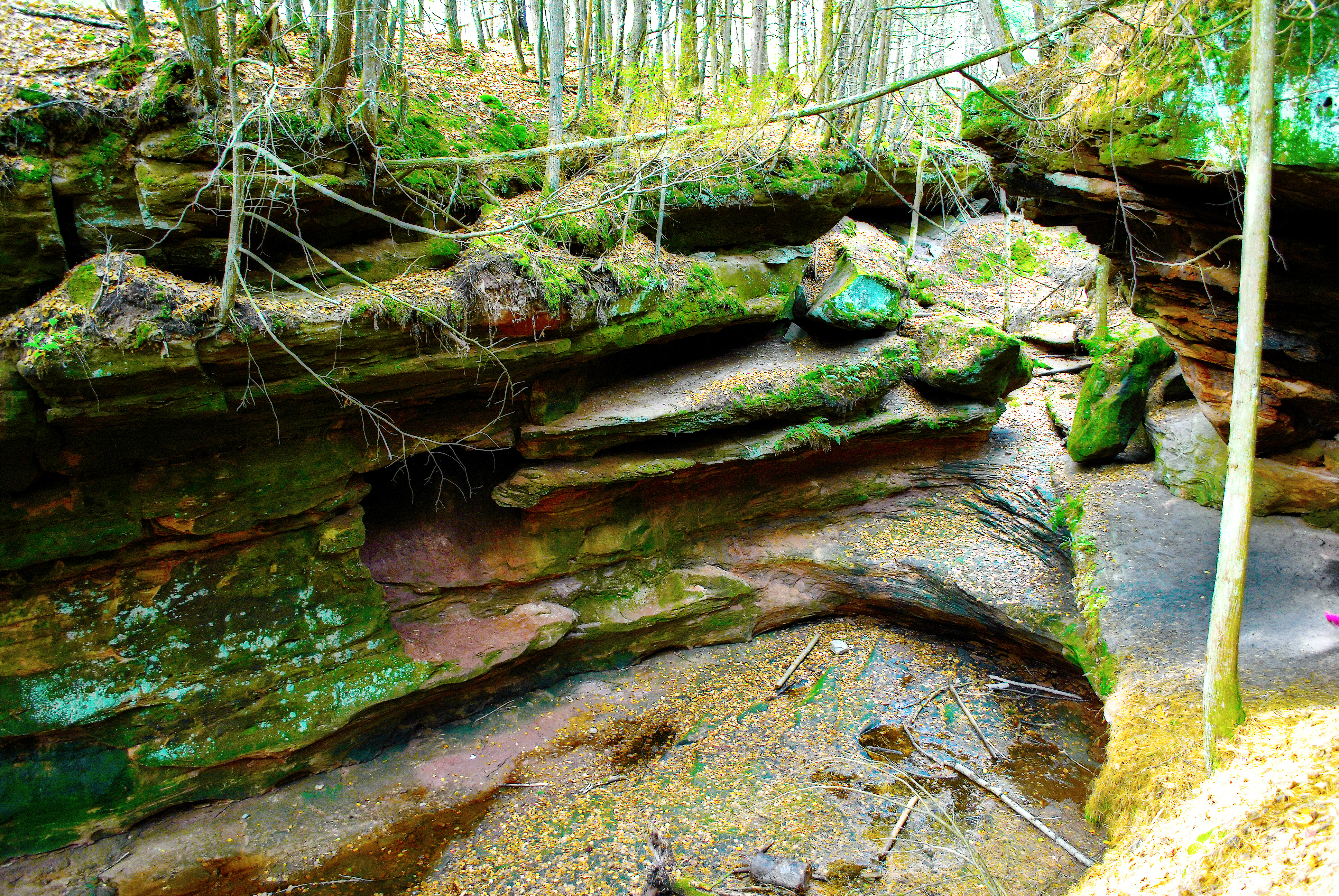
Echo Dells at Houghton Falls State Natural Area.
~ Shared under Creative Commons from Aaron Carlson © 2011
Coming down the lakes from La Pointe I had a pretty hard time of it, was quite sick, had chills, kept my berth most of the time, & when I got to Detroit I was detained by losing my carpet bag and one thing & another because I was unable to help myself, from Thursday P.M. ill Monday A.M. when I came here. Lucky that I had such a refuge to [want?] to in my extremity, had I tried to reach home, my life would have paid the forfeit of I might have had a long sickness among strangers without any of the comforts or conveniences I now enjoy, and insured an enormous train of affection.

Map inset of Chequamegon Bay with Town of Houghton, LaPointe, Bayfield, Ashland, Bay City, and the LaPointe Indian Reservation.
We get letters from Amherst occasionally, he is well & in good spirits boarding at Mr Griswolds, is very anxious for our return to Vermont. By him I learn that Ambrose Chase died after about an hour illness in Nov, & that John Burcham of Johnson died still more suddenly being found dead in the privy. Old Mr Dorsker died lately & that is all he has told of to us. On opening my new trunk here I find some books are missing. Who do you suppose is the rogue? I hope he will russ some amusements & instruction from the books, if so I am content.
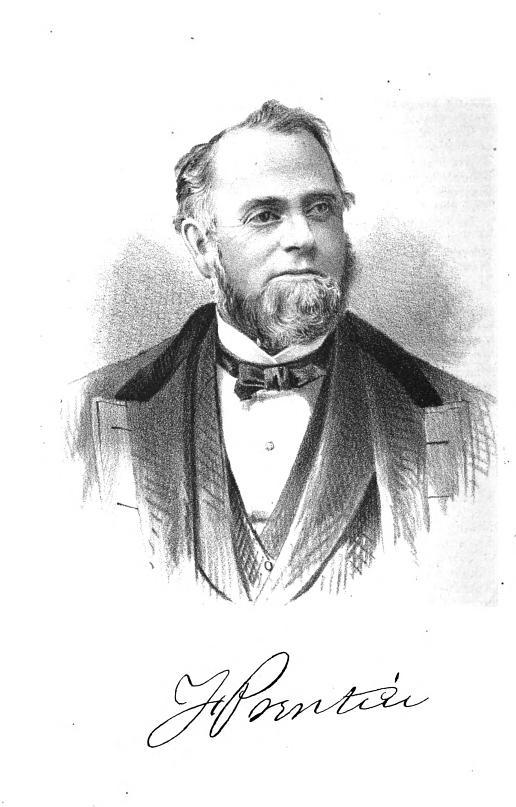
Frederick Prentice (“Man of Money and Mystery”) was an “Indian interpreter for Indian agents and traders”, and owned extensive properties in the Chequamegon Bay region during the 1850s. Prentice started the City of Houghton around the same time he cofounded Bay City (Ashland) during 1854, purchased the Buffalo Tract (Duluth) from Benjamin Armstrong during 1856, and cofounded the City of Houghton (near Washburn) during 1857. Prentice returned to Houghton in 1887 and organized the Prentice Brownstone Company, becoming “the most famous quarryman in northern Wisconsin”. Houghton had a “population of about 250 people, a school house and a sawmill with 25,000 foot capacity” by 1888.
~ This portrait and a profile of Frederick Prentice (the “first white child born” in Toledo, Ohio) is available from History of the Maumee Valley by Horace S Knapp, 1872, pages 560-563.
~ “Business Directory” published in the Superior Chronicle, June 26th, 1855.
August 22nd, 1857
“John H Osborn,
Banker and Land Agent,
And Dealer in Exchange, Superior, Wis.
REFERENCES, — J. B. Ramsay & Co., Cincinnati; J. R. Morton & Co., do; E. Jenkins & Son, Baltimore; A. R. Van Nest & Co., N. Y.; Heston & Druckla, Phila; Holiday & Coburn, St. Louis; John H. Richmon, Esq., Maysville, Kentucky.”
Have you recd your draft yet? Was your compass saved to you? Have you got at work on the reservation yet? If so how do you prosper? How does Herbert make it, does he still remain agent? Does he sell any shares, if so, for how much? Is the work still going on at the City of Houghton, or has the news of the general crash and prostration of all kinds of business failed of reaching Stony Pointe? I recd a letter from Prentiss last week who says, there are some going from Toledo next spring to live there, & he appeared to feel as well as ever.
He said he sent 50 bbls Ham & a lot of Pork to Detroit to go up, but it arrived too late for the last boat to Lake Superior. I have written to Hayes that if the Ammanicon case is decided against me to take an appeal to Washington at once & I will go there & see if testimony has been supplied or any unfair things have been done by the clerks in the office.
I have now sat up [little?] hours, read Douglas’ speech & written this much to you but I feel that I have over taxed my powers and must go to my heated bed for rest. Douglas has come out against the Administration policy toward Kansas & will make a split in the party not easily healed. I will send you his speech.
Tell Mr. Maddock’s folks that Judge John Fitch of Toledo was shot yesterday [????] once of his family by one T.G. Mellon, the ball entering his mouth, lodging in the back of his neck, some hopes are entertained of his life. If this is a ½ sheet it is as long as your letters. Be careful of yourself. I remain your affectionate father.
G.A. Barber
Give my respects to Mr & Mrs Maddocks, & to John Cosborn.
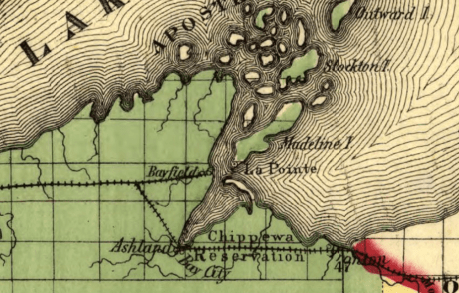
Detail from the 1857 “Township map of Wisconsin showing The Milwaukee & Horicon Rail Road and its connections“. The town-sites of LaPointe County shown here are Ironton, Boyd’s at Old Fort (mislabeled as “La Pointe”), Bay City, Ashland, and Houghton (mislabeled here as “Bayfield” and later as “Lower Bayfield” in the 1865 Colton Atlas). The railroad shown on the LaPointe Indian Reservation correlates to Barber/Wheeler/Stuntz details from “the Gardens“.
~ Library of Congress
To be continued in the Winter of 1858…
Barber Papers: “Let ‘Em Rip” Spring of 1856
October 24, 2015
By Amorin Mello
Selected letters of the Joel Allen Barber Papers
… continued from Winter of 1856.
Johnson April 5th 1856
Dear Son
I grow more & more uneasy every day about your lands. If you get The Grant Co. Herald up there you will see what has got to be done before May 11th. The Herald of March 22nd is out again with two articles in relation to the prefecture of Lands entered under Graduative prices & in one of them says that all lands [forpect?] to Government will be advertised for sale to the highest bidder & if not sold, will be then in the Market at $1.25 per acre. That purchasers under the Graduation Law cannot pay 75 ¢ more per acre & hold nor even can they go now and pay $1.25 to save it, but it must go into the market & sold at a land sale if anybody will buy it. My first efforts will be on reaching Lancaster to see that a dwelling is made on your land & something done by way if improvement & it will be absolutely necessary that you should come there yourself as I view the case.

Barber’s sketch of his Left Hand Point land claim from the Winter of 1856.
If you still have that Pointe of Land in your grip & can leave it for a short time, come & come at any rate if you can possibly without too great a sacrifice, for I cannot bear to have you lose so much money for nothing. Can you not leave your Point after making some moves in the matter without having it squatted on by some one else? Or can you not get some person you can trust to stay on it for you after erecting a cabin on it? You will of course know more about it than I do & must act accordingly. Nothing of great importance transpiring here abouts. Day before yesterday [Vst.?] Pillsbury & Luther Carpenter were hauled up for damages done to Ben Atwell’s Barn on the mountain by cutting down the timbers to the scaffold destroying 1 good horse rake & some hand rakes & 25 buckets & other damages. They had to pay Atwell cost & all $19.12 & on a state prosecution $10 fine each & 3.50 cost each making $46.12 as the price [????] for their sport.
It has got to be warm & snow is [going?], not much sugar made yet. I have got a new tenant on the farm Stephen [Dow?] from York side. Hen. Griswold has become sole owner & occupant of all [red drops?]. Do not go and hang yourself on that [???]. Old Fuller yesterday bought out Bixby’s farm (the [Fod?] [Lathrop?] [place?]). [Belden?] of Eden has [ba?] the Bixby place in the village. Mr. G.W. Hill is nearly gone with consumption. Sir Transit [????]
I [recd?] a letter 2 days ago from [Aug?] dated [Mar?] 4. Written when he was evidently (or as Dr. [Ferhas?] says evidentially) afflicted with the blues. He wanted I should procure some hundreds of Dollars for him to invest in lands & I shall try to get it if possible.
If I can get $1,000. for him, yourself, & myself to invest jointly I will do it.
The [avails?] of the old farm well laid out for lands at the west would soon double while the farm would be gradually going off with the action of the water on the bank & yielding not so much as 4 percent interest on its value.
But Mum will hear to nothing but laying out hundreds of Dollars to fix it up. Well she may have her way about that & that only. I am not for having her jurisdiction extended over all the west while [surveying?] the [distance?] of the world here in Vermont.
Remember your lands. Remember. Shall I meet you at Lancaster about 25th of the present month? All well.
Yours in heart
G. A. Barber.
Johnson April 13th /56
My Dear Allen
This law cheapens, with certain limitations, the price of public lands which have been in market for specified periods to the actual settlers, who are required, before making the entry, to file their affidavits that the purchase is made for actual settlement and cultivation.”
~ United States Congressional serial set, Volume 1117, page 482.
Having had the satisfaction of reading some letters from you of late I now sit down to thank you for them – tho without one thought that I can convey to you an adequate expression of my gratitude for your [??? favors stifl less?] for the continued assurance of your good health and favorable prospects. I am glad to learn that you have had encouragement to persevere in the prosecution of your “claims” and now imagine you doing your utmost to make yourself a house – temporary though it may be – which will some day repay you for all the trouble you have had about it: and I hope much more. Do you intend to build an “Octagon Concrete” house? Or is there no material and no foundation for such a [build.?] Suppose you will have to clear it off and drain it before you will decide on that point. I imagine you will have some [allushectors?] to destroy before you will get peaceable possession. I suppose if you succeed in holding that you will have to give up the land you bought in “Little Grant” as whatever title you could have to that, would seem to be acquired by “preemption and actual settlement” – the reduced price alone depressing on those conditions. Well, no matter if your present “grab” is worth half as much as your exited fancy has you to believe. I know that the letter you have rec’d from home will have a tendency to unsettle your mind and perhaps to send you “packing” to Lancaster, but from such advice come to you too late to be of any use. Indeed, what written advice or sympathy does not when it takes two months to get an answer to a letter?
I, too, have been in something of a “quandary” about a place to stay in while all my family are absent, seeking their fortunes or spending them. Father wished to have me remain in this old house and continue to keep boarders.
I could not agree to that, as I knew how much work there was in it, and how little strength there was in me. Besides, other reasons pertaining to the house and its capacities made me unwilling to stay here. I could see no better way for me than have our goods moved back to the farm and to make it my home there. This did not suit the convenience of the Meads because they could not afford to be troubled to sleep above stairs or to remove any of their things to give me a room. [So?], [their?] minds and interests being previously about equally balanced between staying and going. That turned the scale, and they [prached?] up and were off before we had any warning, scarcely.
But, as good luck would have it, a stranger came with good recommendation and I have the assurance that the woman will be a very agreeable person to reside with – this. I have not yet seen her, but feel hopeful.
They have no children.
~ A Standard History of Kansas and Kansans, Volume 3, page 1313-14.
Presume I shall be lonely, but mean to have work enough to occupy my hands while there and leisure to spend with my friends there at home as well as to visit them at theirs. I shall expect Aug. at home next summer – read a long letter from him to Albe – who, by the way has stared for Kansas – in which he says he shall come to Vermont next summer. Oh! Shant I be glad to see him? [If?] you could come with him. Shall not be so certain of his coming as to be very much disappointed if he does not, as it is my lot to bear his appointments. I am sorry to have Am. go away with his father to such a distance, but I believe he will be much better off to be there than he would to be left with me, as in my care, as he has become selfwilled and independent of my authority to an eminent degree. Hope he will not go to the lake as I do not think he would be of any use there, he is so unused to labor or hardship.
He has not been entirely free from a cough since he had the whooping cough last spring until within three weeks – it seems to have left him free.
My health is quite good tho I cannot endure severe exercise. [?] have best one boarder and no fired girl.
Have a few things to send to you and Aug. – meant to have [???] but my girl [???] away [on?] a visit for a week and as been gone nearly [forever?] – so I could not get [time?] to [grew?] and hurt much for you as I should.
Your Affectionate
Mother
J. A. Barber
Johnson April 13th 1856
Dear Son.
Yours of March [16th?] is rec’d together with one from Augustus by same mail, dated March 11th and you may be assured that it affords me joy to hear of your bright prospects, good health & spirits, courage & perseverance I hope you may finally achieve the object you have in view, and have the satisfaction of distancing all competition for the golden prize. But from what I have been writing to you for some weeks about your land in the town of Little Grant. I shall expect to find you at Lancaster when I get there or at any rate before the 10th of May, if it is necessary that you should be there & commence a residence on your land prior to that time. I have written to your Uncle about the Matter the 2nd time and am looking anxiously for his answer every mail. I cannot see the justice or propriety of your being obliged to make a residence on the law at that particular time when it is taken into consideration that you were only just of age, had exhausted all your means in making the purchase & was forced to seek some employments to raise the necessary means for building and making improvements on your land, & farther than all that, being so young, & unprovided with any means of housekeeping or living. & worst of all, nobody to prepare & get you “bread & milk” when you should happen to feel longer than usual.
Instructions received by the General Land Offices regarding graduation entries of land.
I cannot believe that your land will be forfeit in default of making proof of residence at the time appointed, but it will not be prudent to run any risks about it, if possible to prevent it. I have not yet fixed upon any day for my setting out for Wis, but hope to be ready soon. Perhaps it is all nonsense to take Amherst out there this season. But Augustus & you have said so much about having him go there that your mother (even son) thought best to have him go, & I of course was not unwilling to have it so, but of late you & Aug. do not seem so much in favor of having him up at the Lake, I suppose because you will not know what to do with him, & I should be loth to have him there in burden to you when it costs so much for subsistence if he could do nothing to earn it – But he is nearly in [reading?] [now?] & I rather feel as tough I would choose to have him with me than leave him to the whims and [caprice?] of any woman whatever there would be too many wonderful projects “work on a farm” “Learn a trade” “go into a [store?]” “fit for college” “rest a while certainly two or three years from his studies.” and all the other 1001 notions of a nervous person, who has now within the last ½ hour been complaining of his going off, not from any other consideration but that he were not going when he would not earn anything, or not enough to pay his way. If I work on my little place he can help me & he can do work for others or find some employment or he can go to school to H. B. Woods. I shall feel better if he goes, than if he stays. I have been reading a very long letter today from Augustus to Albe, but Albe is gone to Kansas & left directions that any letters from you or Aug’ to him should be shown to us & then forwarded to him. Everett got home last week, with improved health though not sound yet. He met Allen in Ohio & spent 2 days with him. A. was in good spirit. Minister is so unwell as to give up preaching. Woodruff is failing & will live but a short time. Nothing of consequence to write. Had sugar at the old place & at Columb’s Friday (Fat Friday).
Yours in haste
Giles W. Barber
Cambridge May 30th 1856
My very dear son Allen

“IN MEMORY OF
AUGUSTUS H. BARBER
of Cambridge, Vt.
U.S. Deputy Surveyor
who was drowned in
Montreal River.
Apr. 22. A.D. 1856
Aged 24 yrs. & 8 ms.”
~ FindAGrave.com
One week ago today your letters bearing bearing the heart-crushing intelligence of the sudden Death of our beloved Son and your dear brother were received by me. Oh, may God save – preserve the others to release to me, and may he support us all to endure our great afflictions. Greatly as I suffer under the stroke, my heart bleeds for the absent ones on whom the blow has fallen with equal severity. Augustus was dearly and worthily beloved by us all. Can it be time we shall never again see his face – never receive the dear letters full of bright hopes and cheering anticipations. Oh, he was too much beloved by all who knew him. Why could he not have been spared to bless his family and the world in which he could do good.
My friends [???] tell one that no death has caused such universal sorrow in this vicinity as his. Many of my friends have called to sympathize with me and to learn the particulars of the sad accident.
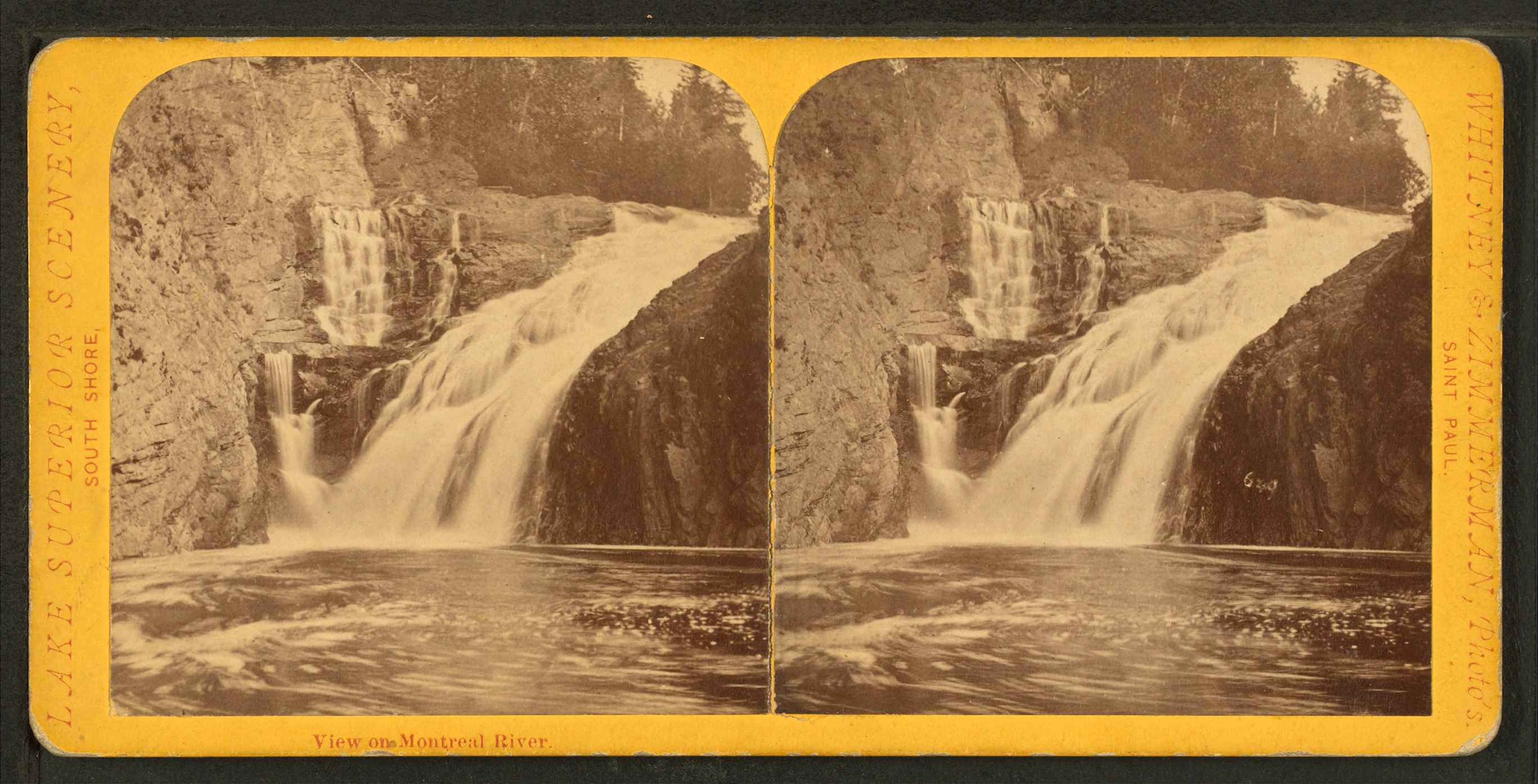
Superior Falls at the mouth of the Montreal River, as featured in the stereograph “View on Montreal River” by Whitney & Zimmerman from St. Paul, circa 1870.
~ Wikimedia Commons
Mr. Dougherty with [Sen.?] Robinson came down on Tuesday to see me. Aunt Martha and Mrs. Chadwick came Wednesday – M. stayed till this Friday morning.
Mr. D. took your letter of the 13 May home with him intending to address his congregation on this mournful subject on next Sabbath, I cannot bear to be present.
I did not get your first letter – addressed to Johnson dated April 28th mailed May 10th until the 23 – the one dated May 13th mailed 14th about two hours afterwards – or in about 10 days from date. I would not write to any one till today – but supposed you had written to your father at Lancaster when you wrote to me last. (13th) If you did not I fear he had started for the lake before the dreadful tidings reached him. Can it be that each one of our severed family has had to bear the grief alone – separated from all the others. How much I know you must have suffered! By your suspense before you could reach the spot where he was lost – and then, during the shocking scenes which followed. I suppose I can imagine but little what your feelings were or what mine would have been had I been present. I am so thankful that you were not with him and that I still have a dear-[kind?] son in this dark and gloomy world – May we all meet again, feeling this chastening affliction to be from the hands of a merciful God. May we be drawn together as a family by a [closer?] tie – even by the bonds of our common affliction.
I hope you will remember to write me as often as possible as I shall feel more concern now for the absent ones than ever before. Am anxiously waiting a letter from “father” that I may know where to direct to him. I want very much to have Amherst come home and stay with me this summer. He would be a great comfort to me if he could be contented to stay here, and would feel that he aught to try to make his mother less miserable. In doing that he would find his reward in being more happy in time to come.
I must close this and prepare to sent it to the office if there is a chance today, shall write soon again. No doubt you have got the letter I wrote to your dear, departed brother, since I came here. If so there is nothing of importance to write now.
Your affectionate Mother
[Incomplete copy of letter]
[ante May, 1856]
A week in Lancaster or Johnson would be worth more to me than an interest in –––. But a copper mine first of all if at all and then for a good time generally.
I have some chances for a location that some would gladly embrace, but I mean to have a right on so I let them drive their trains without making a move or showing that I care a fig for the whole country.
There is a conspiracy, or combination of old preemptors here who have no right to make claims. Their object is to secure each member a claim on the North shore, and to drive off and keep off by knives and pistols any who may wish to make legal preemptions on the lands they choose to appropriate to themselves.
There may be some fighting up here this season and there is certain to be considerable laming before the business is settled. Let ‘em rip.
I can send half a dozen to Jehanum in about as many seconds, but don’t want to do it & will avoid trouble if possible but butcher knife companies must not meddle with any claim when I have made one.
[…]
“Henry Rice, a Minnesota territorial delegate to the US Senate, hadn’t forgotten the Half-Breed Tract. In July 1854, he convinced the Senate to offer the mixed-race claimants a deal. Each could get up to 640 acres of unsurveyed federal lands by giving up their claim to the Half-Breed Tract. Those eligible would receive ‘exchanging scrip,’ certificates that could be used to buy land.”
~ Minnesota Historical Society
Allen, what think you of the [expedring?] of making yourself a location on the famed Half-breed Tract which is to be surveyed and brought into market immediate?
It lies west of Lake Pepin and is as fair a tract of farming land as lies out of doors besides being regarded as very rich in lead.
You never saw such an [Elganim?] as a portion on the Lake appears to be.
I do want to go down and get you out to see more of the North West – not that I wish you to come up here against your inclination, but I want to travel with you, to see what we have not seen and talk over old times together while we rub up each other’s ideas about the things of the present and the future.
If you want a farm in the west and don’t like Sp. just consult Uncle Allen about the “modus operandi” of securing a farm by preemption and then take a look at the country I have mentioned, as there will be great snatching.
My love to Grandmother, Uncles, Aunts and cousins and my respect to the ladies if they inquire – not without.
Augustus H. Barber
To be continued in the Summer of 1856…
Barber Papers: “In a Little Trouble” Winter of 1856
October 9, 2015
By Amorin Mello
Selected letters of the Joel Allen Barber Papers
… continued from Fall of 1855.
Minnesota Point Jan [23rd?] 1856
Dear Parents
It is sometime since I have wrote to you and for a fortnight or more
[???] [two lines on this copy are illegible] [??? ?????]
On arriving at Lapoint we found sheets from home and a good lot of newspapers.
We left Lapoint Thursday afternoon [on a firm of ?????? ? ?? head?] of [?????????] Nagonup the principal chief of all the Chippewas, Augustus and myself [??? ??? ?????] drawn by by two dogs on a dogtrain. At [????? ???????] were joined by one of Nagonup’s [??????].

Photograph of Naagaanab (Minnesota Historical Society).
They were on their way to Washington. Several of them are going accompanied by a gentleman from Lapointe as interpreter. The first night out we stayed in a wigwam with old Chingoon and his interesting family. Friday night we camped. Saturday reached Iron river. Sunday left and [comfortable?] – Monday came here. Augustus has a sore througt, not severe – otherwise we are well as usual notwithstanding our tramp of over [100?] miles. I must now quit writing and try to find one of our dogs which has strayed over to [???].
Under the old permit system, many locations, three miles square, were made on Lake Superior;- several on and near the Montreal river – some on Bad River, south of La Pointe – three on the main land, opposite La Pointe – two or three were made near Superior City, on the Nemadji, or Left Hand river, and one settler’s claim about twenty miles north of Superior.”
~ Mineral Regions of Lake Superior: As Known From Their First Discovery to 1865, by Henry Mower Rice, 1865[?].
Perhaps you wonder what we have made this journey for – perhaps you hope we are going below but that is not the case. Why should we [?????]. It is warmer here than at many places two or three hundred miles south of here. True – one or two thermometers froze up at this place but others did not while at Fort Snelling, the spirit thermometer inside the walls indicated 44 degrees below zero. Augustus wanted to see to his preemption and I had nothing to do but to come along with him. I also wanted to find out a few things concerning a place that I should like to preempt. I suppose there is not a better copper show on the south shore of the lake, but the land is not surveyed and my only sure way to get it is to settle on it and stick to it until it can be legally claimed.
The town lines will be run next summer.
Augustus is in a little trouble about his claim. It appears his declatory statement never reached the land office. But I guess it will all be explained and made right. The dutchman who was to contest his claim has left the country and would stand no chance if he was here. We have a land office here now which saves a great many journeys to Hudson near St. Paul. We shall go back in a few days and commence surveying around the islands. Now don’t fancy that we cannot survey in the winter, for we have tried it and know better.
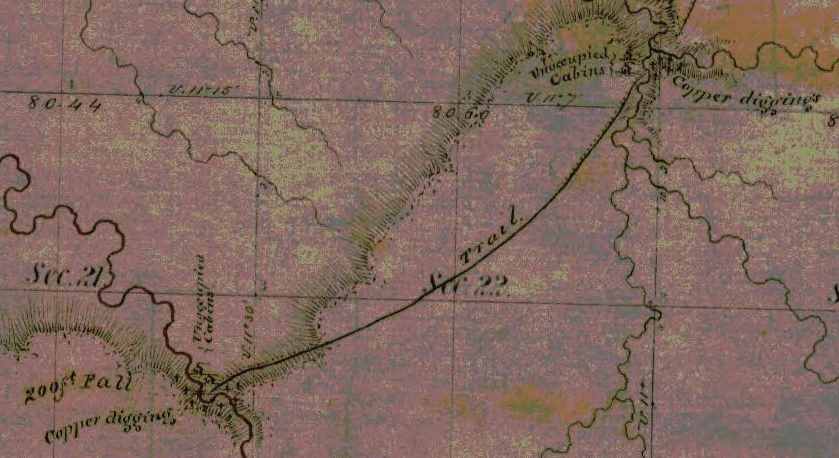
Detail from the Stuntz/Barber survey of T47N R14W.
“J.H. Bardon, a Superior pioneer, stated that ‘at Copper Creek and Black River Falls, twelve or fifteen miles south of Superior, and also near the Brule River, a dozen miles back from Lake Superior, Mr. Stuntz found evidences of mining and exploring for copper on a considerable scale carried on by the American Fur Company, under the direction of Borup and Oaks of La Pointe, in 1845-46. A tote road for the mines was opened from a point ten miles up the Nemadji River to Black River Falls.‘”
~ Duluth and St. Louis County, Minnesota; Their Story and People: An Authentic Narrative of the Past, with Particular Attention to the Modern Era in the Commercial, Industrial, Educational, Civic and Social Development, Volume 1, by Walter Van Brunt, 1921, page 66.
At Bad river we were at work during the coldest weather, and only lost two or three days because of cold but when the thermometer was up to 20* below zero we worked right ahead – sometimes in swamps where we stepped through the snow into the water,
[last line on this page of this copy is cut off]
The weather for a week or more has been fine. Cold enough to cover us with frost but not severe.
Provisions are very scarce – no flour or pork can be had.
They will begin to bring them through from St. Paul in a few days. Flour it is hoped can then be bought for $20 per barrel. Fish are not exactly plenty but they can be obtained for money or labor which is not the case with anything else. The country is flooded with dry goods, [p??y] articles and everything but provisions because they can be bought on time but eatables could only be got by paying cash down.
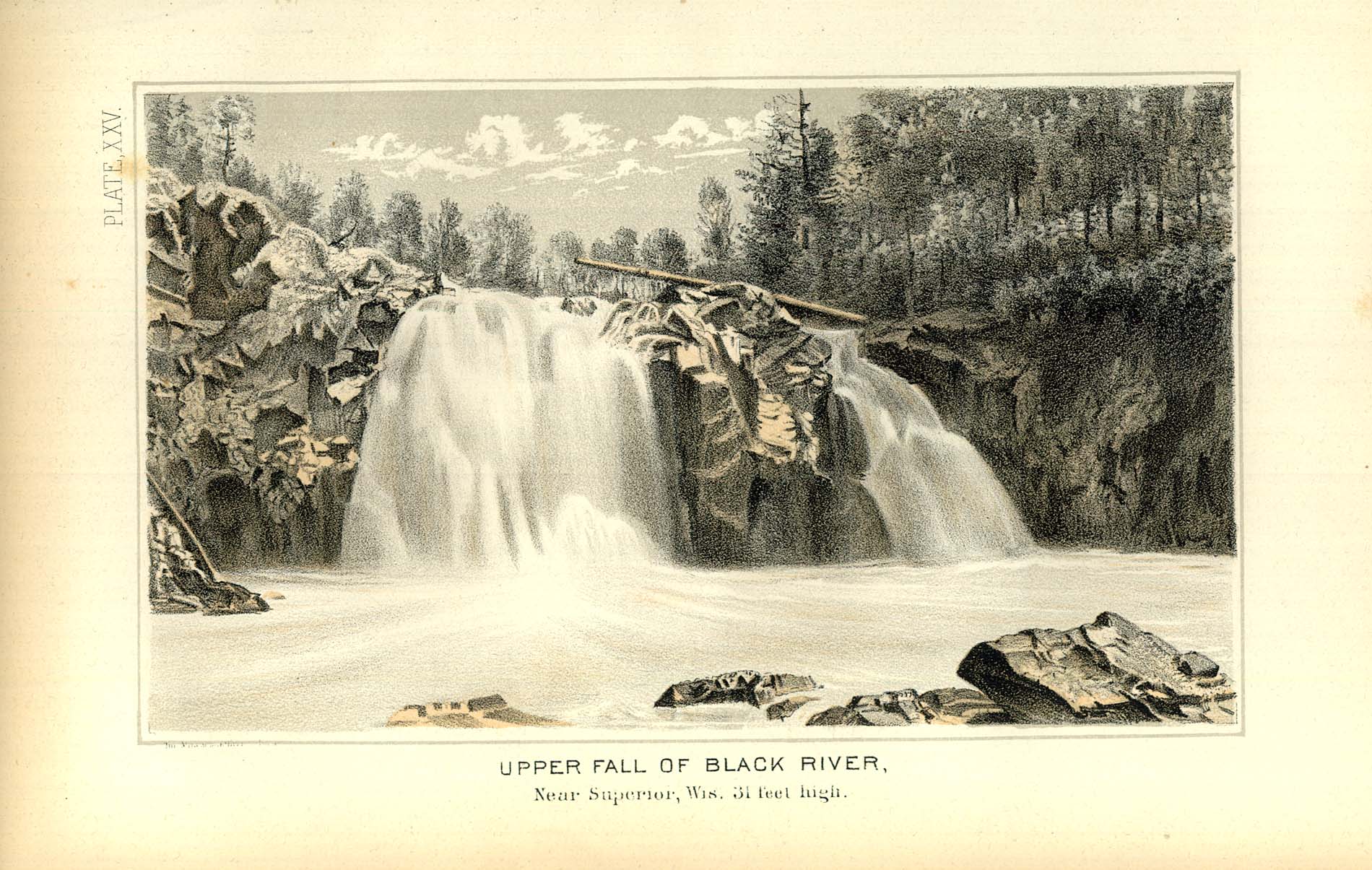
Geology of Wisconsin: Survey of 1873-1879,
Volume III, 1880, page 342[?].

Geology of Wisconsin: Volume 3, page 341.
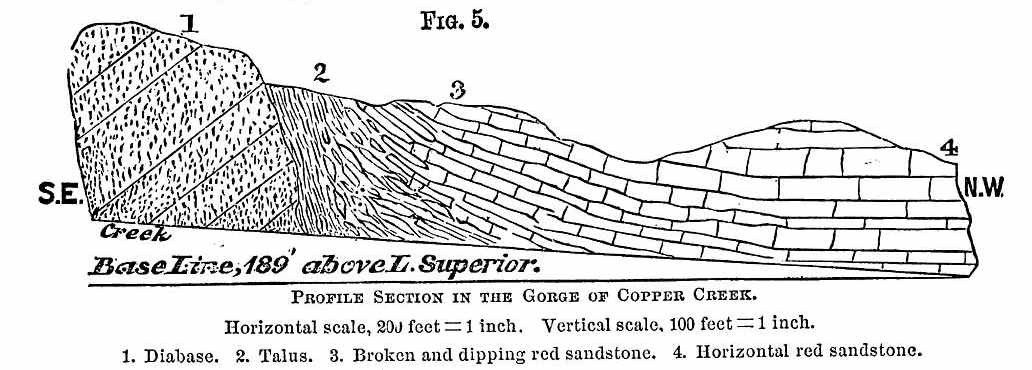
Geology of Wisconsin: Volume 3, page 345.
The Fon du Lac mine has commenced operations with tolerable fair prospects. It is the only mine in operation this side of Montreal river. Augustus’ claim is on the same vein and for aught anyone knows just as good besides having abundance of water power. All the copper excitement since I come to the country has been directed toward the north shore. This morning I signed 2 petitions, one to congress for the early survey of the north shore and another for a road down that way. I have made a little map of the islands and last summers survey and some other things that I will enclose.
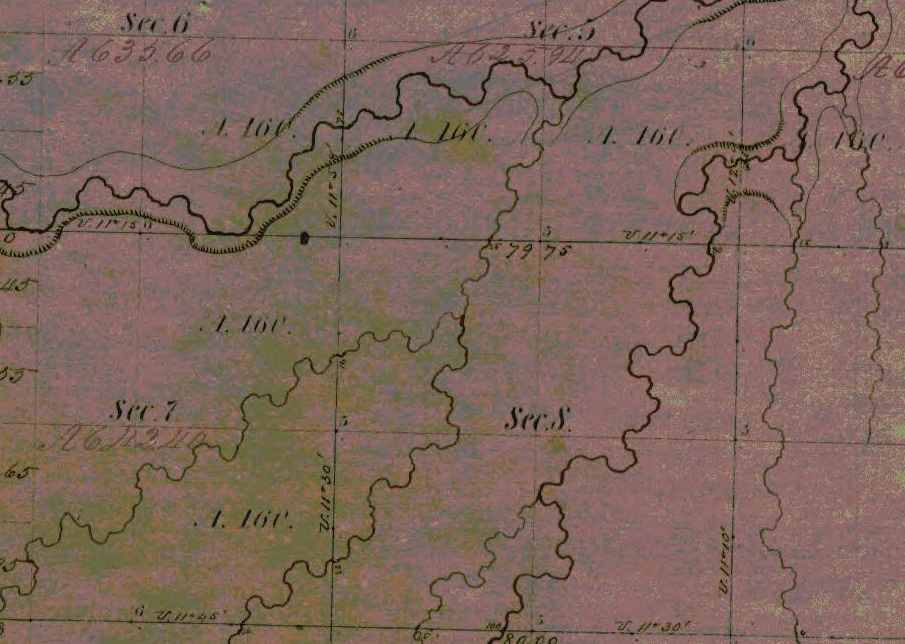
The Fond du Lac copper prospect was located near a small tributary of the Left Hand River on this map detail from T47N R14W, near Pattison State Park. Augustus’ claim was along the same vein of copper but had not been surveyed yet; perhaps it was at Amnicon Falls State Park.
Augustus has begun a letter to send with this. He has just come home with letters now about his claim.
No more at present from
Your affectionate son
J. Allen Barber
Direct to Lapoint
Minnesota Point
Superior County
Minn. Terr.
Sunday Feb 10th 1856
Dear Mother
Augustus has written a letter, and left it for me to enclose and dispatch so I thought I would ship in a few lines before sending it off.
Augustus started today with a young man and two dogs for Lapointe. I shall probably go there in a two or three weeks to return immediately. There are two men going down with a tamlins pony team with provisions from St. Paul for Augustus. The men are going to work for him and I shall probably bring the team back and use it a while. I have at last fixed my mind on a place that I mean to claim. The location is a point at the mouth of Left hand river, known as Left hand point. It contains only 5 or 6 acres in low & swampy and covered only with bushes coarse grass and floodwood. Nothing but the fact of its being a part of Superior city is of any value whatever.
Barber’s sketch of his land claim at the mouth of Left Hand River. This location is now an industrial neighborhood of Superior on the Nemandji River.
As it is $1,000.00 per acre is not an overestimate of its marketable price at present. It joins or is part of the grounds intended for the Railroad buildings when the survey was made here this point was cut off by the meander lines instead of meandered. Therefore according to the [rearns/records?] no such land exists.

A resurvey is to be made and I mean to fasten it by a preemption which is the only way to obtain it before the land sale. I may get cheated out of it and I may throw away my time and money but such chances are scarce and should it transpire that my claim is good I want to have my dish right side up for once. I have written for Uncle Allen’s advice and should I ever find it advisable to drop the matter I can do so without forfeiting my preemption right.
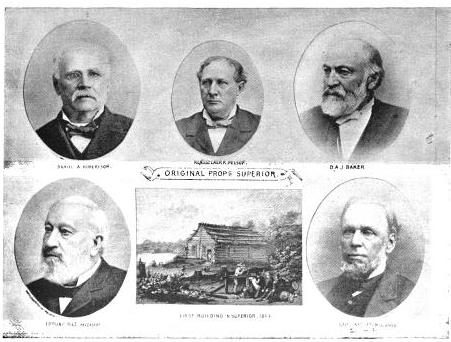
The Eye of the North-west, page 9.
The Superior Company with Company with which I shall probably have to contend is rich, influential, and on good terms with the administration. All that can be done by fair means or foul to defeat any claim will probably be done, but some things can be done as well as others, at any rate we shall see what we shall see.
So my head is so full of business just [snow?] you will please excuse the shortness of this letter and look for more when I have more time.
Your affectionate son
J Allen Barber
Superior Feb. 17th 1856
Dear Brother
It is sometime since I have written anything to you but you have heard of me so often that I suppose it makes no particular difference. It will be nearly sugaring time when you get this.

Makak: a semi-rigid or rigid container: a basket (especially one of birch bark), a box (Ojibwe People’s Dictionary) Photo: Densmore Collection; Smithsonian
I have once more got into a country where sugar is made but not by white men. The Indians make pretty good sugar which is generally done hard and [sinted?] dry and put into birch bark “mo’kucks” holding from 50 to 75 lbs. This bark is also used exclusively for buckets, store trays, gathering pails, &c. The timber in this country is not as equally distributed as in Vermont. The land is mostly covered with evergreens but there are some located portions of country where maple abounds. These “sugar bushes” as they are called are often quite extensive covering several sections and and [they?] only at intervals of 8 or 10 miles, but this is just as well for the Indians are both migratory and gregarious in their habits.
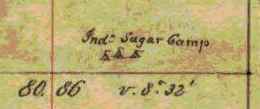
Detail of an Lake Superior Chippewa “sugar bush” from the Barber brothers’ survey of T48N R5W.
I hope you will eat plenty of sugar next spring and take some of the girls to a sugar party or two like I used to. I am doing nothing now most of the time but shall have business enough in a few days when I begin to build my house that is if I conclude to grab for the price of land I am now watching. I am waiting to hear from Uncle Allen and for some other things to transpire. There is not a man in the country whom I could trust that could give me any reliable information such as I want. I want you to hurry and become of age as soon as possible and come out here this spring and make a preemption.
There are some good places left yet, but don’t get married before you make a preemption for it might not be convenient to take your wife out into the woods 30 or 40 miles to live on the place as you would have to do in order to “prove up.” I am going to get up an ice boat before long which will be very useful as I mean to do considerable boating yet this winter, and I might use it to carry lumber and other things up and down the lake. With such winds as we have had a few days ago I could easily go to Lapointe and back in two days. I suppose Augustus got a party started by this time and he will be at it himself in a few days. I am living with a man named Fargo, you have heard of him before. We are living in Stuntz’ store. Board at the hotel is ten dollars per week. Old Steven Bonga is living on the point, he has been something of a traveller having been to Montreal, Hudson Bay, [Oregon?], Prairie du Chien, and all intermediate places.
He is half indian and half negro so you may suppose he is not very white.

Portrait of Stephen Bonga (USDA Forest Service). Additional information about Bonga is available from the Wisconsin Historical Society.
A railroad has been laid out from here to St. Paul and my claim covers the terminus at this end. There have two or three new towns started into existence along its route in imagination. Perhaps they are [surveyed?]. This making towns in a new country is a great business.
What happened in your good town on Christmas and New years eve
Were there any stockings left.
I want to inquire about lots of girls and boys in Johnson and Cambridge but I conclude you will tell me as much as you can in your next letter so with respects to all enquiring friends I remain
Your affectionate brother
Allen
Superior, Douglas Co. Feb. 25th 56
Dear Parents

Detail of Superior City from T49N R1W.
Night before last I got a letter and some papers from Augustus also 2 letters from home which he had read. They were dated Dec. [21st?] & Jan 2nd.
Sad and startling was the news of the death of George Hill. Who could have thought three years ago that such a dark future lay before that family. Every day some sad event warns me of the uncertainty of life. Men have died here who had no friends to mourn their loss, and their death is hardly noticed. I always ask myself why was it not me instead of them and will not my turn come soon. Yes, let it come soon or late as the world reckon, and it will be soon to me.
There is just as much danger or accidents in this country as in any other and no more but as to health there is no better place in the world than this. You seem shocked at the idea of surveying in the winter, but it will be nothing but fun to survey during the rest of the winter. It has been moderate pleasant weather now about two weeks. The snow is going off a little lately and it seems a little like spring. We had some pretty cold weather about new years but we shall have no more such. The lake is more open than it ever was known to be at this season before.
It sometimes freezes across at Lapointe but now it is open within six or eight miles of here. Flour is only $20 per bbl‑ with prospect of falling lower. The Indians chiefs have returned having only been to St. Paul where they found a letter telling them to delay their visit a while.
Poor creatures! They are fooled around by traders and speculators who are with the government in robbing and dwindling them. Any thing like a full account of their wrongs would astonish even them. About my claim I have not [???] today. There is another man after it and it will be no easy thing to carry my point.
Valuable property is troublesome stuff in this country. There is a townsight three miles from there now in litigation for which there is a standing offer of $200,000.
I am still living with Fargo on Minnesota point. I expect to go to Lapointe before long with Albert Stuntz who is going down with some supplies for Augustus which he brought from St. Paul.
It is too dark to write
Good bye
Allen
Superior, March 4th 56
Dear Parents
Not much has happened in this vicinity worth recording. The principle circumstances of note is the burning of a house and all the worldly possessions of a poor [Indian?].
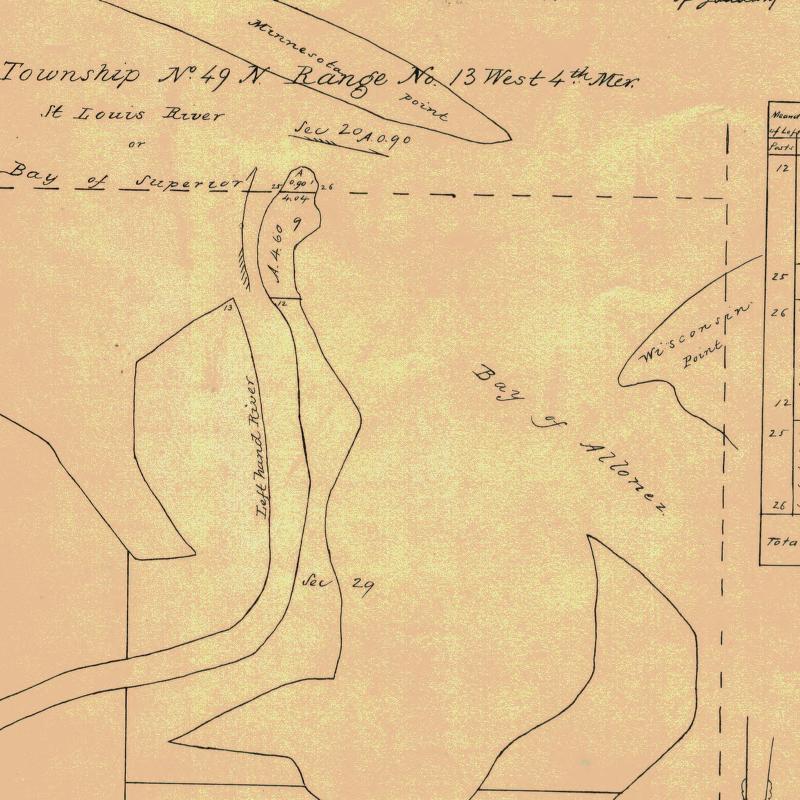
Detail of Left Hand River from Stuntz’s survey; where Barber’s land claim was located.
I have heard nothing of Augustus since writing last but expect to when anybody comes up the lake. About my claim I can say but little my chance is but dull still I don’t mean to give up so large a prize without good reasons.
I have had it surveyed and the notes sent to the Surveyor General with a memorial stating the facts and asking him to [appraise?] the [notes?].
The price contains over 8 acres (8.695).
Perhaps it occurred to you that I am was 22 years old last Sunday. Well such is unquestionably the case although nothing was done to celebrate the day only I had my hair cut for the third time after leaving Vermont. I think I shall have to go to Lancaster this spring but unless I get ousted here it will be difficult to leave.
I wish I could multiply myself by about a dozen in order to hold several valuable claims which are not occupied by any one who can legally hold them. I can’t write here two children [pretting?] and several people [telling?] Albert Stuntz and family are here today. I am perched on a sawhorse writing on a work bench loaded with all manner of [marbles?].
Evening – quiet once more since dark I have written a letter to the Surveyor General to accompany a memorial that I have been circulating. O I wish there was a person in the country that I could depend on to assist me in regard to that claim. There are one or two that I counsel with who know no more than I do and then I do as I think best.
I expect [Lowener?] to find out I have no show, and that will be the last of it I shall [not feel?] that I had lost it for I never had it, but if I don’t get it some body else will get 15 or 20 thousand dollars worth of land that I want.
Provisions are still high and will be higher again before navigation opens which cannot be expected before the 1st of May. Flour is $20/barrel, fresh pork 18 ¾ cents per lb, beef 20 cts milk 20 to 25 cts per qt. &c, &c. Eatables must be higher because there will be little or no sleighing after this over the barrens between here and St. Paul. My mind has been on the [rock?] so much today that I am not in a mood to think much about home so please excuse the shortness and dryness of this letter.
I remain your affectionate son
J Allen Barber
Went to Iron River Thursday 13
Returned 15th
Superior , Douglas Co. March 11 1856
Dear Parents
Yesterday I read a package of letters from Augustus containing one from him & from home one from Albe and one from [Caldridge?]. As Augustus was in town (Lapointe) when he recd. your letters I suppose he has answered them so I cannot tell you much news about him. I am still staying with Fargo – not doing much but hoping to get pay for my time and expense by securing the prize I am after. There is some excitement in town about it, but mighty little is said to me. The Register at the land office gives me good encouragement and says a preemption will hold it. I have taken some steps toward building on it. Today I bought a sack of flour ½ barrel for 12 dollars, I shall get some fish from Lapoint where they are very plenty and cheap and then I shall be almost ready to try housekeeping alone.

I am sorry to hear of the disastrous results of the low price of hops. Although farmers must suffer in consequence yet I believe speculators will make fortunes out of it. If I was in the business of raising them I should stick to it. No articles is so liable to fluctuations in prices as hops but it is well known that the risk fails once in five years on an average so they must come up sometime.
I see you are inclined to believe our country and climate are more in hospitable & forbidding than yours. Such I believe is not the case. We have had some very cold weather but the changes are so moderate and so seldom that we pay but little attention to the weather – in fact we call most all of it very fine weather, as it is. The lake is a great equalizer of temperatures and our cool lake atmosphere in summer causes showers to fall from all the warm, sweaty winds that come here to wash their faces in this big blue pond. People in this country go much better prepared for cold than they ever do in Vermont. I have not worn a boot since leaving Lancaster. We wear shoes in the summer and moccasins in winter.
Boots won’t do for surveyors – they carry too much water unless we stop to empty them after crossing every stream or marsh.
While speaking of clothes perhaps I might as well go on with a few more items of the same sort.
Shoes for this country should have no lining or binding as they are quicker and ae not as stiffwhen dry. We never apply anything to soften them and nothing can preserve them from wearing out in about two months of hard service. They [sell?] about $1.50 per pair. We can get plenty of wool hats which are the only ones we wear.
All manners of shirts can be bought, even the very best quality of red flannel ones, which are universally warm, outside, i.e. by common folks.
The gentry of Superior dress most distressingly.
It is difficult to get good socks any where on the country. I have worn out 6 or 7 pair this summer and lost some more – they cost high bests we don’t wear. I have none. The only cost I have is of [Gihon?] cloth and made by Mrs. Sheldon. Cost are not much more except as an extra garment to wear occasionally.
Good durable pants I find it difficult to get. They are generally poor [ashnet?] and not half put together. Good your mittens would be very acceptable but for want thereof buckskin or blanket mittens are generally warm.
You speak about bringing Kate [in?] to Wisconsin. My advice is to it without fail if you intend coming out to live, nothing should prevent it if I were in your place. The horse that Uncle [Jay?] brought out with him is smarter and tougher than any one he can find to use with him. There is nothing that I regard as more necessary for a family than a first rate horse. I think [Kelty?] will be a very good serviceable animal for work besides being one that you might be proud to ride [after?] over the prairies. Probably Augustus has told you what he thinks about Amherst and other boys coming out here to survey. Butler was so badly disappointed in this country that I have had but little thoughts of [enough?] any one else to come here. Such a disappointment I think would be the fate of 4 out of every 5 that try the business.
A person to be a surveyor must be able to travel all day through the woods and sometimes carry a pack. I would not prevent any from coming here as there is generally business enough besides surveying. A surveyor can make no greater mistake than by hiring any but the best of men. Perhaps Augustus has not told you that he will be out of the business as soon as his present job is done and will devote his time to the improvement of his claim &c. I should like very much to [have?] Amherst here but I dislike to have my parents left entirely alone. As I have [???] two half [sheets?] – when I only [illegible] mind up for the [present?].
[Incomplete copy of letter]
 Chequamegon History