First Sawmills on the Bad River Reservation
March 5, 2016
By Amorin Mello
United States. Works Progress Administration:
Chippewa Indian Historical Project Records 1936-1942
(Northland Micro 5; Micro 532)

Abstract
“Records of a WPA project to collect Chippewa Indian folklore sponsored by the Great Lakes Indian Agency and directed by Sister M. Macaria Murphy of St. Mary’s Indian School, Odanah, Wisconsin. Included are narrative and statistical reports, interview outlines, and operational records; and essays concerning Chippewa religious beliefs and rituals, food, liquor, transportation, trade, clothing, games and dances, and history. Also includes copies of materials from the John A. Bardon collection concerning the Superior, Wisconsin region, La Pointe baptismal records, the family tree of Qui-ka-ba-no-kwe, and artwork of Peter Whitebird.”
Reel 1; Envelope 8; Item 4.
FIRST SAWMILLS ON THE BAD RIVER RESERVATION
By Jerome Arbuckle

Detail of Ervin Leihy’s sawmill at Bad River Falls omitted by the General Land Office.
– Ervin Leihy, one of the first white settlers to come to the northern part of Wisconsin died at his home in this city last week. He was born in Oswego county, N. Y., October 12, 1822. His early life was passed on a farm and at 18 moved to Illinois. Later he bought a farm at Bad River, Ashland county, and in 1846 moved onto it. In 1870 he moved to Bayfield, built his present home and opened a general store which he conducted for a number of years. While living at Bad River he was a member of the town and county boards of Ashland county for a number of years and in 1871 and 1872 was a member of the town board of Bayfield. Besides these he held numerous other offices. He was a public-spirited man, had plenty of means and was always ready to assist in anything that would tend to advance the interests of the town in which he resided.”
~ Wisconsin Weekly Advocate, June 6, 1901.
The first sawmill on the Bad River Reservation was operated by a Mr. Leihy at the rapids of Bad River, which is approximately fifteen miles from the village of Odanah. The power was furnished by a paddle-wheel which was propelled by the force of the stream. The saw was of the old vertical style. With these rude methods, the sawing of six to ten logs into lumber was considered a good daily average. Mr. Leihy was known to the Indians as “Nig-gig-goons” or “Little Otter”. He married a woman of Indian blood, and he apparently enjoyed great favor among the Indians of this region.
The lumber was placed on rafts made of large cedar logs and guided down Bad River when the conditions for such a venture were favorable. A long oar or sculler was used in the stern to assist in propelling the raft and to act as a rudder.
From the mouth of Bad River the raft emerged into Lake Superior provided the wind conditions were favorable, then along the shore line to Chequamegon point and thence across to Madeline Island. The channel between the point and the island was considerably narrower at the time than it is at the present. The lumber thus landed was carried to other points on the Lake by sailboats.

Detail of Albert “Wabi-gog” McEwen‘s sawmill on the White River omitted by the General Land Office.
According to the oldest residents of Odanah, another sawmill was located some distance up the White River. This mill was operated by a man known to the Chippewa as “Wabi-gog” or “The White Porcupine.” This mill was operated practically the same as the Leihy mill. The lumber was also rafted down White River to the confluence with Bad River, thence to Lake Superior and to Madeline Island. During the winter the lumber from this mill was hauled on sleighs by oxen to what is now the city of Ashland.
Read about Benjamin Armstrong’s investigation of Wabi-gog‘s supposed murder in Poor McEwen.
“Wabi-gog” was in the habit of making trips on foot to St. Paul, where he purchased the necessaries for his project. He used a trail that intersected what was known as the “Military Road” which led to St. Paul.
On one of these trips he failed to arrive at his destination and no trace of him was ever found. It was surmised that he had been waylaid and murdered, as he usually carried a considerable sum of money on his person.
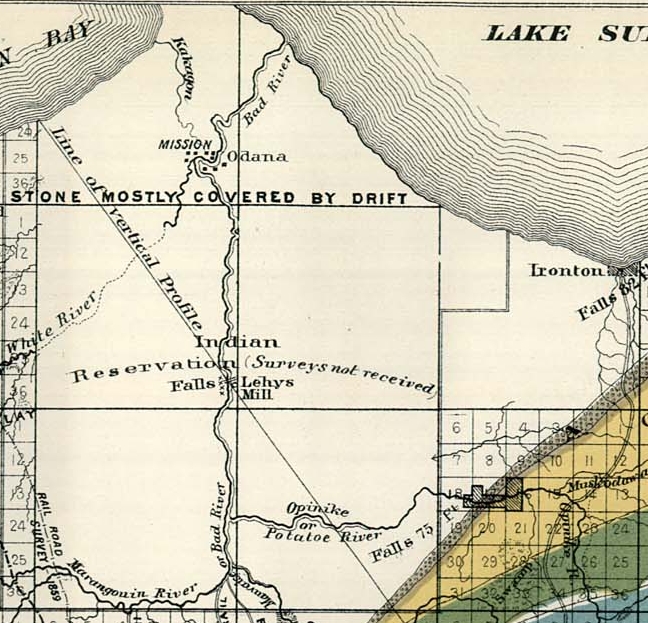
Detail of the La Pointe Indian Reservation from Charles Whittlesey‘s 1860 “Geological Map of the Penokie Range“ from Geology of Wisconsin, Volume III, plate XX-214: “Lehys Mill” is identified at the Falls on the “Mauvaise or Bad River”. The White River was partly surveyed upstream from the Mission at “Odana”, up to Albert “Wabi-gog” McEwen‘s sawmill, but did not identify it. Whittlesey may have had a copy of Joel Allen Barber’s missing 1856 survey of The Gardens at Odanah.
Barber Papers: “Houghton” Fall of 1857
February 17, 2016
By Amorin Mello
Selected letters of the Joel Allen Barber Papers
… continued from the Summer of 1857.
Sandusky Oct 24th 1857
Dear Son
At length your father and I have both reached this place but how soon we shall be able to leave it is uncertain. He arrived here last Monday night in a most miserable state. I did not get here ’till Wednesday morning when I found him much worse than I had supposed he had been, and I believe worse than he had been at any time with his lameness. He probably exerted himself too much and produced a relapse of his fever and swelling of the limbs.
He got to Detroit Thursday at night – when he got ashore he found his carpet sack was missing – he being to sick to bring it off himself. Friday morning he sent round to the hotels to look for it but got no trace and concluded to go without it – but found he was a few minutes too late for the boat. Saturday morning he went down to the wharf, then the driver pretended, or was told, that the boat would not come and go that morning but at 4 P.M. so he was carried back the house again and paid the scamp 50 cts. Soon after he saw a bill posted saying the “Bay City” would leave that day at 7 oclock but before he could get to it, they told him it was gone so he was obligated to remain over till Monday.

Michigan Exchange Hotel in Detroit, circa 1884.
~ Burton Historical Collection.
He put up at the Michigan Exchange where he was on the second floor and had to climb stairs until his limb became very lame and considerably swollen the whole length. He had some fever and no appetite all the way after leaving La P. and probably when he started. The day after he got here Hamilton procured a Homeopathic Physician who has called to “treat” him every day since. He had intermitent fever all the time. Broke a fever every afternoon and night till yesterday and today, when it seems to be leaving him – his appetite is returning. I think tho he is very weak and can bear but very little food and the of the simplest kind. The Dr thinks he will get up soon if he can get the pain out of his limbs, but that will probably take some time to conquer. Says it is probably a rheumatic affliction and might have been produced by taking Quinine. But he is decidedly better now than three days since – in all respects I believe that had he called an Alopathic Dr, he would surely had a Typhoid fever, but if he is quiet and patient I think he will escape this time. But I fear it will take a long time for him to recover sufficiently to go home in cold weather. He had set up a little the last three days but cannot get off nor on the bed without help, and cannot walk without great paid to his limbs – indeed, he has not walked a step since Wednesday. It has certainly been a very unfortunate season with him and with us all, but I must consider it very fortunate that he has fallen in to so good a place to be be sick, and is in the care of an experienced Homeopathist, who I believe will cure him.
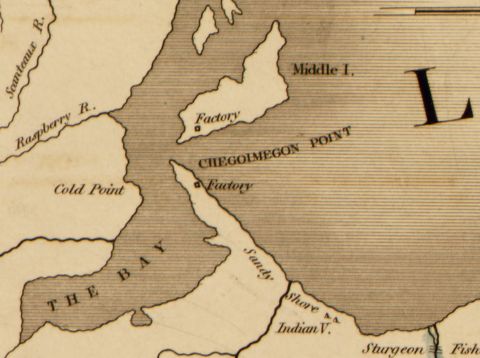
Houghton Point aka “Cold Point”,“Stony Pointe” , and “Point Prospect”.
~ Detail of Map of Michigan & Part of Wisconsin Territory, Exhibiting the Post Offices, Post Roads, Canals, Rail Roads, &c from the 1839 Burr Atlas of Postal Maps.
It is very strange you did not receive any letters from me before father came away as I had sent, certainly three – some of which you may have got before now. And I got but two short letters from you and none from your father after you left me. He wrote to Mr Burr when first taken sick and I heard nothing more from him untill one reached us of Oct 3d saying he wished me to meet him at Sandusky as he was too sick to get to L. Of course, I suffered a good deal of anxiety to know what had become of him and how I was to get home alone – supposing he had gone home without sending me word – I had been so long waiting to hear from him that I had concluded to start in company with Miss Julia Hyde, when I rec’d his letter.

Detail of early settlements and footpaths near Houghton Point from the Barber brothers’ 1855 survey of Chequamegon Bay. Giles and Allen lived with the Maddocks family during 1856 and 1857 at what is now the Houghton Falls State Natural Area.
I had promised a visit to Mrs. Baker at Janesville, so not knowing how soon he would be here, or that he was much ill then, I concluded to stop there and I started Thursday morning from L – and spent three days at Ja – left there Monday at Midnight – that being the express train expecting to get here the next eve but did not till Wed Morning 4O.C.. There being but no train each day from Toledo to this place. I got along very well alone – without losing any thing of consequence. I am afraid that carpet-sack of father’s will never be found tho. Uncle H has written to some one who was on the boat – whom he knows and perhaps it may come again. If not it will be one more loss added to the many we have suffered within two years. When the tide of misfortune will turn with us is yet in the anxious and uncertain future. I yet hope our lives will all be spared to meet again. When I left Lancaster many people were having a sort of influence which they called “colds”. Grandpa – Thode Burr and Mary B. had it and since reaching here Martha has sent a letter saying that Addison – Mame. Lil and Em. in her house – Mother and Lucy – Lib and the two youngest children, and Mary Parker – and Father at Allen’s, Mr. Phelp’s son quite sick; and about half the people in town had the disease. I had the good luck to escape it entirely, tho’ I rode to Boscobel in the stage the worst day there has been this fall. I am afraid we shall not be able to go home without exposing father so much that he will be very sick. I am sure he cannot recover sufficiently to start with safety in less than four weeks if he has very good luck and no relapse on account of the season. But if good nursing & good medicine can cure him he will be well before winter.
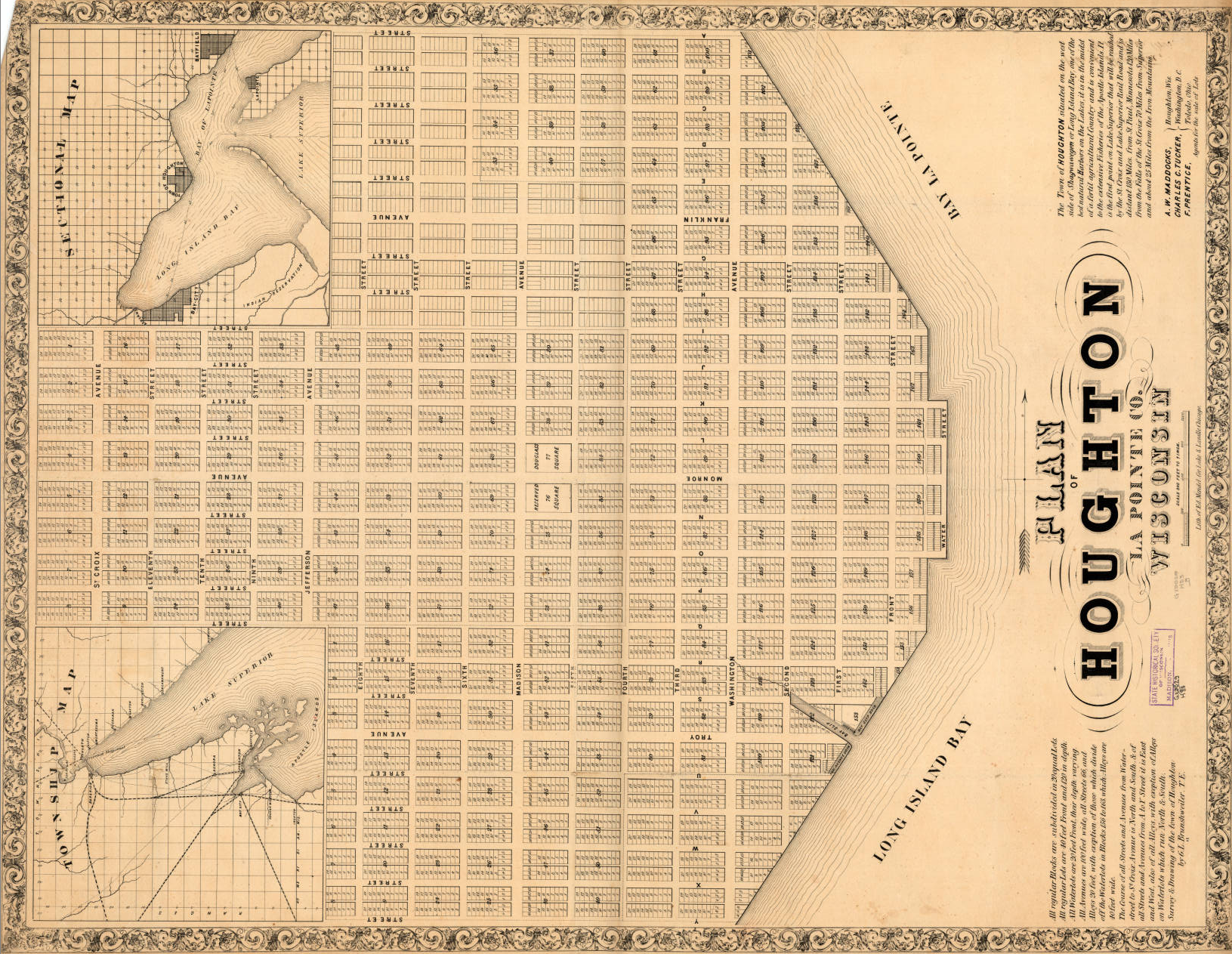
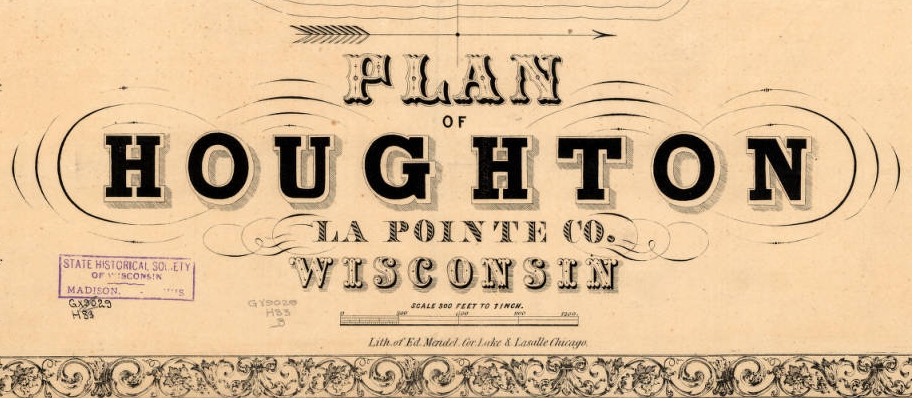
Plan of Houghton, La Pointe County, Wisconsin, 1858.
~ Wisconsin Historical Society
Aunt Emeline is absent, with Frank at Columbus, but the rest of the family are here and show us every kindness. This is a most delightful – comfortable and convenient place to be sick in, if one must be sick. How I wish I could think of our house as possessing half the attractions for a family residence that this does. But, poor as it is I should be very glad to see it once more and be where I could call it home.
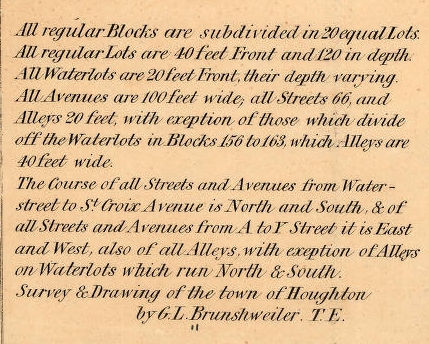
“Survey & Drawing of the town of Houghton
by G. L. Brunschweiler, T.E.”
I am sorry to hear that you have had to wait so long for your money – consequently could not go on with your work. I do hope you will not try to stay there through the winter unless you are sure of money, and that there will be plenty of provisions to be got at. What could have been the reason that your money did not come to you? I did not know that Uncle Sam has suspended payment or lost by the failure of the banks. Perhaps you did not keep reminding them of your case or give them your “address”.
You must write oftener to me and give me an account of your affairs – of all your pleasures and your pains – your disappointments and vexations and be assured no one can feel a deeper interest or more truely sympathize in all that concerns her you than your affectionate parents.
G. A. Barber and M. G. Barber
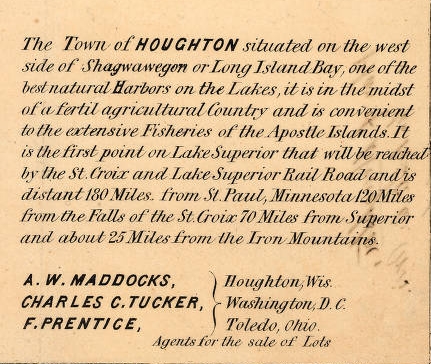
“A. W. Maddocks – Houghton, Wis.
Charles C. Tucker – Washington, D.C.
F. Prentice – Toledo, Ohio.”
Your father wishes you to say to Mrs. Maddocks that he feels under infinite obligations to her for the kindness shown him while sick at her house – that he wishes to express a thousand times more thanks than he was able, when parting from her in the Steam boat, to do. I congratulate you on having the privilege of making it your home at so nice and comfortable a place, with such kind people as father describes those to be. May you have the good fortune or good taste and disposition to make your presence in that, or any other kind hearted family, agreeable – is the wish of your Mother.
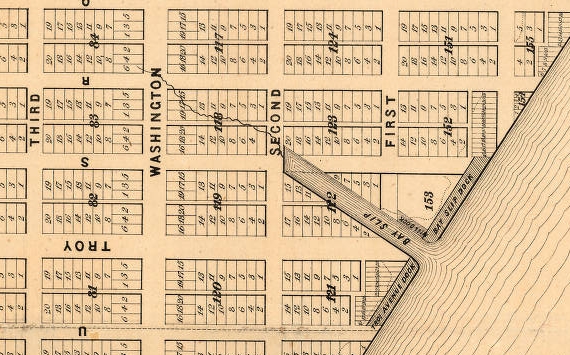
Houghton Falls State Natural Area within the Town of Houghton.
Monday morning
Your father rested better last night than before and had no fever thro the night but sweat a good deal as before – is very cool and comfortable this morning. Has some appetite – does not like to get up as it hurts his limbs. But much less than when I first came here.
Sandusky Nov 1st 1857
Dear Son,
Last sunday I wrote you about your father’s sickness and hope you have rec’d it, or will in good time; but as my letters of the past summer have failed wholey to reach you, perhaps the last has also failed. I shall continue to write to you often while he continues sick – and unless while navigation lasts and you may direct yours here until the last boat leaves your place as I see no prospects now of your father’s being able to move on for some time to come. I told you about the chill he had which made me fear he had got a regular chill fever but he did not have another tho he had pretty severe intermittent fever for three days last week. – indeed it continues somewhat yet, but much lighter. But his lameness is much worse than when he left you – that is – he cannot walk or step because his limbs are so painful and much weaker than when he had more fever. I believe he would never have got here alive had he not been sustained by tonics and morphine, but they would never have cured him, and I do think that had he fallen too sick to get here and had employed another Alopathist he would have gone into a typhoid fever and probably have died, as did the hon. R.C. Benton Sen. a short time since – at Rockford Ill. I met his son – our Johnson teacher one at Janesville who told me the sad news. – He was informed of his father’s sickness but did not reach there ’till after his death. His body was carried to Vt. for interment.
Nov. 2
~ “Business Directory” published in the Superior Chronicle, June 26th, 1855.
Your father wishes to ask you if you know anything about that Geo Perry concern – the present shape of it. And if you have heard any thing farther from the Aminacon claim?
Did you get the money of Jack so as to save your compass? If so – how does it prove? Has Herbert got home since yet? If so, how do the boys fare – do they get any money of him? Does old Whacken let John have his paper? Do you hear anything from your money?
When father left the boat at Detroit he told the porter to get his Carpet bag in his room and send it ashore with his trunk – showing him the trunk. – but when he got to the Michigan Exchange it was not to be found – neither at that house nor any other in the city. In looking for it he was detained so as to lose the boat for Sandusky, Friday morning – Saturday he started in a carriage but was told at the wharf by the driver that the boat would not go – (had not arrived) till afternoon, so he was taken back again when soon word came that it had came, but before he could get started – he being unable to walk – it was off again, so he was obliged to stay ’till Monday.
Thus he was detained nearly four days – sick and lame and obliged to climb a long flight of stairs and take long walks to his meals and other necessities, which all together brought on his fever and rheumatism in the muscles worse than ever. He thinks it almost a miracle that he got through so long a journey – sick as he was when he left you, and without any one to assist or care for him – alive. His lameness is now in the left limb – the other being quite free from pain when kept in a horizontal position, but both pain him extremely yet if put down so that he does not attempt to step on his feet. Ham, Jay, and I brought him up stairs last Saturday where we have every thing we need for convenience and family are all as kind and attentive to one wants as people can be. I do not believe there is any better family, or one happier, than this. It is two weeks today since father came here and I know not how many more he may have to stay – the prospect looks rather dark for a speedy departure.

The “Geo Perry concern” related to Albert McEwen’s death and fraud during the 1856 LaPointe County election. This was investigated by the Wisconsin Assembly.
~ Journal of the Assembly of Wisconsin, Volume 9, 1857, page 191.
We got a letter from Am. Saturday in answer to one from me here, says he is well but I should judge he had not done much this fall but watch and wait for us. I do not wonder the poor boy is out patience as well as every things else, as he says.
Write often to your afflicted parents.
G.A.B. and M.G.B.
Sandusky Friday Nov 13 – 1857
Dear Son.
You will at once perceive that we are stationary since I wrote you last. And when we shall be able to move on, is as much a question of uncertainty as ever. Your father remains sick yet – and I cannot – dare not say that he is even convalescent, tho’ I have a little more courage to think that the medicine now being administered is breaking up his fever. He has had a most singular sickness – having – as I think – more or less fever – with or without chills every day – probably since he was first taking – certainly since coming here. [??] the Dr would not acknowledge – or believe it because his visits would be in the forenoon when the intermissions would occur. But the past week he convinced him that chills and fever do actually exist as he has been [presedest?] to break it up. His sickness is so unlike anything in the experience of the Dr. that he appears to be entirely mistified with [reward?] to the proper course to pursue. I have, and do, doubt his judgement – and sometimes have even put a harsher construction upon his course and doubted his honesty. But he has all along said he had not the least doubt of his ultimate recovery tho it would take considerable time to entirely remove his lameness. As to that lameness I hardly know what to say. He is now free from soreness and only his feet swolen; but he cannot straighten his knees as the cords appear to be contracted and are painful when strained and if his feet are brought lower than his body it brings on the same old tearing pain in the muscles.
But I believe that when his fever leaves him and he begins to gain strength his limbs will improve fast. This week past I have felt more discouraged than ever, as the chills would come on every day about noon – continue an hour – sometimes with a hearty shake – then fever – pulse 120 hr. m. – then a hot sweat most of the night with pulse at 85 at the least pain.
This lasted about 5 days – But the Dr has at length “come in with a Tonic” which appears to work right. It is the most powerful sweating medicine I ever saw. He has taken it two nights and one day – and now the 2nd day – 3 P.M. – he has fairly escaped the chill and fever. I feel greatly encouraged – that he is in a way to recover. He has all the time been quite confined to his bed except as he could manage to get into a great chair once a day and sit up – from two hours to half an hour – this several days he has not got in the chair as he was unwilling to exert himself so much. I have been with him – his only nurse – night and day for 3½ weeks, and I hope and expect to granted health and strength to continue to perform the duties of nurse so long as he shall need my assistance. I cannot but think that he was in just as good condition to receive the medicine, which is working so well over two weeks ago – when the billious fever first left him, as he was two days ago. But the Dr thought not, as his limbs were so bad then, and it might make them worse. It has been altogether an unique case, and the Dr has appeared liked one groping in the dark.
I told you in my letter of last week that father lost his carpet-bag – and intended to tell you to see if it was not returned to La Pointe and left there – he thinks the label on it directed there – tho’ at first he said it was to Lancaster. He can hear nothing from it since and I fear it was stolen by the darkies on the boat. This has truely been an unfortunate year for us as well as for thousands of others.
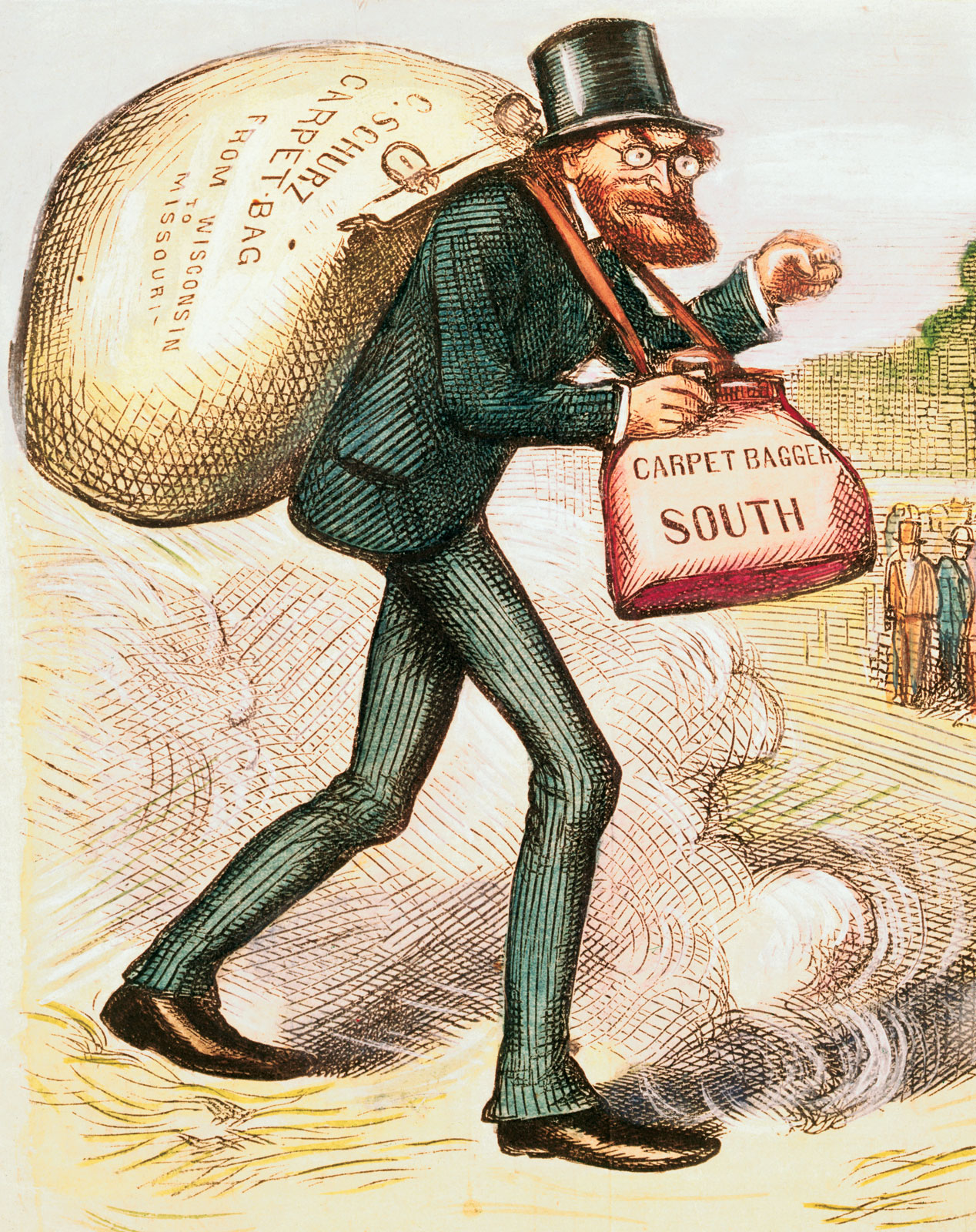
1872 cartoon of Wisconsinite Carl Schurz by Thomas Nast.
Wikipedia.com definition of a Carpetbagger:
In United States history, a carpetbagger was a Northerner who moved to the South after the American Civil War, during the Reconstruction era (1865–1877). White Southerners denounced them fearing they would loot and plunder the defeated South. Sixty Carpetbaggers were elected to Congress, and they included a majority of Republican governors in the South during Reconstruction. Historian Eric Foner argues:
“… most carpetbaggers probably combine the desire for personal gain with a commitment to taking part in an effort “to substitute the civilization of freedom for that of slavery”. … Carpetbaggers generally supported measures aimed at democratizing and modernizing the South – civil rights legislation, aid to economic development, the establishment of public school systems.”
“Carpetbagger” was a pejorative term referring to the carpet bags (a form of cheap luggage at the time) which many of these newcomers carried. The term came to be associated with opportunism and exploitation by outsiders. The term is still used today to refer to a parachute candidate, an outsider who runs for public office in an area where he or she does not have deep community ties, or has lived only for a short time.
We get nothing yet from you. Why is it that you remain so silent? I think it probable we may have to stay here four weeks longer – waiting for him to get well. You may direct here if you send by return mail or by any boat.
You cannot know, nor be told the amount of distress in the country this money panic has produced. I presume you do not see the papers so often as we do, and perhaps do not realize at all. You father warns you to be careful what you do this winter. – not to meddle with any thing – in Ironton shares – or any kind of property – even if you can buy it for a “song” – Every thing is “dead broke” and the less you have to do with Lake Superior property, the better.
Father sends his best love along with mine to you and his respects to Mrs. Maddocks and family.
I am very sorry to think that you will stay up in that wilderness this winter. I wish you could get your money – settle up every thing – come down here and go home with us. It would be a great relief to us to have your assistance for your father if he should continue too lame to walk without help.
We are under a great many obligations to Uncle H. and family for their kindness.
It is growing dark, so good night
Mother
Sandusky Dec 6th 1857
My Dear Son.
Yesterday we rec’d a letter from Am. containing one from you. I was greatly surprised and grieved to learn that you had not got one of my letters since you left Lancaster. I have sent you three from there and as many from here. Neither had you rec’d your draft. I am really suspicious that some one watches the mails and steals your letters hoping to get money or the draft – which, it is possible he has taken out – forged your name &c and taken the money out. In such case you might not discover the theft for a long time – and would be subjected to a great deal of trouble in consequence. I shall have a deal of anxiety in your account this winter, or until I hear that your money has reached you and that provisions are to be had at reasonable prices – which I fear they will and be this since the loss of that new boat must make quite a difference with that region in supplies.

American carpetbag circa 1860; wool with leather handles.
~ Wikimedia.org
I have before written you an account of your father’s journey and continued sickness which you may have yet [??] now. Lest you have not I will briefly say that he got safely to Detroit where he lost his carpet-sack – was detained there three days – arrived here Monday night 19th ult. Oct. 19th where he has remained ever since, confined to his bed. The fatigue of the journey probably somewhat increased his lameness which has been very severe, and he has not been entirely free from chills and fever and sweats until the last week. He has been improving fast for a few days, but just now he is having a little more fever which I presume is caused by some impending diet – either in quantity or quality.
His disease – a very uncommon one – is, in fact, inflamation of the veins extending from the Loins throug the whole limbs – the left much the most – to the toes. He has not been able to put his feet to the floor without extreme pain since he got here, until the last week, and even now, but a few minutes at a time. The cords under the knees have been considerably constrainted but are getting relaxed a little so that his legs make nearly straightened, tho he cannot begin to bear his weight on them.
The disease has been so complicated and so badly treated before he got here that the Dr has been very much perplexed with it. If you have not got my former letters you do not know that we have had a Homeopathist – one whom Uncle H. and Aunt B. think knows enough for all cases but we think that had he possessed a knowledge of anatomy equal to his partner in business who has called twice with him of late, he would have discovered the seat of the disease at first from the symptoms then apparent. But for four weeks he seemed to be in a state of uncertainty, and baffled at every step. But since he discovered the seat of it he has treated it with very good success.
Your father is much reduced in flesh and strength. I cannot now give you a full description of his case but when he gets able to write much I presume he will amuse himself by giving you the particulars if you should feel interested in the subject. Uncle H and family are very kind and obliging and we have every thing our necesities demand at present, but that does not make me contented to remain so long from home. I wish to be in my own house, but it is impossible to leave here until he can walk enough to help himself a little. We have been here 7 weeks, and I fear it will be many more before it will be safe for him to leave or proper for me to leave him for others to wait on. My health is very good so that no one has had to assist me day or night, in nursing.
Your Aff’nt Mother
I suppose this will never reach you unless I direct to some other person for you.
All well at Lancaster last Sunday. Monday morning Aunt Lucy saw a fine little daughter added to her family.
Sandusky Dec 18th 1857
Dear Son
~ Wikipedia.com
You will see that we are here yet, now nearly 9 weeks since I landed here in an almost insensible state from the effects of morphine which I had to take constantly to allay or drown the pain in my limbs. I have been quite sick much of the time. Three or four weeks were spent in treating my sore before the [rest seat became?] of my disease was ascertained, since which time there has been steady progress toward health. My legs had become crooked at the knees, absent at an angle of 45*. My ankles and feet swollen, white, cold & as useless as though made of putty, but I found the pain that had so long affected them was gone & by much exertion, rubbing &c I got so as to bear any weights, & [thoutes who?] crutches, & I have now got so that I can go twice the width of the house at a time on them. My appetite has returned & I am gaining rapidly. My real disease was what is called Spormator [hea?] or a disease of the Spormation vessels or cord on the left side of my body, which the Drs & your Uncle Ham think was the origin of my sickness & all my pain. Sir Astley Cooper [in thing?] authority, giving all the symptoms of my case. We hope to be able in a week or two to go home to Vt. Your mother wants to start in my present helpless condition when I cannot stand alone in a minute without support to save my life, but I have sworn that I will not go to be jostled around & in the can till I am better able to take of my self than now. I cannot get up or down stairs or sit at all weight with crutches, & as neither of my legs are reliable I assure you it is ticklish business to dare go on them (the crutches).
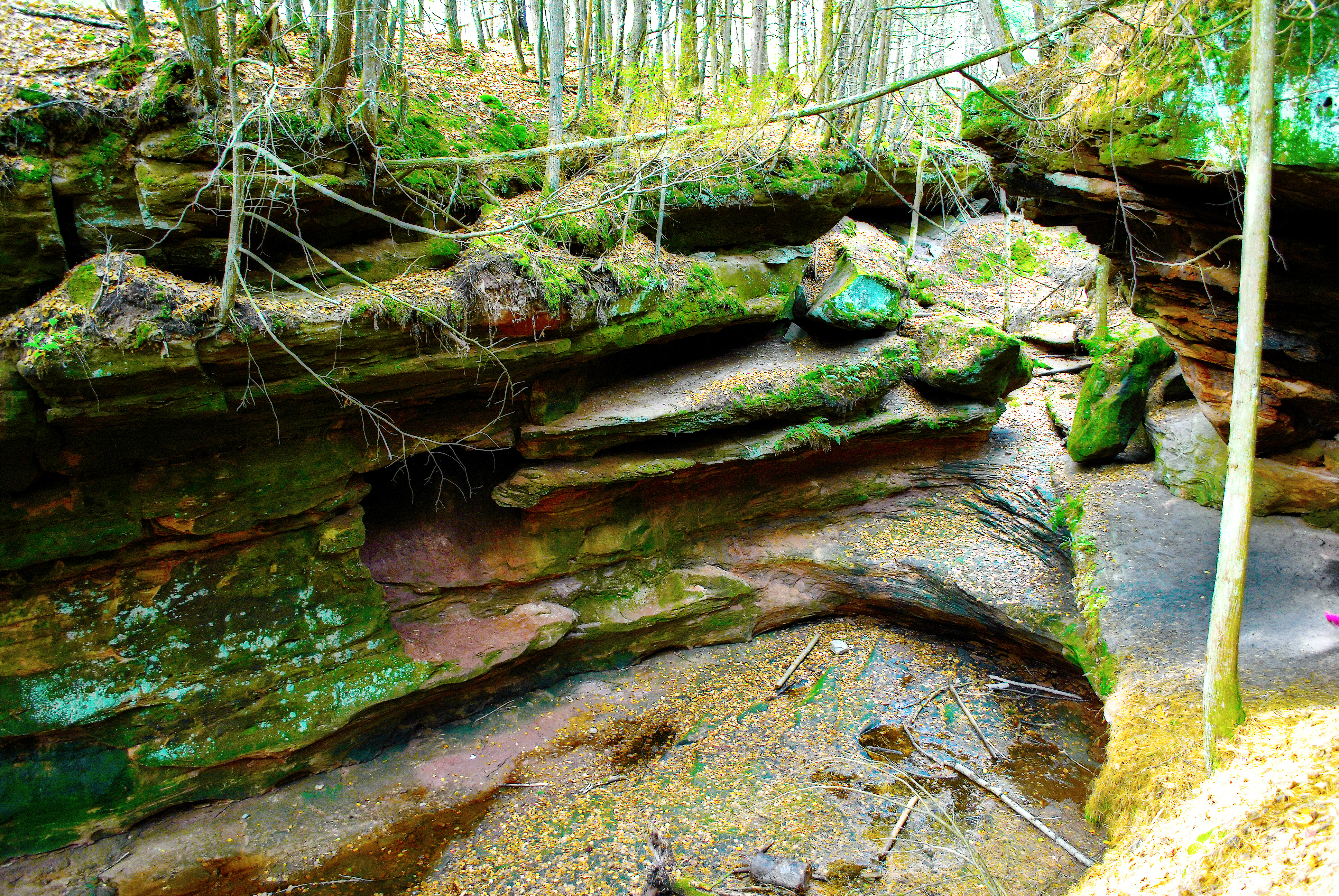
Echo Dells at Houghton Falls State Natural Area.
~ Shared under Creative Commons from Aaron Carlson © 2011
Coming down the lakes from La Pointe I had a pretty hard time of it, was quite sick, had chills, kept my berth most of the time, & when I got to Detroit I was detained by losing my carpet bag and one thing & another because I was unable to help myself, from Thursday P.M. ill Monday A.M. when I came here. Lucky that I had such a refuge to [want?] to in my extremity, had I tried to reach home, my life would have paid the forfeit of I might have had a long sickness among strangers without any of the comforts or conveniences I now enjoy, and insured an enormous train of affection.

Map inset of Chequamegon Bay with Town of Houghton, LaPointe, Bayfield, Ashland, Bay City, and the LaPointe Indian Reservation.
We get letters from Amherst occasionally, he is well & in good spirits boarding at Mr Griswolds, is very anxious for our return to Vermont. By him I learn that Ambrose Chase died after about an hour illness in Nov, & that John Burcham of Johnson died still more suddenly being found dead in the privy. Old Mr Dorsker died lately & that is all he has told of to us. On opening my new trunk here I find some books are missing. Who do you suppose is the rogue? I hope he will russ some amusements & instruction from the books, if so I am content.
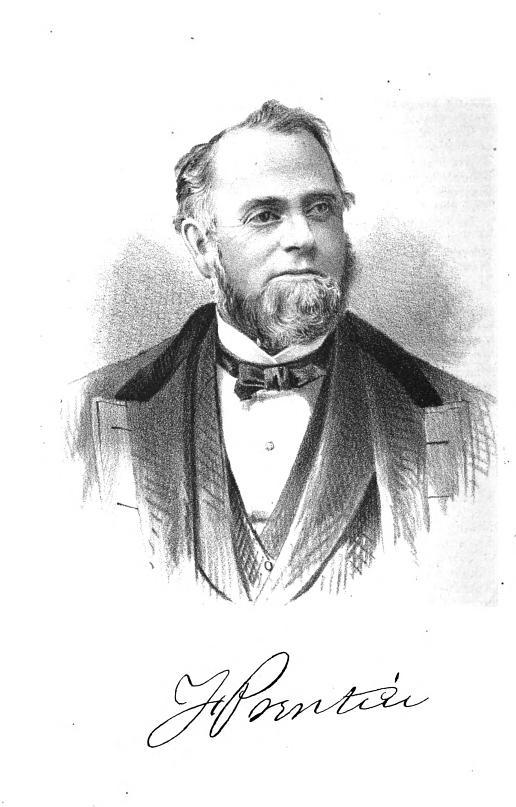
Frederick Prentice (“Man of Money and Mystery”) was an “Indian interpreter for Indian agents and traders”, and owned extensive properties in the Chequamegon Bay region during the 1850s. Prentice started the City of Houghton around the same time he cofounded Bay City (Ashland) during 1854, purchased the Buffalo Tract (Duluth) from Benjamin Armstrong during 1856, and cofounded the City of Houghton (near Washburn) during 1857. Prentice returned to Houghton in 1887 and organized the Prentice Brownstone Company, becoming “the most famous quarryman in northern Wisconsin”. Houghton had a “population of about 250 people, a school house and a sawmill with 25,000 foot capacity” by 1888.
~ This portrait and a profile of Frederick Prentice (the “first white child born” in Toledo, Ohio) is available from History of the Maumee Valley by Horace S Knapp, 1872, pages 560-563.
~ “Business Directory” published in the Superior Chronicle, June 26th, 1855.
August 22nd, 1857
“John H Osborn,
Banker and Land Agent,
And Dealer in Exchange, Superior, Wis.
REFERENCES, — J. B. Ramsay & Co., Cincinnati; J. R. Morton & Co., do; E. Jenkins & Son, Baltimore; A. R. Van Nest & Co., N. Y.; Heston & Druckla, Phila; Holiday & Coburn, St. Louis; John H. Richmon, Esq., Maysville, Kentucky.”
Have you recd your draft yet? Was your compass saved to you? Have you got at work on the reservation yet? If so how do you prosper? How does Herbert make it, does he still remain agent? Does he sell any shares, if so, for how much? Is the work still going on at the City of Houghton, or has the news of the general crash and prostration of all kinds of business failed of reaching Stony Pointe? I recd a letter from Prentiss last week who says, there are some going from Toledo next spring to live there, & he appeared to feel as well as ever.
He said he sent 50 bbls Ham & a lot of Pork to Detroit to go up, but it arrived too late for the last boat to Lake Superior. I have written to Hayes that if the Ammanicon case is decided against me to take an appeal to Washington at once & I will go there & see if testimony has been supplied or any unfair things have been done by the clerks in the office.
I have now sat up [little?] hours, read Douglas’ speech & written this much to you but I feel that I have over taxed my powers and must go to my heated bed for rest. Douglas has come out against the Administration policy toward Kansas & will make a split in the party not easily healed. I will send you his speech.
Tell Mr. Maddock’s folks that Judge John Fitch of Toledo was shot yesterday [????] once of his family by one T.G. Mellon, the ball entering his mouth, lodging in the back of his neck, some hopes are entertained of his life. If this is a ½ sheet it is as long as your letters. Be careful of yourself. I remain your affectionate father.
G.A. Barber
Give my respects to Mr & Mrs Maddocks, & to John Cosborn.
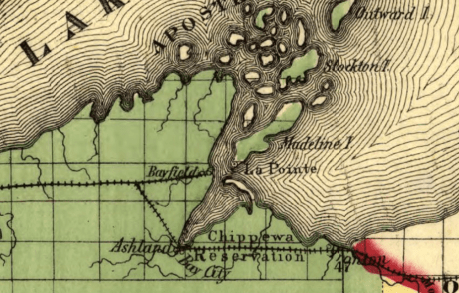
Detail from the 1857 “Township map of Wisconsin showing The Milwaukee & Horicon Rail Road and its connections“. The town-sites of LaPointe County shown here are Ironton, Boyd’s at Old Fort (mislabeled as “La Pointe”), Bay City, Ashland, and Houghton (mislabeled here as “Bayfield” and later as “Lower Bayfield” in the 1865 Colton Atlas). The railroad shown on the LaPointe Indian Reservation correlates to Barber/Wheeler/Stuntz details from “the Gardens“.
~ Library of Congress
To be continued in the Winter of 1858…
Barber Papers: “Poor McEwen” Spring of 1857
January 29, 2016
By Amorin Mello
Selected letters of the Joel Allen Barber Papers
… continued from Winter of 1857.
Cambridge Sunday April 12th 1857
Dear Son
It is some weeks since I have written a word to you, for the reason, that after I learned that you had gone to Superior & might be coming down to Lancaster, all my letters to you might fail of ever reaching you, so I have held on till I should learn something further from you. We have recd several letters from you, since your arrival at Superior, for which we were thankful, & I trust that when you got back again to La Pointe our old friend Esq Bell had a lot of my letters for you that would take a long time to read, i.e. if you should have patience enough to read them all through I wrote you last on the 8th of March & next day letters from you, one dated at La Pointe & one for Amherst dated at Fargo’s. Since that time nothing any important has occurred within the circle of your acquaintance. Every thing has jogged on in the old beaten track. We are all three well, & it is a remarkably healthy time all around us. There have been but 3 or 4 deaths in town since I came home. Deacon Reynolds aged 90 Lyman Seeley’s wife & Walter Wheeler [???s] wife & a boy of D.R. Evan’s. In Johnson no deaths that I can think of except old Mrs Hunt who died last week. The marriages in this town have been very few & none that you will know any thing about except Susan Harvey who was married last week. In Johnson very few, Calvin Whiting has lately married the widow W. (Albe‘s Mother).
This has been a remarkable sugar season thus far, but we are probably through or nearly so for this year. Dow has made about 1150 lbs & has a lot more to sugar off. Amherst has tapped 15 trees where Mr Harvey who used to make sugar in our woods and has made about 250 lbs of the kindest sugar ever made in Vt as he used tin milkpans to catch his sap & boil in the great caldron kettle & every thing is done up scientifically. It would amuse you to see how the “Hops” put into it, as he goes into the woods at 7 a.m. gathers his work, over 3 or 4 times boils it down & draws it down on the handsled in the largest wine keg, at night, often after dark, & half the way in deep mud, sometimes breaking his draw ropes & nearly blistering his hands by drawing on the rope. Amherst has got to be a great swarthy half breed 5 feet 5 ½ inches high in his stockings & weighs 140 lbs as well & free from every ail as one could wish & if you do not see him soon you will never be able to handle him again.
We had a great flood last week as high as I have ever seen it, save a very few times tearing the banks terribly, carrying off fences, bridges, & doing all sorts of mischief generally. Our meadow will part with a slice from the trees just below the house to the large trees on our bank [????] the creeping rock about ½ a rod wide. You will be surprised to see how the meadow is going off, the more it wears, the faster it goes next time & it will not be long before it will go all off entirely. If it were like all other meadows, that gained in some other place as fast as it last elsewhere it would be more tolerable. But we shall have to grin & bear it, awhile, till we all make up our minds to let somebody else have it & try what they can do to save it. Another great objection to our meadow is its liability to have the soil carried off & great holes washed out, if plowed, & there is 1/3 or nearly of the meadow in this state & for want of plowing it does not produce more than 1/3 of what it should do.
Dow is still on the place, though he & wife are bad enough I do not see as I can do better. Jonathan Nichols has got back with his family to Cambridge, Irving sold out in Al. but on?? is homesick to get back again.
You will get a letter from me with a copy of a notice from the Land Office at Mineral Point, & probably you will get a copy of the law as passed by Congress, before this reaches you, or I can cut it out and send it in this letter so that you can see it for yourself which I think the best way & you can also see Oscar’s [???], & as you have lately written to your Uncle Allen I suppose he will give you all needful advise on the subject.
On further reflection I will not send you the Law, you will get it in William’s Paper of March 21st if it now goes to La Pointe as his father said he should direct it [???] Nov 20th then. I think will be no trouble in your case, as you will see that all entries under that act
“where the purchaser has made affidavit & paid the purchase money as required by [?d] [a?] & the instructions issued & in force & in the hands of the Regent at the time of making said entry, are hereby legalised & [???] shall issue to the parties respectively, Excepting those entries under said act, which the Commissioner of the Gen. Land Office may ascertain to have been fraudulently, or evasively made.”
This is all the law governing your case & I think there will be no difficulty whatever about it. Your entry was made in good faith & you went to the Lake to earn something with which to improve your land & have forfeited nothing there. I was thinking that if you came to Lancaster I would go there & take you with me to the Lake via the Sault when I go up there in May or June. However if you do come I know it as soon as you get there, & if you do not I shall expect to find you at or around La Pointe in health & in good spirits I hope, & probably glad to see one from below, but not gladder than we should be to see you here.
I am surprised to learn that you are going to survey islands so late in the season. Nothing that I can now say will avail any thing else I would caution against trusting too long to the treacherous covering over the dark blue waters. I hope you will have good success and get through without any fatal accidents to your self or to any one of your party. I shall feel great anxiety on your account, till I hear from you again, but shall try to comfort myself with the assurance you gave us in a late letter that you were careful to avoid all danger as much as possible, not only on your own account but on that “of your parents & dear brother.” I cannot expect to get answer to this before it is time to go up to the Lake, but that need not deter you from writing, if you do not come below, & if you do come to Lancaster you may expect to see your Mother there forthwith & possibly Amherst & myself. I do not yet know what I shall do with Amherst this season whether continue him at school put him in a store or to some trade. He would like to be a printer well enough, & it is not a bad business. Whether it would be best to have him go through college is matter of uncertainty with me. There are half as many spoiled by going to college as there benefitted by it. But I do want you to close up all your business around that Lake & come to your Uncle’s Office to study Law. Thode Burr thinks of it & his Uncle wants to have him. I wish you to take the matter into consideration. May God preserve your life & health and prosper you in all lawful undertakings
I remain your Affectionate father
Giles A. Barber
Amherst has shot 3 muskrats to day, prices better now from 15 to 25 ¢.
I am very sorry for the fate of poor McEwen. I fear he is dead & that his fate will never be known. I think he was abandoned by his guides & perished alone.
Mr Young is still alive I suppose, have heard lately that he was worse.
You will see that Buchanan is the worst patron of Border Ruffians & the meanest tool of slave holders that has yet cursed the nation, appointing the worst fire eaters and none else to office in Kansas, & doing all the dirty work of the south crushing out freedom & establishing slavery all over the [?????] if possible.
Superior Chronicle
April 14th, 1857
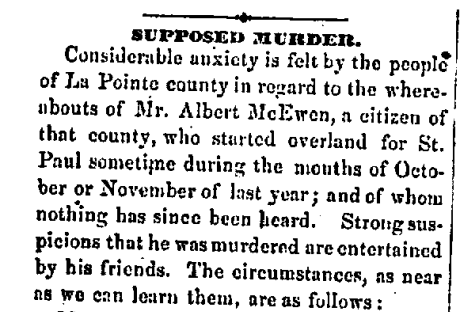
SUPPOSED MURDER.

“Supposed Murder” was a newspaper article published in the Superior Chronicle issue of April 14th, 1857.
“I am much alarmed for the safety of Friend McEwen & think the prospect of his being alive is very small. The case deserves a rigid investigation to ascertain whether he was murdered by his guides, or was deserted by them & left to perish in the wilderness. The weather was favorable about that time & for some days after. I think he left La Pointe Oct. 14th the day I got back from Montreal River. ‘Poor Mc’”.
Considerable anxiety is felt by the people of La Pointe county in regard to the whereabouts of Mr. Albert McEwen, a citizen of that county, who started overland for St. Paul sometime during the months of October or November of last year; and of whom nothing has since been heard. Strong suspicions that he was murdered are entertained by his friends. The circumstances, as near as we can learn them, are as follows:
by Western Historical Co., 1881
“Ironton, which was settled at the time of the iron excitement, was situated on the south shore of the lake, one-half mile west of the Montreal River. The village was platted in 1856-7, by McEwan [Albert McEwen], Herbert, Mandlebaum, and others. Warehouses and docks were built, and the place thrived for about four years, when it was abandoned.”
Mr. McEwen, a gentleman from Detroit connected with the Indian Agency, and several persons from La Pointe county, with half-breed packers, started together last fall to go across the country, and traveled in company until reaching the head waters of the St. Croix. Here McEwen and the gentleman from Detroit procured canoes and, with two half-breed yoyaguers, determined to descend the river, while the remainder of the party took the land route. When the latter party reached Yellow Lake they found the half-breeds there, but could learn nothing definite in regard to McEwen and his companion; nor could the learn anything in St. Paul, where both these gentlemen had business engagements.
McEwen was known to have about $600 in notes and drafts on his person, and his companion $1,000 in gold. The half-breeds were seen a short time after in St. Paul in possession of large sums of money, principally gold. It is believed that they murdered these gentlemen while descending the river. The circumstances are strongly in favor of this belief.
Mr. McEwen had resided in and about LaPointe for several years, and owns considerable property in that county. He was an explorer; and is well and favorably known throughout the lake region. The other gentleman was in the employ of Mr. Gilbert, superintendent of the Lake Superior Indians; and was returning to Detroit from La Pointe, where he had been on business connected with the agency.
At latest advices a party were organizing at La Pointe to go to the St. Croix and arrest the half-breeds, and if possible learn the fate of the missing persons.
Early Life among the Indians:
by Benjamin Armstrong
CHAPTER XVII.
A Murder on a Trial at Yellow Lake.——Yet a Mystery.——Collar and Sleeve Buttons of the Murdered Man.——An Introduction to the Bear Family.
~ Early Life Among The Indians by Benjamin Armstrong, Chapter XVII.
North Woods River:
The St. Croix River in Upper Midwest History
By Eileen M. McMahon, Theodore J. Karamanski, pages 64-66.
“Among the unsavory traders who entered the St. Croix at this time was Joe Covillion. He was a Metis who took over the former mission school at Yellow Lake and used it for his post. Located on the Yellow River just where it leaves Little Yellow Lake, the trading house was the scene of many drunken reveries and a key location in the first murder mystery in the St. Croix valley. In 1845 [sic] Albert McEwen hired Covillion to guide him to timberlands in the Yellow Lake region. McEwen had a large amount of gold coin he hoped to use to secure title to lands upon which a profitable speculation might be made. McEwen never returned from the trip. Covillion explained that he had actually not been with McEwen and he cast suspicion on a Chippewa who was alleged to have actually served as guide. Not long afterwards McEwen’s body was found stuffed in a hallow tree about ten miles from Covilion’s post. Preliminary investigation revealed that Covillion had in his possession a large amount of gold coins, McEwen’s watch, and a fist full of land warrants. Calmly the trader explained that he obtained these from the Chippewa in trade. Later that winter the Indian whom Covillion had claimed guided McEwen was found dead in his camp. Covillion, the owner of ‘considerable property’ retired to Taylor’s Falls, where he died in 1877.”
It seems that McEwen had written to a partner of his in St. Paul prior to his departure that he would arrive there about a certain time, and that his partner had become anxious about him after the time had expired. He wrote to me. I answered him telling all I could, which was his start and arrival at Yellow Lake. In a short time after this friend of McEwen‘s, whose name I cannot remember, came to La Pointe to ferrit out the mystery. I gave him what information I could and he set out, promising to let me know from Yellow Lake what success he was having. He did so, saying that McEwen had arrived at Yellow Lake and remained there two nights and the men that I had sent returned the next morning. I then sent two men to Yellow Lake, who could talk both English and Chippewa, and instructed them to talk with whites and Indians and get all the information they could and the route he had taken and follow it and find out if possible what had became of the man. They ascertained at Yellow Lake from the Indians that Cobaux had sent a man with him by way of Clam Lake trail. The men followed. At Clam Lake they found where they had a fire and had cooked a meal. The next sign they found was at Wood Lake where they had occupied an old lumber camp. Here they found blood stains but a thorough search of the camp only revealed a tin box in which McEwen had carried his papers and minutes of land descriptions. The streams and lakes were now frozen over and snow had fallen and further search had to be abandoned until spring. A search was instituted then which resulted in finding his body in a little lake at the head of Wood Lake proper. The head had been cut with an axe or hatchet on the back part of it. Nothing by which he could be identified was left except his clothing. His collar button and shirt studs and a valuable finger ring, which he told me were made of gold he had dug himself, were missing. I do not think McEwen had any money about him except what might have been left from ten dollars which he borrowed from me. The collar button and Shirt studs, or similar ones, were afterward seen in a shirt worn by a trader at St. Croix Falls, but there being no one who could identify them to a certainty, we were compelled to be satisfied with our own conclusions, but from what we had seen of them and what he had said of them, we were more than satisfied that they were the property of Mr. McEwen.
In the spring of 1841 my first real good introduction to the bear family took place. It was in the logging camp of Mr. Page and less than one mile from the present city of Hudson, Wis. The camp had been pretty well cleared out of its supplies, theyhaving been moved down to the place where the drive would begin. Only a few papers, scalers rule and time book and a keg part full of molasses were left behind. One afternoon after the landings had been broken and booming about completed, Mr. Page requested me to take a man and go to the camp and return in the morning, bringing the rule and papers and have the man bring along the keg of molasses. I took a young Indian about twenty years of age, named Wa-sa-je-zik, and started for the camp. It was nearly dark when we started and we had a mile to walk over a muddy trail. The boy stripped some birch bark from an old wigwam near the road and made a torch to use as a light when we reached the shany. When near he handed me the torch and picked up some wood to make a fire. I lit the torch at the cabin and found the door partly open but went in followed by the boy and dashed his armful of wood down at the fire place. At this we heard a rush along side the camp at our left that nearly scared the life out of us and raising the torch we beheld two bears, who had doubtlessly been attracted to the cabin by the scent of the molasses. They made a rush for the door where they entered but it was closed and wheeling about they faced us, their eyes shining with a lustre that we would much rather have seen in a painting.

Plate “Imprisoned with Two Bears” between pages 238 and 239.
But we were there; no door but the one the bears were guarding and no window where we could escape. We stood like statues for awhile eyeing our companions, while the torch was fast burning away. The roof was made of shakes and the eaves were about four feet from the ground. Escape we must or we would soon be in the dark with our black companions. We expected every moment to be pounced upon, for every spring bears, as a usual thing, are very hungry. It occurred to me that perhaps I could move the shakes enough to crawl through and handing the now shortened torch to the boy and at the same time instructing him to keep it waving to hold bruin at bay, I made a dash for the shakes and soon had a hole through which I could crawl and did crawl and shouted to Wa-sa-je-zik to come. The lad went through that hole like an arrow, and he was none too quick, for the bear espied the light of Heaven through the hole I had made and dashed for it, but missed his footing and fell back. By this time we had the shakes kicked back to place and Messrs. Bruin were our prisoners. We camped outside that night and in the morning got a rifle and killed them both. We took the hides and the best of the meat to the boys on the drive and had a regular pow-wow and feast to celebrate our adventure.
I had several experiences with bears after this but never again was caught in their den. A black bear is harmless except when wounded or cornered and then they are a wicked foe. I once wounded one and before I could reload my gun he was almost upon me and we had a lively promenade around an old pine stub until I got my hunting hatchet from my belt and dealt him several blows when he gave up the fight and we had no quarrels over gate receipts. He started away uttering an occasional growl. I picked up my gun and finished loading it and I soon had his hide as a trophy.
Cambridge, April 22nd 1857
My Dear Son

“IN MEMORY OF AUGUSTUS H. BARBER of Cambridge, Vt. U.S. Deputy Surveyor who was drowned in Montreal River Apr. 22. A.D. 1856 Aged 24 yrs. & 8 ms.” ~ FindAGrave.com
This has been a sorgawful day to me, feeling more impressed with the awful calamity that befel over dear lamented Augustus and all our family in his loss One year ago to day.
I wanted to immerse myself in solitary seclusion from every body & every thing and mourn my sad bereavements, but that was impossible in the house so I went on the hill with Amherst & have been at work with him where we had none to molest or make us afraid. Time has done nothing toward healing the wound, though perhaps something in habituating me to my affliction, so that if my grief is not so fresh & new it is still none the less severe. There are many painful reflections & questions that are suggested by this calamity & 1st whether it was an act of providence in thus snatching him from this life the only way of which we have any certainty & that naturally brings up the question, why was it? Was it for his good? or for the good of any other persons in the world? I know there are those who see, or pretend to see, some intended good in whatever they term the dealings of an [in?????] Providence, but my faith is not so strong in such things as to afford me any consolation in my affliction.
Could I be satisfied that an overruling Providence has removed our dear Augustus from this life, it would not be as painful to bear as it now is, for I should then be satisfied that it was not without wise & sufficient cause, whatever the cause might be, & I should humbly bow to that disposation however distressing it might be
It must remain a sealed book to us, how Augustus was hurried out of the woods, and why it was so ordained if there, was any ordination about it, till we meet him in another world, which I devoutly hope we may do though I am sorry to say more hoping than expecting. Could that blessed assurance, that we shall meet him in the future state of existence, pervade our minds, how death would be show of his greatest terrors. That we may all be enlightened, and be enabled to discover the truths, and guided in the path of wisdom & duty is my daily prayer.
It has been a great sugar season beyond any thing for a dozen years. Dow has made over 1600 lbs. Buck on the Carlston farm 2500 lbs. Some have over 2000 & some over 3000 lbs. Amherst has made some over 300 lbs with 74 milkpans & 4 buckets. We are surfeited with sweet this spring.
It is still a general time of health all around us.
I got a letter from our Aunt Martha a few days ago, saying that Mr Burr was then at Lancaster, was still no better satisfied with the place than when there before, but he was in progress of a trade, buying out your Uncle Thode’s interest in the firm of Howe & Barber, taking an inventory of the goods &c. He sent Thode home soon after getting there, on a visit I suppose, he Thode went to Brooklyn & brought Emily home from thence. Mrs B. feels rather unpleasantly about going to L. “because Thode has done so miserably there, yet knows it is all his fault”. I expect to hear from him again soon, possibly to night. Alvira promised to come up and make us a story of some time this spring, but a letter recd to day from her informed us that she cannot come at present. She is going in a few days to her husband within 10 miles of N.Y. City & has so much work to fit up a gal that is to be married next week that she cannot come wisely concluding that we can bear the disappointment better than the gal could that of not getting married just now while she is in the fit of it though she had seen her intended but 2 or 3 times & had not been acquainted with him over 4 weeks. Alvira enquires for you & says “how I would like to see him”
23rd
I suppose it is about time to begin to prepare for my journey to the Great Lake & I am so perplexed about that & other matters so that I at times hardly know how to turn myself.
Your mother has so many schemes that I consider unwise & impractical that are daily urged upon me that I find there is no way but to take the course I think best under all circumstances. One is to hire out the farm & every thing on it for a term of years and move enough of our effects to Lancaster to keep house with & then go to building & improving the farm, at the same time leaving this place to go to hell faster if possible, than it has done for the 5 years that it has been farmed by somebody else, nor can any thing I say, convince her that whoever rented the place would do his utmost to skin it and rob it of every thing that could be taken from it. (& now she having read the last two or three lines is accusing me of committing this very stripping & robbery myself saying that I take every thing for other purposes & put nothing on the farm again by way of repairs &c) The fact is this. The expensive journey taken by me last year is set down by her as a pleasure trip & I am continually reminded of spending all I can get in traveling back & forth between here & Wisconsin as though I do it for the purpose of wasting the money & nothing else.
If I ever go to Lancaster to live on that little farm I want to make it a pleasant and attractive home. This considering the expense of building & fencing will require some money more than I shall have left in my pockets after I have got the family there, & to think of building without that means would be no wise & consistent as many other plans I hear daily “pro–pos–ed.” One of which to build on the scanty remainders (here my patience gave way). The trouble is, she wants to be present whenever anything is to be done, so as to exercise her undoubted & undisputed [p???ation] to “Benjamin” the business fully confident of her superior judgement & experience in all out-of-door work or mechanical or [????????] operations.
I recd a letter last evening from your Uncle Allen in relation to your land in Little Grant. He writes the substance of the act of March 2nd 1857 as recd by him from Squires, & who concludes by saying “all entries will be reqarded as regular & in good faith untill there is proof to the contrary.” Your Uncle says “who will therefore see that it is not necessary for Allen to take immediate steps to settle &c & for this reason I have taken no steps about Lumber.”
I had written to him to purchase lumber enough to build a house, thinking you would be down and need it to save your place. Whether you come down or not I want to hear from you again before I leave home for the west. Your Mother talks of going to Lancaster, but at times, especially at this minute, she talks as though she should not go, & that is the way the scale vibrates. Amherst & I went yesterday to cutting the small spruces that have sprung up over the pasture & grows to be pretty good sized trees some 6 or 7 inches through & we shall probably try it again to day. Amherst has now [?] rat skins having killed three this morning before breakfast, but one floated into the stream so that he would not get it by following it to the dry hill. He is doing great things with the little old gun, will work in the woods till supper & then go ball over the meadow till dark. My time is up. Give my love to the boys & believe me your ever affectionate father
G.A. Barber
Cambridge Sunday May 3rd 1857
Dear Son
I again sit down to say a few words to you after a pause from April 22nd to this time.
Not really knowing whether you are coming down to Lancaster, or not, I have not been so punctual as previously on account of the uncertainty of your getting my letters so that you must not impute my [rumapneps?] in waiting to any [dririmestion?] of parental affection or anxiety for your welfare. The last letter from you was dated at Superior March 15th and though I have great fears for your safety I shall hope to receive more of your ever welcome letters assuring us of your life being preserved & health also. We are well at home, Amherst has gone to St Albans to day with Mr Kingsbury to return again to morrow. Our Alvira is here with us on a visit & we should have a good time of it, if we could only make her feel contented & happy. She came up last Thursday & says she must return this week. Her husband is at Spuyten Duyvil creek 11 miles above N.Y. on the East bank of the Hudson and she is soon going to join him. Your Uncle Burr has been to Lancaster & bought out T.M.B.’s interest in the stores & has come out in the Herald with the new firm of Howe & Burr, so that they are all bound to go to Wisconsin to live. I think I wrote you in my last that Thode had come home for a visit but I do not know whether he has gone back again. Your Uncle Allen writes me about your land &c, & I wrote you the substance of his letter. He also sent word by Mr Burr to me, that I need have no uneasiness about it, as he thought all was right now.
I recd a letter from Mr Hayes a few days ago Saying that M. S. Bright had returned from Washington, was told by Mr Stevens the Lawyer there that there was no doubt of our land suit being decided in our favor, there being no trouble in the case.
I am fearful that the expense of obtaining it will be half as Enough as it is all worth. Still I shall not regret having done all in my power to hold it, as I think it was carrying out what Augustus would have wished could he have permitted to foresee his untimely death, & given directions.
Our spring has been unusually cold and backwards, so that Hay is in great request, though not very dear. Dow has bought 2 loads at $8.00 per ton & may have to buy some more. Very little has been done at springs work yet, the roads have been badly torn & what grieves me most of all is, the banks of the river are wearing away so fast on our meadow & is [??] going off like shot & in a few years we think have no meadow left, but every body’s meadows are suffering more or less this spring. Well, let them slide, in 100 years from now I shall not care what becomes of them, for I hope now of my posterity will be situated so that it will affect them.
I have to day been to the funeral of Elias Chadwick’s mother. The old Meeting house was pretty full of old familiar faces, they had very good singing and preaching some like [Bes/Mrs?] Peet’s. I have been trying to get Alvira to write something in this letter to you but she declines, saying if she writes to you she wants to write a good long letter. How do you get along with your survey of the Islands? Are Baker, Jo & William with you? if so give them my best [????] respects & tell them I will be with them in a short time, & am some better of my lameness so that I work about on the hills some, cutting up the everlasting growth of small spruces that have sprung up.
They are quite thick in some places, especially in that part of the pasture toward [P????] where they make quite a forest. Some that I cut down will have limbs 4 feet long lying upon the ground and all the [??????] 12 or 15 ft shortening toward the top & when I get them off I find a good deal of good pasture reclaimed. Amherst works with me and is quite strong and happy, and generally ready & willing to do almost any thing if he can work with me. I am at a loss what to do with him this summer, think some of taking him to Pointe aux Tremble where the Dougherty girls went a year or two ago, about 10 miles below Montreal on the left bank of the St Lawrence. He would acquire more French there in 4 months than in 9 months at any of our Academies, and the expense would be no greater.
The new Dr. (Deming) has just gone by returning from Johnson where he has been to see [Du??] Dow who is very sick & probably cannot live through it. There has been but 4 funerals in this town before to day since I got home Dec 25th which I think is very well for as large a population as ours. We had a great [?????] in Feb. & two very great floods this spring, and now we are getting the water over the meadows again to night and probably we shall have one or two more before planting is over by the time the floods are over our meadow will be pretty well whittled down. I hope there will be a little left.
May 4th
All alive yet. Some angry debate last night, because I said I should go to Lancaster if you came down there & then go up to the Lake in company with you. The intention being to put you through to Superior on a bee line, let what will happen, & that was what I had calculated on doing, so that I should not be more than a week or then days in reaching La Pointe, unless you should be down at Lancaster when I should go there & join you.
Another theme of warm debate is concerning the disposition of the farm. No 1 contends to have it rented for an annual rent with the cows, oxen, horses & every thing for 5 years & we all go to Lancaster to live on the farm there leaving this to be stripped of every thing the cattle & horses to die out and every thing on this place even if we are to sell it, & then go to Lancaster where there are no buildings, & have to build without [m?????].
May 5th
I went up to Johnson to Mead’s & N. Hydepark yesterday & it began to rain hard & steady while there & kept it up till I got home bringing a load of lumber with me. Amherst came home & in the rain all the way from that Conglomerate Ledge 16 miles & when he got home you may be assured he made a sorry figure. He found Thode Burr at home, & all the family well as usual. They are not determined whether they will move to Lancaster in June or wait till fall, but rather thought to go in June. Thode & two of the Girls will be here to day, or to morrow, & then I shall know more about the matter. Amherst carried down this 13 pelts and realized $2.23 from them.. Am shot an owl up in the woods one of the large kind, wounded his wing so that he could not fly, had brought him down & kept him two weeks when he got away & went to the woods again. Alvira has gone up to Sylvia’s & to Johnson & is coming back in a few days. Amherst & Kingsbury saw Ryan Ballard yesterday, who Land he should come out & see me soon & probably send up some small articles to Hiram when I go up there. I am yet undecided as to the time of starting for your country. Take good care of yourself, and ever rely upon the paternal affection and solicitude of an affectionate father
G. A. Barber
J. Allen Barber Esq.

“Laura [?] Burr” in “her writing” is signed on the top margin of this letter.
Cambridge May 10th 1857
Dear Son
Again I sit down to give you the the assurance that we are all well, and are not unmindful of you our dear son. Especially do we feel the loss of your society to day & yesterday as Thode Burr, Emily, & Laura are here & we all feel how much our pleasure would be enhanced, were you of our number. Nor would your company have been less agreeable last week when Alvira was here & Hannah, Amy, Charlotte, & Levi..
11th
I got broke off last night by the coming in of Dave Griswold Mary Ann Chadwick & Jim who has just got home from Wisconsin.. Mr Burrs folks are going in June to Lancaster for good. Thode goes one week from to day. He is going into your Uncle’s Office to read Laws, & how much I wish you would feel disposed to do the same & where now ready to begin with Thode, but says the objector (Mother) “There are 3rd & 4th rate lawyers enough now, more than can get a living,” “Every boy should learn a trade,” &c &c, all too tedious to mention. But I would advise you now, to so shape your matters that you can enter the office certainly this next fall, and go through with the study of Law as soon as practicable. I do think it best for you, or I would not advise it, at any rate a year or two or even three devoted to the study of Law would be far from time & labor lost, even if you should then never practice any but follow farming or any other kind of business. I do wish you would think of it, and if you can make up your mind, to try it, I think it will be the best thing you can do. I do not want to have confined to such a dog’s life as [??] you are getting around Lake Superior.
I would certainly try to convince that famous objector that 3rd & 4th rate lawyers would never be more numerous for any thing you had to [??] with the Law, but of this be your own judge. Amherst got home from St A. in the rain (I think I mentioned it in my last) and next day posted off to Johnson on foot to the exhibition a schedule of which I forward you, was there two nights & then came home on foot going down to Whitten’s after you r gloves making 4 miles extra travel 12 in all & then went to the top of the Gooseberry hill for snow, to warm sugar on for we melted some & cooked for By. who got back here some day. But with Amhersts hard work this spring; hs exposure, & tramps he is getting worn down thin and has a bad cold on him. Amherst heard at Johnson that Sis Hunt had left the Country to avoid the impertinent profanity of a Waterville girl. Certain it is Sim carried Sis down one Sunday & went back two days afterward without him, & he has gone suddenly away leaving his shop and business, & if that is not the reason, none can tell what is. The rumor at Johnson was, that he had vamosed to induce said female to bestow her billings gate or naughty words upon somebody else. Poor Sister! Though the rebellion caused snivelling, it did not wholly eradicate the old Adam, & perhaps his fall from grace was not so far as to break any of his bones… How are the Mighty fallen. The ground was covered with snow this morning, the weather cold & unpleasant so that T.A.B. & the girls have not gone from to day & of cards, which for mental discipline is the best game of cards I know of. Thode is the same old coon sitting on a rail. Daniel [?] Dow died last Sunday making 5 that have died in [??????] street with in a year & none in any other part of the village next old Mrs Hunt, while we lived there B [?????????????] in all the rest of the village.
Since my last letter we have had a [???????] the 3rd this spring & 4th since Feb 12th & this last one has raised the very [????] with the meadows & banks, doing more damage than then meadow will repay in a long time. I have not been down to ours yet & scarcely dare to do so, for fear my feelings may suffer. I got a letter from Father dated May 1st saying Cyrus had sown the wheat on my land, set out some apple trees; & was plowing for corn. There is where I want to be with means to erect suitable buildings & if we have anything more it will yield more profit there at interest than here in meadow land that is constantly giving us proofs of it fugacious nature.
12th
This letter did not get finished so as to “get to go” up to this time. Thode & Laura & Emily left here this morning for home in high spirits, it is most likely the last visit they will ever make to Cambridge but if we all live to gether in Wis. it will answer every purpose.
Amherst & I went up to cutting spruce bushes as soon as Thode went away & “wrought [son?],” till 4 o’clock this P.m without dinner or any rest. We have so hard colds both of us, that we are unfit for labor, but the farther we get from the house the pleasanter it is, & this is the main reason why I am pursuing the bushes with such a vengeance.
I am afraid you would not be any better off if I should go on & fill out the sheet, & as Mother wants to go down to the store to night I will dry up.
Give my respects to all friends & accept of the best wishes for your welfare of your affectionate father
G. A. Barber
To be continued in the Summer of 1857…
Barber Papers: “Ironton” Summer of 1856
December 16, 2015
By Amorin Mello
This summer was a time of trauma for the Barber family immediately following the death of Augustus Hamilton Barber at the mouth of the Montreal River near his town-site claim of Ironton during the Spring of 1856. Augustus had unfinished business on Lake Superior, which was being attended to by his brother Allen and father Giles in mourning.

Item from the Superior Chronicle, August 19th, 1856. Ironton was platted during February of 1856 according to the Bayfield Mercury, August 15th, 1857.
The Summer of 1857 was also a when the town-site claims of Ashland and Ironton were being established and platted by merchants near the east and west borders of the Bad River Indian Reservation. Several memoirs about the early days of Ashland and Ironton will be featured in this post to provide context due to copies of certain letters being missing from the Barber Papers. Only one letter was archived from the Summer of 1856 in the Joel Allen Barber Papers, located at the end of this post.
Oral history traditions from the Lake Superior Chippewa tell about how the language describing the exterior boundaries of the LaPointe Indian Reservation were changed sometime between the 1854 Treaty of LaPointe negotiations and when it was ratified by Congress in 1855. According to at least one oral history, both Ashland and Ironton were located within the boundaries negotiated at the treaty.
The Ashland Press
January 4, 1873
—
Ashland! It’s Growth During the Year 1872
A Quarter of a Million Dollars Expended in Improvements.
A Full List Of Buildings—Docks—And Railroad Work
ALL HAIL TO THE IRON CITY
The history of Ashland, full and complete, would require more space, and more labor in its preparation, than we can possibly give it at this time. Nor is it necessary in connection with this summary of its growth during the first year of its regenerated existence, to enter into an elaborate or extended article upon its past fortunes, but merely to give an outline showing its first organization, and a few of the most important items incident to its early settlement. This much we shall endeavor to do in this article, and no more, leaving other and better informed persons to give a full and accurate historical record, hereafter.
July 6, 1933
by Guy M. Burnham
“During the month of February 1854, Leonard Wheeler, the missionary and an Odanah Indian met at Odanah, where Mr. Wheeler then lived, and drove on the ice along the south shore of the Chequamegon Bay, from Kakagon to Fish Creek. It was the year of the great treaty, in which the Indians agreed to cede most of their lands to the United States and to reserve tracts for their permanent homes. The Indians were glad to do this, for only four years before; the government had decided to move the Chippewa to the Minnesota country. William Whipple Warren led a large delegation to Minnesota but like all others who were interested, they much preferred Wisconsin. Leonard Wheeler himself, took up the cudgel of his wards, and practically led the fight to prevent the removal of the Chippewas from Wisconsin, but in 1854, it was understood that some sort of agreement was going to have to be reached, for white settlers were looking to the north, and they need an outlet to Lake Superior. The Indians realized that they would have to do something so Wheeler, the missionary and Little Current [aka Naawajiwanose], the Chippewa, were delegated to look over the south shore of Chequamegon Bay. William Wheeler who was a small boy accompanied his father and the Indian on the trip, says that the Indians furnished the pony and the missionary the cutter, and they drove down past where Ashland now stands, to the extreme head of the bay. From the head of the bay region, at Fish Creek to nearly where Whittlesey afterwards built his first house, there was a straggling Indian settlement, which the Indians called Equadon.
Every foot of land from Fish Creek to Odanah was Indian Land. It was in this settlement or village, which the wife of Robert Boyd, Jr., told me her father, lived in Equadon, near the many flowing springs, which we now call Prentice Park. The Indians thought the western limits of the proposed reservation of Bad River, should be the west end of the bay, but the missionary pointed out that that would keep the white men from building a city on the south shore of the bay, and that it would be advantageous to the Indians to have such a city built, as it would furnish a market for their furs and other products they might have for sale. Little Current agreed to this, and then and there, the agreed on the western limits of the Bad River Reservation should begin at the Kakagon just as it is now, extending the reservation far enough south to make up for the loss of the frontage from Kakagon to Fish Creek. Asaph Whittlesey frequently talked with Leonard Wheeler about good sites along the south shore and so about four months after the momentous trip of Leonard Wheeler and Little Current, near the end of February. Asaph Whittlesey and George Kilbourne rowed a boat over from Bayfield and felled the first tree, built the first house, establishing the settlement, which was to be known for about six years as Whittlesey. When Whittlesey felled the first tree on July 5, 1854, the land still belonged to the Indians. Three months later, on September 30, 1854, the Treaty of La Pointe was signed, under which Bad River, Lac Courte Oreilles, Red Cliff, the tip of Madeline Island, and Lac du Flambeau were reserved, but it was not until January 10, 1855, that the Senate ratified the treaty, which became a law by proclamation of President Franklin Pierce, on January 29, 1855.
Although Whittlesey built his first house on land, which still belonged to the Indians, there was little danger of the Wheeler-Little Current agreement being disturbed, and Whittlesey became Ashland in 1860. The head of the bay, which then, as well as now, swarmed with fish and game, became a part of the white man’s domain, and this included the Place of Many Springs, Prentice Park.”
~ TurtleTrack.org
Old Ashland, to be properly written up, should be woven into the history of all the country extending from the head of Lake Superior to Ontonagon. This section from the beginning of the first settlements has been intimately connected in all its various fortunes, and its people of that date should be considered as one, and spoken of as the early day pioneers on the Lake. Scarcely an enterprise was attempted that a majority were not more or less interested in, and the early Ashlander was not satisfied with being limited to one small portion as the place of his adoption, but generally considered himself honored only when credited with being a citizen of the “Superior Country,” or as many term it, “of Lake Superior.” Like the old fashioned “Queen’s arm” the early settlers “scattered” terribly, and hence we find them at the present day, posessors of corner lots in exploded townsites, parchment mining stocks, iron lands, copper mines, mineral claims and silver veins, in almost every section of the south shore that has been explored. To enumerate all the enterprises attempted by these enterprising, pushing-ahead, speculating men, would be too great an undertaking for us, but a book, well written, giving a thorough history of their operations, would not only be intensely interesting, but posess a value scarcely to be enumerated. But it is not our purpose to digress. We have to do with Ashland only, and chiefly with its present growth and future prospects.
The Ashland of to-day was formerly Bay City, St. Mark and Ashland, two distinct townsites, located but half a mile apart, the intervening territory being that platted as St. Mark, best known as Vaughn’s Division. Each of these divisions has a history of its own, though of course more or less connected with each other in common interests. These three divisions have, since the new enterprise sprang into existence, been joined together and now constitutes the city of Ashland, all parties interested working harmoniously for the common interest and a general prosperity.
August 28, 1920
“Mr. [William] Wheeler was born at the mission at Odanah and remembers distinctly of a trip he made with his father [Leonard Wheeler] and one of the Indian Chiefs [Little Current aka Naawajiwanose], into the country to establish the boundary limes of the Bad River reservation. The Indians wanted the boundary line at Fish Creek but Rev. Wheeler told them to leave a site where the present city not stands, for he was certain that a big city would grow up and big boats from the outer world would sail into the harbor and that the people would furnish a market for the Indian’s products.”
~ Wisconsin Historical Society
On the 5th day of July, 1854, Asaph Whittlesey and George Kilbourn landed on the bank of Ashland bay, and immediately commenced the erection of a claim shanty, within fifty feet of the west line of Section 5, Town 47 north, Range 4 west, in Ashland proper. The first tree was felled by Mr. Whittlesey, on that day, and by night the first log house, 14×16, was commenced. On the 27th day of August this building was occupied by Mr. Whittlesey’s family. It was used many years after for various purposes, and its ruins can still be found on the bank of the bay. During the same season the small log house near the present residence of James A. Wilson, Esq., on lot 6, block 6 was built, and in November of the same year the largest of the three log houses now standing on the same lot was completed and became the residence of Mr. Whittlesey, which he occupied until the fall of 1857. This house has quite a history. It has witnessed many an exciting and tragic scene, as well as many a pleasant and happy gathering. If its walls could speak, and possessed the genius of a Shakspeare, they would tell a story that would out rival in magic fascination any work of fiction. It was within its walls that the first permanent white settlers in Ashland dwelt. In its spacious room in the winter of 1854, the man of God, the missionary in the cause of Christ, preached the first sermon ever preached on the town-site. The minister was the late Rev. L.H. Wheeler, founder of the Odanah Mission, and a man known as a good and earnest Christian missionary, loved and respected by all the border settlement. It was here that the first ball was given in 1854; the first Fourth of July celebrated, in 1855, some thirty persons participating. It was the first post office, established in March, 1855, with Mr. Whittlesey as P.M. It was here too, that the first election was held, in the spring of 1856, at which time the town of Bayport, (which included Ashland and Bay City and all the surrounding county,) was organized. It was also the scene of a sad tragedy, when Henry Cross, in self defense, shot and killed Robert D. Boyd in 1858. The first Sabbath School was organized in this house in 1858, by Ingraham Fletcher, Esq. It was also, May 31st, 1856, the birth place of Miss Delia E. Whittlesey, the second white child born in the town, the first birth being that of Katherine Goeltz, early in the same month. Many other interesting events might be enumerated as belonging to its history, but space forbids. The old house still remains a monument of Ashland’s former glory.
The first freight ever landed from a steamer in our harbor, was in September, 1854. The steamer “Sam Ward,” Capt. Exsterbrook, brought the household goods of Mr. Whittlesey to Ashland at that time, and they were landed in small boats in the ravine near the foot of Main street.
“The first marriage in the town was that of Martin Roehm to Mrs. Modska, in the fall of 1859, John W. Bell officiating, (music furnished by Conrad Goeltz,)” and a good time generally indulged in by all who participated in the festivities. And here let us state that Ashland was never forsaken by this sturdy veteran pioneer couple. They stood by the place with characteristic German fidelity, king and queen of the deserted village, corner lots and all until the dawn of the new era commenced.
The Indian in his might
Roamed monarch of this wild domain,
With none to bar his right.
Excepting fearless Martin Rhoem.
The first government survey of the territory around the head of the bay was made in 1848, when the township lines were run by S.C. Norris, deputy U.S. Surveyor. It was not subdivided, however, until 1856. The town-site of Ashland, embracing lots 1, 2 and 3, and the N. half of the S.W. quarter, N.W. quarter of S.E. quarter and N.E. quarter Section 5, Town 47, Range 4, was surveyed and platted by G.L. Brunschweiler in 1854, and entered at the United Stated Land Office, at Superior, by Schuyler Goff, County Judge, under the laws then governing the location of town-sites on Lake Superior, December 11th, 1856, for the use and benefit of the owners and occupants thereof, viz: “Asaph Whittlesey, George Kilbourne and Martin Beaser.”
Succeeding the first settlement above mentioned, the population of Ashland increased quite rapidly. During the year 1854 several families moved in. Among the new corners were Martin Beaser, J. P. S. Haskell, Austin Cousen, John Cousen, Conrad Goeltz, A. J. Barclay, Capt. J. D. Angus, G. L. Brunschweiler, Frederic Prentice, Adam Goeltz, John Donaldson, David Lusk and Albert Little. Of these a few remained only a short time, coming merely for temporary purposes. 1855 brought a still larger increase of inhabitants, among them M. H. Mandlebaum (now a resident of Hancocck, Mich.), Augustus Barber (who was drowned at Montreal River in 1856), Benj. Hoppenyan, Chas. Day, Geo R. Stuntz, George E. Stuntz, Dr. Edwin Ellis, Martin Roehm, Col. Lysander Cutler, J. S. Buck, Ingraham Fletcher, Hon. J. R. Nelson, Hon. D. A. J. Baker, Mrs. Conrad Goeltz, Henry Drixler (father of Mrs. Conrad Goeltz, who died in 1857, his being the first death in town), and Henry Palmer. In 1856, Mrs. Beaser (now Mrs. James A. Wilson) arrived, also Oliver St. Germain and family, still here; Mrs. J.D. Angus and family, John Beck and family, Schuyler Goff (afterwards County Judge) and Chas. E. Tucker. In 1857, Mr. Eugene F. Prince and family, A. C. Stuntz and family, Wm. Goetzenberger, Geo. Tucker and others arrived.
On the 25th of October, 1856, Hon. S.S. Vaughn pre-empted Lot 1, Section 32, Town 48, Range 4, and the East half of the N.E. quarter and the N.E. quarter of the S.E. quarter Section 5, Town 47, Range 4, the same being now Vaughn’s Division of Ashland. In 1856 Bay City was surveyed and platted, the town-site being owned by a stock company, of which Dr. Edwin Ellis was the agent. Under his direction a large clearing was made, a store, hotel and several substantial buildings created. A saw mill was also commenced, the frame of which is now standing near the east end of the new bridge across Bay Creek creek. During the same year and the next following improvements were being rapidly made in old Ashland. Martin Beaser, Esq., who was the leading business man and property holder of the place, gave it its name, (after the homestead of Henry Clay, he being an ardent admirer of that eminent statesman,) and erected the store and residence now occupied by James A. Wilson, Esq. Eugene F. Prince built his present residence, and quite a number of dwellings were put up, several of which are still standing and have been fitted up and occupied, while others have been destroyed or fallen into decay. Temporary docks were built both at Bay City and Ashland.
The Ashland dock was built by Martin Beaser and cost about $4,000. Both however were allowed to rot down and wash away. Main street and a portion of what is now Second street, as well as a number of avenues were opened and improved. Additions were also platted, and most prominent being ”Prentice’s Addition,” in 1856, and the Ashland of that day presented a live and vigorous aspect, containing as it did a thrifty and energetic class of citizens.
“With the continuing reports of minerals in the area and some mining being done, another group of hopefuls sought recognition as a corporation and received charter to begin mining. This corporation was formed in Milwaukee and was known as the Wisconsin & Lake Superior Mining & Smelting Co. Its charter was granted in 1856 by the State of Wisconsin, and with the charter the company was granted about 1,900 acres of land in the Penokee Range, some of which is now in Iron County and some in Ashland County.”
[…]
“The other two villages planned for their mining venture were Springdale and Lockwood.”
[…]
“Ironton was the headquarters for the officers for only a short time. They moved their office duties to Ashland shortly after getting established.
The names of some of the merchants from Ashland who planned to be the suppliers for these villages included McElwin [McEwen], Herbert and Mandelbaum. Herbert’s name is mentioned in other areas as well as the name of Mandelbaum, who is mentioned in the history of Ontonagon also.”
~ A Historical and Archaeological Reconnaissance of the Saxon Harbor area, Iron County, Wisconsin by John F Wackman et al, pages 57-58.
This was in an era of speculation and Lake Superior the theatre of many a town-site and mining operation, The Penoka Iron Range had begun to attract the attention of eastern capitalists, while the Copper Range and the mineral regions of the Porcupine Mountains had drawn thither a number of daring adventurers, who sought their fortunes in the discovery of valuable metals. Railroads too were projected then, and the brave surveyors with their compass and chains were penetrating the forest and engineering a path through a trackless wilderness to the land of civilization that lay far away to the south. Ashland then, as now, was the center of attraction, and to possess corner lots and broad acres was to realize one’s fortune.
But Ashland was not alone in its glory. Superior City, at the head of the Lake; Red Cliff, Bayfield, Houghton and La Pointe, among the Apostle harbors; Ironton, near the mouth of Montreal river on Raymond Bay; and Ontonagon, Copper Harbor, Eagle River, Hancock, Houghton and Marquette, on the peninsula of Michigan, were each points of interest and struggling for an existence, their claims being urged by their proprietors with characteristic energy. Money was lavishly expended; mining both of copper and iron largely engaged in and the whole country was apparently undergoing that rapid development that leads to general prosperity and thrift.
[…]
The Ashland Press
February 26, 1926
—
CITY OF ASHLAND IS 72 YEARS OLD TODAY
May 3, 1910
“In the year 1855, Dr. Edwin Ellis located upon land to the eastward of Whittleseys. Instead of locating under the town site laws, Mr. Ellis entered a homestead and began to literally hue out his path to civilization. Several of the doctor’s friends joined him and located on adjacent land and soon there was a plat filed of the town of ‘Bayport.’ After a few years of continuous hardships and disappointments, the hardy pioneers became disheartened and some even moved away. The plat of ‘Bayport’ was declared vacated, but when business began to revive and new settlers came in 1872, the old town plat was revived and reinstated by Dr. Ellis as Ellis Division of the city of Ashland.”
~ Wisconsin Historical Society
The city of Ashland is seventy-two years old today, for on Feb. 24, 1854, Dr. Edwin Ellis landed in Ashland, at a spot where Whittesey Avenue now is located. Dr. and Mrs. Ellis had come from Maine and stopped at St. Paul, with Mrs. Ellis’ brother. From St. Paul, Dr. Ellis walked all the way to Superior. Then to Bayfield, then to La Pointe, in the ice, and then on to Ashland. He constructed the first log cabin at what is now Whittlesey Avenue. Asaph Whittlesey and Kilbourn, the next white men to come to this part of the country, arrived in June or July of the same year.
In 1855, Dr. Ellis walked to Dubuque, Iowa to file a petition to have this country surveyed. The trail which he took was know as the St. Croix Falls and from there Dr. Ellis took a steamer down the river to Dubuque. In 1856 he went to St. Paul and brought Mrs. Ellis and the two girls back with him.
The American Fur Company was situated at La Pointe, at this time but had very little to do with the mainland. The people in the early days sent to Chicago for their supplies. As there was always somebody walking to St. Paul they would send their orders by one of these men and from there the mail was taken to Chicago. The suppliers would come up on the last boat which came up Lake Michigan to what is now the Soo Canal.
Twice the boats on their last trip were wrecked and the early settlers would be without supplies for the winter.
The principal food was fish. Deer at that time always left the country during the winter.
Martin Beaser and party arrived here a short time after the Ellis’ but the Beasers settled on the shore where Beaser Avenue is now situated. This whole country was a mass of woods and the Beaser home. which is now the Jack Harris home, was practically the only house at what is called Old Ashland. When the Ellis Family visited the Beasers they had to hitch up the oxen and go through the dense woods.
Scott Ellis was born August 24, 1824, which is also the birthday of Queen Victoria. He died May 3, 1903, at Ashland, after watching the city grow from a dense forest to the present city.

July 28, 1877
Recollections of Ashland
“OF WHICH I WAS A PART”
Number V
This memoir was ghostwritten for The Ashland Press by Doctor Edwin Ellis.
Mr. Dear Press: – As has been already stated, the land on which Ashland now stands, had not, at the time of its first settlement, in 1854, been surveyed. The town lines had only been laying off the country into blocks six miles square.
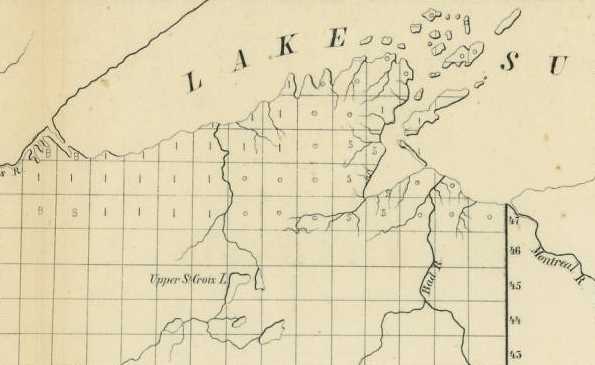
Detail from Sketch of the Public Surveys in Wisconsin and Territory of Minnesota by the Surveyor General’s Office (Warner Lewis), Dubuque, Oct. 21, 1854.

“In 1845 [Warnen Lewis] was appointed Register of the United States Land Office at Dubuque. In 1853 he was appointed by President Pierce Surveyor-General for Iowa, Wisconsin and Minnesota and at the expiration of his term was reappointed by President Buchanan.”
~ The Iowa Legislature
Wisconsin, Iowa, and Minnesota, then were embraced in one Surveyor’s District, with the office at Dubuque, Iowa. It was the duty of the Surveyor General to provide for the details of the Government Surveys in his district, as fast as the settlement of the country might require. Gen’l. Warner Lewis was then Surveyor General of this District.
~ The National Magazine; A Monthly Journal of American History, Volume 9, page 23.
No steps having been taken or any order given for the survey of the shore of Chequamegon Bay, in June 1855, Dr. Ellis left in an open boat for Superior, then on foot through the wilderness to St. Paul, following not far from the route over which many years later was constructed the Lake Superior & Mississippi R.R., – then an early settlement here induced Gen. Lewis to order an immediate subdivision of Towns 47 and 48, North of Range 4 and 5 West, both sides of our bay, and all the lands on which squatters had settled.
Early in September of that year, (1855), Augustus H. Barber began the survey and pushed the work rapidly, so that he had completed 47 and 48 of Range 4 in October, and the returns had been made and plats prepared and forwarded to the local land office by the first of December.
The Pre-emptors now, for the first time, could file claims to their lands and receive assurance that they were likely to be the owners of their homes.
During December many pre-emption claims were filed, and during the closing days of the year and in the first days of 1856, quite a number proved up those claims and received duplicates, upon which patents were afterwards issued. These were the earliest titles to the present site of Ashland. Unlike many towns in the West at that period our site was not cursed with complicating claims, and it is cause for congratulation that Ashland property has no cloud upon its title and that every buyer may, with little trouble, assure himself o this fact. The title to a portion of the site of Superior was bitterly contested involving years of delay and thousands of dollars of cost and much acrimony of feeling; and it is possible that this may have had its influence in carrying the railroad to Duluth rather than to Superior. Quarrels over title are a curse to any town, especially a new one.

“IN MEMORY OF
AUGUSTUS H. BARBER
of Cambridge, Vt.
U.S. Deputy Surveyor
who was drowned in Montreal River.
Apr. 22. A.D. 1856
Aged 24 yrs. & 8 ms.”
~ FindAGrave.com
Of Augustus Barber the early Surveyor of this vicinity, who is unknown to a larger part of this generation, a few words ought to be said:
He was a native of Vermont of an excellent family. At this time he was 22 years of age, well educated, gentle as a lady, refined and easy in his manners and very amiable in his temper. Like many other young men from the east, of active enterprising habits, he had come into this outer verge of civilization to make this his home and to grow up with its institutions. He was the nephew of Hon. J. Allen Barber, of Lancaster, in this State, who once represented his District in Congress. He continued in the surveys of this part of the Lake until in the summer or fall of 1856, when he, with others, conceived of the idea of founding a city at the mouth of the Montreal River – the dividing line between Wisconsin and Michigan about thirty miles east of Ashland.
“According to the Bureau of Public Lands, Department of the Interior, the land surveys were not completed in that area [Ironton] of Wisconsin nor offered for sale to the public until November 18, 1866.
[…]
“A practical location for an operating headquarters was chosen at the site of the Indian settlement on the shore of Lake Superior on that piece of level ground where there were mountains on three sides and through which a creek ran. The village at this location was named Ironton, and because of the activities planned for it and two other mining locations farther inland a group of merchants from Ashland assisted in building up this boat landing and supply headquarters. A dock was built and several buildings for warehouses and some living quarters.”
~ A Historical and Archaeological Reconnaissance of the Saxon Harbor area, Iron County, Wisconsin by John F Wackman et al, pages 57-58.
The iron range approaches nearer the Lake at that point than it does at Ashland. And though the country is much rougher and more difficult for construction of roads than between Ashland and the Range, yet the shorter route, it was argued, would more than compensate for the heavier grades. –The town was laid out and platted by Mr. Barber.
As indication of its future chief industry, as the entry point of the iron range – it was called “Ironton,” with the accent on the second syllable. Great expectations were entertained of the future importance of the place, and much land was entered in the vicinity.
The Montreal, not far from its mouth, leaps down a perpendicular descent of nearly a hundred feet presenting a wild and picturesque view. Being an enthusiastic lover of the beautiful of nature and desiring to reach a position underneath the falls, Mr. Barber in a canoe with two companions, approaching too close, were drawn in by the eddying whirlpool, the canoe was capsized, and before help could reach him he and one of his boatmen were drowned. his body was recovered and was buried on a sand hillock near the mouth of the same river in whose waters he met his death. Ironton has long been deserted, and Barber’s grave with its marble headstone, is the sole mark of that civilization, which twenty years ago there essayed to lay the foundation of a mart of commerce.
The surf of the waves of the lake in summer and fierce driving snow storms in winter, with solitude presiding over the grand orchestra, are perpetually chanting his mournful requiem, while a fond father and mother on the slopes of the distant Green Mountains are mourning bitterly the early death of their first born son.
Interior Field Notes
Ironton Townsite
La Pointe Indian Reservation
Township 47 North, Range 1 West
November, 1856
Notebook ID: [N/a]
This survey is mentioned by multiple sources, however, the Barber Brothers’ field notes and plat map for Ironton from 1856 are not available from the General Land Office Records or from theWisconsin Public Lands Survey Records. Did Warner Lewis receive them at the General Land Office in Dubuque, Iowa? The search for these survey notes continues.
Selected letters of the Joel Allen Barber Papers
… continued from Spring of 1856.
Superior City Sept 15th 1856
Dear Mother
“Ironton’s potential was very promising. While all the activity was taking place for a mining center, plans were being made by the Milwaukee & Superior Railroad to extend its line northward from Stevens Point to a terminus at Ironton at the shore of Lake Superior, then to continue west to Bay City (now Ashland).”[…]
“Besides the officers of the mining company, several businessmen of Ashland became interested in a railroad between Ashland Penokee Gap.
Some of these men were J.S. Beisch, Martin Beaser, John S. Harriss, I.A. Lapham, J.C. Cutler, Edwin Ellis and T.C. Dousman. This railroad was to be the Ashland & Iron Mountain Railroad. A lot of planning and some work was being done when quite suddenly the Panic of 1857 came on bursting many bubbles and bringing to a halt all of the mining activities, causing an exodus of many workers and a large number of potential settlers.”
~ A Historical and Archaeological Reconnaissance of the Saxon Harbor area, Iron County, Wisconsin by John F Wackman et al, page 60.
I wrote a few words to you a few days ago when I was unwell and had to be rather short. I have since recovered my usual health and will try to write a longer letter, but I am afraid it will be of little interest. I see you are anxious that I should quit the lake. It is not strange that you should wish dread to have me remain here. You wish me to come to [?] to Lancaster or any where but here.
Now to tell the truth I am as much attached to this lake as to any other place and I don’t know how to leave it. I know its disadvantages and privations as well as any one. I know the sweets of a more social life and much do I long for them. I know the luxury of living on a fertile soil in a genial climate and hope some day to enjoy it, but still if my life is spared Lake Superior will probably see me occasionally for a number of years.
You ask me my opinion in preference between a good farm in Grant County and ten miles of forest in this country and be bound to it. But I should not be bound to it if I owned [40/41?] miles and there are many farms about here worth more money than any farm on Lamoille river of twice the size.

Detail of Ironton property with trails to Odanah and the Penokee Mountains from T47N-R1W. This survey map was from Elisha S Norris during 1861.
I hope to visit Lancaster this fall but the middle of winter will see me threading my way back to this wild country. I would like extremely to visit Vermont next winter if possible but I expect my engagements will render it impossible.
I hope you will not dwell too much on the terrors of his country and fancy I am suffering all imaginable hardships. I am never hungry and seldom cold or over fatigued. I like the climate about as well any south of here and would sooner emigrate North west than South East, were I not bound by social ties. Were I to follow agriculture as a source of profit I would not go to Vermont or Grant County.
In regard to my Ironton property I have no hopes of getting you to think as you do.
Hon. D. A. J. Baker was introduced as an early resident of Ashland in our Penokee Survey Incidents series. Baker appears to be in business with the Barbers at Ironton.
“A trail between “Penokee” and Ashland is shown on Stuntz’s map of 1858. An Indian trail between Ironton and Odanah was improved for transportation and communication when land travel was preferred to lake travel or when the lake could not be used. During that same time the trail between Odanah and Ashland was being improved to accommodate heavier traffic. (This road later became a part of Old U.S. 10 and now is Ashland County Truck “A”.)
The original Ironton to Odanah trail began on the west side of the village, ascending the highlands at that point, then followed a southwesterly course paralleling the Oronto Creek but avoiding the obstacles of lowlands or ravines until it reached a point where the headwaters of both Oronto Creek and Graveyard Creek were but a few yards apart. As it passed this narrow strip of land and headed both streams it swung sharply to the west towards Odanah.”
A Historical and Archaeological Reconnaissance of the Saxon Harbor area, Iron County, Wisconsin by John F Wackman et al, page 59.
I may be obliged to sacrifice the whole of it, but it will not be my fault. Mr. Baker sold five shares a few days ago for city lots here which will soon be worth 500 dollars. The opinion of explorers and speculars expressed in deeds as well as words confirm my opinion of the place. I suppose Father writes everything concerning his business here so I will depend on him for that and not repeat it.
I would set a time to come home but the future is so uncertain I fear I should only disappoint you and myself. I never yet planned anything as it turns out. I intended to return to Lancaster last fall but did not. I intended to go down last spring but was prevented by the death of Augustus. If I wait untill next spring before going down I shall go to Vermont at the same time probably. “Man proposes and God disposes.” I can only guess how God will dispose my affairs.
I see that you and Amherst feel rather bitter towards [Dow’s?] folks. I am sorry that is so. It is unavoidable that you should see a great many things that you don’t approve but the sum of my advice is “Let em rip.”
I hope to go to Lapointe and Ashland before long where I am about as well acquainted as at any place I ever lived at.
I am now engaged on the field notes of Augustus’ work – [fitting?] them for the office.
With love for yourself and Amherst I remain
Your affectionate son
Allen
 Chequamegon History