Audit of the 1854 Treaty Claims
January 18, 2018
By Amorin Mello
This is one of many posts on Chequamegon History that feature the $90,000 of Indian trader debts that were debated during the 1854 Treaty and the 1855 Annuity Payments at La Pointe.
In summary, the Chiefs of the Chippewas made it a condition of the treaty that they would be granted $90,000 to settle outstanding debts with Indian traders, under the condition that a Council of Chiefs would determine which debts claimed by the traders were fair and accurate. The following quote is the fourth article of the 1854 Treaty of La Pointe, with the sentence about the $90,000 underlined for emphasis:
ARTICLE 4. In consideration of and payment for the country hereby ceded, the United States agree to pay to the Chippewas of Lake Superior, annually, for the term of twenty years, the following sums, to wit: five thousand dollars in coin; eight thousand dollars in goods, household furniture and cooking utensils; three thousand dollars in agricultural implements and cattle, carpenter’s and other tools and building materials, and three thousand dollars for moral and educational purposes, of which last sum, three hundred dollars per annum shall be paid to the Grand Portage band, to enable them to maintain a school at their village. The United States will also pay the further sum of ninety thousand dollars, as the chiefs in open council may direct, to enable them to meet their present just engagements. Also the further sum of six thousand dollars, in agricultural implements, household furniture, and cooking utensils, to be distributed at the next annuity payment, among the mixed bloods of said nation. The United States will also furnish two hundred guns, one hundred rifles, five hundred beaver traps, three hundred dollars’ worth of ammunition, and one thousand dollars’ worth of ready made clothing, to be distributed among the young men of the nation, at the next annuity payment.
~ 1854 Treaty with the Chippewa at La Pointe
Indian Affairs: Laws and Treaties; Volume II by Charles Kappler, 1904
This $90,000 appear to have been an unexpected expense that the United States government incurred in order to successfully negotiate this Treaty. Indian Agent Henry Clark Gilbert was a commissioner of the Treaty, and was obliged to explain this $90,000 to his superiors at the Office of Indian Affairs in Washington D.C. The following is his explanation written a few weeks after the 1854 Treaty of La Pointe was concluded:
The Chiefs who were notified to attend brought with them in every instance their entire bands. We made a careful estimate of the number present and found there were about 4,000. They all had to be fed and taken care of, thus adding greatly to the expenses attending the negotiations.
A great number of traders and claim agents were also present as well as some of the persons from St. Paul’s who I had reason to believe attended for the purpose of preventing if possible the consummation of the treaty. The utmost precautions were taken by me to prevent a knowledge of the fact that negotiations were to take place from being public. The Messenger sent by me to Mr Herriman was not only trust worthy but was himself totally ignorant of the purport of the dispatches to Major Herriman. Information however of the fact was communicated from some source and the persons present in consequence greatly embarrassed our proceedings.
~ Treaty Commissioner Henry C. Gilbert’s explanation of the treaty concluded in 1854 with the assistance of David B. Herriman
Transactions of the Wisconsin Academy of Sciences, Arts and Letters: Volume 79, No. 1, Appendix 5
Indian Agent Gilbert’s explanation suggests that there was some effort on his behalf to preemptively avoid the subject of outstanding debts from occuring during the Treaty negotiations. In January of 1855, a few months after the Treaty was negotiated, President Franklin Pierce budgeted for this $90,000 in the fund appropriated for fulfilling the terms of the Treaty:
For the payment of such debts as may be directed by the chiefs in open council, and found to be just and correct by the Secretary of the Interior, per 4th article of the treaty of September 30, 1854…….. 90,000
~ United States House of Representatives Documents, Volume 11, 33d Congress, 2nd Session, Ex. Doc. No. 61.
1854 Treaty of La Pointe Appropriations
As quoted above, the $90,000 negotiated during the treaty were to be distributed by a Council of the Chiefs following the treaty. How the $90,000 were actually distributed did not honor the intent or terms of the treaty. The following is a public notice from Indian Agent Gilbert that invited Indian traders with claims against Tribe to come forth with their claims before or during the 1855 Annuity, and makes no mention of any distribution to be determined by a Council of Chiefs:
PUBLIC NOTICE.
OFFICE MICHIGAN INDIAN AGENT,
DETROIT, June 12, 1855.ALL PERSONS having just and legal claims against the Chippewa Indians of Lake Superior are hereby notified that all such claims must be presented without delay to the undersigned, for investigation. Each claim must be accompanied by such evidence of its justice and legality as the claimant may be able to furnish; and in all cases where the idebtedness claimed is on book account, or is composed of aggregated items, transcripts of such accounts specifying the items in detail, with the charge for each item, and the name of the person to whom, and time when, the same was furnished, must accompany the claims submitted. The original books of entry must also in all cases be prepared for examination.
Claims may be presented at any time prior to the close of the next annuity payment at La Pointe, which will take place in the month of August next; but after that time they will not be received or acted upon.
This notice is given in accordance with instructions received from the United States Commissioner of Indian Affairs.
HENRY C. GILBERT.
Indian Agent.
jy 10 4t~ Superior Chronicle newspaper, July 10th, 1855
Library of Congress
The distribution of this $90,000 was hotly debated by Blackbird and other members of the Council of Chiefs during the 1855 Annuity Payments. It is clear from the speeches transcribed from this important event that the Council was not being allowed to determine the distribution of this $90,000. The following is one of many speeches that touched upon this subject:
In what Blackbird said he expressed the mind of a majority of the chiefs now present. We wish the stipulations of the treaty to be carried out to the very letter.
I wish to say our word about our reserves. Will these reserves made for each of our bands, be our homes forever?
When we took credits of our trader last winter, and took no furs to pay him, and wish to get hold of this 90,000 dollars, that we may pay him off of that. This is all we came here for. We want the money in our own hands & we will pay our own traders. We do not think it is right to pay what we do not owe. I always know how I stand my acct. and we can pay our own debts. From what I have now said I do not want you to think that we want the money to cheat our creditors, but to do justice to them I owe. I have my trader & know how much I owe him, & if the money is paid into the hands of the Indians we can pay our own debts.
~ Adikoons, Chief of Grand Portage Band
(Wheeler to Smith, 18 Jan. 1856)
Blackbird’s Speech at the 1855 Payment
With the above quotes as an introduction to this subject, we will now investigate what exactly happened to the $90,000 to be disbursed as “directed by the chiefs in open council”. What we have found so far appears to suggest that the federal government did not honor their Trust responsibility to the Tribe:
Senate Documents, Volume 112


[Page 295 of audit]
Indian Disbursements
Statement containing a list of the names of all persons to whom goods, money, or effects have been delivered, from July 1, 1856, to June 30, 1857, specifying the amounts and objects for which they were intended, the amount accounted for, and the balances under each specified head still remaining in their hands; prepared in obedience to an act of Congress of June 30, 1834, entitled “An act to provide for the organization of the department of Indian affairs.”
[Pages 303-305 of audit]
Fulfilling treaties with Chippewas of Lake Superior, September 30, 1854
| When issued | To whom issued. | For what purpose. | Amount of requisition. | Am’t accounted for. |
Amount unaccounted for.
|
| 1856 | |||||
| July 3 | John B. Jacobs | Fulfilling Treaties, (due) | $1,718.73 | $1,718.73 | |
| 22 | Henry C. Gilbert | …do… | $7,000.00 | $7,000.00 | |
| Do | …do… | $5,000.00 | $5,000.00 | ||
| Aug. 14 | Henry E. Leman | …do…(due)… | $1,412.50 | $1,412.50 | |
| 18 | Ramsey Crooks | …do…do… | $6,617.64 | $6,617.64 | |
| Adam Noongoo | …do…do… | $66.00 | $66.00 | ||
| Wm. Parsons | …do…do… | $28.50 | $28.50 | ||
| Erwin Leiky | …do…do… | $119.75 | $119.75 | ||
| Robert Morrin | …do…do… | $163.56 | $163.56 | ||
| Charles Bellisle | …do…do… | $191.00 | $191.00 | ||
| Posh-qway-gin | …do…do… | $47.88 | $47.88 | ||
| 22 | W. A. Pratt | …do…do… | $50.00 | $50.00 | |
| John G. Kittson | …do…do… | $1,280.93 | $1,280.93 | ||
| Asaph Whittlesey | …do…do… | $25.00 | $25.00 | ||
| Louis Bosquet | …do…do… | $72.00 | $72.00 | ||
| David King | …do…do… | $100.00 | $100.00 | ||
| P. O. Johnson | …do…do… | $10.12 | $10.12 | ||
| Henry Elliott | …do…do… | $399.02 | $399.02 | ||
| McCullough & Elliott | …do…do… | $475.78 | $475.78 | ||
| Edward Assinsece | …do…do… | $50.00 | $50.00 | ||
| John Southwind | …do…do… | $21.00 | $21.00 | ||
| Kay-kake | …do…do… | $35.00 | $35.00 | ||
| Goff & Co. | …do…do… | $556.21 | $556.21 | ||
| Jame Halliday | …do…do… | $67.88 | $67.88 | ||
| Peter Crebassa | …do…do… | $1,013.99 | $1,013.99 | ||
| S. L. Vaugh | …do…do… | $57.08 | $57.08 | ||
| David King | …do…do… | $191.72 | $191.72 | ||
| Peter B. Barbean | …do…do… | $1,200.00 | $1,200.00 | ||
| 23 | Antoine Gaudine | …do…do… | $3,250.94 | $3,250.94 | |
| Peter Markman | …do…do… | $300.00 | $300.00 | ||
| Pat L. Philan | …do…do… | $90.08 | $90.08 | ||
| Treasurer of township of Lapointe | …do…do… | $224.77 | $224.77 | ||
| Michael Bosquet | …do…do… | $219.63 | $219.63 | ||
| James Ermatinger | …do…do… | $2,000.00 | $2,000.00 | ||
| Louison Demaris | …do…do… | $2,000.00 | $2,000.00 | ||
| Joseph Morrison | …do…do… | $250.00 | $250.00 | ||
| John W. Bell | …do…do… | $253.11 | $253.11 | ||
| 27 | Paul H. Beaubien | …do…do… | $600.00 | $600.00 | |
| R. Sheldon & Co. | …do…do… | $1,124.71 | $1,124.71 | ||
| Abraham Place | …do…do… | $450.00 | $450.00 | ||
| Michael James | …do…do… | $195.00 | $195.00 | ||
| R. J. Graveract | …do…do… | $269.19 | $269.19 | ||
| Reuben Chapman | …do…do… | $71.11 | $71.11 | ||
| Miller Wood | …do…do… | $38.50 | $38.50 | ||
| Robert Reed | …do…do… | $21.60 | $21.60 | ||
| Louis Gurno | …do…do… | $179.00 | $179.00 | ||
| Gregory S. Bedel | …do…do… | $142.63 | $142.63 | ||
| Geo. R. Stuntz | …do…do… | $537.41 | $537.41 | ||
| Usop & Hoops | …do…do… | $49.43 | $49.43 | ||
| May-yan-wash | …do…do… | $45.50 | $45.50 | ||
| John Hartley | …do…do… | $41.01 | $41.01 | ||
| B. F. Rathbun | …do…do… | $8.07 | $8.07 | ||
| W. W. Spaulding | …do…do… | $258.92 | $258.92 | ||
| Stephen Bonge | …do…do… | $40.00 | $40.00 | ||
| Abel Hall | …do…do… | $160.00 | $160.00 | ||
| Louis Cadotte | …do…do… | $200.00 | $200.00 | ||
| John Senter & Co. | …do…do… | $17.00 | $17.00 | ||
| John B. Roy | …do…do… | $150.00 | $150.00 | ||
| L. Y. B. Birchard | …do…do… | $26.00 | $26.00 | ||
| Peter Roy | …do…do… | $250.00 | $250.00 | ||
| Jacob F. Shaffer | …do…do… | $150.00 | $150.00 | ||
| Peter Vandeventer | …do…do… | $216.31 | $216.31 | ||
| Sept. 4 | John Hotley, jr. | …do…do… | $538.48 | $538.48 | |
| G. B. Armstrong | …do…do… | $950.00 | $950.00 | ||
| Lathrop Johnson | …do…do… | $376.00 | $376.00 | ||
| 6 | Wm. Mathews | …do…do… | $1,741.50 | $1,741.50 | |
| Cronin, Hurxthal & Sears | …do…do… | $4,583.77 | $4,583.77 | ||
| 13 | Henry C. Gilbert | …do… | $12,500.00 | ||
| 24 | B. W. Brisbois | …do…(due)… | $4,000.00 | $4,000.00 | |
| 27 | John Brunet | …do…do… | $2,000.00 | $2,000.00 | |
| John B. Roy | …do…do… | $80.00 | $80.00 | ||
| Edward Connor | …do…do… | $600.00 | $600.00 | ||
| Alexis Corbin | …do…do… | $1,000.00 | $1,000.00 | ||
| Louis Corbin | …do…do… | $1,108.47 | $1,108.47 | ||
| Vincent Roy | …do…do… | $645.36 | $645.36 | ||
| Abner Sherman | …do…do… | $568.00 | $568.00 | ||
| John B. Landry | …do…do… | $502.64 | $502.64 | ||
| Thomas Conner | …do…do… | $1,050.00 | $1,050.00 | ||
| Augustus Corbin | …do…do… | $238.50 | $238.50 | ||
| Julius Austrain | …do…do… | $6,000.00 | $6,000.00 | ||
| Do… | …do…do… | $1,876.86 | $1,876.86 | ||
| John B. Corbin | …do…do… | $750.00 | $750.00 | ||
| Cruttenden & Lynde | …do…do… | $1,300.00 | $1,300.00 | ||
| Orrin W. Rice | …do…do… | $358.09 | $358.09 | ||
| Francis Ronissaie | …do…do… | $817.74 | $817.74 | ||
| Dec. 6 | W. G. and G. W. Ewing | …do…do… | $787.02 | $787.02 | |
| 1857 | |||||
| Jan. 2 | Henry C. Gilbert | …do… | $674.73 | $674.73 | |
| Feb 21 | Do | …do… | $8,133.33 | $8,133.33 | |
| 24 | John B. Cadotte | …do…(due)… | $1,265.00 | $1,265.00 | |
| Cruttenden & Lynde | …do…do… | $1,615.00 | $1,615.00 | ||
| J. B. Landry | …do…do… | $560.00 | $560.00 | ||
| P. Chouteau, jr., & Co. | …do…do… | $935.00 | $935.00 | ||
| Vincent Roy | …do…do… | $5,000.00 | $5,000.00 | ||
| Northern Fur Company | …do…do… | $625.00 | $625.00 | ||
| J. B. Landry | …do…do… | $90.00 | $90.00 | ||
| $105,071.70 | $84,363.64 | $20,708.06 |
Many of the Indian traders listed above make regular appearances in other primary documents of Chequamegon History. Some of the names are misspelled but still recognizable to regular readers. In summary let’s take a closer look at the top ten Indian traders that received the most disbursements related to the 1854 Treaty of La Pointe:
9½.) James Ermatinger
$2,000.00
James Ermatinger was involved with the American Fur Company in earlier years. He seems to have become an independent Indian trader in later years leading up to the 1854 Treaty:
James founded Jim Falls, Wis., arriving by canoe from La Pointe, Wis. where he was involved in fur trading. He settled in Jim Falls, initially managing a trading post there for the American Fur Company. Others in the Ermatinger family were prominent fur traders in Canada, the Upper Peninsula of Michigan, and Wisconsin.
9½.) Louison Demaris
$2,000.00
According to Theresa Schenck’s research in her book All Our Relations, Louison Demarais may have been a son of Jean Baptiste Demarais who was an interpreter for Alexander Henry the Younger’s North West Company on the Red River:
Louison Desmarais residing at Chippewa River a ½ breed Chippewa 50 yrs of age born at Pembina and remained in the North until 9 years back when he came to Chippewa river where he has resided since claims for himself and wfie Angelique a ½ breed, 35 yrs of age born at Fond du Lac where she remained until she was married 23 years since when she went to the North with her husband and has since lived with him.
~ 1839 Mixed Blood Census
All Our Relations by Theresa M. Schenck, 2010, page 60
8.) Cruttenden & Lynde
$1,615.00 + $1,300.00 = $2,915.00

“Here lie the remains of Hon. J. W. Lynde Killed by Sioux Indians Aug. 18.1862″
~ Findagrave.com
James William Lynde was an Indian Agent, Senator, and first casualty of 1862 Sioux Uprising. Mr. Lynde was also a signatory of the 1854 Treaty, which may be a conflict of interest:
Hon. James W. Lynd was a native of Baltimore, born in 1830, but was reared and educated at Cincinnati. He had received a college education at Woodward College, having attended from 1842 – 1844. He was a man of accomplishments and ability. He thoroughly mastered the Indian language, married successively two Indian wives, and spent years in the study of the history and general character of the Sioux or Dakota tribe. For some time prior to his death he had been engaged in revising for publication the manuscript of an elaborate work containing the results of his studies and researches. Under the circumstances the greater part of this manuscript was lost. He was a young man, of versatile talents had been an editor, lecturer, public speaker, and was a member of the Minnesota State Senate in 1861.
~ Sketches: Historical and Descriptive of the Monuments and Tablets Erected by the Minnesota Valley Historical Society in Renville and Redwood Counties, Minnesota by the Minnesota Valley Historical Society, 1902, page 6
Joel D. Cruttenden was Mr. Lynch’s business partner:
Col. Cruttenden, of whom I have spoken briefly in another place, left St. Louis in 1846 and removed to Prairie du Chien, where he was employed by Brisbois & Rice. In 1848 he came to ST. PAUL and remained up to 1850, when he took up his residence in St. Anthony and engaged in business with R. P. Russel. He then went to Crow Wing and was connected with Maj. J. W. Lynde. In 1857 he was elected to the House of Representatives, and on the breaking out of the war was commissioned Captain Assistant Quartermaster; was taken prisoner, and on being exchanged rose to the rank of Colonel. At the close of the war he was honorably discharged, and soon after removed to Bayfield, Wisconsin, where he has held many offices and is greatly esteemed. He is a pleasant, genial gentleman, well known and well liked.
~ Pen Pictures of St. Paul, Minnesota, and Biographical Sketches of Old Settlers: Volume 1, by Thomas McLean Newson, 1886, page 95
7.) Antoine Gaudine
$3,250.94

~ Antoine Gordon
~ Noble Lives of a Noble Race by the St. Mary’s Industrial School (Odanah), page 207
Antoine Gaudine (a.k.a. Gordon) as one of those larger-than-life mixed-blood members of the La Pointe Band leading up to the 1854 Treaty and beyond:
Mr Gordon was the founder of the village of Gordon and for years had a trading post there which was the only store there. It is but a few years since he discontinued this store. He was a full-blooded Chippewa Indian, and came here from Madelaine Island, where he ran a post years ago. He was formerly the owner of the famous Algonquin, the first ship to come through the Soo locks, and used her in the lumber trade.
~ Eau Claire Leader newspaper, May 8, 1907
6.) B. W. Brisbois
$4,000.00
Bernard Walter Brisbois was a son of Michael Brisbois, Sr.:
Bernard Brisbois was born in Prairie du Chien, Wisconsin, in 1808, to Michel Brisbois, a French-Canadian voyageur, and his second wife Domitelle (Madelaine) Gautier de Verville.
Like his father, Brisbois also began his career in the fur trade, working as agent for the American Fur Company. Bernard married Therese LaChappelle [daughter of metis Pélagie LaPointe (herself the daughter of Pierre LaPointe and Etoukasahwee) and Antoine LaChapelle]. Later he engaged in the mercantile business in Prairie du Chien until 1873 when he was appointed consul at Verviers, Belgium. He returned to Prairie du Chien in 1874 and lived there until his death in 1885.
5.) Cronin, Hurxthal & Sears
$4,583.77
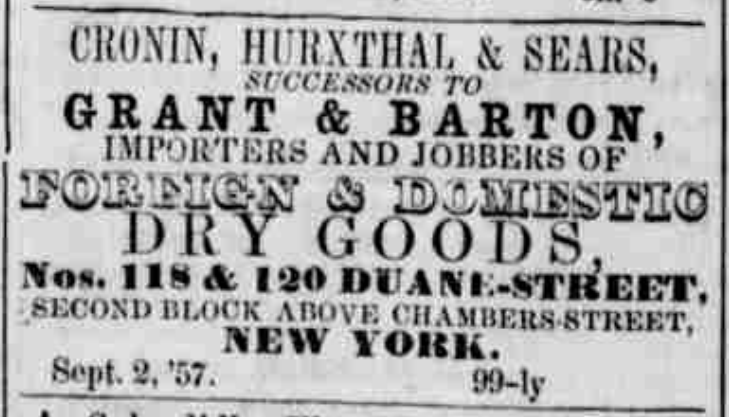
Advertisement of Cronin, Hurxthal & Sears
~ The Prairie News (Okolona, Miss.), April 15, 1858, page 4
According to a receipt from this company, the partners behind this firm were John B. Cronin, Ben. Hurxthal and J. Newton Sears. No further biographical information could be found about these individuals, who are presumed to have been New York City businessmen. In general they appear to have been involved with trades associated with slavery and Indians. Per their advertisement, they were the successors to the firm of Grant and Barton:
Grant and Barton nevertheless remained active in the [Texas] region, winning government contracts to supply the Bureau of Indian affairs with “blankets and dry goods” in the late 1840s and early 1850s…
~ The Business of Slavery and the Rise of American Capitalism, 1815-1860, by Calvin Schermerhorn, 2015, page 225
4.) Vincent Roy
$5,000.00 + $645.36 = $5,645.36

Vincent Roy, Jr. (III)
~ Life and Labors of Rt. Rev. Frederic Baraga, by Chrysostom Verwyst, 1900, pages 472-476
Vincent Roy, Sr. (II) and his son Vincent Roy, Jr. (III) were prominent members of the La Pointe Band mixed-bloods. Sr. was recognized by Gilbert as the Head of the Mixed Bloods of the La Pointe Band of Lake Superior Chippewas. Jr. was allegedly an interpreter at the 1854 Treaty, but is not identified in the Treaty itself and cannot find primary source. Jr. is described as a skilled trader in many sources, including this one:
“Leopold and Austrian (Jews) doing a general merchandize and fur-trading business at LaPointe were not slow in recognizing ‘their man.’ Having given employment to Peter Roy, who by this time quit going to school, they also, within the first year of his arrival at this place, employed Vincent to serve as handy-man for all kind of things, but especially, to be near when indians from the woods were coming to trade, which was no infrequent occurrence. After serving in that capacity about two years, and having married, he managed (from 1848 to 1852) a trading post for the same Leopold and Austrian; at first a season at Fond du Lac, Minn., then at Vermillion Lake, and finally again at Fond du Lac.”
~ Miscellaneous materials related to Vincent Roy, 1861-1862, 1892, 1921
3.) R. Crooks
$6,617.64

Ramsay Crooks
~ Madeline Island Museum
Ramsey Crooks enjoyed a long history with the American Fur Company outfit at La Pointe in the decades leading up to the 1854 Treaty:
“Ramsey Crooks (also spelled Ramsay) was born in Scotland in 1787. He immigrated to Canada in 1803 where he worked as a fur trader and explorer around the Great Lakes. He began working for the American Fur Company, which was started by John Jacob Astor, America’s first multi-millionaire, and made an expedition to the Oregon coast from 1809-1813 for the company. By doing so he also became a partner in the Pacific Fur Company. In 1834 he became acting president of the American Fur Company following Astor’s retirement to New York. A great lakes sailing vessel the Ramsey Crooks was constructed in 1836 by the American Fur Co. A nearly identical sister ship was built in the same year and was called the Astor. Both ships were sold by the dissolving fur company in 1850. Ramsay Crooks passed away in 1859, but had made a name for himself in the fur trade not only in Milwaukee and the Great Lakes, but all the way to the Pacific Ocean.”
2.) J. Austrian
$ 6,000.00 + $1,876.86 = $7,876.86

Julius Austrian
~ Madeline Island Museum
Julius Austrian was competitor and successor of the American Fur Company during the decade immediately leading up to the 1854 Treaty. Chequamegon History’s research has explored the previously uncovered circumstances of Austrian’s purchase of the Village of La Pointe from American Fur Company in 1853, being the unnamed and de facto host of the 1854 Treaty of La Pointe, being the host of the 1855 Annuities at La Pointe, and the host of the 1855 High Holy Days at La Pointe:
“In 1855 a number of Jewish Indian traders met on an island in Lake Superior in the frontier village of La Pointe, Wisconsin. The Indians were assembled there to collect their annuities and the Jews were present to dun their debtors before they dispersed. There were enough Jews for a minyan and a service was held. That was the beginning and the end of La Pointe Jewry.”
~ United States Jewry 1776-1985: Vol. 2; the Germanic Period, Part 1 by Jacob Rader Marcus Wayne State University Press , 1991, page 196
1.) Henry C. Gilbert
$0.00 ?

Henry Clark Gilbert
~ Branch County Photographs
Mackinac Indian Agent Henry Clark Gilbert was the Commissioner of the 1854 Treaty of La Pointe along with David B. Herriman.
Gilbert submitted requisitions for $5,000.00, $7,000.00, $12,500.00, $674.73, and $8,133.33; which is a total amount of $33,308.06. The amount accounted for in his name is $0.00, but his total amount unaccounted for is $20,808.06. The difference between the total amount Gilbert requisitioned and his total amount unaccounted for is $12,500, which is the same amount that Gilbert requisitioned for on September 4th, 1856.
A closer look at all of the 1854 Treaty accounts as a whole suggests that Gilbert was paid his $12,500.00 despite what is shown on paper. The total amount accounted for is actually $71,763.64; which is $12,600.00 less than the total amount on paper. The total amount unaccounted for is $20,808.06; which is $100 greater than the total amount on paper (all of which was in Gilbert’s name). We are left with a puzzle missing some pieces. Did Gilbert obtain his $12,500.00 fraudulently? Was the extra $100 accounted for taken from the unaccounted amounts by someone else as a bribe?
Did Gilbert abuse his Trust responsibility to the 1854 Treaty of La Pointe? Or was this simply a case of sloppy reporting by a federal clerk?
Blackbird’s Speech at the 1855 Payment
January 20, 2014
“We sold our land for our graves–that we might have a home, where the bones of our fathers are buried. We were not willing to sell the ashes of our relatives which are so dear to us. This was the reason why we sold our lands. It was not to pay debts over and over again, but to benefit the living, those of us who yet remain upon earth, our young men & women & children.”
~Makade-binesi (Blackbird)

Scene at Indian Payment–Odanah, Wis. This image is from a later payment than the one described below (Whitney & Zimmerman c.1870)
Most of us have heard Chief Joseph’s “Fight No More Forever” speech and Chief Seattle’s largely-fictional plea for the environment, but very few will know that a outstanding example of Native American oratory took place right here in the Chequamegon Region in the summer of 1855.
It was exactly eleven months after the Lake Superior Ojibwe bands gave up the Arrowhead region of Minnesota, in their final treaty with the United States, in exchange for permanent reservations. Already, the American government was trying to back out of a key provision of the agreement. It concerned a clause in Article Four of the 1854 Treaty of La Pointe that reads:
The United States will also pay the further sum of ninety thousand dollars, as the chiefs in open council may direct, to enable them to meet their present just engagements.
The inclusion of clauses to pay off trade debts was nothing new in Ojibwe treaties. In 1837, $70,000 went to pay off debts, and in 1842 another $75,000 went to the traders. Personal debts would often be paid out of annuity funds by the government directly to the creditors and certain Ojibwe families would never see their money. However, from the beginning there were accusations that these debts were inflated or illegitimate, and that it was the traders rather than the Ojibwe themselves, who profited from the sale of the lands. Therefore, in 1854, when $90,000 in claims were inserted in the treaty, the chiefs demanded that they be the ones to address the claims of the creditors.
However, less than a year later, at the first post-1854 payment, the government was pressured to back off of the language in the treaty. George Manypenny, the Commissioner of Indian Affairs, came to La Pointe to oversee the payment where he was asked by Indian Agent Henry Gilbert to let the Agency oversee the disbursement of the $90,000. Most white inhabitants, and many of the white tourists in town to view the spectacle that was the 1855 payment, supported the agent’s plan, as did most of the mix-blooded Ojibwe (most of whom were employed in the trading business in one way or another) and a substantial minority of the full-bloods.
However, the clear majority of the Lake Superior chiefs insisted they keep the right to handle their own debt claims. As we saw in this post, the Odanah-based missionary Leonard Wheeler also felt the Government needed to honor its treaties to the letter. This larger faction of Ojibwe rallied around one chief. He was from the La Pointe Band and was entrusted to speak for Ojibwe with one voice. From this description, you might assume it was Chief Buffalo. However, Buffalo, in the final days of his life, found himself in the minority on this issue. The speaker for the majority was the Bad River chief Blackbird, and he may have delivered one of the greatest speeches ever given in the Chequamegon Bay region.
Unfortunately, the Ojibwe version of the speech has not survived, and it’s English version, originally translated by Paul Bealieu, exists in pieces recorded by multiple observers. None of these accounts captures all the nuances of the speech, so it is necessary to read all of them and then analyze the different passages to see its true brilliance.
The first reference to Blackbird’s speech I remember seeing appeared in the eyewitness account of Dr. Richard F. Morse of Detroit who visited La Pointe that summer specifically to see the payment. His article, The Chippewas of Lake Superior appeared in the third volume of the Collections of the State Historical Society of Wisconsin. As you’ll read, it doesn’t speak very highly of Blackbird or the speech, celebrating instead the oratory of Naaganab, the Fond du Lac chief who was part of the minority faction and something of a celebrity among the visiting whites in 1855:


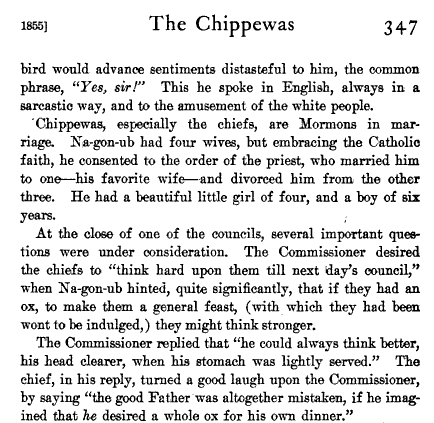
From Morse’s clear bias against Ojibwe culture, I thought there may have been more to this story, but my suspicions weren’t confirmed until I transcribed another account of the payment for Chequamegon History. An Indian Payment written by another eyewitness, Crocket McElroy, paints a different picture of Blackbird and quotes part of his speech:

Paul H. Beaulieu translated the speeches at the 1855 annuity payment (Minnesota Historical Society Collections).
In August 1855 about three thousand Chippewa Indians gathered at the village of Lapointe, on Lapointe Island, Lake Superior, for an Indian Payment and also to hold a council with the commissioner of Indian affairs, who at that time was George W. Monypenny of Ohio. The Indians selected for their orator a chief named Blackbird, and the choice was a good one, as Blackbird held his own well in a long discussion with the commissioner. Blackbird was not one of the haughty style of Indians, but modest in his bearing, with a good command of language and a clear head. In his speeches he showed much ingenuity and ably pleaded the cause of his people. He spoke in Chippewa stopping frequently to give the interpreter time to translate what he said into English. In beginning his address he spoke substantially as follows:
“My great white father, we are pleased to meet you and have a talk with you We are friends and we want to remain friends. We expect to do what you want us to do, and we hope that you will deal kindly with us. We wish to remind you that we are the source from which you have derived all your riches. Our furs, our timber, our lands, everything that we have goes to you; even the gold out of which that chain was forged (pointing to a heavy watch chain that the commissioner carried) came from us, and now we hope that you will not use that chain to bind us.”
These conflicting accounts of the largely-unremembered Bad River chief’s speech made me curious, and after I found the Blackbird-Wheeler-Manypenny letters written after the payment, I knew I needed to learn more about the speech. Luckily, digging further into the Wheeler Papers uncovered the following. To my knowledge, this is the first time it has been transcribed or published in any form.
[Italics, line breaks, and quotation marks added by transcriber to clearly differentiate when Wheeler is quoting a speaker. Blackbird’s words are in blue.]
O-da-nah Jan 18, 1856.
L. H. Wheeler to Richard M. Smith
Dear Sir,
The following is the substance of my notes taken at the Indian council at La Pointe a copy of which you requested. Council held in front of Mr. Austrian’s store house Aug 30. 1855.
Short speech first from Kenistino of Lac du Flambeau.
My father, I have a little to say to you & to the Indians. There is no difference between myself and the other chiefs in regard to the subject upon which we wish to speak. Our chiefs and young men & old men & even the women & children are all of the same mind. Blackbird our chief will speak for us & express our sentiments.
The Commissioner, Col Manypenny replied as follows.
My children I suppose you have come to reply to what I said to you day before yesterday. Is this what you have come for?
“Ah;” or yes, was the reply.
I am happy to see you, but would suggest whether you had not better come tomorrow. It is now late in the day and is unpleasant & you have a great deal to say and will not have time to finish, but if you will come tomorrow we shall have time to hear all you have to say. Don’t you think this will be the best way?
“Ah!” yes was the response.
Think well about what you want to say and come prepared to speak freely & fully about all you wish to say. I would like not only to hear the chiefs and old men speak, but the young men talk, and even the women, if they wish to come, let them come and listen too. I want the women to understand all that is said and done. I understand that some of the Indians were drunk last night with the fire-water. I hope we shall hear nothing more of it. If any body gives you liquor let me know it and I will deal with him as he deserves. I hope we shall have a good time tomorrow and be able to explain all about your affairs.
Aug 31. Commissioner opened the council by saying that he wanted all to keep order.
Let the whites and others sit down on the ground and we will have a pleasant time. If you have anything to say I hope you will speak to the point.
Black Bird. To the Indians.
My brother chiefs, head men & young men & children. I have listened well to all the men & women & others who have spoken in our councils and shall now tell it to my father. I shall have but one mouth to speak your will.
Nose [noose (no-say) “my father”]. My father. We present you our salutations in your heart. We salute you in the name of our great father the President, whose representative you are. We want the Great Spirit now to bless us. The Day is clear, and we hope our thoughts will be clear too. My intention is to tell you what the owner of life has done for us. He has provided for the life of us all. When the Lord made us he provided for us here upon earth he invested it (ie, he made provision for our wants) in the running streams, in the woods & lakes which abound with fish and in the wild animals. We regard you as if men like a spirit, perhaps it is because of your education, because you are so much wiser than we, but if we can trace our tradition right the Great Spirit has not made the white man to cheat us. There is a difference of opinion as it regards different colors among, as to which shall have the preeminence, but the Great Spirit made us to be happy before you discovered us.
I will now tell you about how it was with us before our payments, and before we sold any land. Our furs that we took we sold to our traders. We were then paid 4 martin skins for a dollar. 4 bears skins also & 4 beaver skins for $1.00 too. Can you wonder that we are poor? I say this to show you what our condition was before we had any payments. I[t] was by our treaties that we learned the use of money. I see you White men that sit here how you are dressed. I see your watch chains & seals and your rich clothing. Now I will tell you how it is with our traders. When they first came among us they were very poor, but by & by they became very fat & rich, and wear rich clothing and had their watches & gold chains such as I see you wear. But they got their things out of us. They were made rich at our expense. My father, you told us to bring our women here too. Here they are, and now behold them in their poverty, and pity their condition (at this juncture in the speech several old women stood dressed in their worn out blankets and tattered garments as if designed to appeal to his humanity[)].
My father, I am now coming to the point. We are here to protect our own interests. Our land which we got from our forefathers is ours & we must get what we can for it. Our traders step between us & our father to controll our interests, and we have been imposed upon. Mr. Gilbert was the one I shook hands with last year when he was sent here to treat for our lands. He was the one who was sent to uphold us in our poverty. We are thankful to see you both here to attend to our interests, and that we are permitted to express to you our wants. Last year you came here to treat for our lands we are now speaking about. We sold them because we were poor. We thank our father for bringing clothing to pay for them. We sold our land for our graves–that we might have a home, where the bones of our fathers are buried. We were not willing to sell the ashes of our relatives which are so dear to us. This was the reason why we sold our lands. It was not to pay debts over and over again, but to benefit the living, those of us who yet remain upon earth, our young men & women & children.
You said you wanted to see them. They have been sent for and are now here. Behold them in their poverty & see how poor they look.
They are poor because so much of our money is taken to pay old debts. We want the 90,000 dollars to be paid as we direct. We know that it is just and right that it should be so. We want to have the money paid in our own hands, and we will see that our just debts are paid. We want the 90,000 to feed our poor women, and after paying our just debts we want the remainder to buy what we want. This is the will of all present. The chiefs, & young men & old men & the women & children.
Let what I have now said, my father, enter your head & heart; and let it enter the head of our great father the President, that it may be as we have now said. We own no more land. We must hereafter provide for ourselves. We want to profit by all the provisions of the treaty we have now made. We want the whole annuity paid to us as stipulated in the treaty. I am now done. After you have spoken, perhaps there are others who would like to speak.
This is the first time my father that I have appeared dressed in a coat & pants & I must confess I feel a little awkward.
The Commissioner replied as follows
We have all heard & noted down what you have said. If any others wish to speak they had better speak first and I will reply to all at once.
The Grand Portage Indian [Adikoons] then spoke as follows.
My father, I have a few words to say, and I wish to speak what I think. We have long coveted the privilege of seeing our Great Father. Why not now embrace the opportunity to speak freely while he is here? This man will speak my mind. He is old enough to speak and is a man endowed with good sense. He will speak our minds without reserve.
When we look around us, we think of our God who is the maker of us all. You have come here with the laws of that God we have talked about, and you profess to be a Christian and acknowledge the authority of God. The word of God ought to be obeyed not only by the Indians, but by all. When we see you, we think you must respect that word of God, who gives life to all. Your advice is like the law of God. Those who listen to his law are like God–firm as a rock, (not fickle and vacilating). When the word of the Great Spirit ends. When there is an end to life, we are all pleased with the advice you have given us, and intend to act in accord with it. If we are one here, and keep the word of the Great Spirit we shall be one here after. In what Blackbird said he expressed the mind of a majority of the chiefs now present. We wish the stipulations of the treaty to be carried out to the very letter.
I wish to say our word about our reserves. Will these reserves made for each of our bands, be our homes forever?
When we took credits of our trader last winter, and took no furs to pay him, and wish to get hold of this 90,000 dollars, that we may pay him off of that. This is all we came here for. We want the money in our own hands & we will pay our own traders. We do not think it is right to pay what we do not owe. I always know how I stand my acct. and we can pay our own debts. From what I have now said I do not want you to think that we want the money to cheat our creditors, but to do justice to them I owe. I have my trader & know how much I owe him, & if the money is paid into the hands of the Indians we can pay our own debts.
Naganub.
We have 90,000 dollars set apart to pay our traders, for my part I think it is just that the money should go for this object. We all know that the traders help us. We could not well do without them.
Buffalo.
We who live here are ready to pay our just debts. Some have used expressions as though these debts were not just. I have lived here many years and been very poor. There are some here who have been pleased to assist me in my poverty. They have had pity on me. Those we justly owe I don’t think ought to be defrauded. The trader feeds our women & children. We cannot live one winter without him. This is all I have to say.
 [Wheeler does not identify a new speaker here, but marks a a star (right). Kohl (below) attributes the line about the “came out of the water” to Blackbird, but the line about the copper diggings contradicts Blackbird’s earlier statement, in Kohl, about not knowing their value. This, and Wheeler’s marking of Blackbird as the one who spoke after this speech would indicate this is Buffalo still talking].
Our rights ought to be protected. When commissioners have come here to treat for our lands, we have always listened well to their words. Not because we did not know ourselves the worth of our lands. We have noticed the ancient copper diggings, and know their worth. We have never refused to listen to the words of our Great Father. He it is true has had the power but we have made him rich. The traders have always wanted pay for what we do not remember to have bought. At Crow [W]ing River when our lands were ceded there, then there was a large sum demanded to pay old debts. We have always paid our traders we have acted fair on our part. At St. Peters also there was a large amount of old debts to be paid–many of them came from places unknown–for what I know they came out of the water. We think many of them came out of the same bag, and are many of them paid over & over again at every treaty.
Black Bird.
I get up no[w] to finish what you have put into my heart. The night would be heavy on my breast should I retain any of the words of them with whom I have councilled & for whom I speak. I speak no[w] of farmers, carpenters, & other employees of Govt. Where is the money gone to for them? We have not had these laborers for several years that has been appropriated. Where is the money that has been set apart to pay them? You will not probably see your Red Children again in after years to council with them. So we protest by the present opportunity to speak to you of our wants & grievances. We regard you as standing in the place of our great father at Washington, and your judgement must be correct. This is all I have to say about our arrearages, we have not two tongues.
As exciting as it was to have the full speech, as I transcribed some of the passages, some of them seemed very familiar. Sure enough, on page 53 of Johann Georg Kohl’s Kitchi-Gami: Life Among the Lake Superior Ojibway, there is another whole version. Kitchi-Gami is one of the standards of Ojibwe cultural history, and I use it for reference fairly often, but it had been so long since I had read the book cover to cover that I forgot that Kohl had been another witness that August day in 1855:


When one considers that Paul Beaulieu, the man giving the official English translation was probably speaking in his third language, after Ojibwe and Metis-French, and that Kohl was a native German speaker who understood English but may have been relying on his own mix-blood translator, it is remarkable how similar these two accounts are. This makes the parts where they differ all the more fascinating. Undoubtedly there are key parts of this speech that we could only understand if we had the original Ojibwe version and a full understanding of the complicated artistry of Ojibwe rhetoric with all its symbolism and metaphor. Even so, there are enough outstanding passages here for me to call it a great speech.
“My father…great Father…We regard you as if men like a spirit, perhaps it is because of your education, because you are so much wiser than we…”
The ritual language of kinship and humility in traditional Ojibwe rhetoric can be off-putting to those who haven’t read many Ojibwe speeches, and can be mistaken as by-product of American arrogance and paternalism toward Native people. However, the language of “My Father” predates the Americans, going all the way back to New France, and does not necessarily indicate any sort weakness or submission on the part of the speaker. Richard White, Michael Witgen, and Howard Paap, much smarter men than I, have dedicated pages to what Paap calls “fur-trade theater,” so I won’t spend too much time on it other than to say that 1855 was indeed a low point in Ojibwe power, but Blackbird is only acting the ritual part of the submissive child here in a long-running play. He is not grovelling.
On the contrary, I think Blackbird is playing Manypenny here a little bit. George Manypenny’s rise to the head of Indian Affairs coincided with the end of American removal policy and the ushering in of the reservation era. In the short term, this was to the political advantage of the Lake Superior Ojibwe. In Manypenny the Ojibwe got a “Father” who would allow them to stay in their homelands, but they also got a zealous believer in the superiority of white culture who wanted to exterminate Indian cultures as quickly as possible.
In a future post about the 1855 treaty negotiations with the Minnesota Ojibwe we will see how Commissioner Manypenny viewed the Ojibwe, including masterful politicians like Flat Mouth and Hole in the Day, as having the intelligence of children. Blackbird shows himself a a savvy politician here by playing into these prejudices as a way to get the Commissioner off his guard. Other parts of the speech lead me to doubt that Blackbird sincerely believed that the Americans were “so much wiser” than he was.
My intention is to tell you what the owner of life has done for us. He has provided for the life of us all. When the Lord made us he provided for us here upon earth he invested it (ie, he made provision for our wants) in the running streams, in the woods & lakes which abound with fish and in the wild animals… There is a Great Spirit from whom all good things here on earth come. He has given them to mankind–to the white as to the red man; for He sees no distinction of colour…but if we can trace our tradition right the Great Spirit has not made the white man to cheat us. There is a difference of opinion as it regards different colors among, as to which shall have the preeminence, but the Great Spirit made us to be happy before you discovered us…
This part varies slightly between Wheeler and Kohl, but in both it is very eloquent and similar in style to many Ojibwe speeches of the time. One item that piqued my interest was the line about the “difference of opinion.” Many Americans at the time understood the expansion of the United States and the dispossession of Native peoples in religious terms. It was Manifest Destiny. The Ojibwe also sought answers for their hardships in prophecy. On pages 117 and 118 of History of the Ojibwe People, William Warren relates the following:

Warren, writing in the late 1840s and early 1850s, contrasts this tradition with the popularity of the prophecies of Tenskwatawa, brother of Tecumseh, in Ojibwe country forty years earlier. Tenskwatawa taught that Indians would inherit North America and drive whites from the continent. Blackbird seems to be suggesting that in 1855 this question of prophecy was not settled among the Lake Superior Ojibwe. Presumably there would have been fertile ground for a charismatic millenarian Native spiritual leader along the lines of Neolin, Tenskwatawa, or Wovoka to gain adherents among the Lake Superior Ojibwe at that time.

Johann Georg Kohl recorded Blackbird’s speech in his well known account of Lake Superior in the Summer of 1855, Kitchi-Gami: Life Among the Lake Superior Ojibway.
Our furs, our timber, our lands, everything that we have goes to you; even the gold out of which that chain was forged…Now I will tell you how it is with our traders. When they first came among us they were very poor, but by & by they became very fat & rich, and wear rich clothing and had their watches & gold chains such as I see you wear. But they got their things out of us. They were made rich at our expense…and now we hope that you will not use that chain to bind us…
The gold chain appears in each of McElroy, Wheeler, and Kohl’s accounts. It acts as a symbol on multiple levels. To Blackbird, the gold represents the immense wealth produced during the fur trade on the backs of Indian trappers. By 1855, with the fur trade on its last legs, some of the traders are very wealthy while the Ojibwe are much poorer than they were when the trade started. The gold also stands in for the value of the ceded territory itself, specifically the lakeshore lands (ceded in 1842), which thirteen years later were producing immense riches from that other shiny metal, copper. Finally, in McElroy’s account, we also see the chain acting as the familiar symbol of bondage.
…We sold our land for our graves–that we might have a home, where the bones of our fathers are buried…Our debts we will pay. But our land we will keep. As we have already given away so much, we will, at least, keep that land you have left us, and which is reserved for us. Answer us, if thou canst, this question. Assure us, if thou canst, that this piece of land reserved for us, will really always be left to us…
This passage of Blackbird’s speech, and a similar statement by the “Grand Portage Indian” (identified by Morse as Adikoons or Little Caribou), indicate that perhaps, the actual disbursement of the $90,000 was a secondary to the need to hold Agent Gilbert and the Government to their word. It was very important to the Ojibwe that words of the Treaty of 1854 be rock-solid, not for a need to pay off debts or to get annuity payments, but because the Government absolutely needed to keep its promise to grant reservations around the ancestral villages. The memory of the Sandy Lake Tragedy, less than five years earlier, cast a long shadow over this decade. Paap argues in Red Cliff, Wisconsin that the singular goal of the treaty, from the Ojibwe perspective, was to end the removal talk forever, a goal that had seemingly been accomplished. To hear the Government trying to weasel out of a provision of the 1854 Treaty must have been very frightening to those who heard Robert Stuart’s promises in 1842. This time, the chiefs had to make sure a promise of a permanent homeland for their people wouldn’t turn out to be another lie.
This is the first time my father that I have appeared dressed in a coat & pants & I must confess I feel a little awkward.
You can argue that a great speech can’t end with the line, “I must confess I feel a little awkward.” However, I will argue that this might be the best line of all. It is another example of the political brilliance of Blackbird. The Bad River chief knew who his allies were, knew who his opponents were, and knew how to take advantage of the Commissioner’s prejudices. Clothing played a role in all of this.
George Manypenny despised Indian cultures. In fact, the whole council had almost derailed a few days before the speeches when the Commissioner refused to smoke the pipe presented to him by the chiefs in open ceremony. He remedied this insult somewhat by smoking it later while indoors, but he let it be known that he had no use for Ojibwe songs, dances, rituals or clothing. This put Blackbird, an unapologetic traditionalist and practitioner of the midewiwin at a distinct disadvantage, when compared with chiefs like Naaganab who were known to wear European clothes and profess to be Christians.
Although he had the majority of the people behind him, Blackbird had very little negotiating power. He had to persuade Manypenny that he was in the right. He had no chance unless he could appear to the Commissioner that he was trying to become “civilized” and was therefore worthy enough to be listened to. However, by wearing European clothes, he ran the risk of alienating the majority of the people in the crowd who preferred traditional ways and dress. Furthermore, the chiefs most likely to oppose him, Naaganab and Jayjigwyong (Little Buffalo) had been dressing like whites (I would argue also largely for political reasons) for years and were much more likely to come across as “civilized” in the Commissioner’s eyes.
How did the chief solve these dilemmas? In the same way he turned Manypenny’s request to see the Ojibwe women to his advantage, he used the clothing to demonstrate that he had gone out of his way to work with the Commissioner’s wishes, while still solidifying the backing of the traditional Ojibwe majority and putting his opponents on the defensive all with one well-timed joke. Although this joke seems to have gone over Wheeler’s head, and likely Manypenny’s as well, Kohl’s mention of the “applauding laughter of the entire assembly,” shows it reached its target audience. So, contrary to first appearances, the crack about the awkward pants is anything but an awkward ending to this speech.
Conclusion
In the 1840s and early 1850s, Blackbird rarely appears in the historical record. Here and there he is mentioned as a second chief to Chief Buffalo or as leading the village at Bad River. Many mentions of him by English-speaking authors are negative. He is referred to as a rascal, scoundrel, or worse, and I’ve yet to find any mention of his father or other family members as being prominent chiefs.
However, in the late 1850s and early 1860s, he was clearly the most important speaker for not just the La Pointe Band, but for the other Lake Superior Bands as well. This was a mystery to me. I temporarily hypothesized his rise was due to the fact that Chequamegon was seen as the center of the nation and that when Buffalo died, Blackbird succeeded to the position by default. However, this view doesn’t really fit what I understood as Ojibwe leadership.
This speech puts that interpretation to rest. Blackbird earned his position by merit and by the will of the people.
He did not, however, win on the question of the $90,000. A Chequamegon History reader recently sent me a document showing it was eventually paid to the creditors directly by the Agent. However, if my argument is correct, the more important issue was that the Government keep its word that the reservations would belong to the Ojibwe forever. The land question wasn’t settled overnight, and it required many leaders over the last 160 years to hold the United States to its word. But today, Blackbird’s descendants still live beside the swamps of Mashkiziibii at least partially because of the determination of their great ogimaa.
 Chequamegon History