Julius Austrian Papers: James Hughes Affair
May 15, 2017
By Amorin Mello
Madeline Island Museum
Julius Austrian Papers
Folder 6: James Hughes Affair (1853-1866)
J. Austrian
Power of Attorney to
J. Hughes
“State of Wisconsin”
“La Pointe County”
“Office of Register of Deeds”
Received for Record on this 10th day of December 1853 at 7 O Clock P.M. and Recorded on Pages 20 and 21 in Book A of Records of Deeds.

Robt. D. Boyd
Register of Deeds
– – – – – – – – – –

James Bibb Hughes of St. Paul, MN, and Hudson, WI.
Newsman; Politician; Abolitionist.
~ Wikipedia.org
Know all men
by these presents that I Julius Austrian of La Pointe, Lapointe County and state of Wisconsin, have made, constituted, and appointed and do by these presents, make, constitute and appoint James Hughes now of La Pointe my lawful Attorney for me and in my name, place and stead to, to sell, alien, and convey, any and all rights, title claim and interest that I have or may have unto any lands or lands purchased by me as the public land sales at Willow River or the second day of May A. D. 1853 for which I hold a Duplicate No 242 signed by Moses S. Gibson received Dated May 2, 1853.
Giving and granting unto my said Attorney full power and Authority to do and perform all and every act or thing whatsoever, requisite and necessary to be done and performed in and about the Premises, as fully & completely, to all intents and purposes as I myself might or could do if I were personally present with full authority to make deeds or deeds for lands sold & to receive money & receipt for same here by ratifying and confirming all the acts or acts of my said Attorney (as fully as I myself could do & [cause?] to be [owner?]) by virtue thereof.
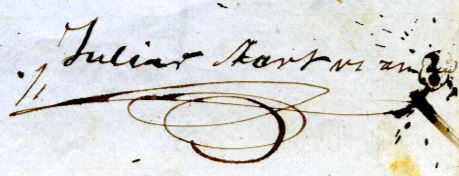
In testimony whereof I have hereunto set my hands & seal this 30th day of May AD 1853
Julius Austrian
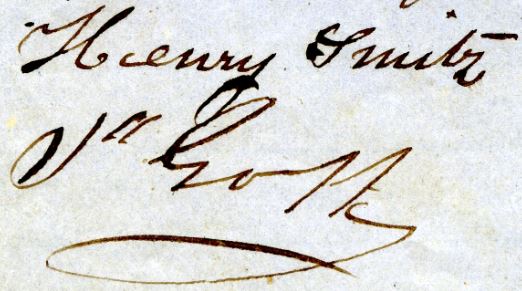 Signed Sealed & delivered
in Presence of
Henry Smitz
S Goff
State of Wisconsin
County of La Pointe
S. Goff came personally before me and being duly sworn according to laws, Says, That, he signed the annexed foregoing power of Attorney from Julius Austrian to James Hughes bearing date on the 30 day of May AD 1853, as one of the subscribing witnesses thereto, and that his Deponents signature thereon and thereto, is genuine, that Deponents was then and still is acquainted with and personally knew the said Julius Austrian who signed the said Power of Attorney, and that he signed the same in the presence of this Deponent at the time the same bears date. To wit: on the 30th day of May AD 1853, and the said Julius Austrian’s signature thereto and thereon is genuine.

S. Goff
Subscribed and Sworn
to before me the 10th day
of december AD 1853

John W. Bell
Justice of the peace
This Agreement
made and entered into between Charles H Oakes, Michael E Ames and Isaac Van Etten of St Paul, Minnesota Territory of the first part and James Hughes of Hudson Wisconsin, of the second part witnesseth:
That the said parties of the first part do hereby agree to pay or cause to be paid, the sum of Three Hundred and fifty Dollars, to be paid unto the said James Hughes, party of the second part, as soon as two certain Warranty Deeds made and executed by Julius Austrian through and by the said James Hughes, his Attorney in fact, to the parties of the first part of even date herewith, shall by duly Recorded in the office of the Register of La Pointe county, Wisconsin, upon the express condition however, that no deed or other instrument of conveyance of the lands described in the said Deed, or any part of them, has been executed or Recorded in said County or State from Julius Austrian, or from his Attorney in fact previous to the Record of the above deeds, to the parties of the first part.
And upon the further condition that the entry or purchase from the United States Government, of the said Austrian of said lands mentioned and described in said Deeds to the parties of the first part, shall be held good and valid by the Government and not vacated or cancelled, and that a patent issue from the United States Government therefore and perfecting the title thereof in the parties of the first part.
And the parties of the first part further agree to pay unto the said James Hughes the further sum of Six Hundred Dollars after and out of the proceeds of the sale of a portion of the property ( Real Estate described in the said two Deeds of Julius Austrian, executed and delivered to the parties of the first, by said James Hughes, as Attorney in fact, for said Austrian above named, after the same shall have been sold and proceeds therefrom realized and not before.

Charles Henry Oakes
La Pointe fur trader; Chippewa treaties signatory; father of a mixed-bloods family; St. Paul banker and Free Mason.
~ Findagrave.com
It is further understood and agreed by and between the parties of the first part, and the party of the second part hereto that the payments of the above sums or either of them, is dependent and upon the express condition, that the said Warranty Deed, bearing even date herewith, to the parties of the first part above herewith, to the parties of the first part above described, does and shall convey and vest a good perfect and legal title of the lands describe therein, in and to the parties of the first part, their heirs and assigns in fee simple, free of all adverse title or titles, and free from all incumbrance (Excepting a certain Mortgage upon a part of the premises to secure the payments of about fifteen Hundred Dollars, from the said Austrian to Charles H Oakes of the parties of the first part).
Otherwise it is understood and agreed that the party of the second part, has not and shall not have any claim whatever when the parties of the first part for the payment of the above mentioned sums, or any part thereof.
In witness whereof, we have hereto set our hands the 1st day of December AD 1853
in duplicate form
Signed Chas H Oakes
[Other signatories cut off in scan]
In presence of
I V D Heard
Julius Austrian
To.
Charles H Oakes
Michael E Ames
Isaac Van Etten
Warranty Deed
“State of Wisconsin”
“County of La Pointe”
“Office of Register of Deeds”
Received for Record on the 10th day of December 1853 at 7 O Clock P.M. and Recorded on Pages 22, 23, and 24 in Book A of Records of Deeds.
Robt. D. Boyd
Register of Deeds
– – – – – – – – – –
THIS INDENTURE,
made this first (1st) day of December is the year of our Lord one thousand eight hundred and fifty three.
BETWEEN
Julius Austrian (by James Hughes his attorney in fact)
of the county of La Pointe and State of Wisconsin of the first part, and
Charles H Oakes Michael E Ames and Isaac Van Etten
of the second part,
WITNESSETH, that the said party of the first part, for and is in consideration of the sum of
One Thousand ($1000)
Dollars, in hand paid by the said parties of the second part – the receipt whereof is hereby acknowledged – has given, granted, bargained, sold, conveyed, and confirmed, and by these presents, does give, grant, bargain, sell, convey and confirm unto the said parties of the second part, their heirs and assigns, forever, all the following described pieces or parcels of land, situate, lying and being in the County of La Pointe ^and State of Wisconsin^ and known and designated as follows, vis:
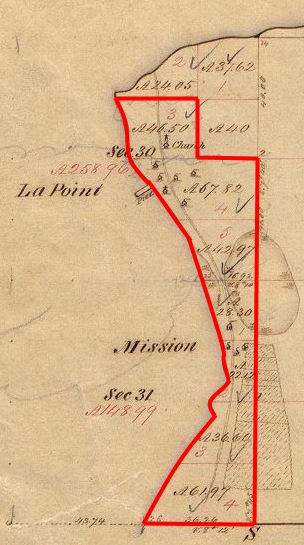
The lots of this deed are outlined in red, describing La Pointe (New Port and Middleport) for a total of 306.28 acres. This is roughly 80 acres short of “Containing 382 23/100 Acres of land”.
~ General Land Office
Lots numbered three (3) four (4) and five (5) in Section No thirty (30) in Township No. fifty (50) North of Range NO. three (3) west, and Lots Numbered One (1) two (2) three (3) and four (4) in Section Number thirty one (31) in said Township No fifty (50), Range No three (3) aforesaid, according to the Survey of the United States government and Platts thereof, [ben?] and hereby intending, to convey the same, and all of the pieces, [pared?] or lots of land heretofore entered, bids of or purchases by the said party of the first part from the United States Government, on or about the second day of May AD 1853, or at any other time. Containing 382 23/100 Acres of land.
TO HAVE AND TO HOLD THE SAME,
together with all and singular the appurtenances and privileges thereunto belonging, or in any wise appertaining, and all the Estate, Right, Title, Interest and Claim whatsoever, of the said party of the first part, either in Law or Equity, in and to the above described premises, to the only proper use, benefit, and behoof of the said parties of the second part, their heirs, and assigns forever. And the said party of the first part, for himself his heirs, executors, and administrators, does COVENANT AND AGREE to and with the said parties of the second part, their heirs and assigns, that he is well seized in fee of the aforesaid premises, and has good right to SELL and CONVEY the same in manner and form as above written, and that the same are free of all incumbrances whatever ; and that the aforesaid premises in the quiet and peaceable possession of the said parties of the second part, their heirs and assigns, against every person lawfully claiming or to claim the whole or any part thereof, he will forever WARRANT AND DEFEND.
IN TESTIMONY WHEREOF, the said party of the first part, has hereunto set his hand and seal the day and year first above written.

Julius Austrian
By James Hughes
his Attorney in fact
Sealed and Delivered in Presence of
The words “and State of Wisconsin” first [intertriced?] before signing.
I V D Heard
Truman M Smith
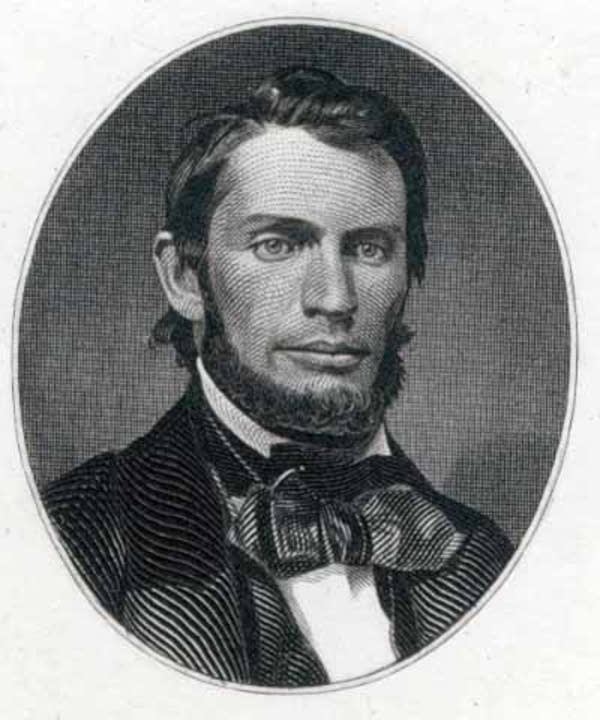
Truman Mott Smith was also a banker.
~ Minnesota Historical Society via Minnesota Public Radio
Territory of Minnesota,
COUNTY OF Ramsey
BE IT KNOWN, that on the first (1st) day of December A. D., before the undersigned, personally came James Hughes (the attorney in fact of the said Julius Austrian) the grantor to the foregoing and within DEED, from him as such grantor to Charles H Oakes Michael E Ames and Isaac Van Etten grantors, and to me personally known to be the identical person described in, and who by James Hughes his said attorney in fact executed the said deed, and the said James Hughes his attorney in fact acknowledged that he executed the said deed, freely and voluntarily, for the uses and purposes therein expressed, for in behalf and on the part of the said Julius Austrian [grantors?], aforesaid,
Truman M Smith
Justice of the Peace
– – – – – – – – – –
Territory of Minnesota
County of Ramsey
I do hereby certify that Truman M Smith, Esq before whom this within acknowledged [guest?] was taken was at the time the same bears date, a Justice of the Peace in and for said County, duly Elected & qualified to act as such, & to take Acknowledgement of Deeds,
that I am well acquainted with his hand writing & believe the within signature purporting to be his, to be his genuine signature. And that the within Deed is Executed & Acknowledged according to the laws of said Territory.
In testimony whereof I have hereunto set my hand & affirm the seal of the District Court of said County, at St. Paul, this 3rd day of December A. D. 1853. [A. J. Mutney?] Clerk.
by Sherwood Hough
Dept. Clerk of said Court
Julius Austrian
To
Charles H. Oakes
M E Ames
Isaac Van Etten
Warranty Deed
“State of Wisconsin”
“Lapointe County”
“Office of Register of Deeds”
Received for Record on this 10th day of December, 1853 at 7 O Clock P.M. and Recorded on pages 24, 25, and 26 in Book A of Records of Deeds.
Robt. D. Boyd
Register of Deeds
– – – – – – – – – –
THIS INDENTURE,
made this first (1st) day of December is the year of our Lord one thousand eight hundred and fifty three.
BETWEEN
Julius Austrian (by James Hughes his attorney in fact)
of the county of Lapointe and State of Wisconsin of the first part, and
Charles H Oakes Michael E Ames and I Van Etten
of the second part,
WITNESSETH, that the said party of the first part, for and is in consideration of the sum of
One hundred and fifty ($150~)
Dollars, in hand paid by the said parties of the second part – the receipt whereof is hereby acknowledged – has given, granted, bargained, sold, conveyed, and confirmed, and by these presents, does give, grant, bargain, sell, convey and confirm unto the said parties of the second part, their heirs and assigns, forever, all the following described pieces or parcels of land, situate, lying and being in the County of La Pointe ^and State of Wisconsin^ and known and designated as follows, vis:

Roughly 80 acres are highlighted in blue, labeled as “Austrian’s Sawmill“ on the 1852 PLSS survey map. This is located along what is now Pike’s Creek south of the Bayfield Road on the mainland.
~ General Land Office
The South West quarter of the North West quarter of Section No twenty one (21) and the North west quarter of the south west quarter of said section No. twenty one (21) in Township No fifty (50) North, of Range No. four (4) containing Eighty Acres more or less.
~ The Sawmill Community At Roy’s Point by Mary E. Carlson, 2009, page 14.
TO HAVE AND TO HOLD THE SAME,
together with all and singular the appurtenances and privileges thereunto belonging, or in any wise appertaining, and all the Estate, Right, Title, Interest and Claim whatsoever, of the said party of the first part, either in Law or Equity, in and to the above described premises, to the only proper use, benefit, and behoof of the said parties of the second part, their heirs, and assigns forever. And the said party of the first part, for himself his heirs, executors, and administrators, does COVENANT AND AGREE to and with the said parties of the second part, their heirs and assigns, that he is well seized in fee of the aforesaid premises, and has good right to SELL and CONVEY the same in manner and form as above written, and that the same are free of all incumbrances whatever ; and that the aforesaid premises in the quiet and peaceable possession of the said parties of the second part, their heirs and assigns, against every person lawfully claiming or to claim the whole or any part thereof, he will forever WARRANT AND DEFEND.
IN TESTIMONY WHEREOF, the said party of the first part, has hereunto set his hand and seal the day and year first above written.
Julius Austrian
By James Hughes
his Attorney in fact
Sealed and Delivered in Presence of
The words “and State of Wisconsin” first [introduced?] before signing.
I V D Heard
Truman M Smith
Territory of Minnesota,
COUNTY OF Ramsey
BE IT KNOWN, that on the first (1st) day of December A. D., before the undersigned, personally came James Hughes the attorney in fact of the said Julius Austrian the grantor to the foregoing and within DEED, from him as such grantor to Charles H Oakes Michael E Ames and I Van Etten grantors, and to me personally known to be the identical person described in, and who by James Huges his said attorney in fact executed the said deed, and by James Hughes his attorney in fact and who acknowledged that he executed the said deed, freely and voluntarily, for the uses and purposes therein expressed, for in behalf and on the part of the said Julius Austrian [grantors?], aforesaid,
Truman M Smith
Justice of the Peace
– – – – – – – – – –
Territory of Minnesota
County of Ramsey
I do hereby certify that Truman M. Smith Esq. before whom the within Acknowledgment was taken, was at the date thereof, a Justice of the Peace in and for said County, duly Elected & qualified to act as such, & to take the Acknowledgement of Deeds, that I am well acquainted with his hand writing and believe the signature to the within certificate purporting to be his, to be his genuine signature. And that the within Deed is Executed & Acknowledged according to the laws of this Territory.
In Testimony whereof I have hereunto set my hand & affix the Seal of the District Court of said County at St. Paul this 2nd day of December A.D. 1853. Clerk.
by Sherwood Hough
Dept. [Crt?] Clerk
of the Dist Court
of said County
Hudson, Wisconsin
Dec. 4th 1853
Julius Austrian Esq.
Dear Sir,
~ Fifty Years in the Northwest, by W. H. C. Folsom, 1888, page 169.
I have first learnt, by report, that Col. Hughes by virtue of a power of att’y given him by you, has sold to Borup and Oaks the whole La Pointe property, for the sum of four thousand dollars. You had better at once draw, execute and have placed on record a written revocation of the Power of Attorney. The revocation should be acknowledged before a justice of the peace as same as a deed.
If this report be true you had better come down at once.
Yours truly
W. H. Semmes
Notice to the Public

Julius Austrian
~ Madeline Island Museum
Whereas James Hughes of Hudson in the County of St Croix and State of Wisconsin, on the first day of December AD 1853, did execute to Charles H Oakes, Michael E Ames and Isaac Van Etten, under a pretended power of attorney from Julius Austrian and without any authority from him, or either of the under signed, two several deeds, one of which deeds had described therein, the following described lands, lying in the County of La Pointe and State of Wisconsin, to wit:
the south west quarter of the north west quarter of Section No twenty one (21), and the north west quarter of the south west quarter of Section No Twenty one (21) in Township No fifty (50) North of Range No four (4) containing eighty acres more or less,
and the other of said deeds had described therein the following described lands to wit:
Lots numbered Three (3) four (4) and five (5) in Section No Thirty (30) in Township No fifty (50) north of Range No Three (3) west and Lots numbered one (1) two (2) three (3) and four (4) in Section No Thirty one (31) in said Township No fifty (50) Range No Three (3) aforesaid.
And whereas the said lands were entered and purchased by Julius Austrian from the Government of the United States on the 2nd day of May 1853. And whereas the said Julius Austrian, did, on the 23rd day of May AD 1853, execute and deliver to one Henry Smitz of La Pointe County, a deed of conveyance in fee simple of the undivided one sixth part of the following described lands, to wit:
Lots Nos three (3) four (4) and five (5) in Section No thirty (30), and Lots Nos one (1) two (2), three (3) and four (4) of Section No Thirty one (31) in Township No fifty (50) North of Range No three (3) in the said County of La Pointe.
And whereas neither the said Julius Austrian, nor the said Henry Smitz, has conveyed any part or portion of the rel estate above described & any person. And whereas further the said James Hughes had no legal or equitable power or authority from the said Julius Austrian and Henry Smitz or either of them, to sell or convey the said above described lands, on the said first day of December AD 1853 or at any time previous or subsequent of that day.
Now therefore notice in hereby given to all persons, that the said Julius Austrian and Henry Smitz, nor either of them do not, and never have recognized the authority of the said James Hughes to make the deeds aforesaid of the said laws, and do not recognize the acts of the said James Hughes in the premises. And that the said Julius Austrian and Henry Smitz, do now claim and have ever since the said 23rd day of May 1853, claimed the legal title to and ownership of, and the sole right to sell and convey the following described lands; to wit;
Lots Nos three (3), four (4) and five (5) in Section No Thirty (30) and lots Nos one (1) two (2), three (3) and four (4) of Section No Thirty one (31) in Township No fifty (50) North of Range No three (3) West.
And that the said Julius Austrian does now claim and has ever since the 2nd day of May 1853, claimed the legal title to and the ownership of and the sole right to sell and convey the following described lands, to wit;
the South West quarter of the North West quarter of Section No Twenty one (21) and the North West quarter of the South West quarter of Section No Twenty one (21) in Township No fifty (50) North of Range No four (4) West, containing eighty acres more or less.
And all persons are therefore hereby warned, notified and forbidden from purchasing of, or receiving any manner of conveyance or conveyances from the said Charles H Oakes, Michael E Ames and Isaac Van Etten, or either of them, of any part or portion of the above described lands.
Hudson, St Croix County, Wisconsin
December 23 1853
Julius Austrian
Henry Smitz
To Messrs Charles H. Oakes, Michael E. Ames and Isaac Van Etten and to each and everyone of you
You are hereby notified that the conveyances made to you by James Hughes on the first day of December A.D. 1853 under a pretended power of attorney from Julius Austrian, of the following described lands to wit:
the South West quarter of the North West quarter of Section No. twenty one (21), and the North West quarter of the South West quarter of Section No. twenty one (21) in Township No. fifty (50) North of Range No. four (4) containing eighty acres more or less; and also Lots numbered three (3) four (4) and five (5) in Section No thirty (30) in Township No. fifty (50) North of Range No. three (3) West, and Lots numbered one (1) two (2) three (3) and four (4) in Section No. thirty one (31) in said Township No. fifty (50) Range No. three (3) aforesaid in the County of La Pointe and state of Wisconsin,
were made in fraud of the rights of the said undersigned, the said Julius Austrian and Henry Smitz to the said lands and without any authority from the said Julius Austrian and Henry Smitz or either of them, either by power of attorney or otherwise, to the said James Hughes.
And you are therefore hereby notified that we the said Julius Austrian and Henry Smitz claim the legal title to and the ownership of the following described lands to wit:
lots numbered three (3) four (4) and five (5) in Section No. thirty (30) in Township No. fifty (50) North of Range No. three (3) west and Lots numbered one (1) two (2) three (3) and four in section No. thirty one (31) in said Township No. fifty (50) Range No. three (3) aforesaid being in the County of La Pointe and state of Wisconsin.
And you are further notified hereby that the said Julius Austrian claims the legal title to and ownership of the following described lands to wit:
the South West quarter of the North West quarter of Section No. twenty one (21) and the North West quarter of the South West quarter of Section No. twenty one (21) in Township No. fifty (50) North of Range No. for (4) containing eighty acres more or less.
And that we the said Julius Austrian and Henry Smitz do not and neither of us does, recognize the acts of the said James Hughes concerning the said above described lands and hereby forbid you and each of you from executing any conveyance or in any manner encumbering the title to the lands above described or any part thereof.
Dated at Hudson December 23d 1853
Julius Austrian
Henry Smitz
Mr. [McCloud?]
You will please deliver to Julius Austrian the enclosed papers upon my sending you a quit claim deed signed by Chas. H. Oakes & wife, Michael E. Ames & wife & I. Van Etten & wife for the lands embraced in two certain Deeds executed by said Austrian by James Hughes his atty-in- fact to said Oakes, Ames & Van Etten which deeds will accompany said Quit Claim Deeds. The [?????ed ??? you?].
I Van Etten
[????] discharge of [??????]
I Van Etten
– – – – – – – – – –
Quit Claim Deed
Chas. H. Oakes
and others
to
Julius Austrian
Office of Register of Deeds
La Pointe County Wis
I hereby Certify that the within Deed was filed in this Office for Record October 10th 1859 a [M?] and was duly Recorded in Book A of Deed Vol 3 on pages 333 & 334.
John W Bell
Register of Deeds
Fee 10$
– – – – – – – – – –
Know all men by these present.
That we Charles H Oakes and Julia B., his wife, Issac Van Etten & Jan I., his wife & Michael E. Ames & Josephine, his wife, of the County of Ramsey in the State of Minnesota. & the first part in consideration of the sum of three Hundred Dollars were?] in [hand?] [paid?] by Julius Austrian of La Pointe County in the State of Wisconsin, the receipt whereof is hereby a acknowledged, have bargained, sold, and quit claimed, deed of these presents do bargain, sell and quit claim unto the said Julius Austrian, his heirs and assigns forever, all [our?] rights, title, intersets, claim and severance in and [wled?] following described pieces or parcels of land situate and being in the County of La Pointe and State of Wisconsin [as is?] described as follows, to wit:
Lots Number three four & five (3, 4 & 5) in Section Number thirty (30) in Township No fifty (50) North of Range No Three (3) West, and lots one (1) two (2) three (3) and four (4) in Section number thirty-one (31) in said Township No fifty (50) Range No Three (3), and the South West quarter of the North West quarter of Section Number twenty one (21), and the North West quarter of the South West quarter of said Section number twenty one (21) in Township Number fifty (50) North of Range No four (4), being the same lands conveyed by said Julius Austrian by James Hughes his Attorney in fact to said Oakse & Van Etten & Michael E. Ames, by Deeds dated Dec [1?] 1853.
To Have and to Hold the above Quit claimed Premises with all the privileges and appurtenances thereto belonging to the said Julius Austrian, his heirs and assigns forever, so [cleat?] neither [we do?] said parties of [wofeist?] part, [??] in heirs or assigns shall have any claims, rights, or title in [?] to the aforesaid premises.
In Witness [????] We have hereunto set our [hand?] and seal, the thirtieth day of September, AD; 1859.

Isaac Van Etten
Jane I. Van Etten
M. E. Ames
Josephine Ames
Chas. H. Oakes
Julia B. Oakes
Signed, Sealed & Delivered
in presence of
[Harvey Affrcer?]
Thomas Van Etten
– – – – – – – – – –
State of Minnesota
County of Ramsey
Be it Remembered that in this 18th day of September AD. 1859, at St Paul in said County & State formerly same before nee, [Iwrue denjued?]. Charles H Oakes and Julia B. his wife, Isaac Van Etten and Jane I. his wife and Michael E Ames and Josephine his wife [fernaly? Rumb? me? who? elusegues?] & [seates?] of [deepering?] deed and acknowledge that they embrace the same for [lew? o? wiwre?] therein expressed, and the said Julia B. Jane I. and Josephine afersaid being by nee examined separate and apart from their said husbands acknowledge that they executed said deed freely.
United States of America
State of Minnesota,
Secretary’s Office.

Francis Baasen
“He was born in Luxembourg, Germany and came to America when he was 19 years of age. […] He was Minnesota’s first Secretary of State, assuming office on May 4, 1858.”
~ Findagrave.com
In Testimony Whereof, I have hereunto set my hand and affixed the Great Seal of the State, at the Capitol, in Saint Paul, this Fifteenth day of September A. D. 1859
Francis Baasen
Secretary of State,
Rec’d August 11, 1866,
of Julius Austrian $766.50 (by draft for 450$ & 210 94/100 acres of land valued at $1.50 per acre) in full satisfaction of a certain deed presents rendered & [d???etece] in the District Court of the United States for the District of Wisconsin in July 3, 1861 for $1127.94 damages & $74.70 cents in my favor & against said Austrian.
C. H. Oakes
by I. Van Etten
his Atty.
Bayfield Aug 11, 1866
Mr Julius Austrian
Dr Sir
In consideration of my settlements this day made I agree to obtain & file a [satisfactuis?] of the Judgement I obtained against you July 3, 1861, in the District Court of the United States for the District of Wisconsin, as soon as I leave [reach?] Madison.
[Y?? ? ?]
I. Van Etten
for C. H. Oakes
Ancient Garden Beds of Michigan
May 4, 2017
By Amorin Mello

This is a reproduction of “Ancient Garden Beds of Michigan“ from Memorials of a Half Century, by Bela Hubbard, 1887, pages 243-261.
ANCIENT GARDEN BEDS OF MICHIGAN.*
* Read before the State Pioneer Society, February 7, 1877, and published in the American Antiquarian.
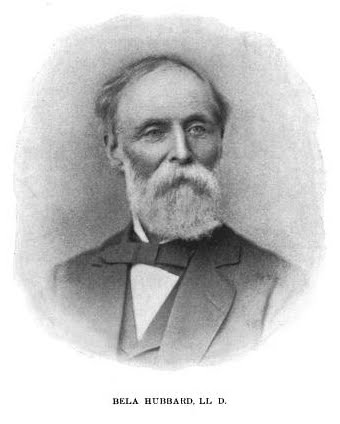
Bela Hubbard explored Lake Superior in 1840 as the Assistant State Geologist of Michigan with Douglass Houghton.
A CLASS of works of the Mound-builders exists in Michigan, of unknown age and origin, which have received the name of “Garden-Beds.”
An unusual importance attaches to these remains of a lost race, from the fact that they have been almost entirely overlooked by archæologists, and that of those which were so numerous and prominent forty, or even thirty years ago, nearly every trace has disappeared. For any knowledge beyond the scanty details hitherto recorded we are forced to rely upon the recollections of the “oldest inhabitants.” We know how uncertain this reliance often is, and were it otherwise, we cannot but recognize the rapidity with which we are losing our hold of this kind of testimony, and the very brief period of which it must cease altogether.
The earliest mention of these relics which I find is by Haven, in his “Archæology of the United States.” It is the report of Verandrie, who, with several French associates, explored this region before 1748. He found in the western wilderness
“large tracts free from wood, many of which are everywhere covered with furrows, as if they had formerly been ploughed and sown.”
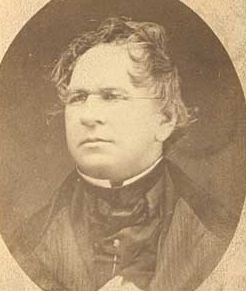
Henry Rowe Schoolcraft wrote about ancient gardens in Archives of Aboriginal Knowledge: Volumes I-VI.
Schoolcraft was the first to give to the world any accurate and systematic account of these “furrows.” Indeed, he is the only author of note who honors this interesting class of the works of the Mound-Builders with more than the most meagre mention. Observations were made by him as early as 1827. He gives figures of two kinds of beds, and he records the fact, that
“the garden-beds, and not the mounds, form the most prominent, and, by far, the most striking and characteristic antiquarian monuments of this district of country.”
Another writer of early date, still resident of our State, John T. Blois, published, in 1839, in his “Gazetteer of Michigan,” a detailed description, with a diagram, of one kind of the beds.
No mention is made of these remains by Priest or by Baldwin. Foster devotes to them less than a single page of his voluminus work, and only says, in effect, that “they certainly indicate a methodical cultivation which was not practised by the red man.”

Increase Allen Lapham wrote about ancient gardens in Antiquities of Wisconsin, and was involved with the Penokee Survey Incidents.
Dr. Lapham describes a few of this kind of remains which were found upon the western shore of Lake Michigan, as
“consisting of low parallel ridges, as if corn had been planted in drills. They average four feet in width, and twenty-five of them have been counted in the space of one hundred feet.”
Yet these relics constitute a unique feature in the antiquities of our country. They are of especial interest to us, from the fact that they were not only the most prominent of our antiquities, but, with the exception referred to in Wisconsin, they are confined to our State.
Some investigations, by no means thorough, enable me to define more accurately and fully than has been heretofore done the different kinds of these beds, which I shall attempt to classify, according to the most reliable information obtained. But I must first define their situation, extent and character.
The so-called “Garden-Beds” were found in the valleys of the St. Joseph and Grand rivers, where they occupied the most fertile of the prairie land and burr-oak plains, principally in the counties of St. Joseph, Cass and Kalamazoo.
They consist of raised patches of ground, separated by sunken paths, and were generally arrange in plats or blocks of parallel beds. These varied in dimensions, being from five to sixteen feet in width, in length from twelve to more than one hundred feet, and in height six to eighteen inches.
The tough sod of the prairie had preserved very sharply all the outlines. According to the universal testimony, these beds were laid out and fashioned with a skill, order and symmetry which distinguished them from the ordinary operations of agriculture, and were combined with some peculiar features that belong to no recognized system of horticultural art.
In the midst of diversity, sufficient uniformity is discoverable to enable me to group the beds and gardens, as in the following
CLASSIFICATION:
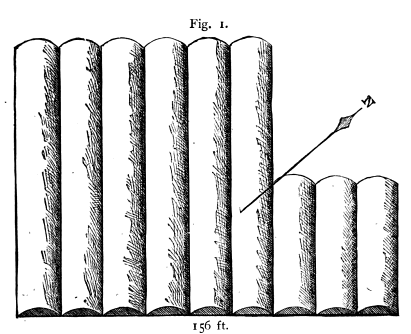
1. Wide convex beds, in parallel rows, without paths, composing independent plats. (Width of beds, 12 feet; paths, none; length, 74 to 115 feet.) Fig. 1.
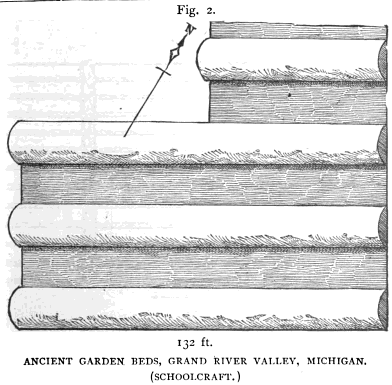
2. Wide convex beds, in parallel rows, separated by paths of same width, in independent plats (Width of bed, 12 to 16 feet; paths same; length, 74 to 132 feet.) Fig. 2.
3. Wide and parallel beds, separated by narrow paths, arranged in a series of plats longitudinal to each other (Width of beds, 14 feet; paths, 2 feet; length, 100 feet.) Fig. 3.

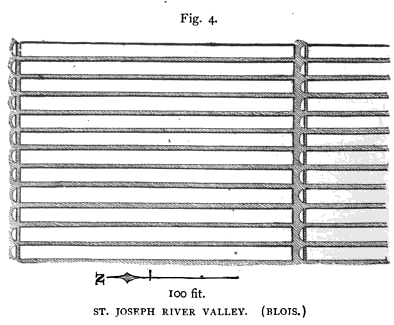
4. Long and narrow beds, separated by narrower paths and arranged in a series of longitudinal plats, each plat divided from the next by semi-circular heads. (Width of beds, 5 feet; paths, 1½ feet; length, 100 feet; height 18 inches.) Fig. 4.
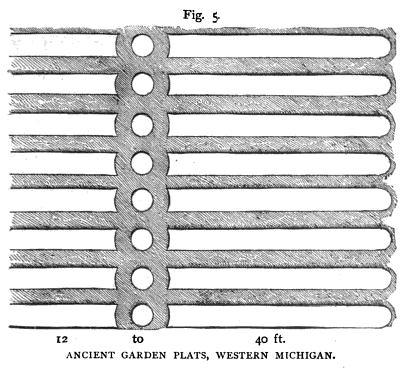
5. Parallel beds, arranged in plats similar to class 4, but divided by circular heads. (Width of beds, 6 feet; paths, 4 feet; length, 12 to 40 feet; height, 18 inches.) Fig. 5.
6. Parallel beds, of varying widths and lengths, separated by narrow paths, and arranged in plats of two or more at right angles N. and S., E. and W., to the plats adjacent. (Width of beds, 5 to 14 feet; paths, 1 to 2 feet; length, 12 to 30 feet; height, 8 inches.) Figures a, b, and c are varieties. Fig. 6.


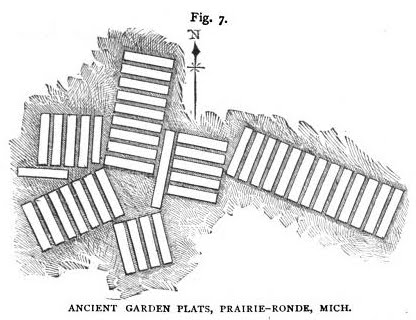
7. Parallel beds, of uniform width and length, with narrow paths, arranged in plats or blocks, and single beds, at varying angles. Width of beds, 6 feet; paths, 2 feet; length, about 30 feet; height, 10 to 12 inches.) Fig. 7.
8. Wheel-shaped plats, consisting of a circular bed, with beds of uniform shape and size radiating therefrom, all separated by narrow paths. (Width of beds, 6 to 20 feet; paths, 1 foot; length, 14 to 20 feet.) Fig. 8.

I present diagrams of each of these classes or kinds of beds. Of these only those numbered 1, 2 and 4 have ever before been delineated, to my knowledge. (See figures 1 to 8, pages 257-261.) Nos. 3 and 5 are described by Schoolcraft and Blois, while the others are figured as well – 1 and 2 by Schoolcraft and 4 by Blois. No. 3, according to the latter, consists of five plats, each 100 feet long, 20 beds in each plat. Schoolcraft does not give the exact localities, and I am unable to state whether beds of the same class have been noticed by other observers. As to their extent, his language is, “The beds are of various sizes, covering generally from 20 to 100 acres.” Some are reported to embrace even 300 acres. Plats of beds are undoubtedly here referred to.
Of the plat figured by Blois (No. 4), the writer says:
“They are found a short distance from Three Rivers, on one side of an oval prairie, surrounded by burr-oak plains. The prairie contains three hundred acres. The garden is judged to be half a mile in length by one-third in breadth, containing about one hundred acres, regularly laid out in beds running north and south, in the form of parallelograms, give feet in width and one hundred in length, and eighteen inches deep.”
The distinctive peculiarity of these beds is what Blois calls the “semi-lunar” head, at the extremity of each bed, separated from them by a path as represented.
Class 6, so far as my own inquiries warrant, represents the form and arrangement which is most common, viz.:
that of a series of parallel beds formed into blocks of two or more, alternating with other similar blocks placed at right angles to them. (See figures a, b, and c.) The prevailing width of the bed is five or six feet, and that of the paths one and a half to two feet. The length of the plats or blocks varies, the average being about twenty feet. Gardens of this kind were found by the early settlers of Schoolcraft, the burr-oak plains at Kalamazoo, Toland’s prairie, Prairie-Ronde, and elsewhere.
Mr. Henry Little says, that in 1831 they were very numerous on the plains where now stands the village of Kalamazoo; and south of the mound, eight or ten acres were entirely covered by them.
Mr. E. Laken Brown confirms this account, and says they reminded him of old New England gardens, being very regular and even, and the beds five feet by twelve or fourteen feet. In 1832 the outlines were very distinct, and the burr-oak trees on them as large as any in the vicinity. Mr. A. T. Prouty concurs as to the extent covered, but thinks the beds were six feet wide by twenty-five to forty long. On the farm of J. T. Cobb, section 7, town of Schoolcraft, the beds were quite numerous as late as 1860. There must have been 15 acres of them on his land. The “sets” would average five or six beds each. Neighbors put the number of acres covered with them in 1830, within the space of a mile, at one hundred.
Fig. 6-b, of class 6, is from a drawing by James R. Cumings, of Galesburg, of a garden in which the beds are of more than usual diversity in width and length. H. M. Shafter and Roswell Ransom, old settlers, say that three or four acres on the edge of the prairie, at this place, were covered with the beds. On the farm of the latter in the town of Comstock, of one hundred acres, there were not less than ten acres of beds, six feet by twenty-five to forty, arranged in alternate blocks, having a north-and-south and east-and-west direction.
Fig. 6-c is from a drawing by Mr. Shafter.
The series represented by Class 7 (fig. 7) were found at Prairie-Ronde. They are platted and described to me by Messrs. Cobb and Prouty. They differ from the more ordinary form of No. 6, in the arrangement of the blocks or sets of beds, which is here not at right angles, but at various and irregular angles, also in the single beds outlying. The number of beds in each block is also greater than usual.
Class 8 is established on the authority of Henry Little and A. T. Prouty, of Kalamazoo. The figure delineated is from the descriptions and dimensions given by the former. The diameter of the circular bed and the length of the radiating ones are each twenty-five to thirty feet. The latter describes two of similar design, but of smaller dimensions, the centre bed being only six feet in diameter, and the radiating ones twenty feet. All occurred at Kalamazoo, and in immediate association with the other forms of beds at that place, represented generally by Class 6.
There is reason for supposing that there may have existed another class of beds, differing altogether from any that I have represented, from expressions used by both Schoolcraft and Blois. The former speaks of “enigmatical plats of variously shaped beds;” and further, “nearly all the lines of each area or sub-area of beds are rectangular and parallel. Others admit of half circles and variously curved beds, with avenues, and are differently grouped and disposed.”
The latter says, the beds “appear in various fanciful shapes.” Some are laid off in rectilineal and curvilineal figures, either distinct or combined in a fantastic manner, in parterres and scolloped work, with alleys between, and apparently ample walks leading in different directions.”
This language is too vague to enable me to construct a diagram, nor have I any confirmation to offer from other sources. The reputation of the writers will not allow us to consider the descriptions fanciful, but it is possible to suppose they were misled by the representations of others.
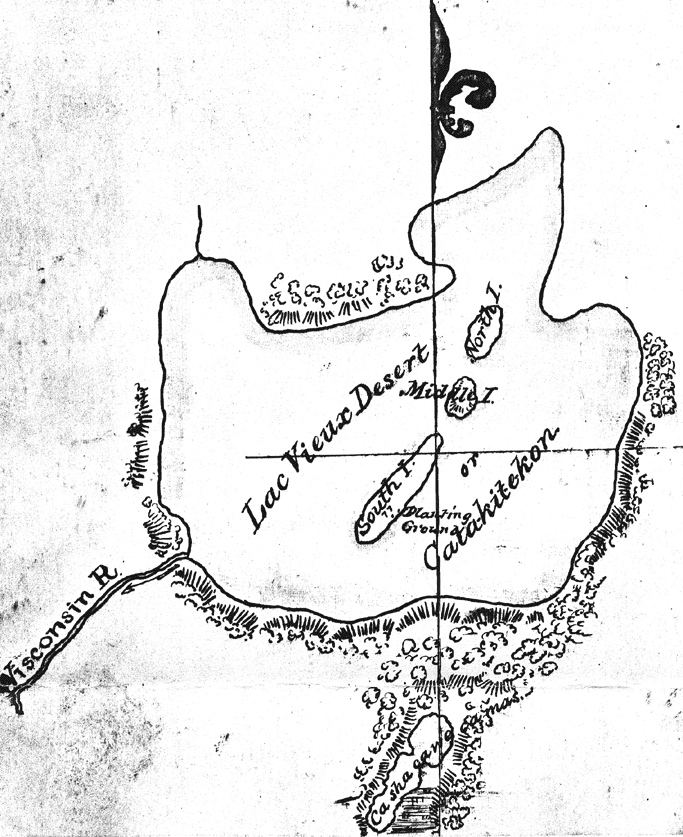
Lac Vieux Desert (‘lake of the old garden’) and Catakitekon [Gete-gitigaan (‘old gardens’)] from Thomas Jefferson Cram’s 1840 fieldbook. This is the headwaters of the Wisconsin River, and near those of the Wolf River and Ontonagon River.
~ School District of Marshfield: Digital Time Travelers
The principal crop of the Indians is maize, and this was never cultivated by them in rows, but in hills often large but always disposed in a very irregular manner. As little do these beds resemble the deserted fields of modern agriculture. On the other hand, the resemblance of many of the plats to the well-laid out garden beds of our own day is very striking; while the curvilinear forms suggest analogies quite as strong to the modern “pleasure garden.”
The nearest approach to anything resembling horticultural operations among Indian tribes, with the historic period, is noticed by Jones, who refers to a practice, among some of the southern Indians, of setting apart separate pieces of ground for each family. This author quotes from Captain Ribault’s “Discovery of Terra Florida,” published in London, 1563. “They labor and till the ground, sowing the fields with a grain called Mahis, whereof they make their meal, and in their gardens they plant beans, gourds, cucumbers, citrons, peas, and many other fruits and roots unknown to us. Their spades and mattocks are made of wood, so well and fitly as is possible.”
In the St. Joseph Valley I learned of numerous places, widely apart, where the labor and ksill of our ancient horticulturists were apparent in small gardens, laid out in different styles, and with an eye to the picturesque; as if each family had not only its separate garden patch, but had used it for the display of its own peculiar taste.
~ Bad River WPA Papers, Envelope 3, Folder 9.
~ Railroad History, Issues 54-58, pg. 26
Historians tell us of the Aztecs, that they had gardens in which were cultivated various plants, for medicinal uses, as well as for ornament. Was there something analogous to this in the Michigan Nation? Did the latter also have botanical gardens? May we accord to this unknown people a considerable advance in science, in addition to a cultivated taste, and an eye for symmetry and beauty, which is without precedent among the pre-historic people of this continent, north of Mexico?
These extensive indications of ancient culture necessarily imply a settled and populous community. We are led, therefore, to look for other evidences of the numbers and character of the people who made them. But here an extraordinary fact presents itself; such evidences are almost wanting! The testimony of nearly every one whom I have consulted – men who were among the first of the white race to break up the sod, that for ages had consecrated these old garden lands – agrees in the fact, that almost none of usual aboriginal relics were found; no pottery; no spear- and arrow-heads; no implements of stone; not even the omnipresent pipe. Tumuli, or burial mounds of the red man, are not uncommon, though not numerous, in Western Michigan, but have no recognized association with the garden race.
Upon the St. Joseph and Colorado rivers, and in the town of Prairie-Ronde, exist several small circular and rectangular embankments, resembling the lesser works of the Mound-Builders so numerous in Ohio. But no connection can be traced between these detached earthworks and the garden-beds. None of them seem to have been the bases of buildings, nor do they give indication of any religious origin or rites. There are no traces of dwellings, and the soil which has so sacredly preserved the labor of its occupants, discloses not even their bones!
At Three Rivers, and in Gilead, Branch County, are some ancient embankments, which are probably referable to this people and may pass for works of defence. That at the first named place was notably extensive. It consisted only of an earth embankment, about six feet in height, extending between two forks of a river, a mile apart. It thus enclosed a large area, and with a sufficient garrison might have withstood the siege of a large army of barbarous warriors.
It seems strange, indeed, that these garden beds, suggestive as they are, should be the only memorials of a race which has left such an evidence of civilized advancement, and was worthy of more enduring monuments! We may reasonably conclude, that they were a people of peaceable disposition, of laborious habits, and of æsthetic if not scientific tastes; that they lived in simple and patriarchal style, subsisting on the fruits of the earth, rather than of the chase. Their dwellings and their tools were of wood, and have perished. This simple record of their character and labors is all, it may be, we can ever know.
But is this all? May we not form some reasonable conjecture as to the period in which these gardeners lived?

Detail of “Chippewa Gardens” at Odanah from Narrative journal of travels from Detroit northwest through the great chain of American lakes to the sources of the Mississippi River in the year 1820, in 1820, by Henry Rowe Schoolcraft, page 105. This place is known as Gete Gititaaning (‘at the old gardens’) in Ojibwemowin.
“My children, I want you to listen to me. The proposition I am about to present will benefit all of you, and I need your cooperation. I would like to have you donate your labor to clear land for a large community garden, where every family, or any one who wishes can plant. The place I would suggest is that swampy flat, near the cemetery. It will take time to drain it and dry out but I know it will make good garden plats.“
~ Early Settlement of the Bad River Indian Reservation
A fact mentioned by Dr. Lapham furnishes a species of evidence, as to the relative antiquity of the garden beds of Wisconsin, as compared with the animal mounds. They were found overlying the latter; from which he infers, of course, a more recent origin. We may also suppose a considerable more recent age, since it is not likely that the race could have thus encroached upon the works of another, until long after these had been abandoned, and their religious or other significance forgotten.
The date of the abandonment of the beds may be approximately fixed, by the age of the trees found growing upon them. One of these mentioned by Schoolcraft, cut down in 1837, had 335 cortical layers. This carries the period back as far as 1502, or some years prior to the discovery of this country by the French. How long these labors were abandoned before this tree commenced its growth may not be susceptible of proof. Early French explorers do not appear to have been interested in the question, and it does not seem to me necessary to go further back than the three centuries during which that tree flourished, for a period quite long enough to have crumbled into indistinguishable dust every trace of wooden dwellings and implements, as well as of the bodies of their fabricators, if the latter received only simple earth burial.
(Anishinaabe Migration Story):
“In the Third Fire the Anishinabe will find the path to their chosen ground, a land in the west to which they must move their families. This will be the land where food grows upon the waters.”
~ The Mishomis Book – The Voice of the Ojibway by Edward Benton-Banai, Chapter 13 – The Seven Fires.
At the time of the arrival of the French the country was in possession of Algonquin tribes, who emigrated from the St. Lawrence about the middle of the 16th century. They were ignorant of the authors of these works, and were not more advanced in the arts of culture than the other known tribes.
It is probable that the few defensive works I have mentioned were erected by this settled and peaceful race of gardeners, as places of temporary refuge for the women and children, against the raids of the warlike tribes living eastward of them. The larger one may have served for the general defence in a time of sudden and great emergency. It is probable that on some such occasion they were surprised by their savage and relentless foes, and were overwhelmed, scattered or exterminated.
Most of the facts I have been able to present are gathered, in large part, from the memories – of course not always exact or reliable – of early settlers, and after modern culture had for many years obliterated the old.
It is perhaps useless to regret that these most interesting and unique relics of a lost people have so completely perished, through the greed of the dominant race; or that they could not have received, while they yet remained, the more exact and scientific scrutiny which is now being applied to the antiquities of our land. Much that might then have been cleared up, must now remain forever involved in mystery, or be left to conjecture.
– – – – – – – – – –
In September, 1885, the writer visited the region of the ancient garden beds, in hopes of being so fortunate as to find some remaining. He did discover, near Schoolcraft, on a plat of land which had been recently cleared of its timber, a few traces of beds belonging to a set, most of which had been broken up by the plough.
Four or five beds could be distinctly traced, for the distance of some ten to fifteen feet. The remainder of their lengths, said to be some twenty to thirty feet, had been obliterated by cultivation. Each bed had a width of about ten feet from centre to centre of the intervening paths. The latter had apparently a width of two or three feet, but it was impossible to define the exact outlines.
After much inquiry I could learn of no other place in or near Prairie-Ronde, or the plains of St. Joseph and Kalamazoo Counties, where any traces of the old garden beds remained.
Mr. Cobb informed me that about 1859 he endeavored to preserve portions of a set of these beds, which were well covered by touch, protective prairie sod. But when the white grub took possession of the turf thereabouts his ancient garden reserve did not escape. In a year or two the hogs, in their search for the grub, had so rooted and marred the outlines that he ploughed the beds up.
I found many old residents who well remembered the garden plats as they appeared a half century ago, and all concurred in the admiration excited by their peculiar character and the perfection of their preservation. Mr. Cobb says, he often took his friend to see his “ancient garden,” counted the beds, and speculated upon their object. The set of beds, which is shown only partially in his sketch (Fig. 7), contained thirteen beds, and was the largest of the sets. The others averaged five or six beds each.
All concurred, too, as to the great extent of land, amounting to several hundred acres, covered, wholly or partially, by the beds, chiefly upon the northern edge of the prairie. That all visible evidence of their existence should have so completely disappeared is not surprising to any one who notes their situation, upon the richest portions of the mixed prairies and plains. The lands most esteemed by their garden race were those which first attracted the modern farmer. These lands still constitute fields as beautiful as the eye can anywhere rest upon, and in a region second in loveliness to no other part of our country. The wants of the early settler almost preclude any care for the preservation of what was regarded as mere curiosities. Even when spared from the plough, and left to the care of nature, the absence of the annual fires, which had prevented the growth of timber; the roots of trees upheaving the beds; the decay of fallen timber; the hummocks caused by upturned roots; the destruction of the turf by the forest growth, and by cattle and hogs, all tend to deface the beds, and leave them to be reduced to the general level by the elements. Under these circumstances, a few years even would suffice to obliterate outlines which had remained almost unaltered for centuries.
Julius Austrian Papers: La Pointe Lands
April 29, 2017
By Amorin Mello
Madeline Island Museum
Julius Austrian Papers
Folder 3: La Pointe Lands
Scans #1-25 transcribed (#26-55 not transcribed)
Mortgage Deed
Julius Austrian to Charles Oakes
Office of Register of Deeds
La Pointe County Wis.
I hereby certify that the within is a true copy from the Records in my office of an instrument recorded June 9th 1853 at 10 O’clock AM in Book A of Deeds Vol 1 pages 18 & 19.
John W Bell
Register of Deeds
Fees 7-
– – – – –

Charles Henry Oakes built New Fort for the American Fur Company, was the white father of a La Ponte Band mixed-blood family, and signed several Treaties.
~ Findagrave.com
This Indenture
made the Second day of May in the year of Our Lord One thousand Eight-hundred and fifty three, Between Julius Austrian of the County of La Pointe and State of Wisconsin of the first part, and Charles H Oakes of Minnesota of the second part; Witnessed, that the said party of the first part, for and in consideration of the sum of Sixteen (16) Hundred Dollars in hand paid by the said party of the Second part, the receipt whereof is hereby acknowledged, has given, granted, bargained, sold, conveyed and confirmed, and by those present does give, grant, bargain, sell, convey and confirm unto the said party of the Second part, his heirs and assigns forever all the following described piece or parcel of land situated, lying and being in the County of La Pointe, and State of Wisconsin, known and designated as follows, to wit;

“10 acres or there abouts of Lots 3, 4 & 5 Section 30 to be selected and resumed for Light House purposes of order of the President bearing date the 4 [Apl.?] 1853 see letter of Secr Interior [apl?] 4 /53.
The above lots 3, 4 & 5 with drawn from market util the selection is made see Comt. Instructions to [R.y R. Apl.?] 28 /53 and June 18 /53.
Reservation rescinded by order of the President March 3 /54 see Instructions to [R.g R.y?] March 7 /54.”
~ General Land Office
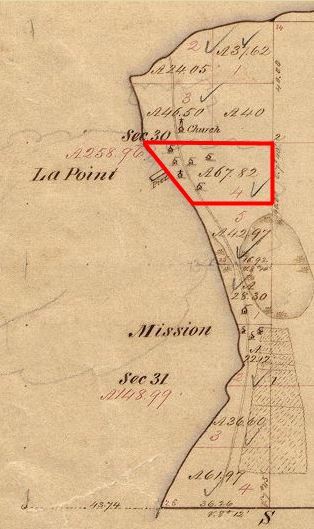
“Lot number four (4)“ is New Fort (downtown) La Pointe.
~ General Land Office
Lot number four (4) Township fifty (50) Section No. thirty (30) and Range No. three west containing sixty seven & 82/100 acres of land according to the Government Survey.
To have and to hold the same, together with all and singular the appurtenances and privileges thereunto belonging or in any wise appertaining and all the Estate Right, Title, Interest and Claim whatsoever, of the said party of the first part, either in Law or Equity, in and to the above described premises, to the only proper use, benefit and behoof of the said party of the second part, his heir and assigns forever, and the said Julius Austrian party of the first part for himself his heirs Executors and administrators do covenant and agree to and with the said party of the second part, his heirs and assigns that he is well seized in Fee of the aforesaid premises, and has good right to sell and convey the same, in manner and form as above written, and that the same are free of all incumbrances whatever, and that the aforesaid premises, in the quiet and peaceable possession of the said party of the second part, his heirs and assigns, against all and every person lawfully claiming or to claim the whole or any part thereof, he will forever warrant and defend.

Julius Austrian
~ Madeline Island Museum
Provided nevertheless that if the said Julius Austrian of the first part, his heirs, administrators, executors or assigns shall well and truly pay or cause to be paid to the said Charles H Oakes party of the second part, his heirs, executors, administrators or assigns the sum of Sixteen (16) Hundred Dollars, lawful money, in six equal annual payments, according to the condition of six certain notes bearing even date with, then this deed to be null and void, otherwise to be and remain in full force and effect, but if Default shall be made in the payment of the said sum of money, or the interest, or of any part thereof, at the time herein before specified for the payment thereof, the said party of the first part, in such case, does hereby authorize and fully empower the said party of the second part his executors, administrators or assigns, to sell the said hereby granted premises, at Public Auction, and convey the same the same to the purchase in Fee Simple, agreeably to the statute in such case made and provided, and out of the moneys arising from such sale, to retain the Principal and interest, which shall then be due on the said notes, together with all costs and charges, and pay the overplus (if any) to the said Julius Austrian, party of the first part his heirs, executors administrators or assigns.
In testimony whereof the said party of the first part has hereunto set his hand and seal the day and year first above written.
Julius Austrian
Sealed and delivered in presence of
~ Findagrave.com
Isaac V D Heard
I Van Etten
Territory of Minnesota
County of Ramsay
Be it known that on the second day of May AD 1853, before the undersigned, personally came Julius Austrian the Grantor to the foregoing and within Deed from him as such Grantor to Charles H Oakes, to me personally known to be the identical person described in and who executed the said deed, and who acknowledged that he executed the said deed freely and voluntarily for the uses and purposes therein expressed.
I Van Etten
Notary Public
Minnesota Territory

Charles W. W. Borup and Charles H. Oakes: married into the La Pointe mixed blood Beaulieu family; built the American Fur Company outift at New Fort, La Pointe; and started Minnesota’s first bank.
~ HeritageAuctions.com
St. Paul, May 2nd 1853
$200
Julius Austrian
– – – – –
St. Paul, May 2nd 1853
$300
On or before the first day of November A.D. 1854, I promise to pay Charles H. Oakes, on order, at the office of Mesfrs. Borup and Oakes, St. Paul, Min. Ter., the sum of Three Hundred dollars, value received—and in case of default in the payment of the above sum of money, then I agree to pay interest on said principal sum at the rate of ten percent per annum until paid.
Julius Austrian
– – – – –
St. Paul, May 2nd 1853
$200
Julius Austrian
– – – – –
St. Paul, May 2nd 1853
$400
Julius Austrian
[Filed 11/30/89]
Power of Att’y
from Jos Austrian
to Jul. A.
Registers certificate inside.
Recorded.
– – – – –
State of Michigan
County of Houghton
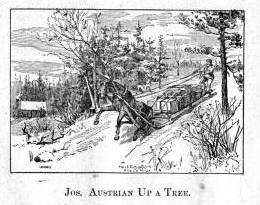
Joseph Austrian lived at La Pointe with his brother Julius during 1851 and 1852.
~ Austrian Papers
Know all men by these presents that I Joseph Austrian of Eagle River county of Houghton and State of Michigan have made, authorized, nominated and appointed and by these presents do make authorize nominate and appoint Julius Austrian of La Pointe county of La Pointe and State of Wisconsin my attorney for me and in my name and to my use, to enter into, and take possession of all such messuages, lands tenements, hereditaments, and real estate whatsoever, in La Pointe County of La Pointe State of Wisconsin, whereof I now am, or hereafter may be by any ways or means howsoever entitled or interested in, either in severalty and jointly or in common with any other person or persons.
And also for me and in my name, to grant, bargain, and sell, the same messuages lands, tenements and hereditaments, or any part, share or portion thereof, and all such rights, titles, interest, claim, and demand both in law and equity, as I may have in the same, for such sum and price, and on such terms, as to him shall seem meet, and for me and in my name to make, execute, and deliver good and sufficient deeds and conveyances for the same, and every part thereof, either with or without covenants and warranty.
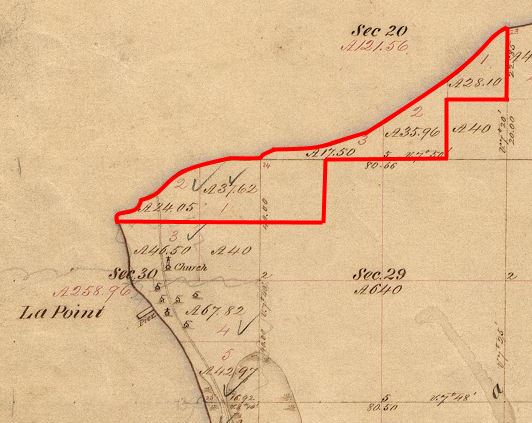
The north coast of La Pointe was patented in Joseph Austrian‘s name during 1852.
~ General Land Office
And while the sale thereof, for me, and in my name, and for my use, to let and do wise the same real estate or any part of parts thereof for the best rent that can be gotten for the same.
And also for me and in my name, and to my use to ask, demand, recover and receive all sums of money which shall become due, owing or payable to me by means of any such bargain, sale or lease. And to have, use, and take, all lawful ways and means for the recovery thereof by attachment, unrest, distress, or otherwise, and to compound, arbitrate, and agree, for the same and aquittances or sufficient discharges for the same, for me and in my name, to make, seal and deliver, and generally to do, execute, and perform, every thing that may be neccesary in and about the premises, as fully in every respect as I myself might or could do, if I were personally present.
And an attorney or attorneys under him for any or all of the purposes aforesaid, to make and substitute, and again at pleasure to revoke. And I hereby ratify, allow, and confirm, all, and whatsoever my said attorney shall do or cause to be done, in and about the premises by virtue of these presents. In witness whereof I have hereunto set my hand and seal.
Eagle River May 31st 1854.
Joseph Austrian
Signed Sealed and delivered in the presents of
Charles Hembeck
A W. Senter
State of Michigan
County of Houghton
Personally appeared before me Joseph Austrian and acknowledged that he executed the within Power of Attorney, and I further certify, that I well know the said Joseph Austrian, and that he is the same individual who is described as the within conveyance and who executed the same. Eagle River May 31st 1854.
Simon Mandlebaum
Justice of the Peace
Houghton County
Michigan
– – – – –
STATE OF MICHIGAN,
County of Houghton
I James Crawford Clerk of said County of Houghton DO HEREBY CERTIFY, that Simon Mandlebaum – whose name is subscribed to the Certificate or proof of acknowledgement of annexed Instrument, and therein written, was, at the time of taking such proof or acknowledgement a Justice of the Peace in and for said County, duly Elected and qualified, and duly authorized to take the same; AND FURTHER, that I am well acquainted with the hand writing of such Justice of the Peace and verily believe that the signature to the said Certificate or proof of acknowledgement is genuine; I FURTHER CERTIFY, that said Instrument is executed and acknowledged according to the Laws of this State.
IN TESTIMONY WHEREOF, I have hereunto set my hand and affixed the seal of said County, at Eagle River this Twelfth day of September A. D. 1856.
James Crawford
Clerk.
A Warranty Deed
S S Vaughn and Peter B Vanterventer
to
M. H. Manddlebaum
7 day April A. D. 1855
Recd for Record April 7 1855 at 4 Oclock P.M and Recorded in Book A of Deeds on Page (127)
John W Bell
Register of Deeds for
La Pointe County
Wis
– – – – –
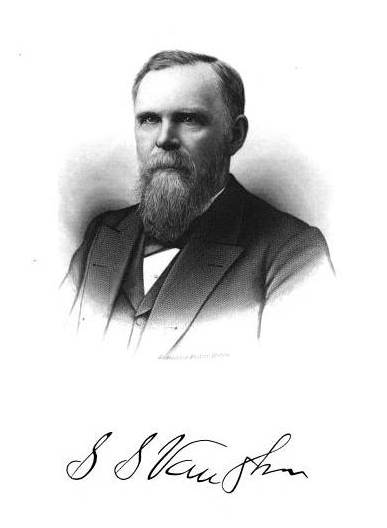
Samuel Stuart Vaughn
~ Western Reserve Historical Society
Know all men
by these presents that we S. S. Vaughn and Peter B Vanderventer and Caroline Vanderventer his wife of the Town and County of Lapointe and State of Wisconsin in consideration of Two hundred Sixty Two and a half dollars to us paid by M. H. Manddlebaum of Town County and State aforesaid the receipt whereof we do hereby acknowledge do by these presents give grant bargain sell and convey unto the said M H Manddlebaum his heirs and assigns a certain piece of land described as follows to wit lot No F??? one in Section No Four and lot No one in Section No Five Township no Forty nine range no Three containing Fifty two acres and forty seven hundreth of an acre together with all the privileges and appurtenances to the said land in any wise appertaining and belonging.

Vaughn/Vanderventer‘s lots 1 & 1 by Old Fort (Grant’s Point) La Pointe.
~ General Land Office
To have and to hold the above granted granted premises to the said M. H. Manddlebaum his heirs and assigns and to his and their use and behoof forever. And we S. S. Vaughn and Peter B Vanderventer and Caroline Vanderventer his wife for ourselves our heirs executors and administrators do covenant with the said M. H. Manddlebaum his heirs and assigns that we are lawfully seized in fee of the aforesaid premises that they are free from all incumbrances that wee have a good right to sell and to convey the same to the said M. H. Manddlebaum as aforesaid and that we will and ours heirs executors and administrators shall warrant and defend the same, to the said M H Manddlebaum his heirs and assigns forever against the lawful demands of all persons.
In testimony whereof we have hereunto set our hand and seal this 7 day of April A.D. 1855
S. S. Vaughn
P. B Vanderventer
Carline (her X mark) Vanderventer

Antoine Gordon was an influential Mixed Blood member of the La Pointe Band.
Sealed and delivered in presence of
John W Bell
A. Gaudin
State of Wisconsin
Lapointe County
April 7th 1855
They personally appeared before me the above named S. S. Vaughn, Peter B Vanderventer and Caroline wife of said Peter B. Vanderventer, who severally acknowledged they did sign and seal the foregoing instruments as their free act and deed, and the said Caroline wife of said Peter B Vanderventer on a private examination before me separate and apart from the said husband acknowledged that she did execute the foregoing deed without any fear or compulsion from her said husband or any other person.
John W Bell
Justice of the Peace in & for
Lapointe County Wisconsin
Deed ~
Antoine & Sarah Gaudin
to Joseph Austrian
Received for Record June 16 1855 [???] and Recorded in Book A of Deeds on page 153.
John W Bell Register for
La Pointe County Wisconsin
– – – – –
WARRANTY DEED. — Printed and sold by SANFORD & HAYWARD, Cleveland, Ohio.
To all People to whom these Presents shall come—GREETING:
KNOW YE, That
we Antoine Gaudin of the County of La Pointe and State of Wisconsin and Sarah wife of said Antoine Gaudin

“Mr. and Mrs. Antoine Gordon,
the founders of Gordon,
would have liked King Midas Flour.”
~ History of Gordon
For the consideration of the sum of two hundred and fifty dollars received to our full satisfaction of Joseph Austrian of Eagle River in the State of Michigan do give, grant, bargain, sell and confirm unto him the said Joseph Austrian the following described TRACT or LOTS of LAND, situate in the township of Lapointe being number (49) in the third range of Townships, which is also in the county of Lapointe and is known
as Lots two (2) and three (3) of section number five (5) containing one hundred acres (100)
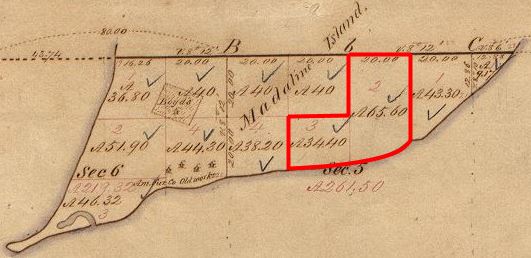
Gordons’ lots 2 & 3 near Old Fort (Grant’s Point) La Pointe.
~ General Land Office
TO HAVE AND TO HOLD the above granted and bargained premises, with the appurtenances thereunto belonging, unto him the said Joseph Austrian his heirs and assigns forever, to his and their own proper use and behoof. And we the said Antoine Gaudin and Sarah his wife do, for ourselves our executors and administrator, covenant with the said Joseph Austrian his heirs and assigns, that at, and until the ensealing of these presents we are well seized of the premises, as a good and indefeasible estate in FEE SIMPLE, and have good right to bargain and sell the same in manner and form as above written, and that the same be free from all incumbrance whatsoever. And furthermore, we the said Antoine Gaudin and Sarah his wife do by these presents find ourselves, our heirs, forever, to WARRANT AND DEFEND the above granted and bargained premises to him the said Joseph Austrian his heirs and assigns, against all lawful claims and demands whatsoever. And I the said Sarah wife of the said Antoine Gaudin do hereby remise, release, and forever quit claim unto the said Joseph Austrian his heirs and assigns, all my right and title of dower in the above described premises.
wife of Antoine Gaudin.
In Witness Whereof, we have hereunto set our hands and seals the fourteenth day of June in the year of our Lord one thousand eight hundred and fifty five.
A. Gaudin
Sarah (her X mark) Gaudin
Signed, Sealed and Delivered
in presence of
John .W. Bell.
M. H. Mandelbaum
THE STATE OF WISCONSIN,
COUNTY OF LA POINTE.
June 14 1855.
Personally appeared before the me above named Antoine Gaudin and Sarah his wife who acknowledged that they did sign and seal the foregoing instrument, and that the same is their free act and deed. I further certify, that I did examine the said Sarah wife of said Antoine Gaudin separate and apart from her husband, and did then and there make known to her the contents of the foregoing instrument, and upon that examination she declared that she did voluntarily sign, seal and acknowledge the same, and that she is still satisfied therewith.
John W. Bell
Justice of the Peace
Warrantee Deed
Joseph Austrain
to
Francois Cadotte
Office of Register of Deeds
La Pointe County Wis
I hereby Certify that the within Deed was filed in this office for Record Jany 21st 1858 A M and was duly Recorded in Book A of Deeds Vol [2 or 3?] and page 239.
John W Bell
Register
Fees $1.00
– – – – –
WARRANTY DEED.
Sold by E. Terry & Co., Milwaukee
This Indenture,
Made the Twenty first day of January in the year of our Lord one thousand eight hundred and fifty eight between
Joseph Austrian by Julius Austrian his attorney in Fact Party of the first part and Francois Cadotte of Lapointe County Wisconsin, party of the second part.

Antoine and Frank Cadotte (son and grandson of Michael and Madeline Cadotte, and Mixed Blood member sof the La Pointe Band).
~ Madeline Island Museum
Witnesseth, That the said party of the first part, for in consideration of the sum of Forty dollars Lawfull Money of the United States of America to him in hand paid by the said party of the second part, the receipt whereof is hereby confessed and acknowledged has given, granted bargained, sold, remised, released, aliened, conveyed, and confirmed, and by these presents does give, grant, bargain, sell, remise, release, alien, convey, and confirm unto the said party on the second part, and his heirs and assigns forever
the following Described Real Estate situated in the County of of Lapointe and State of Wisconsin, and Known as Lot number Thirty four (34) in the Town of Lapointe according to the Recorded Plat of said town as recorded in the Registers Office of said County of Lapointe.

Cadotte‘s block 34 in downtown La Pointe.
~ Julius Austrian Papers (maps folder)
Together with all and singular the Hereditaments and Appurtenances thereunto belonging, or in any wise appertaining; and all the estate, right, title, interest, claim, or demand whatsoever of the said party of the first part, either in Law or Equity, either in possession or expectancy of, in and to the above-bargained premises, and their Hereditaments and Appurtenances TO HAVE AND TO HOLD the said premises as above described, with the Hereditaments and Appurtenaces unto the said party of the second part, and to his heirs and assigns forever.
And the said Joseph Austrian by his P attorney for himself his heirs, executors, and administrators, does convenant, grant, bargain, and agree to and with the said party of the second part, his heirs and assigns, that at the time of the ensealing and delivery of these present, he is well seized of the premises above described, as of a good, sure, perfect, absolute, and indefeasible estate of inheritance in the Law, in fee simple, and that the same are free and clear from all incumbrances whatever, and that the above-bargained premises in the quiet and peaceable possession of the said party of the second part, his heirs and assigns against all and every person or persons, lawfully claiming the whole or any part thereof [???] will forever WARRANT AND DEFEND.
In Witness Whereof, the said party of the first part, has hereunto set his hand and seal the day and year first above written
Joseph Austrian
by Julius Austrian
his Att in fact.
Sealed and delivered in presence of
John W Bell
STATE OF WISCONSIN
COUNTY OF La Pointe
Be it Remembered, that on the Twenty first day of January A. D. 1858 personally came before me the above-named Joseph Austrian by Julius Austrian his attorney in fact to me known to be the person who executed the said Deed, and acknowledged the same to be his free act and deed, for the uses and purposes therein mentioned.
John W Bell
Justice of the Peace
Antoine Gordon & wife
to Julius Austrian
Office of Register of Deeds
La Pointe County Wis
I hereby Certify that the within Deed was filed in this Office for Record July 11th 1858 oclk and was duly Recorded in Book A of Deeds Vol 2 & page 296.
J W Bell
Register
rec 1 day of July 1861
$550 – 7%.
– – – – –
WARRANTY DEED. Sold by E. Terry & Co., Milwaukee.
This Indenture,
Made the Eleventh day of February in the year of our Lord one thousand eight hundred and fifty eight between
Antoine Gaudin and Sarah Gaudin his wife of La Pointe County & State of Wisonsin of the first part and Julius Austrian of the Same County and State party of the Second part.
Witnesseth, That the said parties of the first part, for and in consideration of the sum of Eight hundred Dollars receipt whereof is hereby confessed and acknowledged, has given, granted bargained, sold, remised, released, aliened, conveyed, and confirmed his heirs and assigns forever
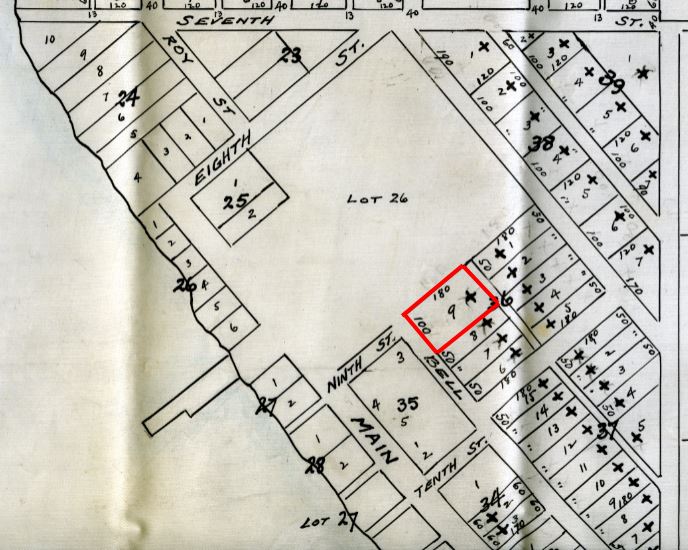
Gordons‘ lot 9 in downtown La Pointe.
~ Julius Austrian Papers (maps folder)
the following Described Real Estate situated and lying in the Town of La Pointe as on Record in the Registers Office of Lapointe County aforesaid and known and Descried as follows being Lot number nine (9) in Block number Thirty six (36) in Said Town of Lapointe, hereby absolutely Revoking and annulling a Deed of Gift, Executed by us to our son Edward on the eighth day of May 1855, and witnessed by John W Bell & William Morin and Recorded same day in the Registers Office of Lapointe County in Book A of Deeds Vol 1 & page 138 for the said described premises.
~ History of Gordon
Together with all and singular the Hereditaments and Appurtenances thereunto belonging, or in any wise appertaining; and all the estate, right, title, interest, claim, or demand whatsoever of the said parties of the first part, either in Law or Equity, either in possession or expectancy of, in and to the above-bargained premises, and their Hereditatments and Appurtenances. TO HAVE AND TO HOLD the said premises as above described, with the Hereditaments and Appurtenances, unto the said party of the second part, and to his heirs and assigns forever.
~ History of Gordon
And the said Antoine Gaudin & wife for themselves heirs, executors, and administrators, does covenant, grant, bargain, and agree to and with the said party of the second part, his heirs and assigns, that at the time of the ensealing and delivery of these present, they are well seized of the premises above described, as of a good, sure, perfect, absolute, and indefensible estate of inheritance in the Law in fee simple, and that the same are free and clear from all incubrances whatever, and that the above-bargained premises, in the quiet and peaceable possession of the said party of the second part, his heirs and assigns against all and every person or persons, lawfully claiming the whole or any part thereof He will forever WARRANT AND DEFEND.
In Witness Whereof, the said parties of the first part, has hereunto set their hands and seals the day and year first above written.
A. Gaudin
Sarah (her X mark) Gaudin
Sealed and delivered in presence of
John W Bell
John [Clikf?]
STATE OF WISCONSIN
COUNTY OF Lapointe
Be it Remembered, that on the Eleventh day of February A.D. 1858 personally came before me the above-named Antoine Gaudin & Sarah Gaudin his wife to me known to be the persons who executed the said Deed, and acknowledged the same to be their free act and deed for the uses and purposes therein mentioned.
John W Bell
Justice of the Peace
Warrantee Deeds
Francis Cadotte
to
Julius Austrian
Office of Register of Deeds
La Pointe County Wis.
I hereby Certify that the within Deed was filedin this Office for Record May the 8th 1858 at M and was duly Recorded in Book A of Deeds Vol 2 on pages 370 & 71
John W Bell
Register of Deeds
Fees $7-
– – – – –
WARRANTY DEED. Sold by E. TERRY & CO., Milwaukee.
This Indenture,
Made the Eighth day of May in the year of our Lord one thousand eight hundred and fifty Eight between
Francis Cadotte of LaPointe County, Wisconsin, party of the first part and Julius Austrian of Lapointe county party of the second part.
Witnesseth, That the said part of the first part, for and in consideration of the sum of Forty Dollars lawfull money of the United States to him in hand paid by the said party of the second part, the receipt whereof is hereby confessed and acknowledged has given, granted, bargained, sold, remised, released, aliened, conveyed, and confirmed, and by these presents does give, grant, bargain, sell, remise, release, alien, convey, and confirm, unto the said party of the second part, and his heirs and assigns forever
the following described Real Estate situate in the County of LaPointe and State of Wisconsin, and Known as Lot Number Thirty four (34) in the Town of La Pointe, according to the Recorded Plat of said Town as Recorded in the Registers Office of said County of La Pointe.
Block 34 in New Fort (downtown) La Pointe.
~ Julius Austrian Papers (maps folder)
Together with all and singular the Hereditaments and Appurtenances thereunto belonging, or in any wise appertaining; and all the estate, right, title, interest, claim, or demand whatsoever of the said party of the first part, either in Law or Equity, either in possession or expectancy of in and to the above-bargained premises, and their Hereditaments and Appurtenances. TO HAVE AND TO HOLD the said premises as above described, with the Hereditaments and Appurtenances made the said party of the second part, and to his heirs and assigns forever.
And the said Francis Cadotte for himself his heirs, executors, and administrators, does covenant, grant, bargain, and agree to and with the said party of the second part, his heirs and assigns, that at the time of the ensealing and delivery of these present, he is well seized of the premises above described, as of a good, sure, perfect, absolute, and indefensible estate of inheritance in the Law, in fee simple, and that the same are free and clear from all incumbrances whatever, and that the above-bargained premises, in the quiet and peaceable possession of the said party of the second part, his heirs and assigns against all and every person or persons, lawfully claiming the whole or any part thereof He will forever WARRANT AND DEFEND.
In Witness Whereof, the said party of the first part, has hereunto set his hand and seal the day and year first above written.
Francis Cadotte
Sealed and delivered in presence of
John W Bell
STATE OF WISCONSIN
COUNTY OF La Pointe
Be it Remembered, that on the Eight day of May A.D. 1858, personally came before me the above-named Franis Cadotte to me known to be the person who executed the said Deed, and acknowledged the same to be his free act and deed, for the uses and purposes therein mentioned.
J W Bell
Justice of the Peace
Office of Register of Deeds
La Pointe County Wisconsin Sept 5th 1859
I hereby Certify that up to this date, that the two United States Patents, to Julius Austrian numbered (79,458) and(2421) for Lands on Madeline Island have never been Recorded in this Office, nor any instrument from any person, in relation to any of the lands embraced in said Patents, and that the same are free from all incumbrances.
John W Bell
Register of Deeds
Asaph Whittlesey Incidents: Number IV
April 11, 2017
By Amorin Mello

Originally published in the March 9th, 1878, issue of The Ashland Press. Transcribed with permission from Ashland Narratives by K. Wallin and published in 2013 by Straddle Creek Co.
… continued from Number III.
Early Recollections of Ashland: Number IV
by Asaph Whittlesey
In our last number we referred to “the most aristocratic house” with lumber floors, etc. Though it was the third cabin built upon the “town site,” it was in reality the first cabin built, designed as a permanent residence. The foundation logs of this house were laid Sept. 20th, 1854. The record made by Martin Beaser, (evidently made from recollection,) calls this the first building erected, (giving the size of it,) whereas we had lived in two buildings previous to the building of this one.

Rev. Leonard Hemenway Wheeler
~ In Unnamed Wisconsin by Silas Chapman, 1895, cover image.
The “Whittlesey Post Office” was kept therein from the date of its establishment, March 12th, 1855 to Nov. 1858. The first dancing done within the “town site” was in this house in Nov. 1854, and during the winter religious services were held therein by Rev. L. H. Wheeler, of the Odanah Mission. It was the birthplace of Delia Elizabeth, second daughter to Mr. And Mrs. Asaph Whittlesey, born May 21st, 1856, being the first American child born within the limits of the “town site.” The first celebration of the Fourth of July was held in this house July 4th, 1855, further reference to which will hereafter be made. The first general election of county officers in the county of Ashland, was held in this building Nov. 4th, 1856, at which time Samuel S. Vaughn received eleven votes for the office of County Clerk, and M. H. Mandelbaum receive twelve. Francis McElroy was elected District Attorney and Asaph Whittlesey County Judge. It was in this house that Robert D. Boyd was shot and instantly killed by Henry Cross, January 10th, 1858, for which a verdict of justifiable homicide was rendered at an inquest, held by Asaph Whittlesey, Justice of the Peace, acting as Coroner.
ARRIVAL OF THE SECOND FEMALE UPON THE TOWN SITE.
Mr. and Mrs. John P. T. Haskell, with their family, parents of Mrs. Whittlesey, made a landing at Ashland, Nov. 2nd, 1854, and made their home with us during the winter following. In the early spring they made a home of their own in a cabin located upon the site of the present residence of G. M. Willis, Esq., a little to the east of Vaughn’s Dock, in Vaughn’s addition to Ashland, which was originally known as Haskell’s pre-emption claim. Mr. Haskell and family remained in the country only a single year, when they returned to Illinois, where Mr. Haskell died in 1873. Mrs. Haskell is still living and is unusually active for one of her age.
I next call your attention to the
FIRST CELEBRATION OF THE 4TH OF JULY
upon the “town site” July 4th, 1855.
Under an understanding had between Mr. and Mrs. Austin Corser and Mr. And Mrs. John Corser, (then living at Fish Creek,) and being the owners of the only cows nearer than Odanah, an agreement was made whereby the Corsers were to furnish milk, while Mrs. Haskell and Mrs. Whittlesey, (then living in the log house still visible on lot 6, of block 6,) were to do the necessary cooking in the celebrated “mud oven” attached thereto, marvelous for its baking capacity and for the quality of its production.
On the day referred to, the Declaration of Independence was read by Asaph Whittlesey, and this with the delivery of an oration by A. W. Burt, with singing and amusements, constituted the first public celebration of the 4th of July in the history of Ashland. The exercises were had at Whittlesey’s house in the after part of the day, and extended late in the evening, when music and dancing were added to the festivities of the day. The ladies present were Mrs. Haskell, Mrs. Whittlesey, the two Mrs. Corsers and Mrs. Farley. The gentlemen present were J. P. T. Haskell, George Kilborn, Lawrence Farley, Austin and John Corser, Asaph Whittlsey, A. W. Burt, A. J. Barckley, Adam Goeltz, John Donaldson, Conrad Goeltz, Andrew Scobie, and Duncan Sinclaire. The children present were Eugenia E. Whittlesey, (less than three years old,) George, son of Mr. and Mrs. Austin Corser, also a child of Mr. and Mrs. John Corser and William, John Joseph and Hattie Haskell, children and Mr. and Mrs. J. P. T. Haskell.
I shall never forget Mrs. Haskell’s “classic step” on that occasion, discounting many of those present much younger than herself. At intervals during the night the party were very highly entertained with singing by Conrad and Adam Goeltz.
FIRST POST OFFICE ESTABLISHED AT ASHLAND, MARCH 12TH, 1855.
As there was no opportunity for doubt as to the rapid growth of the city the establishment of a Post Office was the result of our first raid upon the general government, though for nearly one year following no provision whatsoever was made for furnishing this office with mail service, and mails were received by chance from La Pointe up to the opening of semi-monthly service, upon a new route established between La Pointe via Ashland to Chippewa Falls, and was soon after, during the winter months, supplied with weekly service upon the route from Ontonagon, Mich., to Superior, Wis. On both of these routes the mails were carried by packers and upon dog teams.

Detail of La Pointe County from a map of Wisconsin published by J. H. Colton & Co., New York, 1856.
~ MapofUS.org
In the petition forwarded to Washington asking for the establishment of an office at Ashland, La Pointe county, Wisconsin, the request was made that it be given the name of Ashland, and that Asaph Whittlesey be appointed postmaster. The sequel showed that as there was an office by the name of Ashland within the State, it was not lawful to attach the name to this office and therefore the appointing officers at Washington attached the name of Whittlesey thereto, by which the office was known until July 30th, 1860, when the obstacle to change in the name being removed, it was then given the name of Ashland, and was also designated as being in Ashland County, Wisconsin. I well remember how difficult a task I found it to be to satisfactorily explain to them how the place could one day be known as Whittlesey, La Pointe county and the next as Ashland, Ashland county. But they soon admitted it rather than be longer afflicted with my letters upon the subject.
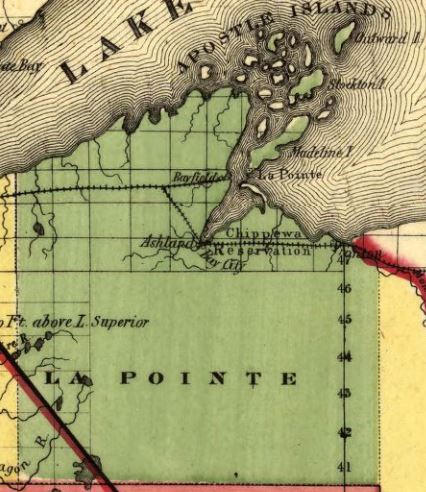
Detail of La Pointe County from a map of Wisconsin by The Milwaukee & Horicon Rail Road, 1857.
~ Library of Congress
The office of Whittlesey was kept in the cabin still in existence on lot 6 of block 6, “original Ashland,” until in Nov. 1857, when it was removed to lot 3 of block 3, into what was known as the Tomkins House, which then became the residence of myself and family until Nov. 1860. The case in which the books and papers connected with the office were kept, (which was made by myself,) is now in the “farm house” at “Pleasant Valley,” and will be delivered to any public organization in Ashland desiring to preserve the same. I continued to serve as postmaster until Nov. 21st, 1860, when I resigned the office and Andrew J. Barckley’s was appointed as my successor. Barckley’s term as postmaster expired Sept. 9th, 1861, by the appointment of Martin Beaser as successor in office to Barckley. Mr. Beaser served as postmaster until his death in Nov. 1866.
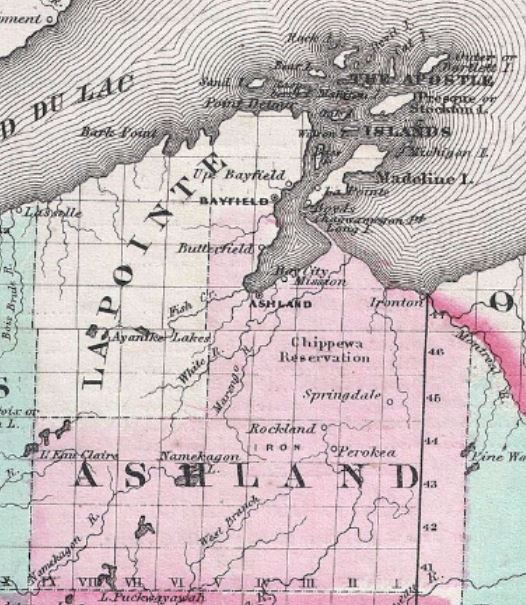
Detail of La Pointe and Ashland Counties from a map of Wisconsin and Michigan by A. J. Johnson and Ward, 1864.
~ Geographicus.org
The post office of Ashland was re-established Dec. 18th, 1871, and James A. Wilson, (the present incumbent,) being appointed postmaster.
The amount of post office money turned over to the Government by me at the close of my term of service was $8.53. My commissions upon this amount, together with the “franking privilege” vested upon postmasters, laid the foundation for my future fortunes, the balance was taken in waitings upon William Gotzenberg, who made daily inquiries for his mail, though he was aware that no mails were received oftener than once a week.
To be continued in Number V…
Objections to Mail Route 13780
April 10, 2017
By Amorin Mello
The following is a reproduction of “objections to Julius Austrian’s mail contract business (May 27, 1855)” from a Minnesota Historical Society collection of United States Post Office correspondences known as Selected items relating to Minnesota, 1855-1861. This is a classic example of how primary sources sources and historians tend to either honor, abhor, or ignore Julius Austrian at La Pointe. The petition was not included, but it will be reproduced here if it can be found.
Whittlesey, La-pointe Co.,
Wisconsin. May 21st, 1855

Horatio King
~ Wikipedia.org
To the Hon. Horatio King,
First Asst. Postmaster General, D.C.
Dear Sir: In addition to this petition, we would respectfully call your attention to a brief history of the base intrigues of Julius Austrian, the Jew, who now holds the contract for carrying the mail on route 13780. Heretofore there have been but few whites, that is, Yankees living upon the Island, most of the residents being halfbreeds, French and Indians. These people never have much interest in mail matters and consequently care very little whether Mr. Austrian carries the mail regularly or not. Indeed they cannot read a letter if they should receive one and therefore have no interest in such things. Now whenever Mr. Austrian wishes to effect an alteration in mail matters, he goes to these illiterate Frenchmen, gets them to sign something they hardly know what, but he gets their names and these, with his unprincipled misrepresentations, are the instruments and means by which he accomplished his selfish ends. Those who are most interested in mails, our merchants and other business men, who of course would oppose his measures, know nothing of this until the change is made, and the “Jew” triumphantly announces to them, that by his influence at Washington he has effected this or that change, a change in which those most interested and most effected, could have no voice. The change of the mail route, via St. Croix, to via Fon-Du-Lac, was accomplished in this manner; the route was perfectly satisfactory to those most interested, as it was, and they knew nothing about it until it was done. The change he has effected this winter, while at Washington, was brought about very much in the same manner, it does not meet the wants of the public.
Julius Austrian
~ Madeline Island Museum
Besides all this, he does not fulfil his present contract, and if anyone complains, he very insolently tells them, if they do not like the mail arrangements they can leave the place. The 11th of May we received a mail from Fon-dulac, how cheering to know that we must wait one month ere we could have another mail. Well, the people were indignant at such treatment, they resolved to use their utmost exertions to break up such a state of things – as soon as the “Jew” found out the indignant feelings that were among the people, he immediately dispatched a mail to Fon-du-lac, and one to Ontonagon on the 16th of May, which we believe is not in accordance with contract which he now holds, it should have left Lapointe June 5th or 8th. No one was prepared to send letters, supposing that the mail was not to go out until the last named date, consequently no good was accomplished by this irregular and untoward way of doing business. His object in this undoubtedly was to arrest our action upon the matter, by giving us to understand, that we were to have the usual privileges of mail, and as soon as our indignation had a little subsided, to do as he pleased again.
Now what we want is to give you such an insight into his doings as will forever destroy his influence at the P. O. Dept. We are tired of his underhand intrigues and disgusted with his mean duplicity. It is hard to think that the only means of doing our business correspondence and communicating with our friends can be enjoyed but twelve times a year and all through the means of an unprincipled “Jew”. We therefore respectfully ask and sincerely hope that if the Dept. can find sufficient evidence that he has broken his contract and other misdemeanors which we know him to be guilty of, they will transfer the carrying of the mail to Wm. E. Vantassle, Esq., who is a respectable man, a good citizen and every way worthy of the trust, and you will thereby illicit the gratitude of your fellow countrymen.
Unanimously approved and adopted at our indignation meeting held at Ashland Whittlesey P.O.
C. A. Rollins, Chairman.
A. W. Burtt, Secretary.
Edwin Ellis Incidents: Number III
April 9, 2017
By Amorin Mello
Originally published in the July 7th, 1877, issue of The Ashland Press. Transcribed with permission from Ashland Narratives by K. Wallin and published in 2013 by Straddle Creek Co.
… continued from Number II.
EARLY RECOLLECTIONS OF ASHLAND.
“OF WHICH I WAS A PART.”
Number III
Dear Press: – My last jottings brought us to the sweeping away of the first dock ever attempted in Ashland, April 1, 1855. Before relating any of the further attempts in the construction of docks, I will recall the names of some of the settlers who came here in 1855 to 1856.
1. George Kilbourn was then over fifty years old, from the Western Reserve, Ohio – a man of great energy and iron constitution, whose greatest joy was hard work, (and if we had a few hundred such men in our country now, who were not afraid to dive into our forests and open farms, the success of Ashland would soon be assured), and who was ever battling with the woods in this, his new home. No one man who ever came to Ashland ever did half as much as he did, with his own strong arm, to clear up our beautiful town site. His favorite spot is now occupied by the house built by Alex. Livingston, Esq. Ashland was “Uncle George’s” pet, and he loved it with an undying love, and when stricken down by death a few years since, he was on his way from Ohio to Ashland. He merits a monument, and his name should always be held in grateful remembrance.
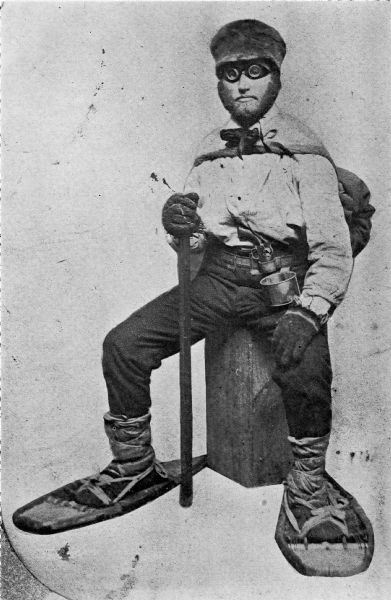
Asaph Whittlesey was Charles Whittlesey’s younger brother.
~ Wisconsin Historical Society
2. Asaph Whittlesey, then about thirty years of age, a native of Ohio, but who had for several years been engaged in business in Peoria, Ill., where the fruits of years of toil were swept away by fire in a single hour, was, in 1854, looking for a place to try anew his fortune. He belonged to one of the oldest and most respectable families of the Buckeye State – an energetic, lively, genial, whole-souled man, whom to know is to esteem. He was active in all the early years of Ashland; was its first Postmaster, (when the office bore his name) in compliment to his venerable uncle, the Hon. Elisha Whittlesey, for many years connected with the U.S. Treasury. And though he now resides at Bayfield, his interests are still largely in our town, and his pleasant face still occasionally gladdens our homes. In his present ill health he has our heartfelt sympathies. May he soon be well again and may his iter ad coctum be postponed yet many years.
~ The Eye of the North-west: First Annual Report of the Statistician of Superior, Wisconsin by Frank Abial Flower, 1890, page 251.
Mrs. Whittlesey, with her mother, Mrs. Haskell, were the first white women who passed the winter on this shore. Her house, though built of logs, was neat and comfortable, and was the resort of all new confers, where we were all made welcome; and the writer will always remember her singing of “The little tailor with the broadcloth under his arm,” and the dancing of her little Eugenia, a flaxen-haired girl of two year, but who, in later years, matured into a beautiful and accomplished woman, and happily settled in life, was, in 1874, called to the “sweet fields beyond the swelling flood.” Mrs. Whittlesey endured much privation, but she was brave and full of life. She is still spared to adorn and cheer her pleasant home at Bayfield.
Her father, Mr. Haskell, who passed the first winter in Mr. Whittlesey’s family, died a few years ago, but Mrs. Haskell still lives in green old age, and in 1875 re-visited the scenes of her pioneer life.

Martin Beaser
~ Western Reserve Historical Society
3. Martin Beaser, though he did not bring his family to Ashland till 1856, he is entitled, nevertheless, to be ranked among the very first settlers of Ashland, for he had chosen this for his home in 1854; had aided by his means and counsel, Messrs. Whittlesey and Kilbourn, and came from Ontonagon several times during the year 1855 to assist in carrying out their plans. He employed and brought with him early in 1855, Dr. Brunschweiler, a Civil Engineer, who surveyed and platted the first site on this bay, which is now known as “Old Ashland” or “Beaser’s Division of Ashland.” Brunschweiler River, twelve miles from Ashland, perpetuates his name.
Mr. Beaser was a native of the State of New York, who, in early life, had passed several years on a whaler in the Pacific Ocean and being an acute observer of men and things, had accumulated a vast amount of useful and entertaining knowledge. He was familiar with the ports of Central and South American and our Northwest coast, not ours then, for the Star Spangled Banner then floated only over a narrow strip of land near the mouth of the Columbia River.
The vast stretch of coast now embraced in the State of California was then Mexican territory and the Russian Bear was the emblem of power extending over forty degrees of longitude and from the fifty-fifth to the seventy-second degree of latitude, or more than eleven hundred miles, from south to north, and sixteen hundred miles from east to west. By the diplomacy of Mr. Seward and the payment of seven million dollars in gold, the vast extent of coast came under our flag.
No one could listen to Mr. Beaser’s recital of what he saw and heard on the Pacific coast without being entertained, and receiving much useful knowledge.
Mr. Beaser came to Ontonagon about 30 years ago, soon after the discovery of copper in that country. Very few settlers had preceded him there; but for several years, from 1858, they came in rapidly.
But here were no regular lines of boats as at present from Lake Erie and Michigan. All the supplies for the population must be brought by water a thousand miles. They were brought to the Sault and transferred across the portage, re-loaded on vessels and distributed to the infant settlements along the coast. As a result of the scanty and uncertain means of conveyance, the early northern winter often found the settlers without their winter’s supply of flour, pork and groceries. They must be brought to Ontonagon from Copper Harbor or Eagle River in open boats, which in the late fall and early winter was a work of hardship and danger. Mr. Beaser’s skill and bravery as a sailor was more than once instrumental in saving Ontonagon from starvation and want.
In the fall of 1856, Mr. Beaser brought his family to Ashland. Here he was closely identified with all enterprises calculated to aid in the opening up of this country. He had accumulated a competence at Ontonagon which he here freely expended.
He was a man of sound discretion and great good common sense, and was one of Ashland’s most useful citizens. Through discouragements and long deferred hope he persevered; while nearly all the rest of us were compelled to retreat. His hope seemed never to forsake him and like the heroes of the Cumberland who went down with their colors flying, he stuck to Ashland in its hours of greatest depression and finally found his grave in the waters of our Bay – while attempting to come from Bayfield to Ashland in an open boat alone during a severe storm in November, 1866. He rests on the Island of La Pointe, but the home of his life should be the home of his mortal remains and I doubt not they will be transferred hither at an early day.
To be continued in Number IV…
Asaph Whittlesey Incidents: Number III
April 8, 2017
By Amorin Mello
Originally published in the March 2nd, 1878, issue of The Ashland Press. Transcribed with permission from Ashland Narratives by K. Wallin and published in 2013 by Straddle Creek Co.
Early Recollections of Ashland
by Asaph Whittlesey
(Continuation of number two.)
So much in harmony with the views we then entertained, are the words of Hon. W. E. Allen, published in the Ashland Press of the 16th inst., as to induce me to quote largely there from. He says:
“That beautiful harbor on which Ashland is situated, was as I believe, intended for use. No prettier harbor or site in the wide world for a city, than that on which the little town now stands. The beautiful rising ground at the south and east of it, with the clear water of the queen of the lakes bathing her shore, hemmed in with a crescent forest circle, extending for hundreds of miles inland, made a picture of nature that to be known and felt must be seen. I was almost transported with rapture at the beauty – the profuse beauty on every side displayed, and as we passed away from all this loveliness, beyond the green islands, which make the bay of Ashland the most commodious and safe harbor on this inland sea, I turned my eyes back upon it till it faded out of sight, and felt a sorrow that I was forced to leave it so soon.
Ashland is a lovely place, its surrounding country equally lovely, and the day is coming when she will be at the main west commercial end of the lake on which she stands, with a railroad running west to the shore of the Pacific Ocean, where the grand city west of the Rocky Mountains is yet to be built. Then the little town of Ashland will take her place with the commercial cities of our state, which nature has given her such just claims to.”
Number III
Next your attention is called to the landing of the first steamboat at Ashland, which took place in the afternoon of Sep. 7th, 1854. Captain Moses Easterbrook, of the steamer Sam Ward, wishing to have the honor of being the first to land a steamer at the new city, extended a general invitation to the people of La Pointe to join him in the excursion, at the same time having on board some fifty or sixty barrels of freight consigned to “Asaph Whittlesey, Ashland, Wis.”
About 5 p.m. of the day mentioned, the steamer Sam Ward driver dropped anchor directly in front of the ravine at the foot of Main Street, where she unloaded her freight by small boat, and while so doing the “freedom of the city” was extended to her passengers by Major Whittlesey. I have never known the exact number of mosquitoes taken on board the steamer by this party, but as each member thereof, with palm in hand, were unceasing in their gestures, it was evident that this is what they were engaged in.
SECOND HOME BUILT UPON THE “TOWN SITE”
The second home built upon the “town site” was built 13×15, one story, and was designed soon to become a store house. This was built upon lot 5 in block 6, the foundation logs only being now visible; it was completed Sep. 12th, 1854, and formed a temporary house for us. The economy of its apartments deserve further notice, especially as it was in reality the first “Chequamegon” of the place. The lower and only floor thereto, was of “puncheons,” so adjusted as to give thorough ventilation, while directly over the bed in which my wife and I slept, a “chicken roost” had been constructed, entrance to which the fowls made from the outside at the top, up an inclined pole. Thus at midnight hour and at early dawn, our “feathered associates” told us of our entrance upon the duties of a new day. As a historical fact of the same period, I will add that a family of skunks had their headquarters underneath the house, and could readily be seen through the “Puncheons,” as also while meandering the premises.
The third and
ONLY REMAINING CABIN BUILT UPON THE “TOWN SITE” DURING 1854

Example of a contemporary mud oven. Not historically accurate.
Amorin Mello © 2005.
was 20×30, built upon lot 6 and block 6, and is in a remarkable state of preservation to this day, except that the “stoop” in front and “room back” for a kitchen with the mud oven opening into it are wanting. So many and important were the events intimately associated with the history of this house, that a somewhat extended notice thereof seems unavoidable. The logs of which it was built were cut by my hands and with only the help of a yoke of oxen, (driven through the woods from Odanah.) Mrs. Whittlesey and myself raised the building to the chamber floor and adjusted the joist for the second story. (Mr. Kilborn being in attendance upon Rev. Wheeler, then dangerously ill.)
By the middle of November we found ourselves fairly settled in a neatly finished cabin of massive proportions, having floors of lumber, being also provided with a “kitchen” with “mud oven,” “mud chimney,” etc., so that it took rank as the most “aristocratic” house in the place.
A few of the events which unite to make this cabin historical will begin in our next number.
To be continued in Number IV…
Ervin Leihy Incidents: At the Falls of Bad River #2
March 31, 2017
By Amorin Mello
… continued from Our First Visitor.
Transcribed and shared by Robert J. Nelson
from the July 7th, 1900, issue of the Bayfield County Press :
Incidents of Early Days on Lake Superior
At the Falls of Bad River # 2
By Ervin Leihy
[Note – my communication in your issue on June 2, starts out with the date, November 1864. This is a mistake of the printer. The date was 1846]
About the middle of October, 1846, after our return from LaPointe, our list of tools and implements was about as follows: two serviceable saws, one or two old ones, well past their days of greatest usefulness, one broad ax, one crosscut saw, two shaving knives, one handsaw, one square, and one nail hammer, a few pounds of nails and two or three heavy grub hoes.
There were four of us in camp; Captain Joseph Wood, Charlie Rowley – the linguist – John Smith and myself. Question arose: what shall we do? Let’s build a house. Where? Let’s go up to the Falls. Captain Wood and the writer went. We found a romantic and lovely spot surrounded by dense forest, on the east of high bluff covered with tall pines, on the North and West with Maple, Elm, basswood and other timber of heavy growth. The rumble and rippling on the falls with the surrounding scenery was almost enchanting. Well, a place was selected, a stake was struck, and the next day work was commenced. Captain Wood took the broad ax, Smith and I an ax each, Rowley – the same linguist – he was suffering with the cut foot, was selected as cook.
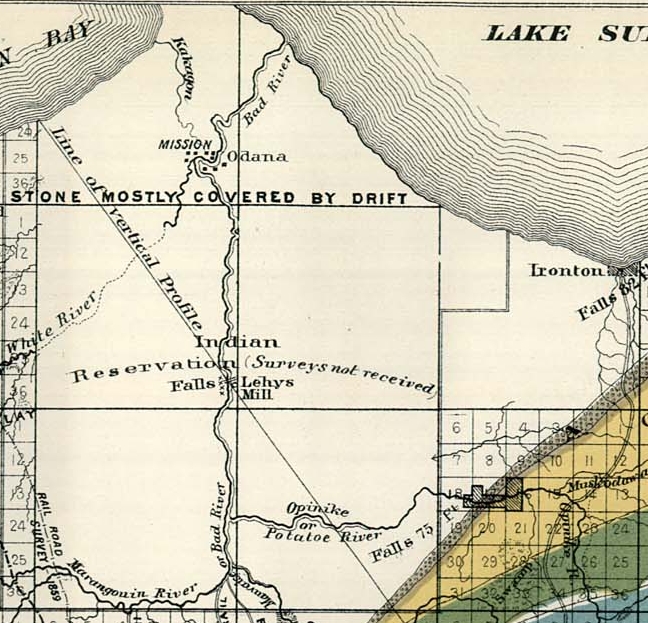
Detail of Ervin Leihy’s mill on the La Pointe (Bad River) Reservation from Charles Whittlesey‘s 1860 Geological Map of the Penokie Range in Geology of Wisconsin: Volume III; plate XX-214.
Work was now the order of the day. The plan of the house was 20 x 24, squared timber 6 inches thick, floor and all. No friction or delay. Timber for the floor and walls was soon produced. Now, how to get the timber to the stake? There was but one way; no choice. Smith and I must do the job. A rude sled or go-devil was made, one end of a stick of timber was placed on this and away it went to its destination. The process was kept up until the timber was all on the ground. The sills, and 24 feet long, were placed 20 feet apart outside to outside, on these the flooring 6 inches thick, was placed; on top of this the walls went up 11 feet without friction. Now comes the tug-of-war; the gables and the roof.
Talk about Robinson Crusoe, he didn’t have to build a house. He found a cave and only he had to do was crawl in. But the gables went up, a beam across the center and a pair of rafters, 6 x 6 on top of this for roof boards. Norway pine poles 24 feet long, hewn nicely, 2 inches thick and placed 10 inches, center to center, and on top of these A No. 1 singles, 2 feet long. Now for the last and worst job of all, fireplace in the chimney. Sand rock in the opposite bank of the river was plentiful and the old ax’s, the same old team in the same old go-devil was in active operation, sand, clay and ashes were mixed up for mortar and the fireplace went up.
Wood, Smith and I often talked, mourned and dreamed about a grindstone. During our quarrying operation one day, down came the slab of slatey sandrock about 2 1/2 feet in diameter and 4 to 5 inches thick. “Holy Moses!” said I, “Smith, if you will help me make a grindstone I will help you make three potato baskets next spring.” “Agreed” was the prompt reply. One grindstone ones known to exist in the Lake Superior area and that was in the government blacksmith shop at LaPointe for use of the Indians.
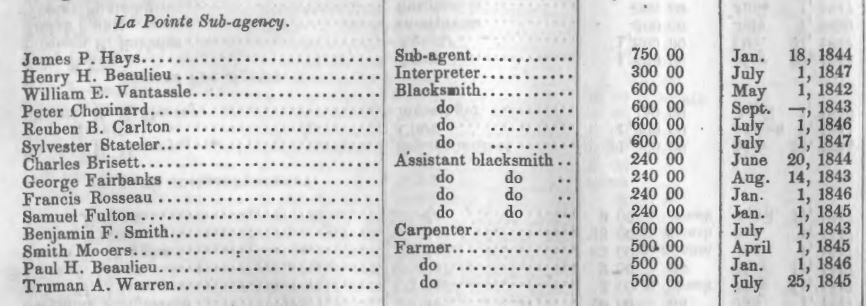
List of mid-1840’s La Pointe Indian Sub-Agency employees including Peter Chouinard, William E. VanTassel, and the previously unknown Carpenter.
~ Thirtieth Congress – First Session. Ex. Doc. No. 26. House of Representatives. Persons Employed In The Indian Department. Letter from The Secretary of War, Transmitting a statement of persons employed in the Indian Department. January 26, 1848.
Before snow fell we had picked up a number of worn-out and castaway Indian axes, some with the initials P.C. – Peter Chounard – who was probably the first man to pound hot iron on Lake Superior, and some of them the initials W.E.V.T. – W. E. Van Tassel – for many nights and Sundays thereafter, those axes might have been heard pecking away at the old sand rock until finally after many days a frame was made, a crank adjusted and a grindstone came into existence.
Wood’s eloquent remark: “a pretty good mechanical job, boys.” It did good service for many years. The chimney was finally completed and on the eighth day of January, 1847, we moved into the second house built in Wisconsin, Northup Chippewa Falls, outside of LaPointe.
Ervin Leihy Incidents: Our First Visitor
March 27, 2017
By Amorin Mello
… continued from At the Falls of Bad River.
Transcribed and shared by Robert J. Nelson
from the June 2nd, 1900, issue of the Bayfield County Press :
Incidents of Early Days on Lake Superior
Out First Visitor
By Ervin Leihy
Lake November, 1864, and late in the evening, a slight noise was heard outside of our cabin at the Falls. The door was opened and a Indian entered, clad in regulation uniform, as follows: cotton shirt, a blanket coat with of same material attached, a breech cloth, leggings of blanket and moccasins of buckskin.
Rowley, who had picked up a few words of Chippewa wanted to show off, stepped up to the Indian, placed his hand on the bare part of the Indians anatomy and inquired ke-se-nah? The Indian surveyed him for moment, placed his hand on Rowley’s cheek in repeated Rowley’s question, ke-se-nah, (cold)? This provided a burst of merriment from the “tender footed,” who could not talk “Injun”, in which the Indian joined. Rowley talked no more Indian that night.
Detail of Ervin Leihy’s sawmill on the La Pointe (Bad River) Reservation from Charles Whittlesey‘s 1860 Geological Map of the Penokie Range in Geology of Wisconsin: Volume III; plate XX-214.
The visitor was evidently a young hunter returning from an unsuccessful hunt. A place was made for him near the fire, he was housed and fed and in the morning departed for his Lodge, six or 7 miles away.
This was not his last visit. After the new house was finished – now well underway – became again and brought his two best friends with him, with presents of nice fresh fish from the Lake, which were much enjoyed. These visits were repeated quite frequently by the three friends. They would come much out of their way to bring us presents of Partridge, venison, most meat, just made Maple sugar or something else intended to please the strangers.
Later on when they came to see the product of our little field their expressions of delight were extravagant in the extreme. They had never seen such potatoes, turnips, corn, squashes, etc. They were always ready and willing to help in planting, hoeing and harvesting. They were always well paid for their work and always well pleased with their pay. The names of these three friends were Wi-nah-kis, Pa-me-sa and Wa-bud-o. There were others equally friendly, honest and deserving; in fact, the great majority of the Chippewa were comparatively so. Of course there were some “dark sheep” some in fact quite black. These, when detected, were given a “cold shoulder” or a hot reception, as the occasion seem to require, but cases of the last named were quite rare. But that generation has passed away; few, very few, I knew on Bad River survives, and as for the present generation, alas! they are becoming civilized.
To be continued in At the Falls of Bad River #2…
Edwin Ellis Incidents: Number II
March 26, 2017
By Amorin Mello
Originally published in the June 30th, 1877, issue of The Ashland Press. Transcribed with permission from Ashland Narratives by K. Wallin and published in 2013 by Straddle Creek Co.
… continued from Number I.
EARLY RECOLLECTIONS OF ASHLAND.
“OF WHICH I WAS A PART.”
Number II
My Dear Press: – At the close of my last scribblings, we had arrived on the present site of Ashland, near where the railroad dock reaches the shore and were sheltered in a log shanty, built by Lusk, Prentice & Co., a kind of land company who had plans of starting a town here, of building a dock, and who had a small stock of merchandise and provisions to aid in their proposed work. The members of the firm were David S. Lusk, of New York, Frederick Prentice, of Toledo, Ohio, Capt. J. D. Angus, of Ontonagon, and Geo. R. Stuntz, then of Superior City.
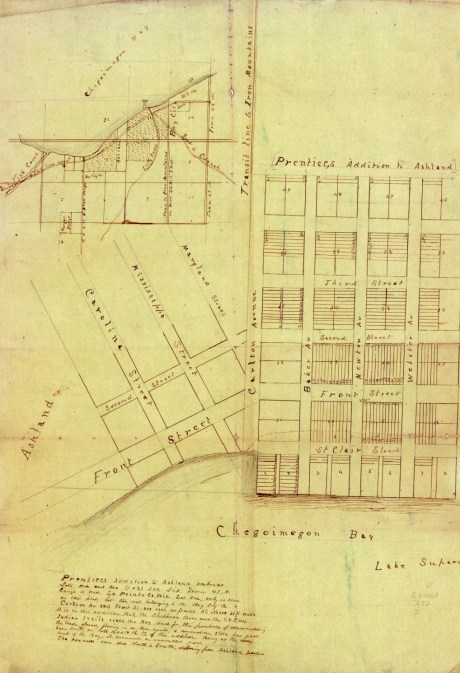
1850s survey of Frederick Prentice Addition of Ashland at/near the ancient village site of Gichi-wiikwedong. “It is in this addition, that, the Chippewa River and the St. Croix Indian trails reach the Bay.”
~ Wisconsin Historical Society
Mr. Lusk left the lake in 1856, and I think died some years since in California.

Frederick Prentice
~ History of the Maumee Valley by Horace S Knapp, 1872, pages 560-562.
Mr. Prentice, a man of great energy and business enterprise, now resides in Toledo, and is largely engaged in the production and refining of coal oil, being one of the great operators in that enlightening civilizer. He has accumulated an ample fortune, and is still largely interested in real estate in our town and country.
Captain John Daniel Angus
~ Madeline Island Museum
Capt. J. D. Angus, and old salt, familiar with all the oceans as well as our inland seas – having circumnavigated the globe; able to build any water craft from a Mackinaw boat to a ship of war; a man with an exhaustless store of anecdotes; who was acquainted with “Sinbad, the Sailor” – having passed through many vicissitudes- is now living in our country, full of life and activity.

George Riley Stuntz
~ The Eye of the North-west: First Annual Report of the Statistician of Superior, Wisconsin, by Frank Abial Flower, 1890, page 26.
George R. Stuntz now resides in Duluth, a civil engineer by profession, who came to the west end of the lake thirty year ago; who has done more surveying of government land than any other man on the lake. He is a descendant from the third generation of a Hessian soldier, hired by George III to fight against the American Colonies in the war of our Revolution; but who after fighting one battle on the side of the Despot, was convinced of the wrong of the British cause, became an active rebel and a sincere defender of American liberty. He and his children and children’s children have ever been true American patriots, and have done good service to the cause of the Republic. He is the owner of much real estate on Lake Superior, in both Wisconsin and Minnesota.
These men had also been attracted by the situation of our bay as the outlet of an extensive country, abounding in minerals and timber. They had perfected no plans for the acquisition of title to the land. It is true several claims had been made reaching from Fish Creek nearly to the Indian Reserve – a narrow strip on the bay, but the claimants gained no rights thereby, for the lands had not been surveyed, and we were all in the eye of the law, trespassers. The Land Office, which was then at Hudson, on the St. Croix river, was not allowed to receive and entertain declaratory pre-emption statements.
Still Lusk, Prentice & Co. were even then engaged in building a dock and clearing off the site of an expected city, to which even then they gave the name of “Bay City” – by which name the larger part of the present site of Ashland was known for many years. It is now in legal description as “Ellis Division of Ashland.” The timber was cut into cord wood and piled upon the dock, in anticipation of the wants of the numerous steamboats soon expected to throng the docks of the rising city.
Some twenty acres of land were thus cut over, reaching from near Dr. Ellis’ present residence to the Bay City creek, and from the bay shore nearly back to the Railroad depot.
The dock extended from the low point about a hundred yards east of the Door and Sash Factory of White & Perinier, about five hundred feet into the water, and reaching a depth of about eleven feet. It was made of cribs of round logs, pinned together with wooden pins. The cribs were about 25×30 feet, and about 25 feet apart. They had no filling of any kind. They were connected with stringers, which served as the foundation of the road-way, made by laying round poles crosswise upon the stringers.
It may seem stranger to us with the results of many years’ observation and experience of the force of waves and currents and ice pressure in the bay, that such a dock should ever have been built. But hind sight is always clearer than fore sight, and recent dock builders have had the benefit of the costly experience of the pioneers.
They labored under the impression that the ice melted in the bay and did not move out in large fields. They soon had this error corrected. On the last day of March, 1855, the ice in Ashland bay was broken for two or three hundred feet from shore only the body of the ice had not moved, and gave no signs of moving. It looked as though it might remain for weeks. The morning sun of April 1st shone upon the smooth, classy surface of the water. The ice had disappeared in a single night, and the dock and wood piled upon it – the result of so many hard days’ work – had passed away also. The remains might be seen for many years scattered along the bay shore and far up the Kau-kau-gon. The present dwellers here can hardly realize the depressing effect of this loss to the little squad of settlers.
 Chequamegon History