Asaph Whittlesey Incidents: Number VI
April 17, 2019
By Amorin Mello

Originally published in the March 23, 1878, issue of The Ashland Press. Transcribed with permission from Ashland Narratives by K. Wallin and published in 2013 by Straddle Creek Co.
… continued from Number V.
Early Recollections of Ashland: Number VI
by Asaph Whittlesey
—
During 1856 the steamers Lady Elgin, Illinois, and Superior landed freight and passengers upon a steamboat dock constructed at Bay City, now Ellis division of Ashland.

1860 photograph of the sidewheel steamer Lady Elgin.
~ Ship-Wrecks.net
Ashland’s first saloon was opened by James Whitney in June 1856, and during the same month the first store was opened by Martin Beaser, on the corner of block one hundred and one.
The patent to Ashland, issued by the United States, bears the date June 23rd, 1862.
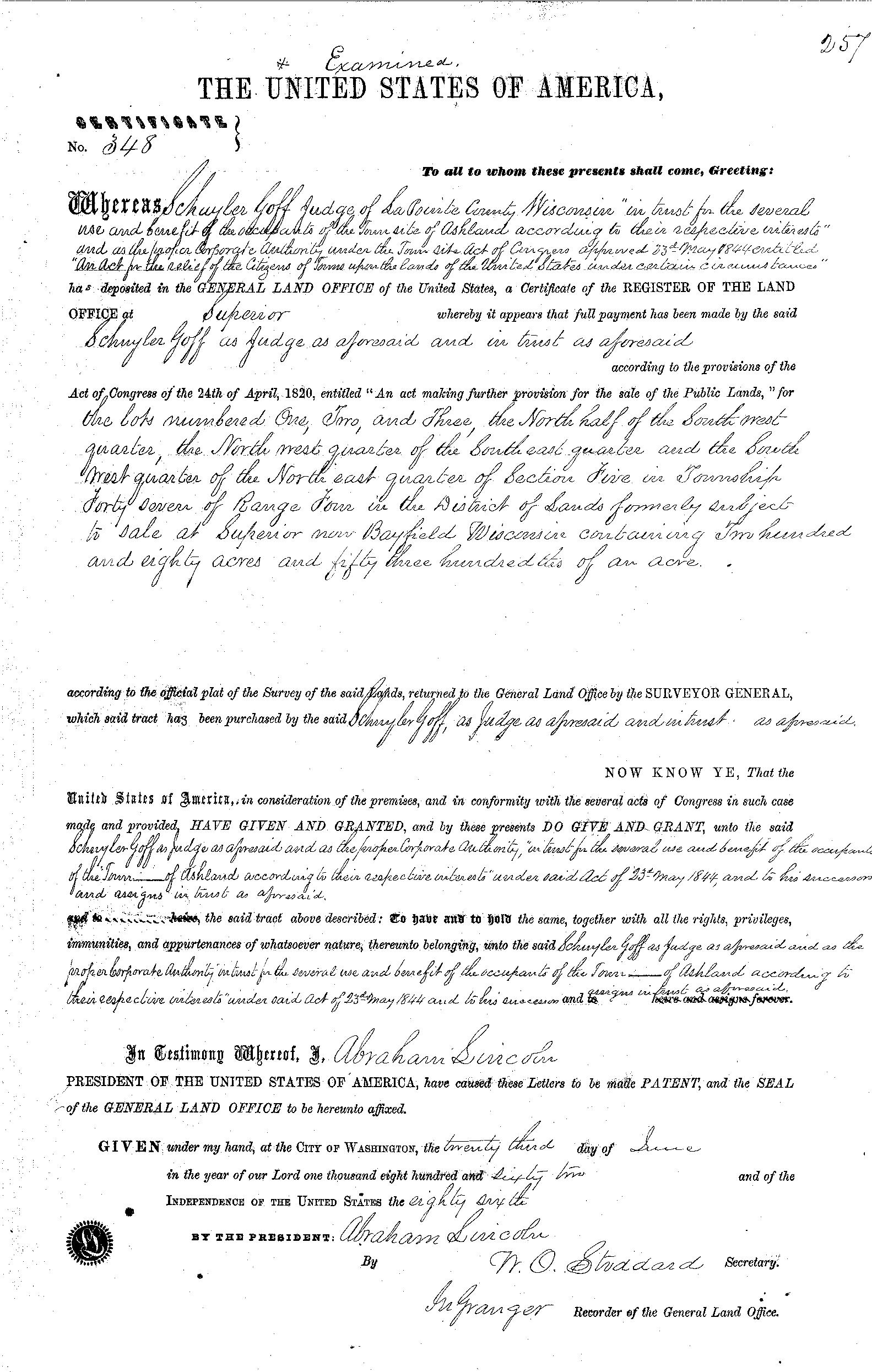
Land patent for the town site of Ashland issued by President Abraham Lincoln on June 23rd, 1862 to Schuyler Goff:
“The contract between the three was, that Mr. Whittlesey and Mr. Kilborn were to receive each an eighth interest in the land, while the residue was to go to Mr. Beaser. The patent for the land was issued to Schuyler Goff, as county Judge of La Pointe county, Wisconsin, who was the trustee for the three men, under the law then governing the location of town sites.”
~ Biographic sketch of Martin Beaser
OF THE OPENING OF ROADS IN THE EARLY DAYS OF ASHLAND.
In reporting upon this subject it is very possible that our town authorities of the present day may be put somewhat to the blush by the manner in which these and other like improvements were made. And I will guarantee the re-election of any Town Board, or other town officer who will carry out the program of former days for the opening of roads, which was simply this:
Whenever a road was needed such men as Edwin Elllis, Martin Beaser, George Kilbourn and myself, (I came near overlooking the latter,) and others who mainly volunteered their work, shouldered their axes and served in person until roads contemplated were completed. There was also this peculiarity attached to this class of individuals; they did not hang about the steps of the town house the balance of the year for the purpose of getting bills audited for work done upon the highways. It was in this manner that the road leading to Odanah and also that leading south to White River Falls were first opened. Even Indians partook of the same spirit in volunteering their labor, as Aid-de-camp to their Great Leader, Rev. L. H. Wheeler.
I have no doubt Dr. Ellis still bears in mind how the woods at Bear Trap were made to echo the yells of the Indians as they collided with the party from Ashland on the very day agreed upon, and I think I may safely say that the citizens of Odanah and of Ashland looked upon the opening of this road as a momentous event, and one which cemented us together even more firmly as friends and neighbors, though I have no doubt many of my readers will stand ready to declare that the foot race existed not very far back.
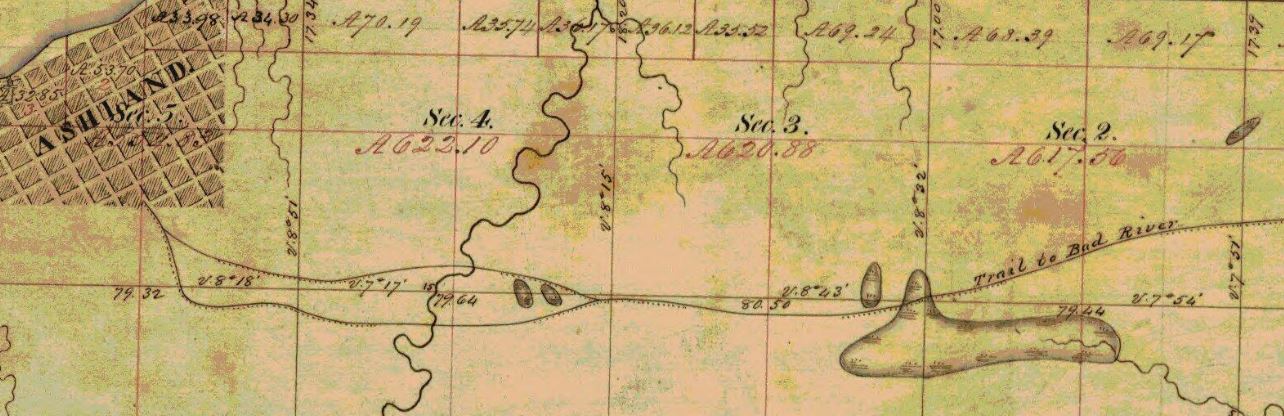
Detail of trail from Ashland to Bad River on Barbers’ survey during the Summer of 1855.
We wore good countenances, slept well nights, and paid one hundred cents on the dollar of our obligations. We were not ashamed to eat salt pork (those of us who could get it,) while our faithful wives vied with each other in the different styles of cooking this staple article of diet.
Next to this comes the everlasting pancake, without which neither town site nor pre-emptions could be legally established.
~ History of the Soo Line by James Lyden, chapter 9.
~ History of Northern Wisconsin by the Western Historical Company, 1881, page 82.
On the second day of June, 1877, I had the honor of driving the last spike, which took place at Chippewa Station, amid the shoutings of a large assemblage of people, including laborers upon the road, and in a few moments thereafter the first train from Milwaukee passed over the road on its way to Ashland, amid great rejoicing and demonstrations of joy over the victory won. At Ashland also the excitement became intense and though it was late on a Saturday evening on which our train reached the town, the illumination of the place brought to our view a field of faces, crazy with excitement over the event they were celebration. As for myself, I confess I felt very much like saying, “Now let thy servant depart in peace.” No longer were we to be informed of what was to be done, but we now knew it to be actually accomplished, and the Wisconsin Central Railroad remained a standing monument to the good name of Gardner Colby, Charles L. Colby and E. B. Phillips, all other efforts being secondary to that of these individuals. I have in my possession a map of this section of country, published by Charles C. Tucker in 1858, on which he laid down an imaginary line of railroad as being likely to be constructed from Madison via Portage and Stevens Point to Ashland, and strange to say it lays down the precise route of the Wisconsin Central Railroad, the very first to be constructed.
Having received by our last mail an important official statement from the Railroad Commissioner for the State of Wisconsin, I will insert the same here rather than to fail to have it published:
He says “the number of miles of railroad now constructed within the State of Wisconsin is two thousand six hundred and fifty-nine and 6-100, while there are seventy-one thousand seven hundred and fifty-nine miles of railroad now operated within the United States, with a capital and debt amounting to four billion six hundred and fifty-eight million two hundred and eight thousand six hundred and thirty dollars.”
STATISTICS IN GENERAL

In furnishing these I desire specially to acknowledge the obligation I am under to Mrs. James Wilson, for granting me access to early records of the place kept by Martin Beaser, Esq., though I find some discrepancies between his record and my own, which I think can be explained by the fact that he did not commence his record until some years after the first settlement of the place, and made it from memory along. For instance he says “the town site of Ashland was located by Martin Beaser, Asaph Whittlesey and George Kilbourn in August, 1854,” whereas Mr. Kilbourn and myself commenced the settlement of the town site July 5th, while Mr. Beaser first visited the place in August when he became an owner therein, the town site being from this time forward owned three fourths by Martin Beaser and one eighth each Kilbourn and Whittlesey.
Again Mr. Beaser’s record states that “the first house was built by Asaph Whittlesey in October, 1854, and was twenty by thirty feet square,” while the fact is I had erected two cabins upon the town site previous to the erection of this one and had lived in them.
Following cabin built by Kilbourn and Whittlesey, foundation laid July 5th, 1854, was twelve by fourteen feet square and was erected on lot number two in block one hundred and five. The foundation to the second cabin built was laid by Kilbourn and Whittlesey Sept. 9th 1854. This cabin was thirteen by fifteen feet square and was erected on lot five of block six. The outline of this building may still be traced. – The third house erected was that erected by Asaph Whittlesey on lot six in block six and was twenty by thirty feet square and this building constituted the residence of the Whittlesey family until the fall of 1857 when I removed to what is known as the Tompkins house on lots five and six in block three. I have in my possession very correct sketches of the first three cabins built, which I hope eventually to have lithographed for preservation. The fourth house was erected by Conrad Goeltz. The fifth house by Martin Beaser. The sixth house by Myron Tompkins. The seventh house by Lawrence Farley. The eighth house by Charles Malmet. The ninth house by Anthony Fisher. The tenth house by Frederick Bauman. Beyond this I am unable to give the order in which buildings were erected.
Conrad and Adam Goeltz first arrived at Ashland in March, 1855, and were employed by me in chopping and delivering cord wood upon the bay shore. As we were without a team we improvised one by harnessing these two Dutchmen and myself in the form of a spike team to a large sized hand-sled with which we banked twenty cords of wood per day.
P.S. – Adam had it twenty-two cords per day, but I think we had better throw off the two cords and try to save our reputation for veracity.
The first chickens brought into town were those brought by A. Whittlesey from Ohio in 1854.
John Beck butchered the first hogs in town, though he left a few which he did not butcher.
Martin Beaser brought the first yoke of oxen, and in 1855 raised about two hundred bushels of potatoes upon the town site. On the third of December, 1855, the schooner Algonquin landed at Ashland two hundred and twenty-five barrels of freight, seventy-five thousand feet of lumber and a yoke of oxen.
Ashland Bay froze over Dec. 7th, 1855. The two first steamboat docks were built during the winter of 1855-6, one by Martin Beaser at the foot of Main Street and one by the Bay City Company. These were carried away by the ice May 1st, 1856.
To be continued in Number VII…
1855 Inquest on the Body of Louis Gurnoe
April 11, 2019
By Amorin Mello
The following is a set of three articles collected and edited from the Superior Chronicle newspaper, followed by my personal thoughts on this matter :

Superior Chronicle newspaper July 7th, 1855, page 2.
Lake News.
We find in the Lake Superior Journal the following paragraphs of lake news:

“The brig Columbia, which carried the first cargo of ore through the Sault Ste. Marie Canal.”
~ The Honorable Peter White, by Ralph D. Williams, 1907, Chapter XIV.
Johnson & Tisdale, of Cleveland, have just built a small side-wheel steamer, for J. H. Garrett, of Ontonagon, and intended to be used on that river as a passenger boat, and also for towing between the mouth of the river and the mines. Her dimensions are : length of keel, 85 feet; beam, 14 feet; depth of hold, 2 feet. She has two engines, and will draw about fifteen inches water.
The Garrison stable at the Sault Ste. Marie, containing two horses was set on fire on the morning of the 29th ult., and, with its contents, totally consumed.
The Canal Company showed their patriotism on the Fourth of July, by exploding about one hundred and fifty barrels of damaged powder.
The first locomotive for the Iron Mountain Railroad, from Lake Superior to the Iron Mountains, left Buffalo on Tuesday by the brig Columbia, for Marquette.
Superior Chronicle newspaper, October 23rd, 1855, page 2.
Man Shot.

George Riley Stuntz
Deputy U.S. Surveyor, and Chequamegon Bay land and minerals speculator.
On Tuesday night last an affray occurred on Minnesota Point, which resulted in the shooting of a sailor, attached to the brig Columbia. The vessel was lying at the wharf of Messrs. Stuntz & Co., and the crew, under the influence of liquor, went on shore for the purpose of having a frolic; in the course of their spree they came across some Indians, encamped on the Point, and one of the men soon provoked a quarrel with an Indian. The Indian was being beaten severely, when the captain coming up, interfered, whereupon he was attached by the man. The captain, being small in statue, and unable otherwise to defend himself, drew a pistol and fired at his assailant, the ball entering his side. The wounded man was brought to town, his wound dressed, and is now said to be doing well, the ball not having penetrated to any serious depth.
Superior Chronicle newspaper, November 6th, 1855, page 2.
Death of Louis Gurnoe — Inquest by a Coronors’ Jury — Verdict, etc.
There were more than one Chippewa mixed-blood named Louis Gurnoe.
man living alone in Superior City during the 1855 Wisconsin Census. No further sources about J. Baker could be found.
Several weeks ago we gave an account of the shooting of a half-breed named Louis Gurnoe by Captain Wells, of the brig Columbia. The affray occurred on Minnesota Point, opposite Superior. It appears that Gurnoe was a man of very intemperate habits, and several nights previous to his difficulty with the captain, was engaged in a row at a low groggery on First street, kept by a negro named Baker. A dance was being held at that place, and Gurnoe, under the influence of liquor, challenged those present to a fight; he was then set upon, knocked down, and kicked and beaten in a cruel manner. The injuries he sustained, aided by excessive dissipation, ensued his death, just as the vessel was leaving our port. At La Pointe, a coronor’s inquest was held on the body, and the verdict rendered was that death was caused by bruises received at Baker’s house. We hope this matter will be brought before the grand jury at the next sitting of our circuit court, and while we may not expect to see the murderers brought to justice, we hope, at least, that sufficient cause may be shown why this miserable den should be removed. It has been tolerated too long already, and for the good order and character of our town, if for no other consideration, some effect should be made to put a stop to the disgraceful proceedings there enacted.
We publish the entire testimony elicited at the inquest, verdict of the jury, and an affidavit made by Gurnoe previous to his death, exhonorating Captain Wells from all blame whatsoever.
Joseph Stone, one of the hands on board, being duly sworn said:
That on Tuesday evening last, the brig Columbia, Captain Justus Wells, from St. Clair, was opposite Superior; there was a noise between [Sandy?] and deceased, Louis Gurnoe; Louis wanted to fight; captain wished him to stop; deceased knocked captain down; Louis then challenged captain to fight; he then got hold of the captain by the hair of the head; captain told him several times to let go; captain said if he did not let go he would shoot him; told him five or six times to let him go; he did not let go; the first thing I heard was the report of a pistol; [Sandy?], captain, and myself carried him to a tent; I stopped there till four o’clock; captain directly sent two men away to get a physician; deceased was in liquor at the time; he had been very quarrelsome; he shipped at Saut Ste. Marie this trip; he had been bruised on the face the Saturday previous; on the Monday previous when leaving Superior wharf he was so intoxicated that he fell off the provision chest; he was sick coming up; he was unable to do duty after Saturday.
Simeon Nelsonn being duly sworn said:
We went on shore at Superior, on Saturday evening last; at Baker’s there was a dance; the dance went on nicely till about twelve o’clock; Louis said something to the effect that no one in the room was able to fight him; with that a little Irishman took it up; I went in and hauled Louis back; some one took me off from him, shoved me on one side and commenced at Louis; knocked him down with his fist, and several men piled on him; they then commenced kicking him in the side, breast, and once or twice in the face; after a while they were parted; then Louis commenced drinking again – had been drinking during the evening. After having got all pacified we went on board about two o’clock in the morning; he went to sleep; when he woke he swore he would have a row with somebody before he left the place; on going on shore he commenced drinking; we unloaded the vessel on Monday and Tuesday, and on that afternoon we went over to Minnesota Point; in the evening all went ashore to have some sport; Louis said, before he went ashore, he was bound to have a row with the captain; after going on shore, everything went on well till about two o’clock in the morning. (Wednesday;) I was lying in the lodge; Louis came in and commenced at me; I told him that I did not want any fuss with him and that everything he said I was bound to knock under to save a row; at that the captain heard the words from Louis and came out from another lodge; as Louis was going to come in at me, the captain grabbed him by the shoulders, hauled him back, and said to him, “Louis we did not come here for a row, we came to have sport;” Louis turned on him, and knocked him down; they were then parted; the captain balloed “enough;” Louis was going at him again; the captain stepped back, pulled out a revolver, and said, “If you don’t leave me alone I will shoot you;” Louis opened his breast to him, and said, “Here’s a clean breast shoot;” captain stepped back, and Louis went at him again; caught the captain by the hair of the head; captain told him if he did not let go he would shoot him; we tried to part them again; couldn’t part them; captain wanted to let go, but Louis wouldn’t; captain again said “If you do not let go I will shoot you;” as Louis was drawing back his foot to kick the captain in the face, he being down about knee high, the captain again repeated his caution, gave him one minute to let go, and then shot him; Louis then let go; says he, “I’m dead’ I’m dead.” – Captain said “I thought it would turn out that way – I told you I would shoot but you would not mind me;” captain said “If there is anything I can do I will do it;” the captain, Joseph Stone and myself, carried him into the lodge; the other two boys that were with him commenced dressing his wounds; captain sent John Scott and myself aboard the vessel after the boat to go for a physician; we went aboard and got the boat; got the second mate and Benj. Rassau to go for the doctor; went to Superior; couldn’t find a physician; captain, second mate, Joseph Chapman, a Frenchman living on the point, and myself, got the deceased into the boat and brought him aboard; before we got him aboard a physician came; about eight o’clock in the morning I saw deceased lying in the cabin; said he felt better; about four o’clock p.m. we endeavored to put him into one of the berths; he seemed to be in convulsions; on Wednesday night he got out of his berth, went on deck, and walked fore and aft; Thursday morning he left the cabin and sat on the rail aft; I said “Louis, you will be falling overboard;” he said “there is no fear of that;” he then left the rail; I was standing at the helm; he came up; looked me very hard in the face; I said, “what is the matter?” he gave no answer, but went directly into the boat; deceased had been very quarrelsome all the way up; he remained in the boat about three minutes; he was sitting in the boat with his arm on the taffrail; I took him to be asleep, and tried to wake up; I lifted his arm up, and eased him down into the boat to keep him from falling overboard, and went down after a lantern, (about five o’clock a.m.;) before I had time to time to come with a lantern, some one hard me talking to him and was there before me with one; the captain was also there; I looked at him, and said he was dead; then we took him out of the boat, and laid him forward of the cabin, and put a mattress under him; he was warm at the time, and we thought he might recover; one of the passengers then said life was not gone but he was dying; deceased frequently complained of his bruises received on Saturday night.

James Chapman
~ Madeline Island Museum
James Chapman, being duly sworn, said:
The quarrel commenced about a squaw; in other respect; he corroborated the testimony of the previous witness.
Daniel Weihl, a passenger, being duly sworn, said:
I saw the doctor probe the wound, and he followed the rib, one or one and a half inches; I turned away as he found the ball; I do not think the wound was sufficient to cause his death; no inflamation existed; deceased went forward so many times that I concluded he had the diarrhea.
A. W. [Groveract?], being sworn, said:
I told the captain not to use the weapon there; after the shot, saw the deceased standing by a tree; he vomited blood; had not seen deceased vomit blood previous to the shot; he bled very near a pint; the blood from the bruise on his face might have got into his mouth and he threw it up.
John [Babner?], being sworn, said:
I corroborate the testimony given by Mr. Nelsonn.
Mr. Hancock, (a passenger,) being sworn, said:
I corroborate the testimony given by Mr. Nelsonn.
Calvin Ripley, being sworn, said:
Deceased had been sick about six weeks previous to his shipping, and was sick again when about two days out; was drunk every night, while at Superior, that I saw him; kept the forecastle a day after the fight at Superior; doctor said the wound would not injure him at all – that deceased was worse off in other respects; doctor said it was better for deceased to be on shore; he might suffer from the bruises; deceased wished to come on board and go down.
E. M. Raymond, being duly sworn, said:
I saw the doctor drawing the ball out, and left; saw nothing out of the way till last evening; noticed that deceased thrashed about the chains, and made unnecessary noise; I think deceased was not in his right mind last evening.
Daniel Weihl, being recalled, said:
The wound did not cause mortification; the worst bruise is the one at the rim of the belly; have seen a person kicked in the same place vomit about a quart of blood.
J. E. Rogers, (passenger,) being sworn, said:
That he observed that that deceased, during the time he lay in the cabin, hawked and spit, and about one-third of it appeared to be blood and the rest yellowish matter.
At the conclusion of the testimony, the following verdict was rendered by the jury:
An inquisition taken on board the brig Columbia, Captain Justus Wells, in the port of La Pointe, on the 18th day of October, 1855, before John W. Bell, one of the justices of the peace for La Pointe county, Wisconsin, upon the view of the body of Louis Gurnoe, there dead, by the jurors whose names are hereunto subscribed, who being duly sworn to inquire on behalf of the people of this State, where, in what manner, and by what means the said Louis Gurnoe came to his death, upon their oaths do say:
That the deceased came to his death in consequence of bruises received at Superior, at Baker’s residence, from the hands of individuals to the jury unknown, but with whom he was engaged in a fight;
That he was at the same time, and had been, suffering from the effects of continued hard drinking, following sickness, from which he had only partially recovered previous to shipping;
That we acquit Captain Wells of all guilt as to the shot fired by him, and that we do not deem it as a mortal wound, or one that accelerated the death of the deceased.
In witness whereof, the said Justice of the peace and the jurors of this inquest have hereunto set their hands the day and year aforesaid.
JOHN W. BELL Justice of Peace,
S. S. VAUGHN, Foreman,
M. H. MENDELBAUM,
R. D. BOYD,
JOHN M. BRADFORT,
JULIUS AUSTRIAN,
A. CARPENTIER.
Copy of a settlement made at Minnesota Point for assault and battery:
Minnesota Territory, Superior county,
Dock at Minnesota Point,
October 17, 1855.Know all men by these presents, That whereas the brig Columbia, of one hundred and seventy-six tons, commanded by Capt. Justus Wells, from St. Clair, Michigan, District of Detroit, laying at Minnesota Point now and for a few days previous, and among other hands on board said brig was one Louis Gurnoe, a half-breed, and this man was in a state of intoxication, and was making a quarrel with other parties; and whereas, the said captain interfered for the purpose of introducing peace measures, and the said Gurnoe opposed the said captain, and they came to blows and a clinch; and whereas Gurnoe held the said captain firm by the hair of the head, and the said captain requested the said Gurnoe to let go of him, and he would not, and the said captain shot the said Gurnoe in the skin of the side to get clear of him, which would was only a flesh wound, entering the skin against the rib and running along under the skin outside of the rib; and the said captain sent a boat to Superior City for a doctor, and he came and dressed the said wound, and said captain paid said doctor five dollars for his fee for crossing St. Louis river from Wisconsin; and the said Louis Gurnoe having [diver?] other fights, was badly bruised before this; and whereas the said captain has made arrangements in Superior City for the taking care of said Gurnoe to the amount of twenty-five dollars, which we receive of the said Captain Justus Wells, and discharge him of all expense whatever that may arise in an action of assault and battery or any other action for the said causes as the said Gurnoe has received a full compensation for all injuries by the said captain on the ground that the said captain seems not to have done anything more than to defend him or his own personal safety, and what he gives is of good heart and a charitable act received by me.
This settlement is to be construed no further than the said parties have a right by law to settle actions and causes of action. In this settlement the said captain does not mean to have it understood that he acknowledged that he has done anything or [ac?] whereby he may be liable to the law, but for the purpose to buy his peace and a general good will to the said Gurnoe.
(Signed)
LOUIS (his X mark) GURNOE,
In presence of JOSEPH GURNOE,
[DORUS MARCUS?], and CALVIN RIPLEY.
Amorin’s Commentary
Hi, Amorin here again. I don’t always add commentary to my reproductions of Chequamegon History, but when I do… it is because I am still trying to understand the rest of the story.
First and foremost, the death of Louis Gurnoe was horrific. It is unfortunate that these articles disrespected him and served him no justice. The October article doesn’t even mention his name. The only real biographical information gleaned from the November article about Louis Gurnoe is that he was a Chippewa mixed-blood who came aboard the brig Columbia at Sault Ste. Marie. Apparently, his death was far more newsworthy than his life to Americans.
The language stereotyping Louis as a drunk Indian is disgraceful, and makes me question whether the references to the negro and little Irishman were perjury. To be clear, yes, I do believe this entire inquest was a fraud. One red flag, for example, is that the doctor was never identified by any of the witnesses for verification.
Besides dishonoring Louis’ life, it seems that the sole purpose of the Verdict in the November article was to acquit George Riley Stuntz and Captain Justus O. Wells of any guilt with the incident as reported in the October article. The Judge and Jury of the mystery Louis were all white Euroamerican settlers of La Pointe that were very involved with Lake Superior Chippewa mixed-bloods by marriage and/or business, yet there does not seem to be any amount of empathy expressed by them for Louis Gurnoe.
Although these articles dishonored Louis (and failed to identify exactly which Louis Gurnoe he was) they revealed just enough information to hint at what his life may have been like before boarding the brig Columbia at Sault Ste. Marie in 1855. The Gurnoe/Garneau/Gournon/Gornow/Gaunaux/etc. families of Chippewa mixed-bloods (a.k.a. Metis) were very active in the cosmopolitan politics of Lake Superior throughout the mid-1800’s. There is more than one Louis Gurnoe this could have been, so unfortunately the Louis Gurnoe that boarded the brig in 1855 may only be known as a mystery to Chequamegon History.
Consider, for example, the Louis Genereaux [Gurnoe] that authored an August 29, 1855 letter to Indian Affairs Commissioner George W. Manypenny via the Mackinac Indian Agency on behalf of Saginaw Chippewa/Odawa Tribe trying to locate their reservation lands in lower Michigan. While it may have been possible for someone to travel from lower Michigan to western Lake Superior within this time frame, there doesn’t seem to be any compelling correlation suggesting that this Louis Genereaux would be the same Louis Gurnoe from the brig Columbia.
Another example Louis Gurnoe that we may consider is the one featured in the bottom right of the following photograph from 1855 at Sault Ste. Marie;
the elder Louis Gurnoe.
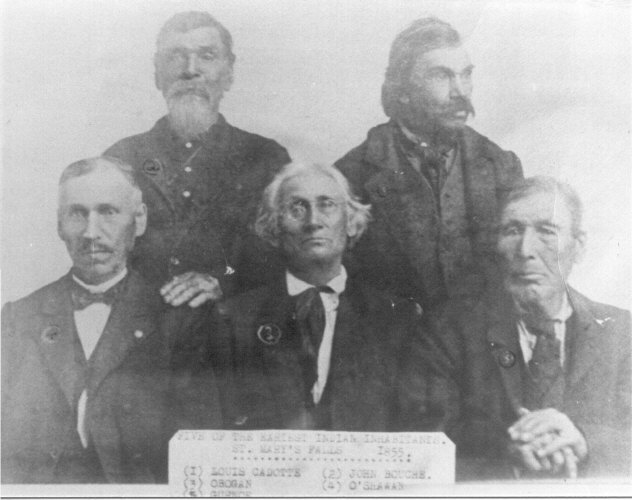
1855 photograph from the Soo Evening newspaper labeled “Five of the Earliest Indian Inhabitants of St. Mary’s Falls” [Sault Ste. Marie] and identified from left to right:
1) Louis Cadotte; 2) John Bouche; 3) Obogan; 4) O’Shawn;
5) [Louis] Gurnoe.
Read Metis-History.info/ by Richard Garneau (Gurnoe) for other possible identities of the first four men in this photograph.
It is possible that the Louis Gurnoe from these articles was one of this elder Louis Gurnoe’s sons. Louis Gurnoe’s Settlement at the end of the November article was signed by another son, who is featured in the bottom center of the following photograph:
the Indian Agency interpreter Joseph D. Gurnoe.

Top: Frank Roy, Vincent Roy, E. Roussin, Old Frank D.o., Bottom: Peter Roy, Jos. Gourneau [Joseph Gurnoe], D. Geo. Morrison. The photo is labelled “Chippewa Treaty in Washington” and dated 1845 by the St. Louis Hist. Lib and Douglas County Museum, but also dated 1855 by the Northeast Minnesota Historical Center. It was probably taken during the Bois Forte Treaty of 1866, which was these men acted as conductors and interpreters in Washington, D.C. Photograph digitized by Mary E. Carlson for her book The Sawmill Community at Roy’s Point.

Superior Chronicle newspaper November 4, 1856
I will share details about Joseph D. Gurnoe’s life, and his professional relationship to James Chapman, but these details will have to wait to be published in another post in the future. This concludes my thoughts for this post.
Until next time,
Amorin
After Missing Treasure
April 10, 2019
By Amorin Mello
The New York Times
June 15, 1897
AFTER MISSING TREASURE
—
James Arthur Looking for $35,000 Buried in Wisconsin at the Outbreak of the War.
—
GOLD HIDDEN IN THE GROUND
—
Net Assets of a Wisconsin Bank Closed When Arthur Enlisted in the Army – Put Away by His Partner, Ell Pingers.
—
SUPERIOR, Wis., June 14. – James Arthur, a veteran of the civil war, now a resident of Buffalo, N. Y., arrived in Superior a few days ago to make inquiries concerning a transaction dating back nearly forty years, and to complete arrangements for starting on a mission in quest of a treasure supposed to be sunk in the bowels of the earth at a point not far from the town of La Pointe, in Ashland County, Wis.
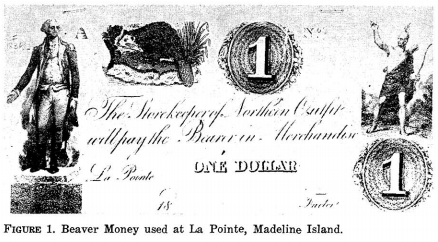
La Pointe Beaver Dollar
Northern Outfit, American Fur Company
~ Wisconsin Academy of Science, Arts, & Letters, Volume 54, page 159.
According to Mr. Arthur’s story, a bag containing $35,000 in gold was buried in the ground by Ell Pingers in 1861, and has never been discovered, though several expeditions have gone in search of it. It is a strange story, but it is not fiction, unless several old timers with records for veracity have combined to deceive the world, and unless State records lie and other documents fail to prove genuine. The money was certainly placed in a hole in the ground by Ell Pingers in the year 1861, and it probably was never taken away, for the man who did the planting was killed during the war, and no other person knew where the hiding place was. A paper has come to light recently which furnishes a clue to the location of the treasure, and Mr. Arthur expects to be richer by $35,000 within a fortnight.
Superior Chronicle – November 4, 1856
“INDIAN PAYMENT. – Mr. Jos. Gurnoe, last week, distributed among the Chippewa Indians of this vicinity their annuities. An unlimited number of silver half dollars are now in circulation, and all are enjoying the benefits of Uncle Sam’s liberality.”
In the year 1856, when wildcat money flooded the State of Wisconsin, and when the country was on the verge of a financial and political crisis, James Arthur and Ell Pingers, two young men who had been supplied by their respective fathers with a good start in life, immigrated from New York to La Pointe and established a bank, which not only issued notes of its own, but made a specialty of discounting the issue of other banks throughout the State. They pulled through the panic of 1857, and the bank was counted among those that redeemed its currency at face value. When war became imminent between the North and South the young men decided to close out their banking business and return to the East to engage in something more lucrative. In 1861, however, before the bank closed, James Arthur made a trip to Milwaukee, and there became fired with a desire to serve his country as a soldier. He sent a letter to Pingers at La Pointe asking him to close out the business as soon as possible and leave for the East with all the funds. He also gave Pinger the number of his regiment and full directions as to where letters should be sent. Then he marched to the front with a Wisconsin regiment.

Facsimile of a $50 coin found at La Pointe.
~ Joel Allen Barber Papers, Summer of 1858
Six months after joining the army Arthur received his first and only communication from Pingers. It was a short note, dated from Milwaukee three months prior, and had been forwarded from post to post until it finally reached him at St. Louis. This note is now in the possession of Mr. Arthur, and was shown by him on his arrival here several days ago. It reads as follows:
“Milwaukee, June 8, ’61 – 4 P.M.
“Friend Jim: Got your letter all right. Have closed up bank and sold everything for cash. I realized in all $37,000, and take $2,000 of that with me, but not caring to take a large sum through such a wild country I buried it in a safe place and will advise later concerning exact spot. I am off for bloody war myself. Yours,
“ELL PINGERS.”
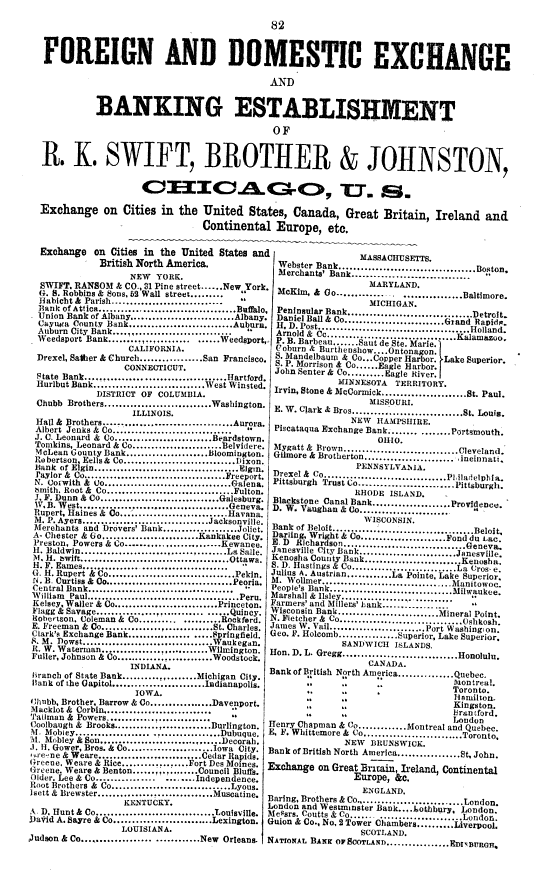
Julius Austrian operated a bank at La Pointe circa 1855.
In 1863 Arthur went on a furlough to visit his mother and sisters in New York City, and while there learned that Pingers had been killed at the battle of Richmond, Ky., on Aug. 30, 1862. The papers and numerous personal effects of the dead soldier had been shipped to his mother from Milwaukee previous to his enlistment in the army, but a thorough search failed to disclose any information concerning the location of the hidden treasure. So the furloughed soldier returned to the scenes of war without hope of ever being able to recover the snug little fortune stored away somewhere in Wisconsin soil.
The war over Mr. Arthur returned to New York, and in 1866 he made a trip to La Pointe in company with two friends for the purpose of hunting up the hidden gold. The mission was a fruitless one, but it had the effect of exciting the La Pointe community, and for years after that the natives dug holes in all directions from the old bank, but as far as known the treasure was never unearthed.
In 1867 Arthur’s mother died, leaving him a small fortune, and the following year he married the sister of the dead soldier, Ell Pingers. Through this marriage all the personal effects of Pingers came into Arthur’s possession, and he made many searches through the papers for a clue to the whereabouts of the missing $35,000, but without result. Ten years after his marriage he made another trip to the scene of his old banking operations, and five years after that he sent a trustworthy employee to look for the hidden gold, but no gold was to be found, and finally all hope of ever recovering the treasure was abandoned.

Hermit Island is believed by some to contain several other long-lost treasures:
– 1861 Wilson the Hermit
– 1760’s British Military Payroll
– Stereotypical Pirate Stories
Did Pingers bury their treasure here as well?
About three weeks ago, while turning the pages of an old book which had once been the property of Ell Pingers, a small piece of note paper was found by Mrs. Arthur which contained a memorandum written by the dead soldier and which gave the missing information for which search had been made for years. This note, Mr. Arthur claims, will no doubt lead to the discovery of the treasure in time, but the references it makes to roads, trees, and other landmarks have long since been removed by the hand of progress or obliterated by time, and the undertaking will therefore be attended by more or less of the difficulties before experienced. The old gentleman is confident that, with the information obtained from old acquaintances here and the assistance expected from old residenters at La Pointe, he will be able to unearth the long-buried treasure. He declares his intention of donating one-half of the $35,000 to the veteran soldiers of the Union Army and turning the remainder over to his wife to do as she pleases with.
By Leo
If you haven’t seen a lot of posts lately, it’s because I’ve given up the the lucrative history-blogging business to become a mad scientist. I have a time machine that will make me wealthy beyond belief. Unfortunately, there are still some kinks to work out with the time-space continuum. Until they’re fixed, I plan to fund my research with my state-of-the-art genetic-ancestry testing business, 1823andMe™. Just spit into a tube, and in three to four weeks we can tell you, with scientific precision, what your actual true race and ethnicity are. You thought you were English? Ha Ha–you’re actually Scottish!
I had hoped to be collecting modern spit by now, but my stupid investors were frightened off by a simple trademark lawsuit. This has really slowed the field testing, so I’ve been reduced to taking the time machine back to eras where I can get saliva on the cheap. In fact, I just returned from a trip to the Lake Superior country!
Originally, I was just going to visit Sault Ste. Marie in 1830, but on the ride back, I just had to stop in at La Pointe in 1850 and 1855. I mean, I used to write a lot about that place and time, so it seemed only right to collect some stories and anecdotes for old-time’s sake.
But, disaster! My briefcase spilled out all over the floor and the notecards got all jumbled. The genetic profiles of the seven donors, and their descriptions, are all out of order. Can you help me sort them?
Here are the seven genetic ancestry profiles I collected according to my proprietary SuperDNA™analysis system:
- 100% Native American
- 88% Native American, 12% European (Mediterranean)
- 50% Native American, 50% West African
- 50% European (British Isles), 50% Native American
- 100% European (Mediterranean)
- 75% Native American, 25% European (Mediterranean)
- 100% European (British Isles)
And here are the descriptions of the seven people they belong to:
- I met him talking to a group of American pioneers who were planning to settle in the new city of Superior. Being one of the few English speakers around, he informed them that he was the first white man born in the area where the city was being built.
- He was a young man of the Lac Vieux Desert band. He arrived at La Pointe in his bark canoe for the payment and Midewiwin ceremonies. We tried to talk a little, but he only spoke Ojibwe.
- This kindly old woman was the matriarch of the leading family on the island. The federal census taker was in the middle of getting her information. I asked if he was going over to Bad River next, and he said he didn’t need to because he only had to count white people.
- We talked for quite a while because there were so few people who spoke English around. He was a clerk and he told me about how he “trades with the Indians,” but now his boss wants him to go into politics. His boss is a prominent Democrat who is friends with John Calhoun and all the other pro-slavery politicians.
- His name was Shaw-shaw-wa-ne-ba-se of the Snake clan, and you could tell he’d led a rough life out in the prairies of Manitoba. He had stolen horses from the Mandan around the time Lewis and Clark stayed with them. Later, his family considered joining Tenskwatawa and Tecumseh in their prophecy to give up white ways so the Great Spirit would send the whites back across the ocean.
- This old Frenchman was loved by almost everyone around. He took great pride in being descended from the French nobility and saw himself as a link back to the old French days at La Pointe. He was proud of his role in getting the Catholic church re-established on the island.
- He was one of the most imposing and respected Ojibwe chiefs around. He was great at playing the American and British authorities off each other. He did the same with the churches, and his influence on other Ojibwe bands was impressive.
Can you sort them accurately?
Ack! Absent-minded professor here–I forgot I had already compiled those notes with names and a few pictures. Sorry for wasting your time. Here are the actual results:
 I met him talking with a group of American pioneers who were planning to settle in the new city of Superior. Being one of the few English speakers around, he informed them that he was the first white man born in the area where the city was being built. I met him talking with a group of American pioneers who were planning to settle in the new city of Superior. Being one of the few English speakers around, he informed them that he was the first white man born in the area where the city was being built.
Bonga, Stephen 1823andMe™ SuperDNA™: 50% Native American, 50% West African |
| He was a young man of the Lac Vieux Desert band. He arrived at La Pointe with his bark canoe, for the payment and Midewiwin ceremonies. We tried to talk a little, but he only spoke Ojibwe.
Gendron, Antoine 1823andMe™ SuperDNA™: 100% European (Mediterranean) |
| This kindly old woman was the matriarch of the leading family on the island. The federal census taker was in the middle of getting her information. I asked if he was going over to Bad River next, and he said he didn’t need to because he only had to count white people.
Cadotte, Mdme. Madeleine Equaysayway 1823andMe™ SuperDNA™: 100% Native American |
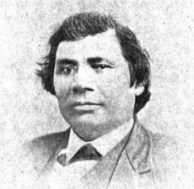 We talked for quite a while because there were so few people who spoke English around. He was a clerk and he told me about how he “trades with the Indians,” but now his boss wants him to go into politics. His boss is a prominent Democrat who is friends with John Calhoun and all the other pro-slavery politicians. We talked for quite a while because there were so few people who spoke English around. He was a clerk and he told me about how he “trades with the Indians,” but now his boss wants him to go into politics. His boss is a prominent Democrat who is friends with John Calhoun and all the other pro-slavery politicians.
Roy Jr., Vincent 1823andMe™ SuperDNA™: 75% Native American, 25% European (Mediterranean) |
 His name was Shaw-shaw-wa-ne-ba-se of the snake clan, and you could tell he’d led a rough life out in prairies of Manitoba. He had stolen horses from the Mandan around the time Lewis and Clark stayed with them. Later, his family considered joining Tenskwatawa and Tecumseh in their prophecy to give up white ways so that the Great Spirit would send the whites back across the ocean. His name was Shaw-shaw-wa-ne-ba-se of the snake clan, and you could tell he’d led a rough life out in prairies of Manitoba. He had stolen horses from the Mandan around the time Lewis and Clark stayed with them. Later, his family considered joining Tenskwatawa and Tecumseh in their prophecy to give up white ways so that the Great Spirit would send the whites back across the ocean.
Tanner, John Shawshawwanebase 1823andMe™ SuperDNA™: 100% European (British Isles) |
| This old Frenchman was loved by almost everyone around. He took great pride in being descended from the French nobility and saw himself as a link back to the old French days at La Pointe. He was proud of his role in getting the Catholic church re-established on the island.
Cadotte Jr., Michel (Mishoons) 1823andMe™ SuperDNA™: 88% Native American 12% European (Mediterranean) |
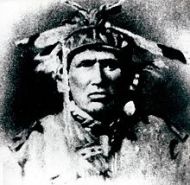 He was one of the most imposing and respected Ojibwe chiefs I met. He was great at playing the Americans and British off of each other. He did the same with the churches, and his influence on other bands was impressive. He was one of the most imposing and respected Ojibwe chiefs I met. He was great at playing the Americans and British off of each other. He did the same with the churches, and his influence on other bands was impressive.
Shingwaukonse 1823andMe™ SuperDNA™: 50% European (British Isles) 50% Native American |
Whew! Disaster averted.

Okay, back to reality. I don’t have a time machine, I don’t have much to say about Elizabeth Warren’s campaign roll-out, and I actually had my DNA done by Ancestry.com and enjoyed the process. So, why the snarky attempt to dabble in anthropology, where I have no business dabbling?
Is it because I really am retiring from teaching* at the ripe-old age of 35 but still have a compulsion to quiz and lesson-plan?
No! It’s because I have some upcoming posts on the concepts of race, identity and citizenship in the census records from 1850-1860 and I wanted to hammer home the following points:
- We, as Americans, have been conditioned to think of race as an immutable, biological aspect of identity. However, this current form of racialized thinking did not fully take hold until the later 19th and early 20th centuries. Earlier times also had racialized thinking, but it was different.
- In the pre-Civil War Lake Superior country, one’s race had as much or more to do with his or her lifestyle, culture, religion, or assigned paternal lineage than it did with perceived genetic ancestry (i.e. amount of “blood” or DNA). Therefore, the race a person had at birth wasn’t necessarily the one he or she would have at death.
- Racial identity in the Lake Superior country was not a matter of black and white (or Native and white for that matter). There was a great deal of nuance in a person’s identity that could not be inferred simply from skin tone or facial features.
- Our modern definitions of a “white person,” a “Native person,” or a “biracial person” did not exist then.
- The idea of race as arbitrary and defined by society is not a new concept, nor is it hard to grasp on a superficial level. However, with race and racism in their current form (and the consequences thereof) being so present in our modern thinking, it is very difficult to remove our present notions from study of the past.
- I mostly like to collect old documents and create narratives. Smarter people than I can continue to fill libraries on these headier topics. That said, if we want to get a good discussion going on the census, we better get close to the same wavelength.
See you soon,
Leo
Notes:
Stephen Bonga, his father, and his brothers have figured in a number of historical studies of African-Americans in the west. See pages 7 and 43 of The Eye of the Northwest by Frank Flower (1890) for this particular story.
This description of Antoine Gendron comes directly from pages 34-37 of Kohl’s Kitch-Gami. Kohl often used pseudonyms, so “Gendron” might not be the actual name of the man he met at La Pointe in 1855.
Madeline Cadotte is an ancestor to so many of the families of this region, and such an important part of regional folklore, we sometimes lose track of Mdme. Cadotte the historical figure who lived to a very old age and was still around into the 1850s. Written sources in English, when compared to contemporaries like Chief Buffalo and Ozhaguscodaywayquay (Susan Johnston), are surprisingly sparse. There are some discrepancies in sources about her early life, but I’ve yet to encounter a source that disputes that she was born to two Ojibwe parents and raised in an Ojibwe household.
Verwyst devotes the final few pages of his biography of Father Baraga, (1900) to a short biography of Vincent Roy Jr., calling the elderly Roy “the best Indian of the Northwest.” In their younger lives, however, Roy and contemporaries like the Warren cousins, Paul and Clement Beaulieu, and Antoine Gordon self-identified variously as white, mix-blood, or Indian depending on the appropriateness of the context. This didn’t mean he wasn’t subject to discrimination, however. The land, business and political ambitions Roy and his brother-in-law, Vincent Cournoyer, were challenged by rivals on the basis of their Ojibwe ancestry.
John Tanner’s narrative (1830) is a fascinating view on the Ojibwe society of the Red River prairies at the dawn of the 19th century. He was kidnapped from American settlers at age 10 by a Saginaw Ojibwe war party. He was later adopted into a prominent Arbre Croche Ottawa family and moved with them to the prairies. By adulthood, he had forgotten English and was fully integrated into the Anishinaabe world. Though his white origins were a liability at times, he was generally perceived as an Ottawa by the Ojibwe, Cree and Assiniboine of the region. He was of the clan of the Saginaw chief who had originally taken him from his birth parents.
The marriage of Misho’s parents, Michel and Madeline, is often portrayed as the coming together of Native and European culture in the region. However, few modern-day Americans would describe Michel Cadotte Sr. as a white man if they met him on the street. His father was half Huron, and his mother was Anishinaabe from the Lake Nipissing region. Michel Jr. and his siblings had seven Native great-grandparents and one European great-grandparent. The direct paternal line being French, both Anishinaabe and French-Canadian society of the time would consider them French. This would not necessarily imply shame or rejection toward their Native ancestry, just an acknowledgement that children belonged to their father’s village.
Janet Chute’s biography of Shingwaukonse (1998), devotes significant time to his origins and how and why he fit into the Ojibwe society of the Soo rather than the area’s large Metis community.
Shameless advertisement:
*I am actually leaving the K-12 teaching field, so hopefully that will leave me with more time and mental energy for Chequamegon History. Also, let me know if you have any job openings for old-document readers and/or transcribers.
Edwin Ellis Incidents: Number V
January 16, 2019
By Amorin Mello
… continued from Number IV.
EARLY RECOLLECTIONS OF ASHLAND.
“OF WHICH I WAS A PART.”
Number V
Mr. Dear Press: – As has been already stated, the land on which Ashland now stands, had not, at the time of its first settlement, in 1854, been surveyed. The town lines had only been laying off the country into blocks six miles square.
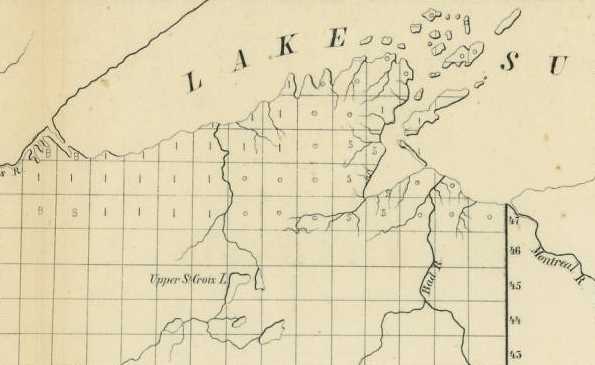
Detail from Sketch of the Public Surveys in Wisconsin and Territory of Minnesota by the Surveyor General’s Office, Dubuque, Oct. 21, 1854 as presented in Senate Executive Document No. 1, 34th Congress, 1st Session.
~ Wisconsin Historical Society
When the settlers made their claims, as most of us did, near the town lines, we were able, by the use of pocket compasses approximately to fix the boundaries of our claims. But no title could be obtained, nor even any safe foundation for a title laid, until the lands should be subdivided into sections, and the returns of that survey made to the Surveyor General’s Office, and by that officer platted or mapped, and then plats and notes sent to the General Land Office at Washington, and from there transmitted to the Local Land office. At that date the local office was at the town of Hudson, on Lake St. Croix, two hundred miles away. But early in 1855 an office was established at Superior, at the west end of the Lake, – and though this was nearly a hundred miles from Ashland, – with no roads, compelling settlers in summer to cost in open boats, and winter to walk this distance. Still it was a very great favor to settlers here, and greatly lessened their hardships, and facilitated the acquisition of their lands.
Wisconsin, Iowa and Minnesota, then were embraced in one Surveyor’s District, with the office at Dubuque, Iowa. It was the duty of the Surveyor General to provide for the details of the Government Surveys in his district, as fast as the settlement of the country might require. Gen’l Warner Lewis was then Surveyor General of this District.

Detail of Ashland City, LaPointe County, from the Barber Brother’s survey during the Joel Allen Barber Papers: Summer of 1855.

These memoirs are classic examples of Edwin Ellis, M.D. writing in the third person when crediting himself for achievements during Ashland’s early days.
No steps having been taken or any order given for the survey of the shore of Chequamegon Bay, in June 1855, Dr. Ellis left in an open boat for Superior, then on foot through the wilderness to St. Paul, following not far from the route over which many years later was constructed the Lake Superior & Mississippi R.R., – then by boat down the river to Dubuque. The situation of our affairs and the people of an early settlement here induced Gen. Lewis to order an immediate subdivision of Towns 47 and 48, North of Range 4 and 5 West, both sides of our bay, and all the lands on which squatters had settled.
Early in September of that year, (1855), Augustus H. Barber began the survey, and pushed the work rapidly, so that he had completed 47 and 48 of Range 4 in October, and the returns had been made and plats prepared and forwarded to the local land office by the first of December.
Spring of 1856
—
Last known letter from Augustus
—
“There is a conspiracy, or combination of old preemptors here who have no right to make claims. Their object is to secure each member a claim on the North shore, and to drive off and keep off by knives and pistols any who may wish to make legal preemptions on the lands they choose to appropriate to themselves.
“There may be some fighting up here this season and there is certain to be considerable laming before the business is settled. Let ‘em rip.
“I can send half a dozen to Jehanum in about as many seconds, but don’t want to do it & will avoid trouble if possible but butcher knife companies must not meddle with any claim when I have made one.“
The Pre-emptors now, for the first time, could file claims to their lands and receive assurance that they were likely to be the owners of their homes.
During December many pre-emption claims were filed, and during the closing days of the year and in the first days of 1856, quite a number proved up those claims and received duplicates, upon which patents were afterwards issued. These were the earliest titles to the present site of Ashland. Unlike many towns in the West at that period our site was not cursed with complicating claims, and it is cause for congratulations that Ashland property has no cloud upon its title and that every buyer may, with little trouble, assure himself of this fact. The title to a portion of the site of Superior was bitterly contested involving years of delay and thousands of dollars of cost and much acrimony of feeling; and it is possible that this may have had its influence in carrying the railroad to Duluth rather than to Superior. Quarrels over title are a curse to any town, especially a new one.
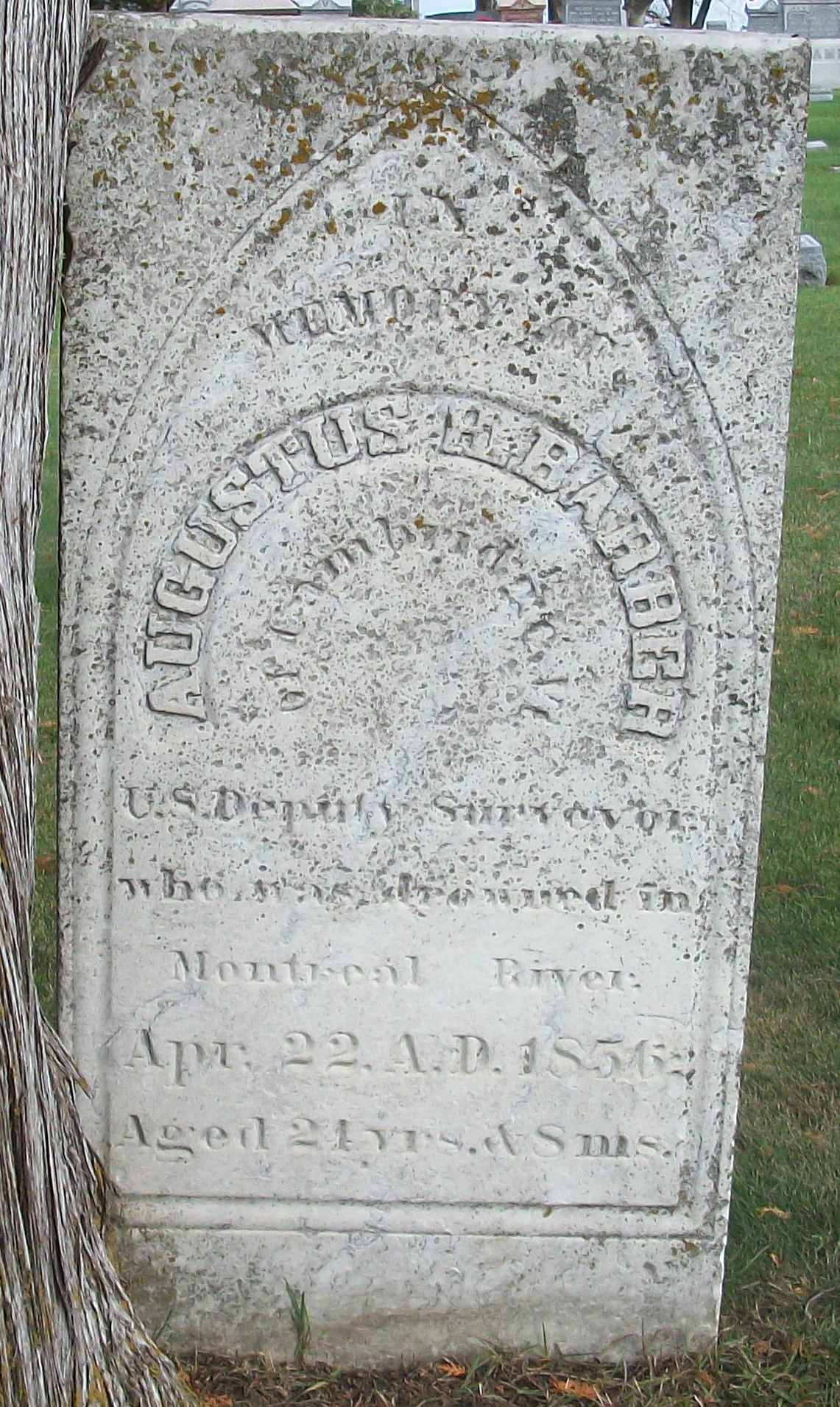
“IN MEMORY OF AUGUSTUS H. BARBER of Cambridge, Vt. U.S. Deputy Surveyor who was drowned in Montreal River
Apr. 22. A.D. 1856
Aged 24 yrs. & 8 ms.”
~ FindAGrave.com
Of Augustus Barber the early Surveyor of this vicinity, who is unknown to a larger part of this generation, a few words ought to be said:
He was a native of Vermont of an excellent family. At this time he was about 22 years of age, well educated, gentle as a Lady, refined and easy in his manners and very amiable in his temper. Like many other young men from the east, of active and enterprising habits, he had come into this outer verge of civilization to make this his home and to grow up with its institutions. He was the nephew of Hon. J. Allen Barber, of Lancaster, in this State, who once represented his District in Congress. He continued in the surveys of this part of the Lake until in the summer or fall of 1856, when he, with others, conceived of the idea of founding a city at the mouth of the Montreal River – the dividing line between Wisconsin and Michigan about thirty miles east of Ashland.
The iron range approaches nearer the Lake at that point than it does at Ashland. And though the country is much rougher and more difficult for construction of roads than between Ashland and the Range, yet the shorter route, it was argued, would more than compensate for the heavier grades. – The town was laid out and platted by Mr. Barber.
Spring of 1857
—
“This has been a sorgawful day to me, feeling more impressed with the awful calamity that befel over dear lamented Augustus and all our family in his loss One year ago to day.”
[…]
“It must remain a sealed book to us, how Augustus was hurried out of the woods, and why it was so ordained if there, was any ordination about it, till we meet him in another world, which I devoutly hope we may do though I am sorry to say more hoping than expecting.“
The Montreal, not far from its mouth, leaps down a perpendicular descent of nearly a hundred feet presenting a wild and picturesque view. Being an enthusiastic lover of the beautiful of nature and desiring to reach a position underneath the falls, Mr. Barber in a canoe with two companions, approaching too close, were drawn in by the eddying whirlpool, the canoe was capsized, and before help could reach him he and one of his boatmen were drowned. His body was recovered and was buried on a sand hillock near the mouth of the same river in whose waters he met his death. Ironton has long been deserted, and Barber’s grave with its marble headstone, is the sole make of that civilization, which twenty years ago there essayed to lay the foundation of a mart of commerce.
Summer of 1857
—
“One man working in the interest of the company the year before, had been discovered, after being missed for some weeks, dead in the forest, near the range. Bruises and other indications of violence on the body gave strong ground for the belief that he had been murdered.“
The surf of the waves of the lake in summer and fierce driving snow storms in winter, with solitude presiding over the grand orchestra, are perpetually chanting his mournful requiem, while a fond father and mother on the slopes of the distant Green Mountains are mourning bitterly the early death of their first born son.
To be continued in Number VI…
Translation Help Needed: Ojibwe and French placenames on Joseph Nicollet’s manuscript map of Wisconsin
December 31, 2018
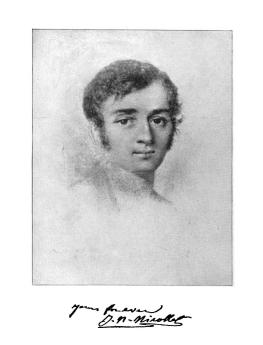
Joseph Nicholas Nicollet 1786-1843 (Wikipedia) *Not to be confused with Jean Nicolet, the explorer who visited Green Bay 200 years before this.
By Leo
Joseph Nicollet* is a name familiar to many in the Upper Midwest. The French-born geographer is remembered in numerous place names, particularly in Minnesota. For followers of Chequamegon History, though, he is best known for his 1843 Map of the Hydrographical Basin of the Upper Mississippi. The map remains very popular for its largely-accurate geography and its retention of original Ojibwe and French placenames for rivers, lakes and other land features. I’ve always found it an attractive map, and use the Chequamegon portion of it to decorate the side panels of the blog.
So, one can imagine the excitement when Brian Finstad emailed and told me there was another version of the map, and that it was available online from St. Olaf College. This version, covering the country between the St. Croix and Wisconsin rivers (what is now the northwestern half of Wisconsin) is handwritten and contains information and names that never made it onto the published map. For those unfamiliar with Brian Finstad’s work, he is a long-time correspondent of Chequamegon History and has a keen and detailed understanding of the Gordon/Upper St. Croix region and the history of the St. Croix-La Pointe trail.

Click to Enlarge or visit the zoomable version at the Nicollet Project at St. Olaf College
The manuscript is also differs from the published map in that the placement of lakes, rivers, and portages. At first glance, to those of us used to Google and the modern highway system, to be less accurate in terms of actual fixed latitude and longitude. Instead, it seems more reflective of how Wisconsin’s geography would have been perceived at the time–as chains of water routes and portages. I need to look into it further, but my current understanding is that Nicollet did not travel extensively in Wisconsin. Therefore, one can assume that he got most of this information from his hired Ojibwe and Metis guides and voyageurs.

Zhagobe (Shakopee, Chagobai, Little Six), a Snake River chief worked with Nicollet and may have been an informant for the map. (Painting by Charles Bird King from James Otto Lewis portrait 1825 or 1826)
The handwritten map is challenging to read. Parts of it are ripped and faded, and the labels are oriented in all directions, including upside-down. Perhaps most difficult for me, as a monolingual English speaker, the map is in no fewer than four languages. French predominates, but there is a great deal of Ojibwe (especially in place names) and some English in descriptions. Near the mouth of the Chippewa River, there is another language, probably Dakota, but I don’t know Siouan languages well enough to say it is not Ho-Chunk.
After spending a few minutes with the map, I knew that the only way I would be able to engage with it fully would be to make it a project. So, I set out to reproduce the map, as faithfully as possible to the original, but with more legible text oriented according to more-modern cartographic conventions. Here is the result:

My hope is that the reproduction will make comparisons with the published map easier for scholars, or at the very least, provide a guide for working with the manuscript. However, this is where I’ll need help from readers, especially those who are good with Ojibwe and French grammar.
Here are some of the challenges we’re up against:


Familiarity of Locations
Being most familiar with the parts of Wisconsin within the Lake Superior basin, a map that focuses on the Mississippi watershed is not necessarily in my wheelhouse. Unfortunately, that’s what this truly is a map. Locations on the lakeshore are barely shown on the manuscript. There is far better detail in Nicollet’s published map showing that he must have used different sources to fill in that section of his finished product. However, because the Chequamegon area is the most ripped, faded, and difficult part to read on the entire map, familiarity was an asset. In the snippet on the left, I am fairly confident that the ripped part under “Chagwamigon” should read Long Ile ou Lapoint or something very similar. Whereas, the snippet on the right, showing the Eau Galle River area west of Eau Claire, has much clearer script, but I am far less confident in my transcription because I have not been able to locate any online references to Jolie Butte or Rhewash. Waga online. So, if there are any French or Dakota speakers out there who live near the mouth of the Chippewa let me know if there is a place called “Pretty Mound” or something similar and if I got my letters correct.
Colloquial Nouns in Poor Handwriting

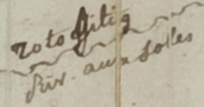
Readers of the blog know that I am a big fan of Google Translate. Compared with the early days of online translation, it is amazing how close one can to reading text in an unfamiliar language these days. No online translation is ever perfect, especially with grammar, but Google usually steers me in the right direction for nouns. That said, there are some problems. The French language, as translated by Google, is more or less the 20th-century version of what Nicollet was educated in. However, neither of those is the French that was spoken in this area. What European visitors called Patois and what Manitobans call Michif or Metis French is truly a language of its own and a product of the fur trade. The “French” of 19th-century La Pointe contained a great deal of Ojibwe and numerous archaic words from colonial Quebec. This can create challenges in translation, especially when the handwriting is ambiguous. The snippet on the left, for example, appears to be the Poplar River in Douglas County. However, the label doesn’t appear to say anything like peuplier or tremble (aspen). I played around with “frondes” or considered other river names entirely, until I stumbled across the word liard. Liard does not seem to have the meaning in modern French, but in colloquial Quebecois, it is regionally used to describe several different species of popple tree. Riv. aux Soles (right), however, has proved much more difficult. I initially saw the French name of the Totagatic as Riv. aux Lobes, but after some emails with Brian Finstad, Soles seems like the best guess. But, what is a Sole? Is it the sun? The bottom of a foot? A flounder? The same fish name can often be applied to different species in different regions. Is a sculpin a sole? Is a bullhead? Do we need to talk to old fishermen in Quebec to find out?
Lack of Grammatical Knowledge
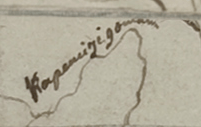
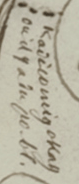
If Google Translate is my go-to place for French, the Ojibwe People’s Dictionary is where I go to try to confirm words in Ojibwe. Again, it’s great for nouns and verb-parts, but unless you speak these languages better than I do, knowing the gist of what the word means doesn’t mean you’ll get the translation right. In the snippet on the left, I transcribed the Ojibwe name for Cross Lake on the Snake River as Kapemijigonian. This word has elements of the meaning “flows through” in Ojibwe, but the word is nonsensical grammatically. Charles Lippert, who works for the Mille Lacs Band and has a wealth of information about Ojibwe linguistics, knew the real name, and was kind enough to offer Kapemijigoman as the correct transcription. Who knows how many similar errors could have been made? French can be tricky too. Mistaking ou for on, which is very possible with Nicollet’s handwriting, might not alter the meaning of a large chunk of text on Google Translate, but it sure can make you sound like a two-year old. Check out the snippet of French on the right. How can a non-Francophone read that?

I used the Inkscape vector graphics illustration program to trace the reproduction from the original.

As always, thanks for reading and please send feedback.
Wheeler Papers: Bad River’s Missing Creek
October 3, 2018
By Amorin Mello

This is one of several posts on Chequamegon History featuring the original U.S. General Land Office surveys of the La Pointe (Bad River) Indian Reservation. An earlier post, An Old Indian Settler, features a contentious memoir from Joseph Stoddard contemplating his experiences as a young man working on the U.S. General Land Office’s crew surveying the original boundaries of the Reservation. In his memoir from 1937, Stoddard asserted the following testimony:

Bad River Headman
Joseph Stoddard
“As a Christian, I dislike to say that the field representatives of the United States were grafters and crooks, but the stories related about unfulfilled treaties, stipulations entirely ignored, and many other things that the Indians have just cause to complain about, seem to bear out my impressions in this respect.”
In the winter of 1854 a general survey was made of the Bad River Indian Reservation.
[…]
It did not take very long to run the original boundary line of the reservation. There was a crew of surveyors working on the west side, within the limits of the present city of Ashland, and we were on the east side. The point of beginning was at a creek called by the Indians Ke-che-se-be-we-she (large creek), which is located east of Grave Yard Creek. The figure of a human being was carved on a large cedar tree, which was allowed to stand as one of the corner posts of the original boundary lines of the Bad River Reservation.
After the boundary line was established, the head surveyor hastened to Washington, stating that they needed the minutes describing the boundary for insertion in the treaty of 1854.
We kept on working. We next took up the township lines, then the section lines, and lastly the quarter lines. It took several years to complete the survey. As I grew older in age and experience, I learned to read a little, and when I ready the printed treaty, I learned to my surprise and chagrin that the description given in that treaty was different from the minutes submitted as the original survey. The Indians today contend that the treaty description of the boundary is not in accord with the description of the boundary lines established by our crew, and this has always been a bone of contention between the Bad River Band and the government of the United States.
The mouth of Ke-che-se-be-we-she Creek a.k.a. the townsite location of Ironton is featured in our Barber Papers and Penokee Survey Incidents. Today this location is known as the mouth of Oronto Creek at Saxon Harbor in Iron County, Wisconsin. The townsite of Ironton was formed at Ke-che-se-be-we-she Creek by a group of land speculators in the years immediately following the 1854 Treaty of La Pointe. Some of these speculators include the Barber Brothers, who were U.S. Deputy Surveyors surveying the Reservation on behalf of the U.S. General Land Office. It appears that this was a conflict of interest and violation of federal trust responsibility to the La Pointe Band of Lake Superior Chippewa.

Missionary stationed at Bad River
Reverend Leonard H. Wheeler
This post attempts to correlate historical evidence to Stoddard’s memoir about the mouth of Ke-che-se-be-we-she Creek being a boundary corner of the Bad River Indian Reservation. The following is a reproduction of a petition draft from Reverend Leondard Wheeler’s papers, who often kept copies of important documents that he was involved with. Wheeler is a reliable source of evidence as he established a mission at Odanah in the 1840s and was intimately familiar with the Treaty and how the Reservation was to be surveyed accordingly.
Wheeler drafted this petition six years after the Treaty occurred; this petition was drafted more than seventy-five years earlier than when Stoddard’s memoir of the same important matter was recorded. The length of time between Wheeler’s petition draft and Stoddard’s memoir demonstrates how long this was (and continued to be) a matter of great contemplation and consternation for the Tribe. Without further ado, we present Wheeler’s draft petition below:
A petition draft selected from the
Wheeler Family Papers:
Folder 16 of Box 3; Treaty of 1854, 1854-1861.
To Hon. C W Thompson
Genl Supt of Indian affair, St Paul, Min-
and Hon L E Webb,
Indian Agent for the Chippewas of Lake Superior
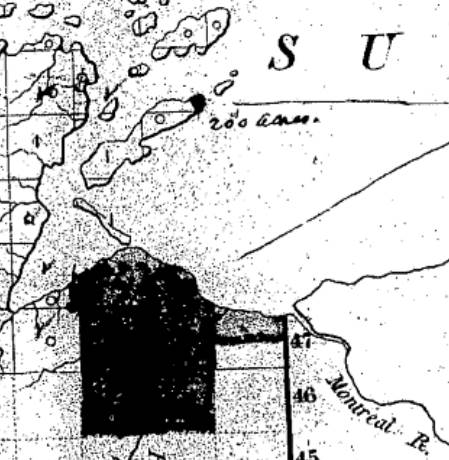
March 30th, 1855 map from the U.S. General Land Office of lands to be withheld from sale for the La Pointe (Bad River) Reservation from the National Archives Microfilm Publications; Microcopy No. 27; Roll 16; Volume 16. The northeast corner of the Reservation along Lake Superior is accurately located at the mouth of Ke-che-se-be-we-she Creek (not labeled) on this map.
The undersigned persons connected with the Odanah Mission, upon the Bad River Reservation, and also a portion of those Chiefs who were present and signed the Treaty of Sept 30th, AD 1854, would most respectfully call your attention to a few Statements affecting the interests of the Indians within the limits of the Lake Superior Agency, with a view to soliciting from you such action as will speedily see one to the several Indian Bands named, all of the benefits guaranteed to them by treaty stipulation.
Under the Treaty concluded at La Pointe Sept 30th, 1854 the United States set apart a tract of Land as a Reservation “for the La Pointe Band and such other Indians as may see fit to settle with them” bounded as follows.
a.k.a.
Ke-che-se-be-we-she
“Ke-che” (Gichi) refers to big, or large.
“se-be” (ziibi) refers to a river.
“we-she” (wishe) refers to rivulets.
Source: Gidakiiminaan Atlas by the Great Lakes Indian Fish & Wildlife Commission
“Beginning on the South shore of Lake Superior a few miles west of Montreal River at the mouth of a creek called by the Indians Ke-she-se-be-we-she, running thence South &c.”

Detail of the Bad River Reservation from GLIFWC’s Gidakiiminaan Atlas. This map clearly shows that the northeast boundary of Bad River Reservation is not located at the true location of Ke-che-se-be-we-she Creek in accordance with the 1854 Treaty. Red highlights added for emphasis of discrepancies.
Your petioners would represent that at the time of the wording of this particular portion of the Treaty, the commissioner on the part of the United States inquired the number of miles between the mouth of the Montreal River and the mouth of the creek referred to, in reply to which, the Indians said “they had no knowledge of distance by miles” and therefore the commissioner assumed the language of “a few miles west of Montreal River” as discriptive of the creek in mind. This however, upon actual examination of the ground, does to the Band the greatest injustice, as the mouth of the creek to which the Indians referred at the time is even less than one mile west of the mouth of the Montreal.*
*This creek at the time was refered to as having “Deep water inside the Bar” sufficient for Boats which is definitive of the creek still claimed as the starting point, and is not descriptive of the most westerly creek.
But White men, whose interests are adverse to those of the Indians now demand that the Reservation boundary commence at an insignificant and at times scarcely visible creek some considerable distance west of the one referred to in the Treaty, which would lessen the aggregate of the Reservation from 3 to 4000 acres.
Your petioners, have for years, desired and solicited a settlement of the matter, both for the good of the Indians and of the Whites, but from lack of interest the administrations in power have paid no attention to our appeals, as is also true of other matters to which we now call your attention.
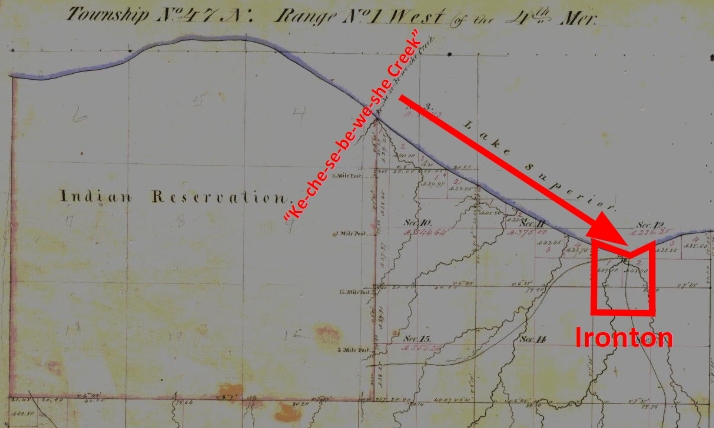
1861 resurvey of Township 47 North of Range 1 West by Elisha S. Norris for the General Land Office relocating Bad River Reservation’s northeast boundary. Ke-che-se-be-we-she Creek was relocated to what is now Graveyard Creek instead of its true location at the Barber Brother’s Ironton townsite location. Red highlights added for emphasis of discrepancies.
As many heads of families now wish to select (within the portion of Town 47 North of Range 1 West belonging to the Reservation the 80 acre tract assigned to them) we desire that the Eastern Boundary of the Reservation be immediately established so that the subdivisions may be made and and land selected.
Your petioners would further [represent?] that under the 3d Section of the 2nd article of the Treaty referred to the Lac De Flabeau, and Lac Court Orelles Bands are entitled to Reservations each equal to 3 Townships, (See article 3d of Treaty. These Reservations have never been run out, none have any subdivisions been made.) which also were to be subdivided into 80 acre Tracts.
Article 4th promises to furnish each of the Reservations with a Blacksmith and assistant with the usual amount of Stock, where as the Lac De Flambeau Band have never yet had a Blacksmith, though they have repeatedly asked for one.
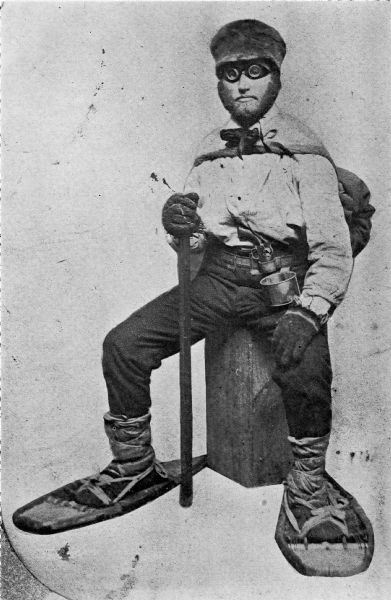
Wisconsin State Representative
and co-founder of Ashland
Asaph Whittlesey
As the matters have referred to one of vital importance to these several Bands of Indians, we earnestly hope that you will give your influence towards securing to them, all of the benefits named in the Treaty and as the subject named will demand labor entirely outside of the ordinary duties of an Indian Agent, and as it will be important for some one to visit the Reservations Inland, so as to be able to report intelligently upon the actual State of Things, we respectfully suggest that Mr Asaph Whittlesey be specially commissioned (provided you approve of the plan and you regard him as a suitable person to act) to attend to the taking of the necessary depositions and to present these claims, with the necessary maps and Statistics, before the Commissioner of Indian Affairs at Washington, the expense of which must of necessity, be met by the Indian Department.
Mr Whittlesey was present at the making of the Treaty to which we refer, and is well acquainted with the wants of the Indians and with what they of right can claim, and in him we have full confidence.
In addition to the points herein named should you favor this commission, we would ask him to attend to other matters affecting the Indians, upon which we will be glad to confer with you at a proper time.
The undersigned L H Wheeler and Henry Blatchford have no hesitency in saying that the representations here made are full in accordance with their understanding of the Treaty, at the time it was drawn up, they being then present and the latter being one of the Interpreters at the time employed by the General Government.
Most Respectfully Yours
Dated Odanah Wis July 1861
Names of those connected with the Odanah Mission
[None identified on this draft petition]
Names of Chiefs who were signers to the Treaty of Sept 30th 1854
[None identified on this draft petition]
Although this draft was not signed by Wheeler or Blatchford, or by the tribal leadership that they appear to be assisting, Chequamegon History believes it is possible that a signed original copy of this petition may still be found somewhere in national archives if it still exists.
Asaph Whittlesey Incidents: Number V
October 2, 2018
By Amorin Mello
Originally published in the March 16, 1878, issue of The Ashland Press. Transcribed with permission from Ashland Narratives by K. Wallin and published in 2013 by Straddle Creek Co.
… continued from Number IV.
Early Recollections of Ashland: Number V
by Asaph Whittlesey
—
FIRST ELECTION IN THE TOWN OF BAY PORT.
The order of the County Board creating the Town of Bay Port was made March 11th, 1856, and the store of Schuyler Goff in Bay City was designated as the place for holding the first election for town officers, the election to be held April 1st, 1856.
The journal containing this order (which was in pamphlet form,) was destroyed by fire at the burning of the Webb House in Bayfield, Wis., June 4th, 1874.

Detail of La Pointe County from a map of Wisconsin published by J. H. Colton & Co., New York, 1856.
~ David Rumsey Map Collection
The new town comprised all that portion of La Pointe county, Wis., laying south of the north line of town 48 north, in all over sixty eight townships, including the Bad River Indian Reservation, which was, on the 8th of Nov. 1859, made a precinct by itself.
At the election held April 1, 1856, there were twenty-four votes cast, resulting as follows: For Chairman of Town Board, Schuyler Goff; remaining member of Town Board, J. T. Welton and Asaph Whittlesey. Schuyler Goff, Chairman elect, was the first to qualify, his oath of office being administered by Asaph Whittlesey, Justice of the Peace.
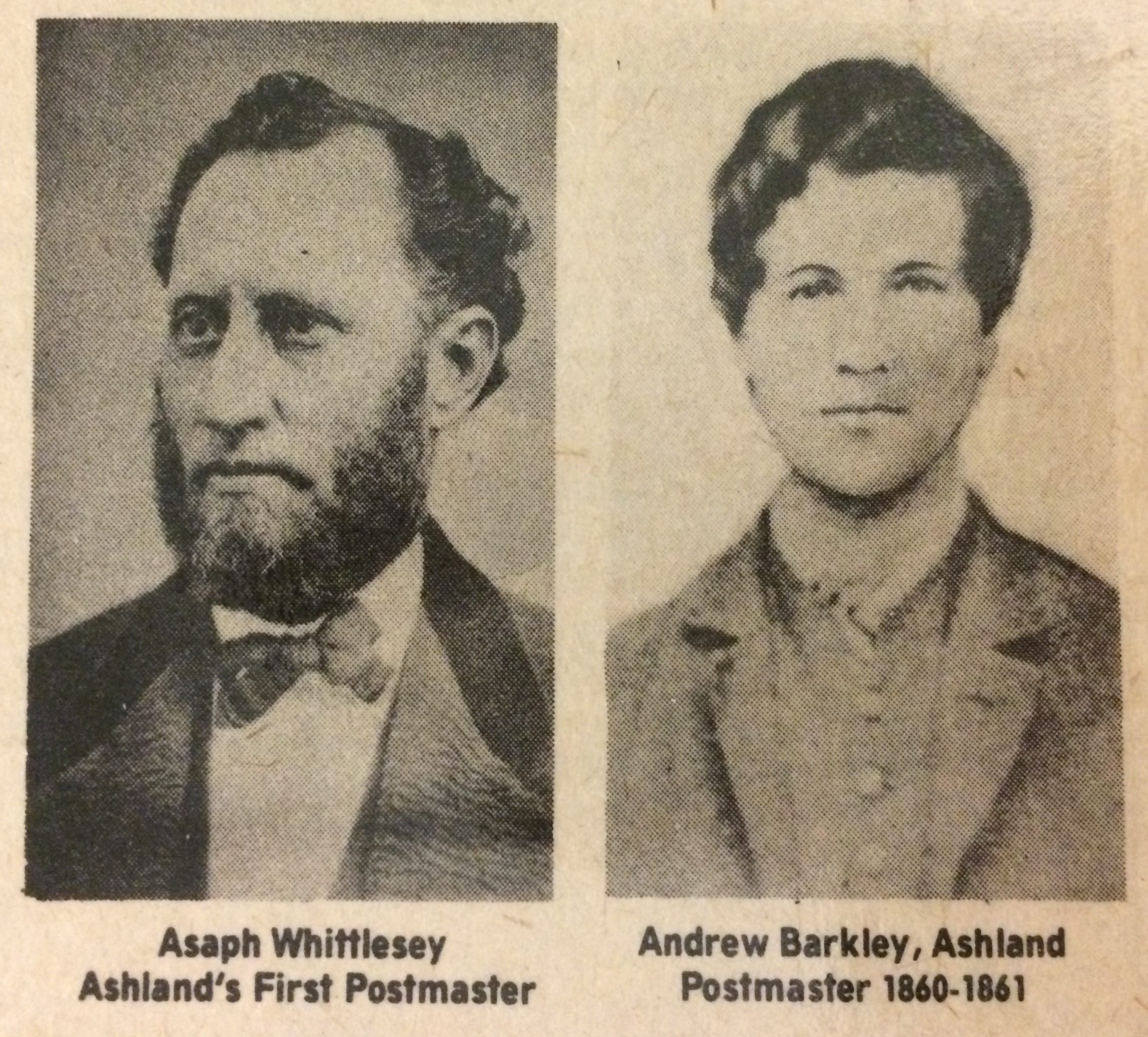
Photographs of Asaph Whittlesey and Andrew J Barkley reproduced from the Ashland Daily Press – national bicentennial issue (July 1976).
The annual statement made in April, 1857, showed the outstanding indebtedness of the town to be $25.00. The report submitted in April, 1858, showed highway orders issued during the year previous $57.50. Town indebtedness in April, 1858, was $22.75, and at that election there was levied the sum of $195.59, to meet the town expenses for the ensuing year. The following were the bills allowed by the town meeting in April, 1857: The first allowed was the bill of Edwin Ellis for $9.25; 2nd, J. T. Welton, $9.00; 3rd, A. J. Barkley, $5.50. In those days no bills were allowed nor orders drawn to cover them until the same had been approved at the town meeting. They had not yet learned to audit accounts with the marvelous rapidity known to Town Boards of more recent dates. However the Town Clerk comprehending this groans out as follows: “The vaults of the Treasuring are declared empty, and the servants of the town will therefore be obliged to wait for their pay until money shall be assessed and collected.”
Again. By referring to the Records of La Pointe, (being two years previous to the organization of the town of Bay Port,) Charles Pulcifer, acting as town treasurer, certifies that “the only unpaid personal property tax was that of J. W. Bell, amounting to $33.00, and that he was unable to find any goods on chattels belonging to the said Bell to enable him to collect the tax.
The assessment for 1857 made by Edwin Ellis for which allowance of $6.00 was made. At the annual town meeting in 1858 the first bill acted upon was that of Asaph Whittlesey, Superintendent of schools, amounting to 75 cents, though it was not allowed as they claimed it was out of their jurisdiction. – Bills of Edwin Ellis and Rev. L. H. Wheeler, for work done on the highway was rejected. It was resolved at this meeting that thereafter one shilling per hour be allowed for work on the highway.
OUR EXPERIENCE IN RAILROAD MATTERS.
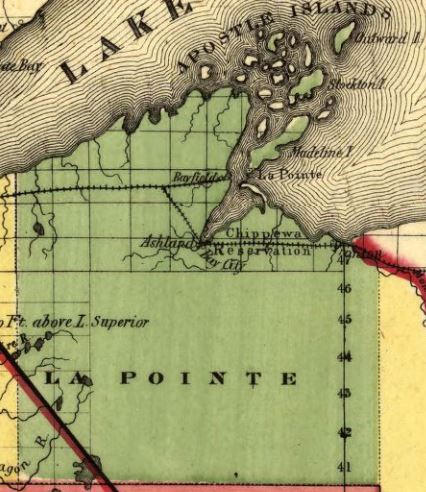
Detail of La Pointe County from a map of Wisconsin published by The Milwaukee & Horicon Rail Road, 1857.
~ Library of Congress
We often fall into the habit of complaining because things move so slow, and especially is this system of fault finding associated with the delays usually experienced in the construction of railroads in the west. However, upon reflecting I find that my time in life embraces the entire history of railroads in the United States, nearly the first roads put into operation, (if not the very first,) were one from Baltimore to Washington and one from Albany to Schenectady, N.Y., over which it was my good fortune to pass before reaching my majority, and about the time I became of age, it was my fortune to ride over not only the first railroad constructed in Illinois, bu the first built in the Mississippi valley, to wit: from Meredosia, on the Illinois River, to Springfield, a distance of forty miles, which, in its day, was regarded something not to be sneezed at, as the roads I have named were at least suggestions of the great systems of roads today. Governor Donenn, of Illinois, in his message of 1835-6, referred in the most glowing language to the triumph of the canal boat and the locomotive in almost annihilating time, burden, and space in other parts of the country and wanted to known if the Patriot bosoms of Illinois did not beat high to emulate such examples of internal improvement.
There were at different times two locomotive run over the Illinois roads mentioned, and finally mule power was resorted to. – The following year an Internal Improvement Bill was passed and roads were laid out for every quarter of the State, the results of which was to bankrupt the State. But the movement was not without its advantages, as by the following spring the forty miles reaching to Springfield was graded and ready for the track to be laid. The track was laid by putting down a piece of square timber called a mud sill on the top of which cross ties were laid. On these a wooden rail was laid and flat bars of iron were spiked on the top of the rail. These bars were tow and one half inches wide and one inch thick, and upon this track turned the wheel of the first locomotive brought into the Mississippi valley.
It might be called a curious contrivance, since the locomotive was simply a piece of clumsiness and of no practical use, the driving wheels being only about two and a half feet in diameter, and the engine itself having very little power. This road finally passed out of the hands of the State for a consideration of $100,000, in State indebtedness, while the actual cost to the State was $1,000,000.
I have dwelt somewhat long and in general terms upon the subject of railroads in the United States, to show to my readers that there has been no want of energy in their construction, but on the contrary the rapidity with which they have penetrated the wilderness is simply marvelous, converting Indian wilds into prosperous cities or fields of golden harvest. My own connection with the building of railroads dates no farther back then the time of my landing here in 1854, since which, I have in my way left no stone unturned looking to the introduction of railroads into this country. I was for a time a director in the St. Croix and Lake Superior Railroad Company, during which (but for the complications of the road,) Gardner Colby would have undertaken its construction instead of turning his attention to the Wisconsin Central Railroad.
To be continued in Number VI…
Edwin Ellis Incidents: Number IV
August 31, 2018
By Amorin Mello
Originally published in the July 14th, 1877, issue of The Ashland Press. Transcribed with permission from Ashland Narratives by K. Wallin and published in 2013 by Straddle Creek Co.
… continued from Number III.
EARLY RECOLLECTIONS OF ASHLAND.
“OF WHICH I WAS A PART.”
Number IV
My Dear Press: – In March 1855, Conrad and Adam Goeltz – then young men, came to Ashland. They were natives of Wittenberg, and Conrad had served six years in the Cavalry of that Kingdom; but liking freedom, he bade adieu to the King, his master, and came to the “Land of the Free.” They both cleared land near the town site, which they afterwards pre-empted, and bought from the U.S. Government. For several years both of them lived in Michigan, but upon the revival of Ashland they came back to their early home. Katy Goeltz, Conrad’s Daughter, was the first white child born in this town, in the fall of 1855. Henry Dretler, Mrs. Conrad Goeltz’s father, came early and bought a quarter section of land. He died here in 1858 and was buried near the present residence of Mr. Durfee.
In June 1855, Dr. Myron Tompkins (brother-in-law of Mr. Whittlsey) came to the bay in search of health. He had been driven from Illinois by ague and rheumatism. The climate cured the ague, and accidentally falling off from a raft in the bay – the severe shock cured the rheumatism. Being thus cured by our climate and water, he has ever since lived on the lake. He is a well-educated physician. At present he is the physician of the Silver Islet Mining Company, on the North Shore of the Lake.
I recall others who came in 1855; Andrew Scobie, now of Ontonagon, Thomas Danielson, Charles Day, (now farming on Fish Creek,) Joseph Webb, Bernard Hoppenjohn, Duncan Sinclair, Lawrence Farley, and Austin Corser. Farley died many years ago, but his widow, after years of absence, has again returned to Ashland. Austin Corser in the summer of 1855 began a farm on the east side of Fish Creek, about half a mile above the mouth. Remaining only two or three years, he went to Ontonagon and afterwards to Iron River – in a wild lonely glen – where in after years from 1873 to 1876. He sold his homestead on which the Scranton Mining Company was formed for a snug little fortune, on which he settled down on a farm near Waukegan, Illinois.
John Beck, also coming in the early days of Ashland. He pre-empted and lived upon the spot now laid out and occupied as our cemetery. His wife was the first adult person who died in this town. The remains of the house in which she died may be seen near the Ashland Lumber Company’s store. He was for many years an active explorer for minerals, was the originator of the Montreal River Copper Mining Company. Subsequently he discovered silver lodes on the North Shore, in Canada. He is now engaged in gold mining in California.
Albert C. Stuntz was also one of our early settlers. He is a brother of Geo. R. Stuntz, to whom reference has already been made. He was here engaged in practicing surveying and ran many hundred miles of township and section lines in this and neighboring counties. The townships embracing our Penoka Iron Range were subdivided by him in 1856 and ’57. He once represented this district in the Legislature. His old home is in ruins on the east bank of Bay City creek. Mrs. Stuntz, who endured much hardship and privation died here in 1862. Mr. S. at present lives at Monroe, in this State.
Geo. E. Stuntz. nephew of A.C. and great grandson of the old Hessian Soldier mentioned in a former chapter, also came to Ashland early. In connection with his uncle and on his own account he did a great deal in the subdivision of the lands on the South Shore of the Lake. Soon after the outbreak of our civil war he enlisted in defense of the Union – was severely wounded and died, as it is supposed, in consequence of his wounds.
~ Sarah Adah Ashe – Part IV – San Bernardino by Marta Tilley Belanger

Welton’s mill and Sibley’s farm were both located along the trail south from Ashland to the Penokee Mountains on the 1860 Geological Map of the Penokie Range by Charles Whittlesey.
~ Geology of Wisconsin. Survey of 1873-1879.
Volume III., 1880, Plate XX, page 214.
J. T. Welton and T.P. Sibley, though never living in Ashland, were yet closely identified with its early history. Mr. Welton came about 1850 to Bad River, where he was Government Farmer among the Indians. He was an ingenious mechanic, and could build a water mill. He was on the lookout for a mill site, and finally in 1854 discovered the falls on White River, six miles south of Ashland. It was an unfailing supply of water, with abundant head and fall, and the river was not subject to great rises. As a mill site it has few rivals. His resolution was quickly formed. The rising town on the bay would afford a ready market for all the lumber he could make. The mill should be built. He corresponded with his brother-in-law, Mr. Sibley, and he was eager to come and make his fortune in this new country; and in Nov. 1855, Mr. Sibley and his wife and one little daughter, about a year old, landed upon our shores. During the summer of 1855 Mr. Welton had built a log house at White River. It still stands, though in ruins. Thither late in Nov. 1855, the two families removed. The sisters were refined, cultivated and Christian ladies from the Western Reserve, in Ohio – a spot itself favored by counting among its early settlers some of the best families of New England, and which had been the new center in the west, whence have validated those influences which have tended to improve and elevate the moral and religious condition of the millions of this new empire. They were of Puritan stock. An unbroken wilderness was around them and their nearest neighbors were at Ashland, six miles away. No time was lost. The work of opening up a farm and building a mill was at once begun. They had little money and the labor must be done with their own hands. The casting for the mill must be brought a thousand miles – from Detroit. Nearly a year of toil had passed, when in October, 1856, a few days before the election of James Buchanan to the Presidency – all the able bodied men were invited to go the mill raising at White River. We went and the frame was up, but it was not until 1857 that they could set the mill running. They were greatly impeded for want of capital in cutting logs and floating down the logs to the mill and sawing a few thousand feet of lumber. But before anything could be realized from it they must either haul it over bad roads to Ashland (6 miles) or raft it down many miles to the Lake. But the river was full of jams and “flood wood” – enough to discourage puny men.
The panic of 1857 and resulting hard times put an end to all building at Ashland, and so their hopes of selling their lumber near home were blasted and after struggling vainly for some time longer, Mr. Welton was finally compelled to abandon his home, which he had labored so hard to establish. He found friends and employment in the copper mines of Michigan, and after somewhat improving his fortunes finally settled in south western Iowa, where he now resides.
In some subsequent chapter I will, with your leave, recur to Mrs. Sibley and the circumstances connected with her death.
To be continued in Number V…
Kohl, J. G. “Remarks on the Conversion of the Canadian Indians and some Stories of Conversion” Part 2 of 2
June 21, 2018
By Leo
Part 1|Part 2
This is part two of, Bemerkungen über die Bekehrung canadischer zum Christenthum und einige Bekehrungsgeschichten (1859) (Remarks on the Conversion of the Canadian Indians and some Stories of Conversion), by Johann Georg Kohl published in the Augsburg-based, German-language magazine, Das Ausland. For information on the translation process and significance of this article, see part one. For Chequamegon History’s concluding analysis, scroll to the bottom of this post.
Das Ausland: Eine Wochenschrift Fur Kunde des geistigen und sittlichen Lebens der Völker
[The Foreign Lands: A weekly for scholars of the moral and intellectual lives of foreign nations]
Nr. 3 15 January 1859
Remarks on the conversion of Canadian Indians to Christianity and some conversion stories
By J.G. Kohl
(conclusion)
Since pagan marriage ties are usually very loose, and can be dissolved under Indian laws and customs at the slightest opportunity, a baptism of a married man is at the same time a re-marriage and a firm Christian marriage. It is all the more necessary to state something about this, since the Indian nations all permit polygamy. Of course, most men have only one wife because they find it difficult to feed several. If this isn’t the case with a baptized man, he must renounce the majority of his wives. The missionaries leave him the choice. He can keep the one whom he most loves. Usually, these ungrateful husbands then have the cruelty to leave the loyal old ones. Women who have been with them the longest are told goodbye, and the man settles down with the last and youngest in the bosom of the church.
Even in the language of the Indians, some reforms must be made upon baptism. These are often the hardest changes to perform. The pagan language of the Indians has many peculiarities which cannot be used after baptism, and permitting their use in Christianity would violate the dignity of religion.
 From Dr. Rand Valentine via email: “Many languages in the world have a special grammatical system called Evidentiality, by which one is essentially required to indicate the source of information that one is reporting. Lots of languages make grammatical distinctions between first hand (visually observed, and in some languages, auditorily heard), hearsay (you heard it from someone else, who might have been a first-hand observer), inference (Joe must be sick, he was not feeling well and didn’t come into work today), common knowledge (everyone knows that frogs can’t fly), etc. The Ojibwe definitely have an evidential system grammatically, so when they talked in the 19th century about things from the Bible, they would say, “the alleged Jesus,” meaning, “I didn’t personally see this, and no one I know did,” etc. This hugely annoyed Baraga, who wanted them to treat the Bible as truth.” (Image: Baraga, F. A Theoretical and Practical Grammar of the Otchipwe Language. (1850). pg. 95.
 For example, the language is full of expressions of vagueness and uncertainty. One finds in it expressions and final suffixes that designate the degree of knowledge which the speaker has acquired from a thing or a person. For example, the Indians have heard talk of Moses, the great lawgiver, but rumor has only given them a dark idea of him. They have not seen Moses, himself, and have not yet gotten to know him better through his writings or his particular life story. Since their whole conception of “Moses” still hovers in vague outlines like a cloud, they do not even say Moses, but instead attach a certain syllable to the name in order to indicate in the idea we would express by paraphrasing, as follows: “a certain Moses” or “Moses, of whom people speak of so much.” These final suffixes are highly-varied and express different nuances and levels of acquaintance or of the celebrity of the person. With one final suffix, they can express “the famous and universally-vaunted Moses,” with another, the person of which one just speaks is merely notorious. Again, with another, they can express that they themselves still very much doubt the actual existence of this Moses, where we might say, “the often-mentioned but still very doubtful Moses.”
As long as they are still pagans, Indians never call the saints and holy persons of our religion “Moses” or “Isaiah” or “Mary” or “Christ.” These names are always spoken so that doubt or mere rumor is expressed. Of “Christ,” for example, one would say “a certain Christ,” and they always bring these expressions to Christianity, where they are supposed to believe in the existence of these personalities. I was told that it was very difficult for them to get used to this fixed and definite way of speaking.
All of these external changes are comparatively easy, of course. But while the christianization and remoulding of the inner man may look successful in these conversions, the degree of these successes is always a more-difficult question.
It is a point that is so intimately-connected with so many other great questions about the often-discussed civilizability of the Indian tribes, it could only be adequately illuminated in a great and profound work. Of course, when I share my little experiences about the Indians, I can not engage in the discussion of this great subject; but I would like to say a lot about what I personally saw and heard myself. Many of these experiences may also confirm long-standing remarks.
One sad observation that comes to mind when you travel around Lake Superior is that there are so few of missions and churches among the local Indians. It has been more than 200 years since the first Christian missionaries came to this lake. They announced to the world, in their lettres édifiantes, their beautiful, rapid, and seemingly-great successes among the Indians. 200 years after Charlemagne had defeated the barbarian Saxons and converted them “to prayer,” there were already many flourishing bishoprics, many beautiful churches, and progressive communities in Saxony, fertilized with much martyrdom and heathen blood. Here on Lake Superior, however, one hardly finds any trace of those first chapels and churches which the fathers: Jogues, Raymbaut, Ménard, Allouez, Marquette, and others built here as early as the middle of the 17th century. Their Indian communities have dissolved in the course of time. They were probably restored, but then they are, again, scattered like chaff. Little or nothing of what those men founded held firm root, and nothing has grown.
Nor does it seem that the number of Protestant missions along the lake is any different. Protestant missionary work has only begun here in recent times, but one still encounters many traces of relapses, abandoned attempts, and ruins of redeemed communities.All of the Catholic churches, congregations, and missions that we saw, and which total no more than a dozen, are a completely new work. They are all the products of the devotional efforts of the venerable and noble Father Baraga, an Austrian, who is now elevated to the position of bishop of the tidy new church and bishopric erected around Lake Superior, and who may well be called the new apostle of that lake.
Yes, everywhere the Protestant work seems far-less laid in stone than the works of the Catholics.
 In Greek myth, the Dainaides were punished for killing their husbands and condemned to fill a sieve with water until full for eternity–a task impossible to complete (Painting by John William Waterhouse Wikipedia).
In short, missionary work among the Indians, if followed through the course of the centuries, looks almost like the labors of the Danaides. A lot of water was poured into the sieve, but it kept dribbling out. As in a garden with weeds, they always regained the upper hand without the gardener constantly present to manage and keep watch constantly.
The few successes among the Protestants can be attributed, in part, to the fragmentation of their powers through the disunity of their jealous sects, their lack of sacrificial zeal, and the tendencies of so many missionaries to have less a sense of gaining martyrdom than of gaining a livelihood. It is also very natural that the Protestant conception of Christianity appeals to the Indian less than the Catholic one. But the reason why the Catholics, even with their their vast church, which triumphs in so many wild nations and counts corps of zealous servants, has so often failed in this Indian endeavor and has created so-little independence, must have something to do with the Indians, themselves.
The wild nature-man is in us all. He lives and works away, even in the most civilized among us. He is a piece of, or rather the basis of, our nature. Civilization is, more or less, just something artificially-constructed and planted. Not only are human civilizations somewhat prone to relapse and recklessness, every individual is as well. Culture requires a constant struggle for renewal and rebirth in all of us. We are often terrified of ourselves as occasionally whole organs and systems of our soul are stunted. We do not see how recently our nature ossified, how recently we became relaxed, or how each day we either lose our susceptibility or regain it through work and specific attention to becoming cultured. Constantly, we dust ourselves off and pull the forever-proliferating weeds. That, after we leave the schoolmaster, we do not completely degenerate, is less to our individual credit than it is a happy consequence of the fact that everything around us struggles and strives for us. This whole river of influences surrounds us and holds us in suspense like drops of water.
 Here, Kohl is clearly drawing on Jean-Jacques Rousseau and other 18th-Century Enlightenment philosophers.
  German Enlightment poet, Friedrich Schiller (1759-1805) modified Rosseau’s famous quote, “Man is born free, and everywhere he is in chains.” to “Man is created free, and is free, Though he be born in chains.” (Images: Wikipedia)
How easy barbarism is for all men? Or rather, what magic enchants the wild, free, casual nature of this life? How do they easily renounce the artist’s civilization, seen in the lands of the Indians, throughout the entire period of conflict and contact?
Members of the “most civilized nation in the world,” the Frenchmen, quickly and easily become so fierce that one could scarcely distinguish them from the native savages. And it is not only the gruff French voyageurs who say that they prefer their laborious life to all the pleasures of a comfortable urban existence.
Even British officers, in the wilds of Hudson’s Bay, will tell you that they are very content in their wooden barracks. I spoke to one who seemed to talk dispassionately about his beautiful gardened island of England, which he had recently returned to on a visit. “I no longer have any desire,” he said. With a quick and eager step he rushes back to his Hudson’s Bay and will hardly ever return to Britain.
Likewise, I was told by a Protestant missionary on Lake Superior, who had recently seen Paris, Rome, and the other miraculous cities of the ancient world. He said that life there had disgusted him, and that he had now returned to Lake Superior to finish his career there. Even the Catholic missionaries are so absorbed in their work, the lake and in the Indians, that one should not even ask whether they prefer that semi-wild missionary life or a fat benefice in Lombardy. And yet, these same people later wonder why it is so hard to wean the Indian from his wild life.
“Man is free, but he would be been born in chains.” Beautiful words, they are, in the sense that our Schiller pronounced them; but in many other ways, the dear human child is born in chains and remains unfree. The civilized man is the servant of tradition and is a product of civilization. The wild forest child is a product of nature, and a slave to its overpowering elemental forces. “The Indians,” as stated by the excellent Heckewelder, “consider the whole living creation as one great society. People are indeed placed at the head of the creatures, but nevertheless exist, in intimate relation, among all the animals down to the toad. Humans are, in their opinion, in only the primus inter pares. All of living nature, in their eyes, is one great whole of which they have not dared to break away. Yes, they even go so far as to include the plants and trees, to a certain extent, in their society. Moreover they do not even exclude animals from the spirit world, their paradise, and they intend for them to go with them after death.”
 (Google Books link: includes libraries it can be found in)
 This is not just a philosophical system or theory, but a life-practice. Not only do they think of themselves as an intimate part of all living nature, but since they do think so, they are so, and because they are so, they think so. So, how can one wonder, and how can one still ask, why it is so difficult to civilize a man for whom the bear is “his brother,” the fox “his cousin,” the wolf his “forefather?” He calls the white stag his “prophet” and fears that the beaver, the rattlesnake, or the bullfrog may be angry with him if he betrays one of his religious secrets to a stranger.
Still more, they do not just see these creatures as relatives. No, they identify with them, too. “I have the soul of a buffalo in me,” they may say. But they are not merely content with that. “I am a buffalo,” or “I am a moose,” is often their decisive statement. They do not joke about this, and this is far more than a mere figure of speech, as can be shown by the thoughtful and foolishly-solemn air with which they bring these matters forward.
We have enough examples among ourselves in long-ago civilized Europe, though more-delicate and less-immediately visible, of these extremely strong bonds struck between nature and the human soul. We have the example of the half-wild gypsy tribe in mind. Cultivation conquers him only when it has completely assimilated and destroyed him. Individuals of this tribe are worked and taught by the culture and the school until the education seems to take hold. However, upon leaving and starting their employment, the overwhelming impressions of the youth, and the peculiarities of the tribes and the blood take supreme power in the fermentation process, and all these restraints are broken.
Yes, even if we want to refrain from using the example of these half-wild children of India, we need only to look around among our own people, and there is sufficient material for comparison to discover. There we find the son of the Scottish Highlands, whom no one can play the bagpipe around for fear he will forget all strict doctrines and all threats of military discipline,* and be swept away by his irresistible instinct for nature, to rush back to his beggars and his little islands. We continue with the child of the Alpine glaciers, well-educated and intelligent. He has become wealthy through speculation and industry. Suddenly, in the midst of the hustle and bustle of the city, like a tree snatched from its native stand to grow for a time before withering and dying in foreign soil, this seemingly fortunate man is seized with a terrible homesickness after hearing the ghost of a cow’s breath on the wind and he is taken with a mysterious longing pain.
(*The Highland regiments guard with bagpipe music, as we have seen. D.R.)
If something like this can happen with green wood, how surprising can it be that these people, who for millennia have grown twisted and knotty in the forest, also cannot bend into the yoke? With the above quote I gave from Heckewelder, one could consider the whole question answered and settled, C’est tout dire! one could say. If the Indian thinks of himself as part of a family that includes snakes, fishes, and fir trees, and if this belief is rooted in the whole tribe, is born in the children, and is incorrigibly in the blood, it seems incurable. Civilization seems difficult! Too difficult! –impossible?
I only say; “it seems.” For if psychological questions were all simple, if human nature were not capable of so many contrasts, then one could soon arrive at a simple “yes” or “no.” But this same man, that same “bear’s cousin” who has just quite earnestly assured you that he is descended from the wolf, or that the soul of a buffalo is in him, or that he is a moose, will soon talk to you like a philosopher. If you lead him to another field, he thinks and opines about the highest matters that you do. He rejects lies and evil with disgust. He recognizes a supreme being. He prays to him. He believes in the immortality of the soul, and in a paradise. He often practices works of unselfish hospitality, love and charity. You believe to recognize a beautiful spirit under the wild mask. You feel very friendly and connected in the soul. He is already a half Christian. He has only a few quibbles and stumbling blocks. He is like a madman, who has a “fixed idea,” but otherwise speaks like a wise man. You draw new courage and take him to your school, hoping to drive him out of this “obsession,” these “little mosquitoes and pitfalls”. To be completely safe, you take him when he is quite young–from the mother’s breast. You work on him until he grows up. But to your chagrin, even in this child of the mother’s breast, when he has come of age, those pitfalls, those wild elements and juices regain their upper hand, and destroy all your laborious work. With horror, you perceive how your adult pupil begins to suffer, to look melancholy and wistful as he goes out into the great outdoors and returns adorned with wild flowers, as he sits for hours in the garden watching the birds arrive in spring like a kitten that has been innocent up until now, but now that it has become a cat, the innate instincts show. The migratory birds pass above while the captured crane watches from the henhouse and calls to his brothers in the clouds.
One day, you are missing your foster child. He stays out into the evening and all night. Only the next day, he comes back with a concerned expression, and confesses to you that he made a journey in the forest–he could not resist–it’s so beautiful there. Of course, you become angry and admonish him severely. Your pupil is now closed-off. He loses trust and love for you, the wrathful one. He is now thinking of his complete liberation, and he obtains it on some pretext that you cannot evade–for example, by being reclaimed by his Indian father. He probably takes his right into his own hands, spreads his wings, and transformed back to bird, fish or animal– natura semper recurrit— he flies, floats or runs away from it into his native element and becomes, again, the wild hunter.
If you meet him again later, you will find him wrapped in furs, his face is painted, he is beating the drum, murmuring magic songs, worshiping the “great spirit”, and you do not know him again, since he has forgotten your hymnbook and your catechism, has completely forgotten your writing and computing tablets.
It was an English teacher who described to me a case of this kind that had come to him in his practice. I saw, myself, a few parts and pieces of this story, which are often repeated. For example, those suffering, melancholy, thoughtful, and quiet creatures are observed to have something pining in their expression (as the English often express themselves), when Indian captives grow up in the schools of Europeans, or their circumstances force them to live semi-educated among the Europeans.
I vividly recall a visit a friend and I made to an Indian woman in a big city of the American West, and the dim impression that this visit left me. This woman was estranged from the people of her earliest youth and educated in a European institution. She spoke excellent French and conversed with ease about the ordinary occurrences of life. She had been the wife of a French Canadian, who had left her a wealthy widow after his death. She lived in perfectly fortunate circumstances, and was physically well, yet she made me feel that she was a suffering person. She had something very timid in her nature. She spoke very quietly and very slowly. She did not complain, but nevertheless, everything that she said (even when we touched on completely innocuous things, as when she praised the beautiful weather we were enjoying at the time), seemed like a lament. When she talked about her half-grown daughters, the lamentation became clearer. She regretted that her children, who, as half-breeds, could never quite melt into the surrounding world and would never be fully of this world. She nearly had tears in her eyes when she talked about her children.
Those same eyes shone soft and bright as my companion mentioned her old mother, and reminded her that the summer time was already at her door, when she would see her mother out on the prairie. Her mother, an ancient Indian woman of the tribe of Ottowas*, had not decided to move with her daughter to the city, so the good daughter had bought her a piece of prairie, thirty miles from the city, and built her a log cabin. There, the mother lived by some Indian relatives, who had also found each other, and who also partly lived at the expense of the wealthy daughter, throughout the entire year in the Indian way. And in the summer, when her children’s education did not push her to the city, the daughter would go out to the prairie, exchange her pretty townhouse for the Indian bark lodge and turn into a cinderella taking care of the old mother’s domestic affairs.
(*The Ottowas live in the State of Michigan.)
Once we mentioned the mother and the prairies, there was no way around it. It remained the topic of discussion until the end of the conversation, which, as I mentioned, had felt up until that point like the reading of an elegy.
Another time, I received a similar impression during a visit to an institute for the education of Indians on Lake Superior. It was led by a Baptist preacher and his wonderful family. I just started talking to this family when a gentle song, with double-vocals, was heard in the house. “It’s Mani and Magit,” (Maria and Margarethe), I was told, “our two Indian schoolgirls singing their evening duet up in the classroom.”
“Could we not go up to them,” I begged, “and see and hear them from nearby?”
“Oh no, that will not work!” was the answer. “Our girls are as shy as deer. If they knew we were there, they would fall silent at the very least. At the most, we can stand on the stairs.”
The good old preacher and I went to the stairs and listened. The voices were exceedingly delicate and lovely, the notes round and velvety, the intonation extremely accurate, and the sound as of some soft metal. The character of the whole was of a soft, melancholy color.
As my old friend, the preacher, watched me attentively, his face became transfigured into a curious joy, as though he himself were hearing something new. So softly, softly, we crept up the stairs like the beat of a clock until, almost against our will, we stood in the classroom opposite the dark faces of the two girls.
But heavens! What had we done there!?! – Lala la la – like a torn harp string, the sound halted and the girls disappeared like a mist. They had rescued themselves by running into the next room.
“Mani! Magit! You fools! Come back. I have to introduce you to a stranger, a friend of music, who would like to hear you sing!” No answer came, no sound, just deathly silence! I think they had fainted on their sophas. The good daughters of the house went over to console them. After much convincing, they finally brought back the younger, Magit, so that we could give our apology and concern. But the older one, Mani, was unable to move. She could not recover. She disappeared, melted away like the mist, unable to regain her composure and form and did not come down to the tea afterwards, while the younger sister invited herself and later even performed a pretty solo song.
“Strange,” I thought to myself, “and these are the same bold, wild girls, the cousins of the bears, who, as long as they remain unaffected, they are not afraid to break into the camp of their enemies beside their brothers and lovers, and cut off the scalps from the dead?* Is it that they become twice ashamed and three times shy after having enjoyed the fruit of knowledge?”
(*It is not uncommon for girls to take scalps.)
“Yes,” said one of the daughters of the house, “Mani often makes me very worried. She already has that nature. Her shy manner only increases among men. In the wild she is more than normal. She has such an exaggerated romantic fondness for nature and the forest. She can sit outside for hours and look at the clouds and other things. Then, she’ll come rushing in at once, moved by an almost wild joy, to tell me she just heard the robin singing for the first time this spring, ‘I saw her red plumage shining clearly in the green foliage of the tree!’ But ‘Mani, Mani!’ I reply to her, ‘Calm yourself. It’s only a robin. What’s so special?’ ‘Oh, alas!’ she says, ‘I am so glad, so glad, to have seen the robin.’ Then she sits down at the piano and sings a melancholy song to me.”
This serious melancholy, this something pining, that the Indians adopt when transplanted from their wilderness into the so-called “garden of culture,” never comes out of them again. One notices it in their children and in their children’s children, when they are produced in the midst of whites or after marriage to whites. It stays in the blood and dies only with the blood.
Moreover, this does not only manifest itself in a suffering soul, but it also manifests itself in blood of the body itself, through peculiar diseases and ailments. I have been told many times that the habits and tendencies of civilization are incompatible with the habits and tendencies of the wild state of nature, so that the blood of the whites and the reds is hostile and far too different to amalgamate favorably. Usually, as I have been told, the first mixture still gives a tolerable product, but in the second or third mixture, degeneracy occurs, and the fruits of the tribe sicken. I mean the children become feeble and die prematurely, and in the end the whole mixed race completely loses itself by being unable to reproduce further. “It seems, then,” I replied, “that something quite different from what we see in Europe in mixtures of the related Caucasian tribes. For example, in the case of the English, the mingling of the Britons, the Normans, and the Anglo-Saxons, created such an overwhelmingly good and healthy race.”
“That’s the way it is!” they replied, “Nature, on the one hand, does not want to mix the too-closely related, as is shown in the races of many of your European countries, where through in and in breeding, the cohabitation of the cousins with cousins does not make a strong race. On the other hand, it does not want the distance to be too great. The red and the white race are set too far apart for mixing to complete. It is necessary to have certain contrasts but also certain affinities, and the latter are altogether wanting in this extremity. Therefore, very similar phenomena appears as with other extreme of close kinship: mental retardation, weakness of nerves, scrofulous diseases, and finally, lethargy and idiocy.”
I had several such or similar conversations, before I was able to observe a few cases and form my own opinion about them.

In the first stage, as it is said, everything seems to be quite beneficial, For example, with my good Canadian, Jean Picard,* he is a Canadian-born thoroughbred Frenchman. His forefathers came from Normandy. His Canadian ancestor left France as Lieutenant du Roi. He was of an old aristocratic race. Almost all of these Canadian voyageurs on Lake Superior have a head full of aristocratic ancestors, as unpretentious and miserly they must now be obliged to live. Picard’s father, mother, grandfather, grandmother, and so on, were all white, he claims, and his own snow-white complexion and all his being are a sufficient guarantor he is telling the truth.
(*It is a very common name in Canada, and I only use it here because it is convenient to have a name to use, and because his name does not matter. My man had another name.)
Despite his white blood, Picard decided to marry a dark red or brown Indian, and despite his aristocratic pretensions, he lives no better than an Indian. He has a log cabin in the interior, where he spends the winter hunting for the fur trade, and in summer, he builds a bark tent on the lake and catches fish. His wife is a genuine thoroughbred Indian; she is fat and round, not pretty, almost feisty, and looks much older than he, who is still in the prime of his manhood. But he is very pleased with her, for she is extremely patient and careful, and will spend the whole day diligently working for him in the hut, whether he is at home or not. She nurtures and educates the children with great care and indulgence, and often mends their constantly-torn clothes, sewing them for a long time, and making them so strong and good that the cloth subsequently holds far better where it has been mended than where it hasn’t been.* She cooks the fish very well for him, and from the venison he brings, she knows how to prepare a strong, nutritious soup. In addition, she has a great deal of home remedies, herbs, decoctions, and tinctures for illnesses–more than he needs, and many of them are the source of infallible relief and healing. Picard firmly believes in the Indian method of healing, and if his wife can not cure something, he turns even more confidently to an Indian doctor than to a French one.** To be sure, he does away with the hocus-pocus of the drum, the calabash, the breaking of the bones, and the necromancy of the spirits. There are Indian doctors who are sensible enough to rely on the power of their remedies and herbs. His wife is especially clever in curing the little wounds that occur daily in the rough pursuits of the husband. She knows how to treat him, excellently, and has all kinds of soothing ointments.*** In short, Mrs. Picard is a true example of an Indian housewife. And the strangest thing is that the American Indian housewives are almost all such examples. Everyone I saw said something similar to what I just described. They are all well-fed, fat, older, soft-spoken, demure, modest, industrious, busy, loyal to their husbands and patient as lambs. Even those whom I did not get to know had been described to me in this way, which is why it happens that the often impatient Frenchmen so gladly take them for their wives. They always find gentle and submissive companions in them.
(*I found out about this myself, for I once had one of these Indian women mend my skirt. Of course, she spent half a day doing this, and I, sitting next to her, smoked my whole tobacco pouch. But it was also good. The rock never tore me again in the same place, but it did elsewhere.)
(**I have seen more than one sick French-Canadian fisherman being treated by an Indian. Once I met one who had tried changing to a European doctor. He was not satisfied with him at all, so he sent him away, and returned to his Indian.)
(***How clever are the Indian women are in wound healing? I experienced it once myself. I had a sore foot. The ankle was cut, and I could not walk. It was an Indian woman, from whom I received my advice. She rubbed the wound with a fat ointment, so daintily and so cautiously, that I immediately felt relief from it. Then, out of the softest reindeer she possessed, she made me a velvet-like covering over the whole foot, especially over the wound. This quickly- improvised moccasin fit so tightly, I was able to easily slide it into my boot and walk as comfortably as if she had given me new skin).
Picard already has a half-dozen children with his wife. To me, the marriages of the French with Indian women always seemed quite blessed. The children are all cheerful, well-educated, and indeed petite! In spite of their Indian way of life, they all suggest something of the father rather than the mother. Though in their dark complexions and raven hair, they clearly show the traces of their mixed descent. The eldest Picard daughter, a girl of fourteen, has grown tall, slim and extremely proportionately built. Yes, she is gracious and moves in and out of the tent like a nimble little nymph. In her new straw cap, decorated with a red ribbon of silk, her tight flowered calico dress, and silk apron, she looks like a little Parisian middle-class girl. If you could move her directly from her hut on Lake Superior to the boulevards in Paris, so, as long as she did not betray herself of course, no discerning dandy would know that she was not born in Rue Ste. Geneviève or otherwise in the neighborhood, but that her maternal fores had been “cousins of bears.”
“Vous êtes si bonne, Mademoiselle, je vous remercie infiniment, Mademoiselle!” I said to her when, for the first time, I entered her hut and received a boiled piece of fish from her dainty hand for my breakfast. She stared at me with wide and questioning eyes, and then turned to her father to find out what I said, and whether I found something wrong with the fish. It was then that I learned that this grazie did not understand a word of French, and that she only spoke Anishinabemong (in Indian).
Of course, these “Metif ladies” have adopted a great deal of European dress. But because the mother, of course, has never been able to learn French, and because the father speaks Indian with the mother, conserving his French as much as possible for outside commerce, Indian is the language of the house, family, and children. This is what I found in all mixed French-Indian households. The little boys then start to go out and study the father’s French, and probably pick up some English as well, because once they are grown up, these Metif sons all speak French. This is their second native language. Most of the time, they also understand English, by the way. And since they have soaked up Indian with mother’s milk, they usually make the best interpreters between Europeans and Indians. In French or English alike, all the interpreters I met, including those of the American Government, were Metifs. As with the French Metis, the English or Scottish halfbreeds also mostly learn the French language and they speak it here better than most full-blood Anglo-Saxons.
I saw such dainty and pretty girls, like Picard’s daughter, quite often in the huts of the French married to Indians. They were no more like their brown, fat mothers than a duckling is to a hen. And even from their dad, they stood out clearly. The apple seemed to have fallen far away from both tribes. It was like a whole new product. For the Metif sons and young men, I did not notice it that much, but that depends more on their later lifestyle and employment. If this throws him more toward the European side, then the Frenchman starts to show more. But if they are driven back toward the Indians, the Indians seems to get the upper hand. If you watch them closely, both types always shine through.
Once, while I was on one of the elegant steamboats of Lake Huron, a young, elegant, very graceful lady, seemingly composed entirely of milk and rose-color, drew all eyes at the table upon herself and decisively won the beauty contest from all present. A friend told me he wanted to show me her birth mother, and I found an old, well-dressed, good-natured, brown, dark-clothed Indian woman. The daughter seemed to me like Preciosa, adopted by a gypsy mother. I am told that this woman has no less than 12 or 13 such lovely biological children, some of whom are more gifted than the daughter present. All are healthy, prosperous and strong. The wife is married to a very wealthy man–I no longer remember whether Scots or Frenchman.
As with Picard, I found it almost everywhere on the first level. Now I wish to show a case from the second stage where the parents both belong to a mixed race. I have known of several such cases, and if I now recall them all, it seems to me that all the children who have come out of such marriages have consistently had a decidedly-similar family resemblance whether they come from the Sioux, Ojibwe, or Iroquois.
I was visiting a Metif who will not mind if I give him the name Monsieur Favard, because he will never know in his thick woods that I have ever spoken of him anywhere. And since no one but myself knows who I mean when I say “Monsieur Favard,” there is nothing indelicate in it when, for the illumination of this subject, I speak of the domestic affairs, of this fictitious Mr. Favard.
“Favard,” though having sprung from two vivacious nationalities: the gay French and the childlike Indian, is himself neither sanguine nor childlike in character. On the contrary, I would call his bearing almost self-conscious. He seems to me like a man who has sat down between two chairs. Although he has inherited from his French father decidedly more intelligence than the Indians usually possess, and although he feels spiritually superior to the latter, he is far from entirely possessing the French mentality. A good piece of Indian indifferentism shimmers through. This expresses itself in his facial features, for they still present the bony stiffness of the Indian face, and only occasionally, like a piece of embroidery applied to a larger canvas, he shows the jovial French face more like a cruel twitch around his mouth. He speaks Canadian-French but it is mixed with some Indian expressions, and he often fell into his native tongue. He sometimes told me how much he regretted that I do not speak Indian because he explains things much better in Indian. I have been told that once, during a fairly long period of his life, he had been a hopeless and bottomless drinker, but that he had now been healed of this passion and had made a vow of renunciation. Of course, there is still much to be desired in this last relationship with the French Canadians, but it is generally said, and fairly so, that the Metifs very often degenerate into boundless indulgence, and that even if they have lived an exemplary life for a time, they could never be completely certain that the rampant Indian would not prevail in them and do away will all good intentions.
Favard’s wife, also a Metif, was probably petite and pretty as a girl. She has aged early, though, and now seemed almost more Indian than her husband. Presumably, the worries, hardships, and work of the household, which she has always done alone, have contributed to her condition. For though the family is in good circumstances, they live more or less by Indian. laws and customs, according to which, the woman gets the lion’s share of domestic labor. In her essence and nature, she has much of the something pining which, as I said, is inherent in the Indians themselves when one seeks to inculcate them with civilization. As for the rest, while the father and mother seemed physically strong and healthy, this was by no means the case with the children.
A few children (daughters) have died at a young age. Of the living three, who are almost grown, none are very healthy or strong. Two of them are girls. In general, as in this case, when I met a mixed marriage of Metifs, the female sex predominates. I would like to know if, as I suspect there is a natural law behind it. The children are all stunted, and none are very “smart” as the Americans express it. It is as if there is a hostile decomposition processes in their blood, for they all suffer from the scrofula, and have lean muscles and weak nerves. The girls are particularly shy and timid. They speak or should I say whimper, in a very squeaky, almost whiny voice. They do not talk much at all and avoided me everywhere. They only laugh at French, and are not much better at Indian. Their mental capacities are very limited. Their ideas, thoughts and manners are reminiscent of the nature of imbeciles. The poor parents, who so much want to make something of them, see with deep sorrow the sad fate of their children. The observation of this case astonished me greatly because I remember experiencing something quite similar in another mixed marriage near the Upper Mississippi.
Unfortunately, my own experiences do not go further, and as I well know, how varied nature, (despite its rules) always works and how many exceptions it makes and allows everywhere, I am far from declaring the characters and cases I described above as typical or generally-valid. It is well-known that there are many Metifs who show a superior and great spirit, and especially when they join the Indians, they become famous and imperious tribal chiefs. Conversely others, when they turn to the European side, have become very useful, honorable and even distinguished members of civil society. It may also be true that such a deterioration of the race, as I have described it, does not always appear so neatly, or perhaps even at all in the second stage.
But I am certain that all observers in the country are of the opinion that this atrophy will prove decisive over time, and that if the mixed-race wish to mingle with the mixed-race, very soon everything will come to a standstill, and end with infertility, sickness, disease, and death.
“If the half-breeds,” the American observers from different parts of the country told me, “do not return to the white or red stem, then it is over for them.” The two pure and unmixed tribes are their pillars, and their lifebloods have to straighten up and refresh.” It is well known that a very similar phenomenon has been observed in this land in cases of continued mixing between negroes and whites. Here, too, the vitality and fertility soon run out.
As I said, I give here only the contributions of a traveler; and I am well aware of how many interesting questions I leave untouched on this occasion. I have no experience of how the case will turn out if a Metif is married to an Indian or a white man, or if a Metif marries an Indian or a white woman, and whether there are particular psychological and physiological manifestations.
 Selkirk’s Settlement, or the Red River Colony, was originally conceptualized in 1811 as a Scottish colony centered on what is now Manitoba, northeastern North Dakota, and northwestern Minnesota. By the time of the Red River Rebellion (1870), its population was primarily Metis of Ojibwe, Cree, Assiniboine, French and Scottish origins. Scottish Metis were pejoratively called “Bungees,” from the Ojibwe baangi (a little bit). Many of the Red River families were related to the mix-blood families of Lake Superior: Cadotte, Roy, Gurnoe, etc.
How interesting would it be to judge the physiology of the various possible mixtures of the Red with the various European peoples? In this respect, I have only noticed how all people here agree that the marriage of a Highland Scot with an Indian gives the strongest and best Metifs. Nowhere else has this mix been stronger than in the well-known colony founded by Lord Selkirk at Pembina on the Red River. A formal mixed race of Indians and High Scots has almost formed. All the world seems to have a high regard for the substance of this mixed Scottish tribe. Everyone describes these people as vigorous, enterprising, and warlike. One told me that when a general war with the Sioux threatened: “O ho, just let the Scottish half-breeds of Pembina on them once. They are enough to keep all the Sioux in check and cut the tribe in two. They can bring 5000 men or more to arms. In the tribulations of life on the prairies where they roam and hunt buffalo as well as the Indians, they are well-accustomed to the Sioux. They have more intelligence and discipline than the Sioux, and they also have a great national hatred for them for they have each taken enough scalps off the other.”
Since, in the opinion of many, the Indians have the bony physiognomy of the Mongolian race and come from eastern Asia, and that since then, mass immigration has once-again taken place from eastern Asia. As the Chinese (who have the high-peaked bones and similar skin color as the Indian) have appeared in California, I was very eager to learn what impression these two related races make of one another. I asked about this to a gentleman from California, who had occupied himself much with the article. His answer was so strange and new to me that I cannot refrain from ending by giving it to the German reader, to whom probably seems so novel, “The Californian Indians,” my acquaintance told me, “seem to have immediately recognized the resemblance between themselves and the Eastern Asians who have appeared among them, for they generally call them: the foreign Indians.” However, they do not love them, and the Chinese have just as little sympathy for the Indians. Both are startled when they meet each other, like enemy brothers. Never does a Chinese marry an Indian, and no Indian woman ever indulges in a Chinese. The Indians harm the Chinese, they attack, they shoot them down wherever they can, which they do not do with the offspring of the other tribes of which we have in so many varieties in California. Even against the Indians of the South Sea Islands, who also come to us, they have no such antipathy. “I suppose,” my friend added, “old Indian traditions are behind it.”
In the first post in this series, I asked: “So, with most of what we know about Johann Kohl coming from Kitchi-Gami, questions remain. Do his progressive racial and religious attitudes show up in all his writings from that era? Was he truly as modern and unbiased in his thinking as we have widely been led to believe?”
So, how does he hold up?
Das Ausland billed itself as, “A weekly for scholars of the moral and intellectual lives of foreign nations.” From a cursory look at other parts of the journal (from a non-German speaker) it featured articles on Russia, Africa, East Asia, the Middle East, and the South Pacific, as well as on American Indians. Some of the articles are in support of missionary work, but that doesn’t seem to be the primary driving force behind the journal. More than anything, it feels like an 1850s version of National Geographic, designed to give information on the foreign and exotic. The word Ausland, itself would literally translate as “Outlands.” This may hold the key to understanding Kohl’s worldview.
By 1859, America still had to fight a great Civil War before it could reexamine its national character. European intellectuals, however, were already emerging from the beliefs that characterized the Romantic Period and the Second Great Awakening. Charles Darwin’s On the Origins of Species saw its first printing that year, and across the continent an emphasis on reason and science would become intellectual main-place again as it had been in 1700s.
For racists, however, that just meant that they had to use science, rather than the bible, to justify their racism.
Kohl often gets credit for being less racist than his contemporaries, but it may just be that he was just ahead of his time in his style of racism. He was not 150 years ahead of his time, but maybe he was 15 years ahead. I don’t know if Francis Galton or Herbert Spencer (who twisted Darwin’s theories into ideas of eugenics and social Darwinism) read Das Ausland as they formed the intellectual underpinnings of modern racism over the next few decades, but it’s easy to believe that they did.
Remember, it was the liberal and educated of their day who gave us Indian boarding schools, colonialism, and eugenics.
Historians are told to avoid presentism. That is, we should hold people accountable to the standards and ethics of their time and place, not ours. That is tricky for someone like Kohl, who is lauded for being an especially-modern thinker.
You don’t get to entertain ideas that, “…the blood of the whites and the reds is hostile and far too different to amalgamate favorably” and be considered a modern thinker. Kohl is gives this as second-hand information and gives disclaimers to the contrary, but he lingers on the subject at length and peppers it with other statements like, “Although he has inherited from his French father decidedly more intelligence than the Indians usually possess…” Even if Kohl was indeed less racist than his contemporaries, his work here could certainly fuel ideas of biological racism in his own time.
Kohl does not seem especially enlightened with regard to sex. Looks are clearly his way of defining women. He lusts after teenagers while deriding their mother’s physical appearance, and generally rates a woman’s competence by the quality of her domestic labor. In this, he also wasn’t forward-thinking or unusual for his times.
It is also somewhat shocking to the modern reader how Kohl uses convoluted explanations of “natural law” to explain what we in the 21st century would easily ascribe to psychological and family trauma. Mani’s shyness around men is explained as her need to be in the forest rather than by the simple fact that she had been ripped from her family to live with a strange older clergyman. Kohl makes no connection between the troubles of the “Favard” children and the depression and alcoholism of their parents. Msr. Favard has defective blood even though, as Kohl himself explains, “He seems to me like a man who has sat down between two chairs,” i.e. has been dislocated from the cultures and economies of his own ancestral communities.
So if Kohl’s worldview and understanding of the differences in people wasn’t especially modern, what is it that does separate Johann Georg Kohl from his contemporaries? Why does his work have such lasting popularity?
He was definitely a thorough and perceptive scholar. Some of his ideas are odd and outdated, but he never seems overly-wedded to them and always seeks out more information. His ego doesn’t seem so large that he would ever close himself off. More than that, however, my sense is that he was a kind, trustworthy person who took the time to listen to people. Let’s go back to line Bieder quoted from Kohl’s Travels in Canada:
“When I was in Europe, and I knew them [Indians] only from books, I must own I considered them rude, cold-blooded, rather uninteresting people, but when I had once shaken hands with them, I felt that they were ‘men and brothers,’ and had a good portion of warm blood and sound understanding, and I could feel as much sympathy for them as for any other human creatures.”
On one hand, this statement is haughty and patronizing. No modern writer would ever phrase anything this way, and I eagerly await critiques of Kohl from Native feminist authors. On the other hand, though, isn’t this all that really matters when meeting people from unfamiliar cultures: to listen to them and see their humanity? Kohl does this, and he does it over and over again in both Kitchi-Gami and Bemerkungen über die Bekehrung canadischer zum Christenthum und einige Bekehrungsgeschichten. He saw foreigners as fellow human beings: something that was all-too rare in 1855 and remains all-too rare in 2018. That is why it only took him a few months on Lake Superior to consistently able to earn people’s trust, enter their homes and hear their stories. He got some good ones. Lucky for us, he wrote them down.
Baraga, Frederic, and Albert Lacombe. A Theoretical and Practical Grammar of the Otchipwe Language: for the Use of Missionaries and Other Persons Living among the Indians. Beauchemin & Valois, 1878.
Ely, Edmund Franklin, and Theresa M. Schenck. The Ojibwe Journals of Edmund F. Ely, 1833-1849. Lincoln: University of Nebraska, 2012. Print.
Kohl, J. G. Kitchi-Gami: Wanderings round Lake Superior. Minneapolis: Minnesota UP, 1985. Print.
Valentine, J. Rand. “Re: J.G. Kohl on Ojibwe Suffixes and Obstacles to Christian Conversion.” Received by Leon T. Filipczak, Re: J.G. Kohl on Ojibwe Suffixes and Obstacles to Christian Conversion, 10 June 2018.
Part 1|Part 2
 Chequamegon History