Penokee Survey Incidents: Number V
March 4, 2015
By Amorin Mello

December 15, 1877.
The Survey of the Penoka Range and Incidents Connected with its Early History.
—
Number V.
~ History of Milwaukee, pg. 358
Friend Fifield:- The reader will no doubt remember that my last left us all anxiously awaiting the completion of the township surveys, which, up to this time, we had hoped would have been accomplished as soon, at least, as we were ready on our part, to “prove up.” But still the work lagged, and instead of being through and home in three months, as at first anticipated, it was now plainly seen that such was not to be the case. Three months had already elapsed since the work was commenced, yet the goal was apparently as far distant as over, and as we could not discharge our men, it was finally decided to explore the country south and west of the Range for the purpose of ascertaining, as far as possible, its adaption for a railroad from Milwaukee to the Range, as well as from the Range to Ashland, the latter of which must, of necessity, be built to move the iron. And in order that it might be properly done, Mr. Albert W. Whitcomb, a civil engineer of considerable experience, was sent up from Milwaukee, to superintend the work, who, after making one trip to the Range returned to Ashland and commenced his work by running what was afterwards known as the “Transit Line,” on account of its being run with that instrument. This line followed principally what was known as the Coburn Trail, which was the only one in use at that time by the company; crossing White River at Welton‘s mill, the Marengo at Sibley‘s, (now Martin Rhiem‘s.) and the outlet of Dr. Brunschweiler‘s old copper location, and thence to Ashland “Pond.” When it became evident that no good route could be found from that point to the Range on account of the heavy grades to be overcome, the work by transit was abandoned, and the balance was run by compass and chain only, simply to ascertain the exact distance in miles. This work, which should under ordinary circumstances, have been completed in ten days, occupied over a month, besides involving a large expenditure of money which might as well have been sunk in the ocean, as far as the Company was concerned, as no benefit whatever resulted from it except to the men employed in the work.
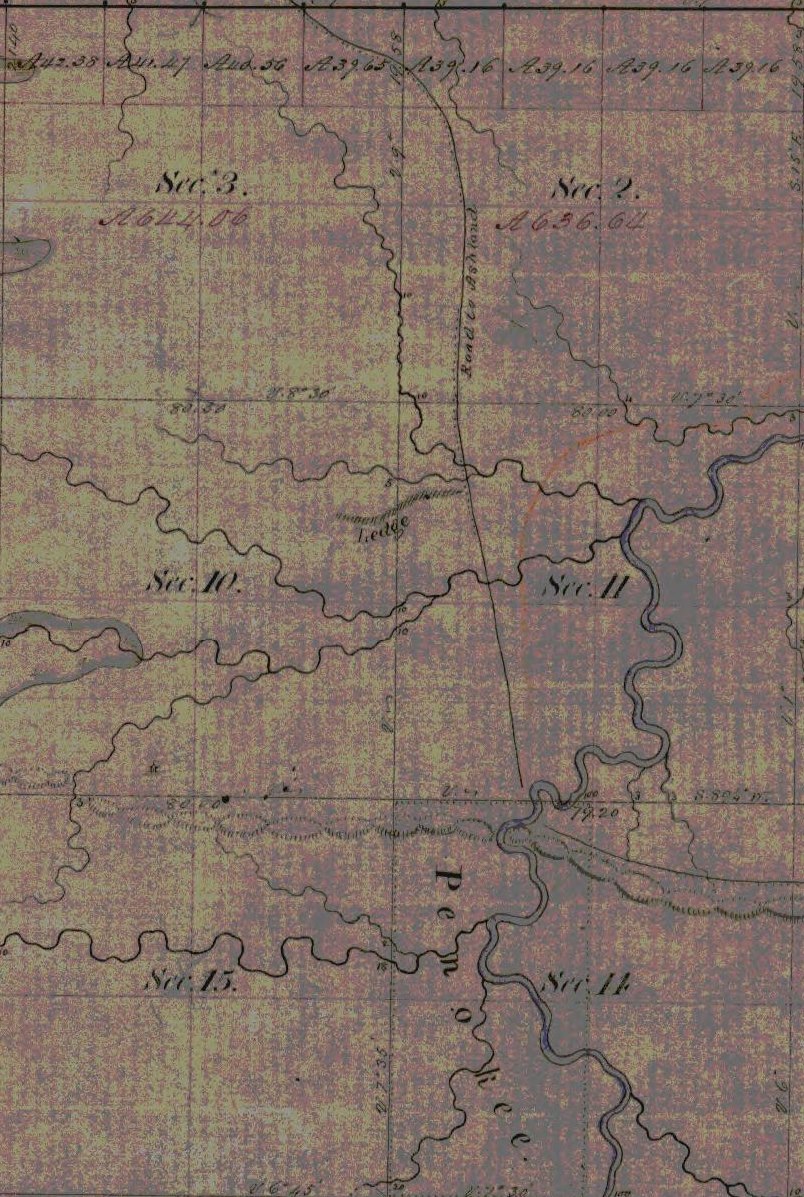
Palmer’s townsite claim located near Penokee Gap on Bad River with the “Coburn Trail” to Ashland. (Detail from Stuntz’s survey during May of 1858)
Subsequent, however, to the close of the survey upon the Transit Line, and the return of Mr. Whitcomb to Milwaukee, several extensive explorations were made to the south and west of the Range, by Gen. Cutler and myself, accompanied by Wheelock, Chas. Stevens, French Joe, (Joe Le Roy, with Big Joe as packer, and a Halfbreed called Little Alic as cook.) in one case nearly to the head waters of the Chippewa. These explorations, which were made with compass and chain, were by far the pleasantest part of my labors that summer, relieving us, as they did, not only of the monotony of camp life while awaiting the completion of the survey, but they also added largely to our knowledge of the topography, as well as the resources of the country south of the Range, then an unbroken wilderness, filled with beaver ponds, many of which were seen, but which is today, thanks to the energy and business tact of the gentlemen in charge of the Wisconsin Central railroad, beginning, metaphorically speaking, to bloom like the rose, and is destined, at no distant period, to take rank as one of the most wealthy and prosperous portions of our fair state. All honor to them for the same.
In this way our time was spent until September, when all homes of Stuntz being able to complete his work that season, unless some special providence should intervene, were abaonded, and preparations for spending the winter upon the Range were at once commenced. Gen Cutler immediately left for Milwaukee after additional supplies, first placing me in charge of the work. A pack train consisting of Stuntz’s pony, (old Jack) and Bascom‘s mare, were at once put upon the trail, in charge of Geo. Miller, a wild, harum-scarum Canuck from Canada West, who quickly stocked the Range with supplies.
But in order that the survey might yet be completed, if possible, additional men were put on, among whom was Wilhelm Goetzenburg, a Mechlinberger, at that time domiciled at Bay City and August Eckee, an old Courier de Bois, including all of our spare men, leaving me to keep camp at Penoka, which I did from about the middle of September to the 12th of October, during which time I saw no one except those who came in from the different claims at stated intervals, for supplies.
I see in your number of December 1, a reference by Hon. Asaph Whittlesey, to my sketch of Sibley and Lazarus, in which he not only confirms my statement, but goes one better in assigning him the belt as the champion liar, also which belt he (Sibley) was subsequently, however, compelled to surrender to John Beck. In consequence of Mr. Whittlesey’s statement I will relate one of Sibley’s yarns, told in the presence of Gen. Cutler, myself, Wheelock and a young man from St. Paul, by the name of Fargo, while eating dinner at his house on the Marengo, in August, 1857, which not only illustrates his powers as a yarn spinner, but the wonderful acoustic properties of his ears as well; being seated at the table, Sibley at once asked a blessing upon the food, for he could pray as well as lie, after which the question was asked by some one, how far it was possible to hear the human voice, upon which Sibley stated that he had not only heard the shouts of the people, but the words of the speaker also, distinctly, that were made at a political barbeque held in Ohio, in the fall of 1844, one hundred miles distant from where he was. Mr. Fargo, although no slouch of a liar himself, was so affected by this statement as to nearly faint, and finally made the remark that if that was not a lie, it came very near it; them lugs of Sibley’s were lugs as was lugs. Can John Beck beat that?

Harvey “Harry” Fargo was a cabinet maker, George R. Stuntz’s neighbor on the Minnesota Point in Duluth, an early mail carrier, and was in the 1853 census of Superior as “Arfargo.” ~ Duluth and St. Louis County, Minnesota; Their Story and People: An Authentic Narrative of the Past, with Particular Attention to the Modern Era in the Commercial, Industrial, Educational, Civic and Social Development, Volume 1, edited by Walter Van Brunt, 1921.
I wish to state at this time, also, a little incident in connection with Eckee, mentioned above, related to me by himself, which was this: That in the fall of 1846, he, in company with three others, in the employ of the Sigourney Lumber Co., of Quebec, ascended the river of the name three hundred miles in an open boat, for the purpose of cutting timber during the winter, and that when within three miles of their journey’s end, their boat was upset in a rapid, they barely escaping with their lives, but with the loss of the boat and all its contents, axes, fishing tackle and supplies. His companions, horrified at their situation, started immediately on their return, following the sinuosities of the river. He however, chose to remain, which he did until spring, never seeing a human face for six entire months. There were four oxen and two horses at the camp the care of which he claimed, kept him from going insane. It is needless to state that his companions were never heard from again. Although this incident has no immediate connection with my history, yet it serves to illustrate the hardships to which the class of men he belonged to are often called to suffer. He could never speak of that winter and its horrors, without tears.
But to return to the Range. Although I can truthfully say that the whole time spent upon the Range was to me one of unalloyed pleasure, yet that engaged during the latter part of September and up to the 20th of October, exceeded all the rest. The forest has, at all times, a charm for me, and the autumnal months doubly so; It is then and then only that its full glories can be seen; and in no country or section of country that it has ever been my privilege to visit, is the handiwork of Dame Nature’s gelid pencil, so grandly displayed as upon Lake Superior, and more particularly is this so, in and around the Range. No doubt the good people of Ashland think the scenery at the Gap very fine, and so it is. Yet that at the west end is far more so. Here the range terminates in a bold escarpment some 300 feet above the surrounding country, giving to an observer an unobstructed view east, west and south, for forty miles.
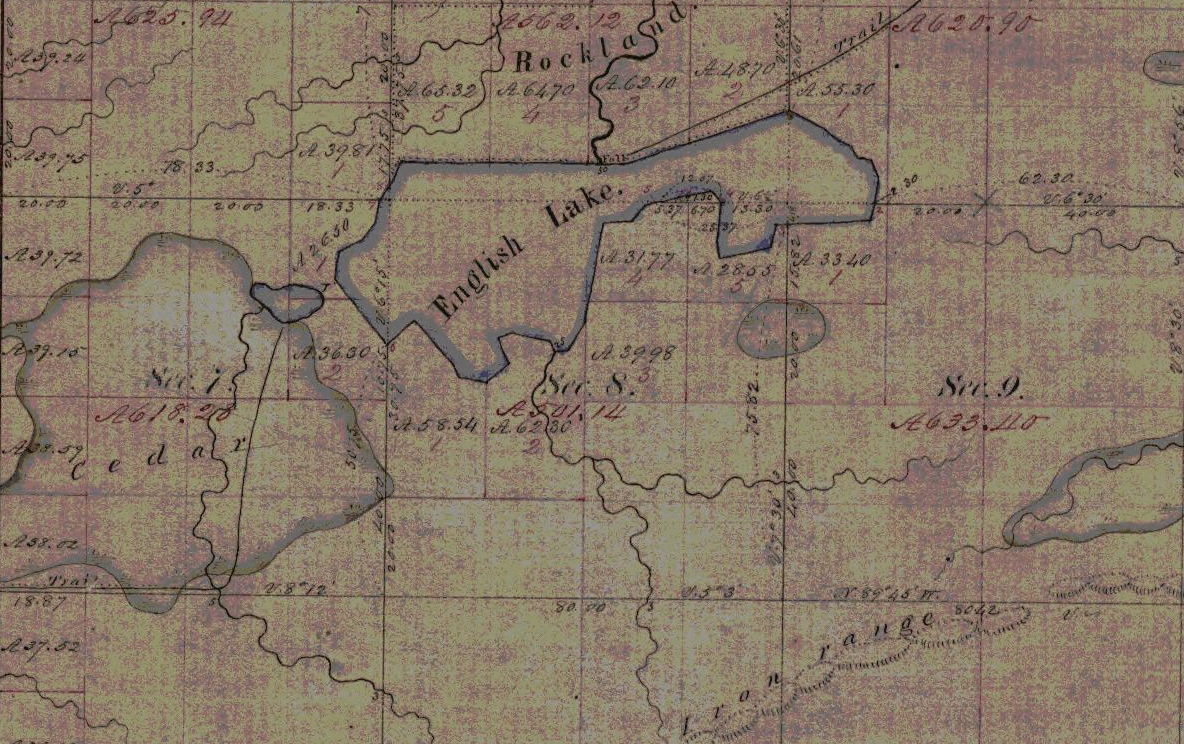
Indian trails to the “Rockland” townsite claim overlooking English Lake and the west end of the Penoka Range. Julius Austrian later claimed the “Rockland” site for his daughter’s estate.(Detail from Stuntz’s survey from May of 1858)
This was my favorite resort in those beautiful autumn mornings, where, seated upon the edge of the bluff, I would feast my eyes for hours upon that matchless panorama. Neither could I ever divest myself of the feeling that, while there, I was alone with God. I have seen, in the course of my life, many landscape paintings that were very beautiful, but never one that could at all compare with the views I enjoyed in the months of October 1857, from the west end of the Penoka Range. J.S.B.
Penokee Survey Incidents: Number IV
February 22, 2015
By Amorin Mello
December 8, 1877.
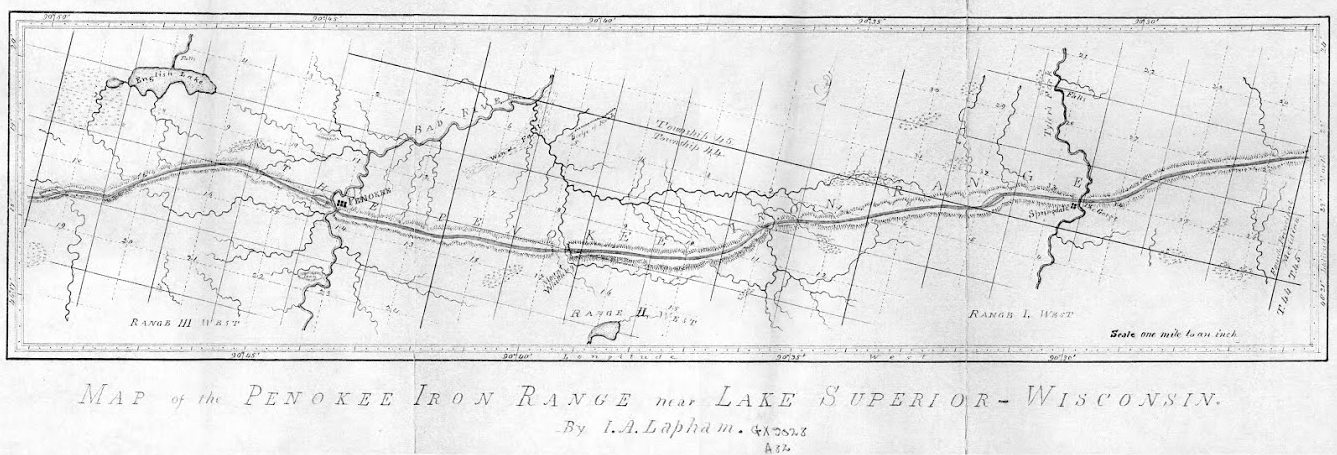
Increase Allen Lapham surveyed the Penokee Iron Range in September of 1858 for the Wisconsin & Lake Superior Mining and Smelting Company. Years later, Lapham’s experience was published as “Mountain of Iron Ore: The buried wealth of Northern Wisconsin“ in the Milwaukee Evening Wisconsin newspaper on February 21, 1887. (Image courtesy of the University of Wisconsin Geography Department)
~ 1978 Marsden Report for US Steel.
~ Railroad History, Issues 54-58, pg. 26
The Penoka Iron Range consists, as is well known, of a sharp ridge, some fifteen miles in length, by from one to one and one half in breadth, with a mean elevation of 700 feet above Lake Superior, from which is a distance about twenty-two miles, as the crow flies, its general trend being nearly east and west, it is densely covered with timber consisting of sugar maple, (of which nearly every tree is birdseye or curly) elm, red cedar, black, or yellow birch, some of which are of an enormous girth, among which are intermixed a few white pine and balsams, for it is traversed from north to south at three different points, by running streams, upon each of which the company had a station, the western being known in the vernacular of the company, as Palmer’s, (now Penoka); the center, as Lockwood’s, in honor of John Lockwood, who was at the time a prominent member of the Company, and upon its executive board; and the eastern, as Sidebotham’s, or “The Gorge.” These were the principal stations or centers, where supplies and men were always kept, and as which, as before stated, more or less work had been done the previous year. Penoka, as which the most work had been done, being considered by far the most valuable. This post was, at the time of my first visit, by charge of S.R. Marston, of whom mention was made in my last, and two young boys from Portsmouth, N.H., who had come west on exhibition, I should say, from the way they acted. They soon left, however, too many mosquitoes for them. “Lockwood’s,” as previously stated, was garrisoned by one man, whose name I have forgotten, and although a great amount of work had been done here as yet, it was nevertheless considered a very valuable claim, on account of the feasibility with which it could be reached by the rail Mr. Herbert had in contemplation to build from Ironton, and which would, in passing along the north side of the Range, come in close proximity to this station; besides, it had the additional advantages of a fine water power. At the east end were two half-breeds employed by the company, and George Chase, a young man from Derby, Vermont, a nephew of ex-Mayor Horace, and Dr. Enoch Chase, of Milwaukee, an employee of Stuntz, who, with James Stephenson, was awaiting the return of Gen. Cutler with reinforcements, in order to continue the survey. Chase subsequently made a claim which he was successful in securing – selling it finally to the Mr. Cogswell, of Milwaukee.
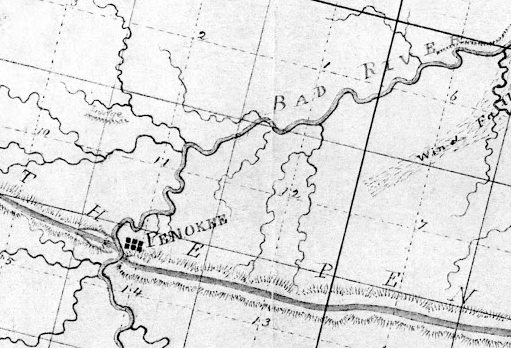
Penoka, aka Penokee, is Palmer’s station near the Bad River Gap.
It is also proper to state in addition to what has been already mentioned, that at, or about this time, a road was opened by Mr. Herbert’s order, from the Hay Marsh, six miles out from Ironton, to which point one had been previously opened, to the Range, which it struck about midway between Sidebotham’s and Lockwood’s Stations, over which, I suppose, the 50,000 tons as previously mentioned, was to find its way to Ironton, (in a horn). For this work, however, the Company refused to pay, as they had not authorized it; neither had Mr. Herbert, at that time, any authority to contract for it, except at his own risk; his appointment as agent having already been revoked; although his accounts had not, as yet, been fully settled. This work, which was without doubt, intended to commit the company still further in favor of Ironton as an outlet for the iron, was done by Samuel Champner, a then resident of Ashland and who if living is probably that much out of pocket today. No use was ever made of this road by the Company, not one of their employees, to my knowledge, ever passing over it.

The location of Lockwood’s station was not mapped by Lapham or by Stuntz. City Creek and Ballou Creek are the two water gaps on either side of Mount Whittlesey, midway between the gaps of Bad River and Tyler’s Fork.
This description will, I think, give your readers a very good understanding of the condition as well as the true inwardness of the affairs of the Wisconsin & Lake Superior Mining and Smelting Co., in the month of June, 1857.
At length, after remaining on the Range nearly three weeks, awaiting, Micawber like, for something to turn up, a change came with the arrival of Gen. Cutler from Milwaukee with the expected reinforcements. Mr. Herbert at once left the Range, went to Milwaukee and settled up with the Company, after which, to use a scriptural expression, “he walked no more with us.”

Springdale is Sidebotham’s station at The Gorge of Tyler Fork’s River.
“A special defense in contract law to allow a person to avoid having to respect a contract that she or he signed because of certain reasons such as a mistake as to the kind of contract.”
~ Duhaime.org
Wheelock, Smith, and McClellan were at once placed upon claims – McClellan in the interest of John Cummings, (whose name by an oversight was also omitted from the list of stockholders, given in my first paper), and Wheelock and Smith for the Company generally. Subsequently, A.S. Stacy, of Canada, was also employed to hold a claim. How well he performed this duty, will be seen further on. This done, the improvements necessary to be made in order to entitle us to the benefits of the preemption law were at once commenced. These improvements consisted of log cabins, principally, of which some twenty in all were erected upon the different claims. These cabins would have been a study for Michel Angelo, or Sir Christopher Wren. They had more angles than the Forty-seventh Problem of Euclid, with an average inclination of fifteen degrees to the Ecliptic. O, but they were “fearfully and wonderfully made,” were these cabins. Their construction embodied all the principle points of architecture in the Ancient as well as Modern–Milesian-Greek, mixed with the “hoop skirt” and Heathen Chimee. Probably ten dollars a month would have been considered a high rent for any of them. No such cabins as those were in exhibition at the Centennial, no sir. Rome was not built in a day, but most of these cabins were. I built four myself near the Gorge, in a day, with the assistance of two halfbreeds, but was not able to find them a week afterwards. This is not only a mystery but a conundrum. I think some traveling showman must have stolen them; but although they were non est we could swear that we had built them, and did.
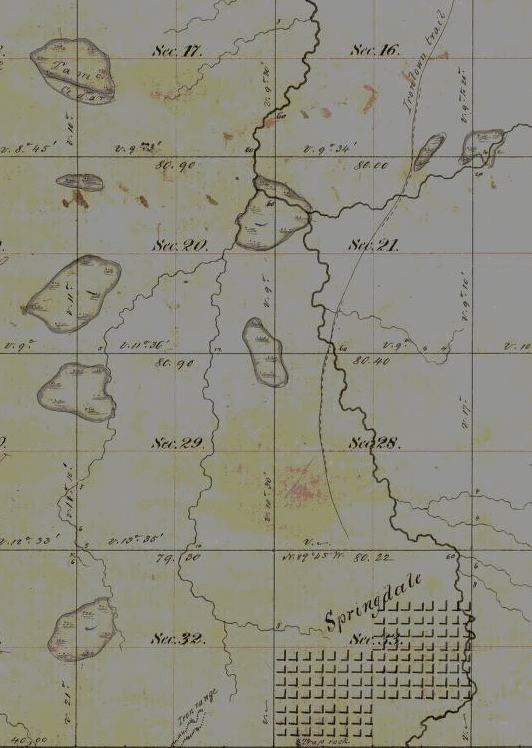
Springdale townsite plan at Sidebotham’s station by The Gorge of Tyler’s Fork in close proximity to the Ironton Trail and Iron Range. (Detail of Stuntz’s survey during August of 1857.)
Three were accordingly platted — one at Penoka, one at Lockwood‘s and one at the Gorge. And in order that it might be done without interfering with the regular survey, Gen. Cutler decided to place S.R. Marston who, in addition to his other accomplishments, claimed to be a full-fledged surveyor, in charge of the work, assisted by Wheelock, Smith and myself. He commenced at the Gorge, run three lines and quit, fully satisfied that he had greatly overestimated his abilities. We were certainly satisfied that he had. A drunken man could have reeled it off in the dark and come nearer the corner than he did. He was a complete failure in every thing he undertook. He left in the fall after the failure of the Sioux Scrip plot. Where he went I never knew. George E. Stuntz was subsequently put upon the work, which he was not long in doing, after which he rejoined Albert on the main work. This main work, however, for the completion of which we were all so anxious, was very much delayed, the cause for which we did not at the time fully understand, but we did afterwards. J.S.B.
Penokee Survey Incidents: Number III
February 15, 2015
By Amorin Mello
December 1, 1877
The Survey of the Penoka Range and Incidents Connected with its Early History.
—
Number III.
~ Detroit Free Press, June 5, 1857
(MarinetimeHistoryoftheGreatLakes.ca)
Friend Fifield:- Upon the first arrival of Mr. Sidebotham and myself at La Pointe, in May, ’57, as previously stated, we took lodging at the “Hotel Angus,” the hospitalities of which we were forced to enjoy until some means could be found to communicate with Gen. Cutler. The Bay, as well as the Lake, was full of ice. In fact, we had been compelled to fight out way from the Sault to La Pointe, through heavy masses of ice, nearly the whole distance – and while upon this subject, I will say, that incredible as the statement may appear to many, yes it is a fact, that ice bergs were aground in front of Austrian’s Warehouse, at La Pointe, on the 4th day of July, 1857, in 36 feet of water, while at the same time a field of floating ice was visible from the Range, beyond which, no water could be seen. I verily believe that the lake was not wholly free from ice that summer.
~ Madeline Island Ferry Line
At length, after remaining at the hotel some eight or ten days, during which Mrs. Angus made us as happy as she could by her kindness and attention, Gen. Cutler came, accompanied by Mr. Herbert. This was the first time that either of us had ever seen Gen. Cutler, but on being informed who we were, he seemed overjoyed to see us, and at once made the proposition to me to take charge of the work, and let him return to Milwaukee, so thoroughly disgusted had he become with the whole thing. To this, however, I would not consent, whereupon he decided to remain, and at once directed Mr. Herbert, who was at that time still in our employ, to return at once to Ironton, taking a part of the supplies, which came up with us, of which they were in great need, Mr. Sidebotham accompanying him, leaving the General and myself at La Pointe. After a long consultation, the General decided to go below, after men and money, wherewith to complete the work; which he did, I following Mr. Sidebotham to Ironton, which place I reached in time to join Mr. Herbert’s party, just starting for the Range, which we reached the second day after leaving Ironton.
During its existence the taxable real estate in the Town of Bayport had increased from nothing to several hundred thousand dollars, principally through entry of pine lands in the south and western portions of the township and also by extensive entries of mineral properties on the Iron Range.”
~ The Lake Superior Country in History and in Story by Guy M Burnham, pg. 179
Omission was made in the list of stockholders given in my first chapter, of Mr. Herbert, whom name should have been included. His stock was, however, by special agreement, unassessable, as it was through his instrumentality, in part, that the existence of this most wonderful metallic deposit was first brought to the knowledge of the Company, and the work of surveying and locating is undertaken. It was this, together with the knowledge that his long residence in the country was supposed to give him, as to the best mode of conducting such an enterprise, that procured for him this aqucession, as well as the appointment of Agent. In justice, however, to Mr. Herbert, it is proper to state, that besides the work done, and money spent at Ironton, the place selected by him as the future shipping point for the iron, (50,000 tons of which he contemplated bringing there that season, at least he stated) considerable work had also been done upon the range during his administration; mostly, however, at Penoka, where a log cabin, yet standing, had been erected, and some thirty acres cleared, the timber being cut into cordwood, to be used in the manufacture of charcoal iron, for the making of which it was contemplated to erect the proper furnaces in the near future. Neither is it any injustice to say, that although perhaps he did the best he could, situated as he was, yet the work did not progress as fast as the company thought it should, the force, while under his control had became badly demoralized. The idea had obtained, if not with him it had with them, that they were working for a company of bloated bondholders,- had a soft thing, and meant to make the most of it; but with the advent of Gen. Cutler, a change came over the spirit of their dreams. Order was quickly brought out of chaos, and the discovery made that a master hand held the reins. Up to this time, May, ’57, the Range had never been visited by any of the company except Messrs. Palmer, Greves and Ripley, those visiting ’56 was one of exploration only, and as Gen. Cutler, Mr. Sidebotham and myself were the only ones that went up there in ’57, or who, in fact, over performed any work there, a short sketch of them will perhaps not be inappropriate in this connection, while awaiting, metaphorically speaking, the arrival of the expected reinforcements from below. And first of Gen. Cutler:

Lysander Cutler of Wisc. (Library of Congress Prints and Photographs Division, Washington, D.C.)
The Order of the County Board creating the Town of Bayport was made March 11, 1856, and the store of Schuyler Goff, in Bay City (Ellis Division) was designated as the place for holding the first election for town officers, the election to be held Tuesday, April 1, 1856.
The Town of Bayport comprised all that portion of LaPointe county (since changed to Ashland County) lying south of the north line of Town 48 North; in all over sixty-eight Townships, including the Bad River reservation, which was, on the 8th day of November, 1859, made a precinct by itself.
At the first election held April 1, 1856, there were 24 votes cast — resulting as follows; for Chairman of the Town Board, Schuyler Goff (later appointed County Judge, an office he held for a year or more). The other members of the town board being J.T. Welton and Asaph Whittlesey. Schuyler Goff, chairman elect, was the first officer to qualify, his oath of office being administered by Asaph Whittlesey, Justice of the Peace.”
~ The Lake Superior Country in History and in Story by Guy M. Burnham, pg. 179
Gen. Lysander L. Cutler was, in many respects, a remarkable man. In person he was rather above the medium height, large head, large, dark eyes, heavy eyebrows, a sure indication of a good memory, as well as firmness, dark hair, inclined to stand erect; walked, usually with a slow and dignified step, with his eyes apparently fixed upon the ground, as if in deep thought, leading an observer to suppose that he was not cognizant of what was being enacted around him. This, however, was a mistake; nothing escaped his observation. In fact, he seemed to know your very thoughts; neither could anyone be in his presence ten minutes without feeling the magnetic influence of his iron will. Was any dangerous work to be undertaken, he would, if within call, be the first one consulted, and appointed to take charge of it. He was a born leader. He was not only one of the best business men I ever knew, but he was also a leader in politics. A good judge of men, sharp and keen, and who ever undertook to circumvent him was sure to some grief, as some of the people who went about the Range did that summer, have no doubt, an abiding recollection. I refer now to Hall, of St. Paul, Minnesota, who undertook, with the assistance of S.R. Marston, a treacherous employee of the Company, and Schuyler Goff, of Racine, at that time a resident of La Pointe, to beat us out of our rights, by entering the lands upon the Range with Sioux Scrip, in which nefarious attempt they would no doubt have succeeded, but for him. He was more than a match for all of them, and they finally retired from the contest in disgrace. Such was Gen. L.L. Cutler, a firm friend, but an uncompromising enemy. Never will the writer forget the happy days spent with him upon the Range in the summer of 1857. We were like brothers, and our friendship was never interrupted by even a passing cloud. We fraternized at once upon our first meeting, and fought the battle for the possession of the Range together, never doubting our ultimately winning the prize. He has gone to his reward, in that bright world beyond the River; yet “in memory’s ever sleepless eye” he is often present with me.
Mr. Sidebotham, however, who was by birth an Englishman, and by occupation a cabinet maker, was of a different mould, and although an honest man, was by his habits of life, wholly unfitted for such an undertaking, and of no practical use whatever, and although not constantly at the Range, he was while there, an actual incumbrance, some one having to remain with him constantly; he could not accustom himself to the woods and its annoyance; was always complaining of his food, which of course soon brought him into contempt with the men. One of his peculiarities was a great fondness for sugar, particularly in his tea, which he could not, or thought he could not, drink without it, and as this was an article not always plenty, the boys would sometimes hide it, in order to see him hunt for it, which he would do most persistently until he found it. I remember on one occasion they hid it in a tree, and as he could not climb or chip, although in plain sight he could not get it. They had, as they expressed it, the “dead wood” on him that time. He finally became so afflicted with boils, on account of his sedentary habits and change of food, that it was with the utmost difficulty we were able to get him from the Range to Ashland, in December, where he remained until sufficiently recovered to be able to travel, after which he reached home in safety. He was the last to sell his stock, which, however, he finally did, to the late Simeon N. Small, claiming that as it was through much tribulation he had obtained it, he would not part with it except at his own price, which I believe he got. This purchase, although it gave Mr. Small a controlling interest in the stock, was ultimately the cause of his financial ruin. J.S.B.
[from same issue of The Ashland Press]
Whittlesey on Early Times in Ashland.
—
~ The Monthly Magazine; A Monthly Journal of American History, Volume 9, 1888, pg. 18
Editor Ashland Press.- In your last issue of the 24th inst., your correspondent “J.S.B.,” in his Early Recollections of Ashland, makes very portient reference to two of Ashland’s prominent citizens of early days, known as “Sibley” and “Lazarus,” stating that in laziness they were competitors for the belt. My own recollection tells me that of this same Sibley had gained some notoriety for telling big yarns, but in this I think he ultimately gave way to John Beck. On one occasion, Sibley arrived in town on foot and alone, and entering a crowd of the boys, addressing himself to Lazarus, said: “Lazarus, I want you to go and help me get my team into town. It now stands in the mud near the head of Main St.” to which Lazarus replied, “I’ll go, if you will first tell us the biggest lie you ever told.” Sibley responded, “Lazarus, I don’t lie.” Lazarus says, “That will do, I’ll go and help you.” I am personally knowing to the fact that this same Lazarus has been known at several different times when he was “keeping back” in cold winters, to remain in beds two nights and the intervening day, to avoid the necessity of cutting wood and cooking a meal; nevertheless, “George E.,” as Lazarus was otherwise known, was a man of much more than usual ability, and was a surveyor had few superiors. We were all glad to have him show himself, and to witness his alacrity in getting upon the “off side” of any proposition that might be submitted.
I hope that brother “J.S.B.” may be heard from again, and that he may tell us more in regard to the crowd of pre-emptors imported by himself and others, (modesty forbids me to mention who,) tending almost invariably to bankruptcy. You, sir, were at the head of some “noble boys,” and you, too, had your share of tough cases. Should I sufficiently recover my strength to enable me to do so, I may hereafter open out on my “Early Recollections” of the place, and if I do attempt it, let all “stand from under,” for “At the siege of Barlisle, I was there all the while.”
W.
Bayfield, Wis., Nov. 24, 1877.
Penokee Survey Incidents: Number II
February 12, 2015
By Amorin Mello
November 24, 1877.
The Survey of the Penoka Range and Incidents Connected with its Early History
—
Number II.
Friend Fifield:– Notwithstanding the work upon the Range was delayed very much on account of the unwoodsman like conduct of the Milwaukee boys, referred to in my first communication, yet it did not cease,- the company having a few white men, previous employed, as well as a large number who were “to the Mannor born” that did not show the “white feather” on account of the mosquitos, gnats, gad flies and other vermin with which the woods were filled,– most of whom remained with us to the end.
Prominent among these last named was Joseph Houle, or “Big Joe” as he was usually called,– a giant halfbreed, (now dead), who was invaluable as a woodsman and packer. Some idea of Joe’s immense strength and power of endurance may be formed from the fact that he carried upon one occasion the entire contents, (200 lbs.) of a barrel of pork from Ironton to the Range without seeming to think it much of a feat. Among the party along on this trip was a young man taking his first lesson in woodcraft, whose animal spirits cropped out to such a degree that the leader caused to be placed upon his back a bushel of dried apples (33 lbs.), simply to keep him from climbing the trees, but before he reached the Range, his load, light as it was, proved too much for him, when Joe, in charity, relieved him of it, adding it to his own pack – making it 233 lbs. This was, without doubt the largest pack ever carried to the Range by any one man. There was an Indian, however, in the employ of the company, as a packer, (“Old Batteese“), who left Sidebotham‘s claim one morning at 7 A.M., went to Ironton and was back again to camp at 7 P.M. with 126 lbs. of pork, having traveled forty-two miles in ten hours. This was in July ’57, and was what I considered the biggest day’s work ever done for the company. The usual load, however, for a packer, was from sixty to eighty pounds.

Ironton townsite claim at Saxon Harbor with trails to Odanah and the Penoka Iron Range. (Detail from Wisconsin Public Land Survey Records)
The halfbreeds were sulky and mutinous at times, giving us some trouble, until Gen. Cutler, who was a strict disciplinarian, gave them a lesson that they did not soon forget and which occurred at follows:
The General and myself left Ironton just before the removal of our supplies to Ashland, with four of these boys, with provisions for the Range, to be delivered at Lockwood’s Station. But upon reaching Sidebotham’s, two of them refused to proceed any further, threw down their packs, and started on their return to Ironton. The General’s blood was up in a moment, and directing me to remain with the others until he returned, at once started after them. Reaching Ironton at 11 A.M., about an hour after their arrival, they were quite surprised at seeing him, but said nothing. The General at once directed Duncan Sinclair, who had charge of the supplies at that time, to make up two packs of one hundred pounds each, with ropes in place of the usual leathern strap, which was quickly done, the “rebels” looking sullenly on all the while. When all was ready he drew his revolver and ordered them to pick them up and start. They did not wait for a second order, but took them and started, he followed immediately behind. Nor did he let them lay them down again until they reached Lockwood’s at sunset, a distance of twenty-six miles. – That evening they were the most completely used up men I ever saw on the Range, and from that time forward were as submissive and obedient as could be desired. After that we never had any trouble. It was a lesson they never forgot.
Among the whites referred to in this article, was James Stephenson, a young man from Virginia, who came up with Stuntz as a surveyor. He was of light build, wiry and muscular – full of fun – very excitable and nervous, – but a good man for the woods. He had some knowledge of the compass, but not sufficient education to make a good surveyor. “Jim” got lost once and was out three days before he came into camp, which he did just as the party was starting out to find him. “Jim” would not have made a good rope walker. He was no Blondin. On the ground he was all right, but let him attempt to cross a stream of water, be it ever so small, upon a log, no matter if the log was six feet in diameter, and he would fall in sure. He fell in twice while lost and came near perishing with wet and cold in consequence of it. He left the company in the fall of ’57.
But the best man we had on the range that summer, as a surveyor, (except Albert Stuntz, and I very much doubt if he could beat him), was George E. Stuntz, a nephew of Albert’s, known among the boys as “Lazarus.” He was tall and slim, with a long thin face, blue eyes, long dark brown hair, stooped slightly when walking; walked with a swinging motion, spoke slow and loud – was fond of the woods, prided himself on his skill with the compass, and was, I think, the laziest man at that time in the county, except “Sibly,” who could discount him fifty and then beat him. But notwithstanding all this Albert could not have completed his survey that season without him. His lines never required any corrections. George was a singer – or thought he was, which is all the same. The recollections of some of his attempts in this line almost brings tears to my eyes from laughter, even now. Nearly every night in camp, the boys, after getting into a position where they could laugh without his seeing them, would coax him to sing. His favorite piece was a song called “The Frozen Limb.” What it meant I have no idea, and do not think he had. One verse of this only can I recall to mind, which ran as follows:
“One cold, frosty evening as Mary was sleeping –
Alone in her chamber, all snugly in bed. – She woke with a noise that did sorely affright her.
‘Who’s that at my window?’ she fearfully said.”
You can easily imagine how this would sound when sung through the nose in the hard shell style – each syllable ending with a jerk, something like this:
“Who’s-that-at-my-win-dow-she-fear-ful-ly-said-ud.”
George had a suit of clothes for the woods made of bed ticking, cap and all complete – all but the cap in one piece. The cap was after the “Dunce” pattern, ie, it ran to a point. The stripes instead of running up and down as they should have done, ran diagonally around him, giving him the appearance of a walking barber’s pole. He was a nice looking boy – he was.
Shortly after donning this beautiful suit, while crossing the Range, he suddenly found himself face to face with a full grown bear. It was no doubt a surprise to both parties,– it certainly was to the bear. For he took one square look and left for distant lands at a speed which, if kept up, would have carried him to Mexico in two days. “Not any of that in mine” was probably what was passing through his massive brain, but he made no sign. The boys who were surveying some fifteen miles south of the Range claimed to have met him that day, still on the jump. J.S.B.
Penokee Survey Incidents: Number I
February 8, 2015
By Amorin Mello
The Ashland Weekly Press is now the Ashland Daily Press.
November 10, 1877
For the Ashland Press
The Survey of the Penoka Iron Range and Incidents Connected With Its Early History.
—
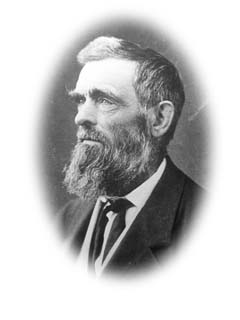
James Smith Buck (1812-92) “For 19 years, Buck was a building contractor, erecting many of the city’s earliest structures. He is best known for his writings on early Milwaukee history. From 1876 to 1886, he published a four-volume History of Milwaukee, filled with pioneer biographies and reminiscences.” (Forest Home Cemetery)
Friend Fifield:- Being one of the patrons and readers of your valuable paper, and having within the past year noticed several very interesting and well written articles entitled “Early Recollections of Ashland” in its columns, and more particularly one from a Milwaukee correspondent, in a recent number, in which my name, with others, was mentioned as having done some pioneer work in connection with your young city, I thought that a few lines in the way of a “Reminiscence” from me as to how and by whom the Penoka Range was first surveyed and located, might be interesting to some of your readers,- if you think so, please give this a place in your paper and oblige.
Truly Yours,
J.S. Buck.
I first visited Lake Superior in the month of May, 1857, in the interest of the Wisconsin and Lake Superior Mining and Smelting Co., a charter for the organization of which had been procured the previous winter.– This company was composed of the following gentlemen: Edwin Palmer, Gen. Lysander Cutler, Horatio Hill, Jas. F. Hill, Dr. J.P. Greves, John Lockwood, John L. Harris, John Sidebotham, Franklin J. Ripley and myself. Edwin Palmer, President, J. F. Hill, Secretary – with a capital of (I think) $60,000. Our first agent was Mr. Milliam Herbert, with headquarters at Ironton, where some five thousand dollars of the company’s money was invested in the erection of a block-house and a couple of cribs intended as a nucleus for a pier – and in other ways – all of which was subsequently abandoned and lost – the place having no natural advantages, or unnatural either, for that matter.– But so it is ever with the first and often with the second installments that such greenies as we were, invest in a new country; for so little did we know of the way work was done in that country that we actually supposed the whole thing would be completed in three months and the lands in our possession. But what we lacked in wisdom, we made up in pluck — neither did we “lay down the shubble and de hoe,” until the goal was reached and the Penoka Iron Range secured – costing us over two years time and $25,000 in money.
The company not being satisfied with Mr. Herbert as agent, he was removed and Gen. Cutler appointed in his place, who quickly selected Ashland as headquarters, to which place all the personal property, consisting of merchandise principally, was removed during the summer by myself upon Gen. C.’s order – and Ironton abandoned to its fate.
~ Captain Robinson Derling Pike (Bayfield 50th anniversary celebrations)
The company at this time having become not only aware of the magnitude of the work they had undertaken, but were also satisfied that Ashland was the most feasible point from which to reach the Range, as well as the place where the future Metropolis of the Lake Superior country must surely be — notwithstanding the “and to Bayfield“ clause in that wonderful charter of H.M. Rice.
The cost of getting provisions to the Range was enormous – it being for the first season all carried by packers – every pound transported from Ashland to the Range costing from five to eight cents as freight.
This was my first experience at surveying as well as Mr. Sidebotham’s, and although I took to it easily and enjoyed it, he never could. He was no woodsman; could not travel easily, while on the other hand I could outwalk any white man except S.S. Vaughn in the country. He was then in his prime and one of the most vigorous and muscular men I ever met; but I think he will tell you that in me he found his match.
By our contract with Albert Stuntz we were not only to pay him a bonus equal to what he received per mile from Government, but we were also to furnish men for the work and see him through. In accordance with this agreement some eighteen men and boys, to be used as axemen and chainmen, were brought up from Milwaukee who were as “green as gaugers” and as the sequel proved, about as honest. A nice looking lot they were, when landed upon the dock at La Pointe, out of which to make woodsmen. I think I see them now, shining boots,– plug hats, with plug ugly heads in them, (at least some of them had), the notorious Frank Gale, Mat. Ward and one or two other noted characters being of the number. Their pranks astonished the good people of La Pointe not a little, but they astonished Stuntz more. One half day in the woods satisfied them – they were afraid of getting lost. In less than two weeks they had nearly all deserted and the work had to be delayed until a new squad could be obtained from below.
But I must close. In my next I will give you an account of my life on the Range. J.S.B.
An Interesting Family History
February 2, 2015
By Amorin Mello

1856 Colton Map of Prussia and Saxony, Germany (WikiMedia.org).
This is a reproduction of “An Interesting Family History” from The Jews of Illinois : their religious and civic life, their charity and industry, their patriotism and loyalty to American institutions, from their earliest settlement in the State unto the present time, by Herman Eliassof, Lawrence J. Gutter Collection of Chicagoana (University of Illinois at Chicago), 1901, pages 383-386:
The goal of this post is to provide genealogical information about the illustrious Austrian and Leopold families as a companion to the Joseph Austrian Memoir and as a reference for future stories. In this post, we will explore events within and outside of the Chequamegon region for context about this family’s history. We recommend reading this Opinion by Andrew Muchin, director for the Wisconsin Small Jewish Communities History Project, for more information about Jewish immigration to Wisconsin in general. Coming soon to Chequamegon History, we will explore some of Julius Austrian’s adventures and his impact upon the Village of La Pointe, the La Pointe Iron Company of the Penokee Mountains, and the Lake Superior Chippewa.
——-
AN INTERESTING FAMILY HISTORY.
——-
The two families of Austrian and Leopold have been prominent in Chicago for many years. They came to Chicago from the Lake Superior region and formed the Lake Michigan and Lake Superior Transportation Co., engaging in freight and passenger transportation on Lake Michigan and Lake Superior, to Mackinac, Sault Ste. Marie and Duluth and did an extensive business. For a number of years, until recently, their luxuriously furnished passenger boat, Manitou, has been extensively patronized by summer pleasure seekers, who wished to enjoy the cool and delightful climate of the Lake Superior region. The boat was then sold to a company, in which Mr. Nathan F. Leopold still holds the largest interest. Mr. N. F. Leopold is the son of one of the Leopold brothers who settled in Mackinac in the early forties, and were the first Jews in that region. He married a daughter of the late Mr. Gerhard Foreman, who is related to the Greenebaum family, and who was a prominent banker of Chicago, the founder of the Foreman Bros. Banking Co., a. very popular financial institution of today.
The history of this old Jewish family, favorably known as successful merchants in the Lake Superior region and in Chicago, appeared in 1866, in the Portage, Mich., Gazette, and was copied in the American Israelite under date of April 13th, 1866. We believe that the history of this popular and highly respected family will be read with interest by their many relatives and friends, and we therefore publish it here. They were brave, honest and upright business men, and the story of their pioneer life in a sparsely settled region, of their struggles, hardships and ultimate success will serve as an encouraging example for many a young beginner.
Following is their history as we find it in the American Israelite:
A BAND OF BROTHERS.
Dissolution of the Oldest Merchant Firm on Lake Superior – The Leopold Brothers – Sketch of their Operations – A Pioneer History.
Abraham Isaac Oestreicher &
Malka Heule
Falk Austrian
Julius Austrian
Marx Austrian
Babette Austrian
Joseph Austrian
Ida Austrian
Fanny Austrian
Samuel Solomon Austrian
Bernard Austrian
Mina Austrian
Jette H.S.H Freudenthaler
Louis F. Leopold
Aaron F. Leopold
Henry F. Leopold
Samuel F. Leopold
Hannah Leopold
Karolina Freudenthaler
Ascher Freudenthaler
In our last issue we made a brief notice of the dissolution of the well known firm of Leopold & Brothers, doing business in Hancock, Chicago and Eagle River, the oldest business firm on Lake Superior after a successful existence of over twenty years. The firm has been composed of Louis F., Henry F., Aaron F., and Samuel F. Leopold and Joseph, Julius and Samuel Austrian, the latter being the last admitted partner, and not so intimately connected with the history of the firm. From the very inception of business transactions within the wilds of Lake Superior down to the present day, the firm of the brothers has been identified with the struggles, hardships, successes, and all the varying interests of the country, have participated with its good and ill fortunes, many times carrying burdens that less confident competitors shrank from bearing; never once fearing that all would be well in the end, and after gathering a rich reward retired from the field, leaving an untarnished history, and brilliant record as an incentive to their successors.
~ Joseph Austrian Memoir
Louis Leopold + Babette Austrian
Hannah Leopold + Julius Austrian
Henry Leopold + Ida Austrian
Samuel Leopold + Babette Guttman
Joseph Austrian + Mary Mann
Solomon Austrian + Julia Mann
The Messrs. Leopold are natives of the little town of Richen, in the Great Duchy of Baden, Germany, and there received the elementary education which fitted them to become the shrewd and successful merchants they have proven to be. They first began business life as clerks in an ordinary country store, as it may not be inaptly termed, as Richen was but a small place, having a less population than either Hancock or Houghton, here on Portage Lake.
Early in the year 1842, Louis, the elder brother, who has since become the “father” of the firm, left his home to try his fortunes in the New World, with a stout heart, and but a very moderate amount of means whereon to build up a fortune, upon arriving in this country he very shrewdly foresaw that the great West, then but just attracting attention, was the most promising field for men of enterprise and limited capital, and instead of joining in the precarious struggle for position and existence, even so peculiar to the crowded cities of the Eastern states, he at once wended his way to Michigan, then considered one of the Western states.
~ Joseph Austrian Memoir, pg. 9
Early in the year 1843 he opened a small depot for fishermen’s supplies on the island of Mackinac, providing for them provisions, salt, barrels, etc., and purchasing the fish caught, and forwarding them by vessels to better markets. The business could not have been a very extensive one, for when joined by his brothers three years afterward, their united capital is stated as being but little more than $3,000, but which has since been increased by their energy, prudence and foresight, at least one hundred fold.
In the year 1844, Louis was joined by his brother Henry (Aaron and Samuel serving their time in the store of Richen), who for a short time became his assistant at Mackinac. At that time there was but one steamboat plying on the headwaters of Lake Huron and Michigan, the old General Scott, which made regular trips between Mackinac and Sault Ste. Marie.
By the 1850’s the Leopolds, Samuel, Henry, and Aaron, and their brother-in-law Julius Austrian had moved westward from Mackinac into Lake Superior and had settled in the Wisconsin island town of La Pointe, not too far from present-day Duluth. They helped also to found the nearby mainland town of Bayfield. Nevertheless the Leopolds and Austrians were not Wisconsin’s Jewish pioneers; Jacob Franks of Montreal had bought peltries and traded with the Indians since the early 1790’s using Green Bay as his base. The town, the oldest in that part of the country, was strategically located on the water highways linking the Mississippi to the Great Lakes and the eastern tidewater. At first Franks was an agent for a Canadian firm; by 1797 he was on his own. He enjoyed several years of prosperity before the game, the furs, and the Indians began to fade away and before he had to cope with the competition of John Jacob Astor’s formidable American Fur Company. Franks was an innovative entrepreneur. Around the turn of the century he built a blacksmith shop, a dam for water power, a saw and grist mill, ran a farm and began a family of Indian children, before he finally went back to Mackinac and then to Montreal where he rejoined his Jewish wife.”
~ United States Jewry, 1776-1985, Volumes 1-2 by Jacob Rader Marcus, pg. 94
Shortly after his arrival at Mackinac, Henry conceived the idea of going to La Pointe with a small stock of goods, and attending the Indian payment, an enterprise never before undertaken by a trader from below the Sault. At that time Lapointe was a much larger place than it is now, was the principal station of Lake Superior, of the American Fur Company and the leading business point above the Sault. Every fall, the government disbursed among the Indians some $40,000 to $50,000, which before the arrival of the Leopold Brothers found its way almost entirely into the coffers of the Fur Company.
In the latter part of the spring the brothers left Mackinac on the old General Scott, and went to the Sault with their goods, and after much difficulty succeeded in chartering the schooner Chippewa, Captain Clark, to take them to Lapointe for $300. There were but four small schooners on Lake Superior that season, the Chippewa, Uncle Sam, Allegonquin and Swallow. The trip from the Sault to Lapointe occupied some three weeks, but one stop being made at Copper Harbor, which was then beginning its existence. The building of Ft. Wilkins was then going on. Little or no thought of mining then occurred to the inhabitants, and did not until two or three years subsequently.
Arrived safely at Lapointe, they at once opened a store in opposition to that of the Fur Company, and were, much to the surprise of the latter, the first white traders who undertook an opposition trade with the Indians. They sold their goods for furs, fish, etc., and prospered well. In the fall they were joined by Julius Austrian (now at Eagle River) and Louis leaving him with Henry, returned to Mackinac.
Before Minnesota became a territory in 1849 it was for a time part of Wisconsin and Iowa territories. In Minnesota as in most states there was a wave of Jewish pioneers who came early, often a decade or more before some form of Jewish institutional life made its appearance. Jewish fur traders roamed in the territory from the 1840’s on, bartering with the Indians on the rivers and on the reservations. They were among the first white settlers in Minnesota. Julius Austrian had a trading post in Minnesota in the 1840’s and he may once have owned the land on which Duluth now stands. In 1851 in the dead of winter he drove a dog sled team loaded with hundreds of pounds of supplies into St. Paul; his arrival created a sensation.”
~ United States Jewry, 1776-1985, Volumes 1-2 by Jacob Rader Marcus, pg. 100-1
In the summer of 1845 Henry also returned to Mackinac, leaving Julius to attend to the business at Lapointe. He remained in Mackinac until the year 1846, when Aaron and Samuel came out from Germany and joined them at that place. The four brothers at once united their fortunes; in fact in all their business career they do not appear to have thought of dividing them. Everything they had was, from the outset, common property, and each labored for the general welfare. They appeared to have fully understood the truthfulness of the adage, that, in “Unity there is strength,” and however varied and scattered may have been their operations, the profits went into the general fund.
In the season of 1846 Henry and Samuel went to Green Bay, and opened a store in Follett’s block, remained there until early in 1848, but did not succeed as well as they anticipated. Green Bay was then a miserable place in comparison with what it is now, and its growth very much retarded by the grasping policy of the site owners, John Jacob Astor and Mr. Whitney, a brother of the present postmaster. They would not sell lots at anything near what was considered a reasonable figure, and the result was that after many vain endeavors to secure property very many business men left for other places, holding out better inducements for settlement. While at Green Bay, Samuel began the study of the English language, under the tutelage of a young Methodist minister who considered himself liberally rewarded by return instruction in the German language.

“This represents the home of Julius and Hannah Austrian, after their marriage in the spring of 1848. Premises located at La Pointe, Madeline Island, Lake Superior. Resided there 19 years, happy and contented among Indians, Half-breeds and two Missionaries who represented the inhabitants of the island. Photograph taken summer of 1850.”
~ Julius Austrian Papers (Madeline Island Museum)
Solomon Austrian“also went up to La Pointe by advice of brother Julius where he stayed but a short time…”
~ Joseph Austrian Memoir, pg. 76
Early in 1847, Joseph Austrian, the subsequent brother-in-law of the Leopolds, came out from Germany, and joined his brother, Julius, at Lapointe, where he remained until the next spring, when he joined Henry Leopold at Eagle River, who had opened a small store in an old stable, the habitation of one cow. A partition was put up, and about two-thirds of her ladyship’s parlor fitted up for the sale of dry goods, groceries, etc. The shanty stood on the lot now owned by John Hocking, the second from the corner in the turn of the road down to the old bridge across Eagle River.
Was Simon Mandelbaum of Eagle River related to M.H. Mandelbaum of Bayfield?
There was then but one opposition store in Eagle River, that of Messrs. Senter and Mandlebaum, with whom Henry and Joe entered into lively competition for the trade of the place.
The same season Samuel joined Aaron and Louis at Mackinac, where their business had materially increased, and remained there until the season of 1855, when they left and returned to Lake Superior. Louis had previously left and established himself at Cleveland, where he remained until he went to Chicago in the fall of 1862. During this period he acted as the purchasing agent of the brothers on the lake.
Stories about the early days of the Keweenaw copper mining industry are told in the Memoirs of Doodooshaboo (Joseph Austrian).
In the fall of 1855 Samuel started a branch store at Eagle Harbor in a small shanty not more than twenty feet square, situated on the lot now owned by Hoffenbecker, and the shanty now forms a part of his building. At the time there were five mines working in that vicinity, as follows: Copper Falls, S. W. Hill, agent; Northwestern (Pennsylvania), M. Hopkins, agent; Summit (Madison), Jonathan Cox, agent; Connecticut (Amygdaloid), C. B. Petrie, agent.
The Copper Falls and Northwest were the two great mines of the District, the others doing but little beyond exploration at that time.
In 1856 Samuel bought out Upson and Hoopes, who had been doing a good business in the building now occupied by Messrs. Raley, Shapley & Co., and was that season joined by Aaron, who, since leaving Mackinac, had been spending his time with Louis, in Cleveland. Samuel was appointed postmaster at Eagle Harbor, and acceptably filled the office till his departure in 1859.
Julius Austrian advertisements
(Bayfield Mercury, August 22nd, 1857)

The three brothers, Henry, Samuel and Aaron, and their brother-in-law, Jos. Austrian, might now be said to be operating in the same field with the elder brother, Louis, at Cleveland, as their ever wide-awake purchasing agent. For a year or two they prospered as well as they could desire, but the hard times of 1857-8 tried them pretty severely, but by the most adroit management they came through safely. At Eagle River, in 1857, there were four mines at work, the Garden City, Phoenix, Bay State and Cliff. This was after the great silver excitement at the Phoenix, and when the reaction had fully set in. The assessments were grudgingly paid, if at all, and the workmen at the mine that winter were paid in orders on Leopold Brothers, who paid them in goods and currency. To enable the company to get along as easily as possible they took thirty day drafts on the treasurer in Boston, which were paid when due and presented. As the winter passed, the time of the drafts were extended from thirty to sixty, ninety, and finally to one hundred and twenty days, and in the spring, the firm was astonished by a notification that the drafts had gone to protest. The mine then owed them about $20,000, a large sum, especially when it is considered that they were also carrying nearly $10,000 for the Garden City Mine, which was also struggling along like the Phoenix.
The first news received by the public of the protesting of the drafts was communicated by the clerk of one of the steamboats, and created no small amount of excitement, especially among the employees of the mine, who naturally became fearful and clamorous for their back pay. The Leopold Brothers told them to go on and work, and they would be responsible for their pay. This quieted them, and the work of the mine continued as before.
Upon receiving information of the protesting of the Phoenix drafts, Samuel was at once dispatched to Boston to consult with the company about their payment. To secure themselves they could have attached the mining property, improvements and machinery, but such was their confidence in the integrity of the agent, Mr. Farwell, President, Mr. Jackson, and Secretary, and Treasurer, Mr. Coffin, that this was not done. Upon his arrival in Boston, Samuel found that Mr. Farwell had held a consultation with the Directors, and in his most emphatic manner demanded that Messrs. Leopold should be reimbursed the money they had advanced for the mine.
~ The Mining Magazine: Devoted to Mines, Mining Operations, Metallurgy, &c., &c., Volume 2, 1854, pg. 404.
Another meeting was called and Samuel presented a statement of the amount due his firm, and inquired what they intended to do. It was difficult for them to say, and after many long consultations no definite course of action was decided upon. Believing that delays were dangerous Samuel proposed that he and his brothers would take the property in satisfaction of their demand, pay off the Company’s indebtedness, amounting to nearly $10,000, and perhaps pay them a few thousand dollars on the head of the bargain.
Another consultation followed this offer, and it was finally concluded that if a merchant firm considered the property sufficiently valuable to pay therefor nearly $40,000, it must be worth at least that much to the company. Some three thousand shares of Phoenix stock had been forfeited for the non-payment of an assessment of $1.50 per share, and these shares were offered Mr. Leopold in satisfaction of his claim. He, of course, declined, saying he would take the whole property, or nothing. Another consultation was held and a meeting of stockholders was called, an assessment was levied and In a few days enough paid in to liquidate his demands, and he started for home mentally determining that in future the Phoenix should give sight drafts for all. future orders, and that they would no longer assume, or be identified with its obligations. It required no small amount of finesse to make the discouraged stockholders of the Phoenix believe that there was a sufficiently valuable property to further advance $2 or $3 per share on its stock, but the cool offer to take its property for its indebtedness, completely assured them and saved the Messrs. Leopold their $20,000.
But it is said ill fortune never comes singly; and this was true of the affairs of Leopold & Brothers. Samuel had scarcely arrived in Cleveland when Louis informed him that their Garden City drafts had been protested and the same night he hurried on to Chicago to provide security for the indebtedness. Arriving there he did not find the Company as tractable as the Phoenix, and after much parleying found the best they were willing to do was to give him a mortgage on their stamp mill, as security for the $10,000. Very correctly deeming this insufficient, he returned home, and got out an attachment for the whole property of the Company. This had the desired effect, and the claim was secured by a mortgage and the attachment withdrawn. Shortly afterward the mine passed into the hands of a new party of men, with Judge Canton at their head, and in a short time the claim was satisfactorily adjusted.
Julius Austrian, along with Martin Beaser and John W. Bell, attended the New State Convention of Lake Superior to represent La Pointe County ~ Superior Chronicle, August 3rd, 1858.
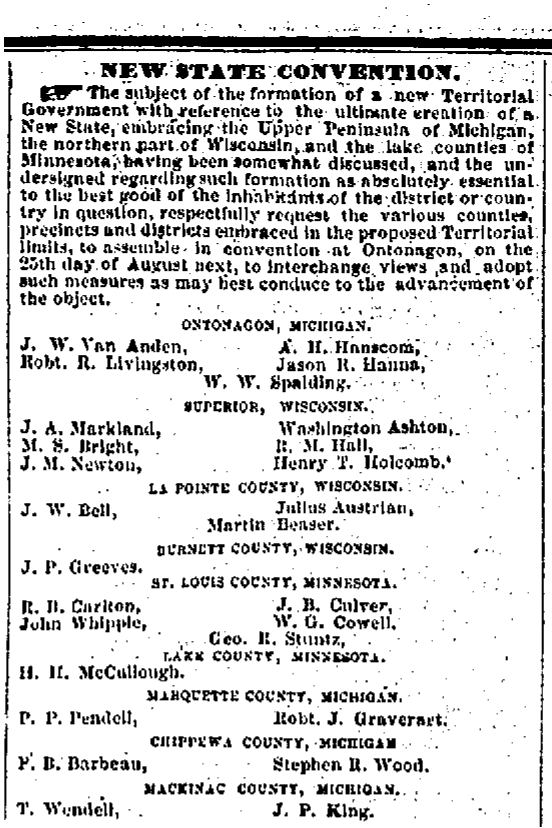
In 1858, the firm had much difficulty in collecting their orders on the mines in the vicinity of Eagle Harbor, and it was finally determined to sell out their store and build up a business elsewhere. S. W. Hill, Esq., had then left the Copper Falls and assumed the direction of the Quincy Mine here at this place. He foresaw that Portage Lake, possessing as it did so many natural advantages, would eventually become the grand business point or the copper region, and with his accustomed energy began the laying out of the town site now occupied by the village of Hancock. Soon after this was done he wrote to the Messrs. Leopold, urging them to come over and open a store there, but they did not give the offer much consideration that year, as nearly everybody in Keweenaw County ridiculed the idea of Portage Lake ever becoming anything of a place.
That year, however, they sold out their business at Eagle Harbor, and removed to Eagle River, where Samuel was for the second time appointed Postmaster, and their business conducted by him and Jos. Austrian. Their present store site at Eagle River had been previously purchased, and additions annually made to their main building, as their business demanded, until they were of a much greater extent than the original frame.
Aaron Leopold was the first Tyler of the Quincy Lodge No. 135 in Hancock. M.H. Mandelbaum was a member.
In the summer of 1859, Jos. Austrian, who was the building man of the firm, came over from Eagle River to Hancock with Geo. D. Emerson, C. E., and selected a site for their new store, and chose the lots on which now stands the Mason House and the Congregational Church, and the dock front now owned by Little, Heyn & Eytenbenz, but Louis, who came up about that time, changed to the present site, deeming the other too remote from what would be the business center of the town. This was judged from the line of the road coming down from the mine, and the location of the Stamp Mill, around which he naturally concluded the workmen’s dwellings would cluster. In this he was slightly mistaken, though the real difference was unimportant; we give it merely to show how easily the most careful and calculating men may make a mistake.
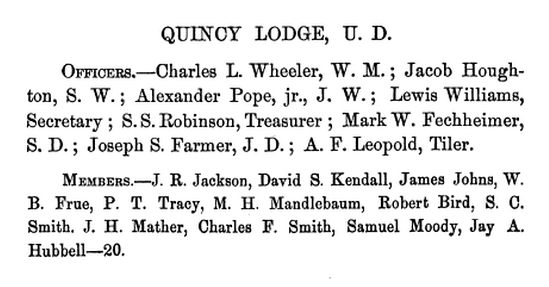
Transactions of the Grand Lodge of Free and Accepted Masons, of the State of Michigan, at Its Annual Communication, 1861, pg. 71.
After the site was determined upon, building was commenced, but as their faith in the future growth of the place was small, they did not propose to erect a large store, or even construct a substantial cellar underneath. Mr. Hill, hearing of their intention, at once paid them a visit and strongly protested against it. “This is going to be a leading town,” he said, “and I want a good large store, and a stone cellar underneath it.” He carried the day, and a larger building was completed, which two years afterward was too small for the business, even with the addition of a large warehouse for storing additional supplies.
As soon as the building was commenced, Louis began to send up goods from Cleveland, and Aaron came over from Eagle River to take charge of the new business. He scarcely reached here before the goods arrived, and were stored in the building before it was closed in, and he for several weeks had to make his bed on the goods virtually in the open air. As this was in the fall of the year, it was not pleasant, as may be at first supposed. Since then their principal business has been done at Hancock, the old head concern at Eagle River having been a branch.
Additional sources about this festive celebration for the Freudenthaler family in Richen have not been located yet.
In the fall of 1861, Aaron concluded to visit his home in Germany, to attend the golden wedding anniversary of his parents, and Samuel came over from Eagle River to take his place in the store. The celebration of the golden wedding was the grandest event which had happened in the little town of Richen for fully one hundred years, and, probably, will not be equaled in the present century. It would be impossible within the limits of this article to give a full description of the proceedings on that festival occasion, suffice it to say, that all the inhabitants of Richen and the neighboring towns, to the number of full five thousand assembled, and under the guidance of the mayor and municipal officers, for three days kept up a continuous round of merry-making and rejoicing. On the anniversary wedding day a procession over a mile in length waited upon the “happy couple,” and escorted them to the church, where appropriate and imposing services were performed. In the name of his brothers Aaron presented the church with a copy of the Sacred Writings, beautifully engrossed on parchment, which, with its ornamented silver case, cost over $600. All the halls and hotels were opened to the public, where for three days and nights they feasted, drank and danced without intermission and free of expense. The celebration of this golden wedding cost the brothers over $5,000, but which they rightfully considered the grandest event in their history.

In the fall of 1862, Joseph Austrian joined the firm at Hancock, and Louis removed from Cleveland to Chicago, which point they had concluded would soon monopolize the trade of Lake Superior. In the spring of 1864 he commenced a shipping business in that city, and early in the following winter was joined by Jos. Austrian, and the purchase of the propeller Ontonagon effected, and a forwarding and commission business regularly organized. Lately they have purchased the light-draft propeller Norman, intending it to run in connection with the Ontonagon.
While this was the end of Julius Austrian’s presence at La Pointe, he was still attached to the region for the remainder of this life by social ties and legal affairs. Julius eventually moved to St. Paul and became President of the Mount Zion Temple.“The Austrians retained their generous spirit even after moving to St. Paul for it was on a mission to the poor with a cutter full of good things to eat that Mr. Austrian was run over by a beer wagon (we don’t have them nowadays) and killed.”
~ The Lake Superior Country in History and in Story by Guy M. Burnham, 1996, pg. 288As aforementioned, Moses Hanauer was son to Moritz Hanauer, elementary educator of the Leopold brothers in their hometown of Richen. Moses’ brother-in-law was Henry Smitz of La Pointe.
In 1862 their branch house at Lapointe was given up, and Julius Austrian returned to Eagle River, and, in connection with Solomon, conducted the branch at that place. The firm now is composed of Solomon and Julius Austrian and Moses G. Hanauer, who for several years has acted as bookkeeper for the firm, under the firm name of S. Austrian & Co. The Hancock firm is composed of H. F. Leopold, Joseph and Solomon Austrian, under the title of Leopold, Austrian & Bro. The Chicago firm is composed of L. F. Leopold and Joseph Austrian, under the name of Leopold & Austrian. Mr. S. F. Leopold will return to Germany, upon the opening of navigation, and spend a year in pleasure and relaxation, which he certainly merits after twenty years constant labor. Aaron will remain here during the coming summer, and in the fall will go below and establish a wholesale business in Detroit, where it is probable he will be joined by Samuel after his return from Europe.
“CHICAGO AND LAKE SUPERIOR LINE.
This line is owned in Chicago, but is included in our list with other lines plying between Michigan ports. Those enterprising and well known gentlemen, Leopold & Austrian, for many years proprietors of this line, have consolidated their navigation interests with those of the Spencer, Lake Michigan and Lake Superior Transportation Co., their boats running between Chicago and Duluth, touching at all intermediate ports in Illinois, Michigan and Wisconsin. The steamers are the Peerless, J. L. Hurd, City of Duluth, City of Fremont and barge Whiting.”
~ Tackabury’s atlas of the State of Michigan : including statistics and descriptions of its topography, hydrography, climate, natural and civil history, railway and steam boat history, educational institutions, material resources, etc. (1884), pg. 23Louis F. Leopold and his sons, Asa F. and Henry F. Jr, started the first mercantile house in Duluth in 1869. Asa and Henry were the first Jewish residents in Duluth and enjoyed success as prominent businessmen.
That the Messrs. Leopold have been more than ordinarily successful in their mercantile career of over twenty years is made evident from the extent and variety of their business transactions within the past five years, and the very large amount of capital required to carry it on successfully and properly. We feel confident that the joint capital of $3,000, with which they commenced business in 1843, had been increased one hundred times by the close of the past year, and we should not be surprised if it had augmented even more than that. It has been the result of no particularly good fortune, but of persistent application in one direction, and the only exception to the ordinary course of operation which can be said to have contributed to their success, has been the remarkable unity which has pervaded all their business transactions, whether located at Mackinac, Green Bay, Lapointe, Eagle River, Cleveland, Eagle Harbor, Portage Lake or Chicago, each member of the firm has labored, not for his benefit alone, but that of the whole brotherhood.
“S. Solomon Austrian, a merchant from the copper country of Upper Michigan married Julia R. Mann, ten years his junior and not yet out of school, of Natchez, Mississippi, about 1866. Their first home was in Hancock, Michigan. In writing of her mother at a later time, Delia describes the young wife’s inexperience as she entered this strange new country, and the difficulties she had learning homemaking from her pioneer neighbors, along with her fear of Indians. Here, their first child, Bertha, was born. After two years of residence, they moved to Cleveland. In 1870, a son, Alfred S., was born in Chicago, but there is no evidence to show they were residents of that city at the time. However, they were still living in Cleveland in 1874 when twin daughters, Celia and Delia, were born.”
~ Guide to the Celia and Delia Austrian Papers 1921-1932, Special Collections Research Center, University of Chicago Library.
And at this partial termination of their active associations, it is with a pride which but few firms experience after so long connection, they can say that in all their twenty years’ relation with each other there has never been a disagreement to mar the harmony and unity of their operations. Whatever has been done by one, even though it did not result as anticipated, has met with the immediate sanction of the others, who had unlimited confidence in the integrity of his intentions to benefit them all. Until now there has been no division of the accumulated profits; all has been placed in one general fund, from which each has drawn as the wants or exigencies of their business demanded. Neither of them have indulged in any private outside investments or speculations, the profits of which has resulted to his own pecuniary benefit. Profit and loss has been shared alike by them all. Such unanimity of action is very rarely to be met with, especially In these modern days of “every man for himself and the devil take the hindmost,” and is, therefore, the more commendable. Although nominally dissolved, at present, we are of the opinion that after S. F. Leopold has returned from his vacation in Europe the old order of things will again prevail, for, after such a lengthy and intimate association, it will be difficult for either of them to operate independent of the rest, after such a practical verification of the truthfulness of the adage on which they founded their business existence, that “In union there is strength.”
We also copy the following letter, which, in our estimation, forms a part of and belongs to the history of the Leopold family. We understand that the son of whose birth the writer of the letter to the “Israelite” speaks, was the first Jewish child born in the northern region of Michigan:
Chicago, July 18, 1863.
Editor of The Israelite:
I have just now returned from Lake Superior, where I have found all my brothers and friends and the readers of The Israelite and Deborah in perfect good health. I cannot refrain from giving you a little history of a very noble act, the fruit of which in hereby enclosed, being a draft for $30, which you will please to appropriate to the purpose for which it has been destined, namely at a Berith which took place on a child of my brother at his house in Hancock, Lake Superior. After about forty participants had done justice to a very luxurious dinner, with the permission of Mr. Hoffman of Cleveland, the operator, a motion was made that the saying of grace should be sold, and the proceeds appropriated to some charitable purpose, whereupon Brother Samuel made an amendment that the proceeds should be sent to Dr. Wise of Cincinnati, to be appropriated by him for the monument to be erected for Dr. Rothenhelm; the sheriff, Mr. Fechheimer, seconded the motion, and the same was unanimously carried. Brother A. F. was the last bidder with $30, consequently he was the lucky purchaser, and bestowed the honor on your humble correspondent.
The act is worth imitating, and if you think it worth mentioning you may give it publicity in The Israelite and Deborah.
Yours truly,
L. F. Leopold.
They called him “Gray Devil”
January 21, 2015
By Amorin Mello

(Lewiston Saturday Journal, April 27, 1895, page 11)

(Lewiston Saturday Journal, April 27, 1895, page 11)
Transcript from the
History of Milwaukee, Wisconsin:
From Prehistoric Times to the Present Date
as published in 1881 by the Milwaukee Genealogical Society:
MAJOR-GENERAL LYSANDER CUTLER was born in Royalston, Worcester County, Mass., February 16, 1807. His father, Tarrant Cutler, was one of the most independent and sturdy farmers of the county, and cultivated, with the help of six boys, as they grew up, one of the largest and most rocky farms in all that stony region of hills that lies at the foot of Mount Monadnock. Here Lysander received his early education. He worked on the farm during the Summers, and attended the district school each Winter till he was 16 years old. At that age he had acquired all that could be gotten from the town schools and all other sources within his reach, and in the opinion of his father was in a dangerous state of forwardness, calculated to unfit him for the high and noble career he had marked out for him — on the farm, and he accordingly determined that his education was complete, and set him down for the coming five years as a steady hand on the farm. The young man broke out in open rebellion against this paternal edict and announced his intention to leave the homestead forever, unless his father would at least assist him to acquire an academic education. After many stormy discussions, the matter was settled by a sort of treaty, whereby, although still under parental rule, he had a roving commission to forage for himself within limits set by his father. Under this arrangement he did very little farm work except in haying, when all the boys were called home to assist. During these five years he managed to clothe himself, learn the clothier’s trade, get a fair academic education, had learnt the art of land surveying, and had acquired a very enviable reputation in the county as a successful schoolmaster, as he had fought into submission several turbulent and unmanageable schools that had heretofore made it a practice to “pitch out” such teachers as were undesirable to them. With such acquisitions, at the age of 21, he emigrated to Maine and settled in the town of Dexter, Penobscot County, in 1828. His worldly goods on his arrival consisted of a silver watch and two dollars in money. He arrived in the Winter, just as the settlement was in an uproar over a rebellion in the school that had thus far proved unmanageable and had resulted in the flogging and summary ejectment of several masters who had attempted to maintain discipline by the ferule and switch, the only means then in vogue. He immediately volunteered to keep the school out for the sum of sixteen dollars per month — no school, no pay. The school committee accepted his proposition. The first day was devoted to an examination on the part of the big boys, as to the qualification of the new master. The examination was searching, and resulted in the thorough flogging of every bully in the school and a quiet orderly session thereafter to the end of the term. Thus early established in favor at the settlement, he began the business of his life. He surveyed the land up and down the stream which flowed from a small lake having an outlet at the village, and discovered the value of the water-power which had hitherto only been roughly put to use to run a saw-mill. In 1834 he entered into a co-partnership with Jonathan Farrar, a wealthy proprietor of the township, and built a woolen mill, then the largest east of Massachusetts, which under his successful management brought him what was then deemed an independent fortune in ten years. In 1843 the mill was burned to the ground, leaving him as poor as when he started. His partner, however, drew upon his private credit and the works were speedily rebuilt and added to from time to time till 1856. At that time the village had grown to a smart manufacturing town numbering 2,000 inhabitants, nearly half of whom were dependent on him for support. The firm owned three woolen factories, a foundry, a grist-mill, a saw-mill, a large store and many tenements. The panic of that year found his business widely extended. The mills stopped, the immense accumulation of their unsold goods were sold, in some instances, at less than half their cost, the property went into other hands and the firm was ruined. Turning his back on the scenes of his active life, he came to Milwaukee in 1856.
During his New England life he took an active part in the affairs of his State. He was almost uninterruptedly a member of the Board of Selectmen of his town, served in the State Senate one term — 1839-40 — as a Whig. He commanded a regiment of troops on the border, pending the settlement of the northeastern boundary, in 1838-9. He was also active in educational matters. He was for several years one of the Trustees of Westbrook Seminary, and served on the Board of Trustees of Tufis College, during the years when it was struggling into life. He also gave his time and means to the development of the railroad system of the State, and was one of the Board of Directors of the Maine Central (then the Androscoggin and Penobscot Railroad Company) until it was built as far east as Bangor. He was generous to a fault, and for the thirty years he lived in Maine he carried an open hand and purse to all who needed. It was certainly no small thing or such a man at such a time of life to commence anew, in a strange country the strife for business success among the crowds of younger men who were thronging every avenue that opened to even a chance of good fortune.

(Pioneer History of Milwaukee: 1847 by James Smith Buck)
“…the population of Ashland increased quite rapidly… Of these a few remained only a short time, coming merely for temporary purposes. 1855 brought a still larger increase of inhabitants, among them M. H. Mandlebaum (now a resident of Hancock, Mich.), Augustus Barber (who was drowned at Montreal River in 1867), Benj. Hoppenyan, Chas. Day, Geo R. Stuntz, George E. Stuntz, Dr. Edwin Ellis, Martin Roehm, Col. Lysander Cutler, J. S. Buck, Ingraham Fletcher, Hon. J. R. Nelson, Hon. D. A. J. Baker, Mrs. Conrad Goeltz, Henry Drixler (father of Mrs. Conrad Goeltz, who died in 1857, his being the first death in town), and Henry Palmer.” ~ Ashland Press, January 4, 1893 (Wisconsin Historical Society)
He came to Milwaukee in answer to a letter from an old Maine friend, Horatio Hill, then one of the most active business men and public-spirited citizens of Milwaukee. He with Palmer, the Pbrothers Hercules and Talbot Dousman, Dr. Greaves and others had organized the Penokee Mining Company. The company had a sort of undefined and undefinable title to some parts of the celebrated iron deposits in the Penokee Range lying some thirty miles inland from Lake Superior, at the extreme northern point where what is now Bayfield County, juts out into the lake. The title was held by virtue of some Indian script which had been bought from the Sioux Indians, then inhabiting that region, and was by no means a perfect one, except the land was surveyed and occupied by the company and direct warrants thereby secured from the Government Land Office. Most brilliant reports had been made of the extent of the deposits and the purity of the ore. There could be no doubt that the development of these immense mineral resources would bring to the owners untold wealth. Mr. Cutler was appointed the managing agent of this prospective Wisconsin bonanza, at a fair salary, to which was added a liberal amount of the stock of the company. His first task was to perfect the title to the property, and the first step toward it was to take a personal view of the situation and the property. It was a somewhat arduous undertaking, not unfraught with danger. Excepting two or three traders and surveyors, who had stock in the company, the population, which consisted mostly of Indians and half-breeds, viewed this incursion of wealth-hunters from the lower lakes with suspicion and distrust. To add to the difficulties of the situation, other parties owning Sioux script were endeavoring to acquire a title to the mineral range. One man working in the interest of the company the year before, had been discovered, after being missed for some weeks, dead in the forest, near the range. Bruises and other indications of violence on the body gave strong ground for the belief that he had been murdered. Altogether it was a position, the applications for which were not numerous. His first trip was made in the Summer of 1857. He spent several months on the range and at LaPointe, Ashland, Bayfield and on to the Indian Reservation, acquainted himself thoroughly with the status of the company’s claims, and returned to Milwaukee. He had ascertained that the immense value of the claim had not been overestimated, and had made a further discovery, less desirable, that the company had no valid title to it, except they occupied it as actual settlers. It was determined to organize a colony sufficiently large to cover every section of the territory desired, and squat it out a sufficient time to entitle them to settlers’ warrants. The colony consisted of picked men, some from the State of Maine, who entered the employ of the company, and built their cabins as fast as the surveyor’s stakes were driven. The main cabin, which was a depot of supplies, was of importance as it was the center of the town, and as it complied with all the requirements of the law, being organized as a store and a school, it gave the company a claim to a “town plat” of a square mile. Here Colonel Cutler spent two Winters, during which he and his trusty employs endured all the hardships and dangers of a pioneer life. The nearest point where supplies could be obtained was thirty miles distant through a trackless and dense forest. All supplies were packed in on the backs of the squatters or half-breed packers who sometimes in a surly mood would lay down their burdens and return to the settlement. Nothing but the fearless pluck and dauntless courage of Colonel Cutler kept these men in wholesome awe, and insured the safety of the settlers while they remained.
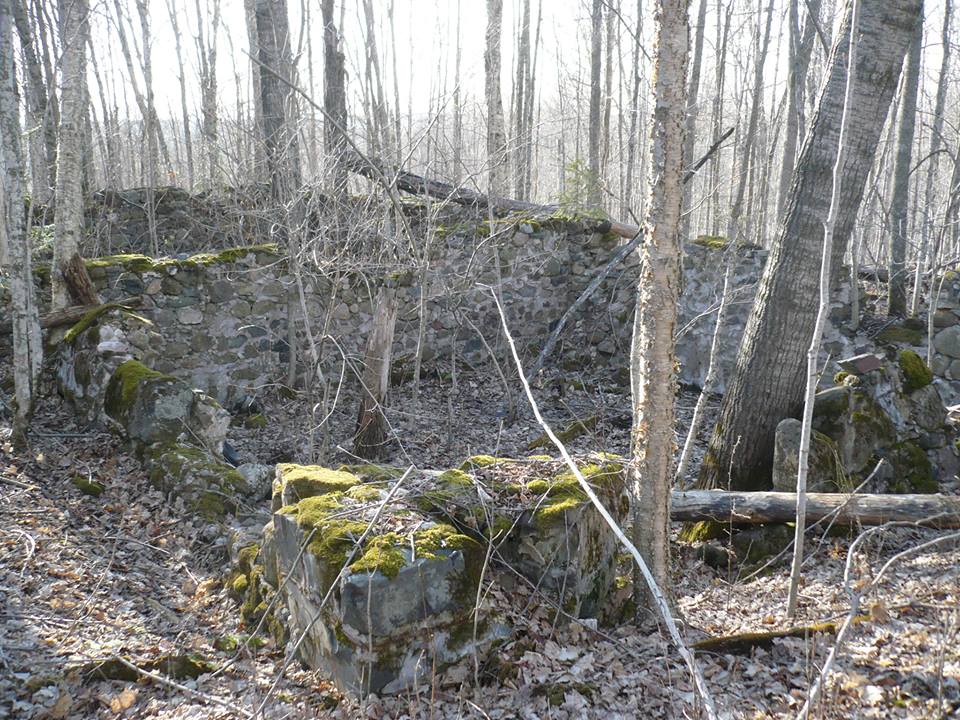
Lysander Cutler’s town plat ruins at the “Moore Location” of the Lac Courte Oreilles Harvest Education Learning Project (Paul DeMain © 2013).

Lysander Cutler and the Ironton Trail (Pioneer History of Milwaukee: 1847 by James Smith Buck)
The following story is told by James S. Buck, of this city, who was one of the colony, as illustrating his mode of discipline: Late one week it was discovered that there were not sufficient supplies to last over Sunday. Colonel Cutler dispatched one of his men to the lake, with instructions to load two half-breeds and send them forward to camp the next day, he agreeing to meet them at the half-way camp and pay them for their services. They arrived before him, in a surly mood, and without waiting except to get breath took up their loads and trudged back to Bayfield. Soon after Colonel Cutler arrived and having been informed of their return set out after them. He did not overtake them on the road, but entered Bayfield a few minutes behind them, and found them at the store sitting by the fire, with their packs, which they had just thrown off, by their sides. On entering he drew up his rifle and said: “Boys, you can have just half a minute to shoulder those packs and start for the range.” In less time than was allowed they were again on the return tramp, supported in the rear by the Colonel and his rifle. At the half-way camp they begged for rest, but the only reply from their implacable guard was: “March!” with an expletive which showed undoubtedly that he was in earnest. They reached the range late at night. It was the last attempt at breach of contract on the part of the half-breeds while he remained in that region.
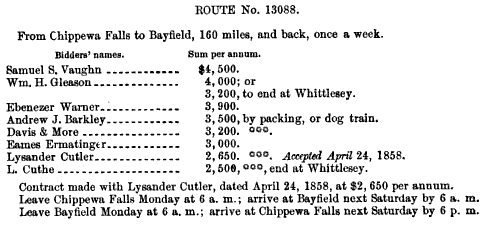
Cutler was contracted for carrying the mails in 1858 (United States Congressional serial set, Volume 1013).
In the Winter all the communication with the rest of the world was cut off, except by a weekly mail which was brought through from St. Paul by an Indian mail-carrier. Once during each Winter he made the trip on snow shoes, to St. Paul, a distance of over two hundred miles. The claim was at last secured, and a valid title to the land vested in the company. He left the region, at the end of two years, successful in this mission, and attained, while there, the general respect of all, both white and red, although his pet name among the Indians did not evince a love unmingled with fear; they called him “Gray Devil.” The dull times that followed put a long quietus on Western schemes of speculation, and Colonel Cutler’s company was laid on the shelf with many others of less merit, till more propitious times.

Cutler’s contract was not successful for long. (United States Congressional serial set, Issue 1041, Part 2).
In 1859 he engaged in the grains and commission business, in which he continued with indifferent success till the breaking out of the war.
The first gun fired on the flag seemed to rouse the full energies of his naturally pugnacious nature. It seemed as though the burdens of twenty years had fallen from his shoulders, and he showed the war-like enthusiasm of a young man of thirty instead of the more quiet demonstrations of a man who had already done the arduous work of a common lifetime. It was only in deference to the earnest protests of his friends that he did not enlist as a common soldier when the first call was made for ninety-day troops.

pg. 787 (History of Milwaukee, Wisconsin)
Colonel Cutler was commissioned as Colonel of the Sixth Wisconsin Regiment June 25, 1861. His regiment left the State July 28, and joined the forces around Washington August 7. August 29 it was attached to King’s Brigade, of which it remained a part during the war and shares in its imperishable renown as “The Iron Brigade.” During its first year of service Colonel Cutler was much of the time in command of the Brigade, and did much in perfecting it in discipline and tactics. His active service in the field commenced with the campaign of 1862. McDowell’s Division, to which the “Iron Brigade” was attached, did not participate in the peninsular battles of the campaign, being held as a reserve force to repel any overland demonstrations on the Capital, similar to that of the year before, which culminated in the first battle of Bull Run. During the earlier months of the campaign Colonel Cutler commanded the Brigade, till the assignment of Brigadier-General John Gibbons, May 2, when he again returned to his regiment. The Brigade was almost constantly on the march from point to point to avert threatened danger or mislead the enemy, till the beginning of August. On the fifth of that month the withdrawal of a part of the rebel forces from McClellan’s front, and a movement up the Shenandoah as well as toward Pope, commenced the active campaign. August 6, Colonel Cutler with his regiment and a New Hampshire regiment of cavalry penetrated into the enemy’s country as far as Frederick’s Hall Station, twenty-three miles from the junction of the Virginia Central with the Richmond & Potomac Railroad, and there tore up the track for a mile in each direction, thus cutting off the rebel communication between Richmond and Gordonsville. They also burned the depot, warehouse and telegraph office and destroyed a large amount of Confederate supplies. The expedition was entirely successful. During three days and one half the regiment had marched ninety miles, and were, when they struck the railroad, thirty miles from any support. It returned without the loss of aman. General Gibbon in his official report commended the regiment and Colonel Cutler as follows: “Colonel Cutler’s part in the expedition was completely successful. I can not refer in too high terms to the conduct of Colonel Cutler; to his energy and good judgment, seconded as he was by his fine regiment, the success of the expedition is entirely due.” On the 19th of August General Pope commenced his retreat. The “Iron Brigade” was for nearly ten days within sight of the enemy as they slowly worked their way up towards Washington, avoiding as much as possible any collision with the troops during its maneuvers to outflank Pope and if possible intercept him in his march to the defense of the threatened Capital. On the twenty-eighth having so far out-maneuvered him as to have separated the divisions of the army too far for support, the division of Longstreet fell upon the “Iron Brigade” which was marching toward Centerville on the Gainesville road. The Federal troops were outnumbered three to one, but they held the enemy in check till night put an end to the carnage which marked it as one of the most severe engagements of the war. How Colonel Cutler and Colonel Hamilton of Milwaukee bore themselves on that bloody field has been detailed in a previous chapter. They were severely wounded. Colonel Cutler had his horse shot under him, and was wounded by a minnie bail which passed entirely through his thigh, His wound was dangerous and kept him from active service till November 5, when he returned to the front and took command of the Brigade which he retained till the twenty-second, when General Sol. Merideth, who had been appointed Brigadier-General, assumed the command and he again returned to his regiment. At the battle of Fredericksburg he again led the “Iron Brigade,” being put in command during the action, after the Brigade had crossed the Rappahannock, and taken position in line of battle. Soon after he was appointed Brigadier-General, to date from November 29, I862, and assigned to the Second Brigade, First Division, First Army Corps. His Brigade with the “Iron Brigade” comprised the division commanded by Wadsworth. The corps was commanded by Major-General Reynolds. He fought through the Chancellorsville campaign, his Brigade covering the retreat after the three days’ slaughter was finished. At Gettysburg his brigade was in the advance, opened the battle and, with the “Iron Brigade,” sustained the brunt of the fighting on the memorable 1st of July 1863. During that day. his old regiment, the Sixth, was attached to his brigade. Major-General Newton, in his report, details the part taken in this action as follows:
“General Cutler was in the advance and opened the battle of Gettsyburg. In this severe and obstinate engagement he held the right for four hours, changing front without confusion, three times, under a galling fire, and lost, in killed and wounded, three-fourths of his officers and men, having three of his staff wounded and all the horses killed. When the order was given to retire, he marched the remnant of his brigade off the field in perfect order and checked the advance of Ewell’s corps, which gave the artillery time to retire. In effecting this he lost heavily. His brigade was engaged on the night of the second and the morning of the third in repulsing the assaults of the Rebels on the right of our line.”
During Grant’s campaign of 1864, General Wadsworth was killed in the second day’s battle in the Wilderness. On his death the command of the division devolved on General Cutler, which he held thereafter all through the series of battles that followed, and during the siege of Petersburg, until August 21, when he was wounded in the face while repulsing an assault on the Weldon Railroad. On the 15th of September, wounded and in broken health, from his long and arduous service, he was, at his own request relieved from field duty, and ordered to New York, to take charge of the forwarding of troops from that State. Subsequently he was ordered to the command of the draft camp of rendezvous at Jackson, Mich., where he remained till the close of the Rebellion. He was appointed Brevet Major-General. the commission to date from his last fight on the Weldon Railroad, August 21. 1864, He resigned July 1, 1865,and returned to Milwaukee. With the excitement of active duty gone, his recuperative powers failed to restore his impaired health, and his earthly career ended July 30, 1866. The following orders were issued at Madison on the occasion of his death, by Gov. Fairchild, one of his companions in arms, and by the G.A.R.
State of Wisconsin, Executive Department,
Madison. July 31, 1866.Executive Order No. 7.
The people of Wisconsin will hear with deep regret the announcement of the death of Brevet Major-General Lysander Cutler. at Milwaukee, on Monday the 30th inst.General Cutler was among the most efficient and best beloved soldiers from this State. Distinguished for his services, covered with honorable scars, filled with years and glory, he goes to his grave deeply mourned by the entire people of a sorrowing State.
As a testimony of respect, the flag upon the State Capitol will be displayed at half mast, on Tuesday, 31st of July, inst.
By the Governor,
Charles Fairchild, Military Secretary.LUCIUS FAIRCHILD
Headquarters Post No. 1. G.A.R;
Madison, July 31, 1866.Special Order No. 1.
It is my painful duty to announce the death of one of Wisconsin’s most devoted and prominent general officers during the late war, Major-General Lysander Cutler, of Milwaukee.
It is ordered that as a mark of respect to the deceased, the members oi’ this post wear the badge of mourning prescribed by army regulations, for the period or ten days from this date.
By command of
Henry Sanford, P.A.J.W. TOLFORD, P.C.
General Cutler was married in 1830, to Catherine W. Bassett. He had five children, two sons and three daughters, all of whom are still living. His widow still survives. In stature he was six feet tall and spare. His eyes were iron gray, deep set. and overhung by heavy eyebrows. He was prematurely gray, and during the later years of life both his hair and beard were white. His indomitable will and strict devotion to duty rendered him stern and uncompromising in his general bearing and appearance; but underneath his rough exterior beat a heart, as tender as a woman’s, that won the lasting love of all who came to know him well. To the toils, dangers and sufferings of his campaigns he never yielded, but on receiving the tidings of the death of his little grandson, who died while he was in the service, he took to his tent and bed, completely bowed and broken by the great grief that had smote his heart. The child and the grim old warrior now sleep side by side at Forest Home.

Gen. Lysander Cutler (Library of Congress Prints and Photographs Division)
19th-Century Deer in the Headlights
January 18, 2015
By Leo

Deer Hunting by Torchlight in Bark Canoes 1846-1848 by George Catlin (Smithsonian American Art Museum)
Chequamegon History doesn’t usually deal with current events, preferring to stay in the 18th and 19th centuries, but I heard a radio program last week that prompted me to dig out some old sources related to a timely topic: off-reservation deer hunting at night by the Lake Superior Chippewa bands.
The State of Wisconsin’s January 7th, 2015 decision to appeal a lower-court decision in favor of Chippewa off-reservation night hunting prompted an edition of Wisconsin Public Radio’s Central Time on the topic that aired later that afternoon. The Ojibwe case in favor of night hunting is briefly, but thoughtfully, presented by the hosts, by Brandon Thoms for the Lac du Flambeau Band and by Richard Monette, Director of the Great Lakes Indian Law Center at UW-Madison.
Though Monette and Thoms touched briefly on the historical and ethical role in Ojibwe communities, the program wasn’t long enough for them to go into much depth. Since night hunting is something that brings controversy, and with it misinformation, I am hoping these historical documents can help promote three points of understanding among those of us who live in the ceded territory of the 21st century.
1. Ojibwe hunters used bright light as a means to harvest deer at night long before the creation of the current reservations.
2. Hunting at night was historically an efficient and effective means of obtaining food.
3. Controversy over the ethics of “shining” stems more from differences in historical and cultural hunting values than on real environmental values and sustainable practices.
“Modern” Technology
In Northern Wisconsin, the idea of night-hunting deer is often associated with the term “shining.” Often used pejoratively, the word tends to conjure up the image of hunters shooting deer out the windows of mud-covered trucks equipped with high-powered electrical spotlights.
Since deer tend to freeze in place when bright light is shone in their eyes, this makes it possible to get close enough to make an accurate shot in darkness. I’ve heard the argument that “shining” relies on modern technology and therefore isn’t fair to the deer.
However, this argument isn’t true. North American hunters used bright light as a means to harvest deer long before the invention of electric spotlights. An 1804 journal entry from the British-Canadian fur-trader George Nelson explains how it worked. Nelson, a teenager trading on the Chippewa River under Simon Charette for the XY Company, participated in such a hunt with his Ojibwe companions just south of Clam Lake. This entry appears on page 158-160 of the 2002 Minnesota Historical Press Edition of the Nelson journals, edited by Laura Lynn Peers and Theresa Schenck:
Monday 29th [May 1804] Sorel & I go to get our small canoe that we left above in this small river not being able to bring it down with our fish upon our backs the river being too rapidous. As soon as we arrived at our camp we set off & encamped at a small portage not very distant. We had no sooner carried our things across the Portage, then I embarked with the indian to hunt deer to night with a Candle[*]. We ascended the river about 2 leagues further than our encampment where we seen a large Buck which we frightened away by sneezing – : However at dusk we light our candle & about an hour after hearing something puddling in the water we let ourselves drift ’till within 8 or ten yards when we found it to be several deer, the indian wounded one & the others immediately run off – we debarked & seen much blood having our candle, dispairing however of finding it we reembarked – but misfortunately we upset our canoe just getting in, consequently our candle not being well secured fell over board & a terrible shower of rain falling just at this momment obliged us to shelter ourselves under a large pine (Epinette) ’till next morning when after some search we found the deer dead – We returned to our people [–& then continued our course up this same river]
At the end of this journal, Nelson added the following (in footnote on same pages of the published edition):
*(To Page 29 – May 29th) The indians from about the 15th of May ’till about the 20th of August kill a great number of deer every night by this means, the skins of which they gather & sell or trade them in the fall with the traders – The means they employ are these, they raise about 4 foot long of pine, elm, or any other strong bark which they double in such a manner as to make the lower part serve as a shelf & upon this the Candle rests, while the rest or upper part off the bark serves as a kind of screen behind which they set unperceived; for the candle that is upon the lower part of the shelf does not leave any part of the canoe visable for it is fastened to the bow of the canoe between the first bar & the curve – it is tied fast & high enough to put the Gun under below. When there is any deer (for they never fail coming every night to the borders of the small lakes & rivers where they eat weeds & remain in the water on account of the muskatas that are no less numerous than troublesome) it is easily known; for indians in General have as sharp an ear as their sight; & can tell where to direct when he hears the least puddling in the water. The deer whenever they see a light of this kind never stir but keep looking upon it ’till sometimes they are not more than three yards distant when the indian shoots them with shot, but if the least noise be made, by striking upon the canoe or its bars, sneezing, caughing, or even by touching your paddle upon a stone or stick in the bottom of the river they scamper off immediately…
And in a later consolidation of his journals, he added this to the account:
…At another place, a young indian & I went out to hunt deer. We made a Candle by chewing tallow, of which we had plenty & wrapped over a piece of cotton shirt as a wick, & placed it conveniently in the bow of the Canoe, where a screen had been erected with a piece of Spruce bark so large as to completely cover the indian, yet so as he could see what was going on before. We saw Several Deer. At dark, we drifted down -frightened off one party of deer. We soon found another, who attracted by the Candles, kept staring upon it alone: we drifted slowly only the lad shot one, & off the others ran…
Similar accounts can be found in other sources, and it seems this method of hunting was widespread and the most common way to hunt deer in spring and summer. The practice almost certainly predates the arrival of whites in the Lake Superior country, and hopefully these journals can put to bed the idea that night-hunting only became possible with the advent of electricity.
The Sport in Shining

Sir Edward Robert Sullivan, 5th Baronet, as depicted by Carlo Pelligrini for Vanity Fair in 1885 (National Portrait Gallery; London)
Some criticism of night hunting comes from the idea that it is too easy, and therefore, not sporting or fair to the deer. An 1850 account from the St. Croix River near present-day Gordon shows some of this sentiment. Sir Edward Robert Sullivan Bart., an English noble came here during a trip throughout the Americas described in the 1852 work, Rambles and Scrambles in North and South America. Although it comes two years before Carl Scherzer’s account of La Pointe (translated into English for the time first here on Chequamegon History) the Brule and the St. Croix, Rambles and Scrambles is not nearly as interesting as the German work. Sullivan took the same route to Stillwater, and even engaged the same La Pointe voyageur (Souverain Denis) as a guide, but the work is generally disappointing. Rather than Scherzer’s curiosity and deep ethnographic detail, Sullivan’s text is largely filled with the haughty superiority one might expect from the most stereotypical Victorian gentleman colonialist.

pg. 76

pg. 77
This account of Ojibwe hunting contrasts humorously with Sullivan’s earlier account from the lakeshore (probably near Sand Bay) of his own attempt at hunting the Northwoods:

pg. 67

pg. 68
The image of the pompous British gentleman hunter walking in panicked circles, is made all the more hilarious by the fact that one of his companions would do the exact same thing the next evening at Iron River. One imagines the thoughts going through the minds of the Ojibwe-French mix-blood guides as they had to rescue two mighty Zhaaganash sportsmen out of the woods in two days.
And that brings me to my point. As hard as it may be to admit, much of the prevailing American conservation ethic comes from this British notion of hunting for sport. This comes from a time in Europe when hunting was forbidden to the common people. A peasant might be arrested for poaching a deer to feed his family, while the gamekeepers kept the forests preserved so men like Sullivan could bring home trophies. In such a viewpoint, something like shining might be condemned for being too easy, effective, and unromantic.
On the other hand, the Ojibwe husband and wife on the St. Croix were not looking for a splendid evening of recreation. They needed venison to feed the village. It didn’t matter if it was summer and the buck’s antlers weren’t as impressive as they might get in November. Hunting was necessary work for survival, and it was done using the most efficient and effective means possible. In describing the Ojibwe idea of the afterlife five years later in 1855, the German ethnographer Johann Kohl writes:
…But, even if we wished to represent the buffalo-covered prairies as a paradise for the hunter, it is still questionable to me whether hunting forms a material feature of the Indian paradise. To us Europeans hunting is more or less an amusement, but to the Indian it is a toil, and frequently a most fatiguing mode of life. In many Indian dialects the words “hunter” and “hunting” are synonymous with “work” and “working.” A good hunter is a clever and industrious workman. As, then, the idea entertained by most nations of paradise is, that it will be without toil or labour, it is to me more than doubtful whether they regard the chase as an element of their paradisiac existence. Among the Ojibbeways I never heard that they held such a view. I once asked a man of their tribe, who was describing paradise to me, and did not at all allude to hunting, “And then you will go every day to hunt and kill a countless number of animals?” “Oh no!” he replied, dryly, “there is no hunting or labour in paradise (212-13).”
I would argue that most deer hunters in Northern Wisconsin today, both Native and non-Native, derive food, pleasure, and a sense of tradition from hunting. However, the relative importance of each can vary greatly from hunter to hunter in both communities.
I know many white hunters who hunt mainly to fill the freezer rather rather than for sport, and with it, there is a certain conservation ethic that has descended from those peasant poachers. In this viewpoint, you respect and value the lives of animals because they gave their lives to keep you alive, not because you came up with some convoluted “sporting” method of harvesting them. The ethics that would have you break the law to keep and eat a dying undersized fish aren’t the same ethics of the Teddy Roosevelts and Ernest Hemingways of the world, but they are conservation ethics nonetheless.
In my mind, these two viewpoints on the role and purpose of hunting are central to the debate over “shining,” and I think examination of history might find Ojibwe and non-Ojibwe residents of the ceded territory having more in common with each other than they do with Scott Walker and his Deer Czar.
Environmental Impact of Night Hunting
While on the subject of conservation, it is worth looking at whether or not night hunting is bad for the environment. Let’s put aside for a minute the fact that the off-reservation night harvest would be minuscule compared to the regular Wisconsin deer hunt or the amount of deer who die at night after being inadvertently “shined” on the highways. And let’s forget for a minute how “divide and conquer” politicians in the eighties used the environment as red herring to turn whites and Indians against each other over the issue of spearfishing or how the walleye populations in the ceded territory are kept up in large part by tribal conservation efforts. Finally, let’s stop puzzling over how Native people managed to survive on this continent for tens of thousands of years before whites came to teach them how to manage resources. Yes, let’s forget about those things and go back to the historical record.
If Nelson’s journals show that hunting out of a canoe by torchlight was well established at the outset of the 1800s, and Sullivan’s Rambles and Scrambles, show it being used at mid-century, we can close out the 19th century with an account from Minnesota.
Reverend Joseph Gillfillan, was a Christian missionary to the Ojibwe people in the areas around Red, Cass, and Leech lakes. In an 1895 letter to the Minnesota Forestry Department and a subsequent article, The Ojibways in Minnesota, presented in 1896 and published in 1901, we hear a familiar story.
Gillfillan doesn’t describe the Lake Superior Chippewa cessions, specifically, but it shows that Ojibwe hunters continued to night at hunt, by canoe, on off-reservation ceded territory:


pg. 100
This account, well into the reservation period, is highly critical of Ojibwe hunting techniques. In it, we see parallels to the earlier elite European hunting ethic and today’s concerns over shining. However, we must remember that the goal of Christian missionaries at that time was not only spreading Christianity but also the assimilation of Native people into white culture. Gillfillan sees success at hunting as an impediment to the settled agricultural life he desires. “The Great Spirit always provid[ing] for their wants,” is a direct threat to his mission. So, rather than admit that maybe the increasing deer population was due to sustainable hunting practices, he tries to come up with outside explanations while condemning the hunt as wasteful.
Changing the Narrative
In presenting these historical documents, I’m not necessarily trying to convince people to change their views on off-reservation night hunting. However, I do want people to have their facts straight. The use of bright lights at the bow of a canoe was a traditional Ojibwe technique for hunting deer long before the land was ceded, and it continues to be to this day.
In my opinion, whether it is a wooden torch or a battery-powered flashlight shining at the deer is immaterial. It serves the same ends.
I don’t expect this to end the conversation on night hunting. I didn’t bring up the safety argument, which is a key part of the State’s opposition (though the DNR has sanctioned other types of night hunting with firearms). I will say, however, that despite its widespread use, I haven’t found any examples of the torch technique being dangerous (unless you count George Nelson capsizing his canoe). I will post one if I come across it.
So, as the ethics of “shining” continue to be debated, I call on those of both sides of this argument to examine where their personal conservation ethics come from. Is hunting primarily for sport or food? How traditional is night hunting, and how sustainable is it? Finally, how have those in power used similar issues in the past to divide different groups of hunters and fishermen, and what motives do they have for doing so?
Think about it.
~LF
~~~~~~~~~~~~~~~~~~~~~~~~~~~~~~~~~~~~~~~~~~~~~~~~~~~~~~~~~~~
While I can’t promise this post will lead to more writing from Leo anytime soon, Chequamegon History will keep producing! Amorin Mello has agreed to contribute a series of articles related to the original land claims, frauds, and mining operations in the Penokee Mountains. For a fascinating preview of what’s coming, check out 0:37-1:24 of this video clip from Indian Country Television’s coverage of the recent Penokee conference at Legendary Waters in Red Cliff. Thank you Amorin for this outstanding research, for the upcoming posts, and for giving Chequamegon History its first mention on TV!
Sources
Gilfillan, Rev. Joseph A. The Ojibways in Minnesota, Collections of the Minnesota Historical Society, Vol. 9 (St. Paul: Minnesota Historical Society, 1901) 72.
Kohl, J. G. Kitchi-Gami: Life among the Lake Superior Ojibway. St. Paul: Minnesota Historical Society, 1985. Print.
Minnesota. Forestry Commissioner. Forestry. Annual Report. N.p.: n.p., 1895. Print.
Nelson, George, Laura L. Peers, and Theresa M. Schenck. My First Years in the Fur Trade: The Journals of 1802-1804. St. Paul, MN: Minnesota Historical Society, 2002. Print.
Sullivan, Edward Robert. Rambles and Scrambles in North and South America. London: R. Bentley, 1852. Print.
“A real bona fide, unmitigated Irishman”
December 7, 2014
By Leo

“The Usual Irish Way of Doing Things”, by Thomas Nast Published 2 September 1871 in Harper’s Weekly. Nast, who battled Tammany Hall and designed the modern image of Santa Claus, is one of the most famous American political cartoonists. However, he frequently depicted Irish-Americans as drunken, monkey-like monsters (Wikimedia Images).
It has been a while since I’ve posted anything new. My personal life has made it impossible to meet my former quota of three new posts a month. Now, it seems like I’ll be lucky to get one every three months. I haven’t forgotten about this site, however, and there is certainly no shortage of new topics. Unfortunately, most of them require more effort than I am able to give right now. Today, however, I have a short one.
Regular readers will know that the 1855 La Pointe annuity payment to the Lake Superior Chippewa bands is a frequent subject on Chequamegon History. To fully understand the context of this post, I recommend reading some of the earlier posts on that topic. The 1855 payment produced dozens of interesting stories and anecdotes: some funny, some tragic, some heroic, some bizarre, and many complicated. We’ve covered everything from Chief Buffalo’s death, to Hanging Cloud the female warrior, to Chief Blackbird’s great speech, to the random arrival of several politicians, celebrities, and dignitaries on Madeline Island.
Racism is an unavoidable subject in nearly all of these stories. The decisive implementation of American power on the Chequamegon Region in the 1850s cannot be understood without harshly examining the new racial order that it brought.
The earlier racial order (Native, Mix-blood, European) allowed Michel Cadotte Jr., being only of one-eighth European ancestry to be French while Antoine Gendron, of full French ancestry, was seen as fully Ojibwe. The new American order, however, increasingly defined ones race according to the shade of his or her skin.
But there are never any easy narratives in the history of this area, and much can be missed if the story of American domination is only understood as strictly an Indian/White conflict. There are always misfits, and this area was full of them.
I recently found an example from the November 7, 1855 edition of the Western Reserve Chronicle in Warren, Ohio shows just how the suffocating paternalism directed toward the Ojibwe at the 1855 payment hit others as well:
A GENUINE IRISHMAN
A correspondent of the Home Journal relates the following characteristic incident of Irish tactic. He says:
Does the wide world contain another paradox that will compare with a real bona fide, unmitigated Irishman? Imagination and sensuality, poetry and cupidity, generosity and avarice, heroism and cowardice–and so on, to the end of the list; all colors, shades and degrees of character congregated together, and each in most intimate association with its intensest antithesis–a very Joseph’s coat, and yet, most marvelous of marvels! a perfect harmony pervading the whole.
Among the reminiscences of a month’s sojourn at La Pointe, Lake Superior, during the annual Indian payment of the last summer, I find the following truly ‘representative’ anecdote:
One day while Commissioner Monypenny was sitting in council with the chiefs, intelligence was brought to Mr. Gilbert (the Indian agent) that two or three Indians were drunk and fighting, at a certain wigwam. With his usual promptitude, Mr. Gilbert summoned one of his interpreters, and proceeded directly to the lodge, where he seized the parties and locked them in the little wooden jail of the village, having first ascertained from them where they obtained their liquor. He then went immediately to the house they had designated, which was a private dwelling, occupied by an Irishman and his wife, and demanded if they kept liquor to sell to the Indians.

Henry C. Gilbert was the Indian Agent during the Treaty of 1854 and oversaw the 1855 annuity payment along with Commissioner of Indian Affairs George Manypenny (Branch County Photographs).
Both the man and woman, with rational vehemence and volubility–and both at once, of course, utterly denied having ‘a dhrop in the house, more nor a little jug full, which we just kape by us, like, for saysonin’ the vittals, and sickness.’ But, unfortunately for the veracity of the parties, on searching the premises, the interpreter discovered, in a little back wood-shed, two barrels of whiskey, besides the ‘little jug’ which proved to be a two gallon one, and full.
Mr. Gilbert ordered some of his men to roll the barrels out on the green, where in the presence of the whole council, they knocked in head, and the jug broken. But the flow of whisky was as nothing compared with the Irish wife’s temper, meanwhile. I had never conceived it possible for a tongue to possess such leverage; it seemed literally to be ‘hung in the middle and to work both ways.’ However, mother Earth drank the whisky, and the abuse melted into ‘the circumambient air’–though one would not have suspected their volubility, they seemed to be such concrete masses of venom.
In the evening of the same day, as Col. Monypenny was walking out with a friend, he encountered and was accosted by, the Irish whisky vender.
‘The first star of the avenin’ to yees, Misther Commissioner! An’ sure it was a bad thrick ye were putting on a poor mon, this mornin’. Och, murther! to think how ye dissipayted the illegant whisky; but ye’ll not be doin’ less nor payin’ me the first cost of it, will ye?’
‘On the contrary,’ said the commissioner, ‘we are thinking of having you up in the morning, and fining you; and if we catch you selling another drop to the Indians, we shall forcibly remove you from the island.’
Quick as–but I despair of a simile, for surely there is no operation of nature or art that will furnish a parallel to the agility of an Irishman’s wit–his whole tone and manner changed, and dropping his voice to the pitch confidential, he said:
‘Wll, Misther Commissioner, an’ its truth I’m tellin’ ye–its mighty glad I was, intirely, to see the dirty barrels beheaded; sure I’d a done it meself, for the moral of the thing, ef it hadn’t been for the ould woman. Good avenin’ to ye, Misther Commissioner.’
It is hardly necessary to add that no further application was made for the ‘first cost of it.’
Very truly yours.
~ Western Reserve chronicle. (Warren, Ohio) November 07, 1855
(Library of Congress Chronicling America Historic Newspaper Collection)
The sale of alcohol was illegal at La Pointe at that time. However, the law was generally impossible to enforce and liquor flowed freely into and out of the island.
Admittedly I chuckled at the depiction of the Irish wit and the temper of the “Irish wife,” but as a descendant of immigrants who fled the Great Famine in the 1840s, it’s hard to read the condescending stereotypes my ancestors would have been subjected to.
That said, it’s important to note that the two or three Ojibwe people in this story were imprisoned without charges or trial for drinking, while the couple selling the illegal liquor only lost his stock and wasn’t fined. This is something those of us of European descent need to be careful of when trying to draw equivalencies.
So then who was the bona fide, unmitigated Irishman?
Hundreds of thousands of Irish immigrants came to America during the 1840s and ’50s. Inevitably, some of them ended up in this area. However, by 1855 it was only a handful.
Just a few weeks prior to the payment, Alexis Carpentier, a former voyageur from a mixed French-Ojibwe family was charged with taking the Wisconsin State Census for La Pointe County. He found 37 residents of foreign birth. Most of these were French or mix-blooded men, born in Canada, who married into local Ojibwe and mix-blood families.
In only one household, more than one person is listed as being foreign-born. This was the home of Patric Sullivan. State censuses only listed the name of the head of household and do not list country of origin. However, in the 1860 Federal census, we find Patrick and Johanna Sullivan living with their three sons in La Pointe township. Both were born in Ireland.

Page 1 of 1855 Wisconsin State Census for La Pointe County (familysearch.org)
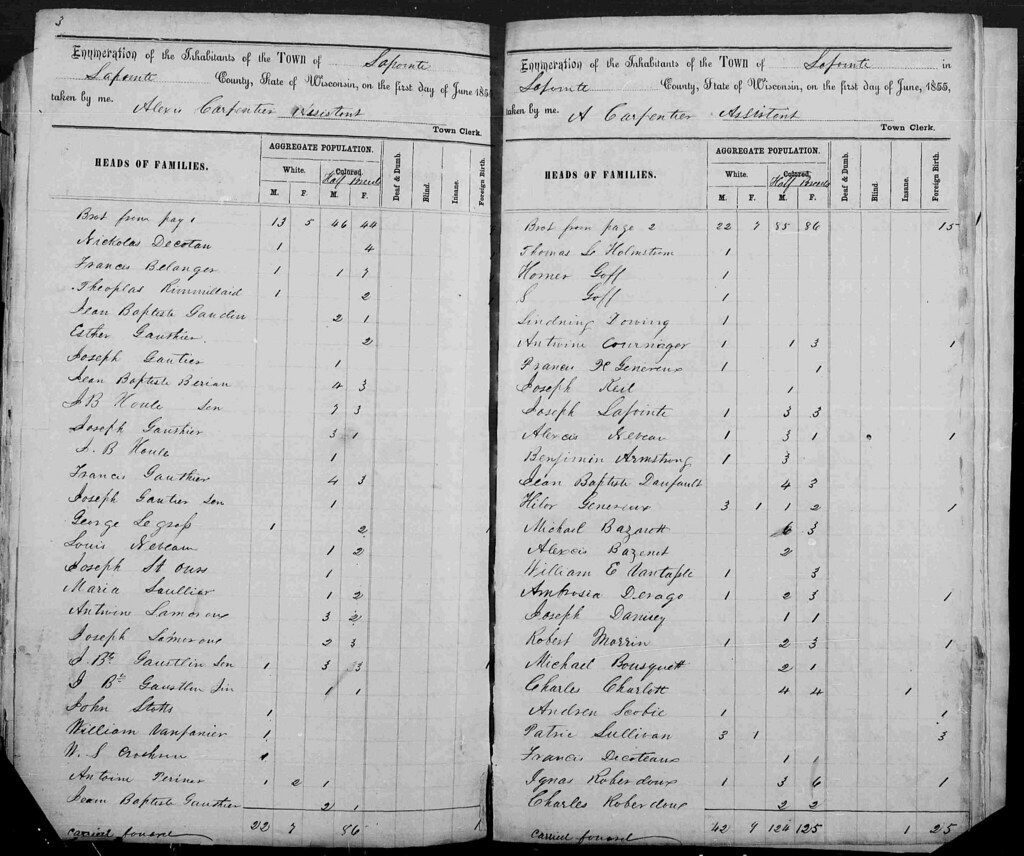
Pages 2 and 3. Patric Sullivan is fourth from the bottom on the right side. enlarge

Pages 4 and 5.
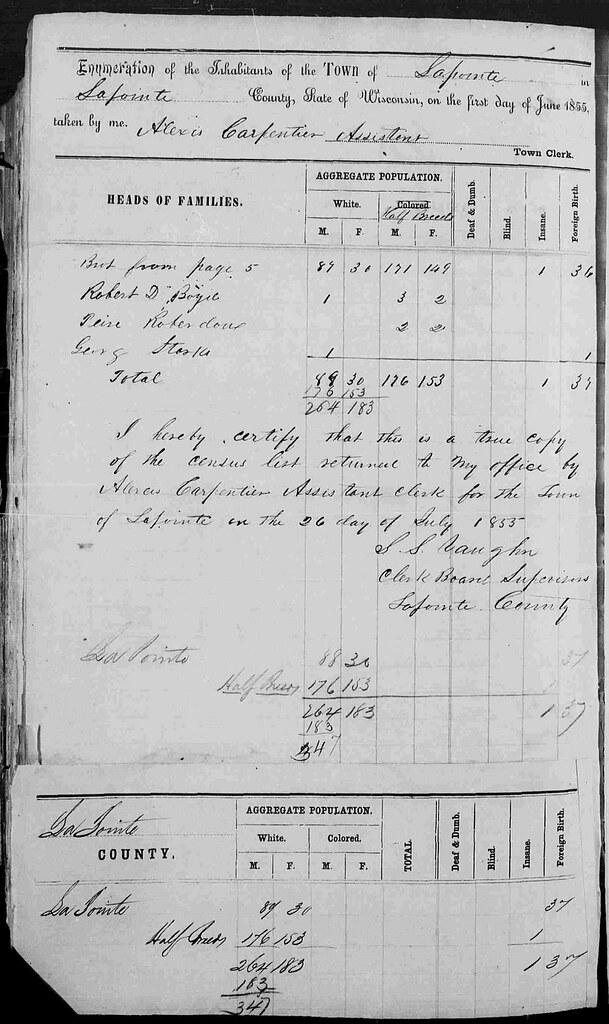
Page 6 with totals.
Patrick Sullivan did not sign the LaPoint Agreement to Stop Whiskey Trade of September 10, 1855. In fact, I haven’t been able to find much information at all about Patrick and Johanna Sullivan in later years. It does appear the family stayed in the area and their children were still living in Ashland at the dawn of the 20th century.
Finally, since this post deals with the 1855 census and issues of race and identity, it’s worth noting another interesting fact. The state census had only two categories for race: “White” and “Colored.” As non-citizens, full-blooded Ojibwe people would not have been counted among the 447 names on the census. However, it seems that Carpentier and his boss, La Pointe town clerk Samuel S. Vaughn, were not sure how to categorize by race.
Carpentier crossed out the designation “Colored” and replaced it with “Half-Breed.” By their count, 329 “Half-Breeds” and 118 Whites (many of them in mixed families) lived in La Pointe County in 1855. Mix-bloods were considered Ojibwe tribal members under the Treaty of 1847. However, they traditionally had their own identity and were thought eligible for U.S. citizenship.
One wonders what conversations were had as the census was completed, but in the final compilation, all 447 names (including several core Red Cliff and Bad River families) were submitted to the state as “White” rather than “Colored.” Despite America’s best efforts to create a racial duality, which would only intensify following the Civil War, this region would continue to defy such categorization for the remainder of the 19th century.
Sources:
Kohl, J. G. Kitchi-Gami: Life among the Lake Superior Ojibway. St. Paul: Minnesota Historical Society, 1985. Print.
Miller, Kerby A. Emigrants and Exiles: Ireland and the Irish Exodus to North America. New York: Oxford UP, 1985. Print.
NOTES: Research originally featured on Chequamegon History is featured in the new Changing Currents exhibit opening today at the Chippewa Valley Museum in Eau Claire. I had a chance to preview the exhibit on Friday, and John Vanek and crew have created an incredibly well-done display of Ojibwe treaty and removal politics of the mid 1800s. See their website for more information. The research found in this exhibit, which extends into several topics, is very deep and does not shy away from uncomfortable topics. I highly recommend it.
There may be some exciting guest research featured on Chequamegon History in the coming months dealing with the aftermath of the 1854 Treaty and fraudulent land claims in the Penokee Iron Range. Stay tuned.
Fall 2014 Preview
September 20, 2014
Posting has slowed considerably on Chequamegon History over the last few months due to my very busy personal life. This shows no signs of letting up, so I can’t promise a new post any time soon. However, the site is not abandoned, and new research topics continue to arise. Here are some I hope to get to before Christmas:
- La Pointe Bands: This is an offshoot of the Perrault-Curot-Nelson-Malhoit-Sayer map and its implications for the identity of the La Pointe Ojibwe Band. It will suggest that even after the Treaty of 1854, there were several “La Pointe” Bands, rather than just one that split into two (Red Cliff and Bad River) as the usual story goes. Theresa Schenck’s annotated edition of William Warren’s History of the Ojibways, and some obscure primary documents will guide much of this.
- Trowbridge Account of the 1820 Cass Expedition: There are several primary accounts of the 1820 expedition led by Lewis Cass through Lake Superior and the Upper Mississippi. This one comes from newspaper articles during the Lake Superior tourist rush of 1855. C. C. Trowbridge, who had accompanied Cass thirty-five years earlier, returned to Lake Superior aboard one of the steamboats.
- “A real bona fide, unmitigated Irishman:” Another account from the 1855 annuity payment, this one describes an Irish whiskey dealer and his wife on Madeline Island. Although the author praises the “Irish wit,” it is highly stereotypical.
- The “British” Chiefs of La Pointe: This one will expand on the La Pointe Bands post, and examine recent scholarship by Janet Chute, Mark Dietrich, and Howard Paap, to suggest that despite La Pointe’s reputation as being a friendly area for American government efforts, the Ojibwe leadership at Chequamegon maintained close connections and sympathies with British-Canadian authorities well into the “American” Era.
- Blackbird-Wheeler Letters Part 2: Politics and the Battle for the Soul of Bad River: This continues from the Blackbird-Wheeler Letters post, looking deeper into the religious aspects of the post-1854 rifts in the Bad River community. Catholics from La Pointe/Red Cliff, the Protestant mission led by Leonard Wheeler and Henry Blatchford, and the families led by Blackbird who kept to the traditions of the Midewiwin all competed for influence.
- Reisen in Nordamerika: From Brule to Stillwater: This is potentially a further translation from the Austrian travelers, Wagner and Scherzer, who visited this area in 1852. We last left them at the mouth of the Brule River with their voyageur guides (thought to be Souverain Denis and Jean-Baptiste Belanger). In Chapters 22 and 23, Denis and Belanger lead the group down the Brule and St. Croix, which are described by Scherzer in detail.
Thank you for reading. I hope to be back at it soon:
~LF
 Chequamegon History