
KAIZHEOSH, and his band from Lake Vieu Desert. Michigan and Wisconsin: Copied from the original birch bark by Seth Eastman and published in Schoolcraft, Henry R. Information Respecting the History, Condition and Prospects of the Indian Tribes of the United States, Volume 1. Philadelphia: Lippincott, Grambo, and Company, 1853. (Digitized by the University of Nebraska Libraries)
In the fall of 1848, a group of Ojibwe Indians led by a charismatic mix-blooded interpreter, arrived in Cincinnati, Ohio. They were bound for Washington D.C., but didn’t have the money to get there because they didn’t have “permission” from the Indian Agent for the trip. They had to raise funds along the way by putting on dances for the curious public. Those who read Chequamegon History might remember this post and recognize them as John Baptiste Martell, Oshkaabewis, Gezhiiyaash, and the other chiefs from the Lac du Flambeau/Ontonagon region who carried the famous pictographic birch bark petitions to Washington. The pictographs showing the united Ojibwe clans, and the written petition that accompanied them, asked the government to create reservations in Michigan and Wisconsin, and not remove the Oijbwe.
When Gezhiiyaash got sick in Cincinnati, the doctor he was seeing noticed that the petitions were not the only birch bark documents carried by the party. The ill Lac Vieux Desert chief was a leader in the Midewiwin Society, and he had brought a Mide scroll. His doctor, like many prominent American men in the middle of the 19th century, was a Freemason, and this is where things got interesting. And, I’ll leave it at that because I don’t want to spoil any more of this story. It’s a good one.

Masonic Voice Review, Volume 4. J. Ernst., 1849. Digitized by Google Books


There isn’t a whole lot to add to this other than to say the 1848-49 “Martell Expedition” gets weirder and more interesting with each new source that surfaces. Please read …a donation of twenty-four sections of land covering the graves of our fathers, our sugar orchards, and our rice lakes and rivers… and Reconstructing the “Martell” Delegation through Newspapers, for an explanation of the goals and accomplishments of these chiefs and the obstacles they faced along the way.
Sources:
Satz, Ronald N. Chippewa Treaty Rights: The Reserved Rights of Wisconsin’s Chippewa Indians in Historical Perspective. Madison, WI: Wisconsin Academy of Sciences, Arts and Letters, 1991. Print.
Schenck, Theresa M. William W. Warren: The Life, Letters, and times of an Ojibwe Leader. Lincoln: University of Nebraska, 2007. Print.
Schoolcraft, Henry Rowe, and Seth Eastman. Historical and Statistical Information Respecting the History, Condition, and Prospects of the Indian Tribes of the United States: Collected and Prepared under the Direction of the Bureau of Indian Affairs per Act of Congress of March 3rd, 1847. Philadelphia: Lippincott, Grambo, 1851. Print.
Sandy Lake Letters: Sherman Hall to the Wheelers
July 11, 2013

“Chippewa Indians Fishing on the Ice” (Digitized by New York Public Library from Heroes and hunters of the West : comprising sketches and adventures of Boone, Kenton, Brady, Logan, Whetzel, Fleehart, Hughes, Johnston, etc. Philadelphia : H. C. Peck & Theo. Bliss, 1859.)
On June 9th, I transcribed and posted two letters related to the Sandy Lake Tragedy (the attempted removal of the Lake Superior Ojibwe in the fall of 1850, which claimed as many as 400 innocent lives). The letters, digitized by the Wisconsin Historical Society, were from the Warren Family Papers. One was from missionary Leonard Wheeler to William Warren before the tragedy, and another was from Indian Agent John Watrous to Warren during a second removal attempt a year later.
That post sought to assess how much responsibility Warren and Watrous bear for the 400 deaths. It also touched on the role of the Protestant A.B.C.F.M. missionaries in the region. This post continues those thoughts. This time, we’re looking at two more letters and evaluating one of the missionaries himself.
Both of these letters are from the Wheeler Family Papers, held by the Wisconsin Historical Society at the Ashland Area Research Center. I went directly to the original documents for these, and while I’ve seen them referenced in published works, I believe this is the first time these particular letters have been transcribed or posted online.
The first is from Sherman Hall, the founder of the La Pointe Mission, to his colleague Leonard Wheeler, who operated the satellite mission at Odanah. Hall traveled to Sandy Lake for the annuity payments and sent this letter to Wheeler, who was visiting family back in Massachusetts, after returning to La Pointe.
Lapointe. Dec. 28th 1850
Brother Wheeler:
I wrote you while at Sandy Lake and promised to write again when I should reach Lapointe. That promise I now redeem. I started from Sandy Lake on the fourth inst. and reached home on the 16th having been absent from home just eight weeks. I was never more heartily glad to leave a place than I was Sandy Lake, nor more glad to reach home after an absence. Of course winter here has justly begun. The snow was some ten inches deep on the Savannah Portage. On reaching the East Savannah River we found the ice good and clear of snow and water. This continued to be the case most of the way to the Grand Portage at Fond du Lac. From Fond du Lac to Lapointe the traveling most of the way was hard, and it was not till the seventh day from F. du L. that I reached home. Besides bad traveling I had to carry a pack which I found, when I got home weighed 60 pounds. With this however I found it not difficult to keep up with most of my traveling companions who were much heavier loaded than I. This is my first experience of carrying a heavy pack on a long journey and I am fully satisfied with the experiment. I had no alternative however, bet either to throw away my blankets and clothes, or carry them. Every body was loaded with a heavy pack, and I could employ no one. I however got through well—did not get lame as many others did, nor do I feel any furious[?] by ill effects of my journey since my arrival.
I found the mission family well on my arrival. They had felt somewhat lonesome while so many were absent from this place. Things in the community here are generally in a quiet state at present. I apprehend that there will be considerable pinching for provisions before spring. It has been a very windy and stormy fall. The people have taken but little fish. Many nets have been lost. The traders have but a small quantity of provisions, and if they had the people have but little to buy with. The bay opposite to this island is now principally covered with ice so that the Indians are on the ice some to spear fish. The ice has once broken up since it first closed, and a heavy wind would break it up again, as it is yet very thin, and the weather mild. If the lake is frozen the Inds will probably get considerable fish; but if it should be open they must suffer.
Our Indian meetings are pretty well attended, and I feel that there is ground for encouragement. Simon I think is exerting a good influence. His Catholic friends have tried to draw him back to their church; but seems stable. His oldest brother, who has recently lost his wife, has expressed a wish to hear the word of God. I hope he will yet become a sincere listener.
Our English exercises are attended by a smaller number than formerly since many have left this place. I think however for our own good, as well as on account of others, we ought to keep them up. Mr. Van Tassel has returned to remain here till spring. I have heard nothing from Bad River for some time past. I had formed a design to go there this week, but have been prevented by the state of the ice. I intend going as soon as the ice gets a little stronger. I suppose there are very few Indians there. More are about the Lake.
I heard that Mr. Leihy has lost both his horses which will be a serious inconvenience to him in this mill enterprise I presume.
Mr. Pulsifer has received one letter from you, and by our last mail he heard through his correspondent at Lowell that you had arrived at that place.
I suppose you find some changes have taken place in the wide world during the times you have been shut up in the wilderness. Do you find calls enough to keep you busy? I have been expecting a letter from you. I want to hear what you have to say about the things you see, and how you like visiting, etc.
I have just had a letter from Mr. Ely, who says, “We are [snugly by quarters?] in St. Paul. My home is full of music—am employed as choir leader in Mr. [Mill’s?] (Prs.) church—sing two evenings a week at Stillwater, and the rest of my time is well filled with the private scholars & tuning Pianos, of which there are 7 or 8 at St. Paul.” Perhaps Br. Ely will find this a more lucrative business than cutting and hauling pine logs. I am glad he has found employment.
Our children all attend school except Harriet. Marydoes very well. Please give my regards to your friends at Lowell. I am writing to Mr. Treat by this opportunity. [Wish?] kind regards to Mrs. W. I remain
yours
S. Hall.
 The Old Mission Church, La Pointe, Madeline Island. (Wisconsin Historical Society Image ID: 24827)
 Harriet Wheeler, pictured about forty years after receiving this letter. (Wisconsin Historical Society: Image ID 36771)
“…your note to Harriet” Harriet Hall was Sherman’s oldest daughter, about 19 years old at this time.
 Many Ojibwe leaders, including Hole in the Day, blamed the rotten pork and moldy flour distributed at Sandy Lake for the disease that broke out. The speech in St. Paul is covered on pages 101-109 of Theresa Schenck’s William W. Warren: The Life, Letters, and Times of an Ojibwe Leader, my favorite book about this time period. (Photo from Whitney’s Gallery of St. Paul: Wisconsin Historical Society Image ID 27525)
 Mary Warren (1835-1925), was a teenager at the time of the Sandy Lake Tragedy. She is pictured here over seventy years later. Mary, the sister of William Warren, had been living with the Wheelers but stayed with Hall during their trip east. (Photo found on University of Connecticut Radio website, scanned from Frances Densmore photos in the Smithsonian Bureau of Ethnology)
Lapointe, Feb. 24th 1851.
Mrs. Wheeler,
By our last mail I wrote to Mr Wheeler, and by this I will address a few lines to you. From your note to Harriet I suppose you are happy among your friends. I am glad you are so, and hope you will not only spend your winter pleasantly, but that you will find the present season of relaxation from the severe duties of your station here, the occasion of reconnecting[?] your health and spirits.
I do not feel that the time has yet come when the churches ought to close their efforts to save these Indians. I do not think they are entirely beyond the reach of hope. The prospect however looks dark. But I think the greatest cause of discouragement arises from their character, and not from their present political condition. Generally they do not want to improve their condition. They are satisfied with their ignorance and degradation. All they think of is to supply for their present wants without their own exertions, while they wish to live in idleness and sin. This is the cause of their keeping so much aloof from the influence of the missions. Their minds are dreadfully dark respecting the things of the future world. They seem to have no ideas of happiness superior to that derives from the gratification of the lowest animal appetites and passions. This is the reason why the truths of the gospel so little effect on them. These things present to my mind much stronger grounds of discouragement than their present political difficulties, though those at present are not inconsiderable.
But as stupid as is the conscience, and as dark as is the understanding and the heart, and as much as they are given up to [?]ality and sin, I believe there is a Power that can quicken them into life. My only hope is that He who has made them, and has power to save them, will come and add his blessing to the preaching of his own gospel, and make it to them the power and wisdom of God. Thousands of others as dead in trespasses and sins, have been saved. Why may not they be saved? Come back home and let us try still to do something for them. Tell Christians to remember them and pray for them, that the word of God among them may have free course and be glorified.
It is a time of great scarcity of food among the Indians. There is some one in our houses almost every hour of the day begging for food. Very few get more than a meal a day; many not half of one. I have been told by several individuals, that they have tried three or four days in succession to catch fish, and have been obliged to return to their starving families each night with nothing for them. I am frequently importuned to spare a little provisions till I am obliged to go away out of sight to get rid of their pleading. I have spared the last potatoes I dare let go. Corn we have none. We have but a small quantity of flour over what will be required to sustain our families till we can expect to obtain a new supply. For a long time I have not known fish so scarce as the present winter. That is almost the only dependence of this people. For a month to come there will be many hungry ones. Many of the French and half-breeds are but little better off than the Indians. All we can do is to divide a little morsel with the hungry ones who come to beg. We have not much to give to those who importune for something to carry to their families. But as long as they continue to waste their summers in idleness they must starve in the winter.
The young Hole-in-the-day has been down to St Paul and there made a public speech in which he attributes the sickness at the payment last fall to the bad provisions which were dealt out to the Indians, and imparts much blame to the officers of the government for the way in which they [were with?]. In time they had some flour dealt out to them which was much damaged. But I think there were other causes for the sickness which prevailed besides the bad provisions. I think however that in some [aspects?] the Indians were wronged. Treaty stipulations were not carried out. H is very confident that many of the Indians are not satisfied with the manner in which they have been dealt with, and recent events have not served to strengthen their attachment to the Government.
We had our communion yesterday. I think there is a [?]ably good state of feeling among the native church members at this time. Simon has been frequently sick this winter. But his trials appear to bring nearer to God. He appears to be growing in the knowledge of God and in piety.
You will probably recollect Mo-ko-kun-ens-ish, an Indian with a bunch[?] between his shoulders, married into the family of the Little-current. He is, by profession, a Catholic. About a week ago, he made me a visit, and said his priest had offended him, and he wished to join us. A short time since he lost a child, and when the priest came to bury it, he said he “scolded him” because he had not cleaned away the snow from the gate of the burying yard, and made a better path for him to come to the grave. He told a long story. I suspected his object was to get some provisions of me. I told him we should be happy to see him at our meetings, and told him where and when they would be held. He said he should attend only sometimes he might be obliged to fish to get something to eat, and be occasionally away. I said a few words to him on religious subjects, and he left without asking for anything. The next day he came with a small piece of cloth and asked me to give him provisions for it. I told I had not provisions to trade. He then enquired about meeting. I told him we were to hold one that evening in the school-house. He said he should attend. The evening came, the meeting was held—but he was not there. Nor have we seen him at any other meeting. Such are the methods the heathens & Catholics take to deceive us. We could make many converts with flour and pork, especially at this time.
Yours Truly,
S. Hall
[Written in margins]
All send love though I have not room to write it.
Mary goes to school and is doing very well.

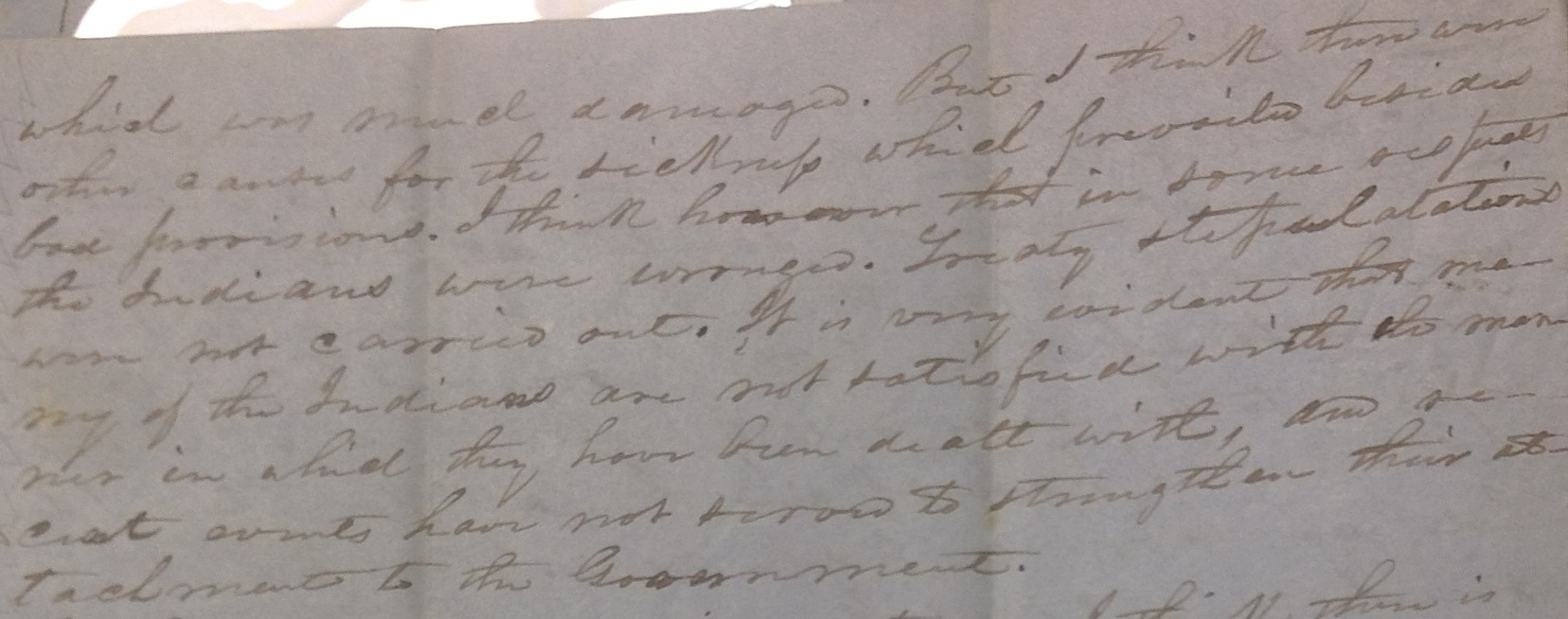
These are the originals of the paragraph about Hole in the Day’s speech in St. Paul. I couldn’t quite decipher all of it. Let me know what you see (Wheeler Family Papers, Personal Correspondence 1851, Wisconsin Historical Society Ashland Area Research Center).
In the June 9th post, we tried to determine how much William Warren and John S. Watrous were at fault for the deaths resulting from the 1850 Sandy Lake removal attempt. In this post, we will do the same for Sherman Hall.
Before we begin, it’s worth reviewing the facts. By 1850, Hall had lived at La Pointe for twenty years. He knew the people who lived here, and he knew the promises the Ojibwe were given at the Treaty of 1842. He was certainly aware of the Ojibwe position on the removal.
Rev. Hall did not order the removal. Compared with the government and Fur Company officials, he was fairly powerless within the Lake Superior region. However, he had a power of a different sort. As the primary voice of the ABCFM in Ojibwe country, he had powerful friends in the eastern states. Many Americans perceived the missionaries as the only neutral voice in the area. Hall admits in the December 28th letter that the Ojibwe were wronged. He could have advocated for their cause in the summer of 1850 as the illegal removal was unfolding. Instead, he largely went along with government efforts.
To his credit, in other letters Hall did blame the government for the failure of the Sandy Lake payment. The best book I’ve encountered about this time period is William W. Warren: The Life, Letters, and Times of an Ojibwe Leader by Theresa Schenck (Nebraska UP, 2007). On page 94, Dr. Schenck quotes a letter from Hall to ABCFM Secretary S.B. Treat. It is dated December 30, and is probably the letter referred to in the letter to Leonard Wheeler above. Hall is honest about Ojibwe feelings on the removal and seems to empathize somewhat. On page 155, Schenck details how the La Pointe mission did eventually turn against government removal efforts later in 1851.
So, it probably seems that I am defending Sherman Hall. Why? Truthfully, it’s because I want to have some balance in this post because, quite frankly, these two letters are some of the most disgusting, horrifying documents I’ve ever read. I felt especially sick typing up the February 24th letter to Harriet Wheeler. For a man who claimed to be “saving” the Ojibwe to be so heartless in the midst of so much suffering is appalling.
Was the mission running low on food? Sure, but doesn’t true Christian charity demand sharing to the last?
Should Hall’s language be judged by the standards of the racist times he lived in? Absolutely, but to say the things he says about human beings, his neighbors of twenty years, is inexcusable in any time period.
Is it possible he was traumatized by his experience at Sandy Lake, and this was a way of dealing with his personal guilt? This is possible. He does seem to be speaking to himself in the letter as much as he is to the Wheelers.
There is a danger in judging too much from just two letters, but I think Hall needs to be held to the same standard as Warren and Watrous were in the June 9th post. He could have spoken out against the removal to begin with. He didn’t. He was an eyewitness to Sandy Lake. He knew what the Ojibwe had been promised, and he saw the consequences of the government breaking those promises. His letters to the Wheelers in Boston could have been used to help right those wrongs by uniting the missions behind the Ojibwe cause. Instead, he chose to blame the people who had been wronged to the point of 400 deaths. For these reasons, I think when we list the villains of Sandy Lake, the Reverend Sherman Hall needs to be among them.
Sources:
Densmore, Frances. Chippewa Customs. Washington: U.S. G.P.O., 1929. Print.
Ely, Edmund Franklin, and Theresa M. Schenck. The Ojibwe Journals of Edmund F. Ely, 1833-1849. Lincoln: University of Nebraska, 2012. Print.
KAPPLER’S INDIAN AFFAIRS: LAWS AND TREATIES. Ed. Charles J. Kappler. Oklahoma State University Library, n.d. Web. 21 June 2012. <http:// digital.library.okstate.edu/Kappler/>.
Satz, Ronald N. Chippewa Treaty Rights: The Reserved Rights of Wisconsin’s Chippewa Indians in Historical Perspective. Madison, WI: Wisconsin Academy of Sciences, Arts and Letters, 1991. Print.
Schenck, Theresa M. William W. Warren: The Life, Letters, and times of an Ojibwe Leader. Lincoln: University of Nebraska, 2007. Print.
Warren, William W., and Theresa M. Schenck. History of the Ojibway People. St. Paul: Minnesota Historical Society, 2009. Print.
In the Fall of 1850, the Lake Superior Ojibwe (Chippewa) bands were called to receive their annual payments at Sandy Lake on the Mississippi River. The money was compensation for the cession of most of northern Wisconsin, Upper Michigan, and parts of Minnesota in the treaties of 1837 and 1842. Before that, payments had always taken place in summer at La Pointe. That year they were switched to Sandy Lake as part of a government effort to remove the entire nation from Wisconsin and Michigan in blatant disregard of promises made to the Ojibwe just a few years earlier.
There isn’t enough space in this post to detail the entire Sandy Lake Tragedy (I’ll cover more at a later date), but the payments were not made, and 130-150 Ojibwe people, mostly men, died that fall and winter at Sandy Lake. Over 250 more died that December and January, trying to return to their villages without food or money.

George Warren (b.1823) was the son of Truman Warren and Charlotte Cadotte and the cousin of William Warren. (photo source unclear, found on Canku Ota Newsletter)
If you are a regular reader of Chequamegon History, you will recognize the name of William Warren as the writer of History of the Ojibway People. William’s father, Lyman, was an American fur trader at La Pointe. His mother, Mary Cadotte was a member of the influential Ojibwe-French Cadotte family of Madeline Island. William, his siblings, and cousins were prominent in this era as interpreters and guides. They were people who could navigate between the Ojibwe and mix-blood cultures that had been in this area for centuries, and the ever-encroaching Anglo-American culture.
The Warrens have a mixed legacy when it comes to the Sandy Lake Tragedy. They initially supported the removal efforts, and profited from them as government employees, even though removal was completely against the wishes of their Ojibwe relatives. However, one could argue this support for the government came from a misguided sense of humanitarianism. I strongly recommend William W. Warren: The Life, Letters, and Times of an Ojibwe Leader by Theresa Schenck if you are interested in Warren family and their motivations. The Wisconsin Historical Society has also digitized several Warren family letters, and that’s what prompted this post. I decided to transcribe and analyze two of these letters–one from before the tragedy and one from after it.
The first letter is from Leonard Wheeler, a missionary at Bad River, to William Warren. Initially, I chose to transcribe this one because I wanted to get familiar with Wheeler’s handwriting. The Historical Society has his papers in Ashland, and I’m planning to do some work with them this summer. This letter has historical value beyond handwriting, however. It shows the uncertainty that was in the air prior to the removal. Wheeler doesn’t know whether he will have to move his mission to Minnesota or not, even though it is only a month before the payments are scheduled.
Sept 6, 1850
Dear Friend,
I have time to write you but a few lines, which I do chiefly to fulfill my promise to Hole in the Day’s son. Will you please tell him I and my family are expecting to go Below and visit our friends this winter and return again in the spring. We heard at Sandy Lake, on our way home, that this chief told [Rev.?] Spates that he was expecting a teacher from St. Peters’ if so, the Band will not need another missionary. I was some what surprised that the man could express a desire to have me come and live among his people, and then afterwards tell Rev Spates he was expecting a teacher this fall from St. Peters’. I thought perhaps there was some where a little misunderstanding. Mr Hall and myself are entirely undecided what we shall do next Spring. We shall wait a little and see what are to be the movements of gov. Mary we shall leave with Mr Hall, to go to school during the winter. We think she will have a better opportunity for improvement there, than any where else in the country. We reached our home in safety, and found our families all well. My wife wishes a kind remembrance and joins me in kind regards to your wife, Charlotte and all the members of your family. If Truman is now with you please remember us to him also. Tomorrow we are expecting to go to La Pointe and take the Steam Boat for the Sault monday. I can scarcely realize that nine years have passed away since in company with yourself and Pa[?] Edward[?] we came into the country.
Mary is now well and will probably write you by the bearer of this.
Very truly yours
L. H. Wheeler
 By the 1850s, Young Hole in the Day was positioning himself to the government as “head chief of all the Chippewas,” but to the people of this area, he was still Gwiiwiizens (Boy), his famous father’s son. (Minnesota Historical Society)
Samuel Spates was a missionary at Sandy Lake. Sherman Hall started as a missionary at La Pointe and later moved to Crow Wing.
Mary, Charlotte, and Truman Warren are William’s siblings.
The Wheeler letter is interesting for what it reveals about the position of Protestant missionaries in the 1850s Chequamegon region. From the 1820s onward, the American Board of Commissioners for Foreign Missions sent missionaries, mostly Congregationalists and Presbyterians from New England, to the Lake Superior Country. Their names, Wheeler, Hall, Ely, Boutwell, Ayer, etc. are very familiar to historians, because they produced hundreds of pages of letters and diaries that reveal a great deal about this time period.

Leonard H. Wheeler (Wisconsin Historical Society)
Ojibwe people reacted to these missionaries in different ways. A few were openly hostile, while others were friendly and visited prayer, song, and school meetings. Many more just ignored them or regarded them as a simple nuisance. In forty-plus years, the amount of Ojibwe people converted to Protestantism could be counted on one hand, so in that sense the missions were a spectacular failure. However, they did play a role in colonization as a vanguard for Anglo-American culture in the region. Unlike the traders, who generally married into Ojibwe communities and adapted to local ways to some degree, the missionaries made a point of trying to recreate “civilization in the wilderness.” They brought their wives, their books, and their art with them. Because they were not working for the government or the Fur Company, and because they were highly respected in white-American society, there were times when certain missionaries were able to help the Ojibwe advance their politics. The aftermath of the Sandy Lake Tragedy was such a time for Wheeler.
This letter comes before the tragedy, however, and there are two things I want to point out. First, Wheeler and Sherman Hall don’t know the tragedy is coming. They were aware of the removal, and tentatively supported it on the grounds that it might speed up the assimilation and conversion of the Ojibwe, but they are clearly out of the loop on the government’s plans.
Second, it seems to me that Hole in the Day is giving the missionaries the runaround on purpose. While Wheeler and Spates were not powerful themselves, being hostile to them would not help the Ojibwe argument against the removal. However, most Ojibwe did not really want what the missionaries had to offer. Rather than reject them outright and cause a rift, the chief is confusing them. I say this because this would not be the only instance in the records of Ojibwe people giving ambiguous messages to avoid having their children taken.
Anyway, that’s my guess on what’s going on with the school comment, but you can’t be sure from one letter. Young Hole in the Day was a political genius, and I strongly recommend Anton Treuer’s The Assassination of Hole in the Day if you aren’t familiar with him.

I read this as “passed away since in company with yourself and Pa[?] Edward we came into the country.” Who was Wheeler’s companion when a young William guided him to La Pointe? I intend to find out and fix this quote. (from original in the digital collections of the Wisconsin Historical Society)
In 1851, Warren was in failing health and desperately trying to earn money for his family. He accepted the position of government interpreter and conductor of the removal of the Chippewa River bands. He feels removing is still the best course of action for the Ojibwe, but he has serious doubts about the government’s competence. He hears the desires of the chiefs to meet with the president, and sees the need for a full rice harvest before making the journey to La Pointe. Warren decides to stall at Lac Courte Oreilles until all the Ojibwe bands can unite and act as one, and does not proceed to Lake Superior as ordered by Watrous. The agent is getting very nervous.
 Clement and Paul (pictured) Hudon Beaulieu, and Edward Conner, were mix-blooded traders who like the Warrens were capable of navigating Anglo-American culture while maintaining close kin relationships in several Ojibwe communities. Clement Beaulieu and William Warren had been fierce rivals ever since Beaulieu’s faction drove Lyman Warren out of the American Fur Company. (Photo original unknown: uploaded to findadagrave.com by Joan Edmonson)
For more on Cob-wa-wis (Oshkaabewis) and his Wisconsin River band, see this post.
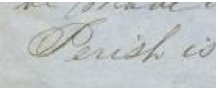
“Perish” is what I see, but I don’t know who that might be. Is there a “Parrish”, or possibly a “Bineshii” who could have carried Watrous’ letter? I’m on the lookout. (from original in the digital collections of the Wisconsin Historical Society)
Aug 9th 1851
Friend Warren
I am now very anxiously waiting the arrival of yourself and the Indians that are embraced in your division to come out to this place.
Mr. C. H. Beaulieu has arrived from the Lake Du Flambeau with nearly all that quarter and by an express sent on in advance I am informed that P. H. Beaulieu and Edward Conner will be here with Cob-wa-wis and they say the entire Wisconsin band, there had some 32 of the Pillican Lake band come out and some now are in Conner’s Party.
I want you should be here without fail in 10 days from this as I cannot remain longer, I shall leave at the expiration of this time for Crow Wing to make the payment to the St. Croix Bands who have all removed as I learn from letters just received from the St. Croix. I want your assistance very much in making the Crow Wing payment and immediately after the completion of this, (which will not take over two days[)] shall proceed to Sandy Lake to make the payment to the Mississippi and Lake Bands.
The goods are all at Sandy Lake and I shall make the entire payment without delay, and as much dispatch as can be made it; will be quite lots enough for the poor Indians. Perish[?] is the bearer of this and he can tell you all my plans better then I can write them. give My respects to your cousin George and beli[e]ve me
Your friend
J. S. Watrous
W. W. Warren Esq.}
P. S. Inform the Indians that if they are not here by the time they will be struck from the roll. I am daily expecting a company of Infantry to be stationed at this place.
JSW
Sources:
Schenck, Theresa M., William W. Warren: The Life, Letters, and times of an Ojibwe Leader. Lincoln: University of Nebraska, 2007. Print.
Treuer, Anton. The Assassination of Hole in the Day. St. Paul, MN: Borealis, 2010. Print.
Warren, William W., and Theresa M. Schenck. History of the Ojibway People. St. Paul: Minnesota Historical Society, 2009. Print.
…a donation of twenty-four sections of land covering the graves of our fathers, our sugar orchards, and our rice lakes and rivers…
March 29, 2013

Symbolic Petition of Chippewa Chiefs: Original birch bark petition of Oshkaabewis copied by Seth Eastman and printed in “Historical and statistical information respecting the history, condition, and prospects of the Indian tribes of the United States” by Henry Rowe Schoolcraft (1851). Digitized by University of Wisconsin Libraries Wisconsin Electronic Reader project (1998).
For the first post on Chequamegon History, I thought I’d share my research into an image that has been circulating around the area for several years now. The image shows seven Ojibwe chiefs by their doodemag (clan symbols), connected by heart and mind to Lake Superior and to some smaller lakes. The clans shown are the Crane, Marten, Bear, Merman, and Bullhead.
All the interpretations I’ve heard agree that this image is a copy of a birch bark pictograph, and that it represents a unity among the several chiefs and their clans against Government efforts to remove the Lake Superior bands to Minnesota.
While there is this agreement on the why question of this petition’s creation, the who and when have been a source of confusion. Much of this confusion stems from efforts to connect this image to the famous La Pointe chief, Buffalo (Bizhiki/Gichi-weshkii).
In 2007, the Great Lakes Indian Fish and Wildlife Commission (GLIFWC) released the short documentary Mikwendaagoziwag: They Are Remembered. While otherwise a very good overview of the Lake Superior Ojibwe in this era, it incorrectly uses this image to describe Buffalo going to Washington D.C. in 1849. Buffalo is famous for a trip to Washington in 1852, but he was not part of the 1849 group.
At the time the GLIFWC film was released, the Wisconsin Historical Society website referred to this pictograph as, “Chief Buffaloʼs Petition to the President,” and identified the crane as Buffalo. Citing oral history from Lac Courte Oreilles, the Society dated the petition after the botched 1850-51 removal to Sandy Lake, Minnesota that resulted in hundreds of Ojibwe deaths from disease and starvation due to negligence, greed, and institutional racism on the part of government officials. The Historical Society has since revised its description to re-date the pictograph at 1848-49, but it still incorrectly lists Buffalo, a member of the Loon Clan, as being depicted by the crane. The Sandy Lake Tragedy, has deservedly gained coverage by historians in recent years, but the pictographic petition came earlier and was not part of it.
If the Historical Society had contacted Chief Buffaloʼs descendants in Red Cliff, they would have known that Buffalo was from the Loon Clan. The relationship between the Loons and the Cranes, as far as which clan can claim the hereditary chieftainship of the La Pointe Band, is very interesting and covered extensively in Warrenʼs History of the Ojibwe People. It would make a good subject for a future post.
After looking into the history of this image, I can confidently say that Buffalo is not one of the chiefs represented. It was created before Sandy Lake and Buffalo’s journey, but it is related to those events. Here is the story:
In late 1848, a group of Ojibwe chiefs went to Washington. They wanted to meet directly with President James K. Polk to ask for a permanent reservations in Wisconsin and Michigan. At that time the Ojibwe did not hold title to any part of the newly-created state of Wisconsin or Upper Michigan, having ceded these lands in the treaties in 1837 and 1842. In signing the treaties, they had received guarantees that they could stay in their traditional villages and hunt, fish, and gather throughout the ceded territory. However, by 1848, rumors were flying of removal of all Ojibwe to unceded lands on the Mississippi River in Minnesota Territory. These chiefs were trying to stop that from happening.
John Baptist Martell, a mix-blood, acted as their guide and interpreter. The government officials and Indian agents in the west were the ones actively promoting removal, so they did not grant permission (or travel money) for the trip. The chiefs had to pay their way as they went by putting themselves on display and dancing as they went from town to town.
Martell was accused by government officials of acting out of self interest, but the written petition presented to congress asked for, “a donation of twenty-four sections of land covering the graves of our fathers, our sugar orchards, and our rice lakes and rivers, at seven different places now occupied by us at villages…” The chiefs claimed to be acting on behalf of the chiefs of all the Lake Superior bands, and there is reason to believe them given that their request is precisely what Chief Buffalo and other leaders continued to ask for up until the Treaty of 1854.


This written petition accompanied the pictographic petitions. It clearly states the goal of the the chiefs was to secure permanent reservations around the traditional villages east of the Mississippi.
The visiting Ojibwes made a big impression on the nationʼs capital and positive accounts of the chiefs, their families, and their interpreter appeared in the magazines of the day. Congress granted them $6000 for their expenses, which according to their critics was a scheme by Martell. However, it is likely they were vilified by government officials for working outside the colonial structure and for trying to stop the removal rather than for any ill-intentions of the part of their interpreter. A full scholarly study of the 1848-49 trip remains to be done, however.
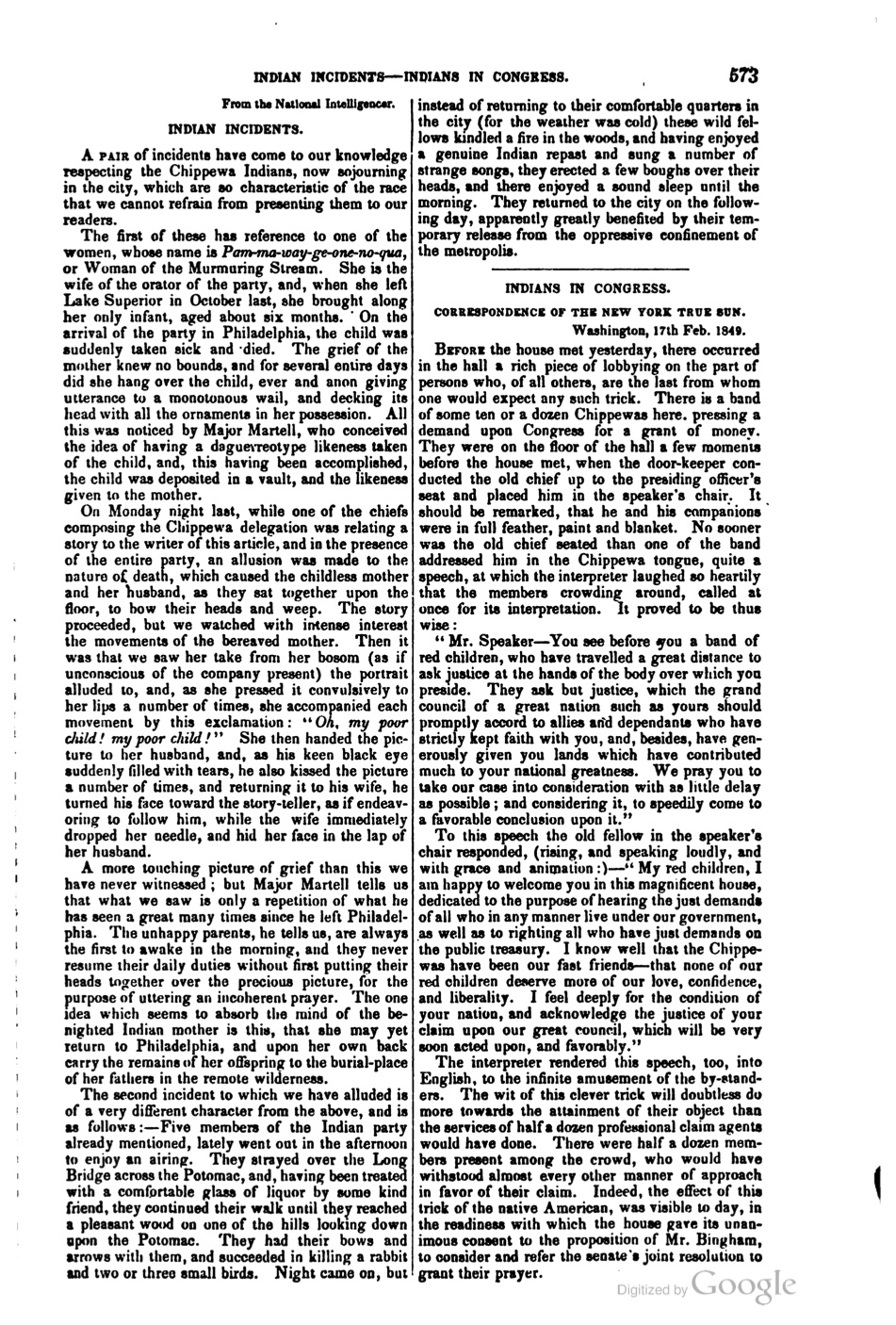
Amid articles on the end of the slave trade, the California Gold Rush, and the benefits of the “passing away of the Celt” during the Great Irish Famine, two articles appeared in Littell’s Living Age magazine about the 1849 delegation. The first is tragic, and the second is comical.
Along with written letters and petitions supporting the Ojibwe cause, the chiefs carried not only the one, but several birchbark pictographs. The pictographs show the clan animals of several chiefs and leading men from several small villages from the mouth of the Ontonagon River to Lac Vieux Desert in Upper Michigan and smaller satellite communities in Wisconsin. After seeing these petitions, the artist Seth Eastman copied them on paper and gave them to Henry Schoolcraft who printed and explained them alongside his criticism of the trip. They appear in his 1851 Historical and statistical information respecting the history, condition, and prospects of the Indian tribes of the United States.
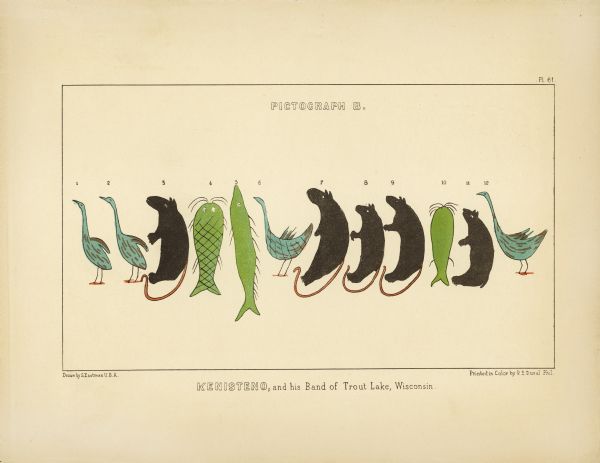
Kenisteno, and his Band of Trout Lake, Wisconsin
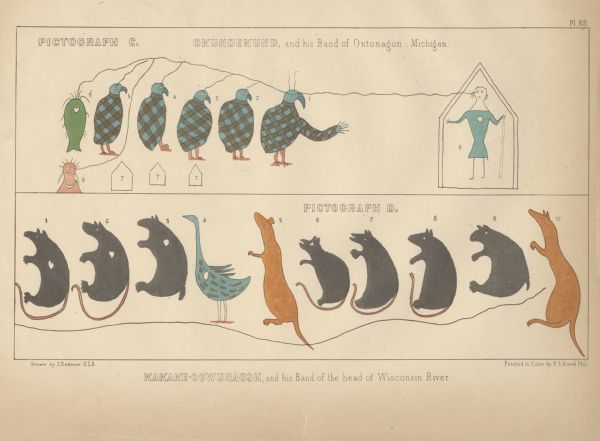
Okundekund, and his Band of Ontonagon, Michigan (Upper) Kakake-ogwunaosh, and his Band of the head of Wisconsin River (Lower)
According to Schoolcraft, the crane in the most famous pictograph is Oshkaabewis, a Crane-clan chief from Lac Vieux Desert, and the leader of the 1848-49 expedition. In the Treaty of 1854, he is listed as a first chief from Lac du Flambeau in nearby Wisconsin. It makes sense that someone named Oshkaabewis would lead a delegation since the word oshkaabewis is used to describe someone who carries messages and pipes for a civil chief.
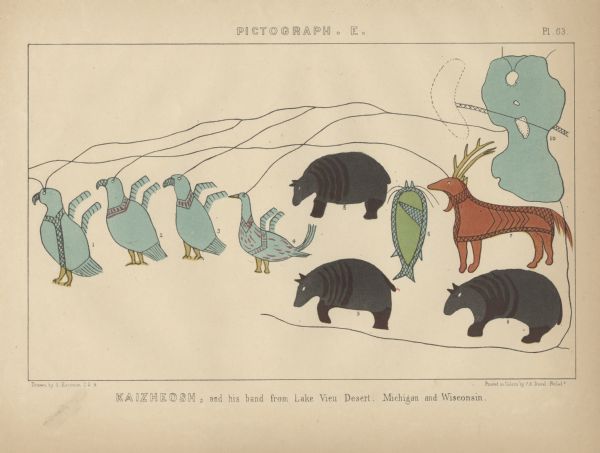
Kaizheosh [Gezhiiyaash], and his band from Lake Vieu Desert, Michigan and Wisconsin (University of Nebraska Libraries)
Long Story Short…
This is not Chief Buffalo or anyone from the La Pointe Band, and it was created before the Sandy Lake Tragedy. However it is totally appropriate to use the image in connection with those topics because it was all part of the efforts of the Lake Superior Ojibwe to resist removal in the late 1840s and early 1850s. However, when you do, please remember to credit the Lac Vieux Desert/Ontonagon chiefs who created these remarkable documents.
 Chequamegon History