CAUTION: This translation was made using Google Translate by someone who neither speaks nor reads German. It should not be considered accurate by scholarly standards.
When we last left Moritz Wagner and Carl Scherzer, the two Austrian adventurers who traveled across Lake Superior in 1852, they had avoided certain death when caught in a storm halfway through the crossing between Bad River and La Pointe. In this post, we find them on Madeline Island in the wee hours of the morning, looking for a place to stay.
In the three days they spent in La Pointe, they produced a description of the island as colorful as any I’ve come across. Enjoy:

A View of La Pointe from Report of a Geological Survey of Wisconsin, Iowas, and Minnesota (1852) by David Dale Owen (Digitized by Google Books)
XXI
From Ontonagon to the mouth of the Bois-brule River–Canoe ride to Magdalen Island–Porcupine Mountains–Camping in the open air–A dangerous canoe landing at night–A hospitable Jewish family–The island of La Pointe–The American Fur Company–The voyageurs or courriers de bois–Old Buffalo, the 90 year-old Chippewa chief–A schoolhouse and an examination–The Austrian Franciscan monk–Sunday mass and reflections on the Catholic missions–Continuing the journey by sail–Nous sommes degrades–A canoeman and apostle of temperance–Fond du lac–Sauvons-nous!
It was 1 o’clock in the morning, and the whole settlement was in a deep sleep. We were at a loss as to which door to knock at. Among 200 Indians, only a few white families live there. One of the boatmen gave us a name, with which we found Mr. Austrian (a name meaning Oestreicher) a descendent of the Mosaic.
We knocked confidently by rattling at the window showing the distinguishing hemp of Austrian. We have always had a favorable bias for our Jewish countrymen in this nation. They have brought over so many ancient patriarchal customs of antiquity unadulterated, faithful, and pure in their sympathetic breasts. Here the noble manners of hospitality sweep away the cold breath of selfishness found among the Americans. The Jews are always ready to welcome strangers and donate a warm and magnanimous hand with every occasion.
They opened and the young doorman yelled out to the person in the next room, “Joe, steh auf, Leut from below, sind da!” and because it could not be doubted that we were, “One of our people!” We were then bombarded with all the tastes of the kosher delicatessen: belek, kugel, kindeln, and other tidbits of the Jewish frying pan. We were offered a nice, clean room and did not suspect that the close Yom Kippur (Jewish fast day) should frustrate our feast.
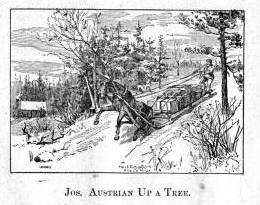
Jewish-immigrant brothers, Julius and Joseph Austrian, were prominent La Pointe residents at this time. This image depicts an incident from Benjamin Armstrong’s Early Life Among the Indians (Engraving by Marr & Richards Co.).
17 September, early, 61° Fahr. The actual owner of the home was absent. However, his younger brother received us with all the warmth of a Bayreuth Jew. He had only been in the country a short time, and spoke English with a Spanish-sounding accent as he called to us in the room, “Waken sie!” He showed us a pair of Indian snowshoes, and asked, “Haben sie snow shoes noch nie geused?*” He finally told of the fish trade in the same mixed gibberish, “Below werden die Fische umgepakt, inspected, und dann weider vereignepakt again.”
(*German immigrants all have a peculiar manner of acquiring the English language. As they hear a strange new name, they mix it together immediately with the words of their native language, without regard for how the expression works in English. A carpenter told us, “Wenn sie ein loghouse bauen wollen un dasselbe inwendig geplastered und von außen geclapboarded wird, so wird es 700 dollars kosten!”
In Pennsylvania, all counties speak an unintelligible German-English slang. It may be that after a few generations, a whole new language is emerging. So, some German immigrants are a tragic example of how one can forget his native language without having to learn another language as a substitute.)
La Pointe is the largest of several islands known under the collective name of Isles des Apotres. It has an unusual history. One of the earliest points on Lake Superior where men of faith planted the cross of salvation in 1665, it wasn’t until a century later that the progress of civilization began to push the two and four-legged forest dwellers further and further west . For several years it was the home depot (post) of the Fur Trading Company. This trading company was founded in 1808 by John Jacob Astor as the American Fur Trading Company, by an act of law of the State of New York. It granted exclusive right of trade and intercourse with the Indians, and in earlier times, provided an immense source of power and wealth. Currently, the business is divided between a Company of the West and the North West, of which the latter united with the Hudson’s Bay Company* and created unrestricted competition and limited the field of activity. The company of the west, currently under the leadership of J. Chouteau and Company, trades with the Indians of the Missouri and Mississippi. Its headquarters are at the upper Mississippi. The company owns 25 stations (trading posts) employing 200 voyageurs who take care of transporting commodities in the business season and bring the furs to the businesses located in St. Paul, Mendota, and Crow Wing in the Minnesota Territory.
(*[This footnote goes on for several pages on the history and structure of the Hudson Bay Company. As it interrupts the narrative, and can be found in other sources, I’ve omitted it.])
The different Indian tribes will kill the animals of the forest in the course of the year and then gather at certain points for the individual bands. Every year there is a caravan of agents (traders) of the fur company who obtain this rich quantity of valuable animal skins from the ignorant Indians for a lowly price of trade items.
This commercial agent will bring birch canoes full of presents across Lake Superior, and usually in 26 to 30 days will bring back the skins of bears, wolves, silver and other foxes, beavers, raccoon, martens, wolverine, otters, muskrats, weasels, and buffalos. Whether their fate is to be a winter covering for the delicate lady’s hands or the lining of a skirt in the princely salons is yet to be determined.
Next door, in perhaps richer numbers and selection, but certainly of far less value, are items of the clever broker. The eyes glare as he flaunts his manufactures. One sees, woolen blankets, cloth fabrics, firearms, ammunition, tin kettles, earrings, finger rings, brass buttons, breastplates, wampum, chopping knives, birch canoes, and mirrors. There is makeup of red, blue, black, and green color, but all the items together carry only one color, that of speculation and dizzying purpose.
Although the furs are barter items, they have an adopted value determined so that the price of the animal fur always corresponds with a certain number of exchanged wares. But the furs are usually valued very low and in contrast, the reverse items are priced very high. The total traffic area with the Indians in the West should produce 1 million dollars annually. Together, the furs are shipped, via New York, to London which is the main market for the American fur trade.
Since we did not visit these remote areas during the season of barter, we could not bear witness to this certainly most-interesting and instructive spectacle, but we cannot omit some words and impart some pressure as we become aware of the facts which throw a sad light on the business of the whites with the Indians. We believe it is the same, and more truthful, to be told as it is by Schoolcraft, the highly-respected American historian, on his travels among the tribes on Lake Superior.
A shotgun worth 10 guineas was sold by an agent to an Indian chief for 120 pounds of beaver skins, or 480 dollars of value. A caravan of 6 bales of barter commodities was traded for $2000. In Athabasca, 96 sacks of beaver skins weighing 8640 pounds brought back four dollars of value when their real worth was $34,560!
Another scholarly researcher, Coldon,writing in 1741 in the area of the Five Nations, describes how the whites in general and the traders in particular, create debts. The vice of drunkenness among the wild Indians occurs so frequently because the greed of the traders allows them to shrink to the lowest means and intentionally put the foolish aborigines in a state of intoxication causing an even more advantageous position for fraud. This evil passion has wreaked more havoc among the Indians than disease or war. It has destroyed more than instruction in Christianity could ever be capable of building up.
Among the Indian tribes there is a strongly-held opinion that if you murder a fur trader, he will retaliate by intentionally bringing back infected goods.* This belief probably arose from the sensitivity caused by the way the whiteskins associate with the redskins. They treat the actual natives of American soil as their subjects and servants, and consider it their privilege to satisfy their greed and passion and claim material and bodily impunity.**
(*[Here the authors insert an extensive footnote about smallpox infections in the Lake Superior region. As it disrupts the narrative and is information that can be found in Schoolcraft’s Narrative of an Expedition Through the Upper Mississippi River to Itasca Lake, I’ve omitted it here.])
(**Two residents of La Pointe told us how a former agent convinced several Indians and mix-bloods to entrust him with their savings due to them from the sale of the Indian country to the government. He used the advantage of his position to gain their trust and did not issue receipts for the borrowed. He had about $800 from everyone but when it was claimed, the fraudulent agent told them they would have to be content with repayment in commodities, flour, sausage, and potatoes, for which the he charged an exorbitant price. We started this narrative not wanting to believe it, but two good Catholics swore on the host. The agent has since left this island, to general contempt, taking the gold pieces of the Indians with him.)

The Voyageurs (1846) by Charles Deas (Wikimedia Images)
After this discussion of the of the rates of the American Fur Company and its agents, we want to add some details about the men whose labor and time exerted such a great influence on the fate and culture of the Indian tribes. We wish to add a few explanatory words about the sad presence on La Pointe of the voyageurs or courriers du bois.
This peculiar class of people, which is like a vein of metal that suddenly disappears within the bedrock and reappears many hundreds of miles away under the same geological conditions, their light reaches the borders of the eastern Canadas. The British people, with their religion and customs, reappeared on the shores of these northern lakes only in 1808 with the Fur Company. For labor they drew on those who could carry their wares across the lakes and communicate with the Indians.
Many young men of adventurous natures left the old wide streets of Montreal and moved into the trackless primeval forests of the West. Young and strong as laborers, they soon started to adopt the lifestyle and language of the aborigines. They married with the Indians and inhabit small settlements scattered throughout those mighty lands which begin at Mackinow Island and come up the upper lake to the region of Minnesota. They almost all speak the Canadian patois along with the language of the Chippewas, the tribe with which they came into kinship. We found only a few, even among the younger generation, who understood English.
Since then, every day the population of the otherwise deserted shore of Lake Superior increases with the discovery of copper mines. The animals driven away by the whirlwind of civilization toward the west, attract the Indians with their sensitive guns, leaving La Pointe, abandoned by the Company for their headquarters at St. Paul in Minnesota. Most voyageurs left the island, having seen their business in ruins and lacking their former importance. Just a few families remain here, making a meager livelihood of hunting, fishing, and the occasional convoy of a few travelers led by business, science, or love of nature who purchase their limited resources.*
(*Except for us, this year they had only two travelers visit this area for scientific interest. The scarcity of this type of tourist seems to be the reason why the price the voyageurs and their companions ask is high. We paid all our leaders one and one half dollars a day and just as many for the days necessary for their return. The voyageurs are democratic and truly similar to those Alpine villagers who charged the emperor two Louis d’or for a breakfast of two eggs.)
A devout Franciscan friar, the family of a Methodist preacher, a school teacher, and a skilled tradesman, together with some old canoe houses, remains of the once large voyageur legion, make up the small numbers of the white population.
The island is 15 miles long, 5.6 miles wide, and has 30 miles in circumference. The main formation is sandstone and red clay. Vegetation proliferates in spruce, pine, cedar, birch, tamarack (Larix americana), etc. The oval horseshoe shape of the island makes it one of the best ports of the entirety of Lake Superior, and this, despite current unemployment, promises hope for a comfortable future.
Add to that, the infinite abundance of fish on their shores. Delicious, but only edible in the spring, are the Siscawit (Salmo siscowet), and the trout (Salmo amethystus). The whitefish (Coregonus albus) are available in uncommon quantities. The most successful fishmonger here sent during the past years, 300 barrels of various species of fish, each 200 pounds, to the markets of Cleveland and Detroit.

The Siscowet, or Fat Trout, is a subspecies of Lake Trout (Drawn by David Starr Jordan, and Barton Warren Evermann, 1911; Digitized by University of Washington)
At the invitation of the zealous schoolteacher*, we toured the schoolhouse. Here we met Old Buffalo (Chi Waishki or Pezhickee), the 90-year-old hereditary chief of the Chippewa band. He was wrapped in a blue striped shirt and a wool blanket. He carried a royal scepter made from a broken wooden base of a bed as a symbol of his authority. He was looking for some glue to repair a garment for a young Indian. We find it necessary here to mention that of the many Chippewas on this island, very few are full-blood Indians. Having crossed frequently with the European race, and through the efforts of Christian missionaries, they have adopted the habits of civilization. They inhabit the abandoned wooden shacks of the Fur Company, and are even given to industrial employment.
(*Mr. Pulcifer, the schoolmaster is a highly-educated teacher. He gives the Sabbath service in the absence of the Methodist preacher. The Methodist mission on the island of La Pointe was founded in 1831).
The Indian chief, worthy by his age, heredity, and his imposing figure, told us he was born near the island and left the area only once to travel in the matters of his tribe to the Great Father* in Washington. His stay was accompanied by many consoling words but little actual success. Since then, he’s been back to the chase. One winter, he brought in 150 fox skins. Despite this wealth of skins in a game-rich area, he is now poor. Here we have the hereditary Chippewa chief, whose generations (totem) are carved in the ancient birch bark,** giving us profuse thanks for just a modest silver coin and a piece of dry cloth. What time can bring to a ruler!
(*”Great Father” is what the Indians call the President and other agents of the United States government.)
(**Almost all Indian tribes have the custom of preserving their lineage from oblivion by carving characters, that correspond to the names of their tribe, on trees, canoes, weapons and everywhere else.
Strangely, we later learned that the majestic Old Buffalo was violently opposed for years to the education and spiritual progress of the Indians. Probably, it’s because he suspected a better instructed generation would no longer obey. Presently, he tacitly accepts the existence of the school and even visits sometimes, where like ourselves, he has the opportunity to see the gains made in this school with its stubborn, fastidious look of an old German high council.)
Although made of simple planks, the school hall is clean and well-ventilated. The youth, consisting of 25 mix-blooded children, are instructed by the Methodist teachers in reading, writing, arithmetic, geography, and natural history. The teacher takes 6 to 8 children to the teacher’s desk and tells them to read their lessons or recite them from memory. Most often, there are questions which are subjected to discussion, questions that relate to the everyday world. This gives the youth the advantage of preparation for practical life.*
(*One of these practical textbooks is similar to Guide to Knowledge, a popular textbook in England: Conversations on common things by a teacher. Boston, Munroe and Francis. 1849.)
For example, a student may read a sentence in which the word “lead” occurs. This immediately gives rise to an instructive conversation about this noble metal, such as where lead is most found, what it is used for, the compounds in which it is used, etc. The youth, by learning this way about various natural phenomena, learns at the same time to know and admire the sources of a country’s wealth. It is an early and delicate way to teach the students the important parts of the geographical, physical, and political history of the country before their own history.

The front page of the Kladderadatsh, a German-languague satirical newspaper published in Berlin. Despite it’s popularity among the masses in Europe, I’m not sure the kids in La Pointe had subscriptions (Wikimedia Images).
At the conclusion of the lesson, the older children, by their own reflection but encouraged by their teacher, asked us several questions about European life: if many European children went to school, and what they learned there…
It was shamefully difficult answering these simple questions asked by the children.
We told these smart young half-Indians that here in Europe the same God lives and moves as in their hemisphere, and that His sun is the only true light that rises for the peoples of the East. We replied further that children learn a tremendous amount but usually know incredibly little, and finally, that the Berliner Kladderadatsch is the most widely read political journal. This last answer left the little indigene who asked the pointed questions bewildered and seemed to discourage the asking of any further information about Europe. At that point, the school meeting was cancelled to our great relief.
Another no-less worthy host received us with warm greetings of the heart. It was the worthy Franciscan monk, Father Scolla, from Rudolphswerth in Carinthia. We went to deliver the pleasure of a recommendation to our pious countryman. We knocked at the meager gate of the little boarded house that grew out from the rear part of the church. We are now almost ashamed of the worldly manner in which we approached, given the distinguished reception we received at the hands of such a pious priest.

Alternate translation of this passage found in History of the diocese of Sault Ste, Marie and Marquette (1906) by Antoine Ivan Rezek pg.367 (Digitized by Google Books)
Our traveling way of life often finds us witness to scenes of parting, separation, and reunion, but we have never seen any man become so pale, taken, and overcome with intimate emotion as this Franciscan when he learned through language and handshake that we were compatriots from the Imperial City.
We can reasonably account for this surprise in that almost 20 years had passed since the lone missionary had seen a countryman “of the Imperial City” and had been addressed in his language, and felt the warm shake of an Austrian hand. His whole religious intercourse with the faithful, be it preaching the gospel at the pulpit, forgiving sin in confessional, or donating food for the journey to the deathbed, happens in a foreign tongue, in French and Indian language.
What troubled us most about his monastic life was the poverty and helplessness with which this devout priest remains continually fights to preach the Way. The greater part of his church consists of converted Indians and mix-bloods, who all live in such poor circumstances that there is no thought of support for this priest. The maintenance costs for the church and its priests must therefore be restricted to those means which fall from the general missionary funds of the Catholic Church.
The quota, that makes its way to the Church of Our Lady of La Pointe, is extremely low, and sometimes isn’t received for so many years that one gets the impression that the bishop in Milwaukee has forgotten the lonely forests of Madeline Island, its Lady, and Father Scolla. The pious Franciscan, whose destitution has denied him any assistance in church and house, must therefore do as priests and lay ministers do. He decorates and adorns the high altar, paints the images of saints, rings the bell, and worries about the upkeep of his small house at the same time.

cntd. translation in Rezek pg.368
On the Sunday before we left, we attended the service. The small church was quite filled with Indian women, mix-bloods, and Canadian voyageurs. The women wore long cloth of dark green, blue, and black covering them from hips to head and wrapping them in one whole soft shape. The men were all dressed in European clothing. During the vicarious sacrifice of the mass, four half-Indians in white surplices sang the Latin text shouldering such edification that you would have sworn they understood every word.
The sermon was held in French, the most common language of the island, and it was appropriate for the comprehension of the people in the audience. In the afternoon, the tireless Franciscan monk preaches in Indian for his neophytes, which prevents age from weakening his intellectual ability to learn a foreign tongue.
Much more edification of the faithful would have prevailed if not for the wailing cries of the infants disturbed by the devotion, who were brought along on the backs of the countless “squaws.” But these grumpy little citizens of the world seemed to understand even less than the adult choir of the plot of the Latin score.

Fr. Otto Skolla was from Novo Mesto (Rudolfswert) in today’s Slovenia not far from the Slovenian homeland of his fellow Lake Superior priest, Bishop Frederick Baraga (Rezek pg. 360)
When we speak of the conviction in his calling and pure enthusiasm of the priest’s benediction, of the faithful community dropping to their knees, covering their faces, and reverently making the sign of the cross, we could not help but feel sadness that such a worthy and pious work could not flourish better due to a lack of temporal goods.
What ability to spread blessings the Catholic missionary would have if equipped with the necessary material resources: a teacher for the youth, a doctor for the sick, a support for the poor. How can the Church win over humanity when right now the distressing spectacle is such that the Catholic youth, lacking the funds for a teacher, get no education, and the narrow-minded principles of their spiritual board keep them from getting permission to attend the Methodist school?
If you watch the incredible speed of the other religious sects, such as the Methodists, Baptists, and Presbyterians, and the extraordinary sums taken in and put out for education and missionary purposes– they have missionaries in all ports in the Union–and how without consideration of their religion, they receive immigrants, comfort the sick, the suffering, and take care of the children, while the Herald of Catholic teaching to foreign lands moves slowly. It may not surprise you, especially here in the United States that foreign religious sects are gaining converts while the ranks of the Catholic Church, despite the massive influx of Catholic populations from Ireland and Germany, not only aren’t increasing, but are actually seeing a decrease in numbers.

The Catholic church on Madeline Island as drawn by Skolla (Rezek pg.361).
CAUTION: This translation was made using Google Translate by someone who neither speaks nor reads German. It should not be considered accurate by scholarly standards.
Chief Buffalo Picture Search: The Island Museum Painting
November 9, 2013
This post is one of several that seek to determine how many images exist of Great Buffalo, the famous La Pointe Ojibwe chief who died in 1855. To learn why this is necessary, please read this post introducing the Great Chief Buffalo Picture Search.

(Wisconsin Historical Society, Image ID: 3957)
Wisconsin Historical Society WHI(x3)41266
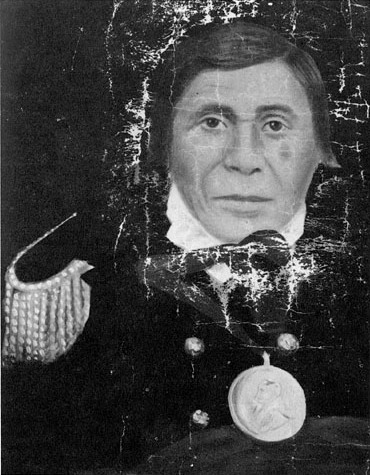
If any image has been as closely tied to Chief Buffalo from La Pointe as the the bust of the Leech Lake Buffalo in Washington, it is an image of a kindly but powerful-looking man in a U.S. Army jacket with a medal around his neck. This image appears on the cover of the 1999 edition of Walleye Warriors, by treaty-rights activist Walter Bresette and Rick Whaley. It is identified as Buffalo in both Ronald Satzʼs Chippewa Treaty Rights, and Patty Loewʼs Indian Nations of Wisconsin. It occupies a prominent position in the collections of the Wisconsin Historical Society and hangs in the Madeline Island Museum, but in spite of the enduring popularity of this image, very little is known about it.
As I have not been able to thoroughly examine the originals or find any information whatsoever about their creation, chain of custody, or even when they entered the Historical Society’s collections, this post will be the most speculative of the Chief Buffalo Picture Search.
There are two versions of this image. One appears to be an early type of photograph. The Wisconsin Historical Society describes it as “over-painted enlargement, possibly from a double-portrait (possibly an ambrotype).” I’ve been told by staff that the painting that hangs in the museum is a copy of this earlier version.
A photograph of the original image is in the Societyʼs archives as part of the Hamilton Nelson Ross collection. On the back of the photo, “Chief Buffalo, Grandson of Great Chief Buffalo” is handwritten, presumably by Ross. This description would seem to indicate that the image shows one of Chief Buffaloʼs grandsons. However, we need to be careful trusting Ross as a source of information about Buffalo’s family.
Ross, a resident of Madeline Island, gathered volumes of information on his home community in preparation for his book La Pointe Village Outpost on Madeline Island (1960). Although the book is exhaustively researched and highly detailed about the white and mix-blooded populations of the Island, it contains precious little information about individual Indians. The image of Buffalo is not in the book. In fact, the only mention of the chief comes in a footnote about his grave on page 177:
O-Shaka was also known as O-Shoga and Little Buffalo, and he was the son of Chief Great Buffalo. The latter’s Ojibway name was Bezhike, but he was also known as Kechewaishkeenh–the latter with a variety of spellings. Bezhike’s tombstone, in the Indian cemetery, has had the name broken off…
Oshogay was not Buffalo’s son (though he may have been a son-in-law), and he was not the man known as “Little Buffalo,” but until his untimely death in 1853, he seemed destined to take over leadership of Buffalo’s “Red Cliff” faction of the La Pointe Band. The one who did ultimately step into that role, however, was Buffalo’s son Jayjigwyong (Che-chi-gway-on):

Drew, C.K. Report of the Chippewa Agency of Lake Superior. 26 Oct. 1858. Printed in Report of the Commissioner of Indian Affairs. 1858 (Digitized by Google Books)
We will return to Jayjigwyong later in the post, but for now, let’s examine the image itself.
The man in the picture wears an early 19th-century army jacket and a medal. This is consistent with the practices of Chief Buffalo’s day. The custom of handing out flags, jackets, and medals goes back at least to the 1700s with the French. The practice continued under the British and Americans as a way of recognizing certain individuals as chiefs and asserting imperial claims. For the chiefs, the items were symbolic of agreements and alliances. Large councils, treaty signings, and diplomatic missions were all occasions where they were given out. Buffalo had received medals and jackets from the British, and between 1820 and 1855, he took part in the negotiations of at least five treaties, many council meetings and annuity payments, visited Washington, and frequently went back and forth to the agency at Sault Ste. Marie. The United States Government favored Buffalo over the more forcefully-independent chiefs on the Ojibwe-Dakota frontier in Minnesota. Considering all this, it is likely that Buffalo received many jackets, flags, and medals from the Americans over the course of his long interaction with them. An excerpt from a letter by teacher Granville Sproat, who lived in the Lake Superior region in the 1830s reads:
Ke-che Be-zhe-kee, or Big Buffalo, as he was called by the Americans, was then chief of that band of Ogibway Indians who dwell on the south-west shores of Lake Superior, and were best known as the Lake Indians. He was wise and sagacious in council, a great orator, and was much reverenced by the Indians for his supposed intercourse with the Man-i-toes, or spirits, from whom they believed he derived much of his eloquence and wisdom in governing the affairs of the tribe.
“In the summer of 1836, his only son, a young man of rare promise, suddenly sickened and died. The old chief was almost inconsolable for his loss, and, as a token of his affection for his son, had him dressed and laid in the grave in the same military coat, together with the sword and epaulettes, which he had received a few months before as a present from the great father [president] at Washington. He also had placed beside him his favorite dog, to be his companion on his journey to the land of souls (qtd. in Peebles 107).
It is strange that Sproat says Buffalo had only one son given that his wife Florantha Sproat references another son in her description of this same funeral, but sorting out Buffalo’s descendants has never been an easy task. There are references to many sons, daughters, and wives over the course of his very long life.
Another description from the Treaty of 1842 reads:
On October 1 Buffalo appeared, wearing epaulettes on his shoulders, a hat trimmed with tinsel, and a string of bear claws about his neck (Dietrich qtd. in Paap 177-78).
From these accounts we know that Buffalo had these kinds of coats, but dozens of other Ojibwe chiefs would have had similar ones, so the identification cannot be made based on the existence of the coat alone. Consider Naaganab at the 1855 annuity payment:
Na-gon-ub is head chief of the Fond du Lac bands; about the age of forty, short and close built, inclines to ape the dandy in dress, is very polite, neat and tidy in his attire. At first, he appeared in his native blanket, leggings, &c. He soon drew from the Agent a suit of rich blue broadcloth, fine vest, and neat blue cap,–his tiny feet in elegant finely-wrought moccasins. Mr. L., husband of Grace G., with whom he was a special favorite, presented him with a pair of white kid gloves, which graced his hands on all occasions. Some two or three years since, he visited Washington, a delegate from his tribe. Upon this journey, some one presented him with a pair of large and gaudy epaulettes, said to be worth sixty dollars. These adorned his shoulders daily; his hair was cut shorter than their custom. He quite inclined to be with, and to mingle in the society, of the officers, and of white men. These relied on him more, perhaps, than any other chief, for assistance among the Chippewas… (Morse pg. 346)
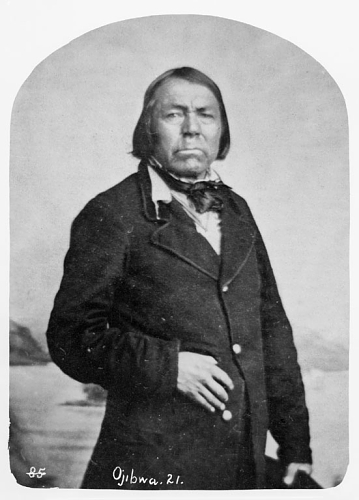
Portrait of Naw-Gaw-Nab (The Foremost Sitter) n.d by J.E. Whitney of St. Paul (Smithsonian)
In many ways, this description of Naaganab fits the image better than any description of Buffalo I’ve seen. The man is dressed in European fashion, has short hair, and large epaulets. We also know that Naaganab had presidential medals, since he continued to display them until his death in the 1890s. The image isn’t dated, but if it truly is an ambrotype, as described by the State Historical Society, that is a technique of photography used mostly in the late 1850s and 1860s. When Buffalo died in 1855, he was reported to be in his nineties. Naaganab would have been in his forties or fifties at that time. To me, the man in the image appears middle-aged rather than elderly.
So is Naaganab the man in the picture? I don’t think so. For one, there are multiple photographs of the Fond du Lac chief out there. The clothing and hairstyle largely match, but the face is different. The other thing to consider is that this image, to my knowledge, has never been identified with Naaganab. Everything I’ve ever seen associates it with the name Buffalo.
However, there is a La Pointe chief who was a political ally of Naaganab, also dressed in white fashion, could have easily owned a medal and fancy army jacket, would have been middle-aged in the 1850s, and bore the English name of “Buffalo.” It was Jayjigwyong, the son of Chief Buffalo.
Alfred Brunson recorded the following in 1843:

(pg. 158) From elsewhere in the account, we know that the “fifty” year-old is Chief Buffalo. This is odd, as most sources had Buffalo in his eighties at that time.
(pg. 191)
Unlike his famous father, Jayjigwyong, often recorded as “Little Buffalo,” is hardly remembered, but he is a significant figure in the history of our region. He was a signatory of the treaties of 1837, 1847, and 1854. He led the faction of the La Pointe Band that felt that rapid assimilation represented the best chance for the Ojibwe to survive and keep their lands. In addition to wearing white clothing and living in houses, Jayjigwyong was Catholic and associated more with the mix-blooded population of the Island than with the majority of the La Pointe band who sought to maintain their traditions at Bad River.
According to James Blackbird, whose father Makadebineshiinh (Black Bird) led the Bad River faction, it was Jayjigwyong who chose where the Red Cliff reservation was to be. James Blackbird, about eleven or twelve at the time of the Treaty of 1854, would have known both the elder and younger Buffalo.
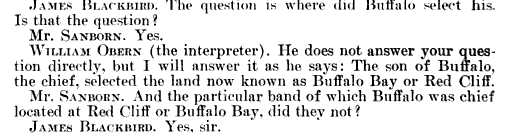
Statement of James Blackbird in the Matters of the Allotments on the Bad River Reservation, Wis. Odanah, 23 Sep. 1909. Published in Condition of Indian affairs in Wisconsin: hearings before the Committee on Indian Affairs, United States Senate, [61st congress, 2d session], on Senate resolution, Issue 263. United States Congress. 1910. Pg. 202.
The younger Blackbird, offered more information about the younger Buffalo in another publication.
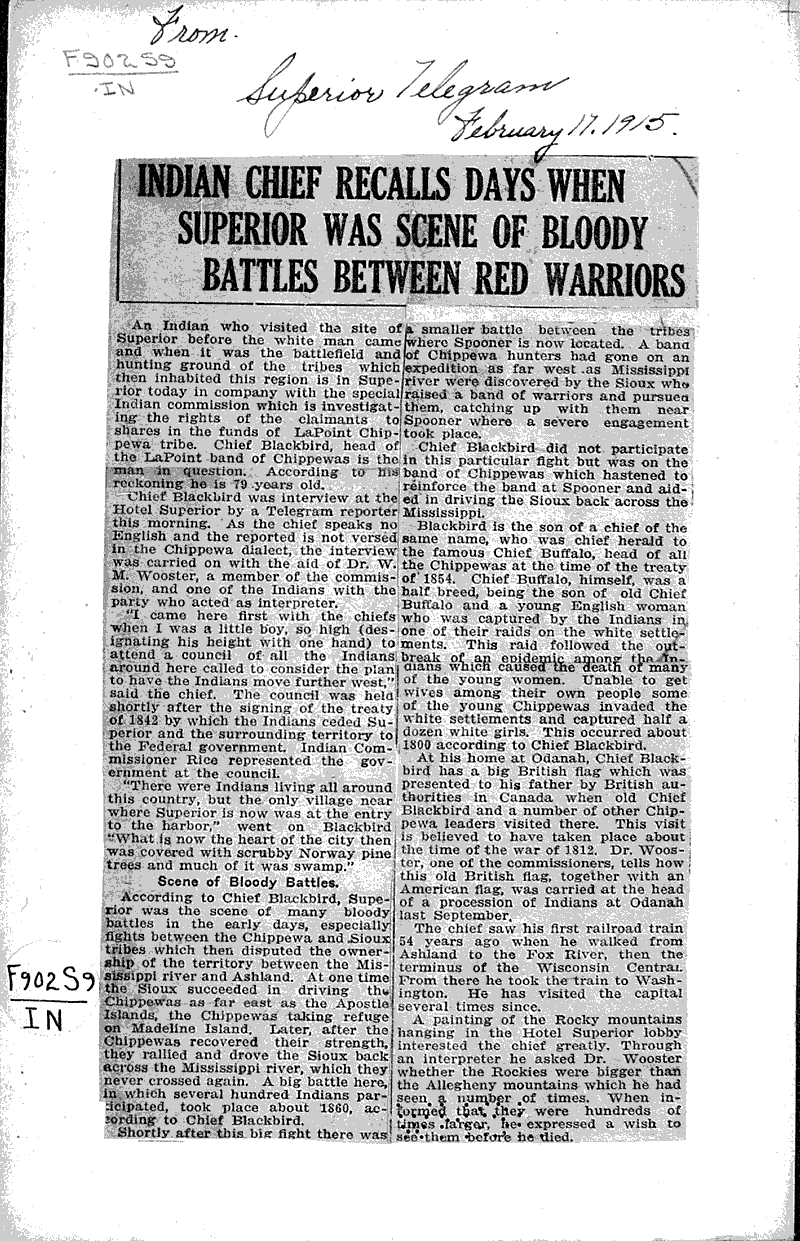
Superior Telegram. 17 Sep. 1915. (Digitized by Wisconsin Historical Society)
Even though it is from 1915, there are a number of items in this account that if accurate are very relevant to pre-1860 history. For this post, I’ll stick to the two that involve Jayjigwyong. This is the only source I’ve ever seen that refers to Chief Buffalo marrying a white woman captured on a raid. This lends further credence to the argument explored by Dietrich and Paap that Chief Buffalo fought in the Ohio Valley wars of the 1790s. It also begs the question of whether being perceived as a “half-breed” had an impact on Jayjigwyong’s decisions as an adult.
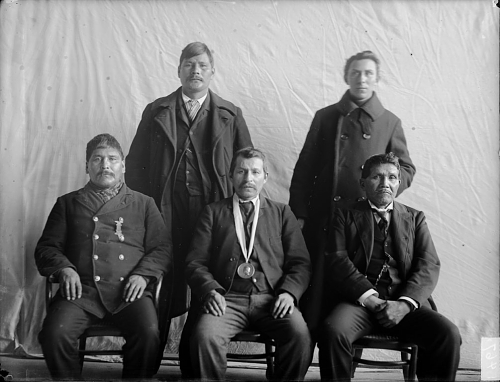
James Blackbird (seated) with interpreter John Medeguan in Washington, 1899. (Photo by Gil DeLancy, Smitsonian Collections)
The other interesting part of the statement is that James Blackbird says his father was pipe carrier for Jayjigwyong. This would be surprising as Blackbird was the most influential La Pointe chief after the death of Buffalo. However, this idea of Jayjigwyong, inheriting the symbolic “head chief” title from his father can also be seen in the following document from 1857:
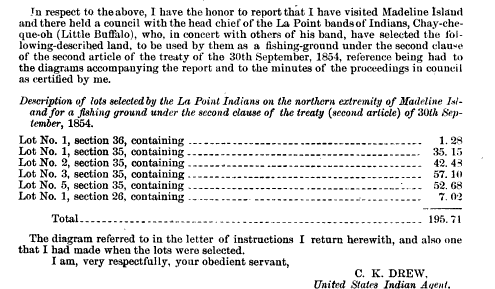
Published in Annual Report of the Commissioner of Indian Affairs to the Secretary of the Interior. Office of Indian Affairs. 1882. pg. 299. (Digitized by Google Books)
Today the fishing ground at the tip of Madeline Island is now considered part of the Bad River Reservation, but it was the Red Cliff chief who picked it out. This shows how the political division of the La Pointe Band into two distinct entities took several years to take shape, and was not an abrupt split at the Treaty of 1854.
Jayjigwyong continued to be regarded as a chief until his death in 1860:

Drew, C.K. Report on the Chippewas of Lake Superior. Red Cliff Agency. 29 Oct. 1860. Pg. 51 of Annual Report of the Commissioner of Indian Affairs. Bureau of Indian Affairs. 1860. (Digitized by Google Books). Zhingob (Shing-oop) was Naaganab’s cousin and the hereditary chief at Fond du Lac. Also known as Nindibens, he figures prominently in Edmund F. Ely’s journals of the mid-1830s.
Future generations of the Buffalo family continued to be looked at as hereditary chiefs in Red Cliff, and sources can be found calling these grandsons and great-grandsons “Chief Buffalo.”
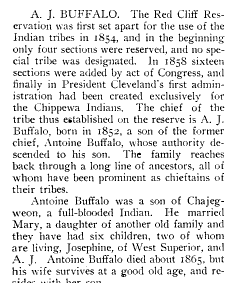
J.H. Beers and Co. Commemorative Biographical Record of the Upper Lake Region. 1905. Pg. 379. (Digitized by Google Books).
Antoine brings us full circle. If we remember, Hamiton Ross wrote that the image of the chief in the army jacket was Chief Buffalo’s grandson. And while we don’t know where Ross got his information, and he made mistakes about Buffalo’s family elsewhere, we have to consider that Antoine Buffalo was an adult by 1852 and he could have inherited his father’s, or grandfather’s, medal and coat.
The Verdict
Although we’ve uncovered several lines of inquiry for this image, all the evidence is circumstantial. Until we know more about the creation and chain of custody, it’s impossible to rule Chief Buffalo in or out. My gut tells me it’s Buffalo’s son, Jajigwyong, but it could be his grandson, Naaganab, or and entirely different chief. We don’t know.
Inconclusive: It could be Chief Buffalo, but there is also evidence pointing to others.
Sources:
Brunson, Alfred. A Western Pioneer, Or, Incidents of the Life and times of Rev. Alfred Brunson Embracing a Period of over Seventy Years. Cinncinnati: Hitchchock and Walden, 1872. Print.
Commemorative Biographical Record of the Upper Lake Region. Chicago: J. H. Beers &, 1905. Print.
Ely, Edmund Franklin, and Theresa M. Schenck. The Ojibwe Journals of Edmund F. Ely, 1833-1849. Lincoln: University of Nebraska, 2012. Print.
KAPPLER’S INDIAN AFFAIRS: LAWS AND TREATIES. Ed. Charles J. Kappler. Oklahoma State University Library, n.d. Web. 21 June 2012. <http:// digital.library.okstate.edu/Kappler/>.
Loew, Patty. Indian Nations of Wisconsin: Histories of Endurance and Renewal. Madison: Wisconsin Historical Society, 2001. Print.
Morse, Richard F. “The Chippewas of Lake Superior.” Collections of the State Historical Society of Wisconsin. Ed. Lyman C. Draper. Vol. 3. Madison: State Historical Society of Wisconsin, 1857. 338-69. Print.
Paap, Howard D. Red Cliff, Wisconsin: A History of an Ojibwe Community. St. Cloud, MN: North Star, 2013. Print.
Peebles, J. M. Immortality, and Our Employments Hereafter. With What a Hundred Spirits, Good and Evil, Say of Their Dwelling Places. Boston: Colby and Rich, 1880. Print.
Ross, Hamilton Nelson. La Pointe, Village Outpost. St. Paul: North Central Pub., 1960. Print
Satz, Ronald N. Chippewa Treaty Rights: The Reserved Rights of Wisconsin’s Chippewa Indians in Historical Perspective. Madison, WI: Wisconsin Academy of Sciences, Arts and Letters, 1991. Print.
Schenck, Theresa M. The Voice of the Crane Echoes Afar: The Sociopolitical Organization of the Lake Superior Ojibwa, 1640-1855. New York: Garland Pub.,1997. Print.
Warren, William W., and Theresa M. Schenck. History of the Ojibway People. St. Paul: Minnesota Historical Society, 2009. Print.
Whaley, Rick, and Walter Bresette. Walleye Warriors: The Chippewa Treaty Rights Story. Warner, NH: Tongues of Green Fire, Writers Pub. Cooperative, 1999. Print.
Reconstructing the “Martell” Delegation through Newspapers
November 2, 2013

Symbolic Petition of the Chippewa Chiefs: This pictographic petition was brought to Washington D.C. by a delegation of Ojibwe chiefs and their interpreter J.B. Martell. This one, representing the band of Chief Oshkaabewis, is the most famous, but their were several others copied from birch bark by Seth Eastman and published in the works of Henry Schoolcraft. For more, follow this link.
Henry Schoolcraft. William W. Warren. George Copway. These names are familiar to any scholar of mid-19th-century Ojibwe history. They are three of the most referenced historians of the era, and their works provide a great deal of historical material that is not available in any other written sources. Copway was Ojibwe, Warren was a mix-blood Ojibwe, and Schoolcraft was married to the granddaughter of the great Chequamegon chief Waabojiig, so each is seen, to some extent, as providing an insider’s point of view. This could lead one to conclude that when all three agree on something, it must be accurate. However, there is a danger in over-relying on these early historians in that we forget that they were often active participants in the history they recorded.
This point was made clear to me once again as I tried to sort out my lingering questions about the 1848-49 “Martell” Delegation to Washington. If you are a regular reader, you may remember that this delegation was the subject of the first post on this website. You may also remember from this post, that the group did not have money to get to Washington and had to reach out to the people they encountered along the way.
The goal of the Martell Delegation was to get the United States to cede back title to the lands surrounding the major Lake Superior Ojibwe villages. The Ojibwe had given this land up in the Treaty of 1842 with the guarantee that they could remain on it. However, by 1848 there were rumors of removal of all the bands east of the Mississippi to unceded land in Minnesota. That removal was eventually attempted, in 1850-51, in what is now called the Sandy Lake Tragedy.
The Martell Delegation remains a little-known part of the removal story, although the pictographs remain popular. Those petitions are remembered because they were published in Henry Schoolcrafts’ Historical and statistical information respecting the history, condition, and prospects of the Indian tribes of the United States (1851) along with the most accessible primary account of the delegation:
In the month of January, 1849, a delegation of eleven Chippewas, from Lake Superior, presented themselves at Washington, who, amid other matters not well digested in their minds, asked the government for a retrocession of some portion of the lands which the nation had formerly ceded to the United States, at a treaty concluded at Lapointe, in Lake Superior, in 1842. They were headed by Oshcabawiss, a chief from a part of the forest-country, called by them Monomonecau, on the head-waters of the River Wisconsin. Some minor chiefs accompanied them, together with a Sioux and two boisbrules, or half-breeds, from the Sault Ste. Marie, Michigan. The principal of the latter was a person called Martell, who appeared to be the master-spirit and prime mover of the visit, and of the motions of the entire party. His motives in originating and conducting the party, were questioned in letters and verbal representations from persons on the frontiers. He was freely pronounced an adventurer, and a person who had other objects to fulfil, of higher interest to himself than the advancement of the civilization and industry of the Indians. Yet these were the ostensible objects put forward, though it was known that he had exhibited the Indians in various parts of the Union for gain, and had set out with the purpose of carrying them, for the same object, to England. However this may be, much interest in, and sympathy for them, was excited. Officially, indeed, their object was blocked up. The party were not accredited by their local agent. They brought no letter from the acting Superintendent of Indian Affairs on that frontier. The journey had not been authorized in any manner by the department. It was, in fine, wholly voluntary, and the expenses of it had been defrayed, as already indicated, chiefly from contributions made by citizens on the way, and from the avails of their exhibitions in the towns through which they passed; in which, arrayed in their national costume, they exhibited their peculiar dances, and native implements of war and music. What was wanting, in addition to these sources, had been supplied by borrowing from individuals.
Engraving of Henry Schoolcraft by Wellstood and Peters (Photo credit: Wikipedia)
Martell, who acted as their conductor and interpreter, brought private letters from several persons to members of Congress and others, which procured respect. After a visit, protracted through seven or eight weeks, an act was passed by Congress to defray the expenses of the party, including the repayment of the sums borrowed of citizens, and sufficient to carry them back, with every requisite comfort, to their homes in the north-west. While in Washington, the presence of the party at private houses, at levees, and places of public resort, and at the halls of Congress, attracted much interest; and this was not a little heightened by their aptness in the native ceremonies, dancing, and their orderly conduct and easy manners, united to the attraction of their neat and well-preserved costume, which helped forward the object of their mission.
The visit, although it has been stated, from respectable sources, to have had its origin wholly in private motives, in the carrying out of which the natives were made to play the part of mere subordinates, was concluded in a manner which reflects the highest credit on the liberal feelings and sentiments of Congress. The plan of retrocession of territory, on which some of the natives expressed a wish to settle and adopt the modes of civilized life, appeared to want the sanction of the several states in which the lands asked for lie. No action upon it could therefore be well had, until the legislatures of these states could be consulted (pg. 414-416, pictographic plates follow).

I have always had trouble with Schoolcraft’s interpretation of these events. It wasn’t that I had evidence to contradict his argument, but rather that I had a hard time believing that all these chiefs would make so weighty a decision as to go to Washington simply because their interpreter was trying to get rich. The petitions asked for a permanent homeland in the traditional villages east of the Mississippi. This was the major political goal of the Lake Superior Ojibwe leadership at that time and would remain so in all the years leading up to 1854. Furthermore, chiefs continued to ask for, or go “uninvited” on, diplomatic missions to the president in the years that followed.
I explored some of this in the post about the pictograph, but a number of lingering questions remained:
What route did this group take to Washington?
Who was Major John Baptiste Martell?
Did he manipulate the chiefs into working for him, or was he working for them?
Was the Naaganab who went with this group the well-known Fond du Lac chief or the warrior from Lake Chetek with the same name?
Did any chiefs from the La Pointe band go?
Why was Martell criticized so much? Did he steal the money?
What became of Martell after the expedition?
How did the “Martell Expedition” of 1848-49 impact the Ojibwe removal of 1850-51?
Lacking access to the really good archives on this subject, I decided to focus on newspapers, and since this expedition received so much attention and publicity, this was a good choice. Enjoy:
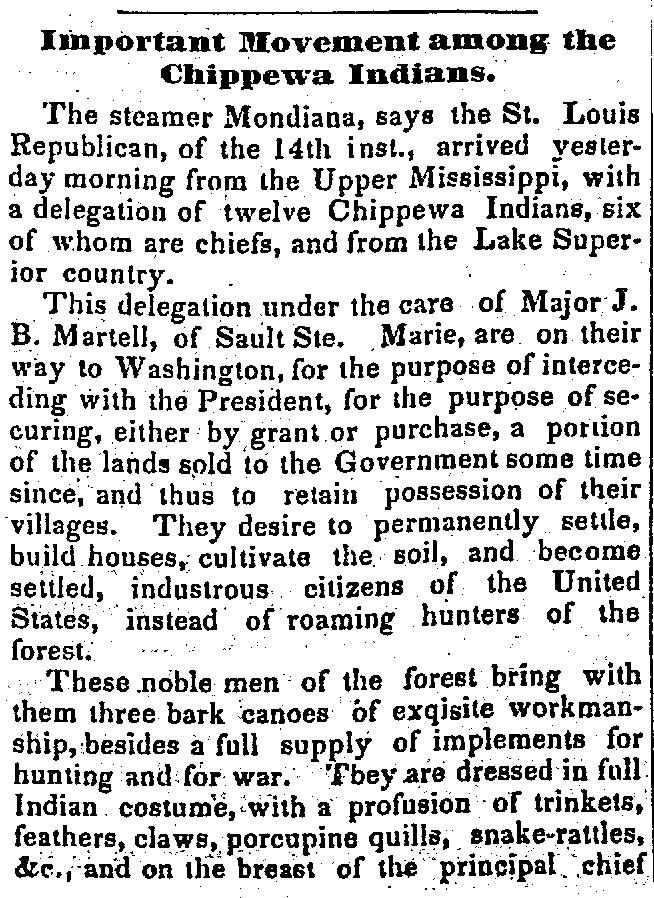
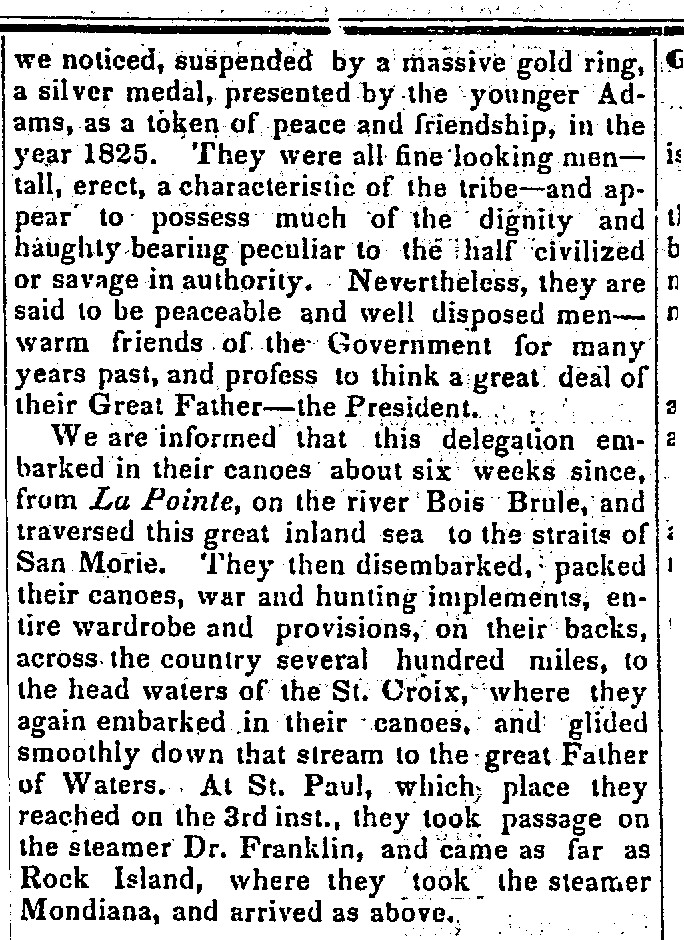
Indiana Palladium. Vevay, IN. Dec. 2, 1848
Capt. Seth Eastman of the U.S. Army took note of the delegation as it traveled down the Mississippi from Fort Snelling to St. Louis. Eastman, a famous painter of American Indians, copied the birch bark petitions for publication in the works of his collaborator Henry Schoolcraft. At least one St. Louis paper also noticed these unique pictographic documents.
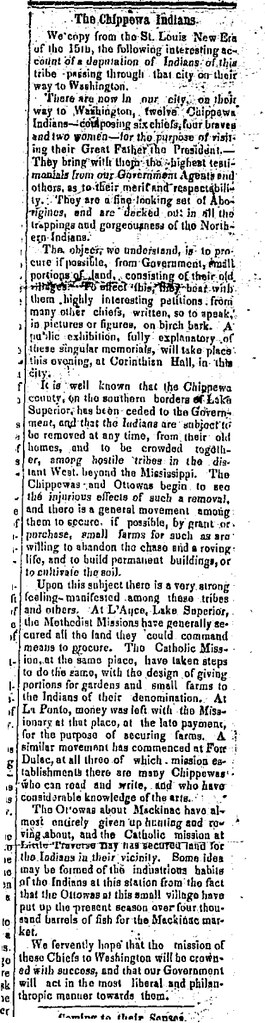 Lafayette Courier. Lafayette, IN. Dec. 8, 1848.
The delegation made its way up the Ohio River to Cincinnati, where Gezhiiyaash’s illness led to a chance encounter with some Ohio Freemasons. I won’t repeat it here, but I covered this unusual story in this post from August.
At Cincinnati, they left the river and headed toward Columbus. Just east of that city, on the way to Pittsburgh, one of the Ojibwe men offered some sound advice to the women of Hartford, Ohio, but he received only ridicule in return.
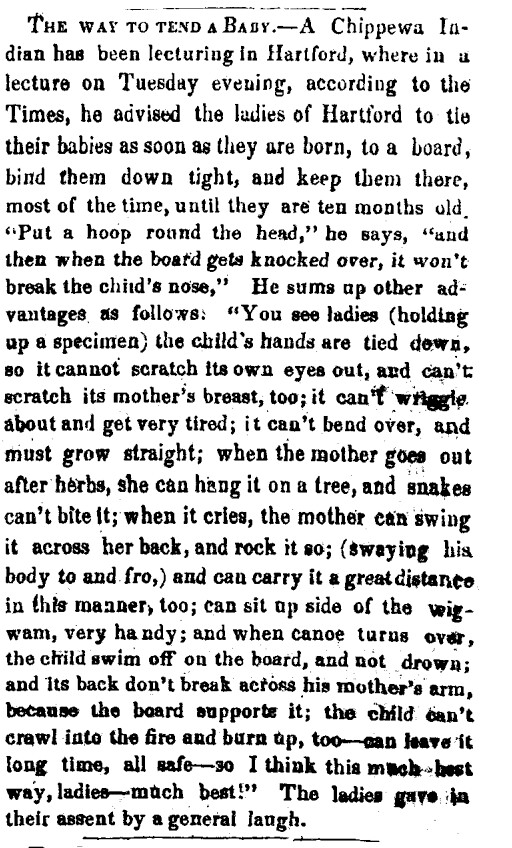
Madison Weekly Courier. Madison, IN. Jan. 24, 1849

It’s unclear how quickly reports of the delegation came back to the Lake Superior country. William Warren’s letter to his cousin George, written in March after the delegation had already left Washington, still spoke of St. Louis:
William W. Warren (Wikimedia Images)
“…About Martells Chiefs. They were according to last accounts dancing the pipe dance at St. Louis. They have been making monkeys of themselves to fill the pockets of some cute Yankee who has got hold of them. Black bird returned from Cleveland where he caught scarlet fever and clap. He has behaved uncommon well since his return…” (Schenck, pg. 49)

From this letter, we learn that Blackbird, the La Pointe chief, was originally part of the group. In evaluating Warren’s critical tone, we must remember that he was working closely with the very government officials who withheld their permission. Of the La Pointe chiefs, Blackbird was probably the least accepting of American colonial power. However, we see in the obituary of Naaganab, Blackbird’s rival at the 1855 annuity payment, that the Fond du Lac chief was also there.
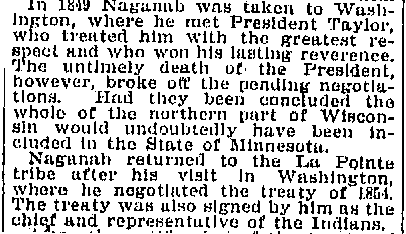
New York World. New York. July 22, 1894
Before finding this obituary, I had thought that the Naaganab who signed the petition was more likely the headman from Lake Chetek. Instead, this information suggests it was the more famous Fond du Lac chief. This matters because in 1848, Naaganab was considered the speaker for his cousin Zhingob, the leading chief at Fond du Lac. Blackbird, according to his son James, was the pipe carrier for Buffalo. While these chiefs had their differences with each other, it seems likely that they were representing their bands in an official capacity. This means that the support for this delegation was not only from “minor chiefs” as Schoolcraft described them, or “Martells Chiefs” as Warren did, from Lac du Flambeau and Michigan. I would argue that the presence of Blackbird and Naaganab suggests widespread support from the Lake Superior bands. I would guess that there was much discussion of the merits of a Washington delegation by Buffalo and others during the summer of 1848, and that the trip being a hasty money-making scheme by Martell seems much less likely.
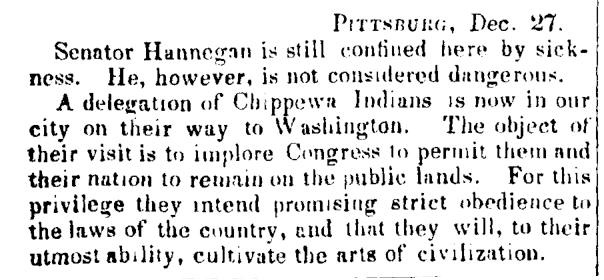
Madison Daily Banner. Madison, IN. Jan. 3, 1849.
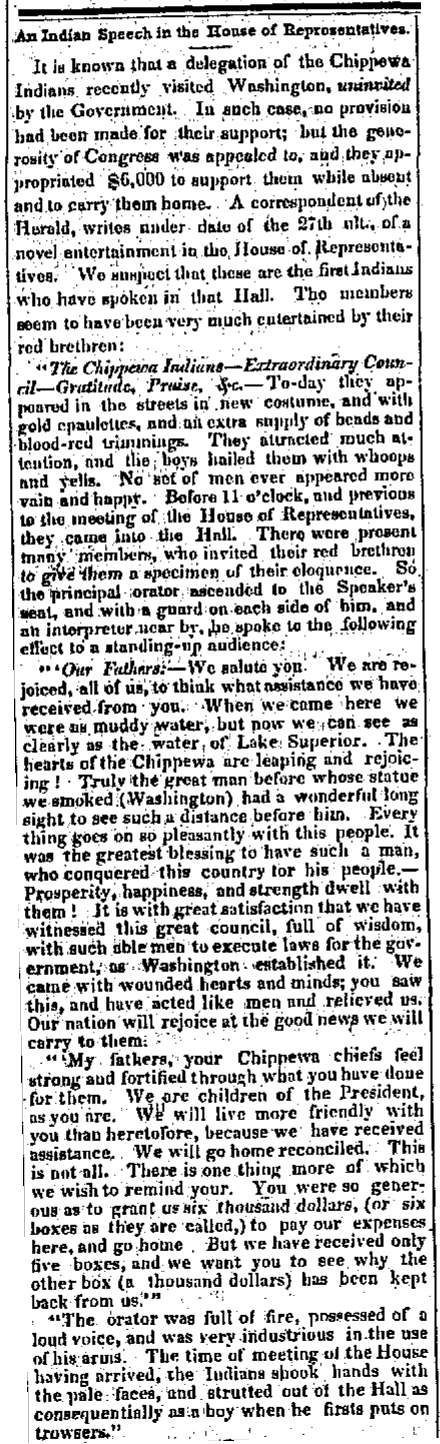
From Pittsburgh, the delegation made it to Philadelphia, and finally Washington. They attracted a lot of attention in the nation’s capital. Some of their adventures and trials: Oshkaabewis and his wife Pammawaygeonenoqua losing an infant child, the group hunting rabbits along the Potomac, and the chiefs taking over Congress, are included this post from March, so they aren’t repeated here.
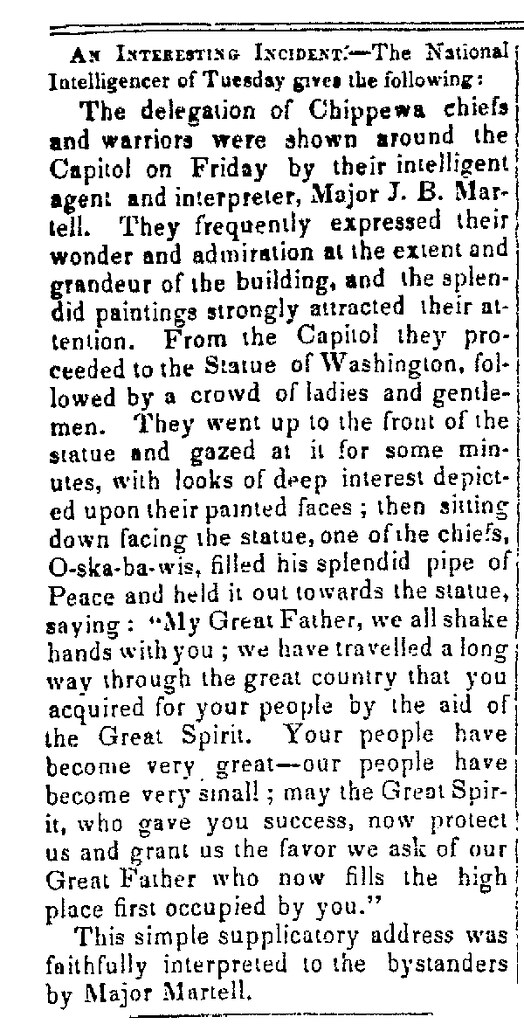
Adams Sentinel. Gettysburg, PA. Feb. 5, 1849.
According to Ronald Satz, the delegation was received by both Congress and President Polk with “kindly feelings” and the expectation of “good treatment in the future” if they “behaved themselves (Satz 51).” Their petition was added to the Congressional Record, but the reservations were not granted at the time. However, Congress did take up the issue of paying for the debts accrued by the Ojibwe along the way.


George Copway (Wikimedia Commons)
Kah-Ge-Ga-Gah-Bowh (George Copway), a Mississauga Ojibwe and Methodist missionary, was the person “belonging to one of the Canada Bands of Chippewas,” who wrote the anti-Martell letter to Indian Commissioner William Medill. This is most likely the letter Schoolcraft referred to in 1851. In addition to being upset about the drinking, Copway was against reservations in Wisconsin. He wanted the government to create a huge pan-Indian colony at the headwaters of the Missouri River.

William Medill (Wikimedia Commons)
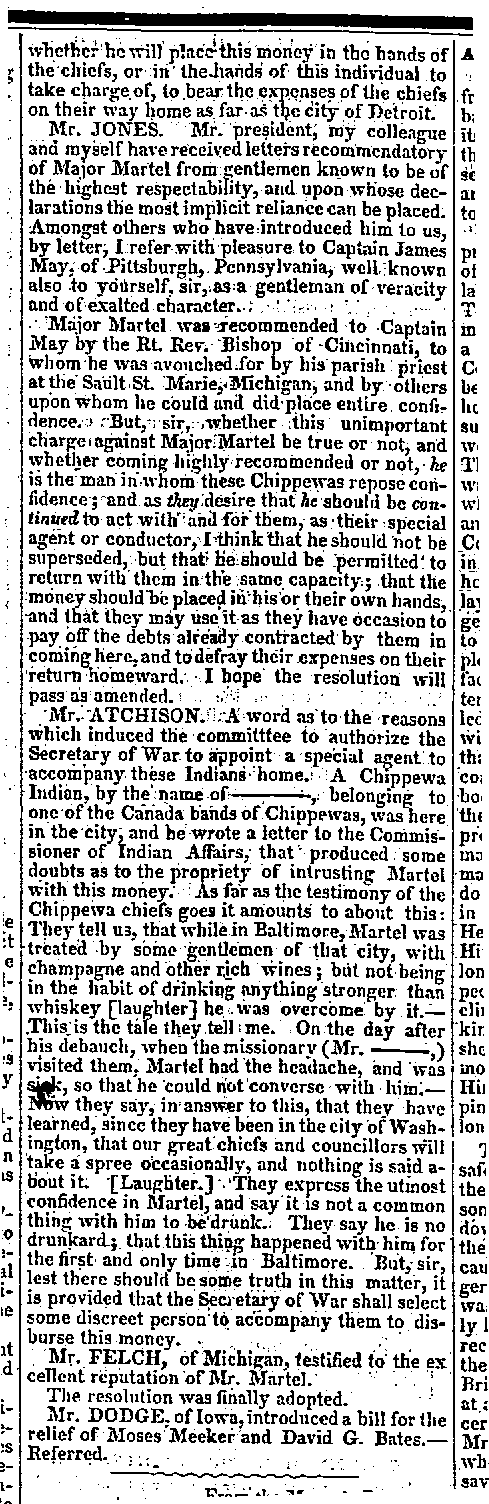
Iowa State Gazette. Burlington, IA. April 4, 1849
~~~~~~~~~~~~~~~~~~
~~~~~~~~~~~~~~~~~~~~~~~~~~~~~~~~~~~~~~~~~~~~~~~~~~~~~~~~~
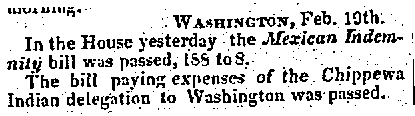 Weekly Wisconsin. Milwaukee. Feb. 28, 1849.
With $6000 (or did they only get $5000?), a substantial sum for the antebellum Federal Government, the group prepared to head back west with the ability to pay back their creditors.
It appears the chiefs returned to their villages by going back though the Great Lakes to Green Bay and then overland.
The Chippewa Delegation, who have been on a visit to see their “great fathers” in Washington, passed through this place on Saturday last, on their way to their homes near Lake Superior. From the accounts of the newspapers, they have been lionized during their whole journey, and particularly in Washington, where many presents were made them, among the most substantial of which was six boxed of silver ($6,000) to pay their expenses. They were loaded with presents, and we noticed one with a modern style trunk strapped to his back. They all looked well and in good spirits (qtd. in Paap, pg. 205).
Green Bay Gazette. April 4, 1849
So, it hardly seems that the Ojibwe chiefs returned to their villages feeling ripped off by their interpreter. Martell himself returned to the Soo, and found a community about to be ravaged by a epidemic of cholera.
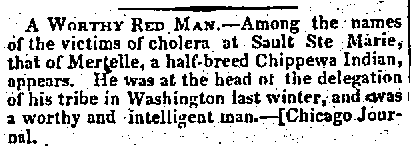
Weekly Wisconsin. Milwaukee. Sep. 5, 1849.
Martell appears in the 1850 census on the record of those deceased in the past year. Whether he was a major in the Mexican War, whether he was in the United States or Canadian military, or whether it was even a real title, remains a mystery. His death record lists his birthplace as Minnesota, which probably connects him to the Martells of Red Lake and Red River, but little else is known about his early years. And while we can’t say for certain whether he led the group purely out of self-interest, or whether he genuinely supported the cause, John Baptiste Martell must be remembered as a key figure in the struggle for a permanent Ojibwe homeland in Wisconsin and Michigan. He didn’t live to see his fortieth birthday, but he made the 1848-49 Washington delegation possible.
So how do we sort all this out?
To refresh, my unanswered questions from the other posts about this delegation were:
1) What route did this group take to Washington?
2) Who was Major John Baptiste Martell?
3) Did he manipulate the chiefs into working for him, or was he working for them?
4) Was the Naaganab who went with this group the well-known Fond du Lac chief or the warrior from Lake Chetek with the same name?
5) Did any chiefs from the La Pointe band go?
6) Why was Martell criticized so much? Did he steal the money?
7) What became of Martell after the expedition?
8) How did the “Martell Expedition” of 1848-49 impact the Ojibwe removal of 1850-51?
We’ll start with the easiest and work our way to the hardest. We know that the primary route to Washington was down the Brule, St. Croix, and Mississippi to St. Louis, and from there up the Ohio. The return trip appears to have been via the Great Lakes.
We still don’t know how Martell became a major, but we do know what became of him after the diplomatic mission. He didn’t survive to see the end of 1849.
The Fond du Lac chief Naaganab, and the La Pointe chief Blackbird, were part of the group. This indicates that a wide swath of the Lake Superior Ojibwe leadership supported the delegation, and casts serious doubt on the notion that it was a few minor chiefs in Michigan manipulated by Martell.
Until further evidence surfaces, there is no reason to support Schoolcraft’s accusations toward Martell. Even though these allegations are seemingly validated by Warren and Copway, we need to remember how these three men fit into the story. Schoolcraft had moved to Washington D.C. by this point and was no longer Ojibwe agent, but he obviously supported the power of the Indian agents and favored the assimilation of his mother-in-law’s people. Copway and Warren also worked closely with the Government, and both supported removal as a way to separate the Ojibwe from the destructive influences of the encroaching white population. These views were completely opposed to what the chiefs were asking for: permanent reservations at the traditional villages. Because of this, we need to consider that Schoolcraft, Warren, and Copway would be negatively biased toward this group and its interpreter.
Finally there’s the question Howard Paap raises in Red Cliff, Wisconsin. How did this delegation impact the political developments of the early 1850s? In one sense the chiefs were clearly pleased with the results of the trip. They made many friends in Congress, in the media, and in several American cities. They came home smiling with gifts and money to spread to their people. However, they didn’t obtain their primary goal: reservations east of the Mississippi, and for this reason, the following statement in Schoolcraft’s account stands out:
The plan of retrocession of territory, on which some of the natives expressed a wish to settle and adopt the modes of civilized life, appeared to want the sanction of the several states in which the lands asked for lie. No action upon it could therefore be well had, until the legislatures of these states could be consulted.
“Kindly feelings” from President Polk didn’t mean much when Zachary Taylor and a new Whig administration were on the way in. Meanwhile, Congress and the media were so wrapped up in the national debate over slavery that they forgot all about the concerns of the Ojibwes of Lake Superior. This allowed a handful of Indian Department officials, corrupt traders, and a crooked, incompetent Minnesota Territorial governor named Alexander Ramsey to force a removal in 1850 that resulted in the deaths of 400 Ojibwe people in the Sandy Lake Tragedy.
It is hard to know how the chiefs felt about their 1848-49 diplomatic mission after Sandy Lake. Certainly their must have been a strong sense that they were betrayed and abandoned by a Government that had indicated it would support them, but the idea of bypassing the agents and territorial officials and going directly to the seat of government remained strong. Another, much more famous, “uninvited” delegation brought Buffalo and Oshogay to Washington in 1852, and ultimately the Federal Government did step in to grant the Ojibwe the reservations. Almost all of the chiefs who made the journey, or were shown in the pictographs, signed the Treaty of 1854 that made them.
Sources:
McClurken, James M., and Charles E. Cleland. Fish in the Lakes, Wild Rice, and Game in Abundance: Testimony on Behalf of Mille Lacs Ojibwe Hunting and Fishing Rights / James M. McClurken, Compiler ; with Charles E. Cleland … [et Al.]. East Lansing, MI: Michigan State UP, 2000. Print.
Paap, Howard D. Red Cliff, Wisconsin: A History of an Ojibwe Community. St. Cloud, MN: North Star, 2013. Print.
Satz, Ronald N. Chippewa Treaty Rights: The Reserved Rights of Wisconsin’s Chippewa Indians in Historical Perspective. Madison, WI: Wisconsin Academy of Sciences, Arts and Letters, 1991. Print.
Schenck, Theresa M. William W. Warren: The Life, Letters, and times of an Ojibwe Leader. Lincoln: University of Nebraska, 2007. Print.
Schoolcraft, Henry Rowe, and Seth Eastman. Historical and Statistical Information Respecting the History, Condition, and Prospects of the Indian Tribes of the United States: Collected and Prepared under the Direction of the Bureau of Indian Affairs per Act of Congress of March 3rd, 1847. Philadelphia: Lippincott, Grambo, 1851. Print.
The banner at the top of this website reads “Primary history of the Chequamegon Region before 1860. In the About page, I explain that 1860 is really an arbitrary round number, and what I’m really focusing on is this area before it became dominated by an English-speaking American society. This is not an easy date to pinpoint, though I think most would argue it happened between 1842 and 1855. While the Treaty of La Pointe in 1854 is an easy marker of separation between the two eras, I would argue that the annuity payments that took place on the island the next summer, can also be seen as a watershed moment in history.

Crocket McElroy from a short biography in the Cyclopedia of Michigan: historical and biographical, comprising a synopsis of general history of the state, and biographical sketches of men who have, in their various spheres, contributed toward its development. Ed. John Bersey. Western Engraving and Publishing; 1890 (Digitized by Google Books)
The 1855 payment, in many ways, illustrates the change in the relationship between the United States and the Ojibwe people that would characterize the rest of the 19th century and early 20th century. The threats of Ojibwe removal or military conflict between the two nations largely ended with the treaty and the establishment of reservations. However, in their place was a paternalistic and domineering government that felt a responsibility to “civilize the Indian.” No one at this time embodied this idea more than George Manypenny, the Commissioner of Indian Affairs, and it was Manypenny, himself, who presided over the 1855 payment.
The days were over when master politicians like Buffalo and Flat Mouth could try to negotiate with the Americans as equals while playing them off of the British in Canada at the same time. In fact, Buffalo died during the 1855 payment, and the new generation of chiefs were men who had spent their youth in a time of Ojibwe power, but who would grow old in an era where government Indian Agents would rule the reservations like petty dictators. The men of this generation, Jayjigwyong (“Little Buffalo”) of Red Cliff, Blackbird of Bad River, and Naaganab of Fond du Lac, were the ones who were prominent during the summer of 1855.
Until this point, our knowledge of the 1855 payment cams largely from the essay The Chippewas of Lake Superior by a witness named Richard Morse. Dr. Morse’s writing includes a number of speeches by the Ojibwe leadership and a number of smaller accounts of items that piqued his interest, including the story of Hanging Cloud the female warrior, and the deaths of Buffalo and Oshogay. However, when reading Morse, one gets the sense that he or she is not getting stray observations of an uninformed visitor rather than a complete story.
It was for this reason that I got excited today when I stumbled across a second memoir of the 1855 payment. It comes from Volume 5 of Americana, a turn-of-the-century historical journal. Crocket McElroy, the author, is writing around fifty years after he witnessed the 1855 payment as a young clerk in Bayfield.
We still do not have a full picture of the 1855 payment, since we will never have full written accounts from Blackbird, Naaganab, and the rest of the Ojibwe leadership, but McElroy’s essay does provide an interesting contrast to Morse’s. The two men saw many of the same events but interpreted them very differently. And while McElroy’s racist beliefs skew his observations and make his writing hard to stomach, in some ways his observations are as informative as Morse’s even though his work is considerably shorter:
From Americana v.5 American Historical Company, American Historical Society, National Americana Society Publishing Society of New York, 1910 (Digitized by Google Books) pages 298-302.
AN INDIAN PAYMENT
By Crocket McElroy
In August 1855 about three thousand Chippewa Indians gathered at the village of Lapointe, on Lapointe Island, Lake Superior, for an Indian Payment and also to hold a council with the commissioner of Indian affairs, who at that time was George W. Monypenny of Ohio. The Indians selected for their orator a chief named Blackbird, and the choice was a good one, as Blackbird held his own well in a long discussion with the commissioner. Blackbird was not one of the haughty style of Indians, but modest in his bearing, with a good command of language and a clear head. In his speeches he showed much ingenuity and ably pleaded the cause of his people. He spoke in Chippewa stopping frequently to give the interpreter time to translate what he said into English. In beginning his address he spoke substantially as follows:
“My great white father, we are pleased to meet you and have a talk with you We are friends and we want to remain friends. We expect to do what you want us to do, and we hope that you will deal kindly with us. We wish to remind you that we are the source from which you have derived all your riches. Our furs, our timber, our lands, everything that we have goes to you; even the gold out of which that chain was forged (pointing to a heavy watch chain that the commissioner carried) came from us, and now we hope that you will not use that chain to bind us.”

Buffalo’s death in 1855 marked the end of an era. Jayjigwyong (Young Buffalo) was no young man when he took over from his father. The connection between Buffalo and Buffalo, New York also appears in Morse on page 368, although he says the names are not connected. If Buffalo did indeed live in the Niagara region, it may lend credence to the hypothesis explored in Paap’s Red Cliff Wisconsin, that Buffalo fought the Americans in the Indian Wars of the 1790s and signed the Treaty of Greenville (Photo: Wikimedia Images).
The commissioner was an amiable man and got along pleasantly with his savage friends, besides managing the council skilfully.
Among the prominent chiefs attending the payment was Buffalo, then called “Old Buffalo,” as he had a son called “Young Buffalo” who was also an old man. Old Buffalo was said to be over one hundred years old. He died during the council and the writer witnessed the funeral. He was buried in the Indian grave yard near the Indian church in Lapointe village. The body was laid on a stretcher formed of two poles laid lengthwise and several poles laid crosswise. The stretcher was carried on the shoulders of four Indians. Following the corpse was a long procession of Indians in irregular order. It was claimed for Buffalo, that he maintained a camp many years before at the mouth of Buffalo Creek on the Niagara River, and that the creek and the present large and flourishing city of Buffalo were named after him.

Naaganab’s (above) comments about Wheeler being ungenerous with food echoed a common Ojibwe complaint about the ABCFM missionaries. Wheeler’s Protestant Ethic of upward mobility and self-reliance made little sense in a tribal society where those who had extra were expected to share. Read The Ojibwe Journals of Edmund F. Ely, edited by Theresa Schenck, for Naaganab’s experience with another missionary two decades earlier. Read this post if you don’t understand why the Ojibwe resented the missionaries over the issue of food (Photo from Newberry Library Collections, Chicago).
Another prominent chief attending the conference was Ne-gon-up, head chief of the Fond du lac Indians. Negonup’s camp was on the south side of the St Louis River in Wisconsin, about where the city of Superior now stands. Negonup was a shrewd, practical Indian and had considerable influence. The writer saw him going to the Indian church one Sunday, there was a squaw on each side of him and one behind, they were said to be his wives. A good and zealous Methodist minister named Wheeler desired to talk to Negonup and his tribe about the Great Spirit. Negonup it is said expressed himself in regard to Mr. Wheeler in this manner:
“Mr. Wheeler comes to us and says he wants to do us good. He looks like a good man and we think he is and we believe his intentions are good, but he does not bring us any proof. Now if Mr. Wheeler will bring to me a good supply of barrels of flour and barrels of pork, for distribution among my people, then I shall be convinced that he is a good man.”
The sessions of the council began on August 30th and were held in the open air on a grass common. On the second day the special police acting under directions from the Indian agent H. Gilbert, seized two barrels of whisky that was being secretly sold to the half-breeds and Indians. The proceedings of the council were suspended and the two barrels of whisky were rolled into the center of the common. Mr. Gilbert then took a hatchet, chopped a hole into each barrel and poured the whiskey out on the ground. A few half-breeds and Indians in the outer edge of the crowd dropped on their knees and sucked some of the whisky out of the grass.
In accordance with the stipulations of a treaty, the government was distributing among the Indians a large quantity of blankets, cotton cloth, calico, and other kinds of cloth to be used for clothing or bedding. Also provisions, farming implements, cooking utensils, and other articles supposed to be useful to the Indians The Indians were entitled to a certain value per head in goods and also in cash. The cash payment was I think two dollars and fifty cents per head. The goods were distributed first to the heads of families. After the goods were disposed of the money was paid in gold and silver.
Notwithstanding the care exercised by the Indian agent to prevent the sale of liquor to Indians they were still able to find it, and occasionally some would be found drunk. One who was acting badly was arrested and confined in a log lockup, and while there created a great disturbance. He pounded his head against the logs and yelled so loud and continuously as to excite the other Indians and some of them became very angry. It was feared they would make trouble and a rumor spread through the village that the Indians would rise that night, break into the jail, release the prisoner and then murder all the white people on the island. As the Indians outnumbered the whites ten to one the excitement became painfully intense and a meeting of whites and half breeds was called to take action. A company of volunteers was organized to assist the Indian agent in searching for and destroying liquors. A systematic and thorough search was made of nearly every building in the village, from attic to cellar. A good deal of liquor was found and promptly destroyed. After two days of this kind of work the danger of murders being committed by drunken Indians was supposed to be past and quiet was restored. Either the laws of the United States give the Indian agent in such cases arbitrary power, or the agent assumed it at any rate it was courageously exercised.

Rev. Leonard Wheeler’s mission was Congregational-Presbyterian, not Methodist as McElroy states. The Fond du Lac Indians were familiar with both Protestant sects, but the “civilized” Fond du Lac chiefs Zhingob (Nindibens) and Naaganab, much like Jayjigwyong in Red Cliff, aligned with the Catholics. This represented a major threat to Wheeler and his virulently anti-Catholic colleagues who envisioned a fully-assimilated Protestant future for the Ojibwe (Photo: Wisconsin Historical Society).
A good many of the Indians were warriors, who were frequently, in fact, almost constantly at war with the Sioux. They were pure savages, totally uncivilized, and the faces of some of them had an expression as utterly destitute of human kindness as I have ever seen in wild beasts. A small portion of them were partially civilized and a very few could talk a little English. Nearly all the Indians came to the island in their own canoes bringing along the entire family.
The agent completed his work in about twenty-five days.
There is hardly anything that a savage Indian has less use for than money and when it comes into his hands he hastens to spend it. It goes quickly into the hands of traders, half-breeds and the partially civilized Indians.
A few days previous to the opening of the council, the Indians gave a war dance which was attended by a large crowd of Indians and whites. A ring about twenty feet in diameter was formed by male Indians and squaws sitting cross legged around it, a number of whom had small unmusical drums. The ceremony commenced with the Indians in the circle singing: “Hi yi yi, i e, i o.” This was the whole song and it was repeated over and over with tiresome monotony, and the drums were beaten to keep time with the singing. After the singing had been going on for some minutes a warrior bounced into the ring and began to talk. Instantly the singing stopped. The orator showed great agitation, no doubt for the purpose of convincing his hearers that he was a brave warrior. He hopped and jumped about the ring, swung his arms violently and pointed toward his enemies in the west. He was apparently telling how badly the Sioux had been beaten in the last fight, or how they would be whipped in the next one, and perhaps also how many scalps he had taken. So soon as the talking stopped the singing would begin again and after a little more of the ridiculous music, another warrior would bounce into the ring and begin his speech.
For this occasion some of the Indians were painted with different colored paints, made out of clay and other coarse materials daubed on without much regard to order or taste. A good many males were entirely naked except that they wore breech clouts. One Indian had one leg painted black and the other red, and his face was daubed with various colored paints, so that except in the form of his body, he looked like anything but a human being. When a few speeches had been made the war dance ended.
During the council a begging party of Indians went the rounds of the camps to solicit donations for a squaw widow with four children, whose husband had been killed by the Sioux. At every tent something was given and the articles were carried along by the party. One of the presents was a dead dog, a rope was tied to the dog’s legs and an Indian put the rope over his head and let the dog hang on his back. The widow marched in the procession she was a large strong woman with long hair in a single braid hanging down her back. To the end of the braid was tied two scalps which dangled about one foot below. It was said she had killed two Sioux in revenge for their killing her husband and had taken their scalps.
Among the notable persons in attendance at the council, was a lady distinguished as a writer of fiction under the pen name of Grace Greenwood. She had been recently married to a Mr. Lippincott and was accompanied by her husband. Mrs. Lippincott. did not look like a healthy woman, but she lived to be forty-nine years older and to be highly respected and honored before she died in the year 1904.
Hopefully this document will contribute to the understanding of our area in the earliest years after the Treaty of 1854. Look for an upcoming post with a letter from Blackbird himself on issues surrounding the payment.
Sources:
Ely, Edmund Franklin, and Theresa M. Schenck. The Ojibwe Journals of Edmund F. Ely, 1833-1849. Lincoln: University of Nebraska, 2012. Print.
McElroy, Crocket. “An Indian Payment.” Americana v.5. American Historical Company, American Historical Society, National Americana Society Publishing Society of New York, 1910 (Digitized by Google Books) pages 298-302.
Morse, Richard F. “The Chippewas of Lake Superior.” Collections of the State Historical Society of Wisconsin. Ed. Lyman C. Draper. Vol. 3. Madison: State Historical Society of Wisconsin, 1857. 338-69. Print.
Paap, Howard D. Red Cliff, Wisconsin: A History of an Ojibwe Community. St. Cloud, MN: North Star, 2013. Print.
Western Publishing and Engraving. Cyclopedia of Michigan: historical and biographical, comprising a synopsis of general history of the state, and biographical sketches of men who have, in their various spheres, contributed toward its development. John Bersey Ed. Western Publishing and Engraving Co., 1890.
CAUTION: This translation was made using Google Translate by someone who neither speaks nor reads German. It should not be considered accurate by scholarly standards.

Moritz Wagner (1813-1887) (Wikimedia Images)
Americans love travelogues. From de Tocqueville’s Democracy in America, to Twain’s Roughing It, to Steinbeck’s Travels with Charley, a few pages of a well-written travelogue by a random interloper can often help a reader picture a distant society more clearly than volumes of documents produced by actual members of the community. And while travel writers often misinterpret what they see, their works remain popular long into the future. When you think about it, this isn’t surprising. The genre is built on helping unfamiliar readers interpret a place that is different, whether by space or time, from the one they inhabit. The travel writer explains everything in a nice summary and doesn’t assume the reader knows the subject.
You can imagine, then, my excitement when I accidentally stumbled upon a largely-unknown and untranslated travelogue from 1852 that devotes several pages to to the greater Chequamegon region.
I was playing around on Google Books looking for variants of Chief Buffalo’s name from sources in the 1850s. Those of you who read regularly know that the 1850s were a decade of massive change in this area, and the subject of many of my posts. I was surprised to see one of the results come back in German. The passage clearly included the words Old Buffalo, Pezhickee, La Pointe, and Chippewa, but otherwise, nothing. I don’t speak any German, and I couldn’t decipher all the letters of the old German font.

Karl (Carl) Ritter von Scherzer (1821-1903) (Wikimedia Images)
The book was Reisen in Nordamerika in den Jahren 1852 und 1853 (Travels in North America in the years 1852 and 1853) by the Austrian travel writers Dr. Moritz Wagner and Dr. Carl Scherzer. These two men traveled throughout the world in the mid 19th-century and became well-known figures in Europe as writers, government officials, and scientists. In America, however, Reisen in Nordamerika never caught on. It rests in a handful of libraries, but as far as I can find, it has never been translated into English.
Chapter 21, From Ontonagon to the Mouth of the Bois-brule River, was the chapter I was most interested in. Over the course of a couple of weeks, I plugged paragraphs into Google Translate, about 50 pages worth.
Here is the result (with the caveat that it was e-translated, and I don’t actually know German). Normally I clog up my posts with analysis, but I prefer to let this one stand on its own. Enjoy:
XXI
From Ontonagon to the mouth of the Bois-brule River–Canoe ride to Magdalen Island–Porcupine Mountains–Camping in the open air–A dangerous canoe landing at night–A hospitable Jewish family–The island of La Pointe–The American Fur Company–The voyageurs or courriers de bois–Old Buffalo, the 90 year-old Chippewa chief–A schoolhouse and an examination–The Austrian Franciscan monk–Sunday mass and reflections on the Catholic missions–Continuing the journey by sail–Nous sommes degrades–A canoeman and apostle of temperance–Fond du lac–Sauvons-nous!
On September 15th, we were under a cloudless sky with the thermometer showing 37°F. In a birch canoe, we set out for Magdalene Island (La Pointe). Our intention was to drive up the great Lake Superior to its western end, then up the St. Louis and Savannah Rivers, to Sandy Lake on the eastern bank of the Mississippi River. Our crew consisted of a young Frenchman of noble birth and education and a captain of the U.S. Navy. Four French Canadians were the leaders of the canoes. Their trustworthy, cheerful, sprightly, and fearless natures carried us so bravely against the thundering waves, that they probably could have even rowed us across the river Styx.
Upon embarkation, an argument broke out between passengers and crew over the issue of overloading the boat. It was only conditioned to hold our many pieces of baggage and the provisions to be acquired along the way. However, our mercenary pilot produced several bags and packages, for which he could be well paid, by carrying them Madeline Island as freight.
Shortly after our exit, the weather hit us and a strong north wind obliged us to pull to shore and make Irish camp, after we had only covered four English miles to the Attacas (Cranberry) Rive,r one of the numerous mountain streams that pour into Lake Superior. We brought enough food from Ontonagon to provide for us for approximately 14 days of travel. The settlers of La Pointe, which is the last point on the lake where whites live, provided for themselves only scanty provisions. A heavy bag of ship’s biscuit was at the end of one canoe, and a second sack contained tea, sugar, flour, and some rice. A small basket contained our cooking and dining utensils.
The captain believed that all these supplies would be unecessary because the bush and fishing would provide us with the richest delicacies. But already in the next lunch hour, when we caught sight of no wild fowl, he said that we must prepare the rice. It was delicious with sugar. Dry wood was collected and a merry flickering fire prepared. An iron kettle hung from birch branches crossed akimbo, and the water soon boiled and evaporated. The sea air was fresh, and the sun shone brightly. The noise of the oncoming waves sounded like martial music to the unfinished ear, so we longed for the peaceful quiet lake. The shore was flat and sandy, but the main attraction of the scenery was in the gigantic forest trees and the richness of their leafy ornaments.
At a quarter to 3 o’clock, we left the bivouac as there was no more wind, and by 3 o’clock, with our camp still visible, the water became weaker and weaker and soon showed tree and cloud upon its smooth surface. We passed the Porcupine Mountains, a mountain range made of trapp geological formation. We observed that some years ago, a large number of inexperienced speculators sunk shafts and made a great number of investments in anticipation of a rich copper discovery. Now everything is destroyed and deserted and only the green arbor vitae remain on the steep trap rocks.
Our night was pretty and serene, so we went uninterrupted until 1 o’clock in the morning. Our experienced boatmen did not trust the deceptive smoothness of the lake, however, and they uttered repeated fears that storms would interrupt our trip. It happens quite often that people who travel in late autumn for pleasure or necessity from Ontonagon to Magdalene Island, 70 miles away, are by sea storms prevented from travelling that geographically-small route for as many as 6 or 8 days.
Used to the life of the Indians in the primeval forests, for whom even in places of civilization prefer the green carpet under the open sky to the soft rug and closed room, the elements could not dampen the emotion of the paddlers of the canoe or force out the pleasure of the chase.* But for Europeans, all sense of romantic adventure is gone when in such a forest for days without protection from the heavy rain and without shelter from the cold eeriness for his shivering limbs.
(*We were accompanied on our trip throughout the lakes of western Canada by half-Indians who had paternal European blood in their veins. Yet so often, a situation would allow us to spend a night inside rather than outdoors, but they always asked us to choose to Irish camp outside with the Indians, who lived at the various places. Although one spoke excellent English, and they were both drawn more to the great American race, they thought, felt, and spoke—Indian!)
It is amazing the carelessness with which the camp is set near the sparks of the crackling fire. An overwhelming calm is needed to prevent frequent accidents, or even loss of human life, from falling on the brands. As we were getting ready to continue our journey early in the morning, we found the front part of our tent riddled with a myriad of flickering sparks.
16 September (50° Fahrenheit)*) Black River, seven miles past Presque Isle. Gradually the shore area becomes rolling hills around Black River Mountain, which is about 100 feet in height. Frequently, immense masses of rock protrude along the banks and make a sudden landing impossible. This difficulty to reach shore, which can stretch for several miles long, is why a competent captain will only risk a daring canoe crossing on a fairly calm lake.
(*We checked the thermometer regularly every morning at 7 o’clock, and when travel conditions allowed it, at noon and evening.)
At Little Girl’s Point, a name linked to a romantic legend, we prepared lunch from the unfinished bread from the day before. We had rice, tea, and the remains of the bread we brought from a bakery in Ontonagon from our first days.
In the afternoon, we met at a distance a canoe with two Indians and a traveler going in an easterly direction. We got close enough to ask some short questions in telegraph style. We asked, “Where do you go? How is the water in the St. Louis and Savannah River?”
We were answered in the same brevity that they were from Crow Wing going to Ontonagon, and that the rivers were almost dried from a month-long lack of rain.
The last information was of utmost importance to us for it changed, all of a sudden, the fibers of our entire itinerary. With the state of the rivers, we would have to do most of the 300-mile long route on foot which neither the advanced season of the year, nor the sandy steppes invited. If we had been able to extend our trip, we could have visited Itasca Lake, the cradle of the Mississippi, where only a few historically-impressive researchers and travelers have passed near: Pike, Cass, Schoolcraft, Nicollet, and to our knowledge, no Austrian.
However, this was impossible considering our lack of necessary academic preparation and in consideration of the economy of our travel plan. We do not like the error, we would almost say vice, of so many travelers who rush in hasty discontent, supported by modern transport, through wonderful parts of creation without gaining any knowledge of the land’s physical history and the fate of its inhabitants.*
(*We were told here recently of such a German tourist who traveled through Mexico in only a fortnight– i.e. 6 days from Veracruz to the capital and 6 days back with only two days in the capital!)
While driving, the boatmen sang alternately. They were, for the most part, frivolous love songs and not of the least philological or ethnographic interest.
After 2 o’clock, we passed the rocks of the Montreal River. They run for about six miles with a long drag reaching up to an altitude of 100 feet. There are layers of shale and red sandstone, all of which run east to west. By weathering, they have obtained such a dyed-painting appearance, that you can see in their marbled colors something resembling a washed-out image.
The Montreal* is a major tributary of Lake Superior. About 300 steps up from where it empties into the lake, it forms a very pretty waterfall surrounded by an impressive pool. Rugged cliffs form the 80’ falls over a vertical sandstone layer and form a lovely valley. The width of the Montreal is 10’, and it also forms the border between the states of Michigan and Wisconsin.
(*Indian: Ka-wa’-si-gi-nong sepi, the white flowing falls.)
We stayed in this cute little bay for over an hour as our frail canoes had begun to take on a questionable amount of water as the result of some wicked stone wounds.
Up from Montreal River heading towards La Pointe, the earlier red sandstone formation starts again, and the rich shaded hills and rugged cliffs disappear suddenly. Around 6 o’clock, we rested for half an hour at the mouth of the Bad River of Lake Superior. We quickly prepared our evening snack as the possibility of reaching Magdalene Island that same night was still in contention.
Across from us, on the western shore of Bad River*, we saw Indians by a warm fire. One of the boatmen suspected they’d come back from catching fish, and he called in a loud voice across the river asking if they wanted to come over and sell us some. We took their response, and soon shy Indian women (squaws) appeared. Lacking a male, they dreaded to get involved in trading with Whites, and did not like the return we offered.
(*On Bad River, a Methodist Mission was founded in 1841. It consists of the missionary, his wife, and a female teacher. Their sphere of influence is limited to dispensing divine teaching only to those wandering tribes of Chippewa Indians that come here every year during the season of fishing, to divest the birch tree of its bark, and to build it into a shelter).
A part of our nightly trip was spent fantastically in blissful contemplation of the wonders above us and next to us. Night sent the cool fragrance of the forest to our lonely rocking boat, and the sky was studded with stars that sparkled through the green branches of the woods. Soon, luminous insects appeared on the tops of the trees in equally brilliant bouquets.
At 11 o’clock at night, we saw a magnificent aurora borealis, which left such a bright scent upon the dark blue sky. However, the theater soon changed scene, and a fierce south wind moved in incredibly fast. What had just been a quietly slumbering lake, as if inhabited by underwater ghosts, struck the alarm and suddenly tumultuous waves approached the boat. With the faster waves wanting to forestall the slower, a raging tumult arose resembling the dirt thrown up by great wagon wheels.
We were directly in the middle of that powerful watery surface, about one and one half miles from the mainland and from the nearest south bank of the island. It would have been of no advantage to reverse course as it required no more time to reach the island as to go back. At the outbreak of this dangerous storm, our boatmen were still determined to reach La Pointe.
But when several times the beating waves began to fill our boat from all sides with water, the situation became much more serious. As if to increase our misery, at almost the same moment a darkness concealed the sky and gloomy clouds veiled the stars and northern lights, and with them went our cheerful countenance.
Now singing, our boatmen spoke with anxious gestures and an unintelligible patois to our fellow traveler. The captain said jokingly, that they took counsel to see who should be thrown in the water first should the danger increase. We replied in a like manner that it was never our desire to be first and that we felt the captain should keep that honor. Fortunately, all our concern soon ended as we landed at La Pointe (Chegoimegon).
To be continued…
CAUTION: This translation was made using Google Translate by someone who neither speaks nor reads German. It should not be considered accurate by scholarly standards.
Chief Buffalo Picture Search: The Armstrong Engraving
October 3, 2013
This post is one of several that seek to determine how many images exist of Great Buffalo, the famous La Pointe Ojibwe chief who died in 1855. To learn why this is necessary, please read this post introducing the Great Chief Buffalo Picture Search.
In 1892, thirty-seven years after the death of the La Pointe Chief Buffalo, a curious book appeared on the market. It was printed by A.W, Bowron of Ashland, Wisconsin, just south of Madeline Island at the end of Chequamegon Bay. It was titled Early Life Among the Indians: Reminiscences From the Life of Benj. G. Armstrong. More than any other book, this work has informed the public about the life of Buffalo, and it contains the only complete account of his famous 1852 journey to Washington D.C.
Benjamin Armstrong was born in Alabama. As a young man, he travelled throughout the South and up the Mississippi River eventually making it to Wisconsin. He learned Ojibwe, settled on Madeline Island, and married one of Buffalo’s nieces. Over time, he became Buffalo’s personal interpreter and accompanied him to Washington. His work translating the 1854 Treaty of La Pointe, which established reservations in Wisconsin on largely favorable terms to the Ojibwe, led Buffalo to refer to him as an adopted son. The chief even inserted a provision for a section of land for Armstrong within the ceded territory. The land Armstrong chose was at the site where downtown Duluth would rise.
Over the next several decades, Armstrong battled poverty, temporary blindness, and alcohol. He was duped into trading away his claim on Duluth and lost his bid to regain it in the U.S. Supreme Court. Had he hung on to the land, it would have made him very wealthy, but instead, he remained poor in the Chequamegon region. As he neared the end of his life, he decided to team with Thomas P. Wentworth of Ashland to record his memoirs. The work was completed in 1891 and went to press the following year.
Early Life Among the Indians is a complex work. Much of it contains rich details that could only have come from the true experiences of an insider. Other parts appear to be wholly fabricated. Armstrong’s tone is more that of a northwoods storyteller than it is of a academic historian. Faced with this dilemma, modern scholars of Ojibwe history have either fully embraced Armstrong or have completely rejected him. For the purposes of this study, we cannot do either.
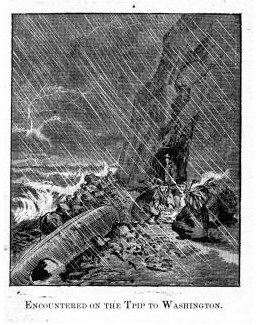
Some of the images in Armstrong’s memior seem to have been created especially for the work and were not derived from earlier photographs (Marr and Richards Co.).
In the first two chapters, Armstrong describes the trip to Washington. He mentions himself, Buffalo, and the young orator Oshogay, making the trip along with four other Ojibwe men. From other sources, we know that a young mixed-blood from La Pointe, Vincent Roy Jr., was also part of the delegation. Within these two chapters, there are two images. Each may contain a representation of Buffalo.
All of the images in the book are from engravings produced by the Marr and Richards Engraving Company of Milwaukee. Born and trained in Germany, master engraver John Marr had started the company with the American-born George Richards in 1888. Their highly-precise maps, and illustrations appeared throughout the upper Midwest during this time period. For Early Life Among the Indians, it appears that Marr and Richards produced two types of engravings. One type was derived from original photographs, and the others were original designs to illustrate incidents from Armstrong’s stories. Of the latter type, a plate between pages 32 and 33 shows an image of five Indians huddled around a fire during a fierce thunderstorm. A bearded figure in a raincoat, presumably Armstrong, stands in the background.
This image, called Encountered on the Tpip [sic] to Washington., illustrates a part of Armstrong’s story where the delegation had to pull their canoe out of the water during a storm on the south shore of Lake Superior on the first leg of the journey. Of the five Ojibwe men shown, the one with the most feathers, nearest the viewer with his back and profile visible is the most prominent. However, all five are simple renderings that play into Indian stereotypes of the day and do not appear to be based on any real images. So, while the illustrators may have intended one to show Buffalo, this image was produced long after his death and does nothing to suggest what he would have looked like.
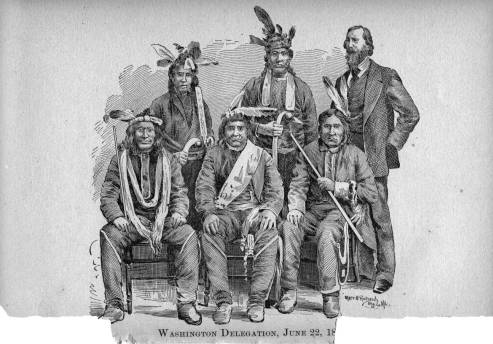
Washington Delegation, June 22, 1852: Chief Buffalo led this famous Ojibwe delegation to Washington, so it is assumed he is one of the men in this engraving, but which one? The original photograph has not been located (Marr and Richards Co.).
The image labelled Washington Delegation, June 22,1852, between pages 16 and 17, is much more intriguing. It shows three seated men in front of three standing men. The man standing on the right appears to be Armstrong, but the rest of them are not identified. There has been a lot of speculation whether or not this image shows Chief Buffalo. The man seated in the middle with the large white sash across his chest was featured on on poster of Buffalo released by the Minnesota Historical Society in the 1980s. He does appear to be the oldest and most prominent of the group. However, the man holding a pipe sitting to his left (bottom right in the picture)was used as the model for the large outdoor mural of Buffalo on the corner of Highways 2 and 13 in Ashland.
Besides the title and the engraver’s mark, there is no other information to identify the origin of this image. It almost certainly came from a photograph. Two similar engravings, found elsewhere in the book can be traced to specific photos. One Armstrong identifies as being the 1862 Ojibwe delegation to President Lincoln. In the engraving, seven chiefs stand behind three who sit. Again, the men are not identified, but Armstrong lists the names of the chiefs who accompanied him on pages 66 and 67. The Fond du Lac chief, Naaganab (Sits in Front) is identifiable from other photographs. As his name would suggest, he is seated in front in the center.


The photograph this engraving was made from was taken by the famous Civil War photographer Matthew Brady, and it can be found in the collections of the Minnesota Historical Society. From the postures and facial expressions of the men, it is clear the engraving was made from this photo. However, the two images are not exact duplicates. The man standing third from the left in the photo appears to have been moved to the far right in the engraving, and to the right of him, we see another man who is not in the photo. Because the photograph from MHS cuts off immediately to the right of the man who is third from the right in the engraving, it is impossible to know whether or not anyone stood there when the photo was taken.
The other engraving based on a photograph appears between pages 134 and 135. Armstrong identifies it as Annuity papement [sic] at La Pointe, 1852. The photograph it comes from, by Charles Zimmerman, is well known to scholars of this time period, and it appears in many secondary works. One copy is held by the Wisconsin Historical Society. It shows four government officials from La Pointe seated at a table surrounded by Ojibwe men and women waiting to receive their treaty payments. Sources vary on the date. The Historical Society identifies it as 1870 and describes it as “Indians receiving payment. Seated on the right is John W. Bell. Others are, left to right, Asaph Whittlesey, Agent Henry C. Gilbert, and William S. Warren (son of Truman Warren).”


While the engraving of the 1852 Delegation is clearly also from a photograph, the original has not been located. If it exists, and contains any more identifying information, it represents possibly the best opportunity to see what Buffalo looked like. We need to find the photo!
The Verdict
Inconclusive: One of these men could be Buffalo from La Pointe, but more information is needed.
Sources:
Armstrong, Benj G., and Thomas P. Wentworth. Early Life among the Indians: Reminiscences from the Life of Benj. G. Armstrong : Treaties of 1835, 1837, 1842 and 1854 : Habits and Customs of the Red Men of the Forest : Incidents, Biographical Sketches, Battles, &c. Ashland, WI: Press of A.W. Bowron, 1892. Print.
Ashland Chamber of Commerce. “Ashland Mural Walk.” Ashland Wisconsin. N.p., n.d. Web. 28 June 2012. <http://www.visitashland.com/>.
Brady, Matthew. Ojibwe Men (Possibly at 1857 or 1862 Treaty Signing at Washington D.C.). c.1862. Photograph. Minnesota Historical Society, Washington. MHS Visual Resource Database. Minnesota Historical Society, 2012. Web. 28 June2012. <http://collections.mnhs.org/visualresources/>.
Loew, Patty. Indian Nations of Wisconsin: Histories of Endurance and Renewal. Madison: Wisconsin Historical Society, 2001. Print.
Merrill, Peter C. German Immigrant Artists in America: A Biographical Dictionary. Lanham, MD: Scarecrow, 1997. Print.
Morse, Richard F. “The Chippewas of Lake Superior.” Collections of the State Historical Society of Wisconsin. Ed. Lyman C. Draper. Vol. 3. Madison: State Historical Society of Wisconsin, 1857. 338-69. Print.
Satz, Ronald N. Chippewa Treaty Rights: The Reserved Rights of Wisconsin’s
Chippewa Indians in Historical Perspective. Madison, WI: Wisconsin Academy of
Sciences, Arts and Letters, 1991. Print.
Schenck, Theresa M. William W. Warren: The Life, Letters, and times of an Ojibwe Leader. Lincoln: University of Nebraska, 2007. Print.
Warren, William W., and Theresa M. Schenck. History of the Ojibway People. St. Paul: Minnesota Historical Society, 2009. Print.
Zimmerman, Charles A. Annuity Payment at La Pointe. c.1852-1870. Photograph. Wisconsin Historical Society, La Pointe, WI. Wisconsin Historical Images. Wisconsin Historical Society, 1996-2012. Web. 28 June 2012. <http://http://www.wisconsinhistory.org/whi>.
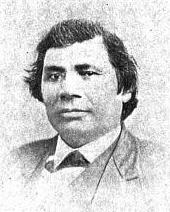
Vincent Roy Jr. (From Life and Labors of Rt. Rev. Frederic Baraga by Chrysostom Verwyst: Digitized by Google Books)
Chief Buffalo’s 1852 delegation to Washington D.C. is an iconic moment in the history of the Chequamegon region. As the story goes, the 92 year-old chief made the difficult journey by canoe, steamship, rail and foot all the way to the capital city, met with President Millard Fillmore, and came back with an order to stop the removal of the Wisconsin Ojibwe. Despite its continuing popularity, and its special importance to the Red Cliff community, recent scholarship has called into question several key details of this story. Central to this controversy is whether or not Buffalo actually met the president. However, I recently found a document in the archives of an early Red Cliff resident, Vincent Roy Jr. It confirms what Red Cliff residents already know. Chief Buffalo did travel to Washington and met the president in June of 1852.
Benjamin Armstrong
According to the popular Buffalo story, some of the young men of the La Pointe Band were ready to fight the United States in early 1852. The government removal efforts that led to the Sandy Lake Tragedy in the fall of 1850 were ongoing, and the future of the Ojibwe bands in Wisconsin was in doubt. To maintain the peace, and gain title to reservations in Wisconsin, Buffalo and a small group of chiefs and headmen (including Oshogay Buffalo’s speaker and Benjamin Armstrong his interpreter), left La Pointe that spring. They encountered bad weather and negative government officials along the way, but they were able to gather signatures on their petition from several prominent Lake Superior whites. In New York and Washington, they ran short on money and had to count on the kindness of wealthy Americans who were amazed by the culture and appearance of the Ojibwe from the western country. In Washington, the Indian Affairs department refused to hear their petition and ordered them to return to La Pointe, but through luck, they met a congressman who arranged a special meeting with the president. As the story goes, Buffalo smoked with Fillmore and Oshogay delivered a long speech laying out the Ojibwe grievances. In a second meeting, Fillmore declared the removal efforts over. The delegation then returned to La Pointe via St. Paul and stopped at several Ojibwe villages causing “great rejoicing” as they announced the news. Two years later the Treaty of La Pointe (1854) confirmed forever the promises made to Buffalo by Fillmore.

Washington Delegation, June 22 1852: The man in the upper right is assumed to be Armstrong. (Engraved from unknown photograph by Marr and Richards Co. for B. Armstrong Early Life Among the Indians). Look for an upcoming post about this image
The hero, along with Buffalo, in this version story is often Benjamin Armstrong. That shouldn’t be too surprising because all the details of it come from Armstrong’s 1891 memoir Early Life Among the Indians. This entire work is freely available online on the website of the Wisconsin Historical Society. Another well-made website, chiefbuffalo.com, has several additional primary documents related to Buffalo and Armstrong. I consider Early Life required reading for anyone who lives in the Chequamegon Bay area. However, the reader has to be careful with Armstrong. As I mentioned in the post on Hanging Cloud, the female warrior of the Chippewa River country, the memoir should be treated like a work of literature rather than scholarly piece. It wasn’t unusual for 19th-century autobiographies to contain fictional parts, and Early Life is no exception. The details that the elderly Armstrong (who admitted to a fuzzy memory) dictated to Thomas P. Wentworth in 1891, don’t always match the details found in the documents of the 1850s. This is the case with the Buffalo-Fillmore story.
Recent Scholarly Work and Primary Sources about the 1852 Delegation
In his extremely thorough scholarly overview of the pro-Treaty Rights position, Chippewa Treaty Rights (1991), Ronald Satz admitted that “Armstrong’s reminiscences contain some factual errors” and that anti-Treaty Rights anthropologist James Clifton attacked Armstrong’s credibility in an attempt to undermine the Treaty Rights argument. Still, Satz’ story of the 1852 delegation is straight out of Armstrong with the admission that “Scholars have not located a decree by Fillmore specifically rescinding President Taylor’s removal order.” Patty Loew’s Indian Nations of Wisconsin (2001) also gives the story Chief Buffalo’s journey largely the way it appeared in Armstrong. At that time, it appeared that the popular story, the Armstrong story, and the mainstream scholarship all matched up.
However, recent years have seen a shift in the interpretation of the Buffalo story Bruce M. White’s The Regional Context of the Removal Order of 1850, published in Fish in the Lakes, Wild Rice, and Game in Abundance: Testimony on Behalf of Mille Lacs Ojibwe Hunting and Fishing Rights (2000; Michigan State University Press), is a highly comprehensive account of the time period and the players involved. He devotes an entire chapter to the 1852 delegation. He does not dismiss Armstrong entirely, writing:
Some questions have been raised about the accuracy of Armstrong’s account. Some details, including dates, in Armstrong’s memories of events that had occurred 40 years before, appear to be mistaken. This, of course, is true of many autobiographical accounts written without the benefit of written documentation. Nonetheless, many key features of Armstrong’s account find corroboration in Indian office records, though not always in the exact way or order in which Armstrong describes them. (pg. 245)
Despite this nod to Armstrong, White’s examination of historical records from the National Archives, the American Board of Commissioners of Foreign Missions, Minnesota Territorial records, and other sources, paint a different picture from that in Early Life Among the Indians. He produces letters from federal officials saying the Indian Office sent the delegation home “with a flea in their ear,” while John Watrous, the Indian Agent the delegation came to complain about, received “flying colors.” White also uncovered a letter that Bad River missionary Leonard Wheeler wrote after Buffalo’s return to La Pointe. It stated the delegation “accomplished nothing.” Most significantly, on page 253, White reproduces a letter from Buffalo and Oshogay to Minnesota Territorial governor Alexander Ramsey. The letter is written in July 1852, after the delegation returned. The chiefs inform the governor that the decision is his whether or not to remove the Ojibwe. They plead with Ramsey to let them stay on the lake shore. This a far cry from the situation described by Armstrong where Buffalo received a promise from Fillmore and spread “rejoicing” to all the Ojibwe bands.
In fact, the very existence of the Buffalo-Fillmore meeting is called into question. For all the documents White produces saying the delegation was unsuccessful, he fails to produce one that even speaks of a meeting with the president. He leaves the possibility open for such a meeting, using some notations indicating chain of custody of the delegation’s petition as circumstantial evidence. However he uses language like “Whether or not the Ojibwe actually met with Fillmore…” for an important symbolic event taken for granted in Ojibwe history up until that point.
If White’s investigation of the original sources calls into question the success of the delegation and its ability to meet the president, Theresa Schenck’s William W. Warren: The Life, Letters, and Times of an Ojibwe Leader (2007; U. of Nebraska Press) makes one question Armstrong’s importance in the group. In Early Life Among the Indians, Armstrong is the star of the show. He claims the delegation was his idea, that he conducted it, made all the arrangements along the way, and was generally responsible for its success. The historical record does not back these claims up. Even before the Sandy Lake Tragedy, Ojibwe chiefs were doubting the truth of the removal order as stated by Agent Watrous and Governor Ramsey. They demanded to hear it directly from the president himself. By the end of 1852, after seeing hundreds of their fellow Ojibwe die in two botched removal attempts, and having missed out on two crucial years of annuity payments, the demands of the chiefs for a meeting with the president grew louder. It was William Warren who wanted to lead and interpret for an officially-sanctioned delegation. As Ramsey used stalling tactics, Warren’s health failed, and the hope of official approval waned, Buffalo took matters into his own hands and arranged his own delegation. The elderly chief wanted to bring Leonard Wheeler along, but the missionary objected to the inclusion of a certain “half-breed” who was “incapable of doing justice to their affairs.” White speculates that Wheeler meant Armstrong, but Armstrong was a white man from Alabama. A June 24, 1852 letter, from William Warren to his cousin George, reveals who the mix-blooded interpreter likely was. This letter, as quoted in Schenck (2007) reads:
…Old Beauf [Buffalo] with others having V. Roy Jr for Intpr have gone on to Washington. All nonsense. They can effect nothing going off like fools with poor interpreters and representing only the Lapointe band (pg. 162).
Warren had included Vincent Roy Jr. in his original plan for a Washington delegation, so it seems his objections to Buffalo’s choice of interpreter have more to do with the chief not following Warren’s plan than on any reflection on the merits of Roy himself. Roy, who later in life was described as a man of outstanding character, may have earned the enmity of Wheeler because he was a strong Catholic. Wheeler and the other ABCFM missionaries were working intensely at this time to counter Roman Catholic influence in the area. In either case, Armstrong isn’t even mentioned. Though his presence isn’t supported by these documents, I believe the details of Armstrong’s memoir show he was part of the delegation. However, the claims that he “conducted” it seem grossly exaggerated.
Local Response to the Questioning of the Chief Buffalo Story
Bruce White’s primary goal was to argue the Mille Lacs Treaty-Rights case rather than maintain the popular history of this area, and Theresa Schenck has never been one to shy away from challenging long-cherished myths, but what do scholars with a bigger stake in the Chief Buffalo story say?
On the Chequamegon History website, I’ve written a lot on Buffalo, and I’ve taken part in various projects related to Buffalo’s trip, so I was disappointed when I first heard from Dr. Schenck that our region’s defining historical event may have never happened. Unfortunately, my primary research only seemed to confirm that the 1852 trip was a failure. The only new document I could find was an untranslated German travelogue Reisen in Nordamerika in den Jahren 1852 and 1853 (Travels in North America in the Years 1852 and 1853) by the noted Austrian travel writers Moritz Wagner and Karl Ritter von Scherzer. On page 336 of Volume 2, Wagner and Scherzer describe meeting Buffalo. I don’t read German, so I had to work through Google Translate:
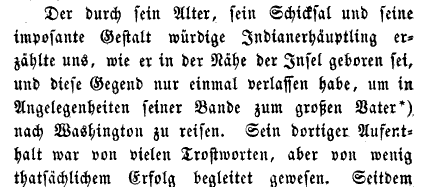
From page 336 of Reisen in Nordamerika Vol. 2 by Wagner and Scherzer. Look for an upcoming post with more from this obscure 19th-century travelogue (Digitized by Google Books).
“The Indian chief, worthy by his age, heredity, and his imposing figure, told us he was born near the island and left the area only once to travel in the matters of his tribe to the Great Father [president] in Washington. His stay was accompanied by words of comfort but little success.” (My rough Google-aided translation of above)
This source, combined with the work of Schenck and White, and other issues I’ve had with Armstrong, led me to believe that perhaps the Chief Buffalo story was just a myth. Then, this summer saw two locally-linked authors publish works.
This summer, Patty Loew released an updated version of her fantastic introduction to Wisconsin Indian history, Indian Nations of Wisconsin. It revises the Armstrong-based section on the 1852 trip from the first edition to admit that Buffalo may not have met the president. Loew lives in Madison but is a Bad River tribal member and a Chief Buffalo fan.
Howard Paap, who is married into the Red Cliff community, has written extensively about it. His new book, Red Cliff, Wisconsin: A History of an Ojibwe Community, also came out this summer. He extends White’s arguments and thoroughly evaluates Armstrong’s story against the other primary sources. Paap’s conclusions are bold for someone writing a history on behalf of a reservation community established for Buffalo’s descendants:
We are left with the question of whether or not the Buffalo and Oshaga delegation really did have an audience with President Fillmore in the summer of 1852, and if so, what actually transpired during such a meeting…
…perhaps the easiest solution to the question of whether or not such a meeting occurred is to believe Benjamin Armstrong’s recollections, along with contemporary Ojibwe oral traditions about the trip, and leave it at that.
However, given the reality of the errors in Armstrong’s memoir, and much more importantly, the hard evidence of the trip’s paper trail as recently uncovered by Charles Cleland and Bruce White, we are confronted with a dilemma. In today’s popular history the scene of Buffalo and President Fillmore standing eye to eye, as crafted in the Carl Gawboy painting wherein Fillmore is handing Buffalo a paper canceling the removal order, is compelling, but the surviving papers that document another scenario cannot be ignored (pg. 241).
Paap goes on to describe the Buffalo story as “folkloric,” but he suggests that while the 1852 delegation did not single-handedly end the threat of Ojibwe removal, the most symbolic part of the myth remains the meeting with the president. Following White, Paap admits the possibility that the Buffalo-Fillmore meeting happened, reiterating that primary sources suggested the delegation did not achieve its objectives, but there was nothing that explicitly said there was no meeting with the president.
The Vincent Roy Jr. Account of the 1852 Trip
In browsing the online catalog of the Wisconsin Historical Society archives this spring, I discovered the society had some of Vincent Roy Jr.’s papers. The catalog description mentioned a fur trade journal, a description of early ships on Lake Superior, and some manuscript biographies of Roy from some Catholic priests. Roy, who was raised in an Ojibwe-French mix-blood family, was a fur trader and government interpreter in his early years. Still a young man at the time of the Treaty of 1854, he lived into the 20th century and was notable for several reasons including making multiple trips to Washington with Ojibwe delegations, being the namesake of Roy’s Point in Red Cliff, leading area mix-blooded Ojibwe in the cause of the “half-breed land claims,” and being one of the earliest and wealthiest settlers of Superior. He was a commanding figure in the Catholic Church and Democratic Party of Wisconsin, and there is a lot out there about him.
The wonderful staff at Wisconsin Historical Society Research Center in Ashland agreed to have the papers sent up from Madison for me. The arrived in early August, mere days after I had the chance to read Paap and Loew. Since the scope of Chequamegon History is pre-1860, I went in mostly interested in seeing the fur trade journal. I assumed the biography would be identical to the biographical information about Roy published in Life and Labors of Rt. Rev. Frederic Baraga by Chrysostom Verwyst. The Holland-born Verwyst was a priest who knew Roy personally and considered him “The Greatest Indian of the Northwest.” I didn’t think there would be anything new in this part of the archive, but I was wrong:
[Letter accompanying manuscript biography written in Verwyst’s hand]
St. Agnes’ Church
205 E. FRONT ST.
Ashland, Wis., June 27, 1903
Reuben G. Thwaites,
Sec. Wis. Hist. Soc. Madison, Wis.
Dear Sir,
I herewith send you personal memories of Hon. Vincent Roy, lately deceased, as put together by Rev. Father Valentine O.F.M. Should your society find them of sufficient historical interest to warrant their publication, you will please correct them properly before getting them printed.
Yours very respectfully,
Fr Chrysostom Verwyst O.F.M.
[From Page one of manuscript biography in Valentine’s handwriting]
~ Biographical Sketch – Vincent Roy ~
~ T. Apr. 2. 1896 – Superior Wis. ~
[Sections 1-3 (Roy’s early years) omitted. Transcription picks up on page 5 (section 4). Valentine lists his sources in the left margin. I will put them in parentheses before each paragraph].
(Mr. Roy to V.)
IV. His first Visit to Washington, D.C. – The Treaty of La Pointe.
At the instance of Chief Buffalo and in his company Vincent made his first trip to Washington, D.C. It was in the spring of the year 1852. Buffalo (Kechewaishke), head chief of the Lake Superior Ojibways had seen the day when his people, according to indian estimation, was wealthy and powerful, but now he was old and his people sickly and starving poor. Vincent referring once to the incidents of that time spoke about in this way “He (Buffalo) and the other old men of the tribe, his advisers, saw quite well that things could not go on much longer in the way they had done. The whites were crowding in upon them from all sides and the U.S. government said and did nothing. It appeared to these indians their land might be taken from them without they ever getting anything for it. They were scant of food and clothing and the annuities resulting from the sale of their land might keep them alive yet for a while. The desire became loud that it might be tried to push the matter at Washington admitting that they had to give up the land but insisting they be paid for it. Buffalo was willing to go but there was no one to go with him. He asked me to go with him. As I had no other business just then on hand I went along.”
(Sources: Cournoyer or Mr. Roy to V.) [Vincent Cournoyer was V. Roy’s brother-in-law]
They went by way of the lakes. Arriving in Washington, they found the City and the capitol in a garb of mourning and business suspended. Henry Clay, the great statesman and orator, had died (June 29) and his body was lying in state. Vincent said: “we shook hands and spoke with the President (Fillmore) and with some of the headmen of the government. They told us that they could not do anything at the moment, but that our petition should be attended to as soon as possible. Unable to obtain any more, we looked around a few days and returned home.” The trip had entailed a considerable drain on their private purses and the result towards the point at issue for them, the selling of the land of the indians, was not very apparent.
(the treaty doct.)
After repeated urging and an interval of over two years, during which Franklin Pierce had become President of the United States, the affairs of these Indians were at last taken up and dealt with at La Pointe by Henry C. Gilbert and David B. Herriman, commissioners on the part of the United States. A treaty was concluded, September 30th 1854. The Lake Superior Ojibways thereby relinquished their last claims to the soil of north west Michigan, north east Wisconsin, and an adjoining part of Minnesota, and, whilst it was understood that the reserves at L’Anse Michigan, Odanah, Court Oreille Wisconsin and Fondulac Minnesota were set apart for them, they received in consideration of the rest the aggregate sum of about four hundred and seventy five thousand dollars, which, specified as to money and material, ran into twenty years rations.
(Cournoyer)
Chief Buffalo in consideration of services rendered was allowed his choice of a section of land anywhere in the ceded terrain. The choice he made, it is said, were the heights of the city of Duluth, but never complying with the incident law formalities, it matters little that the land became the site of a city, his heirs never got the benefit of it. Of Vincent who had been also of service to the indians from the first to the last of the deal, it can only be said that he remained not just without all benefit from it. A clause was inserted in the treaty (Art. 2. n. 7.) by which heads of families and single persons over twenty one years of mixed blood were each entitled to take and hold free of further charge eighty acres of the ceded lands:- this overruled in a simple and direct way the difficulties Vincent had met with of late in trying to make good his claim to such a property. The advantages here gained was however common to others with him. For the sacrifices he made of time and money in going with Chief Buffalo to Washington he was not reimbursed, so it is believed, and is very likely true judgeing from what was the case when later on he made the same trip a second time.
[End of Section 4, middle of page 7 of Valentine’s manuscript]
In my mind, this document is proof that the Buffalo-Fillmore meeting did happen. We know Roy went on the trip, and his account (unlike Armstrong’s) supports rather than contradicts the documents from the time period. It wasn’t two scheduled ceremonial meetings that permanently settled the removal question. In fact, it may have only been a handshake and a few words, but the central image of the two leaders, ogimaa and president, meeting remains part of the Chief Buffalo story.

Identified as Vincent Cournoyer and Vincent Roy Jr. c. 1880 in photo at Bayfield Library. See the Photos, Photos, Photos post for an alternative identification. (Charles Bell, Washington: Collections of the Smithsonian Institution)
For Vincent Roy Jr., I hope this inquiry will lead to more attention. His life spanned two key eras in Ojibwe history and he was often at the center of it. His name is all over the primary sources, but compared with Armstrong, the Warrens, and the Beaulieus, we don’t see him much in the secondary scholarship.
For Benjamin Armstrong, I think the Roy documents require us to take a fresh look at Early Life Among the Indians. If the Fillmore meeting can be verified after a long look, there’s a good chance some of the other details in the memoir can be as well. I’m a Benjamin Armstrong fan, and he’s taken a beating in this post and some of the recent scholarship, but I still maintain that there is a lot of truth in Early Life.
For Chief Buffalo, it is gratifying to find out that the 1852 meeting with the president isn’t complete fiction. Buffalo may not have been satisfied with the results of his trip, but I feel the ultimate appeal of his story is the fight to keep an Ojibwe homeland in Wisconsin. We may not be able to point to a single event and say, “That’s where the removal died,” but ultimately, the Ojibwe leadership prevailed. For that reason, we should continue to celebrate the 1852 delegation, all the people who were part of it, and all those who were part of the larger struggle for justice it represented.
Sources:
Armstrong, Benj G., and Thomas P. Wentworth. Early Life among the Indians: Reminiscences from the Life of Benj. G. Armstrong : Treaties of 1835, 1837, 1842 and 1854 : Habits and Customs of the Red Men of the Forest : Incidents, Biographical Sketches, Battles, &c. Ashland, WI: Press of A.W. Bowron, 1892. Print.
Loew, Patty. Indian Nations of Wisconsin: Histories of Endurance and Renewal. Madison: Wisconsin Historical Society, 2001. Print.
———— Indian Nations of Wisconsin: Histories of Endurance and Renewal. 2nd ed. Madison: Wisconsin Historical Society, 2013. Print.
McClurken, James M., and Charles E. Cleland. Fish in the Lakes, Wild Rice, and Game in Abundance: Testimony on Behalf of Mille Lacs Ojibwe Hunting and Fishing Rights / James M. McClurken, Compiler ; with Charles E. Cleland … [et Al.]. East Lansing, MI: Michigan State UP, 2000. Print.
Paap, Howard D. Red Cliff, Wisconsin: A History of an Ojibwe Community. St. Cloud, MN: North Star, 2013. Print.
Satz, Ronald N. Chippewa Treaty Rights: The Reserved Rights of Wisconsin’s Chippewa Indians in Historical Perspective. Madison, WI: Wisconsin Academy of Sciences, Arts and Letters, 1991. Print.
Schenck, Theresa M. William W. Warren: The Life, Letters, and times of an Ojibwe Leader. Lincoln: University of Nebraska, 2007. Print.
Verwyst, Chrysostom and Father Valentine. Biographical Sketch – Vincent Roy Jr. 1896-1903. MS. Vincent Roy Jr. Papers. Wisconsin Historical Society Archives, n.p.
Verwyst, Chrysostom. Life and Labors of Rt. Rev. Frederic Baraga: First Bishop of Marquette, Mich., to Which Are Added Short Sketches of the Lives and Labors of Other Indian Missionaries of the Northwest. Milwaukee, WI: M.H. Wiltzius, 1900. Print.
Wagner, Moritz, and Karl Von Scherzer. Reisen in Nordamerika in Den Jahren 1852 Und 1853. Leipzig: Arnold, 1854. Print.
Warren, William W., and Theresa M. Schenck. History of the Ojibway People. St. Paul: Minnesota Historical Society, 2009. Print.
Thank you to Theresa Schenck, Howard Paap, Linda Mittlestadt, Pam Ekholm, Larry Balber, and Betty Johnson for help and encouragement in this research.

KAIZHEOSH, and his band from Lake Vieu Desert. Michigan and Wisconsin: Copied from the original birch bark by Seth Eastman and published in Schoolcraft, Henry R. Information Respecting the History, Condition and Prospects of the Indian Tribes of the United States, Volume 1. Philadelphia: Lippincott, Grambo, and Company, 1853. (Digitized by the University of Nebraska Libraries)
In the fall of 1848, a group of Ojibwe Indians led by a charismatic mix-blooded interpreter, arrived in Cincinnati, Ohio. They were bound for Washington D.C., but didn’t have the money to get there because they didn’t have “permission” from the Indian Agent for the trip. They had to raise funds along the way by putting on dances for the curious public. Those who read Chequamegon History might remember this post and recognize them as John Baptiste Martell, Oshkaabewis, Gezhiiyaash, and the other chiefs from the Lac du Flambeau/Ontonagon region who carried the famous pictographic birch bark petitions to Washington. The pictographs showing the united Ojibwe clans, and the written petition that accompanied them, asked the government to create reservations in Michigan and Wisconsin, and not remove the Oijbwe.
When Gezhiiyaash got sick in Cincinnati, the doctor he was seeing noticed that the petitions were not the only birch bark documents carried by the party. The ill Lac Vieux Desert chief was a leader in the Midewiwin Society, and he had brought a Mide scroll. His doctor, like many prominent American men in the middle of the 19th century, was a Freemason, and this is where things got interesting. And, I’ll leave it at that because I don’t want to spoil any more of this story. It’s a good one.

Masonic Voice Review, Volume 4. J. Ernst., 1849. Digitized by Google Books


There isn’t a whole lot to add to this other than to say the 1848-49 “Martell Expedition” gets weirder and more interesting with each new source that surfaces. Please read …a donation of twenty-four sections of land covering the graves of our fathers, our sugar orchards, and our rice lakes and rivers… and Reconstructing the “Martell” Delegation through Newspapers, for an explanation of the goals and accomplishments of these chiefs and the obstacles they faced along the way.
Sources:
Satz, Ronald N. Chippewa Treaty Rights: The Reserved Rights of Wisconsin’s Chippewa Indians in Historical Perspective. Madison, WI: Wisconsin Academy of Sciences, Arts and Letters, 1991. Print.
Schenck, Theresa M. William W. Warren: The Life, Letters, and times of an Ojibwe Leader. Lincoln: University of Nebraska, 2007. Print.
Schoolcraft, Henry Rowe, and Seth Eastman. Historical and Statistical Information Respecting the History, Condition, and Prospects of the Indian Tribes of the United States: Collected and Prepared under the Direction of the Bureau of Indian Affairs per Act of Congress of March 3rd, 1847. Philadelphia: Lippincott, Grambo, 1851. Print.
Oshogay
August 12, 2013
At the most recent count, Chief Buffalo is mentioned in over two-thirds of the posts here on Chequamegon History. That’s the most of anyone listed so far in the People Index. While there are more Buffalo posts on the way, I also want to draw attention to some of the lesser known leaders of the La Pointe Band. So, look for upcoming posts about Dagwagaane (Tagwagane), Mizay, Blackbird, Waabojiig, Andeg-wiiyas, and others. I want to start, however, with Oshogay, the young speaker who traveled to Washington with Buffalo in 1852 only to die the next year before the treaty he was seeking could be negotiated.
I debated whether to do this post, since I don’t know a lot about Oshogay. I don’t know for sure what his name means, so I don’t know how to spell or pronounce it correctly (in the sources you see Oshogay, O-sho-ga, Osh-a-ga, Oshaga, Ozhoge, etc.). In fact, I don’t even know how many people he is. There were at least four men with that name among the Lake Superior Ojibwe between 1800 and 1860, so much like with the Great Chief Buffalo Picture Search, the key to getting Oshogay’s history right is dependent on separating his story from those who share his name.
In the end, I felt that challenge was worth a post in its own right, so here it is.
Getting Started
According to his gravestone, Oshogay was 51 when he died at La Pointe in 1853. That would put his birth around 1802. However, the Ojibwe did not track their birthdays in those days, so that should not be considered absolutely precise. He was considered a young man of the La Pointe Band at the time of his death. In my mind, the easiest way to sort out the information is going to be to lay it out chronologically. Here it goes:
1) Henry Schoolcraft, United States Indian Agent at Sault Ste. Marie, recorded the following on July 19, 1828:
Oshogay (the Osprey), solicited provisions to return home. This young man had been sent down to deliver a speech from his father, Kabamappa, of the river St. Croix, in which he regretted his inability to come in person. The father had first attracted my notice at the treaty of Prairie du Chien, and afterwards received a small medal, by my recommendation, from the Commissioners at Fond du Lac. He appeared to consider himself under obligations to renew the assurance of his friendship, and this, with the hope of receiving some presents, appeared to constitute the object of his son’s mission, who conducted himself with more modesty and timidity before me than prudence afterwards; for, by extending his visit to Drummond Island, where both he and his father were unknown, he got nothing, and forfeited the right to claim anything for himself on his return here.
I sent, however, in his charge, a present of goods of small amount, to be delivered to his father, who has not countenanced his foreign visit.
Oshogay is a “young man.” A birth year of 1802 would make him 26. He is part of Gaa-bimabi’s (Kabamappa’s) village in the upper St. Croix country.
2) In June of 1834, Edmund Ely and W. T. Boutwell, two missionaries, traveled from Fond du Lac (today’s Fond du Lac Reservation near Cloquet) down the St. Croix to Yellow Lake (near today’s Webster, WI) to meet with other missionaries. As they left Gaa-bimabi’s (Kabamappa’s) village near the head of the St. Croix and reached the Namekagon River on June 28th, they were looking for someone to guide them the rest of the way. An old Ojibwe man, who Boutwell had met before at La Pointe, and his son offered to help. The man fed the missionaries fish and hunted for them while they camped a full day at the mouth of the Namekagon since the 29th was a Sunday and they refused to travel on the Sabbath. On Monday the 30th, the reembarked, and Ely recorded in his journal:
The man, whose name is “Ozhoge,” and his son embarked with us about 1/2 past 9 °clk a.m. The old man in the bow and myself steering. We run the rapids safely. At half past one P. M. arrived at the mouth of Yellow River…
Ozhoge is an “old man” in 1834, so he couldn’t have been born in 1802. He is staying on the Namekagon River in the upper St. Croix country between Gaa-bimabi and the Yellow Lake Band. He had recently spent time at La Pointe.
3) Ely’s stay on the St. Croix that summer was brief. He was stationed at Fond du Lac until he eventually wore out his welcome there. In the 1840s, he would be stationed at Pokegama, lower on the St. Croix. During these years, he makes multiple references to a man named Ozhogens (a diminutive of Ozhoge). Ozhogens is always found above Yellow River on the upper St. Croix.
Ozhogens has a name that may imply someone older (possibly a father or other relative) lives nearby with the name Ozhoge. He seems to live in the upper St. Croix country. A birth year of 1802 would put him in his forties, which is plausible.

Ke-che-wask keenk (Gichi-weshki) is Chief Buffalo. Gab-im-ub-be (Gaa-bimabi) was the chief Schoolcraft identified as the father of Oshogay. Ja-che-go-onk was a son of Chief Buffalo.
4) On August 2, 1847, the United States and the Mississippi and Lake Superior Ojibwe concluded a treaty at Fond du Lac. The US Government wanted Ojibwe land along the nation’s border with the Dakota Sioux, so it could remove the Ho-Chunk people from Wisconsin to Minnesota.
Among the signatures, we find O-sho-gaz, a warrior from St. Croix. This would seem to be the Ozhogens we meet in Ely.
Here O-sho-gaz is clearly identified as being from St. Croix. His identification as a warrior would probably indicate that he is a relatively young man. The fact that his signature is squeezed in the middle of the names of members of the La Pointe Band may or may not be significant. The signatures on the 1847 Treaty are not officially grouped by band, but they tend to cluster as such.
5) In 1848 and 1849 George P. Warren operated the fur post at Chippewa Falls and kept a log that has been transcribed and digitized by the University of Wisconsin Eau Claire. He makes several transactions with a man named Oshogay, and at one point seems to have him employed in his business. His age isn’t indicated, but the amount of furs he brings in suggests that he is the head of a small band or large family. There were multiple Ojibwe villages on the Chippewa River at that time, including at Rice Lake and Lake Shatac (Chetek). The United States Government treated with them as satellite villages of the Lac Courte Oreilles Band.
Based on where he lives, this Oshogay might not be the same person as the one described above.
6) In December 1850, the Wisconsin Supreme Court ruled in the case Oshoga vs. The State of Wisconsin, that there were a number of irregularities in the trial that convicted “Oshoga, an Indian of the Chippewa Nation” of murder. The court reversed the decision of the St. Croix County circuit court. I’ve found surprisingly little about this case, though that part of Wisconsin was growing very violent in the 1840s as white lumbermen and liquor salesmen were flooding the country.

Pg 56 of Containing cases decided from the December term, 1850, until the organization of the separate Supreme Court in 1853: Volume 3 of Reports of Cases Argued and Determined in the Supreme Court of the State of Wisconsin: With Tables of the Cases and Principal Matters, and the Rules of the Several Courts in Force Since 1838, Wisconsin. Supreme Court Authors: Wisconsin. Supreme Court, Silas Uriah Pinney (Google Books).
The man killed, Alexander Livingston, was a liquor dealer himself.
Alexander Livingston, a man who in youth had had excellent advantages, became himself a dealer in whisky, at the mouth of Wolf creek, in a drunken melee in his own store was shot and killed by Robido, a half-breed. Robido was arrested but managed to escape justice.
~From Fifty Years in the Northwest by W.H.C Folsom
Several pages later, Folsom writes:
At the mouth of Wolf creek, in the extreme northwestern section of this town, J. R. Brown had a trading house in the ’30s, and Louis Roberts in the ’40s. At this place Alex. Livingston, another trader, was killed by Indians in 1849. Livingston had built him a comfortable home, which he made a stopping place for the weary traveler, whom he fed on wild rice, maple sugar, venison, bear meat, muskrats, wild fowl and flour bread, all decently prepared by his Indian wife. Mr. Livingston was killed by an Indian in 1849.
Folsom makes no mention of Oshoga, and I haven’t found anything else on what happened to him or Robido (Robideaux?).
It’s hard to say if this Oshoga is the Ozhogen’s of Ely’s journals or the Oshogay of Warren’s. Wolf Creek is on the St. Croix, but it’s not far from the Chippewa River country either, and the Oshogay of Warren seems to have covered a lot of ground in the fur trade. Warren’s journal, linked in #4, contains a similar story of a killing and “frontier justice” leading to lynch mobs against the Ojibwe. To escape the violence and overcrowding, many Ojibwe from that part of the country started to relocate to Fond du Lac, Lac Courte Oreilles, or La Pointe/Bad River. La Pointe is also where we find the next mention of Oshogay.
7) From 1851 to 1853, a new voice emerged loudly from the La Pointe Band in the aftermath of the Sandy Lake Tragedy. It was that of Buffalo’s speaker Oshogay (or O-sho-ga), and he spoke out strongly against Indian Agent John Watrous’ handling of the Sandy Lake payments (see this post) and against Watrous’ continued demands for removal of the Lake Superior Ojibwe. There are a number of documents with Oshogay’s name on them, and I won’t mention all of them, but I recommend Theresa Schenck’s William W. Warren and Howard Paap’s Red Cliff, Wisconsin as two places to get started.
Chief Buffalo was known as a great speaker, but he was nearing the end of his life, and it was the younger chief who was speaking on behalf of the band more and more. Oshogay represented Buffalo in St. Paul, co-wrote a number of letters with him, and most famously, did most of the talking when the two chiefs went to Washington D.C. in the spring of 1852 (at least according to Benjamin Armstrong’s memoir). A number of secondary sources suggest that Oshogay was Buffalo’s son or son-in-law, but I’ve yet to see these claims backed up with an original document. However, all the documents that identify by band, say this Oshogay was from La Pointe.
The Wisconsin Historical Society has digitized four petitions drafted in the fall of 1851 and winter of 1852. The petitions are from several chiefs, mostly of the La Pointe and Lac Courte Oreilles/Chippewa River bands, calling for the removal of John Watrous as Indian Agent. The content of the petitions deserves its own post, so for now we’ll only look at the signatures.

November 6, 1851 Letter from 30 chiefs and headmen to Luke Lea, Commissioner of Indian Affairs: Multiple villages are represented here, roughly grouped by band. Kijiueshki (Buffalo), Jejigwaig (Buffalo’s son), Kishhitauag (“Cut Ear” also associated with the Ontonagon Band), Misai (“Lawyerfish”), Oshkinaue (“Youth”), Aitauigizhik (“Each Side of the Sky”), Medueguon, and Makudeuakuat (“Black Cloud”) are all known members of the La Pointe Band. Before the 1850s, Kabemabe (Gaa-bimabi) and Ozhoge were associated with the villages of the Upper St. Croix.

November 8, 1851, Letter from the Chiefs and Headmen of Chippeway River, Lac Coutereille, Puk-wa-none, Long Lake, and Lac Shatac to Alexander Ramsey, Superintendent of Indian Affairs: This letter was written from Sandy Lake two days after the one above it was written from La Pointe. O-sho-gay the warrior from Lac Shatac (Lake Chetek) can’t be the same person as Ozhoge the chief unless he had some kind of airplane or helicopter back in 1851.

Undated (Jan. 1852?) petition to “Our Great Father”: This Oshoga is clearly the one from Lake Chetek (Chippewa River).

Undated (Jan. 1852?) petition: These men are all associated with the La Pointe Band. Osho-gay is their Speaker.
In the early 1850s, we clearly have two different men named Oshogay involved in the politics of the Lake Superior Ojibwe. One is a young warrior from the Chippewa River country, and the other is a rising leader among the La Pointe Band.

Washington Delegation July 22, 1852 This engraving of the 1852 delegation led by Buffalo and Oshogay appeared in Benjamin Armstrong’s Early Life Among the Indians. Look for an upcoming post dedicated to this image.
8) In the winter of 1853-1854, a smallpox epidemic ripped through La Pointe and claimed the lives of a number of its residents including that of Oshogay. It had appeared that Buffalo was grooming him to take over leadership of the La Pointe Band, but his tragic death left a leadership vacuum after the establishment of reservations and the death of Buffalo in 1855.
Oshogay’s death is marked in a number of sources including the gravestone at the top of this post. The following account comes from Richard E. Morse, an observer of the 1855 annuity payments at La Pointe:
The Chippewas, during the past few years, have suffered extensively, and many of them died, with the small pox. Chief O-SHO-GA died of this disease in 1854. The Agent caused a suitable tomb-stone to be erected at his grave, in La Pointe. He was a young chief, of rare promise and merit; he also stood high in the affections of his people.
Later, Morse records a speech by Ja-be-ge-zhick or “Hole in the Sky,” a young Ojibwe man from the Bad River Mission who had converted to Christianity and dressed in “American style.” Jabegezhick speaks out strongly to the American officials against the assembled chiefs:
…I am glad you have seen us, and have seen the folly of our chiefs; it may give you a general idea of their transactions. By the papers you have made out for the chiefs to sign, you can judge of their ability to do business for us. We had but one man among us, capable of doing business for the Chippewa nation; that man was O-SHO-GA, now dead and our nation now mourns. (O-SHO-GA was a young chief of great merit and much promise; he died of small-pox, February 1854). Since his death, we have lost all our faith in the balance of our chiefs…
This O-sho-ga is the young chief, associated with the La Pointe Band, who went to Washington with Buffalo in 1852.
9) In 1878, “Old Oshaga” received three dollars for a lynx bounty in Chippewa County.

Report of the Wisconsin Office of the Secretary of State, 1878; pg. 94 (Google Books)
It seems quite possible that Old Oshaga is the young man that worked with George Warren in the 1840s and the warrior from Lake Chetek who signed the petitions against Agent Watrous in the 1850s.
10) In 1880, a delegation of Bad River, Lac Courte Oreilles, and Lac du Flambeau chiefs visited Washington D.C. I will get into their purpose in a future post, but for now, I will mention that the chiefs were older men who would have been around in the 1840s and ’50s. One of them is named Oshogay. The challenge is figuring out which one.

Ojibwe Delegation c. 1880 by Charles M. Bell. [Identifying information from the Smithsonian] Studio portrait of Anishinaabe Delegation posed in front of a backdrop. Sitting, left to right: Edawigijig; Kis-ki-ta-wag; Wadwaiasoug (on floor); Akewainzee (center); Oshawashkogijig; Nijogijig; Oshoga. Back row (order unknown); Wasigwanabi; Ogimagijig; and four unidentified men (possibly Frank Briggs, top center, and Benjamin Green Armstrong, top right). The men wear European-style suit jackets and pants; one man wears a peace medal, some wear beaded sashes or bags or hold pipes and other props.(Smithsonian Institution National Museum of the American Indian).
- Upper row reading from the left.
- 1. Vincent Conyer- Interpreter 1,2,4,5 ?, includes Wasigwanabi and Ogimagijig
- 2. Vincent Roy Jr.
- 3. Dr. I. L. Mahan, Indian Agent Frank Briggs
- 4. No Name Given
- 5. Geo P. Warren (Born at LaPointe- civil war vet.
- 6. Thad Thayer Benjamin Armstrong
- Lower row
- 1. Messenger Edawigijig
- 2. Na-ga-nab (head chief of all Chippewas) Kis-ki-ta-wag
- 3. Moses White, father of Jim White Waswaisoug
- 4. No Name Given Akewainzee
- 5. Osho’gay- head speaker Oshawashkogijig or Oshoga
- 6. Bay’-qua-as’ (head chief of La Corrd Oreilles, 7 ft. tall) Nijogijig or Oshawashkogijig
- 7. No name given Oshoga or Nijogijig
The Smithsonian lists Oshoga last, so that would mean he is the man sitting in the chair at the far right. However, it doesn’t specify who the man seated on the right on the floor is, so it’s also possible that he’s their Oshoga. If the latter is true, that’s also who the unknown writer of the library caption identified as Osho’gay. Whoever he is in the picture, it seems very possible that this is the same man as “Old Oshaga” from number 9.
11) There is one more document I’d like to include, although it doesn’t mention any of the people we’ve discussed so far, it may be of interest to someone reading this post. It mentions a man named Oshogay who was born before 1860 (albeit not long before).
For decades after 1854, many of the Lake Superior Ojibwe continued to live off of the reservations created in the Treaty of La Pointe. This was especially true in the St. Croix region where no reservation was created at all. In the 1910s, the Government set out to document where various Ojibwe families were living and what tribal rights they had. This process led to the creation of the St. Croix and Mole Lake reservations. In 1915, we find 64-year-old Oshogay and his family living in Randall, Wisconsin which may suggest a connection to the St. Croix Oshogays. As with number 6 above, this creates some ambiguity because he is listed as enrolled at Lac Courte Oreilles, which implies a connection to the Chippewa River Oshogay. For now, I leave this investigation up to someone else, but I’ll leave it here for interest.

United States. Congress. House. Committee on Indian Affairs. Indian Appropriation Bill: Supplemental Hearings Before a Subcommittee. 1919 (Google Books).
This is not any of the Oshogays discussed so far, but it could be a relative of any or all of them.
In the final analysis
These eleven documents mention at least four men named Oshogay living in northern Wisconsin between 1800 and 1860. Edmund Ely met an old man named Oshogay in 1834. He is one. A 64-year old man, a child in the 1850s, was listed on the roster of “St. Croix Indians.” He is another. I believe the warrior from Lake Chetek who traded with George Warren in the 1840s could be one of the chiefs who went to Washington in 1880. He may also be the one who was falsely accused of killing Alexander Livingston. Of these three men, none are the Oshogay who went to Washington with Buffalo in 1852.
That leaves us with the last mystery. Is Ozhogens, the young son of the St. Croix chief Gaa-bimabi, the orator from La Pointe who played such a prominent role in the politics of the early 1850s? I don’t have a smoking gun, but I feel the circumstantial evidence strongly suggests he is. If that’s the case, it explains why those who’ve looked for his early history in the La Pointe Band have come up empty.
However, important questions remain unanswered. What was his connection to Buffalo? If he was from St. Croix, how was he able to gain such a prominent role in the La Pointe Band, and why did he relocate to La Pointe anyway? I have my suspicions for each of these questions, but no solid evidence. If you do, please let me know, and we’ll continue to shed light on this underappreciated Ojibwe leader.
Sources:
Armstrong, Benj G., and Thomas P. Wentworth. Early Life among the Indians: Reminiscences from the Life of Benj. G. Armstrong : Treaties of 1835, 1837, 1842 and 1854 : Habits and Customs of the Red Men of the Forest : Incidents, Biographical Sketches, Battles, &c. Ashland, WI: Press of A.W. Bowron, 1892. Print.
Ely, Edmund Franklin, and Theresa M. Schenck. The Ojibwe Journals of Edmund F. Ely, 1833-1849. Lincoln: University of Nebraska, 2012. Print.
Folsom, William H. C., and E. E. Edwards. Fifty Years in the Northwest. St. Paul: Pioneer, 1888. Print.
KAPPLER’S INDIAN AFFAIRS: LAWS AND TREATIES. Ed. Charles J. Kappler. Oklahoma State University Library, n.d. Web. 12 August 2013. <http:// digital.library.okstate.edu/Kappler/>.
Nichols, John, and Earl Nyholm. A Concise Dictionary of Minnesota Ojibwe. Minneapolis: University of Minnesota, 1995. Print.
Paap, Howard D. Red Cliff, Wisconsin: A History of an Ojibwe Community. St. Cloud, MN: North Star, 2013. Print.
Redix, Erik M. “The Murder of Joe White: Ojibwe Leadership and Colonialism in Wisconsin.” Diss. University of Minnesota, 2012. Print.
Schenck, Theresa M. The Voice of the Crane Echoes Afar: The Sociopolitical Organization of the Lake Superior Ojibwa, 1640-1855. New York: Garland Pub., 1997. Print.
———–William W. Warren: The Life, Letters, and times of an Ojibwe Leader. Lincoln: University of Nebraska, 2007. Print.
Schoolcraft, Henry Rowe. Personal Memoirs of a Residence of Thirty Years with the Indian Tribes on the American Frontiers: With Brief Notices of Passing Events, Facts, and Opinions, A.D. 1812 to A.D. 1842. Philadelphia, [Pa.: Lippincott, Grambo and, 1851. Print.
Warren, William W., and Theresa M. Schenck. History of the Ojibway People. St. Paul: Minnesota Historical Society, 2009. Print.
Who doesn’t love a good mystery?
In my continuing goal to actually add original archival research to this site, rather than always mooching off the labors of others, I present to you another document from the Wheeler Family Papers. Last week, I popped over to the Wisconsin Historical Society collections at the Northern Great Lakes Visitor Center in Ashland, and brought back some great stuff. Unlike the somber Sandy Lake letters I published July 11th, this first new document is a mysterious (and often hilarious) journal from 1843 and 1844.
It was in the Wheeler papers, but it was neither written by nor for one of the Wheelers. There is no name on it to indicate an author, and despite a year of entries, very little to indicate his occupation (unless he was a weatherman). He starts in Fond du Lac, Wisconsin, bound for Fond du Lac, Minnesota–though neither was a state yet. Our guy reaches Lake Superior at a time of great change. The Ojibwe have just ceded the land in the Treaty of 1842, commercial traffic is beginning to start on Lake Superior, and the old fur-trade economy is dying out.
Our guy doesn’t seem to be a native of this area. He’s not married. He doesn’t seem to be strongly connected to the fur trade. If he works for the government, he isn’t very powerful. He is definitely not a missionary. He doesn’t seem to be a land speculator or anything like that.
Who is he, and why did he come here? I have some hunches, but nothing solid. Read it and let me know what you think.
1843
Aug. 24th 1843. left Taycheedah for Milwaukie on my route to Lake Superior, drove to Cases[?] in Fond du Lac
25th Drove to Cases on Milwaukie road, commenced rowing before we arrived, and we put up for the night.
26th Started in the rain, drove to Vinydans[?], rain all the time. wet my carpet bag and clothes—we put out 12 O’clock m. took clothes out of my traveling bag and dried them.
27th sunday Left early in the morning. arrived at Milwaukie at 12 O clock M. stayed at the Fountain house, had good fun.

Arch Rock, Mackinac Island (Jeffness upload to Wikimedia Commons CC)
28th Purchased provisions and other articles of outfit and embarked aboard the Steamboat Chesapeake for Mackinac 9 O’clock P. M. had a pleasant time.
30th Arrived at Mackinac 6 O’clock A.M. put up at Mr. Wescott’s had excellent fare and good company, charges reasonable. four Thousand Indian men encamped on the Island for Payment—very warm weather—Slept with windows raised, and uncomfortably warm. There are a few white families, but the mass of the people are a motley crowd “from snowy white to sooty[?],” I visited the curiosities, the old fort Holmes, the sugar loaf rock the arched rock—heard some good stories well told by Mr. Wescott and a gentleman from Philadelphia.
Sept 4th Left Mackinac on board the Steamer Gen. Scott 8 O’clock A. M. arrived at Sault St, Marie same night 6 O’clock—very pleasant weather. gardens look well. Put up at Johnsons. had good fare fish eggs fowls and garden vegetables.
7th Embarked on board the Brig John Jacob Astor for La Pointe. Sailed fifty miles. at midnight the wind shifted suddenly into the N.W. and blew a hurricane and we were obliged to run back into the St. Marie’s river, and lay there at Pine Point until Sunday.
10th when we best[?] out of the river, and proceeding on
1843
Sept 11th Monday heading against hard wind all day—
 makak: a semi-rigid or rigid container: a basket (especially one of birch bark), a box (Photo: Smithsonian Institution; Definition: Ojibwe People’s Dictionary).
12th Warm cloudless brilliant morning, a perfect calm—10 O’clock fair wind, and with every sail our vessel plows the deep, with majesty.
13th cloudy—fair wind, we arrive at La Pointe 9 O’clock P.M. when a cannon fired from on board the vessel announced our arrival.
Mr. Wheeler of the Presbyterian Mission was very kind in receiving me to room with him, and I am indebted to him and family for many acts of kindness during my stay at La Pointe, and I fell under [?] for about 15 lbs boiled beef and a small Mokuk of sugar, which they insisted on my taking on my departure for Fond du Lac, and which men[?] very p[?]able while wind on my way upon the shore of Lake Superior.
27th Left La Pointe about 4 O clock P. M. in small boat in company with the farmer & Blacksmith stationed at Fond du Lac. we rowed to Raspberry river and encamped.
28th Head wind—rowed to Siscowet Bay and encamped.
29th Rain and fair wind, we embarked about 8 O clock in the rain—in doubling Bark Point we got an Ocean more, but our little boat rides it nobly. the wind and rain increase, and we run into Pukwaekah river, the wind blowing directly on shore and the waves dashing to an enormous height, it was by miracle, our men chose, that struck the mouth of that small river, and entered in safety, After we had pitched our tent, we saw eight canoes with sails making directly for the river. they could not strike the entrance at the mouth of the river, and were driven on shore upon the beach and filled. We assisted in hauling our some of the first that came, and they assisted the rest.
1843
Sept 30th High wind and rain. We remained at this place until wednesday.
Oct 4th At 1 O clock A. M. the wind having abated we again embarked and rowed into the mouth of the St. Louis at 1 O clock P. M. I threw myself upon the bank, completely exhausted, and thankful to be once more on Terra firma, and determined to stay there until my strength should be reignited, however having taken dinner upon the bank and a cup of tea, the wind sprang up favorably and we sailed up the river ten miles and encamped upon an island.
5th Arrived at the A.M.F.’s Trading Post the place of our destination, at 10 O’clock A.M. (mild and pleasant from this time to the 24th weather has been remarkably.
24th Cold—snow and some ice in the river
26th The river froze over at this place.
27th Colder the ice makes fast in the river
Nov 1st Crossed the river on the ice—winter weather—
2nd Moderate
5th Sunday warm the ice is failing in the river dangerous crossing on foot
7th and 8th Warm and pleasant—the ice is melting
9th Warm and misty—thawing fort
20th Warm—rains a little—the river is nearly clean of ice—
Dec. 3rd The weather up to this date has been very mild. No snow, the ice on the river scarcely sufficient to bear a horse and train—
Jan 1st 1844 Warm and misty—more like April fool than New years day
1844
Jan 1st On this day I must record the honor of being visited by some half dozen pretty squaws expecting a New Years present and a kiss, not being aware of the etiquette of the place, we were rather taken by surprise, in not having presents prepared—however a few articles were mustered, an I must here acknowledge that although, out presents were not very valuable, we were entitled to the reward of a kiss, which I was ungallant enough not to claim, but they’ll never slip through my fingers in that way again.
March 2nd New sugar, weather pleasant
3rd Cloudy chilly wind

Bebiizigindibe (Curly Head) signed the Treaty of 1842 as 2nd Chief from Gull Lake. According to William Warren, he was known as “Little Curly Head.” “Big Curly Head” was a famous Gull Lake war chief who died in 1825 while returning home from the Treaty of Prairie du Chien. The younger chief was the son of Niigaani-giizhig (also killed by the Dakota), and the half-brother of Gwiiwizhenzhish or Bad Boy (pictured). According to Warren, this incident broke a truce between the two nations (Photo by Whitney’s of St. Paul, Collections of the Minnesota Historical Society).
17th Pleasant, two Indians arrive and bring the news that the chief of the Gull Lake band of Chippeways has been killed by the Sioux—there appears to be not much excitement among the Indians here upon the subject. The name of the chief that is killed is Babezegondeba (Curly Head)
The winter has been remarkably mild and pleasant—but little snow—no tedious storms and but two or three cold days.
31st A cloudy brilliant day—The frogs are singing
April 1st A lovely spring morning—warm—the Ducks are flying
Afternoon a little cloudy but warm
Evening, moonlight—beautiful and bright
2nd Warm morning. afternoon high wind rain
A pleasant moonlight evening—warm
3rd Briliant morning—warm afternoon appearance of rain. the ice is moving out of the river Ducks & Geese are flying and we have fresh fish
4th Clean cold morning wind N.E. afternoon high wind chilly. The clear of ice at this place.
5th Cold cloudy morning. Wind NE. After noon wind and rain from the N.E.
1844
April
6th Wind N.E. continues to rain moderately again—thunder and rain during the past night.
7th Sunday. warm rainy day—attended church
8th Cloudy morning and warm, afternoon very fair.
9th Fair frosty morning, afternoon very warm.
10th Cloudy and warm—thunder lightning and rain during the past night, afternoon fair and warm.
11th Rainy warm morning, with thunder and lightning afternoon fair and very warm.
12th Fair warm morning, after noon, cloudy with a little rain thunder and lightning—Musketoes appear
13th Most beautiful spring morning—fair warm day, wind S.W.
14th Cool cloudy day—Wind N.E. (Sunday)
15th Rainy, warm day
16th Fair cool morning—after noon warmer
17th Fair and warm day (Striker started for La Pointe Bellanger with the Blacksmith)
18th Another beautiful day.
19th Warm rainy day
20th Rainy day
21st Sunday fair and cool—high wind from N.E.
22nd Cool morning—some cloudy—P.M. high wind and rain
23rd High wind and rain from the N.E.—tremendous storm;
24th Fair morning moderately warm—afternoon fair. Musketoes
25th Rainy day
26th Cool cloudy morning
27th} fair & warm
28th
29th Beautiful April day
30th Rainy day
May 1st Warm with high wind
2nd Do. a little rain
3rd Warm—sunshine and showers
4th} Beautiful warm day
5th
6th Most beautiful brilliant day
the woods have already a shade of green
1844
May 7th Warm rainy day
June 21st Since the last date the weather has been good for the season—during the month of may occasionally a frosty night with sufficient variety of sunshine and shower. On this day I started for La Pointe in company with the farmer, the Blacksmith & Striker, and Indian, named Red Bird, in a small boat. we rowed to the River Aminicon and encamped.
22nd Three O’clock A.M. Struck our tent and embarked—took the oars, (about 6 O’clock met a large batteau from La Pointe Bound for Fond du Lac with seed Potatoes for the Indians, it also had letters for Fond du Lac, among which was one for my self—The farmer returned to Fond du Lac to attend to the distribution of the Potatoes. We breakfasted at Burnt wood River. about 7 O’clock The wind sprang up favorably and blew a steady strong blast all day, and we arrived at La Pointe about sun set.
23rd Sunday, attended church
24th Did nothing in particular—weather very warm
28th Was taken suddenly with crick in the back which laid me up for a week
July 4th Independence day—Just able to get about The batteaus were fitted out by Dr. Borup for a pleasure ride, by way of celebrating the birth day of American Independence—These boats were propelled by eight sturdy Canadian voyagers each, nearly all the inhabitants of La Pointe were on board, and I was among the number, we were conveyed , amidst the firing of pocket pistols, rifles, shot guns & the music and mirth of the half-breeds and the mild cadence of the Canadian Boat songs, to one of the Islands of the Apostles about ten miles distant from La Pointe. Here we disembarked and partook of a sumptuous dinner which had been prepared and brought on board the boats.

The brig John Jacob Astor, named for the fur baron pictured above, was one of the earliest commercial vessels on Lake Superior. It sank near Copper Harbor about two months after the La Pointe Independence Day celebration (Painting by Gilbert Stuart, Wikimedia Images).
Just as we had finished the repast, having done ample justice to the viands which were placed before us, Some one, by means of a large spy glass discovered the Brig Astor supposed to be about 10 or 15 miles distant beating for La Pointe in thirty minutes we were all on board our boats and bound to meet the Astor. The Canadians were all commotion, and rowed and sung with all their might for about eight miles when finding that we yet a long distance from the vessel, she making little head way, and it being past middle of the afternoon, the question arose whether we should go forward or return to La Pointe. a vote was taken, but as the chairman was unable to decide which party carried the point, he said he should be under the necessity of dividing the boat. this was accordingly done, and all those who were desirous to go a head, took one boat, and those who wished to return the other. I was anxious to go and meet the vessel, but being unwell was advised to return, and did so, and arrived at La Pointe at dusk.
July 11th Started from La Pointe for Fond du Lac with Mr. Johnson & Lady missionaries at Leech Lake. Mr. Hunter the Blacksmith, and two Indians, in our small boat. sailed about three miles a squall came up suddenly and drove us back to La Pointe—Started again after noon and rowed to Sandy River and encamped next
12th day rowed to Burnt wood (Iron) river.
13th Arrived at Fond du Lac 9 O’clock P.M.
Aug 6th Since I arrived the weather has been intensely warm Yesterday Mr. Hunter started for La Pointe to attend the Payment. I am alone

Erethizon dorsatum, North American Porcupine: I’m going to assume our author devoured one of these guys. Hedgehogs are exclusively an Old World animal (J. Glover, Wikimedia Images, CC)
Aug 27th The weather fair, the nights begin to be cooler. Musketoes and gnats have given up the contest and left us in full and peaceable possession of the country. Since Mr. hunter left for the payment I have been unwell, no appetite, foul stomac, after trying various remedies, in order to settle my stomac, I succeeded in effecting it at last by devouring a large portion of roast Hedge hog But was immediately taken down with a rheumatism in my back, which has held me to the present time and from which I am just recovering.
An Indian has just arrived from Leech Lake bringing news that the Sioux have killed a chippeway and that the Chippeways in retaliation have killed eight Sioux.
29th Johnson arrived from La Pointe—Rainy day.
31st The farmer and Blacksmith arrived from La Pointe
The weather is very warm—
Sept 5 Weather continues warm. Mr. Wright Mr Coe and wife start for Red Lake (they are Missionaries)
10 Frosty night
11 Do. “
12 Cloudy and warm
13 Do. Do. “
14 Do. Do. Do. Batteau arrived from La Pointe
15 Sunday foggy morning—very warm fair day
16 Warm
22 Do.
29 fair
Oct 3rd Warm and fair
Sunday 13th fair days & frosty nights, this month, thus far
14-15 Rainy days
19th cold
20 Snow covers the ground—the river is nightly frozen over at some places—
21 fine day
22&23 fair & warm thunder & lightning at night
24th Do. Do. (Agent arrived from La Pointe 28th)
28th Cold—snow in the afternoon and night
—————————————————————————————————————–
END OF 1843-44 JOURNAL
The last two pages of the document are written in the same handwriting, a few years later in 1847, and take the form of a cash ledger.
________________________________________________________________
| 1847 | Madam Defoe [?][?] 1847 | ||||
| Dec 3rd | [?] | [?] | |||
| p/o 4 lbs Butter | 1 | 00 | |||
| “ | “ 3 Gallons Soap | 1 | 00 | ||
| 15th | By Making 2 pr Moccasins | 50 | |||
| “ | [Washing 2 Down pieces ?] | 1 | 00 | ||
| “ | Mending pants [?] | 25 | |||
| Joseph Defoe Jr | |||||
| p/o 50 lbs Candles | 1 | 50 | |||
| “ 10 “ Pork | 1 | 50 | |||
| “ 20 “ flour | 1 | 25 | |||
| By three days work by self and son | 3 | 75 | |||
| p/o Pork 4 lbs | 50 | ||||
____________________________________________________________________________
| 1847 | Memorandum | ||||
| Aug | Went to La Pointe with Carleton | ||||
| Staid four days | |||||
| Oct 9th | Went to La Pointe (Monday) | ||||
| 12 | Returned 4 O’clock P.M. | ||||
| 16 | Went to La Pointe. returned same night | ||||
| 24th | Do. Do. | ||||
| 25th | Returned | ||||
| Nov. 28th | Lent Mr. Wood 10 lbs nails– | ||||
| 5 lbs 4[?] 5 lbs 10[?] previous to this time 12 lbs | |||||
| 4[?] Total= 22 lbs | |||||
| By three days work by self and son | |||||
| p/o Pork 4 lbs | |||||
| Nov | T.A. Warren Due to Cash | 2 | 00 | ||
 Truman A. Warren, son of Lyman Warren and Marie Cadotte Warren, brother of Willam W. (Wisconsin Historical Society Image ID: 28289)
____________________________________________________________________________
While not overly significant historically, I enjoyed typing up this anonymous journal. The New Years, Independence Day, and “Hedge Hog” stories made me laugh out loud. You just don’t get that kind of stuff from an uptight missionary, greedy trader, or boring government official. It really makes me want to know who this guy was. If you can identify him, please let me know.
Sources:
 Chequamegon History