“Ukraine: Four Years Later” Tuesday, March 3rd in Bayfield
February 23, 2026
Not Chequamegon History, but Chequamegon History-adjacent (if only in the sense that Leo is putting it on). See you there! We had to cancel for the 24th, but we’ll be there next week on March 3rd.
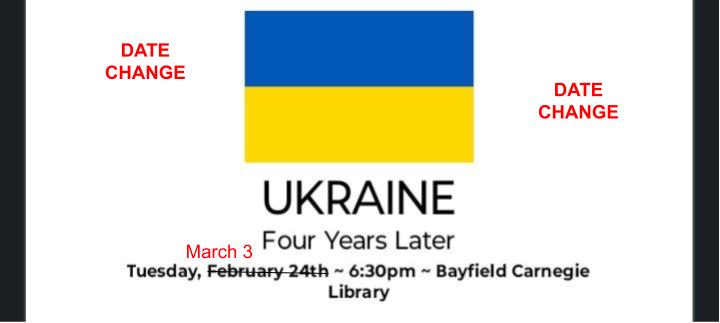
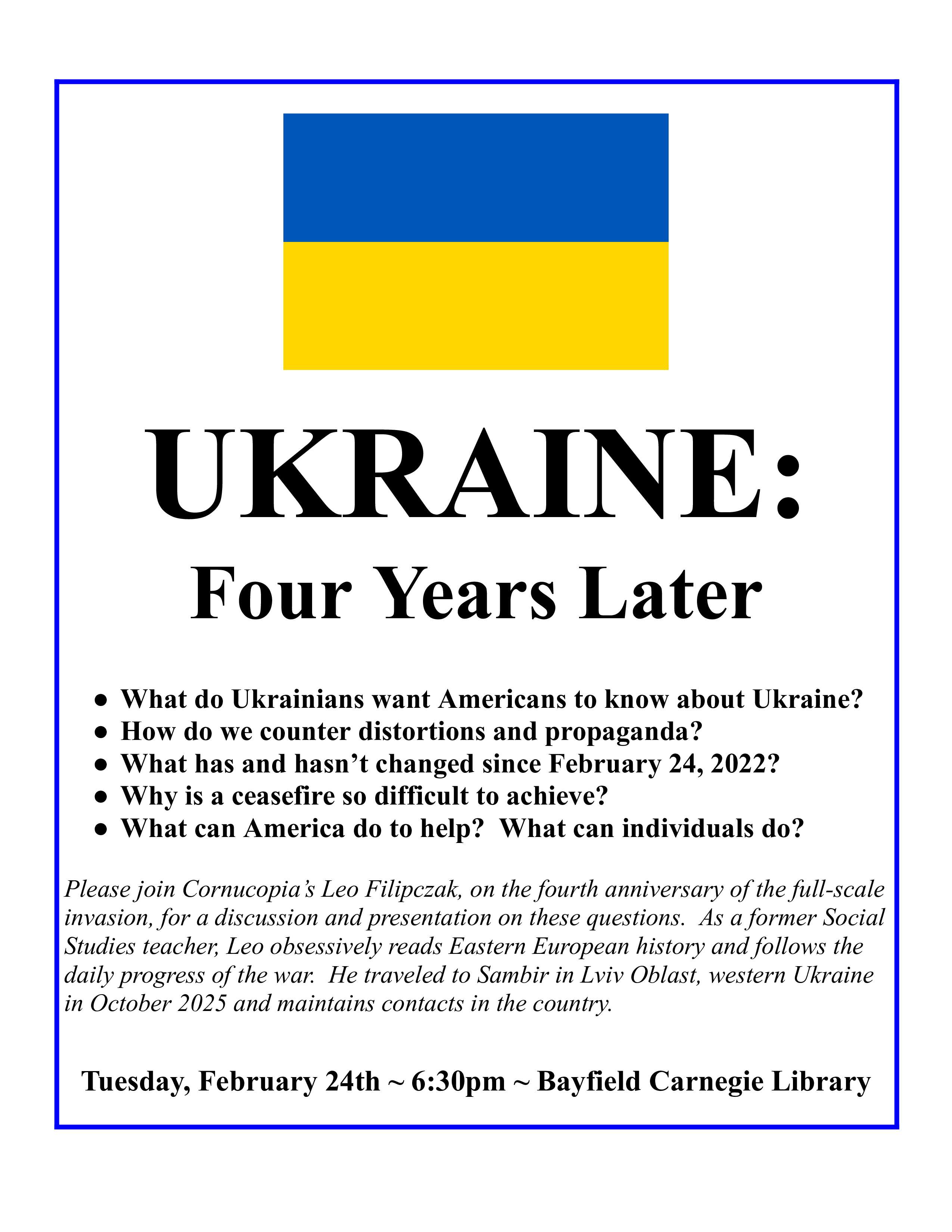
“Ukraine: Four Years Later” Tuesday, Feb. 24 in Bayfield
February 21, 2026
Not Chequamegon History, but Chequamegon History-adjacent (if only in the sense that Leo is putting it on). See you there!
Madeline Island History Event f. Amorin Mello July 12th
June 30, 2025
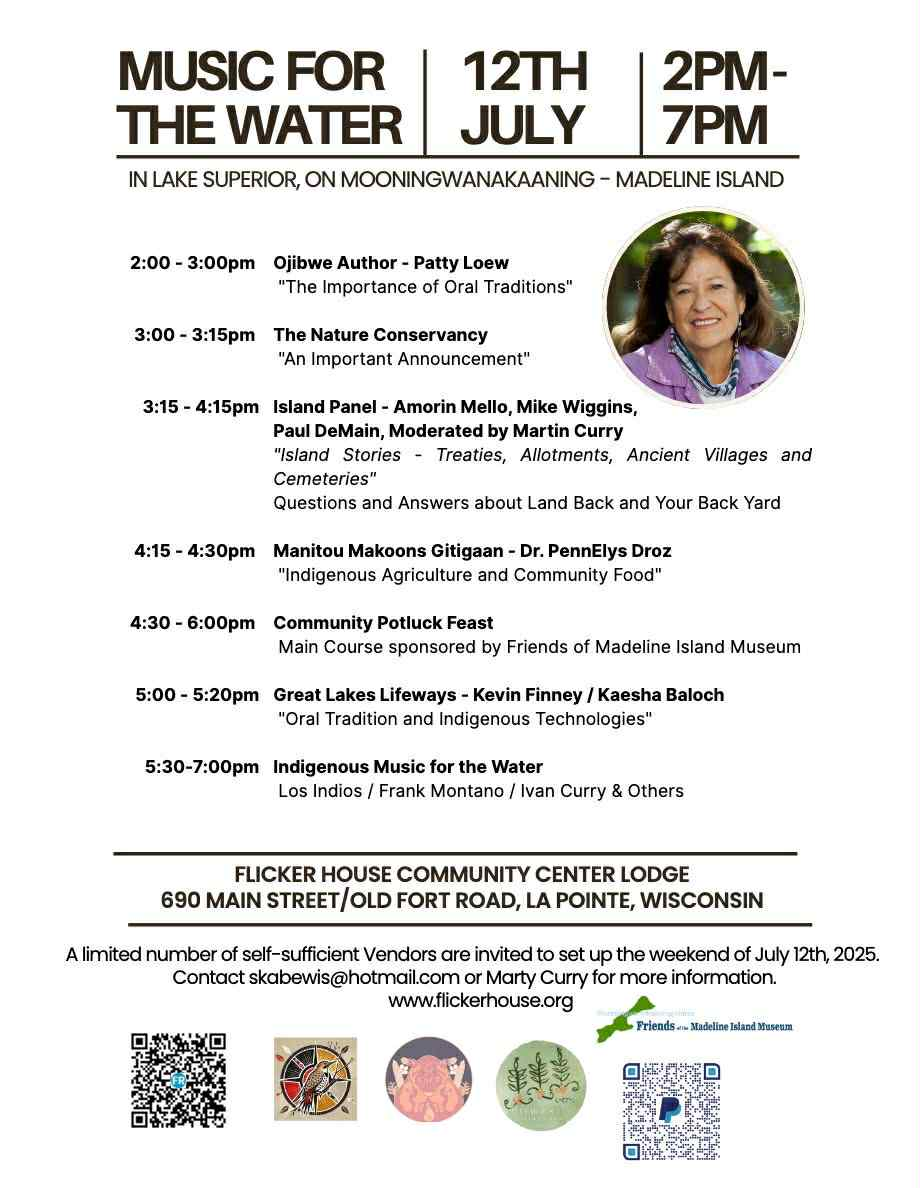
Join Chequamegon History author Amorin Mello as part of a distinguished schedule of speakers July 12th on the Island. It should be a great time!
Diplomacy in the Time of Cholera: why there was no Ojibwe delegation to President Taylor in the winter of 1849-50
December 15, 2024
By Leo
At Chequamegon History, we deal mostly in the micro. By limiting our scope to a particular time and place, we are all about the narrow picture. Don’t come here for big universal ideas. The more specific and obscure a story, the more likely it is to appear on this website.
Madeline Island and the Chequamegon region are perfect for the specific and obscure. In the 1840s, most Americans would have thought of La Pointe as remote frontier wilderness, beyond the reach of worldwide events. Most of us still look at our history this way.
We are wrong. No man is an island, and Madeline Island–though literally an island–was no island.
This week, I was reminded of this fact while doing research for a project that has nothing to do with Chequamegon History. While scrolling through the death records of the Greek-Catholic church of my ancestral village in Poland, I noticed something strange. The causes of deaths are usually a mishmash of medieval sounding ailments, all written in Latin, or if the priest isn’t feeling creative or curious, the death is just listed as ordinaria.
In the summer of 1849, however, there was a noticeable uptick in death rate. It seemed my 19th-century cousins, from age 7 to 70, were all dying of the same thing:

Cause of death in right column. Akta stanu cywilnego Parafii Greckokatolickiej w Olchowcach (1840-1879). Księga zgonów dla miejscowości Olchowce. https://www.szukajwarchiwach.gov.pl/en/jednostka/-/jednostka/22431255
Cholera is a word people my age first learned on our Apple IIs back in elementary school:

At Herbster School in 1990, we pronounced it “Cho-lee-ra.” It was weird the first time someone said “Caller-uh.” You can play online at https://www.visitoregon.com/the-oregon-trail-game-online/
It is no coincidence. If you note the date of leaving Matt’s General Store in Independence Missouri, Oregon Trail takes place in 1848.
Diseases thrive in times of war, upheaval, famine, and migration, and 1848 and 1849 certainly had plenty of all of those. A third year of potato blight and oppressive British policies plunged the Irish poor deeper into squalor and starvation. The millions who were able to, left Ireland. Meanwhile, the British conquest of the Punjab and the “Springtime of Nations” democratic revolutions across central Europe meant army and refugee camps (notorious vectors of disease) popped up across the Eurasian continent.
North America had seen war as well. The Treaty of Guadalupe-Hidalgo (1848) ended the Mexican-American War and delivered half of Mexico over to Manifest Destiny. The discovery of gold in California, part of this cession, brought thousands of Chinese workers to the West Coast, while millions of Irish and Germans arrived on the East Coast. Some of those would also find their way west along the aforementioned Oregon Trail.
Closer to home, these German immigrants meant statehood for Wisconsin and the shifting of Wisconsin’s Indian administration west to Minnesota Territory. Eyeing profits, Minnesota and Mississippi River interests were increasingly calling for the removal of the Lake Superior Ojibwe bands from Wisconsin and Michigan. This caused great alarm and uncertainty at La Pointe.
All of these seemingly disparate events of 1848 and 1849 are, in fact, related. One of the most obvious manifestations was that displaced people from all these places impacted by war, poverty, and displacement carried cholera. The disease arrived in the United States multiple times, but the worst outbreak came up Mississippi from New Orleans in the summer of 1849. It ravaged St. Louis, then the Great Lakes, and reached Sault Ste, Marie and Lake Superior by August.
Longtime Chequamegon History readers will know my obsession with the Ojibwe delegation that left La Pointe in October 1848 and visited Washington D.C. in February 1849. It is a fascinating story of a group of chiefs who brought petitions (some pictographic) laying out their arguments against removal to President James K. Polk and Congress. The chiefs were well-received, but ultimately the substance of their petitions was not acted upon. They arrived after the 1848 elections. Polk and the members of Congress were lame ducks. General Zachary Taylor had been elected president, though he wasn’t inaugurated until the day after the delegation left Washington.
If you’ve read through our DOCUMENTS RELATED TO THE OJIBWE DELEGATION AND PETITIONS TO PRESIDENT POLK AND CONGRESS 1848-1849, you’ll know that both Polk and the Ojibwe delegation’s translator and alleged ringleader, the colorful Jean-Baptiste Martell of Sault Ste. Marie, died of cholera that summer.
So, in this post, we’re going to evaluate three new documents, just added to the collection, and look at how the cholera epidemic partially led to the disastrous removal of 1850, commonly known as the Sandy Lake Tragedy.
The first document is from just after the delegation’s arrival in Washington. It describes the meeting with Polk in great detail, lays out the Ojibwe grievances, and importantly, records Polk’s reaction. I have not been able to find the name of the correspondent, but this article is easily the best-reported of all the many, many newspaper accounts of the 1848-49 delegation–most of which use patronizing racist language and focus on the more trivial, “fish out of water” element of Lake Superior chiefs in the capital city.
New York Daily Tribune, 6 February 1849, Page 1
The Indians of the North-West–Their Wrongs–Chiefs in Washington
Correspondence of The Tribune
WASHINGTON, 3d Feb 1849.
Yesterday (Friday) the Chiefs representing the Chippewa Tribe of Indians located on the borders of Lake Superior and drawing their pay at La Pointe, representing 16 bands, which comprise about 9,000 Indians, after remaining here for the last ten days, were presented to the President.– The Secretary of War and Commissioner of Indian Affairs were also present. One of the Chiefs who appeared to be the eldest, first addressed the President, for a period of twenty minutes. The address was interpreted by John B. Martell, a half-breed, who was born and has always continued among them. He appears a shrewd, sensible man, and interprets with much fluency. This Chief was followed by two others in addresses occupying the same length of time. They all addressed the President as “Our Great Father,” and spoke with much energy, dignity and fluency, preserving throughout a respectful manner and evincing an earnest sincerity of purpose, that bespoke their mission to be one of no ordinary character. They represented their grievances under which their tribes were laboring: the trials and privations they had undergone to reach here, and the separation from their families, with much emotion and in truly touching and eloquent terms.
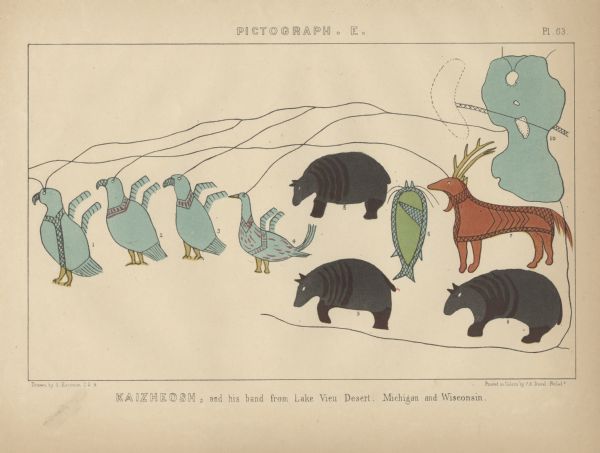
The oldest chief was Gezhiiyaash (his pictographic petition above) or “Swift Sailor” from Lac Vieux Desert. The two other chiefs were likely Oshkaabewis “Messenger” from Wisconsin River, and Naagaanab “Foremost Sitter” from Fond du Lac.
They represented that their annuities under their Treaty of La Pointe, made about the year 1843, were payable in the month of July in each year and not later, because by that time the planting season would be over; beside, it would be the best time and the least dangerous to pass the Great Lake and return to their homes in time to gather wild rice, on which they mainly depended during the hard winters. The first payment was made later than the time agreed upon. The agent, upon being notified, promised to comply with the terms of the Treaty, but every year since the payments have been made later, and that of last year did not take place until about the middle of October, in consequence of which they have been subjected to much suffering.– They assemble at the place for payment designated in the treaty. It is then the traders take advantage of them–being three hundred miles from home, without money, and without provisions; and when their money is received it must all be paid for their subsistence during the long delay they have been subjected to; and sickness frequently breaks out among them from being obliged to use salt provisions, which they are not accustomed to. By leaving their homes at any other time than in the month of July they neglect their harvesting–rice and potato crops, and if they neglect those they must starve to death; therefore it would be better for them to lose their annuities altogether. And without their blankets, procured at the Pointe, they are liable to freeze to death when passing the stormy lake; and the tradespeople influence the Agent to send for them a month before the payment is made, and when they arrive the Agent accepts orders from them for provisions which they are obliged to purchase at a great price–one dollar for 15 lbs of flour, and in proportion for other articles. They have assembled frequently in regard to these things, and can only conclude that their complaints have never reached their “Great Father,” and they have now come to see him in person, and take him by the hand.
In regard to the Half-Breeds at La Pointe, who draw pay with them, they say: That in the Treaty concluded between Governor Dodge and the Chippewas at St. Peters, provision was made for the half-breeds to draw their share all in one payment, and it was paid them accordingly, $258.50 each, which was a mere gift on the part of the tribe; a payment which they had no right to, but was given them as a present. Induced by some subsequent representations by the half-breeds, they were taken into their pay list, and the consequence has been that almost all the half breeds, as well as the French who are married to Indian women, are in the employ of, or dependent upon one of the principal trading houses, (Dr. Bourop’s) at La Pointe, with whom their goods and provisions are stored; and that they are thus enabled to select and appropriate to themselves the choice portion of all the goods designed for them–in many cases not leaving them a blanket to start with upon their journey of two or three hundred miles distant to their homes. After many other details, to which we will make reference in future articles, they urged that owing to the faithlessness of the half-breeds to them, and to the Government, that they be stricken from the pay list.
One half the goods furnished are of no use to them. The articles they most need are guns, kettles, blankets and a greater supply of provisions, &c.
They are under heavy expense, and no money to pay their board. They have undertaken this long journey for the benefit of their whole people, and at their earnest solicitations. They have been absent from their families nearly one year. It has cost them $1,400 to get here. Half of that sum has been raised from exhibitions. The other half has been borrowed from kind people on the route they have traveled. They wish to repay the money advanced them and to procure money to return home with. They want clothes and things to take to their families, and ask an appropriation of $6,000 on their annuity money.
They have before made a communication to the President, to be laid before the present Congress, for the acquisition of lands and the naturalization of their bands–propositions which they urged with great force.
All the Chiefs represented to the President that their interpreter, Mr. Martel, was living in very comfortable circumstances at home, and was induced to accompany them by the urgent solicitations of all their people who confided in his integrity and looked upon him as their friend.

The paternalistic ritual kinship (“Great Father”) language used here by James K. Polk, can be off-putting to the modern reader. However, it had a long tradition in Ojibwe “fur trade theater” rhetoric. Gezhiiyaash was no meek schoolboy, as evidenced by his words in this document (White House)
Their supplicating–though forcible, intelligent, and pathetic appeal, to be permitted to live upon the spot of their nativity, where the morning and noon of their days had been past, and the night time of their existence has reached them, was, too, and irresistible appeal to the justice, generosity and magnanimity of that boasted “civilization” that pleads mercy to the conquered, and was calculated to leave an impress upon every honest heart who claims to be a “freeman.”
The President, in answer to the several addresses, requested the interpreter to state to them that their Great Father was happy to have met with them; and as they had made allusion to written documents which they placed in his hands, as containing an expression of their views and wishes, he would carefully read them and communicate his answer to the Secretary of War and the Commissioner of Indian Affairs, assuring them of kindly feelings on the part of the Government, and terminating with some expressions very like a schoolmaster’s enjoinder upon his scholars that if they behaved themselves they might expect good treatment in future.
The fact that they met Polk was not new information, but we hadn’t been previously aware of just how long the meeting went. It is important to note the president’s use of “kindly feelings” and “behaved themselves.” Those phrases would come up frequently in subsequent years.
One could argue that Polk was a lame duck, and would be dead of cholera within a few months, so his words didn’t mean much. One could argue the problem was that the Ojibwe didn’t understand that in the American political system–that the incoming Whig administration might not feel bound by the words and “kindly feelings” of the outgoing Democratic administration.
However, the next document shows that the chiefs did feel the need to cover their bases and stuck around Washington long enough meet the next president. To us, at least, this was new information:
National Era v. III. No. 14, pg. 56 April 5, 1849
For the National Era
THE CHIPPEWA CHIEFS AND GENERAL TAYLOR
On the third day after the arrival of General Taylor at Washington, the Indian chiefs requested me to seek an interview for them, as they were about to leave for their homes, on Lake Superior, and greatly desired to see the new President before their departure.
It was accordingly arranged by the General to see them the next morning at 9 o’clock, before the usual reception hour.
Fitted out in their very best, with many items of finery which their taste for the imposing had added to their wardrobe, the delegation and their interpreter accompanied me to the reception room, and were cordially taken by the hand by the plain but benevolent-looking old General. One of the chiefs arose, and addressed the President elect nearly as follows:
“Father! We are glad to see you, and we are pleased to see you so well after your long journey.
“Father! We are the representatives of about twenty thousand of your red children, and are just about leaving for our homes, far off on Lake Superior, and we are very much gratified, that, before our departure, we have the opportunity of shaking hands with you.
“Father! You have conquered your country’s enemies in war; may you subdue the enemies of your Administration while you are President of the United States and govern this great country, like the great father, Washington, before you, with wisdom and in peace.
“Father! This our visit through the country and to the cities of your white children, and the wonderful things that we have seen, impress us with awe, and cause us to think that the white man is the favored of the Great Spirit.
“Father! In the midst of the great blessings with which you and your white children are favored of the Great Spirit, we ask of you, while you are in power, not to forget your less fortunate red children. They are now few, and scattered, and poor. You can help them.
“Father! Although a successful warrior, we have heard of your humanity! And now that we see you face to face, we are satisfied that you have a heart to feel for your poor red children.
“Father Farewell”
The tall, manly-looking chief having finished and shaken hands, General Taylor asked him to be seated, and, rising himself, replied nearly as follows”
“My Red Children: I am very happy to have this interview with you. What you have said I have listened to with interest. It is the more appreciated by me, as I am no stranger to your people. I resided for a length of time on your borders, and have been witness to your privations, and am acquainted with many of your wants.
“Peace must be established and maintained between yourselves and the neighboring tribes of the red men, and you need in the next place the means of subsistence.
“My Red Children: I thank you for your kind wishes for me personally, and as President of the United States.
“While I am in office, I shall use my influence to keep you at peace with the Sioux, between whom and the Chippewas there has always been a most deadly hostility, fatal to the prosperity of both nations. I shall also recommend that you be provided with the means of raising corn and the other necessaries of life.
“My Red Children: I hope that you have met with success in your present visit, and that you may return to your homes without an accident by the way; and I bid you say to your red brethren that I cordially wish them health and prosperity. Farewell.”
This interesting interview closed with a general shaking of hands and during the addresses, it is creditable to the parties to say, that the feelings were reached. Tears glistened in the eyes of the Indians and General Taylor evinced sufficient emotion, during the address of the chief, to show that he possesses a heart that may be touched. The old veteran was heard to remark, as the delegation left the room, “What fine looking men they are!”
Major Martell, the half-breed interpreter, acquitted himself handsomely throughout. The Indians came away declaring that “General Taylor talked very good.”
The General’s family and suite, evidently not prepared for the visit; were not dressed to receive company at so early an hour; nevertheless, they soon came in, en dishabille, and looked on with interest.
P.
One of the lingering questions I’ve had about the 1848-49 Delegation has been whether or not the Ojibwe leadership viewed it as a success. This document shows that the answer was unequivocally yes. It also shows why the chiefs felt so blindsided and disbelieving in the spring of 1850 when the government agents at La Pointe told them that Taylor had ordered them to remove. They didn’t have to go back to 1842 for the Government’s promises. They had heard them only a year earlier from both the president and the president-elect!
It also explains why during and after the removal, the chiefs number-one priority was sending another delegation. One would eventually go in 1852, led by Chief Buffalo of La Pointe. This would help secure the reservations sought by the first delegation, but that was only after two failed removal attempts and hundreds of deaths.
If the cholera epidemic had not come, Chief Buffalo and other prominent chiefs, would have likely gone back to Taylor in the winter of 1849-50. They may have been able to secure new treaty negotiations, reservations on the ceded territory, or at the very least have been more prepared for the upcoming removal:
George Johnston to Henry Schoolcraft, 5 October 1849, MS Papers of Henry Rowe Schoolcraft: General Correspondence, 1806-1864, BOX 51.
Saut Ste Maries
Oct 5th 1849
My Dear sir,
Your favor of Sep. 14th, I have just now received and will lose no time in answering. Since I wrote to you on the subject of an intended delegation of Chippewa Chiefs desiring to visit the seat of Govt., I visited Lapointe and remained there during the payment, and I had an opportunity of seeing & talking with the chiefs. They held a council with their agent Dr. Livermore and expressed their desire to visit Washington this season, and they laid the matter before him with open frankness, and Dr. Livermore answered them in the same strain, advising them at the same time, to relinquish their intended visit this year, as it would be dangerous for them, to travel in the midst of sickness which was so prevalent & so widely spread in the land, and that if they should still feel desirous to go on the following year that he would then permit them to do so, and that he would have no objections, this appearing so reasonable to the chiefs, that they assented to it.
I will write to the chiefs and express to them the subject of your letter, and direct them to address Mr. Babcock at Detroit.
You will herein find enclosed copy of Mr. Ballander’s letter to me, a gentleman of the Hon. Hudson’s Bay Co. & Chief factor at Fort Garry in the Red river region, it is very kind & his sympathy, devotes a feeling heart.– Mr. Mitchell of Green Bay to whom I have written in the early part of this summer, to make enquiries relative to certain reports of Tanner’s existence among the sioux, he has not as yet returned an answer to may communication and I feel the neglect with some degree of asperity which I cannot control.
Very Truly yours
Geo. Johnston
Henry R. Schoolcraft Esq.
Washington
It is hard to say how differently history may have turned out if a second delegation had been able to go with George Johnston. There is a good chance it would have been a lot more successful. Johnston was much more of an insider than Martell–who had had a lot of difficulty convincing the American authorities of his credentials. One of those who stood in Martell’s way was Henry Schoolcraft. Schoolcraft, was regarded by the American establishment as the foremost authority on Ojibwe affairs and was Johnston’s brother-in-law.
It may not have worked. The inertia of United States Indian Policy was still with removal. Any attempt to reverse Manifest Destiny and convince the government to cede land back to Indian nations east of the Mississippi was going to be an uphill battle. The Minnesota trade interests were strong.
Also, Schoolcraft was a Democrat, so he would have had less influence with the Whig Taylor–though agreements on Western issues sometimes crossed party lines. However, one can imagine George Johnston sitting around a table in Washington with his “Uncle” Buffalo, his brother-in-law Schoolcraft, and the U.S. President, working out the contours of a new treaty avoiding the removal entirely. Because of the cholera, however, we’ll never know.
For more on how the fallout from the Mexican War impacted Ojibwe removal, see Slavery, Debt Default, and the Sandy Lake Tragedy
For more on the 1848-49 Delegation, see: this post, this post, and this post
Wednesday’s Recorded Livestream: Tragedy of the Siskiwit
June 29, 2024
Watch on YouTube for description.
Wednesday’s Presentation Will be Livestreamed
June 22, 2024
If you aren’t able to make it out to Cornucopia Wednesday night, check out the livestream on https://www.facebook.com/ChequamegonHistory/ The link should be up around 5:45.

Chief Buffalo Picture Search: Coda
June 1, 2024
My last post ended up containing several musings on the nature of primary-source research and how to acknowledge mistakes and deal with uncertainty in the historical record. This was in anticipation of having to write this post. It’s a post I’ve been putting off for years.
Amorin forced the issue with his important work on the speeches at the 1842 Treaty negotiations. While working on it, he sent me a message that read something like, “Hey, the article quotes Chief Buffalo and describes him in a blue military coat with epaulets. Is the world ready for that picture that Smithsonian guy sent us years ago?”
This was the image in question:

Henry Inman, Big Buffalo (Chippewa), 1832-1833, oil on canvas, frame: 39 in. × 34 in. × 2 1/4 in. (99.1 × 86.4 × 5.7 cm), Smithsonian American Art Museum, Gift of Gerald and Kathleen Peters, 2019.12.2
We first learned of this image from a Chequamegon History comment by Patrick Jackson of the Smithsonian asking what we knew about the image and whether or not it was Chief Buffalo from La Pointe.
We had never seen it before.
This was our correspondence with Mr. Jackson at the time:
July 17, 2019
Hello, my name is Patrick, and I am an intern at the Smithsonian American Art Museum. I’m working on researching a recent acquisition: a painting which came to us identified as a Henry Inman portrait of “Big Buffalo Ke-Che-Wais-Ke, The Great Renewer (1759-1855) (Chippewa).” We have run into some confusion about the identification of the portrait, as it came to us identified as stated above, yet at Harvard Peabody Museum, who was previously the owner of the portrait, it was listed as an unidentified sitter. Seeing as you’ve written a few posts about the identification of images of the three different Chief Buffalos, I thought you might be able to give some insight into perhaps who is or isn’t in the portrait we have. Thank you for your time.
July 17, 2019
Hello,
I would be happy to comment. Can you send a photo to this email?
I am pretty sure Inman painted a copy of Charles Bird King’s portrait of Pee-che-kir.
Doe it resemble that portrait? Pee-che-kir (Bizhiki) means Buffalo in Ojibwe (Chippewa). From my research, I am fairly certain that King’s portrait is not of Kechewaiske, but of another chief named Buffalo who lived in the same era.
Leon Filipczak
July 17, 2019
Dear Leon,
I have attached our portrait—it’s not the best scan, but hopefully there’s enough detail for you to work with. I’ve compared it with the Peechikir in McKenney & Hall, as well as to the Chief Buffalo painted ambrotype and the James Otto Lewis portrait of Pe-schick-ee. The ambrotype has a close resemblance, as does the Peecheckir, though if that is what Charles Bird King painted I have doubts that Inman would make such drastic changes in clothing and pose.
The identification as Big Buffalo/Ke-Che-Wais-Ke/The Great Renewer, as far as I understand, refers to the La Pointe Bizhiki/Buffalo rather than the St. Croix or Leech Lake Buffalos, though of course that is a questionable identification considering Kechewaiske did not (I think) visit Washington until after Inman’s death in January of 1846. McKenney, however, did visit the Ojibwe/Chippewa for the negotiations for the Treaty of Fond du Lac in 1825/1826, and could feasibly have met multiple Chief Buffalos. Perhaps a local artist there would be responsible for the original? Another possibility is, since the identification was not made at the Peabody, who had the portrait since the 1880s, is that it has been misidentified entirely and is unrelated to any of the Ojibwe/Chippewa chiefs. Though this, to me, would seem unlikely considering the strong resemblance of the figure in our portrait to the Peechikir portrait and Chief Buffalo ambrotype.
Thank you again for the help.
Sincerely,
Patrick
July 22, 2019
Hello Patrick,
This is a head-scratcher. Your analysis is largely what I would come up with. My first thought when I saw it was, “Who identified it as someone named Buffalo? When? and using what evidence?” Whoever associated the image with the text “Ke-Che-Wais-Ke, The Great Renewer (1759-1855)” did so decades after the painting could be assumed to be created. However, if the tag “Big Buffalo” can be attached to this image in the era it was created, then we may be onto something. This is what I know:
1) During his time as Superintendent of Indian Affairs (late 1820s), Thomas McKenney amassed a large collection of portraits of Indian chiefs for what he called the “Indian Gallery” in the War Department. He sought the portraits out wherever and whenever he could. When chiefs would come to Washington, he would have Charles Bird King do the work, but he also received portraits from the interior via artists like James Otto Lewis.
2) In 1824, Bizhiki (Buffalo) from the St. Croix River (not Great Buffalo from La Pointe), visited Washington and was painted by King. This painting is presumed to have been destroyed in the Smithsonian fire that took out most of the Indian Gallery.
3) In 1825 at Prairie du Chien and in 1826 at Fond du Lac (where McKenney was present) James Otto Lewis painted several Ojibwe chiefs, and these paintings also ended up in the Indian Gallery. Both chief Buffalos were present at these treaties.
4) A team of artists copied each others’ work from these originals. King, for example remade several of Lewis’ portraits to make the faces less grotesque. Inman copied several Indian Gallery portraits (mostly King’s) to be sent to other institutions. These are the ones that survived the Smithsonian fire.
5) In the late 1830s, 10+ years after most of the portraits were painted, Lewis and McKenney sold competing lithograph collections to the American public. McKenney’s images were taken from the Indian Gallery. Lewis’ were from his works (some of which were in the Indian Gallery, often redone by King). While the images were printed with descriptions, the accuracy of the descriptions leaves something to be desired. A chief named Bizhiki appears in both Lewis and McKenney-Hall. In both, the chiefs are dressed in white and faced looking left, but their faces look nothing alike. One is very “Lewis-grotesque.” and the other is not at all. There are Lewis-based lithographs in both competing works, and they are usually easy to spot.
6) Not every image from the Indian Gallery made it into the published lithographic collections. Brian Finstad, a historian of the upper-St. Croix country, has shown me an image of Gaa-bimabi (Kappamappa, Gobamobi), a close friend/relative of the La Pointe Chief Buffalo, and upstream neighbor of the St. Croix Buffalo. This image is held by Harvard and strongly resembles the one you sent me in style. I suspect it is an Inman, based on a Lewis (possibly with a burned-up King copy somewhere in between).
7) “Big Buffalo” would seemingly indicate Buffalo from La Pointe. The word gichi is frequently translated as both “great” and “big” (i.e. big in size or big in power). Buffalo from La Pointe was both. However, the man in the painting you sent is considerably skinnier and younger-looking than I would expect him to appear c.1826.
My sense is that unless accompanying documentation can be found, there is no way to 100% ID these pictures. I am also starting to worry that McKenney and the Indian Gallery artists, themselves began to confuse the two chief Buffalos, and that the three originals (two showing St. Croix Buffalo, and one La Pointe Buffalo) burned. Therefore, what we are left with are copies that at best we are unable to positively identify, and at worst are actually composites of elements of portraits of two different men. The fact that King’s head study of Pee-chi-kir is out there makes me wonder if he put the face from his original (1824 portrait of St. Croix Buffalo?) onto the clothing from Lewis’ portrait of Pe-shick-ee when it was prepared for the lithograph publication.
A few weeks later, Patrick sent a follow-up message that he had tracked down a second version and confirmed that Inman’s portrait was indeed a copy of a Charles Bird King portrait, based on a James Otto Lewis original. It included some critical details.

Portrait of Big Buffalo, A Chippewa, 1827 Charles Bird King (1785-1862), signed, dated and inscribed ‘Odeg Buffalo/Copy by C King from a drawing/by Lewis/Washington 1826’ (on the reverse) oil on panel 17 1⁄2 X 13 3⁄4 in. (44.5 x 34.9 cm.) Last sold by Christie’s Auction House for $478,800 on 26 May 2022
The date of 1826 makes it very likely that Lewis’ original was painted at the Treaty of Fond du Lac. Chief Buffalo of La Pointe would have been in his 60s, which appears consistent with the image of Big Buffalo. Big Buffalo also does not appear as thin in King’s intermediate version as he does in Inman’s copy, lessening the concerns that the image does not match written descriptions of the chief.
Another clue is that it appears Lewis used the word Odeg to disambiguate Big Buffalo from the two other chiefs named Buffalo present at Fond du Lac in 1826. This may be the Ojibwe word Andeg (“crow”). Although I have not seen any other source that calls the La Pointe chief Andeg, it was a significant name in his family. He had multiple close relatives with Andeg in their names, which may have all stemmed from the name of Buffalo’s grandfather Andeg-wiiyaas (Crow’s Meat). As hereditary chief of the Andeg-wiiyaas band, it’s not unreasonable to think the name would stay associated with Buffalo and be used to distinguish him from the other Buffalos. However, this is speculative.
So, there we were. After the whole convoluted Chief Buffalo Picture Search, did we finally have an image we could say without a doubt was Chief Buffalo of La Pointe? No. However, we did have one we could say was “likely” or even “probably” him. I considered posting at the time, but a few things held me back.
In the earliest years of Chequamegon History, 2013 and 2014, many of the posts involved speculation about images and me trying to nitpick or disprove obvious research mistakes of others. Back then, I didn’t think anyone was reading and that the site would only appeal to academic types. Later on, however, I realized that a lot of the traffic to the site came from people looking for images, who weren’t necessarily reading all the caveats and disclaimers. This meant we were potentially contributing to the issue of false information on the internet rather than helping clear it up. So by 2019, I had switched my focus to archiving documents through the Chequamegon History Source Archive, or writing more overtly subjective and political posts.
So, the Smithsonian image of Big Buffalo went on the back burner, waiting to see if more information would materialize to confirm the identity of the man one way or the other. None did, and then in 2020 something happened that gave the whole world a collective amnesia that made those years hard to remember. When Amorin asked about using the image for his 1842 post, my first thought was “Yeah, you should, but we should probably give it its own post too.” My second thought was, “Holy crap! It’s been five years!”
Anyway, here is Chequamegon History’s statement on the identity of the man in Henry Inman’s 1832-33 portrait of Big Buffalo (Chippewa).
Likely Chief Buffalo of La Pointe: We are not 100% certain, but we are more certain than we have been about any other image featured in the Chief Buffalo Picture Search. This is a copy of a copy of a missing original by James Otto Lewis. Lewis was a self-taught artist who struggled with realistic facial features. Charles Bird King and Henry Inman, who made the first and second copies, respectively, had more talent for realism. However, they did not travel to Lake Superior themselves and were working from Lewis’ original. Therefore, the appearance of Big Buffalo may accurately show his clothing, but is probably less accurate in showing his actual physical appearance.
And while we’re on the subject of correcting misinformation related to images, I need to set the record straight on another one and offer my apologies to a certain Benjamin Green Armstrong. I promise, it relates indirectly to the “Big Buffalo” painting.
An engraving of the image in question appears in Armstrong’s Early Life Among the Indians.
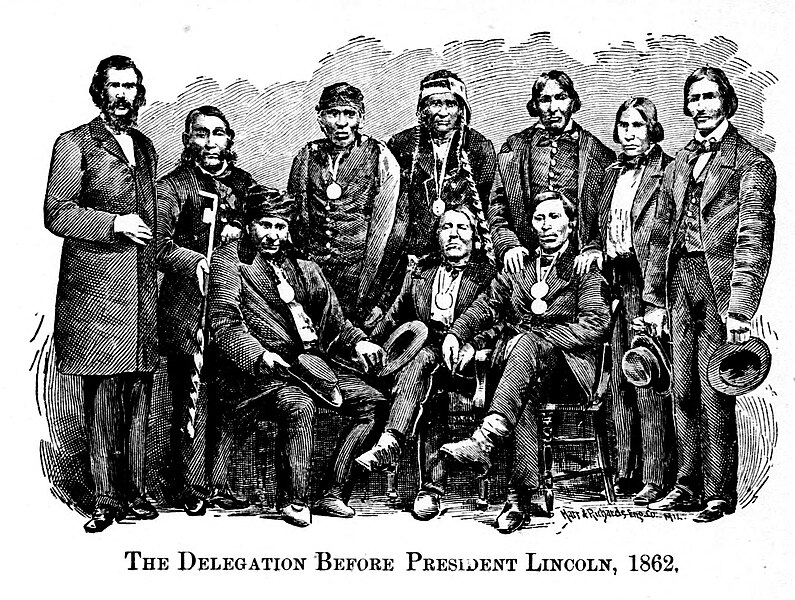
Ah-moose (Little Bee) from Lac Flambeau Reservation, Kish-ke-taw-ug (Cut Ear) from Bad River Reservation, Ba-quas (He Sews) from Lac Courte O’Rielles Reservation, Ah-do-ga-zik (Last Day) from Bad River Reservation, O-be-quot (Firm) from Fond du Lac Reservation, Sing-quak-onse (Little Pine) from La Pointe Reservation, Ja-ge-gwa-yo (Can’t Tell) from La Pointe Reservation, Na-gon-ab (He Sits Ahead) from Fond du Lac Reservation, and O-ma-shin-a-way (Messenger) from Bad River Reservation.
In this post, we contested these identifications on the grounds that Ja-ge-gwa-yo (Little Buffalo) from La Pointe Reservation died in 1860 and therefore could not have been part of the delegation to President Lincoln. In the comments on that post, readers from Michigan suggested that we had several other identities wrong, and that this was actually a group of chiefs from the Keweenaw region. We commented that we felt most of Armstrong’s identifications were correct, but that the picture was probably taken in 1856 in St. Paul.
Since then, a document has appeared that confirms Armstrong was right all along.
[Antoine Buffalo, Naagaanab, and six other chiefs to W.P. Dole, 6 March 1863
National Archives M234-393 slide 14
Transcribed by L. Filipczak 12 April 2024]
To Our Father,
Hon W P. Dole
Commissioner of Indian Affairs–
We the undersigned chiefs of the chippewas of Lake Superior, now present in Washington, do respectfully request that you will pay into the hands of our Agent L. E. Webb, the sum of Fifteen Hundred Dollars from any moneys found due us under the head of “Arrearages in Annuity” the said money to be expended in the purchase of useful articles to be taken by us to our people at home.
Antoine Buffalo His X Mark | A daw we ge zhig His X Mark
Naw gaw nab His X Mark | Obe quad His X Mark
Me zhe na way His X Mark | Aw ke wen zee His X Mark
Kish ke ta wag His X Mark | Aw monse His X Mark
I certify that I Interpreted the above to the chiefs and that the same was fully understood by them
Joseph Gurnoe
U.S. Interpreter
Witnessed the above Signed } BG Armstrong
Washington DC }
March 6th 1863 }
There were eight Lake Superior chiefs, an interpreter, and a witness in Washington that spring, for a total of ten people. There are ten people in the photograph. Chequamegon History is confident that this document confirms they are the exact ten identified by Benjamin Armstrong.
The Lac Courte Oreilles chief Ba-quas is the same person as Akiwenzii. It was not unusual for an Ojibwe chief to have more than one name. Chief Buffalo, Gaa-bimaabi, Zhingob the Younger, and Hole-in-the-Day the Younger are among the many examples.
The name “Sing-quak-onse (Little Pine) from La Pointe Reservation” seems to be absent from the letter, but he is there too. Let’s look at the signature of the interpreter, Joseph Gurnoe.

Gurnoe’s beautiful looping handwriting will be familiar to anyone who has studied the famous 1864 bilingual petition. We see this same handwriting in an 1879 census of Red Cliff. In this document, Gurnoe records his own Ojibwe name as Shingwākons, The young Pine tree.

So the man standing on the far right is Gurnoe. This can be confirmed by looking at other known photos of him.
Finally, it confirms that the chief seated on the bottom left is not Jechiikwii’o (Little Buffalo), but rather his son Antoine, who inherited the chieftainship of the Buffalo Band after the death of his father two years earlier. Known to history as Chief Antoine Buffalo, in his lifetime he was often called Antoine Tchetchigwaio (or variants thereof), using his father’s name as a surname rather than his grandfather’s.

So, now we need to address the elephant in the room that unites the Henry Inman portrait of Big Buffalo with the photograph of the 1862-63 Delegation to Washington:

Wisconsin Historical Society
This is the “ambrotype” referenced by Patrick Jackson above. It’s the image most associated with Chief Buffalo of La Pointe. It’s also one for which we have the least amount of background information. We have not been able to determine who the original photographer/painter was or when the image was created.
The resemblance to the portrait of “Big Buffalo” is undeniable.
However, if it is connected to the 1862-63 image of Chief Antoine Buffalo, it would support Hamilton Nelson Ross’s assertions on the Wisconsin Historical Society copy.
Clearly, multiple generations of the Buffalo family wore military jackets.
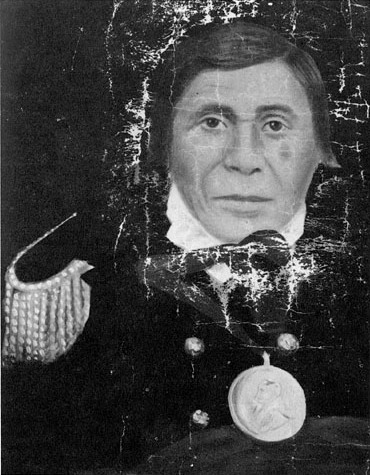
Inconclusive: uncertainty is no fun, but at this point Chequamegon History cannot determine which Chief Buffalo is in the ambrotype. However, the new evidence points more toward the grandfather (Great Buffalo) and grandson (Antoine) than it does to the son (Little Buffalo).
We will keep looking.
Chequamegon History Event: Tragedy of the Siskiwit
May 25, 2024
Join Leo for an evening of history at the most beautiful place in the world: Cornucopia Beach.
Check Cornucopia Green Shed Museum and Chequamegon History Facebook for more details:
Le Boeuf et Le Pain: Alexis Cadotte’s letter to Chief Buffalo and Manabozho, January 11, 1840
April 30, 2024
By Leo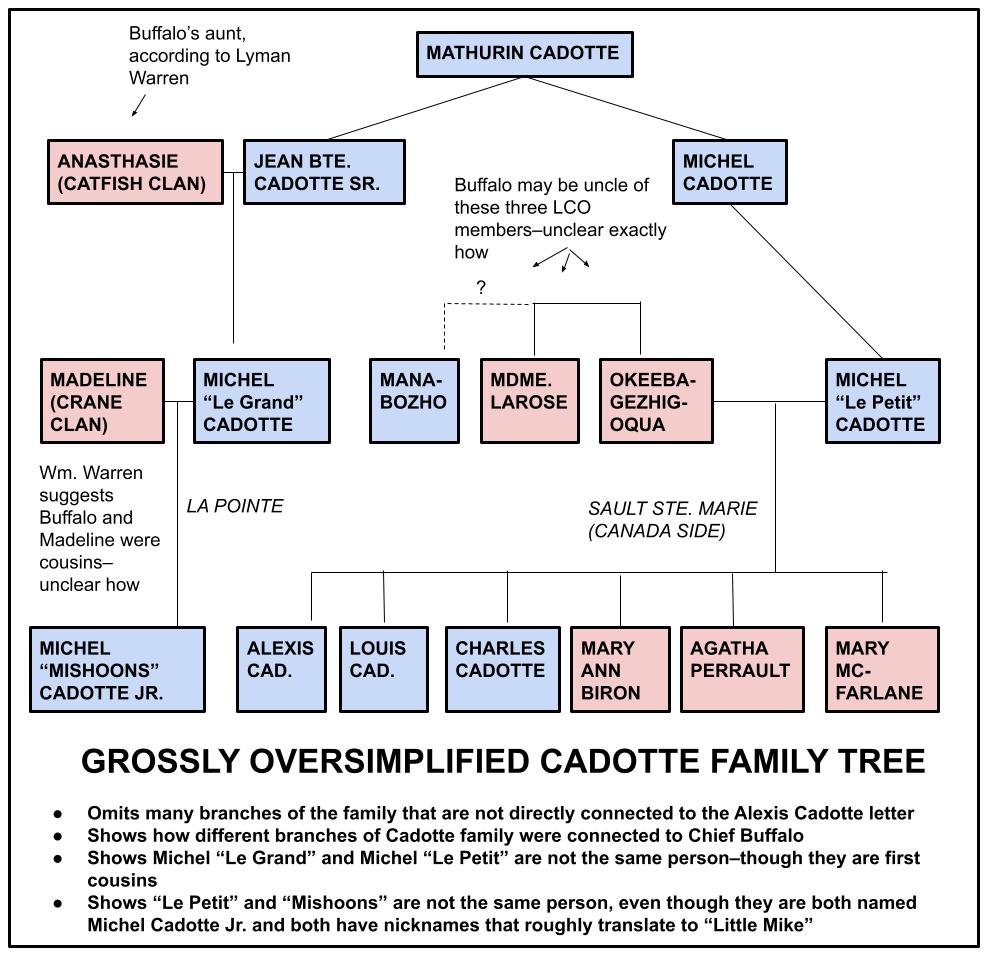
This was supposed to be a short post highlighting an interesting document with some light analysis of the relationship between the Ojibwe chiefs at La Pointe and the ones on the British-Canadian side of Sault Ste. Marie. It’s grown into an unwieldy musing on the challenges of doing what we do here at Chequamegon History. If you are only interested in the document, here it is:
(Copy)
Sault St. Maries 11 Janvier 1840
A Msr. le Beuf chef au tête à la pointe}
Cher grand-père,
Nous avons Recu votre par le darnier voyage des Barque de la Société. Ala nous avons apris la mort de votre fils qui nous a cose Boucup de chagrain, nous avons aussi bien compri le reste de votre, nous somme satisfait de n avoir vien neuf à la tréte de la pointe plus que vous ave vien neuf vous même nous somme de plus contents de vous pour L année prochaine arrive ici à votre endroit tachez de va espere promilles que vous nous fait que nous ayon la satisfaction an vous voyent de vous a tete cas il nous manque des Beuf ici, nous isperon que vous vous l espère Sanger il bon que vous venite a venire aucure une au Sault est Boucoup change de peu que la vie du Le Pain ne pas ici peu etre quil vous quelque chose pas cette ocation espre baucoup de vous voir l’etee prochienne, nous avons rien de particulier a vous mas que si non que faire. Baucoup a vous contée car il y a de grande nouvelles qui regarde toute votre nation et la nôtre tachez de nous faire réponse à notre lettre par le même.
2 Toute notre famille sont ans asse santé et Madame Birron qui est malade depui un mois et demi, un autre de ce petit garcon malade de pui cinq jour. Mon cher grand père nous finisson au vous Souhaitons toute sorte de Bonne prospérité croyez moi pour la vis votre tautre et efficionne fils
Signed Alexi Cadotte
Mon nomele Mainabauzo,
Je vous fais le meme Discours a vous dece que je vien de dire ici au Bouf. Il faut absolument que vous vene nous voir ici particulièrement votre patron qui moi meme et mon fils il y a un an l’été Darnier je vous espère au aspeill à la pointe nous avant neuf après ent la réponce du contenu de notre di proure si vous vere nous rejoindre nous iron ansemble à l ile Manito Wanegue au présent Anglois Car les Mitif se toi en Britanique resoive à présent comme les Sauvage vous dire à votre Jandre La pluve blanche que nous avon pas compri la lettre mon chère on ete je fini au vous enbrassan toute croyez moi pour la vie votre neveux.
signed Alexis Cadotte
Toute la famille vous fon des complément. Complement tous nous parans particulièrement
signed Cadotte
If you only want the translation, keep scrolling. If you want the story, read on.
Several years ago, I received a copy of this letter from Theresa Schenck, author and editor of several of the most important recent books on Ojibwe history. She knew that I was interested in the life of Chief Buffalo of La Pointe and described it as a charming letter written to Buffalo by one of his Cadotte relatives at Sault Ste. Marie. Dr. Schenck made a special point of telling me there were jokes inside.

Many streak freezes were used to obtain this number.
My immediate reaction was what many of you might be thinking, “But I don’t speak French!” Her response was very matter-of-fact, “Well you need to know French if you’re going to study Lake Superior history. Learn French.”
During the pandemic, I finally got to it, and according to Duolingo, I now have the equivalent of three years of high-school French even though I can’t speak it at all. I can read enough to decipher Alexis Cadotte’s handwriting, though, and get the words into Google Translate. That’s where we hit a second problem.
The French that Cadotte uses in 1840 is not the same French that Duolingo and Google Translate use in 2023. Ojibwe was almost certainly the mother tongue of Alexis, who was born at Lac Courte Oreilles around 1799, but later he would have picked up French, and later still English. However, the French spoken by Cadotte and his contemporaries was commonly called patois or Metis/Michif (Alexis spells it “Mitif”), and was a mixture of French, Ojibwe, and Cree. This letter shows that Cadotte had some formal education, but even formal Quebec French deviates significantly from modern standard French. This is all to say that the letter is filled with non-standard spellings and vocabulary.
Lacking confidence in my translation, I shared the letter with Patricia McGrath, a distant relative of Alexis’ and Canadian Chequamegon History reader, and with the help of her her cousin Stéphane, we combined to produce this:
(Copy)
Sault St. Maries 11 January 1840
To Mr. Le Boeuf, Head chief at La Pointe}
Dear grandfather,
We received your communication at the last arrival of the Company Boat. It was then that we learned of the death of your son, which left us in grief. We also understood the rest of your message. You are more satisfied to have us come again to the head of “La Pointe” than for you to come here yourself. We are more than happy to see you next year, when we arrive at your place, but we hold out hope for the promise you made to give us the satisfaction of seeing you here in person. We are missing some Beef here. We hope you agree. My blood, it would be good that you should come here soon. There are many changes at the Sault. One is that Le Pain does not live here anymore. Perhaps there is something wrong with the timing. We hope to see you next summer. We have nothing new in particular to say to you. Much has been said to you because there is great news, which concerns your entire nation and ours. Try to respond to our letter in the same way.
2 Our whole family is in good health but for Madame Birron, who has been ill for a month and a half, along with one of her little boys who has been sick for five days. My dear grandfather, we end by wishing you all kinds of good prosperity. Believe me, for life, your affectionate other son
Signed Alexi Cadotte
My namesake Mainabauzo,
I am making the same speech to you as I have just said here to Le Boeuf. You absolutely have to come see us here, especially your chief, who was with me and my son a year ago last summer. I hope you will welcome us to La Pointe. Please respond to the content of our report if you wish to join us, go together to Manito Wanegue Island and receive the presents of the English, because the Mitif, if you are in British territory, now receive them as the Indians do. You tell your son-in-law White Plover that we didn’t understand his letter. My dear one, we have finished greeting you all. Believe me, for life, your nephew.
signed Alexis Cadotte
The whole family sends salutations, especially the parents.
signed Cadotte
Food puns? Long, circular statements that seem to only say “come visit your relatives.” What the heck is going on here? Another letter, written by Alexis Cadotte on the same day, sheds some light.
Sault Ste Marie, January 11 1840
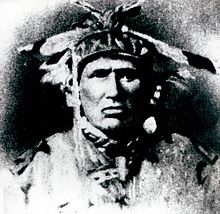 Cadotte clarifies here that Le Pain is yet another food pun–this time on Le Pin, or the Pine. Zhingwaakoons (Pine) was a powerful Ojibwe chief on the British side of the Sault. The Lagardes and their in-laws, the LeSages were Metis trading families in the region.
Eustache Legarde
My dear friend,
I write you this to wish you good health & to send my compliments to all our friends. I make known to you the result of the counsel we held yesterday with the Bread.* The answer is now received. The English Government has accepted all the applications of the Indians in favor of the half breeds, so the half breeds will begin to receive presents of the Government next summer. Furthermore the Government promises to supply the Indians with all things necessary to cultivate the soil. Besides all this the Government promises to build houses for the Half breeds, and to let them have a Forge. The Bread (Pine) is looking for a convenient place to build a half breed village. I recommend that you tell this news to all who are concerned in this matter. I am very sorry to inform you that your youngest nephew died some days ago. The rest of Sages family appear to be well. I close wishing you all kind of prosperity.
Believe me your friend
Alexis Cadotte
*Pine
From this letter, it becomes clear who “The Bread” is. It also shows that Cadotte’s motivation for writing Buffalo and Manabozho goes beyond simply missing his relatives. He wants the La Pointe chiefs to maintain their relationship with the British government and potentially relocate to Canada permanently.
By 1840, the Lake Superior Ojibwe were beginning to feel the heat of American colonization. The influx of white settlers (aside from in the lumber camps on the Chippewa and St. Croix) had yet to begin in earnest, but missionaries had settled in Ojibwe villages, and their presence was far from universally welcomed. The fur trade was in steep decline, and the monopolistic American Fur Company was well into its transition into a business model based on debts, land cessions, and annuity payments (what Witgen calls the political economy of plunder). The Treaty of St. Peters (1837) further divided Ojibwe society, creating deep resentments between the Lake Superior Bands and the Mississippi and Leech Lake Bands. Resentments also grew between the “full bloods” who were able to draw annuities from treaties, and the “mix-bloods,” who did not receive annuities but were able to use American citizenship and connections to the fur company for continued economic gain post-fur trade. Finally, the specter of removal hung over any Indian nation that had ceded its lands. The Lake Superior Ojibwe were well aware of the fates of the Meskwaki-Sauk, Potawatomi, Kickapoo, Ho-Chunk and other nations to their south.
Keeping up relations with the British offered benefits beyond just the material goods described by Cadotte. It forced the American government to remain on friendly terms with the Ojibwe to prove that they were a more benevolent people than the British. In negotiations, the Ojibwe leadership often reminded the U.S. of the generosity of the “British Father.” Canadian territory also offered a potential refuge in the event of forced removal. The Jay Treaty (1796) had drawn a line through Lake Superior on European maps, but in 1840, there was still Ojibwe territory on both sides of the lake, and the people of La Pointe had many relatives on both sides of the Soo.
Zhingwaakoons was a fierce advocate of Ojibwe self-determination, and Cadotte’s letter shows that Little Pine (a.k.a. The Bread) was beginning to implement his scheme to concentrate as many Ojibwe people as possible at Garden River. If he could add the Lake Superior bands on the American side to his number, it would strengthen his position with the British-Canadian authorities. The British were open to the idea, as the Ojibwe provided a military buffer against American aggression in the event of another war between the United States and the United Kingdom. The more Ojibwe on the border in Canada, the stronger the buffer.
If you are interested in these topics, I strongly recommend this book:
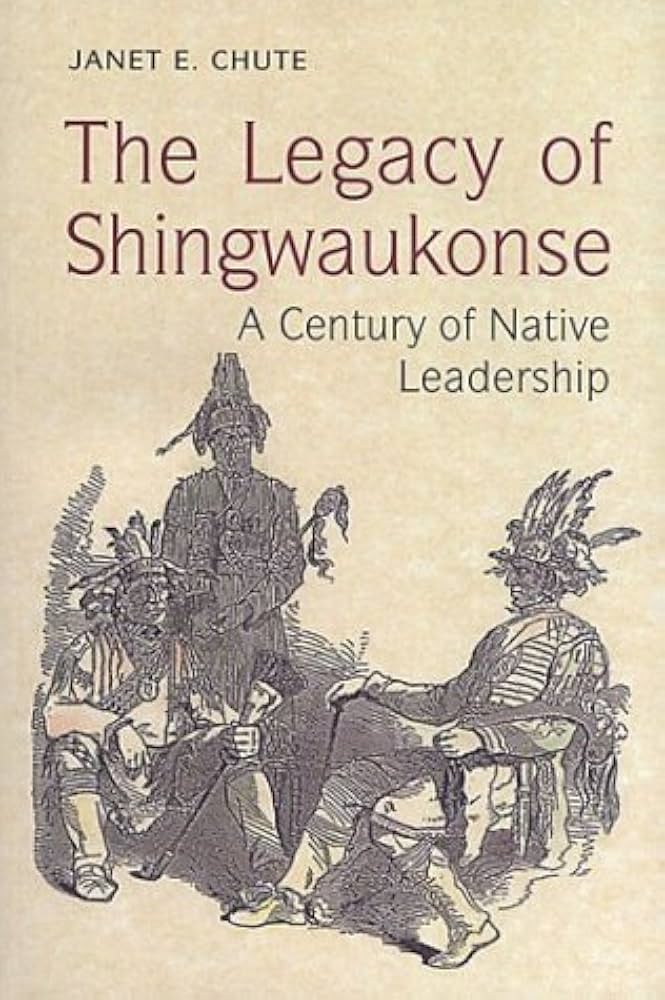
I had already been writing Chequamegon History for a few years before I discovered The Legacy of Shingwaukonse: A Century of Native Leadership by Janet E. Chute through multiple fascinating references in Paap’s Red Cliff, Wisconsin. It was a nice wakeup call. It’s easy to get into the rut of only looking at records from the U.S. Government, the fur companies, and the missionary societies. There are other sources out there, of which the material coming from the British side of the Sault is a one example.
One of the puzzling things about the Alexis Cadotte letter is that it’s written in French. The common mother tongue of Cadotte, Buffalo, and Manabozho would have been Ojibwe. Granted, 1840 was a little early for Father Baraga’s Ojibwe writing system to have caught on, and Cadotte wouldn’t have known Sherman Hall’s system. In the following decades, letters in the Ojibwe language would become slightly more common, but at that early point, Cadotte may have still regarded Ojibwe as strictly a spoken language. It’s also possible that French offered a little more secrecy than English. Potential translators on Madeline Island would be other Metis (or Canadien heads of Metis families), whose goals would align more with Cadotte’s than with the United States Government’s. However, this is speculation.
Chief Buffalo is probably referenced more than any other individual on Chequamegon History, but we haven’t had a lot to say about Manabozho. The truth is, we don’t have a lot of sources about him. From another French document, from another Cadotte, we know that he was living at La Pointe in 1831:
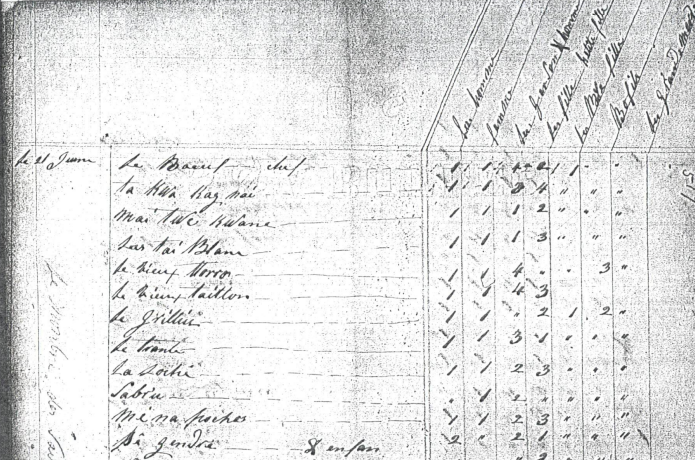
This 1831 census of La Pointe was taken by Big Michel Cadotte (first cousin of Alexis’ father, Little Michel Cadotte), and we see Le Boeuf listed as chief of the band. Me-na-poch-o is the eleventh household listed, and “se gendre,” an unidentified son-in-law and grandson are directly beneath him. 1 man (des hommes) 1 wife (des femmes) 2 sons (des hommes & garsons) and 3 daughters or granddaughters (des filles et petite filles) were living in Manabozho’s household.
We also see his name among the two La Pointe chiefs who signed the Treaty of Prairie du Chien (1825).

“Gitshee X Waiskee or Le Bouf of La pointe Lake superior” “Nainaboozho X of La pointe Lake Superior” Manabozho is named after the famous trickster and rabbit manitou who William Warren called “the universal uncle of the An-ish-in-aub-ag.” The initial consonant in the name of this powerful being could be an “M,” “N,” or “W” depending on grammatical context and regional dialect. Spellings in La Pointe documents from this era use all three.
And from the testimony from the 1839 payments at La Pointe, to mix-bloods and traders under the third and fourth articles of the Treaty of St. Peters (1837), we can see that Manabozho and Buffalo had a history of working with Alexis’ family. This testimony was given in favor of Alexis’ brother Louis’ claim against the Lac Courte Oreilles Ojibwe:
Heirs of Michel Cadotte a British Subject
To amount of private property destroyed at the post occupied by Mr. Louis Corbin in the year 1809 or 1810, the claimant being then absent from said post but had left there his private property and that of his deceased father, Estimated at Eight hundred Dollars– $800.00
Louis Cadotte
His X mark
La Pointe 30th August 1838
G Franchere } witnesses
Eustache Roussain
N.B. The papers and books were all destroyed
L x C
We the undersigned Pé-jé-ké, chief of the Chippewa Tribe of Indians, residing at La Pointe and Mé-na-bou-jou, also of La pointe but formerly residing at Lac Court Oreil, do hereby certify that, to our knowledge, to the best of our recollection, about the year 1809 or 1810 the above claimant and his father had who was an Indian trader at said Lac Court Oreil, had their property destroyed by a band of Chippewa Indians, whilst said claimant was absent as well as his late father who had gone to Michilimackinac to get his usual years supply of Goods for the prosecution of his trade, which we firmly believe that the amount of Eight hundred Dollars as specified in the above account, is just and reasonable, and ought to be allowed. In witness whereof we have signed these presents the same having been read over and interpreted to us by Eustache Roussain. La Pointe this 30th day of August 1838.
Pé-jé-ké his X mark The Buffalo
Mé-na-bou-jo his X mark

This claim is for property destroyed by followers of the Shawnee Prophet, Tenskwatawa on the Cadotte outfit post of Jean Baptiste Corbine at Lac Courte Oreille. Tenskwatawa, the brother of Tecumseh, had many followers in this region. Chequamegon History covered this incident, and Chief Buffalo’s role, back in 2013.
In the general mix blood claims, published in Theresa Schenck’s All Our Relations: Chippewa Mixed Bloods and the Treaty of 1837 (Amik Press; 2009), we learn more the exact relationship of Manabozho and Buffalo to the Cadottes. The former is their uncle, and the latter is their great uncle. Whether that makes the two men closely related to each other isn’t clear. The claims don’t say if they are blood relatives or in-laws of the Cadotte’s mother, Okeebagezhigoqua. However, if Manabozho was born into the band of Buffalo’s grandfather, Andegwiiyaas, and was living at Lac Courte Oreilles at the dawn of the 19th century, this would be consistent with a pattern of the “La Pointe Bands” of that era who were associated with La Pointe but living and hunting inland.
I should note that in Alexis Cadotte’s letter, he refers to Buffalo as grandpere rather than grand oncle. Don’t get too hung up on this. I am no expert on traditional Ojibwe conceptions of kinship other than to say they can be very different from European kinship systems and that it would not be at all unusual for a grandnephew to address his granduncle with the honorific title of grandfather.
From Francois, Joseph, and Charles LaRose claim
“Their Uncles are now residing at the Point, one of them is a respectable full blood Chippewa named Na-naw-bo-zho. The chief at La Pointe called Buffalo is their grand uncle. Their mother is a sister to the Cadottes. (Schenck, pg. 86)
From claims of Alexis, Louis, and Charles Cadotte, Mary Ann Biron, Agathe Perrault, and Mary McFarlane
“[Their] father was Michael Cadotte, a French trader in the ceded country, where he married a woman of the Ojibwa nation from Lake Coute Oreille named O-kee-ba-ge-zhi-go-qua.” (Schenck pg. 41)
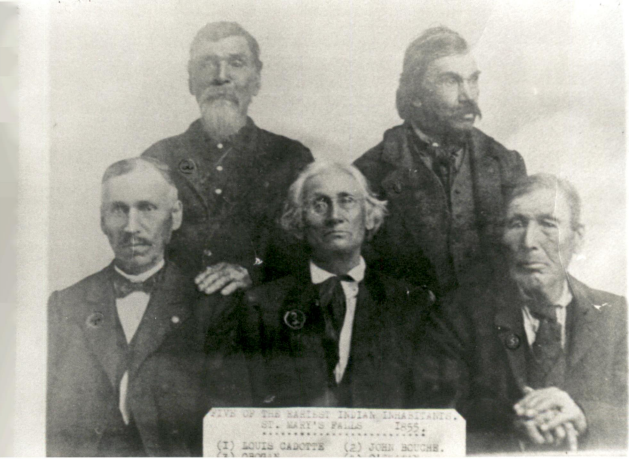
“Five of the Earliest Indian Inhabitants of St. Mary’s Falls, 1855: 1) Louis Cadotte, John Boushe, Obogan, O’Shawan, [Louis] Gurnoe If this caption is to be trusted, andcaptions aren’t always to be trusted, there is a man named Louis Cadotte in this photo who would be about the right age to be Alexis’s brother. I read the numbers to indicate that he’s the man in the upper right. Others have interpreted this photo differently.
Sometimes different people have the same name. Very few of us can be expected to be fluent in English, Ojibwe, and regional dialects and creoles of 18th-century Quebec French (that doesn’t mean we shouldn’t try!). It’s not only language. Subtle differences of religious and cultural understanding can skew the way a source is interpreted. Sources can be hard to come by, contradictory, misinterpreted by other researchers, or in unexpected places. Sometimes you stumble upon a previously unknown source that throws a monkey wrench into all your previous conclusions.
All this means that if you’re going to do this research, expect that you are going to have to humble yourself, admit mistakes, and admit when you might be pretty sure of something but not absolutely certain. My next few posts will explore these concepts further.
As always, thanks for reading,
Leo
~~~~~~~~~~~~~~~~~~~~~~~~~~~~~~~~~~~~~~~~~~~~~~~~~~~
P.S. Speaking of monkey wrenches…
Facts, Volumes 2-3. Facts Publishing Company. Boston, 1883. Pg. 66-68.


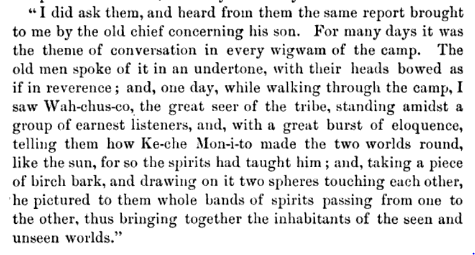
At Chequamegon History, we try to use reliable narrators. We try to use sources from before 1860. First-hand information is preferable to second or third-hand information, and we do not engage in much speculation or evaluation when it comes to questions of spirituality. This is especially true of traditional Ojibwe spirituality, of which we know very little.
Therefore, I strongly considered leaving out this excerpt from FACTS Prove the Truth of Science, and we do not know by any other means any Truth; we, therefore, give the so-called Facts of our Contributors to prove the Intellectual Part of Man to be Immortal. From what I can tell, this bizarre 1883 publication is dedicated to stories of “Spiritualism,” the popular late 19th-century pseudoscience (think the earliest Ouija boards, Rasputin, etc.). If you haven’t already guessed from the the length of the title, FACTS… appears to have been pretty fringe even for its own time. Take it for what it is.
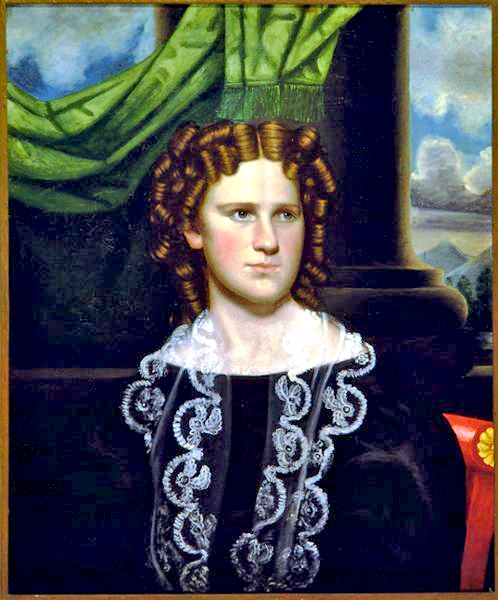
Florantha (above) and Granville Sproat were more than just teachers with funny names. They wrote about 1840s La Pointe. The sex scandal that led to their departure sent a ripple through the Protestant mission community. (Wisconsin Historical Society)
Granville Sproat, however, was a real person–a schoolteacher in the Protestant mission at La Pointe. His wife, Florantha, is quoted near the top of this post, referencing the death of Chief Buffalo’s sons. The Sproats’ impact on this area’s history is pretty minimal, though they did produce a fair amount of writing in the late 1830s and early ’40s. Perhaps the most interesting part of their Chequamegon story is their abrupt departure from the Island after Granville became embroiled in what I believe is Madeline Island’s earliest recorded gay sex scandal. Since I can’t end on that cliff hanger, and it might be several years before I get to that particular story, you can learn more from Bob Mackreth’s thorough and informative treatment of Florantha’s life on youtube.
This post has really gone off the rails. Thanks for sticking with it, and as always, thanks for reading. ~LF
Special thanks to Theresa, Patricia, and Stephane for making this post possible.
When we die, we will lay our bones at La Pointe.
March 20, 2024
By Leo
From individual historical documents, it can be hard to sequence or make sense of the efforts of the United States to remove the Lake Superior Ojibwe from ceded territories of Wisconsin and Upper Michigan in the years 1850 and 1851. Most of us correctly understand that the Sandy Lake Tragedy was caused an alliance of government and trading interests. Through greed, deception, racism, and callous disregard for human life, government officials bungled the treaty payment at Sandy Lake on the Mississippi River in the fall and winter of 1850-51, leading to hundreds of deaths. We also know that in the spring of 1852, Chief Buffalo and a delegation of La Pointe Ojibwe chiefs travelled to Washington D.C. to oppose the removal. It is what happened before and between those events, in the summers of 1850 and 1851, where things get muddled.

Confusion arises because the individual documents can contradict our narrative. A particular trader, who we might want to think is one of the villains, might express an anti-removal view. A government agent, who we might wish to assign malicious intent, instead shows merely incompetence. We find a quote or letter that seems to explain the plans and sentiments leading to the disaster at Sandy Lake, but then we find the quote is dated after the deaths had already occurred.
Therefore, we are fortunate to have the following letter, written in November of 1851, which concisely summarizes the events up to that point. We are even more fortunate that the letter is written by chiefs, themselves. It is from the Office of Indian Affairs archives, but I found a copy in the Theresa Schenck papers. It is not unknown to Lake Superior scholarship, but to my knowledge it has not been reproduced in full.
The context is that Chief Buffalo, most (but not all) of the La Pointe chiefs, and some of their allies from Ontonagon, L’Anse, Upper St. Croix Lake, Chippewa River and St. Croix River, have returned to La Pointe. They have abandoned the pay ground at Fond du Lac in November 1851, and returned to La Pointe. This came after getting confirmation that the Indian Agent, John S. Watrous, has been telling a series of lies in order to force a second Sandy Lake removal–just one year removed from the tragedy. This letter attempts to get official sanction for a delegation of La Pointe chiefs to visit Washington. The official sanction never came, but the chiefs went anyway, and the rest is history.
La Pointe, Lake Superior, Nov. 6./51
To the Hon Luke Lea
Commissioner of Indian Affairs Washington D.C.
Our Father,
We send you our salutations and wish you to listen to our words. We the Chiefs and head men of the Chippeway Tribe of Indians feel ourselves aggrieved and wronged by the conduct of the U.S. Agent John S. Watrous and his advisors now among us. He has used great deception towards us, in carrying out the wishes of our Great Father, in respect to our removal. We have ever been ready to listen to the words of our Great Father whenever he has spoken to us, and to accede to his wishes. But this time, in the matter of our removal, we are in the dark. We are not satisfied that it is the President that requires us to remove. We have asked to see the order, and the name of the President affixed to it, but it has not been shewn us. We think the order comes only from the Agent and those who advise with him, and are interested in having us remove.
Kicheueshki. Chief. X his mark
Gejiguaio X “
Kishkitauʋg X “
Misai X “
Aitauigizhik X “
Kabimabi X “
Oshoge, Chief X “
Oshkinaue, Chief X “
Medueguon X “
Makudeua-kuʋt X “
Na-nʋ-ʋ-e-be, Chief X “
Ka-ka-ge X “
Kui ui sens X “
Ma-dag ʋmi, Chief X “
Ua-bi-shins X “
E-na-nʋ-kuʋk X “
Ai-a-bens, Chief X “
Kue-kue-Kʋb X “
Sa-gun-a-shins X “
Ji-bi-ne-she, Chief X “
Ke-ui-mi-i-ue X “
Okʋndikʋn, Chief X “
Ang ua sʋg X “
Asinise, Chief X “
Kebeuasadʋn X “
Metakusige X “
Kuiuisensish, Chief X “
Atuia X “
Gete-kitigani[inini? manuscript torn]
L. H. Wheeler
We the undersigned, certify, on honor, that the above document was shown to us by the Buffalo, Chief of the Lapointe band of Chippeway Indians and that we believe, without implying and opinion respecting the subjects of complaint contained in it, that it was dictated by, and contains the sentiments of those whose signatures are affixed to it.
S. Hall
C. Pulsifer
H. Blatchford
When I started Chequamegon History in 2013, the WordPress engine made it easy to integrate their features with some light HTML coding. In recent years, they have made this nearly impossible. At some point, we’ll have to decide whether to get better at coding or overhaul our signature “blue rectangle” design format. For now, though, I can’t get links or images into the blue rectangles like I used to, so I will have to list them out here:
Joseph Austrian’s description of the same
Boutwell’s acknowledgement of the suspension of the removal order, and his intent to proceed anyway
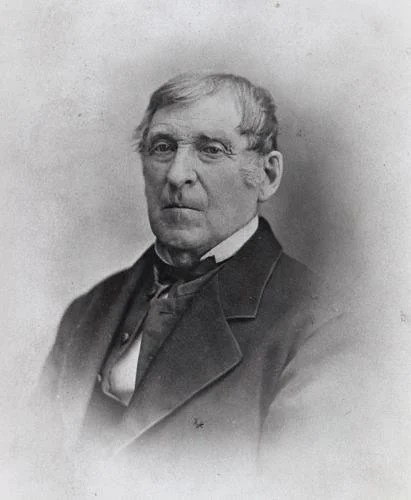
Chequamegon History has looked into the “Great Father” fur trade theater language of ritual kinship before in our look at Blackbird’s speech at the 1855 Payment. You may have noticed Makadebines (Blackbird) didn’t sign this letter. He was working on a different plant to resist removal. Look for a related post soon.
If you’re really interested in why the president was Gichi-noos (Great Father), read these books:

Watrous, and many of the Americans who came to the Lake Superior country at this time, were from northeastern Ohio. Watrous was able to obtain and keep his position as agent because his family was connected to Elisha Whittlesey.
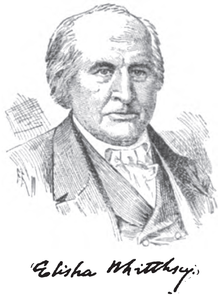
In the summer and fall of 1851, Watrous was determined to get soldiers to help him force the removal. However, by that point, Washington was leaning toward letting the Lake Bands stay in Wisconsin and Michigan.
Last spring, during one of the several debt showdowns in Congress, I wrote on how similar antics in Washington contributed to the disaster of 1850. My earliest and best understanding of the 1850-1852 timeline, and the players involved, comes from this book:

We know that Kishkitauʋg (Cut Ear), and Oshoge (Heron) went to Washington with Buffalo in 1852. Benjamin Armstrong’s account is the most famous, but the delegation’s other interpreter, Vincent Roy Jr., also left his memories, which differ slightly in the details.

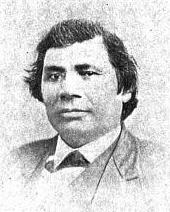
One of my first posts on the blog involved some Sandy Lake material in the Wheeler Family Papers, written by Sherman Hall. Since then, having seen many more of their letters, I would change some of the initial conclusions. However, I still see Hall as having committing a great sin of omission for not opposing the removal earlier. Even with the disclaimer, however, I have to give him credit for signing his name to the letter this post is about. Although they shared the common goal of destroying Ojibwe culture and religion and replacing it with American evangelical Protestantism, he A.B.C.F.M. mission community was made up of men and women with very different personalities. Their internal disputes were bizarre and fascinating.
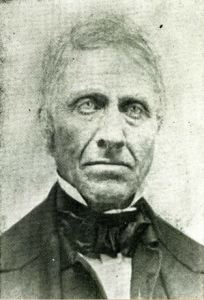

 Chequamegon History