Collected and edited by Amorin Mello
This is an imperfect attempt to research the legacy of Julius Austrian and his wife Hannah Leopold at La Pointe on Madeline Island of Lake Superior. This page is updated with more research from time to time.

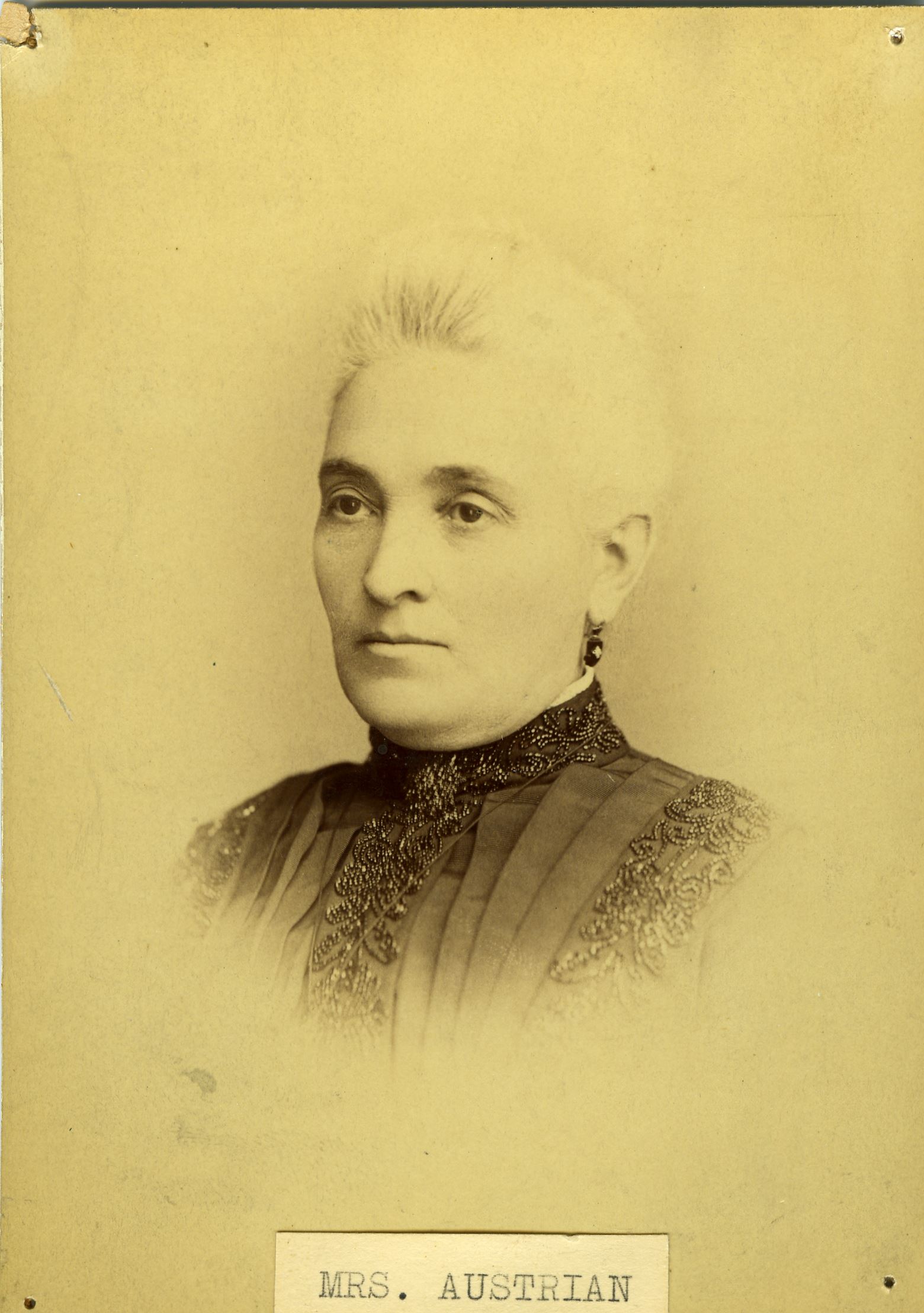

“This represents the home of Julius and Hannah Austrian, after their marriage in the spring of 1848. Premises located at La Pointe, Madeline Island, Lake Superior. Resided there 19 years, happy and contented among Indians, Half-breeds and two Missionaries who represented the inhabitants of the island. Photograph taken summer of 1850.”
~ Madeline Island Museum
An Interesting Family History

“The history of this old Jewish family, favorably known as successful merchants in the Lake Superior region and in Chicago, appeared in 1866, in the Portage, Mich., Gazette, and was copied in the American Israelite under date of April 13th, 1866. We believe that the history of this popular and highly respected family will be read with interest by their many relatives and friends, and we therefore publish it here. They were brave, honest and upright business men, and the story of their pioneer life in a sparsely settled region, of their struggles, hardships and ultimate success will serve as an encouraging example for many a young beginner.”
[…]
“The Messrs. Leopold are natives of the little town of Richen, in the Great Duchy of Baden, Germany, and there received the elementary education which fitted them to become the shrewd and successful merchants they have proven to be. They first began business life as clerks in an ordinary country store, as it may not be inaptly termed, as Richen was but a small place, having a less population than either Hancock or Houghton, here on Portage Lake.”
Memoirs of Doodooshaboo:
Joseph Austrian in Bavaria 1833-1847

Joseph Austrian
a.k.a. Doodooshaboo
“I was born September 15, 1833, in a small village called Wittelshofen (Mittel Franken, Bavaria), located at the foot of the Hesselberg, a mountain 1800 ft. high, and at the junction of two little rivers Wörnitz and Sulzach near Dinkelsbuehl, where the judiciary district court is located.”
[…]
“My father’s name was Abraham Isaac Oestreicher (Austrian), he was born in Wittelshofen and died there Sept 17, 1852 of apoplexy at the age of 75 yrs. He was an only son and his father gave him what educational advantages could then be obtained and principally in ‘Hebrew’ which gained for him the name title of ‘Reb’ and he was known by the Jewish village people as ‘Reb Frohen’. He had a large library of Hebrew books, they were of unusual size and some nearly a hundred years old.”
[…]
“My next brother Julius, was sent to Feuchtwangen to learn the tanning trade and afterwards travelled afoot for a couple of years or more working in a number of other cities at his trade, as it was there customary to perfect themselves in the trade, and later going clear to Paris, France, before returning home, a short time afterwards he emigrated to America to join our brother-in-law Lewis F. Leopold, who had located in business at Mackinaw, with branches in Wisconsin.”
Baash-ki-taa-go-zi, the Firecracker
“We again recur to Mackinac, and in 1845 find at this point members of the Leopold and Austrian families which afterwards became prominent as owners of Lake Michigan vessels and merchants in the ports of the Great Lakes. Lewis F. Leopold, his wife, who was a Miss Babette Austrian, and their son of less than a year old, together with his sister Hannah and his brother Samuel, were located at the island in the year mentioned. Samuel F. Leopold soon after his arrival at Mackinac purchased a one-mast sloop, the “Agate,” with which he gathered up the product of the different fishing points, becoming the first pioneer at this locality in the fishery business, which since that time has grown to such a great industry. The brothers sent down to Cleveland a thousand barrels of salted fish each season, no insignificant industry for those days. This venture, together with the sale of supplies to fishermen, Indian trading, and the purchase of furs, laid the foundations for an extensive business. Samuel F. Leopold left Mackinac in 1853, joining his brothers, Henry and Aaron, and Julius Austrian, who had married Miss Hannah Leopold in 1849, in their recently undertaken business ventures at La Pointe and Fond du Lac, Wisconsin, where they were among the first white settlers.”
[…]

Edward Kanter a.k.a.
Baash-ki-taa-go-zi
“In 1846, as has been stated, he worked for the Leopolds and Austrians. The following year he had been placed in charge of a stock of goods at the island by some eastern parties who suddenly decamped without notice to their creditors. When the latter arrived, they were so impressed by the honesty and zeal wherewith young Kanter had guarded their interests that they voluntarily turned the entire stock and store over to him on easy terms of payment, and so in July, 1847, he opened his books with a cash capital of $200. On these prospects he married a month later the daughter of former State Senator Lyman Granger of the neighboring Bois Blanc Island. He remained at Mackinac until 1852. In that year the late Mr. E. S. Heineman, father of the writer, recently arrived at Detroit, was sent to Mackinac to be present at the Indian payment. Mr. Kanter and he immediately became warm friends. The Indians had given Mr. Kanter, because of his bustling activity, the name of ‘Bosh-bish-gay-bish-gon-sen,’ meaning ‘Fire Cracker,’ and Mr. Heineman being somewhat shorter in stature than Mr. Kanter, but of equal activity, was immediately dubbed ‘Little Firecracker.'”
1847 Treaty of Fond du Lac
[To be published at a later date.]
Memoirs of Doodooshaboo:
Joseph Austrian’s migration to Manhattan 1848-1850
 “In accordance with the suggestions of my brother Julius and brother-in-law Lewis F. Leopold, who had gone to America some four years before, it was finally decided that I with my sister Ida should emigrate to America. Mr. L. F. Leopold had a fishing and trading business at Mackinaw, my brother Julius was located at La Pointe on Madelaine Island, one of the Apostle group of islands in Lake Superior, northern Wisconsin, where he was engaged in the fur trading and had a general store, and traded with the Indians and half breeds buying fur from them.”
Race, Identity, and Citizenship in the U.S. Census… in 1850
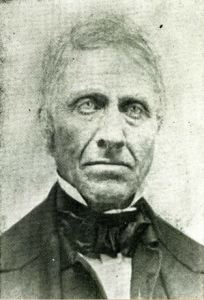
Reverend Sherman Hall
There were a few white American settlers. The Halls had been at La Pointe for twenty years. The Wheelers were well-established at Odanah. Junius and Jane Welton had arrived by then. George Nettleton was there, living with a fellow Ohioan James Cadwell. The infamous Indian agent, John Watrous, was there preparing the disastrous Sandy Lake removal. Less easy to describe as American settlers, but clearly of European origins, Fr. Otto Skolla was the Catholic priest, and Julius Austrian was the richest man it town.
[…]
Excluding the single farmer, men in the merchant/trader group controlled the most wealth in real estate, with Julius Austrian controlling as much as the other merchants combined. Behind them were carpenters and men with specific trades like cooper or shoemaker. Those who reported their occupation generally as “laborer” were not far behind the tradesmen. I suspect their real estate holdings may be larger and less varied than expected because of the number of sons and close relatives of Michel Cadotte Sr. who identified themselves as laborers. Government and mission employees held relatively little real estate, but the institutions they represented certainly weren’t lacking in land or power. Voyageurs come in seventh, just behind widows and ahead of fishermen of which there were only four in each category.
Memoirs of Doodooshaboo:
Joseph Austrian’s migration to Mackinac 1850-1851
“On my arrival there I received a most hearty welcome from my sister Babette and brother-in-law Louis F. Leopold, who had worried considerably over my having missed the last boat of the season and therefore having been obliged to remain all winter in Detroit. Mr. L. F. Leopold was the oldest of four brothers Aaron, Henry & Samuel, they together with Mr. Julius Austrian had a dry goods store on the Island, and in addition to this were engaged in the fish business, furnishing nets, salt & barrels to the fishermen, who caught and packed the fish, the same being later on collected from the different fishing grounds by a small schooner sent out for that purpose. Alternately the three younger brothers were sent in charge of these expeditions. L. F. Leopold was naturally a bright man, but egotistical, and very visionary and with most unpractical business ideas, still he had complete influence and control over his brothers who implicitly obeyed his commands, often contrary to their own and better judgement.”
Memoirs of Doodooshaboo:
Joseph Austrian at La Pointe 1851-52 (Part 1)
“Mr. Julius Austrian was stationed at La Pointe, Madaline Island, one of the Apostle Group in Lake Superior, where he conducted an Indian Trading post, buying large quantities of fur and trading in fish on the premises previously occupied by the American Fur Co. whose stores, boats etc. the firm bought. Julius Austrian, one of the partners had had charge of the store at La Point for five years past, he was at this time expected at Mackinaw and it had been arranged that I should accompany him back to La Pointe when he returned there, on the first boat of the season leaving the Sault Ste. Marie. I was to work in the store and to assist generally in all I was capable of at the wages of $10 a month. I gladly accepted the proposition being anxious for steady employment. Shortly after, brother Julius, his wife (a sister of H. Leopold) and I started on the side wheel steamer Columbia for Sault Ste. Marie, generally called ‘The Soo,’ and waited there five days until the Napoleon, a small propellor on which we intended going to La Point, was ready to sail.”
Memoirs of Doodooshaboo:
Joseph Austrian at La Pointe 1851-52 (Part 2)
“During the first summer of my stay at La Point, the Indian Agent, Mr. Watrous was directed by the Secretary of the Indian Dept. at Washington to summon the chiefs of that part of the Chippewa tribe residing in the vicinity of Bad River, Bayfield, & Red River for a council. The Agent accordingly sent runners around to the chiefs of the different lodges some of which were quite remote, summoning them to meet him on a certain day at La Point. They came in obedience to the summons many bringing their squaws, papooses and their Indians of their lodges with them. Near the lake shore the put up their wigwams, which were made of birch bark leaving an opening over hung with a blanket which served as a doorway. It made an interesting Indian settlement. The meeting was held on the appointed day, in my brother’s store which was a long wooden structure.”
[…]
“Scherzer arrived at La Pointe at midnight coming from Ontonagan 90 miles in a small row boat. To his dismay, he found that there was not a hotel in the place. The boatman told him that he thought that one Austrian might give him shelter for the night, so he came to the house and knocked at the door. Henry Schmitz, my fellow employee, who roomed with me opened the door and called out “Joe step auf freund von below sind da,” whereupon I cordially invited them to enter and made them as comfortable as possible. They remained with us about three days and profoundly appreciated our hospitality. Even making mention of it later on in his book.”
Reisen in Nordamerika:
From Ontonagon to the mouth of the Bois-brule (Part 2)

Austrian travel writer
Karl Ritter von Scherzer
“It was 1 o’clock in the morning, and the whole settlement was in a deep sleep. We were at a loss as to which door to knock at. Among 200 Indians, only a few white families live there. One of the boatmen gave us a name, with which we found Mr. Austrian (a name meaning Oestreicher) a descendent of the Mosaic. We knocked confidently by rattling at the window showing the distinguishing hemp of Austrian. We have always had a favorable bias for our Jewish countrymen in this nation. They have brought over so many ancient patriarchal customs of antiquity unadulterated, faithful, and pure in their sympathetic breasts. Here the noble manners of hospitality sweep away the cold breath of selfishness found among the Americans. The Jews are always ready to welcome strangers and donate a warm and magnanimous hand with every occasion.
[…]
“17 September, early, 61° Fahr. The actual owner of the home was absent. However, his younger brother received us with all the warmth of a Bayreuth Jew. He had only been in the country a short time, and spoke English with a Spanish-sounding accent as he called to us in the room, ‘Waken sie!’ He showed us a pair of Indian snowshoes, and asked, ‘Haben sie snow shoes noch nie geused?’ He finally told of the fish trade in the same mixed gibberish, ‘Below werden die Fische umgepakt, inspected, und dann weider vereignepakt again.'”
Biographical Sketch of Vincent Roy, Jr.

Chippewa entrepreneur
Vincent Roy, Jr.
“Vincent Roy was born August 29, 1825, the third child of a family of eleven children. His father Vincent Roy Sen. was a halfblood Chippewa, so or nearly so was his mother, Elisabeth Pacombe. His grandfather was a french-canadian who located as a trader for the American Fur Company first at Cass Lake Minn, and removed in 1810 to the bank of Rainy River at its junction with Little Fork, which is now in Itasca Co. Minn. At this place Vincent saw at first the light of the world and there his youth passed by. He had reached his twentieth year, when his grandfather died, who had been to him and all the children an unmistakable good fortune.”
[…]
“Leopold and Austrian (Jews) doing a general merchandize and fur-trading business at LaPointe were not slow in recognizing ‘their man.’ Having given employment to Peter Roy, who by this time quit going to school, they also, within the first year of his arrival at this place, employed Vincent to serve as handy-man for all kind of things, but especially, to be near when indians from the woods were coming to trade, which was no infrequent occurrence. After serving in that capacity about two years, and having married, he managed (from 1848 to 1852) a trading post for the same Leopold and Austrian; at first a season at Fond du Lac, Minn., then at Vermillion Lake, and finally again at Fond du Lac.”
1852 Austrian’s Store at Fond du Lac
[To be published at a later date.]
Memoirs of Doodooshaboo:
Joseph Austrian after La Pointe 1852-54
“Started Work at Eagle River. 1852. I was at once installed in my work after my arrival, and the next day went to the Cliff Mine to attend to some collections. Mr. H. F. Leopold was an uneducated man not able to read or write English, the business correspondence and keeping of accounts therefore devolved entirely on me. After becoming thoroughly acquainted with the business I resolved to enlarge the same and my efforts to do so succeeded well. A short time after my arrival at Eagle River a letter was received by the Leopolds containing the sad news of the death of my father. He died suddenly Sept 17th, 1852 from a stroke of apoplexy at the age of 75 years. This was naturally a cause of great grief and worry to me, as there was besides my mother, my blind brother Marx, a younger sister and brother at home to be cared for.”
[…]
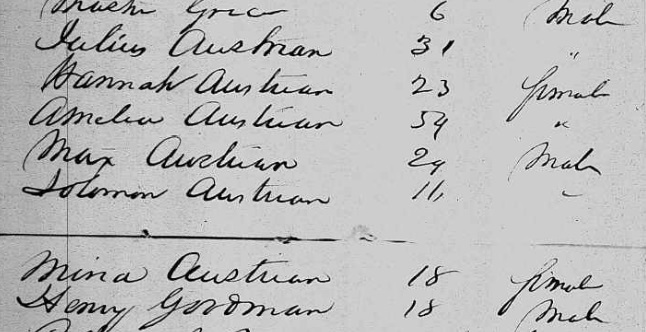 “Things went on satisfactorily in the business and in the summer of 1853 brother Julius, who was stationed at La Point started with his wife, a sister of the Leopolds, for Germany in accordance with a conclusion we had come to, to bring mother and the rest of the family to this country, and at the same time to visit the native village of his wife – “Rḯchen,” in the Grand Dukedom of Baden. It was a mission combined with a great deal of hardship and trouble for Julius, as it meant for him to convert all the real & personal property of my late father’s estate into money, which was in itself very difficult besides getting the family ready for this long voyage for their destination in the new world after having lived all their lifetime in Wittelshofen. Brother Marx especially was disinclined to go on account of his affliction from loss of eyesight. My mother not having any special ties there to keep her, was in a measure glad to go where the most of her children were living, and did everything in her power to get ready without unnecessary delay. They had a safe voyage and arrived at Cleveland Sept 1853.”
Memoirs of Doodooshaboo:
Joseph Austrian at Eagle River 1854-1859
1854-1859 were the boom and bust years of La Pointe County land speculation, which arose from the La Pointe Treaty of 1854 and Soo Locks of 1855, and crashed with the 1857 Financial Panic of 1857 and American Civil War of 1861. It is unfortunate how Joseph’s memoirs do not mention anything about his Leopold & Austrian family’s business at La Pointe during 1854-1859, when they were capitalizing on Chippewa Treaty Allotments in the Penokee Mountains to form the La Pointe Iron Company.
Judge Bell Incidents:
King of the Apostle Islands
“Prior to the final extinction of the fur trade at La Pointe and in the early days of steamboating on the great lakes, the members of the well-known firm of Leopold & Austrian settled here, and soon gathered about them a number of their relatives, forming quite a Jewish colony. They all became more or less interested in real estate, Julius and Joseph Austrian entering from the government at $1.25 per acre all the lands upon which the village was situated, some 500 acres.”
“The original patent issued by the government, of which a copy exists in the office of the register of deeds in Ashland, is a literary curiosity, as are also many other title papers issued in early days. Indeed if any one will examine the records and make a correct abstract or title history of old La Pointe, the writer will make such person a present of one of the finest corner lots on the island. Such a thing can not be done simply from the records. A large portion of the original deeds for village lots were simply worthless, but the people in those days never examined into the details, taking every man to be honest, hence errors and wrongs were not found out.”
Julius Austrian Papers:
James Hughes Affair
“Notice to the Public”
“Whereas James Hughes of Hudson in the County of St Croix and State of Wisconsin, on the first day of December AD 1853, did execute to Charles H Oakes, Michael E Ames and Isaac Van Etten, under a pretended power of attorney from Julius Austrian and without any authority from him, or either of the under signed, two several deeds, one of which deeds had described therein, the following described lands, lying in the County of La Pointe and State of Wisconsin, to wit:”

Julius Austrian Papers:
La Pointe Lands
“Know all men by these presents that I Joseph Austrian of Eagle River, county of Houghton and State of Michigan have made, authorized, nominated and appointed and by these presents do make authorize nominate and appoint Julius Austrian of La Pointe, county of La Pointe, and State of Wisconsin, my attorney for me and in my name and to my use, to enter into, and take possession of all such messuages, lands tenements, hereditaments, and real estate whatsoever, in La Pointe, County of La Pointe, State of Wisconsin, whereof I now am, or hereafter may be by any ways or means howsoever entitled or interested in, either in severalty and jointly or in common with any other person or persons.”
Wheeler Papers:
1854 La Pointe before the Treaty

Chippewa entrepreneur
Clement Hudon Beaulieu
“Mr. Beaulieu said that the sale of last spring has been confirmed, and that Austrian will hold Lapointe. So farewell to all the inhabitants’ claims then, and to anything being done for the prosperity of the peace for the present, unless it gets out of his hands. I have written to Austrian to try to get something for our property if we can. But I fear there is not much hope. If he goes back to Lapointe in the spring, do the best you can to make him give us something. I feel sorry for the inhabitants there that they are left at his mercy. He may treat them fairly, but it is hardly to be expected.”
[…]
“I suppose Austrian will hold the property and probably we shall never realize anything for our improvements. You must do the best you can. Make your appeal to his honor, if he has any. It will avail nothing to reproach him with his dishonesty. I do not know what more I can do to save anything, or for any others whose property is in like circumstances with ours.”
Asaph Whittlesey Incidents:
Number I
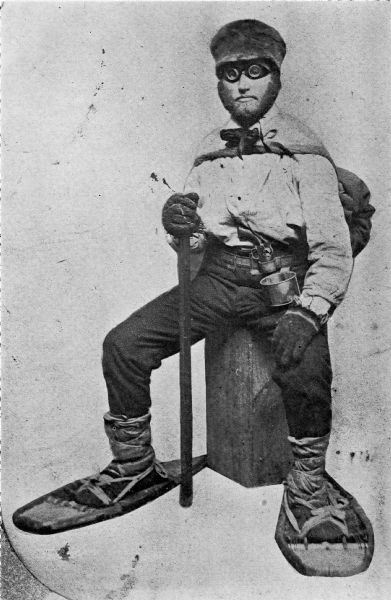
Wisconsin State Representative
Asaph Whittlesey
“We had already made the acquaintance of Mr. and Mrs. Julius Austrian, having had the pleasure of their company up the Lakes, and had made many inquiries of them as to the place of our destination. From this time forward we found Mr. and Mrs. Austrian to be most agreeable neighbors and associates, and these young ‘brides’ spent much of their time together, and not unfrequently did the evening air carry to listening crowds our notes of ‘Good old Colony times,’ and ‘There’s no place like home,’ still fresh in our memory.”
[…]
“As I have before stated, the general appearance of the island was most attractive. The garden of Mr. Austrian was laid out most tastily. We found there a large variety of fruit trees, apples, plums, cherries, etc. Also large quantities of currants and strawberries; but the crowning attraction was the ‘grape bower,’ affording a most attractive lounging place. Here also a merry party, consisting, so far as my recollection serves me, of the following persons: Mr. and Mrs. Julius Austrian, Rev. John Chebohm, (who, I remember, asked the blessing at the table,) Marks Austrian, Mr. H. Mandelbaum, Henry Smit, Mr. and Mrs. Hocksteiner, Mr. and Mrs. George Starks, old Mr. and Mrs. Perinier, Mr. and Mrs. Asaph Whittlesey, and I think Mrs. William Herbert, and a Mr. Roy, celebrated the ‘FORTH OF JULY,’ 1854.”
Asaph Whittlesey Incidents:
Number VIII
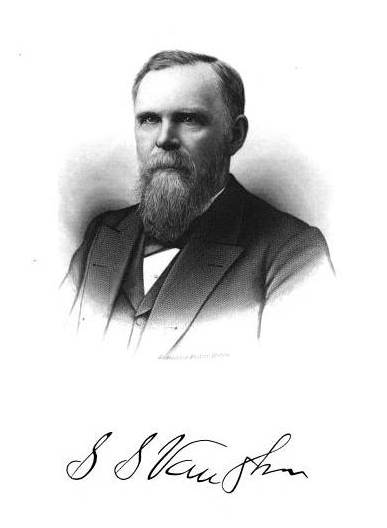
Wisconsin State Representative
Samuel Stuart Vaughn
“At the time of my arrival there in 1854, I found him [Samuel Stuart Vaughn] running a one horse store in an old frame building, standing in the sand near the present residence of George A. Stahl. So far as I am enabled to bring to mind the succession of events, my first sight of this man was at his own store where I invested in a very poor pocket compass, and this I soon after deposited on the copper range while upon an exploring trip with Ervin Leihy, Esq. Mr. Vaughn, however, claims that he first caught sight of me on the occasion of my aiding Rev. L. H. Wheeler in a social talk with the La Pointe people upon the subject of temperance one Sunday afternoon, in the store of Julias Austrian, Esq.”
“The leading man then engaged in the grocery business, as it was called, was one Peter B. Vanderventer, who subsequently left the country at a midnight hour rather than remain and meet a worse doom. Vanderventer was a large sized man and more a hellish countenance, and in exhibition of his bravery at the temperance meeting to which I have referred, he planted himself directly in front of me, and not more than three feet distant, so that I presume he did not mistake my language.”
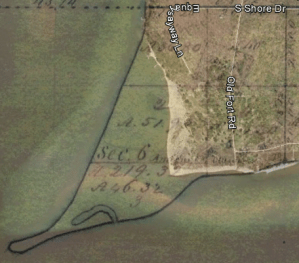
“I cannot let slip the opportunity now furnished for informing the public of what seemed to me a rather severe practical joke inflicted upon Vaughn and Vanderventer, as it is too good to be lost, we will mention it right here. It seems that at the time Mr. Austrian made so extended entries of land upon the island, Messrs. Vaughn and Vanderventer discovered that Austrian had failed to enter a fraction shown upon the official plot, as reaching quite a distance into the bay, from what was known as Boyd’s Point and containing some forty acres or more. As La Pointe seemed likely to hold prominence as a business place, they saw the necessity of forthwith securing the tract of land in question. The two therefore suddenly disappeared amid the coldest days of a Lake Superior winter, and footed it under very adverse circumstances through to Willow River, something like one hundred and seventy-five miles, and returned, but yet were quite satisfied to know that they had secured to themselves what they had started for. From this time forward for several years these gentlemen paid their taxes promptly, until they finally employed a surveyor to re-survey and plot their promising possessions. Right here is where they discovered the point of the joke, by being informed that there was not a single foot of their land left, but all and much more had been washed away. Perhaps it was cruel in me to do so, but I could not resist making frequent inquiries as to their real estate.”
Indian Agency’s Instructions for the 1854 Treaty
“When you get to La Point, if you conclude to send for Maj. Herriman, and the principal Men of his bands, you can do so, leaving the impression on those who may be privy to it, that their presence is necessary, in order that a better understanding may exist as to a proper disposition of the present annuities between the Lake bands and those on the Mississippi.
“Mr. Austrian who resides at La Point, and who was here last winter, tendered his services to the Office in collecting Indians etc. etc. at any time, and he is recommended to me as a faithful man. He would perhaps be a faithful man to whom to confide the message to Major Herriman.”
1854 Treaty of La Pointe
[To be published at a later date.]
Early Life among the Indians:
Chapter II

Adopted Son of Chief Buffalo
Benjamin Green Armstrong
“Buffalo informed the commissioners of what he had done in regard to selecting a tract of land for me and insisted that it become a part of the treaty and that it should be patented to me directly by the government without any restrictions. Many other questions were debated at this session but no definite agreements were reached and the council was adjourned in the middle of the afternoon. Chief Buffalo asking for the adjournment that he might talk over some matters further with his people, and that night the subject of providing homes for their half-breed relations who lived in different parts of the country was brought up and discussed and all were in favor of making such a provision in the treaty. I proposed to them that as we had made provisions for ourselves and children it would be only fair that an arrangement should be made in the treaty whereby the government should provide for our mixed blood relations by giving to each person the head of a family or to each single person twenty-one years of age a piece of land containing at least eighty acres which would provide homes for those now living and in the future there would be ample room on the reservations for their children, where all could live happily together. We also asked that all teachers and traders in the ceded territory who at that time were located there by license and doing business by authority of law, should each be entitled to 160 acres of land at $1.25 per acre. This was all reduced to writing and when the council met next morning we were prepared to submit all our plans and requests to the commissioners save one, which we required more time to consider.”
[…]
“That evening the chiefs considered the other matter, which was to provide for the payment of the debts of the Indians owing the American Fur Company and other traders and agreed that the entire debt could not be more than $90,000 and that that amount should be taken from the Indians in bulk and divided up among their creditors in a pro-rata manner according to the amount due to any person or firm, and that this should wipe out their indebtedness. The American Fur Company had filed claims which, in the aggregate, amounted to two or three times this sum and were at the council heavily armed for the purpose of enforcing their claim by intimidation. This and the next day were spent in speeches pro and con but nothing was effected toward a final settlement.”
Objections to Mail Route 13780
“Dear Sir: In addition to this petition, we would respectfully call your attention to a brief history of the base intrigues of Julius Austrian, the Jew, who now holds the contract for carrying the mail on route 13780. Heretofore there have been but few whites, that is, Yankees living upon the Island, most of the residents being halfbreeds, French and Indians. These people never have much interest in mail matters and consequently care very little whether Mr. Austrian carries the mail regularly or not. Indeed they cannot read a letter if they should receive one and therefore have no interest in such things. Now whenever Mr. Austrian wishes to effect an alteration in mail matters, he goes to these illiterate Frenchmen, gets them to sign something they hardly know what, but he gets their names and these, with his unprincipled misrepresentations, are the instruments and means by which he accomplished his selfish ends.”
Blackbird’s Speech at the 1855 Payment

Office of Indian Affairs Director
George Washington Manypenny
“In August 1855 about three thousand Chippewa Indians gathered at the village of Lapointe, on Lapointe Island, Lake Superior, for an Indian Payment and also to hold a council with the commissioner of Indian affairs, who at that time was George W. Manypenny of Ohio. The Indians selected for their orator a chief named Blackbird, and the choice was a good one, as Blackbird held his own well in a long discussion with the commissioner.”
[…]
“The following is the substance of my notes taken at the Indian council at La Pointe a copy of which you requested. Council held in front of Mr. Austrian’s store house Aug 30. 1855.”
[…]
“We want the 90,000 dollars to be paid as we direct. We know that it is just and right that it should be so. We want to have the money paid in our own hands, and we will see that our just debts are paid. We want the 90,000 to feed our poor women, and after paying our just debts we want the remainder to buy what we want. This is the will of all present. The chiefs, & young men & old men & the women & children.”
1855 Yom Kippur at La Pointe
“In 1855 a number of Jewish Indian traders met on an island in Lake Superior in the frontier village of La Pointe, Wisconsin. The Indians were assembled there to collect their annuities and the Jews were present to dun their debtors before they dispersed. There were enough Jews for a minyan and a service was held. That was the beginning and the end of La Pointe Jewry.”
1855 Inquest on the Body of Louis Gurnoe
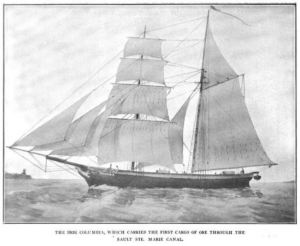
The brig Columbia
“An inquisition taken on board the brig Columbia, Captain Justus Wells, in the port of La Pointe, on the 18th day of October, 1855, before John W. Bell, one of the justices of the peace for La Pointe county, Wisconsin, upon the view of the body of Louis Gurnoe, there dead, by the jurors whose names are hereunto subscribed, who being duly sworn to inquire on behalf of the people of this State, where, in what manner, and by what means the said Louis Gurnoe came to his death, upon their oaths do say:”
[…]
“In witness whereof, the said Justice of the peace and the jurors of this inquest have hereunto set their hands the day and year aforesaid.
JOHN W. BELL Justice of Peace,
S. S. VAUGHN, Foreman,
M. H. MENDELBAUM,
R. D. BOYD,
JOHN M. BRADFORT,
JULIUS AUSTRIAN,
A. CARPENTIER.”
Judge Bell Incidents: Fooled the Austrian Brothers
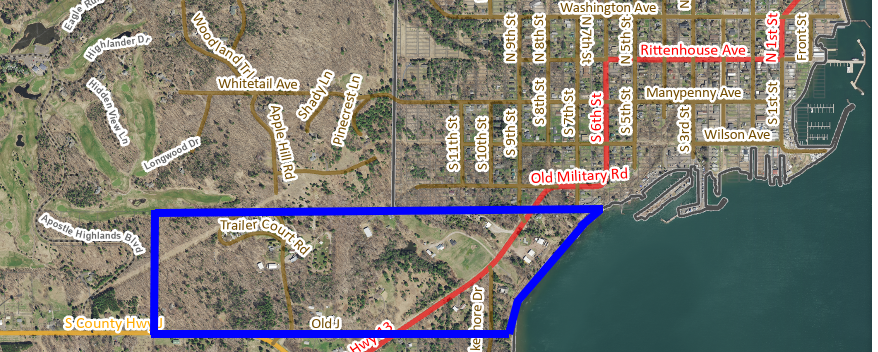
Marx Austrian’s Addition to Bayfield (in blue).
“Mr. Bell was an acute judge of human nature, and made it an invariable rule to deal with his fellowmen according to each one’s individual peculiarity. Before Bayfield was located, or in fact thought of as a town site, a Hebrew by the name of Marx Austrian pre-empted the 126 acres of land now known as Austrian’s clearing, and which adjoins Bayfield on the south. After a short residence upon the claim Mr. Austrian’s family became sick, and in order that proper care might be given them they were compelled to move to La Pointe, where a physician could be had. A speculator, noticing the apparent irregularity, tried to jump the claim. The case was taken to Superior for trial…”
Bayfield’s Beginnings
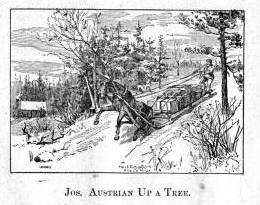 “Major McABOY arrived here about the first of March [1856] and made his headquarters with Julius AUSTRIAN of LaPointe. Julius AUSTRIAN in those days being the Governor General of all that part of the country west of Ontonagon to Superior; Ashland and Duluth being too small to count. The major spent probably two weeks at LaPointe going back and forth to Bayfield with a team of large bay horses owned by Julius AUSTRIAN, being the only team of horses in the country.”
Audit of the 1854 Treaty Claims
“Statement containing a list of the names of all persons to whom goods, money, or effects have been delivered, from July 1, 1856, to June 30, 1857, specifying the amounts and objects for which they were intended, the amount accounted for, and the balances under each specified head still remaining in their hands; prepared in obedience to an act of Congress of June 30, 1834, entitled ‘An act to provide for the organization of the department of Indian affairs.'”
September 27, 1856: $6,000.00 + $1,876.86 = $7,876.86 to J. Austrian
Penokee Survey Incidents:
Number III
“The Bay, as well as the Lake, was full of ice. In fact, we had been compelled to fight out way from the Sault to La Pointe, through heavy masses of ice, nearly the whole distance – and while upon this subject, I will say, that incredible as the statement may appear to many, yes it is a fact, that ice bergs were aground in front of Austrian’s Warehouse, at La Pointe, on the 4th day of July, 1857, in 36 feet of water, while at the same time a field of floating ice was visible from the Range, beyond which, no water could be seen. I verily believe that the lake was not wholly free from ice that summer.”

Union Army General
Lysander Cutler
a.k.a. Grey Devil
[…]
“I refer now to Hall, of St. Paul, Minnesota, who undertook, with the assistance of S.R. Marston, a treacherous employee of the Company, and Schuyler Goff, of Racine, at that time a resident of La Pointe, to beat us out of our rights, by entering the lands upon the Range with Sioux Scrip, in which nefarious attempt they would no doubt have succeeded, but for him. He was more than a match for all of them, and they finally retired from the contest in disgrace. Such was Gen. L.L. Cutler, a firm friend, but an uncompromising enemy. Never will the writer forget the happy days spent with him upon the Range in the summer of 1857. We were like brothers, and our friendship was never interrupted by even a passing cloud. We fraternized at once upon our first meeting, and fought the battle for the possession of the Range together, never doubting our ultimately winning the prize.”
Penokee Mixed-Blood Allotments Shakedown Scam of 1858
Wisconsin State Senator
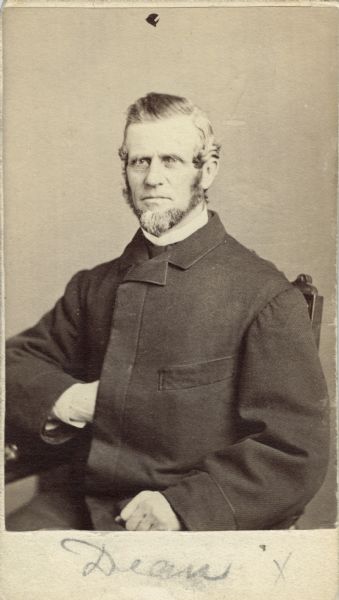
Eliab B. Dean, Jr.
“Julius Austrian being duly sworn says that he resides in the County of LaPointe, Wisconsin and that he is acquainted with Eliab B. Dean Jr Receiver of the U. S. Land Office at Superior Wisconsin; that on the first day of March A.D. 1858, this affiant applied at said Land Office to locate certain Chippewa Half Breed Scrip, under Power of Attorney”
[…]
“1) Refusing to sign an application of Julius Austrian to locate certain Half breed scrip, under power of Attorney, said Dean refused to sign the applications unless Austrian paid $500, after some demur A. paid the $500 and Dean signed the papers in his official capacity as Receiver.”
[…]
“4) Proposing to John D. Howard, a secret partnership for the purpose of speculating in half breed Scrip, and entering lands therewith, which Lands had been filed upon by settlers under the pre-emption law. Dean exhibited to Howard a list of persons claiming these lands, also exhibiting the Official list of half breeds; which list this Office directed should be kept confidentially from all persons.”
Treaty Allotments at Copper Falls
“The condition of the above obligations are such that whereas the above mentioned Julius Bernault, Peter King, Abraham Comartin, John W Bell & Henry Merryweather having Squatted and improved the following mentioned Lands in Lapointe County with the intent of Claiming the Same as a Town Site namely the East half of Section No Seventeen (17) of Township number Forty five (45) of Range no two (2) and have agreed with the said Julius Austrian that he may enter the above described lands by Chippewa Script or otherwise at his option.
“Now if the said Julius Austrian shall with due diligence enter the same as provided and obtain a Patent or Patents as Early as possible from the United States, and within 10 Days from the time he may procure and obtain said Patent or Patents for the above mentioned lands whether in his name or in the names of other parties, make execute & deliver or cause so to be done, to each of the above mentioned parties a Good & Sufficient Deed of warrantee clear of all incumbrances […]“
Barber Papers:
Winter of 1858
[To be published at a later date.]
Barber Papers:
Spring of 1858
[To be published at a later date.]
Barber Papers:
Summer of 1858
[To be published at a later date.]
Barber Papers:
Fall of 1858
[To be published at a later date.]
1859 La Pointe Iron Company
[To be published at a later date.]
 Chequamegon History