Judge Bell Incidents: Fooled the Austrian Brothers
October 30, 2025
Collected & edited by Amorin Mello
This is the third post in a series featuring The Ashland News items about La Pointe’s infamous Judge John William Bell, written mainly by his son-in-law George Francis Thomas née Gilbert Fayette Thomas a.k.a G.F.T. In today’s post we explore stories about real estate transactions negotiated between Judge Bell and Julius Austrian.
… continued from King No More.

The Ashland News
Wednesday, January 11, 1888, Page 5
STORIES OF JUDGE BELL
HOW HE FOOLED THE AUSTRIAN BROTHERS IN A LAND DEAL.
“Incidents in the life of Judge John W. Bell. – A Half Century in Old La Pointe – by Geo. Francis Thomas.”
Such is the proposed title to a forth-coming historical work which will prove wonderfully interesting, especially to the older residents in this vicinity. The author begins with the year 1835, when the brig “John Jacob Astor,” the first vessel built upon the shores of Lake Superior, first cast her anchor in the bay at La Pointe, and ends with the death of the old pioneer, John W. Bell, which occurred but a few days since. In speaking of the pioneer the author says:
“From the day that Mr. Bell stepped ashore at La Pointe from ‘The Astor,’ June 23, 1835, to the day of his death, he was a character possessing a most positive individuality; and it was not until his later years, and then when he had become financially distressed, that his wonderful spirit became at all broken; but even then he was never known to as a favor.”
The old judge, or “Squire” as he was usually called, was always ready to relate some incident of early days in which he was usually a participant. There are also a great many equally interesting incidents related by others, where the old judge would not justify his telling the story himself. The author says:

Detail from Julius Austrian’s 1854 Plan of the Town of La Pointe with Judge Bell’s Block 35 and four small Lots.
~ Wisconsin Historical Society
“[…] except a small portion in the North West Corner claimed and enclosed by Edwin Connor, and so much of the South West Corner as is claimed by P. B. Vanderventer, and the enclosure of Barboo & Meletle in the South East Corner”
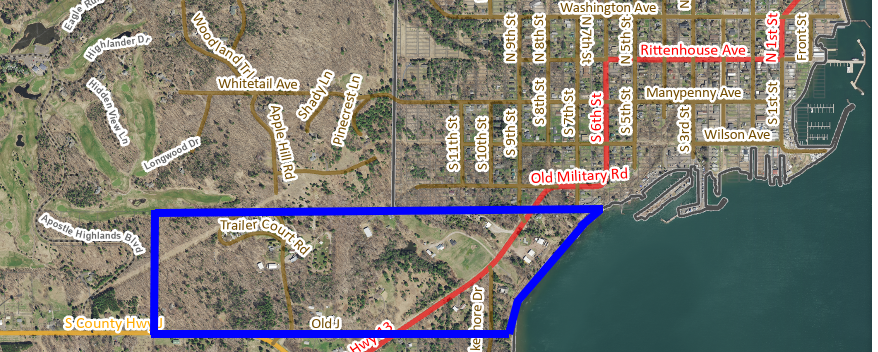
“The old man always liked to have things done on the square, so when Julius Austrian was platting the village of La Pointe and proposed to Mr. Bell to give him the block he already occupied for a nominal consideration, Mr. Bell insisted that his block, number thirty-five, be exactly square – all the four streets crossing at right angles. A square block or lot was quite a novelty where each squatter’s garden-patch had been fenced in and called a lot, regardless of street lines or quantity of land.”
Memoirs of Doodooshaaboo: Joseph Austrian’s Time at La Pointe 1851-52 (Pt. 2)
“Our blind brother Marx Austrian with brother Julius’ assistance at that time, preempted 160 acres of land near Bayfield from La Point, complying with preemption laws. He built a small log house living there with his wife. One night during their first winter in their new house, there was a knock at the door, and when opened they were confronted by a number of Indians, who were evidently under the influence of liquor and who swinging their tomahawks vigorously, making all sorts of threatening demands. An old Indian who knew Marx interceded and enabled him and his wife to escape without injury who thoroughly scared fled panic stricken in the dark about two miles at night, over the ice, on the Bay which was covered with a foot of snow to La Point for safety. The poor woman having the hazardous task of leading her blind husband over this long and difficult road, not to come back again and glad to escape with their lives and thus abandoning their right of preemption. This place was later on platted and is now known as the Bayfield Addition.”
Mr. Bell was an acute judge of human nature, and made it an invariable rule to deal with his fellowmen according to each one’s individual peculiarity. Before Bayfield was located, or in fact thought of as a town site, a Hebrew by the name of Marx Austrian pre-empted the 126 acres of land now known as Austrian’s clearing, and which adjoins Bayfield on the south. After a short residence upon the claim Mr. Austrian’s family became sick, and in order that proper care might be given them they were compelled to move to La Pointe, where a physician could be had. A speculator, noticing the apparent irregularity, tried to jump the claim. The case was taken to Superior for trial, and Mr. Bell, being the only available witness, the Austrian brothers and Louis Leopold proposed to give him a one-fourth interest in the land as compensation for making the trip to Superior. Mr. Bell accordingly accompanied the party, to Superior, and on arriving at the hotel as was his custom, he immediately began to make himself at home with the guests of the house, most of whom he was well acquainted with. At length when the case was called, Mr. Bell seemed so entirely unconcerned that he was urged to come forward by some one of the interested parties; but Mr. Bell carelessly said,
“Oh! I believe I will not attend court today.”

Julius Austrian
~ Madeline Island Museum
The Austrians wildly expostulated, and at last agreed to pay all the old “Judge’s” expenses for the trip, besides giving him a one-fourth interest in the 126 acres of land. This brought him all right and Marx Austrian gained his point. A few years later, when the town of Bayfield was laid out by the Hon. Henry M. Rice, the Austrians, Julius and Marx, concluded that they ought to buy back the one-fourth interest in the 126 acres held by “Squire” Bell, and accordingly Julius approached him on the subject. Mr. Bell was a man of few words and no give-in to his dictum. He told Austrian that $1,000 would buy his interest if taken by noon the next day. Austrian claimed the price was exorbitant but finally went off to get the cash. on the morrow at noon, or a few minutes before, Austrian called on Bell and said he could only give him $800. Mr Bell insisted on $1,000, which Julius Austrian finally agreed to pay;
“but,” says Mr. Bell, “now you are too late. It is fully a minute past the time which I specified, now I will not take less than $1,250, and that must be forthcoming within two hours from now.”
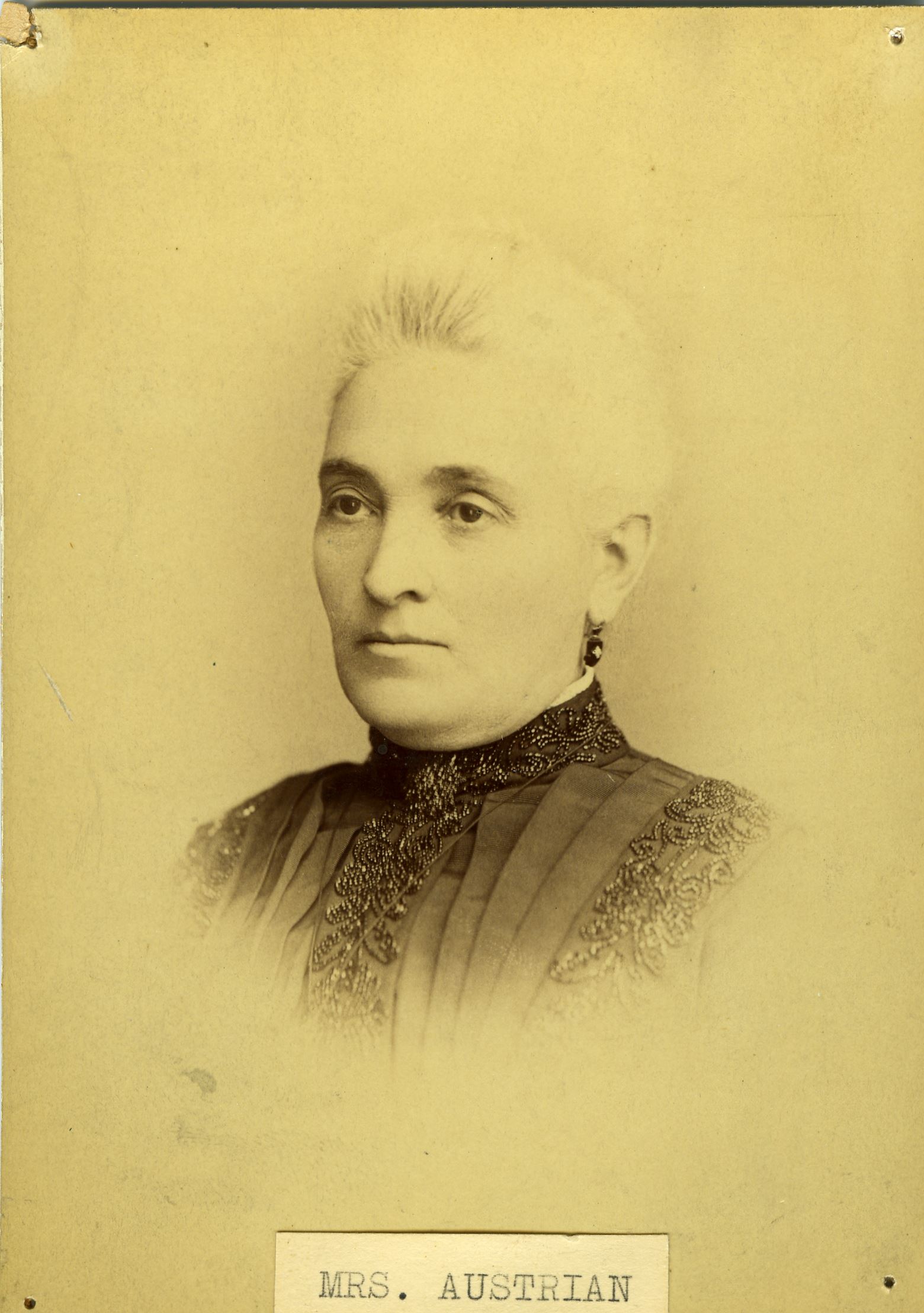
Hannah Leopold Austrian
~ Madeline Island Museum.
This time Austrian kept away, thinking Mr. Bell would go back to his $1,000 offer if he did not seem too anxious. In that Mr. Austrian misjudged his man, for when Austrian again approached the “squire” his price was $1,500 spot cash. Things now looked dubious to the Austrians, a conference was held with Mrs. Hannah Austrian and together they raised $1,300, all the cash which was available at that moment. This they handed over to Mr. Bell with a sight due bill for $200, secured by a deposit of all Mrs. Austrian’s jewels, including her diamond earrings. They got back the one quarter interest in the 126 acres, and they have paid taxes on it ever since, yet the whole is hardly worth now what the quarter cost them.
“This recalls an incident back in ’61 or ’62,” said one of the jurymen at a recent trial in this city. “It was a case against a trader who was accused of selling whiskey to an Indian. The jury was drawn, and after hearing the evidence they retired to a back room to determine on a verdict. It was about four o’clock in the afternoon. At six o’clock the jury was about evenly divided. About midnight, after continuous balloting, the vote stood ten for acquittal and two for conviction. There was no fire in the room, and it was very cold. The ten jurors who stood for acquittal made one final request to the other two to vote with them, but they persistently refused. The ten then got a long pine board and laying it across two stools proceeded to play an interesting game of freeze-out. About two o’clock one of the two came over on the other side and joined the rest in the game of freezing out the other juror. At three o’clock in the morning he gave up.”
To be continued…
Ruelle Chagouamigon du Vieux-Montréal
October 25, 2025
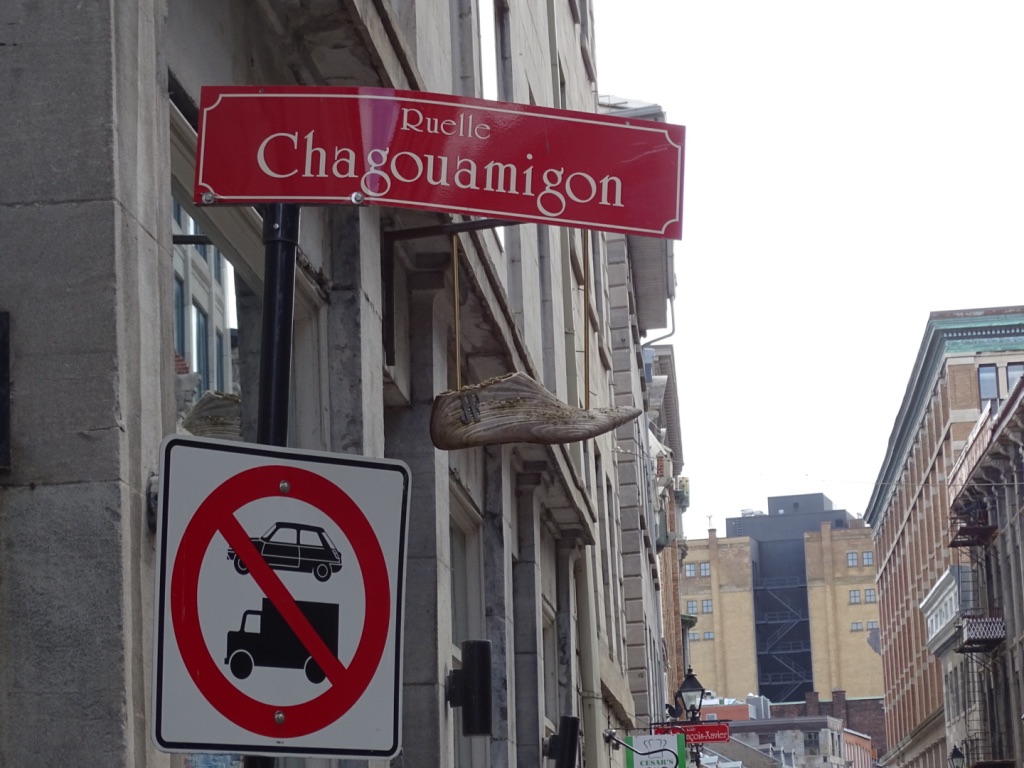
Photo taken by David Trudeau at Ruelle Chagouamigon, 2019.
A Street named for Chequamegon in Montreal.
Guest post by David Trudeau
French North America at the dawn of the 18th century was a vast network of French and Indigenous trading outposts spanning the entire Mississippi and St. Lawrence-Great Lakes watersheds with Montreal as its main hub. Chequamegon was a part of that network, and so notable, that a street in old Montreal was called “Rue Chagouamigon.”
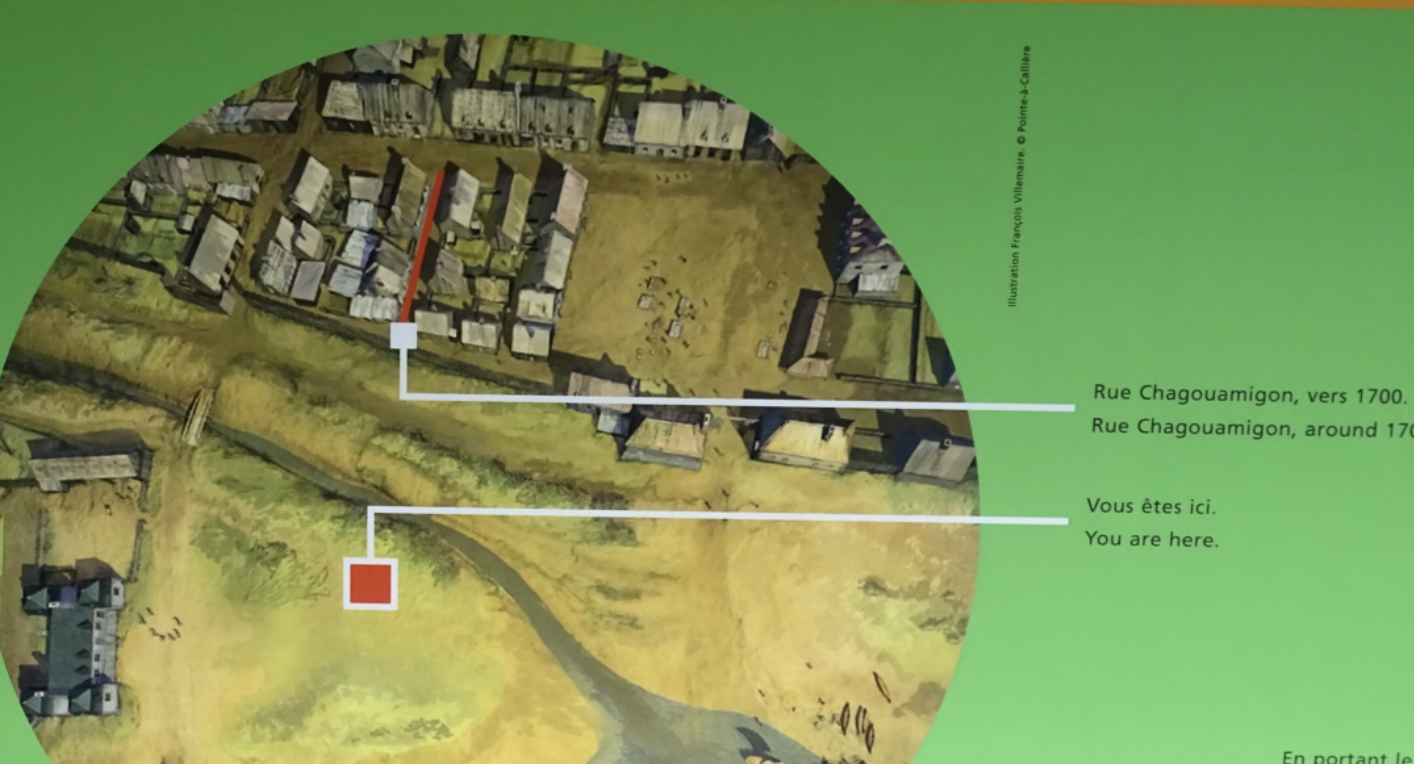
Model of Rue Chagouamigon circa 1700. Photo taken by David Trudeau at the Pointe-à-Callière Museum, 2019.
Madeline Island is approximately 1200 miles from Montreal, a journey of about 6 hours by plane — or one of up to two months by canoe and portage across Superior and Huron and down the Ottawa river. In the days of the voyageurs, the trip of trade goods to Lapointe and the return trip to Montreal of bundled beaver pelts was typically a once a season event. Circa 1700 “Chagouamigon” was a well enough known place in old Montreal to merit a street name.
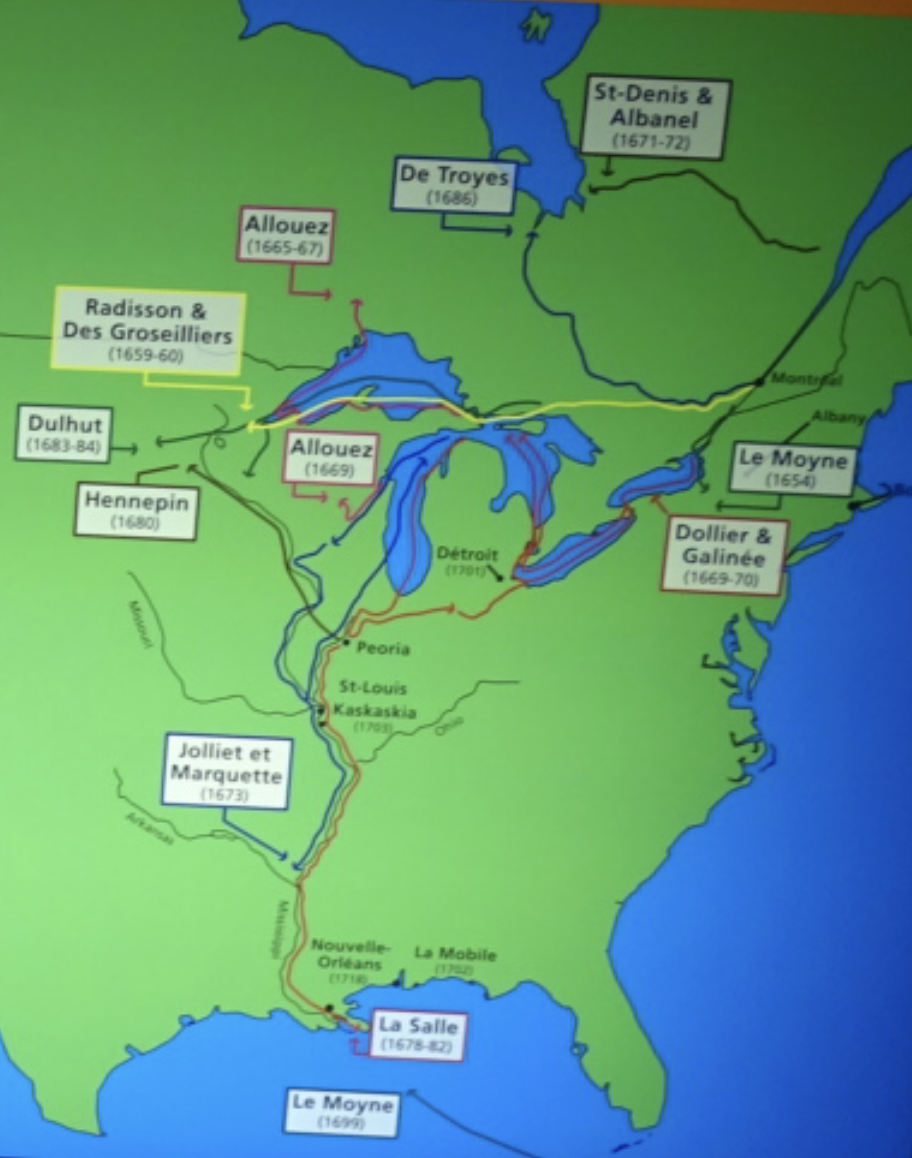
Map of Montreal’s fur trade routes circa late 1600s. Photo taken by David Trudeau at the Pointe-à-Callière Museum, 2019.
The place name is French spelling of the Ojibwe term for “soft beaver dam”1 and a reference to Chequamegon point, so named by a local Ojibwe legend about a giant beaver dam (Long Island) and how the Apostle Islands archipelago was created. Was the name of the street whimsically chosen because of its beaver reference or was it more likely a reference to a place becoming well known to the fur trade. Today the street still exists in the in Vieux-Montreal, the old town. Time has changed its route to a mere one block, and it is now known as a “Ruelle,” a little street. There is a special mention of Ruelle Chagouamigon in the Pointe-à-Callière Museum, built on and incorporating the archaeologic remains of Ville-Marie, the beginnings of Montreal started in 1642.
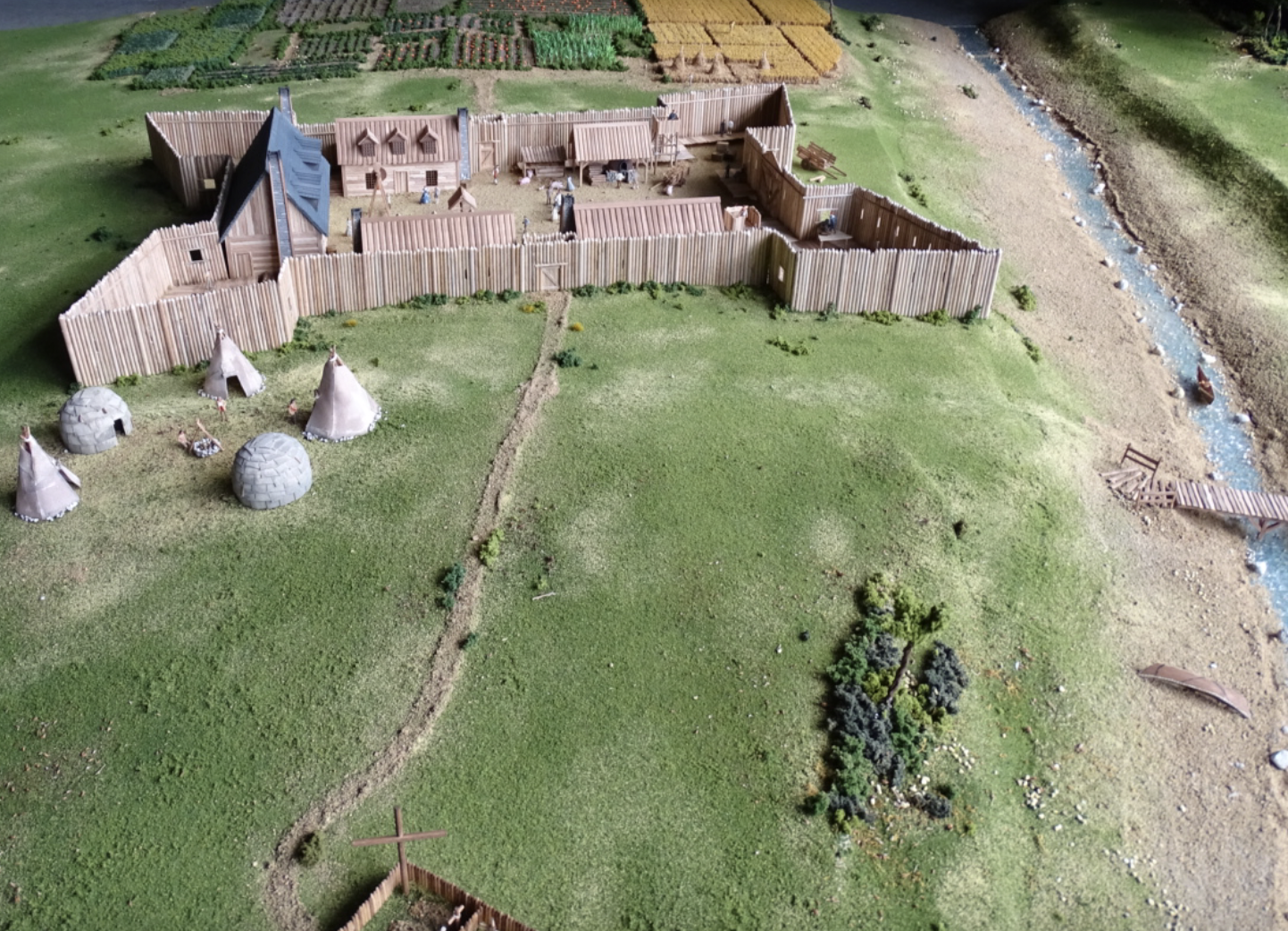
Model of Ville Marie circa 1643. Photo taken by David Trudeau at the Pointe-à-Callière Museum, 2019.

Photo of wife taken by David Trudeau at Ruelle Chagouamigon, 2019.
As I visited the Pointe-à-Callière in May of 2019, researching and learning about my French colonial ancestors who were among Montreal’s founders, I was thrilled to find the exhibit showing the street. I was equally thrilled to walk right up to it as it exists today, and take a photo of my wife Karen on the street. Karen is not a big person, but the tiny narrow street makes her look enormous.

Excavated timbers beneath the Pointe-à-Callière Museum. Photo taken by Amorin Mello, 2023.
Montreal began as a mission outpost, Ville-Marie, founded in 1642 by a lay missionary society, with the objective of building a hospital to care for Indigenous people, and establishing a mission. Many of the missions early contacts and converts were Algonquin speakers. The excavations inside the museum show original posts and timbers of Ville-Marie likely laid out by carpenter Gilbert Barbier, my 8x great grandfather.2
Ville-Marie’s existence was touch and go because of constant predation by Mohawk Haudenosaunee. By 1685, Ville-Marie was home to some 600 colonists, most of them living in modest wooden houses. Ville-Marie became a centre for the fur trade and a base for further exploration3. Etienne Truteau, my 7x great grandfather, arrived in 1659, and had 13 sons with his wife Adrianne Barbier. Many of their boys worked the fur trade routes when they were younger – usually from age 15 to 25. They saved up and bought land and married about age 25.
~ Quebec Commission de Toponymie
~ Montreal.ca
~ WalkMontreal.com
Their son, my 6x great grandfather Pierre, spent 10 years contracted between Montreal, Mackinac and Green Bay. On July 31, 16884, Pierre Truteau dit Barbier (1669-1740), the second son of Etienne, joined Nicolas Perrot for the Outaouais (Ottawa), which probably led him to Baie des Puants (Green Bay, Wisconsin)5. Alone or with other companions, over the next decade, Pierre contracted no less than seven times to equip himself for trading, going to the Maskutins (Sac) of western Lake Michigan, the Huron of Lake Huron and the Ottawa at Michilimackinac. He abandoned the fur trade in 1698 to marry and cultivate the land of his grandfather Gilbert Barbier at Côte Saint-François (Longue-Pointe).6 His nephew Toussaint (1716-1782), a blacksmith and cutter by trade, committed for a period of three years in 17367 to Messrs De la Ronde and Guillory, to go to the post of “Chagouamigon” and help paddle a canoe of trade goods up to the De la Ronde post on Madeline Island and bring it down again loaded with furs. He traveled again in 17488 for the society of Sieurs De Clignancourt, L’Échelle and Monière, on Lake Michigan, namely to the post at Baie des Puants, as part of a group of thirty-eight men in six canoes.9
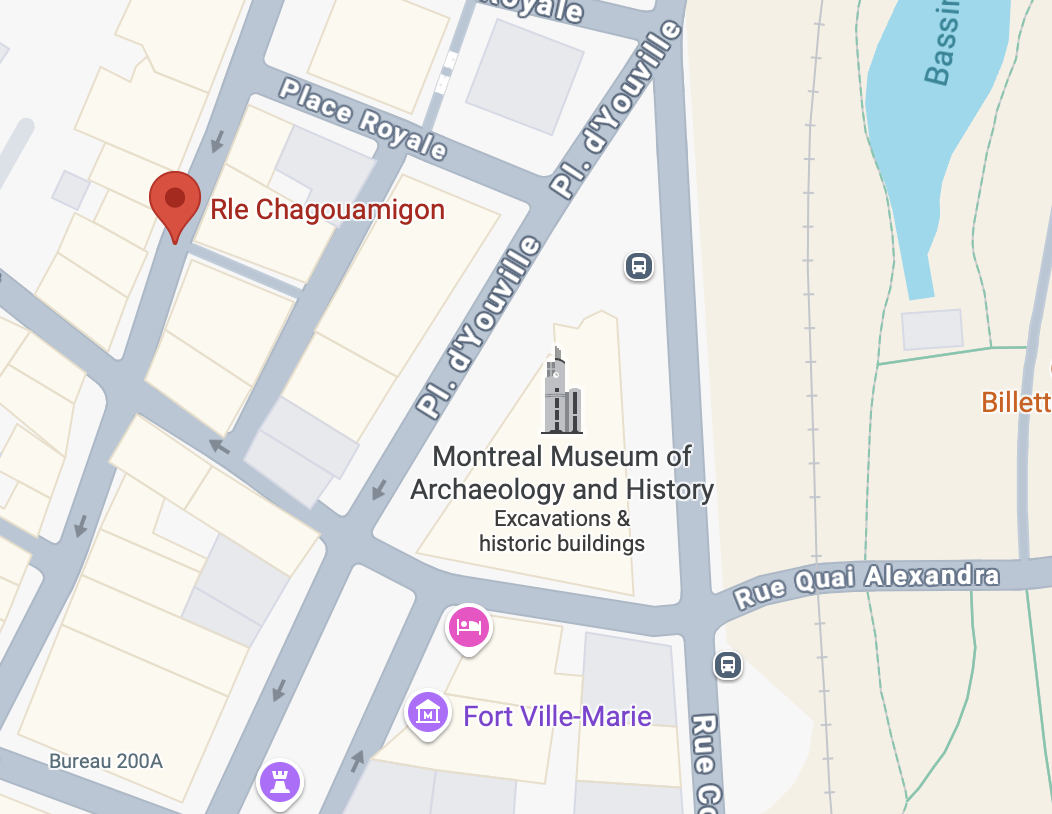
Google Map of Ruelle Chagouamigon and the Pointe-à-Callière Museum in Vieux-Montréal.

La ruelle Chagouamigon (Ebook)
Histoire de Montréal: édition 375e anniversaire de la fondation de Montréal by Yvon Codère, 2016.
Today Montreal is a huge metro area, but in its oldest part there is a tiny street, a block long and so narrow that it is restricted from cars and trucks. The street commemorates Montreal’s historic connections to Chequamegon Bay. And as a personal note, there are also traces there of my French ancestors who arrived almost 400 years ago, some of whom made the long paddle with many portages up the Ottawa and across the great lakes to Madeline Island. They were able to do so only because their friends and trading partners, the Algonkian peoples, showed them the way to survive on the journey, and provided them with food and canoes. I find it amazing that I live in the Chequamegon Bay area and share a surname with long ago Montreal ancestors who are connected to a tiny street there named for the area I call home.
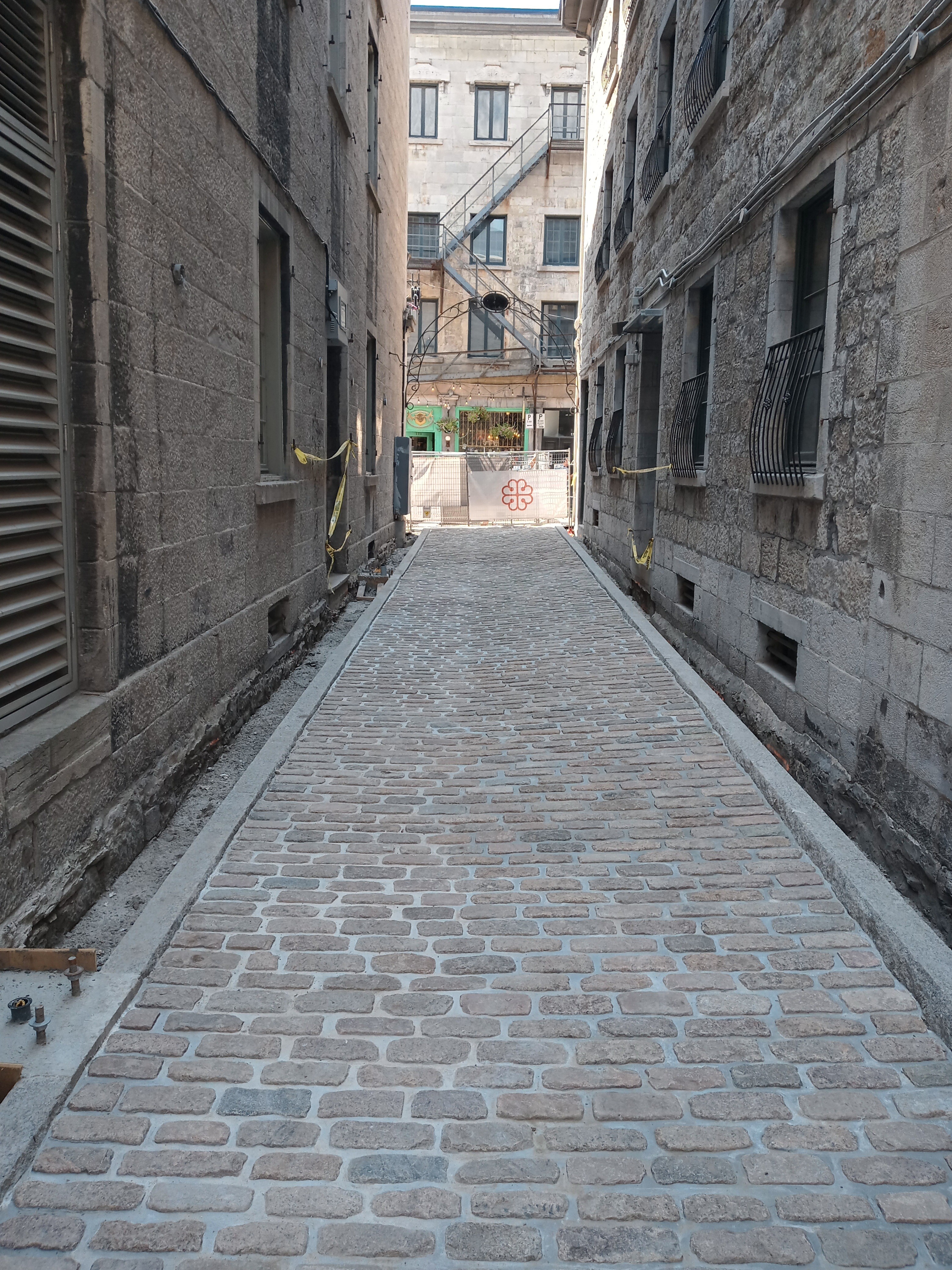
Ruelle Chagouamigon after being completely excavated for archaeological research and rebuilt. Photo taken by Francis Hervieux of the Pointe-à-Callière Museum in 2025.
—————
1 https://chequamegonhistory.com/about/.
2 Dollier de Casson, François (1636-1702) A History of Montreal 1640—1672 from the French of Dollier de Casson, translated and edited with a Life of the Author by Ralph Flenly, 1928. London & Toronto, J. M. Dent & sons, Ltd.; New York, E. P. Dutton & co. p. 103.
3 Miquelon, Dale. “Ville-Marie (Colony)“. The Canadian Encyclopedia. Archived from the original on December 3, 2013. Retrieved 22 October 2025.
4 Notary Antoine Adhémar, Library and Archives nationales du Québec (BANQ).
5 Claude Perrault “PERROT, NICOLAS”, in Dictionary of Canadian Biography, vol. 2, Laval University / University of Toronto, 2003.
6 Louise Trudeau “The History Page” Voyageur Sons Le Charpente December Volume 10 No 3, 2017.
7 Notary François Le Pallieur, Minute # 1022, Library and Archives nationales du Québec (BANQ).
8 Notary Louis-Claude Danré of Blanzy, BANQ.
9 Notary Louis-Claude Danré of Blanzy, BANQ.
Judge Bell Incidents: King No More
October 16, 2025
Collected & edited by Amorin Mello
This post is the second of a series featuring newspaper items about La Pointe’s infamous Judge John William Bell. Today we explore obituaries of Judge Bell that described his life at La Pointe. Future posts of this series will feature articles about the late Judge Bell written by his son-in-law George Francis Thomas née Gilbert Fayette Thomas a.k.a G.F.T.
… continued from King of the Apostle Islands.

Wisconsin State Journal
Saturday, December 31, 1887, Page 1
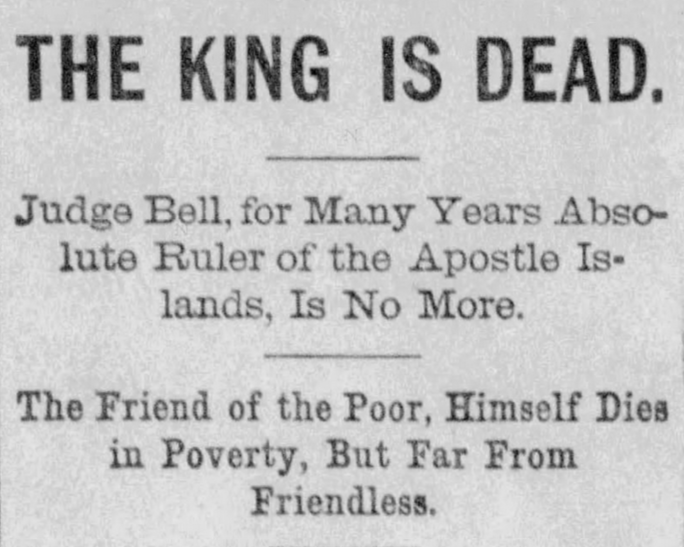
King of the Apostle Islands No More
ASHLAND, Wis., Dec. 31. – Judge Bell, known far and wide as “King of the Apostle Islands,” died yesterday. For nearly half a century he governed what was practically a little monarchy in the wilderness. He was 83 years old, and was the oldest living settler on the historic spot where Marquette founded his mission, two hundred years ago.

The Saint Paul Globe
Saturday, December 31, 1887, Page 1
KING OF THE ISLANDS.
Judge Bell,
“King of the Apostle Islands,”
Has Given Up His Crown.
The Oldest Living Pioneer
of the Historic Spot
Dies in Apparent Poverty,
Special to the Globe.

San Francisco Examiner
Wednesday, January 3, 1888, Page 2
ASHLAND, Wis., – “The king of the Apostle islands” is dead. He passed away at an early hour this morning at La Pointe, on Madeline, the largest of the group, where he has lived for forty-four years, the oldest living pioneer of the historic spot where Pere Marquette founded his little Indian mission 200 years ago. Judge Bell was a character in the early history of the Lake Superior region, known far and wide as the “king” of the country known as La Pointe, which was organized in 1846 by Judge Bell. The area of the country was as large as many states of the Union, its borders including nearly all of Wisconsin north of the Chippewa river, the Apostle islands and to an almost
ENDLESS DISTANCE WEST.

Wisconsin Historical Society’s copy of Lyman Warren’s 1834 “Map of La Pointe” from the American Fur Company Papers at New York Historical Society.
The population of whites consisted only of a small handful of French voyagers, traders and trappers, most of whom rendezvous at La Pointe. The country was hardly known by the state, and Bell’s county was practically a young monarchy. He bossed everything and everybody, but in such a way that every Indian and every white was his friend and follower. Judge Bell came here in 1832, from Canada, in the employ of the American Fur company, which at that time was a power here. He had rarely left the island, except in years gone by to make occasional pilgrimages through the settlements. During his eventful life he held every office in the county, and for many years, served as county judge. He was a man of great native ability, possessed of a courage that controlled the rough element which surrounded him in the early days when there was no law except his will. He was honest, fearless,
A NATURAL-BORN RULER
Fargo Daily Argus
Sunday, January 1, 1888, Page 1
of men, and through his efforts the poor and needy were cared for, and in no instance did he fail to befriend them. For this reason among those who survive him, and who lived in the good old pioneer days, all were his firm friends. His power departed only when the advance guard of civilization reached the great inland sea, through the medium of the iron horse, and opened a new era in the history of the new Wisconsin. For many years he has been old and feeble and has suffered for the comforts of life, having become a charge upon the town. He squandered thousands for the people and died poor but not friendless. He was eighty-three years of age.
The Ashland News
Wednesday, January 4, 1888, Page 7
ANOTHER PIONEER GONE
DEATH OF “SQUIRE” BELL, “THE KING OF LAPOINTE.”
Sketch of the Life of the Oldest Settler in the Lake Superior Region.
He comes to La Pointe With John Jacob Astor for the American Fur Co.
Judge John W. Bell died Friday morning at seven o’clock at his home at La Pointe, on Madeline Island, aged eighty-four years.
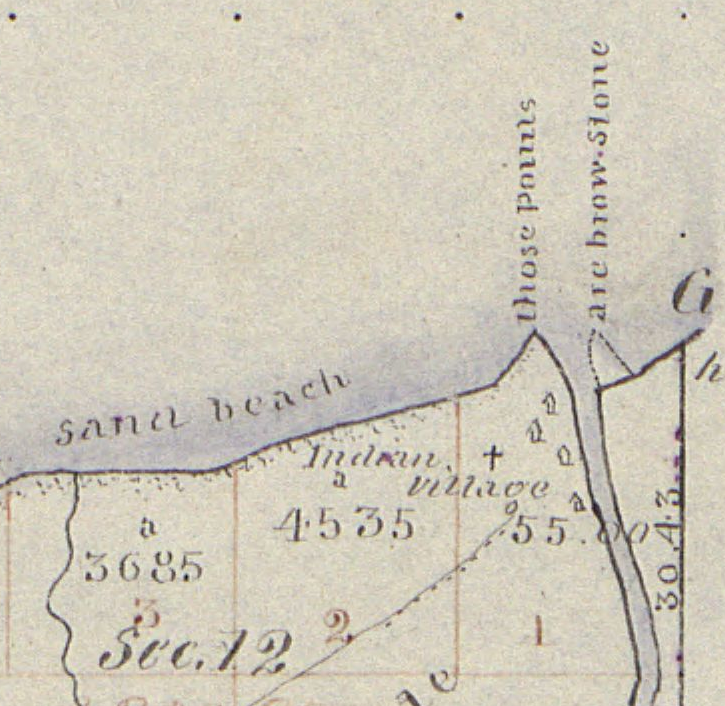
1847 PLSS survey map detailing the mouth of Iron River at what is now Silver City, Michigan along the east entrance to the Porcupine Mountains.
John W. Bell was born in New York City on May 3, 1803, and was consequently eighty-four years and seven months old. He learnt the trade of a cooper, and in this capacity in the year 1835, he came to the Lake superior country for the United States Fur company. He first settled at the mouth of Iron river, in Michigan, about twenty miles west of Ontonagon. Here, at that time, was one of the principal trading and fishing posts of the American Fur company, La Pointe being its headquarters. Remaining at Iron river for a few years, he came to La Pointe about 1840, where he continued to reside till the time of his death.

1845 United States map by John Dower, with the northernmost area of Wisconsin Territory that became La Pointe County.
At the time he came upon this lake its shores were an unbroken wilderness. At the Sault was a United States fort, but from the foot of Lake Superior to the Pacific ocean, no white settlement existed. The American and Northwest Fur companies were lords of this vast empire, and their trading posts and a few mission stations connected with them, held control. A small detachment of United States soldiers formed the distant outposts of Ft. Snelling. The state of Wisconsin had not been organized. No municipal government existed upon this lake. It was many years before Wisconsin was organized.
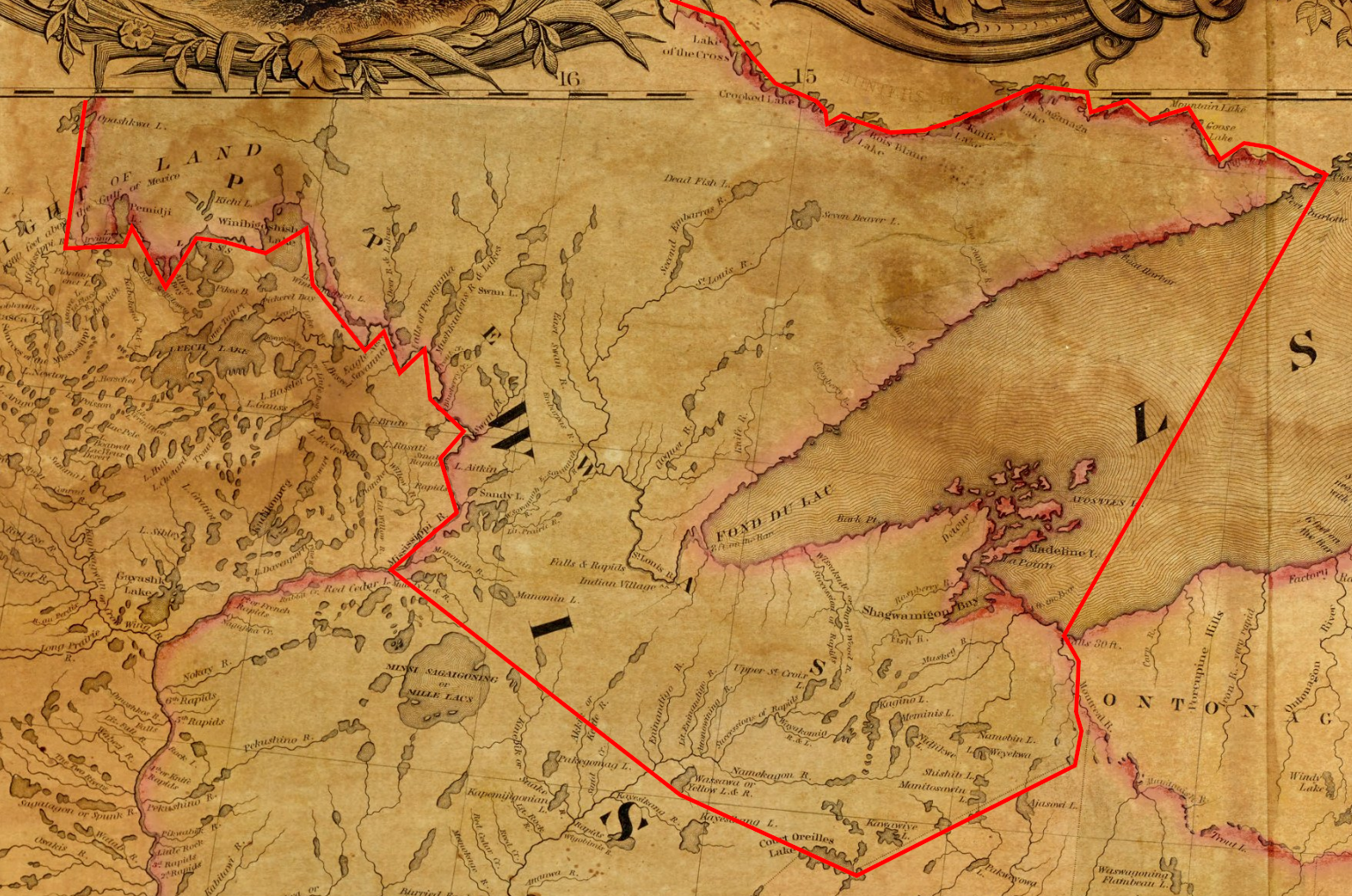
1845 United States map by J. Calvin Smith, with the original 1845 boundaries of La Pointe County added in red outline.
“beginning at the mouth of Muddy Island river [on the Mississippi River], thence running in a direct line to Yellow Lake, and from thence to Lake Courterille, so to intersect the eastern boundary line at that place, of the county of St Croix, thence to the nearest point on the west fork of Montreal river, thence down said river to Lake Superior.”
Finally the county of La Pointe was formed, embracing all Wisconsin bordering upon the lake and extending to town forty north. “Squire Bell,” as he was always called, became one of the county as well as town officers of the town and county of La Pointe, and for more than thirty years continued to hold office, being at different times chairman of supervisors, register of deeds, justice of the peace, clerk of the circuit court and county judge. This last office he held for many years.
He was a man of genial nature and robust frame. About four years ago, while in Ashland he fell and fractured his thigh, and was never able to walk again. His sufferings from this accident were great and his pleasant face was never seen again in Ashland. He enjoyed the esteem and friendship of his neighbors, so far as is known without exception. He was clear headed and of commanding appearance. His influence among the Indians and the French who for many years were the only inhabitants in the country was very great, and continued to the last. For years his dictum was the last resort for the settlement of the quarrels in this primitive community, and it seems to have been just and satisfactory. He was often called “The King of La Pointe,” and for years no one disputed his supremacy.

Edwin Ellis, M.D.
Dr. Edwin Ellis, of this city, said in speaking of the dead old pioneer:
“Thus one by one the early settlers are passing away, and ere long an entirely new generation will occupy the old haunts. He will rest upon the beautiful isle overlooking Chequamegon bay, where the landscape has been familiar to him for more than a generation. We a little longer linger on the shores of time, waiting the summons to cross the river. While we consign the body of an old friend to the earth we will in all heartfelt sorrow say: ‘Requiescat in Pace.'”

Superior Times
Saturday, January 7, 1888, Page 2
The Lake Superior Monarch
Judge Bell, the ‘king of the Apostle islands,’ who died the other day on Madeline Island at the age of eighty-three, was a conspicuous character in the early history of the Lake Superior region. He was the “king” of the county known as La Pointe, which was organized in 1846 by himself. The county was as large as many states of the Union, its borders including nearly all of Wisconsin north of the Chippewa river, the Apostle islands, and to an almost endless distance west. The white population consisted of a handful of French voyagers, traders and trappers, most of whom made their rendezvous at La Pointe. The country was hardly known by the state, and Bell’s realm was practically a little monarchy. He “bossed” everything and everybody, but in such a way that every Indian and every white was his friend and follower. Judge Bell rarely left the island except to make occasional pilgrimages through the settlements. During his eventful life he held every office in the county, and of late years had served as county judge. He was a man of great native ability, and was possessed of a courage that controlled the rough element that surrounded him in the early days when there was no law except his will. He was an honest, fearless, natural-born ruler of men. Through his efforts the poor and needy were cared for. His power departed only when the advanced guard of civilization reached the great inland sea. For many years he had been feeble, and of late had become a charge upon the town. He spent thousands upon the people.
To be continued in Fooled the Austrian Brothers…
1839 Petitions against Payments at La Pointe
October 10, 2025
Collected & edited by Amorin Mello
Previously we featured 1837 Petitions from La Pointe to the President about $100,000 Payments to Chippewa Mixed-Bloods from the 1837 Treaty of Saint Peters, and 1838 more Petitions from La Pointe to the President about relocating the Payments from St. Croix River to Lake Superior. Those earlier Petitions were from Chief Buffalo and dozens of Mixed-Bloods from the Lake Superior Chippewa Bands, setting precedence for La Pointe to host the 1842 Treaty and 1854 Treaty in later decades.
Today’s post features 1839 Petitions against Payments at La Pointe. These petitioners appear to be looking to get a competitive edge against the American Fur Company monopoly at La Pointe, by moving the payments south across the Great Divide into the Mississippi River Basin.
For more information about the $100,000 Payments at La Pointe in 1839, we strongly recommend Theresa M. Schenck’s excellent book All Our Relations: Chippewa Mixed-Bloods and the Treaty of 1837.
Letters Received by the Office of Indian Affairs:
La Pointe Agency 1831-1839
National Archives Identifier: 164009310

April 9, 1839
from Joseph Rolette at Prairie du Chien
to the Superintendent of Indian Affairs
Received April 27, 1839
Prairie du Chiene 9th April 1839
T.H. Crawford Esq’r
Commissioner of Ind’n affairs
Washington
You must excuse the liberty I take in addressing you once more – presuming you are not well acquainted yet with this Country, I am requested by the Chippewaw half Breeds that remain in this Country, that it is with regret they have heard that the payment allowed to them in the treaty of the 29th July 1837 is to be made on Lake Superior. They have to State, that it will be impossible for them to reach that place as the American Fur Co. are the only Co. who have vessels on Lake Superior & Notwithstanding they could procure on Passage Gratis on the Lake.
This distance between Sault Ste Mary, and the Mississippi is great and expensive. They also represent that the half Breeds born on Lake Superior are not entitled to any Share of the money allowed.
Whereas if the Payment was made at the Falls of St. Croix, there would be Competition amongst traders, whereas in Lake Superior they can be done none. They humbly beseech that you will have Mercy on them and not allow them to be deprived by intrigue of the Sum due them. So Justly to go in other hands but the real owners.
Respectfully
your most obd’t Serv’t
Joseph Rolette
on behalf of the Chippewaw
Half Breeds of
Prairie du Chiens

June 21, 1839
from the Indian Agent at Saint Peters
via the Governor of Wisconsin Territory
to the Superintendent of Indian Affairs
Received July 16, 1839
Answered July 24, 1839
Superintendency of Indn Affairs
for the Territory of Wisconsin
Mineral Point June 20, 1839
Sir,

Henry Dodge
Governor of Wisconsin Territory
I have the honor to transmit, enclosed herewith, three letters from Major Taliaferro, Indian Agent at St Peters, dated 10th, 16th, & 17th inst, with two Indian talks of 3rd & 14th, for the information of the Department.
Very respectfully
Yours obedt sevt
Henry Dodge
Supt Ind Agy
T Hartley Crawford Esq
Com. of Indian Affairs
North Western Agency St Peters
Upper Mississippi June 10th 1839
Governor,
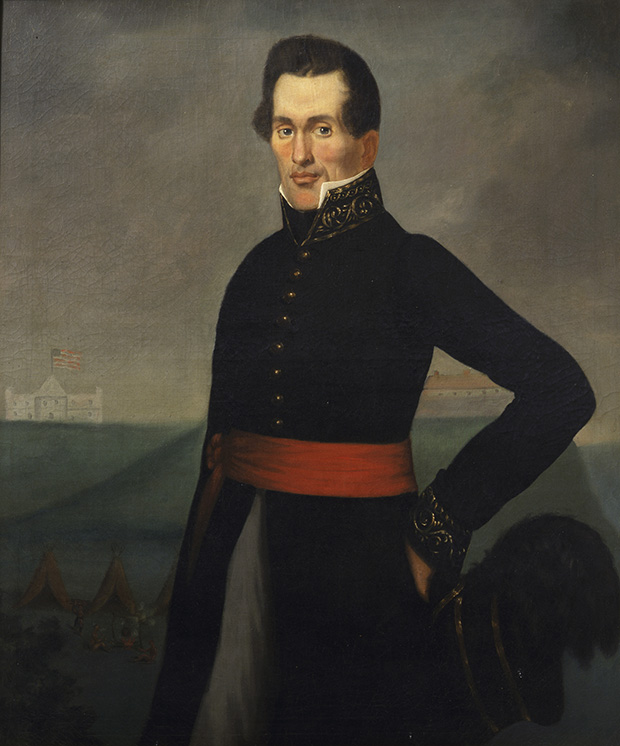
Lawrence Taliaferro
Indian Agent at Fort Snelling
I deem it to be most adviseable that the enclosed paper, addressed to the Agent, and Commanding Officer on this Station from the Chippewa Chief “Hole in the Day” should be forwarded to you, the Indians addressing us being within your Excellency’s Superintendency. It may be well to add that a similar document proceeding from the Chippewa Chiefs of St Croix was on the 4th inst forwarded for the information of the Office of Indian Affairs at Washington.
The consolidation of the two Chippewa Sub Agencies and located at Lapointe, it is feared may lead to rather unpleasant results. I know the Chippewas well, and may have as much influence with those of the Mississippi particularly as most men, yet were I to say “you are not to have an agent in your Country, and you must go to Lapointe in all time to come for your Annuity, and treaty Stipulations.” I should not expect to hold their confidence for one day.
With high respect Sir
Your mo obt Serv
Law Taliaferro
Indian Agent
at S. Peters
His Excellency
Governor Henry Dodge
Suprt of Indi Affairs
at Mineral Point
For Wisconsin
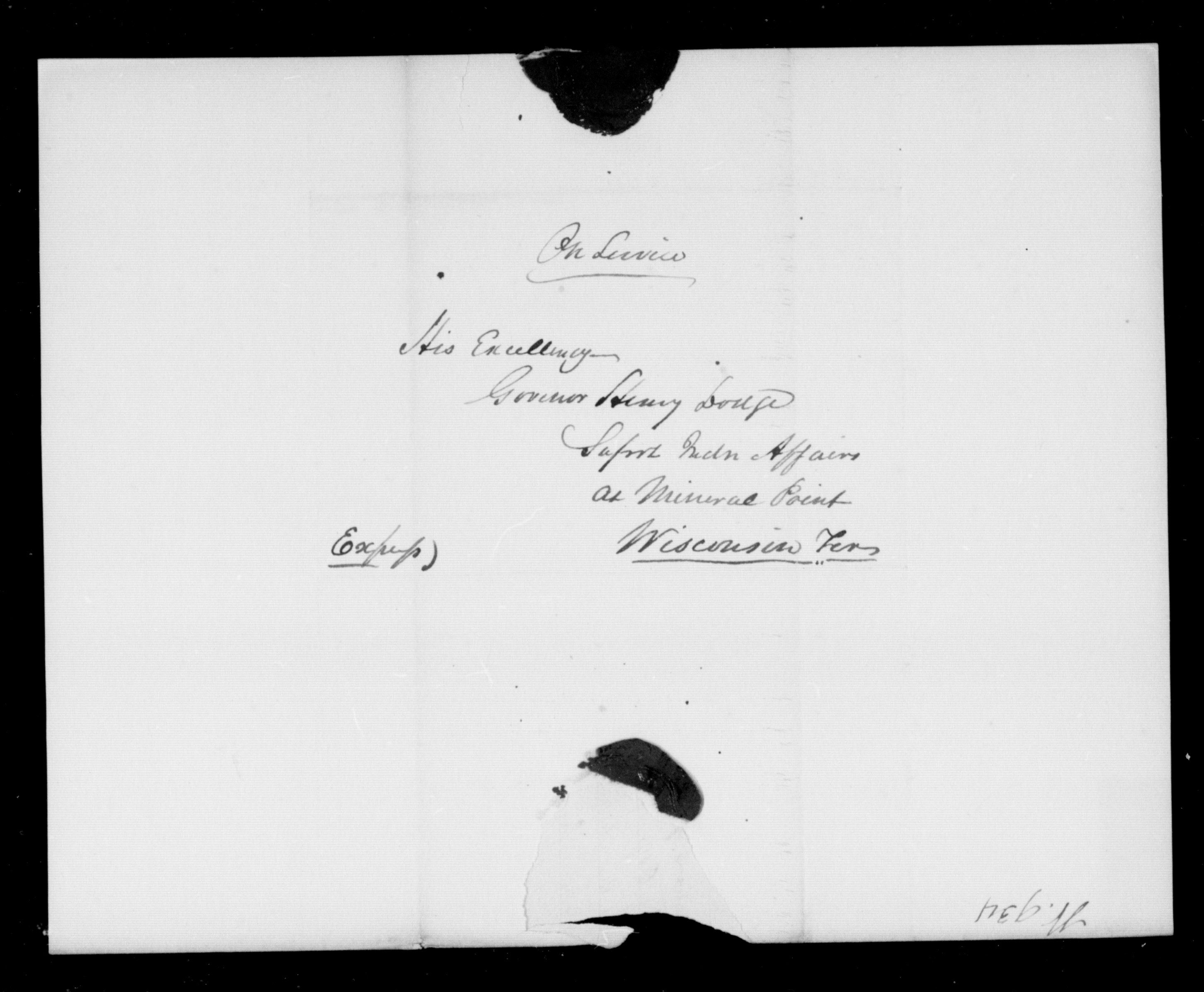
North Western Agency S. Peters
Upper Mississippi June 16th, 1839
Governor
I have been earnestly selected by a number of the respectable half breed Chippewas resident, and others of the Mississippi, interested in the $100,000 set apart in the treaty of July 29, 1837 of S. Peters, to ask for such information as to their final disposal of this Sum, as may be in your possession.
The claimants referred to have learned through the medium of an unofficial letter from the Hon Lucius Lyon to H. H. Sibley Esqr. of this Post, that the funds in question as well as the Debts of the Chippewas to the traders was to be distributed by him as the Commissioner of the United States at Lapointe on Lake Superior, and for this purpose should reach that place on or about the 10th of July. The individuals Seeking this information are those who were were so greatly instrumental in bungling your labours at the treaty aforesaid to a successful issue in opposition to the combinations formed to defeat the objects of the government.
There remains 56,000$ in specie at this post being the one half of the sum appropriated or applicable to the objects in contemplation, and upon which the authorities here have had as yet no official instructions to transfer some special information would relieve the minds of a miserably poor class of people and who fear the entire loss of their just claims.
With high respect, Sir
your mo obt Sevt
Law Taliaferro
Indn Agent
at S. Peters
His Excellency
Gov Henry Dodge
Suprt of Ind. Affairs
for Wisconsin
North Western Agency S. Peters
Upper Mississippi June 17th 1839
Governor
On the 20th of May past I dispatched Peter Quin Express to the Chippewas of the Upper Mississippi with a letter from Maj D. P. Bushnell agent for this tribe at Lapointe notifying the Indians, and half breeds that they would be paid at Lapointe hereafter, and at an earlier period than the last year. I informed you of the result of his mission on the 10th inst. enclosing at the same time the written sentiments of the principle Chief for his people. I now forward by Express a second communication from the Same Source received late last night. I would make a plain copy, but have not time. So the original is Sent.
In four days there will be a large body of Chippwas here, and they cannot be Stopped. There are now also 880 Sioux from remote Sections of the Country at this Post and of course we may calculate on some difficulty between these old enemies. Your presence is deemed essential, or such instructions as may soothe the Angry feelings of the Chippewas, on account of the direction given to their annuity, & treaty Stipulations.
With high respect Sir
Your mo ob Sevt
Law Taliaferro
Indn Agent
at S Peters
His Excellency
Governor Henry Dodge
Suprt of Indi Affairs
Mineral Point
(NB) The Chippewas are to be understood as to the point of payment indicated to be the St.Croix, and not the S.Peters, as deemed by the written Talks. It never could be admited in the present state of the Tribes to pay the Chippewas at this Post, but they might with safety to all parties be paid at or above the Falls of S.Croix, by an agent who they ought to have or some special person assigned to this duty.
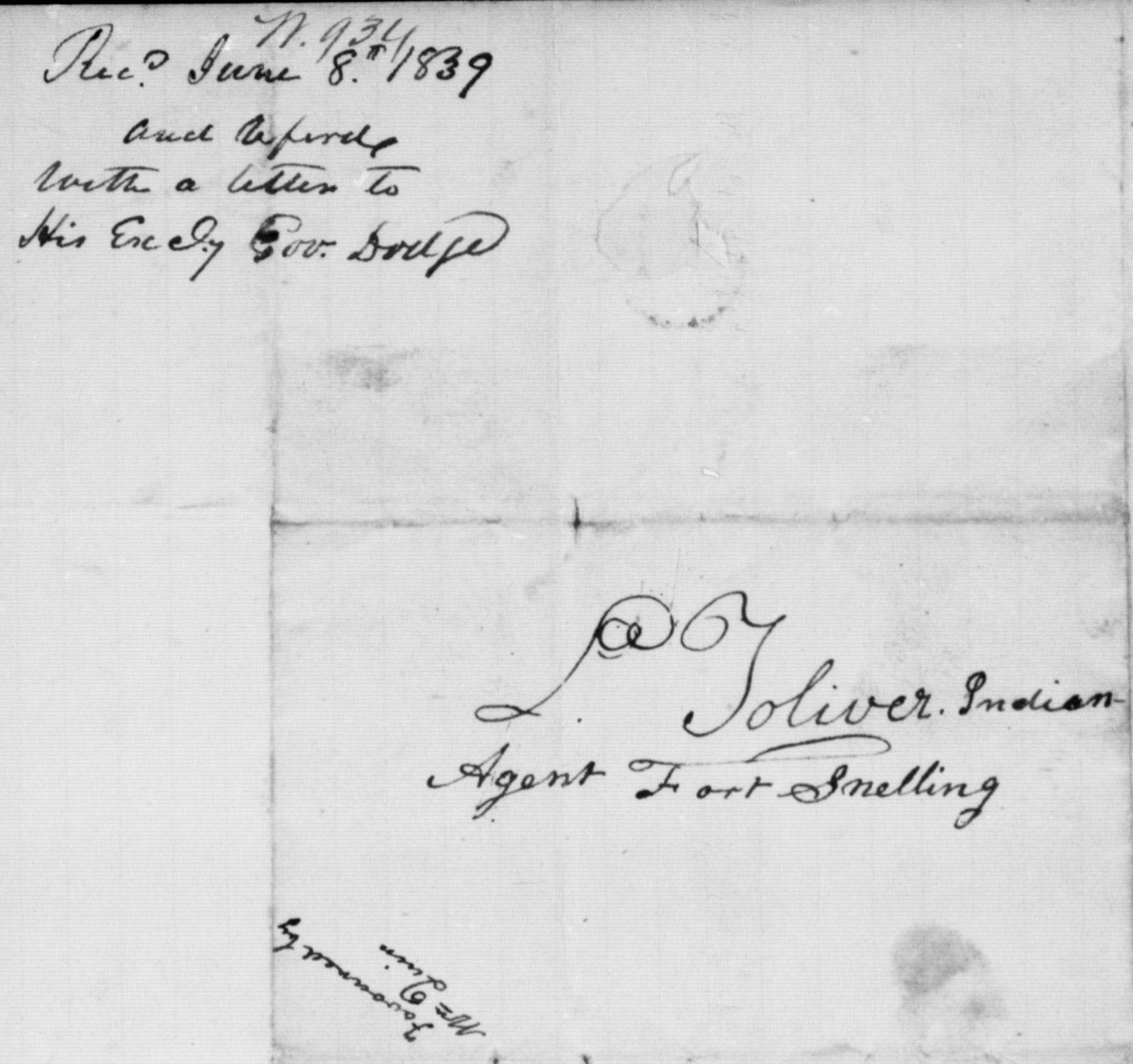
Elk River, June 3rd 1839
Maj Toliver. Maj Plimpton.
My respects to you both, and my hand: I am to let you know that I intend to pay you a visit, with my chiefs as braves, the principle of my warriors are verry anxious to pay you a visit.
The above mentioned men are verry anxious to see Gov. Dodge with whom we made the treaty, that we may have a talk with him. It was with him commissioner of the United-States we made the treaty, and we are verry much disappointed to hear the newes, we hear this day (IE that we must go to Lake Sup. for our pay) which we have this day decided we will not do; that we had rather die first: it is on this account we wish to pay you a visit, and have a talk with Gov. Dodge. You sir, Maj Toliver know verry well our situation, and that the distance is so great for us to go to Lake Sup. for to get our pay &c. or even a gun repaired; that it is inconsistent for such a thing to be required of us; even if we did literally place the matter in the hands of Government. We are all living yet that was present at the treaty when we ceded the land to the Unitedstates, and remember well what was our understanding in the agreement.
We now wish Maj Toliver; to mention to your children that it is a fals report that we had any intention to have more difficulty with the Sioux, as our Missionaries can attest as far as they understand us. We will be at the Fort in seventeen days to pay you a friendly visit as soon as we received the news; we sent expressed to our brethren to meet us at the mouth of Rum Riv. and accompany us to the Fort.
It is my desire that Maj Plimpton would keep fast hold of the money appropriated for my children the half breeds, in this section, and not let it go to Lake Sup. as they are like ourselves and it would cost them a great deal to go there for it.
Pah-ko-ne-ge-zeck or Hole in the Day
Maj Toliver
Maj Plimpton

Elk River June 14 1839
Maj L. Toliphero,
My hand, It is twelve dayes since we have the newes and are all qouiet yet. My father I shall not forget what was promiced us below, I think of what you promiced us when you were buing our lands.
My father this is the thing that you & we me to take care of when you bougt our lands & I remember all that you said to me. My father I am the cheif of all the Indians that sold there land and this is the time when all of your children are coming down to receive their payment where you promiced to pay us.
My father I am the cheif and hold the paper containing the promices that you made us. The Gov. D. promised us that in one year from the date of the treaty that we should receive our first payment and so continue anually.
My father; I have done for manny years what the white men have told me and have done well, and now I must look before we are to know what I have to do.
When I buy anything I pay immediately the Great Spirit knows this Now when we get below we are expecting all that you promiced us Ministers and Black Smiths and cattle.
I say my father that we want our payment at St Peters where you promiced us. I said that I wanted the half breeds to be payed there with us. I told you that when the half breeds were payed that there was some French that should have something ((ie) of the half breed money) because they had lived with us for many years and allways gave us some thing to eat when we went to their houses.
My father all of your children are displeased because you are to pay us in another place and not at St Peters it is to hard and far for us to be payed at Lapointe.
My father I did not know that the payment was to be made at Lapointe until we heard by Mr Quin.
My father it is so far to Lapointe that we should lose all of our children before we could get their and if we should brake our Gun we may throw it in the water for we cannot go there to get it mended, and if we have a [illegible] holding a coppy of the Treaty in his hand
Black Smith we want him here and not at Lapoint.
My father I want that you should tell me who it was told you that we all wanted our payment at Lapoint. All of the Cheifs are alive that hear what you said to us below. You Mr Toliphero hear me ask Gov Do’ for an Agen and to have him located here and he promiced that it should be so. I want that the Agent should be here because our enemies come here sometimes and if he was here perhaps they would not come. My father we are all of us very sorry that we did not ask you to come and be our Agent. I don’t know who made all of the nois about our being payed at Lapoint. I don’t look above where we should all starve for our payment but below where the Treaty was made.
My father give my compliments to all of the officers at the Fort.
Hole in The Day X
 Chequamegon History