Asaph Whittlesey Incidents: Number VIII
April 20, 2023
Collected & edited by Amorin Mello

Originally published in the April 6, 1878, issue of The Ashland Press. Transcribed with permission from Ashland Narratives by K. Wallin and published in 2013 by Straddle Creek Co.
… continued from Number VII.
Early Recollections of Ashland: Number VIII
by Asaph Whittlesey
We now offer a few comments upon our experience in common, and our appreciation of Doctor Edwin Ellis. I observe first that the inherent modesty of the man left him with next to no thought of himself in his “Early Recollections of Ashland,” and therefore the weightier of the task falling upon me. Had the question been raised “who is Dr. Ellis?” a proper reply would have been “Dr. Ellis is Dr. Ellis.”

In all my acquaintance I find no person more clearly identified than is this man. His manner of shaking hands, the music of his voice, and his unconscious habit of setting his hair on end, belong to no one but the man Edwin Ellis. For near a quarter of a century have I known him in the relationship of neighbor, physician, oarsman, farmer, speculator, preacher, merchant and as one skilled in back gammon, and can testify that he is a man who does with his might whatsoever his hands find to do. Those of us who were known as pre-emptors or town site claimants had occasion to regard the arrival of Dr. Ellis with no little suspicion, as certainly an emergency only would have induced him to make the trip from La Pointe during the most inclement season of the year. I remember well my anxiety to know whether or not he was a married man, and so direct were my inquiries as to this, that seemingly there was no way left but for him to satisfy our curiosity by simply saying yes or no. However we soon discovered that we were only wasting words in pressing the subject, and abandoned all further inquiry regarding it. Is it not strange that so good a man and one possessing so admirable a wife should be found so unwilling to satisfy our inquisitive minds in regard to this matter?
There was still another peculiarity noticeable in the Doctor, and that was his proclivity for secret organizations. He was chosen Chairman of a secret organization having for its object protection to pre-emptors from having their claims jumped, though one writer informs us that in the eye of the law they were all trespassers, – but by this means those holding claims felt a security in being absent from them the greater portion of their time. Perhaps the existence of this organization may explain why there has been so many little acres of early clearings discovered by brother Pratt, in the vicinity of Ashland.
Again, Dr. Ellis is one who thinks for himself, but is ever free to weigh the arguments of others, that he may be convinced of the right, and having formed his conclusion is outspoken, so that no one can mistake his position. Being of a hopeful and cheerful turn of mind, his company is courted. All in all whether as to his fitness for the life of a pioneer or as a neighbor and Christian friend I never knew a better.
I have been with him also in times of very great peril, when seemingly we were destined to a watery grave. But through presence of mind and well directed effort we succeeded in reaching the shore amid a feeling of profound gratitude toward our Great Protector above, for sparing our lives. As it is my intention hereafter to refer briefly to the history of a few of the ladies who first settled in and about Ashland. I will omit any special reference to Mrs. Ellis at this time.
HON. SAMUEL S. VAUGHN
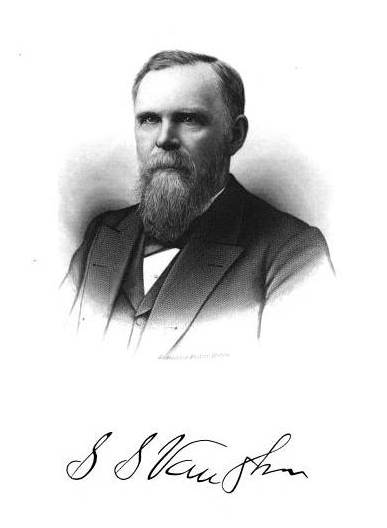
First arrived at La Pointe in 1852. At the time of my arrival there in 1854, I found him running a one horse store in an old frame building, standing in the sand near the present residence of George A. Stahl. So far as I am enabled to bring to mind the succession of events, my first sight of this man was at his own store where I invested in a very poor pocket compass, and this I soon after deposited on the copper range while upon an exploring trip with Ervin Leihy, Esq. Mr. Vaughn, however, claims that he first caught sight of me on the occasion of my aiding Rev. L. H. Wheeler in a social talk with the La Pointe people upon the subject of temperance one Sunday afternoon, in the store of Julias Austrian, Esq.

Reverend
Leonard H Wheeler
The leading man then engaged in the grocery business, as it was called, was one Peter B. Vanderventer, who subsequently left the country at a midnight hour rather than remain and meet a worse doom. Vanderventer was a large sized man and more a hellish countenance, and in exhibition of his bravery at the temperance meeting to which I have referred, he planted himself directly in front of me, and not more than three feet distant, so that I presume he did not mistake my language.

I cannot let slip the opportunity now furnished for informing the public of what seemed to me a rather severe practical joke inflicted upon Vaughn and Vanderventer, as it is too good to be lost, we will mention it right here. It seems that at the time Mr. Austrian made so extended entries of land upon the island, Messrs. Vaughn and Vanderventer discovered that Austrian had failed to enter a fraction shown upon the official plot, as reaching quite a distance into the bay, from what was known as Boyd’s Point and containing some forty acres or more. As La Pointe seemed likely to hold prominence as a business place, they saw the necessity of forthwith securing the tract of land in question. The two therefore suddenly disappeared amid the coldest days of a Lake Superior winter, and footed it under very adverse circumstances through to Willow River, something like one hundred and seventy-five miles, and returned, but yet were quite satisfied to know that they had secured to themselves what they had started for. From this time forward for several years these gentlemen paid their taxes promptly, until they finally employed a surveyor to re-survey and plot their promising possessions. Right here is where they discovered the point of the joke, by being informed that there was not a single foot of their land left, but all and much more had been washed away. Perhaps it was cruel in me to do so, but I could not resist making frequent inquiries as to their real estate.

Section 6 from 1852 GLO PLSS survey of T49N-R3W-4PM showing Boyds Point (now Grants Point) on Madeline Island.
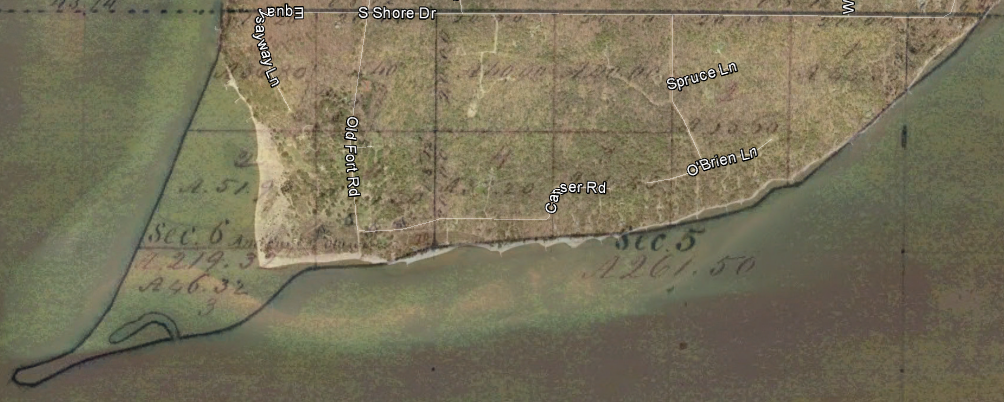
Modern aerial imagery overlay showing Vanderventer & Vaughn’s Lot 3 lost to the sands of time (along with parts of Boyd & Rowley’s Lots 1 & 2).
In 1855 Vaughn removed his stock of goods to a building near where Thomas Stahl, Esq., now resides, where I often shared his bed and board, and it remains a pleasure to me to this day to testify to his qualities as a No. one cook, while biscuits of his make were entitled to special mention. It was a standing rule with him to have a controversy of words with Mr. McElroy, neither being specially noted for the refinement of their language. I think it was during the August term of the Circuit Court in 1860 that Mr. Vaughn and Andrew Tate were admitted to the practice of law before the Hon. S.N. Fuller, Judge of the Eighth Circuit of Wisconsin. It is said that they passed a very creditable examination.
This was the first term of Circuit Court held in the County of La Pointe, Elisha Pike being honored as foreman of the first grand jury convened within the county. Although Mr. Vaughn is but forty-eight years of age he can boast of having held the following positions of trust: Post-master, Justice of the Peace, Chairman of Town and County Boards, also member of the Wisconsin legislature in 1871, (having a constituency of 6,365 souls). In the practice of law his maiden effort was that of procuring papers of divorce in a somewhat renowned case. It is thought that but for the public trust which he held as a Chairman of the School Board he probably would never have known married life, – but as it was so foreordained they accepted the situation, while the people shouted, Amen!
On the arrival of business at Ashland in 1873, Mr. Vaughn removed his family to that place where he once more engaged as trader and forwarding and commission merchant.
To be continued in Number IX…
1838 more Petitions from La Pointe to the President
April 16, 2023
Collected & edited by Amorin Mello
Letters Received by the Office of Indian Affairs:
La Pointe Agency 1831-1839
National Archives Identifier: 164009310
O.I.A. Lapointe W.692.
Governor of Wisconsin
Mineral Pt. 15 Oct. 1838.
Encloses two communications
from D. P. Bushnell; one,
to speech of Jean B. DuBay, a half
breed Chippewa, delivered Aug. 15, ’38,
on behalf of the half breeds then assembled,
protesting against the decision
of the U.S. Court on the subject of the
murder of Alfred Aitkin by an Ind,
& again demanding the murderer;
with Mr Bushnell’s reply: the other,
dated 14 Aug. 1838, being a Report
in reference to the intermeddling of
any foreign Gov’t or its officers, with
the Ind’s within the limits of the U.S.
[Sentence in light text too faint to read]
12 April 1839.
Rec’d 17 Nov 1838.
See letter of 7 June 39 to Hon Lucius Lyon
Ans’d 12 April, 1839
W Ward
Superintendency of Indian Affairs
for the Territory of Wisconsin
Mineral Point Oct 15, 1838.

Henry Dodge
Sir:
I have the honor to enclose herewith two communications from D. P. Bushnell Esq, Subagent of the Chippewas at La Pointe; the first, being the Speech of Jean B. DuBay, a half breed Chippewa, on behalf of the half-breeds assembled at La Pointe, on the 15th august last, in relation to the decision of the U.S. Court on the subject of the murder of Alfred Aitkin by an Indian; the last, in reference to the intermeddling of any foreign government, or the officers thereof, with the Indians within the limits of the United States.
Very respectfully
Your obed’t serv’t.
Henry Dodge
Sup’t Ind. Affs.
Hon. C. A. Harris
Com of Ind. Affairs.
D. P. Bushnell Aug. 14, 1838
W692
Subagency
La Pointe Aug 14th 1838
Sir
I have the honor to acknowledge the receipt of your communication dated 7 ultimo enclosing an extract from a Resolution of the House of the Representatives of the 19th of March, 1838. No case of intermeddling by any foreign government on the officers, or subject thereof with the Indians under my charge or any others, directly , or indirectly, has come to my knowledge. It is believed that the English government has been in the Habit of distributing presents at a point on Lake Huron below Drummonds Island to the Chippewa for a series of years.
The Indians from this region, until recently, visited that place for their share of the annual distribution. But the Treaty made last summer between them and the United States, and the small distribution of presents that has been made within the Last Year, under the direction of our government, have had the effect to permit any of them from visiting, the English Territory this year. These Indians have generally manifested a desire to live upon terms of friendship with the American people. All of the Chiefs from the region of Lake Superior have expressed a desire to visit the seat of Gov’t where none of them have yet been. There is no doubt, but such a visit with the distribution of a few presents among them would be productive: of much good, and render their attachment to our Gov’t still stronger.
Very Resp’y
yr ms ob sev’t
D. P. Bushnell.
I. O. A.
To
His Excellency Henry Dodge
Ter, Wisconsin Sup’t Ind Affs
Half breed Speech
Speech of Jean B. DuBay,
a half breed Chippewa, on behalf of the half breeds assembled in a numerous body at the United States Sub Indian Agency office at La Pointe, on the 15th day of August 1838.
Father. We have come to you for the purpose of speaking on the subject of the murder that was committed two years ago by an Indian on one of our Brothers. I allude to Alfred Aitken. We have always considered ourselves Subject to the Laws of the United States and have consequently relied upon their protection. But it appears by the decision of the United Sates court in this case. “That it was an Indian Killed an Indian, on Indian ground, and died not therefore come under its jurisdiction,” that we have hitherto laboured under a delusion, and that a resort to the laws can avail nothing. We come therefore to you, at the agent of the Government here, to tell you that we have councilled with the Indians and, have declared to them and we have solemnly pledged ourselves in your presence, to each other, that we will enforce in the Indian Country, the Indian Law, Blood for Blood.
We pay taxes, and in the Indian Country are held amenable to the Laws, but appeal to them in vain for protection. Sir we will protect ourselves. We take the case into our own hands. Blood shall be shed! We will have justice and who can be answerable for the consequences? Our brother was a gentlemanly young man. He was educated at a Seminary in Louville in the State of New York. He was dear to us. We remember him as the companion of our childhood. The voice of his Blood now cries to us from the ground for vengence! But the stain left by his you shall be washed out by one of a deeper dye!
For injuries committed upon the persons or property of whites, although within the Indian Country we are still willing to be held responsible to the Laws of the United States, notwithstanding the decision of a United States Court that we are Indians. And for like injuries committed upon us by whites we will appeal to the same tribunal.
Sir our attachments to the American Government and people was great. But they have cast us off. The Half breeds muster strong on the northwestern frontier & we Know no distinction of tribes. In one thing at least we are all united. We might muster into the service of the United States in case of a war and officered by Americans would compose in frontier warfare a formidable corps. We can fight the Indian or white man, in his own manner, & would pledge ourselves to Keep peace among the different Indian tribes.
Sir we will do nothing rashly. We once more ask from your hands the murder of Mr. Aitken. We wish you to represent our case to the President and we promise to remain quiet for one year, giving ample time for his decision to be made Known. Let the Government extend its protection to us and we will be found its staunchest friends. If it persists in abandoning us the most painful consequences may ensue.
Sir we will listen to your reply, and shall be Happy to avail ourselves of your advice.
Reply of the Subagent.
My friends, I have lived several years on the frontier & have Known many half breeds. They have to my Knowledge paid taxes, & held offices under State, Territorial, and United States authorities, been treated in every respect by the Laws as American Citizens; and I have hitherto supposed they were entitled to the protection of the Laws. The decision of the court is this case, if court is a virtual acknowledgement of your title to the Indians as land, in common with the Indians & I see no other way for you to obtain satisfaction then to enforce the Indian Law. Indeed your own safety requires it. in the meantime I think the course you have adopted, in awaiting the results of this appeal is very proper, and cannot injure your cause although made in vain. At your request I will forward the words of your speaker, through the proper channel to the authorities at Washington. In the event of your being compelled to resort to the Indian mode of obtaining satisfaction it is to be hoped you will not wage an indiscriminate warfare. If you punish the guilty only, the Indians can have no cause for complaint, neither do I think they will complain. Any communication that may be made to me on this subject I will make Known to you in due time.
O.I.A. Lapointe. D.333.
Hon. Ja’s D. Doty.
New York. 25 March, 1839
Encloses Petition, dated
20 Dec. last, of Michel Nevou & 111
others, Chippewa Half Breeds, to the
President, complaining of the delay
in the payment of the sum granted
them, by Treaty of 29 July, 1837,
protesting against its payments on the
St Croix river, & praying that it be
paid at La Pointe on Lake Superior.
Recommends that the payment
be made at this latter place,
for reasons stated.
Rec’d 28 March, 1839.
Ans 29 Mch 1839.
(see over)
Mr Ward
D.100 3 Mch 28
Mch 38, 1839.
Indian Office.
The within may be
an [?] [?] [?] –
[guest?]. in fact will be
in accordance with [?]
[lat?] opinions and not of
the department.
W. Ward
New York
March 25, 1839
The Hon.
J.R. Pointsett
Secy of War
Sir,
I have the honour to submit to you a petition from the Half-breeds of the Chippewa Nation, which has just been received.
It must be obvious to you Sir, that the place from which the Indian Trade is prosecuted in the Country of that Nation is the proper place to collect the Half Breeds to receive their allowance under the Treaty. A very large number being employed by the Traders, if they are required to go to any other spot than La Pointe, they must lose their employment for the season. Three fourths of them visit La Pointe annually, in the course of the Trade. Very few either live or are employed on the St. Croix.
As an act of justice, and of humanity, to them I respectfully recommend that the payment be made to them under the Treaty at La Pointe.
I remain Sir, with very great respect
Your obedient Servant.
J D Doty
[D333-39.LA POINTE]
Hon.
J. D. Doty
March 29, 1839
Recorded in N 26
Page 192
[WD?] OIA
Mch 29, 1839
Sir
I have the honor to acknowledge the receipt of your letter of the 25th with the Petition of the Chippewa half breeds.
It is only necessary for me to observe his reply that it had been previously determined that the appropriation for them should be distributed at Lapointe, & the instructions with be given accordingly.
Very rcy
Hon.
J.D. Doty
New York
D100
D.333.

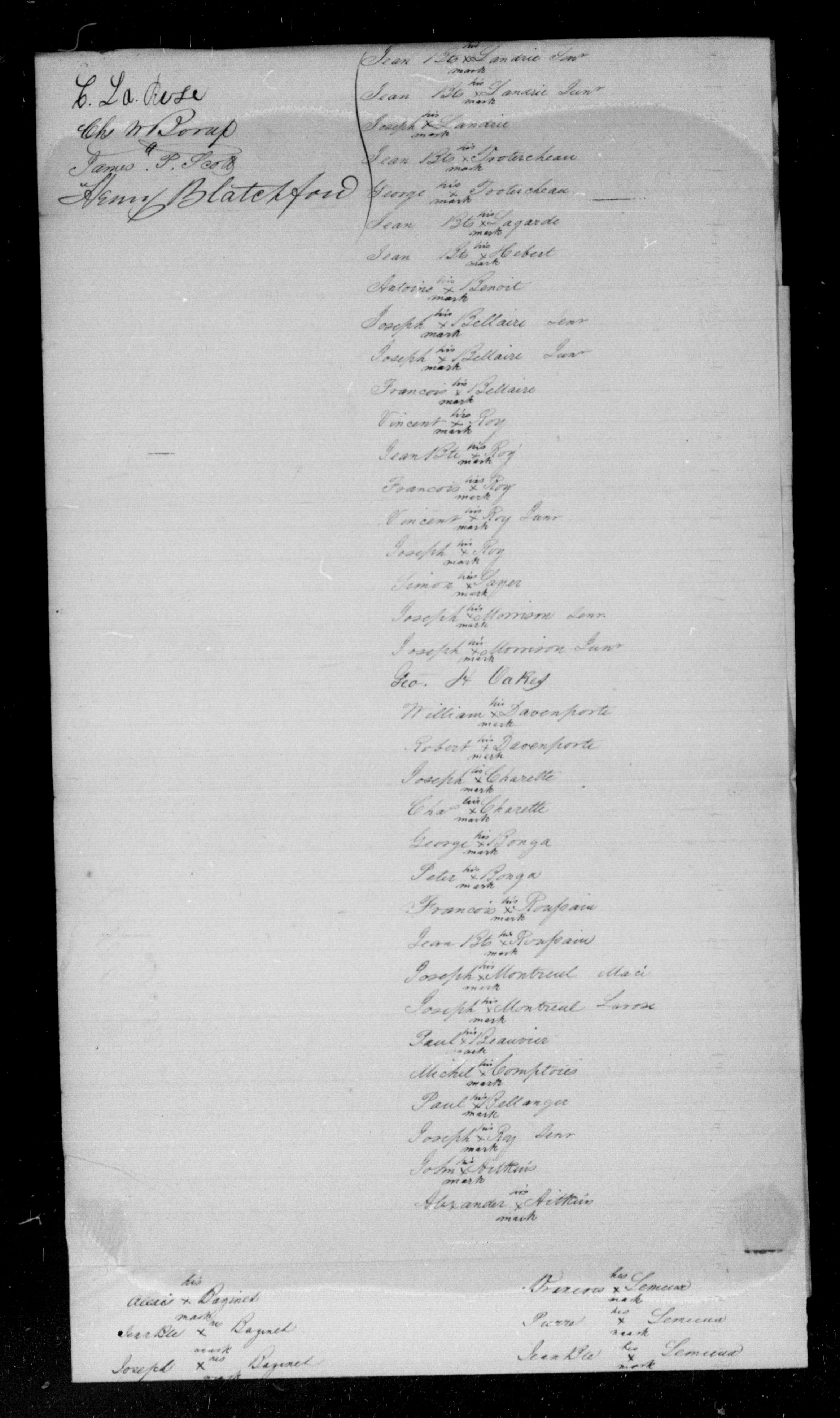

To the President of the United States of America
The Petition of the Half Breeds of the Chippewa nation respectfully shareth.
That we, Half Breeds of the Chippewa Nation, have recently learned, that the payment of the sum granted to the Chippewa Half Breeds, by virtue of the Treaty of 29th July 1837, has been deferred to next Spring, and, that the St Croix River has been selected as the place of payment.
That the delay in not having received our share of the above grant to the Chippewa Half Breeds, last summer, has caused us much loss, by keeping us from our regular vocations for several months, and by leaving many of us without means of support during winter, and that the arrangement of having the payment made next spring on the St Croix, will oblige us to perform a long and expensive Journey, leaving our families in our absence without any means of subsistance, and depriving us of all chance of being employed either in the Indian Trade or at fishing, by which means alone, we are able to earn our daily bread.
Your Petitioners with great deference and implicit submission to the pleasure of the President of the United States, respectfully pray, that an alteration may be made in the place assigned for payment and that Lapointe on Lake Superior may be fixed upon as the place of payment that place being the annual rendezvous of the Chippewa Half Breeds and the Chippewa Indians Traders, by whom we are employed.
And your Petitioners as in duty bound shall ever pray &c. &c.
Lake Superior Lapointe Dec. 20th 1838
Michel Neveu X his mark
Louis Neveu X his mark
Newel Neveu X his mark
Alexis Neveu X his mark
Joseph Danis X his mark
Benjamin Danis X his mark
Jean Bts Landrie Sen’r X his mark
Jean Bts Landrie Jun’r X his mark
Joseph Landrie X his mark
Jean Bts Trotercheau X his mark
George Trotercheau X his mark
Jean Bts Lagarde X his mark
Jean Bts Herbert X his mark
Antoine Benoit X his mark
Joseph Bellaire Sen’r X his mark
Joseph Bellaire Jun’r X his mark
Francois Bellaire X his mark
Vincent Roy X his mark
Jean Bts Roy X his mark
Francois Roy X his mark
Vincent Roy Jun’r X his mark
Joseph Roy X his mark
Simon Sayer X his mark
Joseph Morrison Sen’r X his mark
Joseph Morrison Jun’r X his mark
Geo. H Oakes
William Davenporte X his mark
Robert Davenporte X his mark
Joseph Charette X his mark
Chas Charette X his mark
George Bonga X his mark
Peter Bonga X his mark
Francois Roussain X his mark
Jean Bts Roussain X his mark
Joseph Montreal Maci X his mark
Joseph Montreal Larose X his mark
Paul Beauvier X his mark
Michel Comptories X his mark
Paul Bellanger X his mark
Joseph Roy Sen’r X his mark
John Aitkins X his mark
Alexander Aitkins X his mark
Alexis Bazinet X his mark
Jean Bts Bazinet X his mark
Joseph Bazinet X his mark
Michel Brisette X his mark
Augustin Cadotte X his mark
Joseph Gauthier X his mark
Isaac Ermatinger X his mark
Alexander Chaboillez X his mark
Michel Bousquet X his mark
Louis Bousquet X his mark
Antoine Cournoyer X his mark
Francois Bellanger X his mark
John William Bell, Jun’r
Jean Bts Robidoux X his mark
Robert Morin X his mark
Michel Petit Jun X his mark
Joseph Petit X his mark
Michel Petit Sen’r X his mark
Pierre Forcier X his mark
Jean Bte Rouleaux X his mark
Antoine Cournoyer X his mark
Louis Francois X his mark
Francois Lamoureaux X his mark
Francois Piquette X his mark
Benjamin Rivet X his mark
Robert Fairbanks X his mark
Benjamin Fairbanks X his mark
Antoine Maci X his mark
Joseph Maci X his mark
Edward Maci X his mark
Alexander Maci X his mark
Joseph Montreal Jun. X his mark
Peter Crebassa X his mark
Ambrose Davenporte X his mark
George Fairbanks X his mark
Francois Lemieux X his mark
Pierre Lemieux X his mark
Jean Bte Lemieux X his mark
Baptist St. Jean X his mark
Francis St Jean X his mark
Francis Decoteau X his mark
Jean Bte Brisette X his mark
Henry Brisette X his mark
Charles Brisette X his mark
Jehudah Ermatinger X his mark
Elijah Eramtinger X his mark
Jean Bte Cadotte X his mark
Charles Morrison X his mark
Louis Cournoyer X his mark
Jack Hotley X his mark
John Hotley X his mark
Gabriel Lavierge X his mark
Alexis Brebant X his mark
Eunsice Childes
Etienne St Martin X his mark
Eduard St Arnaud X his mark
Paul Rivet X his mark
Louisan Rivet X his mark
John Fairbanks X his mark
William Fairbanks X his mark
Theodor Borup
James P Scott
Bazil Danis X his mark
Alexander Danis X his mark
Joseph Danis X his mark
Souverain Danis X his mark
Frances Dechonauet
Joseph La Pointe X
Joseph Dafault X his mark
Antoine Cadotte X his mark
Signed in Presnce of
John Angus
John Wood
John William Bell Sen’r
Antoine Perinier
Grenville T. Sproat
Jay P. Childes
C. La Rose
Chs W. Borup
James P. Scott
Henry Blatchford
Edwin Ellis Incidents: Number VII
April 9, 2023
Collected & edited by Amorin Mello
Originally published in the August 25th, 1877, issue of The Ashland Press. Transcribed with permission from Ashland Narratives by K. Wallin and published in 2013 by Straddle Creek Co.
… continued from Number VI.

Plat of Prentice’s Addition to Ashland:
“It is in this addition, that, the Chippewa River and the St. Croix Indian trails reach the Bay.”
My Dear Press: – Recollections of Ashland which should forget to mention Martin Roehm, would leave out a material part – in truth a connecting link in the “chain of events.” He came to the Bay in the summer of 1856 – a hearty industrious young man, not many years from the “Fader Land.” He pre-empted a quarter section of land near the town site – which he still owns. He was not long in discovering the worth and beauty of a comely young widow, who, like himself, had left the “Fader Land” to improve her worldly condition. – After a somewhat lengthy courtship, they were married by “Esquire Bell” in their own home. The ruins of the house may be seen in Prentice’s Addition on the flats between “town” and the mouth of Fish Creek. The bride herself cooked with her own hands the marriage feast, while the guests were gathering. The ceremony was concluded by a grand gallopade, the music being under the direction of that master of the Terpsichorean art, Conrad Goeltz, assisted by his brother Adam, himself a master of the art.

Photograph from obituary of Martin Roehm:
Ashland Daily Press,
April 17, 1898
Martin and his worthy wife still live in Ashland, having witnessed and participated in its varied fortunes for more than twenty years. They may be said to form the connecting link between the Old and New Ashland; for when all others had been, by the force of circumstance, compelled to abandon their homes, they alone remained “monarchs of all they surveyed.” They were in possession of an improved estate in their beautiful valley of Marengo twelve miles from Ashland. This was their favorite winter retreat; while upon the shores of the bay their palaces exceeded in number the residences of the richest kings of the old world. For years they were sovereigns alone, in possession of territory rivaling in extent some of the Kingdoms of Europe.
Their herds of cattle increased year by year and in time patriarchal style, were driven from one part of the vast estate to another, as the necessities of forage might require.
And now, although the revival of Ashland has somewhat restricted the extent of Martin’s possessions, he still owns a valuable herd of cows, and finds a sure source of revenue in the milk supply of Ashland, to the mutual satisfaction of his patrons and himself. His experiments have shown that our soil and climate are adapted to cattle raising and dairy purposes.

Robert Dundas Boyd
Register of Deeds
La Pointe County
Robert D. Boyd, unknown to most of the present generation, came to Ashland in 1855. He was a native of the island of Mackinac – the son of an Indian Agent there stationed. His father was connected by marriage with a distinguished ex-President, to whom he owed his appointment. Rob’t D. as the report was, had, from the effects of a sudden outbreak of passion been guilty of a high crime, and to escape the penalty of the law, had fled to Lake Superior – then almost inaccessible – and safe from invasions of sheriffs and wicked men of that sort. At La Pointe he married a French mixed blood girl by the name of Cadotte, by whom he had several children. Except when under the influence of liquor, his conduct was good and his manner gentlemanly and polite. When partially intoxicated he was thought to be somewhat dangerous if not desperate.

Detail of settlement at Boyd Creek from Augustus Barber’s 1855 survey:
“There is a house in the NE quarter and another in the SE quarter of Section 25.”
He laid claim to a piece of land on the west side of the bay opposite to Ashland, of which a plat was made, to which he gave the name of “Menard,” in memory of the lamented French Jesuit Priest, who, according to tradition, labored for a while at an Indian village then located at this spot, – the point where the old St. Croix Indian trail reached the water of the Great Lake, and which in early years was a well beaten path – but now deserted. No traces of the village are now visible. The storms of nearly two hundred and fifty winters have obliterated all traces, of what from its position, must have been an important point among the Ojibwas of the northwest. According to the tradition, Father Menard left the bay for a missionary tour inland, from which he never returned and no trace of him was ever found.

La Pointe County Deeds Book A Page 577:
Plat of Mesnard
Surveyed, certified, and recorded in 1857 by Edward L. Baker, as power of attorney for Thomas H. Hogan of La Pointe:
“the SE¼ of the SW¼, the SW¼ of the SE¼, and Lot 3 in Section 24, and Lots 1 & 2 and the NE¼ of the NW¼ and west½ half of the NW¼ of Section 25, all in Township 48 North of Range 5 West of the 4th principal meridian of the State of Wisconsin“
Boyd erected a house in 1857 in the western part of Beaser’s Division which still stands, but unoccupied.
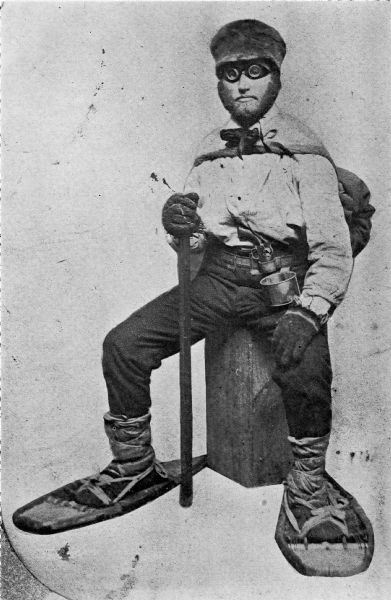
Wisconsin Representative Asaph Whittlesey also wrote about this tragedy.
In the latter part of 1857 he became unusually dispirited; his drunken sprees became frequent and long continued; and he was often under arrest for his disorderly and quarrelsome conduct. Finally in January 1858 he fell into a drunken debauch of several days duration. He was then living in the old log cabin on Main Street – Mr. Whittlesey’s first house – with one bachelor companion by the name of Cross. Having passed the night in drunken carousals, in the early morning – irritated by some real or imaginary insult from Cross – he approached the latter with a drawn butcher knife in his hand, holding it up in a threatening manner, as if about to strike. Cross drew a revolver and fired – two balls passed into the chest – one entering the heart. Boyd fell and in five minutes had breathed his last. This tragic event produced a profound sensation in our little community. A coroner’s inquest was held by Asaph Whittlesey, then a justice of the peace, – and although the evidence seemed to show that Cross might have retreated and saved himself without taking Boyd’s life, still Cross was judged by the jury to have acted in self-defense and was acquitted, Boyd’s known desperate character doubtless contributed to this result.
Boyd’s wife had died some years before, and several children were left orphans; and the writer will always carry in his mind the affecting scene as the little daughter three years old was held up in the arms of Mrs. Angus to take a last view of, and imprint a last kiss on the cold brow of her only natural protector. But God – who is ever the Father of the fatherless, – took care of the orphans, and they are now grown up to manhood and womanhood, and twenty years have effaced from most the memory of this sad event.
 Chequamegon History