Martin Beaser
August 9, 2016
By Amorin Mello

Magazine of Western History Illustrated
November 1888
as republished in
Magazine of Western History: Volume IX, No.1, pages 24-27.
Martin Beaser.

Portrait of Martin Beaser on page 24.
On the fifth day of July 1854, Asaph Whittlesey and George Kilborn left La Pointe, in a row-boat, with the design of finding a “town site” on some available point near the “head of the bay.” At five o’clock P.M. of the same day they landed at the westerly limit of the present town site of Ashland. As Mr. Whittlesey stepped ashore, Mr. Kilborn exclaimed, “Here is the place for a big city!” and handing his companion an axe, he added, “I want you to have the honor of cutting the first tree in a way of a settlement upon the town site.” And the tree thus felled formed one of the foundation logs in the first building in the place. Such is the statement which has found its way into print as to the beginning of Ashland. But the same account adds: “Many new-comers arrived during the first few years after the settlement; among them Martin Beaser, who located permanently in Ashland in 1856, and was one of its founders.”1 How this was will soon be explained.
The father of the subject of this sketch, John Baptiste Beaser, was a native of Switzerland, educated as a priest, but never took orders. He came to America, reaching Philadelphia about the year 1812, where he married Margaret McLeod. They then moved to Buffalo, in one of the suburbs of which, called Williamsville, their son Martin was born, on the twenty-seventh of October, 1822. The boy received his early education in the common schools of the place, when, at the age of fourteen, he went on a whaling voyage, sailing from New Bedford, Massachusetts. His voyage lasted four years; his second voyage, three years; the last of which was made in the whaleship Rosseau, which is still afloat, the oldest of its class in America.
The young man went out as boat-steerer on his second voyage, returning as third mate. During his leisure time on shipboard and the interval between the two voyages, he spent in studying the science of navigation, which he successfully mastered. On his return from his fourth years’ cruise in the Pacific and Indian oceans, he was offered the position of second mate on a new ship then nearing completion and which would be ready to sail in about sixty days. He accepted the offer. They would notify him when the ship was ready, and he would in the meantime visit his mother, then a widow, residing in Buffalo. Accordingly, after an absence of seven years, he returned to his native city, spending the time in renewing old acquaintances and relating the varied experience of a whaler’s life. He had rare conversational powers, holding his listeners spell-bound at the recital of some thrilling adventure. A journal kept by him during his voyages and now in the possession of his family, abounds in hair-breadth escapes from savages on the shores of some of the South sea islands and the perils of whale-fishing, of which he had many narrow escapes. The time passed quickly, and he anxiously awaited the summons to join his ship. Leaving the city for a day the expected letter came, but was carefully concealed by his mother until after the ship had sailed, thus entirely changing the future of his life.
“… Martin, a sailor just from the whaling grounds of the Northwest Coast …”
Disappointed in his aspirations to command a ship in the near future, as he had reasons to hope from the rapid promotions he had already received – from a boy before the mast to mate of a ship in two voyages – and yielding to his mother’s wish not to leave home again, he engaged in sailing on Lake Erie from Buffalo to Detroit until 1847, when he went in the interest of a company in the latter city to Lake Superior for the purpose of exploring the copper ranges in the northern peninsula of Michigan. He coasted from Sault Ste. Marie to Ontonagon in a bateau. Remaining in the employ of the company about a year, he then engaged in a general forwarding and commission business for himself.
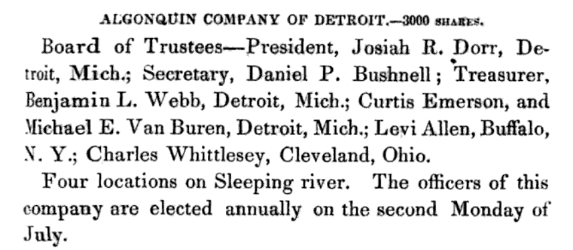
“Algonquin Company of Detroit.”
~ Reports of Wm. A. Burt and Bela Hubbard, by T. W. Bristol, 1846, page 97.
~ A History of the Northern Peninsula of Michigan and Its People: Volume 1, by Alvah Littlefield Sawyer, 1911, page 222.
Mr. Beaser was largely identified with the early mining interests of Ontonagon county, being instrumental in opening up and developing some of the best mines in that district.
In 1848 he was married in Cattaraugus county, New York, in the town of Perrysburgh, to Laura Antionette Bebee. The husband and wife the next spring went west, going to Ontonagon by way of Detroit. The trip from buffalo lasted from the first day of May to the sixth of June, they being detained at the “Soo” two weeks on account of the changing of the schooner Napoleon into a propeller, in which vessel, after a voyage of six days, they reached Ontonagon.
Here Mr. Beaser resided for seven years in the same business of forwarding and commission, furnishing frequently powder and candles to the miners by the ton. He was a portion of the this time associated with Thomas B. Hanna, formerly of Ohio. They then sold out their interest – Mr. Beaser going in company with Augustus Coburn and Edward Sayles to Superior, at the head of the lake, taking a small boat with them and Indian guides. Thus equipped they explored the region of Duluth, going up the Brule and St. Louis rivers. They then returned to La Pointe, going up Chaquamegon bay; and having their attention called to the site of what is now Ashland, on account of what seemed to be its favorable geographical position. As there had been some talk of the feasibility of connecting the Mississippi river and Lake Superior by a ship canal, it was suggested to them that this point would be a good one for its eastern terminus. Another circumstance which struck them was the contiguity of the Penokee iron range. This was in 1853. The company then returned to Ontonagon.
Closing up his business at the latter place, Mr. Beaser decided to return to the bay of Chaquamegon to look up and locate the town site on its southern shore. In the summer of 1854, on arriving there, he found Mr. Whittlesey and Mr. Kilborn on the ground. He then made arrangement with them by which he (Mr. Beaser) was to enter the land, which he did at Superior, where the land office was then located for that section. The contract between the three was, that Mr. Whittlesey and Mr. Kilborn were to receive each an eighth interest in the land, while the residue was to go to Mr. Beaser. The patent for the land was issued to Schuyler Goff, as county Judge of La Pointe county, Wisconsin, who was the trustee for the three men, under the law then governing the location of town sites.
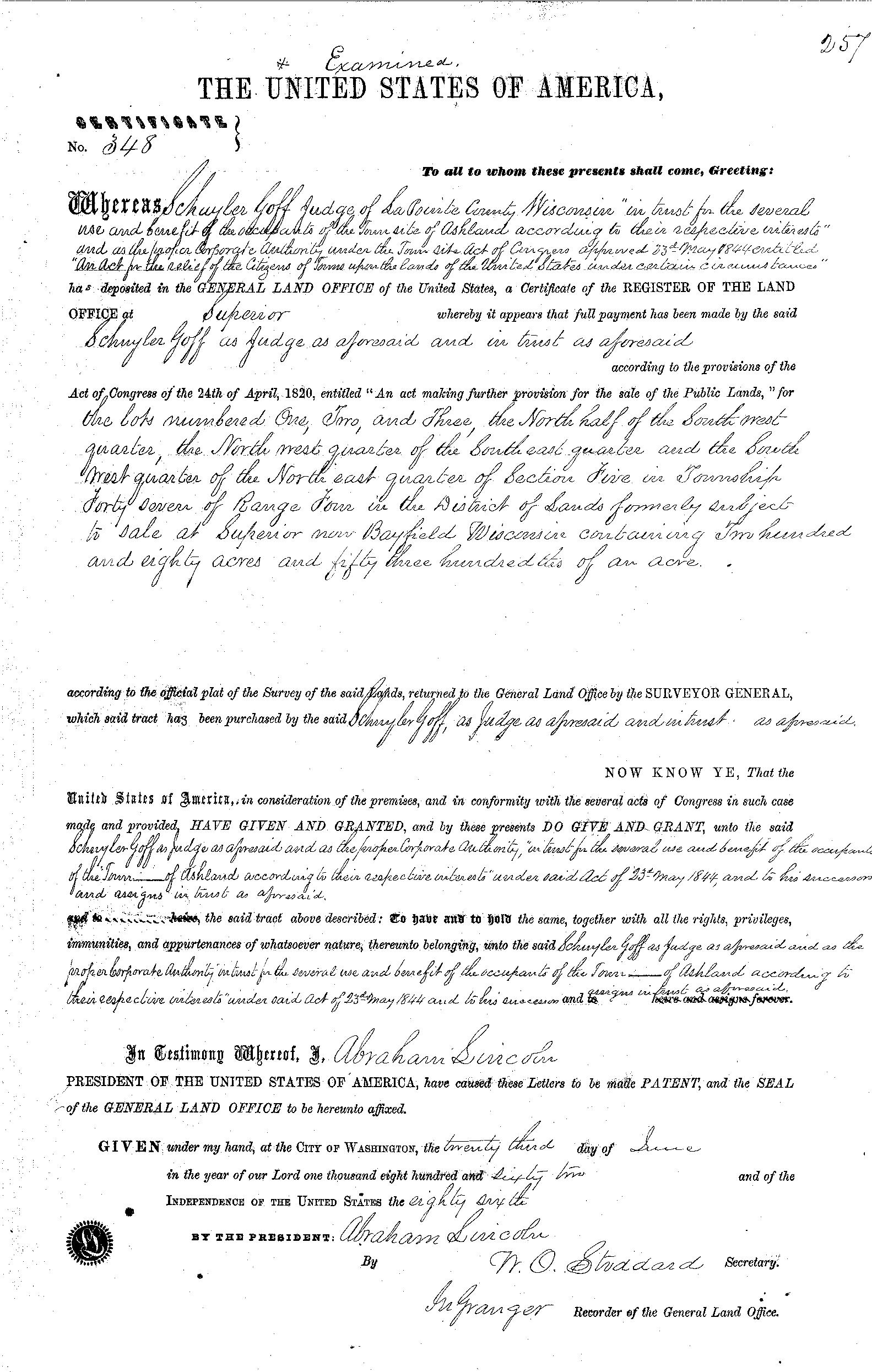
La Pointe County Judge Schuyler Goff was issued this patent for 280.53 acres on June 23rd, 1862, on behalf of Martin Beaser, Asaph Whittlesey, and George Kilburn.
~ General Land Office Records
Mr. Beaser afterwards got his deed from the judge to his three-quarters’ interest in the site.

Beaser named Ashland in honor of the Henry Clay Estate in Kentucky.
~ National Park Service
In January, 1854, Mr. Beaser having previously engaged a topographical engineer, G.L. Brunschweiler, the two, with a dog train and two Indians, made the journey from Ontonagon to the proposed town site, where Mr. Brunschweiler surveyed and platted2 a town on the land of the men before spoken of as parties in interest, to which town Mr. Beaser gave the name of Ashland. These three men, therefore, were the founders of Ashland, although afterwards various additions were made to it.
Mr. Beaser did not bring his family to Ashland until the eighth of September, 1856. He engaged in the mercantile business there until the war broke out, and was drowned in the bay while attempting to come from Bayfield to Ashland in an open boat, during a storm, on the fourth of November, 1866. He was buried on Madeline island at La Pointe. He was “closely identified with enterprises tending to open up the country; was wealthy and expended freely; was a man of fine discretion and good, common sense.” He was never discouraged as to Ashland’s future prosperity.
The children of Mr. Beaser, three in number, are all living: Margaret Elizabeth, wife of James A. Croser of Menominee, Michigan; Percy McLeod, now of Ashland; and Harry Hamlin, also of Ashland, residing with his mother, now Mrs. Wilson, an intelligent and very estimable lady.
1 See ‘History of Northern Wisconsin,’ p. 67.
2 The date of the platting of Ashland by Brunschweiler is taken from the original plat in the possession of the recorder of Ashland county, Wisconsin.
Samuel Stuart Vaughn
August 8, 2016
By Amorin Mello
Magazine of Western History Illustrated
November 1888
as republished in
Magazine of Western History: Volume IX, No. 1, pages 17-21.
Samuel Stuart Vaughn.
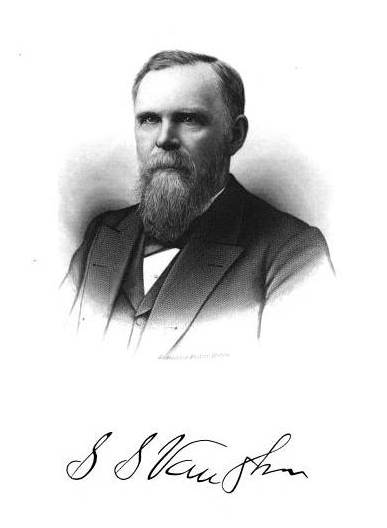
Portrait of Samuel Stuart Vaughn on page 16.
Of the pioneers upon the southern shores of Lake Superior, none stand higher in the memory of those now living there than Samuel Stuart Vaughn. He was born at Berea, Cuyahoga county, Ohio, on the second of September, 1830. His parents were Ephraim Vaughn and Eunice Stewart Vaughn. Samuel was the youngest in a family of five children – two daughters and three sons. Although at a very early age possessed of a great desire for an education, he was, to a large extent, denied the advantages of schools, owing to the fact that his father was in straitened circumstances financially. It is related of the boy Samuel that he picked up chestnuts at one time, and took them into Cleveland, where he disposed of them to purchase a geography [book?] he wanted. Three months was the whole extent of his time passed in the common schools of his native place – surely a brief period, and one sorely regretted for its brevity by a boy who, even then, hungered and thirsted for knowledge.
~ FindAGrave.com
In 1849 the young man came to Eagle River, Michigan, where he engaged himself to his brother as clerk. He remained there until 1852, when the brothers removed to La Pointe, Wisconsin, reaching that place on the fourth of August. He now opened a store, and engaged in trading with the Indians and fishermen of the island and surrounding country. La Pointe was then the county seat of a county of the same name in Wisconsin, and a place of considerable importance, though its glory has since departed.

Vaughn advertisement from the August 22nd, 1857, issue of the Bayfield Mercury newspaper.
~ NewspaperArchive.com
Young Vaughn spoke the French and Chippewa languages fluently. This accomplishment was absolutely necessary, in the early days of this region of country to make a man successful as a trader. He was very fond of reading, particularly works of history, and through all his pioneer life his books were his loved companions. His taste was not for worthless books, but for those of an improving character; hence he received a large amount of benefit from his silent teachers.
In his relation with the Indians, which, owing to the nature of his business, were quite intimate, Mr. Vaughn commanded their fullest confidence. It is related that when at one time there were rumors of trouble between the white people and the Chippewas, and many of the settlers became frightened and feared they would be murdered by the natives, a delegation of chiefs came to him and said they wanted to have a talk. They said they had heard of the fears of the whites, but assured him there was nothing to be afraid of; the Indians would do no harm, “for,” said they, “we know that the soldiers of the white man are like the sands of the sea in numbers, and if we make any trouble they will come and overpower us.” Mr. Vaughn was abundantly satisfied of their sincerity as well as of their peaceful disposition, and he soon quieted the fears of the settlers.
“Being impressed,” says a writer who knew him well,
“with the future possibilities of this country and ambitious, to use a favorite expression of his own, to become ‘a man among men,’ he recognized the disadvantage under which he labored from the limited educational advantages he had enjoyed in his youth, and his first earnings were devoted to remedying his deficiency in this respect. Closing his business at La Pointe, he returned to his native state, where a year was spent in preparatory studies, which were pursued with a full realization of their importance to his future career. He spent several months in Cleveland acquiring a ‘business education.’ He became a systematic bookkeeper, careful in his transactions and persevering in his plans. Having devoted as much time to the special course of instruction marked out by him as his limited means would afford, he returned to La Pointe, at that time the only white settlement in all this region, where he remained until 1856.” 1
Mr. Vaughn, during the year just named, removed to Bayfield, the town site having been previously surveyed and platted. It was opposite La Pointe on the mainland, and is now the county-seat of Bayfield county, Wisconsin. There he erected the first stone building,2 built also a saw-mill, and engaged in the sale of general merchandise and in the manufacture of lumber. “In his characteristic manner,” says the writer just quoted,
“of doing with all his might whatever his hands found to do, he at once took a leading position in all matters of private and public interest which go to the building up of a prosperous community.”
Mr. Vaughn built what is known as Vaughn’s dock in Bayfield, and remained in that town until 1872. Meanwhile, he was married in Solon, Ohio, to Emeline Eliza Patrick. This event took place on the twenty-second of December, 1864. After spending a few months among friends in Ohio, he brought his wife west to share his frontier life. The wedding journey was made in February, 1865, the two going first to St. Paul; thence they journeyed to Bayfield by sleigh, “partly over logging roads, and partly over no road.” It was a novel experience to the bride, but one which she had no desire to shrink from. She was not the wife to be made unhappy by ordinary difficulties.
As early as the twenty-fifth of October, 1856, Mr. Vaughn had preëmpted one hundred and sixty acres of land, afterwards known as “Vaughn’s division of Ashland.” He was one of the leading spirits in the projection of the old St. Croix & Lake Superior railroad, and contributed liberally of his time and money in making the preliminary organizations and surveys. Being convinced, from the natural location of Ashland, that it would become in the future a place of importance, was the reason which induced him to preëmpt the land there, of which mention has just been made.

Vaughn was issued his patent to 40 acres in Ashland on June 1st, 1859. The other 120 acres of his preemption are not accounted for in these records.
~ General Land Office Records
As may be presumed, Mr. Vaughn omitted no opportunity of calling the attention of capitalists to the necessity of railroad facilities for northern Wisconsin. He became identified with the early enterprises organized for the purpose of building a trunk line from the southern and central portions of the state to Lake Superior, and was for many years a director in the old “Winnebago & Lake Superior” and “Portage & Lake Superior” Railroad companies, which, after many trials and tribulations, were consolidated, resulting in the building of the pioneer road – the Wisconsin Central.

The Vaughn Building
~ The Northwest Magazine, October 1890, page 18.
In 1871, upon the completion of the survey of the Wisconsin Central railroad, he proceeded to lay out his portion of the town of Ashland, and made arrangements for the transfer of his business thither from Bayfield. During the next year he made extensive improvements to his new home; these included the building of a residence, the erection of a store, also (in company with Mr. Charles Fisher) of a commercial dock. The Wisconsin Central railroad had begun work at the bay (Chaquamegon); and, at this time, many settlers were coming in. In the fall he moved into his new house, becoming, with his wife, a permanent resident of Ashland.
Mr. Vaughn and his partner just named received at their dock large quantities of merchandise by lake, and they took heavy contracts to furnish supplies to the railroad before mentioned. In the fall of 1872 they established branch stores at Silver creek and White river to furnish railroad men with supplies. They also had contracts to get out all the ties used by the railroad between Ashland and Penokee. In 1875 the firm was dissolved, and Mr. Vaughn continued in business until 1881, when he sold out, but continued to handle coal and other merchandise at his dock. In the winter previous he put in 10,000,000 feet of logs.
Mr. Vaughn represented the counties of Ashland, Barren, Bayfield, Burnett, Douglas and Polk in the thirty-fourth regular session of the Wisconsin legislature, being a member of the assembly for the year 1871. These counties, according to the Federal census of the year previous, contained a population of 6,365. His majority in the district over Issac I. Moore, Democrat, was 398. Mr. Vaughn was in politics a Republican. Previous to this time he had been postmaster for four years at Bayfield. He was several times called to the charge of town and county affairs as chairman of the board of supervisors, and in every station was faithful, as well as equal, to his trust; but he was never ambitious for political honors. He died at his home in Ashland of pneumonia, on the twenty-ninth day of January, 1886.

Ashland – Residence of Mrs. E. Vaughn.
~ The Northwest Magazine, October 1890, page 20.
Mr. Vaughn was one of the most prominent men in northern Wisconsin, and one of the wealthiest citizens of Ashland at the time of his decease. He had accumulated a large amount of real estate in Ashland and Bayfield, and held heavy iron interests in the Gogebic district; but, at the same time, he was a man of charitable nature, being a member of several charitable orders and societies. He was a member of Ashland Lodge, I.O.O.F., and one of its foremost promoters and supporters. Mr. Vaughn was also a Mason, being a member of Wisconsin Consistory, Chippewa Commandery, K.T., Ashland Chapter, R.A.M., and Ancient Landmark Lodge, F. and A.M.
Although an unostentatious man, Mr. Vaughn was possessed of much public spirit, and the remark had been common in Ashland since his death, by those who knew him best, that the city had lost its best man. Certain it is that he was possessed of great enterprise, and was always ready with his means to help forward any scheme that he saw would benefit the community in which he lived. It had long been one of his settled determinations to appropriate part of his wealth to the establishment of a free library in Ashland. So it was that before his death the site had been chosen by him for the building, and a plan of the institution formulated in his mind, intending soon to make a reality of his day-dreams concerning this undertaking; but death cut short his plans.

Vaughn Memorial Library
~ The Northwest Magazine, October 1890, page 18.
It is needless to say to those who know to whom was confided the whole subject of the “Vaughn Library,” that it has not been allowed to die out. In his will Mr. Vaughn left hall his property to his wife, and she nobly came forward to make his known desires with regard to the institution a fixed fact. The corner-stone of the building for the library was laid, with imposing ceremonies, on the fourteenth of July, 1887, and a large number of books will soon be purchased to fill the shelves now nearly ready for them. It will be, in the broadest sense, a public library – free to all; and will surely become a lasting and proud monument to its generous founder, Samuel Stewart Vaughn. She who was left to carry out the noble schemes planned by the subject of this sketch, now the wife of the Rev. Angus Mackinnon, deserves particular mention in this connection. She is a lady of marked characteristics, all of which go to her praise. Soon after reaching her home in the west she taught some of the Bayfield Indians to read and write; and from that time to the present, has proved herself in many ways of sterling worth to northern Wisconsin.
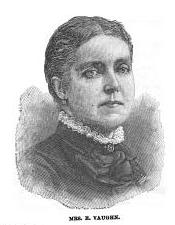
Mrs. Emeline Vaughn
~ The Northwest Magazine, October 1890, page 19.
“Years ago, when Ashland consisted of a few log houses and a half dozen stores – before there was even a rail through the woods that lead to civilization many miles away – this lady was a member of ‘Literary,’ organized by a half-dozen progressive young people; and in a paper which she then read on ‘The Future of Ashland,’ she predicted nearly everything about the growth of the place that has taken place during the past few years – the development of the iron mines, railroads, iron furnaces, water-works, paved streets, and, to a dot, the present limits of its thoroughfares. She is a representative Ashland lady.”
1 Samuel S. Fifield in the Ashland Press of February 6, 1886.
2 This was the second house in the place.
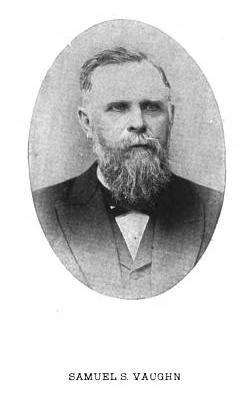
Another biographical sketch and this portrait of Samuel Stuart Vaughn are available on pages 80-81 of Commemorative Biographical Record of the Upper Lake Region by J.H. Beers & Co., 1905.
Edwin Ellis, M.D.
August 7, 2016
By Amorin Mello
Magazine of Western History Illustrated
November 1888
as republished in
Magazine of Western History: Volume IX, No.1, pages 21-24.
Edwin Ellis.

Portrait of Edwin Ellis, M.D. on page 20.
The subject of this sketch is a native of New England, and one of the “Oxford Bears,” having been in Peru, Oxford county, Maine, in 1824. His birthplace was on the banks of the Androscoggin river, among the mountains, a wild, romantic place. His ancestors came early from England to the Massachusetts colony, about the middle of the seventeenth century.
His maternal grandfather was in the Revolutionary army, and to the end of a long life was intensely patriotic and American in all his acts and thoughts. He bought one hundred and sixty acres of government land at the close of the War of the Revolution, on which he lived for more than seventy years, until his death. It still remains in the family. There were no roads in his neighborhood; and at first he was obliged to carry his corn and wheat to mill, for more than thirty miles, upon his shoulders and by a “spotted line.” He lived to break the ground for a railroad to his town and to see its completion.
Dr. Ellis received his early education in the New England common school, whose term was not more than three months in the year. At the age of fourteen years he began the study of Latin at home, going for occasional recitations to one of the celebrated Abbot family, who was a farmer in the town, some four miles distant. He was inclined to study the law, but his mother, who was a most conscientious woman, thought an honest lawyer could not live by his calling, often repeating to him this couplet –
“If I turn lawyer, I must lie and cheat,
For honest lawyers have no bread to eat.”
This had some influence upon him, and he chose the profession of medicine. He entered Waterville college (now Cobly university) in 1842, pursuing its first year’s course, when he began the study of medicine, teaching school in winter to raise money enough to pay his expenses, in which he was cheerfully assisted by his father to the extent of his means, which were very limited, he being a house carpenter and receiving the usual wages of those days of one dollar to one dollar and fifty cents per day.
Edwin Ellis graduated in medicine at the University of the city of New York, in March, 1846, being nearly twenty-two years of age. He at first settled at North New Portland, Maine. It was a frontier town, and the roads in such condition that he was obliged to travel on horseback, going sometimes forty miles in the night.
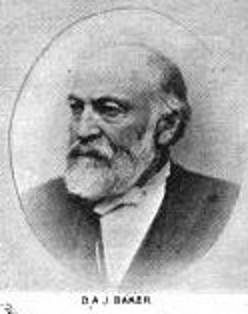
Brother-in-law Daniel A. J. Baker
~ The Eye of the North-west, pg. 9.
At the end of a year he settled in Farmington, Maine, where he had studied his profession, where, in 1847, he was married to Sophia S. Davis, who lived less than two years, leaving a daughter, Sophia Augusta, who married George H. Kennedy, who now lives at Ashland.
Dr. Ellis married Martha B. Baker of New Sharon, Maine, in 1850, a woman who has been a faithful and efficient wife for almost forty years. By her he has three children – Domelia, married to George C. Loranger of Calumet, Michigan; Edwin H., bookkeeper in the First National Bank of Ashland, and J. Scott, engaged in wood and coal at Ashland.
Dr. Ellis continued the practice of his profession in Maine, till 1854, with an increasing practice and fair prospects.
~ Minnesota Historical Society Collections: Volume XV, page 832.
But the west was then attracting much attention and the tide of emigration flowing with a strong current. His wife’s brother, Judge Baker of St. Paul, and been for several years in St. Paul, and his representations and inducements led him to sever his pleasant relations with the east and try his fortunes in the west. He with his family, wife and two children, reached St. Paul early in May, 1854. That year he carried on a farm where Merriam park now is, but he was not at home in this business, and abandoned it in the fall of that year.
The years 1852 to 1857 were years of great speculation throughout the northwest. Towns and cities, at least on paper, were springing up with marvelous rapidity. Men became, or seemed to become, suddenly rich by the rapid rise of farming lands and city lots. It was an era of strange speculation, demoralizing in its effects and leading to the terrible panic of 1857.
!["In 1845 [Warren Lewis] was appointed Register of the United States Land Office at Dubuque. In 1853 he was appointed by President Pierce Surveyor-General for Iowa, Wisconsin and Minnesota and at the expiration of his term was reappointed by President Buchanan." ~ The Iowa Legislature](https://chequamegonhistory.com/wp-content/uploads/2015/10/warner-lewis.jpg)
“In 1845 [Warren Lewis] was appointed Register of the United States Land Office at Dubuque. In 1853 he was appointed by President Pierce Surveyor-General for Iowa, Wisconsin and Minnesota and at the expiration of his term was reappointed by President Buchanan.”
~ The Iowa Legislature

Ellis was issued his title to 125.72 acres of land in Ashland on July 15th, 1858.
~ General Land Office Records

Downtown in Saint Paul during the financial panic of 1857.
~ Minnesota Historical Society
![Leonard Hemenway Wheeler ~ Unnamed Wisconsin by [????]](https://chequamegonhistory.com/wp-content/uploads/2016/03/leonard-hemenway-wheeler-from-unnamed-wisconsin.jpg)
Leonard Hemenway Wheeler
~ Unnamed Wisconsin, by John Nelson Davidson, 1895.
In 1877 he was appointed as county judge of Ashland county, by Governor Smith, to which he has been twice re-elected by his fellow-citizens. He is president of the First National Bank of Ashland. He has retired from the general practice of his profession, but is one of the surgeons of St. Joseph’s hospital, which he visits an hour each day. He is still active and deeply interested in all that concerns Ashland; has aided in securing the Holly system of water-works, the gas and electric works and the street railway. He is a firm believer in the Christian religion and in a personal God, whose guiding hand he recognizes in all the events of his life, and to whom he owes everything and to whom he desires to honor in all his journey of life, and is still alive to all efforts designed to improve and elevate the condition of his fellow-men.

Edwin Ellis, M.D., died in Ashland on May 3rd, 1903. This portrait and a posthumous biography of Dr. Ellis are available on pages 16-18 of Commemorative Biographical Record of the Upper Lake Region by J.H. Beers & Co., 1905.
Early Trails and Water Routes
August 3, 2016
By Amorin Mello

United States. Works Progress Administration:
Chippewa Indian Historical Project Records 1936-1942
(Northland Micro 5; Micro 532)
Abstract
“Records of a WPA project to collect Chippewa Indian folklore sponsored by the Great Lakes Indian Agency and directed by Sister M. Macaria Murphy of St. Mary’s Indian School, Odanah, Wisconsin. Included are narrative and statistical reports, interview outlines, and operational records; and essays concerning Chippewa religious beliefs and rituals, food, liquor, transportation, trade, clothing, games and dances, and history. Also includes copies of materials from the John A. Bardon collection concerning the Superior, Wisconsin region, La Pointe baptismal records, the family tree of Qui-ka-ba-no-kwe, and artwork of Peter Whitebird.”
Reel 1, Envelope 2, Item 1
Editor’s Note: This article is the result of the information given by the staff, also gleanings from the “Bardon Collection.”
EARLY TRAILS AND WATER ROUTES
~ Fifty Years in the Northwest, by W. H. C. Folsom, 1888, page 258.
Bardon in his Collections says, “From the earliest times, the waterways were the Red Man’s highways: naturally the fur-trader, explorer, and missionary followed the same routes.”
For hundreds of years before the white man came to live in this country, the Indians rarely traveled on land except to portage their canoes in taking short cuts from one body of water to another, thus cutting off considerable distance for extensive traveling. Then, too, game was plentiful on the banks of rivers and lakes. For these reasons the Indian preferred traveling by water to that of land.
For the white man in the early 50’s as well as for the Indian, transportation could be carried on only by water in the lowlands and by trails in the uplands, therefore, canoes were extensively used in the former and quite commonly employed in the latter, for the highlands, too, and their lakes and streams.
Water Routes
An important route connecting the Great Lakes and the Mississippi was by way of the Brule and the St. Croix Rivers. This water route began at Lake Superior, ascended the Brule River to Lake St. Croix then descended the St. Croix River to the Mississippi. The first eastern settler, missionaries, explorers, traders and Indians used this route very extensively.
Another route connecting Lake Superior and the Mississippi River was made by the historian, Schoolcraft, over a hundred years ago. This historic water route began at Chequamegon Bay, ascended the Bad River, and descended the Namekagon and the St. Croix Rivers to the Mississippi.
A route by way of Fish Creek from Chequamegon Bay was also important. Indian travelers portaged their canoes from Fish Creek to White River and down this river for several miles and again portaged to Lake Namakagon, from thence to Namakagon River, thence to the St. Croix and down to the Mississippi. This same route could be taken to the Flambeau and the Wisconsin Rivers by going upstream on the St. Croix.
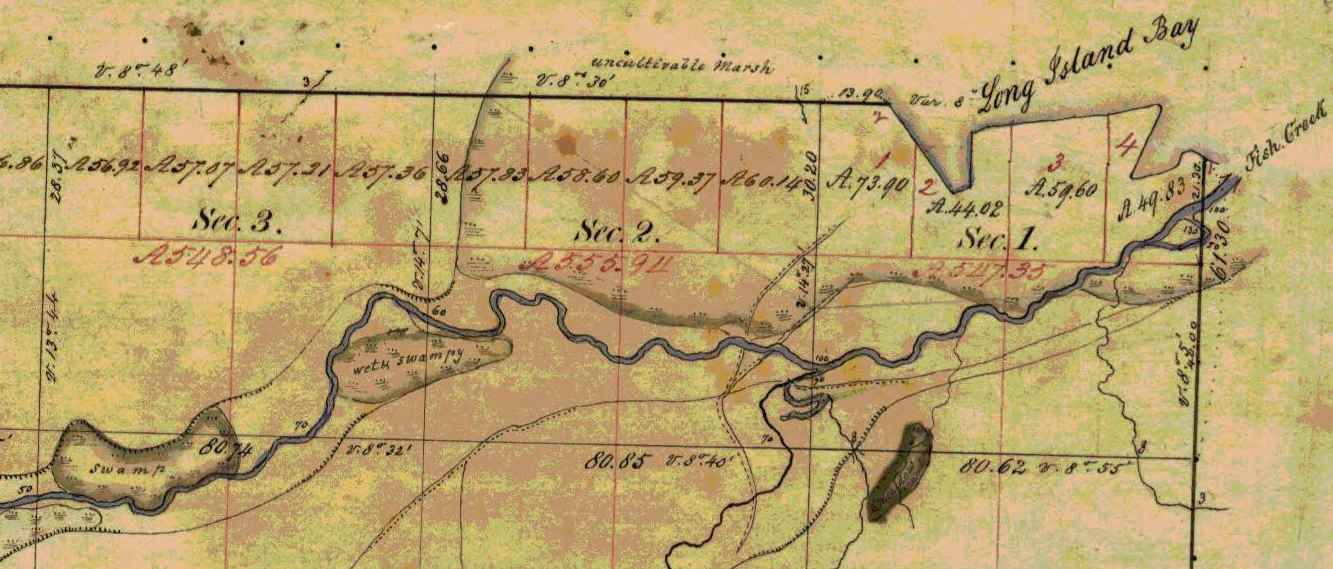
Several trails converged at the mouth of Fish Creek on Chequamegon Bay. ~ Wisconsin Public Land Survey Records
Trails
In traveling by trail most Indians traveled on foot, but many used dog-teams and toboggans, and in some cases, ponies. The Lake Superior region was a permanent camping ground for the Chippewa. This country for many miles around, and numerous trails branching off in all directions, far too many for us to mention each individually. Here we shall point out only the more important ones.
Talking Trail
“Talking Trail”, was so named on account of its beginning at a popular meeting or camping site situated where the city of Washburn now stands. “Talking Trail” began at this camping ground, thence it extended south, to Fish Creek, then south-west for a few miles, finally west to Superior, thus connecting Chequamegon Bay and Superior.
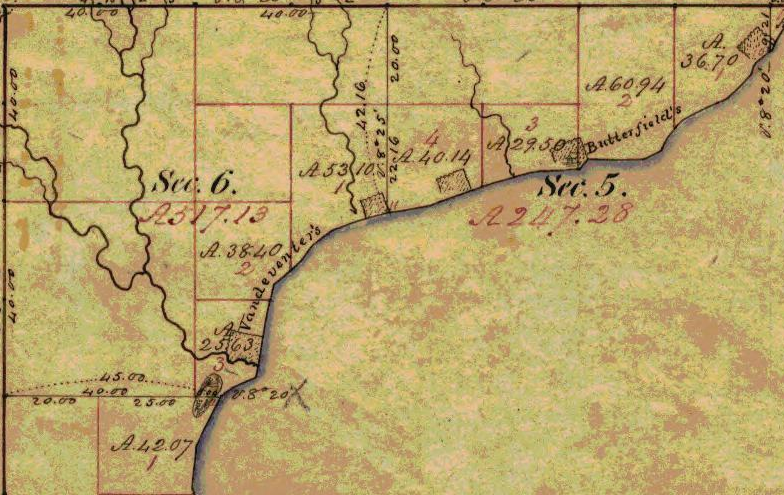
The “Talking Trail” began at the mouth of Vanderventer Creek near Washburn, and was also known as the “Council Trail.”
~ Wisconsin Public Land Survey Records
Bad River Trail
Whether or not this old trail was specifically known as designated above, the title is quite appropriate, since it began at the Leihy Mill on Bad River, Odanah, ran south to Tyler’s Forks, thence to Lake Namakagon and on to Lac Court Oreilles Reservation.
Indian War Trail
The reason for this name is evident: This trail was much used by the Chippewa in time of strife with the Sioux. The War Trail ran east to Montreal River and on to Porcupine Mountains, then to Ontonagon, thence to the copper country, including L’Anse and Marquette, Michigan. Mrs. Frank La Fernier of the Bad River Reservation, (1937) whose father, Mr. James lived to the age of one hundred-three years, corroborated this statement. Mr. James carried United States mail over this trail from our section of the country.
Moccasin Mike Trail

Chief Joseph Ozaagii was a cosigner of the 1854 Treaty at La Pointe on behalf of the Fond Du Lac Band.
~ Geni.com
“Moccasin Mike Trail”, was only another name for the “Osaugee1 Trail”. It was one of the most historic trails, and was evidently named after the local chief, Osaugee, who was the father-in-law of Charles Lord, a latter resident of Solon Springs, but originally a pioneer Quebec trader and voyageur.
This famous trail extended from the south of the St. Louis River, down Wisconsin Pointe, thence along the southern shore of Lake Superior to La Pointe, Bayfield, Ashland, Ontonagon, and the “Copper Country” of Michigan.
A branch of this trail led south, along the Montreal River to central Wisconsin, and was the route of the fur trader from Lake Superior to Green Bay. In the late 50’s and early 60’s, this trail was the land route East and South, and was much used by the early missionaries, traders and pioneer settlers. It became the regular mail route between all “south shore” points. Owen Sheridan and R.S. Mclean were two of the early mail carriers on this trail, packing on foot during the summer and fall, and travelling by dog team in winter.

“Osawgee Beach” postcard, circa 1920.
~ Zenith City Online
When Superior was started in 1853, a new branch of this trail began at the Nemadji River crossing and followed the mainland east, practically along the present high-ways 10 and 2, through what is now Alloues and Itasca, then east over the route of the present drive to an intersection with the main trail near Dutchman’s Creek. The early settlers remember it well. The density of the woods through which it passed kept the trail free from drifting snows and cutting winter winds. Snow shoes, toboggans, and dog teams were a powerful aid to travelers over this early trail.

Detail of Michael S. Bright Sr.‘s trading post on Saint Louis Bay near Oneota (West Duluth).
~ General Land Office Records
With the march of civilization, the settler, and the coming of regularly laid out roads, this intensely historic trail became practically eliminated. In the early 90’s, the Board of Douglas County in conjunction with the city of Superior saw the need of an all-year-round road to Lake Superior and Wisconsin Point. The project was sponsored by Michael S. Bright, now of Duluth, then a member of the County Board from the second ward of Superior. As the Supervisor of the Ward was always dubbed some Indian name, Mr. Bright fell heir to the sobriquet of “Moccasin Mike”. Because the rejuvenated road followed the old Osaugee Trail, and Mr. Bright had been very active in its building, the County Board officially designated the new road: “The Moccasin Mike Trail”.
1 Chief Osaugee was one of the signers of the important Treaty with the Chippewa in 1854. In Vol 2 “Treaties”, compiled by Chas. J. Kappler, the chief’s name is spelled: O sau’gee. The Chippewa spelling is: Osagi, the a being pronounced like a in ah, and the i like e in he.
TRAILS BECOME HIGHWAYS
“… the navigable waters leading into the Mississippi and St. Lawrence, and the carrying places between the same, shall be common highways and forever free …”
Many of the old Indian trails, especially those bordering on the southern shores of Lake Superior, have become permanent highways, and a number of these took their rise in our own village of Odanah. One of these led to Lac du Flambeau, and is now our present U.S. No. 2.
Over-Ridge Trail
This one-time Indian trail ran through Hurley, Wisconsin, Ironwood, Bessemer, Wakefield, and beyond Marinesco, Michigan, where it turned south to Lac du Flambeau. The Indians called the trail: “Ka-ke-way-wa-jwie-no-con”, meaning – “Over Ridge Trail”. At the turning point, it was necessary to cross a small river called “Ka-ba-no-ti-go-ge-wung” or “Presque Isle River”.
White River Trail
Another old Indian trail, leading West out of Odanah followed the [????] of our present U.S. No. 2; after crossing the Chicago and North Western railroad just a few feet west of the steel Railroad Bridge at the west entrance of the village, this trail entered the outskirts of Ashland where it turned directly towards Lake Superior. From thence it followed what is now Front Street in Ashland, turning south at the present site of the Knight Hotel. Following Ellis Avenue, it later crossed “Wa-bi-si-bi,” or White River. Mr. Scott, one of our historical staff says, “At that time there was a solid jam of flood wood at that point. Elm trees blew down on top of the jam, making it sufficiently solid for all kinds of Indian traffic.”

Detail of trails in Ashland east to Odanah and south to the White River. ~ Wisconsin Public Land Survey Records
This Indian Trail ran through Fifield, Wisconsin then straight east to Lac du Flambeau, from thence to Wausau, which was one of the trading posts of the early days. It is now our present U.S. Highway, No. 13.
N.B. An old wagon road known as the St. Paul Road was once a trail when the United States mail was carried on foot. In later years a wagon road was constructed by the War Department for military purposes.
See article following on “Military or St. Paul Road,” By W.P. Bigboy.
Reel 1, Envelope 2, Item 2
MILITARY, OR ST. PAUL, ROAD
By W.P. Bigboy
The road referred to in the “Recollections of Joseph Bell,” was the old military, or St. Paul, road, built by the government during the Civil War.
It followed the trail blazed out in earlier years by “Old Michel Buskey,” later identified as a keeper of a stopping place along this route. These hostelries could be found along the entire route and were for the accommodation and convenience of the early mail packers and travelers, who in the pursuit of their regular missions found the water ways or routes an impediment in the early and proper discharge of their assigned duties. Their locations were spaced by about twenty miles, and in most cases homesteads located near lakes were designated as such. Here mail carriers and other weary travelers, becoming too fatigued to continue farther, could pause and rest, and then continue on their way.
Leaving Bayfield, the first stopping place was at Moose Lake and the second at Loon Lake. These two places were located between Iron River and Bayfield, somewhere in the “Barrens.” The third stop was at Spider Lake. Here lived “Old Michel Buskey,” original trail blazer. His sunny disposition led to the designation of his cheery home as one of the stopping places; and for many years, not only the mail carriers, but many other weary travelers enjoyed the hospitality rendered by this family.
Leaving this place the next stopping place was at Island Lake, near Barnes of today. The next or fifth stop was at Gordon considered the crossroad of the country. Here the traveler usually made an over-night-stop, and enjoyed the hospitality of the village founder, Antoine Gordon.
From Gordon the road continued in a southwesterly direction until it reach near where the Namakagon empties into the St. Croix River. Here John Morrison, the grandfather of the Odanah Morrison, maintained a small hostelry for the accommodation of the traveling public for years. From there the road continued on to Yellow Lake, where another stopping place was located, then the road continued on to St. Croix Falls, where the traffic was ferried across the St. Croix, thence continuing on to St. Paul.
The road was not turnpiked as are the roads of today, but deep gullies and ravines were bridged with stout timbers and lumber, strong enough to bear the heavier armament of the United States Army in the event it became necessary to use the road for the transportation of army equipment.
Reel 1, Envelope 12, Item 3.
EARLY EXPERIENCE
Statement of Joseph Bell, [90?] yrs.
Interviewed by Dan Morrison.
I am in no position to give you much of a story that anyone would care to read, as I am not educated. During my childhood days we did not have the opportunity of going to school that the children now have, and all that I know is what I picked up myself. I have a few things in mind, however, that may be of interest to the present and succeeding generations, pertaining to some old people who were brought up at La Pointe on Madeline Island.

Portrait of Antoine Gordon from Noble Lives of a Noble Race by St. Mary’s Industrial School (Odanah), page 207.
I will tell you about William Gordon’s father raised on Madeline Island, who belongs ot the Lake Superior Band of Chippewa Indians. In the very early days when the United States Government caused roads to be built for the purpose of opening up the country, one of the first roads to be constructed ran from Bayfield to Eau Claire Lakes. This road opened up a vast section of the country, and when new roads were built in those times, people, as a rule, followed in quest for new locations and homes. William Gordon’s [illegible] father did just this. He followed the road from the starting point at Bayfield, running south for some distance, thence west to what they call Moose Lake. This was known as the first station and stopping place. The second station or stopping place was Moon Lake. The third station was at Spider Lake, known now as Silver Lake. The fourth place was Gordon’s, where William Gordon’s father settled. The present town of Gordon represents the first settlement of William Gordon’s father. The fifth stopping place was Yellow River; the sixth, Grantsburg and the seventh, was St. Croix Falls. This was the last stopping place as far as I remember.

The 1820 Cass-Schoolcraft expedition mapped the “Great Trail to the Folle Avoines Country” beginning at the mouth of the Sioux River.
~ Narrative journal of travels from Detroit northwest through the great chain of American lakes to the sources of the Mississippi River in the year 1820, by Henry Rowe Schoolcraft, page 105.
As I said before, these roads opened up a beautiful section of the country, full of wild game, plenty of fur-bearing animals, with many lakes and rivers where fishing was at its best. one could easily make a good living by hunting and trapping, and there was always plenty to eat. Many of the Indians who lived at La Pointe on Madeline Island left the island, following the direction of the newly constructed road. Though they were members of the La Pointe Band of the Lake Superior Chippewa, many remained in the new settlements, and the Indians remaining along the St. Croix River and other adjacent places finally lost their identity on the La Pointe Band and were later known as the “Lost Tribe.”
My great grandfather told me that the Chippewa lived on the south side of Lake St. Croix and the Sioux Indians lived on the north side, both claiming ownership of the St. Croix River. The question of full right of the St. Croix River kindled a feeling of animosity between the two tribes, and failing to arrive at any suitable agreement, war was declared between them, the aim of which was to settle the ownership of the river once and for all. In these encounters the Chippewa conquered the Sioux, driving them out of the country entirely. In their retreat, the Sioux followed a westerly direction, finally stopping where the city of St. Paul stands today.
 Chequamegon History